Introduction
During the past few decades cultural and social gerontology have become more diversified as researchers have begun to recognise the richness and complexities of the ageing process. In particular, gerontologists have expanded their research beyond demographic and biomedical issues to consider the social representations and imaginaries of older age and ageing (Hepworth, Reference Hepworth2000; North and Fiske, Reference North and Fiske2012) that not only reflect but, more importantly, reinforce and even create experiences of social inclusion and exclusion for individuals who are constructed as old.
One of the key social tensions individuals face – and must resolve – in negotiating their ageing identities is the roles they assume in the whole process of ageing: are they passive or active? It is our contention that although existing social discourses of active ageing can be synthetised as a passive–active dichotomy, individuals’ life projects are too complex and pluralistic to be dichotomised in this way. Instead, we expect individuals to rearticulate this social tension in the transition from mid-life to later life, accepting some versions of active ageing, rejecting others and also challenging existing propositions.
Despite critiques of the active ageing paradigm – discussed below – we use the concept here as it represents the centrality of the roles adopted by individuals in personal projects, in the family and in communities. These roles arise when older people's lives interact with structures of opportunity, e.g. organisations, activities and networks. The guiding principle for this study is that ‘active ageing’ should be understood as the interaction between older people's agency and the social structures within which their agency is embedded. On the one hand, the agency of ‘active ageing’ is concerned with how older people try to take control not only of their bodies but also the resources on which the quality of their lives depends. On the other hand, agency is embedded in the cultural and institutional settings of society so that the extent to which individuals can exercise active agency in the ageing process is influenced by government policies, cultural values, families and communities. By shifting away from the medical criteria that have dominated the idea of ‘successful ageing’, ‘active ageing’ opens avenues to broaden understandings of the active roles taken by older people (Foster and Walker, Reference Foster and Walker2014).
After critically reviewing existing studies, we argue that rather than simply asking ‘Are older people passive or active in ageing?’, it is more useful to ask how multiple understandings of active ageing are introduced and disseminated in public discourses, and how re-articulating the meaning of active ageing influences the short- and long-term plans and strategies in later life. Essentially, we envisage ‘active ageing’ as a process of exploring and implementing strategies to make the best use of resources available to ageing individuals and to fend off potential risks. But the challenges of satisfying demands from different stakeholders within multiple social domains in developing and following these strategies give rise to tensions that are represented in social imaginaries constructed in these social domains. We describe and analyse how these imaginaries affect individuals’ understandings of, and strategies for coping with, the challenges of the ageing process in contemporary Chilean society.
We begin by exploring the concept of ‘active ageing’, its theoretical and policy implications, as well as lay perceptions. We then explain how social imaginaries are helpful in understanding the co-existence of multiple and sometimes contradicting perspectives of ageing, and we offer an insight into social imaginaries of ageing in contemporary Chile. Our empirical investigation employed a novel research design. In the initial stage we constructed social imaginaries of ageing within parliamentary debates, newspaper articles and transcriptions of focus groups with individuals over 60 years old. The analysis of these imaginaries led to the identification of a series of tensions in the ways ageing is portrayed in the politics, mass media and older people social domains. One tension was found to be particularly related to active and passive social roles in ageing. In the second stage of the study this tension was portrayed in a series of images used as stimuli in qualitative interviews conducted in Santiago with 32 participants aged 40–90. These interviews allowed us to explore how individuals challenged discursive dichotomies present in social imaginaries by navigating constraints stemming from gender and socio-economic inequalities, to develop their own models of active ageing.
Active ageing and social imaginaries of later life
The dichotomy of active–passive ageing is rooted, at least in part, in the historical association between active and successful ageing. Borne from the broad activity perspective, ‘successful ageing’ and ‘active ageing’ seek to ‘enable the participation of older adults in society’ (Foster and Walker, Reference Foster and Walker2014: 2) and propose that older people can actively improve their quality of life. Although they are different concepts, ‘successful ageing’ often encompasses active lifestyles, and the achievement of expected activities can be regarded as success. However, ‘successful ageing’ refers to the maintenance of patterns of physical, cognitive and psychological functioning in later life equivalent to those in middle age, whereas ‘active ageing’ challenges the association of older age with passivity through engagement in a wide range of activities (Walker, Reference Walker2015). Since ‘successful’ ageing and ‘active’ ageing have been used largely as interchangeable terms (Foster and Walker, Reference Foster and Walker2013), research has tended to focus on participation in physically healthy activities rather than in social, cultural, civic and economic activities (Annear et al., Reference Annear, Keeling, Wilkinson, Cushman, Gidlow and Hopkins2014). The notion of ‘successful ageing’ has evolved through two independent branches from the seminal work of Robert J. Havighurst, centred on older people's perspectives, and Sidney Katz, focused on expert measurements, until they slowly converged (Kusumastuti et al., Reference Kusumastuti, Derks, Tellier, Di Nucci, Lund, Mortensen and Westendorp2016). Interest in older people's own perspectives on styles of life and daily activities overlaps with ‘active ageing’, which may have contributed to the interchangeable use of the two terms. The interconnectedness of social roles and health is supported by older individuals’ acknowledgement of the centrality of social participation for active ageing, while ‘issues of physical, mental, social and financial health intertwine to determine their engagement in life’ (Buys and Miller, Reference Buys and Miller2006).
The concepts of active and successful ageing share common critiques. Both have been questioned for endorsing government agendas that seek to reduce public expenditure (Bowling and Gabriel, Reference Bowling and Gabriel2004), over-emphasising individual responsibility in achieving active and successful ageing (van Dyk, Reference van Dyk2014), perpetuating the values of youth-based culture (Grenier, Reference Grenier2012), restricting the meaning of activity and success in later life (Bowling and Iliffe, Reference Bowling and Iliffe2006; Boudiny, Reference Boudiny2013), ignoring limitations to physical and financial health (Gilleard and Higgs, Reference Gilleard and Higgs2002), and maintaining narrow definitions of activity and success (Boudiny and Mortelmans, Reference Boudiny and Mortelmans2011). Critics also argue that stability and change in physical, emotional and social functioning are situated in a continuous rather than a binary proposition (Kok et al., Reference Kok, Aartsen, Deeg and Huisman2017), and that engagement with life and dependency are not mutually exclusive (Boudiny, Reference Boudiny2013). Successful and active ageing therefore engage two distinctive but interconnected levels of activity. We argue for a third understanding of active ageing that advocates for broader engagement with life, comprised of different combinations of mid- and later-life goals.
The notion of active ageing is deceivingly simple. What constitutes ageing as a living process is a highly complex issue. The entry point of ageing is often blurred (van Dyk, Reference van Dyk2014) and the ageing process always involves multiple and sometimes conflicting meanings (Gilleard and Higgs, Reference Gilleard and Higgs2013). Furthermore, when considering participation in activities, some facilitators and barriers to active ageing seem to remain constant (Annear et al., Reference Annear, Keeling, Wilkinson, Cushman, Gidlow and Hopkins2014). Facilitators include living in urban areas, proximity to services, positive perceptions of local environments, attachment and security in home and neighbourhood, proximity to social networks and good relationships with neighbours. Barriers to active ageing include fear of violence in the local environment, social disconnection, unfamiliar environments, and air and noise pollution (Annear et al., Reference Annear, Keeling, Wilkinson, Cushman, Gidlow and Hopkins2014).
Of particular concern for social gerontologists is the variation in meanings of active ageing across social groups based on ethnicity, urban/rural residence, social class and gender. For example, Bowling (Reference Bowling2009) found that lay definitions of active ageing differed among ethnically diverse and ethnically homogenous older populations in Britain. The latter emphasised exercising the body to retain health as the most common definition of active ageing, whilst the former were more likely to define active ageing in terms of psychological resources and attitudes. However, neither group defined active ageing in terms of economic productivity. A qualitative study (Closs et al., Reference Closs, Allen, Alvarado, Zunzunegui, Simeon and Eldemire-Shearer2010) of perceptions of active ageing among older participants in six Caribbean countries showed that social participation and employment were understood as different types of activity, largely mediated by the financial situation of individuals and whether they lived in urban or rural settings. Those living in urban settings had greater access to organised activities for older people, but that access was mediated by income. Wealthier individuals were better informed about available activities and had time and resources to spend on engaging in such activities. In contrast, financially poorer older people experienced both financial and time constraints since they needed to engage in income-generating activities as well as domestic chores. They did, however, engage in unspecified informal activities. In the European context, gender inequalities linked to income-generating opportunities including pay gaps, female unpaid domestic work and care responsibilities have extended into later life, creating unequal conditions for engaging in activities contemplated in existing policy frameworks (Foster and Walker, Reference Foster and Walker2013).
While Bowling (Reference Bowling2009) has stressed the importance of lay definitions of active ageing in ensuring that policies to promote active ageing are effective in practice, van Dyk et al. (Reference van Dyk, Lessenich, Denninger and Richter2013) have argued that most policies grounded in the concept of active ageing have a weak empirical evidence base. They connected public discourses of active ageing in German newspapers to storylines on active ageing produced by 55 interviewees aged 60–72, and found that ‘ageing well’ had a broad set of meanings to older people. These were rarely associated with the notion of productivity as evidence of active ageing. Instead, ageing well was associated with a general ‘vitalist’ and ‘ageless’ conception of human activity, and with the ‘continued participation in social life and the effective prevention of dependency’ (van Dyk et al., Reference van Dyk, Lessenich, Denninger and Richter2013). A broader understanding of active ageing has also been advocated by Boudiny and Mortelmans (Reference Boudiny and Mortelmans2011: 12) who argue that ‘active ageing should represent a dynamic, life course-driven concept that taps into people's perceptions and enables them to create their own forms of activity instead of focusing on a predetermined, limited number of domains’ such as sports, care, paid labour, voluntary work and active outdoor recreation. Limiting the definition of active ageing to a narrow scope of activities disregards the diversity of choices among the ageing population, especially those who, instead of engaging with traditional indicators of active ageing, prefer home-based and family-related leisure as well as everyday activities in which they maintain continuing interest. Furthermore, the narrow use of traditional indicators of active ageing risks inducing a sense of failure within individuals who do not comply with such tenets, which in turn can result in decreased social participation.
Limited evidence of lay understandings of active ageing calls for broader and more inclusive conceptualisations that circumvent binary approaches to activity in later life. But we must apply caution in drawing clear distinctions between the values of mid- and later life. van Dyk (Reference van Dyk2014) warns that emphasising essential differences between life phases homogenises older age and rules out the possibility that those in mid-life and later life may have overlapping priorities. As images of ageing change over time (Pintos, Reference Pintos2005b), discourses and experiences of later life of different time periods constantly emerge as being at odds with each other (Grenier, Reference Grenier2012). Different institutions and organisations with various agendas and motivations also contribute to the creation and popularisation of different images of ageing (Baars and Phillipson, Reference Baars, Phillipson, Baars, Dohmen, Grenier and Phillipson2013). Lassen and Moreira (Reference Lassen and Moreira2014) showed that conceptions of active ageing that focus on the body and lifestyle, as well as those that focus on social roles and productivity, stem from policy frameworks developed by the World Health Organization and governments. They argue that these frames of reference have led to dichotomised views of active and passive ageing that are at odds with more holistic and integrated perspectives that value diverse ways of ageing.
Social imaginaries
Originally developed by Jacques Lacan as a psychoanalytical concept in the 1940s (Jameson, Reference Jameson1977), the notion of imaginary was later adopted by the social sciences in the form of social imaginary to explain the delimitation of the social boundaries of sense, or how far specific meanings will stretch within social groupings (Castoriadis, Reference Castoriadis1975; Anderson, Reference Anderson1991). Following this general conceptualisation, Charles Taylor developed understanding of ‘social imaginary’ as ‘the ways people imagine their social existence, how they fit together with others, how things go on between them and their fellows, the expectations that are normally met, and the deeper normative notions and images that underlie these expectations’ (Taylor, Reference Taylor2004: 23). But social imaginaries are not simply normative; they are ‘both factual and normative’ because people's understandings of ‘how things usually go’ are intertwined with ‘how things ought to go’ (Taylor, Reference Taylor2004: 24) within a specific human community. Discourse and practice are intrinsically connected in social imaginaries.
Taylor (Reference Taylor2002) suggests that an imaginary is similar to a script that is polished and rewritten over and over again. Consequently, it becomes more refined and established as a general background for action. The process of refining and re-defining social imaginaries involves multiple contentions between diverse perspectives in society (Pintos, Reference Pintos2001). This is why we should speak not about the social imaginary, but about social imaginaries, because any frames of reference must be diverse. Social imaginaries facilitate the display of multiple perspectives in social domains which can be synthetised and compared with social imaginaries in other social domains. In the study reported here, we identify tensions between political, mass media and older people's domains, before re-introducing them into public discourse and observing patterns of continuity and change in active ageing.
Social imaginaries of ageing in Chile
Within the Organisation for Economic Co-operation and Development, Chile has a young population. The estimated median age in 2014 was 33.3, with 9.7 per cent of the population aged 65+ (Central Intelligence Agency, 2014). Nonetheless, Chile's pace of ageing is accelerating. The demographic projections estimate that the population over 60 will grow from 15 per cent to 28.2 per cent between 2010 and 2050 (Boreal and SENAMA, 2011), while those over 65 will constitute 21.6 per cent of the population and the oldest group (over 80), 6.9 per cent (Instituto Nacional de Estadísticas, 2014).
There is pessimism about the ability of Chilean society to adapt to these ongoing changes (Abusleme et al., Reference Abusleme, Arnold Cathalifaud, González, Guajardo, Lagos, Massad, Sir, Thumala Dockendorff, Urquiza and ómez2014), and concern that the population, particularly those of lower socio-economic status (SES), is ill prepared. Representations of ageing are laden with descriptions and prescriptions perpetuated by all age groups (North and Fiske, Reference North and Fiske2013). For example, studies conducted on imaginaries of ageing in school textbooks have found persistently stereotyped language (Jorquera, Reference Jorquera2010), and studies on stereotypes of older age saw older people as infantilised and described as dependent, sickly, frail, sexually inactive, conservative, unvalued, marginalised, passive, untrusting and intolerant (Comité Nacional Para el Adulto Mayor, 2002; Urquiza Gómez et al., Reference Urquiza, ómez, Arnold Cathalifaud, Thumala Dockendorff and Ojeda Mayorga2008). These negative stereotypes of ageing seem to have led older people to adjust their attitudes and behaviours to social conventions (Urquiza Gómez et al., Reference Urquiza, ómez, Arnold Cathalifaud, Thumala Dockendorff and Ojeda Mayorga2008) as hegemonic discourses associating ageing with illness, internalised by individuals, easily produce self-images of dependency, and minor corporeal limitations produce feelings of ambivalence towards life, social detachment and reduced vitality (Abusleme et al., Reference Abusleme, Arnold Cathalifaud, González, Guajardo, Lagos, Massad, Sir, Thumala Dockendorff, Urquiza and ómez2014).
Although the meanings attributed to everyday life, lifestyles, habits and social integration become increasingly relevant for older people as they become more disabled (Osorio Parraguez et al., Reference Osorio Parraguez, Torrejón, Meersohn and Anigstein2011), the idea of active ageing seems unattainable for most older individuals. Torrejón (Reference Torrejón2007) found that social imaginaries of ageing in Chilean newspapers showed that activity among older people was frequently associated with leisure or with exotic and exceptional performance (e.g. rock musicians touring in their sixties and seventies), unrelated to older people's daily lives. The study also unveiled some exceptional circumstances where vitality and vigour were over-emphasised (e.g. older people sky diving). Daily experiences described in newspapers and school textbooks (Torrejón, Reference Torrejón2007; Jorquera, Reference Jorquera2010) have been largely restricted to roles as grandparents, guardians of traditions, social norms, experience and knowledge to be passed on to younger generations, and advisers at critical moments. By contrast, older people have rarely been represented in positions of power and influence, with political roles limited to participation in surveys or passive receipt of social policies, with rare exceptions in higher management as politicians or members of elders’ councils (Torrejón, Reference Torrejón2007; Jorquera, Reference Jorquera2010). The proliferation of imaginaries of ageing that associate active participation with extraordinary individuals or to leisure contexts is detrimental to generating images of active citizenship and societal engagement in later life (Osorio Parraguez et al., Reference Osorio Parraguez, Torrejón, Meersohn and Anigstein2010).
While social imaginaries present themselves as complete accounts of the truth about ageing, social imaginaries emerging from different social domains may present diverging accounts of ageing. Ultimately, individuals create their own identities and styles of growing older influenced by the social imaginaries to which they have been exposed, as well as by drawing on personal experiences and available resources. In the following sections we present an empirical exploration of social imaginaries of ageing in Chile, and discuss how imaginaries of active ageing are re-articulated in individuals’ attempts to control their own processes of ageing.
Data and methods
Despite growing interest among social researchers in conceptualising social imaginaries, methodological development for their study has been slow. Shotter (Reference Shotter1997, Reference Shotter2011) has argued that such methods require an orientation towards the interaction between practices and discourses but does not indicate how such reorientation could be accomplished. Juan-Luis Pintos provides the most complete methodological proposal for the construction of social imaginaries. His strategy assumes that the analysis of social imaginaries is an active process of constructing perspectives ‘connected to power, to knowledge and to pretension of dominating the field … foremost a struggle for the pre-eminence of the imaginaries that reunify all realities in one’ (Pintos, Reference Pintos2005a: 65). In this study we focused on social imaginaries representing the contentions between political, mass media and older people's domains, and used them in interviews to elicit narratives of acceptance and resistance in the face of disrupted states of equilibrium (Feldman et al., Reference Feldman, Skoldberg, Brown and Horner2004) associated with experiences of ageing.
Data collection
We collected data in two stages. To demonstrate how social imaginaries represent ageing in Chile, we analysed documents from three different social domains: (a) 196 articles from two national newspapers: La Tercera, with a moderate conservative editorial line, and El Mostrador, with a more liberal editorial line, from January 2011 to September 2012, representing the social domain of mass media; (b) transcriptions of 17 parliamentary debates on seven bills affecting older citizens during the period 2002–2012, representing the political domain; and (c) transcriptions of 15 focus groups with people 60 years old and above (Table 1) conducted in 2008 as a part of a study on ageing and quality of life in Santiago, ChileFootnote 1 (Bunout et al., Reference Bunout, Osorio, Barrera, Torrejón, Meersohn, Anigstein, Miranda, Espinoza, Hirsch and de la Maza2012; Osorio Parraguez et al., Reference Osorio Parraguez, Torrejón, Meersohn and Anigstein2013), representing the domain of older people.
Composition of focus groups across selected categories

Note: N = 15.
Analysis of these data identified a series of tensions in understanding and coping with the transition from mid- to later life. One core tension was activity versus passivity in ageing.
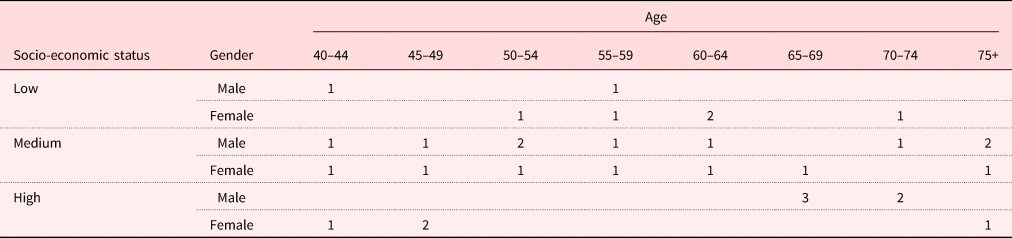
Drawing on the social imaginaries of ageing generated in this first stage of the study, we created a set of cartoon-style images (as an example, see Figure 1) portraying active and passive roles. These were used in interviews with 32 residents of Santiago aged 40–90 to elicit strategies for coping with this tension. In selecting the individuals to take part in interviews, we aimed to strike a balance in terms of gender, age and SES, as shown in Table 2. Purposive sampling was designed to achieve broad representation of the discursive spectrum given our aim to construct and understand imaginaries of ageing held by diverse groups. Such a sample is never meant to be representative in the statistical sense.
Example of cartoon style drawing. Translation: Hey Lucho, are you coming along later to the centre for older adults? Nahhh, what for? I don't know anyone. Besides, I'd rather stay home.

Distribution of interview participants across selected categories

Note: N = 32.
Images have the power to ‘invoke beyond-text sensations … meaningful in ways that are ineffable and invisible using conventional text-based methods’ (Prosser, Reference Prosser, Denzin and Lincoln2011: 488). The meaning of an image is shaped by previous knowledge of the logical organisation of space, the cultural signs and symbols, and the verbal imagery that surrounds it (Mitchell, Reference Mitchell1984). The power of these images in this study lay in the stories they suggested prompting engagement from participants, whilst keeping these scenarios open for interpretation. They acted as an invitation to fill in the blanks of what was not explicit in the images with participants’ own stories (Meersohn Schmidt, Reference Meersohn Schmidt2015). Analysis of participants’ reactions to the images enabled us to tease out their strategies for coping with competing or contradictory messages.
During the interviews, participants were asked to divide the images into two sets: one that represented their understandings and experiences of ageing in Chile and the other that did not. They were then asked to divide those images that represented their understandings of ageing into three sets: desirable, undesirable and neutral images of ageing. The neutral pile was discarded since it did not resonate, positively or negatively, with their experiences of ageing. Participants were asked to explain what they found desirable or undesirable in the images, and what strategies they could use to achieve the desirable and avoid the undesirable.
Participants moved, without prompting, from one image to the next, engaging with relatable characters and situations. They told two types of stories: public and ontological (Somers, Reference Somers1994), operationalising the discursive (general) and practical (personal) aspects of social imaginaries. In their public stories they spoke of roles and representations of ageing in an abstract way, referring to ageing in general, avoiding direct reference to themselves. In contrast, their ontological stories spoke of personal experiences, those that participants observed directly, and told in ways such as ‘I believe I will…’ or ‘my mother once…’. By comparing public and ontological stories and contrasting each with active–passive ageing, we identified convergent and divergent ongoing strategies developed by participants to cope with changes brought about by ageing.
Strategies and methods of data analysis
In the initial stage of analysing the documents in the political, mass media and older people's domains, we identified excerpts that were conceptually relevant to, and semantically consistent with, roles and representations of ageing. Following Pintos's (Reference Pintos2005b) guidelines for producing social imaginaries, we identified the specific linguistic corpus within each social domain in relation to roles and representations of ageing in Chilean society. Linguistic corpora carry meaning within, because each social domain speaks – and thus represents – ageing from a particular perspective. Selecting excerpts semantically related to each other, subsequent discursive analysis revealed how ageing in Chilean society was portrayed in each domain.
We constructed the language fields inductively using cluster analysis of the sampled documents. The clusters were constructed with paragraphs as the units of analysis. To avoid excluding relevant terms, we used second-order co-occurrence that grouped together words that never appeared in each other's vicinity, but whose ‘environments are similar’ (Grefenstette, Reference Grefenstette1994). When the analysis produced more than four word clusters, the least robust ones were discarded as they were likely to become linguistically isolated (Pintos, Reference Pintos2004, Reference Pintos2005b), and thus marginal to social imaginaries of ageing (Pintos, Reference Pintos2005b). We created visual representations of these semantic fields using word clouds to reconstruct the topics, concerns and sensibilities at play.
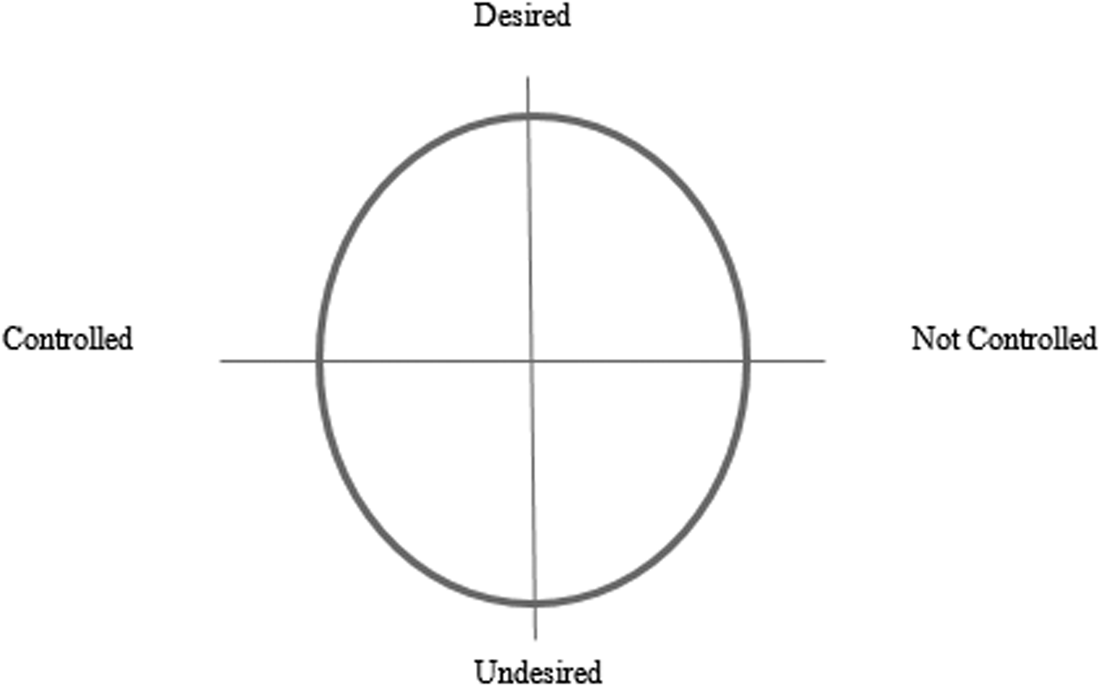
The next step was the development of a frame of observation that afforded comparisons between social domains (Pintos, Reference Pintos2005a) across the entire body of text. We used two dichotomies – control versus no control, and desirable versus undesirable – to capture the tensions represented in the textual data. These were mapped on to a dual-axis diagram of four internal perspectives within each social imaginary (Figure 2). These perspectives within a social imaginary reveal how different social domains define the characteristic features of their reality (Pintos, Reference Pintos2004). The axes refer to the valuations attributed by politicians in debates, by journalists and editors in the press, and by older participants in the focus groups.
Perspectives in social imaginaries of roles and representations.

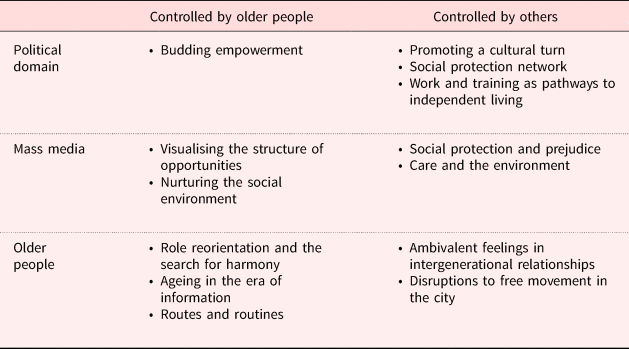
Once the frame was established, each perspective in each of the three social domains was inductively analysed to identify emerging themes (Table 3). The themes emerged via iterative reading and classification of text excerpts (Saldana, Reference Saldana2013). Once all social imaginaries in each of the three domains were constructed, we compared them to identify agreements and conflicts in their perspectives of roles and representations of ageing. The conflicts were then operationalised as tensions of ageing and used to construct images for visual elicitation interviews.
Main themes emerging from the analysis of social imaginaries

The interviews were analysed to distinguish public from ontological stories, and then to identify temporal dimensions (past, present and future) and resources in each type of story. Temporality provided a sense of the stability of these strategies over time indicating, for instance, whether participants imagined they would replicate current strategies in the future, and/or whether they planned to enact a strategy that had not yet been set in place. Resources, including people (e.g. friends, offspring, partners, etc.), organisations (e.g. care homes, clubs, municipalities, etc.), assets (house, income, benefits, etc.), and personal dispositions (e.g. drive, mastery, beliefs, etc.), enabled participants to reconstruct their strategies for resolving the tensions in their ageing process. Reconstructing the strategies by tracing in each story the one-to-one relationships between the resources and iterative repetition of this procedure, patterns of connections between resources and temporality emerged.
This coding procedure facilitated the subsequent situational analysis of public and ontological stories. Situational analysis (Clarke, Reference Clarke2005) allowed us to observe the outcomes of combining multiple sets of resources across different situations in which the tension of active versus passive ageing was present. These situations are analytical categories emerging from the analysis of the combination of resources. Typical combinations of resources were associated with specific contexts. The actions and meanings attributed to the resources in a particular context constitute a situation. For example, in ontological stories, participating in a committee was a central resource associated with having a profession and with the workplace, and the frequent association of these resources across narratives constituted a typical situation of organisation. Once a typical situation has been established, it can be described through the resources it holds and the strategies for their use in the specific context. Finally, each strategy was described within a temporal frame indicating its use in the past or present, and any expectation of its relevance in the future.
We now turn to social imaginaries in the political, mass media and older people social domains. We explain the understandings and perspectives of later life in each social domain, focusing on conflicting perspectives, and then show how the active versus passive ageing tension was re-articulated during visual elicitation interviews with individuals in mid- and later life.
Tensions of active ageing in three domains
Political domain
The political domain defined older people as a group in transition from passive to active social actors. Challenging prevailing views of passivity, this domain constructed an imaginary of active citizenship in later life to be steered by state policies. Despite the acknowledgement of human potential, the means of integrating older people into more active social roles remained largely unspecified. An exception was their participation in regional consulting committees of the National Service of Older Adults (SENAMA) and in other local organisations of older adults. As explained in the parliamentary debate:
It [modification of the structure of the National Service] ensures at least a third [members of the National Service Consulting Committee] are reserved for representatives of organisations of older adults pursuing social, cultural or leisure purposes, as well as organisations pursuing economic concessions (pensioners, retirees, widows’ pensions) at all levels, national, regional or local. (Act No. 19.828, 2002:134)
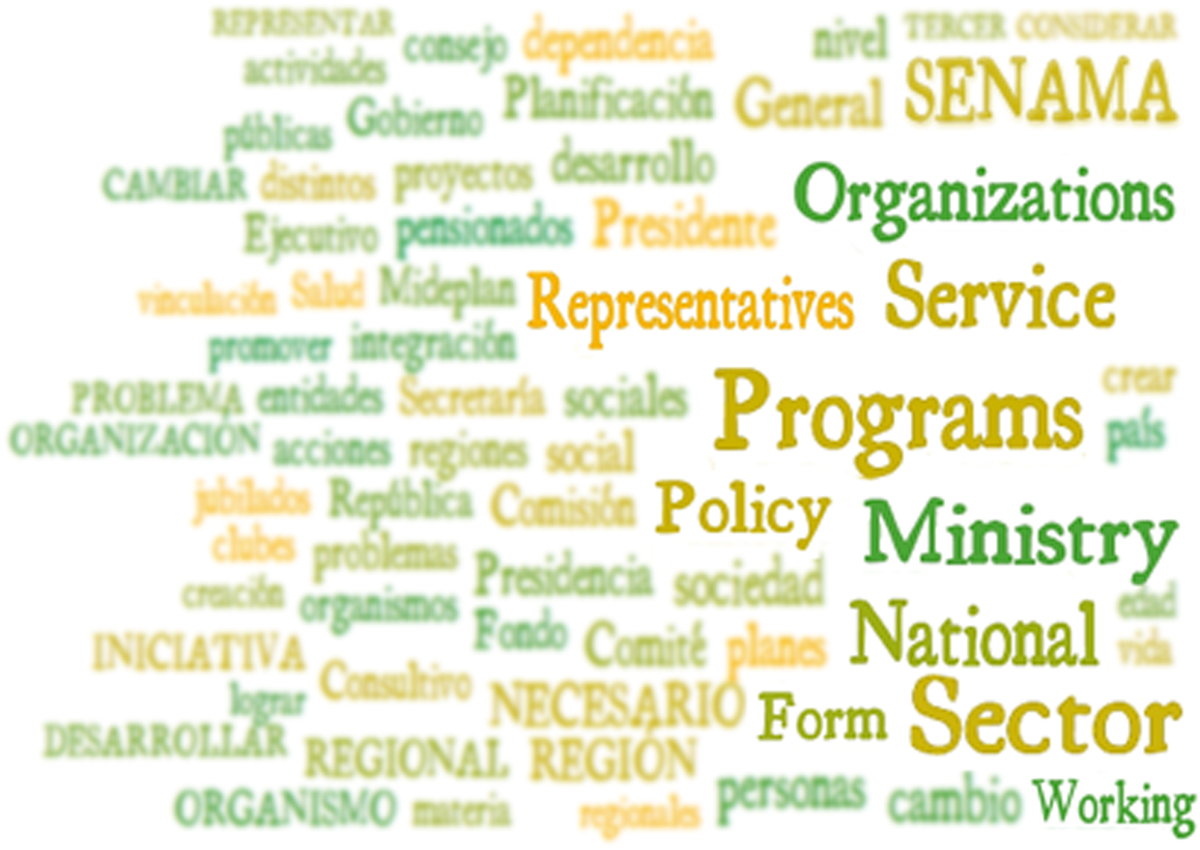
Parliamentary discourses stressed important economic, social and cultural roles to be fulfilled by older people. Since its inception in 2002, the National Service for Older Adults has shifted from being heavily centralised with very restricted participation of older stakeholders to a much broader participation of local organisations of older adults nationwide (Figure 3). This more inclusive structure, relying on regional consulting committees, aims to capture multiple voices, improving the potential to address local concerns. Changes in the structure of the National Service were made possible through the prior existence of local organisations, mostly at a municipal level. It is through these local organisations that central government expects to channel older adults’ views on policies that are proposed and implemented by local and central agencies. An example is the Central Union of Pensioners of Chile that campaigned to exempt pensioners from paying contributions towards health care. By doing so, older individuals assumed an active role in taking control over policies affecting their financial autonomy, and parliamentary debates evidenced the emergence of capacity-building potential that had previously been invisible in the political domain.
Social imaginaries of the political domain. The word cloud the reliance of the political domain on the National Service of Older Adults (SENAMA) to co-ordinate the nationwide policies and programmes aimed at older adults.

By connecting local and central organisations, the imaginaries of older people as potential contributors to forthcoming political projects challenge past imaginaries of ageing found in the press by Torrejón (Reference Torrejón2007), in which older people were seldom viewed in positions of power and more frequently portrayed as passive recipients of social policies. Opening up the channels of communication between political actors in government and older people's organisations provides older individuals with broader opportunities for participation where they can be active agents in shaping their social and physical environments, such as the allocation of public space for social organisations and recreational activities managed by older people themselves.
Evidence presented in Congress showed that the average health expenditure of the population over 65 was up to six times that of people in their thirties. This evidence raised questions about whether state health-care systems could be sustained without the contribution from the waged and retired populations. The political implications are complex. As the wealthier quintile of the population did not contribute to the public health-care system (SENAMA et al., 2010) because they have private health care, politicians had to face the problem of health expenditure by assessing the impact of losing revenue from any group of the lower four quintiles. In addition, the transition between 1980 and 1982 from a redistributive pension system to a private one managed by AFPs (Pension Fund Administrators) resulted in a dramatic drop in the value of pensions, making those near retirement age suffer the most as they could not recover from the losses caused by the volatility of financial markets.
While some politicians argued that benefits should only apply to the poorest quintiles of the older population, others argued that retirees should universally be exempt from contributing to the health-care system as they were no longer waged, independently of their income quintile. Universal access was regarded as an equalising measure challenging the discourse of older adults as intrinsically vulnerable, while selective access was defended by those believing that public expenditure should focus on the most deprived.
Mass media domain
The mass media was the only domain showing representations of both empowerment and disempowerment. La Tercera (conservative) drew more attention than El Mostrador (liberal) to cases of abandonment of, and crimes against, older people, while both newspapers presented articles constructing imaginaries of active political engagement. Despite the emergent nature of political organisations among older adults, they were considered by the media as strong campaigners in collective and individual demonstrations that voiced concerns about the rights of older people, and other social causes.
The idea – explains the parliamentarian – is for older adults themselves to be their peer inspectors, because they enjoy more free time, and who could be better than them to assess whether the people receiving care are getting the attention they deserve and need. (La Tercera, 5 December 2011)
Political news articles in both newspapers covered the potential contributions of older people to the successful implementation of specific policies. They referred to the dialogue between organisations of older adults and political representatives to express the concerns of the older population. In turn, politicians pledged to create national awareness of the needs and rights of older people. Media representations of collaboration between older people's organisations and government agencies to combat abuse of older people were emblematic in showing older people's empowerment. Older people were also portrayed as having roles in quality control of existing services for older adults (e.g. care homes), given their knowledge and understanding of older people's needs.
The imaginaries shown in Figure 4 contrast with roles identified by Torrejón (Reference Torrejón2007) in which older people were largely restricted to the consumption of leisure, and their social participation frequently limited to the family sphere, mostly related to grandparenting roles. They also show recognition of roles with political and citizenship dimensions that have been rare, with occasional exceptions such as depictions in school textbooks of older people as tribal leaders and elders’ councils (Jorquera, Reference Jorquera2010).
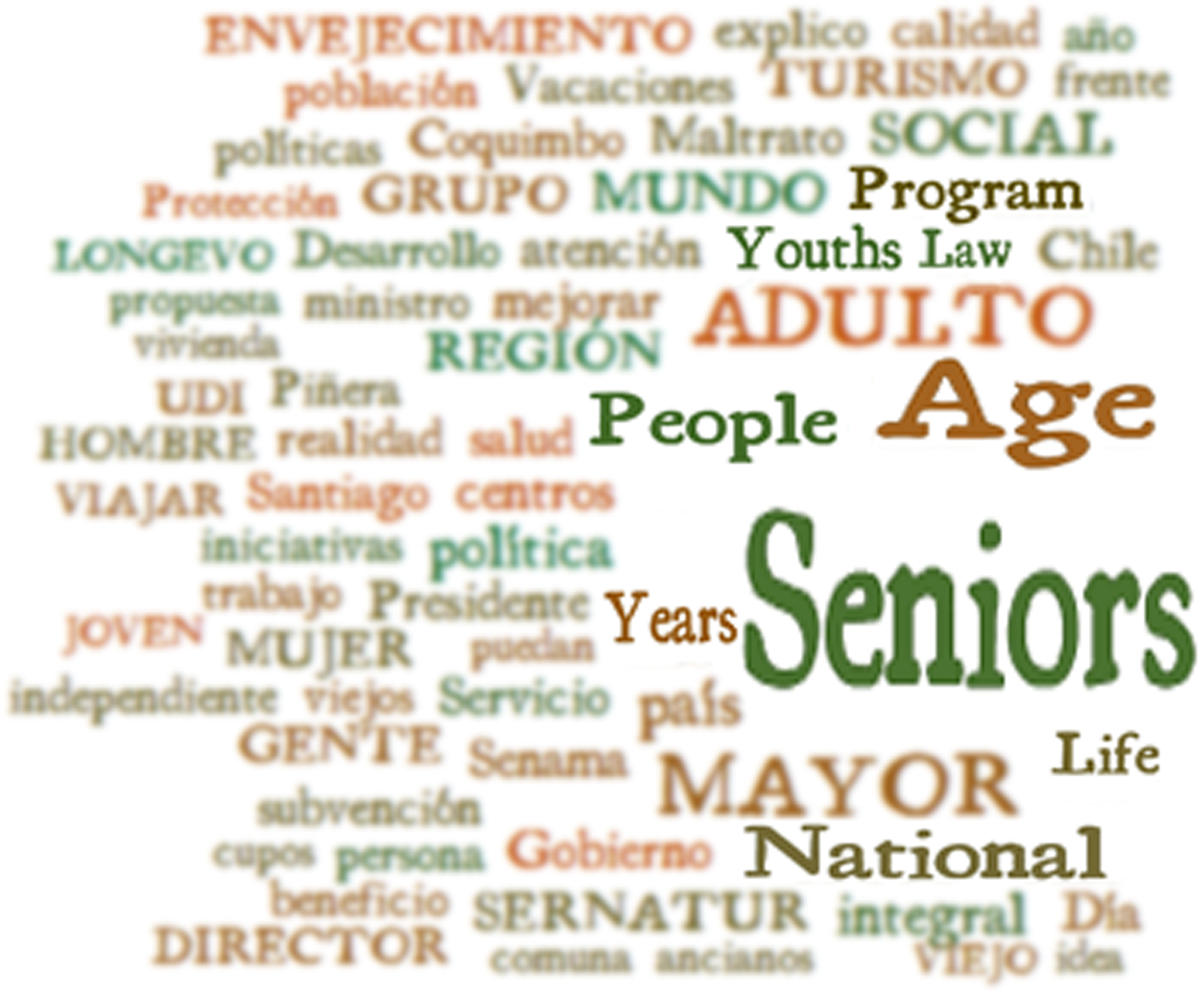
Social imaginaries of the mass media domain. The word cloud shows the concern of the mass media with programmes at a national scale that can improve older people's lives. Some of these programmes are related with tourism, others with improvement of health-care centres and others with the protection of older people against maltreatment. It also showcases the relationship between older people and youth, which can be collaborative or conflictive.

Older people domain
Older people presented very different social imaginaries of roles and representations of ageing. Although involvement in social activities was mentioned as an effective strategy of keeping isolation at bay, participants’ scope for social participation was limited largely to the family, assuming roles in guiding and nurturing the wellbeing of younger generations (Figure 5). They did, however, express some ambivalence about performing these roles. Furthermore, it was not clear whether when older people retreated from broader social activities was linked to lack of motivation, to lack of appropriate conditions or simply to informed personal choices. Clearly evident in older people's imaginaries were older women's perceptions of macho culture sometimes constraining them from participating fully in social activities.
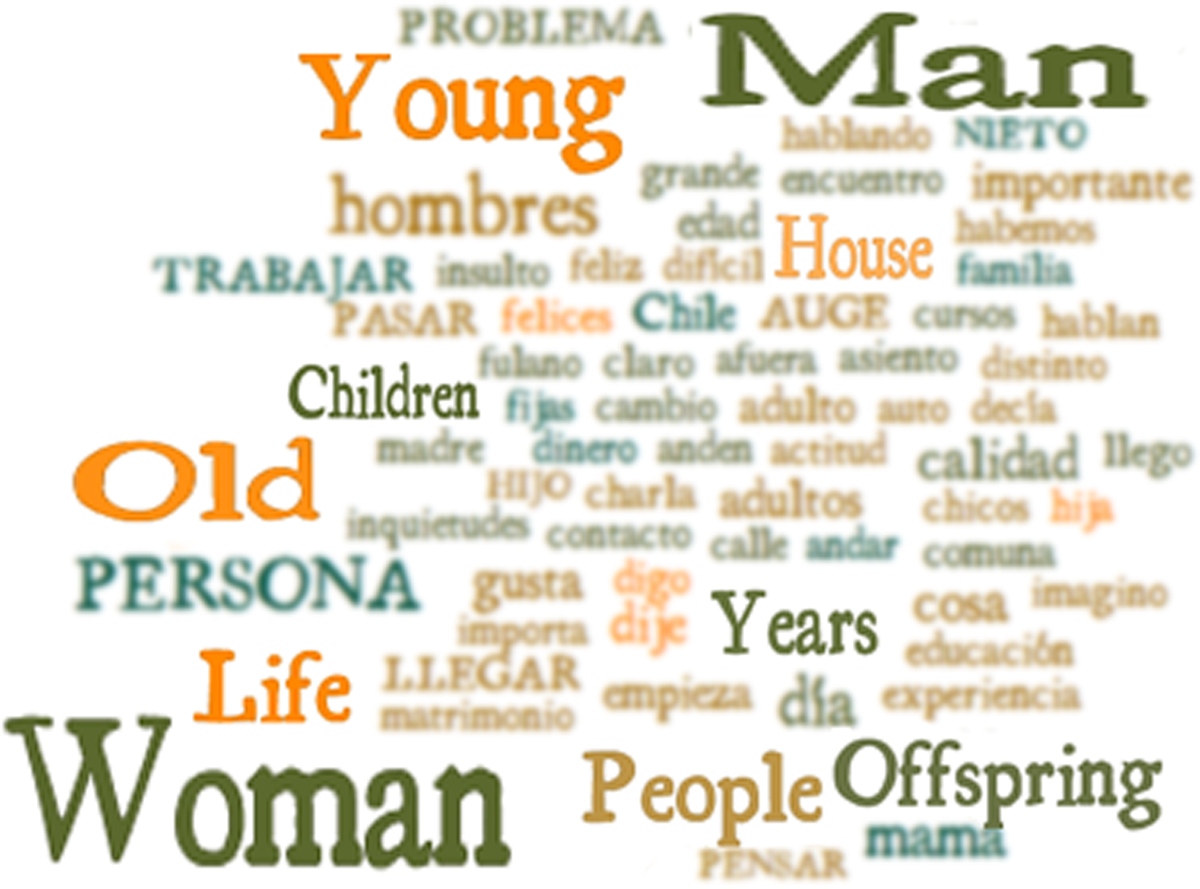
Social imaginaries of the older people domain. The word cloud reflects the centrality of gender in defining roles in later life. Intergenerational relationships are also highlighted, both in terms of family relationships, and by the prominence of old and young as defining the roles older people may or may not adopt in later life. Due to the variety of interests and preferences, words expressing specific motivations are not among the most frequent, but they are present nonetheless in the cloud (i.e. interests, working, liking, problem, happy, important). This word cloud diverges from the mass media and political domains in the absence of references to policies, but it does connect with the mass media in the centrality of intergenerational relationships.

Maintaining involvement in social activities was one of the main strategies adopted to cope with isolation and loneliness. While older men tended to associate loneliness with events in the past, older women tended to focus on strategies to cope with loneliness, such as keeping busy, making new acquaintances or resuming contact with old friends, and joining community centres or groups of older adults. Although men reported enjoying the benefits of friendship and companionship as much as women, they expressed more frequently than women their reluctance to socialise in organised groups, being uneasy with environments in which they assumed they would be outnumbered by women, and fearing ridicule when participating in activities they had not mastered. Men were nonetheless slowly venturing into some activities such as sports or workshops. Considering the causes of gender differences in attitudes to social participation, the focus group discussions revealed a reliance on essential definitions of gender identity, in which deeply embedded gender roles had been normalised. Men explained that women were endowed with skills for domestic chores and caring for children, and were thus more naturally suited for social activities. Women responded by saying that men were frequently too controlling and reliant on their male status for self-assurance, and that their development in a macho culture left them disoriented when distanced from decision-making roles.
Seventy-, 75-year-old men are extremely chauvinistic, they ask you where you are going and with whom … think that you are crazy because you join a drama group, the gym, or anything. A new generation is needed for men's mentality to change. (Female, 60–64, SES High)
While self-isolation practices seemed to be more common among men, they affected both genders in ways that often had little explanation other than personal preference. A survey in Chile (Boreal and SENAMA, 2011) found that although most participants in community groups, clubs and organisations were older adults, only 25 per cent of older people were formal members of any of these, the main reported reason (55%) being lack of interest. By contrast, the focus groups in this study revealed other reasons, including religious affiliations and financial constraints, preventing participation in classes or workshops. However, they did not refer to health problems or lack of time due to work or household chores, mentioned in national surveys (Boreal and SENAMA, 2011).
The inactivity of some older individuals seemed incomprehensible to those who were active. For example:
I know older adults that live locked up in their flats … so I don't know what kind of life these people lead … I have invited them here or to the friendly society where I go to workshops, but it's hopeless. (Female, 60–64, SES Middle)
Family was frequently the backdrop against which individuals negotiated their efforts to control their social environments and was regarded as a long-term project with roles and participation understood in retrospect. Grandchildren were a great source of joy and a main motivation to continue contributing to family harmony, participating in festive occasions, helping with chores or running errands. This chimes with earlier findings that helping children to gain a solid start in their own lives has been identified as having the potential to bolster older people's sense of self-efficacy (SENAMA et al., 2010; Osorio Parraguez et al., Reference Osorio Parraguez, Torrejón, Meersohn and Anigstein2011).
Reintroducing and re-articulating the tensions
The different, and sometimes discrepant, social imaginaries of roles and representations of ageing in different domains suggest that older people and those approaching later life face challenges in incorporating and articulating the discrepancies in order to make sense of their own narratives. We now explore this tension between understandings of passivity and activity in later life, and explain how it was re-introduced and re-articulated both in the discourses and lived experiences of Chileans in mid- and later life. The main perspectives here relate to the envisioned possibilities for activities in later life, the capacity of older people to organise collective action, and the main barriers to activity and participation.
Understandings of activity
Thinking about the contributions of individuals in later life steers the discussion of roles and representations towards what Hepworth (Reference Hepworth2000: 3) called the cultural co-constructions of ageing. The word ‘contribution’ elicits the notion of activity, and public stories in this study endorsed traditional discourses about active ageing that highlighted outdoor leisure and communal activities (Boudiny and Mortelmans, Reference Boudiny and Mortelmans2011). The ideal of active ageing in public stories involved engagement with local organisations, social participation beyond the family sphere and a continued sense of mastery over chosen projects of activity. Yet despite public stories promoting active ageing, some participants in this study were ambivalent about engaging with opportunities for community engagement, regarding them as a way of filling idle time which would otherwise be occupied with work and family responsibilities. Alejo (70–74 SES High), for instance, affirmed that people engaging in regular leisure activities as their main occupation did so only ‘when one doesn't know what to do with one's time’.
In contrast, ontological stories told of individuals’ valued contributions extending across multiple domains. Work, entreprenuership, volunteering, peer and family support were all evident, some co-existing in harmony, others competing with each other. Individuals in mid-life imagined future projects of ageing through multiple activities, not only those designed for older individuals. These strategies for rearticulating the active versus passive tension have three implications. Firstly, life projects imagined by participants, including those over 70, who envisioned a narrower range of activities than those of younger age groups, defied the infantilising stereotypes with traits of passivity and marginalisation constructed by younger adults in Chile (Comité Nacional Para el Adulto Mayor, 2002; Urquiza Gómez et al., Reference Urquiza, ómez, Arnold Cathalifaud, Thumala Dockendorff and Ojeda Mayorga2008), and confirmed that people in later life feel motivated to learn and to achieve goals, generating future possible selves well into older age (Arber et al., Reference Arber, Bowling, Creech, Duncan, Goulding, Gyi, Hallam, Haslam, Kazi, Lloyd, Lord, Murphy, Newman, Phillips, Twumasi, Upton and Walker2014). Secondly, projects of activity and community engagement challenged social imaginaries found in the media by Pintos (Reference Pintos2005b) and Torrejón (Reference Torrejón2007) that portrayed activities and contributions in later life outside the family as exotic, exceptional and anecdotal. Thirdly, beyond the illusion of active ageing as unproblematic, maintaining mastery over multiple projects presented challenges. The difficulties described by those participants who assumed leadership roles in local organisations (e.g. anxiety about lack of support or possible conflicts with neighbours) were also found in the CALL-ME study conducted in Manchester and identified as barriers to participation (Murray et al., Reference Murray, Amigoni, Bernard, Crummett, Goulding, Munro, Newman, Rezzano, Rickett, Tew, Warren and Walker2014).
The achievement of imagined projects of active ageing can be mediated by gender. Women's ontological stories in this study often revealed resentment, sometimes from an early age but becoming more acute as couples grew older, about the restrictions imposed on their social lives by spouses who refused to accompany them to group activities and social gatherings. They understood these constraints as men seeking to regain a sense of control when their decision-making roles had been threatened by retirement. The masculine search for power in decision making conflicted with women's search for lifestyles matching their interests, and their desire to socialise. Delia illustrated this contrast, referring to her parents’ experiences:
Whilst my dad worked, my mother could do a lot of things. Now that my dad is at home, my mum's wings are cut off. She doesn't go anywhere because he doesn't … I don't like that dependency and lack of autonomy, and sexism, because my dad is very macho, so he neither does anything nor lets her do. (Delia,Footnote 2 55–59, SES Middle)
Organisation in later life
In public stories, class barriers restricted organised citizen action in later life, because class differences disrupted notions of intragenerational solidarity (Phillipson and Walker, Reference Phillipson, Walker, Phillipson and Walker1986). Several participants discussed in their public stories the value of older people organising and co-ordinating with authorities to resolve pressing concerns such as the pensions crisis. However, men of high SES and 60+ years pointed out the obstacles to organisation in later life. Samuel felt that organised citizen action was only helpful for those of lower SES, arguing that individuals of higher SES could fend for themselves; Alejo thought that organised action served to create paternalistic relationships between people and government: ‘all these groups generally go to the municipality only to ask for things, they do not create things by themselves’; and Benjamin argued that organisation was necessary at a local level, but national issues such as pensions reform should be left to the government. Concern was also expressed at the possibility of being dispossessed of status as active citizens (Segal, Reference Segal2013) by internalising stereotypes of older people as losing vitality, leading to a state of hopelessness about the future. Responding to an image that showed a neighbourhood council comprised mostly of older people discussing co-ordinated action with the government, Osvaldo said:
The reality is different. To meet with the neighbours and resolve our problems, we are old, no … no, because they don't pay any attention to us anymore. (Osvaldo, 55–59, SES Low)
In ontological stories, the workplace and neighbourhoods were important elements in facilitating citizen action. Organisations such as professional associations and neighbourhood councils stimulated continuous involvement in action to improve individual and collective living conditions. For instance, Óscar (60–64, SES Medium) and Irene (60–64, SES Medium) undertook leadership roles in the Teachers’ Association and Teachers’ Union. Both were able to negotiate improvements in pensions and retirement payments for their colleagues. This concurs with Ranzijn and Grbich's (Reference Ranzijn and Grbich2001) claim that meso-social environments foster capacity building in later life because they preserve face-to-face interactions which protect older people from the isolation that may result from the dissolution of traditional communities (Machielse and Hortulanus, Reference Machielse, Hortulanus, Baars, Dohmen, Grenier and Phillipson2013). An additional advantage of citizen action that brings together individuals with similar concerns, but not necessarily belonging to the same age group, is that fears of being stereotyped can be circumvented (Phillipson and Walker, Reference Phillipson, Walker, Phillipson and Walker1986). Involvement in advocacy does not always require previous membership of an organisation. For example, Ismael (65–69, SES High) joined the increasing number of people who took legal action every year against the rise in tariffs by private health-care providers. When members of an organisation are mobilised by causes that can potentially be supported by individuals of any age, participation opportunities for older people are opened up. Strategies of citizen advocacy informed by ontological stories showed there are multiple ways in which individuals can mobilise public and private agencies to pursue social justice for older people. Such mobilisation challenges portrayals of older people as passive recipients of policies that limit images of active societal engagement and opportunities for the empowerment of older people (Torrejón, Reference Torrejón2007; Jorquera, Reference Jorquera2010; Osorio Parraguez et al., Reference Osorio Parraguez, Torrejón, Meersohn and Anigstein2010).
Resisting exclusion
In Chile, there has been increasing awareness during the last decade of the need to construct positive images of ageing that demonstrate the value of maturity, acceptance of detachment from some activities and continuing engagement in others (SENAMA, 2009). In the study reported here it was not uncommon for participants, especially men, to be enthusiastic about the capacity of older people to apply their creativity, skills and intellectual contributions to work. To them, work in later life boosted personal resources such as self-esteem, motivation and mastery over new challenges. Ismael, for instance, resented that most images showed older characters only:
One can stay active and be in contact with people that are not necessarily of the same age. One can make intellectual contributions, I do not see why not. (Ismael, 65–69, SES Medium)
Participants also felt that their knowledge and experience could be used as resources for the mutual benefit of older people and their communities. For example, Catalina (60–64, SES Low) owned a pastry stall, and perceived her interaction with others as: ‘a recreation and it makes you feel that you are still worth something and that you can do it’.
The wish to redirect work and life experiences to new projects is consistent with notions of transition (Roer, Reference Roer2009; Grenier, Reference Grenier2012) in which change and risk are dealt with by maintaining consistency and a recognisable style of doing things. However, the wish to remain engaged in activities on a par with younger generations during later life was combined with the expectation of the right to cease engagement. Withdrawal from publicly active roles in such situations was not understood as a form of exclusion, but as a relief from responsibilities and burdens. Consistent with Boudiny and Mortelmans (Reference Boudiny and Mortelmans2011), individuals who have had active roles in their communities may willingly step down to pursue other interests:
We come here [Centre for Older Adults] to have a good time, to laugh, to tell jokes, but not to work because we are no longer here to be working. (Estela, 70–74, SES Low)
Although some participants defended the right to withdraw from active roles, they also wanted their contributions to be recognised and did not want not be excluded from any domain of action, wishing to maintain control of their activities and to enjoy the freedom to step aside and pursue other sources of gratification. For example, Ismael (65–69, SES High) and Alejo (70–74, SES High) developed strategies to avoid being stereotyped as passive and frail by not participating in groups of older adults. Instead, they involved themselves in activities with younger people. In contrast, Amalia (75+, SES Medium) participated in activities at Centres for Older Adults (COA) but finding that they did not offer her opportunities to develop skills, she felt she was wasting her time and explained, ‘I'm still good enough to do stuff’. Refusal to be consigned to spaces of participation for older people, and rejection of the prescriptive stereotypes dictated by others, did not represent denial of ageing but the signalling of resistance to exclusion from active roles on the basis of chronological age and resistance to assumptions about capabilities. In these ways, individuals expressed their desire to define and redefine their own conditions for active ageing.
The ambivalence shown by some participants towards COAs suggested variation in activities offered by such centres, linked to the SES of local residents. Ontological stories told by participants of different socio-economic backgrounds supported the idea that organisations facilitate recreation, learning and socialisation for individuals who are already motivated to engage. Indeed, centres in municipalities of high SES seemed responsive to the varied interests of users such as Pascuala (75+, SES high) and Luz (40–44, SES high) who attended and expected to attend a variety of courses. By contrast, participants in municipalities of lower SES appeared to be constrained by the provision of more standardised activities where crafts such as knitting, embroidery, crochet and baking are traditionally learned and practised by women. Priscilla (50–54, SES Low) engaged with such activities daily to keep herself busy and entertained; and as Catalina (60–64, SES Low) observed, ‘they learn to knit, they learn embroidery, they make very pretty things there’. However, some COAs in lower-SES municipalities limited their function to only providing a place for older people to meet, without offering any courses. Although we do not wish to undermine the value of a meeting space as a socialising facilitator, the absence of courses implied a more restricted variety of activities than in higher-SES municipalities.
In addition, participants of high and medium SES were more likely to have cultivated a wider range of interests earlier in life, such as going to the opera, folklore dancing or playing the guitar. All of these required the accrual of economic and cultural capital throughout the lifecourse. For Pascuala, the image of an older person being taught about technology by their grandchild reminded her of her youth and elicited her lifelong passion for culture and learning:
I was a flight attendant. I was 17, 18, 19 years old and even then when we flew to Buenos Aires I loved it, I would say ‘they are having opera at the Colón, I'm going to the opera’, ballet, concerts, singers, I love singers. (Pascuala, 75+, SES High)
In terms of social life, individuals of medium SES, particularly individuals who were 75+ like Gerardo, Amalia and Arturo, mentioned more than any other group that they were visited at home by family and friends, something not mentioned by those of low SES. This suggests that participants of low SES were more dependent on the opportunities provided by organisations; therefore, they were getting less out of COAs than their better-off peers.
Conclusion
This re-articulation of social imaginaries of ageing in individuals’ lives has shown that whether ageing is understood as active or passive has less to do with following the tenets of successful and active ageing in their narrower sense, and more to do with the extent to which individuals are engaged in constructing their own versions of active ageing. Although public stories seem to endorse traditional indicators of active ageing – care, paid and voluntary work, and outdoor leisure (Boudiny and Mortelmans, Reference Boudiny and Mortelmans2011) – individuals’ own stories of their lives and expectations presented a broader picture of what activity may entail. Expanding opportunities for participation in areas such as politics were simultaneously confronted with more restricted roles in the family sphere. Flexibility in patterns of employment, work, study, retirement and volunteering co-existed with increasingly institutionalised leisure in centres for older adults. It was rare for individuals to classify themselves as either completely included or excluded from social roles, and despite the stereotypes that dichotomised participation in later life as productive and non-productive, individuals were gradually imagining multiple projects for the future.
Age itself seemed to have little to do with individuals’ engagement in active lifestyles, but did have an effect on the type of activities in which they engaged. In this regard, although we agree that social roles and health are intertwined (Buys and Miller, Reference Buys and Miller2006), we argue that health is not the sole determinant for engagement in active roles, and that constraint and disengagement should not be taken as synonyms. For older participants, maintaining interests, meaningful personal interactions and, above all, an ability to ‘do things’ was central to their ideas of activity. Most participants across the age spectrum imagined roles in later life that included flexible timetables where combinations of income generation, volunteering and leisure would no longer be considered either exceptional or exotic (Torrejón, Reference Torrejón2007).
Participants of medium and higher SES tended to develop more extended networks of resources than individuals of lower SES (Closs et al., Reference Closs, Allen, Alvarado, Zunzunegui, Simeon and Eldemire-Shearer2010), which allowed those who were older to diversify their activities and those in mid-life to widen their expectations for activity in later life. This does not mean that individuals of lower SES were structurally constrained to lead passive lives. Rather, it reflected less diversity in their envisioned structure of opportunities in their stories. The range of opportunities offered by COAs appeared more restricted for men of low SES, whilst for women of low SES activities resembled extensions of domestic chores (Foster and Walker, Reference Foster and Walker2013). These were not necessarily perceived as an extension of female oppression, but also as signalling vitality and capability (van Dyk et al., Reference van Dyk, Lessenich, Denninger and Richter2013). There were, however, some female participants of different ages and SES who expressed their frustration in the face of pervasive machismo in Chilean culture.
As these variations indicate, neither age, gender nor SES alone determine engagement with roles and activities in later life. Our research has demonstrated that degrees of engagement in, and control over, the life trajectory – including financial, emotional and physical independence – are the main facilitators or barriers to active ageing. The development of interests and skills, engagement in community leadership, volunteering, entrepreneurship or political activity earlier in life appear to continue in later life. Hence, lifelong active individuals do not seem to restrict themselves to what is socially or institutionally prescribed as active ageing (van Dyk, Reference van Dyk2014). Rather, they continue their life trajectories according to the cultural, material, health and organisational resources available to them.
Our conclusion that experiences and expectations of ageing in metropolitan Chile are substantially more nuanced than the commonly argued active–passive binary has been derived from a cross-sectional research design for understanding continuity and change in social imaginaries of ageing. While this study has offered a view of expectations and strategies of individuals in mid- and later stages of life – and reflects contemporary Chilean society – it cannot tell us about expectations of ageing under earlier demographic, political, economic and historical circumstances. Although we might expect that changes in social imaginaries of ageing would lead to changing attitudes towards ageing and strategies for active ageing, it is difficult to predict the extent to which future social, economic and political developments may influence social imaginaries of ageing. However, we argue that continuing engagement with imaginaries of ageing has the potential to enable researchers to chart changes in imaginaries over time, to develop a clearer sense of the power of imaginaries produced in the political sphere and by the mass media, and the power of individuals in exercising agency when conforming to, or resisting, externally prescribed expectations of ageing.
Acknowledgements
We wish to acknowledge the valuable contribution of Karen Meersohn-Abkarian in producing the artwork used in visual elicitation interviews. We are grateful to our colleagues Helen Charnley, Matthew David and Will Craige for their insightful views. We are also grateful for the helpful comments and suggestions by the anonymous reviewers and Susan Pickard.