Introduction
Rates of both alcohol use and alcohol use disorder (henceforth ‘alcohol disorders’) increase markedly across adolescence and into the early 20s (Chen & Kandel, Reference Chen and Kandel1995; Harford et al. Reference Harford, Grant, Yi and Chen2005; Hasin et al. Reference Hasin, Stinson, Ogburn and Grant2007). The onset of these problems is predicted by psychiatric problems (particularly conduct problems), parental substance history, negative life events and low socio-economic status (SES) (e.g. Webb et al. Reference Webb, Baer, McLaughlin, McKelvey and Caid1991; Guo et al. Reference Guo, Collins, Hill and Hawkins2000; Kosterman et al. Reference Kosterman, Hawkins, Guo, Catalano and Abbott2000; Kaplow et al. Reference Kaplow, Curran, Angold and Costello2001; Tarter, Reference Tarter2002; Pagan et al. Reference Pagan, Rose, Viken, Pulkkinen, Kaprio and Dick2006). During the mid- to late 20s, however, prevalence rates diverge: alcohol use decreases modestly (Chen & Kandel, Reference Chen and Kandel1995) whereas alcohol disorders decrease precipitously (Grant et al. Reference Grant, Dawson, Stinson, Chou, Dufouf and Pickering2004; Harford et al. Reference Harford, Grant, Yi and Chen2005). For example, in the 2001 National Household Survey on Drug Abuse, 12-month prevalence rates for any alcohol disorders fell by 28% for males and 47% for females from ages 18–23 to ages 24–29 (Harford et al. Reference Harford, Grant, Yi and Chen2005). Thus, desistance from alcohol disorders by the mid- to late 20s is common. In turn, persistence is developmentally deviant and probably associated with the poorest long-term prognosis. To date, risk factors for persistence into the mid-20s are rarely studied, but could provide important information for selective and indicated prevention efforts.
Studies aimed at understanding how persistence of and recovery/desistance from alcohol disorders unfolds for most people require community, epidemiologic samples because treatment studies only tap into select, biased samples. Indeed, only 24.1% of individuals with lifetime alcohol dependence and 7.0% individuals with lifetime alcohol abuse receive treatment (Hasin et al. Reference Hasin, Stinson, Ogburn and Grant2007). Several studies have focused on natural recovery from alcohol disorders without treatment (for review see Smart, Reference Smart, Klingemann and Sobell2007), but these studies typically excluded individuals with any treatment history and also suffered from sample selection biases inherent in using media solicitation (Rumpf et al. Reference Rumpf, Bischof, Hapke, Meyer and John2000). Another group of community, longitudinal studies has looked at general predictors of recovery and relapse across the lifespan (Hasin et al. Reference Hasin, Grant and Endicott1990, Reference Hasin, Van Rossem, McCloud and Endicott1997; Schuckit et al. Reference Schuckit, Smith and Landi2000; Grant et al. Reference Grant, Stinson and Harford2001; De Bruijn et al. Reference De Bruijn, van den Brink, De Graaf and Vollebergh2006; Pirkola et al. Reference Pirkola, Poikolainen and Lonnqvist2006; Dawson et al. Reference Dawson, Goldstein and Grant2007). Only a few studies have focused on the period from late adolescence to young adulthood when desistence is normative. These studies have described desistance as ‘maturing out’, and focused on family and educational role transitions, including marriage and parenthood, and personality factors to understand this normative decrease in alcohol disorders (Yamaguchi & Kandel, Reference Yamaguchi and Kandel1985; Bachman et al. Reference Bachman, O'Malley, Sscheulenberg, Johnston, Bryant and Merline2002; Littlefield et al. Reference Littlefield, Sher and Wood2009, Reference Littlefield, Sher and Wood2010; Staff et al. Reference Staff, Schulenberg, Maslowsky, Bachman, O'Malley, Maggs and Johnston2010).
In a review of results from longitudinal studies, Zucker recommended ‘longitudinal analyses that incorporate models of offset/desistance as well as continuity and growth’ (Zucker, Reference Zucker2008, p. 107) as next steps in understanding drinking behavior. To date, there is no broad risk profile that helps to identify late adolescents whose alcohol problems will persist. The few studies of persistence implicate the phenomenology of use [including severity and levels of dependence symptoms (Delucchi et al. Reference Delucchi, Matzger and Weisner2008) and age of first substance use (Chen & Kandel, Reference Chen and Kandel1998)], polysubstance use (Kandel & Raveis, Reference Kandel and Raveis1989), legal problems (Delucchi et al. Reference Delucchi, Matzger and Weisner2008), depressive symptoms (Chen & Kandel, Reference Chen and Kandel1998) and being male (Delucchi et al. Reference Delucchi, Matzger and Weisner2008). Other risk areas such as individual abuse and dependence criteria and psychiatric diagnoses have not been studied.
In the current study we use an epidemiologic, community sample followed from adolescence into the mid-20s to develop a risk profile for the persistence of alcohol disorders into young adulthood. We define persistence and desistance according to DSM diagnostic status; thus the focus is on severity. This approach is consistent with previous work suggesting that developmental subtypes tend to ‘differ in degree rather than kind’ (Jackson et al. Reference Jackson, O'Neill and Sher2006, p. 229). Because age of onset, severity of problems, psychiatric co-morbidities and specific symptom profiles have been implicated in developmental subtypes of alcohol problems (Cloninger, Reference Cloninger1988; Babor et al. Reference Babor, Hofmann, Delboca, Hesselbrock, Meyer, Dolinsky and Rounsaville1992; Zucker et al. Reference Zucker, Fitzgerald, Moses, Cicchetti and Cohen1995; Maggs & Schulenberg, 2004/Reference Maggs and Schulenberg2005), we also evaluate the relative roles of these factors in the prediction of persistence versus desistance.
Method
Participants
The Great Smoky Mountains Study (GSMS) is a longitudinal study of the development of psychiatric disorder and need for mental health services in rural and urban youth (Costello et al. Reference Costello, Angold, Burns, Stangl, Tweed, Erkanli and Worthman1996, Reference Costello, Mustillo, Erkanli, Keeler and Angold2003). A representative sample of three cohorts of children, age 9, 11 and 13 years at intake, was recruited from 11 counties in western North Carolina in 1993. Potential participants were selected from the population of some 12 000 children using a household equal probability, accelerated cohort design. The accelerated cohorts design means that, over several years of data collection, each cohort reaches a given age in a different year, thus controlling for cohort effects. A screening questionnaire (the externalizing problems scale of the Child Behavior Checklist) was administered to a parent (usually the mother) of the first stage sample (n=3896). All children scoring above a predetermined cut-point (the top 25% of the total scores), plus a 1-in-10 random sample of the rest (i.e. the remaining 75% of the total scores), were recruited for detailed interviews. All subjects were subsequently assigned a weight inversely proportional to their probability of selection, so that the results are representative of the population from which the sample was drawn and not biased from the oversampling procedure. Ninety-five percent of families contacted completed the telephone screen. About 8% of the area residents and the sample are African American, less than 1% are Hispanic, and 3% are American Indian. The ethnic/racial make-up of the sample is consistent with the area sampled. Of all subjects recruited, 80% (n=1420) agreed to participate.
This paper focuses on assessments completed when the subjects were ages 19, 21 (1999–2005) and in their mid-20s (2006–2010), but also includes some variables assessed in childhood or adolescence that have previously been useful in predicting initial alcohol use and misuse (e.g. Hawkins et al. Reference Hawkins, Catalano and Miller1992). Participants were interviewed within 3 months of their birthday each year. Across all waves, 81.9% of all possible interviews were completed (74–94% at any particular wave).
Procedures
The parent (biological mother for 83% of interviews) and subject were interviewed by trained interviewers separately until the subject was age 16, and subjects only thereafter. Before the interviews began, parent and child signed informed consent forms approved by the Duke University Medical Center Institutional Review Board. Each parent and child received an honorarium for their participation.
Assessment
All variables except criminal offenses were assessed using the Child and Adolescent Psychiatric Assessment (CAPA) until age 16, and its upward extension, the Young Adult Psychiatric Assessment (YAPA), thereafter (Angold et al. Reference Angold, Cox, Prendergast, Rutter, Simonoff, Costello and Ascher1999; Angold & Costello, Reference Angold and Costello2000). These structured interviews were coded by a trained interviewer and each interview was then checked by a supervisor. A detailed glossary provides the operational rules for each item assessed. The time frame for determining the presence of diagnostic criteria was the 3 months immediately before the interview to minimize forgetting and recall biases, although onset dates were also collected for all symptoms. Most variables were assessed during late adolescence (ages 19 or 21).
Scoring programs written in SAS (SAS Institute Inc., USA) by the senior authors combined information about the date of onset, duration and intensity of each symptom to create diagnoses according to the DSM-IV (APA, 1994). A symptom was counted as present if reported by either parent or child or both, as is standard clinical practice. Two-week test–retest reliability of diagnoses is comparable to that of other highly structured child psychiatric interviews (Angold & Costello, Reference Angold and Costello1995). Cohen's κ value for substance abuse/dependence was 1.0 and the intraclass correlation for substance abuse/dependence symptoms was 0.98. Construct validity was judged by 10 different criteria including comparison to well-established scales for detecting psychopathology, ability to predict mental health service use, consistency of diagnoses over time, and similarity of rates and age and gender patterns of disorder to those found using other interviews. Validity across all criteria was good to excellent (Angold & Costello, Reference Angold and Costello2000).
Alcohol persistence
Persistence and desistance were defined based on alcohol abuse and dependence diagnostic status in late adolescence and young adulthood. All subjects who met DSM-IV criteria for alcohol abuse or dependence at the age 19 or 21 assessment were included in this analysis. Alcohol abuse was diagnosed without application of the dependence exclusion criterion, allowing participants to be positive for alcohol abuse and/or dependence. Participants with a late adolescent disorder who continued to meet criteria for an alcohol disorder (abuse or dependence) at the age 24/25/26 assessment were labeled ‘persisters’ and participants who did not continue to meet criteria at the later assessment were labeled ‘desisters’.
Educational and early family role transitions
To confirm patterns observed in past studies, role transitions were tested as predictors of alcohol desistance (Yamaguchi & Kandel, Reference Yamaguchi and Kandel1985; Bachman et al. Reference Bachman, O'Malley, Sscheulenberg, Johnston, Bryant and Merline2002; Littlefield et al. Reference Littlefield, Sher and Wood2009, Reference Littlefield, Sher and Wood2010; Staff et al. Reference Staff, Schulenberg, Maslowsky, Bachman, O'Malley, Maggs and Johnston2010). Parenthood, marriage and post-secondary education were assessed through self-report during subject interviews in late adolescence (ages 19 and 21).
Predictors of persistent problems
Most predictors were assessed at the two late adolescent assessments (ages 19 and 21), but several risk factors associated with initiation of alcohol use and misuse were included from childhood/adolescence. The phenomenology of alcohol use was assessed by age of onset, frequency of use, alcohol disorder before late adolescence, each symptom of late adolescent alcohol abuse and dependence, and associated features of problematic use (i.e. craving, use of alcohol to improve mood, narrowed substance repertoire, use in the mornings, blackouts, and unconsciousness). Service use for alcohol-related problems was identified using the Child and Adolescent Services Assessment (CASA; Ascher et al. Reference Ascher, Farmer, Burns and Angold1996), a portion of the CAPA/YAPA that assesses for the use of 39 types of service use.
Four categories of psychiatric disorders that have been associated with alcohol disorders in past research (Hasin et al. Reference Hasin, Stinson, Ogburn and Grant2007) were tested: late adolescent anxiety disorders (separation anxiety, generalized anxiety, social phobia, specific phobia, agoraphobia, panic disorder, obsessive–compulsive disorder, and post-traumatic stress disorder), depressive disorders [major depression, dysthymia, and depressive disorder not otherwise specified (NOS)], antisocial personality disorder, and childhood/adolescent conduct disorder. We also tested other substance problems as predictors of persistence, including any childhood/adolescent substance-related impairment, cannabis use, cannabis abuse, cannabis dependence, and other illicit drug use (e.g. opioids, cocaine, mushrooms, sedatives).
The following risk factors have also been associated with initial risk for alcohol use and transition to impairing use (Webb et al. Reference Webb, Baer, McLaughlin, McKelvey and Caid1991; Guo et al. Reference Guo, Collins, Hill and Hawkins2000; Kosterman et al. Reference Kosterman, Hawkins, Guo, Catalano and Abbott2000; Kaplow et al. Reference Kaplow, Curran, Angold and Costello2001; Tarter, Reference Tarter2002; Pagan et al. Reference Pagan, Rose, Viken, Pulkkinen, Kaprio and Dick2006): first, SES of the participant, including falling below the federal poverty line, high school education only, and low occupational prestige as defined by the National Opinion Research Center (NORC) General Social Survey (Nakao & Treas, Reference Nakao and Treas1992). Second, criminal contact was assessed from official charges collected from the North Carolina Administrative Offices of the Court Database and self-reported police contact. Third, two types of negative events were assessed: events involving violence (e.g. physical abuse, violent death of a loved one) and events involving loss (e.g. parental divorce, breaking up with a boy/girlfriend). Fourth, parent functioning variables was assessed during parent interviews during the subject's childhood and adolescence, including low family SES, parental mental health treatments, parental treatment for alcohol/drug use, and parental criminality. Additional details about any predictor variables are available from the first author upon request.
Analyses
All associations were tested using weighted logistic regression models in a generalized estimating equations framework implemented by SAS proc genmod. Robust variance (sandwich-type) estimates were used to adjust the standard errors of the parameter estimates for the stratified design effects. Therefore, the parameters reported here are representative of the population from which the sample was drawn.
Results
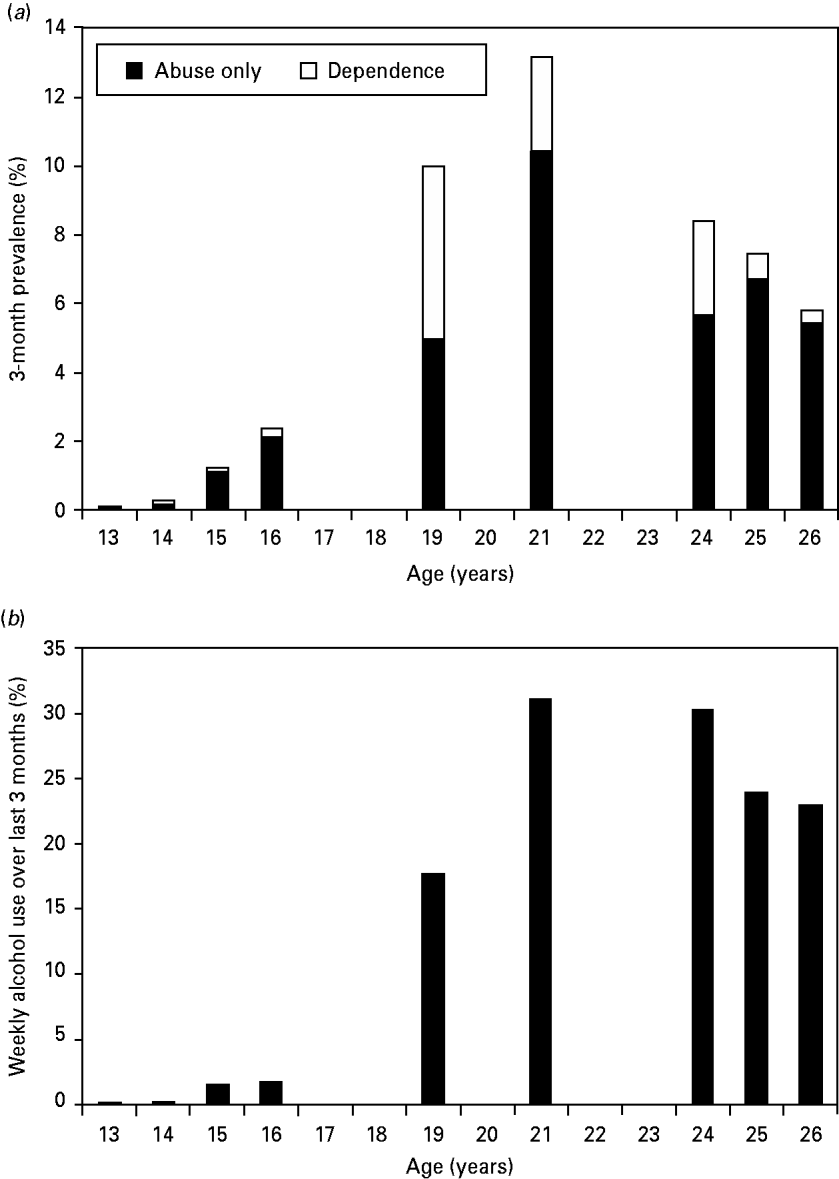
Consistent with past research, the 3-month likelihood of having an alcohol disorder (abuse or dependence) increased markedly from early to late adolescence (defined as ages 19 and 21) and then decreased into the mid-20s (Fig. 1 a). No alcohol disorders were diagnosed before age 13. Across all ages, males displayed higher rates of alcohol disorders than females [odds ratio (OR) 3.3, 95% confidence interval (CI) 2.0–5.5, p<0.001]. There were no differences in the rate of having had an alcohol disorders by race/ethnicity (p=0.91). Weekly alcohol use rates increased in a manner similar to alcohol disorder rates across adolescence; however, weekly use rates did not decrease at the same rate as alcohol disorder rates in young adulthood (Fig. 1 b).
Three-month prevalence rates for (a) alcohol abuse or dependence and (b) at least weekly alcohol use.

A total of 16.2% (unweighted n=175) of the overall sample met criteria for an alcohol disorder at one of the two assessments in late adolescence. One hundred and forty-four of those subjects (82.3%) were interviewed again at the mid-20s assessment. The follow-up rates were similar for participants without an alcohol disorder in late adolescence, indicating no differential attrition (82.3% v. 79.7%, p=0.63). Of those with a late adolescent alcohol disorder, 33.9% (unweighted n=37) continued to meet criteria for an alcohol disorder in young adulthood (again, either abuse or dependence), whereas 66.1% (unweighted n=107) desisted. Because persisters and desisters only constituted a subset of the total sample, only moderate to large effects were detectable (ORs >3.0) in between-group comparisons. Despite this, persisters had elevated rates of concurrent marijuana use (74.2% v. 0.0%, p<0.0001), illicit drug use (34.2% v. 2.4%, p<0.0001) and depressive (9.2% v. 0.0%, p<0.0001) and anxiety disorders (15.7% v. 2.6%, p<0.0001) as compared to desisters. Persistent alcohol problems placed subjects at risk for a range of impairing concurrent co-morbidities.
Educational and early family role transition
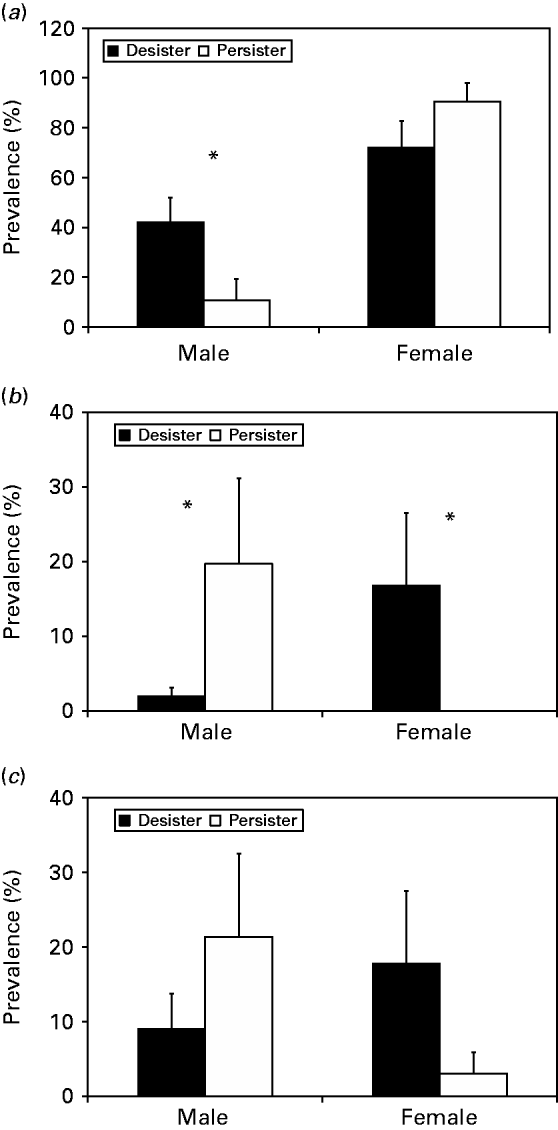
Prior studies suggest that family and, to a lesser extent, education-related transitions may affect risk for persistent alcohol problems. Three late adolescent (ages 19 and 21) transitions were tested: parenthood, marriage, and post-secondary education. None of these potential protective factors were significantly associated with persistence/desistance [parenthood: 11.6% v. 18.2% (desister rate first), p=0.45; marriage: 6.4% v. 16.3%, p=0.14; post-secondary education: 50.9% v. 24.7%, p=0.07], but all three interacted significantly with sex (Fig. 2). Females were more likely to desist if they were a parent (only at trend level) or married, whereas males were more likely to desist if they had completed at least 2 years of college. By contrast, marriage during late adolescence was a risk factor for persistence in males.
Comparison of males and female rates of persistence and desistance for protective factors. Graphs compare rates for (a) 2 or more years of post-secondary education, (b) marriage, and (c) parenthood. All interaction terms were statistically significant (post-secondary education: p=0.03; marriage: not estimated as there were no cases of persistence in married females; parenthood: p=0.04). Post-secondary education was protective for males [odds ratio (OR) 0.2, 95% confidence interval (CI) 0.0–0.9, p=0.05] but not for females (OR 3.6, 95% CI 0.5–27.1, p=0.20). Marriage increase risk for persistence in males (OR 12.3, 95% CI 2.1–71.5, p=0.005) but was protective in female (OR could not be estimated as no female persisters were married). Despite a significant interaction term, parenthood was not associated with persister/desister status for females (OR 0.2, 95% CI 0.0–1.4, p=0.09) or males (OR 2.7, 95% CI 0.5–15.5, p=0.25). * Significant group difference.

Predictors of persistent alcohol problems
Compared to subjects with no history of alcohol problems in either late adolescence or young adulthood, both persisters and desisters were elevated on almost every risk index in late adolescence. To identify a risk profile of persistent alcohol problems, rates of risk factors were compared between persisters and desisters only. Neither sex nor race/ethnicity was significantly associated with persistent alcohol problems, but both variables were included in all analyses as covariates to minimize potential confounding. The onset of alcohol use was not significantly earlier in persisters than in desisters [8.9 years (s.d.=6.0) v. 11.1 years (s.d.=4.1), p=0.13] and persisters were not more likely to have had alcohol problems in childhood (16.6% for persisters v. 6.2% for desisters, p=0.25). (Some predictors, such as childhood alcohol problems, were significant predictors in univariate models, but not when accounting for sex and race.) Both groups displayed similar rates of alcohol dependence at late adolescence assessments (43.6% for persisters v. 35.4% for desisters, p=0.59), but persisters had a higher rate of alcohol abuse than desisters (98.2% v. 88.5%, p=0.04). Use of specialty services tailored to problematic alcohol use was extremely rare in both groups (<1%).
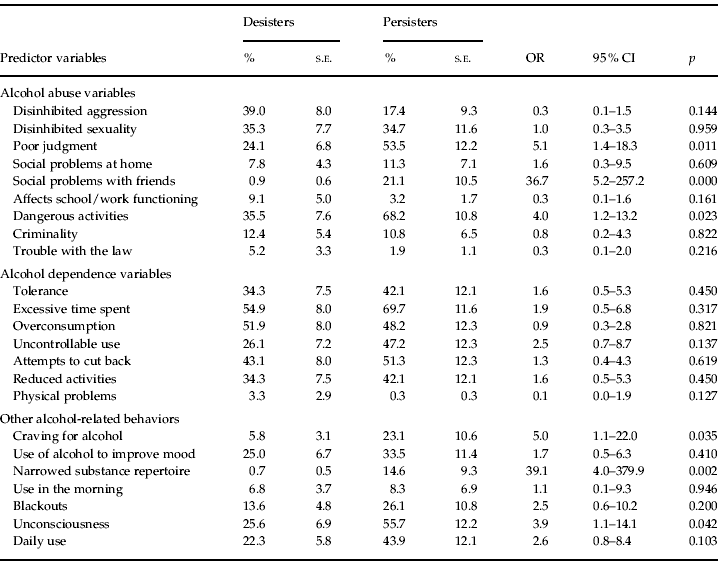
Table 1 compares rates of items used to code for late adolescent alcohol abuse and dependence criteria and associated features between persisters and desisters. This analysis tests the importance of specific aspects of alcohol abuse and dependence in predicting persistence/desistence. Of abuse symptoms, three were significantly more common in persisters than desisters: alcohol-related poor judgment, social problems with friends, and dangerous activities. No symptoms of alcohol dependence were significantly elevated in persisters. Three associated features of alcohol dependence, although not formal criteria, predicted long-term persistence: craving alcohol, a narrowed substance repertoire, and drinking to unconsciousness. Two additional aspects of drinking behavior were tested: any recent binge drinking and frequency of binge drinking. Almost all subjects, desisters and persisters alike, had reported binge drinking behavior, but the mean number of recent binge-drinking episodes was higher in the persisters than the desisters (10.0 v. 18.4, p=0.05). When all significant alcohol-related behaviors were tested as predictors simultaneously, all alcohol abuse symptoms and a narrowed substance repertoire continued to predict persistent alcohol problems.
Alcohol-related predictors of alcohol abuse/dependence persistence from young adulthood to the mid-20s

s.e., Standard error; OR, odds ratio; CI, confidence interval.
Withdrawal criterion for alcohol dependence was excluded due to low prevalence. All variables assessed in young adulthood (ages 19 and 21).
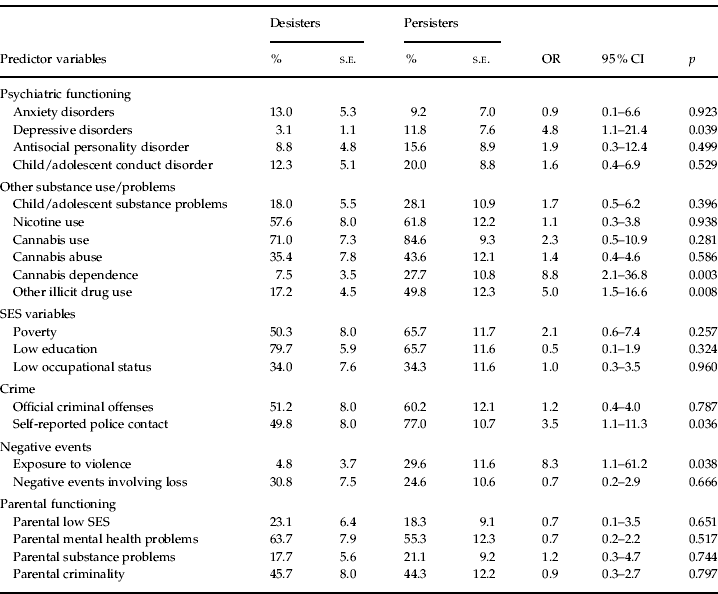
Table 2 compares persisters and desisters in terms of additional domains of late adolescent function, many of which are known to be associated with onset of alcohol use and misuse: psychiatric functioning, other substance problems, SES, crime, negative events, and parent history. Unless otherwise indicated, the domains were measured in late adolescence. Of all non-substance psychiatric outcomes tested, only late adolescent depressive disorders predicted persistent alcohol problems. Both cannabis dependence and illicit drug use increased risk for persistent problems. Across other domains, self-reported police contact and exposure to violence increased risk for persistence. None of these indicators were required to be related to alcohol use. When these predictors were tested together, cannabis dependence, self-reported police contact and exposure to violence continued to predict persistence.
Predictors of alcohol abuse/dependence persistence from young adulthood to the mid-20s

SES, Socio-economic status; s.e., standard error; OR, odds ratio; CI, confidence interval.
All variables assesses in young adulthood (ages 19 and 21) unless otherwise indicated.
Moderation by sex
It is possible that predictors might have different effects for males or females, as was observed for the life transition analysis. To test this moderation hypothesis, models were rerun including an interaction term between sex and each predictor. The number of significant interaction terms was only slightly more than would be expected by chance (three of 43 tests) suggesting limited evidence of sex-specific predictors.
Cumulative risk
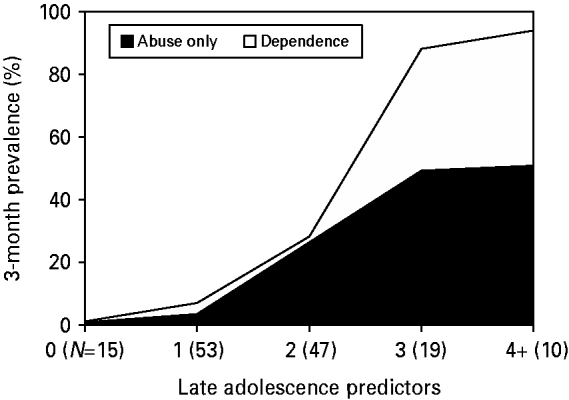
A final model was tested that included all significant alcohol-related and other predictors. All variables except illicit drug use continued to predict persistence status independently. These items were then combined into a summary risk scale. Fig. 3 displays the relationship between this cumulative late adolescent risk scale and the likelihood of displaying persistent alcohol abuse or dependence problems in young adulthood. More than 90% of subjects with three or more risk factors met criteria for a young adult alcohol disorder. This cut-off balanced high specificity (92.9%) with good sensitivity (66.2%).
Association between cumulative scale of late adolescent risk factors and 3-month mid-20s alcohol disorder rates. Controlling for sex and race/ethnicity, the number of late adolescent risk factors significantly predicted young adult persistence status [odds ratio (OR) 8.4, 95% confidence interval (CI) 4.5–15.7, p<0.0001].

Discussion
The increase in rates of alcohol disorders seen in late adolescence is both dramatic and time limited. Despite high rates of continued alcohol use and vanishingly low rates of service utilization, more than half of late adolescents with an alcohol disorder had desisted by their mid-20s. Thus, desistance from alcohol disorders was the norm. The question for this study was why a substantial minority of people in their mid-20s have persistent alcohol disorders. This question can only be addressed in a large community sample with prospective assessment of alcohol misuse across adolescence and young adulthood.
This study supports the importance of family and educational transitions in understanding risk for long-term alcohol problems. Risk factors predicting persistent alcohol disorders in this study generally differed from risk factors for initial problems that have been identified in previous research as most risk factors for persistence were secondary to alcohol use. Several criteria for alcohol abuse in late adolescence predicted persistence of alcohol disorders into the mid-20s, as did some associated features of dependence. No dependence criteria predicted persistence. A few risk factors that are typically associated with early alcohol misuse also predicted persistent problems, including depression, police contact and exposure to violence. Aspects of parent functioning, SES and psychiatric problems that are potent predictors of early alcohol use and abuse did not predict persistent problems.
Only by combining results from prior studies have we previously been able to infer the discrepancy between trajectories of alcohol use and disorder rates into young adulthood (e.g. Chen & Kandel, Reference Chen and Kandel1995; Grant et al. Reference Grant, Dawson, Stinson, Chou, Dufouf and Pickering2004; Harford et al. Reference Harford, Grant, Yi and Chen2005). When reported together in the GSMS, alcohol use and disorder levels both peak in late adolescence, but the substantial desistance of alcohol disorders is not mirrored in similar decreases in weekly alcohol use rates, suggesting that desistance of alcohol disorders is not an artifact of diminished use. Despite licit exposure to alcohol throughout adulthood, other studies suggest that rates of alcohol abuse and dependence decrease to the point of being relatively rare (<3% in males and <1% in females) in later adulthood (Harford et al. Reference Harford, Grant, Yi and Chen2005). Late adolescence seems to be a risky period for alcohol exposure. It is notable that the highest rates of criminal behavior (Farrington, Reference Farrington, Vandusen and Mednick1983; Sampson & Laub, Reference Sampson and Laub2003) and traffic infractions (Harrington & McBride, Reference Harrington and McBride1970) also occur during late adolescence, and late adolescence immediately precedes a period of intense cortical myelination that diminishes impulsivity and improves decision making (Casey et al. Reference Casey, Giedd and Thomas2000; Thompson et al. Reference Thompson, Giedd, Woods, Macdonald, Evans and Toga2000). Risk for alcohol problems may be greatest immediately following initial exposure and attenuate with repeated exposure. To test this habituation hypothesis, conditional risk for alcohol problems following alcohol initiation would have to be compared in different developmental periods.
Many of the strongest risk factors for persistent alcohol problems were alcohol abuse criteria rather than the associated psychosocial risk factors often associated with initial alcohol use. It is not surprising that behaviors directly related to alcohol use and other substances replaced other psychosocial risk factors in terms of understanding long-term problematic alcohol use. Other typologies used to characterize alcohol trajectories have done so on the basis of age of onset, use severity, or associated problems such as conduct disorder (Cloninger, Reference Cloninger1988; Babor et al. Reference Babor, Hofmann, Delboca, Hesselbrock, Meyer, Dolinsky and Rounsaville1992; Zucker et al. Reference Zucker, Fitzgerald, Moses, Cicchetti and Cohen1995; Maggs & Schulenberg, 2004/Reference Maggs and Schulenberg2005). With the exception of binge-drinking frequency, this study found little support for these factors in predicting DSM-based trajectories.
Criteria for alcohol abuse, but no criteria for alcohol dependence, discriminated persistent alcohol problems from time-limited impairing use. This is consistent with item response analyses of abuse and dependence criteria, which found that these criteria form a continuum of disorder severity with abuse and dependence criteria intermixed (Martin & Srihari, Reference Martin and Srihari2006; Saha et al. Reference Saha, Chou and Grant2006). These findings suggest two recommendations for current efforts at diagnostic refinement. First, these findings support the DSM-V proposal to combine abuse and dependence criteria into a single alcohol-use disorder. Second, associated features of alcohol dependence, such as craving, narrowed use repertoire and drinking to unconsciousness, may have better predictive validity than some of the dependence criteria themselves do. These features should be subject to further testing to determine whether they merit inclusion as criteria in the revised alcohol-use disorder.
The risk scale derived from this study for predicting persistent alcohol problems was proficient at identifying both true positives and true negatives, a rare balance for medical tests (Kraemer, Reference Kraemer1992). By comparison, the first three consumption items of the Alcohol Use Disorders Identification Test (AUDIT) comprise a commonly used screener for alcohol disorders. In a recent study based on the National Epidemiologic Survey on Alcohol and Related Conditions (NESARC) database, the optimal AUDIT-C cut-point achieved similar specificity (92.5%) and higher sensitivity (73.6%) for predicting current alcohol abuse or dependence (Dawson et al. Reference Dawson, Grant, Stinson and Zhou2005). The risk scale in the current study focused on status 5 or more years later. Persistence was uncommon for those with two or fewer risk factors, but nearly universal for those with three or more of the identified risk factors. The predictive value of any scale requires replication before it can be widely recommend, but these initial results are promising, and the contents of the scale involve information routinely collected in the clinical evaluation of alcohol problems. A tool with such predictive value could serve as a useful screen for late adolescents at risk for a prolonged course of alcohol problems and prioritizing subjects for intervention, goals that are relevant for both clinicians and those developing selective and indicated interventions.
Caveats
The GSMS has several strengths besides its longitudinal, prospective design. The key variables, alcohol abuse and dependence, were assessed prospectively from middle childhood through adolescence and young adulthood into adulthood. A population-based design minimized selection biases. A wide range of functional domains in young adulthood were assessed to test as possible predictors. Despite these strengths, the sample is not representative of the US population (Native Americans were over-represented and African Americans and Latinos under-represented).
The 5-year follow-up identified a substantial decline in alcohol problems, but the subsequent course of problematic alcohol use is unknown, introducing the possibility of misclassification (e.g. identified desisters may still meet criteria for alcohol abuse and dependence again in the future). Furthermore, the 3-month assessment period used in this study minimized forgetting and recalls biases, but also missed diagnostic cases outside of the assessment window. Despite these potential misclassification issues, strong predictors of persistent alcohol problems were identified, suggesting that any misclassification bias was minimal. It is possible to question our definition of alcohol problems as involving a diagnosis of either abuse or dependence. Other subtypes and classes have been proposed to characterize alcohol use, some theory based and others based upon modeling techniques. It is possible that alternative group definitions might affect the profile of significant late adolescent predictors. Our definition, however, is consistent with the DSM-V proposed changes to alcohol disorders and those in this combined category in the current study displayed widespread psychiatric and substance co-morbidities, confirming the severity of their condition. Finally, the nature of the research question limited the number of subjects included in the analyses. As such, it was only possible to detect moderate to large effects and more modest elevations in other areas were not detectable. This concern may be particularly relevant to the sex by predictor interaction analyses, where only interactions of large effect were detectable. It is important to note that the GSMS is one of only a few large prospective, community studies that can address this issue.
Conclusions
It is uncommon for late adolescents with alcohol problems to receive any mental health services and rarer still to receive best-practice services, yet most did not display alcohol problems 5 years later. The late adolescent spike in alcohol problems is time limited. This is not to say that treatment is unnecessary. Alcohol problems are associated with distress and impairments even if the disease course is brief. This does suggest, however, that persistence is abnormal. Such persistence is associated with multiple co-morbidities and such highly co-morbid conditions are among the most costly to society (Costello et al. Reference Costello, Copeland, Cowell and Keeler2007). Fortunately, this study suggests that late adolescents at risk for persistent problems may be identified by aspects of their alcohol use, other substance use and other associated behaviors, and targeted for intensive intervention.
Acknowledgments
The work presented here was supported by the National Institute of Mental Health (MH63970, MH63671, MH48085), the National Institute on Drug Abuse (DA/MH11301), and the William T. Grant Foundation.
Declaration of Interest
None.