Introduction
Cancer is one of the leading causes of death and disability worldwide (1). Cancer treatment has received additional attention in the last decade because of the very high costs associated with new targeted therapies (type of cancer treatment that targets proteins that control how cancer cells grow, divide, and spread, for example, bevacizumab an angiogenesis inhibitors nivolumab, anti-PD1 antibody). In France like in many other developed countries (England, Japan, Canada, Australia, Spain, Denmark), (2–Reference Leff, Burton and Mader4) the debate has also focused on where patients should receive and would prefer to receive their treatment, that is, in hospital, home or in local health centers (LHC) (2;5;Reference Buthion6).
A large variety of treatments can now be provided at home (e.g., antibiotics, parenteral feeding, pain treatments, dressing changes, chemotherapy, and palliative care), 24 h a day, 7 days a week through a hotline with the same level of safety and effectiveness as in the hospital (Reference Shepperd, Gonçalves-Bradley, Straus and Wee7). However, even though its use is growing, home care is still under-used (Reference Lüthi, Fucina and Divorne8;9) representing less than 0.7 percent of cancer care (2).
LHCs are ambulatory facilities usually run by teams of GPs, nurses, and/or physiotherapists and are found in large cities, suburbs, small towns, and rural areas. The number of LHCs is increasing in France since 2000. However, they do not currently offer cancer treatments, but healthcare decision makers (DMs) think that they represent a potential option for cancer care. They are assumed to have the advantages of safety and effectiveness of treatment and closer proximity to home without the perceived drawbacks of home care (e.g., intrusion of care into daily life) and hospital (e.g., the stress of hospitalization, proximity to other patients).
In response to the increasing demand for care in cancer as well as more generally in chronic care, DM wish to develop these alternative options to hospital care, hoping they could be both cost-saving and preferred by patients. Nonetheless, reality is more complex. A survey showed that cancer patients may prefer hospital as compared to home care, especially for complicated care (Reference Lüthi, Fucina and Divorne8). In this survey, the vast majority of cancer patients in the Rhone–Alps region wanted to separate home life from the place of care and wanted to avoid becoming a burden on their relatives. A quarter of the patients (24 percent) preferred home care mainly to avoid traveling, maintain their lifestyle, and because they found hospitals frightening. Only 5 percent of participants preferred to receive treatment in LHCs. Based on these findings, we wanted to explore French citizens’ preferences for place of care for cancer (i.e., a respondent states where they would like to get the service if needed, between home care, LHC, or hospital in the same region that our survey on patient’s preferences was done (Reference Margier, Gafni and Moumjid10)) and their strength of preference for their chosen alternative. We decided to study the general public (i.e., citizens) preferences because their preferences matter re what will be funded or not (e.g., via taxation). Indeed, French healthcare system is collectively and publicly funded.
We conducted a willingness to pay (WTP) survey in the Rhone–Alps region of France among the general population on the topic of hospitals versus alternative places of care for cancer. Contrary to other measures of preference, WTP has the advantage to allow capturing the opportunity cost of the type of service chosen if additional resources are required to develop it (Reference Donaldson11). In other words, it forces the respondent to think where the additional money will come from. It is especially interesting in our context where the development of the alternative places of care will be funded by citizens. To the best of our knowledge, the questions asked in this study have not been studied for hypothetical options related to service use (and not a specific treatment). Also, contingent valuation surveys in healthcare are also typically used to study use value, that is, actual users WTP in a ex post context or at the point of consumption (Reference Smith and Sach12). Our goals were twofold:
-
1) To elicit from a representative sample of citizens their preferences for the three options: home care, LHC, and hospital.
-
2) To conduct a contingent valuation survey among the participants to measure how much they are willing to pay for their preferred option.
The results obtained could help DM to prioritize the alternative places of care that are respectful of the general population’s preferences in the Rhone–Alps Region. The methodology described in this study can help DM in other regions.
Survey design and data collection
Participants
Participants were adults over 18 years old recruited by the national survey institute “Research Now.” Ethics approval for the study was obtained (Leon Bérard cancer center Ethics committee, Advisory Committee on Information Processing in Material Research in the Field of Health).
CV survey
Because clear and understandable information about the options is an important prerequisite for the CV method (Reference Smith13), we decided to integrate a decision aid in our CV survey. Decision aids have been shown to increase patients’ understanding and improve the quality of the information conveyed (Reference Syrowatka, Krömker, Meguerditchian and Tamblyn14;Reference Elwyn, O’Connor and Stacey15). The web CV survey was divided into four sections:
-
1) Questionnaires on citizens’ sociodemographic and experience of care. There was also a question on the respondent’s perception of their cancer risk because our hypothesis was that the more the respondent worried about cancer, the higher would be their WTP.
-
2) A computerized decision aid that provided information on the three options of care (hospital care, home care, LHC) developed in a previous study of our team (Reference Margier, Gafni and Moumjid10).
-
3) Preference measures for different scenarios of cancer care. To be as realistic as possible in representing the diversity and complexity of the cancer context, we developed three scenarios, in collaboration with clinicians. To validate the scenarios developed, a pre-test was done among a convenient sample of clinicians (n = 6) not involved in the development on the survey, belonging to four different structures managing cancer patients at home or at hospital to test the neutrality of information and the plausibility of the scenarios. The three scenarios are ranging from light (curative) cancer care to heavy (e.g., palliative) care:
-
1) Scenario 1: short chemotherapy (<1 h) every month for 6–12 months.
-
2) Scenario 2: medium or long chemotherapy (2–6 h) over 5 consecutive days for 6–2 months.
-
3) Scenario 3 (e.g., palliative care): patient can have different types of care (chemotherapy, treatment against pain in infusion, an antibiotic in infusion, enteral or parenteral feeding, a blood transfusion) as needed. For each scenario, the respondent had first to rank the options (hospital, home care or LHC) from the most to the least preferred and then to indicate using visual analog scales (VAS) the strength of their preference for their preferred option. To study preference determinants, attitudinal questions related to cancer management were also added. These questions were developed from reasons given by cancer patients to explain their own preferences for a place of care collected in our research team’s previous studies (Reference Buthion6;Reference Margier, Gafni and Moumjid10;Reference Cummings, Brookshire, Bishop and Arrow16) (Supplementary Material S1).
-
4) The CV question: WTP for home care and for LHC. For each scenario, the WTP question was: “How much is the maximum are you willing to pay per month per household to use [the respondent’s preferred option: home care /LHC] if needed? Please bear in mind that your payment would reduce the amount of money you have to pay for other goods/services.” Only respondents who declared they preferred home care or LHC to the hospital were asked to respond to this question. For example, if a respondent preferred home care in scenario 1, LHC in scenario 2 and hospital in scenario 3, two WTP questions were asked, one about home care in scenario 1 and the other one about LHC in scenario 2. If a respondent preferred a hospital for each scenario, no WTP question was asked since in the French healthcare system cancer management in a hospital is considered the default option and provided free of charge, thus the question is irrelevant and can be confusing to respondents.
WTP elicitation format: payment card
The respondents were asked to indicate their maximum WTP using a payment card where payment bids ranged from 0 to 25 Euros, with the possibility of giving another amount. These amounts were determined in a pre-test of the whole survey, which was administrated online to a sample of 100 individuals from the general population (Supplementary Material S2).
“Cheap talk” and follow-up question
To mitigate the divergence between real and hypothetical payments called hypothetical bias (Reference Cummings, Brookshire, Bishop and Arrow16) a “cheap talk” that is, a statement that emphasizes the importance of the respondent’s answers to incite them to devote more effort, attention, to the preference elicitation task (Reference Aadland and Caplan17–Reference Lusk19) has been added. Moreover, after the WTP questions, respondents were asked to indicate in a follow-up question, how sure they were about the amount chosen on a scale from 1 to 10 (where 1 is very uncertain and 10 is very certain).
Payment method
The method of payment can impact the WTP and the proportion of protest zeros (Reference Bateman, Covey and Loomes20–Reference Morrison, Blamey and Bennett22). The choice of payment method has to be realistic and neutral with respect to the context (Reference Mitchell and Carson23). Even if a tax is generally associated with a high rate of protest responses (Reference Champ, Bishop, Brown and McCollum24), we decided to use it as a payment method because in France more than 75 percent of healthcare spending is publicly funded. Moreover, there were no protest responses about this type of payment method in the pre-test results.
Statistical analysis
There are several ways to estimate mean and median WTP. The first is to consider the selected bid amount on the payment card as an exact expression of the respondent’s maximum WTP (Reference Mitchell and Carson25). The second method is based on the interval regression model which is particularly relevant when the payment card is used. This model is a reparameterization of the random utility model developed by Hanemann (Reference Hanemann26). The true WTP value is considered to be between the amount selected and the next higher amount on the payment card, that is, the WTP was within this range. The interval regression model can be estimated with the intercept only to estimate the median and the mean WTP for the sample. (Reference Mahieu, Riera and Giergiczny27). We used the log of the WTP to produce a near-normal distribution because the WTP values were not normally distributed. Moreover, the estimate with the interval regression model is presented with the non-parametric bootstrap estimate of the 95 percent confidence interval with 1,000 replications. We also estimated separately the WTP in the sub-group of respondents who were sure of their WTP. For the recoding method, the threshold used for considering a response as certain was seven, as recommended by some authors (Reference Ethier, Poe, Schulze and Clark28;Reference Poe, Clark, Rondeau and Schulze29).
The interval data model has also been used to study the variables affecting the WTP and to test its internal validity. Variables used in the WTP analyses and the associated hypothesis are described in Supplementary Material S3. The models were compared with AIC (i.e., Akaike’s Information Criteria), BIC (i.e., Bayesian Information Criteria) log-likelihood and the Cox–Snell pseudo-R2 in which the ratio of the likelihoods reflects the improvement of the full model over the intercept-only model. The coefficients estimated can be interpreted like in the OLS model: if we change x by 1 (unit), we expect our y variable to change by approximately 100⋅β1 percent. The exact value is: percentΔy = 100×(exp(β1)−1). In addition, two-way ANOVA or mixed model and non-parametric tests had been used to compare continuous variables across groups.
Finally, to classify the protest respondents (i.e., respondents indicating zero WTP for their preferred option) they were asked to explain why they were unwilling to pay by ticking the most important reason from a list of possible explanations provided. According to the literature (Reference Freeman30), a zero WTP can be reclassified as a true zero WTP or as a protest response. We classified here a zero value as a protest response if the respondent checked “I did not understand the question”, “There was not enough information for me to choose”, “I refuse to pay for care”, “Other.” After controlling with binary logit regression to ensure that the protest respondents were not different from respondents who provided a positive or a true zero WTP, we excluded the protesters from the analysis of the WTP (Supplementary Material S4).
Results
Sample characteristics
We aimed to recruit a sample that is representative of the population of the Rhone–Alps Region. It was developed with the quota method regarding sex, age, socioprofessional category, and administrative department sub-regions criteria.
A total of 1,046 individuals were invited to participate to the web-based survey and 95.7 percent accepted, corresponding to a sample of 1,001 respondents. We focus here on a random sub-sample of 800 respondents, who responded with a payment card, the other 201 individuals were given an alternative elicitation method for their WTP that we do not present in this paper.
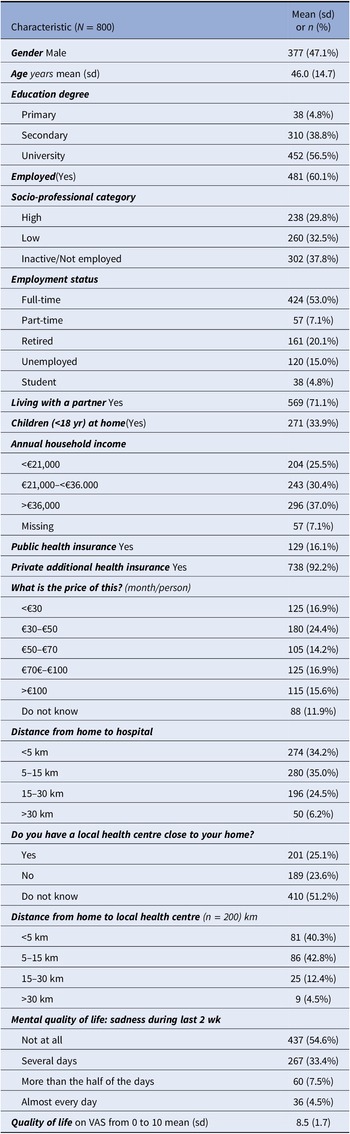
Respondents’ characteristics are presented in Table 1. Respondents were 46 ± 14.7 years old on average. More than a half had a university degree and were fully employed. A quarter had a post-tax net annual household income under €21,000. A large majority, 92.2 percent, had additional private health insurance as well as public health insurance.
General population sample characteristics

VAS, visual analog scale.
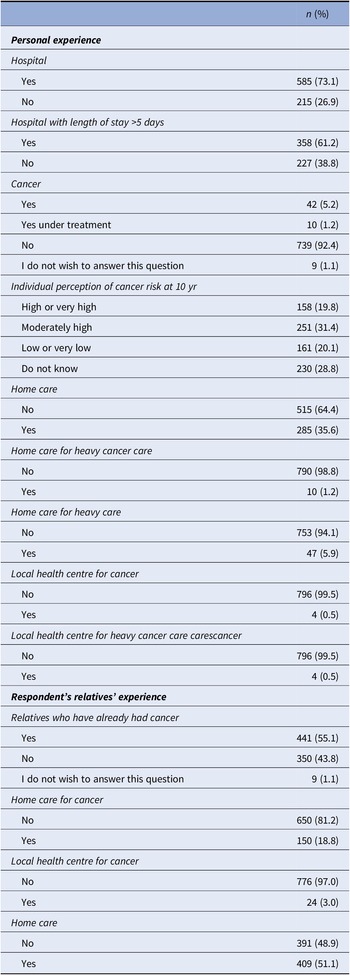
Table 2 shows respondents’ experience of care, 73.1 percent had already been hospitalized and 35.6 percent had already experienced home care. Concerning cancer, 55.1 percent knew a relative who had already had cancer. Only 5.2 percent of the respondents had already been treated for cancer and 1.2 percent were still under treatment.
General population’s experience of care

Ranking of scenarios
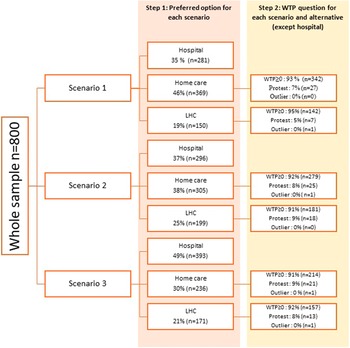
As shown in Figure 1, the preferred option for scenario 1 (light care) was home care for 46.1 percent of the respondents, hospital for 35.1 percent and LHC for 18.7 percent. For medium care, hospital and home care were closely ranked with respectively 37.0 percent and 38.1 percent of respondents choosing these options as the first choice. For heavy care, hospital was the first choice for a large majority of respondents (49.1 percent), followed by home care (29.5 percent). Whatever the scenario, LHC was the option with the lowest proportion of respondents preferring it as a first choice. The strength of preference (measured with VAS from 0 to 10) was significantly higher for respondents who preferred home care (whatever the scenario) (p < .001); scores were 8.5 ± 1.5, 8.4 ± 1.6, 8.3 ± 1.7 for light, medium and heavy care respectively. For hospital, scores were 8.1 ± 1.6, 8.0 ± 1.6, and 8.0 ± 1.6 for light, medium and heavy care respectively; and for LHC, scores were 7.7 ± 1.6, 7.6 ± 1.4, 7.6 ± 1.3 for light, medium and heavy care respectively. LHC was the option with the weakest preferences.
Diagram of the general population study: whole sample n = 800.

WTP estimations for home care and LHC
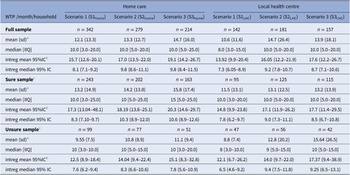
Table 3 summarizes the results for the WTP questions. These results demonstrate that there are significant differences in the valuation of the WTP across scenarios. In the whole sample, for home care, the mean WTP was €12.1/per month/per household for light care, €13.3 for medium care, and €14.7 for heavy care (p < .001). The mean WTP estimated with interval regressions had the same trend, with €15.7, €17.0, and €19.1 for light, medium, and heavy care respectively. For LCH, the mean WTP was €10.6 per month/household for light care, €14.7 for medium care, and €13.9 for heavy care. These differences too are significant (p < .001).
WTP Estimates on the whole sample and a sub-sample of “sure” respondents, according to scenario and preferred option

WTP, willingness to pay.
a This estimation considered that the respondent’s chosen amount on the PC is their true WTP, the WTP is estimated with a classical mean calculation.
b The mean is estimated with a bootstrap replication of the interval regression which considers that the amount is an interval.
c A respondent is considered sure if they have a score ≥7 on the VAS from 0 very uncertain to 10 very certain.
Finally, if we compare mean WTP between certain and uncertain respondents, the mean WTP was higher for respondents who were certain for all scenarios except for respondents who had a preference for LHC for heavy care whatever the method used. However, this difference is statistically significant only for respondents who had a preference for medium care at home (p = .035) and heavy care at home (p = .047). Analysis conducted among the “certain” respondents sample provided more or less the same results in terms of significant variables, but with different coefficients and a slightly better adjustment (R2 criteria) (Supplementary Material S4).
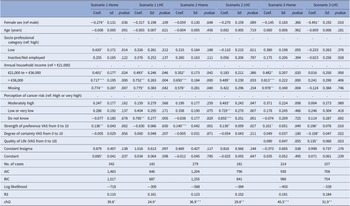
As shown in Table 4, household income (except in the sub-group of respondents who preferred LHC for heavy care) was a strong predictor of the WTP.
Interval regression analysis of WTP according to scenario and prefered option

VAS, visual analog scales; WTP, willingness to pay.
* p < .05.
** p < .01.
*** p < .001.
Whatever the scenario, for respondents who preferred home care, a higher strength of preference had a positive impact on valuation, whereas for LHC, this relation was not significant (p = .650).
Quality of life was a positive predictor of the WTP for S3home (p = .055) and S3LHC (p = .023) (S3, scenario for heavy care) but was not significant for other scenarios, the higher is the quality of life the higher is the WTP. Finally, education level, number of people in the household and experience of home care did not impact the mean WTP whatever the scenario was. The proportion of respondents who provided a zero valuation in response to the WTP questions ranged from 13.1 percent for scenarios 1 and 2 to 15 percent for scenario 3 (Supplementary Material S6). After the reclassification process, the rate of protest responses varied from 6.5 to 8.5 percent for scenarios 1 and 2 respectively.
Discussion
In this study, we elicited for the first time citizens’ preferences for home care, LHCs and hospital in the context of cancer management. We also assessed respondents’ WTP for their preferred option (home care or LHC) according to three different scenarios ranging from light cancer management to heavy (e.g., palliative) care.
Our results showed that the heavier the care scenarios were, the stronger were the preferences for hospital care. The mean WTP tendency also increased as the care scenario became heavier, that is, people were prepared to pay more for heavier care.
Concerning the acceptability and validity of the CV method, the proportions of protest responses and outliers were very low. Indeed, our proportion was never higher than 8.5 percent. A meta-analysis of 254 studies indicated that the rate of protest responses is around 18 percent on average, sometimes reaching 50 percent (Reference Meyerhoff and Liebe31). Moreover, as expected, using the whole sample, the interval regression model indicated that income is a good predictor of the WTP. Additionally, the relation between WTP and strength of preference was significant and in the expected direction. These elements seem to confirm the validity of the CV survey results.
Concerning preferences, another French study (Reference Blayac, Clément and Mercier32) analyzed patient and population preferences for home care and hospital without focusing on a specific disease using the discrete choice experiment method. They found that 50 percent of patients and 50 percent of citizens preferred home care. The strength of their preference was also significantly higher for home care than for hospital whatever the scenario. We obtained similar results but the authors did not include LHC, which could explain a higher proportion of respondents who prefer home care. In a previous study about patients’ preferences, a large majority of patients preferred hospital (70 percent), a quarter preferred home care and only 5 percent LHC (Reference Margier, Gafni and Moumjid10). This study showed that citizen’s preference are slightly different. Indeed, a large number of citizens preferred home care (between 30 and 46 percent depending on the scenario) or LHC (between 19 and 25 percent according to scenario). While the hospital is the preferred option for 35 to 49 percent of citizens depending on the scenario. We did not expect that patients and general public will have the same preferences. Our results confirms our expectation but enable us to quantify the differences in preferences for place of care (more details in Supplementary Material S5).
Limitations
Although the number of LHC has been increasing since the early 2010s, LHCs do not offer cancer care and people do not see them as potential place of care for cancer care. The LHC option may thus have been more subject to hypothetical bias and framing effect than the other options (Reference Alberini, Boyle and Welsh33;Reference Corso, Hammitt and Graham34). The WTP question was only asked of respondents who declared they preferred home care or LHC. We decided to do so for two reasons: (i) WTP questions can both elicit option value and externalities or altruism value, that is, a respondent who prefers hospital could be willing to pay for the development of home care or LHC for others. We chose to isolate the altruism value because this value could generate a “warm glow” effect (social desirability bias) (Reference Andreoni35). We could have asked a WTA question to give us the preferred option of all respondents who preferred hospital too, but WTA is known to suffer from a bias due to the lack of budget constraint and to loss aversion (Reference Kahneman and Tversky36).
Additionally, we used a payment card (PC) because it is the most common elicitation format in health surveys (Reference Smith37). Although PCs can suffer from range and central value bias, we chose not to present the amount randomly as suggested by some authors (Reference Voltaire, Donfouet and Pirrone38). Indeed, random payment cards can increase cognitive burden (Reference Andersen, Harrison, Lau and Rutström39). Moreover, there is no strong evidence that random PCs avoid this bias and we thought that randomizing the PC might decrease the credibility of the WTP questions (Reference Voltaire, Donfouet, Pirrone and Larzillière40).
Finally, the order of the WTP questions could influence the mean WTP, even though we stressed that the three WTP questions would be asked depending on the individual’s preferences (Reference Anderson, Brackenbury, Quackenbush, Buras, Brown and A-SIDE41;Reference Bateman, Cole and Cooper42). However, the fact that the differences between WTPs across scenarios were significant could indicate that respondents considered each scenario independently of their order.
Strengths
We measured citizens’ strength of preferences using two methods, that is, VAS, but since they do not allow to take into account the opportunity costs (i.e., how much an individual is willing to give up to benefit from a service or a good in case it requires additional resources to implement), we decided to add the WTP measure. This method could help health policy DMs to determine if the development of new modalities of care represents a good use of scarce resources (e.g., use them in a cost-benefit analysis).
Health policy DMs are claiming, without any rigorous evidence that, LHC and HC are cheaper than hospital care. This seems to be their main reason to develop them. If this is not the case than the additional resources to develop these options for care will have to come from somewhere (i.e., one has to consider the opportunity cost of investing in LHC and HC for cancer care instead of other potential uses of these resources). Using the WTP approach our study shows how to estimate the total WTP of the population for such services.
We chose to use a direct measure of WTP (as suggested in CV studies) and not a Discrete Choice Experiment (DCE) for several reasons. In DCE, alternatives are described based on their attributes (characteristics of the alternatives) and levels that are modified in different scenarios. Cost could be considered as an attribute and thus an indirect WTP could be assessed. Even if some authors argue that WTP in DCE survey is less sensitive to strategic or protest bias (Reference Ryan and Watson43), some others emphasize that cost attribute could be neglected or even ignored by respondents in favor of other attributes (Reference Bijlenga, Bonsel and Birnie44–Reference Sever, Verbič and Sever46), thus leading DCE to provide a biased WTP. To our knowledge, there is no evidence showing the superiority of DCE to CV in WTP estimation. In addition, our study was part of a larger study that used a decision aid (DA) that provided realistic alternatives (options), it made sense to use a direct measurement of WTP which is based on the use of a DA as an important component. To use a DCE to measure WTP would have required to add a new study.
Conclusion
Although the CV method is more widely used (Reference Smith and Sach12;Reference Baker, Currie and Donaldson47–Reference Smith and Sach49), a large number of CV surveys have been used to elicit only patient preferences. We thus decided to conduct a CV survey among the general population, to answer the question about their prospective preferences for a place of care for a serious disease such as cancer. We have conducted a similar study among cancer patients sample of this same region. We realized that cancer patients’ preferences might differ from those of the public. Each of these groups preferences have a role in policy decisions re services. The WTP of the public (e.g., via additional taxation) gave us indication re what services will be funded. Patients’ preferences gave us idea re how likely are these services to be demanded.
There is a mismatch between what DM think will happen and what both of our studies showed. DM must work to converge both patients and general public’ preferences and better inform them about benefits and risks of each possible options including alternatives (LHC and home care) to hospital.
Acknowledgment
We thank Louisa Blair for the comments that greatly improved the translation of the manuscript.
Supplementary material
To view supplementary material for this article, please visit https://doi.org/10.1017/S0266462322000599.
Funding statement
This work was granted by French National League Against Cancer (grant numbers not applicable).
Conflicts of interest
The authors declare none.