

Introduction
Much work has been done regarding the immediate effects of blast injury, but many questions remain unanswered regarding the longer-term health effects that can result from exposure to an explosion. This is particularly true of explosions occurring in a civil setting. Analysis of terrorist and other bombings over the past two decades indicates that there are not just immediate but also wider, long-term health risks that must be considered following explosions in the civil setting.
This paper presents a synopsis of immediate injury patterns and the longer-term health effects based upon a study carried out by the United Kingdom (UK) Health Protection Agency (HPA). The objective of the review was to provide information regarding such health effects to a wide range of health professionals who may be involved in the management of blast-injured patients.
Explosions cause direct injury to those in the vicinity by the generation of a high pressure blast wave.Reference DePalma, Burris, Champion and Hodgson 1 Main patterns of injury from blast are commonly described, and a fifth pattern (immunological response) is becoming more widely accepted and described:
-
• Primary blast injury—direct injury due to the high pressure effects of the blast wave itself;
-
• Secondary blast injury—injury from missiles produced by the explosion, e.g., shards of glass or brick;
-
• Tertiary blast injury—injuries sustained by the casualty being displaced by the blast wave and coming into contact with fixed objects;
-
• Quaternary blast injury—thermal and chemical injury from the blast including inhalational injury from the blast;
-
• Quinternary blast injury—delayed immunological response to the blast wave.
All the above mechanisms can lead to latent health problems with long-lasting implications.
Methods
The review was carried out in March 2011 at the Extreme Events Health Protection Section of the Centre for Radiological, Chemical and Environmental Hazards division of the HPA, London, UK. The review involved:
-
• A literature and direct interview survey of all possible health problems secondary to exposure to an explosive discharge;
-
• Exploration of current military information about blast injury and its long-term effects, available from the UK Armed Forces Medical Services;
-
• Liaison with other concerned departments within the UK HPA and Home Office (Interior Ministry).
Selection of Events
A number of civilian, industrial and some military deliberate and accidental explosive events were chosen as the main sources of evidence for the project. Events were included when the damage was caused by the explosion itself, and not by secondary events such as fire.
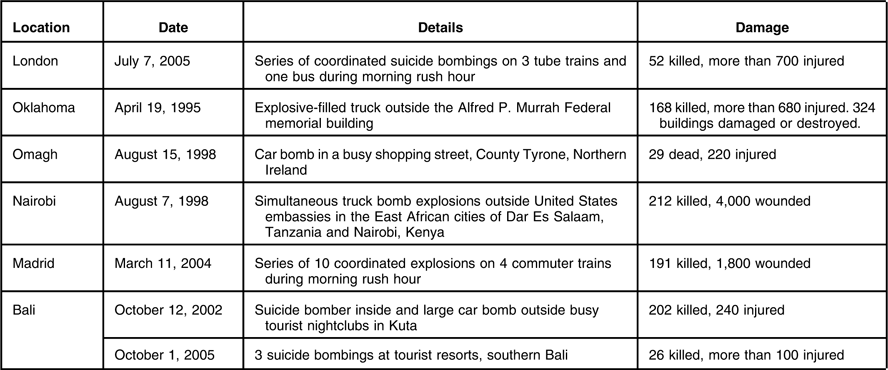
An initial Google search was performed with the terms “explosions,” “bomb,” and “blast.” The events shown in Tables 1 and 2 were selected as the events over the past 30 years that provided the largest evidence base. Evidence from the conflict zones in Iraq, Afghanistan and Israel was also included.
Civilian Bombings 2

Industrial Explosions

Literature Survey
A search strategy was devised to study the available literature across various databases. All available evidence-based medicine databases (Cochrane, American College of Physicians’ (ACP) Journal Club, Database of Abstracts of Reviews of Effectiveness (DARE), and Cochrane Controlled Trials Register (CCTR)) were searched. Inclusion criteria were:
-
• All papers relating to the events listed in Tables 1 and 2;
-
• All papers relating to long-term health implications of blast injury.
Exclusion criteria were:
-
• All subjective reports containing no scientific data;
-
• Reports relating only to military casualties;
-
• Papers relating solely to chemical, radioactive or nuclear threats from explosions;
-
• Literature relating to events where the main damage came from a mechanism other than explosion (e.g., the 2001 World Trade Center bombing, where fire and structural collapse was the primary cause of death).
The following databases were searched:
-
• Pubmed;
-
• Medline;
-
• Embase;
-
• OvidSP;
-
• ScienceDirect;
-
• Google Scholar.
The U.S. National Library of Medicine Medical Subject Heading (MeSH) search terms used were:
-
• Bomb$.ti,ab;
-
• Blast$.ti,ab;
-
• Terroris$.ti,ab;
-
• Terror$.ti,ab;
-
• Explosion$.ti,ab;
-
• Burn$.ti,ab;
-
• inhalation$.ti,ab;
-
• trauma.ti,ab.
A search for general papers relating to the above terms was conducted. The MeSH terms were then matched with “AND” to the location of the bombing in order to find evidence relating to specific events. The bibliographies of each relevant paper were manually searched for further relevant documents.
Grey literature was reviewed, and expert opinions sought. Meetings and telephone conferences were arranged with experts in the field who had links with the Health Protection Agency (HPA).
Results
The study indicated that every somatic system is affected in the short or long term by blast and its secondary effects. The findings for each system is summarized as follows:
Central Nervous System
The increased survival of those with blast-related head injuries in the military (due to Kevlar body armor) and the increased recognition of milder presentations through screening have prompted extensive research in this area. Much of this has been performed at the Walter Reed Army Hospital in Washington, DC, which receives returning injured troops from the Iraq and Afghanistan conflicts. Following screening, approximately 59% are diagnosed with traumatic brain injury (TBI), the majority of which are mild cases.Reference Okie 3 The extensive published military data permits comparisons between their injuries and those suffered by civilians in a similar blast, particularly terrorist bombings. 4
Mechanisms of acute TBI include:
-
• Primary pressure wave transmitted through the skull, causing shear between the various different density tissues. Contusions, hemorrhages, edema and diffuse axonal injury may result;
-
• Air embolism;
-
• Acceleration/deceleration forces on the head similar to a motor vehicle accident.Reference Warden 5 , Reference Ford and Rosenfeld 6
Mild TBI may manifest as physical, cognitive, behavioral or emotional problems. Common symptoms include headaches, altered sleep pattern, and hypersensitivity to light, noise and distractions.Reference Martin, Lu, Helmick, French and Warden 7 Signs are often subtle and easily missed. There is considerable overlap with features of post-traumatic stress disorder, major depression and acute stress disorder. This association may deter some from reporting symptoms due to the stigma attached, further delaying diagnosis and interventions to help reduce the long-term sequelae.
Ear, Nose and Throat (ENT)
The ear is, by its nature, designed to be hyper-responsive to pressure changes, thus it is particularly susceptible to blast injury.Reference Darley and Kellman 8 Of all the long-term health impacts of blast injury, audio-vestibular problems are among the longest-lasting effects, and appropriate management is crucial to minimize associated morbidity.Reference Catchpole and Morgan 9 , Reference Nageris, Attias and Shemesh 10 Data from OklahomaReference Van Campen, Dennis, Hanlin, King and Velderman 11 show no correlation between patient location and symptoms reported, suggesting that even those far from the blast should be questioned regarding symptomatology.
Hearing loss is common and long-lasting post blast exposure.Reference Catchpole and Morgan 9 , Reference Radford, Patel, Hamilton, Collins and Dryden 12 Follow-up months and years post blast-related injury reveals a high prevalence of ongoing morbidity.Reference Van Campen, Dennis, Hanlin, King and Velderman 11 , Reference Mallonee, Shariat, Stennies, Waxweiler, Hogan and Jordan 13 - Reference Van Campen, Dennis, King, Hanlin and Velderman 15 The typical 4 kHz “notch” normally associated with acoustic trauma is not always seen on the audiogram.Reference Van Campen, Dennis, Hanlin, King and Velderman 11
Inner ear problems, such as tinnitus and vestibular damage, also cause longer-term damage.Reference Radford, Patel, Hamilton, Collins and Dryden 12 Progress is slow, and the effects long-lasting; only seven percent of patients with tinnitus post-blast exposure in Israel showed any improvement at one year.Reference Nageris, Attias and Shemesh 10 Dizziness and balance problems are among the main complaints of service personnel returning from Iraq after blast exposure.Reference Scherer and Schubert 16
Tympanic membrane rupture is commonly observed.Reference Turegano-Fuentes, Caba-Doussoux and Jover-Navalón 17 Poor healing rates have been noted, possibly secondary to the severity of the explosion.Reference Miller, McGahey and Law 14 Long-term complications can ensue: cholesteatoma,Reference Roth, Kronenberg, Lotem and Leventon 18 otitis,Reference Roth, Kronenberg, Lotem and Leventon 18 , Reference Lucic 19 and facial nerve palsy.Reference Lucic 19
Importantly, there appears to be no correlation between the tympanic membrane injury and later complications of blast injury in other systems such as the lung.Reference Lebovici, Gofrit and Shapira 20
Ophthalmology
Explosions often inflict severe eye injuries, mostly due to secondary blast effect (fragments).Reference Ari 21 There is a wide range of injuries seen following terrorist bombings, ranging from minor corneal abrasions to penetrating injuries of the globe requiring enucleation.Reference Thach 22 Ocular injuries also may be grossly contaminated from materials packed around the explosive device, leading to continued ooze despite washouts. There is only one documented case in the literature of injury to the eye from pure primary blast wave. 4
Despite the eyes’ accounting for <0.1% of the body's frontal body surface area, ocular injury has been shown to be 20-50 times greater than expected by surface area alone in combat situations.Reference Thach 22 This may be explained by the essential sensitivity of the eye compared with other epithelial structures such as the skin.
Caution in imaging choice should be exercised in those who possibly have sustained an intra-ocular metallic fragment from a blast. Thin slice Computed Tomography (CT) should be performed prior to Magnetic Resonance Imaging (MRI) in order to detect potential magnetic implanted materials. Aeromedical evacuation over 1000 m may cause extrusion of globe contents through a laceration if intra-ocular air, present from penetrating injury, expands.
Injury to Soft Tissues
Soft tissue injuries in the form of burns, crush injuries, lacerations and contusionsReference Hogan, Waeckerle, Dire and Lillibridge 23 are the predominant blast injuries, and can cause significant long-term health effects.Reference Bumbasirević, Lesic, Mitkovic and Bumbasirević 24 Disruption to soft tissue from the blast wave can result in extensive injury deep under what may appear to be a superficial wound. Not only does this often necessitate deep debridement or observation for injury, but the resulting nociceptor stimulation can result in wounds which may produce pain disproportional to the apparent injury, and adequate analgesia is important.Reference Aldington, Mcquay and Moore 25 The presence of foreign bodies in wounds, from shrapnel or even embedded bony fragmentsReference Wong, Marsh, Abu-Sitta, Lau, Mann, Nawabi and Patel 26 from a suicide bomber or other casualties, creates management challenges in terms of debridement, infection control and long-term wound healing. The effect of heat is two-fold. Hot fragments may immediately cauterize wounds, resulting in less blood loss than expected,Reference Potter and Carter 27 and burns from the blast can predominate, especially in thermobaric-style blasts as occurred in Bali in 2002.Reference Edgar and Goodwin-Walters 28 Infection of burns, especially if dirty fragments have been embedded, can be particularly problematic.Reference Silla, Fong, Wright and Wood 29
Abdominal Injury
As in the case of blast lung and tympanic membrane rupture, the air-filled abdominal viscera suffer most from primary blast injury. Although primary blast wave abdominal injuries are typically seen in underwater explosions, there is an increased incidence of this problem being associated with complex blast waves in confined spaces. 4 , Reference Owers, Morgan and Garner 30
The primary blast wave of an explosion can cause rapid compression, then decompression, of hollow structures, constricting the bowel wall layers of different densities at different rates.Reference Crabtree 31 The ensuing separation of mucosal layers leads to varying degrees of hemorrhage and possible thrombosis. Transmural necrosis of the bowel wall may then occur due to hypoperfusion. This may happen hours or even several days later, leading to eventual perforation.Reference Crabtree 31 , Reference Katz, Ofek, Adler, Abramowitz and Krausz 32 This mandates a period of careful observation in patients at risk, serial examination, and often repeated imaging.
The ileocaecal region is the most frequent site of injury.Reference Crabtree 31 - Reference Mayorga 34 Solid organs, usually the liver or spleen, may be contused or lacerated with high-intensity blast waves.
Suicide bomb victims in Israel often undergo whole body x-ray or CT scanning to detect fragment injury. Such injury to the buttock region can result in trauma to the lower colon/rectum, and clinicians should be vigilant in detecting this.Reference Aharonson-Daniel, Klein and Peleg 35
Lung Injury
Blast lung injury is the most common fatal primary blast injury, and is second only to tympanic membrane rupture as the most frequent injury. It typically presents with dyspnea, hemoptysis, cough, and chest pain, with signs similar to acute respiratory distress syndrome. Primary blast waves cause tearing within the alveoli or blood vessels, hemorrhage, contusions and edema.
There is a characteristic latent period before the development of features of blast lung injury, and that period may be as long as 48 hours. 4 Deteriorating patients with blast lung injury require intubation and careful titration of ventilator pressure settings to avoid further barotraumas, and intravenous fluids to avoid overload.
Other respiratory health effects include inhalational injury, from hot toxic gases and aerosolized microbes, and air emboli from the blast wave.
Pain
Pain levels from blast can often be higher than those experienced by other mechanisms of injury, possibly because of deeper soft tissue disruption and stimulation of nociceptors. There is a case for starting analgesia directed at neuropathic and chronic pain very early in the patient's management.Reference Aldington, Mcquay and Moore 25 Blast-injured patients had increased use of opioid on discharge, and reduced improvement in pain intensity, compared with those injured via other means.Reference Clark, Walker, Gironda and Scholten 36
Infection
Explosive events frequently result in a large amount of bloodshed at the scene, particularly when secondary fragments are produced. Victims, rescuers, emergency medical services personnel, and hospital staff are all at potential risk of bloodborne infection, most notably from hepatitis B or C and Human Immunodeficiency Virus (HIV). Particular care should be taken in this environment, where there are likely to be multiple sharp projectiles such as broken glass.
There have been no documented cases of infectious disease transmission in suicide bombings.Reference Siegel-Itzkovich 37 However, implantation of infected biological material has been noted in one case report.Reference Braverman, Wexler and Oren 38 Current HPA/Department of Health guidance is to give an accelerated hepatitis B vaccination course for those with penetrating wounds, and to assess the need individually for those splashed with blood. 39 Recommendations worldwide will depend on the prevalence of these infections in the local population.
The risk of infected wounds increases if the explosive material was contaminated or buried, wounds are not washed or dressed expediently, and if there is delay in debriding eschar from resultant burns.Reference Silla, Fong, Wright and Wood 29
Aerosolized microbes from the surrounding environment have the potential to become pathogenic following explosions, e.g., candidemia associated with inhalational injury from market place bombings.Reference Wolf, Polacheck and Block 40
Cardiac
Acute coronary syndromes have commonly been linked to stressful events, and explosions and terrorist events are no exception. Emotional triggers lead to acute autonomic dysregulation, neuroendocrine activation, and hemostatic and inflammatory responses. If this is associated with plaque disruption, it can result in myocardial ischemia, cardiac dysrhythmias, and thrombosis formation,Reference Bhattacharyya and Steptoe 41 and rates of acute coronary syndrome have been shown to rise after blast exposure.Reference Ruidavets, Paterniti, Bongard, Giroux, Cassadou and Ferrières 42 Injury to the heart from a blast can be similar to that from blunt trauma; contusions and microscopic injuries predominate, predisposing to arrhythmias.Reference Crabtree 31 Cardiac monitoring and further investigation should be undertaken when cardiac injury is suspected.Reference Crabtree 31
Orthopedics
Immediately apparent orthopedic injuries related to blast, such as fractures, strains and dislocations, can result in immediate and prolonged disability. It is vital that less apparent injuries, which may present later, are not missed, especially thoracic and lumbar injuries.Reference Roth, Kronenberg, Lotem and Leventon 18 , Reference Helgeson, Lehman, Cooper, Frisch, Anderson and Bellabarba 43 Late presentation of back pain in the blast victim should not be ignored. Orthopedic injuries can disable an otherwise economically productive population, leaving reduced ability to function and care for dependents, which puts added pressure on the surrounding community.Reference Museve 44 Late complications of orthopedic injury, such as compartment syndrome, infection, malunion, deep vein thrombosis (DVT) and neuropathic pain, must also be anticipated. Late development of pseudoaneurysms has also been reported.Reference Freiman, Marom, Ofer, Hoffman and Calif 45
Inflammatory Responses
Recent work highlights the inflammatory response as part of a “quinary” stage blast injury. A unique, “hyperinflammatory” state manifesting as hyperpyrexia, sweating, and low central venous pressure despite adequate fluid input, has been reported.Reference Kluger, Nimrod, Biderman, Mayo and Sorkin 46 Similar results from Belgrade point to markedly raised levels of eicasonoids resulting from the physical stress of blast injury.Reference Cernak, Savic, Ignjatovic and Jevtic 47 More research is required in this area to determine the long-term health effects.
Psychiatric Complications
Psychiatric and psychological reactions and long-term health effects following any sudden adverse event are common. The sudden and devastating impact of an explosion on casualties, emergency responders, and the community as a wholeReference Crabtree 31 , Reference Birmes, Raynaud and Daubisse 48 can have an effect on long-term mental health, particularly if it is related to a terrorist attack. One disaster health model cannot be used to describe all post-disaster scenarios—the event type and the population affected alter the psychiatric needs.Reference North 49 , Reference Pffefferbaum, North, Flynn, Norris and DeMartino 50
Post-traumatic stress disorder is the most widely-reported psychiatric consequence of blast exposure.Reference Brewin, Fuchkan and Huntley 51 , Reference North, Pfefferbaum, Kawasaki, Lee and Spitznagel 52 There is evidence of early onset post-exposure, and therefore it can be detected by screening soon after the event.Reference North, Nixon and Shariat 53 Early intervention is beneficial,Reference Whibley 54 and cognitive behavioral therapy (CBT) has been found to be useful in treatment.Reference Brewin, Fuchkan and Huntley 51 , Reference Gillespie, Duffy, Hackmann and Clark 55 There is a postulated link between traumatic brain injury and post-traumatic stress disorder.Reference Warden 56
Psychological distress in emergency responders has been noted.Reference Sansone and Roman 57 - Reference Collins and Long 60 Other noted symptoms include anxiety,Reference Hoek, Braceridge and Oliver 61 depression,Reference Riviere, Albessard, Gardette, Lapierre-Duval, Schwoebel and Lang 62 increased substance misuse,Reference North, Tivis and McMillen 63 , Reference North, Tivis and McMillen 64 and worsening of previous psychiatric disorders.
Pregnancy
There is very little literature relating specifically to long-term health effects of the pregnant blast casualty. The main risks that may be missed are placental abruption, amniotic fluid embolus, and possible increased risk of blast lung.Reference Matthews 65 Fetal skull fractures co-existing with maternal pelvic fracture have been reported.Reference Matthews and Hammersley 66 Rhesus status should be established, and Anti-D given as necessary.
Pediatrics
Sadly, the indiscriminate nature of bombings and explosions means that children are as likely to be injured as adults. Physiological and psychological characteristics of the pediatric patient are such that their long-term health management poses particular challenges. Much data comes from the Oklahoma bombing. The second floor of the Alfred P. Murrah building housed a nursery in which 19 children died and 66 were injured.Reference Quintana, Parker, Jordan, Tuggle, Mantor and Tunell 67 Tympanic membrane rupture was found to be particularly prevalent in children.Reference Quintana, Parker, Jordan, Tuggle, Mantor and Tunell 67 Head injury also predominated,Reference Quintana, Parker, Jordan, Tuggle, Mantor and Tunell 67 highlighting the crucial importance of suitable investigation for those presenting with head injury and clear advice for those discharged home. The day of the Omagh bombing was a children's carnival day, and nine children were killed, the most severely injured showing evidence of abdominal injury and burns.Reference Lavery and Horan 68 Data from Iraq highlights the importance of a pediatric trauma registry to ensure adequate patient follow-up.Reference McGuigan, Spinella and Beekley 69
The possible lack of evident external injury in children despite significant internal injury should be emphasized, and the need for repeated examinations and periods of observation stressed.Reference Quintana, Parker, Jordan, Tuggle, Mantor and Tunell 67 This relates predominantly to abdominal, chest and head injury. In one extreme case report, a 14 year-old girl with no evidence of external wounds was found to have a nail embedded in her brain, with an entry site inside her mouth.Reference Benjaminov, Sklair-Levy, Rivkind, Cohen, Bar-Tal and Stein 70 Children are more prone to abdominal blast injury than adults, due to their thinner abdominal walls and proportionately larger solid organs. 4
The wider implications of pediatric injury must not be ignored. Psychological consequences, with anxiety and behavioral problems, are common after exposure to blast.Reference Pfefferbaum 71 It is important to acknowledge that such effects may be seen in children distant from the blast who have been exposed through media coverage or by word of mouth.Reference Pfefferbaum, Jeon-Slaughter, Pfefferbaum, Houston, Rainwater and Regens 72 Injury to loved ones may exacerbate problems. In the worst case, the primary caregiver may have been severely injured or killed, and ensuring ongoing care and safety of the child is paramount.
Discussion
There is a worldwide increase in explosions in the civil setting due to acts of terrorism. With notable exceptions such as Israel, Iraq and Afghanistan, emergency medical staff working in civilian settings have very little experience of dealing with both the traumatic and long-term health effects of explosions. Similarly, long-term health effects may go unrecognized in health care systems in the civil community. It is essential that medical personnel are aware, trained and ready to manage such devastating incidents. This applies not only to emergency management but also to long-term follow-up with reference to registers of actual and potential victims.
Explosive events, particularly those caused by terrorism, are challenging to any health service due to the frequent production of mass casualties and understandable distress and fear surrounding the event. Multi-system life-threatening injuries often present in multiple victims simultaneously, and this risks quickly overwhelming services if stringent major incident plans are not practiced.
The extent and patterns of injury can vary widely from event to event. Effects depend on multiple factors, including amount and composition of explosive material, contamination, fragments, surrounding environment, and proximity to blast. The body systems-based approach used in this study describes both typical injury patterns and latent and easily-missed injuries produced from the blast waves of explosions. It also highlights the long-term effects appearing with variable periods of latency.
Some conditions are at risk of being missed due to a lack of reporting of symptoms. This may be due to survivors not wishing to complain about health effects they perceive to be minor in the grand scale of events. They may also not understand the implications of such symptoms.
One important message from the project was the importance of having a system for follow-up of casualties from bombings. The benefit of a registry of people involved in the event extends beyond individual heath to public health. By accurately recording injuries sustained and health effects of the blasts, information can be gathered which may help in the emergency preparation for, and response to, future incidents. Work is currently underway in the HPA looking into how to best record data for such a registry in the event of a major incident.
Limitations
Certain limitations of this review should be mentioned. Most existing studies relate to military data, hence most victims are now likely to be wearing some degree of body armor. How well injury patterns and management can therefore be extrapolated to the civilian population is not entirely clear.
There are few studies related to the more minor health effects of explosions, as most concentrate on immediately apparent injuries. This review has had to rely on reports that are available in the open literature, which may not represent the total body of knowledge available on the subject.
Conclusions
There are a wide range of health effects following explosions. While many of these are immediately obvious, considerable morbidity and mortality may result from missed injuries or delays in diagnosis of more subtle or latent effects. Health problems such as mild traumatic brain injury, ENT complaints, and psychological effects should be actively screened for in order to implement early measures to reduce long-term sequelae. Latent, potentially fatal, pathological processes such as blast lung injury and delayed gastrointestinal perforation are at risk of being overlooked without knowledge of the association of these conditions with blasts and appropriate observation.
This review highlighted the importance of awareness and preparation among emergency personnel and health workers for both the short- and long-term effects of explosions.
Abbreviations
- ENT:
-
ear, nose and throat
- HPA:
-
Health Protection Agency
- TBI:
-
Traumatic Brain Injury