Introduction
Until recently, it was very unusual for very young children to undergo tonsillectomy. In the 2005 UK National Prospective Tonsillectomy Audit,1 for example, out of 21 063 children aged less than 16 years, only 14 patients (0.07 per cent) were aged less than 18 months, and 3 (0.01 per cent) were under 1 year old.
Young children present specific increased risks from tonsillectomy. Their small circulating blood volume makes even a minor post-operative haemorrhage a potentially life-threatening event, and it would be rare for them to have had enough episodes of tonsillitis to make such a risk worthwhile. Over recent years, however, increased awareness of sleep-disordered breathing among clinicians has led to many more children being diagnosed with the condition, often at a very young age. Research evidence suggesting significant long-term sequelae from sleep-disordered breathing has led to many clinicians recommending early intervention in the form of adenotonsillectomy in order to reduce the risk of cognitive impairment, endocrine disturbance and cardiovascular disturbance.Reference Powell, Kubba, O'Brien and Tremlett2 As a result, it is now much more common to see children under two years of age undergoing surgery to remove the adenoids and tonsils. These children will often require the specialist skills of paediatric anaesthetists and nurses in a children's hospital and the back-up of a paediatric intensive care unit, leading to fewer paediatric tonsillectomies being performed in local hospitals and more in specialist centres. This can place a strain on specialist services.
There have been a few studies of tonsillectomy in children under the age of three years with conflicting conclusions about whether such young children are,Reference Lawlor, Riley, Carter and Rodriguez3–Reference McCormick, Sheyn, Haupert, Thomas and Folbe5 or are not,Reference Spencer and Jones6,Reference Belyea, Chang, Rigby, Corsten and Hong7 at increased risk of early complications, particularly respiratory complications. However, the number of children below the age of two years in these studies is very small, and the studies are all from North America.
We report here a series of children younger than two years of age who had tonsil surgery in our hospital over a five-year period. We feel they are a distinct group of children who are worth studying, not least because they seem to be undergoing surgery more often in our hospital compared with previous years. Our aim is to describe who these children are and why they underwent surgery, as well as reporting on their post-operative course and their risk of complications.
Materials and methods
Study subjects
Children aged 1–23 months of age who underwent tonsil surgery at the Royal Hospital for Children, Glasgow over a 5-year period, between 1 January 2014 and 31 December 2018, were identified from the hospital's computerised operating theatre database. Procedures were identified using Office of Population Censuses and Surveys code F34 and all its sub-categories. Electronic patient records were then studied to extract demographic information, co-morbidities, weight at time of surgery, surgical procedure performed and post-operative course.
Statistical analysis
Statistical analysis was carried out using SPSS software version 26 (IBM, Armonk, New York, USA). Statistical comparisons were performed using two-sided Fisher's exact tests with an alpha value of 0.05.
Ethical considerations
This work is based on anonymised data, which are routinely collected by the hospital. Research ethics committee approval is not required for access to the data. No specific ethical considerations arose.
Results
Children studied
A total of 157 children underwent tonsil surgery during the five-year study period, a mean of 31.4 cases per year. There were 105 boys (67 per cent) and 52 girls (33 per cent). The youngest was aged six months. Five children were aged 7–11 months, and a further 33 were aged below 1.5 years (median age, 1 year and 8 months). Over the five years of the study, children aged under two years comprised 3.9 per cent of all children (aged 0–16 years) undergoing tonsil surgery in our hospital.
At the time of surgery, the children's weight ranged from 6.9 kg to 17.7 kg (median, 11.4 kg), with 147 children weighing less than 15 kg, 90 weighing less than 12 kg and 41 weighing less than 10 kg.
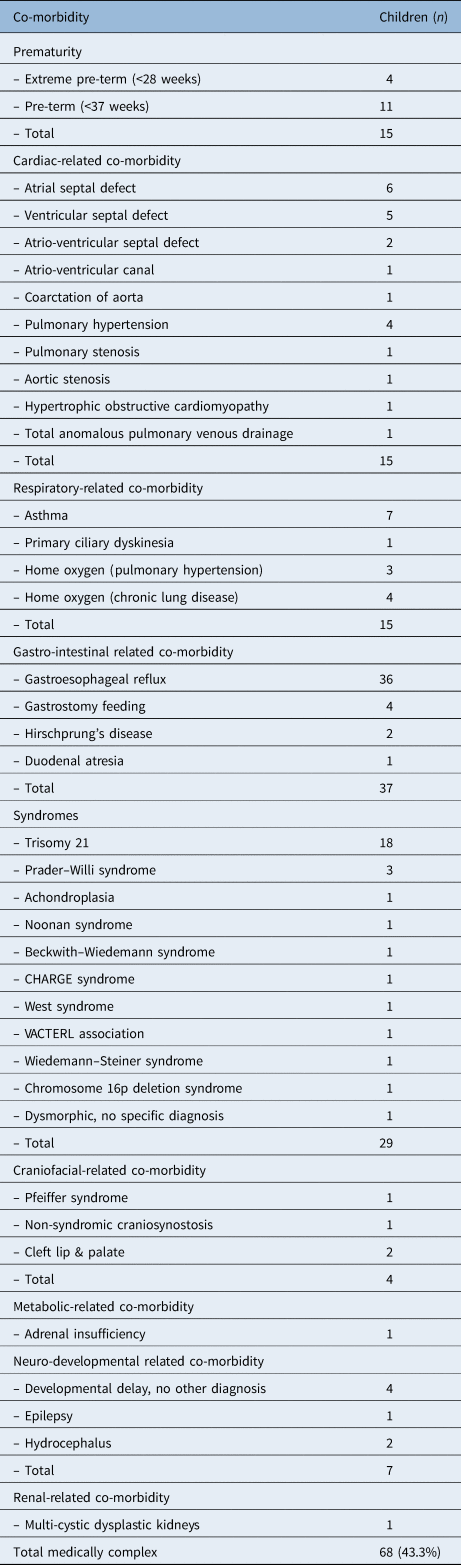
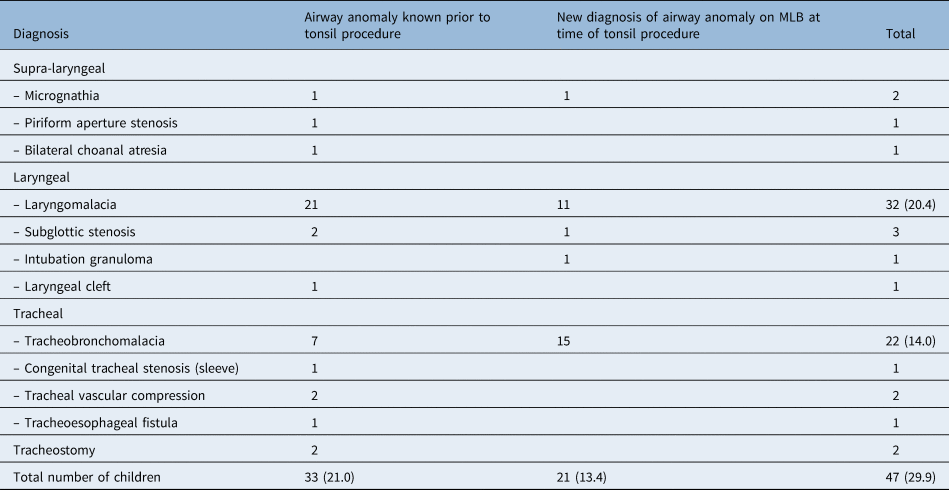
The co-morbidities of the children are listed in Table 1. Based on the presence of at least one significant co-morbid condition, 68 (43.3 per cent) of the children in the series could be described as medically complex. Airway anomalies were known pre-operatively in 33 children (21 per cent). These are shown in Table 2.
Co-morbidities of children in the study

The same child may have more than one co-morbidity, hence the number of co-morbidities is greater than the number of children within each category and overall. CHARGE = coloboma of the eye, heart defects, atresia of the choanae, retardation of growth and development and/or mental deficiency, genital anomalies, and ear anomalies and/or deafness; VACTERL = vertebral defects, anal atresia, cardiac defects, tracheoesophageal fistula, renal anomalies and limb abnormalities
Co-existing airway anomalies in children undergoing tonsil surgery

Data represent numbers (and percentages) of cases. The same child may have more than one airway diagnosis, hence the number of airway diagnoses is greater than the number of children within each category and overall. Percentages are given based on the total number of children in the series (n = 157). MLB = microlaryngoscopy-bronchoscopy
The indication for surgery was listed as sleep-disordered breathing alone for 136 children (86.6 per cent), sleep-disordered breathing with concomitant recurrent tonsillitis in 11 (7.0 per cent) and recurrent tonsillitis alone in 5 (3.2 per cent). For four children, the indication for surgery was listed as choking on food (with concomitant sleep-disordered breathing in two and recurrent tonsillitis in the other two), and for one child the procedure was performed to facilitate tracheostomy decannulation. Polysomnography is available for use in selected cases according to surgeon preference in our institution, but as it is not routinely used, we have not reported it here. The majority of sleep-disordered breathing diagnoses were made on clinical grounds alone.
Surgical procedure
Tonsil surgery was performed by means of: cold steel extracapsular dissection with bipolar diathermy haemostasis (23 cases, 14.6 per cent), coblation extracapsular dissection (96 cases, 61.1 per cent) and coblation intracapsular tonsillotomy (partial tonsillectomy: 31 cases, 19.7 per cent). One procedure was performed by bipolar diathermy dissection and one with the harmonic scalpel. For five children, the surgical procedure was not recorded. The proportion of tonsillotomy procedures varied between 12 and 42 per cent of all tonsil procedures performed (between 9 and 37 per cent of all coblation procedures) in any particular year, but there was no trend evident over time.
Of the children, 153 (97.5 per cent) had concomitant adenoidectomy at the time of the tonsil surgery, with the remaining 4 having had their adenoids removed at a previous procedure. Adenoidectomy was carried out by monopolar suction diathermy if the tonsillectomy was performed by cold steel dissection, or by coblation if the tonsil surgery was being performed in the same way. Other procedures carried out at the same time as the tonsil surgery included middle-ear ventilation tube insertion (21 cases, 13.4 per cent), tracheocutaneous fistula closure (1 case), choanal dilatation (1 case), oesophago-gastro-duodenoscopy (1 case), gastrostomy with fundoplication (1 case) and jejunal feeding tube replacement (1 case).
In young children with breathing issues, it is not uncommon or unreasonable for the clinician to want to examine the airway, even if the breathing issues have been attributed to the adenoids and tonsils. In this series, 55 children (35 per cent) underwent diagnostic microlaryngoscopy-bronchoscopy at the same time as the tonsil surgery. For 33 of these children, there were no new findings; however, for 21 children (38.2 per cent of those undergoing microlaryngoscopy-bronchoscopy), there were new airway anomalies found, namely laryngomalacia (11 cases), tracheobronchomalacia (15 cases, including 6 with a new finding of laryngomalacia), a grade 1 subglottic stenosis, an intubation granuloma (in a child who also had new findings of tracheomalacia and laryngomalacia) and micrognathia (in a child who also had new findings of tracheomalacia and laryngomalacia). Adding these to the airway anomalies already known before surgery reveals that airway anomalies were present in 29.9 per cent of the 157 children in this series, most commonly laryngomalacia (20.4 per cent) and tracheobronchomalacia (14.0 per cent), as shown in Table 2.
The 55 children who underwent microlaryngoscopy-bronchoscopy included 15 (9.6 per cent) who also had an endoscopic laryngeal procedure with therapeutic intent, namely supraglottoplasty for laryngomalacia (14 cases), repair of a grade 1 laryngeal cleft (1 case) and excision of a vocal fold granulation (1 case, in a child who also underwent supraglottoplasty).
Post-operative care and complications
Of the children, 131 (83.4 per cent) were nursed on the surgical ward post-operatively, and 19 (12.1 per cent) were electively admitted to the paediatric intensive care unit (PICU). Six children (3.8 per cent) were originally admitted to the ward, but then transferred emergently to the PICU. One child was already an in-patient on the PICU when the surgery was performed, having been admitted as an emergency with breathing issues. For the 26 children admitted to the PICU, the respiratory interventions required were: no intervention (6 cases, 23.1 per cent), oxygen (13 cases, 50 per cent), nasopharyngeal airway insertion (2 cases, 7.7 per cent), intubation and ventilation (3 cases, 11.5 per cent), and extracorporeal membrane oxygenation (1 case, 3.8 per cent). The duration of intubation and ventilation ranged from 1 to 5 days. The child who required extracorporeal membrane oxygenation had severe post-obstruction pulmonary oedema and a tension pneumothorax on a background of Noonan syndrome. Four children required emergency admission to the PICU for persistent hypoventilation and hypoxia, of whom two had Prader–Willi syndrome and one had trisomy 21: two of these children were on long-term home oxygen (one child with trisomy 21 and one with Prader–Willi syndrome). The other reasons for emergency admission to the PICU were: post-extubation stridor requiring reintubation in a child with trisomy 21, and pulmonary hypertensive crisis, also in a child with trisomy 21.
Medically complex children were more likely to: be admitted to the PICU (21 out of 68 vs 5 out of 89, Fisher's exact p < 0.001), be admitted to the PICU as an emergency (6 out of 68 vs 1 out of 89, p = 0.043) and require some form of post-operative respiratory support, including oxygen (30 out of 68 vs 9 out of 89, p < 0.001). Children aged less than 18 months were more likely to be admitted to the PICU (16 out of 46 vs 10 out of 111, p < 0.001) and to require respiratory support (19 out of 46 vs 20 out of 111, p = 0.04), but were no more likely to require emergency admission to the PICU. Children weighing less than 10 kg and less than 12 kg were more likely to: be admitted to the PICU (14 out of 41 vs 12 out of 116, p = 0.01, and 21 out of 90 vs 5 out of 67, p = 0.009, respectively), be admitted to the PICU as an emergency (6 out of 41 vs 1 out of 116, p = 0.001, and 7 out of 90 vs 0 out of 67, p = 0.02) and require respiratory support (20 out of 41 vs 19 out of 116, p < 0.001, and 31 out of 90 vs 8 out of 67, p = 0.001). Weight of less than 15 kg was not associated with a greater risk of complications.
Reactionary tonsil haemorrhage occurred in four children (2.5 per cent), and was managed conservatively in two children and operatively in two. Two children (1.3 per cent) had reactionary post-adenoidectomy haemorrhage, managed operatively in both cases. Other early complications were: poor oral intake that delayed discharge from hospital, in seven children (4.5 per cent); unexplained pyrexia, in four children (2.5 per cent); pneumonia requiring antibiotics, in three children (1.9 per cent); nausea and vomiting, in one child (0.6 per cent); and aspiration, in one child (0.6 per cent). One child developed chicken pox on the ward on the 1st post-operative day. One child had prolonged gastrostomy problems that delayed discharge for 41 days.
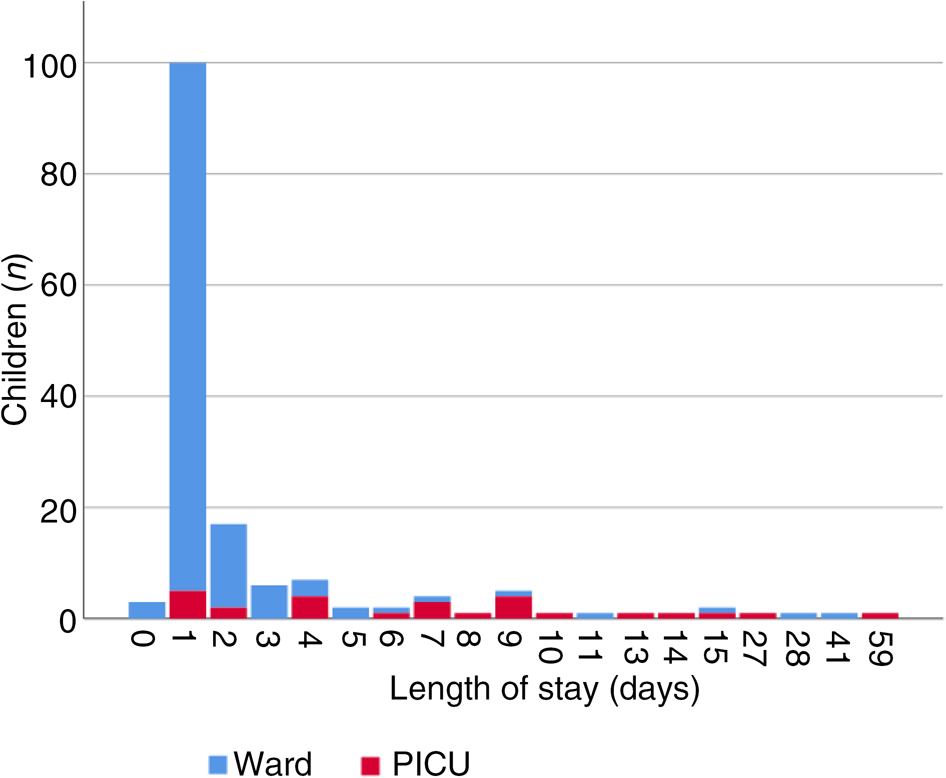
Length of stay ranged from 0 to 59 days (median, 1 day). No child should have been discharged home on the day of surgery as a matter of hospital policy, although it appears from the records that three children were. One hundred children (63.7 per cent) had a stay of 1 day. Seventeen children stayed for 2 days, and six stayed for 3 days, with the commonest reason being hypoxia requiring short-term support with supplemental oxygen (10 and 2 cases, respectively). Length of stay is shown in Figure 1. Extended hospital stays were caused by: the requirement of extracorporeal membrane oxygenation in the PICU (1 child, who stayed for 59 days), gastrostomy issues (1 child, who stayed for 41 days), and a prolonged need for supplemental oxygen in medically complex children (18 children staying between 7 and 28 days). Oxygen therapy was required for short-term post-operative support in 25 children for 1 to 5 days (median, 2 days).
Length of post-operative stay for the 157 children in the series. Children admitted to paediatric intensive care unit (PICU) are shown in red, those admitted to the ward are shown in blue.

Secondary haemorrhage occurred in 12 children (7.6 per cent). All were readmitted for observation according to hospital policy. Eleven cases (91.7 per cent) were managed conservatively and one operatively. Considering both reactionary and secondary haemorrhage, the overall bleed rate was 10.2 per cent, with a return to operating theatre rate of 1.9 per cent. None of the children in this series required blood transfusion. Reactionary, secondary and overall haemorrhage rates were not significantly higher in medically complex children, in children aged less than 18 months, or in children weighing under 10 kg, 12 kg or 15 kg. Reactionary, secondary and overall bleed rates did not vary according to surgical technique (cold steel dissection vs coblation dissection vs coblation tonsillotomy).
Three children who underwent intracapsular tonsillotomy (9.7 per cent) had a symptomatic late regrowth of tonsil tissue requiring a completion tonsillectomy (at 30, 34 and 61 months after the initial procedure).
In the latest UK guidance,8 children aged one year and over, who weigh at least 10 kg, and who have no major co-morbidities, are deemed suitable to undergo a tonsillectomy in some selected secondary care hospitals, which, while not tertiary paediatric centres, are judged to be ‘high acuity centres with HDU (high-dependency unit) provision’. In our study, 5 of the 157 children were aged under a year; 36 of the remainder weighed less than 10 kg, and a further 30 met criteria for significant co-morbidities in the UK guidance. Thus, there were 86 children in our study who would have met the criteria for tonsil surgery in a high acuity secondary care hospital with high-dependency unit facilities. Of these, one (1.2 per cent) required admission to the PICU as an emergency (with both post-operative hypoxia requiring oxygen and reactionary haemorrhage requiring a return to the operating theatre). Three children were admitted electively to the PICU, of whom only one required any respiratory intervention (oxygen). A further seven children required oxygen therapy on the general ward after surgery, bringing the total number of children requiring oxygen to eight (9.3 per cent). Three reactionary haemorrhages occurred in children managed on the general ward, with one requiring a return to the operating theatre, bringing the total number of bleeds to four (4.7 per cent) and the total number of same-day returns to the operating theatre to two (2.3 per cent). Twenty children in this group (23 per cent) stayed longer than 1 night after surgery (range, 2–9 days), mostly for poor oral intake, persistent pyrexia or oxygen requirement.
Conclusion
We present here a series of very young children undergoing tonsil surgery in our hospital. We are performing more than 30 of these procedures a year, some in children as young as six months and many weighing less than 10 kg. Almost half of these children are medically complex. Obviously, such young children present unique challenges, but, despite all this, most stay only 1 day and are nursed on a surgical ward with a low rate of respiratory complications. The rate of emergency admission to the paediatric intensive care unit (PICU) is only 3.8 per cent. Of those who were admitted electively to the PICU post-operatively, three-quarters required either no respiratory support at all or simple administration of oxygen. Serious complications do occur, but they tend to be in the children weighing less than 12 kg, the medically complex and those aged under 18 months. It has been our experience that children with Noonan syndrome, Prader–Willi syndrome or trisomy 21, and those on long-term home oxygen, are particularly at risk of complications, and these groups certainly need careful monitoring in a PICU environment.
Concerns about the post-operative care of young, high-risk children undergoing tonsillectomy for obstructive sleep apnoea led to the development of multidisciplinary referral guidance in the UK in 2009.Reference Robb, Bew, Kubba, Murphy, Primhak and Rollin9 This suggested that age of less than two years, weight of less than 15 kg and significant co-morbidities were reasons to refer the child for tonsillectomy in a specialist children's hospital. These were reasonable recommendations on the evidence available at the time, but they unfortunately led to very large numbers of children being referred to regional centres. This in turn led to increased waiting times and significant strain on children's hospital services. More recent guidance has been produced, with the referral threshold now suggested to be one year of age and a weight of 10 kg,8 along with the presence of significant co-morbidities as before. Our experience of children who meet these criteria is that only 1 out of 86 (1.2 per cent) required emergency admission to the PICU, and this child was managed only with oxygen therapy. Most likely, this child could have been managed in the high-dependency unit of a large district hospital, as could the other complications that occurred in this specific patient group. The guidance suggests that children aged less than a year, weighing less than 10 kg or with significant co-morbidities should be referred to a tertiary paediatric centre, and our findings support this guidance. For any child where there is concern, a discussion between the local hospital and the regional tertiary paediatric hospital is always worthwhile to discuss the most appropriate location for the surgery.
It is perhaps unsurprising that breathing difficulties in such young children are often multifactorial. Airway anomalies in addition to adenotonsillar hypertrophy are common, particularly laryngomalacia and tracheobronchomalacia. Laryngomalacia is itself common and is increasingly being recognised as a cause of sleep-disordered breathing.Reference Oomen and Modi10 The high prevalence of tracheobronchomalacia is interesting and novel, however, in a cohort of children who are presenting with sleep-disordered breathing rather than stridor, cough or recurrent pneumonia. A third of our series underwent microlaryngoscopy-bronchoscopy under the same anaesthetic as their tonsil surgery, and the pick-up rate for new airway lesions was high, at 38 per cent. We feel it is important for clinicians to consider additional airway pathology when young children present with sleep-disordered breathing, even if the presentation is typical and the tonsils are large.
We have to acknowledge that a retrospective review such as this has major limitations. Electronic patient records are not always complete, and some important information may be missing. Patients with a secondary post-tonsillectomy haemorrhage, for example, may present to a local hospital, and they would not then appear in our records. However, we feel that we have a sufficiently large number of patients and enough detail for each of them for us to be able to present some useful data, despite the limitations of the study.
While our experience is that bleeding is no more common in younger children, the consequences should a bleed occur are potentially much more serious because of their small circulating blood volume. Across much of the world, there has been a move from traditional extracapsular tonsil dissection to partial intracapsular tonsillotomy, with increasing evidence of lower haemorrhage rates and faster recovery from surgery.Reference Walton, Ebner, Stewart and April11 One in five procedures in our series was performed with the intracapsular technique, based on the preference of two of the eight permanent staff members in the department. We did not show any difference in bleed rates or respiratory complications between the main techniques used in our series (cold steel dissection vs coblation dissection vs coblation tonsillotomy), but that is likely to be because of the small number of complications and a lack of statistical power. As more evidence emerges of the benefits of the intracapsular technique, it is likely that more surgeons will use it, especially for these very young children where the need to avoid bleeding is paramount. No trend for an increasing proportion of tonsillotomies over time was visible in our data, but we expect that to change as more members of our staff become convinced of the potential benefits of the procedure.
• Younger children undergoing tonsillectomy may be more at risk of complications; previous North American evidence of children aged 3 years or less is conflicting
• Most children in this study had an uneventful post-operative course, spending 1 night on the surgical ward
• Additional, often unsuspected, airway pathology is common; airway endoscopy during adenotonsillectomy should be considered
• Emergency paediatric intensive care unit admission was required by 3.8 per cent, and 1.9 per cent required re-operation for bleeding
• Serious complications are more common in children weighing less than 12 kg, the medically complex and those aged under 18 months
• Children with Noonan or Prader–Willi syndromes, trisomy 21, or on long-term home oxygen are particularly at risk of complications, and need monitoring
It is noteworthy that the increase in the number of these very young children undergoing tonsil surgery represents a major change in practice over recent years, with significant implications. We need to consider the evidence that has driven this change. Observational studies have shown that sleep-disordered breathing is associated with serious sequelae, such as systemic and pulmonary hypertension, and endocrine disturbance, with effects on cognition, behaviour and learning.Reference Powell, Kubba, O'Brien and Tremlett2 Removal of the tonsils and adenoids is usually curative, so obstructive sleep apnoea has rapidly become a very common indication for surgery. Concerns about long-term cognitive sequelae in particular have led to more and more young children undergoing surgery. Recent randomised controlled trials, however, have not demonstrated any neuro-developmental benefit from surgery.Reference Marcus, Moore, Rosen, Giordani, Garetz and Taylor12,Reference Waters, Chawla, Harris, Heussler, Black and Cheng13 The children included in the trials are older than the children in our series, but the failure to demonstrate any effect on neurological and cognitive development should at least make us consider very carefully whether so many very young children need to undergo tonsil surgery at all.
Data availability statement
The data that support the findings of this study are available from the corresponding author upon reasonable request.
Competing interests
HK has previously run coblation tonsillectomy courses and provided other training on behalf of Smith & Nephew (formerly Arthrocare), manufacturers of coblation tonsillectomy equipment. OM has no conflict of interest to declare.