Despite its many anatomic modifications, Fontan failure remains prevalent in adult patients living with single-ventricle physiology. Utilised for repair of highly complex single-ventricle anatomy, the Fontan is most commonly used to palliate tricuspid atresia and hypoplastic left heart syndrome. Although this has created a generation of survivors of complex single-ventricle disease, recognition of the limitation of this circulation is increasing.Reference Goldberg, Shaddy, Ravishankar and Rychik1 Most commonly, survivors suffer from ventricular dysfunction, protein-losing enteropathy, plastic bronchitis and arrhythmias. Although several medical therapies exist to palliate these long-term complications, surgical treatments are becoming increasingly useful, including the introduction of mechanical devices and cardiac transplantation.
The Fontan operation was originally described by Francois M. Fontan and by Guillermo Kreutzer in 1971 as a treatment for tricuspid atresia. The premise is that utilising the only adequate functioning ventricle as the systemic ventricle requires that blood flow to the lungs be delivered passively without the contraction of a ventricle. In this case, deoxygenated blood returns from the body and is directed towards the pulmonary arteries, bypassing a ventricle. The blood is oxygenated and returns back to the left atrium, driven by the difference between central venous pressure and left atrial pressure. Therefore, this system is sensitive to pressure gradients created by alterations in pulmonary vascular resistance, systolic or diastolic dysfunction, or even the slightest degree of obstruction in the system. As suggested by Goldberg et al, Fontan failure may be categorised as ventricular dysfunction, systemic complications of the Fontan and chronic Fontan failure.
Ventricular dysfunction has a variable pattern in patients with Fontan failure. Although systolic dysfunction may be easy to recognise, diastolic dysfunction is insidious and often equally debilitating. Ventricular failure is hypothesised to arise from the use of a right ventricle as the systemic ventricle, maybe because of ventriculotomy during the staged palliation of single-ventricle disease, and from ventricular volume loading during early palliation. Medical therapy for biventricular heart failure has been widely utilised in single-ventricle failure but without any definitive efficacy, although preliminary data remain encouraging. Ultimately, medical management can palliate ventricular failure, but in many patients it is not a permanent solution.
Even in the absence of ventricular dysfunction, systemic complications of the Fontan operation include protein-losing enteropathy and plastic bronchitis. These may occur in ∼5% of patients, including those with normal ventricular function.Reference Mertens, Hagler, Sauer, Somerville and Gewillig2, Reference Feldt, D and Offord3 Mortality is high in patients suffering from these systemic complications and has been reported to be as high as 50% within 5 years of diagnosis. In protein-losing enteropathy, enteric protein loss, primarily of albumin, leads to ascites, peripheral oedema and pleural effusions. Further complications include thromboembolism, immunodeficiency and impaired growth due to nutritional compromise. Diarrhoea is a common symptom but not always present. The diagnosis is confirmed by evidence of α-1-antitrypsin in stool. In the case of plastic bronchitis, proteinaceous material develops in the airway, forming bronchial casts. Chronic cough occurs and there is bronchial plugging with thick mucus and casts, which characterise the shape of the airway in an arborisation pattern. Segmental obstruction leads to atelectasis and airway obstruction, which can be potentially fatal.
Several mechanisms of Fontan failure, although not all, may be amenable to surgical intervention. Most often, surgical therapy includes atrial arrhythmia ablation, atrioventricular valve repair or replacement, neo-aortic valve replacement and conduit revision for residual pathway obstruction. In 2003, we published our early experience with re-operation following the Fontan.Reference Petko, Myung and Wernovsky4 From 1995 to 2001, 123 procedures were performed in 71 patients. The majority of the procedures included re-inclusion of previously excluded hepatic veins, revision of an atriopulmonary Fontan to an extracardiac Fontan, enlargement or creation of a baffle fenestration, isolated atrioventricular valve repair or replacement, cardiac transplantation, and, predominantly, pacemaker insertion or revision. It is well recognised that almost half of the patients followed after the Fontan operation go on to develop sinus node dysfunction.Reference Cohen, Wernovsky and Vetter5
For those patients with atriopulmonary Fontans, conversion to a total cavopulmonary artery extracardiac Fontan addresses many of these issues. Mavroudis et alReference Mavroudis, Deal and Backer6 reported outcomes with Fontan conversion in 2007 on 111 patients. The mean age for these patients was 22.5 years. The risk factors for death or transplantation include presence of a right or ambiguous ventricle, pre-operative protein-losing enteropathy, moderate-to-severe atrioventricular valve regurgitation and long (>239 minutes) cardiopulmonary bypass time. In comparing different cohorts, there was an era effect with a trend towards older patients and increased atrial arrhythmias. Although the Fontan conversion is a useful adjunct to management of the failing Fontan, the durability of this approach remains unclear.
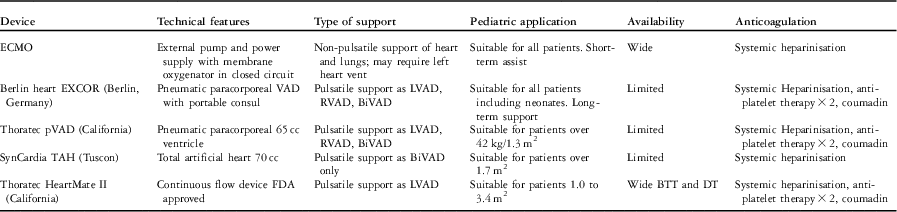
For those patients who have already undergone Fontan revision and suffer from progressive Fontan failure, cardiac transplantation is the preferred treatment. The biggest challenge for single-ventricle patients of any age remains the availability and utility of adequate mechanical support to ensure survival to transplantation. Intuitively, a ventricular assist device may replace the systemic ventricle, but often this is insufficient to “fix” the failing Fontan. Owing to the passive flow through the pulmonary vascular bed, inadequate preload for the single ventricle is a cause of diminished cardiac output, and thus support of the single ventricle alone with a ventricular assist device does not necessarily reduce the systemic venous pressure. Table 1 lists the forms of mechanical support available at The Children's Hospital of Philadelphia. In order to proceed with mechanical device, patients must be a transplant candidate and without neurologic impairment, sepsis or multi-system organ failure.
Types of mechanical support available at The Children's Hospital of Philadelphia.

BiVAD = both at once ventricular assist device; BTT = bridge to transplantation; DT = destination therapy; LVAD = left ventricular assist device; pVAD = paracorporeal ventricular assist device; RVAD = right ventricular assist device; VAD = ventricular assist device.
A limited number of ventricular assist devices have been implanted into Fontan patients.Reference Kogon7 There are isolated case reports in patients ranging from 18 months to 25 years. Devices include Berlin Heart, Heartmate II and Thoratec. The majority of the patients were successfully transitioned to transplant, with one death and one explant for recovery of function. A variety of techniques have been used.Reference Nathan, Baird and Fynn-Thompson8
More recently at The Children's Hospital of Philadelphia, we report the first use of a total artificial heart for Fontan failure as a bridge to transplant (Fig 1a and b). An atrial connector for the total artificial heart was sutured to the mitral annulus and cuff of LV muscle. An ellipse of the Gore-Tex graft was excised and an atrial connector sutured to the neo-RA. The pulmonary artery bifurcation was opened and the pulmonary artery outflow graft anastomosed in an end-to-side manner. The aortic outflow graft was anastomosed in an end-to-end manner to the aorta. The drive lines for the artificial ventricles were tunneled to the left upper quadrant. The left artificial ventricle was filled with saline and attached to the atrial connector and the outflow graft. The right artificial ventricle was inserted in a similar manner. Providing biventricular support in this clinical setting has the advantage of reducing systemic venous pressure while augmenting cardiac output. This strategy addresses the fundamental difficulty with the failing Fontan circulation and, as in this case, may allow for the resolution of symptoms and end-organ dysfunction associated with failing Fontan physiology, thus improving suitability for transplantation. Although devices are routinely used as a bridge to transplant, total artificial hearts have become a viable option for destination therapy but only in those patients large enough to accommodate the devices. The lack of organ availability resurrects the questions of destination therapy for the failing Fontan. Icenogle is proceeding with a single-centre feasibility study to examine the effects of implanting continuous flow cardiac support devices (HeartMate II) in 20 patients with Fontan physiology who are not candidates for transplantation. The end-point is survival without disabling stroke within the first 2 years following implantation.
(a) Extra-cardiac conduit (ECC) Fontan. (b) Removal of ECC, creation of “neo-right atrium” to collect caval flow and insertion of right and left artificial ventricles for the total artifical heart.
Owing to the fact that wait list times are often long, physicians must cautiously and judiciously decide when to list the failing Fontan for transplantation. Optimally, patients are transplanted before suffering from refractory protein-losing enteropathy or plastic bronchitis and while they exhibit no evidence of end-organ renal or hepatic failure and have maintained adequate nutritional status. It is our belief that patients with a failing Fontan circulation should therefore be evaluated early for transplantation. Haemodynamic assessment is critical and often a pulmonary vascular resistance greater than 6 WU without reactivity is a contraindication for heart transplantation. Often, accurate assessment of pulmonary vascular resistance in the Fontan circuit is difficult because of non-pulsatile flow, the presence of venous and aortopulmonary collaterals, low cardiac output and the presence of a fenestration. Another consideration regarding transplantation is the sensitisation of the recipient. Patients who have received multiple blood transfusions or have undergone surgical reconstruction with homograft material risk being highly sensitised to human leukocyte antigen. Liver dysfunction is now widely recognised as a complication of the Fontan circulation and is thought to correlate with duration of Fontan circuit. Candidacy for transplantation therefore includes thorough evaluation of hepatic function including liver biopsy. The presence of severe bridging fibrosis or cirrhosis is an indication for combined heart–liver transplantation.
Evidence remains contradictory that patients with single-ventricle physiology have increased morbidity and mortality after cardiac transplantation. Davies et alReference Davies, Sorabella, Yang, Mosca, Chen and Quaegebeur9 recently published their results for 43 patients, with a median age of 14.5, undergoing transplant. In this study, Fontan patients had a longer cardiopulmonary bypass time and were more likely to require pulmonary artery reconstruction. The 90-day mortality in the Fontan group was significantly higher compared with those patients with biventricular congenital heart disease. This experience parallels our experience at The Children's Hospital of Philadelphia in which the use of deep hypothermic circulatory arrest is often an indicator of the complex reconstruction required. However, Kanter et alReference Kanter, Mahle, Vincent, Berg, Kogon and Kirshbom10 at Emory report mortality from transplantation equal to those in non-Fontan patients. Davies et alReference Davies, Russo, Yang, Quaegebeur, Mosca and Chen11 reported data from the UNOS data set from 1995 to 2009 during which time over a thousand patients with congenital heart disease were transplanted. Interesting observations include the steady rate of listing for patients with congenital heart disease, consistently comprising ∼2.5% of all patients listed for heart transplantation. This is despite a growing population of adult congenital survivors. Authors hypothesise that this is perhaps related to the hesitation to list complex patients requiring technically demanding surgery with known increased early mortality. Yet although early mortality was higher among patients with congenital heart disease, by 10 years overall survival was equivalent when comparing patients with congenital heart disease to those without congenital heart disease. Chen notes that congenital heart disease patients spend longer on the waiting list despite a higher percentage of time as status I/IIA/IIB and that ventricular assist device implantation in the congenital heart disease population did not increase survival to transplant as it does in the non-congenital heart disease population. The fact that fewer patients reach transplantation suggests that decisions regarding the timing of listing, management of waiting list candidates and donor selection all need improvement.
Although Fontan conversion and transplantation will continue to benefit patients suffering from the failing Fontan circulation, future efforts are directed towards the development of more suitable devices for children. The PumpKIN trial, funded by the National Heart Lung Blood Institute, is schedule to start in late 2013 and will trial several devices appropriate for children up to 20 kg. Patients must be in decompensated heart failure and inotrope dependent or unable to wean from the ventilator. They must be eligible for cardiac transplant. Primary end-points are survival to transplant, recovery or continued support with no new profound neurologic dysfunction.
Overwhelmingly, the increasing number of failing Fontan patients highlights the need for improved surveillance in anticipation of determining the subtle signs of failure. By identifying early signs of Fontan failure, we have the potential to slow or modify the course of Fontan failure until better strategies for survival become available. Although there are fewer atriopulmonary Fontan patients eligible for Fontan conversion, mechanical support options will increase for failing Fontan patients, including the availability of destination therapy. Ultimately, transplant will remain a limited option for all patients.