Implications
This study provides insights into the effects of n-3-enriched diets offered to ewes during late pregnancy and lactation on postnatal growth performance of their offspring. Of special interest was the efficiency by which dietary n-3 fatty acids are transferred and deposited in fetal tissue. The potential enrichment in long-chain PUFAn-3 by elongation and desaturation of linolenic acid was monitored. To our knowledge, this is the first study that shows that diets with elevated n-3 fatty acids offered prepartum were more efficient in increasing the amount of long-chain fatty acids compared with postpartum diets. These results are equally relevant for the lamb production as well as for human nutrition.
Introduction
Consumption of meat from suckling lambs is common in Mediterranean countries, where lambs are traditionally slaughtered as early as possible, so that sheep milk can be transformed into cheese. In Sardinia, there is a special line of production of Sardinian lambs (Agnello di Sardegna) with Protected Geographic Indication (PGI) created in 2001 (CE No. 138/01). These lambs are raised with their dams and fed almost exclusively maternal milk. At slaughter, they are 25 to 30 days old and reach a BW of 9 to 11 kg.
Increasing public awareness on the health benefits attributable to CLA, n-3 polyunsaturated fatty acids (PUFA) and long-chain (LC) fatty acids stimulated interest in the sources of these fatty acids available for human consumption. Recent human studies showed beneficial effects of dietary intake of dairy products naturally enriched with cis(c)9,trans(t)11-CLA, such as a decrease in plasma cholesterol level (Pintus et al., Reference Pintus, Murru, Carta, Cordeddu, Batetta, Accossu, Pistis, Uda, Ghiani, Mele, Secchiari, Almerighi, Pintus and Banni2013). Epidemiological studies indicated that, among PUFAn-3, α-linolenic acid (18:3n-3; ALA) is associated with reduced risk of cardiovascular diseases, and the LC-PUFAn-3, notably docosapentaenoic acid (22:6n-3; DHA), are recognized for their beneficial effects on heart health, proper prenatal brain and eye development and maintenance of neural and visual tissues throughout life (Ruxton et al., Reference Ruxton, Reed, Simpson and Millington2004). Metabolically, ALA is the precursor of eicosapentaenoic (20:5n-3; EPA), docosapentaenoic (22:5n-3; DPA) and DHA. Due to the low conversion rates of ALA to DHA, improvement of the DHA status of humans can be achieved primarily with dietary DHA supplements (Brenna et al., Reference Brenna, Salem, Sinclair and Cunnane2009). A lot of effort has been put into testing ways to increase the LC-PUFAn-3 levels in meat (Shingfield et al., Reference Shingfield, Bonnet and Scollan2013). Due to its lower allergenicity compared with other red meat sources (Cardi et al., Reference Cardi, Corrado, Cavaliere, Grandina, Pacchiarotti, Rea, Mazza, Nardelli and Agazie1998; Martino et al., Reference Martino, Bruno, Aprigliano, Agolini, Guido, Giardini and Businco1998), an enrichment of these fatty acids in lamb meat could be interesting, especially in weaning diets of children.
Although linseed is one of the crops richest in ALA content, and therefore a predestinated dietary source for providing LC-PUFAn-3, the reported effects on LC-PUFAn-3 enrichment in meat are of modest extent and not univocal. Some authors found an increase of LC-PUFAn-3 in lambs fed linseed diets (Noci et al., Reference Noci, Monahan and Moloney2011; Berthelot et al., Reference Berthelot, Bas, Pottier and Normand2012), while others did not observe any effect (Bas et al., Reference Bas, Berthelot, Pottier and Normand2007). Others found that feeding ewes a n-3-enriched diet in lactation increased the proportion of 18:3n-3 and their longer chain derivatives in suckling lamb muscles (Gómez-Cortés et al., Reference Gómez-Cortés, Gallardo, Mantecón, Juárez, de la Fuente and Manso2014; Mele et al., Reference Mele, Serra, Pauselli, Luciano, Lanza, Pennisi, Conte, Taticchi, Esposto and Morbidini2014), whereas Berthelot et al. (Reference Berthelot, Bas, Pottier and Normand2012) did not report such effects in their earlier experiment. Some studies in human and laboratory animals suggest that the conversion of ALA into LC-PUFA homologs increases during pregnancy probably due to the agonistic effects of the female sex hormones estrogen and progesterone (Kitson et al., Reference Kitson, Stroud and Stark2010). Similarly, de Quelen et al. (Reference de Quelen, Boudry and Mourot2010) reported an increase in LC-PUFAn-3 content in the placenta of sows fed ALA-enriched diets during pregnancy, suggesting the synthesis of LC-PUFAn-3 from dietary ALA.
If both the conversion rate of 18:3n-3 into their LC-PUFAn-3 homologs in either fetal or maternal tissue and their transfer rate to the fetus are increased, feeding ALA-rich diets to ewes during gestation could be a way to elevate LC-PUFAn-3 content in lamb meat. To test this hypothesis, accumulation of ALA and their LC-PUFAn-3 homologs was determined in muscle tissues of suckling lambs born from dairy ewes offered either an ALA-enriched or unsupplemented diet during pregnancy alone or during pregnancy and early lactation. In addition, the effect of maternal ALA supplementation on lamb growth and carcass yield was evaluated.
Materials and methods
Animal and dietary treatment
The study was carried out with 36 pluriparous ewes of Sarda breed that were mated within a period of 2 weeks. The trial started 8 weeks before lambing and ended after the first 4 weeks of lactation. The ewes were randomly assigned to one of the following four feeding plans (nine animals for each group): control diet both in gestation and lactation (CON/CON); linseed diet both in gestation and lactation (LIN/LIN); LIN diet in gestation and CON diet in lactation (LIN/CON); and CON diet in gestation and LIN diet in lactation (CON/LIN). Thus, the lambs used in this experiment were from ewes fed CON/CON, CON/LIN, LIN/LIN or LIN/CON diets.
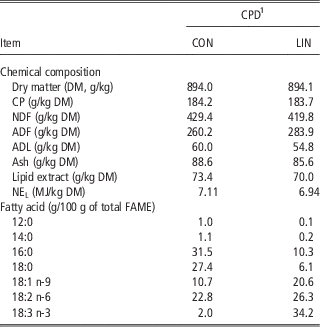
The CON and LIN diets consisted of two isolipidic, isonitrogenous and isoenergetic concentrate-pelleted diets (CPD; Table 1) and were formulated to meet the energy and protein requirements of late-gestating and lactating ewes, respectively, using the Small Ruminant Nutrition Model (Tedeschi et al., Reference Tedeschi, Cannas and Fox2010). These diets, due to the different lipid sources, varied widely in their fatty acid composition (Table 1). In the control CPD, the lipid source was a mix of soybean flakes, corn germs, rice hulls, distillers and hydrogenated fatty acids. The predominant fatty acids in the CON diet were palmitic (16:0), stearic (18:0) and linoleic acids (18:2n-6), with concentrations of 31%, 27% and 23% of total fatty acid methyl esthers (FAME), respectively. The addition of extruded linseed in the LIN diet (150 g/kg of CPD) resulted in an ALA level of 34% of total FAME. Each ewe received 1 kg of the CPD and had ad libitum access to hay. The CPD was offered daily in three equal portions for 8 weeks until parturition and during 4 weeks postpartum. In the last 4 weeks of GEST, an additional 150 g/day of corn flour was fed to support the increased energy requirements for fetal growth. During the experiment, the CPD was completely eaten by all animals. The average individual hay intake was estimated at 250 and 1100 g of dry matter (DM) for last month of gestation and early lactation, respectively, based on animal energy requirements.
Chemical composition and fatty acid profile of the control (CON) and linseed (LIN) supplemented concentrate-pelleted diets (CPD)

FAME=fatty acid methyl esthers.
1 CPD (concentrate pelleted diet) with the following ingredients: CON (control)=wheat bran, alfalfa meal, distilled from wheat, sunflower extraction meal, corn germ cake, dried sugar beet pulp, calcium carbonate, soybean meal, maize, sodium chloride and sodium bicarbonate, magnesium oxide; LIN (linseed)=soybean hulls, extruded linseed, wheat bran, sunflower seeds flour, alfalfa meal, dried sugar beet pulp, corn gluten feed, calcium carbonate, soybean meal, maize, sodium chloride, sodium bicarbonate, magnesium oxide. Mineral and vitamin supplements.
After lambing, 36 newborn lambs (four males and five females per group in CON/CON and CON/LIN; five males and four females per group in LIN/CON and LIN/LIN) were housed with their respective mothers and nourished exclusively by suckling from birth until day 28 of age. Milk production was estimated and milk samples were collected at week 3 and 4 postpartum. To estimate the milk yield, the day before sampling, lambs were removed from their mothers. Subsequently, ewes were milked at 1800 h to remove residual milk and milked again at 0600 h the next morning. Milk production during 12 h was used to obtain a 24-h estimate of milk yield for each ewe.
At 28 days of age, the lambs were weighed and then slaughtered according to the EU legislation. Procedures were conducted according to the guidelines of the Directive 2010/63/EU on the protection of animals used for scientific purposes. The cold carcass weight was determined after 24-h storage at 4°C. The thigh muscles (Semitendinosus, Semimembranosus and Femoral biceps) were excised from the right side of each carcass. After being freeze-dried for 72 h (−55°C and 2.0 hPa), the epimysium and visible external fat were removed from the samples, finely minced and prepared for chemical analysis.
Nutrient composition of feed, milk and meat samples
The DM content of the feed was determined by oven-drying at 105°C for 24 h, and the ash content was determined in accordance with the Association of Official Analytical Chemists (AOAC) method 942.05 (AOAC, 2000). Feed samples were analyzed for NDF, ADF and ADL contents using the filter bag equipment of Ankom (Ankom Technology Corp., Fairport, NY, USA). The CP content was determined in accordance with the AOAC method 988.05 (AOAC, 2000), and the lipid extract was determined by the Soxhlet method using petroleum ether. Results of the chemical analyses are reported as percentages of DM.
Individual milk samples were analyzed for fat, protein, lactose and milk urea nitrogen contents using a Milkoscan 6000 instrument (Foss Electric, Hillerød, Denmark), and for somatic cell count using a Fossomatic 360 instrument (Foss Electric).
The muscle samples were analyzed for moisture, ash, total protein and fat contents. The moisture content was determined in about 50 g of muscle tissue after 72 h of freeze-drying. Total ash content was determined at 550°C for 24 h according to the AOAC method (2000). The CP content (N×6.25) was determined by the Kjeldahl method (AOAC, 2000). Total fat content was determined after extraction using a solution (2 : 1 v/v) of chloroform : methanol (Folch et al., Reference Folch, Lees and Stanley1957).
Fatty acid analysis of feed, milk and meat samples
Fatty acid composition of feed, milk and meat samples was determined by gas chromatography (GC Turbo 3400 CX; Varian Inc., Palo Alto, CA, USA). Milk fat was extracted by the Rose-Gottlieb procedure with some modification, as detailed by Mele et al. (Reference Mele, Conte, Castiglioni, Chessa, Macciotta, Serra, Buccioni, Pagnacco and Secchiari2007). In brief, 0.4 ml of ammonia (25%, w/v), 1 ml of ethyl alcohol (95%, v/v) and 5 ml of hexane were added to 1 g milk, which was then vortexed and centrifuged. The upper layer was collected, and a second extraction was performed with 1 ml of ethyl alcohol (95%, v/v) and 5 ml of hexane. A third extraction was then carried out using 5 ml of hexane. The extracted fat was evaporated under nitrogen and finally dissolved in hexane. The meat samples were lyophilized and finely ground before fat extraction, as detailed by Nudda et al. (Reference Nudda, McGuire, Battacone, Manca, Boe and Pulina2011). In brief, 30 ml of chloroform : methanol (2 : 1, v/v) was added to 1 g of lyophilized meat in a 50-ml tube. The tube was shaken for 30 s, sonicated for 5 min and then centrifuged at 600×g for 10 min at room temperature. The supernatant was filtered under vacuum, and 6 ml of NaCl (1%, w/v) was added and then centrifuged at 600×g for 10 min. The upper methanol : water layer was discarded and the chloroform extract layer was evaporated under nitrogen.
Approximately 20 mg of milk and meat lipid fractions were converted to methyl esters (FAME) by cool base-catalyzed methylation using 0.5 M methanolic solution of sodium methoxide (Sigma-Aldrich, St. Louis, MO, USA), according to the standard procedure of the International Dairy Federation (1999). For quantitative purposes, 1 ml of internal standard (0.5 mg/ml of C19:0 methyl ester; Sigma-Aldrich) was added to the meat lipid fraction before methylation. FAMEs from feeds were obtained directly from samples using a two-step sodium methoxide and methanolic HCl procedure (Kramer et al., Reference Kramer, Fellner, Dugan, Sauer, Mossoba and Yurawecz1997). The FAMEs were separated in a capillary column (CP-select CB for Fame; 100 m×0.32 mm i.d., 0.25-μm film thickness; Varian Inc.). The injector and FID temperatures were set at 255°C. The programmed temperature was 75°C for 1 min, raised to 165°C at a rate of 8°C/min, maintained at 165°C for 35 min, increased to 210°C at a rate of 5.5°C/min and finally increased to 240°C at a rate of 15°C/min. The split ratio was 1 : 100 with He as the carrier gas at a pressure of 37 psi. Individual FAMEs were identified by comparing them to known standards of FAMEs and published isomeric profiles, as detailed in Nudda et al. (Reference Nudda, McGuire, Battacone, Manca, Boe and Pulina2011). The concentrations of PUFA and of monounsaturated fatty acids (MUFA), saturated fatty acids (SFA) and odd-branched chain fatty acids (OBCFA) were calculated. Fatty acids were expressed as a proportion of total FAME (% of total FAME) or in gravimetric concentration (mg/100 g of fresh meat). The energy value (kcal) was calculated by multiplying the amount of protein and lipid by the general conversion factors of 4 and 9, respectively (EU Council Directive 496/90, 1990).
Fatty acid oxidation was assessed in meat samples by determining secondary products of fatty acid oxidation such as 2-thiobarbituric acid-reactive substances, as described by Nudda et al. (Reference Nudda, Battacone, Boe, Manca, Rassu and Pulina2013).
Statistical analysis
The effects of dietary treatment on milk yield, nutrient and fatty acid compositions were determined using the following mixed linear model:
 $$Y_{{ijkl}} =\mu {\plus}{\rm D}_{i} {\plus}{\rm W}_{j} {\plus}\left( {{\rm D{\times}W}} \right)_{{jj}} {\plus}{\rm A}_{k} {\plus}e_{{ijkl}} $$
where Y ijkl is the milk-dependent variable (yield, nutrient and fatty acid composition); μ the overall mean, D i the fixed effect of maternal diet (i=CON/CON, CON/LIN; LIN/CON; LIN/LIN); W j the fixed effect of week of lactation; A k the random effect of animal nested within diet; e ijkl the residual error.
Data of nutrient and fatty acid compositions of meat were analyzed with the following general linear model:
 $$Y_{{ijk}} =\mu {\plus}{\rm D}_{i} {\plus}{\rm S}_{k} {\plus}\left( {{\rm S{\times}D}} \right)_{{ik}} {\plus}e_{{ijk}} $$
where Y ijk is the fatty acid, fat, protein and ash content; μ the overall mean; D i the fixed effect of maternal diet (i=CON/CON, CON/LIN, LIN/CON, LIN/LIN); S k the fixed effect of sex; e ijkl the residual error.
Statistical analysis was performed using SAS version 9.2 (SAS Institute Inc., Cary, USA). The level of significance was set at P⩽0.05 and tendencies at P⩽0.10. Interactions are only commented in the text when they were significant (P⩽0.05).
Results and discussion
Milk yield and composition
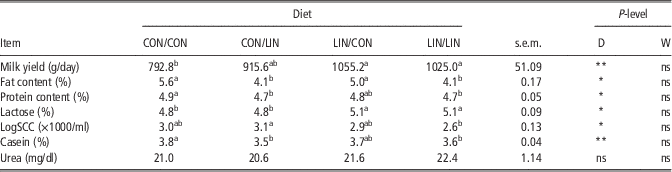
Compared with the CON/CON, LIN supplementation only during gestation (LIN/CON) positively influenced (P<0.05) milk yield and lactose concentration without affecting the fat and protein contents in the subsequent lactation period (Table 2). In contrast, the linseed supplementation in the lactation period (CON/LIN) did not affect milk yield but reduced (P<0.05) fat and protein contents compared with the CON/CON treatment. Continuous linseed supplementation (LIN/LIN) did not cause a further increase in milk yield compared with the LIN/CON diet. As the amount of CPD and hay offered to the animals was the same in both the treatments and the diets tested in this trial were isoenergetic and isonitrogenous, no changes in milk yield or nutrient composition were expected. A possible explanation for the greater milk yield in LIN/CON treatment could be a greater differentiation of udder secretory cells, which is completed at the end of gestation and within the first few days of lactation in dairy sheep (Boutinaud et al., Reference Boutinaud, Guinard-Flamenta and Jammes2004; Castañares et al., Reference Castañares, Colitti, Nudda, Stefanon and Pulina2013), due to linseed supplementation in the gestation period. This hypothesis is supported by recent results with dairy cows offered a linseed supplement in late gestation and early lactation, where an increase in the expression of genes involved in cell proliferation of the mammary gland was evidenced (Mach et al., Reference Mach, Zom, Widjaja, van Wikselaar, Weurding, Goselink, van Baal, Smits and van Vuuren2013). The observed drop in the milk fat content in groups that received linseed during lactation (CON/LIN and LIN/LIN) compared with the CON/CON group may result from a reduced de novo fatty acid synthesis in milk due to the increased intake and ruminal passage of LC fatty acids. The latter are known to compete in the mammary gland with short- and medium-chain fatty acids for esterification into triglycerides. In addition, the LIN supplementation during lactation may have caused a shift in rumen biohydrogenation pathways with the increased formation of the t10c12 CLA isomer or other biohydrogenation intermediates that have been associated with a decrease in mammary de novo fatty acid synthesis (Shingfield et al., Reference Shingfield, Bernard, Leroux and Chilliard2010). Furthemore, the PUFA supplementation may have depressed the expression of genes involved in lipogenesis in the mammary gland (Bernard et al., Reference Bernard, Leroux and Chilliard2008). The reduction of milk fat due to ALA supplementation from linseed was previously observed in ewes supplemented with a similar dose of extruded linseed (128 g/day; Gómez-Cortés et al., Reference Gómez-Cortés, Gallardo, Mantecón, Juárez, de la Fuente and Manso2014).
Milk yield, milk nutrient composition and somatic cell count in Sarda ewes fed control (CON) and linseed (LIN) diets during gestation and/or lactation

SCC=somatic cell count;
P-level=probability values for diet (D) and wk of lactation (W). The interactions D×W were not significant.
Milk fatty acid composition
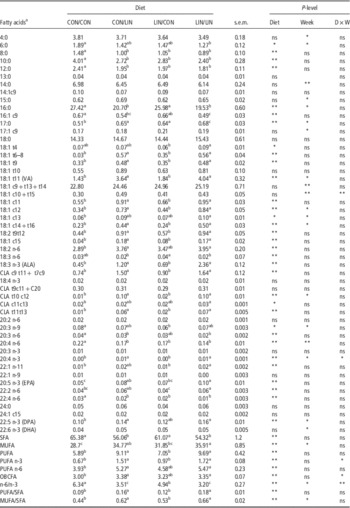
The fatty acid profiles of milk fat from ewes of the different experimental treatments are given in detail in Table 3. In line with previous reports for sheep (Manso et al., Reference Manso, Bodas, Vieira, Mantecón and Castro2011), milk from ewes fed linseed during lactation (CON/LIN and LIN/LIN) had a lower (P<0.01) proportion of total SFA (−15.6%) and greater (P<0.01) proportion of total MUFA (+23%) as well as total n-3 and n-6 PUFA concentrations (+141 and+36%, respectively) compared with milk from the CON/CON group. On the other hand, PUFAn-3 concentration was not different between the CON/CON and LIN/CON groups.
Fatty acid profile (expressed in mg/100 mg total FAME) of milk collected 3 and 4 weeks postpartum in Sarda ewes fed control (CON) and linseed (LIN) diets during gestation and/or lactation

Within rows, means without a common letter differ (P<0.05).
P-level=probability values for diet (D) week of sample collection (W) and D×W interaction: *P<0.05, **P<0.01, ns=P>0.10.
aCLA=conjugated linoleic acid; VA=vaccenic acid; ALA=alpha-linolenic acid; EPA=eicosapentaenoic acid; DPA=docosapentaenoic acid; DHA=docosahexaenoic acid; SFA=saturated fatty acids (sum of 10:0, 12:0, 14:0, 15:0, 16:0, 17:0, 18:0, 22:0, 24:0 and odd-branched fatty acids); MUFA=monounsatured fatty acids (sum of 14:1, Σ16:1, Σ171 and Σ18:1); PUFA=polyunsatured fatty acids (sum of total n-6 and total n-3); PUFA n-3=sum of 18:3n-3, 18:4n-3, 20:3n-3, 20:4n-3, 20:5n-3, 22:5n-3, 22:6n-3); PUFA n-6=sum of Σ18:2n-6 cis/trans isomers, 18:3n-6, 20:2n-6, 20:3n-6, 20:4n-6, 22:2n-6, 22:4n-6; OBCFA=odd-branched fatty acids (sum of 13:0, 13:0 i, 13:0 ai, 14:0 i, 15:0 i, 15:0 ai, 16:0 i, 17:0, 17:0 i, 170 ai and Σ17:1, where i is an iso-isomer and ai is an ante-iso-isomer).
With reference to individual saturated fatty acids, milk from ewes offered linseed during gestation and/or lactation had lower proportions of 8:0, 10:0 and 12:0 and a greater proportion of 17:0 compared with the CON/CON diet. Moreover, ewes fed linseed during lactation (CON/LIN and LIN/LIN) had a lower proportion of 16:0 compared with the CON/CON or LIN/CON diets. Regarding the individual LC-PUFA contents, the milk of the ewes fed linseed diets during lactation had a lower proportions of 20:4n-6 and 22:4n-6 and a greater proportions of EPA and DPA (but not DHA) with respect to the CON/CON group. These differences in LC-PUFA content were not observed between the LIN/CON and CON/CON ewes. The continuous linseed supplementation from gestation to lactation did not cause additive effects on the aforementioned fatty acids.
The amount of almost all the identified t-18:1 isomers increased (P<0.05) because of the linseed supplement. In particular, the proportion of vaccenic acid (t11-18:1) was more than twice greater in groups receiving linseed during lactation compared with the CON/CON and LIN/CON treatments. The total CLA level was almost twice greater in groups receiving linseed during lactation, with the c9,t11-CLA being the most abundant isomer in both groups. The observed 102% enrichment in c9,t11-CLA in the CON/LIN compared with the CON/CON group was almost 40% lower compared with what Gómez-Cortés et al. (Reference Gómez-Cortés, Gallardo, Mantecón, Juárez, de la Fuente and Manso2014) found with early lactating ewes fed extruded linseed. Nevertheless, these results substantiate the effectiveness of linseed as a dietary source during early lactation as well to improve the nutritional value of milk fat.
Lamb performance and carcass measurements
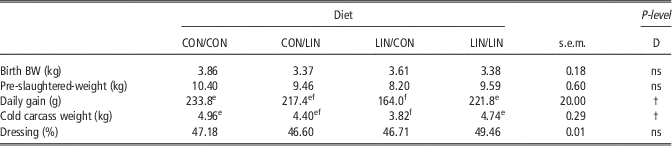
The average daily gain and cold carcass weight of offspring born from ewes fed linseed only during gestation (LIN/CON) tended (P<0.10) to be lower compared with the CON/CON and LIN/LIN groups (Table 4). Because both the amount and composition of milk produced were determined only on week 3 and 4 of lactation, one cannot exclude that milk yield and composition earlier in lactation differed from those reported in Table 2, and therefore have affected lambs’ growth. No effect of linseed supplementation of the ewe diet was observed on weight at birth, in accordance with other reports for pigs (de Quelen et al., Reference de Quelen, Boudry and Mourot2010; Tanghe et al., Reference Tanghe, Missotten, Raes, Vangeyte and De Smet2014).
Growth performances and carcass traits of lambs from Sarda ewes fed control (CON) and linseed (LIN) diets during gestation and/or lactation

Within rows, means without a common letter differ (P<0.10).
P-level=probability values for group (D) and sex (S): †P<0.10, *P<0.05, **P<0.01, ns=P>0.10.
Sex and interaction D×S were not significant.
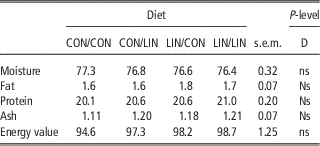
Linseed supplementation in the prepartum period and during lactation had no effect on the chemical composition and energy values of the leg muscles (Table 5). Sex did not affect lamb growth and carcass measurements.
Nutrient composition (expressed as g/100 g fresh tissue) and energy values (kcal/100 g) of lamb meat from Sarda ewes fed control (CON) and linseed (LIN) diets during gestation and/or lactation

P-level=probability values for group (G): ns=P>0.10. Sex and the interaction D×S were not significant.
Intramuscular fatty acid composition
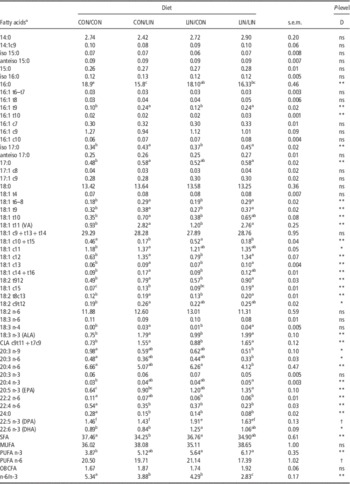
Linseed supplementation in the prepartum period affected the concentrations of some LC-PUFA of the thigh muscles (Table 6). Among the LC fatty acids of the n-6 family, the contents of 22:2n-6 and 22:4n-6 were lower (P<0.01) in offspring of the LIN/CON compared with CON/CON ewes. In contrast, the PUFAn-3 content was greater (P<0.01) in LIN/CON lambs due to increased levels of EPA (+84%; P<0.01), DPA (+31%; P<0.10) and DHA (+40%) compared with the CON/CON group.
Fatty acid composition (expressed in mg/100 mg total FAME) of the intramuscular fat of lambs from Sarda ewes fed control (CON) and linseed (LIN) diets during gestation and/or lactation

Within rows, means without a common letter differ (P<0.05).
P-level=probability values for diet (D): †P<0.10, *P<0.05, **P<0.01, ns=P>0.10. Sex (S) was significant only for 17:1 c8; the D×S interactions were not significant.
aCLA=conjugated linoleic acid; VA=vaccenic acid; ALA=alpha linolenic acid; EPA=eicosapentaenoic acid; DPA=docosapentaenoic acid; DHA=docosahexaenoic acid; SFA=saturated fatty acids (sum of 10:0, 12:0, 14:0, 15:0, 16:0, 17:0, 18:0, 22:0, 24:0 and odd-branched fatty acids); MUFA=monounsatured fatty acids (sum of 14:1, Σ16:1, Σ17:1 and Σ18:1); PUFA=polyunsatured fatty acids; PUFA n-3=sum of 18:3n-3, 18:4n-3, 20:3n-3, 20:4n-3, 20:5n-3, 22:5n-3, 22:6n-3); PUFA n-6=sum of Σ18:2n-6 cis/trans isomers, 18:3n-6, 20:2n-6, 20:3n-6, 20:4n-6, 22:2n-6, 22:4n-6; OBCFA=odd-branched fatty acids (sum of 13:0, 13:0 i, 13:0 ai, 14:0 i, 15:0 i, 15:0 ai, 16:0 i, 17:0, 17:0 i, 17:0 ai and Σ17:1, where i is an iso-isomer and ai is an ante-iso-isomer).
As expected, the fatty acid profile of maternal milk was reflected in the fatty acid profile of the muscle lipids (Table 3). Feeding CON/LIN resulted in greater content of PUFAn-3, mainly due to higher ALA (+138%), with no effects on EPA, DPA and DHA concentrations. This suggests that, compared with milk, placenta is more effective in promoting LC-PUFA transfer and accumulation. Moreover, the low forage : concentrate ratio (0.25 : 1) in gestation diets may have impaired ruminal biohydrogenation of unsaturated fatty acids (Chilliard et al., Reference Chilliard, Glasser, Ferlay, Bernard, Rouel and Doreau2007). Consequently, ewes fed extruded linseed during gestation had greater ALA levels in blood available for the conversion into LC-PUFA homologs.
With respect to tissue DHA levels, the current data contrast observations reported by Gómez-Cortés et al. (Reference Gómez-Cortés, Gallardo, Mantecón, Juárez, de la Fuente and Manso2014). They found twice greater DHA levels in the intramuscular fat of suckling lambs from ewes fed linseed supplemented diet compared with an unsupplemented lactation diet. The different outcomes from the studies could be explained by differences in the anatomical depot location (Juárez et al., Reference Juárez, Horcada, Alcalde, Valera, Mullen and Molina2008), slaughter weight (Serra et al., Reference Serra, Mele, La Comba, Conte, Buccioni and Secchiari2009) and phospholipids/triglycerides ratio between the samples analyzed in our trial and those from other studies. Sex did not affect the overall fatty acid profile in muscles. The lack of effect of sex on the fatty acid of interest was also previously observed in meat of suckling lambs (Nudda et al., Reference Nudda, Battacone, Boe, Manca, Rassu and Pulina2013).
The nutritional value of lamb meat
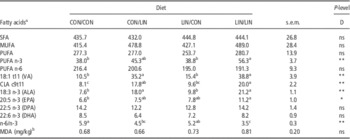
In Table 7, the contents of SFA, MUFA and PUFA as well as the most nutritionally important fatty acids expressed in mg/100 g of meat are summarized. Regarding the PUFAn-3, European Food Safety Authority (EFSA) (2010) has proposed a daily intake of 250 mg of EPA and DHA for primary prevention of cardiovascular diseases in healthy individuals. Thus, in this experiment, 100 g of meat sample from suckling lambs born from ewes fed the LIN/LIN diet provided about 18 mg of EPA+DHA, which represents 7% of the recommended daily intake for adults.
Content of nutritionally important fatty acids (expressed in mg/100 g) and oxidative status (expressed as malondialdehyde concentration) of the lamb meat from Sarda ewes fed control (CON) and linseed (LIN) diets during gestation and/or lactation

Within rows, means without a common letter differ (P<0.05).
P-level=probability values for diet (D): †P<0.10, *P<0.05, **P<0.01, ns=P>0.10. Sex (S) and interaction D×S was not significant.
aSFA=saturated fatty acids (sum of 10:0, 12:0, 14:0, 15:0, 16:0, 17:0, 18:0, 22:0, 24:0 and odd-branched fatty acids); MUFA=monounsatured fatty acids (sum of 14:1, Σ16:1, Σ17:1 and Σ18:1); PUFA=polyunsatured fatty acids (sum of total n-6 and total n-3); PUFAn-3=sum of 18:3n-3, 18:4n-3, 20:3n-3, 20:4n-3, 20:5n-3, 22:5n-3, 22:6n-3); PUFAn-6=sum of Σ18:2n-6 cis/trans isomers, 18:3n-6, 20:2n-6, 20:3n-6, 20:4n-6, 22:2n-6, 22:4n-6; VA=vaccenic acid; CLA=conjugated linoleic acid; ALA=alpha linolenic acid; EPA=eicosapentaenoic acid; DPA=docosapentaenoic acid; DHA=docosahexaenoic acid;
bMDA=malondialdehyde concentration in the leg muscle.
Experts in the area of infant nutrition of the US Institute of Medicine reported that the adequate intake of total PUFAn-3 is 0.5 g/day in 6- to 12-month-old children (EFSA, 2010). Considering that 100 g of raw lamb meat in our experiment contained approximately 50 mg of PUFAn-3 (Table 7), it can be concluded that this portion can satisfy about 10% of the recommended daily requirements of infants. This is interesting if we consider that lamb meat is the first meat usually recommended at weaning by Italian pediatricians, due to its presumed lower allergenicity compared with other types of meat (Cardi et al., Reference Cardi, Corrado, Cavaliere, Grandina, Pacchiarotti, Rea, Mazza, Nardelli and Agazie1998; Martino et al., Reference Martino, Bruno, Aprigliano, Agolini, Guido, Giardini and Businco1998).
Regarding the CLA, no reference values for requirements have been established yet. However, it was estimated that 0.72 g/day of CLA intake can help in achieving the biological and physiological effects of CLA (Watkins and Li, Reference Watkins and Li2003). In the present study, the CLA level reached 20 mg/100 g of meat, which is in line with those reported in other studies on suckling lambs (Serra et al., Reference Serra, Mele, La Comba, Conte, Buccioni and Secchiari2009). Assuming a 20% to 25% conversion rate in the human body of vaccenic acid to CLA, the measured vaccenic acid level would provide 5 mg of CLA (Kuhnt et al., Reference Kuhnt, Kraft, Moeckel and Jahreis2006). By adding the CLA and the vaccenic acid converted into CLA, lamb meat produced using this feeding strategy would provide approximately 25 mg of CLA/100 g of meat. Therefore, 100 g of these muscles would provide only 3% to 4% of the daily recommended dose of c9,t11-CLA, which might be considered too low for a potentially beneficial effect in humans. However, this source should not be neglected, because ruminant meat and meat products are one of the main natural sources of c9,t11-CLA in human diets (Schmid et al., Reference Schmid, Collomb, Sieber and Bee2006). Moreover, the current data suggest that diets of ewes could be further improved to increase the t11-18:1 and c9,t11-CLA concentrations in milk and subsequently in the meat of suckling lambs.
Conclusions
The linseed supplementation in ewes’ diet during gestation (LIN/CON and LIN/LIN), at the dose used in the present study, resulted in an increased milk yield. On the other hand, linseed supplementation in lactation diet (CON/LIN and LIN/LIN) caused a milk fat depression in ewes.
Feeding linseed during pregnancy tended to decrease lamb growth and increased the PUFAn-3 concentration in the intramuscular fat of leg muscles due to a greater EPA, DPA and DHA accumulations compared with the CON/CON group. The maternal ALA supplementation during lactation increased markedly the concentration of ALA, whereas EPA, DPA and DHA concentrations in the intramuscular fat of suckling lambs were unchanged compared with the CON/CON group. This finding supports the hypothesis that the elongation and desaturation pathway of ALA occurs more efficiently in the prenatal than in the postnatal period. Moreover, the low forage:concentrate ratio in gestation diets may have lowered the biohydrogenation of ALA, and increased the blood levels of ALA available for conversion into LC-PUFA homologs. The continuous supplementation of linseed during gestation and lactation did not cause additive effects on the parameters of interest.
In conclusion, this study revealed the possibility to increase the intramuscular LC-PUFAn-3 content of lamb meat. In view of its dietetic properties, lambs produced with this feeding strategy could be useful sources of n-3 fatty acids, especially in diets of weaning children. However, it should be noted that these FA contents are still far from a minimum threshold for providing an adequate dietary intake.
Acknowledgments
The authors thank Mrs Antonio Fenu for providing technical assistance during the experiment and Mrs Roberto Rubattu for technical assistance in analyzing and processing samples. Thanks are extended to Cargill (Animal Nutrition Division, Milan, Italy) for providing the dietary ingredients for this study.