


Philosophers, psychologists, and neuroscientists have debated the nature of emotion for centuries because it touches on our most precious questions. Do emotions show us to be the same or different from the rest of the animal kingdom? Do we respond automatically and reflexively to the world or do we have free will? Is it possible to have an objective science of subjective phenomena? How do we map psychological descriptions to physical measurements? These basic issues are at the foundation of the commentaries on our target article. We are grateful for the thought-provoking commentaries that provide us with the opportunity to clarify misconceptions, rectify ambiguities, address points of contention, and discuss exciting suggestions for applications and future directions of our model.
R1. Basic emotions versus psychological construction: Theoretical clarification
For several centuries, mental philosophers debated whether the human mind is populated by mental organs, each producing a specific kind of mental content (“faculty psychology”; e.g., Broca Reference Broca1861/2003; Gall & Spurzheim Reference Gall and Spurzheim1809), or whether it is organized as a set of more basic, domain-general elements that together make a variety of mental states (e.g., Hartley Reference Hartley1749; Herbart Reference Herbart1809; Thorndike Reference Thorndike1923; for reviews, see Klein Reference Klein1970; Uttal Reference Uttal2001). As psychology moved from philosophy to empirical science, this debate was absorbed into its guiding theoretical assumptions, particularly in writings on the nature of emotion. Some writers argued that certain emotion categories have the status of mental faculties: independent and autonomous, hard-wired and innate, and psychologically elemental (e.g., Allport Reference Allport1924; Lange Reference Lange and Rand1885/1912; McDougall Reference McDougall1908). In modern times, this approach has become known as the basic emotion approach (e.g., Ekman Reference Ekman and Cole1972; Reference Ekman1992; Ekman & Cordaro Reference Ekman and Cordaro2011; Izard Reference Izard1977; Reference Izard1990; Reference Izard2011; Lewis Reference Lewis2005; Panksepp Reference Panksepp1998; Reference Panksepp2007; Panksepp & Watt Reference Panksepp and Watt2011; Tracy et al. Reference Tracy, Shariff and Cheng2010) or the natural kind approach (cf. Barrett Reference Barrett2006a). Others argued that emotions were produced out of a more basic set of psychological elements (e.g., Duffy Reference Duffy1934; James Reference James1890; Wundt Reference Wundt and Judd1897/1998). Recently, this approach has become known as the psychological construction approach to emotion (e.g., Barrett Reference Barrett2006b; Russell Reference Russell2003; for a discussion, see Gendron & Barrett Reference Gendron and Barrett2009).
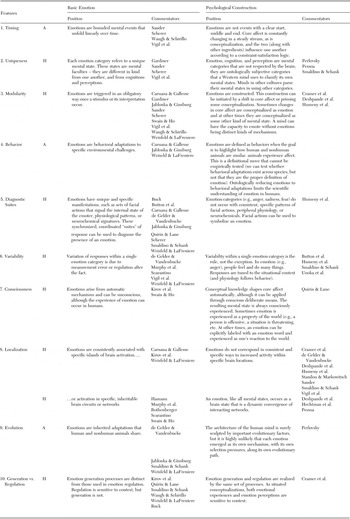
Just as there is variety in any category, both basic emotion and psychological construction models come in a variety of flavors (Table R1). These nuances can make the emotion literature difficult to understand for those who are not steeped in its history and debates. Most relevant to the discussion at hand, there is disagreement within the basic emotion approach about what makes certain emotions (but not others) basic (also see Ortony & Turner Reference Ortony and Turner1990). Some hold a strong localization hypothesis, such that all the emotional episodes belonging to a single emotion category (e.g., fear) are caused by neural responses in an anatomically defined location (e.g., Calder Reference Calder2003; Davis Reference Davis1992; Ekman Reference Ekman, Dalgleish and Powers1999; Öhman & Mineka Reference Öhman and Mineka2001). Other models hypothesize that each basic emotion should be localized to the firing of a (typically) subcortical circuit (e.g., Izard Reference Izard2011; Panksepp Reference Panksepp1998). Still others believe that emotions need not be localized in the brain to be natural kinds (e.g., Ekman & Cordaro, Reference Ekman and Cordaro2011; Lewis Reference Lewis2005). These latter models hold other hypotheses about what makes emotions biologically basic with naturally defined boundaries (e.g., synchronized patterns of autonomic response, specific facial expressions, etc.), and we discuss the empirical status of these other hypotheses later in section R2. For the rest of the present section, we use Table R1 to launch a discussion of the commentaries that deal with basic emotion ideas or to contrast them to psychological construction. During this discussion, we emphasize how the two approaches compare in their assumptions and definitions (ideas that are not empirically verifiable; e.g., “emotions are behaviors”) as well as their hypotheses (ideas that can be tested with data; e.g., “emotions are coordinated sets of physiology, action, and feeling”).
Assumptions and testable hypotheses in Basic Emotion and Psychological Construction Models

Note. A=assumption. H=hypothesis.
R1.1. False dichotomies
By claiming that emotions are evolutionary adaptations (de Gelder & Vandenbulcke; Jablonka & Ginsburg; Smaldino & Schank; Weisfeld & LaFreniere), researchers often falsely assume that the basic emotion approach is the evolutionary approach and that psychological construction does not consider evolution as important. In reality, both approaches assume that the human mind was sculpted by evolutionary forces, but at issue is what, exactly, evolved (e.g., emotions or the more basic psychological ingredients that create emotions?).
Similarly, it is tempting to assume that the basic emotion approach is a natural science approach, whereas the psychological construction approach engages in extreme relativism (de Gelder & Vandenbulcke). Our model tries to traverse the biology–psychology divide by taking the position that (1) psychological elements can be mapped to activity in the nervous system (but probably not at the gross anatomical level or in a 1:1 manner); (2) the biological function of an individual brain region can always be described by its anatomical connections, but its psychological function should also include its functional connections (or neural context; McIntosh Reference McIntosh2000); and (3) emotion categories, as complex psychological categories, are not psychological functions – they are collections of psychological events that are best explained as combinations of more basic psychological building blocks. These building blocks might be localized at the level of an anatomical or functional network. The psychological ingredients we have proposed in the target article and response to commentaries (core affect, conceptualization, language, executive attention, and sensory perception) are a first approximation, and we expect that these ingredients will be refined with future research.
A related idea is that the basic emotion approach is scientifically advantageous because it is easier to empirically disconfirm (e.g., a locationist hypothesis) when compared to the more flexible psychological construction approach (Hamann). The psychological construction framework is flexible by design, however, to explicitly account for the observed variability in emotional responding (Barrett Reference Barrett2009a). Given that we outlined our model in print only five years ago, and that psychological construction, as a definable scientific approach to emotion, has only been articulated within the last decade (e.g., Barrett Reference Barrett2006a; Russell Reference Russell2003),Footnote 1 it is not surprising that more evidence is needed before we can be confident of its validity (see sect. R3.1). Furthermore, psychological construction is more challenging to test precisely because we must measure variability (rather than looking for a small set of stable outcomes) and we must show that this variability is scientifically meaningful and not due to error. That said, it is not the case that any set of hypotheses will do. The a priori hypothesis at issue in our target article was that the same brain regions would be consistently active during a range of emotional experiences and perceptions, as we found in our meta-analysis. In other papers, we hypothesize that these regions become functionally coupled into multiple, large-scale networks and that these interconnected networks are the relevant functional units that constitute the human mind (see Barrett Reference Barrett2009a). We have further proposed that these networks dynamically configure during an instance of emotion (e.g., an instance of anger), but that the precise configuration would be tied to a specific situational context, rather than a broad psychological category (e.g., anger) (Wilson-Mendenhall et al. Reference Wilson-Mendenhall, Barrett, Simmons and Barsalou2011).
It is also easy to assume that basic emotion approaches find scientific value in categories like anger, disgust, fear, and so forth, but that psychological construction models do not (de Gelder & Vandenbulcke; Smaldino & Schank). Indeed, it is often assumed that psychological construction models merely reduce discrete emotions to simple affective dimensions of valence and arousal (de Gelder & Vandenbulcke; Buck; Scherer). But psychological construction is an explicit attempt to integrate dimensional and categorical approaches to emotion. All psychological construction models assume that, at their core, emotional experience and perceptions contain a representation of the somatovisceral state of the bodyFootnote 2 (a point that both Stapleton and Sander question).Footnote 3 Bodily representations are then made meaningful as instances of discrete emotion (or as cognitions, perceptions, or even physical symptoms) (cf. Barrett Reference Barrett2009b). We hypothesize that these mental categories themselves are not given by nature, but live in the mind of the perceiver: we predict that there is no reliable, objective distinction between emotions, cognitions, perceptions, or physical symptoms as types of mental categories, although the individual instances within a category will vary (Barrett Reference Barrett2009b; Barrett & Bar Reference Barrett and Bar2009; Duncan & Barrett Reference Duncan and Barrett2007; Pessoa Reference Pessoa2008; also see Pessoa's commentary). The instances of these categories are therefore important phenomena to be explained, but emotions, cognitions, perceptions, or physical symptoms are not causes or processes.
Because a key feature of psychological construction is the hypothesis that changing body representations are transformed into a discrete emotion via some kind of meaning-making process,Footnote 4 there is a temptation to assume that this meaning-making is deliberate, effortful, and the act of conscious labeling (Quirin & Lane; Scherer; Smaldino & Schank; Weisfeld & LaFreniere), whereas the basic emotion hypothesis is that emotions are automatically generated. Yet our psychological construction approach hypothesizes that conceptual knowledge shapes sensations from the body automatically, effortlessly, and continuously, just as top-down conceptual knowledge turns wavelengths of light into images and objects, and air vibrations into voices, music, and noises. Of course, there are pre-conceptual aspects to perception by any reasonable definition of conception. But without conceptual knowledge, people are “experientially blind.”
R1.2. Mistaken similarities
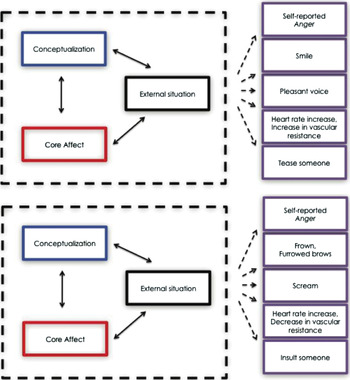
Several commentators assumed that our psychological construction approach relies on Descartes' machine metaphor by inferring that psychological ingredients are encapsulated but interacting parts (see de Gelder & Vandenbulcke; Pessoa; Vigil, Dukes, & Coulombe [Vigil et al.]). Basic emotion models certainly use this metaphor in assuming that emotions work like mechanisms in a machine. Our model does not rely on traditional mechanistic models of the mind, however, and instead incorporates assumptions about constraint satisfaction (Barrett Reference Barrett2011a; Barrett et al. Reference Barrett, Ochsner, Gross and Bargh2007d) (see Fig. R1). In constraint satisfaction, two or more processes have a nonlinear influence on one another, such that they exert mutual influence (Read et al. Reference Read, Vanman and Miller1997) (but see Lewis [2005] for a basic emotion approach that utilizes similar concepts rather than a machine metaphor).Footnote 5
Our psychological constructionist model posits that core affect (red), sensory input from the world (black), and conceptual knowledge (including language – blue) mutually constrain one another to produce an emergent state that can be measured as a discrete emotion (purple). In a given instance of emotion (e.g., anger), the constellation of measures will take one pattern, and in another instance, it take a different pattern. A color version of this image can be viewed in the online version of this target article at: http://www.journals.cambridge.org/bbs.

A basic emotion approach usually ontologically reduces (i.e., redefines) emotions to their causes (brain locations or circuits) or parts (a behavior, e.g., Jablonka & Ginsburg, Weisfeld & LaFreniere). It is tempting to assume that psychological construction models also necessarily reduce emotions to their ingredients (de Gelder & Vandenbulcke), and indeed, some do (e.g., Duffy Reference Duffy1957; James Reference James1884; Russell Reference Russell2003). Our model, however, makes explicit use of the concept of emergence (see Barrett Reference Barrett2006b; Reference Barrett2011a; also see Wundt Reference Wundt and Judd1897), and so we explicitly assume that emotions cannot be merely redefined as their ingredients (cf. Gross & Barrett Reference Gross and Barrett2011). Instead, our model causally reduces emotions to neural firing (cf. Barrett et al. Reference Barrett, Ochsner, Gross and Bargh2007d).
Furthermore, in our model, psychological ingredients are descriptions of what brain networks are doing at a psychological level as they combine to produce emergent mental phenomena (such as instances of anger, memory, beliefs, etc.; see Figure R2). The concept of “psychological primitive” might be useful to describe a basic level of psychological operation (e.g., conceptualization) without reducing it to something biological (e.g., functional connectivity between midline cortical areas). As time goes on, research will reveal whether these psychological descriptions are “primitive” or whether something even more psychologically basic is needed.
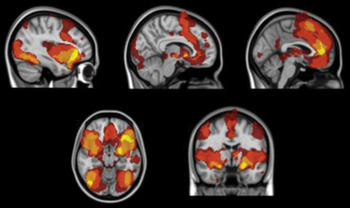
Intrinsic networks derived from resting state functional connectivity analyses that used peaks from Vytal and Hamann's (Reference Vytal and Hamann2010) meta-analytic anger, disgust, fear, and sadness contrasts as seeds. Yellow indicates that 4/4 networks overlap spatially in that area. Light orange indicates spatial overlap for 3/4 networks. Orange indicates spatial overlap for 2/4 networks. Red indicates no spatial overlap. A color version of this image can be viewed at http://www.journals.cambridge.org/bbs.

R1.3. Other theoretical approaches
Commentators Scherer and Sander argue that we had left out the appraisal approach to understanding the nature and function of emotion. As we noted in our target article, we did not include a discussion of appraisal models because they typically do not contain targeted hypotheses about whether emotions are generated in specific locations, anatomically defined circuits, or domain-general interacting networks. Furthermore, we did not include appraisal approaches in Table R1 because these models come in two definable varieties (causal and constitutive appraisal models; discussed in Barrett et al. Reference Barrett, Mesquita, Ochsner and Gross2007c) that make it difficult to assimilate into a single theoretical approach. Causal variants assume appraisals have the power to coordinate and synchronize all aspects of an emotional response (Grandjean & Scherer Reference Grandjean and Scherer2008; Scherer Reference Scherer2009a; and Scherer's commentary here) and are therefore more similar to basic emotion approaches. Constitutive models treat appraisals as descriptions of experience during emotional episodes and are much closer to psychological construction accounts (e.g., Clore & Ortony Reference Clore, Ortony, Lane and Nadell2000; Reference Clore, Ortony, Lewis, Haviland-Jones and Barrett2008) (cf. Gross & Barrett Reference Gross and Barrett2011).
Our psychological construction approach can also be differentiated from other models in the emotion literature with which it shares a passing resemblance. In response to Vigil et al., we point out that our psychological construction view (which relies on the idea of embodied, situated conceptualization) is distinct from other embodied simulation models (e.g., Damasio Reference Damasio2000; Niedenthal Reference Niedenthal2007) that assume emotions are biologically basic categories with distinct somatic markers. In response to Quirin & Lane, we note that our model is also distinct from Lane's cognitive-developmental model of emotional awareness (Lane & Schwartz Reference Lane and Schwartz1987) in which language is used to systematically differentiate global affective responses (for a more detailed discussion, see Lindquist & Barrett Reference Lindquist, Barrett, Lewis, Haviland-Jones and Barrett2008b).
R2. The empirical status of the basic emotion approach
Having clarified these theoretical points, we now address commentaries that focus on the empirical status of the basic emotion approach. Several commentators have suggested that emotion categories can indeed be localized to specific brain locations, but that evidence to this effect was obscured by weaknesses in fMRI techniques, problems with our meta-analytic approach, or other variables. Others argue that evidence for basic emotion is best observed in responses other than those occurring in the brain. In this section, we address both types of issues.
R2.1. Emotions can be localized to specific brain locations
R2.1.1. Emotions might be localized to brain locations were it not for problems with the temporal resolution of fMRI
Several commentators raise the question of whether fMRI methods provide a suitable test of the brain basis of emotion, because they have poor temporal resolution. We agree that finer temporal resolution would be advantageous in studying the psychological functions of the brain, although we point to brain stimulation studies that also fail to find evidence that emotions can be localized to particular brain locations (sect. R2.3.4). These commentaries raise a deeper issue, however: writers hold beliefs about the timing of emotion that are a matter of definition and cannot be empirically tested. The suitability of fMRI for studying emotion comes down to how one defines emotion in the first place.
One underlying premise in some commentaries is that emotions are quick events that cannot be captured by fMRI's poor temporal resolution and the limits of a slow hemodynamic response (Unoka, Berán, & Pléh [Unoka et al.]; Vigil et al.; Weisfeld & LaFrenier). The concern is that “emotion centers” trigger very quickly after encountering a stimulus and regulatory brain areas fire only after emotion centers. If this were the case, then the Blood Oxygen Level-Dependent (BOLD) response might be too slow to capture emotion generation and regulation as separate events. Both production and regulation would be mistakenly included in the same contrast map, leading to the wrong conclusion about the nature of emotion. Unfortunately, it is not possible to empirically test how short an emotion is, but logically, it might not make sense to define emotion as a brief, exclusively feedforward event. Consider, for example, that almost instantly after a visual stimulus is presented, there is dynamic feedback and re-entrant processing between cortical and subcortical regions (Duncan & Barrett Reference Duncan and Barrett2007; Lamme & Roelfsema Reference Lamme and Roelfsema2000; Pessoa & Adolphs Reference Pessoa and Adolphs2010; but see, de Gelder et al. Reference de Gelder, van Honk and Tamietto2011) that make it impractical to separate purely bottom-up and top-down influences in vision. Similarly, it might not make sense to try and separate an initial response from regulatory processes in emotion, as these distinctions might be more subjective and based on when they occur in time relative to stimulus onset, rather than on mechanistic differences (cf. Gross & Barrett Reference Gross and Barrett2011).
By contrast, other commentators (Waugh & Schirillo) believe that fMRI is problematic because emotions are episodes that evolve over time, and fMRI only captures the first second of neural response after stimulus onset. Timing is admittedly an important source of information. Yet, as reported in Waugh et al. (Reference Waugh, Hamilton and Gotlib2010), the differences between the findings from their time-sensitive inverse logit modeling and the traditional (gamma) hemodynamic response function (HRF) modeling were not substantial enough to invalidate the studies summarized in our meta-analysis, meaning that it is possible to learn something about emotion from standard BOLD analyses. It is always possible that unmeasured variables such as time will more clearly differentiate emotion categories from one another, but the burden of proof is on those who wish to find such effects (i.e., the basic emotion view is not the null hypothesis).
A related concern was raised by Vigil et al., who are skeptical that changes in BOLD signal can be used to map the dynamics of neural activation. This is not a new point in the debate on whether neuroimaging can contribute to an understanding of the human mind. Although active investigation is ongoing and necessary, BOLD signals during fMRI do, in fact, match measures of integrated synaptic activity in the vast majority of cases, as evidenced by both direct studies (e.g., Logothetis et al. Reference Logothetis, Pauls, Augath, Trinath and Oeltermann2001) and convergence between animal studies and human meta-analyses across many fields (see Van Snellenberg & Wager Reference Van Snellenberg, Wager, Goldberg and Bougakov2009). Furthermore, every research technique has some kind of limitation. Electrophysiology is suspect because it does not measure or model neurochemistry. Neurochemical measurements do not consider electrical activity in detail. Lesion studies provide limited information about normative function. All nonhuman animal studies are limited because their subjects do not have human brains, which differ substantially in structure and connectivity (see Streider Reference Striedter2005). All human studies are limited because the available measurements are coarse and the potential for direct brain manipulation is limited. Neuroimaging data are thus useful to the extent that they converge with other methods and/or provide information of practical value, and in this regard, our meta-analysis provides one useful source of information. It is notable that our meta-analytic findings are consistent with meta-analyses and summaries of research in other measurement domains (in the face and body) that also fail to find strong support for the hypothesis that emotion categories are natural kinds (e.g., Bachorowski & Owren Reference Bachorowski and Owren1995; Barrett Reference Barrett2006b; Barrett et al. Reference Barrett, Lindquist, Bliss-Moreau, Duncan, Gendron, Mize and Brennan2007a; Barrett et al. Reference Barrett, Mesquita and Gendron2011; Cacioppo et al. Reference Cacioppo, Berntson, Larsen, Poehlmann, Ito, Lewis and Haviland-Jones2000; Ortony & Turner Reference Ortony and Turner1990; Mauss & Robinson Reference Mauss and Robinson2009; Russell et al. Reference Russell, Bachorowski and Fernandez-Dols2003), while at the same time being broadly consistent with a psychological construction approach to emotion (see sect. R3).
R2.1.2. fMRI does not have the spatial resolution to identify brain locations for emotion
Several commentators believe that fMRI has insufficient spatial resolution to reveal emotion locations in the brain, on the assumption that emotion circuits reside in subcortical nuclei (Buck; Quirin & Lane; Weisfeld & LaFreniere) that are difficult to image with normal levels of resolution. It is an empirical question whether imaging methods with better spatial precision could localize different emotion categories to changes in midbrain and brainstem nuclei or sets of nuclei, but several observations make us predict that such an outcome is unlikely. First, although subcortical neurons are necessary for certain behavioral adaptations (e.g., freezing, fleeing, fighting) in nonhuman animals, it is not clear that there is a one-to-one correspondence between these adaptations and emotion categories (see sect. R2.3.1.). Second, some subcortical structures that are important to emotion (e.g., lateral hypothalamus) have a more diffuse anatomical structure in the adult human brain than in an infant human or nonhuman animal brain (Saper Reference Saper, Mai and Paxinos2012), making it difficult to find clear localization. Third, existing evidence is not consistent with the hypothesis that finer levels of spatial resolution reveal the brain localization for different emotion categories. For example, in single cell recordings within the rhesus monkey brain, neurons throughout the amygdala respond preferentially to the screams of other monkeys but also respond to coos (positive sounds) and sounds indicating aggression (Kuraoka & Nakamura Reference Kuraoka and Nakamura2007). Taken together, studies like this suggest that no matter the degree of spatial resolution, the brain very likely does not contain “anger” neurons or “fear” neurons.
Perhaps most importantly, the hypothesis that emotions are subcortically generated and merely regulated by the cortex is based on an outmoded view of brain evolution (for an extended discussion, see Barrett et al. Reference Barrett, Lindquist, Bliss-Moreau, Duncan, Gendron, Mize and Brennan2007a). Buck is correct when he writes that our meta-analysis identifies many of the brain structures discussed by Papez (Reference Papez1937) and MacLean (Reference MacLean1952). But like all models of brain organization that rely on a phylogenetic scale, MacLean's triune brain concept is not correct (Striedter Reference Striedter2005). Some of the changes in connectivity that occurred during human evolution (e.g., the long-range connections between the isocortex and subcortical and spinal cord autonomic nuclei described in An et al. Reference An, Bandler, Ongur and Price1998; Öngür & Price Reference Öngür and Price2000) produce the kind of re-entrant processing that is more consistent with a psychological construction account.
R2.1.3. Pairwise comparisons within our meta-analysis would have revealed evidence for emotion localizations
Commentator Hamann believes that we would have found better evidence for biologically basic emotion categories in our meta-analysis if we had performed pairwise comparisons between all categories. Vytal and Hamann (Reference Vytal and Hamann2010) performed these comparisons and found, as we did, that emotion categories were consistently but not specifically associated with increased activity in certain brain regions. For example, they report that both anger, when compared to sadness, and disgust when compared to happiness, were associated with increased activation in a region within the left inferior frontal gyrus (BA 47). Although the peaks themselves do not overlap, they are representative of broader clusters that do overlap. A similar point can be made for activity reported for the left insula, right insula, right basal ganglia, and amygdala in Vytal and Hamann's (Reference Vytal and Hamann2010) meta-analysis. Their findings, like ours, are therefore more consistent with our psychological construction approach that emotional experiences and perceptions are complex instances built from configurations of building blocks.
R2.1.4. Neural deactivations might help to identify brain locations for emotion
Commentators Vigil et al. argue that neural deactivations (which we did not include in our meta-analytic summaries) could potentially give evidence of cross-modal inhibition between brain areas that would reveal support for a locationist view of emotion. We agree that deactivations will contribute to a more complete picture of the brain basis of emotion, and we welcome further research that demonstrates their utility in meta-analytic summaries. One conceptual issue that must be addressed, however, is what the deactivations are relative to (i.e., whether there is really a baseline state of the brain; Stark & Squire Reference Stark and Squire2001). “Rest,” for example, means that the brain is not being probed by an external stimulus, but during “rest” a host of different mental processes are in play, including episodic memory retrieval and self-reflection (Andrews-Hanna et al. Reference Andrews-Hanna, Reidler, Huang and Buckner2010).
On a more specific point, Vigil et al. misinterpreted our logistic regressions as showing that the amygdala was deactivated during anger perception. In fact, the logistic regressions indicated whether a variable was associated with an increase (positive beta) or decrease (negative beta) in activation frequency. Therefore, the finding that anger perception had a negative beta value means that it predicted a “0” for amygdala activation (versus predicting a “1”), meaning that anger perception was associated with less frequent activation of the left amygdala than other emotion categories on average.
R2.1.5. Evidence of emotion locations is obscured by less than perfect brain imaging studies that contribute to the meta-analytic summaries
Although we agree with de Gelder & Vandenbulcke on the “garbage in – garbage out” rule for meta-analysis, there are two major ways that the “meta-analytic whole” is greater than the sum of its parts (i.e., the individual studies). First, meta-analysis can weed out false positives (which are frequent in neuroimaging studies; see Wager et al. Reference Wager, Lindquist and Kaplan2007; Yarkoni Reference Yarkoni2009) and focus interpretation on the activations that are consistently observed. Second, meta-analyses can provide a picture of whether the consistent activation is specific to one emotion category or another, which individual studies can rarely, if ever, do (i.e., it is rare to find studies that include five categories of experienced emotions).
R2.1.6. Individual differences might obscure evidence for brain locations for emotion
Commentators Murphy, Ewbank, & Calder [Murphy et al.] suggest that variation in person-level variables such as personality might impair researchers' ability to find consistent and specific increases in brain activity associated with discrete emotions. It is always a possibility that a third, un-modeled variable is adding more noise to signal, thereby preventing researchers from finding an effect. Still, according to a basic emotion view, the mechanisms and experiences of emotion are supposed to be universal (Ekman Reference Ekman and Cole1972; Reference Ekman1992; Ekman & Cordaro Reference Ekman and Cordaro2011; Izard Reference Izard2011). The idea that personality produces variation in emotional experience and perception is more consistent with a psychological construction approach. For example, almost two decades ago, our lab documented individual differences in the specificity with which people use emotion words to describe experience (termed “emotional granularity”; Barrett Reference Barrett1998; Reference Barrett2004; Feldman Reference Feldman1995) even though researchers often assume that anger, disgust, sadness, and other emotions are basic in a Roschian (Reference Rosch and Moore1973) sense. For some people, however, pleasant and unpleasant appear to be more cognitively basic categories. For others, subordinate categories like frustration and agitation, and depressed, morose, anxious terrified, and so on, might be cognitively basic (Lindquist & Barrett Reference Lindquist, Barrett, Lewis, Haviland-Jones and Barrett2008b). Although the neural responses realizing emotion might differ for people who differ in emotional granularity (an idea which has not yet been tested), the available evidence makes us skeptical that any of these categories are biologically basic and respected by the brain.
R2.1.7. Other “better” emotion categories might allow evidence of brain localization
Several commentators speculate on a variety of ways to classify emotion categories, premised on the assumption that there must be certain classes of emotions that will have special biological status: “animal/basic” versus “human/complex” emotions (Jablonka & Ginsburg; Perlovsky); “universal” versus “non-universal” emotions (Weisfeld & LaFreniere); “social” versus “non-social emotions” (Jablonka & Ginsburg); or “pure” versus “blended”/“mixed” emotions (Scherer). Weisfeld & LaFreniere further speculate that we chose to study the brain basis of anger, disgust, fear, happiness, and sadness because these are the categories with specific facial expressions. In fact, we chose these categories because amidst disagreement about which emotions are supposed to be biologically basic (Ortony & Turner Reference Ortony and Turner1990), most basic emotion researchers agree that these five are supposed to be inborn, universally experienced, and species-general (e.g., Ekman Reference Ekman and Cole1972; Reference Ekman1994b; Ekman & Cordaro Reference Ekman and Cordaro2011; Izard Reference Izard1977; Reference Izard2011). Thus, these emotion categories would be most likely to show strong localization if it exists.
Scarantino argues that anger, disgust, fear, happiness, and sadness categories are each too heterogeneous to yield evidence for locationism (in agreement with our psychological construction approach), and instead proposes that emotion researchers should refine each category into more homogenous subordinate categories (e.g., different types of anger) that would yield better evidence for locationism. Scarantino does not offer any concrete suggestions for how to identify these categories a priori, however. One promising possibility is that context plays an important role in characterizing meaningful subordinate categories (Barrett Reference Barrett2006a; Barrett et al. Reference Barrett, Lindquist and Gendron2007b; Barrett et al. Reference Barrett, Mesquita and Gendron2011). For example, a recent neuroimaging study from our group asked participants to construct a variety of experiences within two different emotion categories (fear vs. anger) across two different contexts (physical vs. social contexts). The neural representations for fear and anger largely overlapped, but there were distinctive neural responses for physical versus social instances (Wilson-Mendenhall et al. Reference Wilson-Mendenhall, Barrett, Simmons and Barsalou2011). Context also seems to be important when searching for peripheral physiological correlates of emotion (Kreibig Reference Kreibig2010). It thus may be fruitful to think of context itself as a sort of ingredient in emotion.
R2.1.8. Emotions can be localized to networks rather than gross anatomical regions
Once a 1:1 correspondence between gross anatomical regions and emotion categories is ruled out, a number of other possibilities for localizing emotions remain. For example, commentators Hamann, Murphy et al., Rothenberger, Scarantino, and Swain & Ho all suggest that each emotion category is a natural kind if it is consistently associated with increased activity within a network of brain regions, rather than within a specific anatomically bounded set of voxels in one gross anatomical location. Indeed, the field of cognitive neuroscience has been moving steadily towards the conclusion that psychological functions are best described at the level of networks than at the level of individual brain regions. Our commentators do not consider the distinction, however, between a hard-wired, anatomical network and a dynamic functional network that is generated on the fly during an emotional experience or perception. This distinction is crucial for evaluating a basic emotion versus a psychological construction approach. It is tempting to claim evidence for basic emotions by merely showing that any pattern of brain activation distinguishes the instances of emotion category from another (e.g., as did Vytal & Hamann Reference Vytal and Hamann2010); however, merely showing some difference is not sufficient support for the basic emotion view. A key hypothesis of the basic emotion approach is that emotions are innate, and this could mean that emotion networks, whether they are local or widely distributed, should be anatomically defined, intrinsic to the human brain, and present in other animals. A dynamic, functional network could be supportive of a weak version of basic emotions, but only to the extent that is consistently and specifically active during instances of a single emotion category.
One means of testing whether emotion categories can be localized to stable networks is to investigate “resting state” networks, which are evidenced as correlational patterns in low-frequency BOLD signal fluctuations across a set of voxels when participants are not being probed by an external stimulus. These data reveal a number of large-scale distributed networks that are anatomically constrained and intrinsic to the human brain (Buckner Reference Buckner2010; Deco et al. Reference Deco, Jirsa and McIntosh2011; Fox & Raichle Reference Fox and Raichle2007; Vincent et al. Reference Vincent, Patel, Fox, Snyder, Baker, Van Essen, Zempel, Synder, Corbetta and Raichle2007). A number of brain networks have been repeatedly identified and the task-related activity in these networks has been observed in tasks that involve attention, default mental activity, and motivational salience (Smith et al. Reference Smith, Fox, Miller, Glahn, Fox, Mackay, Filippini, Watkins, Toro, Laird and Beckman2009; Seeley et al. Reference Seeley, Menon, Schatzberg, Keller, Glover, Kenna, Reiss and Greicius2007; Vincent et al. Reference Vincent, Patel, Fox, Snyder, Baker, Van Essen, Zempel, Synder, Corbetta and Raichle2007). Dozens of these studies have now been published, and no one has identified anything that remotely looks like basic emotion networks. Instead, emotion-related tasks appear to engage the “default” network (Andrews-Hanna et al. Reference Andrews-Hanna, Reidler, Huang and Buckner2010) or what we have called the “conceptual” network. The degree of connectivity within a “body representation network” (with hubs in the ventral anterior insula and pregenual anterior cingulate cortex [ACC]) is correlated with individual differences in negative affect (Seeley et al. Reference Seeley, Menon, Schatzberg, Keller, Glover, Kenna, Reiss and Greicius2007) and the intensity of affective experience in response to negative images (Touroutoglou et al., in press). In a recent analysis, we took the peaks that were consistently activated for each emotion category in Vytal and Hamann's (Reference Vytal and Hamann2010) meta-analysis and used them as seeds in a functional connectivity analysis of resting state data. Each seed/set of seeds produced an intrinsic network, but these networks largely overlapped for all the negative emotion categories (e.g., anger, disgust, fear, sadness); overlap was greatest in the ventral anterior insula, lateral orbitofrontal cortex, dorsal anterior cingulate cortex, and thalamus (Touroutoglou et al., in preparation; and see our Figure 2 on page 127). Rather than providing evidence for unique networks for basic emotions, these findings are consistent with our hypothesis about core affect.
R2.2. Localization is not required for the brain basis of natural kinds of emotion
Some commentators have criticized our characterization of the basic emotion view by arguing that such models do not require emotions to be localized to specific brain regions. Strictly speaking, they are correct – for an emotion category to be a natural kind, it must have firm boundaries in biology that exist independently of perception and there are two ways of fulfilling this criterion (Barrett Reference Barrett2006a; Barrett et al. Reference Barrett, Lindquist, Bliss-Moreau, Duncan, Gendron, Mize and Brennan2007a). First, all instances of a category must be caused by the same biological mechanism (i.e., they must be homologous) or second, all instances must share a distinctive marker or collection of properties (i.e., they must be analogous). When testing for analogy, it is crucial that the measurements are objective and independent from a perceiver (e.g., facial electromyographic measurements are preferable to judgments of facial action; electrical changes in muscular or autonomic systems are preferable to judgments of behavior). Many writers define emotions as “basic” based on some version of both homology and analogy (e.g., Allport Reference Allport1924; McDougall 1908/1926; Panksepp Reference Panksepp1998; Tomkins Reference Tomkins1962; Reference Tomkins1963; Tracy et al. Reference Tracy, Shariff and Cheng2010), whereas some focus on homology (Ekman & Cordaro Reference Ekman and Cordaro2011; Griffiths Reference Griffiths1997; Izard Reference Izard2011) and others focus on analogy (e.g., Buck; Levenson Reference Levenson, Ekman and Davidson1994; Reference Levenson and Ekman2003; Lewis Reference Lewis2005; Roseman Reference Roseman2011). Our meta-analytic findings, along with our review of the brain stimulation literature (Barrett et al. Reference Barrett, Lindquist, Bliss-Moreau, Duncan, Gendron, Mize and Brennan2007a), do not support the hypothesis that emotion categories are natural kinds by homology. Many more empirical reviews demonstrate that emotions cannot be considered natural kinds by analogy (in chronological order: James Reference James1890/1998; Duffy Reference Duffy1934; Hunt Reference Hunt1941; Mandler Reference Mandler1975; Ortony & Turner Reference Ortony and Turner1990; Turner & Ortony Reference Turner and Ortony1992; Cacioppo et al. Reference Cacioppo, Berntson, Larsen, Poehlmann, Ito, Lewis and Haviland-Jones2000; Russell Reference Russell2003; Barrett Reference Barrett2006a; Barrett et al. Reference Barrett, Lindquist, Bliss-Moreau, Duncan, Gendron, Mize and Brennan2007a; Kagan Reference Kagan2007; Mauss & Robinson Reference Mauss and Robinson2009). Although several individual studies report that emotion categories can be distinguished by different responses, many other studies do not support such claims, usually because no differences are found beyond valence and/or arousal (Barrett Reference Barrett2006a). Even the studies that do find differences fail to produce evidence that emotions are natural kinds by analogy, because the precise pattern of differences does not replicate from study to study.
R2.2.1. The production of facial actions will reveal natural kinds of emotion
Commentators Caruana & Gallese, de Gelder & Vandenbulcke, and Vigil et al. all write that each emotion category has its own universal expression. This is a deeply held belief in psychology, but for many years now there is evidence to the contrary. Congenitally blind infants (Fraiberg Reference Fraiberg1977) and children (Galati et al. Reference Galati, Micelli and Sini2001; Roch-Levecq Reference Roch-Levecq2006) who are not able to learn visually produce only a limited number of the predicted facial actions that are supposed to occur in prototypic emotional expressions; they almost never produce an entire configuration of the predicted facial action units (but then again neither do sighted adults; Galati et al. Reference Galati, Scherer and Ricci-Bitti1997). Careful laboratory studies show that 4-month-olds do not produce specific facial displays for anger, fear, disgust, and sadness (e.g., Bennett et al. Reference Bennett, Bendersky and Lewis2002; Reference Bennett, Bendersky and Lewis2004; for a review, see Camras & Fatani Reference Camras, Fatani, Lewis, Haviland-Jones and Barrett2008; Camras & Shutter Reference Camras and Shutter2010) although infant facial actions give evidence of valence and arousal (Dinehart et al. Reference Dinehart, Messinger, Acosta, Cassel, Ambadar and Cohn2005). Even 11-month-old infants fail to produce the predicted facial actions in response to an emotional event (e.g., in contexts designed to elicit anger and fear) (Camras et al. Reference Camras, Oster, Bakeman, Meng, Ujiie and Campos2007). Although some researchers continue to adhere to the hypothesis that expressions develop according to pre-programmed timetables of emotional development (e.g., LaFreniere Reference LaFreniere2000; Reference LaFreniere2010; Sroufe Reference Sroufe1997; and Weisfeld & LaFreniere in their commentary), many developmentalists now adopt a more flexible functionalist or dynamical systems approach to emotional development (e.g., Bennett et al. Reference Bennett, Bendersky and Lewis2002; Reference Bennett, Bendersky and Lewis2004; Camras & Fatani Reference Camras, Fatani, Lewis, Haviland-Jones and Barrett2008, Camras & Witherington Reference Camras and Witherington2005, Dickson et al. Reference Dickson, Fogel, Messinger, Mascolo and Grifin1998; Saarni et al. Reference Saarni, Campos, Camras, Witherington and Damon2006) that does not require emotions to be natural kinds.
The infant findings are consistent with emotion production findings showing that adults do not routinely produce specific expressions in the laboratory when they are expected to (using objective measures of facial electromyography; Cacioppo et al. Reference Cacioppo, Berntson, Larsen, Poehlmann, Ito, Lewis and Haviland-Jones2000). One hypothesis is that facial actions are thus symbols for communication rather than signals of the emoter's internal state (cf. Barrett Reference Barrett2011b; Fridlund Reference Fridlund1994), because they occur largely when other people are present or implied (Fernandez-Dols & Ruiz-Belda Reference Fernandez-Dols and Ruiz-Belda1995; Fridlund Reference Fridlund1994). This research also echoes what has been observed with nonhuman animals. Nonhuman primates, for example, do not automatically produce vocal expressions unless they are in social contexts (Seyfarth & Cheney 2003). Of course, the field still awaits careful ethological study (beyond Eibl-Eibesfeldt's work) to explore whether humans actually make specific expressions in real-life instances of emotion.
R2.2.2. The perception of facial actions will reveal natural kinds of emotion
Commentators Buck and Button, Lewis, & Munafò [Button et al.] and Smaldino & Schank write that emotional expressions can be universally recognized, and this is often used as a criterion for showing that biologically basic emotions exist. Again, there is a considerable amount of research to the contrary. Studies that claim evidence for emotion perception in infants and children usually confuse affect (pleasant or unpleasant states with some degree of arousal) and discrete emotions (anger, sadness, fear, disgust, etc.). (Incidentally, a similar point can be made about research assessing event related potentials [ERPs] in response to emotional faces; see Barrett et al. Reference Barrett, Lindquist and Gendron2007b for a discussion). For example, 5-month-old infants look longer at startled (or scowling, or pouting) faces after habituating to smiling faces (e.g., Bornstein & Arterberry Reference Bornstein and Arterberry2003), but this increased looking time only gives evidence that infants can distinguish between faces of different valence. Infants look longer at a pouting face after habituation to scowling faces (or vice versa) (e.g., Flom & Bahrick Reference Flom and Bahrick2007), but this gives evidence that infants can categorize the faces in terms of arousal. Studies find that infants tend to show biased attention to fearful caricatures above other categories (e.g., Bornstein & Arterberry Reference Bornstein and Arterberry2003), but this finding could be driven by the fact that infants rarely see people making these facial configurations. For example, infants look equally long at unusual facial configurations and fearful caricatures (DiCorcia & Urry, in preparation). Finally, it is important to rule out that infants perceive structural differences in faces without knowing what they mean. Seventeen-week-olds distinguish between faces showing teeth, whether those faces are from the same emotion category (e.g., both happy faces) or not (e.g., a happy and an angry face) (Caron et al. Reference Caron, Caron and Myers1985). These findings with infants are consistent with the emotion perception findings with young children showing that children are unable to recognize emotion in faces until they have learned the associated emotion concept (for reviews, see Russell & Widen Reference Russell and Widen2002; Widen & Russell Reference Widen and Russell2008a; Reference Widen, Russell, Lewis, Haviland-Jones and Barrett2008b).
It is also not clear that nonhuman primates perceive discrete emotions. Claims have been made that nonhuman primates perceive discrete emotions based on findings from match-to-sample experiments in which animals select a face that matches a target face (i.e., perceptual matching). Chimpanzees are able to match a negative target face (e.g., “bared teeth”) when the face stimuli choices includes one matching negative face (i.e., a “bared teeth”) and one neutral face (Parr et al. Reference Parr, Hopkins and de Waal1998). Performance is inconsistent, however, when the stimuli choices are both negative faces (e.g., a “bared teeth face” with a “scream face”; Parr et al. Reference Parr, Hopkins and de Waal1998). Rhesus macaque monkeys also have the greatest success when they are able to differentiate between two stimuli choices based on affective (positive or negative) value. Macaques are able to correctly select the match for a positive face (i.e., “play face”) on approximately 80% of trials when the two stimuli choices are a “play face” and either a neutral or a negative face (Parr & Heintz Reference Parr and Heintz2009). In contrast, matching accuracy of negative faces is extremely low (~50%) and inconsistent when the choices are other negative faces, the positive face (“play face”), or neutral faces (Parr & Heintz Reference Parr and Heintz2009). These findings suggest that nonhuman primates are readily able to distinguish faces that communicate affective signal from those that do not, but the data do not provide clear evidence that chimpanzees are categorizing faces in terms of their discrete emotional content.
Adults automatically perceive emotions on the face, but with a lot of conceptual input. Humans are “natural pattern classifiers” (to use Smaldino & Schank's words) and we routinely include many sources of information as part of the patterns, including context and top-down conceptual knowledge (see Barrett et al. Reference Barrett, Lindquist and Gendron2007b; Reference Barrett, Mesquita and Gendron2011). For instance, studies showing that people from different cultures can universally recognize certain prototypic expressions (e.g., Ekman et al. Reference Ekman, Friesen, O'Sullivan, Chan, Diacoyanni-Tarlatzis, Heider, Krause, Krause, LeCompte, Pitcairn, Ricci-Bitti, Scherer, Tomita and Tzavaras1987) have methodological features that produce high levels of emotion perception accuracy (Russell Reference Russell1994). For example, the best results are achieved when perceivers are presented with a posed facial depiction of emotion (e.g., a scowling face) along with a list of between two and six emotion words, and then are asked to choose which word best matches the face. When emotion words are removed from the experiment or when perceivers are unable to process their meaning, people are significantly impaired in their ability to perceive emotion, even in faces that are supposed to be the clearest examples of emotional expressions (e.g., Fugate et al. Reference Fugate, Gouzoules and Barrett2010; Gendron et al., in press; Lindquist et al. Reference Lindquist, Barrett, Bliss-Moreau and Russell2006; Naab & Russell Reference Naab and Russell2007; Roberson et al. Reference Roberson, Davidoff and Braisby1999; Russell et al. Reference Russell, Suzuki and Ishida1993; for reviews, see Barrett et al. Reference Barrett, Lindquist and Gendron2007b; Reference Barrett, Mesquita and Gendron2011; Roberson et al. Reference Roberson, Damjanovic and Kikutani2010; Russell Reference Russell1994).
R2.2.3. Neurochemicals will reveal natural kinds of emotion
According to Buck, discrete emotional feelings arise from combinations or “cocktails” of neurochemicals. This is an interesting speculation, and provides an avenue for new hypothesis generation within a psychological construction approach. The difference between our view and Buck's view, however, is that he believes anger, happiness, fear, and so forth have special ontological status (Buck Reference Buck1999) in that each correspond to the secretion of a particular pattern of neuropeptides. We know of no research to date that has systematically evaluated whether emotional experiences are linked to specific patterns of neurochemical secretion in a consistent and specific way, although there is evidence against Buck's assertion that specific neurochemicals correspond to “primary affects” (e.g., see Berridge & Robinson Reference Berridge and Robinson1998; Horvitz Reference Horvitz2000; Reference Horvitz2002; Salamone et al. Reference Salamone, Correa, Mingote and Weber2005; Reference Salamone, Correa, Farrar and Mingote2007; Reference Salamone, Correa, Farrar, Nunes and Pardo2009; Schultz et al. Reference Schultz, Apicella and Ljungberg1993; Wise Reference Wise2005; for a review, see Barrett et al. Reference Barrett, Lindquist, Bliss-Moreau, Duncan, Gendron, Mize and Brennan2007a). As Swain & Ho suggest, future research should address the relationship between brain activity and hormone secretion.
R2.3. Other data that might reveal evidence for emotions as natural kinds
R2.3.1. Research using nonhuman animals provides evidence for natural kinds of emotion in the brain
Commentators Jablonka & Ginsburg present the idea that neural circuitry for behavior provides evidence for the brain basis of emotion. As we note in Table R1, this is a definition, based on assumptions about the continuity between humans and other animals, but it is not a testable hypothesis. Careful behavioral neuroscience research shows that there are specific neural circuits that control behavioral adaptations (highly heritable, species-general actions that an animal performs to survive or reproduce), but this work does not necessarily provide evidence to support the claim that emotion categories are natural kinds. For instance, years of careful study have confirmed that the amygdala plays a crucial role in several behavioral adaptations involved in responding to threat (e.g, freezing in response to a tone that was previously paired with an electric shock: Fanselow & Poulos Reference Fanselow and Poulos2005; Fendt & Fanselow Reference Fendt and Fanselow1999; LeDoux Reference LeDoux2007; enhanced startle response as a function of a threatening or negative stimulus: e.g., Davis Reference Davis1992). Yet, as we note in our target article, an animal can show many behavioral adaptations in response to a threat, and not all of them involve freezing or potentiated startle. Rats avoid the location of uncertain threat when they are free to move around, such as in a testing chamber with several arms (e.g., Vazdarjanova & McGaugh Reference Vazdarjanova and McGaugh1998). Rats will “defensively tread” by kicking bedding towards a threatening object (e.g., Kopchia et al. Reference Kopchia, Altman and Commissaris1992; Reynolds & Berridge Reference Reynolds and Berridge2008). At other times, a rat will attack a threatening object by attempting to jump on it and bite it (e.g., Blanchard et al. Reference Blanchard, Hori and Blanchard1989). Each of these actions (freezing, potentiated startle, avoidance, defensive treading, and aggression) is dependent on different circuitry. Given this heterogeneity, it is difficult to claim that nonhuman animal research has identified the brain basis of fear, unless we are willing to assume that there are many fear circuits. Even then, how do we know for sure that defensive aggression is fear (rather than anger), or that freezing to an uncertain threat is fear (vs. surprise)?
R2.3.2. Brain activity during sleep reveals evidence of emotion locations in the brain
Commentators Kirov, Brand, Kolev, & Yordanova (Kirov et al.) claim that a psychological construction view of emotion is disconfirmed by the observation that people have increased activity in limbic regions during sleep and that they report emotions during dreams, even in the absence of activity in networks supporting executive attention. It is known that wakeful cognition can influence reports of dreams (e.g., people used to report dreaming in black and white before color television was invented), so one obvious issue in Kirov et al.'s logic is that people are awake when they report those experiences. Hence, the possibility remains that people add conceptual detail in retrospect while reporting on the strong affective feelings that were evoked during dreams. The deeper point is that situated conceptualizations do not require executive attention, as Kirov et al. presume; rather, controlled attention is required to suppress extraneous conceptual detail and keep the contents of emotional experience from being dysregulated from the situation (or disjointed and odd as often occurs in dreams). The fact that people dream (i.e., retrieve stored representations from the past and combine them in novel ways) is a testament to the fact that a dreaming brain is creating situated conceptualizations. Indeed, the brain regions making up the “default” network are active during sleep (although they appear to fire differently when a person is asleep than when awake; Horovitz et al. Reference Horovitz, Braun, Carr, Picchioni, Balkin, Fukunaga and Duyn2009). Finally, a key aspect of our psychological construction approach is that individual brain regions do not have a single psychological function; therefore, it is possible that, for example, the amygdala is not triggering emotion in sleep, or even processing novelty or salience per se, but instead is serving a function to produce and maintain REM sleep (e.g., Calvo et al. Reference Calvo, Badillo, Morales-Ramirez and Palacios-Salas1987; Sanford et al. Reference Sanford, Tejani-Butt, Ross and Morrison1995; Smith & Young Reference Smith and Young1980). Indeed, it is argued that limbic areas are involved in sleep because they are involved in consolidation of learned material (Maquet Reference Maquet2000), or perhaps even learned emotional material (Nishida et al. Reference Nishida, Pearsall, Buckner and Walker2009) during REM periods.
R2.3.3. Clinical data might provide evidence of emotion locations in the brain
Although Button et al., Murphy et al., Swain & Ho, and Rothenberger all find value in our psychological construction approach, they each suggest that studies of clinical patients might provide evidence for the existence of biologically basic emotions. Although we agree that any account of the brain basis of emotion must include evidence from individuals who are suffering from disrupted emotional life due to psychopathology, there are a number of reasons to be skeptical that clinical data will reveal natural kind emotion categories when basic research does not. First, many psychiatric diagnostic categories have strong co-morbidity or share similar symptoms such as dysregulated affect, problems with conceptualization, of deficits in executive function. Second, many involve disturbances in the same brain regions. Third, and perhaps most importantly, many scientists recognize that current psychiatric diagnostic categories, like other complex psychological categories (e.g., anger, sadness, fear), are heterogeneous and the products of more general causes that might go awry (Cramer, Kendler, & Borsboom [Cramer et al.]). A paradigm shift is occurring in experimental psychopathology towards a transdiagnostic approach that attempts to identify the psychological and biological building blocks that are common to many types of psychopathology (e.g., Fairholme et al. Reference Fairholme, Boisseau, Ellard, Ehrenreich, Barlow, Kring and Sloan2010; Harvey et al. Reference Harvey, Watkins, Mansell and Shafran2004; Kendler & Parnas Reference Kendler and Parnas2008; Sanislow et al. Reference Sanislow, Pine, Quinn, Kozak, Garvey, Heinssen, Wang and Cuthbert2010), and psychological construction accounts of mental illness are starting to appear (Kring Reference Kring, Lewis, Haviland-Jones and Barrett2008; Suvak & Barrett Reference Suvak and Barrett2011).
R2.3.4. Deep brain stimulation or neuropsychological findings give evidence of emotion locations in the brain
Commentators Caruana & Gallese, Staniloiu & Markowitsch, Hamman, Murphy et al., and Weisfeld & LaFreniere all point to the importance of brain stimulation and/or neuropsychological findings for evaluating the brain basis of emotion. Because of space limitations, we cannot report a comprehensive review of this literature, although we have reviewed it elsewhere (Barrett et al. Reference Barrett, Lindquist, Bliss-Moreau, Duncan, Gendron, Mize and Brennan2007a). A careful look at the literature, however, indicates that the findings are more consistent with psychological construction than with locationism (in particular, see Halgren et al. Reference Halgren, Walter, Cherlow and Crandall1978; Sem-Jacobson Reference Sem-Jacobson1968; Valenstein Reference Valenstein1974). For example, after their careful brain stimulation study, Halgren et al. (Reference Halgren, Walter, Cherlow and Crandall1978) concluded, “There is no apparent tendency for any category of mental phenomena to be evoked more easily from any particular site” (p. 97). More recent studies of brain stimulation provide similar conclusions (e.g., see Blomstedt et al. [Reference Blomstedt, Hariz, Lees, Silberstein, Limousin, Yelnik and Agid2008] on the link between depression and stimulation of the subthalamic nucleus [STN], in combination with other studies showing that stimulation of the STN is not specific to depression [Bejjani et al. Reference Bejjani, Damier, Arnulf, Thivard, Bonnet, Dormont, Cornu, Pidoux, Samson and Agid1999; Reference Bejjani, Dormont, Pidoux, Yelnik, Damier, Arnulf, Bonnet, Marsault, Agid, Phillipon and Cornu2000; Doshi et al. Reference Doshi, Chhaya and Bhatt2002; Kulisevsky et al. Reference Kulisevsky, Berthier, Gironell, Pascual-Sedano, Molet and Pares2002; Limousin et al. Reference Limousin, Pollak, Benazzouz, Hoffmann, Le Bas, Broussolle, Perret and Benabid1995; Romito et al. Reference Romito, Raja, Daniele, Contarino, Bentivoglio, Barbier, Scerrati and Albanese2002]).
R3. The empirical status of the psychological construction approach
In this section, we discuss how scientific evidence supports the psychological construction approach, clarifying where its key hypotheses are supported by our meta-analytic findings and where future research is required.
R3.1. Utility of meta-analysis for testing psychological constructionism
Commentators de Gelder & Vandenbulcke raise the question of whether a meta-analysis of neuroimaging research is a useful way to evaluate the brain basis of emotion. They are concerned that methodological variation across individual studies might limit the degree of consistency that can be observed in meta-analytic summaries. Although this might be true, it is important to remember that we did find some consistency in the brain activations for each emotion category; the issue is that the activations were not specific to any emotion category. This pattern of results (consistency with no specificity) is made more dramatic by the fact that most studies targeted the most typical instances of emotional experience and perception. Since context influences the neural representation of emotion (Wilson-Mendenhall et al. Reference Wilson-Mendenhall, Barrett, Simmons and Barsalou2011), it is very likely that a reasonable sample of everyday instances of experience and perception would produce less consistent activations. Nonetheless, we agree with Deshpande, Sathian, Hu, & Buckhalt (Deshpande et al.) and Pessoa that psychological construction would be better tested using network-based approaches. Concepts and methods from neuroinformatics and systems neuroscience are a natural avenue for a psychological construction approach. Formal classification techniques, such as those used in statistical (or “machine”) learning, could in principle be used to discover which kinds of psychological categories are most consistently and specifically respected in the brain (Mitchell et al. Reference Mitchell, Shinkareva, Carlson, Chang, Malave, Mason and Just2008; Yarkoni et al. Reference Yarkoni, Poldrack, Nichols, Van Essen and Wager2011), potentially providing new tests of locationist versus constructionist approaches to emotion.
Hamann wonders whether our meta-analytic results provide sufficient evidence for a psychological construction approach to emotion, but of course no single analysis within a single measurement domain is ever sufficient. The fact that all methods have limitations makes it important to use multiple types of methods to test principled a priori hypotheses. We have tested our psychological constructionist view of emotion in our own laboratory by utilizing behavioral studies of normal adults (e.g., Fugate et al. Reference Fugate, Gouzoules and Barrett2010; Gendron et al., in press; Lindquist & Barrett Reference Lindquist and Barrett2008a; Lindquist et al. Reference Lindquist, Barrett, Bliss-Moreau and Russell2006; Lindquist et al., in preparation) and of lesion patients (e.g., Lindquist et al., under review), as well as individual neuroimaging studies (e.g., Wilson-Mendenhall et al. Reference Wilson-Mendenhall, Barrett, Simmons and Barsalou2011). We look forward to a time when there are findings from more experiments to draw on.
Scherer wonders whether our meta-analytic results support an appraisal rather than a psychological construction model of emotion. He raises a series of theoretically deep questions about the nature of psychological causation and explanation. In Scherer's view, appraisals are psychological events (or checks) that are implemented by (or one might say, constructed by) domain-general mechanisms (such as executive function, categorization, minimizing prediction error, etc.). Since our hypothesis is that emotions are constructed from such mechanisms, this provides a valuable opportunity to explore the conceptual similarity between our two models. If appraisals describe what it is like to have a particular type of experience (i.e., are the “contents” of experience), as Scherer claims in his commentary, then there is very little difference in the predictions offered by our psychological construction view and his appraisal view, although Scherer would need to be clear about what his extra level of psychological description (i.e., the appraisals) contributes in terms of theoretical or predictive power. If appraisals, describe processes that cause emotions (i.e., are causal mechanisms) (see Grandjean & Scherer Reference Grandjean and Scherer2008; Sander et al. Reference Sander, Grandjean and Scherer2005; Scherer Reference Scherer2009a), however, then it is necessary to empirically evaluate which psychological descriptions are most effective – our ingredients or Scherer's appraisals.
R3.2. Other evidence consistent with psychological constructionism
We were excited to read that commentators found a psychological constructionist approach to be consistent with and generative for their own work. For example, Jablonka & Ginsburg discuss the important role of language in emotion, suggesting that language development and the ability to communicate emotions have contributed to humans' evolutionary success. Quirin & Lane also cite the importance of language in emotion, noting that in their view, language helps to differentiate a general, nonspecific affective response into complex, discrete emotional experiences. Gardiner points to fascinating research on emotional responses to music that are consistent with our psychological construction approach. Staniloiu & Markowitsch point out that psychological construction is consistent with neuropsychological and neuroimaging research on episodic-autobiographical memory, while a number of other commentators (Cramer et al.; Humeny, Kelly, & Brook [Humeny et al.]; Rothenberger; Unoka et al.) point to the similarities between psychological construction and a transdiagnostic approach to psychopathology.
Other commentators see our psychological ingredients as a useful avenue for understanding cross-cultural differences in emotion. Cross-cultural studies are important to our psychological constructionist model because they will help reveal whether core affect, conceptualization, executive attention, and language are universal psychological ingredients of the mind. For instance, Unoka et al. argue that there are clear cross-cultural differences in emotion knowledge that can shape how individuals from different cultures experience core affect. Hechtman, Pornpattananangkul, & Chiao (Hechtman et al.) suggest that the ingredients of core affect, conceptualization, and executive attention have the power to explain differences in brain activity observed among individuals of different cultures. One question that we find particularly interesting is whether there is cultural variation in certain emotion categories that might be basic in a cognitive (Rosch Reference Rosch and Moore1973) rather than in a biological sense. “Minimal universality” (cf. Russell Reference Russell1995) might exist because many cultures were subject to similar selection pressures (e.g., living in large groups) and hence developed similar emotion concepts (Barrett Reference Barrett2006b). Other emotion concepts will differ cross-culturally. Even the same emotion categories can contain different content across cultures (e.g., sadness is an experience of physical agony in Russian but loss in English; Wierzbicka Reference Wierzbicka2009; for reviews, see Mesquita & Frijda Reference Mesquita and Frijda1992; Mesquita & Walker Reference Mesquita and Walker2003; Russell Reference Russell1991; Wierzbicka Reference Wierzbicka1992).
R4. Closing remarks
Our meta-analysis tested a simple version of faculty psychology: whether emotion categories map to consistent activations in specific locales of the brain. Our meta-analysis, along with some of the other research cited in our response, puts this view to rest. Although the meta-analysis was not optimized for testing a psychological construction view of emotion, its findings were largely consistent with this approach. Over time, the approach will continue to be refined, and understanding of the neural dynamics that create mental states will progress. For now, the psychological construction approach is useful because it dissolves old controversies, makes sense of persistent puzzles in the empirical literature (e.g., Barrett Reference Barrett2006a; Reference Barrett2009a), and sometimes generates hypotheses that violate commonsense. For example, as Scherer correctly observes, the hypothesis that language is required for emotion experiences and perceptions means that animals, infants, or people without language would not experience or perceive discrete emotions (although we believe that they experience core affect) (see Lindquist et al. [under review] for an empirical example). Whereas Scherer sees this as a critique of our model, we view it as an interesting implication. In our view, the existence of emotion itself depends on the perceiver. To a human perceiver, who has a concept for anger, a growling dog is angry. From the dog's perspective, anger does not exist; a dog is engaging in a behavioral adaptation that is yoked to the specific context. But try telling a pet owner that his dog does not experience anger – it is like telling someone that the sky isn't really blue. Perceptions are powerful precisely because they usually mask the mechanisms that produce them.



Target article
The brain basis of emotion: A meta-analytic review
Author response
What are emotions and how are they created in the brain?