Introduction
Termites are considered as ecosystem engineers of the earth and play a vital role in nature in various ways (Korb, Reference Korb2008; Bignell, Reference Bignell2006; Jouquet et al., Reference Jouquet, Bottinelli, Shanbhag, Bourguignon, Traore and Abbasi2016). However, some termite species cause serious losses to agricultural crops, trees, and building materials especially in tropical and sub-tropical areas of the world (Rouland-Lefèvre, Reference Rouland-Lefèvre, Bignell, Roisin and Lo2011). The most common methods to control such problematic termite species include physical barriers, termiticide barriers in soil and buildings, chemical dusts in the termite foraging territory, and baiting (Pearce, Reference Pearce1997; Hu, Reference Hu and Dhang2011; Iqbal et al., Reference Iqbal, Evans, Saeed and Khan2016, Reference Iqbal, Wijedasa and Evans2017; Iqbal and Evans, Reference Iqbal and Evans2018). Each method has certain advantages over others depending upon the specific situation. The main goal is to prevent/control termite infestation with minimum undesirable side effects on public health, other non-target organisms, and the environment.
The most recent technique to manage termite infestation is baiting (Su, Reference Su2019). This technique is more environmentally friendly as it uses a very low quantity of insecticide enclosed inside a bait station along with cellulose food matrix. It aims to eliminate the targeted termite colonies by feeding and spreading the bait throughout the colonies (Evans, Reference Evans2010). Over 25 years, many commercial baiting systems have been developed (Iqbal et al., Reference Iqbal, Khan and Saeed2015).
Baiting exploits the foraging behavior of termites. The food in the station is used to attract the foraging workers whereby the workers eat the food containing a slow and non-repellent poison (French, Reference French1991; Su et al., Reference Su, Thoms, Ban and Scheffrahn1995). These foraging workers then distribute the poison throughout the colony members through trophallaxis and proctodeal feeding (Su et al., Reference Su, Thoms, Ban and Scheffrahn1995; Grace et al., Reference Grace, Tome, Shelton, Ohsiro and Yates1996; Grace and Su, Reference Grace and Su2001). The foraging of termites toward bait stations depends on many factors such as termite species, soil temperature and pH, soil type, type and size of food in the station, chemical composition of the food, type of station, and availability of alternative resources in the vicinity (Traniello and Leuthold Reference Traniello, Leuthold, Abe and Bignell2000; Evans and Gleeson, Reference Evans and Gleeson2001; Lenz and Evans, Reference Lenz and Evans2002; Evans, Reference Evans2006; Lenz et al., Reference Lenz, Kard, Evans, Mauldin, Etheridge and Abbey2009). Among all the factors, size of food in the bait station largely influences the foraging behavior of termites (Iqbal et al., Reference Iqbal, Khan and Saeed2015, Reference Iqbal, Alvi, Shoaib, Rashied, Saeed and Bashir2018).
The current commercial baiting systems are not equally successful in different countries for different termite species. Most of the baiting systems have been designed for use against lower termites (Rhinotermitidae, specifically species in Reticulitermes and Coptotermes) in urban areas within temperate regions like the USA. There are many pest termite species in other families that are problematic in the tropics, and rural and forested habitats (Lee et al., Reference Lee, Vongkaluang and Lenz2007; Evans and Iqbal, Reference Evans and Iqbal2015). It is unclear whether the existing baiting systems (designed for lower termites) are universally effective against other termite species especially in semi-urban, urban, and forested habitat of tropical Asia.
Fungus-growing higher termites in sub-family Macrotermitinae (e.g. Macrotermes, Microtermes, and Odontotermes, etc.) are serious pests in tropical and sub-tropical areas of Asia and Africa (Wood et al., Reference Bignell1980, Reference Wood, Bednarzik and Aden1987; Tiben et al., Reference Tiben, Pearce, Wood, Kambal and Cow1990). These termites are different from Rhinotermitid lower termites in a number of ways. These species cultivate white rot fungus Termitomyces, as a symbiont instead of gut protozoan symbionts, have larger body size, live in more populous colonies, forage over longer distances, dominate other termites living in their habitats, and are significant components of these habitats (Wood and Thomas, Reference Wood, Thomas, Wilding, Collins, Hammond and Webber1989; Bignell and Eggleton, Reference Bignell, Eggleton, Abe, Bignell and Higashi2000; Pringle et al., Reference Pringle, Doak, Brody, Jocqué and Palmer2010).
These major ecological and biological differences between the fungus-growing termites and the rhinotermitid termites demand different bait station designs. There is a significant effect of bait design and food size on the foraging behavior of rhinotermitid termites (Evans and Gleeson, Reference Evans and Gleeson2006). In the current study, we explored the effect of bait station design and food size for a fungus-growing Scavenging Termite, Odontotermes obesus (Blattodea: Termitidae: Macrotermitinae) in Pakistan. We considered that food size plays a critical role in attracting, retaining fungus-growing termites in bait stations, and ultimately for baiting efficacy. We hypothesized that larger bait stations containing greater food resources would be quickly found, attract, and retain more termites as compared to smaller bait stations especially in disturbed areas.
Materials and methods
Study site
The study was performed at the Airport Campus of Ghazi University, Dera Ghazi Khan, Pakistan during May–September 2016. Three fields were selected for this study: Field 1 with Ziziphus jujube Miller trees, Field 2 with Acacia nilotica (L.) Willd. Ex Delile trees, Field 3 with Eugenia jambolana Lam. trees. These fields were 100–150 m apart from each other and had clay soil; however, Fields 1 and 2 had a sandy soil top of about 15 cm. The climate of Dera Ghazi Khan is dry with little rainfall, cold winter, and hot summer.
Bait stations
Three bait/station size combinations were tested: small, medium, and large. These stations were made of plastic and contained wood (Bombax sp.) pieces respective to their sizes. There were holes (10 mm diameter) on the sides and base of each container. The first two station sizes were comparable to earliest commercial baiting systems, e.g. Sentricon©, Firstline© (small stations), Exterra© and Nemesis© (medium stations), while large stations were comparable in size to non-commercial baiting system used in various studies in Australia (Evans et al., Reference Evans, Lenz and Gleeson1998, Reference Evans, Lenz and Gleeson1999; Evans and Gleeson, Reference Evans and Gleeson2006; Lenz et al., Reference Lenz, Creffield, Evans, Kard, Vongkaluang, Sornnuwat, Lee, Yoshimura and Tsunoda2012, Reference Lenz, Kard, Creffield, Evans, Brown, Freytag, Zhong, Lee, Yeo, Yoshimura, Tsunoda, Vongkaluang, Sornnuwat, Roland and Pommier de Santi2013). The small stations were ca. 0.55 litre (16 cm high, top Ø 8.3 cm, bottom Ø 5 cm), and contained one piece of wood (10 × 5 × 2.5 cm). The medium stations were ca. 2.5 litres in volume (19 cm high, top Ø 12.5 cm, bottom Ø 10 cm), and contained two pieces of wood (18 × 5 × 2.5 cm). The large stations were ca. 7.5 litres (23.5 cm high, top Ø 21 cm, bottom Ø 18.5 cm), contained four pieces of wood (21 × 7.6 × 5 cm). The wood in all stations was placed vertically.
Installation of bait stations
Traps were installed in seven rows of three traps (21 per field), with each row containing one of each trap size. Traps were positioned at least 2 m apart, and rows were positioned at least 5 m apart. The stations were placed in the holes just under the soil surface, covered with plastic lids and soil.
Data recording
We inspected all stations weekly for a total of 15 weeks. At each inspection, we cleared the covering soil, opened the lid, and visually inspected each station for termite presence with minimal disturbance. The presence of termites on the wood was considered as termite contact. We carefully removed one wood from each bait station to identify and count termites in each station. For this purpose, termites were shifted to plastic boxes containing moist filter papers and brought to the laboratory for identification and counting the numbers of each termite species. Then we immediately returned the same piece of wood in the station, closed the lid, and covered it all with soil. After the first week, we recorded the date of new contact, bait abandonment, and continuous contact by O. obesus and other termite species. In the laboratory, we counted the number of termites of each species collected from each trap. The numbers of workers collected from stations were also correlated with temperature and relative humidity.
Data analysis
The association between termite population collected at each inspection and environmental factors was tested using simple linear correlation analysis with Statistix v8.1 software (Analytical Software, 2005). The data of station size and contacts over time were analyzed using repeated-measures ANOVA (Sokal and Rohlf, Reference Sokal and Rohlf1995) using SPSS (v. 23). We used P < 0.05 as the level of statistical significance.
Results
Overall and weekly activity of O. obesus
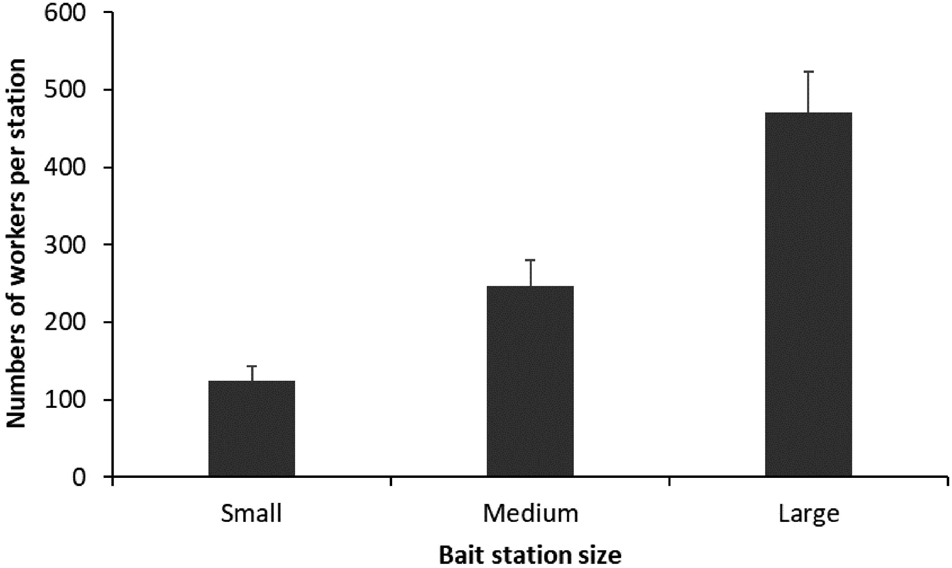
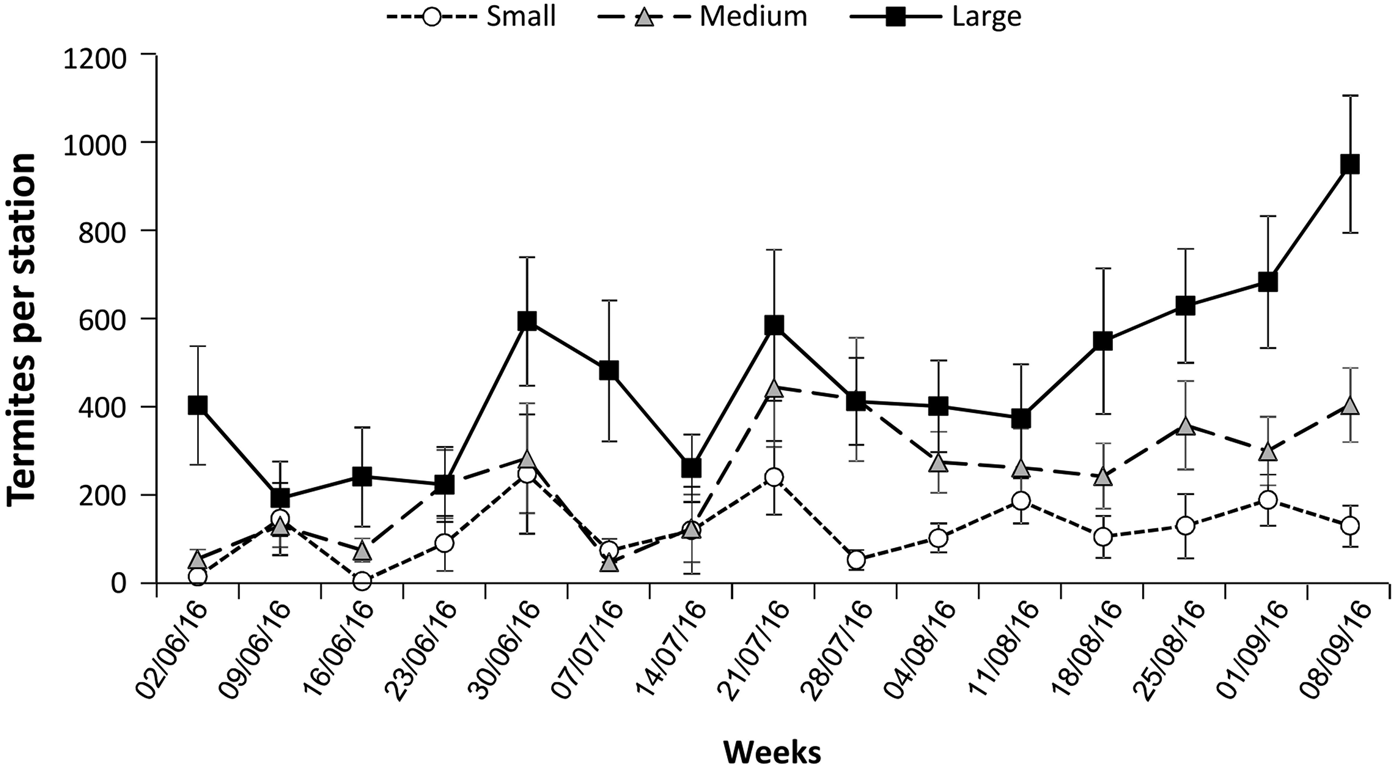
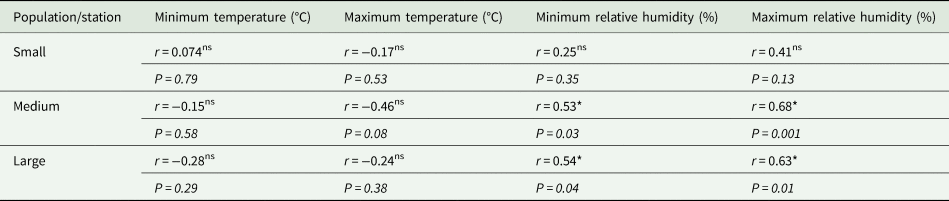
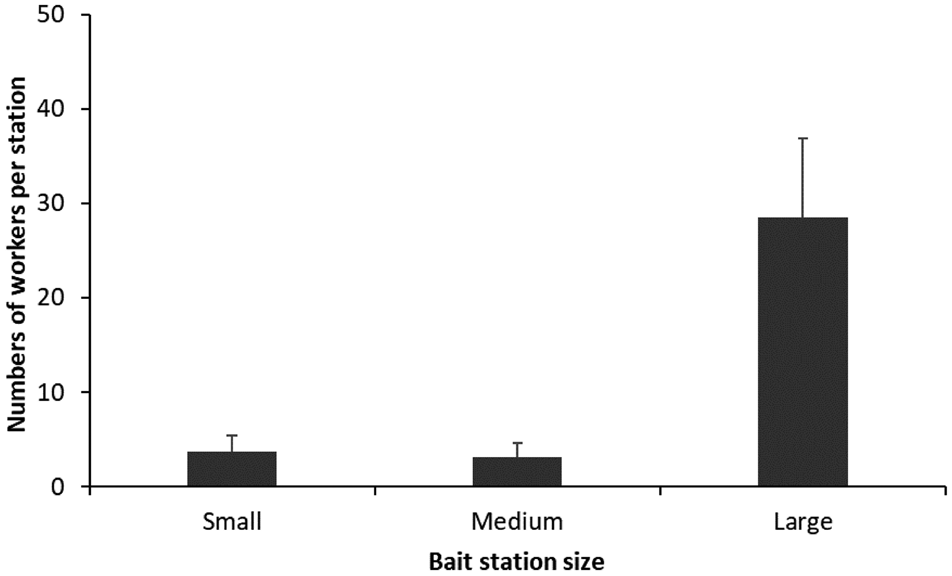
Overall, the larger the station the more termites that were attracted (fig. 1). The weekly activity also showed maximum capture of workers in large station on 30 June 2016 (601 ± 147 numbers/station), 21 July 2016 (591 ± 143 numbers/station) and highest peak population was recorded on 8 September 2016 (967 ± 157 numbers/station). An almost similar pattern was observed in medium and small stations but with lower capture (fig. 2). These differences were significant for station size (F 2, 57 = 17.493, P < 0.001), effect of time (F 14, 798 = 4.793, P < 0.001), and for the interaction (F 28, 798 = 1.507, P = 0.045). There was a positive and significant correlation between the population of O. obesus in large and medium stations with relative humidity but no correlation between populations in large and medium stations, with temperature (table 1).
Overall mean population of Odontotermes obesus in three station sizes.

Weekly mean population of Odontotermes obesus in three station sizes. White circles small stations, grey triangles medium stations, black squares large stations.

Correlation of Odontotermes obesus population/station with environmental factors during inspection weeks

ns, non-significant.
*Significantly different at 5% level of significance.
Total contacts to stations
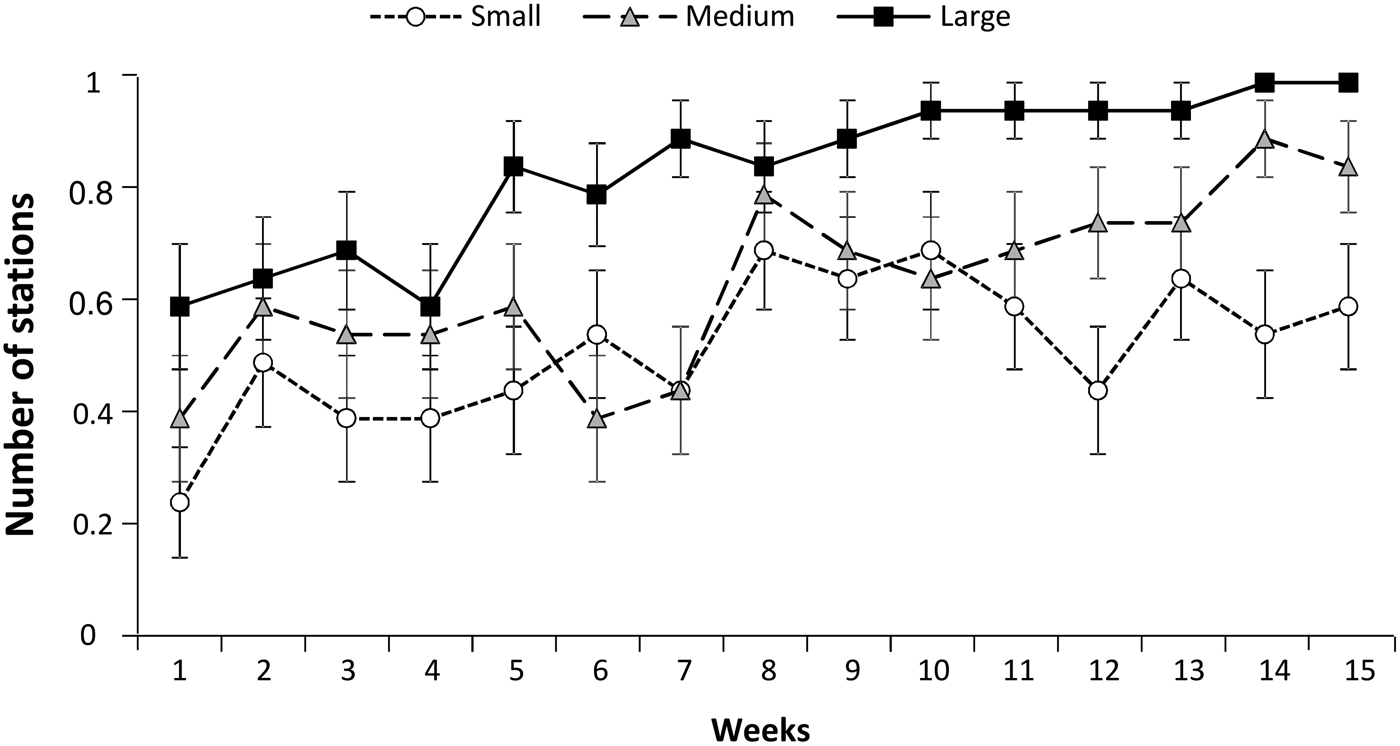
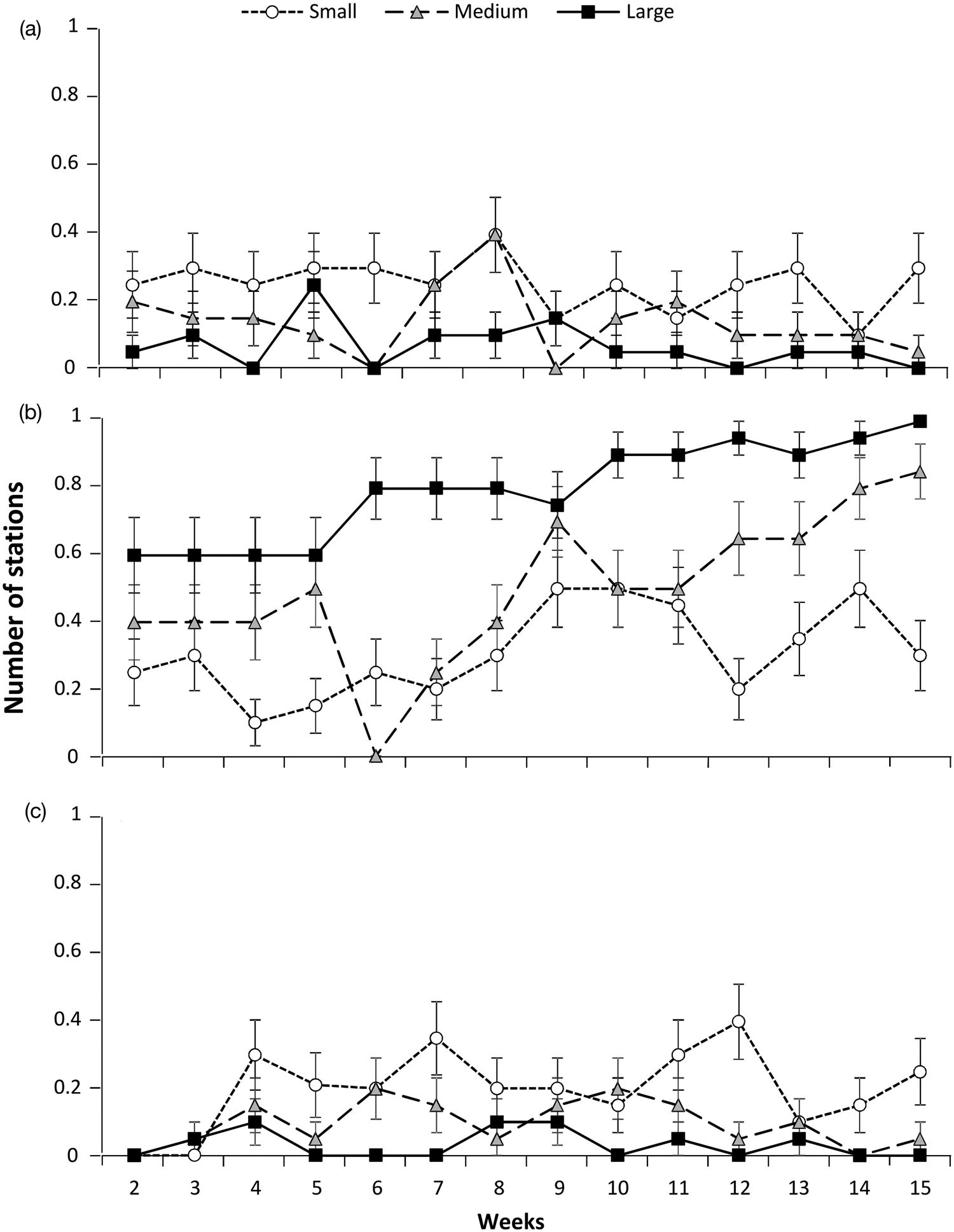
The results showed that the mean total number of contacts to large-size stations increased gradually from 0.60 ± 0.11 stations on the first inspection to 1.00 ± 0.00 stations on the final inspection after 15 weeks. Comparatively less increase in contacts was observed for medium-size stations from 0.40 ± 0.12 contacts on the first inspection to 0.85 ± 0.08 contacts on the final inspection. The mean numbers of contacts for small-size stations first increased by the second inspection and then declined and total mean numbers of contacts on the final inspection were 0.60 ± 0.11 (fig. 3). These differences were significant: for station size (F 2, 57 = 14.03, P < 0.001), effect of time (F 14, 798 = 5.48, P < 0.001), as was the interaction, as fewer small stations were occupied over time whereas the opposite was true for large stations (F 28, 798 = 0.840, P = 0.705).
Total contacts (mean ± SE) of Odontotermes obesus for three station sizes. White circles small stations, grey triangles medium stations, black squares large stations.

New contacts over time
The results of the new contacts to three station sizes by O. obesus revealed more new contacts to the small bait stations compared to medium and large station sizes during the study period. The new contacts on large and medium stations decreased along the inspection weeks while new contacts on small stations remained almost similar along weeks. On the final inspection, 0.0 ± 0.0, 0.05 ± 0.05, and 0.3 ± 0.11 new contacts were recorded on large-, medium-, and small-size stations, respectively (fig. 4a). These differences were significant: for station size (F 2, 57 = 25.263, P < 0.001), effect of time for all stations (F 14, 798 = 3.401, P < 0.001), and significant interaction, as only large stations contact increased over time (F 28, 798 = 1.511, P = 0.044).
Mean (±SE) numbers of stations newly contacted (a), continuous contacts (b), abandoned (c) by Odontotermes obesus. White circles small stations, grey triangles medium stations, black squares large stations.

Continuous contacts over time
The numbers of new contacts to large stations almost remained constant over time, whereas sudden peaks were recorded in small stations followed by medium stations. The continuity of the O. obesus contacts to the stations was greatest for the large stations followed by medium and small stations with 0.10 ± 0.00, 0.85 ± 0.08, and 0.3 ± 0.11 contacts, respectively, recorded on final inspection (fig. 4b). These differences were significant: for station size (F 2, 57 = 24.856, P < 0.001), time (F 14, 798 = 6.849, P < 0.001), again, the interaction showed large stations continuous contact increased over time (F 28, 798 = 2.042, P = 0.001)
Abandoned stations
Station abandonment by O. obesus was always less in large stations than in medium and small stations where huge fluctuations were observed during the study period. The mean numbers of abandonments to large stations fluctuated around a mean of 0.03 stations, 0.03 for medium stations, and 0.20 for small-sized stations over the experimental period (fig. 4c). These differences were not significant for any factor: for station size (F 2, 57 = 15.122, P < 0.001), time (F 14, 798 = 5.368, P < 0.001), and the interaction (F 28, 798 = 1.936, P < 0.001).
Other termites
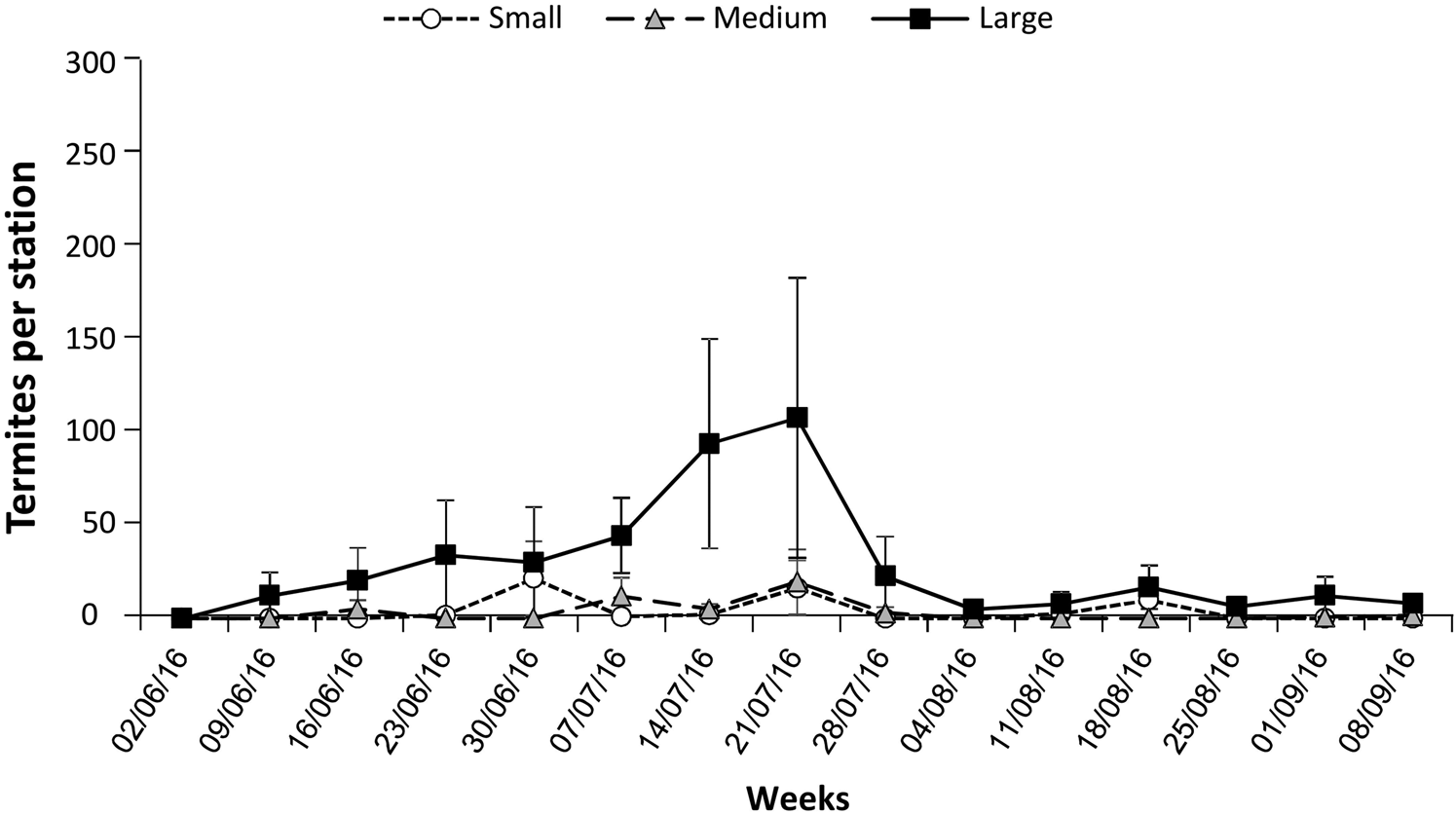
The other termite species recorded in the bait station were Microcerotermes spp., Microtermes spp., and Amitermes sp. The population of other termite species was also greatest within large stations (figs 5 and 6). The population of other termite species was significantly different for station size (F 2, 57 = 1.712, P < 0.190), but not for effect of time (F 14, 798 = 2.795, P < 0.001), nor for the interaction (F 28, 798 = 1.487, P = 0.051).
Overall mean population of termites other than Odontotermes obesus in three station sizes.

Weekly mean population of termites other than Odontotermes obesus in three station sizes. White circles small stations, grey triangles medium stations, black squares large stations.

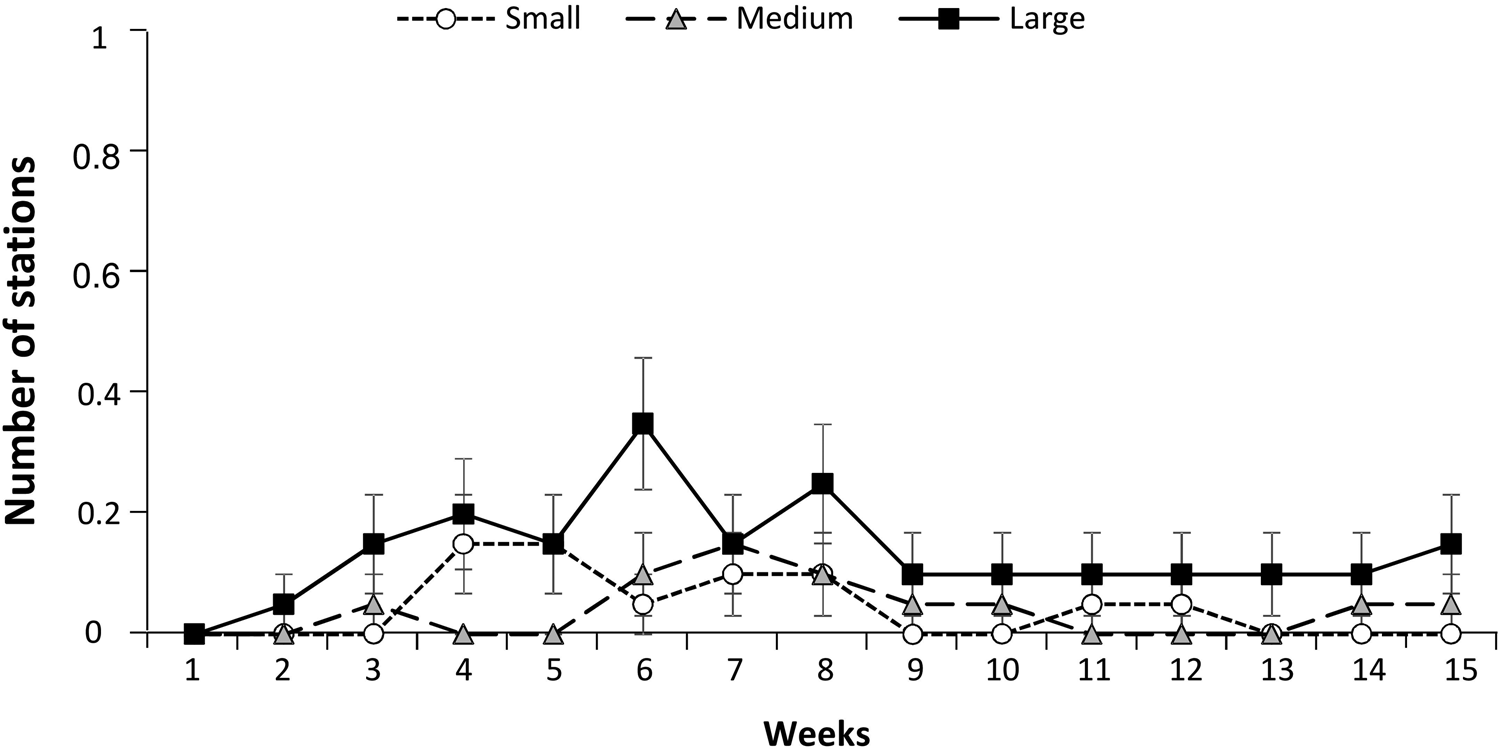
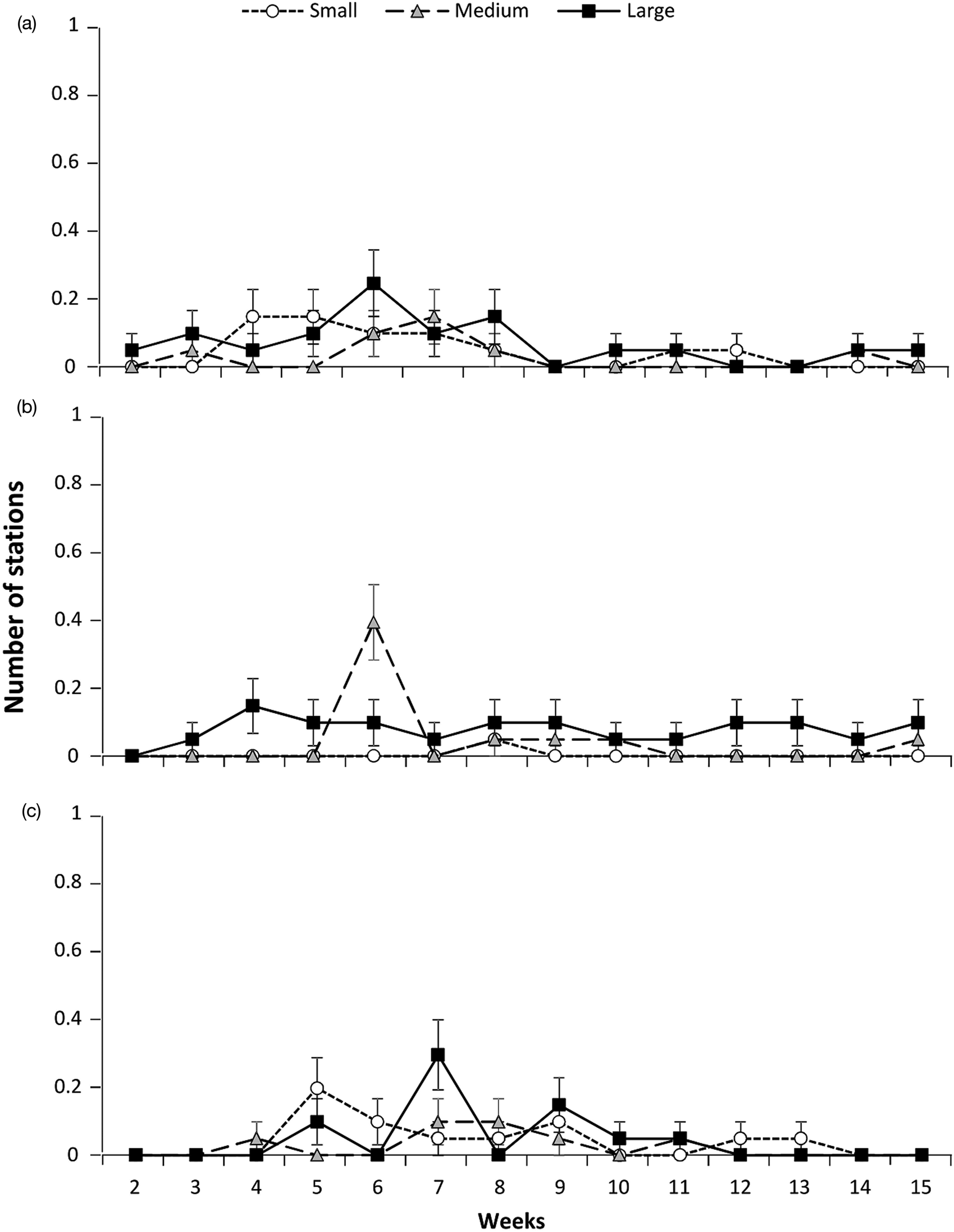
The contacts to bait stations by other termite species were considered together. The pattern of contacts by other termite species was almost similar as for O. obesus but at lower rates. The mean number of total contacts to small stations was 0.04 stations over the 15 weeks of the experiment; the rate for medium stations was 0.04 stations, and that for large-size stations was 0.13 stations (fig. 7). These differences were significant for station size (F 2, 57 = 3.604, P = 0.034), but not for effect of time (F 14, 798 = 2.776, P < 0.001), nor for the interaction (F 28, 798 = 0.977, P = 0.500). The mean numbers of new contacts were higher on large stations followed by medium and small stations (Fig. 8a). These differences were significant for station size (F 2, 57 = 2.772, P = 0.071), but not for effect of time (F 13 741 = 2.75, P = 0.01), nor for the interaction (F 26, 741 = 0.829, P = 0.711). Similarly, continuous contacts to large stations were comparatively greater as compared to other two station sizes (Fig. 8b). These differences were not significant for station size (F 2, 57 = 1.87, P = 1.62), but significant for effect of time (F 13, 741 = 4.103, P < 0.001), and for the interaction (F 26, 741 = 3.334, P < 0.001). There were less abandonments in large stations whereas maximum station abandonments were observed in small stations (Fig. 8c). However, these differences were not significant for station size (F 2, 56 = 0.853, P = 0.432) but significant for effect of time (F 13, 728 = 3.872, P < 0.001), and for the interaction (F 26, 728 = 1.584, P = 0.03).
Total contacts (mean ± SE) of termites other than Odontotermes obesus for three station sizes. White circles small stations, grey triangles medium stations, black squares large stations.

Mean (±SE) numbers of stations newly contacted (a), continuous contacts (b), abandoned (c) by termites other than Odontotermes obesus. White circles small stations, grey triangles medium stations, black squares large stations.

Discussion
The workers of O. obesus preferred large stations with relatively greater wood supply compared to medium- and small-size stations with respectively less wood. On the first inspection, about 60% of the large stations were contacted while medium and small stations have only 40 and 20% contacts, respectively. On the final inspection, O. obesus was found in almost all large stations while small stations have only 60% contacts by O. obesus. New contacts and continuous contacts to large-size stations also increase gradually with the passage of time. On average, 20% abandonment was recorded in small station while it was only 9% in medium and 3% in large stations.
More workers of O. obesus were recruited toward large stations as compared to the other two station sizes. Foraging of large numbers of workers toward large stations is necessary for effective baiting. These workers will take higher quantities of bait and distribute among colony members resulting in quicker colony collapse. Similar pattern was observed in some other fungus-growing termite in India, Pakistan and Singapore. Shanbhag and Sundararaj (Reference Shanbhag and Sundararaj2014) reported a quicker discovery and higher infestation of larger baits by Odontotermes wallonensis in Indian forest. Macrotermes gilvus contacted about 50% of the large stations as compared to only 5% small stations in Singapore during 8 weeks (Iqbal et al., Reference Iqbal, Wijedasa and Evans2017). These total contacts were quite less as compared to those in the current study because of the large variations in the study sites. The study in Singapore was conducted in Singapore Botanic Garden which has a mixture of habitats, including primary dipterocarp rainforest, various stages of secondary forests, manicured parklands, and specialist gardens. This mixture of habitat provides alternative food resources resulting in less contact of the bait stations (Lenz et al., Reference Lenz, Kard, Evans, Mauldin, Etheridge and Abbey2009).
Foraging behavior of non-fungus-growing termite species has also been influenced by the bait size in prior work. De Souza et al. (Reference De Souza, Araujo and Reis2009) observed delayed occupation of single bait as compared to triplet bait in some in Apicotermitinae and Nasutitermitinae in forests in Brazil. Coptotermes lacteus preferred and removed more baits where bait size was larger compared to a smaller bait size. Large baits appear to be preferred by termites because they are easier to find and termites consume them faster than smaller baits (Evans and Gleeson, Reference Evans and Gleeson2006). Studies have also shown that termites utilize less bait when the bait size is small (Lenz, Reference Lenz, Hunt and Nalepa1994; Hedlund and Henderson, Reference Hedlund and Henderson1999). Therefore, placing large baits at the beginning of the study would result in more consumption of the baits by large numbers of workers recruited toward large stations.
The less abandonment in the large stations could be related to the less bait disturbance in the current study. Although baits were inspected in the same fashion and time, smaller stations would inherently be disturbed more than larger stations. Studies have shown that termites always dislike frequent disturbances resulting in bait abandonment (Lai, Reference Lai1977; Jones, Reference Jones1990; French et al., Reference French, Ahmed and Ewart1995). The wood within large- and medium-size stations withstands these frequent disturbances and remained contacted.
Effectiveness of bait stations varies greatly among baiting studies focused on fungus-growing termites. In previous studies, less contact rates have been reported to the stations similar in size to our small and medium stations resulting in delayed colony elimination (Peters and Broadbent, Reference Peters, Broadbent, Lee and Robinson2005; Huang et al., Reference Huang, Lei and Xue2006; Wang et al., Reference Wang, Guo, Gong, Lu, Lei, Sun and Mo2007; Dhang, Reference Dhang2011). However, in studies where large stations were used, they achieved higher contact rates and effective colony elimination. The inefficiency of small stations could be related to the small amount of bait matrix placed inside them. The small quantity of bait matrix was often completely consumed before inspection which requires frequent replacement of bait matrix resulting in higher disturbance and station abandonment (Iqbal et al., Reference Iqbal, Wijedasa and Evans2017). In comparison, placing more quantity of bait matrix in large stations results in the consumption of bait matrix for an extended period of time, hence causing less disturbance and abandonment (Lenz, Reference Lenz, Hunt and Nalepa1994; Hedlund and Henderson, Reference Hedlund and Henderson1999; Evans and Gleeson, Reference Evans and Gleeson2006; Lenz et al., Reference Lenz, Creffield, Evans, Kard, Vongkaluang, Sornnuwat, Lee, Yoshimura and Tsunoda2012).
The foraging behavior of workers toward the station is very important for successful baiting. A toxic bait is placed inside the station and control of termites by baiting can be accelerated if baits are found quicker and more workers forage toward the bait station. Thus large numbers of workers will take and distribute the toxin throughout the colony members. Our next goal is to find a toxicant that can be used for baiting against O. obesus. In some studies, different neurotoxins (fipronil, imidacloprid, thiamethoxam) and metabolic inhibitors have been tested in the laboratory (Kumawat, Reference Kumawat2001; Iqbal et al., Reference Iqbal, Alvi, Saeed, Rashied, Saeed, Jaleel, Khan and Garmah2019) but detailed field baiting studies are still needed for effective management of O. obesus. Different microbial agents such as nucleopolyhedrosis virus, entomopathogenic fungi, and nematodes have great potential for controlling termites, but they require comprehensive laboratory and field studies to evaluate their efficacy.
Acknowledgements
Authors are thankful to the Higher Education Commission, Pakistan for providing funds to carry out this research through SRGP Project No. (Project No. 21-631).
Authors' contributions
NI, AMA, and SS designed the study. NI and MH conducted the study. NI, UN-U, and AAK analyzed the data. NI and ADA wrote the manuscript.
Conflict of interest
None.