Introduction
The taxonomy of tropical lichens is still incompletely known, but in recent years there has been much progress and a few attempts have even been made to predict the number of species in some predominantly tropical lichen families, based on a detailed analysis of the known species distribution. So far, this has been done for the Graphidaceae (Lücking et al. Reference Lücking, Johnston, Aptroot, Kraichak, Lendemer, Boonpragob, Cáceres, Ertz, Ferraro and Jia2014) and the Trypetheliaceae (Aptroot et al. Reference Aptroot, Cáceres, Johnston and Lücking2016). In both instances, a complete data matrix was published online with known accepted species and distributions across the globe. For the Graphidaceae this is still the only existing complete enumeration of currently accepted species; for the Trypetheliaceae it is in accordance with the revision published simultaneously (Aptroot & Lücking Reference Aptroot and Lücking2016). For the equally predominantly tropical family of the Pyrenulaceae, a similar paper is in preparation (C. O. Mendonça, A. Aptroot, R. Lücking & M. E. S. Cáceres, unpublished data). Several undescribed species are mentioned there and this provided a good incentive to formally describe them.
The family Pyrenulaceae is a mostly tropical family comprising 11 genera, including Pyrenula Ach., Pyrgillus Nyl. and Sulcopyrenula H. Harada (Gueidan et al. Reference Gueidan, Aptroot, Cáceres and Binh2016). In a recent key to the species of the genus Pyrenula, Aptroot (Reference Aptroot2012) accepted 169 species out of the c. 745 named taxa in the genus. Today the genus has c. 225 accepted species, including the 169 accepted in Aptroot (Reference Aptroot2012) plus the many additional species that have been described since (Aptroot et al. Reference Aptroot, Schumm and Cáceres2012, Reference Aptroot, Sipman and Cáceres2013, Reference Aptroot, Ferraro and Cáceres2014, Reference Aptroot, Andrade, Mendonça, Lima and Cáceres2015; Wijeyaratne et al. Reference Wijeyaratne, Lücking and Lumbsch2012; Cáceres et al. Reference Cáceres, Aptroot, Nelsen and Lücking2013; Lima et al. Reference Lima, Mendonça, Maia, Aptroot and Cáceres2013; Gueidan et al. Reference Gueidan, Aptroot, Cáceres and Binh2016; Mendonça et al. Reference Mendonça, Aptroot and Cáceres2016). From the genus Pyrgillus, only seven species are currently known (Aptroot Reference Aptroot1991; Kashiwadani et al. Reference Kashiwadani, Aptroot, Futagami and Moon2012; Singh & Singh 2012 Reference Singh and Singha , Reference Singh and Singhb , Reference Singh and Singh2017), and in Sulcopyrenula only four species (Harada Reference Harada1999; Aptroot Reference Aptroot2002, Reference Aptroot2012).
During recent fieldwork and herbarium studies by the authors, several undescribed species in the above genera were discovered. Some of these (the red Pyrgillus and the two Pyrenula species with red parts) were so characteristic that they were already recognized in the field as undescribed species. The purpose of this paper is to formally describe them.
Material and Methods
Descriptive work was carried out using an Olympus SZX7 stereomicroscope and an Olympus BX50 compound microscope with interference contrast, connected to a Nikon Coolpix digital camera. Sections were mounted in tap water (unless otherwise indicated), in which all measurements were also taken. The chemistry of the type specimens was investigated by TLC (Orange et al. Reference Orange, James and White2001) using solvent A.
The Species
Pyrenula biseptata Aptroot & M. Cáceres sp. nov.
MycoBank No.: MB 821612
Pyrenula with simple ascomata with vertical ostioles, an inspersed hamathecium and 2-septate ascospores 11–12×4·5–5·0 μm.
Type: Brazil, Pará, Fazenda Pantera, 85 km N of Dom Eliseu, 3°49'54''S, 48°03'37''W, on bark of tree, c. 120 m alt., 29 October 2016, M. E. S. Cáceres & A. Aptroot ISE 40367 (ISE—holotype; ABL—isotype).
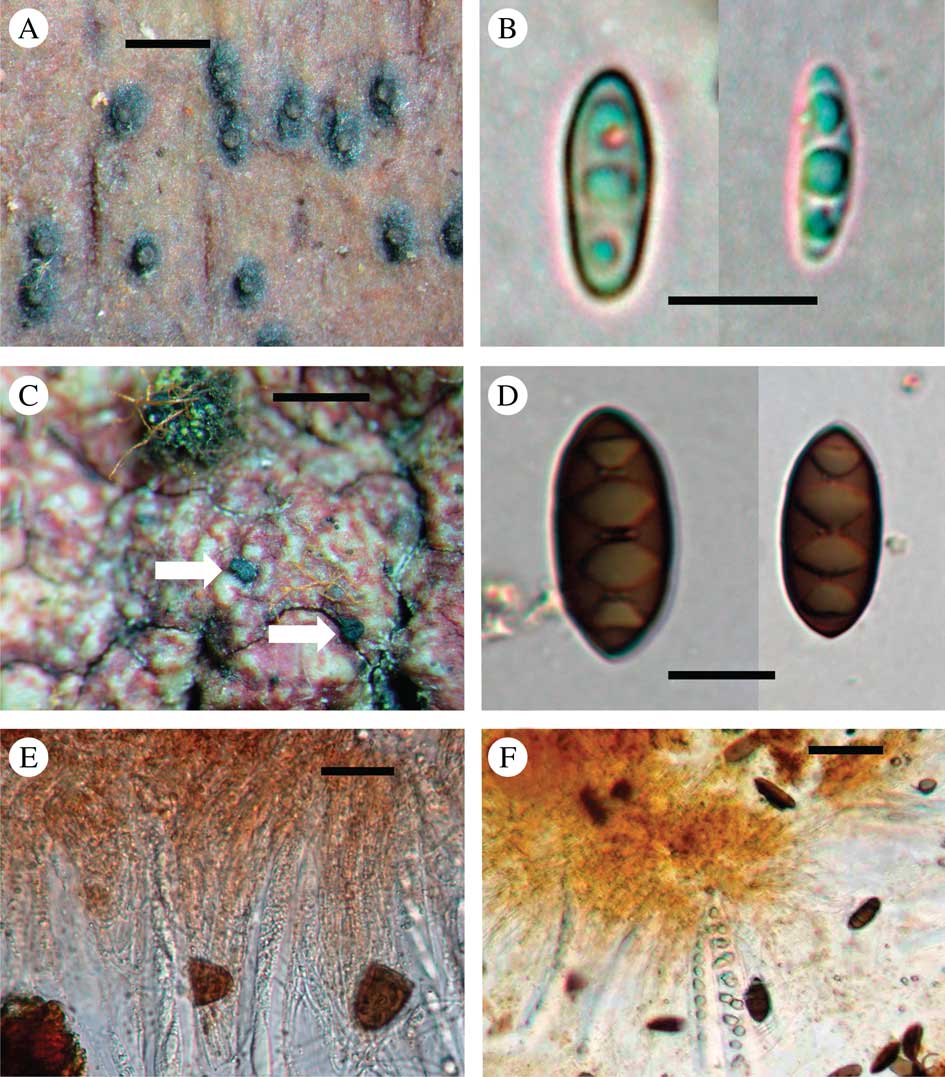
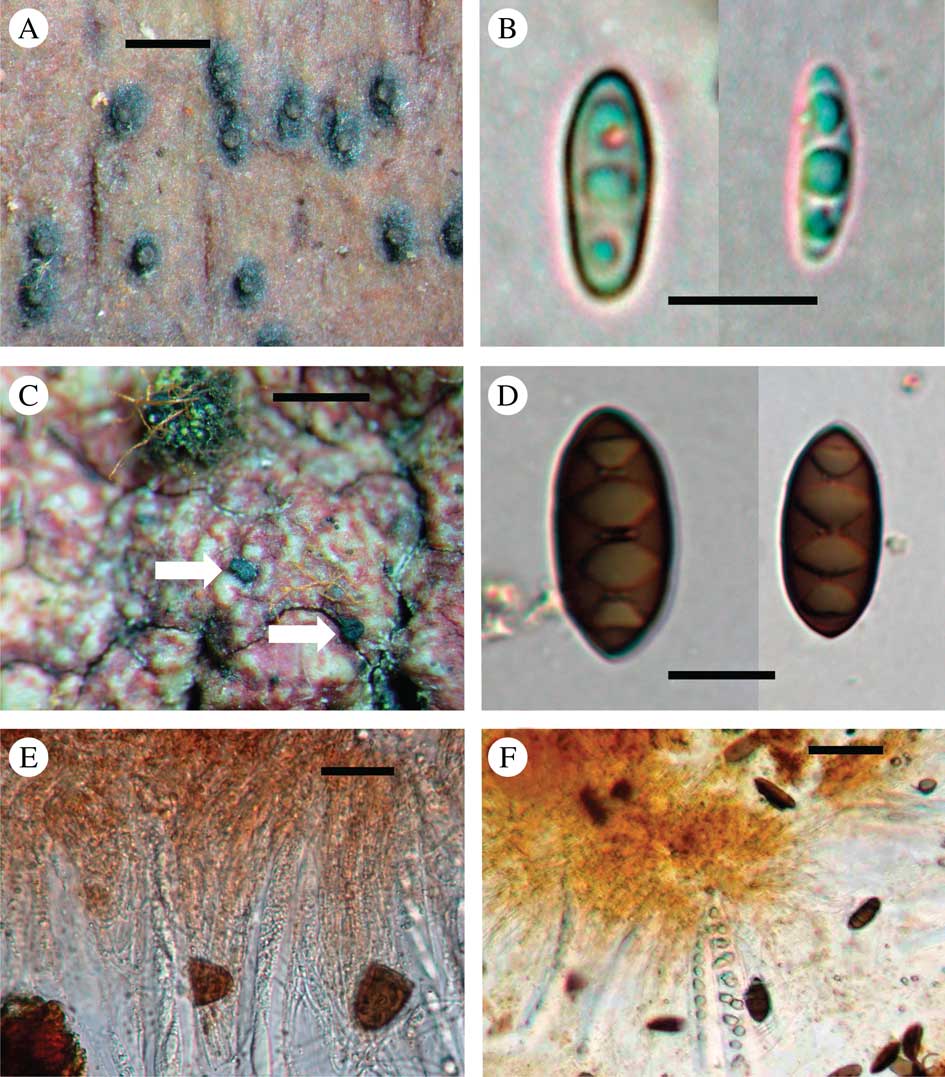
A & B, Pyrenula biseptata (isotype): A, habitus; B, ascospores. C–F, Pyrenula sanguineomeandrata (isotype): C, habitus, arrows pointing to ostioles; D, ascospores; E, red hamathecium inspersion in H2O; F, orange hamathecium inspersion in KOH. Scales: A & C=0·5 mm; B & D=10 μm; E & F=50 μm. In colour online.
Thallus corticate, smooth, continuous, thin, dark brown, without pseudocyphellae or pockets of crystals; algal cells trentepohlioid.
Ascomata perithecioid, simple, dispersed, flat conical, superficial, often elongated, 0·2–0·4 mm diam., black, without thallus covering. Wall more or less equally carbonized, without crystals, c. 50 μm thick. Ostioles apical, brown. Hamathecium hyaline, heavily inspersed with oil droplets. Asci cylindrico-clavate, with 8 irregularly arranged ascospores. Ascospores brown, 2-septate, long ellipsoid, without constrictions, 11–12×4·5–5·0 μm, ends rounded; lumina rounded to diamond-shaped, terminal lumina separated from the end wall by an endospore layer.
Pycnidia not observed.
Chemistry. No secondary lichen substances detected.
Ecology and distribution. On smooth bark of trees in primary tropical rainforest. Known only from Brazil.
Discussion. This is only the second species in the genus with consistently 2-septate ascospores, a character that is rare throughout lichenized, and even non-lichenized, fungi because ascospore septation is a result of repeated, simultaneous division that affects all ascospore cells, often leading to 1-septate or 3-septate ascospores. The other Pyrenula species that has 2-septate ascospores, viz. P. lineatostroma Aptroot (Aptroot et al. Reference Aptroot, Diederich, Sérusiaux and Sipman1997), differs in the ascomata that are not separate but joined together sideways to form pseudostromata, and by the absence of hamathecium inspersion.
Pyrenula sanguineomeandrata Aptroot & Mercado Diaz sp. nov.
MycoBank No.: MB 821613
Pyrenula with a thallus with red, KOH+ purple pigmentation of lines or a reticulum, simple ascomata with vertical ostioles, a deep red inspersed, KOH+ orange hamathecium, and dark brown 3-septate ascospores 25–29×10–12 μm.
Type: Puerto Rico, Maricao, Bosque Estatal de Maricao, Vereda Los Viveros, 18°09'N, 66°59'W, on bark of tree, c. 850 m alt., 18 February 2014, A. Aptroot 72206 (UPR—holotype; ABL, F—isotypes).
Thallus corticate, smooth, continuous, up to 0·1 mm thick, ochraceous, with lines or a reticulum of dark red pigmentation, without pseudocyphellae or pockets of crystals; algal cells trentepohlioid.
Ascomata perithecioid, simple, dispersed, pyriform, deeply immersed in the bark and only visible from above by the ostiole, 0·2–0·4 mm diam., black. Wall more or less equally carbonized, without crystals, c. 30 μm thick. Ostioles apical, dark to reddish brown. Hamathecium inspersed with dark red oil droplets. Asci cylindrico-clavate, with 8 irregularly arranged ascospores. Ascospores dark brown, 3-septate, broadly fusiform, without constrictions, 25–29×10–12 μm, ends rather pointed; lumina mostly diamond-shaped, terminal lumina separated from the end wall by an endospore layer.
Pycnidia not observed.
Chemistry. Red anthraquinone on thallus reacting UV+ red and KOH+ purple; dark red hamathecium inspersion (anthraquinone?) reacting K+ orange.
Ecology and distribution. On bark of tree in submontane evergreen wet forest. Known only from Puerto Rico.
Discussion. This is only the second Pyrenula species with a red inspersion in the hamathecium. Pyrenula rubroinspersa Aptroot & Sipman also has a red inspersion in the hamathecium, but that reacts KOH+ green, suggesting the presence of isohypocrellinic acid. The red pigment that reacts KOH+ orange is unusual but is, for example, also present on the outside of the mazaedia of Pyrgillus rufus (see below).
Pyrenula sanguineostiolata Aptroot & Mercado Diaz sp. nov.
MycoBank No.: MB 821614
Pyrenula with a thallus with deeply immersed simple ascomata with vertical ostioles, which are superficial and bright red, and 3-septate ascospores 25–28×9–12 μm.
Type: Puerto Rico, Maricao, Bosque Estatal de Maricao, Vereda Los Viveros, 18°09'N, 66°59'W, on bark of tree, c. 850 m alt., 18 February 2014, A. Aptroot 72180 (UPR—holotype; ABL, F—isotypes).
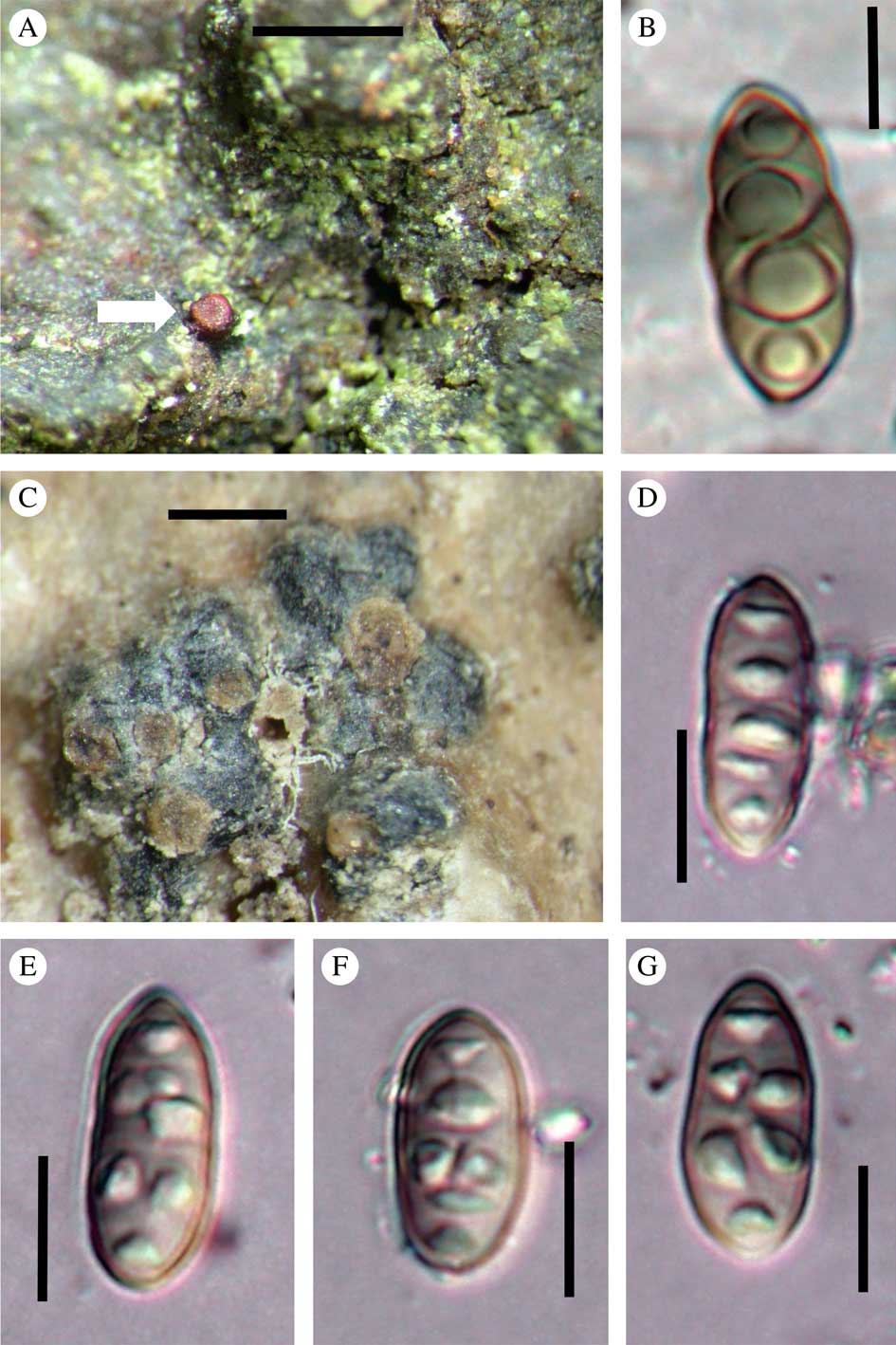
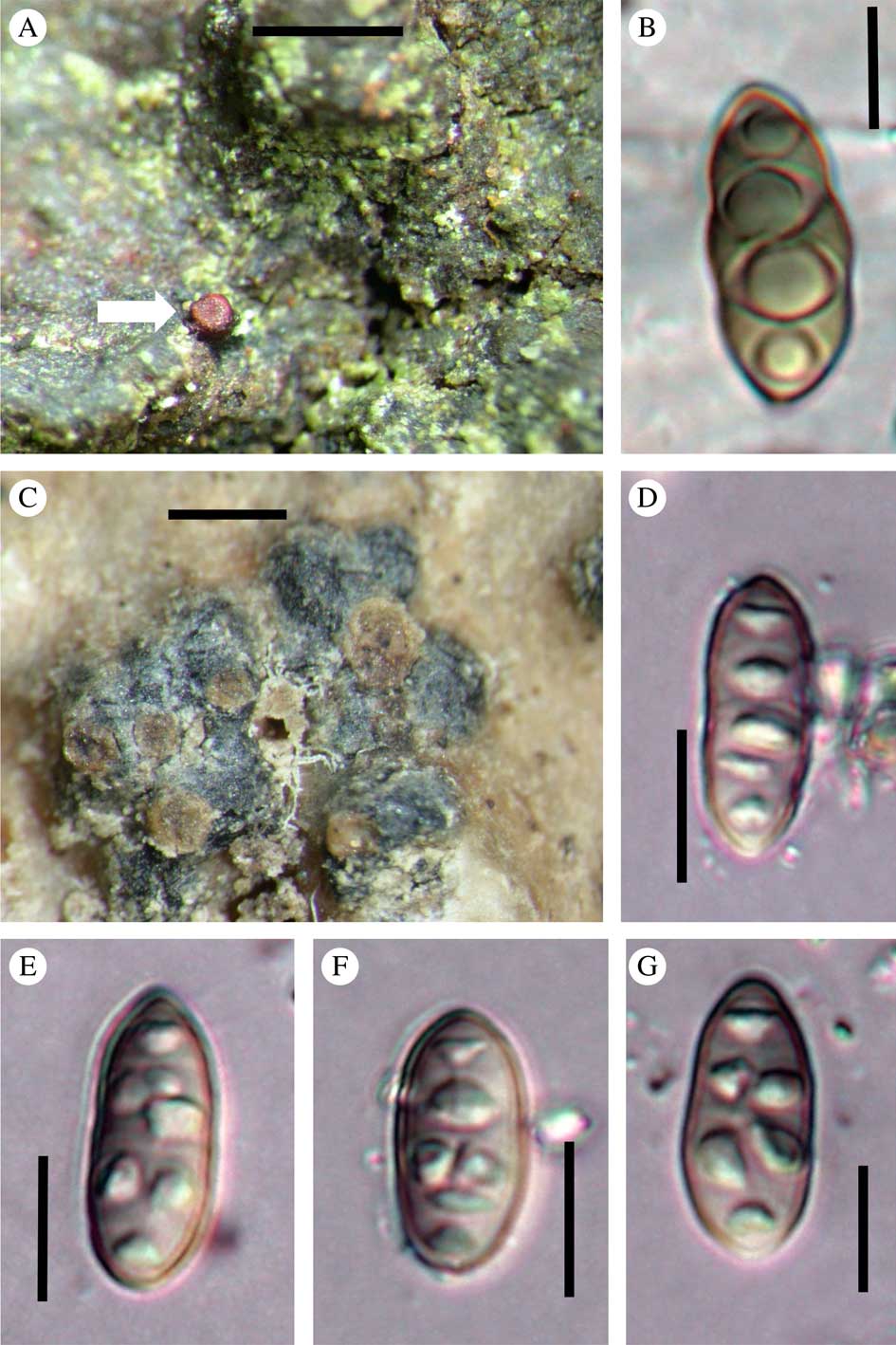
A & B, Pyrenula sanguineostiolata (isotype): A, habitus, arrow pointing to ostiole; B, ascospore. C–G, Pyrenula subvariabilis (holotype): C, habitus; D–G, ascospores. Scales: A & C=0·5 mm; B, D–G=10 μm. In colour online.
Thallus corticate, smooth, continuous, up to 0·1 mm thick, olivaceous green, without pseudocyphellae or pockets of crystals; algal cells trentepohlioid.
Ascomata perithecioid, simple, dispersed, pyriform, deeply immersed in the bark and only visible from above by the ostiole, 0·3–0·5 mm diam., black. Wall more or less equally carbonized, without crystals, c. 40 μm thick. Ostioles apical, superficial, c. 0·1 mm diam., bright red. Hamathecium hyaline, not inspersed with oil droplets. Asci cylindrico-clavate, with 8 irregularly arranged ascospores. Ascospores brown, 3-septate, broadly fusiform, without constrictions, 25–28×9–12 μm, ends rather pointed; lumina mostly rounded to diamond-shaped, somewhat irregularly aligned, terminal lumina separated from the end wall by an endospore layer.
Pycnidia not observed.
Chemistry. Red anthraquinone of ostiole reacting UV+ red and KOH+ dark purple (almost black).
Ecology and distribution. On bark of tree in submontane evergreen wet forest. Known only from Puerto Rico.
Discussion. This is one of the few species of Pyrenula with a bright red ostiole and the first one of these with deeply immersed ascomata.
Pyrenula subvariabilis Aptroot & Sipman sp. nov.
MycoBank No: MB 821615
Pyrenula with fused ascomata with lateral ostioles and submuriform ascospores 17–20(–25)×6–9 μm.
Type: Guyana, Potaro-Siparuni Region, surroundings of Pakaraima Village, along trail to Kawatipu, 4°42'N, 59°43'W, on bark of canopy branches of tree, c. 800 m alt., 22 February 1996, H. J. M. Sipman 41155 (B—holotype).
Thallus corticate, smooth, continuous, thin, ochraceous, without pseudocyphellae or pockets of crystals; algal cells trentepohlioid.
Ascomata perithecioid, in groups of 2–8, pyriform, emergent, 0·4–0·7 mm diam., black, mostly with thallus covering. Wall more or less equally carbonized, without crystals, c. 50 μm thick. Ostioles eccentric, fused, pale brown, c. 0·2 mm wide. Hamathecium hyaline, not inspersed with oil droplets. Asci cylindrico-clavate, with 8 irregularly arranged ascospores. Ascospores brown, irregularly submuriform, 3–5×0–2-septate, with total number of lumina 6–12, fusiform, without constrictions, 17–20(–25)×6–9 μm, ends rather pointed; lumina mostly triangular to rounded, irregular, terminal lumina separated from the end wall by an endospore layer.
Pycnidia not observed.
Chemistry. No secondary lichen substances detected.
Ecology and distribution. On smooth bark of canopy branches in savannah. Known only from Guyana.
Discussion. There are only a small number of species of Pyrenula known with submuriform ascospores (Aptroot Reference Aptroot2012), and none with fused ostioles and ascospores of this size; all species with fused ostioles have much larger ascospores.
Pyrenula xanthinspersa Aptroot & M. Cáceres sp. nov.
MycoBank No.: MB 821616
Pyrenula with an ecorticate thallus containing lichexanthone, simple ascomata with vertical ostioles, not inspersed hamathecium and 3-septate ascospores of 14–17×6·0–7·5 μm.
Type: Brazil, Amazonas, Manaus, Reserva Florestal Ducke, along trails in vicinity of field station, alt. 80 m, 2°56'S, 59°57'W, on tree bark in primary rainforest, 3–8 June 2016, M. E. S. Cáceres & A. Aptroot ISE 28435 (ISE—holotype; ABL—isotype).
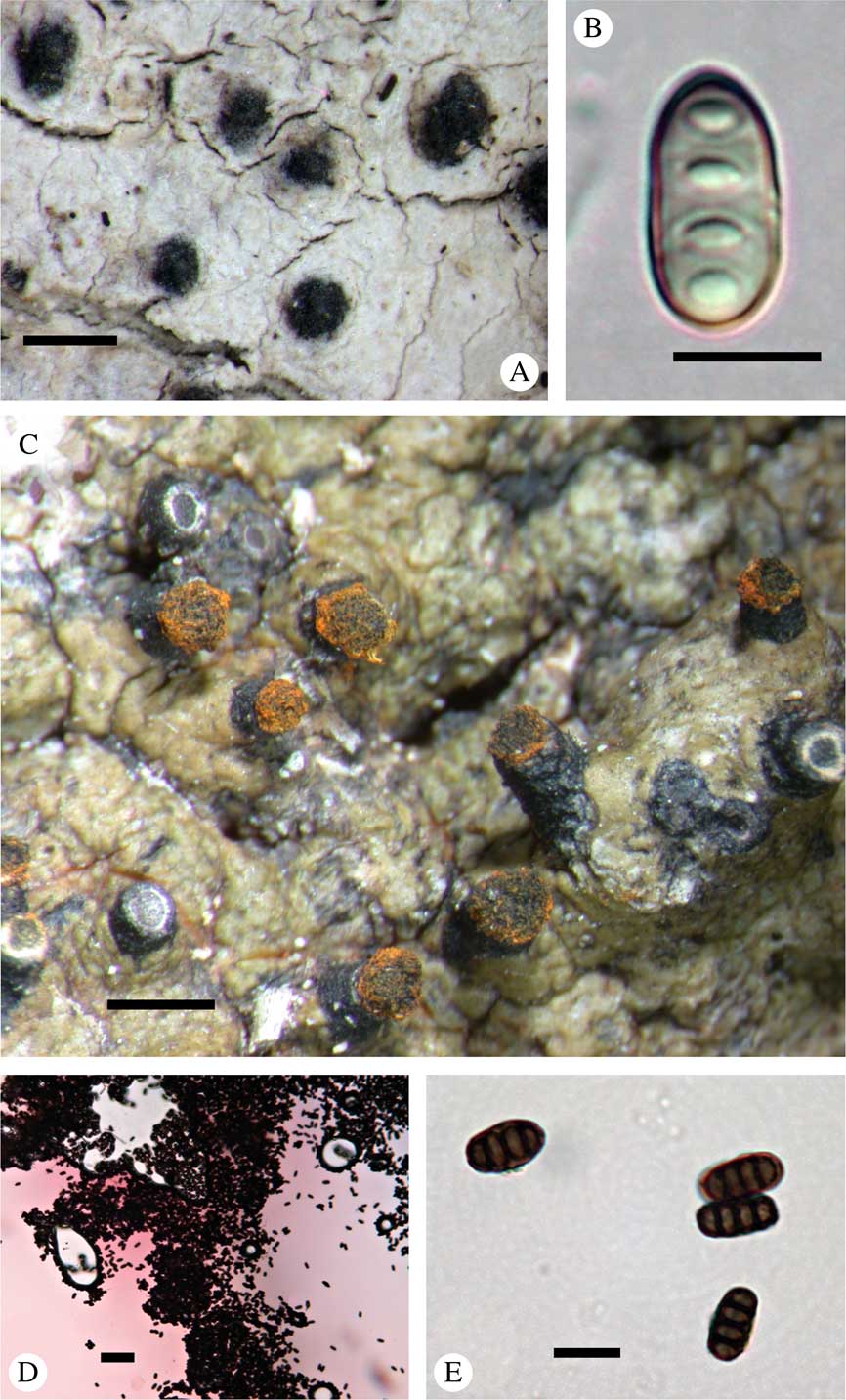
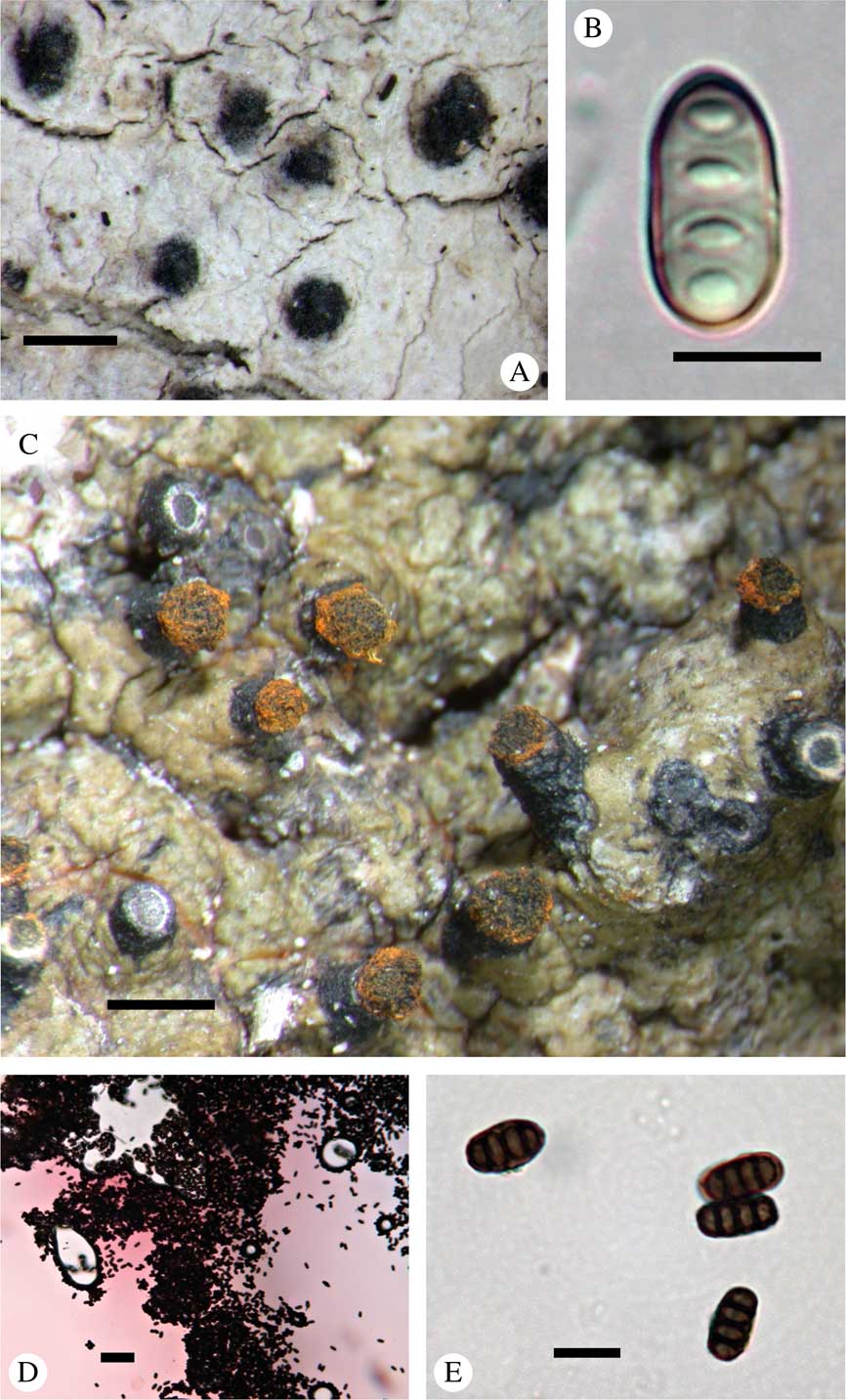
A & B, Pyrenula xanthinspersa (isotype): A, habitus: B, ascospore. C–E, Pyrgillus aurantiacus (isotype): C, habitus; D, ascospores in KOH showing reaction of pruina; E, ascospores. Scales: A & C=0·5 mm; B & E=10 μm; D=100 μm. In colour online.
Thallus not corticate, dull, continuous, thin, pale creamish, without pseudocyphellae or pockets of crystals; algae trentepohlioid.
Ascomata perithecioid, simple, dispersed, low hemispherical, emergent to superficial, 0·3–0·5 mm diam., black, without thallus covering. Wall more or less equally carbonized, without crystals, c. 40 μm thick. Ostioles apical, black. Hamathecium hyaline, not inspersed with oil droplets. Asci cylindrico-clavate, with 8 irregularly arranged ascospores. Ascospores brown, 3-septate, broadly fusiform, without constrictions, 14–17×6·0–7·5 μm, ends rather pointed; lumina mostly diamond-shaped, terminal lumina separated from the end wall by an endospore layer.
Pycnidia not observed.
Chemistry. Thallus UV+ yellow, with lichexanthone.
Ecology and distribution. On smooth bark of trees in primary tropical rainforest. Known only from Brazil.
Discussion. This species is close only to Pyrenula cocoes Müll. Arg. (Aptroot Reference Aptroot2012) which differs by the larger ascospores (18–21×10–13 μm). In addition, that species is mostly coastal while the new species was collected very far from any coast.
Pyrgillus aurantiacus Aptroot & M. Cáceres sp. nov.
MycoBank No.: MB 821617
Pyrgillus with corticate thallus containing lichexanthone, mazaedium with orange, KOH+ violet, UV+ red pruina and ascospores 13–16×6·0–7·5 μm.
Type: Brazil, Tocantins, near Itaguatins, alt. 150 m, 5°44'48''S, 47°33'46''W, on tree bark in cerrado remnant on farm, 23 October 2016, M. E. S. Cáceres & A. Aptroot ISE 28857 (ISE—holotype; ABL—isotype).
Thallus corticate, fissured, rather smooth and flat, c. 0·1 mm thick, olivaceous green, without pseudocyphellae or pockets of crystals; algal cells trentepohlioid.
Ascomata mazaedioid, sessile, simple or a few together, dispersed, cylindrico-pyriform, 0·5–0·8 mm diam., 0·5–1·2 mm high, black, lower half mostly with thallus covering. Wall more or less equally carbonized, without crystals, c. 100 μm thick. Ostioles apical, covered with black mazaedium which is mostly covered by a bright orange pruina. Hamathecium not observed. Ascospores dark brown, 3-septate, long ellipsoid, usually with faint median constriction, 13–16×6·0–7·5 μm, c. 2 times as long as wide, ends rounded; lumina mostly rounded, septa thickened and darkened, terminal lumina not separated from the end wall by an endospore layer.
Pycnidia not observed.
Chemistry. Thallus UV+ yellow, with lichexanthone; orange anthraquinone pruina on ascomata reacting UV+ red and KOH+ violet.
Ecology and distribution. On smooth bark of trees in cerrado forest. Known only from Brazil.
Discussion. There is so far only one species known in the genus Pyrgillus with a corticate thallus containing lichexanthone, viz. P. tibellii Kr. P. Singh & Pushpi Singh. That species differs by the dark red pruina on the mazaedium that reacts KOH+ purple and the larger ascospores of 15–20(–23)×7·5–10·0 μm. See also the next species, which differs in the red, generally lower ascomata with complete thallus cover at the sides, and especially by the dark red-brown pruina that reacts KOH+ orange, and the somewhat longer but thinner ascospores. The two new Pyrgillus species are described here from different states but could almost be regarded as occurring in the same region as their collecting localities are only 200 km apart. Both species belong to the core group of Pyrgillus, having 3-septate ascospores with thickened septa.
Pyrgillus rufus Aptroot & M. Cáceres sp. nov.
MycoBank No.: MB 821618
Pyrgillus with a corticate thallus containing lichexanthone, mazaedium with dark red, KOH+ orange, UV+ red pruina and ascospores 15·0–17·5×5·0–6·5 μm.
Type: Brazil, Pará, Villa Nazaré, 85 km N of Dom Eliseu, 3°53'56''S, 48°05'44''W, on bark of tree, c. 120 m alt., 29 October 2016, M. E. S. Cáceres & A. Aptroot ISE 40256 (ISE—holotype; ABL—isotype).
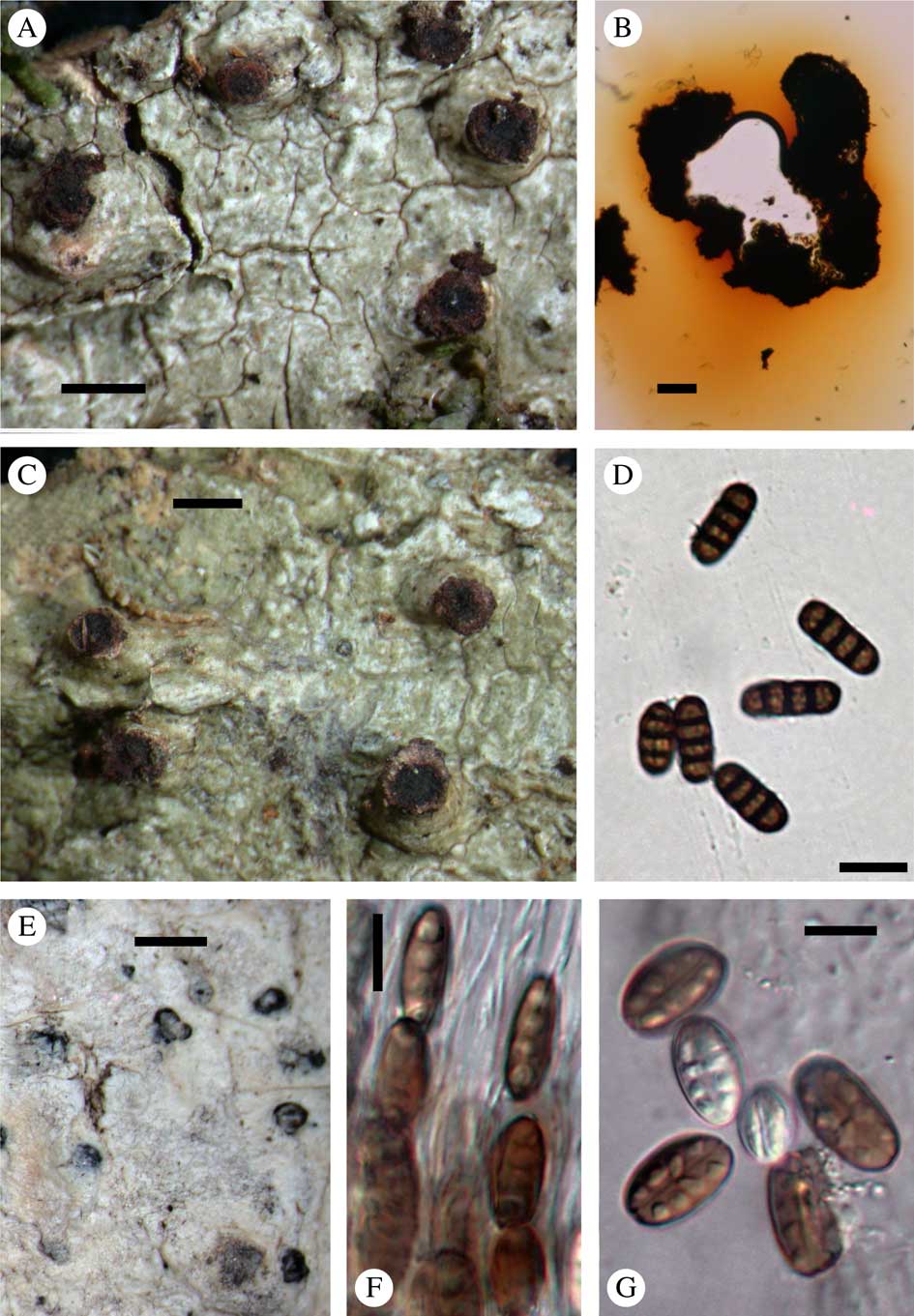
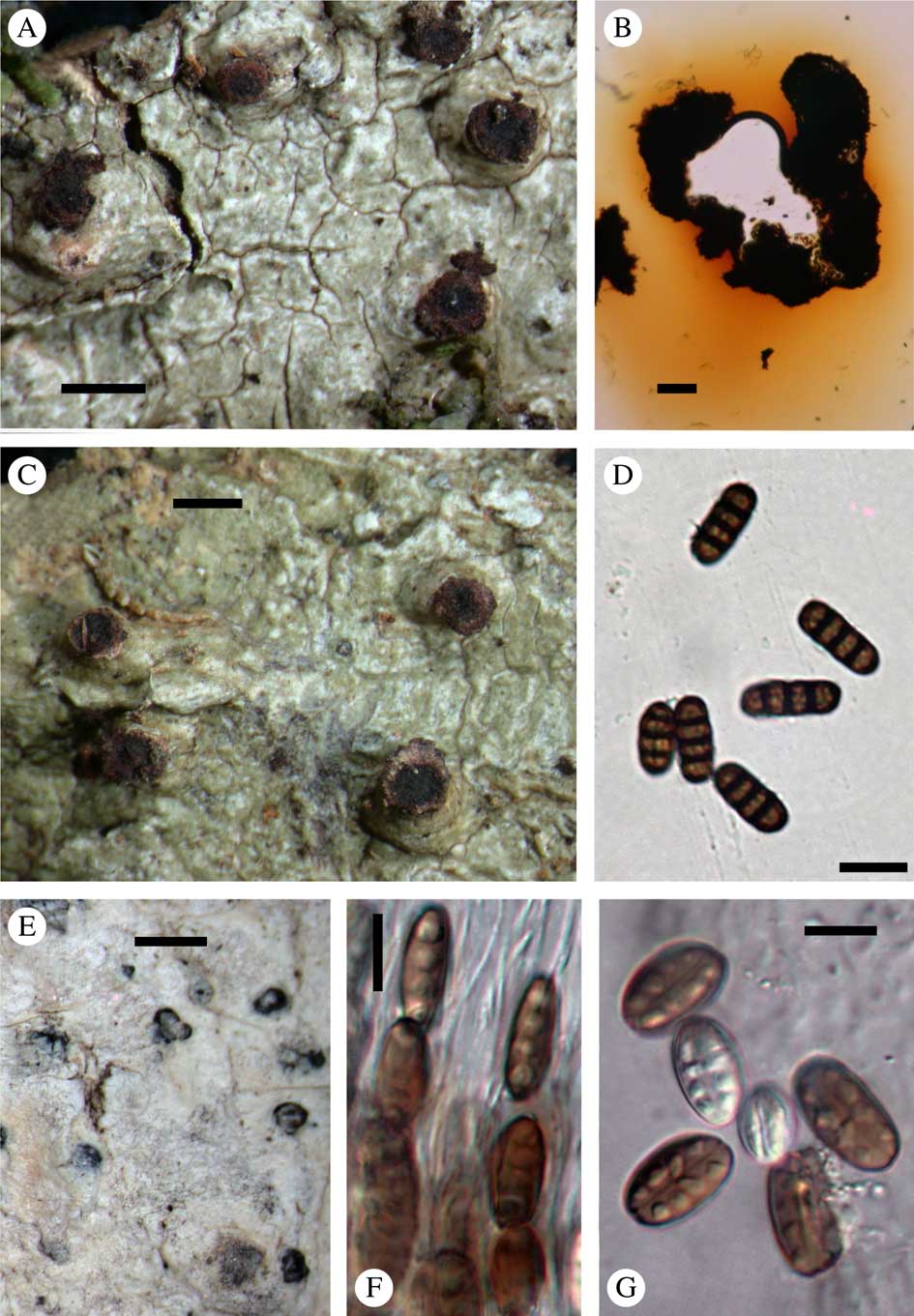
A–D, Pyrgillus rufus (isotype): A & C, habitus; B, ascospores in KOH showing reaction of pruina; D, ascospores. E–G, Sulcopyrenula biseriata (holotype): E, habitus; F, ascospores in ascus, upper ones in side view; G, discharged ascospores. Scales: A, C & E=0·5 mm; B=100 μm; D, F & G=10 μm. In colour online.
Thallus corticate, fissured, rather uneven, c. 0·1 mm thick, olivaceous green, without pseudocyphellae or pockets of crystals; algae trentepohlioid.
Ascomata mazaedioid, erumpent to sessile, simple, dispersed, cylindrico-pyriform, 0·5–0·8 mm diam., 0·5–0·8 mm high, black, sides almost completely with thallus covering. Wall more or less equally carbonized, without crystals, c. 100 μm thick. Ostioles apical, covered with black mazaedium which is mostly covered by a dark red pruina. Hamathecium not observed. Ascospores dark brown, 3-septate, long ellipsoid, usually with faint median constriction, 15·0–17·5×5·0–6·5 μm, c. 2·5–3 times as long as wide, ends rounded; lumina mostly rounded, septa thickened and darkened, terminal lumina not separated from the end wall by an endospore layer.
Pycnidia not observed.
Chemistry. Thallus UV+ yellow, with lichexanthone; red pigment (anthraquinone?) pruina on ascomata reacting UV+ red and KOH+ orange.
Ecology and distribution. On smooth bark of trees in primary tropical rainforest. Known only from Brazil.
Discussion. There is so far only one species known in the genus Pyrgillus with a corticate thallus containing lichexanthone, viz. P. tibellii Kr. P. Singh & Pushpi Singh, for which the new species was mistaken in the field. That species differs by the pruina on the mazaedium that reacts KOH+ purple and the larger and especially wider ascospores of 15–20(–23)×7·5–10·0 μm. See also the previous species. The red pigment that reacts KOH+ orange is unusual but is, for example, also present in the hamathecium of Pyrenula sanguineomeandrata (see above).
Sulcopyrenula biseriata Aptroot & Sipman sp. nov.
MycoBank No.: MB 821619
Sulcopyrenula with a thallus containing lichexanthone, simple ascomata with lateral ostioles and lozenge-shaped ascospores with 8 locules, (13–)15–17(–20)×8–10 (width)×6–7 (thickness) μm.
Type: Guyana, Upper Takutu District, Rupununi Savannah, Kusad Mountain, SE-side, 2°47'N, 59°51'W, on bark of Aspidosperma ulei tree, c. 450 m alt., 29 September 1992, H. J. M. Sipman 57895 (B—holotype).
Thallus indistinctly corticate, smooth, continuous, very thin, pale ochraceous, without pseudocyphellae or pockets of crystals, surrounded by a thin black hypothallus line; alga trentepohlioid.
Ascomata perithecioid, simple, dispersed, pyriform, immersed to emergent, 0·3–0·4 mm diam., black, mostly with thallus covering. Wall more or less equally carbonized, without crystals, c. 40 μm thick. Ostioles lateral, black. Hamathecium hyaline, not inspersed with oil droplets. Asci cylindrico-clavate, IKI−, with 8 almost uniseriately arranged ascospores. Ascospores dark brown, lozenge-shaped with one longitudinal euseptum that is formed first and is paralleled by fissures at upper and lower surfaces, and 3 distosepta in each ascospore-half giving 8 locules, ellipsoid, without constrictions, (13–)15–17(–20)×8–10 (width)×6–7 (thickness) μm, ends rounded; lumina mostly triangular but rounded, terminal lumina separated from the end wall by an endospore layer.
Pycnidia not observed.
Chemistry. Thallus UV+ yellow, with lichexanthone.
Ecology and distribution. On smooth bark of tree in savannah. Known only from Guyana. Growing together with Pseudopyrenula subgregaria Müll. Arg. and Astrothelium cf. pulcherrimum (Fée) Aptroot & Lücking.
Discussion. This is only the fifth species of this genus. All species in the genus share the lozenge-shaped, flat, submuriform ascospores with either 4 or 8 locules; the two species known with lichexanthone in the thallus, viz. S. cruciata Aptroot (Aptroot Reference Aptroot2002) and S. subglobosa (Riddle) Aptroot (Aptroot Reference Aptroot2012), have subglobose to ellipsoid ascospores with only 4 locules.

The CNPq (Conselho Nacional de desenvolvimento Científico e Tecnológico) is thanked for a research grant (311706/2012-6) to MESC. The Stichting Hugo de Vries-Fonds is thanked for various travel grants to AA. AA and MESC thank the project funded by the National Science Foundation ‘ATM – Assembling a Taxonomic Monograph: The Lichen Family Graphidaceae’ (DEB-1025861 to The Field Museum; PI T. Lumbsch, Co PI R. Lücking) for inviting them to collect in Puerto Rico. Dr Eugenio Santiago-Valentín, from the Botanical Garden Herbarium of the University of Puerto Rico, and Dr Armando Rodríguez-Durán, from the Inter American University of Puerto Rico, are warmly thanked for their support towards the realization of the Lichen Workshop in Puerto Rico.