Introduction
The increase in women's employment in post-industrial societies produces new social needs and risks, moving family policy to the centre stage of welfare policy debate. Investigations of policy responses to these challenges are forming a comprehensive body of empirical research. Comparative analyses conclude that family policy still differs in the OECD area (e.g., Thévenon, Reference Thévenon2011). Diversity may reflect different stages of policy development; some countries have only recently changed their policy orientation, but it also suggests the continuation of more fundamental institutional differences (ibid.). There is uncertainty about the sources of this variation and the future development of this policy field, which is why advancement of explanations of what drives and shapes family policy developments is essential (Mätzke and Ostner, Reference Mätzke and Ostner2010a).
This study suggests that finer-grained comparative studies of similar welfare state regimes can engender this endeavour. The Nordic countries are particularly interesting cases. Earner–carer models, aiming at the engagement of mothers and fathers in both paid and unpaid work, have become a hallmark of these welfare states. The early politicisation of working motherhood and gradual expansion of support for working mothers/parents over three or four decades means there is less need for radical reform today. Still, the degree to which mature policy systems are progressing is of considerable interest. Accounts of recent Nordic family policy reform abound. Some find that the Nordic welfare states remain on the ‘social-democratic path’, although there is an unfolding hybridisation by promoting more ‘choice’ in childcare (Knijn and Smit, Reference Knijn and Smit2009). Others indicate that more ‘choice’ may challenge ‘the traditional goals’ of the Nordic welfare states (Eydal and Rostgaard, Reference Eydal and Rostgaard2011a). It is also suggested that Nordic childcare politics are ‘edging’ toward a neo-liberal free choice model (Mahon et al., Reference Mahon, Anttonen, Bergqvist, Brennan and Hobson2012).
Further scrutiny of policy dynamics is needed in order to understand and explain these developments. The aim here is to investigate the role of political parties as drivers of policy change and stability. Family policies are disputed, and are often prominent in electoral campaigns. They entail competition over what are considered core values, probably more so than in many other policy fields (Fleckenstein, Reference Fleckenstein2011; Lewis, Reference Lewis2008). My key assumption is that the Nordic mature family policy systems continue to be an important field of policy struggle among political parties. The crucial question is what kind of struggles are unfolding – and why. In identifying policy change, I draw on theories of incremental institutional change (Mahoney and Thelen, Reference Mahoney, Thelen, Mahoney and Thelen2010). In explaining policy drivers, I relate to recent work on the role of party competition in welfare state/family policy development (e.g., Fleckenstein and Lee, Reference Fleckenstein and Lee2012; Häusermann et al., Reference Häusermann, Picot and Geering2013; Morgan, Reference Morgan2013; Seeleib-Kaiser, Reference Seeleib-Kaiser2010). Since social democracy and the left commonly have been seen as the protagonists of the earner–carer model, a particularly interesting question is whether the left–right divide is still a significant policy driver.
My empirical investigation engages with the real effects of the quotidian contestation that surrounds policy developments, analysing the history of the political debate of different policy measures separately. I track the advancement of three central elements of the earner–carer model in Denmark, Finland, Norway and Sweden: paid parental leave, earmarked leave for fathers and publicly subsidised childcare services, and also a fourth policy that undermines the earner‒carer model: cash-for-childcare schemes, i.e., cash benefits for children under three not using childcare services.Footnote 1, Footnote 2 The main emphasis is on the ‘mature’ period, the past ten to twenty years, but in order to understand underlying trends of stability and tensions, developments since the 1970s, the pioneering era of Nordic family policy reform, are included.
Mature family policy systems: party competition and incremental change
Regime theory and path dependency, i.e., the continued importance of political choices once taken and the mechanisms that keep policies on the same path (Mahoney, Reference Mahoney2000), have dominated the study of welfare state development in recent years. Institutions have been viewed as difficult to change: they are mostly seen as stable politics only periodically punctuated by external shocks (Mahoney and Thelen, Reference Mahoney, Thelen, Mahoney and Thelen2010). While regime theory's path dependency thesis helps predict the pressure of change as well as national responses, the role of political actors in initiating, or backtracking, a course of welfare state change is increasingly stressed; policy making is considered a highly complex and differentiated process (Mahon et al., Reference Mahon, Anttonen, Bergqvist, Brennan and Hobson2012). A special emphasis here is on how competition among political parties generates different modes of policy change. A theory of incremental institutional change, as outlined by Mahoney and Thelen (Reference Mahoney, Thelen, Mahoney and Thelen2010), is useful for the identification of policy change in mature policy systems. Actors, coalition patterns and political conflicts are important in order to understand institutional stability and change (Mahoney and Thelen, Reference Mahoney, Thelen, Mahoney and Thelen2010).
Family policy and party competition
Although a changing socioeconomic environment creates pressures for change, policy reform cannot be reduced to a functionalist response but requires an analysis of its political underpinnings (Fleckenstein and Lee, Reference Fleckenstein and Lee2012; Seeleib-Kaiser, Reference Seeleib-Kaiser2010). In contrast to the noted path dependence, in the past two decades several European welfare states (e.g., Germany, the Netherlands and the UK) have been path shifters with regard to work–family policies, departing from strong breadwinner models and embracing reforms that aim to support mothers’ employment (Morgan, Reference Morgan2013). Scholars contend that in the study of comparative politics, the focus on path dependency and institutional stickiness has side-lined electoral politics (ibid.). Studies of the influence of political parties on welfare state development rarely scrutinise the ideational positions of parties per se (Seeleib-Kaiser et al., Reference Seeleib-Kaiser, van Dyk and Roggenkamp2005).
New theoretical approaches accentuate that post-industrialism has changed the relationship between party politics and the welfare state. In a review article, Häusermann et al. (Reference Häusermann, Picot and Geering2013) maintain that electoral constituencies no longer correspond to those of the industrial age, and it is argued that the ‘traditional partisan politics’ theory needs revision. The latter sees parties as representatives of social constituencies (mostly industrial classes), and as bearers of clear ideological stances for social democratic or conservative welfare policies. A linear and direct relationship between the type of party in power (e.g., social democratic vs. conservative) and policy output is assumed. By contrast, Häusermann and colleagues argue, the institutional context, party system and party competition matter for the kind of welfare policies individual parties advocate. Strategies are not always programmatic, related to a broader ideology; they are sometimes particularistic, narrowly defined to attract specific groups of voters. Parties with the same ideological label make different choices if they act under particularistic competition. Party preferences are not necessarily stable, as some of the comparative welfare state literature implicitly assumes, but can change within a relatively short period of time (Seeleib-Kaiser, Reference Seeleib-Kaiser2010). The ‘strong’ version of party competition theories considers parties as strategic and opportunistic (Häusermann et al., Reference Häusermann, Picot and Geering2013). Instrumentalist political parties can best be seen as vote and office seekers rather than driven by deep ideological commitment (Fleckenstein and Lee, Reference Fleckenstein and Lee2012). A ‘softer’ version builds on the socially structured voter–party link, but adds competitive elements (Häusermann et al., Reference Häusermann, Picot and Geering2013).
Scholars argue that the policy drivers of the work–family policy of the ‘golden age’ of pioneering welfare states differ from the political environment of family policy ‘latecomers’ (Fleckenstein and Lee, Reference Fleckenstein and Lee2012). In contrast to the golden age, party competition is key to understanding family policy modernisation and institutional change among the ‘latecomers’ (ibid.). But the argument of changing political environment is also valid for the study of institutional stability and change among the now mature ‘pioneering’ welfare states. The position of social democracy is weakened, and coalitions have been the common form of government over the past decades. How parties at the centre-right have positioned themselves with regard to the advancement of the earner–carer model is particularly interesting. Fleckenstein and Lee suggest that a ‘dual strategy’ (e.g., a combination of employment-oriented policies and choice motivated cash-for-care arrangements) reflecting the internal divide within parties is the result of modernisation processes among some ‘latecomers’. But ‘dualisation’ can also be an outcome of inter-party competition and conflict at the national level.
Incremental institutional change
Incremental change means that once created, institutions often change in subtle and gradual ways (Mahoney and Thelen, Reference Mahoney, Thelen, Mahoney and Thelen2010). One basic assumption is that policy institutions are fraught with continuous struggles within and over prevailing institutional arrangements. Institutions are laden with power implications; formal political institutions are intended to distribute resources to particular kinds of actors and not to others – this animates change. Institutional stability is a function not simply of positive feedback but of active ongoing political mobilisation; institutions are vulnerable to change not just in moments of crisis but on a more ongoing basis.
The aim here is to identify drivers of policy stability and instability in the earner–carer model based on the modal types of institutional change outlined by Mahoney and Thelen (Reference Mahoney, Thelen, Mahoney and Thelen2010: 15–18). Layering and displacement are the most relevant modes to the present analysis. Layering is the introduction of new rules in addition to, or in parallel with, existing rules, and that involves amendments, revisions or additions. Displacement is the removal of existing rules and the introduction of new ones. This kind of change may be abrupt and entail radical shifts, but it may also include a slow-moving process in which new institutions compete with old ones. An important point is that displacement may occur gradually if actors are unable to make things change as quickly as they wish. The two other modes of institutional change, conversion and drift, are less relevant here because they are generally applicable to institutions where there is considerable room for discretion in rule enforcement, which is rather limited in Nordic family policies. Some family policy rules are implemented by municipalities, but their main mode of influence is via policy layering.
Where institutions represent compromises or are relatively durable though contested settlements based on specific coalition dynamics, they are always vulnerable to shifts (Mahoney and Thelen, Reference Mahoney, Thelen, Mahoney and Thelen2010). Moreover, the expected costs of non-compliance are factored into the strategic behaviour of actors. In the present analysis, it is useful to distinguish between political actors’ position with respect to reform: protagonists are parties initiating policies, consenters are supporters at later stages, while antagonists oppose reform (Korpi, Reference Korpi2006). Political parties may vacillate between these positions, especially between consenters and antagonists.
Economic and cultural environment
The time periods of the different reform paths vary, which means that the different reforms have developed within different economic and social contexts. The main elements of the Nordic earner–carer model – legislation on parental leave and public childcare services – date back to the 1970s. Social democracy was the protagonist of support for working mothers, in conflict with the political right that wanted to preserve the one-income family and limit state influence and finances. It has been established that partisan politics was the most important factor that shaped welfare states through the 1970s and 1980s, and that Social Democratic governments were the strongest determinant of public funding and delivery of services (Huber and Stephens, Reference Huber and Stephens2000).
The decades after the ‘golden age’ represented a new economic and cultural environment for the Nordic welfare state model. The 1990s saw a period of unprecedented economic and employment problems in the Nordic region, most notably in Finland and Sweden. Pressures towards the downscaling of the welfare state increased, as did labour market deregulation. Yet women's labour market integration was a robust feature during the turbulence, and, as a rule, work–family policy reform was not instituted to dismantle or cut services or benefits (Ellingsæter and Leira, Reference Ellingsæter and Leira2006). But during this period, the emphasis on ‘flexibility’ and ‘choice’ gained a stronger foothold in the welfare policy debate (ibid.). ‘Parental choice’ became a highly influential family policy notion, challenging the gender equality ambition. The 2008 financial crisis did not entail any dramatic consequences for the economic situation or the labour market in the four Nordic countries studied here, and work–family policy measures were not targeted for potential savings (Parrukoski and Lammi-Taskula, Reference Parrukoski and Lammi-Taskula2012).
Layering, stability 1: parental leave systems
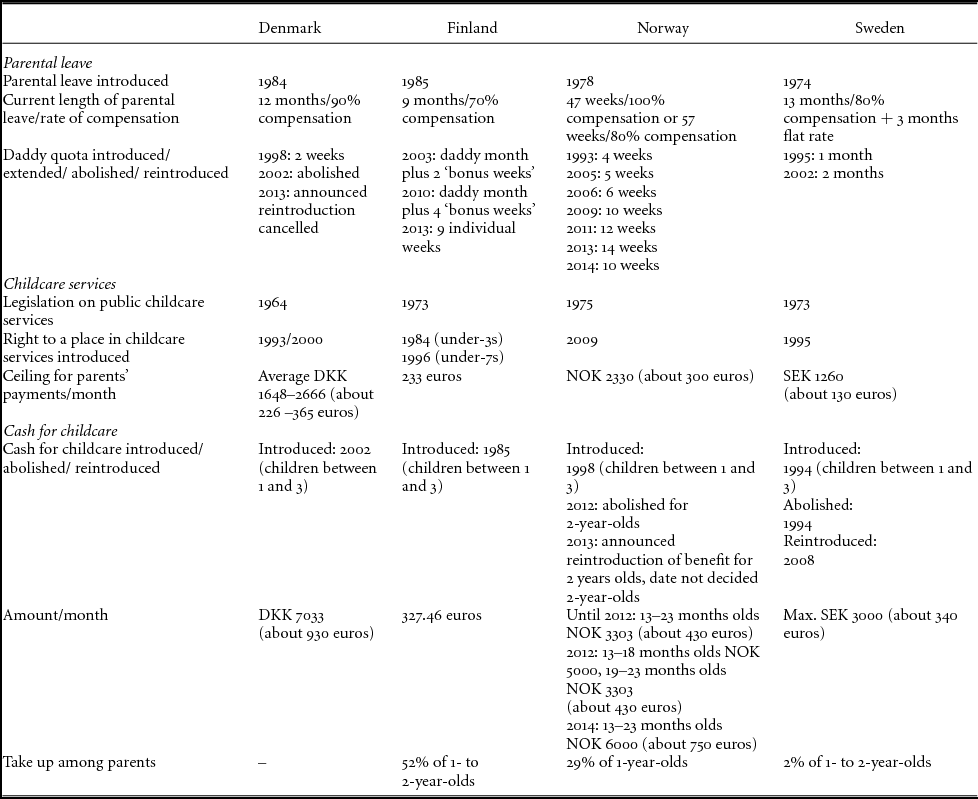
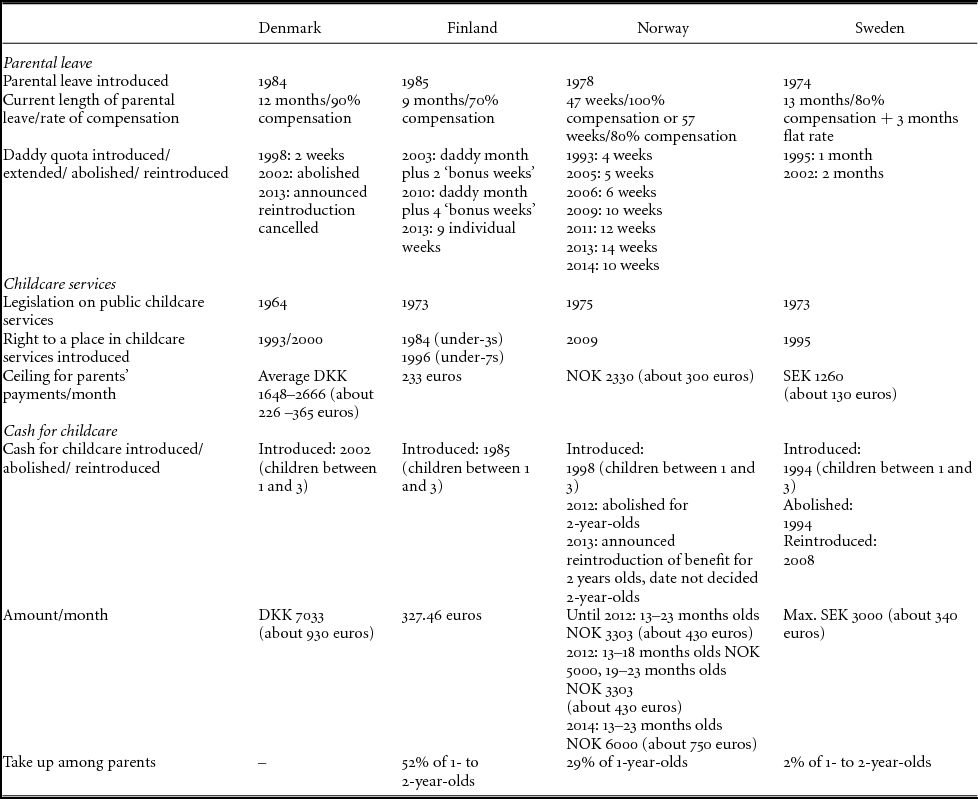
The current status of the Nordic parental leave system is about one year of leave with quite high levels of wage compensation and low thresholds of eligibility: Sweden has the longest total leave, Norway the highest replacement rate, while Finland has the shortest leave and the lowest compensation level (Table 1). The parental leave arrangements also share other similarities, e.g., flexibility in uptake of leave. Fathers’ individual rights to parts of the leave differ; this will be elaborated in the next section. Length and compensation levels have been rather stable over the past fifteen to twenty years. The latter is likely to be bolstered by the fact that historically compensation is tied to the development in sickness insurance.
Main childcare policies in Denmark, Finland, Norway and Sweden.
Sources: Eydal and Rostgaard, Reference Eydal, Rostgaard, Gíslason and Eydal2011b; Repo, Reference Repo, Sipilä, Repo and Rissanen2010; Statistiska Centralbyrån, 2012; www.kela.fi.
The Nordic parental leave systems have expanded and converged through layering processes. Convergence is resulting from reforms mainly occurring in the mid-1970s and early 1980s (Ellingsæter, Reference Ellingsæter2009). The timing of the various reforms has varied extensively, however. Policy motivations of leave expansion have differed among the countries, and also among parties. Parental leave has a variety of aims, satisfying different policy programmes: economic compensation of lost income, children's right to parental care, promotion of maternal employment, fathers’ involvement in care and pronatalism. A left–right divide has been apparent in connection with leave extensions. Parties on the political right have in certain periods been sceptical about increasing public expenditure; in some cases stating a preference for a cash-for-care benefit as an alternative (Borchorst, Reference Borchorst, Michel and Mahon2002, Reference Borchorst2003; Ellingsæter, Reference Ellingsæter2007).
The replacement of maternity leave by parental leave in the 1970s was a part of the political institutionalisation of the gender equality objective in the Nordic countries. Sweden was the first country to introduce leave for both parents in 1974, followed by Finland in 1977 and Norway in 1978, while Danish reform came later, in 1984–85. Extensions have also emphasised the infants’ needs and right to parental care. Leave extension tempo has varied considerably, with Sweden the forerunner in developing quite long leave. By 1989, paid parental leave in Sweden was extended to twelve months (plus an additional three months at a flat rate benefit). Norway experienced a period of very rapid leave expansion from 1986 to 1993, i.e., from eighteen to fifty-two weeks (at 80 per cent wage replacement). By contrast, it took Denmark a decade to reach one year of leave (in 2002). Finland has not yet reached one year and continues to debate leave extensions (Parrukoski and Lammi-Taskula, Reference Parrukoski and Lammi-Taskula2012).
In Denmark, in the 1980s and early 1990s, only parties on the far right voted against parental leave reforms (Borchorst, Reference Borchorst2003). Danish parental leave extension in the early 2000s was less concerned with gender equality than with labour supply; the productivist rationale is motivated by research that has shown that job-protected paid leave speeds up mothers’ return to work after giving birth (Abrahamson, Reference Abrahamson2010). A main motivation of extending parental leave in Finland in the 1980s and 1990s was to secure the health of children and mothers, as Finnish mothers traditionally had high employment rates, usually full-time (Salmi, Reference Salmi, Ellingsæter and Leira2006). In contrast to the other Nordic countries, the central actors in the development of parental leave policies have been the main employer and employee federations, while the role of governments has been relatively passive (Lammi-Taskula and Takala, Reference Lammi-Taskula, Takala, Kamerman and Moss2009). The financing role that the social partners play in the schemes has given them influence in their development, which has been used to withhold leave extension (ibid.). In Norway, leave extensions were driven by the left wing, motivated by a combination of gender equality and a ‘rationality of care’ – the child's need for parental care (Ellingsæter, Reference Ellingsæter2007). The priority of right-wing parties and Christian democrats was instead for cash-for-care benefit, with the aim of increasing the family's freedom of choice regarding care for the youngest children. Swedish parental leave reforms were, until the late 1970s, influenced by the dominating role of the social democrats. An important objective of parental leave was to increase mothers’ employment and thus improve the economic position of poorer families (Chronholm, Reference Chronholm, Kamerman and Moss2009). Extensions from six to twelve months were, however, introduced by the centre-right government in office between 1976 and 1982.
Layering, displacement 1: daddy quotas
Controversies about extending fathers’ individual leave rights have been the main issue in the Nordic countries in recent years. Daddy quotas, a part of the parental leave earmarked for fathers on a use it or lose it basis, usually feature as a particular trademark of advanced Nordic earner–carer models. In Norway and Sweden, the ‘daddy quotas’ are ten weeks and two months, respectively. A Finnish father gets non-transferable paternity leave of nine weeks. Presently, no leave is reserved for fathers in Denmark. Daddy quotas, have been, and are still contested, manifesting political differences between the left and the right, but also ambivalence within parties. ‘Equal parenthood’ competes against ‘parental choice’: the aim of more equal distribution of leave between mothers and fathers against parents’ right to decide for themselves. Policy conflict has led to slow progress in quota extensions, and there has been one case of policy abolishment, one case of the cancelling of an announced quota reintroduction and one case of quota reduction.
In Norway, daddy quota protagonists have been social democrats and the left. Parties at the political centre have mainly been consenters; the Conservative Party has vacillated between being an antagonist and consenter; the far right Progress Party has been an antagonist. A social democratic minority government launched a ‘daddy quota’ of four weeks in 1993. The main aim was to redistribute caring time from mothers to fathers; but the father–child bonding was also a stated aim (Ellingsæter, Reference Ellingsæter2007). The quota was supported by parties at the political centre, while the right wing opposed it with the slogan: quotas deny parents’ freedom of choice. The quota was extended by one week in 2005 and by yet another week in 2006, both adding to the total leave. Both extensions were supported by all parties except the Progress Party; the first was proposed by a centre-right government, the second by a majority centre-left government. The latter extended the quota further in 2009 (four weeks), 2011 (two weeks) and 2013 (two weeks). The political conflict over daddy quotas has become increasingly polarised, resonating with divided public opinion on this issue. The Conservative Party characterises quotas as ‘brutal coercion’ intervening in the private lives of families and has joined the Progress Party in its aim to abolish the quota (Ellingsæter, Reference Ellingsæter2012a). The quota was a main controversy in the 2013 election campaign. The new minority right-wing government (Conservative Party and Progress Party) has not displaced the daddy quota, however. After negotiations with parties at the political centre the quota will be reduced from fourteen to ten weeks, but new rules will allow more ‘flexibility’ in the father's possibility to transfer his part to the mother.
Social democrats were the initial daddy quota protagonists in Sweden, too. A proposal for a ‘daddy month’ was launched in 1976, when the party found itself in political opposition for the first time, having lost an election after forty-four years in government (Chronholm, Reference Chronholm, Kamerman and Moss2009). The centre-right government rejected the proposal as being a socialist ambition to control family life (ibid.). In 1982, when the social democrats regained power, the daddy quota was no longer part of their policy aims; parents would decide on this matter for themselves. In 1991, a new centre-right government was elected and in 1995 they introduced a non-transferable ‘daddy month’. The main protagonist was the Liberal Party, and the reform passed as part of a compromise – a trade-off with a cash-for-care benefit promoted by the Christian Democratic Party and the Conservative Party. The adding of a second daddy month was initiated by a social democratic government in 2002. A three-part division of leave has been proposed, but is controversial (Chronholm, Reference Chronholm, Kamerman and Moss2009). Further individualisation of leave is the ambition of the social democrats, but the compromise of the 2013 congress was to postpone it in order to open up negotiations with other parties after the next election.Footnote 3 The agenda of the centre-right government in power since 2006 has not involved abolishment of the quota. But as part of a political compromise where a cash-for-care benefit was introduced (I will come to that), a tax reduction scheme, called the ‘gender equality bonus’, aimed at making it more profitable for fathers to take leave was added. This individual economic incentive conforms to a conservative policy agenda of ‘choice’. Few parents take advantage of this scheme, however.
Inspired by Norway and Sweden, a two-week daddy quota was introduced in Denmark in 1998 by a social democratic–social liberal government together with the left (Borchorst, Reference Borchorst, Ellingsæter and Leira2006). The quota was passed after a brief debate in Parliament, with the conservative parties voting against it (Borchorst, Reference Borchorst2003). The quota was abolished in 2002 by the new right-wing government. ‘Parental choice’ was the main motivation for this policy displacement; earmarking was seen as a negative interference in the private affairs of families (Borchorst, Reference Borchorst, Ellingsæter and Leira2006). Borchorst explains this in light of a much weaker politicisation of men as carers and fathers in the family in Denmark, compared to Norway and Sweden. Also the centre-left failure to challenge the ‘choice’ rhetoric in part reflected how these parties were internally divided on the issue. The centre-right government has continued to emphasise parental choice in the take up of leave, while the centre-left government elected in 2011 campaigned for the reintroduction of a daddy quota. This ambition was abandoned in 2013 when the government instead proposed a tax reduction scheme, similar to the Swedish one, contrary to the advice of a government committee. This was the result of a government ‘leave drama’: the social democrats were said to have opted out ‘due to opinion polls’.Footnote 4 However, the proposal did not get the required parliamentary support.
Despite influence from the other Nordic countries and many years of debate on fathercare, the establishment of a daddy quota has been slow in Finland, a consequence of the historically much weaker role of social democracy than in the other Nordic countries (Lammi-Taskula and Takala, Reference Lammi-Taskula, Takala, Kamerman and Moss2009). Fathercare is more highly valued by left-wing and liberal parties than by the strong Centre Party (agrarian base) and more conservative right-wing parties (ibid.). Reforms aimed at equal sharing of leave have been based on compromise and gradual adjustment. In 2003, the ‘father month’ was instituted; if fathers took two weeks of the joint parental leave, they would get two additional weeks (extended to four weeks in 2010). From 2013, fathers’ individual leave is no longer preconditioned on the use of parts of the joint parental leave. Labour market concerns, cost containment and the interests of certain occupational groups have been more important than the aim of gender equality.
Layering, stability 2: childcare services
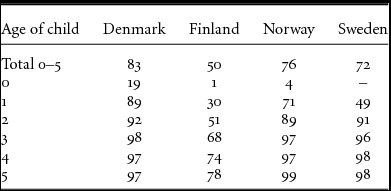
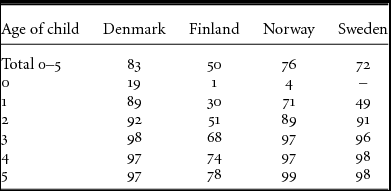
Childcare services may serve various policy aims. They can be a social policy instrument for increasing (mothers’) employment, for increasing gender equality, for equality in children's upbringing and for investment in human capital. All four Nordic countries have legislated for the obligation of municipalities to provide childcare services, instituted the right of parents to have a place if they want it and introduced ceilings on parents’ fees (Table 1).Footnote 5 Through processes of policy layering, childcare services in the Nordic countries have been converging towards a universal arrangement. Timing and tempo have varied significantly, though. Different left–right priorities with regard to childcare expansion relative to cash-for-care benefit as an alternative have been visible in these processes. Today a left–right divide is mainly visible in the drive towards the marketisation of childcare. Childcare services have become a fundamental part of normal childhood: the use of childcare services for children aged two to five is almost universal in Denmark, Norway and Sweden (Table 2). By contrast, the coverage rates in Finland are much lower, especially among the under threes, but also among older preschool-age children (the role of the cash-for-care scheme in this is discussed below).
Children in daycare by age. 2011 (%)
Note: Children in totally or partly publicly funded day care.
Source: Nordic Council of Ministers (2012).
In the early stages of developing Danish childcare services, the social democrats were the protagonist, putting the issue on the agenda and getting support from other political parties (Borchorst, Reference Borchorst, Michel and Mahon2002). There was no initial consensus regarding the underlying ideas, but by the time of the introduction of the law in 1964, a consensus had emerged about a model combining care and pedagogy. A marked expansion of services followed. After a long period of social democratic minority coalitions, the conservative government taking office in 1982 did not mean significant policy change. But the Progress Party and the Danish People's Party (both far right) questioned the public commitment to childcare. In the 1990s, conservative parties argued in favour of contracting out public childcare services and allowing for-profit services. The Social Democratic government, taking office in 1993, announced a childcare guarantee, but implementation was delayed due to disputes over the level of parents’ fees (Borchorst, Reference Borchorst, Michel and Mahon2002). Parties on the left have been critical of the marketisation of childcare services and of increasing the caring role of the family; by contrast parties on the right have sought to enhance both (ibid.). Still, Borchorst notes a ‘remarkable’ level of consensus.
Social democrats were also the protagonist of universal childcare services in Sweden. Expansion of childcare services became a generally accepted policy objective between the 1970s and the 1990s. However, although consenting, two of the three conservative parties remained in favour of a care allowance and in principle critical of ‘too much state involvement’ (Bergqvist and Nyberg, Reference Bergqvist, Nyberg, Michel and Mahon2002). In 1985, a Social Democratic government launched the aim of providing places in public childcare for all children between one-and-a-half and six years of age whose parents were working or studying. The social democrats initiated the 1995 Act on Child Care, stating the municipalities’ obligation to provide childcare, and the social democrats introduced a universal voluntary preschool for all four- and five-year-olds and a maximum parental fee (ibid.). The Social Democratic Party was supported by the Left Party and the Green Party on these initiatives; the four centre/conservative parties in opposition rejected the reforms (ibid.). An ideological difference has also existed with regard to centre-right parties’ promotion of for-profit childcare centres, which is rejected by social democrats.
In Norway, full coverage, provision of places to parents who want a place, has been a goal across the political spectrum for a considerable time, with the exception of the Progress Party. The breakthrough for universal childcare occurred with the Day Care Act in 1975, the main rationale being educational benefits and the best interest of the child; however, gender equality and mothers’ employment were not central issues (Leira, Reference Leira1992). A left–right divide was visible in the debate, though – between support for working mothers versus continued support for the gender differentiated male breadwinner family. Also, priorities regarding expansion and the institutionalisation of a right to childcare have followed a left–right divide. An all-party childcare agreement in 2003 established maximum parents’ fees and a plan for significant expansion in places. The centre-right government was pressured into this agreement by the left opposition in an unusual alliance with the Progress Party. The latter has modernised its family policies significantly – their initial position was that childcare was a private, not a public issue. Norway is a latecomer with regard to the right to a place in childcare services, introduced in 2009 by the centre-left government, with the opposition wanting to delay the reform. Since the mid-2000s, access has improved greatly due to a massive expansion in places under the centre-left government. Expanding places and lowering prices have led to an increase in demand. Full childcare coverage has come to be seen as a precondition for ‘parental choice’ among cash-for-care protagonists. The political right has been particularly concerned with equalising the conditions of privately provided childcare services with those provided by municipalities. Private owners run about half of all childcare institutions, and the centre-left government has instituted regulations to limit profit extraction, not supported by the right wing.
Finland was the first country to introduce an individual right to a place in childcare services for children under three in 1985. This was part of a political compromise between the Social Democrats and the Centre Party; the latter was the protagonist of the cash-for-care benefit supporting parents’ choice of care, which was the other element of the compromise. This right was extended to apply to children under seven in 1996 (Rantalaiho, Reference Rantalaiho2009). In Finland, the cash-for-care benefit (discussed below) has hampered the expansion and use of childcare services.
Layering, displacement 2: cash for childcare
Cash-for-childcare schemes can be used for different purposes, support of parental care or support of market-based care. Schemes in the Nordic countries are directed at supporting parental care. At present, all four countries have introduced cash-for-childcare schemes for children between the age of one and three (in Norway only for one-year-olds since 2012), where receipt of benefit is tied to non-use of publicly subsidised childcare services (Table 1). Cash-for-care benefits are a key marker of political difference; centre-right governments stand behind the reforms. ‘Parental choice’ has been the major reform rationale in all the four countries: parents should be able to choose between childcare services and taking care of their own children at home. Valorisation of parental care and a more equal distribution of state support between employed and non-employed mothers are other aims. Finland and Norway have introduced a state-based benefit, while Denmark and Sweden leave it to the municipalities to determine whether or not to offer this kind of benefit. Different entitlements, eligibility criteria and political framing in the various schemes influence take-up rates (Eydal and Rostgaard, Reference Eydal, Rostgaard, Gíslason and Eydal2011b; Rantalaiho, Reference Rantalaiho, Sipilä, Repo and Rissanen2010). In some cases, the reform had been on the agenda for decades before it succeeded, epitomising an underlying pressure for change, and there have been cases of layering, displacement and partial displacement.
The Finnish Child Home Care Allowance, introduced in 1985, was part of the aforementioned compromise combining the right to cash-for-care with a right to childcare services, reflecting the weaker position of social democracy in this country. It dates back to the 1970s when municipalities began to pay parents a home care allowance to help limit the growing demand for childcare (Rantalaiho, Reference Rantalaiho2009). Later, this became part of national childcare policies as an alternative to childcare services. Centre-right proponents emphasised the value of work at home and parents’ opportunities to choose the form of care they needed; also important to the dominant Centre Party was that childcare services did not satisfy the needs of rural families (Lammi-Taskula and Takala, Reference Lammi-Taskula, Takala, Kamerman and Moss2009; Rantalaiho, Reference Rantalaiho, Sipilä, Repo and Rissanen2010). Costs have been an overarching concern; cash for care is much cheaper than institutional day care (Hiilamo and Kangas, Reference Hiilamo and Kangas2009). Opposition was never very strong (Hiilamo and Kangas, Reference Hiilamo and Kangas2009; Rantalaiho, Reference Rantalaiho, Sipilä, Repo and Rissanen2010). Municipal policy layering, in the form of extra supplements, creates incentives especially for low-income families to rely on the allowance as an alternative to childcare services (Repo, Reference Repo, Sipilä, Repo and Rissanen2010). A growing number of families take advantage of the benefit until the child turns three (Repo, Reference Repo, Sipilä, Repo and Rissanen2010). Many mothers see the allowance positively, an extension of parental leave and home care is considered in the best interest of the child. The allowance structure encourages families to also care for their older children at home. There are no strong initiatives to abolish the benefit. Still, some scholars contend that the political consensus is ‘relative’ and the issue of whether to develop the allowance or childcare services has been a point of contention between Social Democrats and the Centre Party/Conservatives (Salmi, Reference Salmi, Ellingsæter and Leira2006). In 2012, a proposal from the left-centre–right majority coalition to cut the allowance for two-year-olds caused heated public debate (Salmi and Lammi-Taskula, Reference Salmi, Lammi-Taskula and Moss2013). The motivation was both saving money and raising women's employment rate, but the proposal was not carried out.
By contrast, profound political conflict characterised the cash-for-care benefit reform in Norway, launched in 1998 by a minority centre government, with the Christian Democratic Party as the reform's long-time protagonist, supported by the right wing (Ellingsæter, Reference Ellingsæter2003). The Left parties were fierce antagonists. ‘Parental choice’ was a main policy rationale, giving parents more time for their children and a more equal distribution of public subsidies to families. The gender equality concern was prominent in the left's opposition to the reform; it was expected to lead to a decrease in mothers’ employment and lower demand and supply of childcare services. A high proportion of parents/mothers received the benefit at the start, but numbers have fallen dramatically commensurate with the expansion in childcare places. Nevertheless, the attitude towards the cash-for-care benefit continues to divide the Norwegian population into two equal parts, for and against (Gulbrandsen, Reference Gulbrandsen2009). The emphasis of criticism of the reform has shifted somewhat, from its main focus on the gender equality concern, to paying more attention to the impact on integration of immigrant mothers and their children. In the centre-left government in office between 2005 and 2013, both the Social Democratic Party and the Socialist Left Party aimed at the abolishment of the cash for care, but the third coalition partner, the Centre Party – initially a supporter of the reform – was hesitant. But in 2012, a partial displacement of the benefit was effectuated; the benefit was discontinued for the two-year-olds. This change was subject to rule neglect through policy layering; some centre-right municipalities continued to provide the benefit (Ellingsæter, Reference Ellingsæter2012b). However, a reintroduction of the benefit for the two-year-olds was announced by the new minority right-wing government in 2013. This government also increased the benefit for the one-year-olds substantially.
In Sweden, since the late 1970s, the main priorities among social democrats have been parental leave and childcare services versus cash allowances among the centre-right (Nyberg, Reference Nyberg, Sipilä, Repo and Rissanen2010). Throughout the 1980s, the centre-right parties intensified their promotion of neo-liberal alternatives that stressed parental ‘choice’ with regard to childcare arrangements, and also markets and privatisation with regard to services (Bergqvist and Nyberg, Reference Bergqvist, Nyberg, Michel and Mahon2002). After several years of heated debate, a cash-for-care benefit was introduced for the first time in 1994 by a centre-right government (Nyberg, Reference Nyberg, Sipilä, Repo and Rissanen2010). The government also expanded the social democratic/liberal line of day care provision (Bergqvist and Nyberg, Reference Bergqvist, Nyberg, Michel and Mahon2002). When the social democrats returned to power shortly afterwards, the benefit was abolished. But with a majority centre-right government coming to power ten years later, a cash-for-care benefit was again established (in 2008), the Christian Democratic Party being its main proponent while the Liberal Party reluctantly accepted it. The reform was sweetened by the aforementioned ‘gender equality bonus’ in the parental leave system. The 2008 cash-for-care scheme is more limited, being optional for municipalities. In 2011, 37 per cent of all municipalities – most of them centre-right – had begun to offer a cash-for-care benefit (Nyberg, Reference Nyberg, Sipilä, Repo and Rissanen2010; Statistiska Centralbyrån, 2012). Only 2 per cent of all children in the target group receive the benefit and only 5 per cent of children in municipalities that have introduced the benefit (Statistiska Centralbyrån, 2012).
In Denmark, the opportunity for municipalities to offer quite limited cash-for-care benefits instead of childcare services was established in 2002 by the right-wing government as part of a new family policy, and to provide municipalities with some flexibility in the provision of childcare services (Eydal and Rostgaard, Reference Eydal and Rostgaard2011a,Reference Eydal, Rostgaard, Gíslason and Eydalb) (Table 1). Parents with children aged six months to three years can only apply for the cash benefit if they have already applied for a place in childcare services, the benefit can only be paid for a year, and allowances are only paid to parents outside the labour market. The arrangement is seldom mentioned in comparative studies of childcare, and has very little practical influence: only 700 parents are reported to receive the cash benefit (Rantalaiho, Reference Rantalaiho2009, Reference Rantalaiho, Sipilä, Repo and Rissanen2010).
Nordic earner–carer models: competition over ‘equal parenthood’ vs. ‘parental choice’
State involvement in family affairs in post-industrial welfare states is an ongoing process, far from complete, and not quite settled in its character and scope (Mätzke and Ostner, Reference Mätzke and Ostner2010b). The present analysis demonstrates that this also applies to mature Nordic welfare states. The earner–carer model is no uncontested policy equilibrium: reforms over the past ten to twenty years encompass both policy reforms advancing and undermining the model. Policy development constitutes a mix of stability and instability, of moderate adjustments to long-standing commitments and more abrupt changes. Family policy emerges as an important field of competition for electoral support. It is marked both by instrumentalist strategies and ideological political difference, supporting a ‘soft’ version of party competition theories. Diverse constellations of minority and coalition governments mean that the opportunities for policy reform have varied in different periods of time. Thus the degree of stability and change in the family policy field varies across and within countries over time.
Examining family policy development through the theoretical lenses of party competition and incremental change helps uncover underlying tensions and ongoing struggles. Institutional layering is the main policy mechanism, but displacement also occurs. Policy layering sometimes results in model ‘dualisation’ or hybridisation. Hybridisation often contains latent policy conflicts, i.e., ongoing struggles that are vital in inducing change (Mahoney and Thelen, Reference Mahoney, Thelen, Mahoney and Thelen2010). Some reforms have been introduced only after decades of political struggle. Other reforms are the outcome of compromises; policy reform does not necessarily reflect the first preference of all parties involved. Policy displacement usually occurs when new political constellations come into power. The earner‒carer model's protagonists have been, and to a considerable degree still are, parties left of the political centre. The political centre-right has at times been consenters, at other times antagonists. Although there has been vacillation in policy standpoints among political parties and ambivalence within them as well, the left–right divide continues to drive the advancement of the earner‒carer model.
Policy stability characterises the two main pillars of the earner–carer model: the one-year parental leave with high compensation levels and childcare services. What these two policies have in common is that they satisfy different policy rationales. They also represent vital interests for the large majority of contemporary parents; paid parental leave and childcare services are the foundation of working parents’ organisation of everyday life. Long leave is compatible with a conservative/Christian democratic family policy agenda as it increases parental care for the youngest children. Parties right of the political centre have at times been reluctant to support leave expansion because of the increase in public expenditure. Working parents are an important target group of election campaigns, and weakening of leave rights are likely to be very costly for parties. The same goes for childcare services. Childcare services have converged towards a universal arrangement; parents have been secured the right of access to affordable services. Nearly all Nordic parents rely on childcare services after the parental leave period ends, with Finland as the exception. Parents’ extensive use of childcare services generates a stronghold for universal childcare services; party non-compliance would be high. Increasing emphasis on investing in children's human capital, compatible with a conservative policy agenda and underpinned by the influential transnational social investment paradigm (Mahon et al., Reference Mahon, Anttonen, Bergqvist, Brennan and Hobson2012), is likely to bolster stability further. Furthermore, increasing immigration in the Nordic countries and the related challenges of integration has brought new meaning to the importance of early childhood education for equality. The left–right competition thus is likely to continue mainly in the struggle over privatisation of service delivery.
By contrast, the left–right divide is a decisive driver of policy instability, with the opposing ideological values of ‘equal parenthood’ versus ‘parental choice’ as fulcrum. Instability is likely to persist in the two policy measures where these programmatic values are put in play: daddy quotas and cash-for-care benefits. Daddy quotas are contested, and quota expansion has been slow. The policy was abolished in the Danish case; a later promise of reintroduction by a new left-centre government was cancelled. The recent right-wing government of Norway did not abolish the quota, their main preference, but reduced the number of weeks as part of a political compromise. The main quota protagonists have been parties on the left. Conservative parties have in the main been antagonists, but consenters in certain periods, displaying both inter-party compromises and intra-party conflict. Daddy quotas correspond with programmatic values of both a social democratic agenda of equality of outcome and a liberal agenda of individual rights. Family-based leave rights by contrast belong to a traditional conservative agenda, even if it is packaged as ‘choice’. The addition of cash-for-care benefits in all the four countries is commonly seen as ‘hybridisation’ of the Nordic models. But this may be a premature judgment. It may be a temporary situation; the policy measure is contested and thus unstable. There have been instances of both full and partial policy abolishment, as well as reintroduction. The content of the arrangements vary widely, and are today of minor practical influence. The exception is Finland where it has a major influence on motherhood and early childhood. The ‘costs’ of undermining ‘equal parenthood’ may vary among the countries. In Finland, the weak position of Social Democracy and the left seems to ensure the continuation of their hybrid childcare model. In the three other countries, redistribution of care within the family is the core of political competition, but the politicisation of men as carers has been weaker in Denmark than in Norway and Sweden (Borchorst, Reference Borchorst, Ellingsæter and Leira2006).
Promoting ‘parental choice’ instead of ‘equal parenthood’ in relation to daddy quotas and cash-for-care benefits has less non-compliance costs for the centre-right because popular/parent support is more divided with regard to these policies. Ideological and instrumental strategies thus come together. ‘Choice’ is a powerful notion in contemporary welfare policies, and the political right has largely appropriated political issue ownership of the idea. The dominant notion of ‘choice’ in family policy is framed as ‘non-intervention’ in decisions belonging to the family sphere; its distributive consequences are seen as not relevant. ‘Parental choice’ versus ‘equal parenthood’ has been translated into the main left–right policy difference in politicising the relationship between the state and the family, suitable for electoral competition.