Introduction
Tonsillectomy is indicated for a great variety of disorders, including recurrent tonsillitis, peritonsillar abscess, tonsillar hypertrophy with obstructive sleep disorders, and staging in cases of malignant lymphoma.Reference Rodriguez, Sun, Pike, Mandel, Casselbrant and Chi1, Reference Mattila, Tahkokallio, Tarkkanen, Pitkäniemi, Karvonen and Tuomilehto2 It is thus one of the most commonly performed surgical procedures.Reference Krishna and Lee3 In particular, tonsillectomy and/or adenoidectomy is the most common elective surgical procedure among US children, being performed in 300 000 patients every year.Reference Asaf, Reuveni, Yermiahu, Leiberman, Gurman and Porat4, Reference Hartnick and Ruben5
Great efforts have been made to systematically assess tonsillectomy-related factors affecting the incidence of post-tonsillectomy haemorrhage. However, debate still continues over the need for pre-tonsillectomy coagulation assessment. To our knowledge, no specific guidelines exist in Europe. Therefore, pre-operative coagulation assessment practice is governed by individual departments' clinical protocols and audit cycles, and by each country's insurance system. The American Academy of Otolaryngology—Head and Neck Surgery has stated that pre-operative coagulation screening is only indicated in patients in whom suspicions have been raised due to the clinical history or prior genetic evaluation; thus, US otolaryngologists have the benefit of exact guidelines.6 However, a recent study found that 21 per cent of US otorhinolaryngologists still perform pre-operative coagulation screening prior to tonsillectomy.Reference Wieland, Belden and Cunningham7
On the other hand, little is known about the significance of, and indications for, post-operative advanced coagulation testing in cases of recurrent, severe post-tonsillectomy bleeding. In such cases, the patient's past medical history is no longer considered a reliable guide. Furthermore, the prothrombin time (PT), activated partial thromboplastin time (aPTT) and international normalised ratio (INR) tests have well established limitations in identifying blood coagulation disorders; in addition, their low predictive value for identifying cases at risk of post-operative bleeding makes safe diagnosis and management even more challenging.Reference Krishna and Lee3, Reference Hoffman8–Reference Zwack and Derkay12
We hypothesised that undiagnosed haemorrhagic disorders, whether hereditary or not, may contribute to the aetiology of recurrent, severe post-tonsillectomy bleeding. Bearing in mind the above-mentioned diagnostic limitations of medical history and PT, aPTT and INR investigation in such cases, we investigated the utility of detailed haemostasis testing in our patients with recurrent, severe post-tonsillectomy haemorrhage.
Materials and methods
Study setting and patient selection
This study was conducted postoperatively over a 48-month period from January 2006 to February 2010, within the otorhinolaryngology department of Hanover Medical University, Germany, a tertiary, referral, teaching centre. We recorded all cases of post-tonsillectomy bleeding which either occurred in our department or were referred to our emergency facilities as out-patients. We examined in detail only those cases involving severe, recurrent or repetitive bleeding, defined as at least two episodes of haemorrhage, either primary (i.e. within the first 24 hours post-operatively) or secondary (i.e. after 24 hours post-operatively), which required immediate surgical intervention with general anaesthesia.
One hundred and twenty patients were admitted with post-tonsillectomy bleeding; 46 were in-patients within our institution (38.3 per cent), while the remaining 74 had undergone surgery in other hospitals (61.7 per cent). Of these 120 patients, the current study assessed 22 who had experienced severe, recurrent bleeding (18.3 per cent): 13 males and nine females, with a mean age of 30.7 years (range 9.3–60.8 years). Nine of these patients had undergone surgery in our department.
In addition to their previously documented medical history and standard blood test results, these 22 patients underwent further, detailed haemostasis investigation. For these patients, we also documented additional demographic data relating to factors occasionally associated with haemorrhagic diatheses.
Post-operative haemostasis investigation
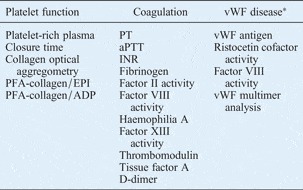
Detailed post-operative coagulation investigation included PT, aPTT and INR, analytical evaluation of haemostasis factor levels and platelet function, and tests for von Willebrand disease (Table I). Due to the diagnostic limitations of PT, aPTT and INR, all 22 patients underwent complete haemostasis evaluation, even if these three values were normal. Definitive laboratory diagnosis of von Willebrand disease was based on assessment of von Willebrand antigen levels, ristocetin cofactor activity, coagulation factor VIII activity and von Willebrand multimer analysis.Reference Lillicrap, Nair, Srivastava, Rodeghiero, Pabinger and Federici13
Post-operative haemostasis tests

*For definitive diagnosis. vWF = Von Willebrand factor; PT = prothrombin time; aPTT = activated partial thromboplastin time; INR = international normalised ratio; PFA-collagen/EPI = platelet function analyser–collagen in epinephrine cartridges; PFA-collagen/ADP = platelet function analyser–collagen in adenosine diphospate cartridges
Post-tonsillectomy haemostasis testing was performed after the second episode of severe bleeding. If another post-operative haemorrhage occurred, no supplementary coagulation tests were performed; however, the patient was referred to the haematology department for further specialist assessment.
If values were abnormal, the haemostasis tests were repeated. Isolated abnormal results were not taken into consideration, due to the possible effect of numerous factors upon haemostasis (e.g. age, acute infection, excessive blood loss with dilutional coagulopathy, medication, and systemic disease).Reference Jackson, White, Barrowcliffe, Esnouf, Jespersen and Kluft14, Reference Kozek-Langenecker15
In order to clarify any invalid test results due to the acute haemorrhage, further haematological assessment was performed for all patients, six to eight weeks post-haemorrhage.
Medical history
A specific, haemostasis-relevant medical history was taken, noting the following factors: any known coagulopathy; family history of haemorrhagic disease; development of bruises after insignificant injuries; unusual bleeding from superficial lacerations; extreme blood loss during dental interventions; recurrent bleeding from the nose or gums; use of anticoagulant medication; and any haemostasis problems during previous surgery.
For patients who had not undergone tonsillectomy in our department, a specific haemostasis history was obtained at the time of admission if possible, or post-operatively.
In-patients' records were reviewed to check whether any earlier coagulation-related queries had gone unanswered.
In addition to the above enquiries, we also documented each patient's age, gender, smoking habits, the presence of infection on admission, and post-operative day(s) of bleeding.
Statistical analysis
Statistical tests were performed using the Statistical Package for the Social Sciences® version 16 software program (SPSS Inc, Chicago, Illinois, USA), to identify the statistical significance of the above-mentioned factors as regards recurrent, severe post-tonsillectomy haemorrhage. A p value of less than 0.05 was taken to indicate statistical significance.
Therapeutic interventions
The main treatment consisted of emergency surgical haemostasis under general anaesthesia, using bipolar coagulation, tonsillar fossa suturing and vessel ligation, employing an oral or even external neck approach to the external carotid artery system. An external neck approach, main vessel ligation and extended emergency procedures (e.g. tracheotomy) were characterised as advanced surgical interventions.
Depending on their coagulation test results, and following specialist haematological assessment, some patients were treated with tranexamic acid. The main criterion for this treatment was the severity of bleeding. Tranexamic acid is an antifibrinolytic agent originally used to treat excessive menstrual and orthopaedic bleeding. Following haemorrhage, short-term application of this drug has been found to assist bleeding control and to help prevent new haemorrhagic episodes.Reference Levy16 The therapeutic effect of tranexamic acid in controlling severe post-tonsillectomy bleeding was not examined in the current study.
Results and analysis
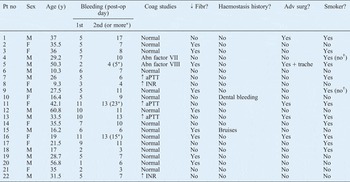
Haemorrhagic disease was not detected in any of our 22 patients who experienced severe, repetitive post-tonsillectomy bleeding. The INR was found to be slightly increased in two patients (9 per cent), and the aPTT was slightly extended in three more cases (13.6 per cent). However, further analysis did not reveal any underlying coagulopathy. In two patients (9 per cent; patients 4 and 5), isolated abnormal values for coagulation factors VII and VIII were found, respectively. After repeated coagulation testing six to eight weeks later, plus expert haematological assessment, no haemorrhagic pathology was diagnosed in either of these patients. A post-bleeding decrease in fibrinogen concentration due to dilutional coagulopathy was found in nine patients (40.9 per cent).
The mean time to the first episode of bleeding was 5.77 days post-operatively (range 1–11 days); the mean time to the second episode was 8.5 days (range 3–13 days). In four patients (18.2 per cent), arterial ligation was necessary. One patient (4.5 per cent) also underwent emergency tracheotomy. Three of the 22 patients (13.6 per cent) experienced a third episode of severe post-tonsillectomy bleeding. No fatalities occurred.
Only two patients (9 per cent; patients 10 and 15) had a history suspicious for coagulopathy, involving unusual bleeding at the dentist and unexplained bruises, respectively. No clinical suspicion of infection was documented at the time of bleeding, for any patient. No patients used any haemorrhage-related medication. Notably, 12 patients were smokers (54.5 per cent); interestingly, 10 patients (45.5 per cent) continued to smoke during the post-tonsillectomy period.
Statistical analysis revealed that both dilutional coagulopathy and smoking were significantly associated with recurrent, severe post-tonsillectomy bleeding (p < 0.05). Table II presents the results in detail.
Demographic, clinical and coagulation data

*Third bleeding episode. †Did not smoke during post-operative period. Pt no = patient number; y = years; bleeding (post-op day) = post-operative day on which bleeding episode occurred (calculating day of surgery as 0); coag = coagulation; ↓fibr = decreased fibrinogen level; adv surg = advanced surgical intervention; M = male; F = female; abn = abnormal; trache = tracheotomy; aPTT = activated partial thromboplastin time; INR = international normalised ratio
Discussion
Post-operative bleeding represents an important complication of tonsillectomy. Although much has been published in the literature, there is still argument over the predictive value and need for pre-operative haemostasis testing. Recent findings have suggested that such pre-operative testing should be avoided as it confers no significant prognostic or therapeutic benefits.Reference Krishna and Lee3, 6 In contrast to previous research, the present study focussed only on cases of severe, recurrent post-tonsillectomy bleeding, and on post-operative haemostasis testing. To our knowledge, no such study has previously been reported.
Role of underlying hereditary haemorrhagic disease
It has already been shown that children with von Willebrand disease have an increased risk of post-operative bleeding. In general, von Willebrand and other hereditary haemorrhagic diseases are diagnosed at an early age, usually in childhood, using specific laboratory methods.Reference Lillicrap, Nair, Srivastava, Rodeghiero, Pabinger and Federici13, Reference Jackson, White, Barrowcliffe, Esnouf, Jespersen and Kluft14, Reference Allen, Armfield, Bontempo, Kingsley, Goldstein and Post17 Such patients usually have a positive haemorrhagic history that leads to referral for further evaluation, prior to any surgical intervention.
In our 22 patients with severe, recurrent post-tonsillectomy haemorrhage, the mean age was 30.7 years. Therefore, we would expect that any existing coagulopathy should have already been diagnosed. Even so, cases of undiagnosed haemorrhagic disorders could still arise, particularly in patients with severe, recurrent bleeding. However, haematological history-taking and advanced haemostasis testing did not reveal von Willebrand disease or any other hidden coagulopathy in any of our patients. Thus, we conclude that hereditary haemorrhagic disease was not an aetiological factor in any of our patients' haemorrhagic episodes.
Role of dilutional coagulopathy
Excessive blood loss combined with intravenous fluid administration can lead to dilutional coagulopathy, i.e. a disturbance of the quantity and quality of factors involved in haemostasis and additional bleeding.Reference Innerhofer and Kienast18 Although various laboratory parameters can be affected, decreased fibrinogen concentration is the most sensitive predictor of dilutional coagulopathy.Reference Ciavarella, Reed, Counts, Baron, Pavlin and Heimbach19 In our study, decreased fibrinogen concentration was found in nine cases (40.9 per cent). Interestingly, two of these nine patients experienced a third episode of severe bleeding, a short time after the second one. These findings were statistically significant, and could help explain the occurrence of recurrent haemorrhage in such cases.
However, dilutional coagulopathy findings were not identified in any of our other patients. It has been found that blood loss equalling more than 100 per cent of the blood volume is needed in order for decreased fibrinogen levels to be detected.Reference Innerhofer and Kienast18 In our patients, blood loss was less severe, and was not associated with massive disturbance of haemostatic mechanisms. Based on the findings of the current study and previous reports, we believe that dilutional coagulopathy could partly explain the aetiology of recurrent, severe post-tonsillectomy bleeding. Proper, established therapeutic protocols must be applied in such cases to avoid further bleeding.Reference Innerhofer and Kienast18, Reference Ciavarella, Reed, Counts, Baron, Pavlin and Heimbach19
Reliability of post-operative haemostasis tests
As described above, massive bleeding can affect the haemostatic mechanism, resulting in disturbance of coagulation factors. In patients with dilutional coagulopathy, fibrinogen concentration is the most affected laboratory parameter.Reference Innerhofer and Kienast18, Reference Ciavarella, Reed, Counts, Baron, Pavlin and Heimbach19 It could be hypothesised that other clotting factors are also negatively influenced, which may lead to unreliable results for haemostasis tests performed during the primary post-operative period. This could have affected the accuracy of our own study results.
However, recent research has indicated that excessive bleeding has no effect on coagulation factor XIII or platelet function; pathological values for these parameters are in fact related to underlying coagulopathy rather than to massive bleeding.Reference Fenger-Eriksen, Tønnesen, Ingerslev and Sørensen20 Based on the reliability of such haemostasis tests and on the therapeutic consequences of identifying underlying coagulopathy, we performed advanced haemostasis testing during the primary post-bleeding period. In addition, we referred all patients to the haematology department for further specialist assessment, six to eight weeks post-operatively, in order to verify our diagnosis.
Expert haematological assessment proved to be of great significance. This was especially true for patients 4 and 5, for whom pathological coagulation factor values were found in the immediate post-operative period; however, six weeks later repeated haematological testing revealed normal coagulation factor values and no underlying haemorrhagic disease. Notably, both these cases had an unremarkable medical history. Similarly, we would expect abnormal factor VIII values to give rise to pre-operative symptoms of coagulation disorder. However, the abnormal factor VIII values observed in two of our patients in the immediate post-operative period were related to laboratory inaccuracies, rather than to undiagnosed haemorrhagic disease or bleeding-related disturbances in coagulation testing.
Financial aspects
One study estimated the cost of unnecessary haemostasis testing, within a tertiary hospital over a one-year period, to be approximately US$25 000.Reference Asaf, Reuveni, Yermiahu, Leiberman, Gurman and Porat4 In Germany, every PT and aPTT test costs approximately €7, with an additional €22 for platelet function assessment.Reference Heindl21 In the UK, the costs are similar: PT and aPTT tests cost £4.88 during the daytime and £10.40 after-hours.Reference Thaha, Nilssen, Holland, Love and White22 In the developing world, analogous tests cost approximately €7.Reference Awan, Iqbal and Imam23 Considering the recent American Academy of Otolaryngology–Head and Neck Surgery guidelines, the lack of predictive value for such haemostasis tests, and the great number of tonsillectomies performed, routine coagulation investigation would appear to be a waste of financial resources.
On the other hand, the importance of post-operative haemostasis investigation in cases of severe and potentially life-threatening post-tonsillectomy bleeding has not previously been assessed. Although such investigation is even more expensive, it may bring therapeutic benefits if underlying coagulopathy is revealed. However, this was not the case in our current study. Apart from identification of decreased fibrinogen levels, which enabled the diagnosis of dilutional coagulopathy and assisted the regulation of fluid and electrolyte balance, all other coagulation tests resulted only in avoidable expense and unnecessary laboratory work-load.
Contribution of other factors
Of the other factors investigated in connection with severe, recurrent post-tonsillectomy haemorrhage, only smoking was found to be significantly associated with bleeding episodes. Twelve of our 22 patients were smokers (54.5 per cent), and 10 continued to smoke during the post-operative period. Based on the identified, statistically significant correlation, smoking thus represents a predisposing factor for severe post-tonsillectomy bleeding.
The day of post-tonsillectomy bleeding was another interesting finding: none of our 22 patients experienced a primary haemorrhage.
However, because of the small size of our sample, the effect of additional factors upon the incidence of severe, repetitive post-tonsillectomy bleeding cannot be systematically evaluated in this study.
• Most recent research has found no utility for pre-operative coagulation testing as regards post-tonsillectomy bleeding
• The benefits of post-operative coagulation testing in cases of recurrent, life-threatening post-tonsillectomy bleeding are little known
• In this study, advanced haemostasis screening was not indicated in cases of severe post-tonsillectomy bleeding, as results were not related to underlying undiagnosed haemorrhagic disease
• However, recurrent post-tonsillectomy bleeding was associated with dilutional coagulopathy; this should be promptly diagnosed and treated
Finally, it is worth reporting that our overall incidence of severe, recurrent post-tonsillectomy haemorrhage was very low. We identified 22 patients with such bleeding, out of a total of 120 post-tonsillectomy bleeding cases (18.3 per cent). The general incidence of post-tonsillectomy bleeding has been reported as 2 to 4 per cent.Reference Howells, Wax and Ramadan24 Severe, recurrent haemorrhage would be expected in 0.37 to 0.73 per cent of all patients undergoing tonsillectomy. Such a low incidence makes it difficult to perform statistically robust evaluation of factors related to such haemorrhage. However, due to the high morbidity risk and additional medical and socioeconomic aspects of severe, recurrent post-tonsillectomy haemorrhage, we believe that well standardised, multi-centre studies are necessary in order to identify and evaluate the factors responsible for this serious surgical complication.
Conclusion
Recurrent, severe post-tonsillectomy haemorrhage does not appear to be related to undiagnosed haemostatic disorders. In such patients, the post-operative performance of advanced coagulation tests is of questionable diagnostic reliability, and does not appear to confer any therapeutic benefit. However, due to the correlation between dilutional coagulopathy and recurrent haemorrhage, fibrinogen concentration should be tested.
Acknowledgement
The authors would like to thank the Haematology Department of Hanover Medical University for advice and laboratory support.