Introduction
The ageing workforce is a major issue for many countries (Bloom, Canning and Sevilla Reference Bloom, Canning and Sevilla2003; Shultz and Adams Reference Shultz and Adams2007), and unfortunately many countries are generally not well prepared for the current demographic changes (Field, Burke and Cooper Reference Field, Burke and Cooper2013). Therefore, one of the main aims of career scholars is to detect age-aware human resource (HR) policies (Baltes and Carstensen Reference Baltes and Carstensen1996; Boudiny Reference Boudiny2013), and preventive and pro-active measures/practices to preserve career potential or employability (Forrier and Sels Reference Forrier and Sels2003; Fugate, Kinicki and Ashforth Reference Fugate, Kinicki and Ashforth2004; Rothwell and Arnold Reference Rothwell and Arnold2007; Van der Heijde and Van der Heijden Reference Van der Heijde and Van der Heijden2006) throughout age and career stages (Briscoe and Hall Reference Briscoe and Hall2006; DeFillippi and Arthur 1996; Shultz and Adams Reference Shultz and Adams2007; Stroh and Greller Reference Stroh and Greller1995; Van der Heijden, De Lange, Demerouti and Van der Heijde Reference Van der Heijden, De Lange, Demerouti and Van der Heijde2009). However, it might be conceivable that these policies and measures/practices are more driven by the necessity to act with regard to the ageing workforce and the desire to increase the numbers at work (Sargeant Reference Sargeant, Field, Burke and Cooper2013) instead of stemming from a true belief in the ‘power of seniority’.
Age discrimination in the workplace is a very complicated issue given the fact that age is treated differently than other grounds of discrimination, such as disability, race or sex, because there are still an important number of age-related policies and practices that are considered legitimate. More concretely, as there are manifestations of discrimination based upon age and as there continues to be stereotyping of the relative competencies of different groups of workers based on age (Malinen and Johnston Reference Malinen and Johnston2013), one might conclude that there is a case for treating such discrimination in the same way as governments have tackled discriminations based upon other grounds (Sargeant Reference Sargeant, Field, Burke and Cooper2013). This study is meant to add to our knowledge on the role the employee's interpersonal work context may play in combating the negative effect of age-related stereotyping.
First, this contribution aims to investigate how the concept of age can impact upon performance ratings by studying directional age difference (a situation wherein a supervisor is younger than his or her subordinate). Given the profound demographic shifts in the labour market, far-reaching changes in the composition of the labour force are detectable (Shultz and Adams Reference Shultz and Adams2007; Van der Heijden, Schalk and Van Veldhoven Reference Van der Heijden, Schalk and Van Veldhoven2008). On many occasions, older subordinates have to report to younger managers, herewith stressing the need for more research on employee appraisal practices comparing different types of supervisor–subordinate dyads.
Traditionally, psychological research has examined independent effects of employees’ demographic characteristics, such as age, gender, race, tenure and education, on outcomes such as performance, satisfaction, selection, turnover and leadership (see e.g. Blau Reference Blau1985; Mitchel Reference Mitchel1981; Steckler and Rosenthal Reference Steckler and Rosenthal1985; Waldman and Avolio Reference Waldman and Avolio1986; to mention but a few). However, in their exemplary article, Tsui and O'Reilly (Reference Tsui and O'Reilly III1989) introduced the term relational demography (‘the comparative demographic characteristics of members of dyads or groups who are in a position to engage in regular interactions’), and proposed that knowing the comparative (dis)similarity in given demographic attributes of a superior and a subordinate, or of the members of an interacting work team, may provide additional information about the members’ characteristic attitudes and behaviours and, more important, insight into the processes through which demography affects work outcomes (see also Tsui, Porter and Egan Reference Tsui, Porter and Egan2002).
Cleveland and Landy (Reference Cleveland and Landy1983) have already stated that research on age stereotypes is limited and superficial if it is restricted to simply considering discrimination as the correlation between chronological age of the employee and a certain criterion. They stressed the need for more research including possible correlates of age. Directional age difference comprises a broader operationalisation than employee's chronological or calendar age only, and investigating its impact will add to our understanding of the role of age in performance appraisal.
The second objective of this contribution is to add to the discussion regarding the value of relational demography in performance appraisal research by moving beyond the signalling function of directional age difference only (for excellent examples of the advocated approach, see also the meta-analyses by Finkelstein, Burke and Raju Reference Finkelstein, Burke and Raju1995 and by Gordon and Arvey Reference Gordon and Arvey2004), and focusing on better understanding its mechanisms and processes.
Third, although substantial numbers of studies have examined the importance of age for job performance (Ferris et al. Reference Ferris, Judge, Chachere and Liden1991; Giniger, Dispenzieri and Eisenberg Reference Giniger, Dispenzieri and Eisenberg1983; Ng and Feldman Reference Ng and Feldman2008; Ostroff, Atwater and Feinberg Reference Ostroff, Atwater and Feinberg2004; Waldman and Avolio Reference Waldman and Avolio1986), researchers have not typically investigated how variations in age, in either its simple or its relational form, affect specific ratings of performance outcomes such as occupational expertise. For instance, Judge and Ferris (Reference Judge and Ferris1993), Ferris et al. (Reference Ferris, Judge, Chachere and Liden1991) and Schaubroeck and Lam (Reference Schaubroeck and Lam2002) have already called for more research using broader operationalisations of performance instead of a single-item approach for regular work evaluations, such as hiring recommendations, promotions and salary increases. The competence-based approach to performance measurement that is used in this contribution incorporates the wider spectrum of knowledge and skills that are necessary for workers to perform qualitatively well (Van der Heijde and Van der Heijden Reference Van der Heijde and Van der Heijden2006). Van der Heijde and Van der Heijden (Reference Van der Heijde and Van der Heijden2006) came up with a competence-based domain-independent operationalisation of employability or career potential (consisting of an employee self-perceptions version and a supervisor version) (see also Van der Heijden et al. Reference Van der Heijden, De Lange, Demerouti and Van der Heijde2009), of which occupational expertise is a core ingredient (see also Bereiter and Scardamalia Reference Bereiter and Scardamalia1993; Chi, Glaser and Farr Reference Chi, Glaser and Farr1988; Ericsson Reference Ericsson and Ferrari2002; Van der Heijden Reference Van der Heijden2000). Occupational expertise comprises both occupational knowledge and skills, meta-cognitive knowledge, i.e. ‘knowing about knowing’ or ‘knowing that one knows’, and social recognition by important key figures (for a detailed explanation of the ingredients of the occupational expertise dimension, see Van der Heijden Reference Van der Heijden2000). In this empirical work, supervisor's perceptions regarding the competencies (knowledge and skills) of their subordinates have been used as these are considered to be a key factor in the light of their willingness to stimulate and enhance employee's career potential or employability further (Van der Heijde and Van der Heijden Reference Van der Heijde and Van der Heijden2006; Van der Heijden et al. Reference Van der Heijden, De Lange, Demerouti and Van der Heijde2009).
Because of the fact that most expertise researchers restricted themselves to one domain of expertise and tried to examine outstanding behaviour in that particular domain (Chi, Glaser and Farr Reference Chi, Glaser and Farr1988; Ericsson and Smith Reference Ericsson and Smith1991), research using a domain-independent operationalisation of the concept is greatly needed (see also Van der Heijden et al. Reference Van der Heijden, Scholarios, Van der Schoot, Jędrzejowicz, Bozionelos, Epitropaki, Knauth, Marzec, Mikkelsen and Van der Heijde2010) also in order to understand better the generalisability of age effects across occupational sectors (as already advocated by Perry, Kulik and Zhou Reference Perry, Kulik and Zhou1999).
Finally, the fourth objective of this study is to find out whether age-related stereotyping in the performance appraisals can be buffered by interpersonal work context factors. Concretely, this article goes into the issue of whether dyadic tenure and transformational leadership style might moderate the impact of directional age difference upon occupational expertise ratings. The inclusion of possible moderators in the age–performance relationship deserves more attention, and taking an interactive perspective responds to the call for research in this field (Griffeth and Bedeian Reference Griffeth and Bedeian1989; Liden, Stilwell and Ferris Reference Liden, Stilwell and Ferris1996).
To summarise, this empirical study has four objectives. First, the impact of directional age difference (between supervisor and subordinate) on occupational expertise ratings will be examined. Second, this study is meant to add to the discussion about the value of relational demography in performance appraisal research. Third, this research is intended to contribute to the knowledge in this scholarly domain by investigating how variations in age, in both its simple and relational form, influence specific ratings of performance, in our case, occupational expertise. Finally, the fourth objective is to examine whether interpersonal work context factors can buffer or combat the negative effect of age-related stereotyping. In the next section of the article, the theoretical framework will be outlined.
Theoretical framework
Age and supervisor ratings of occupational expertise
Many studies spanning the last decades have revealed that a person's age forms one of the principal bases for stereotypical categorisations (see e.g. Boerlijst, Munnichs and Van der Heijden Reference Boerlijst, Munnichs, Van der Heijden, Drenth, Thierry and De Wolff1998; Chiu et al. Reference Chiu, Chan, Snape and Redman2001; Dittmann-Kohli and Van der Heijden Reference Dittmann-Kohli and Van der Heijden1996; Finkelstein and Burke Reference Finkelstein and Burke1998; Finkelstein and Farrell Reference Finkelstein, Farrell, Shultz and Adams2007; Gray and McGregor Reference Gray and McGregor2003; Hedge, Bormann and Lammlein Reference Hedge, Bormann and Lammlein2006; Kite and Johnson Reference Kite and Johnson1988; Malinen and Johnston Reference Malinen and Johnston2013; Maurer, Wrenn and Weiss Reference Maurer, Wrenn, Weiss, Buckley, Halbesleben and Wheeler2003; Posthuma and Campion Reference Posthuma and Campion2009; Posthuma and Guerrero Reference Posthuma, Guerrero, Field, Burke and Cooper2013; Rosen and Jerdee Reference Rosen and Jerdee1976; Tuchman and Lorge Reference Tuchman and Lorge1952; Von Hippel, Kalokerinos and Henry Reference Von Hippel, Kalokerinos and Henry2013; Warr Reference Warr, Triandis, Dunnette and Hough1994). Moreover, Stagner (Reference Stagner, Birren and Schaie1985) pointed out that stereotyping of the young versus the old is also encouraged by some researchers. In particular, many of them frequently make suggestive generalisations about observed significant differences, even if these are very slight, and the groups overlap to a great extent, herewith supporting negative views about older employees instead of drawing cautious conclusions. What is more, their overall conclusions often cannot hide the fact that they do not doubt the correctness of such stereotypes.
More specifically, among supervisors, both in multinationals and in small and medium-sized enterprises, there is a broadly held view that older workers are less able to cope with the demands of a modern, complex and competitive organisation compared with younger subordinates, and that older workers’ ability or motivation to change jobs or to learn new skills and expertise has deteriorated (see Boerlijst Reference Boerlijst, Snel and Cremer1994; Boerlijst, Van der Heijden and Van Assen Reference Boerlijst, Van der Heijden and Van Assen1993; Van der Heijden Reference Van der Heijden2000, Reference Van der Heijden2002).
Equally distressing, just as the immediate supervisor makes an assessment of the ‘pay-off’ period for career activities, the employee him- or herself also deliberately takes into account whether the investments are worth the effort. A decline in workers’ self-confidence (or self-efficacy) for career-relevant learning and expertise development with age has been demonstrated as well (Maurer Reference Maurer2001; Maurer, Weiss and Barbeite Reference Maurer, Weiss and Barbeite2003). In other words, a decrease in the extent to which both supervisors and their subordinates are actively engaged in furtherance of the subordinate's professional career is noticeable with ageing of the latter (see also Simpson, Greller and Stroh Reference Simpson, Greller and Stroh2002). As a consequence, most employees develop expertise in too narrow a field to stay employable in the long run (Van der Heijden et al. Reference Van der Heijden, De Lange, Demerouti and Van der Heijde2009). Obviously, the latter might lead to a self-fulfilling prophecy (Boerlijst Reference Boerlijst, Snel and Cremer1994; Boerlijst, Van der Heijden and Van Assen Reference Boerlijst, Van der Heijden and Van Assen1993), implying an even more negative evaluation of the value of investments in an employee's career furtherance by the supervisor. Even worse, stereotype threat, or the belief that one may be the target of demeaning stereotypes, appears to be already associated with acute performance declines and reduced psychological wellbeing among older workers (Von Hippel, Kalokerinos and Henry Reference Von Hippel, Kalokerinos and Henry2013).
To conclude, age bias may lead to the social exclusion of older workers, not only because superiors may evaluate them more negatively on the basis of their age, but also because stereotypes may lead to self-fulfilling prophecies when those who are subject to negative stereotypes start behaving accordingly (Hilton and Von Hippel Reference Hilton and Von Hippel1996; Kogan and Wallach Reference Kogan, Wallach, Hoch and Zubin1961; Van der Heijden et al. Reference Van der Heijden, De Lange, Demerouti and Van der Heijde2009). Moreover, two other possible biases are worth mentioning here. First, a so-called ‘leniency effect’ (Tsui and Ohlott Reference Tsui and Ohlott1988), referring to the tendency to present oneself positively, or at any rate, to give a rosier image, might bias employee self-ratings on occupational expertise (see also Van der Heijden Reference Van der Heijden2000). Second, possibly, supervisor ratings on occupational expertise are strongly influenced by a response set, for instance the degree to which they like or dislike the employee in question as a person. It is well known that such liking–disliking factors, or the ‘halo effect’ (Nisbett and Wilson Reference Nisbett and Wilson1977), can have a strong effect where persons are required to give valid and dependable judgements of other persons, but are not well informed enough to base their judgement on observations of real-life behaviour of these people or on relevant real-life events in which they are involved. Ratings by supervisors are based on a much smaller amount of information, leading to the so-called ‘effect of under-sampling’.
Whether true performance shortcomings or biases, e.g. due to age-related stereotyping, are responsible, the effects are equally important as they influence the career perspectives and chances of older workers (Hair Collins, Hair and Rocco Reference Hair Collins, Hair and Rocco2009; Henkens Reference Henkens2005; Kearney Reference Kearney2008).
The similarity–attraction paradigm, the social competition perspective and the concept of status-incongruence
In this section, the similarity–attraction paradigm and the social competition perspective are critically reflected on, and the concept of status-incongruence is used to support our first hypothesis on age effects that was tested in this empirical study. Next, dyadic tenure (Hypothesis 2) and transformational leadership style (Hypothesis 3), being important interpersonal work context factors that might moderate the negative effects of age-related bias, will be dealt with.
Although originally the similarity–attraction paradigm (Byrne Reference Byrne1971) focused on similarity of attitudes as the basis for positive evaluations, it has been extended to include demographic variables as well (Riordan Reference Riordan, Buckley, Halbesleben and Wheeler2000; Riordan, Schaffer and Stewart Reference Riordan, Schaffer, Stewart, Dipboye and Colella2005). As regards the impact of demographic characteristics in superior–subordinate dyads, performance evaluation has been the most frequently studied (Kraiger and Ford Reference Kraiger and Ford1985; Mobley Reference Mobley1982; Pulakos and Wexley Reference Pulakos and Wexley1983). Previous research has indicated that supervisors’ age may interact with employees’ age to affect supervisory ratings (Cleveland and Landy Reference Cleveland and Landy1981; Schwab and Heneman Reference Schwab and Heneman1978; Shore, Cleveland and Goldberg Reference Shore, Cleveland and Goldberg2003). Relational demography research takes this approach one step further by directly exploring the extent to which the comparative demographic characteristic in supervisor–subordinate dyads influences work outcomes, such as performance ratings (O'Reilly, Caldwell and Barnett Reference O'Reilly III, Caldwell and Barnett1989). For instance, as regards age, being the variable of attention in this study, Wagner, Pfeffer and O'Reilly (Reference Wagner, Pfeffer and O'Reilly III1984) found that larger non-directional age differences were associated with higher turnover.
It appears that relational demography can affect perceptions of work outcomes and attitudes through both interpersonal attraction, based upon similarity in attitudes, values and experiences (Byrne Reference Byrne1971; Byrne, Clore and Smeaton Reference Byrne, Clore and Smeaton1986), through strong communication (Byrne Reference Byrne and Berkowitz1969, Reference Byrne1971) and through the frequency of interactions (Roberts and O'Reilly Reference Roberts and O'Reilly III1979). In line with Tsui and O'Reilly (Reference Tsui and O'Reilly III1989), it is assumed that these effects account for variance beyond that accounted for by simple demographic attributes.
Directional age difference (between supervisor and subordinate) comprises a broader operationalisation than employee's chronological or calendar age only, and touches upon different approaches to age conceptualisation as proposed by Sterns and Doverspike (Reference Sterns, Doverspike, Goldstein and Katzel1989): psycho-social or subjective age, organisational age and the life-span concept of age, over and above calendar age. Psycho-social or subjective definitions have focused on the age at which society perceives an individual to be older, the social attitudes that are held towards an older worker (or the perceived attributes and stereotypes of an older worker) and the implications for personnel decisions of labelling a worker as older. Organisational age refers to the ageing of individuals in jobs and organisations. The life-span concept of age borrows from a number of the above-mentioned approaches, but advances the possibility for behavioural change (normative, age-graded biological and/or environmental determinants) at any point in the lifecycle (for more elaborate explanations, see Kooij, De Lange, Jansen and Dikkers Reference Kooij, De Lange, Jansen and Dikkers2008).
Concretely, supervisors and subordinates in the same age cohort tend to have common experiences (Lawrence Reference Lawrence1980; Ryder Reference Ryder1965), and these experiences forge common values. For example, being both in the mid-career stage, the two parties might experience similar health problems, or other age-related experiences, such as taking care of needy parents or losing close friends that passed away. People who are close in age may feel more comfortable with each other compared to people belonging to (very) different age groups, assuming that they have similar values and attitudes, and/or because of their ‘common language’ (Webber and Donahue Reference Webber and Donahue2001; Zenger and Lawrence Reference Zenger and Lawrence1989), implying smoother interactions (see also Geddes and Konrad Reference Geddes and Konrad2003).
A second approach to examine reactions to differences in age concern social comparison processes (Goodman Reference Goodman, Staw and Salancik1976; Jones and Regan Reference Jones and Regan1974). Within the present study, one would expect that, because of professional competition within a generational cohort, supervisors would provide relatively lower evaluations to subordinates that are relatively close in age (see also Vecchio Reference Vecchio1993). The predicted pattern of outcomes building upon this approach is the inverse of the pattern that is predicted by the similarity–attraction paradigm; that is, the age-equivalent group of subordinates would manifest lower values for occupational expertise ratings compared to the older and younger groups of subordinates.
As previous studies exploring age demographic effects at the dyad (superior–subordinate) level, using objective and subjective performance ratings, have failed to find an effect for non-directional age difference (e.g. Liden, Stilwell and Ferris Reference Liden, Stilwell and Ferris1996; Tsui and O'Reilly Reference Tsui and O'Reilly III1989), following Vecchio (Reference Vecchio1993) and Perry, Kulik and Zhou (Reference Perry, Kulik and Zhou1999), in this contribution, effects of directional age difference were tested (see also Pfeffer Reference Pfeffer1985) as well. Findings of previous studies on occupational expertise among employees working at middle and higher levels of functioning indicate that employees rate themselves higher than their supervisors do, which Van der Heijden et al. (Reference Van der Heijden, De Lange, Demerouti and Van der Heijde2009) attributed to response sets, such as stereotyping on account of age (see also Hedge, Bormann and Lammlein Reference Hedge, Bormann and Lammlein2006; Maurer, Wrenn and Weiss Reference Maurer, Wrenn, Weiss, Buckley, Halbesleben and Wheeler2003). It is important to investigate further whether the age gap between a superior and his or her subordinate may be more problematic (leading to lower evaluations about the subordinate) in one direction (in case the superior is younger than his or her subordinate, that is, in case of status-incongruence) than in the other direction (Tsui, Yin and Egan Reference Tsui, Yin, Egan, Jackson and Ruderman1995).
More specifically, inconsistencies between a person's relative status ranking on different status dimensions (e.g. organisational position and age), or so-called perceived violation of the career timetable associated with supervisory positions (Perry, Kulik and Zhou Reference Perry, Kulik and Zhou1999; Shore and Goldberg Reference Shore, Goldberg, Dipboye and Colella2005), may, next to perceptions as regards (dis)similarities, affect that person's attitudes and behaviours as well (Bacharach, Bamberger and Mundell Reference Bacharach, Bamberger and Mundell1993). Concretely, employees that have to report to a younger supervisor may experience status-incongruence, and, subsequently, respond negatively, for instance, because of a lack of trust in their supervisor's capacity to lead them adequately (Perry, Kulik and Zhou Reference Perry, Kulik and Zhou1999). These employees might also believe that they possess both a higher amount of domain-specific competencies (knowledge and skills within their occupational field) as well as more emotional maturity, coping strategies and problem-solving strategies, to mention but a few. Apparently, the negative responses of subordinates that are due to the perceived status-incongruence might be ‘translated’ into negative behaviours and attitudes, which, as a result, might lead to a lower quality of the interaction between the two parties (i.e. supervisor and subordinate). Subsequently, the latter may result in lower performance ratings, herewith creating a vicious circle or a self-fulfilling prophecy (see also Walton, Murphy and Ryan Reference Walton, Murphy and Ryan2015).
To conclude, the similarity–attraction paradigm and the social competition approach may provide a relevant, but incomplete, explanation for relational demography effects in working organisations. Therefore, we hypothesised the following:
-
• Hypothesis 1: The greater the directional age difference (status-incongruence) between a supervisor and his or her subordinate, the lower will be the supervisor ratings of subordinate occupational expertise.
Looking at some interesting meta-analytic approaches, it may be concluded that the effects of directional age difference are highly complex, and that more empirical research using additional model variables is needed. For instance, Kite and Johnson (Reference Kite and Johnson1988) revealed that, overall, older workers were evaluated less positively than were younger workers, yet, only in real-life work settings. However, smaller differences between evaluations of elderly and younger targets were found in the cases where (a) personality traits were used (compared with measures of competence), (b) there were a larger number of dependent measures included in the effect size, (c) specific information about the target person was provided (compared with when a general target, such as ‘old person’, was used), and (d) a between-subject design was used (a participant evaluates either a younger or an older worker).
Finkelstein, Burke and Raju (Reference Finkelstein, Burke and Raju1995), in their meta-analysis based upon simulated employment contexts, found that younger participants tended to give less favourable ratings to older workers when they were not provided with job-relevant information about them, and when they concurrently rated older and younger workers. Gordon and Arvey (Reference Gordon and Arvey2004), in their meta-analytic review of age discrimination research, in laboratory and field settings, revealed that, overall, younger workers were evaluated more positively compared with older ones. All in all, it is concluded that age in itself is not sufficient in determining attitudes towards older workers. Other factors, such as the direction of the age difference between supervisor and subordinate, the amount of information they have about each other (familiarity) and other interpersonal work context factors might be important as well, and should be taken into account in empirical approaches dealing with age bias.
Dyadic tenure as a moderator
When supervisors make evaluations or even decisions about their employees, it would be appropriate that they base their assessment with relative thoroughness upon relevant information, that they combine the information appropriately and that they arrive at a reasoned evaluation. Thoughtful information processing takes place when people possess both high ability (e.g. adequate information, freedom from distraction) and high motivation to work carefully. However, on many occasions, including in workplace settings, people often engage in a much less effortful style of processing, and make their evaluation with a minimum of time and thought (see e.g. Chaiken and Trope Reference Chaiken and Trope1999; Sloman Reference Sloman1996; Smith and DeCoster Reference Smith and DeCoster2000), which might evoke stereotyping, for instance based upon age. More specifically, in the case where a supervisor has a lack of prior experience with a certain employee, individuated information does not exist, thus reliance on stereotypes is cognitively efficient (and sometimes may be the only practical resource). In the case where a supervisor has sufficient or ample prior experience with a certain employee, there will still be motivation to be cognitively efficient (within the constraints of time pressures and other task demands) but less need to rely on stereotypes to ‘fill in the blanks’.
A higher amount of interaction between a superior and his or her employee, generally, leads to a higher amount of individuated knowledge (Finkelstein and Burke Reference Finkelstein and Burke1998; Gordon and Arvey Reference Gordon and Arvey2004; Kite et al. Reference Kite, Stockdale, Whitley and Johnson2005), and to a favourable social context (Vecchio Reference Vecchio1998; Waldron and Hunt Reference Waldron and Hunt1992). Moreover, increased opportunities to observe behaviour has been shown to enhance the reliability and validity of performance ratings (Lefkowitz Reference Lefkowitz2000; Rothstein Reference Rothstein1990). From previous empirical research (see Gordon and Arvey Reference Gordon and Arvey2004: 485), it is also known that the degree of age bias is likely to be dependent on the amount of job-relevant information that a rater possesses, and subsequently utilises in forming judgements and evaluations. That is, greater and more relevant information about and experience with subordinates among supervisors (which a longer dyadic tenure or duration of the relationship entails) leads to less age-related stereotyping.
In a similar vein, Kingstrom and Mainstone (Reference Kingstrom and Mainstone1985) reported more favourable overall performance ratings, and higher chances for promotion for subordinates with whom supervisors had established relatively high task and personal acquaintance (for their research on the acquaintanceship effect in multi-source ratings, see also Strauss Reference Strauss2005; Van Hooft, Van der Flier and Minne Reference Van Hooft, Van der Flier and Minne2006). Wieseke et al. (Reference Wieseke, Ahearne, Lam and Van Dick2009) referred to a moderation effect of the leader–follower dyadic tenure, and found that the transfer from organisational identification from leader to follower is stronger in the case of a longer dyadic tenure. Moreover, they found that a higher amount of organisational identification is associated with a higher performance. Obviously, the latter is a determinant for supervisor ratings, and in this regard the duration of the relationship is an important factor to consider in relational demography research.
Moreover, since the time that careers consisted of upward moves within a framework of long-term employment relations has passed, and that herewith the average dyadic tenure between supervisor and his or her subordinate has decreased considerably (see Chudzikowski Reference Chudzikowski2012; Colakoglu Reference Colakoglu2011; DeFillippi and Arthur Reference DeFillippi and Arthur1994; Hall and Mirvis Reference Hall and Mirvis1995; Sullivan Reference Sullivan1999), it is important to understand better its consequences for performance appraisals. Several scholars have suggested that the duration of superior–subordinate interaction moderates the effects of demographic dissimilarity (e.g. Avery et al. Reference Avery, Volpone, McKay, King and Wilson2012; Bauer and Green Reference Bauer and Green1996; Dienesch and Liden Reference Dienesch and Liden1986; Mayer, Davis and Schoorman Reference Mayer, Davis and Schoorman1995; Turban, Dougherty and Lee Reference Turban, Dougherty and Lee2002). Correspondingly, it was proposed that ‘early in the relationship, demographic factors are salient and set the stage for later interactions. But as time goes on leaders may begin to evaluate and test members rather than simply rely on stereotypes and biases’ (Somech Reference Somech2003: 1006).
Therefore, the following hypothesis was developed:
-
• Hypothesis 2: A longer working relationship (tenure) between a supervisor and his or her subordinate decreases the strength of the negative relationship between directional age difference and supervisor ratings of subordinate occupational expertise.
Transformational leadership style as a moderator
Transformational leadership is characterised by a high level of interaction between leader and follower because leaders seek to provide vision and empower employees. Through clear communication, transformational leader behaviours make subordinates aware of the special role they play in the ‘big picture’; they set goals, inspire and motivate their employees, and individually guide them in playing their role (Douglas Reference Douglas2012).
Still today, many researchers and practitioners alike consider transformational leadership suitable in an era wherein key representatives in a working organisation should take into account moral and ethical implications of their business-related decisions (Jung, Yammarino and Lee Reference Jung, Yammarino and Lee2009). Given the changing nature of employment conditions, employees are required to update their occupational knowledge and skills continuously and to invest in career development, while supervisors must provide ample opportunities to do so (Waterman, Waterman and Collard Reference Waterman, Waterman and Collard2000). Previous research has shown that transformational leadership, especially reflected in developmental behaviours (such as career counselling, careful observation of one's subordinates, recording their progress, and encouraging training and development) (Bass Reference Bass1985), is an important way to help employees to succeed in today's business environment (Rafferty and Griffin Reference Rafferty and Griffin2006; Thite Reference Thite2001). Within work units, different types of relationship develop between leaders and their subordinates. Subordinates who receive more information and support from the leader, and who engage in challenging tasks that require responsibility, are expected to have more positive work attitudes and engage in more positive work behaviours compared with subordinates who receive less support (see also Bakker and Demerouti Reference Bakker and Demerouti2007; Basu and Green Reference Basu and Green1995; Graen and Uhl-Bien Reference Graen and Uhl-Bien1995; Liden, Sparrowe and Wayne Reference Liden, Sparrowe, Wayne, Buckley, Halbesleben and Wheeler1997; Van der Heijden and Bakker Reference Van der Heijden and Bakker2011).
Indeed, transformational leadership behaviours appear to have a strong positive relationship with a range of outcome variables such as organisational productivity, effectiveness, employee job satisfaction, commitment and performance (Bass Reference Bass1985; Eagly, Johannesen-Schmidt and Van Engen Reference Eagly, Johannesen-Schmidt and Van Engen2003; Fuller et al. Reference Fuller, Patterson, Hester and Stringer1996; Gasper Reference Gasper1992; Lowe, Kroeck and Sivasubramaniam Reference Lowe, Kroeck and Sivasubramaniam1996; Patterson et al. Reference Patterson, Fuller, Kester and Stringer1995; Walumbwa and Hartnell Reference Walumbwa and Hartnell2011). By providing a clear vision, by enhancing followers’ capacity and potential, and by expressing high expectations and confidence in subordinates’ capabilities to meet these expectations (Day Reference Day, Klimoski and Zaccaro2000; Eden Reference Eden1992), transformational leaders increase followers’ self-esteem (Bass et al. Reference Bass, Avolio, Jung and Bernson2003; Kark, Shamir and Chen Reference Kark, Shamir and Chen2003) and creativity (Shin and Zhou Reference Shin and Zhou2003; Vera and Crossan Reference Vera and Crossan2004), resulting in higher ratings on followers’ performance (Bono and Judge Reference Bono and Judge2003; Nemanich and Keller Reference Nemanich and Keller2007).
As indicated above, previous research has already shown the positive effect of transformational leadership behaviours in the light of individual employee outcomes. Following this line of thought, it is conceivable that transformational leadership behaviours that are reflected in constructive, solid interaction patterns with subordinates, that is, individualised consideration, might play a role in the performance appraisal process as well, by moderating the negative impact of directional age difference upon occupational expertise ratings. Moreover, the mere fact that transformational leaders have a genuine concern in the personal growth and development of their subordinates, and have a high amount of social interactions through coaching or mentoring, implies that there is a higher amount of individuated knowledge, which is expected to lead to less age-related stereotyping (Finkelstein and Burke Reference Finkelstein and Burke1998; Gordon and Arvey Reference Gordon and Arvey2004; Kite et al. Reference Kite, Stockdale, Whitley and Johnson2005).
Notwithstanding the support as regards the validity of transformational leadership in predicting positive work outcomes, more research is needed to understand better the processes by which transformational leaders have their effect upon employees (see also House and Aditya Reference House and Aditya1997; Piccolo and Colquitt Reference Piccolo and Colquitt2006; Yukl Reference Yukl2002), for instance, by extending the, up to now, relatively scarce research using moderation models. Especially the individual concern, support and empowerment dimensions of transformational leadership are assumed to be of importance given their predictive validity for employee achievement (Alban-Metcalfe and Alimo-Metcalfe Reference Alban-Metcalfe and Alimo-Metcalfe2000a , Reference Alban-Metcalfe and Alimo-Metcalfe2000b ) (for more specific information, see the ‘Measures’ section). Therefore, the following hypothesis was developed:
-
• Hypothesis 3: A higher score for transformational leadership decreases the strength of the negative relationship between directional age difference and supervisor ratings of subordinate occupational expertise.
Methodology
Participants and procedure
This study was carried out among dyads of employees, working in a variety of middle- and higher-level jobs, and their supervisors working at a large Dutch company that produces building materials. The company is a subsidiary of a French multinational with establishments throughout the world. Its main products concern glass and high-quality (building) materials. The company's turnover rate was 13 per cent (total percentage for external turnover) and its performance (expressed in sales) comprised €400 million. Participation in the study was encouraged using invitation letters written by the HR manager, allowing time to fill in the anonymous electronic survey during working hours and by means of a prize draw. Moreover, respondents received an anonymous feedback report indicating their scores on the model variables with guidelines on the interpretation thereof, as well as a clear outline on ways for improvement in the light of their future employability. In general, the participating company can be characterised as one that gives serious attention to employability enhancement and life-long learning measures, which might have positively influenced the willingness to participate in the study.
In order to protect the independence of the data points, as we know from previous research that the strongest effects in examining transformational leadership models occurred at the individual level (Ayman, Korabik and Morris Reference Ayman, Korabik and Morris2009), we strived for a sampling stratification wherein a supervisor answered questions about only one subordinate. After carefully studying the composition of each and every dyad in the final data-set, this appeared to be fully the case, implying that the intra-group or team dimension of the supervisor evaluations was not to be taken into account (no ‘nestedness’ of the data points).
The employee questionnaire included, next to some demographic characteristics, measures of transformational leadership. It is the subordinate's evaluation of this interpersonal work context factor and their experiences with it that matters. In addition, their direct supervisors were asked to fill in a questionnaire, including some demographic characteristics, and were asked to indicate how they rated the occupational expertise of their subordinates, as they are the ones that are expected to assess on a regular basis whether the employee's amount of expertise has increased, or whether they observe a deteriorated competence base. Moreover, in this way the so-called common-method bias was prevented (Doty and Glick Reference Doty and Glick1998).
Our final sample consisted of 303 pairs of employees and supervisors (response rate was 91.8%). During the time of the study, all staff members participated in an employability project consisting of a workshop on ‘employability management throughout the career’, and a call to participate in an on-line employability survey, partly explaining the high response rate. The ‘employability management’ workshop comprised a seminar by the author of this article on individual, job-related and organisational factors that are important in the light of sustainable career management over the life-span. The sample included 253 male (83.5%) and 50 female employees (16.5%). The mean age of the employees was 41 years (standard deviation (SD) = 9.15). As regards the respondents’ highest educational qualification, the outcomes were: (a) high school or equivalent (46.4%), (b) college/(some) university (34.2%), (c) bachelor's degree (or recognised equivalent) (17.0%), and (d) Master's degree (or recognised equivalent) (2.4%). Their organisational tenure was on average 10.74 years (SD = 9.61). In total, 288 of the participating supervisors were male (95.0%) and 15 were female (5.0%). Their mean age was 43 years (SD = 7.96); 7.8 per cent of these supervisors were in charge of their department for less than one year, 41.5 per cent for one to two years, 16.1 per cent for three to four years, 16.4 per cent for five to six years and 18.2 per cent for seven years or longer.
Measures
Directional age difference
Directional age difference refers to a difference score calculated by subtracting the superior's age from the subordinate's age. A difference score of 0 means that a subordinate and a superior are identical in age. Negative scores indicate that the employee is younger than his or her supervisor, and positive scores indicate the opposite (Tsui and O'Reilly Reference Tsui and O'Reilly III1989).
Dyadic tenure
Dyadic tenure was measured by asking the supervisors how long they have been supervising a particular employee. The scale anchors comprised: (a) shorter than one year; (b) one to two years; (c) three to four years; (d) five to six years; (e) seven years or longer.
Transformational leadership style
Transformational leadership style was assessed with the thoroughly validated Transformational Leadership Questionnaire (TLQ) (Alban-Metcalfe and Alimo-Metcalfe Reference Alban-Metcalfe and Alimo-Metcalfe2000a , Reference Alban-Metcalfe and Alimo-Metcalfe2000b ). Evidence indicates that its factor structure, reliability, and convergent and discriminant ability are good. Given their proven predictive validity in the light of employee achievement (Alban-Metcalfe and Alimo-Metcalfe Reference Alban-Metcalfe and Alimo-Metcalfe2000a , Reference Alban-Metcalfe and Alimo-Metcalfe2000b ; Van der Heijden and Bakker Reference Van der Heijden and Bakker2011), five scales of the TLQ have been used, measuring: (a) ‘genuine concern for others’ wellbeing and development’ (13 items; Cronbach's α = 0.95); (b) ‘empowers, delegates, develops potential’ (six items; Cronbach's α = 0.84); (c) ‘integrity and openness to ideas and advice’ (nine items; Cronbach's α = 0.85); (d) ‘encourages questioning and critical and strategic thinking’ (eight items; Cronbach's α = 0.91); and (e) ‘creates a supportive learning and self-development environment’ (nine items; Cronbach's α = 0.82). Examples are: ‘The manager [referring to the employee's supervisor] I am rating is sensitive to my needs and aspirations’ (concern), ‘The manager I am rating allows me to lead when the situation requires’ (empowerment), ‘The manager I am rating is prepared to admit when (s)he is wrong or has made a mistake’ (openness), ‘The manager I am rating gives clear direction about long-term corporate goals’ (encouragement) and ‘The manager I am rating makes it easy for me to admit my mistakes’ (support). The scale anchors for each item range from: (1) strongly disagree to (6) strongly agree.
Occupational expertise
Occupational expertise was assessed with the 15-item measure of Van der Heijde and Van der Heijden (Reference Van der Heijde and Van der Heijden2006) (Cronbach's α = 0.95). The instrument, which has been carefully tested as regards its reliability and (predictive) validity (in terms of both objective and subjective career success) (see also Van der Heijden et al. Reference Van der Heijden, De Lange, Demerouti and Van der Heijde2009; De Vos, De Hauw and Van der Heijden Reference De Vos, De Hauw and Van der Heijden2011), has proven to have sound psychometric qualities. Examples are: ‘I consider this employee competent to engage in in-depth, specialist discussions in his or her job domain’, ‘I consider this employee competent to provide information on his or her work in a way that is comprehensible’, ‘In general, this employee is competent to distinguish main issues from side issues and to set priorities’ and ‘During the past year, this employee, in general, was competent to perform his or her work accurately and with few mistakes’. All items were scored on a six-point rating scale in order to avoid a central answering tendency. Examples of scale extremes are ‘not at all’, ‘to a considerable degree’, ‘never’ and ‘very often’.
Analyses
To examine the effect of directional age difference on occupational expertise ratings (Hypothesis 1), a two-step hierarchical regression analysis was performed (Cohen and Cohen Reference Cohen and Cohen1983). In the first step, the control variables were entered: subordinate's age, gender, educational level and organisational tenure (see also Ng and Feldman Reference Ng and Feldman2008). In the second step, the directional age difference variable was entered. Examination of the scatter plot showed that the data points clearly resembled a straight line, indicating a negative linear relationship between directional age difference and occupational expertise, therefore justifying the chosen analysis approach (Cohen and Cohen Reference Cohen and Cohen1983).
In addition, considering the moderation tests, following Shepperd (Reference Shepperd1991), who indicated that it is particularly important to test for non-linear relationships when predictor variables are highly correlated, preliminary analyses showed that linear regression models were suitable for these data. The association between ‘directional age difference’ and ‘dyadic tenure’ was moderately negative (r = −0.40); for the other moderator the association with ‘directional age difference’ was negligible (see also Lubinski and Humphreys Reference Lubinski and Humphreys1990, who warned that moderator effects revealed using hierarchical multiple regression analyses may be spurious and actually represent non-linear relationships between predictors and outcome variables).
Subsequently, a series of four-step hierarchical regression analyses (Cohen and Cohen Reference Cohen and Cohen1983) was performed in order to examine the (moderator) effects of the interpersonal work context characteristics, that is, dyadic tenure and transformational leadership style. This procedure controls for inter-correlations among independent variables by partialling out shared variance, and by measuring the unique contribution of the specific block of variables entered into the regression, after all other independent variables have been entered. In the first step, the control variables were entered (see above), because we were interested in the effects of relational demography (as far as age is concerned) above and beyond the simple demographics. In the second step, the directional age difference variable was entered. In the third step, one specific interpersonal work context characteristic (the moderator) was entered in each separate regression analysis. Finally, in the fourth step the interaction term was added in order to test whether the specific interpersonal work context factor could alleviate the impact of directional age difference on occupational expertise. To test these interaction effects, the composing variables were centred (the directional age difference variable and one specific work context characteristic) and interaction terms were built (cf. Aiken and West Reference Aiken and West1991).
More specifically, the extent to which the interaction between dyadic tenure and directional age difference explained a unique proportion of the variance in expertise ratings was examined (Hypothesis 2), after controlling for the demographic factors and the main effects. Similarly, whether the interaction between transformational leadership style and directional age difference explained a unique proportion of the variance in expertise ratings was examined (Hypothesis 3).
Results
Descriptive statistics
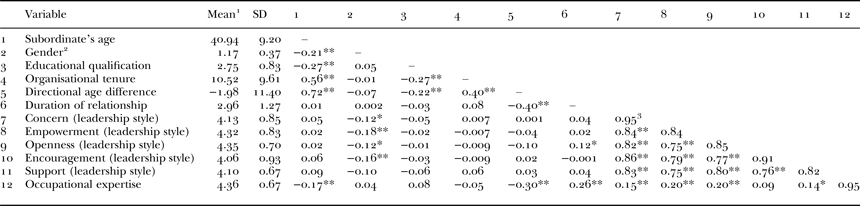
Table 1 shows the means, standard deviations, reliability coefficients (on the diagonal) and correlations between all study variables. All constructs that were assessed demonstrated good internal consistencies. The inter-correlations between the transformational leadership style components were relatively high. In addition, Table 1 shows that the correlation between the directional age difference term and occupational expertise was significantly negative (r = −0.30, p < 0.01).
Means, standard deviations (SD), reliability coefficients and correlations between the model variables

Notes: N = 303. 1. Means and SD of binary (0, 1) coding for supervisor–subordinate age difference. 2. Binary coding for gender (1, 2). 3. Reliability coefficients are Cronbach's alpha (on the diagonal).
Significance levels: * p < 0.05, ** p < 0.01.
Outcomes of hierarchical regression analyses
Age dissimilarity effect
The outcome of the analysis modestly supports the status-incongruence hypothesis (Hypothesis 1) (R 2 = 0.10, F = 6.63, p < 0.001). Directional age dissimilarity accounts for a substantial incremental amount of variance in expertise (ΔR 2 = 0.07, p < 0.001; β = −0.35, p < 0.001), after having controlled for the control variables (ΔR 2 = 0.03, p < 0.10). As far as the latter are concerned, the standardised regression coefficients (β) were: for age 0.07 (not significant (n.s.)), for gender 0.03 (n.s.), for educational level 0.04 (n.s.) and for organisational tenure 0.06 (n.s.).
Moderator effects
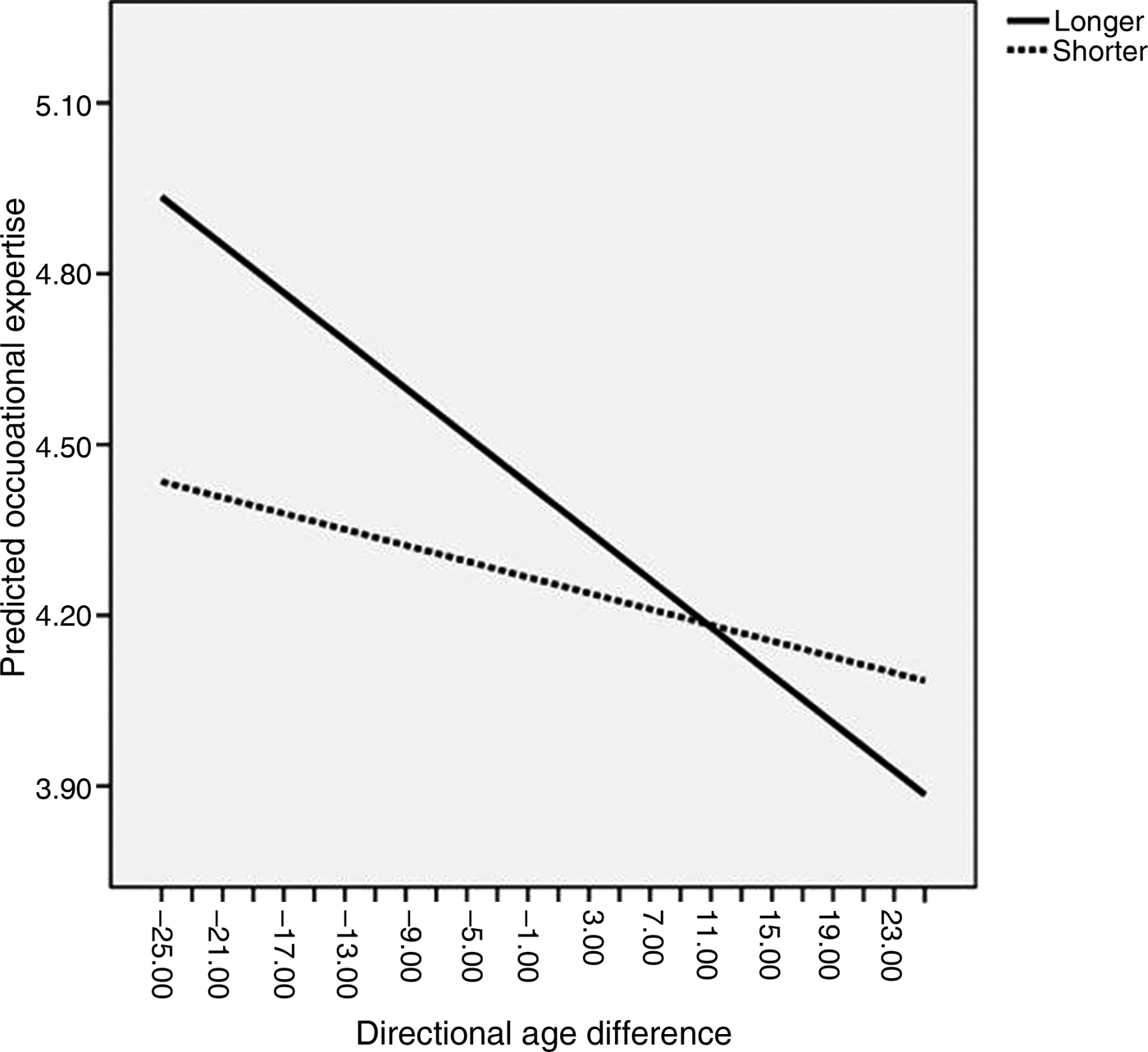
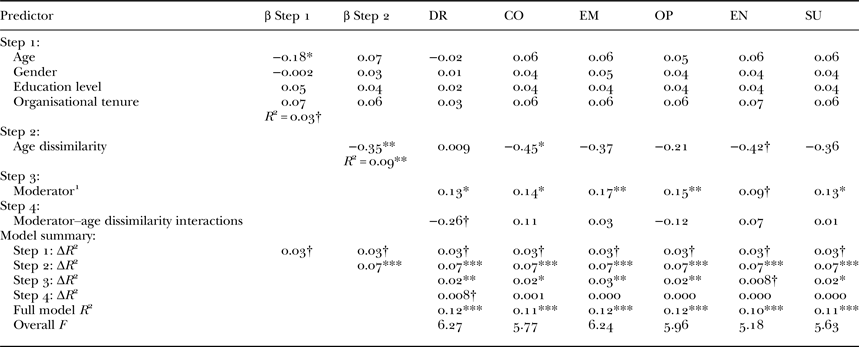
The results of the regression analyses are summarised in Table 2. Each column pertains to one of the distinguished interpersonal work context characteristics, i.e. dyadic tenure, and the five transformational leadership behaviours. Our outcomes indicate that all interpersonal work context characteristics appear to be important factors in the light of supervisor expertise ratings about subordinates. Looking at the interaction effects, it was found that only the interaction between age dissimilarity and dyadic tenure was significant, and that it displayed a rather complicated pattern. Simple slope analyses pointed out that, in the case of a longer duration of the relationship, more positive scores for directional age difference were associated with significantly more negative expertise ratings (β = −0.26, p < 0.01). In the case of a shorter relationship, the effect was not significant (β = −0.13, n.s.). In other words, the main negative effect of directional age difference on expertise ratings was only found in the case where employees and supervisors are quite familiar with one another (see Figure 1). With this outcome, Hypothesis 2 is rejected. Contrary to the expectations, there was no effect of directional age difference in the case of a short dyadic tenure, while the effect was negative in the case of a longer tenure.
Interaction effects between directional age difference and tenure.

Summary of hierarchical regression results using superior's directional age difference as the predictor, and with occupational expertise ratings as the dependent

Notes: N = 303. DR: duration of the relationship. CO: concern. EM: empowerment. OP: openness. EN: encouragement. SU: support. Standardised regression coefficients (β) are shown for the last step in the regression, except for the first two columns indicating β Step 1 and β Step 2, respectively. 1. Moderators are listed horizontally under the relevant dependent variable. Thus, for the first occupational expertise equation, duration of the relationship is the moderator.
Significance levels: † p < 0.10, * p < 0.05, ** p < 0.01, *** p < 0.001.
Contradictory to the expectations, for the five transformational leadership behaviours only main effects were found. With these outcomes Hypothesis 3 was rejected.
Discussion
Reflection on the outcomes
This study intended to add to our understanding of the age–performance relationship by studying relational demography and its impact upon supervisors’ perceptions of occupational expertise of their subordinates. It appears that the status-incongruence hypothesis is supported. Indeed, the greater the directional age difference between a superior and his or her employee, the lower the supervisor rating of subordinate occupational expertise. The latter implies that age-related stereotyping might be an important phenomenon in cases where assessments concerning occupational expertise are made by superiors who are younger than their subordinates.
After examining the possible moderating influence of dyadic tenure, it appears that the effect of directional age difference is quite complex, and cannot be easily combated. On the contrary, it seems as if the negative effect of directional age difference on expertise ratings is only found in cases where employees and supervisors are (quite) familiar with one another, according to a longer duration of their relationship (dyadic tenure). It was hypothesised that in the case of a lack of experience with one another, reliance on, in this case, age-related stereotyping, is cognitively efficient (and sometimes even the only practical resource) (Chaiken and Trope Reference Chaiken and Trope1999; Sloman Reference Sloman1996; Smith and DeCoster Reference Smith and DeCoster2000). However, the opposite appears to be the case. That is, in situations of more experience with one another (longer duration of the working relationship), the negative effect of status-incongruence is more prevalent.
It is not easy to understand these outcomes, as familiarity is usually seen as a highly important factor possibly buffering the negative effects of age-related stereotyping (see the theoretical outline above). However, when people make evaluations, such as performance appraisals, about objects, situations or events that they have encountered previously, they also tend to engage in lower levels of effortful, systematic processing (Garcia-Marques and Mackie Reference Garcia-Marques and Mackie2001; Johnston and Hawley Reference Johnston and Hawley1994). This tendency is adaptive as it is wasteful for human beings to think extensively about objects, situations or events that they have encountered in the past. This is why, under circumstances of familiarity, people might be inclined to rely on readily accessible knowledge, and reserve extensive and thoughtful processing mostly for novel objects, situations and events (Claypool et al. Reference Claypool, Mackie, Garcia-Marques, McIntosh and Udall2004; Garcia-Marques and Mackie Reference Garcia-Marques and Mackie2001; Reder and Ritter Reference Reder and Ritter1992).
In relation to person perception, effortful processes of individuation have often been contrasted with heuristic or non-analytic processes of stereotyping or category-based processing (Brewer Reference Brewer, Wyer and Srull1988; Fiske and Neuberg Reference Fiske, Neuburg and Berkowitz1990). There is considerable evidence that the ‘default’ mode of person perception, in the absence of either motivation or capacity, is stereotyping, and that motivation and capacity tend to increase perceivers’ use of individuating information (see Fiske Reference Fiske, Gilbert, Fiske and Lindzey1998). Intuitively, more familiarity of the supervisor with the subordinate might be expected to increase the capacity to process information about the latter, and (perhaps) to increase motivation as well, allowing for greater individuation. However, the outcome of our study is in line with Smith et al. (Reference Smith, Miller, Maitner, Crump, Garcia-Marques and Mackie2006), who predicted that previous exposure to information about a target person should decrease analytic processing of individuating information, thereby increasing the perceiver's reliance on stereotypes in making judgements about the target (see also Häfner and Stapel Reference Häfner and Stapel2009, who tried to resolve the apparent contradiction between recent research showing that familiarity experiences may increase stereotyping and the common belief that familiarity should decrease stereotyping, and who argued for a ‘usability’ rather than a ‘heuristic processing’ perspective).
As regards person perception in working environments, one would not expect previous exposure to have this effect, because a longer duration of the relationship between an employee and his or her supervisor should generally lead to increases in affective ties, depth of friendship, amount of individuated knowledge and interpersonal interdependence. All these factors should, of course, motivate and enable individuated processing and thereby reduce stereotyping. However, in everyday business life, especially at higher functioning levels, employees work highly independently, and supervisors might frequently see them without engaging in meaningful interactions or forming an actual relationship. That is to say, they may engage only in minimal, highly scripted interactions. In such cases, if repeated exposure indeed reduces analytic processing, increased stereotyping of familiar target persons may be (partly) explained, because this effect would not be counteracted by individuated knowledge, emotional involvement, and so forth (Smith et al. Reference Smith, Miller, Maitner, Crump, Garcia-Marques and Mackie2006).
The outcomes described above greatly support the decision to include relational demography in research studying age effects. It seems that compositional effects of demographic attributes, in this case age, indeed add to our knowledge, given the complex interaction pattern using dyadic tenure as a moderator. While more age-related stereotyping was expected in the case of a lack of knowledge on a certain category of employees (in this case older workers), these data indicate that supervisors are inclined to fall back upon stereotypes, instead of making a careful consideration and weighing of observations of employee's work behaviour and capabilities, in case there is a history of interaction.
Additionally, in this study, it was examined whether these effects might be moderated by another interpersonal work context characteristic, i.e. transformational leadership style. A methodological strength of the chosen approach concerns the fact that this contextual variable is assessed from the subordinate's point of view, while the dependent variable, i.e. ratings on occupational expertise, is assessed from the supervisor's point of view. Whereas transformational leadership appeared to be an important factor in the light of occupational expertise development, it does not seem to moderate the negative effects of age dissimilarity upon supervisor ratings of occupational expertise. Again, these outcomes lead to the conclusion that age-related stereotyping is hard to combat, and it is important to pay serious attention to its impact upon the career growth of the working population, especially given the demographic changes. While a leadership style that is characterised by concern, empowerment, openness, encouragement and support, in itself is valuable, other means are necessary to prevent biased performance ratings.
Limitations of the study and recommendations for further research
Although these findings lend some credence to part of the theoretical framework, they must be interpreted with caution for several reasons. Firstly, observed effects and overall variance explained by the regression models are modest. On the other hand, the magnitude of the effects found in the current study is consistent with that reported in earlier research (see also Van der Heijden et al. Reference Van der Heijden, Scholarios, Van der Schoot, Jędrzejowicz, Bozionelos, Epitropaki, Knauth, Marzec, Mikkelsen and Van der Heijde2010), and indicate that directional age differences between employee and supervisor provide unique – albeit small – sources of systematic variance in employee appraisal, that can be hardly buffered by means of interpersonal work context factors. Also, the small effects can represent a cumulative process that may multiply over time (Abelson Reference Abelson1985). Furthermore, any degree of systematic variance in this regard, however small, is worth noting (see also Prentice and Miller Reference Prentice and Miller1992), given the possible disadvantageous or unfair outcomes in terms of workplace decisions (see Rudolph and Baltes 2001). Secondly, all data have been collected using survey research opening up the possibility of response set consistencies. Thirdly, all data have been collected at one point in time, that is, our study is cross-sectional. The inability to test causal inferences makes it impossible to rule out alternative explanations for the effects noted in this study. Future longitudinal data collection procedures should be used to determine causality. An example of an alternative explanation that can be tested in longitudinal approaches comprises the idea that the outcomes pertaining to dyadic tenure represent a selection effect, as presumably those subordinates with higher expertise ratings will be more likely to remain with their supervisors (and so have higher tenure). Future approaches might also control for tenure in the job and/or in the department, in order to rule out the possibility that some employees are given lower ratings as a result of a lack of extensive expertise, instead of shorter dyadic tenure, and/or to understand better the impact of having fulfilled different jobs while working for the same supervisor, and the other way around. Moreover, due to the fact that both the employees’ and supervisors’ samples are predominantly male, more empirical work is needed to understand whether the results of this study may be generalised to more female, mixed or gender-balanced populations of employees and supervisors.
Future approaches using research designs investigating supervisor–subordinate dyads’ age differentials in a context where a supervisor has multiple subordinates is recommended as well. More specifically, in this case the intra-group or team dimension to the supervisors’ evaluations could be included, and one could examine the extent to which a supervisor's evaluation of multiple subordinates demonstrates differences within the same unit or team (see also Joshi, Liao and Roh Reference Joshi, Liao and Roh2011, who stressed the need for multi-level research in this field of study). Also polynomial regression models might be used in future research in order to reply to some conceptual and methodological problems that are inherent to the practice of using difference scores (see Edwards Reference Edwards1995).
Moreover, scholars could include multiple demographic variables, and other sources of dissimilarity in future research, such as personal values, attitudes and personality (see also Glomb and Welsh Reference Glomb and Welsh2005; Strauss, Barrick and Connerley Reference Strauss, Barrick and Connerley2001), and data on the nature and quality of the relationship, for instance using leader–member exchange measures (Graen and Uhl-Bien Reference Graen and Uhl-Bien1995). A longer duration of the relationship does not always imply a high-quality relationship and more familiarity. Also more research on perceived (age) similarity versus actual similarity is interesting as perceptions of similarity more consistently predict work-related outcomes than actual similarity because ‘people react on the bases of perceptions of reality, not reality per se’ (Ferris and Judge Reference Ferris and Judge1991: 464; see also Riordan and Wayne Reference Riordan and Wayne2008; Wayne and Liden Reference Wayne and Liden1995).
More research is also needed to investigate whether the impact of relational norms may differ according to national culture (for an interesting example, see Hope Pelled and Xin Reference Hope Pelled and Xin2000), racio-ethnicity, gender (see e.g. Carter et al. Reference Carter, Mossholder, Feild and Armenakis2014; David et al. Reference David, Avery, Witt and McKay2015; Luksyte, Avery and Yeo Reference Luksyte, Avery and Yeo2015) or employment status (e.g. part-time versus full-time employees; see Avery et al. Reference Avery, Volpone, McKay, King and Wilson2012). For example, the relational norm of age could be more salient in cultures that value and respect the wisdom of the elderly. The results of the current study suggest that performance ratings in the vertical dyad may be lowest for subordinates who are dissimilar from the supervisor in a direction that is inconsistent with relational norms. Another opportunity for future research is to conduct cross-cultural studies of relational demography at the group level, rather than at the dyad level. Empirical research should also compare contexts in which relational norms differ. For example, in some occupations and in some companies, it may be ‘normative’ for supervisors to be younger, or to have less tenure. Moreover, given the fact that organisations may differ as to the extent to which they offer a climate that is more or less prone to age discrimination, more research into the possible impact of organisational culture is called for.
In addition, across the globe different approaches to legislation are adopted. For instance, one major difference between the United States of America (USA) and Europe lies in the fact that US legislation is designed to assist older workers, whilst the legislation of the European Union (EU) applies to all those at work. Specifically, under the US Age Discrimination in Employment Act (ADEA), it would not be illegal to discriminate between an older and a younger worker from the protected class (those aged 40 plus), at the expense of the younger person. This would not be possible under the EU directive (unless there was justification). Both the US and EU measures have some significant weaknesses, herewith hindering a constructive approach to combat age discrimination. For instance, the ADEA has a small-firm exclusion, while under the EU directive, there is the possibility of justifying exceptions if the aim is legitimate and the means proportionate, but Article 6 of the Directive permits a wide interpretation of the meaning of legitimate aim. That is to say, in a sense both legislation approaches are similar in that they are really an inadequate response to the need for age discrimination protection (Sargeant Reference Sargeant, Field, Burke and Cooper2013: 517–8). Therefore, there is an urgent need to investigate further which role an employee's interpersonal work context may play in changing this negative situation.
Future research might also go into the impact of demographic similarity in horizontal (e.g. among colleagues, such as mentor with protégé; for a dyadic approach, see Finkelstein, Allen, Ritchie, Lynch, and Montei Reference Finkelstein, Allen, Ritchie, Lynch and Montei2012), rather than in vertical dyads, and by incorporating ratings on both employee, leader and peer outcomes (for an exemplary meta-analytic approach on the impact of leader–subordinate age differences on leadership effectiveness ratings, see e.g. Rudolph and Baltes Reference Rudolph and Baltes2011).
Notwithstanding the limitations that are inherent to this study, the results are noteworthy and provide challenges for future research and cross-validation in different occupational settings and countries.
Practical implications
Our findings suggest that staffing organisations with subordinates and supervisors that are dissimilar in age may create a breeding ground for bias in performance ratings, in particular age-related stereotyping. As the current demographic developments imply that more older workers will be supervised by younger managers, attention for diversity, for instance by means of training on the importance of age-aware HR policies and practices, is needed in order to alert both subordinates and supervisors to the possible consequences of age differences. The focus of such training should be to motivate supervisors to be highly ethical and conscientious in performance appraisals and to enable them to invest time in individuated processing of information and knowledge about all employees, regardless of their age. Obviously, given the previously mentioned inadequate response of current legislation approaches to the need to combat age discrimination (Sargeant Reference Sargeant, Field, Burke and Cooper2013: 517–8), we advocate the use of psychometrically sound (i.e. valid and reliable) measurement instruments for performance appraisal practices in working organisations. Moreover, important stakeholders in organisations should really care about justified appraisals of the competencies of all of their staff members across the lifespan. They should do their utmost to combat age-related stereotyping by stressing the need for thorough interaction between employees and their supervisors, and by stimulating transparency throughout evaluation processes in all major HR functions (planning, staffing, employee development and employee maintenance). After all, in-depth and valid knowledge about employee outcomes, in our case, occupational expertise ratings, is needed to guide staff welfare and development continuously, and as a result, to enhance organisational performance outcomes as well (Kehoe and Wright Reference Kehoe and Wright2013). In order to improve performance appraisals and to combat age-related stereotyping, organisations should pay more attention to communication about the behaviour of individual employees (Stoker and Van der Heijden Reference Stoker and Van der Heijden2001). Superiors and subordinates should ask each other regularly for feedback, e.g. based upon a psychometrically sound instrument such as the one used for the occupational expertise ratings in this study. Given the current labour market demands, more knowledge on occupational expertise, over and above regular work evaluations, might add to an organisation's adaptive power, in that closing expertise gaps enhances employees’ chances to contribute to the organisation's success.
In order to gain from what performance appraisal systems can offer, and to minimise the possible adverse consequences, organisations need to create an atmosphere of trust, openness and sharing (Jones Reference Jones2001; McNabb and Whitfield Reference McNabb and Whitfield2001). This is why the amount of interaction, and possibly familiarity, in terms of a longer duration of the working relationship between superior and subordinate, is an important aspect to take into consideration. To facilitate employees in their further development, they need to know what they need to change, where (specifically) they have fallen short and what they need to do to improve their performance. In some cases, a personal coach may be the key to deal with the inherent discrepancies found in performance ratings (Van der Heijden and Nijhof Reference Van der Heijden and Nijhof2004).
Combining supervisor appraisals and self-assessments may make apparent any area of supervisor–subordinate disagreement, and might lead to ‘healthy conflicts’ over the evaluation, and possibly increase job performance (Thornton Reference Thornton1980). Further, it is likely that this will result in an exchange of ideas and may imply a step forwards in reaching ‘workable solutions’ that are more likely to be accepted by employees due to their influence upon the process (see also Lind et al. Reference Lind, Kulik, Ambrose and Vera Park1993). In addition, one should make sure that raters are provided with guidance and training, including a clear explanation of the major competencies expected (see also Brutus and Derayeh Reference Brutus and Derayeh2002), and on the importance of experience in rating processes in the light of the reliability and validity of performance appraisals.
Furthermore, supervisors should be provided with opportunities to detect their own rating biases, if any, before they actually rate an employee. Training supervisors to recognise a perceived similarity bias may increase their willingness to evaluate (dissimilar) others more accurately. In this respect, training about generational differences and the impact of culture is called for as well. This becomes even more critical in an era wherein workforces flow across national boundaries, and with organisations being more likely to have a culture mix of employees who are not similar to each other. Without some type of intervention (e.g. frame of reference or diversity training) raters are more likely to base ratings on stereotypes due to, for instance, age (dis)similarity, especially when filling in gaps of knowledge on ratee performance (see also Lefkowitz Reference Lefkowitz2000).
The suggestion to use think-aloud protocols aimed at explaining why a supervisor gives a particular rating to a particular item might be used in order to improve the quality of performance appraisals further (Heerkens and Van der Heijden Reference Heerkens and Van der Heijden2005; Van der Heijden Reference Van der Heijden2000). It is possible that this technique may improve the validity of the instrument, though, at the cost of the homogeneity of the rating scale. If supervisors are asked to give concrete examples of performances or behaviours of their subordinates, response biases like age-related stereotyping will probably be sifted out, or at least partly. If supervisors are required to justify their choices and are encouraged to think more carefully about their answers, the differentiation between item meanings will probably increase, leading to even more valid outcomes. Only if ratings are explicitly founded on empirical verifiable observations of behaviour and performance can we use them confidently in annual job and career assessments, including related salary implications (see Ostroff and Atwater Reference Ostroff and Atwater2003). To conclude, given the importance of a supervisor's perceptions about the competencies of individual employees in terms of future career development opportunities (Van der Heijden et al. Reference Van der Heijden, De Lange, Demerouti and Van der Heijde2009), it is highly important to make them aware of the possible dangers of age-related stereotyping in this regard. Diversity programmes wherein the strengths, challenges and added values of employees across the lifespan are stressed might help to overcome bias in performance appraisal, be it conscious or unconscious in the first place. Moreover, the possible impact of the employee's social work context should be explicitly taken into account as well in order to increase the chances for a better and happier life in the workplaces.
Acknowledgements
This study was financed by the Netherlands’ Organisation for Scientifie Research (ASPASIA Program, Project 015.000.114). Ethical approval was not required.