


1. The problem Plato faced
Firstly, I'll describe the timeless elements of this problem, then the special intensity of the problem for Plato's Athens. I suggest, then as now, there are at least four ‘codes’ by which we assess human conduct.
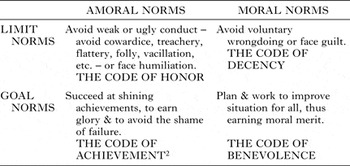
This distinction of norms leans on a prior distinction between shame/glory sanctions on the one hand and guilt/credit sanctions on the other hand, as explained below:
Some differences between guilt and amoral shame
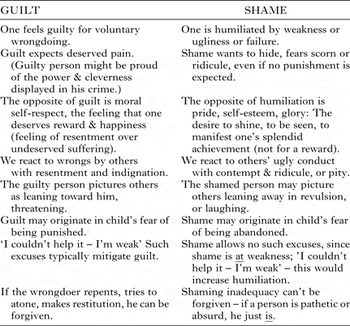
These distinctions are stated baldly and controversially; let us just assume their adequacy for now.
Anthropologists sometimes distinguish ‘shame-cultures' from ‘guilt-cultures'. They suggest that societies like Japan or Montenegro or ancient Greece are influenced more by fear of shame, while Northern European societies fear guilt more. But I'd submit that, in any culture, shame is more fearful than guilt, at least for energetic natural leaders. For instance, if you had to choose, would you rather be resented and hated, or despised and ridiculed? Guilt connotes punishment within the group; shame connotes abandonment, exclusion. Guilt can find excuses; shame is increased by any reference to weakness.Footnote 3 Guilt can be forgiven – shame can be expunged only by some difficult change or triumph. (It's not ridiculous to say, ‘That was worse than a sin – that was a blunder.’)
Now the problem with these four codes is that they are so apt to clash. Philosophers are familiar with clashes between decency and benevolence (‘Do benevolent ends justify ruthless means?’) and all moralists know about temptations to injustice stemming from ‘ambition’ (i.e., from norms of achievement).
But honor-norms can also clash with achievement-norms. To save the Roman Republic from the threat of Caesarism, Shakespeare's Brutus can't lead an army honorably in revolt; he must kneel basely at the feet of his friend and benefactor, to set him up for the conspirators' knives. And Plato himself had to submit, in his old age, to various humiliations from Dionysius, in his benevolent attempt to set up a philosophical utopia on Syracuse – here honor clashed with benevolence.
For a young person who is talented, active, and upright, who wants to leave his/her mark on the world by improving things for everyone, who wants also to preserve his self-respect and to respect the rules of justice, life seems necessarily tragic. If he pushes on to his noble achievements, this will probably require some base and/or unjust conduct, as Machiavelli noted. If he scrupulously avoids all flattery, deceit and injustice, he'll likely lose his chance to initiate major improvements which he knows he could manage – and he'll likely bear the shame of defeat and failure.
Caught in this iron net of conflicting norms, the natural leader's energy will often lead him to push ahead ruthlessly, violating the limits of honor and decency on the way. He might also find glory in accomplishments that are socially destructive (e.g. seeking victory in factional quarrels that rend the larger society). Modern liberal society tries to harness these elite energies by systems of financial reward and legal punishment – whatever the youth wants to do, (it is hoped) he'll be reluctantly willing to ‘play the game’ fervently but within the rules – in the hope of getting high pay and status, and to avoid the risk of prison. But it seems more and more clear lately that this system works only when it supplements a system of training youth to internalize social norms as legitimate. The finest young people might scorn crass money; and they might enjoy the risk of penalties.Footnote 4
So, this is the timeless problem about which Plato was worried: how to reconcile conflicting norms, how to prevent the powerfully sanctioned norms of shame and glory from swamping the socially vital norms of shame and glory. This problem was especially intense in Plato's Athens, for several reasons. Firstly, the Greeks were obsessed with beauty in action and vigor in rivalry. Plato notes in Republic VIII: ‘That which men at any time honor they practice’Footnote 5 (what is admired will be practiced). The Greeks also considered humiliation a fate worse than death – anyone who would not prefer death to slavery deserved to live on as a slave.Footnote 6 Then, they were impressed with the basic futility of temporary animal life – they hungered for immortality, but their traditional religion offered them only a shadowy, personal survival after death. Better to live as the lowest vagabond on earth, says expert Achilles, than to be king of the underworld. The best Greek hope of immortality lay in ‘doing some big deed so men to come may know of me’ (in Hektor's wordsFootnote 7); and Plato refers to the ‘[desire] to win renown and not to lie in our graves without a name.Footnote 8 And Plato even describes this policy as what his own policy or that of any decent man ought to be, in exercising power – ‘by conferring benefits on the city, to acquire for himself the greatest power and the highest honors.'Footnote 9
Besides, the Greeks were constantly at war. In such garrison states, as Adkins has noted,Footnote 10 the competitive excellences (e.g. self-disciplined strength, courage, and cleverness), which are related to shame/glory norms, loom in seeming importance over the cooperative excellences (justice and benevolence) which are emphasized by what we call today the moral norms. Now in fact, some of this emphasis was militarily outdated by Plato's time – war was now a team-sport, requiring cooperation among Athenians far more than individual virtuosity in battle; but the Athenians were still enchanted with the normative system found in Homer, which praised single combat between knights.Footnote 11 Homer's superhuman charm made his outdated standards of social excellence all too attractive. Homer's archaic enchantment threatened Athens' survival.Footnote 12 Indeed, Athens collapsed as an independent polis soon after Plato's time – he was right to be pessimistic – and part of the trouble, presumably, was from the internal quarrels between faction-leaders, each leader desperate for competitive glory and terrified of defeat or failure.
If the norms of justice and benevolence had still been backed by divine threats of inevitable punishment, things would be different. (Not only would Greeks fear future punishments; even in the present the ‘splendid villain' would count as foolish, since his actions were leading to future self-destruction. So shame would ally itself with justice.) However, scepticism held that there might be no gods; or else they might not care how men live; or else perhaps they could be appeased by gifts from the rich, wicked winners.
The Greeks loved Nature, which they saw as a principle of Motion;Footnote 13 and being a seaport city, Athens was aware that what was ‘immoral’ in one society might be required in another. Moral norms seemed to be partly arbitrary and conventional – but norms of shame and glory seemed to them natural and self-evident (being enshrined in the traditional Homeric subconscious). After all, the natural behavior of the rock is the way it behaves when it is unimpeded; analogously, natural behavior for an Athenian is what he would do if he were liberated (say, by invisibility) from moral and legal restraints, free to seek triumph.Footnote 14
The myth of the Splendid Villain haunted Athens (a myth partially incarnated in splendid human tigers like Alcibiades). The ordinary Greek leader knew he couldn't manage to be the splendid villain who posed successfully as goodFootnote 15 – few people are that talented at deception. No, the Athenian accepted the rules of justice as annoying but necessary impediments. But the myth of the splendid villain made the Athenian see his own justice as a sign of his weakness – he was a little ashamed of his own justice.Footnote 16 This further weakened the norms of justice. (The theme of Republic I could be rephrased not as: ‘Does Justice Pay?' but as: ‘Is the just man a foolish simpleton?') (Paradoxically, Plato's presentation of the splendid villain, especially in the magnificent speech by Callicles,Footnote 17 may have extended the psychological influence of this dangerous myth over all subsequent Western culture.)
Earlier Greeks' behavior had been controlled by a balanced tension between shame/glory norms on the one hand and moral norms backed by divine authority on the other hand. The sophistic questioning of moral norms did not liberate Athenians – it handed them over completely to their rigid, outdated, and socially-disastrous shame/glory standards of conduct.
Plato saw all this – he realized there was no real-chance in the near-future to revivify the divine sanctions for justice and benevolence.Footnote 18 The only solution was to co-opt the honor/glory systems, to seize the powerful shame/glory sanctions and harness them to the socially-vital justice norms.Footnote 19 People must be made automatically vain only about intelligent and cooperative service to the whole Athenian community, and automatically humiliated only over injustice. They must be persuaded that wicked factional triumph was not truly glorious, that defeat caused by just scruples was not really humiliating (not even ‘being slapped', as Socrates tells CalliclesFootnote 20) – that unjust behavior was always shaming, even when it was clever, daring, and successful. A mighty project Plato faced, but a vitally necessary one – he focused his enormous powers on this challenge.
2. Plato's project
Plato referred again and againFootnote 21 in a vast system of metaphors, to his great project. In the ideal city of the Republic, the golden thinkers would say what should be done; then the stalwart warriors would enforce the thinkers' edicts on the grumbling, lazy, undisciplined masses.Footnote 22 And each human soul is like a city – in the good person, reason lays down just standards of conduct, which are often received unsympathetically by the lower passions. Luckily, our ‘military soul’ (our silver thymos) mediates – loving victory, it is very sensitive to shame. It listens to reason (for instance, anger in a true nobleman can't be roused in a wrong causeFootnote 23) and, fearing shame, thymos angrily curbs the tugging of incoherent lower drives for food, drink, orgasm and continued animal existence, as well as the derived lust for money.
In Symposium, shameless Alcibiades notes that one man, Socrates, can make him feel humiliated at the way he is betraying his higher self in his reckless pursuit of triumph.Footnote 24
So Plato sees the love of true fame and the fear of true shame as indispensable reinforcements for the norms of morality. But sometimes he seems to feel differently: in the Seventh Letter, he says that a person is not worthy of philosophical culture if he is enamored of philosophical reputation.Footnote 25 And Socrates in Phaedo Footnote 26 seems to scorn the silver version of courage – he pictures the aristocrat as torn ingloriously between his fear of death and his fear of disgrace. But there's no real contradiction here. To say that concern for shame and glory is not the highest motivation for good conduct in no way counters the claim that, for all humans except the top philosophers, it is a serviceable, indispensable motive.
3. Plato's EristicFootnote 27
Before he can win Athenians over to the true view of shame and glory, Plato must shake their stubborn faith that they understand these ‘natural’ relationships already. One could reconstruct the ‘sturdy common-sense’ position he is opposing – it would go something like this: ‘Aretai – admirable human excellences – are straightforwardly recognizable, and naturally, self-evidently glamorous in every context. Conversely, one can easily pick out and describe human weaknesses, deformed traits that are of course contemptible. Proficiency in the activities comprising social struggle is always admirable – defeat (or the weaknesses leading to defeat and failure) is always pathetic and contemptible.’
Plato's eristic strategy is to introduce the idea of merely hypothetical values – qualities and assets that are valuable only if certain background assumptions are true. However, the main issue for Plato is not ‘categorical goods’ but categorical beauties (nothing noble is evil and hurtfulFootnote 28). (After all, some people today think that technological proficiency remains always beautiful and glamorous even when it threatens to destroy all of us. Such a person just shrugs that the world is a tragic one, where the beautiful and the useful can be radically opposed and the choice of a beautiful doom is rather noble.)Footnote 29
Plato wants to show that there are two ways one can define ‘courage’, ‘self-discipline’, ‘cleverness’, etc. One can assume they are good in every context – but then one can't give an empirical description of them. Or one can describe them empirically, but it will then turn out that they are sometimes harmful. There aren't any human traits, empirically describable, that are beneficial or harmful in every context.Footnote 30 (And so Plato assumes that these traits, presumed beautiful, are beautiful only-if found in certain context – likewise, defeat might not be ugly in all contexts.)
Plato starts by reminding people there there's no such thing as Power – no invisible, glamorous ‘electricity’, there is only ‘able to do x’ or ‘able to do y’. Each of these ‘ables’ must be evaluated separately. So when a wandering teacher comes by hawking his wares, offering to sell know-how, knowledge-power, to young natural leaders, Socrates always asks, ‘Your speciality makes one able to do what?’ Then when the professor gives an empirical specification – e.g. ‘Rhetoric makes you able to harm your foes’ – Socrates can easily imagine a situation where this particular ability harms its possessor. So ‘able to x’ is always harmful in some situations. Thus he notesFootnote 31 that boldness (‘courage’) is sometimes self-destructive, whereas ‘flight from battle’Footnote 32 is sometimes beneficial and correct.Footnote 33 In Charmides, Socrates notes that quietness (‘temperance’)Footnote 34 is sometimes bad. Fear is sometimes good – the brave man, after all is characterized by his noble fear of shame. ‘The power to govern men would be ugly in a slave.Footnote 35 Performing menial services for another can be goodFootnote 36 (as, for instance, when an apprentice runs errands for his teacher.) (Plato took this type of paradox quite seriously – in his ideal city in Laws, detailed rules can't be laid down beforehand as to when ‘menial’ services are really degrading – the matter must be adjudicated by a recognized lover of nobility on the spot who hears individual cases!)Footnote 37 Short-run cleverness can backfire. Socrates reminds Callicles of the Thessalian witches who succeeded in pulling the moon down from the sky – to their own destruction.Footnote 38 (Socrates could have reminded his auditors of the recent disaster in Athens when the rhetoricians cleverly succeeded at getting Alcibiades convicted in absentia of sacrilege – which provoked him so that he switched sides and gave important Athenian military secrets to Sparta. Socrates seems to touch gingerly on this sore topic when he reminds Polus that people could succeed in hurting their foes and thereby harm themselves.)
Why do people think that certain empirical traits and powers are always good? Well, they think of these powers used in situations they judge as typical (e.g. ‘if I had that money, I'd use it well’); then they generalize illicitly to the goodness of the trait or asset in every situation. Powers often make the wise man better off – he's now able to implement his wise plans. But powers make the fool worse off; the fool is better off weak – however, fools rarely see how that point is relevant for them. Powers multiply the value or disvalue of the wisdom or folly that controls their use. (Plato mentions one mirror-image of this fallacy: Spartans rate the Athenian practice of drinking-parties – symposia – as categorically bad,Footnote 39 just because they've never observed a symposium run correctly.Footnote 40 Analogously, Plato notes that despised retail trade would be a beneficent calling if carried out correctly.Footnote 41)
Plato has one weak argument in this connection. He says repeatedlyFootnote 42 that if x is sometimes beneficial and sometimes harmful, then x has no value or disvalue ‘in itself.’ But consider that chlorine in some compounds would be poisonous, and in some compounds salubrious (e.g. in table salt), whereas, by itself, chlorine is poisonous. Something could have hypothetical intrinsic value, in the sense that its value is not stable in every context, but neither is its value just instrumental. A power could be valuable-in-itself, but only when accompanied by the good sense to use it correctly.Footnote 43 And Plato doesn't need to hold any more than this, to shake the ordinary Athenian's faith in his own power to ‘intuit’ beauty in certain traits and assets.
In Euthydemus,Footnote 44 Socrates advances an interesting abstract formulation of his oft-repeated point, namely, that ‘knowing-how-to-x' does not automatically guarantee ‘knowing-whether-to-x’, hence knowhow, or power, can't be categorically good. because we can imagine it being misused. He states that the only knowledge that would be good in every context would be some ‘knowing-how-to-x’ that includes ‘knowing-whether-to-x'. It's hard to imagine what such knowledge would be like – perhaps this explains why Socrates held such a low opinion of human cleverness at its best. G.E. Moore says simply that no human excellence (virtue) is good in every context.Footnote 45 This seems to express the Socratic perspective.
On the other hand, in Meno, Socrates advances a more cautious scepticism about human excellences. He admits that occasionally a power can be used rightly, simply by good luck, without any stable, theoretical, ‘know-whether’ wisdom.Footnote 46 He admits further that sometimes there are intuitive decision-makers who do get great things done consistently, who enjoy a considerable measure of continued success,Footnote 47without having the kind of know-whether theory they could explain or teach. He simply ascribes such a fluke to divine inspiration (we ascribe it to ‘practical genius’).
However we describe the situation, this concession seems to leave possible a rehabilitation of glamorous powers and assets. Under the direction of such a decision-maker of genius, these specific powers (like courage, self-discipline, cleverness) would be used well consistently, by hypothesis, and could be consistently valuable. On the other hand, in practice such genius is rare and unpredictable. Usually we recognize it only in hindsight. If we think we see it in a new leader, we worry that his past successes might involve a string of good-luck coincidences, or that this promotion might raise him to his proper ‘level of incompetence’ (as the Peter Principle puts it.) So this concession doesn't really undermine the Socratic eristic which strips human ‘can-do’ of its automatic glamour.
In Euthydemus, Socrates seems to anticipate an objection: suppose someone said that ‘able-to-x’ does not always depend for its value on the value of doing-x-in-each-context.Footnote 48 For instance, Gorgias is a nice old man who wouldn't want to exploit anyone. But he glories innocently in the fact that rhetorical skill would make its possessor able to enslave and exploit the doctor, the trainer, the money-makers. By controlling the government that could coerce these experts, the rhetorician could control them – so his is the Arts Artium – it contains all the powers of their arts.Footnote 49 All this is true and glorious for Gorgias even though actually using the skill in such exploitative ways would be base and ugly.Footnote 50
To counter such an objection, Socrates first asserts in Euthydemus that assets not used for action have no value.Footnote 51 (Indeed, this would be the miser's fallacy, Plato could say, to think that money-never-to-be-used has beauty in itself.) Then Socrates notes that using-x-wrongly can be worse than not using x at all.Footnote 52Nor can one say that it's always better to be ‘able to do much’ – because doing little, correctly, is better than doing much foolishly.Footnote 53 Socrates concludes with a staggering paradox: the weak, near-sighted, timid, slow clod who has senseFootnote 54 is better off and less contemptible than the strong, bold fool. (Even today this is a difficult saying – who can hear it?)
Plato also anticipates another objection: ‘Beauty is beauty – clearly recognizable.’ (Indeed, sometimes Plato, himself makes this claim! In Phaedrus,Footnote 55 Socrates says that, while ideals like justice and truth are not physically visible, the ideal of Beauty is. And in Laws, the Athenian says that public reputation is worth seeking (as a sign of personal worth) because even bad people can recognize true nobility.)Footnote 56
Sophocles (in Ajax) seems to suggest that, even though Ajax's fierceness and bravery are rendered ridiculous, in a certain sense, (when madness leads him to attack sheep), still the overall judgment must be that he is a splendid, though tragic, fellow.Footnote 57
Plato can't admit this kind of possibility, or else he'd have to concede that the Greek crowd could be right when they think they just see splendor in factional combative skills, and ugliness in factional defeat – even though the consequences of these skills (and of this perception) are disastrous for Athens. Plato must hold that beauty is not just there, in separate units, to be intuited. The Critias Footnote 58 tells of a virtuous prehistoric people who valued temperance above riches, etc. Then they got corrupt, and began to grab for power. Now, to the unseeing eye they lost their former bloom. (The unseeing eyes see separate facts – e.g. this nation's new thrust for worldly ‘greatness’ – but they can't interpret these facts correctly, as splendid or ugly.) And in Menexenus, Socrates imagines a great strong, handsome fellow displaying himself in battle as a whining coward.Footnote 59 His splendid appearance, his physical assets, accentuate the ugliness of his behavior.
Beauty for Plato is contextual, not atomic – people who don't appreciate the whole context may misperceive beauty and ugliness, true glory or shame.Footnote 60 (Sophocles in Oedipus Tyrannus seems to make a similar point – if a Greek imagines Oedipus provoked at the crossroads, lashing out triumphantly, this seems splendid and beautiful. But when the audience gets a ‘wide-angle’ view revealing this scene as Oedipus killing his father, then the same incident seems incredibly foul. When they imagine Oedipus outwitting the sphinx, winning the Queen and throne as prize, the scene is splendid – but when they remember that this means he'll be siring children by his own mother, the horror is increased by the contrast.Footnote 61) So Plato's contextual view of beauty seems correct – with it he can show that the ordinary Greek is cocksure and foolish to think he can just read ‘beautiful/ugly’ from situations, to think he can get by with copybook standards ascribing glory always to action and energy and success, ascribing shame always to weakness and defeat.
Adkins seems to claim that Plato wanted to glamorize the cooperative dispositions like justice.Footnote 62 He might want this, as political reformer – but his philosophical method of seeing values as hypothetical would forbid him to present the ‘quiet virtues’ (traits) as always good,Footnote 63 any more than the competitive dispositions. Justice is always good for Plato – therefore justice is not a set of empirically-describable dispositions like the tendency to return what's borrowed, or to return good for good and evil for evil. Justice does not equal any power at all.Footnote 64
4. Plato's Constructive Project
Everyone admits that unjust acts are sometimes incompetent, warranting shame as well as guilt. But Plato needs to show that unjust actions are automatically ignoble, even when they exhibit cleverness, daring and persistence – even when they're triumphantly successful. This is a heroic project, unlikely to succeed completely.
There are two ways a thinker could try to show that the successful villain is not so splendid. First, starting from a concept of ‘true achievement’, he could try to show that bad means automatically befoul the beauty of the goal. This is a strategy that Aristotle will use later – he just seems to assume that ‘just’ is a precondition of ‘splendid achievement’. Of ruthless aggression, Aristotle says that it is not even just, let alone glorious.Footnote 65
Plato doesn't lean much on such a ‘definitional’ move. Instead, he chooses a second method which starts from the code of honor, and attempts to show that unjust actions are automatically shaming.Footnote 66
Plato tries again and again to show that injustice must involve weakness, error, enslavement. For instance, in Laws the Athenian says that all wrongdoing stems from ignorance or from domination by the passions (rage, fear or greed).Footnote 67 And in Republic IV, Socrates claims that where Reason rules the soul, supported by high-spirit controlling the lower passions, such a just person could never rob or cheat others.Footnote 68 However, he does anticipate the possibility of a coldly ‘rational,’ self-disciplined villain (an Iago or a Richard III). He even describes such a villain, the miser in Republic VIII. The miser's lower passions are strictly controlled by reason and thymos, but Reason doesn't control his soul; no, greed controls the soul, with reason serving as abject, toadying prime minster. Reason plays Pollonius to Greed's Claudius. The miser's reason is asked only how to make more money, not whether to seek more. His thymos may glory only in wealth, may take shame only in poverty. And so on.Footnote 69 (Of course Plato needs to show also that in every villain, some low passion rules – and that in saints not even benevolent passions – e.g. sympathy – rule the soul. I know of no place where Plato recognizes or refutes this Humean possibility.)
In Protagoras Footnote 70 and Philebus,Footnote 71 Socrates says that people do wrong because they miscompare the nearer with the distant pleasures. (They overrate the nearer pleasures, in an error of perspective.) Perhaps we could extend Plato's account by saying that all egoists rate their own welfare as more important than the stranger's, in an analogous error of perspective. Thus every evil act would involve a mistake. (Commentators have puzzled over Plato's odd insistence that all wrongdoing is involuntary.Footnote 72 Perhaps one motivation for this odd claim was, precisely, his need to show that all injustice involved some incompetence, in order to moralize humiliation.)
Again and again Plato insists that injustice is automatically dishonorable, that justice is always comely.Footnote 73 Even ugly just men are comely. (We know that Alcibiades found Socrates a fascinating Silenus, ugly on the outside, gold on the inside.Footnote 74) This insistence leads to one paradox. We learn in Gorgias, and again in Laws,Footnote 75 that when someone is justly punished, he is beautifully punished: his punishment is also beautiful-to-him. Yet in Laws the Athenian also notes that to be effective, just punishment must seem ugly and shaming to the criminal. As just, the punishment must be beautiful; as effective deterrent, it must be shaming.Footnote 76 (This paradox could be resolved,Footnote 77 but it is dropped without explicit resolution.)
One simple way to carry through the Platonic project is to define the beautiful as the beneficial.Footnote 78 In Greater Hippias, it's strongly suggested that beautiful equals beneficial;Footnote 79 and the objections to this definition seem forced. Eyes, says Socrates, aren't beautifulFootnote 80 when they look blind.Footnote 81 Well-made pots,Footnote 82 and well-made bodies, whose structures are neatly apt for their proper functions, are beautiful. But in Republic V occurs the most heroically teleological redefinition of beauty. Socrates is defending his proposal that women should receive military training, against ridicule at the picture of naked old ladies exercising in public. He points out calmly that Athenians see nothing ridiculous in naked old men exercising publicly, because Athenians understand the social function of this practice. Then he generalized, that only the useful is beautiful; only the harmful is ugly.Footnote 83 If this breathtaking definition were really accepted, then those who saw the need for justice in Athens, to pacify the ruthless factions that were tearing her apart – such people could readily accept the automatic ugliness of injustice. However, this redefinition seems rather forced (though one recalls here Hume's noting that a certain bulge in the line of a ship seems ugly to landlubbers, but comely to those who understand the function of such a bulge).
At one point Plato himself seems to balk at a completely utilitarian beauty. The Athenian in Laws IV opposed locating a new colony near the sea, where it must be defended by sailors and marines. Marines are trained, basely enough, to think it's acceptable to throw down their weapons in ‘flight without dishonor’.Footnote 84 But even Homer denounces such tactics! Besides, maritime cities must depend for their survival on (and so must honor) such dubious characters as sea-captains.
But a critic might say that, if utility completely determines what counts as base or noble, then for a maritime city, such fleeing marines shouldn't count as base or ugly, since their flight is socially helpful – after all, the marine lives to fight another day. (Remember, the Athenian says that the law-abiding citizen is more to be honored than is the military hero, presumably because in contemporary Hellas, law-abiding citizens are scarcer than good fighters, so more valuable.Footnote 85)
The Athenian's revulsion at marine-style war might be based on the shrewd suspicion that if you tell fighters today they can run when absolutely necessary, tomorrow you'll see them run whenever it is convenient. On this interpretation, the Athenian has a ‘rule utilitarian’ theory of honor: the maxim ‘run from battle if necessary’ would have disastrous results if promulgated with ‘average style of compliance’ – hence the maxim is unacceptable as a norm of honor.
However, the Athenian doesn't sound as if that's his point. On the contrary, when he's reminded that a sea battle once saved all Hellas, he replies loftily that his concern is with promoting the moral worth of the citizens, not with their mere survival.Footnote 86 But on any utilitarian theory of honor (such as the definition in Republic III embodies) surely ‘conducive to the corporate survival of the city’ would set the standard for defining moral worth. The two considerations can't be easily opposed.
Plato has many problems with his constructive project – but we can see clearly what the project attempts.
5. Plato's Rhetorical and Social Project
There are two ways society can motivate people to comply with its norms. The liberal strategy is to leave alone people's minds and desires and private lives, counting on rewards and punishments to make people at least reluctantly willing to comply externally.Footnote 87 The Athenian in Laws thinks this is a coercive and illiberal policy. He thinks the City should use persuasion on people who aren't hardened, and use threats, banishment or execution on people too shameless to be persuaded.Footnote 88 He wants to make people eager to comply, not just reluctantly willing.
It's easy, he says, to shape young people's thinkingFootnote 89 and desiresFootnote 90 – if they hear everyone agree on what counts as fair or foul. He notes the crowning triumph of such indoctrination: young men never give a thought about intercourse with certain girls – their sisters.Footnote 91 The incest taboo is so strong it removes even the temptation (he says).
Thus in practice it's not necessary that Plato validly prove that injustice is automatically shaming. Even if that were not so, says the Athenian, it might be a good idea to indoctrinate youths in this idea anyway, as a useful social myth.Footnote 92 He recalls nostalgically the sterling character of primitive people, who were too naïve to question the conventional (and correct) way labels of ‘fair and foul’ were assigned.Footnote 93
The Athenian wants a preamble for each law to preach the nobility of compliance, the foulness of disobedience. Ignominy is heaped on the disobedient citizen – people who refuse to have children are snubbed systematically.Footnote 94 And while it's true that the City can't snoop in every corner to catch adulterers and fornicators, it can publically disgrace those who get caught. This will lead adulterous wretches to sin in nervous secrecy – this by itself will mark adultery as shaming.Footnote 95
The most spectacular case of ignominy used instead of pain as a penalty is the unusual reaction, in the Athenian's ideal city, to cowards who throw away their weapons.Footnote 96 The ideal thing would be to turn them into women – (indeed Timaeus says that cowards will be reincarnated as women).Footnote 97 As second best, the City simply strips them of any manly, military role – it grants them just what they seem to want: a long, craven life with no soldierly risks. (It's understood they'll be crushed by this disgrace; Plato knew about shameless villains, but it took democratic Christianity to produce shameless splendid cowards like Parolles, Thersites and Falstaff. The Athenian would go apoplectic if he met some American males today – like the draftee in Korea who remarked sagely, ‘I'd rather have them say of me, “There he runs!” than “Here he lies.”’) The suicide is thrown into an unmarked tomb in the wasteland.Footnote 98 The wretch who dares to kill a close kinsman is killed, then cast out naked from the city – his head is crushed with stones, and he's left to rot above ground outside the border. And so on.
Conversely, glory is consciously rationed out to mark the best way to behave.Footnote 99 The City, for instance, honors moderate, all-around fitnessFootnote 100 – where an uncontrolled mob might applaud excessive proficiency at useless sports like tricky wrestling.Footnote 101 The City allows no prestige for comic actors – indeed no citizen can take up this career.Footnote 102 Generals are seen as craftsmen, earning honor as their proper pay.Footnote 103 (Surprisingly, military heroes don't get top honorsFootnote 104 – these are reserved for just citizens at their best.)Footnote 105
We often ask ‘Who will guard the guards?’ Today we set all the bureaucrats spying on each other, with dubious success. The Athenian faces the fact that the top auditors (The Inspectors-General) must simply be trusted, at least in the short run. So they must be motivated by a love of moralized glory – they must ‘work to benefit the City, in order to earn the highest honor’.Footnote 106 If these auditors manage to live un-corrupted among the temptations of great power, then truly divine honors are reserved for them. A whole page in Laws describes their glorious funerals. And their immortality is guaranteed – a year is named for each of them – their names are enshrined forever in the calendar.Footnote 107
We noted earlier that it isn't strictly necessary to prove philosophically that injustice is always ugly. Nor would such valid argument be socially sufficient. People's shame-feelings must be rousted and controlled by art and ritual.Footnote 108 Punishments themselves are significant mainly as shaming rituals. Children must be surrounded with vivid reminders of the beauty of right conduct, of the ugliness of injustice. The child must get this message from every side (as he hears everywhere the unthinkable foulness of incest) – that is, he must hear the same message not just from all full citizens, but also from all women, slaves and other children he may meet. (It wouldn't do at all to have Nabokov's novel Ada circulating its picture of a deep, poignant, aristocratic love affair between a brother and his full sister!).
People's private lives must be controlled.Footnote 109 Their practices must be controlled, in order to shape their habits and thus their desires. Mere coercion won't work on people who want fiercely to live in ways the laws forbid. The correct line connecting the just with the noble must be incarnated in rituals, songs, drama, to rouse deep feelings of pride and shame that can be harnessed to the norms of justice.
And these incarnations must be unanimous – it's unthinkable to let any random poet push his chance view about the way justice and nobility are related. After all, poets as such are not experts on evaluation.Footnote 110 (Plato never considers the possibility that some artists could know ‘by inspiration’ certain deep truths about human nature – as he admits they know, without studying, how to make beautiful lines, as he admits some politicians have a non-theoretical knack for regularly making correct decisions.) No, Plato thinks the poets' undoubted skill at producing surface beauty cannot be allowed to lend prestige to whatever activities each poet sees as fine. (He might also note that even if Homer correctly rated activities in his own time, the ranking he ‘endorsed’ for Hellenes was, centuries later, fatally out-dated.)
It follows of course that songs and dramas must be censored. It's better to have unmusical songs about glory and honor that are composed by true noblemen, who have proved by their deeds that they understand Honor, than to allow enchanting songs of praise which might push a distorted, amoral view of shame and glory.Footnote 111 To allow artistic freedom to any chance poet would be to abandon altogether the project of harnessing powerful feelings of shame and pride to the norms of justice and benevolence.
(However, as I noted before, in one place in Laws, Plato raises an optimistic possibility that might weaken his clear case for censorship – the Athenian is explaining why even the enlightened leaders should value their public reputations, as a sign of their inward worth: he notes that even bad men have an odd ability to recognize true nobility when they see it.Footnote 112 Insofar as injustice is visibly foul, so any clod can see it, – to that extent, ordinary people could be trusted to see through the enchantments of poets who mislabel fair and foul activities. But Plato would not count on this.)
Here I have sketched the rich theme, running through most of Plato's writings (early and late) of the need for moralizing shame and glory, and the possible ways to succeed at harnessing influential shame to vital norms of justice. This project seems to explain many pressures on Plato's thought – why he wanted to hold various odd positions.
The highest tribute to Plato would be for us to ask in our world if shame can be completely moralized, whether ‘splendid villains’ can be always discredited as ugly and inglorious. But that's another paper.


