Thousands of plant species throughout tropical and temperate zones secrete extrafloral nectar (EFN) (see www.biosci.unl.edu/emeriti/keeler/extrafloral/worldlistfamilies.htm) to attract ants, whose presence leads to an indirect defence against herbivores (Chamberlain & Holland Reference CHAMBERLAIN and HOLLAND2009, Heil Reference HEIL2008, Heil & McKey Reference HEIL and McKEY2003, Rico-Gray & Oliveira Reference RICO-GRAY and OLIVEIRA2007). Although termed ‘extrafloral’ because the nectar is not involved in pollination, EFN can also be secreted within the inflorescences (Bentley Reference BENTLEY1977, Holland et al. Reference HOLLAND, CHAMBERLAIN and HORN2010, Martins Reference MARTINS2009). Because ants tend to defend reliable food sources against all types of putative competitors, it has been hypothesized that the presence of extrafloral nectaries close to flowers may lead to competition among ants and pollinators, or even to direct ant–pollinator conflicts. Such antagonistic interactions would reduce the access of pollinators to flowers and, thereby, may cause significant ‘ecological costs’ of indirect, ant-mediated defences (Heil Reference HEIL2002).
Research into different systems has indeed demonstrated that the presence of ants can reduce pollinator visits to flowers (Ness Reference NESS2006 and references therein). Flowers of several species can, therefore, release specific odours that act as repellents against ants (Ghazoul Reference GHAZOUL2001) or solve the ant–pollinator conflict by providing rewards in temporal or spatial patterns that allow a separation of ant activity from pollinator activity (Chamberlain & Holland Reference CHAMBERLAIN and HOLLAND2008, Galen Reference GALEN2005, Holland et al. Reference HOLLAND, CHAMBERLAIN and HORN2010, Martins Reference MARTINS2009, Nicklen & Wagner Reference NICKLEN and WAGNER2006, Raine et al. Reference RAINE, WILLMER and STONE2002, Wagner & Kay Reference WAGNER and KAY2002). Ecological costs resulting from defender–pollinator conflicts appear a generally accepted paradigm in the context of indirect defence; earlier studies have, however, usually not considered a potential positive effect of the ant-attracting resource, the EFN, on the pollinators.
In the present study we used Lima bean (Phaseolus lunatus L.) to study the effect of defence induction within the inflorescences on the interaction between ants and flower visitors. The study was conducted in the coastal area of the state of Oaxaca, Mexico. The climate in the study area is characterized by one main rainy season from June to October, which follows a bimodal distribution peaking in July and September. The site selected was located 15 km north-west of Puerto Escondido (15°55.596ʹN, 97°9.118ʹW). Here, Lima bean grows naturally along dirt roads that lead to extensively used pastures or plantations. All experiments were performed on this native population in December 2009 during the transition from wet to dry season.
Lima bean is a suitable model plant to investigate our question because it exhibits an inducible EFN secretion both on leaves and in the inflorescences, thus allowing an easy manipulation of the rates of EFN secretion (Heil Reference HEIL2004). We selected plants with inflorescences that presented more than 50% of fully open flowers. To induce EFN secretion, an aqueous solution of jasmonic acid (1 mM l−1 of JA, the EFN-inducing wound hormone) was applied to the youngest parts of each shoot (comprising the seven youngest fully unfolded leaves and inflorescences). JA and a ring of ant-excluding resin (Tangletrap®, The Tanglefoot Corporation, Grand Rapids, MI, USA) around the base of the shoot were applied in a complete two-factorial design: (1) ants present, no JA (control); (2) ants present, JA application; (3) ant exclusion, no JA; and (4) ant exclusion, JA application. We used plants at three sites in the field and realized three censuses (at 10h00, 12h00 and 14h00) with four replicates (four different shoots) for each treatment. During every census all flower visitors and ants entering the inflorescences were counted: for the purpose of this study we considered all Hymenopterans and Dipterans (bees, wasps and flies) that entered flowers and stayed for more than 5 s as ‘flower visitors’. Ants were considered when they completely entered the inflorescence. Visits per day were averaged for every plant and were evaluated with a two-factorial nested ANOVA for the effect of JA and ant presence (with ‘site’ as the nested factor because due to the clonal growth of lima bean we cannot exclude genetic identity among some of the shoots that were investigated at the same site) on numbers of flower visitors. Tukey-Kramer tests were applied as a post hoc test. Independent plants were used to confirm the EFN-inducing effect of JA within inflorescences. We used 10 plants at each site: on five of them we applied jasmonic acid, while the other five plants were used as controls: both plant groups were protected against EFN consumers with mesh bags. Nectar concentration was measured 4 h later as described by Heil (Reference HEIL2004).
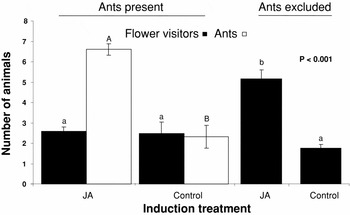
Our results confirmed earlier observations (Heil Reference HEIL2004) that EFN secretion within the inflorescences responds positively to JA treatment (Control: mean ± SE = 2.96 ± 0.53 mg, JA: 11.3 ± 2.89 mg, t(1,9) = 2.84, P = 0.009) and that an increased EFN secretion leads to increased numbers of ant visits to the inflorescences. In the censuses of insect visits, our treatments of ant exclusion and JA application significantly affected the number of ants entering the inflorescences and of flower visitors. Approximately 2.6 ± 0.27 flower visitors were counted in JA-treated inflorescences to which ants had access whereas 7.4 ± 0.61 flower visitors attended JA-treated inflorescences from which ants had been excluded. Without JA application, c. 1.8 ± 0.63 flower visitors were counted on inflorescences to which ants had access and 2.5 ± 0.29 when ants were excluded (F 3,35 = 40.1, P < 0.001, according to two-factorial nested ANOVA) (Figure 1). The JA-mediated induction of EFN secretion had, thus, a significant effect on the number of visits to the flowers, which became particularly obvious under ant exclusion conditions (7.4 visits to induced plants vs. 2.5 visits to controls; F 3,35 = 13.1, P < 0.001). This part of our results clearly supports the general assumption of an ant–pollinator conflict (Ghazoul Reference GHAZOUL2001, Holland et al. Reference HOLLAND, CHAMBERLAIN and HORN2010). Most interestingly, however, the negative effect of the presence of ants and the positive effect of the JA-treatment nearly cancelled each other out, because no significant difference could be found between the number of flower visitors on the inflorescences of control shoots (no ant exclusion and no JA treatment) and the visits to the induced shoots in the presence of ants (F 3,35 = 0.1, P = 0.090, Figure 1).
Conflict among ants and flower visitors after induction of extrafloral nectar secretion. Numbers of flower visitors and ants are presented for the four treatments (JA+ants+, JA−ants+, JA+ants− and JA−ants−). Bars represent means ± SE, different letters indicate significant differences (P < 0.001 according to Tukey–Kramer test, lowercase letters represent flower visitors, uppercase letters represent ants).

Although some studies have found evidence for temporal differences in the activity patterns of ants and pollinators (Holland et al. Reference HOLLAND, CHAMBERLAIN and HORN2010, Martins Reference MARTINS2009, Raine et al. Reference RAINE, WILLMER and STONE2002) we found that ants and flower visitors can co-occur at the same time on the inflorescences of lima bean. We conclude that a JA-treatment of lima bean with the resulting increase of EFN secretion within the inflorescences can increase the intensity of indirect, ant-mediated defence without decreasing the frequency of visits to flowers, as compared with control plants. What is the causal mechanism that underlies this phenomenon? Flower visitors have occasionally been observed to feed on Lima bean EFN and significantly more Hymenoptera and Diptera were observed on plants that had been experimentally supplied with an EFN mimic (Kost & Heil Reference KOST and HEIL2005, Reference KOST and HEIL2008). Thus, the increased EFN flow within the inflorescences might have been the main attractant for the flower visitors in our study. Most recently, however, a positive effect of JA on flower nectar secretion has been observed for rape (Brassica napus) although it remains to be studied whether JA also induces floral nectar secretion in other species (Radhika et al. Reference RADHIKA, KOST, BOLAND and HEIL2010). Finally, JA might have affected flower odours and thereby increased their attractive effect. Future studies will have to investigate why flower visitors were attracted to JA-treated inflorescences of Lima bean. Independently of the underlying physiological mechanism, however, future studies on ant–pollinator conflicts will have to consider the potential positive effect on flower visitors of a resistance induction within the inflorescences and its consequence for pollination efficiency.
ACKNOWLEDGEMENTS
We thank Rosa María Adame-Álvarez from the CINVESTAV Irapuato for assistance in the field. This project was financially supported by the Swiss National Fund (project No: 31003A) and CONACyT de México.