Sermons are one of the most conspicuous means by which religious ideology is communicated in contemporary Pakistani society. Vast numbers of men attend Friday mosque sermons, their prayer mats spilling over into adjacent fields and busy streets. Although attendance is compulsory in areas like the Khyber Agency, their appetite for religion is far more than can be explained by mere coercion. Hundreds of thousands attend rallies show-casing their favourite mullahs. In shops, rickshaws and private homes these same sermons are played on cassette players, listened to on FM radio, downloaded from the Internet and distributed as MP3 and MP4 files on mobile phones.
Listening to sermons is also a widespread practice among women. Despite being excluded from public worship, women rely on radioFootnote 1 and audio cassette listening, as well as a growing cadre of female preachers who speak to groups of women in their homes. In the troubled Swat valley the public burning of thousands of secular audio cassettes dramatically highlights the way sermons are replacing traditional folk music.Footnote 2
Despite this enthusiasm for sermons, their form and content have been little studied. What has been lacking since the British colonists became aware of the mullahs’ role in mobilisation has been an understanding of what it is about the construction and spread of sermons that enables them to be so trenchant. Surprisingly, given the access they allow to the voice of religious spokesmen pressing for violent upheaval, only brief reference to sermons has been included in the historical and anthropological studies of the region. To date no analysis has been made to match the detailed study of Friday sermons preached in Jordan, Iran, or Egypt.Footnote 3
The need to pay more attention to sermons is underlined by historical studies pointing to their influence in societies in which preaching was prominent. The historian Harold Grimm claims that during the European Reformation the “the role of the sermon in making the Reformation a mass movement can scarcely be overestimated”.Footnote 4 The anthropologist Charles Hirschkind has argued that in the Middle East today the sermon (and particularly the cassette sermon) holds a similar prominence, and exhibits a vigorous ability to shape the “religious sensibility”Footnote 5 of Muslim communities. Judging from the enthusiastic reception of sermons in Pakistan it is reasonable to assume they may be having a similar influence.
To explore this question I focused on the Pashtuns of KPK; a group who pride themselves as being the most devote practitioners of Islam in Pakistan. The primary source for this study was a collection I made of 193 popular audio cassette sermons, known locally as tuqrīr. These tuqrīr were delivered in the Eastern dialect of PashtoFootnote 6 and were in circulation from 2003 to 2006.Footnote 7 The tapes yielded about 250 hours of sermons which were then transcribed for further analysis. Over twenty mullahs were also interviewed to gain insight into how they prepare and deliver their messages.
A Persuasive History
The persuasive role of sermons in Pashtun society has a long pedigree. They have been marvelled at, manipulated and mimicked by a succession of invaders, politicians and sectarian groups alike. Their influence likely gained momentum when the Friday sermon evolved from a brief recitation of the Arabic khutba into the unfettered and compelling style of discourse found today. In Northern India this change occurred sometime before the nineteenth century, when groups like the ill-fated Tariqa-ī Muhammadiyya movement (1826-1830) apparently began using “extended discursive utterances”Footnote 8 to rally their followers for jihad against the Sikhs.
From this point on there was a growing awareness - particularly by those on the sharp end of the mullahs’ words - that the sermon provides a potent means of establishing ideological commitment. When insurrection spread during the “Pathan Revolts” of 1897, the colonialists concluded that it was the mullahs who were the “levers by which the fanaticism of a frontier tribe is set in motion”.Footnote 9 British attempts at invading Afghanistan may also have been thwarted by the role sermons played in fomenting resistance. The historian Senzil Nawid has suggested that during the Second Afghan War (1879-1880) mullahs “became the major force in mobilising the Afghan population”.Footnote 10 Preaching was also blamed for prompting the assassination of the Afghan Emir Habibullah Khan in 1919, as well as anti-Hindu violence that accompanied partition.Footnote 11
It was an awareness of the power of the sermon to mould public opinion (and frustrate the colonial programme) that led to British attempts to first mimic and, when that failed, to try and stifle, or modify, the mullahs’ words. The attempt to mimic sermons involved the setting up of pre-tuned radio receivers in Pashtun villages from 1936. Like sermons broadcast from the mosque today, the messages were played in public space at high volume. The experiment was soon abandoned, however, as Pashtun villagers showed little interest in the social reforms the broadcasts attempted to propagate, and became suspicious that the receivers were in fact spying devices used to eavesdrop on them.Footnote 12
A more fruitful approach at ideological manipulation involved interference with the Friday sermon itself. In 1938 the NWFP Governor George Cunningham peacefully disbanded a formidable tribal army that had amassed to fight against the British by paying a £25,000 bribe to persuade their spokesman, the ‘Shami’ Pīr, to return to his native Syria.Footnote 13 The silencing of the charismatic orator successfully dispersed the army. This success seems to have encouraged Cunningham to form what he privately referred to as his “propaganda”Footnote 14 network of paid preachers. Among other schemes mentioned in his diaries were attempts to get hireling mullahs to preach against the Third Reich and Indian Independence. Wali Khan (1917-2006), the frequently-jailed leader of the Awami National Party also claimed that his father's non-violent Khoday Khitmatgarān (The Servants of God) movement was thwarted by Cunningham's manipulation of the oratory of the Manki Pīr against him.Footnote 15
There have been different understandings of the role of local sermons. For outsiders mosques along the Afghan border have been characterised as a world populated by “mad mullahs”Footnote 16 spouting regressive “racist bilge”.Footnote 17 But for Pashtuns the sermon is a highly appreciated sacred declaration of faith, informing the deepest levels of intellect and emotion. Mullahs claim that rather than being an incendiary and brief-lived rant, their sermons are carefully crafted so as to be “kept in the heart, thought over, and passed on to their families”.Footnote 18 Since tuqrīr are widely distributed on audio cassettes it is now possible to analyse the speech of Pashtun preachers, to puzzle out the reasons for the powerful draw of their message, and to query some of the unexamined ideas about their content.
The Compelling Power of Modern Tuqrīr
It would be wrong to claim that everyone has fallen under the thrall of the mullahs’ words, or that such influence as they do have is uniform; but there are indications that sermons do exert a powerful hold on society. At times there is a clear link between the words of mullahs and activism. Sermons have been implicated, for example, in their role in rousing crowds to riot against blasphemy,Footnote 19 in inciting a mob to ransack a Christian village,Footnote 20 and in inspiring the murder of those who are seen as the enemies of Islam.Footnote 21 According to Abbas's psychological analysis of 517 captured jihadi fighters interviewed in Peshawar and Haripur jails, the most important factor to have motivated them to cross the border into Afghanistan and attack the American invaders in 2001were the words of their religious leaders.Footnote 22
There are also other, less virulent paths promoted by mullahs. Some preachers - often at great personal risk - stand against violence, rioting and jihad. A recent example was the noted Barelwi preacher Sarfraz Ahmed Naeemi, who was murdered after preaching against suicide bombing in 2009.Footnote 23 Such moderate preaching may influence some to forgo violence and to follow a less strident practice of their faith. Because sermons rally support for these divergent paths there is a growing need to understand how their persuasive power is generated. I argue that the impact of sermons is derived from a synergy of four main factors: credible form, reliable source, stirring content and their wide propagation by modern media.
Credible Form
One reason why sermons are such an effective vehicle for promoting ideas in Pashtun society is because of their trusted format. For Pashtuns, the tuqrīr’s tri-part structure of Arabic khutba, the body of the sermon (in Pashto), and closing prayer is a divinely sanctioned sound bite. The credibility of the tuqrīr style of address is such that politicians mimic it in campaign speeches, and even the Communist Afghan President Dr Najibullah adopted the same three-part format when he tried to convince reluctant Pashtun tribal elders to join his cause in 1992.Footnote 24
Tuqrīr gains credence by borrowing an Arabic voice. By sandwiching a message between Arabic book ends and using frequent quotations from Qur’ān and Hadīth throughout, the spoken word is given a stamp of approval essential to its legitimacy. Even though few Pashtuns can understand Arabic, it remains their sacred ‘truth’ language.
Reliable Source
A second factor boosting the influence of tuqrīr is that it is perceived to come from a highly reliable local source. As President Najibullah found out to his peril, just using the right format is no guarantee of persuasiveness. Despite turning to tuqrīr-style addresses towards the end of his regime, he was too late to gain the confidence of Pashtuns, and would be captured, tortured and hung by the invading Taliban in 1996. In contrast, Friday tuqrīr benefits from the way the words mullahs deliver from the pulpit are trusted as coming from an infallible source.
Mullahs have emerged to fill the vacuum left by weakened government and tribal structures to become an authoritative, almost inerrant voice. This dynamic was dramatically seen on the night of February 12 2005, when an estimated 10 million Pashtuns left their homes in the middle of the night because of a spurious earthquake warning.Footnote 25 For many the message was believable because it had been relayed by a reliable source; the loudspeakers of mosques.
According to local tradition, messages delivered from the minbar (pulpit) of a mosque are infallible. As one mullah reminded his audience after concocting a fabulous tale about debating with Saudi leaders: “I swear to you what I say is true, since I am sitting on the Prophet's pulpit”.Footnote 26 This sense of infallibility comes from the idea that mullahs are literally standing in for the Prophet and acting as passive mouthpieces of the Divine. As Dr Feda Husayn points out to his listeners: “I don't say ‘do this and don't do that’, but I speak what God and the Prophet forbid and enjoin”.Footnote 27
Stirring content
The persuasive power of sermons is also generated by the use of impressive rhetoric. Mullahs combine a poetic sing-song style with an extemporaneous, content-rich structure which enthrals the hearts and minds of their audience. A madrasa student from the Khyber Agency highlighted these two facets of local preaching style in this way: “When a person has been given a pleasing voice and has also studied books, then his sermons will have a good influence on people and people will listen to them a lot”.Footnote 28 The pleasing voice refers to the spoken performance of the sermon, while the study of books relates to their learned content. Both these skills are honed by years of study in the madrasa.
Although madrasas have been criticised for their supposedly authoritarian teaching method and narrow world view,Footnote 29 they do succeed in producing preachers well-suited for the orally oriented and doctrinally discriminating Pashtun audience. The centuries-old method of teaching equips successful graduates with a retentive memory and outstanding public-speaking skills. Part of the reason for the high quality of sermons in Pakistan is that mullahs are selectively drawn from a massive pool of students. There is uncertainty about the total number of madrasa students, but figures released by the Federal minister for religious affairs lists 13,000 officially- registered madrasas.Footnote 30 In addition there may be as many as 20,000 unofficial madrasas; giving an estimated total of about 3 million students from which to select and train the cream of the crop as preachers.Footnote 31
1. The poetics of tuqrīr
The sing-song style of sermons seems to be an essential cause for their influence, especially among Sufi-leaning Barelwi and Deobandi groups. Because Pashtuns have a rich poetic tradition,Footnote 32 sermons with rhyme and rhythm resonate with their audience in ways which make the message memorable and authoritative.
Part of the significance of this prosody lies in its memetic value. Sermons using it become attractive to hear, as well as easy to remember and pass on. The words of popular mullahs are made memorable by their form. A good example of the power of poetics is seen in the sermons of the popular Deobandi preacher Maulana Bijilī Ghar. Quotes from his Friday sermons soon become common knowledge. One example of the way his famous rhyming quips rapidly pass through the grapevine was a joke that he made about the newly-elected Nawaz Sharif in 1997, in which he rhymed the word ‘mandate’ with the Urdu word maynḍuk (frog) to describe the new Prime Minister.Footnote 33
A poetic style of delivery also lends authority to sermons by recreating the inaugural production of Qurʾānic verses. Pashtuns listening to sermons feel great pleasure when listening to well recited Arabic. As the Deobandi preacher Maulana Manzoor Shah explains, such style transports the listener into a deep religious feeling: “[Arabic] is an eloquent language, more eloquent than any other language, and it has plenty of rhetoric and with it a lot of words; such tuqrīr gives pleasure, and emotion comes on people”.Footnote 34 Part of the power of sermons is derived from the way mullahs carry over the sacred rhythm and intonation of Arabic into the main body of the sermon (delivered in Pashto), and thereby make the whole sermon appear to be one long Qur’ānic recitation.
The sing-song power of tuqrīr is forged from a combination of tonal, metrical and rhyming elements which give the more popular preachers - like Maulanas Tariq, Mufti Munīr, Bijilī Ghar and Esānullah - what locals describe as a “sweet character of voice”.Footnote 35 The production of this style is not easy. Some, like Maulana Sirāj ud-din Afridi, admit to being unable to use it at all,Footnote 36 while others deploy less developed styles.Footnote 37
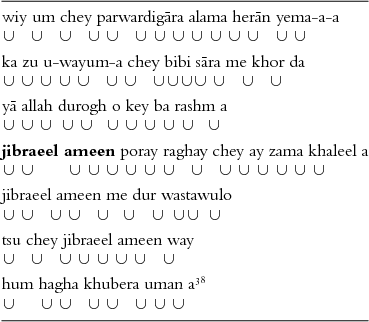
A description of sing-song preaching is challenging, since its lyrical quality is barely noticeable when sermons are transcribed, and it becomes completely washed out in translation. Yet even someone who does not speak the language is immediately aware of the change from normal to sing-song speech when they listen to a sermon. A short section of the Deobandi preacher Maulana Tariq's narration of the story of Abraham provides an example. The excerpt in Table 1 is at the dramatic crux of the tale of Abraham, when the prophet cries out to God for help in protecting his beautiful wife Sarah. Syllables are shown here by the symbol ∪, and words with added stress are given in bold type:
Stress and Syllable distribution in sing-song Tuqrīr

One of the most noticeable features of Tariq's delivery is a shift in register. His voice takes on a tonal value far higher than normal speech. This shift is similar to that found in “spiritual preaching” in the African-American folk sermon,Footnote 39 or in what Tedlock describes as “raising it right up”Footnote 40 in Zuni prayer language. In each, the high register acts as a signal of the sacred nature of the discourse.
Rhythm is a second aspect of the musicality of sing-song speech. It comes from a spontaneously-generated syllable and stress pattern. Pashtuns are particularly sensitive to the rhythm of speech which, like Cockney rhyming slang, is rife with delightful couplets in which a last ‘nonsense’ line is added to achieve a perfect rhythmical balance. Tariq's sing-song style incorporates similar rhythmic tendencies. He improvises his delivery to generate a steady beat by slipping in extra syllables or elongating others to even out the timing. In line 2, for example, the addition of a superfluous ‘a’ achieves a rhythmical balance within the line, while lines 1, 3, 4 and 7 all end in elongated ‘ā’s which function to punctuate the section like a full stop. There is a break in the delivery following these elongated endings that gives time for an intake of breath and perhaps also for the mental gymnastics needed for the production of the next line. The net result is a feeling rather like being repeatedly dropped from the top of a sonic roller-coaster: rhythmic undulations accompany the fall through evenly-spaced loops, a sustained glide to a stop created by the elongated ā at the end of each line, and a pause as you are lifted to the top again. The syllable distribution (∪) shows that although there is not the same kind of tight metrical control of rhythm found in formal Pashto poetry, it does create a definite poetic feel. The last two lines accomplish an 8-8 distribution of syllables, elevating the style above saj’ – the simple rhyming prose so popular in the Arabic-speaking world.
Maulana Tariq also displays a distinctive use of volume modulation in his tuqrīr. His highly energised ‘jibraeel ameen’ at the start of line 4 is a dramatic way of introducing the angel Gabriel into the narrative. The sudden increase in volume acts like a clash of symbols in an orchestra, a heady burst of sound that refocuses the audience on the story and its emotional resolution. Similar eruptions of volume are used by Tariq throughout his tuqrīr. They occur at the start of lines, often as frequently as every sixth line, and are almost invariably preceded by a noticeable drop in the volume of the preceding line. As the volume tails off at the end of a line the audience anticipates a sudden surge in the next. The modulation in volume transforms the dull monotone of boring lecture into the violent crashing of waves.
Another memetic feature of Pashtun sing-song preaching style is rhyme. Rhyming schemes in tuqrīr have a subtlety that goes beyond the simple harmony of words at the end of each line. The first two lines of the passage from Tariq's Abraham sermon provide a good example of the remarkable control that an adroit preacher can spontaneously produce:
wiy um chey parwardigar a alama herān yema-a- a
ka zu u-wayum- a chey bibi sāra me khor d a
Each line contains an ending, or radeef rhyme as well as the internal kafia rhyme, supplied by Tariq's skilful addition of extra – a's in the middle and end of each line. The extra letters are superfluous to meaning, but essential to the delightful internal rhyme.
In an interview Maulana Tariq credited his intuitive, spontaneous ability to create rhyme to training in the madrasa; where poetics is one of the key disciplines. Students begin their training in recitation as soon as they enter the madrasa in the Nazira class at age ten. They start by memorising the sounds of the Arabic alphabet and simple recitation of shorter chapters of the Qurʾān. Further refinement of recitation is accomplished in two advanced classes called Qir’āt and Tajwīd. The emphasis in these classes, which each take a full year to complete, is on excellent pronunciation and rhythm. This study is supplemented by the memorisation of poetry. The inclusion of Persian Sufi poetry in the traditional Dars-i Nizāmi curriculum provides a pattern for poetic recitation used when Urdu and Pashto poetry is quoted in tuqrīr. Maulana Hisamuddin suggests that it is not unusual for preachers to improve their skills in poetry recitation by listening to the audio cassettes of other preachers the night before giving tuqrīr.Footnote 41
2. Extemporaneous disputation
Sublime recitation provides the musicality of sermons, but years of madrasa learning also equip mullahs to deliver sermons that are rich in content. They are drilled in detailed arguments and proofs until they can preach in a seemingly extemporaneousFootnote 42 style of speech that relies on their ability to stitch together memorised components.
The word zubāni is particularly relevant to the discussion here. Literally, zubāni means ‘spoken’ or ‘oral’. Preachers interviewed took pride in claiming to be able to perform zubāni tuqrīr effortlessly, and by this they mean that they do not write out their sermon or use any notes during delivery. Their claim to use “no preparation” is misleading though, as long years of study have primed them to be ready to preach at a moment's notice. When asked if he prepared for tuqrīr, Maulana Feda Husayn replied “No, by God's grace I have spent so much time with learned teachers that whatever topic you ask me, then I can talk on it right away”.Footnote 43
This skill in extemporary delivery is not achieved through the mastery of rhetorical devices in the way aspiring public speakers once did in ancient Greece and Rome.Footnote 44 The methods used in the madrasa are more similar to the training given to young boys groomed in impromptu speech making in ancient China, or the early Aztec civilisations.Footnote 45 Close parallels can also be seen with the preparation given to Dominican preachers in thirteenth-century Europe, when students were given weekly “disputation” classes to check on their mastery of memorised lessons.Footnote 46 Seemingly impromptu speech-making is developed by the patching together of already memorised copia. The development of this apparently effortless style relies on saturation training, a prodigious memory and repeated opportunities for live practice.
In the madrasa this skill is taught when students are 18–20 years old.Footnote 47 Initial instruction is limited to such practical concerns as delivering tuqrīr at the right time, wearing white, smelling sweet, looking in three directions, starting with khutba and ending in prayer, and on keeping on preaching even if the electricity goes out. Training begins with each student delivering impromptu ten-minute tuqrīr on a chosen topic. An emphasis on both oral fluency and approved content is foundational. Students who stumble over words are told to sit down, and fellow students mete out criticism of the content of the talk. Assigned topics progress in difficulty, culminating in exposition on the Hadīth. By this time students are given topics a day in advance, for delivery on Friday morning:
There are in this madrasa some students called anjumān who gather up these students on Thursday night when the other students are on leave, and give a topic to them to prepare. They then deliver the tuqrīr to the group. Praise God that at the time of giving a [real] tuqrīr the fear of people will have left their heart and they become used to [giving] tuqrīr, for standing to give tuqrīr requires a steady heart, not everyone can stand up. Standing up before a hundred or a thousand people is a big thing.Footnote 48
Preachers also commit to memory talks on different mas’āla (disputed points of doctrine) as a way of building their repertoire. Each issue that they can flawlessly recall from memory is then ready to be delivered on demand. As Maulana Mir Sami ul-Haq insists, the reputation of a mullah relies on this skill: “In both our sight and yours a person is better if he . . . has memorised a few mas’āla”.Footnote 49 Because those with a retentive memory are given high status in Pashtun culture, this training to speak without notes lends enormous credibility to the message.
The process of memorisation may have been accomplished years earlier or just hours prior to delivery of tuqrīr. The experienced preacher Maulana Bijilī Ghar, who began preaching in the 1950s, claims not to have done one minute of preparation for a sermon in his whole career.Footnote 50 If this is accurate then it must be assumed that his phenomenal long term memory allows him to rely on a store of memorised material retained from his sixteen years of madrasa education. Other mullahs admit to relying on their short-term memory; either by brushing up on familiar topics the night before tuqrīr, or by studying the details of an upcoming topic they have been assigned. Thus, Maulana Feda Husayn, after initially claiming to do no preparation,Footnote 51 went on to admit “Sometimes the topic is such that looking at a [book of] commentary is necessary, or looking at a Hadīth is necessary. I look at them; for without that a person cannot do a thorough tuqrīr”.Footnote 52
New Media Enable Sermons to Go Viral
Since the 1980s the compelling power of sermons in Pakistan has been dramatically multiplied by modern media. As the Middle East historian Edmund Ghareeb has noted, specific media have acted to catalyse public opinion in different settings around the world. The fax machine provided a vehicle for the uprising in Tiananmen Square, videotape for the Polish revolutionary movement, E-mail for the removal of the Suharto government in Indonesia, and Al-Jazeera TV for rousing public opinion against the invasion of Iraq.Footnote 53 In KPK, as in many other Muslim countries, radio and audio cassettes have provided the major vehicles for the dissemination of religious discourse in the last twenty years. New media enable the message to spread far beyond the narrow confines of the local mosque and go viral in the oral chain.
Audio cassettes first became popular in the Middle East in the 1970s.Footnote 54 The best known example of their influence was the use that Ayatollah Khomeini made of this ‘small media’ in Iran. Sermons made by the exiled preacher were phoned or smuggled on audio cassettes into Tehran, where they were duplicated in vast numbers, giving dynamic voice to public resistance to the Shah and contributing to the overthrow of his regime.Footnote 55 By the 1990s the sermons of preachers like the blind Egyptian cleric Shaykh ‘Abd al-hamid Kishk and the Shi'i cleric Muhammad Husayn Fadlallah could be found throughout the Arabic-speaking world and demonstrated how audio cassette sermons reach a trans-national audience.Footnote 56 The prevalence of Islamic audio cassette sermons in such diverse locations as Mali, China and AlgeriaFootnote 57 is indicative of their widespread use in many settings. The analogy has even been drawn by one commentator that cassettes have become for the Islamist what printed material had been to Luther and Calvin.Footnote 58
In South Asia audio cassettes only came to the fore in the 1980s,Footnote 59 and have been cheaply and widely distributed among the semi-literate population of Pakistan. It is significant that when weapons stored beneath a madrasa accidentally blew up in July 2009, the wreckage included the charred remains of hundreds of sermon cassettes used to indoctrinate students.Footnote 60 In KPK the industry has mushroomed into a network of recording centres and small shops, which have flooded the market with sermon tapes. Listening to sermons is no longer an activity confined to the mosque. Sermons are played on buses and taxis, in restaurants and shops and listened to privately in homes. Cheap bootlegged copies of sermons have elevated tuqrīr to a major channel of influence.
Shops specialising in sermon tapes maintain large reference collections of tapes from which duplicate sermons can be copied on demand, while general shops carry a smaller selection of the most popular speakers. The total number of audio cassette sermons being sold is hard to assess, but a rough feeling for the extent of the business can be gauged from survey results (see Table 2) and the fact that shops in Peshawar's Story-Teller's Bazaar claimed to sell around 250 cassettes per day in 2005.Footnote 61 Many of these shops are partisan, and only sell cassettes of single or closely related Sunni groups.
Survey of Sermon Listening Habits

The influence of tuqrīr in KPK has also been boosted by radio broadcasts. Local mosques have made use of portable FM broadcasting units imported from China.Footnote 62 A key finding of a survey of media use conducted in 2008 by the Pak-Afghan Cross-Border Radio Transmission project was that the rise to power of Maulana Fazlullah (who came to be nicknamed “Radio Mullah”) in Swat was “rooted in the spread of his illegal FM radio station”.Footnote 63 Radio broadcasts of tuqrīr also played a key role in the inter-firqa clashes of the Khyber Agency.Footnote 64
To assess the relative importance of different media in informing religious views, I conducted survey work in the Gulberg area of Peshawar in September 2004. The neighbourhood is a mixed lower-middle and middle class area of the city. It is occupied by small businessmen, professional workers and shopkeepers. A total of 64 males and 7 females were interviewed by a local Pashtun research assistant to gauge what channels of communication informed their religious views. The sample was broadly representative of Peshawar's urban population, being composed of 62 Pakistanis and 9 Afghans, with an average age of 28. Of these 20% were uneducated, 27% had some higher education, and 13% had received specialised religious education. 70 were Sunni and 1 Shi'a. The results are summarised in Table 2 above.
It is clear that a variety of electronic media were making sermons more important than just a once a week event. The survey also revealed that there were pockets of highly enthusiastic listeners. The statistic that there were an average of 22 audio cassettes per home masks uneven habits of tuqrīr listening. Cassette collections were highly concentrated in a few homes, one having as many as 500 sermon tapes. Discussion with neighbours who had such large collections revealed they were often members of sectarian Sunni denominations.
Since the survey, tuqrīr-listening technology has changed, while listening habits seem to have remained unchanged. The main shift is an increasing use of internet and mobile phone technology. Sermons recorded as MP3 and MP4 files are now starting to be spread on SD cards, downloaded from websites like Daily Motion and YouTube and relayed via Facebook. But as technology changes, listening habits still seem to favour the same group of superstar preachers who were in vogue before the smart-phone. For example remarkable numbers of Pashtuns continue to listen to Maulana Bijili Ghar's sermons from YouTube; his top 15 sermons alone had been watched 3,270,223 times by November 2016.
Another factor that amplifies the hold of sermons in KPK is the absence of any substantive state control of preaching. Government efforts are limited to occasional and half-hearted attempts to censure militant or subversive content.Footnote 65 Pakistani law is finely tuned to prosecute anyone who blasphemes against the Prophet Muhammad, but there is little enforcement of common law to prevent public speech which incites hatred or sectarian tension. What attempts the government makes to control preaching have been achieved through monitoring and censorship. The small number of mullahs who work in government-funded mosques may have their sermons monitored, but are rarely censored. A move to dismiss two government preachers and bring charges against eleven others in Islamabad in March 2004 was an unusual development. They were accused of preaching sermons which were “inciting people against Pakistan”.Footnote 66 No such action was taken against non-government mullahs, and, to my knowledge, no preachers have been arrested because of their sermons since the 1980s.
A lack of resolve to enforce censorship has contributed to serious law and order problems in Swat and the Tribal Areas. Officials announced their plans to close illegal radio broadcasts in 2005,Footnote 67 but their attempts were either thwarted or not pursued.Footnote 68 Such a lack of concern for what is being preached may be explained by the political risk of attempting to stifle preaching in KPK, or (as some believe) by government complicity in the mullahs’ agenda. The political risk to the Pakistani government has been increased by the public perception that Western powers are trying to extinguish what Tony Blair called the “evil ideology”Footnote 69 of terrorism. This perception is kept alive by Pakistani media reports of measures taken by non-Muslim countries to curb anti-state preaching in their mosques.Footnote 70 The question of whether there is state support for jihadi groups preaching the most virulent anti-establishment message is hard to resolve, but several commentators are convinced that this is the case.Footnote 71
Implications
This article has explored some of the means by which sermons in Pakistan gain traction from their traditional form, when harnessed to new technology. But what are the implications of this fusion of ancient and modern? The anthropologist Dale Eickelman has argued that the use of new media has led Muslim preachers in the Middle East to face an “increasing fragmentation of their authority”Footnote 72 as well as enabling them to branch out into a wider range of intellectual ideas than those found in the narrow confines of the madrasa. But my findings suggest the situation is more complex in the Pakistani context; where sermons still continue to promote authoritarian conservatism, divisive sectarianism and religious inertia.
1. Authoritarian Conservatism
Because of the compelling nature of rhetorical poetics used in tuqrīr, mullahs speak as the Prophet in a way that preserves authoritarian conservatism, rather than encouraging the kind of pluralism that Eickelman has noted elsewhere. In Pakistan mullahs use their influence from the pulpit to create a narrowly prescribed and antithetical world view in which angels line up to honour the faithful, and the devil delights over those condemned to hell.Footnote 73 The contrast between the two worlds is stark. Those with correct faith are characterised as “alive”,Footnote 74 “blessed”Footnote 75 and the “guests of Allah”,Footnote 76 while all others are counted as “lost”,Footnote 77 “dead”,Footnote 78 and destined to face unrelenting shame.Footnote 79 Such clear-cut distinctions make it untenable to hold other views. As Maulana Bijilī Ghar expresses it, “The battle is about this: that on one side there is no God but Allah, and on the other side there are decisions based on the law of foreigners”.Footnote 80 As Channel 4’s current affairs documentary “Undercover Mosque” revealed, Pakistani preachers in mosques in the United Kingdom may also employ the same kind of Manichean rhetoric.Footnote 81 The outcome is that rather than fragmentation of authority, such preaching encourages totalistic thinking that resists any drift towards pluralism.
2. Divisiveness
The extraordinary ability of mullahs to perform extemporaneous disputation over doctrinal issues leads to a second implication of their preaching. Militant and reformist Islamic groups like the PanjpirFootnote 82 and neo-Taliban thrive on the entrenched divisiveness that their arguments produce. Modern media have enabled them to popularise their hardened positions in ways quite different from the broad-minded diversity that Eickelman foresees. The great weight of preaching by these groups is directed towards attacking the beliefs of other Muslim groups. Their arguments are often laid out as a catalogue of propositions, as in sermons that elucidate eleven objections to Wahhabis,Footnote 83 a list of four faulty Barelwi beliefs,Footnote 84 or six points supporting the Tablīghi Jamāʿat agenda.Footnote 85 In sermon T 61, for example, the Panjpir mullah Khan Badshah uses the pejorative expression mushrik (polytheist) in an aggressive attack on those holding Barelwi belief. His use of the term is part of a dense web of apologetic discussion during which he quotes from 40 different verses of the Qurʾān and three Hadīth to make his appeal against their errant belief.
This kind of cognitive, dialogic preaching illustrates the way sermons enable a narrowing of Islamic belief, rather than a move towards pluralism. This trend is particularly evident in the way Islamic reformist groups use sermons to undermine the credibility of more tolerant Sufi belief. Pashtun preachers export this same rhetoric in the diaspora. South Asian Studies scholar Roger Ballard has noted how the popularity of Barelwi belief has declined among second-generation British Muslims because they have increasingly preferred the more cognitive teachings of the Tabligh-i-Jamaʻat and Hizb ut-Tahrir.Footnote 86
3. Inertia
A third implication of this study is the way that modern media may contribute to a greater religious inertia than Eickelman anticipates. Theoretically, new media might make it easier to hear a broader range of religious and secular views, but there are indications that repeated listening to partisan preaching may be creating more, rather than less, entrenched belief in KPK.
Repetition is especially significant in oral societies because of a reliance on memory to create tradition. From his study of the use of audio cassette sermons in Egypt, Hirschkind described this process as a kind of “sedimentation” of familiar stories, which accumulates in memory and tradition.Footnote 87 New media provide a powerful way to create such sedimentation - through repetition. Sermons preached in Peshawar on a Friday are soon on sale as bootlegged audiocassettes, available on the internet, downloaded onto micro SD cards, and relayed on the radio. The end result is that Pashtuns listen to a lot of sermons, perhaps as many as ten a month. It is this repetition that enables the ideology of sermons to saturate their minds.
This inertia is further strengthened by selective listening. Shops selling audiocassettes tend to only sell the sermons of a narrow range of speakers sharing the same doctrine. There is also evidence from the survey of listening habitsFootnote 88 that Pashtuns who listen to a lot of sermons are more likely to listen to the mullahs of one firqa. In this way the reiterated doctrines, poems, Qurʾānic stories, and Hadīth used by these mullahs become engrained in their thinking.
Such discourse has broad implications for the region. Despite the expenditure of massive military and financial resources to try and create stability, the role of religion has been largely overlooked. From 2001–2009 the United States alone spent over $40 billion in aid to Pakistan and Afghanistan, most of it linked to the stated goal of blunting terrorism.Footnote 89 The money has been used to fight militants and to promote development, pluralism, democracy and human rights. But despite this expenditure, a serious investigation of how religious ideology might either annul or encourage the adoption of these moderating ideas was never attempted. Ignored was the unusually compelling power of sermons; a teaming of ancient and modern that still anchors Pashtuns in their old ways and confounds the plans of intruders.