Introduction
Dung-baited pitfall traps are commonly used to characterize local assemblages of coprophagous insects (Howden and Nealis, Reference Howden and Nealis1975; Floate and Gill, Reference Floate and Gill1998; Price, Reference Price2004; Bertone et al., Reference Bertone, Green, Washburn, Poore, Sorenson and Watson2005; Floate, Reference Floate2007; Webb et al., Reference Webb, Beaumont, Nager and McCracken2007; Louzada and Silva, Reference Louzada and Silva2009; Brousseau et al., Reference Brousseau, Cloutier and Hébert2010; Fiene et al., Reference Fiene, Connior, Androw, Baldwin and McKay2011; Goñi et al., Reference Goñi, Remedios, González-Vainer, Martínez and Vilela2012; Rounds and Floate, Reference Rounds and Floate2012; Viegas et al., Reference Viegas, Stenert, Schulz and Maltchik2014; Jochmann and Blanckenhorn, Reference Jochmann and Blanckenhorn2016; Rentz and Price, Reference Rentz and Price2016). Pitfall traps are inexpensive, easy to maintain and can recover large numbers of insects in a short period of time (Bezanson and Floate, Reference Bezanson and Floate2020). Some studies have used a trapping period of 1 day (Fincher et al., Reference Fincher, Stewart and Davis1970; Bertone et al., Reference Bertone, Green, Washburn, Poore, Sorenson and Watson2005), whereas other studies have used trapping periods of 2 (Larsen and Forsyth, Reference Larsen and Forsyth2005; Rounds and Floate, Reference Rounds and Floate2012), 3 (Barbero et al., Reference Barbero, Palestrini and Rolando1999), 5 (Howden and Nealis, Reference Howden and Nealis1975) or 7 days (Errouissi et al., Reference Errouissi, Haloti, Jay-Robert, Janati-idrissi and Lumaret2004; Fiene et al., Reference Fiene, Connior, Androw, Baldwin and McKay2011; Kadiri et al., Reference Kadiri, Lumaret and Floate2014).
There is no standard recommendation regarding the frequency with which traps should be emptied and rebaited, and relatively few studies have examined this question. In Columbia, a comparison of pitfall traps baited with monkey and human dung at intervals of 1 or 5 days found that bait attractiveness declined sharply after 2 days with an associated reduction of species richness and abundance (Howden and Nealis, Reference Howden and Nealis1975). In Brazil, dung from pig (Sus scrofa Linnaeus, 1758) remained highly attractive to dung beetles for 2 days, whereas dung from collared peccary (Tayassu tajacu Linnaeus, 1758) lost its attractiveness after 1 day (Flechtmann et al., Reference Flechtmann, Tabet and Quintero2009). This same study also reported that odours associated with insects decaying in traps seemed to reduce the catches of certain species. A study in India indicated that dung from elephants (Elephas maximus Linnaeus, 1758) began losing its attractiveness to dung beetles after 3–5 days (Sabu et al., Reference Sabu, Vinod and Vineesh2006). In Malaysia, many more dung beetles were recovered in pitfall traps baited with cattle dung aged 1 day than with cattle dung aged 3 or 5 days (Aruchunnan et al., Reference Aruchunnan, Foo, Ling and Hazmi2015). Results from this latter study also suggested that some species were preferentially attracted to the dung of different ages. In Maryland, USA, the recovery of dung beetles dropped off sharply in pitfall traps baited with dung aged 1 vs. 3 days, regardless of whether the baits comprised dung from horses (Equus ferus caballus Linnaeus, 1758) (Rentz and Price, Reference Rentz and Price2016) or humans (Simons et al., Reference Simons, Molina, Hagadorn and Price2018).
Studies also vary in whether pitfall traps are baited with dung that, at the time of placement, is fresh (Price et al., Reference Price, Brenneman and Johnston2012; Rounds and Floate, Reference Rounds and Floate2012) or frozen (Floate, Reference Floate1998; Finn and Giller, Reference Finn and Giller2002; Marsh et al., Reference Marsh, Louzada, Beiroz and Ewers2013). The former approach can result in baits being made of dung from different groups of animals or collected at different times, which can introduce changes in dung quality across bait intervals that might affect insect captures. Tiberg and Floate (Reference Tiberg and Floate2011) reported differential recovery of coprophilous species in pitfall traps baited with dung from cattle fed barley silage vs. hay. Levels of nitrogen and moisture change during the grazing season in cattle dung on pastures (Lysyk et al., Reference Lysyk, Easton and Evenson1985). The latter approach introduces freezing as a potential confounding factor. Coprophagous insects are attracted to volatile compounds emitted from fresh dung (Wurmitzer et al., Reference Wurmitzer, Blüthgen, Krell, Maldonado, Ocampo, Müller and Schmitt2017) with cattle dung containing at least 35 such compounds (Dormont et al., Reference Dormont, Jay-Robert, Bessiere, Rapior and Lumaret2010). Freezing the dung prior to use could conceivably affect the composition and release of these volatiles to affect trap catches. Use of frozen baits, however, allows for large numbers of baits to be made from the dung of the same quality and stored until needed. Some studies have incorporated both methods; i.e., dung is collected at one time, frozen and then thawed to make baits (Bertone et al., Reference Bertone, Green, Washburn, Poore, Sorenson and Watson2005; Pecenka and Lundgren, Reference Pecenka and Lundgren2018). Pimsler (Reference Pimsler2007) reported greater recovery of insects from pitfall traps baited with frozen vs. fresh cattle dung, but experimental details were incomplete. We are unaware of any studies specifically designed to critically test the effect on insect recovery of baiting traps with dung that is fresh or frozen at the time of placement.
To address this lack of information, we compared the attractiveness to coprophilous insects, of baits made from fresh cattle dung (fresh) to that of baits made from fresh cattle dung, but kept frozen until placement in the field (frozen). More specifically, we compared for seven consecutive days, the daily recovery of insects in paired pitfall traps baited with the two types of bait. To validate the rigour of our results, the experiment was repeated in four trials over 2 years using a design to minimize the confounding effect of short-term weather events on insect recoveries.
Materials and methods
Experimental design and study sites
We used pitfall traps of the same design as described in Kadiri et al. (Reference Kadiri, Lumaret and Floate2014). Each trap was comprised of two plastic pails (2 litres capacity), one nested inside the other, buried with the lip of the trap level with the soil surface. The inner pail was easily removed to empty trap contents, whereas the outer pail remained in the soil to prevent the hole from collapsing. A mixture of propylene glycol and water (1:1, ca. 100 ml) was added to the inner pail as a preservative. A wire screen (ca. 25 mm grid) was secured with metal pins over the mouth of each trap to support a suspended dung bait and to exclude rodents and birds (Supplementary fig. 1).
Each bait comprised cattle dung (ca. 250 ml) wrapped in 3-ply cheese cloth secured with a twist tie. Dung was collected fresh from a pen of cattle maintained on a diet of barley silage and housed at the Lethbridge Research and Development Station (Agriculture and Agri-Food Canada) in Lethbridge, Alberta, Canada (Lat. 49.691°, Long. −112.774°). ‘Fresh’ baits were formed the day of use, whereas ‘frozen’ baits were formed 2–3 days prior to use, and then stored at −15°C until placement in the field. To distinguish between the two types, fresh and frozen baits were secured with white and green twist ties, respectively (Supplementary fig. 1).
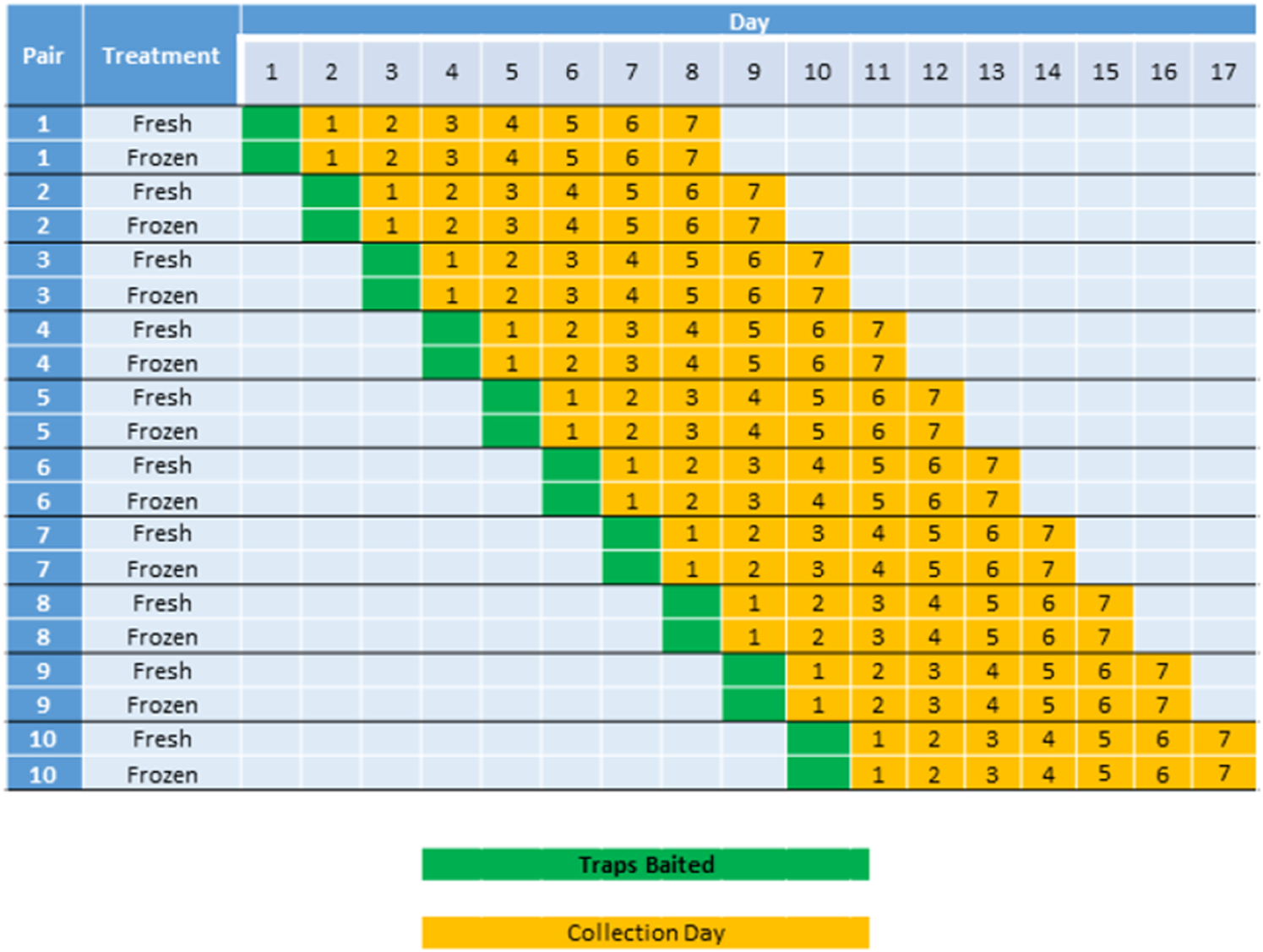
For the experiment, ten pairs of pitfall traps were placed in the field. Paired traps were separated by 1 m; adjacent pairs of traps were separated by about 7 m. We baited paired traps with either a fresh or frozen bait; insects were removed from these traps the following morning on each of the next 7 days. In this manner, ten samples were collected for each combination of bait age (1, 2, 3, 4, 5, 6 and 7 days old) and bait type (fresh, frozen) (140 total samples). We considered the possibility that short-term weather events (e.g., rain) might have an inordinate effect of trap captures if all traps were baited on the same day. For this reason, one pair of traps was baited on each sequential day such that the experiment spanned a period of 17 days (fig. 1).
A schematic illustrating the experimental setup. Green boxes identify when the traps were baited, and yellow boxes identify the seven subsequent days that traps were emptied.

To establish the rigour of our findings, we repeated the experiment as a series of four trials. Trials 1 (14–29 June 2017), 2 (26 August–10 September 2017) and 3 (5–21 June 2018) were conducted at the Lethbridge Research and Development Centre. We selected these periods to collect data for species present at different times of the year (Floate and Gill, Reference Floate and Gill1998; Kadiri et al., Reference Kadiri, Lumaret and Floate2014). The study site was immediately adjacent to tame pasture that had been seeded to Kentucky bluegrass (Poa pratensis L.), orchardgrass (Dactylis glomerata L.) and brome (Bromus spp.). The pasture housed cattle throughout the grazing season. The site has been successfully used in previous studies on coprophilous insects (Floate and Gill, Reference Floate and Gill1998; Floate et al., Reference Floate, Bouchard, Holroyd, Poulin and Wellicome2008; Tiberg and Floate, Reference Tiberg and Floate2011). However, recovery of insects at the site for the current study was unexpectedly low. For this reason, Trial 4 (31 July–15 August 2018) was conducted on native grassland at the Purple Springs Grazing Reserve, Alberta, Canada (Lat. 49.847°; Long. −111.896°). The site housed cattle that freely roamed from May to October and harboured a rich assemblage of coprophilous species (Kadiri et al., Reference Kadiri, Lumaret and Floate2014; Bezanson, Reference Bezanson2019).
We collected daily weather data during the course of the four trials. Data for the Lethbridge Research and Development Centre were collected from an on-site weather station. Data for the Purple Springs Grazing Reserve (PSGR) were collected from a weather station located at Vauxhall, Alberta (Lat. 50.0645°; Long. −112.105°), about 30 km NNW of the PSGR site. The location of study sites and weather station in relation to each other is shown in Supplementary fig. 2.
Processing of insect samples
Previous studies have used dung-baited pitfall traps to address research questions specific to dung beetles, whereas we broadened our scope to encompass all coprophilous taxa. In doing so, we increased the number of taxa available in trap catches to assess bait attractiveness.
Trap catches were pre-sorted to remove debris and taxa that were clearly not coprophilous. Examples of these taxa included spiders (Araneae), harvestmen (Opiliones), springtails (Collembola), thrips (Thysanoptera), ants (Hymenoptera: Formicidae), aphids (Hemiptera: Aphididae) and leafhoppers (Hemiptera: Cicadellidae), moths and butterflies (Lepidoptera) and grasshoppers (Orthoptera). We then sorted, counted and identified the remaining taxa to the best of our ability. Some taxa were identified to species, whereas others were identified to Superfamily. Staphylinids (Coleoptera: Staphylinidae) were sorted into different size categories as we have done in previous studies (Tiberg and Floate, Reference Tiberg and Floate2011). Insect samples were identified by their associated trap (e.g., Pair 1–Pair 10), day (D1–D7) and type of bait (fresh, frozen).
Statistical analyses
To determine whether fresh or frozen baits recovered the most diverse assemblage of insects, we pooled the data for each bait type across traps and days. We then calculated for each set of pooled data, total insect abundance, observed species richness and estimated species richness (Chao-1). The Chao-1 index estimates minimum species richness using rare species to infer total species richness (Chao, Reference Chao1984), and was calculated using PAST (version 2.17c). We repeated these analyses for each of the four trials.
To assess the overall effect of bait type on insect catch, we compared the average number of insects (x̄ ± SE) recovered in paired traps baited with either fresh or frozen dung. For these analyses, daily catches from the same trap were pooled to provide ten pairwise comparisons for each trial. Shapiro–Wilk tests identified datasets with non-normal distributions that could not be corrected with log transformation. Analyses were therefore performed using the non-parametric Wilcoxon signed-rank test (α = 0.05). We repeated these analyses for each trial and for data from the four trials combined (n = 40 pairwise comparisons).
To assess changes in the attractiveness of bait type over time, we compared the average number of insects (x̄ ± SE) recovered each day, in paired traps baited with either fresh or frozen dung. These analyses also were performed using Wilcoxon signed-rank tests (α = 0.05). We repeated these analyses for each trial (n = 10 pairwise comparisons per day) and for data from the four trials combined (n = 40 pairwise comparisons per day). Wilcoxon tests were performed using Systat® (Systat Software, Inc., San Jose, CA, USA).
We then used a generalized linear mixed model to assess concurrently, the relative effects of bait type (fresh, frozen), age of bait (day) and trap position (pair) on the total number of insects recovered in a trap. We included trap position in the analyses because we thought it might be a potential confounding factor. In previous work, we had observed that the position of a trap along a transect appeared to influence the recovery of dung beetles (see fig. 1 in Floate, Reference Floate1998). For the model, we used the 560 samples obtained from the four trials (2 treatments × 10 traps × 7 days × 4 trials). We used a negative binomial distribution, which provided lower values of the Bayesian information criterion than were obtained using either Poisson or geometric distributions. Analyses were performed using SAS PROC GLIMMIX (SAS Institute Inc., Cary, NC, USA).
Results
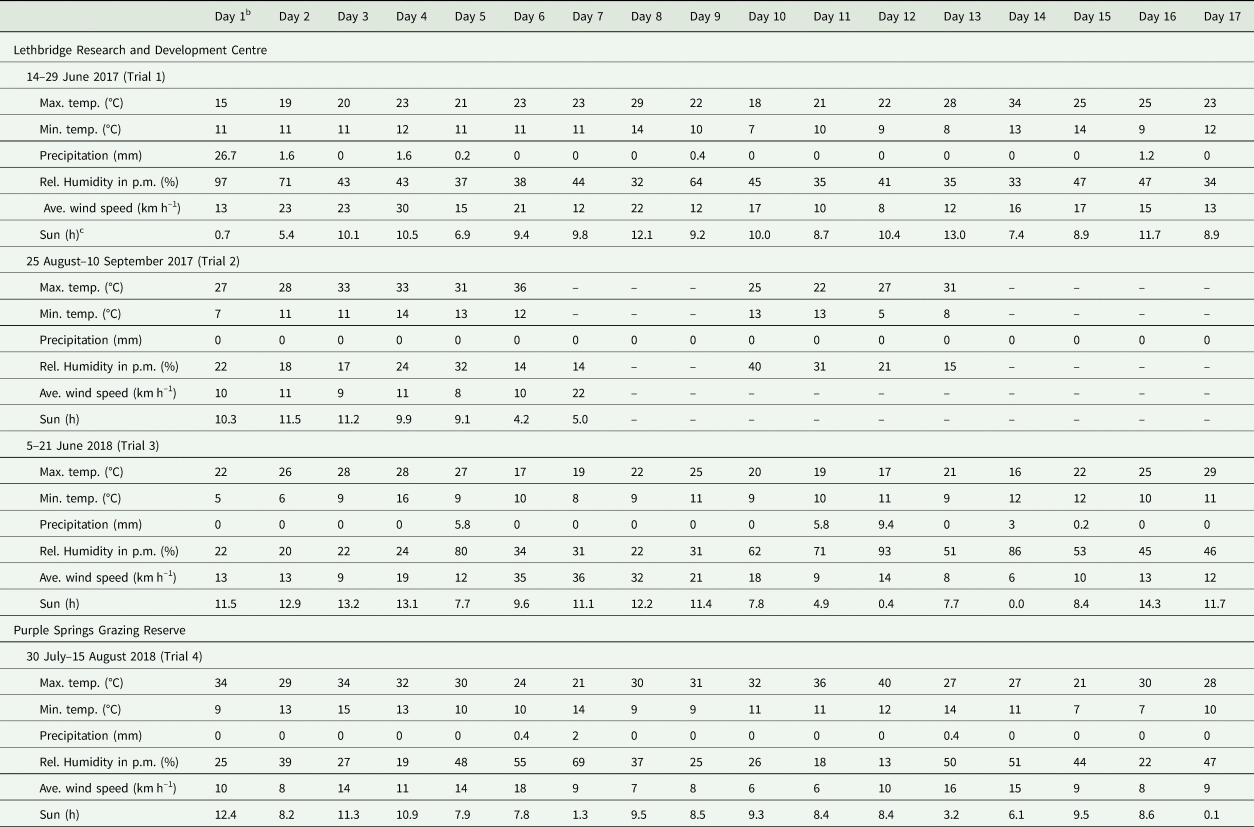
Weather patterns were consistent with regional long-term averages (table 1). Conditions were cooler and wetter in June (Trials 1 and 3), and warmer and drier in August and early September (Trials 2 and 4). Over the course of a 17-day trap period, maximum variation in daily maximum temperatures ranged from 21 to 40°C (Trial 4), of daily minimum temperatures from 5 to 16°C (Trial 3) and of direct sunlight from 0 to 14.3 h (Trial 3). Total precipitation during the course of each trial was 31.7 mm (Trial 1), 0.0 mm (Trial 2), 24.2 mm (Trial 3) and 2.8 mm (Trial 4). Weather data for Trial 2 are incomplete due to an instrument malfunction.
Daily weather parameters for the 17 days of each triala

a Data for the Lethbridge Research and Development Centre were collected from an on-site weather station. Data for the Purple Springs Grazing Reserve (PSGR) were collected from a weather station located at Vauxhall, Alberta. Vauxhall is about 30 km NNW of the PSGR site.
b D1 corresponds to the day that the first traps in the trial were baited.
c A measure of direct sunlight (cloud-free hours), defined as the period for which direct solar irradiance exceeds 120 W m–2 (WMO, 2003).
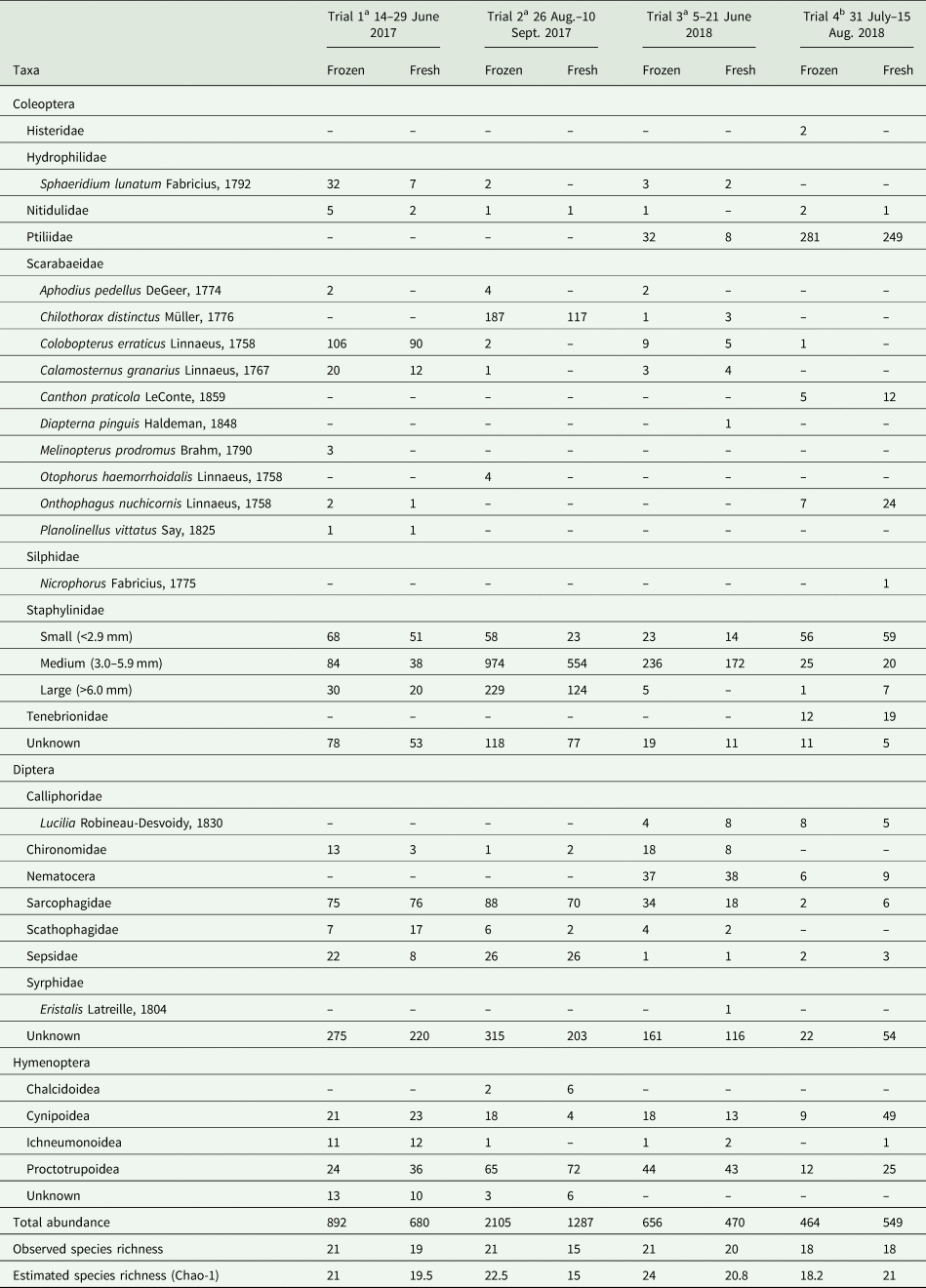
With the exception of Trial 4, results were comparable across trials and indicated a greater recovery of individuals and diversity using frozen baits (table 2). In Trial 1, 892 (21 taxa) and 680 (19 taxa) insects with corresponding Chao-1 index values of 21 and 19.5 were recovered with the use of frozen vs. fresh baits, respectively. In Trial 2, 2105 (21 taxa) and 1287 (15 taxa) insects with corresponding Chao-1 values of 22.5 and 15 were recovered with the use of frozen vs. fresh baits, respectively. In Trial 3, 656 (21 taxa) and 470 (20 taxa) insects with corresponding Chao-1 values of 24 and 20.75 were recovered with the use of frozen vs. fresh baits, respectively. In contrast to Trials 1, 2 and 3, more insects were recovered with fresh baits in Trial 4; i.e., 464 (18 taxa) and 549 (18 taxa) insects with corresponding Chao-1 values of 18.2 and 21, for frozen vs. fresh baits, respectively.
Abundance and richness of taxa recovered over a 7-day trap period in pitfall traps baited with dung either frozen or fresh at the time of placement

The experiment was repeated in a series of four trials.
a Conducted at the Lethbridge Research and Development Centre (Agriculture and Agri-Food Canada) in Lethbridge, Alberta, Canada.
b Conducted on native grassland at the Purple Springs Grazing Reserve, Alberta, Canada.
A significant effect of bait type on the number of insects recovered in a trap over the 7-day period was only detected in Trial 2 and when data from all trials were combined. Averaged across traps in Trial 1, more insects were recovered with frozen (89.2 ± 11.2) than with fresh (68.0 ± 10.0) baits (Wilcoxon signed-rank test, Z = −1.376, P = 0.169). Corresponding values for the other replicates were as follows: Trial 2 – frozen (210.5 ± 14.1) vs. fresh (128.7 ± 11.1) (Z = −2.803, P = 0.005); Trial 3 – frozen (65.6 ± 11.7) vs. fresh (47.0 ± 6.8) (Z = −1.478, P = 0.139); Trial 4 – frozen (46.4 ± 23.0) vs. fresh (54.9 ± 13.2) (Z = 0.714, P = 0.475); Trials 1–4 – frozen (102.9 ± 12.7) vs. fresh (74.7 ± 7.2) (Z = −2.796, P = 0.005).
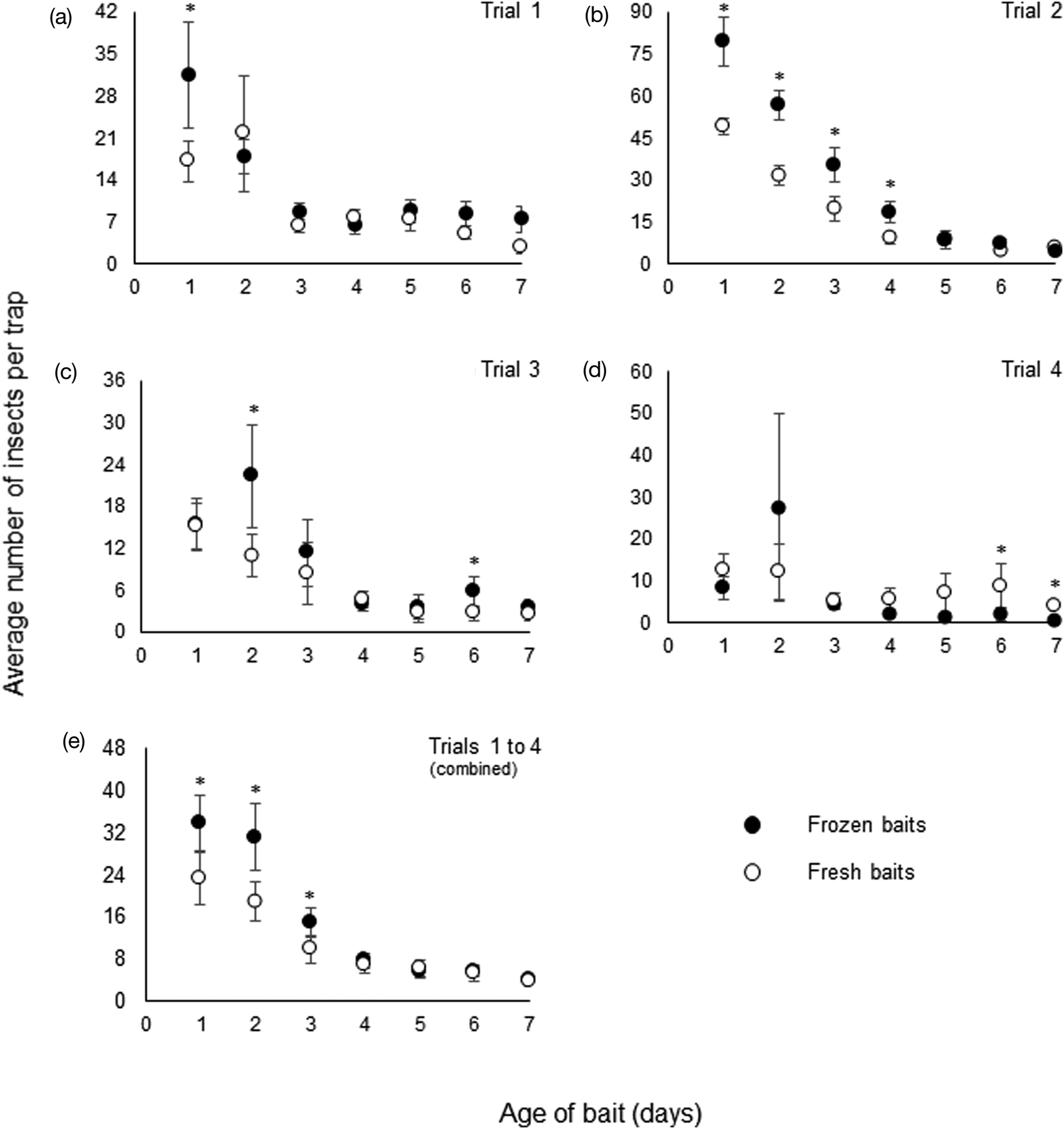
Insect recovery in traps typically dropped off after 2–3 days with greater captures using frozen baits (fig. 2). When compared for each day in Trial 1, frozen baits recovered significantly more insects on day 1 (Wilcoxon signed-rank test, Z = −2.250, P = 0.024) with no effect of bait type detected for days 2–7 (P 0.161) (fig. 2a). For Trial 2, frozen baits recovered significantly more insects on day 1 (Z = −2.807, P = 0.005), day 2 (Z = −2.803, P = 0.005), day 3 (Z = −2.805, P = 0.005) and day 4 (Z = −2.550, P = 0.011) with no effect of bait type detected for days 5–7 (P 0.235) (fig. 2b). For Trial 3, frozen baits recovered significantly more insects on day 2 (Z = −2.10, P = 0.036) and day 6 (Z = −2.325, P = 0.020) with no effect of bait type detected for any other day (P 0.169) (fig. 2c). In Trial 4, no effect of bait type was detected for days 1–5 (P 0.074) with fresh baits (not frozen) recovering more insects on day 6 (Z = 2.689, P = 0.007) and day 7 (Z = 2.20, P = 0.028) (fig. 2d). For data combined across the four trials, frozen baits recovered significantly more insects on day 1 (Z = −2.817, P = 0.005), day 2 (Z = −3.402, P = 0.001) and on day 3 (Z = −2.529, P < 0.001) with no effect of bait type detected for days 4–7 (P 0.332) (fig. 2e).
Number of insects (x̄ ± SE) recovered on each of seven sequential days in pitfall traps baited on day 0 with frozen vs. fresh dung. Asterisks identify significant differences between bait types on a given day (paired t test, P < 0.05; n = 10 samples per bait type for each trial; n = 40 samples per bait type for all trials combined).

Results of the GLM model using data combined across the four trials were consistent with the results obtained using Wilcoxon tests. The total number of insects recovered in a trap (Total) was described by the equation:
 $${\rm Ln\ }\lpar {{\rm Total}} \rpar = 3.4836 + \lpar {0.3212 \times {\rm Frozen}} \rpar + \lpar {-0.3677 \times {\rm Day}} \rpar + \lpar {-0.0020 \times {\rm Pair}} \rpar $$
where Frozen = 0 when the bait is fresh and Frozen = 1 when the bait is frozen. Standard errors for equation values were: 3.4836 (± 0.2991), 0.3212 (± 0.1002) and −0.0020 (± 0.0175). A significant effect on Total was detected for bait type (Frozen, P = 0.001) and age of the bait (Day, P ≤ 0.001). An effect on Total was not detected for the position of the traps in the field (Pair, P = 0.910).
Discussion
Our results support the use of frozen dung baits in pitfall trapping studies, and indicate that the abundance and richness of the recovered taxa typically exceed that obtained with the use of fresh baits. Our results are also consistent with the previous reports of dung baits losing their attractiveness after 2–3 days in the field (Howden and Nealis, Reference Howden and Nealis1975; Flechtmann et al., Reference Flechtmann, Tabet and Quintero2009; Aruchunnan et al., Reference Aruchunnan, Foo, Ling and Hazmi2015). These findings are supported by four trials of the experiment, conducted at two locations in 2 years. We attribute the greater effectiveness of frozen baits to the longer duration during which they release attractant volatiles compared to that of fresh baits. Whereas fresh baits begin to immediately desiccate, frozen baits must first thaw before desiccation begins.
We do not attribute a bait effect to greater captures on day 6 in Trial 3 using frozen baits, or on days 6 and 7 in Trial 4 using fresh baits. We cannot explain these results, but believe that after such a passage of time, the qualities of the two types of baits would be essentially the same.
The design of the study gives confidence in the generality of our conclusions regardless of daily variation in weather. Dung becomes less attractive to insects as it ages and desiccates. Thus, insect recovery in dung-baited pitfall traps is directly affected by temperature, precipitation, relative humidity (RH) and solar radiation ( = sun hr). If we had opted to bait all of our traps on the same day, doing so for Trial 4 on 10 August (max. temp. = 40°C; 0.0 mm rain; RH = 13%, 8.4 h of sun) vs. 11 August (max. temp. = 27°C; 0.4 mm rain; RH = 50%; 3.2 h of sun) might have produced significantly different outcomes. Instead, however, we chose to bait one pair of traps (fresh, frozen) on each of 10 sequential days. Hence, our findings on the attractiveness of baits after 1 day in the field, for example, accounted for variation in weather conditions over a 10-day period (fig. 1).
We have used frozen dung baits to good effect in several studies (Floate and Gill, Reference Floate and Gill1998; Floate, Reference Floate2007; Tiberg and Floate, Reference Tiberg and Floate2011; Kadiri et al., Reference Kadiri, Lumaret and Floate2014). Our standard practice is to prepare and space them apart on a tray prior to freezing. Baits frozen while in contact with one another can be difficult to separate until they have thawed. Frozen baits can be grouped into sealed plastic bags or pails to prevent desiccation (e.g., freezer burn) during storage. Using this method, we have prepared large numbers of baits months in advance and kept frozen until needed.
Results of the current study provide evidence that the use of baits, either frozen or fresh at the time of placement, largely lose their attractiveness after 2–3 days. Results also provide evidence that the use of frozen baits will not reduce, but rather may enhance, insect recoveries. However, further research using baits frozen for longer than the 2–3 days used here is warranted to more fully assess this phenomenon.
Supplementary material
The supplementary material for this article can be found at https://doi.org/10.1017/S000748532000070X.
Acknowledgements
We thank Kathryn Vezsenyi (Trent University, Peterborough, ON, Canada) for help with insect identifications. For field assistance, we thank Paul Coghlin. For access to the Purple Spring Grazing Reserve, we thank the Purple Springs Irrigated Grazing Association. We thank Timothy Schwinghamer for performing the generalized linear mixed model. Funding was provided by AAFC Research Grant J-001380.