Introduction
Cod (Gadus morhua) is among the most commercially exploited species in the Baltic Sea and is popular as a food in many countries. In the Baltic there are two stocks, eastern and western, with a mixing zone around the Bornholm area. Cod is a migratory species, spawning in deeper water and migrating to shallow areas for feeding (Bagge et al., Reference Bagge, Thurow, Steffensen and Bay1994). It is one of the most important predators in the Baltic Sea after marine mammals and salmonid fish. Cod plays an important role in the ecosystem of the Baltic Sea where small, young individuals occur mostly in shallow, coastal waters, which provide optimal conditions for growth. This environment also offers reduced opportunities for cannibalism by larger, older fish, which migrate to deeper, off-shore waters. Horbowy et al. (Reference Horbowy, Podolska and Radtke2003) revealed that the highest abundance of young cod by depth was at 50–70 m, with the density of fish increasing almost linearly up to this depth range and decreasing in deeper areas. According to Sparholt et al. (Reference Sparholt, Aro and Modin1991), adult cod prefer 60–70 m depths compared to the 80–100 m depths suggested in the analysis of Horbowy et al. (Reference Horbowy, Podolska and Radtke2003). Feeding preferences differ between small (young) and larger (adult) cod and dietary composition reflects both the availability of food and its diversity in the environment. Cod is a predatory fish during most of its life span. Young individuals prey on invertebrates and small fish such as the following (in order of decreasing frequency): sprat Sprattus sprattus, Saduria entomon, Gobiidae fish, Crangon crangon, Pontoporeia femorata, Bylgides sarsi and Mysis mixta. Older cod feed mostly on sprat, herring Clupea harengus, cod, Ammodytidae fish and also on S. entomon. In the southern Baltic Sea an ontogenetic shift in dietary composition is observed in cod between 30 and 40 cm in length (Pachur and Horbowy, Reference Pachur and Horbowy2013). Analysis of cod food items can give much more than just information about the fish diet, however. It is well known that crustaceans eaten by cod are not only a source of nutrients, but may also transmit parasites to fish.
Marine crustaceans, including amphipods, decapods, copepods, mysids and euphausiids, are common intermediate or paratenic hosts of parasites. For example, the nematode Hysterothylacium sp. has been reported by Lick (Reference Lick1991) and Zander et al. (Reference Zander, Reimer, Barz, Dietel and Strohbach2000) in many gammarid species from the North Sea and Baltic Sea (studies limited to German coastal waters), including Gammarus locusta, Gammarus salinus and Gammarus zaddachi. Experimental research described in the literature confirms that invertebrates can serve as intermediate hosts. Thus, Copepoda (Acartia tonsa and Oithona similis) have been successfully infected with Anisakis simplex (Køie, Reference Køie1993, Reference Køie2001); Cirripedia (Balanus sp.) with A. simplex and Contracaecum osculatum (Køie and Fagerholm, Reference Køie and Fagerholm1995); and Copepoda (Temora longicornis) with C. osculatum (Køie and Fagerholm, Reference Køie and Fagerholm1995). For these studies, biological material was obtained from Baltic seals and eels.
The parasite fauna of cod from the Baltic Sea is well documented. Buchmann (Reference Buchmann1995) described the presence of acanthocephalan Echinorhynchus gadi in cod from the Baltic Sea. Parasites Cryptocotyle lingua and Lernaeocera branchialis were recorded in cod in 11 areas from the Mecklenburg Bight in the southwest to the Estonian coast in the northeast of the Baltic Sea (Mellergaard and Lang, Reference Mellergaard and Lang1999). The composition and structure of the parasite fauna of cod sampled in 2002–2003 in south-eastern Swedish waters were analysed by Perdiguero-Alonso et al. (Reference Perdiguero-Alonso, Montero, Raga and Kostadinova2008). Recent interest has focused on the presence of nematodes in the Baltic cod, with Nadolna and Podolska (Reference Nadolna and Podolska2014) reporting a marked increase in the prevalence of infection with anisakid nematodes in fish sampled in the southern Baltic in 2011. These authors reported an 11% infection rate, compared with 4% between 1987 and 1993 (Myjak et al., Reference Myjak, Szostakowska, Wojciechowski, Pietkiewicz and Rokicki1994). In 2011, the dominant species among Anisakidae found in the cod liver was Contracaecum sp. at 95.2%, then Anisakis sp. 4.7% and Pseudoterranova sp. 0.1% (Nadolna and Podolska, Reference Nadolna and Podolska2014). Haarder et al. (Reference Haarder, Kania, Galatius and Buchmann2014) also conducted a parasitological study of cod from the southern Baltic Sea in spring 2012. They compared the results with data from 1982/1983 and also observed an increase in the prevalence of infection of cod with nematodes from 22 to 55.1%. Haarder et al. (Reference Haarder, Kania, Galatius and Buchmann2014) suggest that the elevated parasitism of cod liver is associated with the increased number of grey seals in the southwestern Baltic. The level of cod infection with parasitic nematodes depends on the area of sampling, as discussed by Lunneryd et al. (Reference Lunneryd, Boström and Aspholm2015). During sampling conducted east of Bornholm in 2013–2014, nematodes were found in fillets of cod, with Pseudoterranova decipiens at a prevalence of 28.7% and A. simplex at 8.1% (Mehrdana et al., Reference Mehrdana, Bahlool, Skov, Marana, Sindberg, Mundeling, Overgaard, Korbut, Strom, Kania and Buchmann2014), while in the area south-west of Bornholm (sampling 2013–2015) only 1.09% of cod examined were infected with P. decipiens (Zuo et al., Reference Zuo, Huwer, Bahlool, Al-Jubury, Christensen, Korbut, Kania and Buchmann2016).
The level of cod infection is determined by many factors and depends on the sampling area. In the Baltic Sea, genetically distinct stocks of cod follow different migration patterns (Ovegård et al., Reference Ovegård, Berndt and Lunneryd2012) and are therefore exposed to different infection risks (Lunneryd et al., Reference Lunneryd, Boström and Aspholm2015). Nursery areas for cod in the Baltic Sea are located in coastal waters (Bagge et al., Reference Bagge, Thurow, Steffensen and Bay1994) and fish that stay near a coastline with a high seal density have a higher likelihood of infection (Hauksson, Reference Hauksson2002, Reference Hauksson2011). The life cycles of A. simplex, C. osculatum and P. decipiens are similar and involve marine mammals as the final hosts (McClelland et al., Reference McClelland, Misra and Martell1990; Klimpel and Palm, Reference Klimpel, Palm and Mehlhorn2011). The following important cetacean hosts for A. simplex have also been reported in the Baltic: the harbour porpoise, Phocoena phocoena (Herreras et al., Reference Herreras, Balbuena, Aznar, Kaarstad, Fernandez and Raga2004), the white-beaked dolphin, Lagenorhynchus albirostris, and the common bottlenose dolphin Tursiops truncatus (Smith and Wootten, Reference Smith and Wootten1978). According to Fagerholm (Reference Fagerholm1990), the grey seal, Halichoerus grypus, is considered to be the most important final host for C. osculatum, while the common seal (harbour seal), Phoca vitulina, is the most important final host for P. decipiens (Aspholm et al., Reference Aspholm, Ugland, Jødestøl and Berland1995). In the eggs of A. simplex and P. decipiens, two moults occur during larval development; therefore L3 larvae are likely to be present in sea water (Køie et al., Reference Køie, Björn and Burt1995) and are available for invertebrates, fish and mammals. As a consequence, in an area with high seal density the likelihood of cod food items being infected is higher than otherwise. The distribution of invertebrates (that serve as intermediate or paratenic hosts for these nematodes) is driven by salinity, because in the Baltic the number of invertebrate species declines with declining salinity (Bonsdorff, Reference Bonsdorff2006). In some areas there could be a lack of suitable hosts to complete the life cycles of the parasites (Lunneryd et al., Reference Lunneryd, Boström and Aspholm2015). Young cod, which stay near the coastline and feed mostly on invertebrates, have the highest risk of infection due to ingestion of infected food items. Many authors have reported a strong positive correlation between fish size (e.g. length) and the prevalence, intensity and/or abundance of infection with Anisakidae in different species of fish (Horbowy and Podolska, Reference Horbowy and Podolska2001; Podolska and Horbowy, Reference Podolska and Horbowy2003; Zuo et al., Reference Zuo, Huwer, Bahlool, Al-Jubury, Christensen, Korbut, Kania and Buchmann2016; Sokolova et al., Reference Sokolova, Buchmann, Huwer, Kania, Krumme, Galatius, Hemmer-Hansen and Behrens2018). Such a correlation is explained by the accumulation of parasites during the life of the fish. Anisakidae nematodes migrate from the digestive tract to the liver (C. osculatum, A. simplex) and muscle tissue (A. simplex, P. decipiens) of cod, where parasites are deposited and cannot be cleared by the host fish.
The most dangerous nematode parasites to human health found in Baltic cod are A. simplex and Anisakis pegreffii (Ishikura et al., Reference Ishikura, Kikuchi, Nagasawa, Ooiwa, Takamiya, Sato, Sugane and Sun1993; Audicana and Kennedy, Reference Audicana and Kennedy2008; Mattiucci et al., Reference Mattiucci, Fazii, De Rosa, Paoletti, Megna, Glielmo, DeAngelis, Costa, Meucci, Calvaruso, Sorrentini, Palma, Bruschi and Nascetti2013), Pseudoterranova spp. and C. osculatum (Torres et al., Reference Torres, Jercic, Weitz, Dobrew and Mercado2007; Shamsi and Butcher, Reference Shamsi and Butcher2011; Mattiucci et al., Reference Mattiucci, Fazii, De Rosa, Paoletti, Megna, Glielmo, DeAngelis, Costa, Meucci, Calvaruso, Sorrentini, Palma, Bruschi and Nascetti2013; Mehrdana et al., Reference Mehrdana, Bahlool, Skov, Marana, Sindberg, Mundeling, Overgaard, Korbut, Strom, Kania and Buchmann2014; Shamsi and Suthar, Reference Shamsi and Suthar2016). Accidental ingestion by humans of viable, invasive anisakid larvae may cause anisakidosis: symptoms include nausea, diarrhoea, vomiting, and intense abdominal pain (Ishikura et al., Reference Ishikura, Kikuchi, Nagasawa, Ooiwa, Takamiya, Sato, Sugane and Sun1993; Hochberg and Hamer, Reference Hochberg and Hamer2010). To date, there are no published case studies of acute anisakidosis caused by eating infected cod, but the presence of these potentially zoonotic parasites in Baltic cod still raises concerns connected with food safety, because parasites do not need to be viable to endanger human health. Although adequate treatment kills the parasite (Wharton and Aalders, Reference Wharton and Aalders2002), the allergenic proteins of anisakid nematodes are thermostable (Audicana et al., Reference Audicana, Ansotegui, de Corres and Kennedy2002; Moneo et al., Reference Moneo, Caballero, Gonzalez-Munoz, Rodriguez-Mahillo, Rodriguez-Perez and Silva2005). Two examples of allergy related to anisakidosis linked with consumption of raw cod have been reported (Alonso-Gómez et al., Reference Alonso-Gómez, Moreno-Ancillo, López-Serrano, Suarez-de-Parga, Daschner, Caballero, Barranco and Cabañas2004).
The European Food Safety Authority (EFSA) stated that all wild-caught fish (intended to be eaten raw or nearly raw) must be considered at risk of containing viable parasites of concern to human health (EFSA, 2010). Cod is very popular as food in many countries. There is a particular risk with dishes prepared from fresh (neither frozen nor prepared at high temperature) fillets (e.g. sushi, ceviche, fish smoked in low temperature) or livers (e.g. marinated liver), because these tissues may contain live parasites. The liver is used for the production of cod-liver oil and the consumption of cod liver is popular in many European countries, e.g. the traditional North Norwegian dish mølje or canned cod livers/pate available in markets in Iceland, Latvia, Lithuania, Russia, Poland and Norway (Nadolna and Podolska, Reference Nadolna and Podolska2014). It must be emphasized that A. simplex larvae possess a high tolerance to a wide temperature range and can survive freezing under some conditions (Podolska et al., Reference Podolska, Pawlikowski, Nadolna-Ałtyn, Pawlak, Komar-Szymczak and Szostakowska2019).
Cod plays the role of paratenic or definitive host for many parasite species (Hemmingsen and MacKenzie, Reference Hemmingsen and MacKenzie2001) in various habitats, including the Baltic Sea. However, the life cycles of particular species of these cod parasites in the Baltic sea are described only in general terms. Invertebrates are known to serve as intermediate hosts, but for any particular species of parasite the respective host invertebrate in the Baltic Sea is unclear. A single experimental study indicated the possibility of cod infection with C. osculatum (Køie and Fagerholm, Reference Køie and Fagerholm1995), although some marine invertebrate species have been noted as intermediate hosts in the life cycles of parasitic nematodes (Lick, Reference Lick1991; Klimpel et al., Reference Klimpel, Palm, Ruckert and Piatkowski2004). Because of the paucity of information in this area, we decided to conduct parasitological inspection of the food items in the stomachs of Baltic cod to investigate which invertebrate species are responsible for the infection of cod with zoonotic nematodes.
Materials and methods
The research material consisted of cod stomachs collected during research surveys in November 2015 and February 2016, and a commercial cruise in February 2015, in the southern Baltic Sea Polish Exclusive Economic Zone (Polish EEZ). Cod is a demersal fish and during our studies was caught using the trawl method, but there were differences between research and commercial surveys, the most important being the selectivity of the fishing gear. In commercial fisheries, the minimum conservation reference size of cod caught in the Baltic Sea is 35 cm, whereas the gear used in research surveys allows much smaller fish to be caught. A sampling of these young, so-called undersized cod (<35 cm in length) allowed data on food composition and the presence of parasites in small fish to be obtained that would not be available from commercial fisheries. Furthermore, the trawling time in commercial fishing was 240 min, which was much longer than during research surveys (30 min). This might influence the nature of food items in the cod stomach due to longer residence times and the possibility of regurgitation under stress.
Basic ichthyological analysis of each fish was performed and age of fish was determined by examination of otoliths. The total number of stomachs collected was 916. All samples were frozen at −20 °C until analysis of stomach content. The taxonomic identification of each organism found in cod stomach was performed to the lowest possible level depending on the degree of decomposition of prey. Invertebrates were identified by morphology (Żmudziński, Reference Żmudziński1990; Hayward and Ryland, Reference Hayward and Ryland1995). All invertebrates found in the stomach were collected and checked for the presence of parasites. If necessary, crustaceans were additionally digested in artificial digestive juice (aqueous solution of 10 g pepsin and 30 mL 35–38% hydrochloric acid in 1 L tap water; room temperature) to improve the level of detection of parasites, and were then re-analysed parasitologically. The duration of digestion depended on the species of crustacean and the degree of its decomposition. For partially digested crustaceans, which were not transparent, laboratory digestion took a few hours; for example, in the case of Gammarus sp., 4 h. For crustaceans that had only just been ingested by cod and showed no sign of decomposition, the digestion time was long; for example, in the case of C. crangon this was 12 h. The crustaceans were laboratory digested only when the organisms were well preserved, i.e. they had not been digested earlier by cod and the body was not transparent. Well-preserved crustaceans were analysed carefully, to avoid accidentally damaging any parasites that may have been present inside the body. When a parasite was visible in the body cavity during initial analysis, it was carefully, manually removed with tweezers. All parasites found in the stomach adjacent to prey items were also collected.
Taxonomic identification of parasites was performed on the basis of anatomo-morphological features (Fagerholm, Reference Fagerholm1982; Berland, Reference Berland and Möller1989). Additionally, molecular analysis of parasites was conducted according to the procedures described by Zhu et al. (Reference Zhu, Gasser, Podolska and Chilton1998), which involved amplification and sequencing of the ITS-1 region of rDNA. Polymerase chain reaction (PCR) products were sequenced directly using standard procedures and amplification primers. DNA was isolated using a Genomic Mini Kit (A&A Biotechnology, Gdynia, Poland) according to the manufacturer's instructions. Amplification was performed using the primers NC5 (forward) 5′-GTA GGT GAA CCT GCG GAA GGA TCA TT-3′ and NC13 (reverse) 5′-GCT GCG TTC TTC ATC GAT-3′. The reaction mixture consisted of 25 µL PCR Master MixPlus High GC (ready-to-use PCR mixture containing Taq DNA polymerase, PCR buffer, MgCl2 and dNTPs; A&A Biotechnology), 0.2 µL each primer (stock concentration 100 µ m), 20 µL DNA template, supplemented with deionized water up to 50 µL. The PCR reaction conditions were as follows: 2 min at 94 °C (initial denaturation) followed by 35 cycles of 30 s at 94 °C, 30 s at 60 °C, 30 s at 72 °C and a final extension step of 5 min at 72 °C. Some DNA fragments obtained as a result of the amplification reaction were purified using a Gel-Out Concentrator kit (A&A Biotechnology). PCR products were eluted with sterile water. Sequences were analysed using the software CLC Workbench and GeneStudio and confirmed by a BLAST search of GenBank.
Results
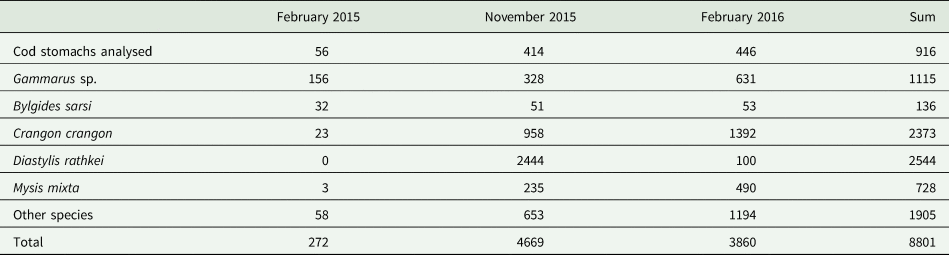
We analysed 916 cod stomachs and found 8801 individual invertebrates, which we inspected for the presence of parasites. In February 2015, the most prevalent invertebrate species were Gammarus sp., B. sarsi and C. crangon; in November 2015, Diastylis rathkei, C. crangon and Gammarus sp.; in February 2016, C. crangon, Gammarus sp. and M. mixta (Table 1). The only invertebrate species found to be infected with parasites were members of Decapoda (C. crangon) and Amphipoda (Gammarus sp.).
Dominant invertebrate species among food items in cod stomachs

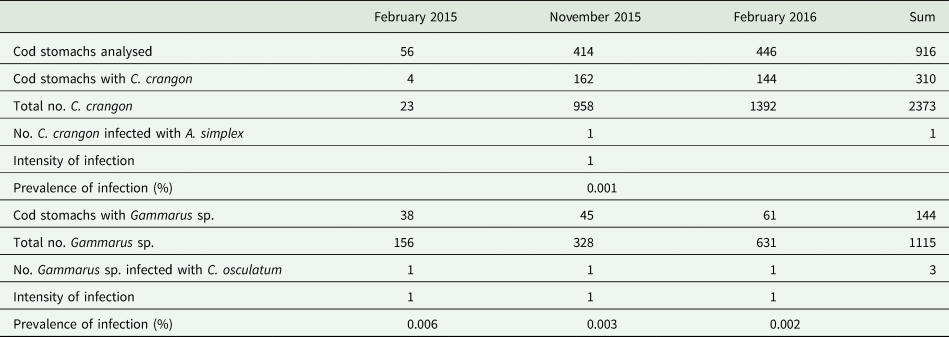
One individual C. crangon was infected with a single A. simplex L3-stage larva, found in the stomach of a cod collected in November 2015 (cod 36 cm in length, 2 years old). This fish was caught at a depth of 19 m, ICES rectangle 38G7; Polish fisheries rectangle M6. The crustacean was well preserved, and not initially digested. The presence of the parasite only became apparent after it was rinsed out of the body of C. crangon following laboratory digestion in artificial gastric juice.
Each of three individuals of Gammarus sp. was infected with a single C. osculatum L3-stage larva in each of three sampling seasons (Table 2). These fish were caught in February 2015: cod 38 cm in length and 4 years old (depth 22 m; ICES 38G7; O7); November 2015: cod 34 cm in length and 3 years old (depth 19 m; ICES 38G7; M6); and February 2016: cod 21 cm in length and 2 years old (depth 59 m; ICES 38G8; R7). In the Baltic Sea a few species of Gammarus have been reported previously (Szaniawska, Reference Szaniawska and Szaniawska2018). Characteristic elements of morphology, such as antennules, legs, telson and mandible, are used to distinguish the species, but these structures are fragile and are easily damaged when preyed on by cod during the passage of the food item to the stomach. It was therefore impossible to identify the species of Gammarus on the basis of these features. The body cavities of these individuals were well preserved and not initially digested. In each case, the parasite was not detected until the Gammarus sp. individuals had been digested in artificial gastric juice and rinsed out.
Invertebrates infected with Anisakidae nematodes found in stomachs of Baltic cod

Molecular identification of these larvae was performed and the results deposited in GenBank: A. simplex from C. crangon ID MK757430, C. osculatum from Gammarus sp. ID MK757431, MK757432, MK757433. In all cases, the C. osculatum and A. simplex sequences were identical to those previously recorded for these species in the GenBank.
Parasites found among the stomach content adjacent to prey items were also collected and identified; these comprised the nematode Hysterothylacium sp., the acanthocephalan E. gadi and a few individuals representing Cestoda (Table 3). No A. simplex or C. osculatum larvae were found next to prey items; these species of nematode were only present in infected invertebrates.
Parasites found in stomachs of Baltic cod adjacent to prey items

Discussion
Cod is known to play a role as an intermediate, paratenic or definitive host for numerous species of parasites (Hemmingsen and MacKenzie, Reference Hemmingsen and MacKenzie2001). The most dangerous for consumer health is cod infected with zoonotic nematodes such as Anisakis spp., Pseudoterranova spp. or C. osculatum. Increasing levels of G. morhua infection with these parasites have been reported for the Baltic Sea in recent years (Mehrdana et al., Reference Mehrdana, Bahlool, Skov, Marana, Sindberg, Mundeling, Overgaard, Korbut, Strom, Kania and Buchmann2014; Nadolna and Podolska, Reference Nadolna and Podolska2014; Horbowy et al., Reference Horbowy, Podolska and Nadolna-Ałtyn2016; Zuo et al., Reference Zuo, Huwer, Bahlool, Al-Jubury, Christensen, Korbut, Kania and Buchmann2016), but the source of infection is unknown.
Despite the fact that the parasite fauna of Baltic cod is well documented, the life cycles of these parasites are described only in general terms for that area. Invertebrates are suspected to play a role as transmitters of parasites to cod, but which species of invertebrates are responsible for the transfer of particular parasite species in the Baltic Sea is unclear. There is a lack of reports from the Baltic on invertebrates that are infected with the nematode parasites Pseudoterranova spp., Anisakis spp. or C. osculatum. Experimental infection of crustaceans with A. simplex has been conducted (Køie and Fagerholm, Reference Køie and Fagerholm1995; Køie, Reference Køie2001). However, the detection of parasites in free-living invertebrates requires a large number of samples, and such studies are consequently laborious and expensive, which at least partially explains why these investigations are infrequent. In our study, we used a new approach, i.e. a parasitological analysis of the invertebrates found in situ in the stomachs of cod, which was proposed for the first time by Pawlak et al. (Reference Pawlak, Nadolna-Ałtyn, Szostakowska, Pachur and Podolska2018). The advantages of this method are that it both directly shows the route of infection of fish with parasites and also records the infection of invertebrate prey.
During our analysis, an individual of the species C. crangon was found to be infected with a single A. simplex larva, which represents the first record of this host–parasite system in general, and not only for the Baltic Sea. Indeed, C. crangon has never been reported previously as a host for any parasitic nematode (Busch et al., Reference Busch, Kuhn, Münster, Klimpel and Mehlhorn2012). To the best of our knowledge, before the current report there were no findings of invertebrates infected with Anisakis in the Baltic Sea. This raises the question of whether the life cycle of A. simplex can be completed in the Baltic Sea. Grabda (Reference Grabda1974) stated that low salinity environmental conditions are unsuitable for A. simplex. According to Grabda (Reference Grabda1974, Reference Grabda1976), herring that spawn along the Polish coast of the Baltic belong to the western spring herring group, which migrate from the Baltic Sea to the Danish Straits or even to the North Sea, and there become infected with Anisakis larvae while feeding upon euphausiids. The results obtained by Podolska et al. (Reference Podolska, Horbowy and Wyszyński2006) indicate that fish infected with Anisakis larvae represent a mixed group of western and central Baltic herring. Anisakis simplex has been used as an indicator of herring migration out of the Baltic Sea.
The main final hosts for A. simplex in the Baltic Sea are cetaceans, namely the harbour porpoise, P. phocoena (Herreras et al., Reference Herreras, Balbuena, Aznar, Kaarstad, Fernandez and Raga2004), the white-beaked dolphin, L. albirostris, and the common bottlenose dolphin, T. truncatus (Smith and Wootten, Reference Smith and Wootten1978). The density and distribution of harbour porpoise in the central Baltic Sea or Baltic Proper considerably declined during the last century (Koschinski, Reference Koschinski2001). Acoustic monitoring indicates a recent increase in porpoise registration rates in the Kadet Trench and Pomeranian Bay, but this does not necessarily represent a population increase (Benke et al., Reference Benke, Bräger, Dähne, Gallus, Hansen, Honnef, Jabbusch, Koblitz, Krügel, Liebschner and Narberhaus2014). Baltic porpoises have been examined by Rokicki and Berland (Reference Rokicki and Berland1995) and Rokicki et al. (Reference Rokicki, Berland and Wroblewski1997), but A. simplex was not recorded. Later studies, conducted by Wünschmann et al. (Reference Wunschmann, Frese, Müiller, Baumgärtner, Siebert, Weiss, Lockyer and Heide-Jørgensen2001), revealed the presence of A. simplex in the first and second gastric compartment of porpoises from the German North Sea and the Baltic Sea. Similarly, Lehnert et al. (Reference Lehnert, Raga and Siebert2005) found A. simplex in the first stomach compartment in six (28%) of the Baltic Sea porpoises examined. Some individuals (6%) showed infections in the second compartment. Carlén et al. (Reference Carlén, Thomas, Carlström, Amundin, Teilmann, Tregenza, Tougaard, Koblitz, Sveegaard, Wennerberg, Loisa, Dähne, Brundiers, Kosecka, Kyhn, Ljungqvist, Pawliczka, Koza, Arciszewski, Galatius, Jabbusch, Laaksonlaita, Niemi, Lyytinen, Gallus, Benke, Blankett, Skóra and Acevedo-Gutiérrez2018) indicated the presence of three separate populations of harbour porpoises in the eastern part of the North Atlantic: one extending into the North Sea, Skagerrak and northern Kattegat; one in southern Kattegat, the Belt Sea and southwestern Baltic Sea; and one in the Baltic Proper. The authors revealed that harbour porpoise might migrate from the Belt Sea to the Danish straits. In the Danish straits, harbour porpoise may become infected with A. simplex and, after returning to the southwestern Baltic, shed parasite eggs, which would make it possible to complete the life cycle of A. simplex in the Baltic.
Anisakis simplex has been found in three species of Baltic seal: grey seal, H. grypus (Skrzypczak et al., Reference Skrzypczak, Rokicki, Pawliczka, Najda and Dzido2014; Zuo et al., Reference Zuo, Kania, Mehrdana, Marana and Buchmann2018); harbour seal, P. vitulina (Lunneryd, Reference Lunneryd1991; Skrzypczak et al., Reference Skrzypczak, Rokicki, Pawliczka, Najda and Dzido2014); and ringed seal, Pusa hispida (Skrzypczak et al., Reference Skrzypczak, Rokicki, Pawliczka, Najda and Dzido2014). The grey seal population in the Baltic Sea increased recently (Haarder et al., Reference Haarder, Kania, Galatius and Buchmann2014): according to HELCOM (2016), there were 32 000 grey seals in the Baltic in 2014, showing an annual rate of increase of 7.9% over the period 2000–2014. Larger numbers of seals in the environment potentially lead to more infected crustaceans, and a corresponding increase in infected fish. With such an increase in grey seal numbers and increasing levels of infection of fish with nematodes, completion of the Anisakis life cycle in the Baltic Sea could theoretically be possible. Despite the fact that there is no direct evidence for reproduction of A. simplex in seals (i.e. the presence of mature stage larva that is capable of producing fertilized eggs), hypothetically it cannot be excluded that these marine mammals may play the role of final host for Anisakis in the Baltic Sea.
According to some authors (Smith, Reference Smith1971, Reference Smith1983a, Reference Smith1983b; Højgaard, Reference Højgaard1999), euphausiids are regarded as the most important intermediate hosts for A. simplex in the marine environment. However, Makings (Reference Makings1981) reported the presence of A. simplex larvae in Mysidae (Mesopodopsis slabberi) from the west coast of Scotland. Also, other studies have indicated that euphausiids are not important for the successful transmission of A. simplex in particular areas; for example, Klimpel et al. (Reference Klimpel, Palm, Ruckert and Piatkowski2004) found Paraeuchaeta norvegica (Copepoda) from the Norwegian Deep infected with an L3-stage A. simplex larva (coiled in the haemocoel of the invertebrate). The authors clarified the role of the different intermediate hosts in the life cycle of A. simplex in the study area. These findings confirm that A. simplex does not require a particular species of marine crustacean as an intermediate host, and therefore it is possible that C. crangon can play this role in the life cycle of the nematode. Furthermore, studies conducted by Køie et al. (Reference Køie, Björn and Burt1995) show that the invasive L3 larval stage can be reached by parasites even inside the egg, and therefore invertebrates are not needed as intermediate hosts to infect fish.
This is the first report of infection of Gammarus sp. from the Baltic Sea with a C. osculatum larva, in this case on three separate occasions. However, amphipods were indicated by Sudarikov and Ryzhikov (Reference Sudarikov and Ryzhikov1951) as transport hosts for endemic C. osculatum baicalensis in Baikal Lake. Representatives of different Gammarus species were earlier reported as hosts for parasitic nematodes. The presence of Hysterothylacium sp. was reported in Gammarus duebeni and Gammarus inaequicauda (Lick, Reference Lick1991), and in Gammarus finmarchicus (Zander et al., Reference Zander, Groenewold and Strohbach1994), while Ascarophis sp., Hysterothylacium sp., Paracuaria adunca, P. decipiens and Tetrameres sp. were recorded in Gammarus lawrencianus (Lick, Reference Lick1991; Jackson et al., Reference Jackson, Marcogliese and Burt1997). G. locusta, G. salinus and G. zaddachi were reported as hosts for nematodes Ascarophis arctica and Hysterothylacium sp. by Lick (Reference Lick1991) and Zander et al. (Reference Zander, Koçoglu and Skroblies2002), while the nematodes A. arctica, Hysterothylacium sp., P. adunca and Tetrameres sp. were found in Gammarus oceanicus (Svendsen, Reference Svendsen1990; Lick, Reference Lick1991; Jackson et al., Reference Jackson, Marcogliese and Burt1997; Zander et al., Reference Zander, Koçoglu and Skroblies2002). However, no Gammarus species has previously been indicated as a host for C. osculatum in the Baltic Sea. Despite the fact that Haarder et al. (Reference Haarder, Kania, Galatius and Buchmann2014) suggested the amphipod as transport host in the Baltic life cycle of C. osculatum, our finding is the first in situ evidence of this in a particular species, i.e. Gammarus sp.
During our studies, C. crangon infected with A. simplex was found in a 36 cm-long cod, while Gammarus sp. infected with C. osculatum was found in cod 21, 34 and 38 cm in length. According to Nadolna and Podolska (Reference Nadolna and Podolska2014) and Zuo et al. (Reference Zuo, Huwer, Bahlool, Al-Jubury, Christensen, Korbut, Kania and Buchmann2016), the level of infection of small cod with C. osculatum is usually low. However, the rate of infection by anisakid nematodes of cod >30 cm long is increasing rapidly, in particular by C. osculatum larvae (Zuo et al., Reference Zuo, Huwer, Bahlool, Al-Jubury, Christensen, Korbut, Kania and Buchmann2016). Such increases in infection rate might be related to the shift in the composition of the cod diet, resulting from differences in environmental conditions between coastal and deeper waters. Münster et al. (Reference Münster, Klimpel, Fock, MacKenzie and Kuhn2015) and Mouritsen et al. (Reference Mouritsen, Hederholm, Schack, Møller, Storr-Paulsen, Dzido and Rockicki2010) indicate, for cod from Greenland, that the diet changes from predominantly invertebrate (Crustacea) to vertebrate prey (fish) as the body length of the fish reaches approximately 20–30 cm. Pachur and Horbowy (Reference Pachur and Horbowy2013) suggest that the shift in dietary composition for the Baltic cod occurs between 30 and 40 cm in length. Nevertheless, cod >30 cm can also prey on invertebrates.
In the Baltic Sea, the prevalence and intensity of infection of cod with Contracaecum sp. increased during 2011–2014 (Horbowy et al., Reference Horbowy, Podolska and Nadolna-Ałtyn2016). Several studies have shown the negative impact of parasitic infection on the condition of fish. Acha and Szyfres (Reference Acha and Szyfres1987) reported a decrease in the weight of cod infected with Contracaecum, and a significant reduction in the fat content of the liver if the number of larvae was large. Santoro et al. (Reference Santoro, Mattiucci, Work, Cimmaruta, Nardi, Cipriani, Bellisario and Nascetti2013) demonstrated an adverse effect of the presence of C. osculatum in the liver of the icefish Chionodraco hamatus on the body condition index of the host. Horbowy et al. (Reference Horbowy, Podolska and Nadolna-Ałtyn2016) revealed that the intensity of infection has a significant negative effect on the condition of cod. The poor body condition of fish infected with nematodes may be explained on physiological grounds. According to Lambert and Dutil (Reference Lambert and Dutil1997a, Reference Lambert and Dutil1997b), the protein reserves of cod are stored in the trunk muscles, whereas the main energy reserves are stored in the form of lipids in the liver. A severe reduction in liver lipids may reduce the chance of cod surviving periods of food limitation. During starvation, cod first mobilize liver lipids, then muscle and hepatic glycogen, and finally muscle proteins (Guderley et al., Reference Guderley, Lapointe, Bedard and Dutil2003).
The most important finding in this study was the demonstration of the presence of invertebrates infected with nematodes in the stomach of cod. The novel approach we used might raise the question of whether the invertebrates became infected, not in the marine environment, but in the cod stomach; i.e. the nematode larvae were already present in the digestive tract of the fish (as the remains of an earlier meal of infected fish, for example) before the arrival of the invertebrate food item. Several observations should dispel these doubts. The infected invertebrates were well preserved (only slightly digested), which indicates that these food items had not spent a long time in the cod stomach. Załachowski (Reference Załachowski1977) stated that the time spent by food items in the cod stomach depends on many factors, including the length of the fish, and the type and weight of the food item; for organisms like Gammarus sp. and C. crangon, this does not exceed 8 h. Thus, there was a short time between the cod's last meal and sampling, invertebrates were not decomposed. Furthermore, A. simplex and C. osculatum larvae were found inside the body of the crustacean food items, indicating that parasites were not ingested by the invertebrates in the cod stomach. We did not find any ‘free’ larvae of either Anisakis sp. or Contracaecum sp. in the cod stomach; these parasites are known to migrate quickly from the digestive tract to the muscle tissue (Anisakis sp.) or liver (Contracaecum sp., Anisakis sp.) of their host. Thus, Wootten and Smith (Reference Wootten and Smith1975) observed that A. simplex migrate very quickly from the digestive tract to the body cavity, in only 2 h after experimental infection of trout. There is a small possibility that Contracaecum sp. or Anisakis sp. larvae originated from a previous meal (invertebrate or fish) and were released into the cod stomach and then infected an invertebrate that was subsequently ingested. However, this is unlikely, at least in the case of an earlier fish meal, because the infected invertebrates were found in small cod. Infection of Baltic herring with A. simplex does not occur if the herring is smaller than 21 cm in length (Podolska and Horbowy, Reference Podolska and Horbowy2003) and cod <36 cm long are not able to eat such large fish. The above observations are therefore most consistent with our hypothesis, i.e. that the parasites did not infect the invertebrates in the cod stomach, but were already present within the body of the invertebrates when they were ingested by the cod.
This study reveals for the first time that Baltic cod may be infected with A. simplex via C. crangon, and with C. osculatum via Gammarus sp. Thus, our results provide new information about the life cycles of parasitic nematodes in the Baltic sea.
Acknowledgements
The research material was collected as part of the National Programme for Collection of Fisheries Data (EU DCF).
Financial support
This work was supported by the National Science Centre (Poland), grant number 2015/19/N/NZ9/00173.
Conflict of interest
None.
Ethical standards
Not applicable.