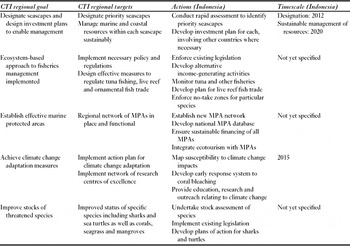
The Coral Triangle Initiative on Coral Reefs, Fisheries and Food Security, hereafter referred to as the Coral Triangle Initiative (CTI) represents a unique and innovative international collaboration focusing on the conservation and sustainable use of marine resources. Involving the countries of Indonesia, Malaysia, Papua New Guinea, the Philippines, the Solomon Islands and Timor Leste, the CTI covers approximately 5.7 million km2 of territorial waters, which contain around 76% of all known coral species, over 3000 species of fish and large areas of coral reefs, seagrass and mangroves, as well as supporting a coastal population of approximately 150 million people (Ministry of Marine Affairs and Fisheries 2008). Since its announcement in 2007, the CTI has received widespread political support, culminating in a Regional Plan of Action agreed at the World Oceans Conference in Manado, Indonesia in May 2009. The goals of the CTI reflect a greater emphasis on active planning and management in order to address the impacts of climate change, overfishing and destructive fishing practices (Table 1). Central to this is the establishment of a new network of marine protected areas (MPAs) designed to conserve marine habitats in the face of these threats. This article will review the rationale behind the implementation of networked MPAs in the Coral Triangle, arguing that the proposed network is conceptually deficient in terms of science, funding, management and the participation of local stakeholders, all of which have considerable implications for the long term viability of the MPA network and the success of the CTI itself.
Table 1Goals, targets, actions and timescales of proposed CTI activities (ARC Centre of Excellence for Coral Reef Studies 2008).
The identification of global ‘hotspots’ of biodiversity (Myers et al. Reference Myers, Mittermeier, Mittermeier, da Fonseca and Kent2000) and the perceived need to intensify protective measures in these areas has resulted in policies favouring the establishment of linked systems or ‘networks’ of MPAs. Through protecting a representative cross-section of habitats and species within a defined area and facilitating species movement between sites through connectivity, MPA networks are considered to impart a greater resilience to environmental stresses, whilst also enabling conservation targets to be met relating to the inclusion of particular habitats within the protected area estate (Ray Reference Ray2004; Mora et al. Reference Mora, Andréfouët, Costello, Kranenburg, Rollo, Veron, Gaston and Myers2006). Spatial planning software such as Marxan is frequently favoured as an objective tool to assist network design (Ball & Possingham Reference Ball and Possingham2000; Smith et al. Reference Smith, Eastwood, Ota and Rogers2008). MPA networks are planned or already implemented within waters governed by the USA, European Union (EU) member states, Australia, New Zealand, Indonesia and the Philippines, amongst others. International organizations including the International Union for the Conservation of Nature (IUCN), The Nature Conservancy (TNC), the World Wild Fund for Nature (WWF) and Conservation International (CI) all promote MPA networks as being able to provide greater benefits to conservation and fisheries management than individually planned MPAs (Skilbred et al. Reference Skilbred, Corrigan, Almany, McLeod, Lombana and Fox2006; IUCN World Commission on Protected Areas [IUCN-WCPA] 2008). These bodies have been closely involved in the CTI since 2003, and are recognized as full partners in its implementation (Jakarta Post 2007; Washington Post 2007; Green & Mous Reference Green and Mous2008; Jakarta Globe 2009).
Science and MPA networks
The design of MPA networks often prioritizes the siting of MPAs according to ecological criteria over socioeconomic, political or other considerations (Botsford et al. Reference Botsford, Micheli and Hastings2003; Roberts et al. Reference Roberts, Branch, Bustamante, Castilla, Dugan, Halpern, Lafferty, Leslie, Lubchenco, McArdle, Ruckelshaus and Warner2003). This may be justified in developed countries given the relative abundance of information and the ease of its dissemination to the wider public through electronic and other means. It does, nevertheless, inevitably result in delays in implementation, which in the case of the rezoning of the Great Barrier Reef Marine Protected Area, involved over six years of consultation (Fernandes et al. Reference Fernandes, Day, Lewis, Slegers, Kerrigan, Breen, Cameron, Jago, Hall, Lowe, Innes, Tanzer, Chadwick, Thompson, Gorman, Simmons, Barnett, Sampson, De'ath, Mapstone, Marsh, Possingham, Ball, Ward, Dobbs, Aumend, Slater and Stapleton2005).
However, the dearth of ecological data, particularly relating to crucial issues such as connectivity, mobility and life history of target species, along with fundamental hydrodynamic and other physical attributes of potential sites, is acknowledged as a constraint in planning reserves and reserve networks (Hilborn et al. Reference Hilborn, Stokes, Maguire, Smith, Botsford, Mangel, Orensanz, Parma, Rice, Bell, Cochrane, Garcia, Hall, Kirkwood, Sainsbury, Stefansson and Walters2004) and is inevitably more common in areas managed by developing countries (Bertzky & Stoll-Kleemann Reference Bertzky and Stoll-Kleemann2009). Despite this, proponents of MPA networks in the Coral Triangle region have adopted an interpretation of the precautionary principle which maintains that ‘a lack of certainty or science should not be used as an excuse for not planning the MPA network’, concluding that attempts to gather more scientific information would cause ‘delays [which render] the development of MPA networks more difficult and costly’ (IUCN-WCPA 2008, p. 35) Such a radical understanding of the precautionary principle appears to be at odds with calls for greater investment in systematic quantitative data collection to inform the design of ecologically successful marine reserves (Sale et al. Reference Sale, Cowen, Danilowicz, Jones, Kritzer, Lindeman, Planes, Polunin, Russ, Sadovy and Steneck2005), which would itself be a fundamental step towards gaining local stakeholder support for reserve networks.
This lack of ecological data can be compounded by the use of specialized spatial planning tools such as Marxan to identify preferred MPA sites. Marxan employs a metaheuristic algorithm termed ‘spatially explicit annealing’ to identify optimal protected area sites through repeated model runs, with the user being able to specify conservation targets and the cost of habitat protection as reflected by opportunity cost, adverse anthropogenic impacts or other measures of potential cost (Ball & Possingham Reference Ball and Possingham2000).
It is inevitable that an absence of detailed data relating to all species in a particular area will require that planning tools use surrogates or other measures to represent biodiversity. Evidently, however, this can be taken to an extreme, as in the case of the Channel Islands of California, wherein reserve siting maps were generated in the ‘absence of data on many of the ecological criteria’ (IUCN-WCPA 2008, p. 91). Furthermore, the opinion held by proponents of this network that this represented an advantage of using Marxan may be open to question, as an absence of detailed ecological criteria renders the evaluation of each reserve's contribution towards the goal of a comprehensive, adequate, representative or ecologically coherent network inevitably difficult, whilst the software designers themselves recommend alternative approaches to Marxan in cases where spatial data is limited (Ardron et al. Reference Ardron, Possingham and Klein2008, p. 17). The absence of sociopolitical variables in Marxan has been noted as restricting the value of the model output (Sarkar et al. Reference Sarkar, Pressey, Faith, Margules, Fuller, Stoms, Moffett, Wilson, Williams, Williams and Andelman2006), and alternative programmes which avoid potentially contentious conservation targets are available (Leathwick et al. Reference Leathwick, Moilenan, Francis, Elith, Taylor, Julian, Hastie and Duffy2008). Despite these issues, the examples cited above indicate that proponents of MPA networks involved in the CTI may elevate tools such as Marxan from decision-support mechanisms to decision-making systems in themselves in order to further their goals (IUCN-WCPA 2008).
The timescale of the CTI and its geographical location, together with the attitudes of its proponents as outlined above, will inevitably entail the development of MPA networks based on limited scientific information. Given that the overarching imperative of the CTI is to enhance the resilience of coral reef systems to anthropogenic stresses, it remains unclear as to how baseline data demonstrating the benefits of the MPA networks envisaged in the CTI may be derived, which has implications for the scientific validity of the CTI programme and, through association, other longstanding non-CTI MPA activities in the region. Accordingly, it would seem appropriate to ensure that, wherever possible, networks of MPAs in the CTI programme build upon existing knowledge and conservation practices rather than prioritizing the designation of new large sites which, as in the case of the Savu Sea MPA in Indonesia, may attract high profile publicity but are more likely to encounter difficulties in terms of the scientific rationale for protection (Jakarta Post 2009b).
A further consideration in this context relates to the nature of publications evaluating the achievements of MPA networks, most of which emanate from organizations in favour of their implementation (Leisher et al. Reference Leisher, van Beukering and Scherl2007; IUCN-WCPA 2008). This imbalance has been noted previously in the context of no-take marine reserves as being damaging in terms of both prospects for conservation and the credibility of marine scientists involved (Willis et al. Reference Willis, Millar, Babcock and Tolimieri2003; Sale et al. Reference Sale, Cowen, Danilowicz, Jones, Kritzer, Lindeman, Planes, Polunin, Russ, Sadovy and Steneck2005), which is equally applicable to the issue of MPA network design in the CTI.
Funding and MPA networks
The question of funding the proposed network of MPAs within the CTI as envisaged in the Regional Plan of Action raises a number of issues. Protected areas in the developing world are commonly subject to severe budgetary constraints impeding the ability of managers to implement essential monitoring, education and enforcement activities to achieve conservation goals. Furthermore, the inequitable distribution of income derived from tourism, along with perceptions of inappropriate restrictions on fishing activity, can often erode any support for MPAs amongst resident communities, which is often exacerbated by a lack of appropriate conflict resolution mechanisms (Christie Reference Christie and Shipley2004). Estimates indicate that an inflation-corrected figure of around US$ 210 million in 2009 terms would be required to adequately fund the 14 existing MPAs within the Coral Triangle region over a 10-year period (Merkl et al. Reference Merkl, Claussen, Thompson and Winship2003). Park management authorities were the principal data sources used in deriving these estimates, which may underestimate the extent of cost-effective contributions that could be made by local communities and non-governmental organizations (NGOs) under a more collaborative model of park management. Bearing this in mind, it is reasonable to assume that this total estimate could be doubled to reflect the additional MPAs being considered as part of the CTI. The cost of funding the MPA network activities envisaged in the Regional Plan of Action alone could, therefore, amount to US$ 400 million over the next decade, far exceeding the US$ 120 million thus far pledged to the programme as a whole following the Manado World Oceans Conference (Jakarta Post 2009a).
Proponents of the MPA network model support the establishment of self-financing MPAs, citing a variety of additional funding sources. These include income through fees charged to visitors, tour operators and resorts; the retention of taxes by local government to support MPA activities; securing grants and donations from international organizations, NGOs and the private sector and achieving cost reductions through allowing some management activities to be undertaken by local resident communities (IUCN-WCPA 2008). All of these options make considerable assumptions relating to, amongst others, a sustained growth in tourism, the inclination of central government to devolve economic policy to local authorities, achieving support for MPAs from all levels of government and communities, and the willingness of public or private donors to support MPA-related activities. These are in turn evidently contingent upon a number of wider political and economic drivers, leading to reasonable doubts over the ability for the components of the MPA network to become self-financing.
Furthermore, it is apparent that not all MPAs will be able to pursue a similarly diversified portfolio of financing mechanisms. For instance, MPAs with relatively high visitation levels will be more capable of raising funds through visitor fees, tour operator fees and merchandizing, whilst those MPAs with established links to external donors may be able to leverage grants more successfully. This situation is addressed by NGOs who advocate that the MPA network should be managed as a single entity (IUCN-WCPA 2008). Thus, management objectives within each MPA would be aligned with those of the network, whilst revenues generated by each MPA would be pooled to facilitate management of the network as a whole. Whilst theoretically logical, this would in reality involve highly politicized decisions over the raising and distribution of revenues and raises serious questions relating to, amongst others, the independence of local, regional and national policy involving economic development and environmental management. There is also a degree of contradiction between this concept of collective MPA management and the funding mechanisms outlined previously, some of which entail greater financial independence being granted to local authorities. The likelihood of local levels of government willingly subsuming their power to a higher authority as envisaged under this concept of collective management is extremely dubious, to say nothing of the prospect of reaching such an agreement at an international level.
Stakeholder participation in MPA networks
Local stakeholder participation in MPA planning and operation in the Coral Triangle area has a rich history, particularly in the Philippines where currently around 600 MPAs are managed collaboratively by local government and fishing communities (Alcala & Russ Reference Alcala and Russ2006). Successful stakeholder participation in this region has been noted by these authors as reflecting the use of trained facilitators in long term programmes of social preparation and community organization. This is echoed in the World Bank's understanding of participation as ‘a process through which stakeholders influence and share control over development initiatives, and the decisions and resources which affect them’ (World Bank 1996, p. 3), In contrast, participation in MPA design is viewed by organizations such as the IUCN and TNC as being conditional upon education intended to ‘influence people's attitudes and behaviours and increase awareness, understanding of and participation in MPA network development and management’ (IUCN-WCPA 2008, p. 86). The last quote encapsulates a perception of local communities as the recipients of policies rather than as empowered stakeholders with a right to actively influence conservation issues which impinge upon their livelihoods, directly contradicting many other widely held views on stakeholder participation (Pimbert & Pretty Reference Pimbert, Pretty, Ghimire and Pimbert1997).
As one of the main proponents of the MPA network in the CTI, TNC's approach towards stakeholder participation merits closer examination. This organization has adopted a standardized policy that ranks stakeholders’ eligibility for participation in MPA-related activities through criteria quantifying these groups’ legitimate claims over resources, the urgency of these claims and their power to influence the decision-making process (Halim et al. Reference Halim, Soekirman, Ramono, Sodhi, Acciaioli and Tan2008). Those groups scoring highest on these three indicators are to be allocated primacy in terms of participating in the higher tiers of management structures established within each MPA. Clearly, the relevance of this procedure in vastly differing sociocultural contexts can be queried, whilst the valuations undertaken by TNC staff in each location are evidently not immune to favouritism or subjectivity. Analysis of the ranking data provided by TNC for four existing MPAs in the Coral Triangle (Halim et al. Reference Halim, Soekirman, Ramono, Sodhi, Acciaioli and Tan2008) shows that the inclusion of the ‘power’ criterion invariably skews the selection of participants towards those in local government and park management. This approach to involving local stakeholders in MPA design will therefore result in individuals and elites who are more likely to be in favour of MPAs through being well positioned to capture their benefits (Pomeroy et al. Reference Pomeroy, Katon and Harkes2001) receiving an elevated role in the already constrained process of ‘participation’ as defined by TNC.
In contrast, there is little indication in the CTI literature as to how fisherfolk adversely affected by new regulations introduced as part of the MPA network in the Coral Triangle would be recompensed. Fishers may be reluctant to engage in alternative employment such as mariculture or tourism for non-economic reasons (Pollnac et al. Reference Pollnac, Pomeroy and Harkes2001), whilst there is evidence that these activities may not be associated with a reduction in fishing effort (Gillett et al. Reference Gillett, Preston, Nash, Govan, Adams and Lam2008). It is apparent that such issues will require close consideration in the diverse coastal communities of the Coral Triangle countries, recognizing that efforts to enhance the sustainability of small-scale fisheries through technological assistance, reducing by-catch and other mechanisms (Allison & Ellis Reference Allison and Ellis2001) may be more appropriate forms of intervention than those involving new income-generating activities.
Conclusions
This analysis has demonstrated how organizations closely involved in the development of the CTI have used the concept of MPA networks to promote the adoption of a uniform approach to marine conservation in this programme. Such a policy may be described as ‘cloned conservation’, reflecting how common threats to marine ecosystems are highlighted and used to justify a similar response in terms of MPA design, siting, financing, management and stakeholder participation, irrespective of the local socioeconomic, cultural, political or environmental context. Paradoxically, given the emphasis on ecological design criteria, the scientific rationale underpinning this approach is open to question, as is the ability of the component MPAs to become self-financing and to be managed as part of a wider network. Moreover, the means by which stakeholder participation is limited and carefully managed may serve to minimize dissent in the short term, but will inevitably lead to problems of non-compliance with regulations over the longer term.
There are means, however, by which this policy can be altered to provide a more realistic chance of implementing successful conservation measures within the Coral Triangle and elsewhere. Recent research (McClanahan et al. Reference McClanahan, Cinner, Maina, Graham, Daw, Stead, Wamukota, Brown, Ateweberhan, Venus and Polunin2008) has demonstrated how the resilience of resident communities can be measured in order to assess their adaptive capacity to restrictions imposed by protected areas involving access to food, fuel and other raw materials. This work highlighted the mismatch of designating MPAs in areas characterized by low adaptive capacity in the western Indian Ocean, which, given the widespread poverty, limited occupational mobility and low food security common amongst fishing communities in the Coral Triangle countries (Pauly et al. Reference Pauly, Silvestre and Smith1989; Asian Development Bank 2008), would appear to be equally relevant to this region. However, there is thus far little indication as to how the CTI will address the issue of assisting local communities to adapt to new restrictions upon fishing associated with an expanding network of MPAs in the region.
Furthermore, large-scale high profile conservation programmes such as the CTI run inevitable risks of excessive expectations, both on behalf of donors and the local stakeholder communities. These potential difficulties could be minimized through ensuring close cooperation between CTI implementing agencies and the multiple smaller NGOs, academics, activists and other groups with experience of MPA planning and implementation in the region, thereby avoiding the adverse consequences of scaling up management activities beyond existing local institutional and social capacity (Christie et al. Reference Christie, Pollnac, Fluharty, Hixon, Lowry, Mahon, Pietri, Tissot, White, Armada and Eisma-Osorio2009). The potential for beneficial cross-fertilization of ideas building upon tried and tested practices of MPA management is clearly evident, as are the negative consequences of attempting to introduce and justify MPA networks based on a predominantly scientific agenda driven by governments and international NGOs with insufficient attention to the local context.
This in turn underlines the necessity to integrate adaptive management strategies into the design of individual MPAs within the CTI network, reflecting the need to actively learn from implementing MPAs within the contrasting cultural, environmental and political circumstances of the region. Whilst the CTI is in its early stages and changes in policy are inevitable, it is argued that this process must enable MPAs to be tailored to their local context in order to avoid replicating past errors in marine conservation on a yet larger scale.







 You have
Access
The Coral Triangle Initiative on Coral Reefs, Fisheries and Food Security, hereafter referred to as the Coral Triangle Initiative (CTI) represents a unique and innovative international collaboration focusing on the conservation and sustainable use of marine resources. Involving the countries of Indonesia, Malaysia, Papua New Guinea, the Philippines, the Solomon Islands and Timor Leste, the CTI covers approximately 5.7 million km2 of territorial waters, which contain around 76% of all known coral species, over 3000 species of fish and large areas of coral reefs, seagrass and mangroves, as well as supporting a coastal population of approximately 150 million people (Ministry of Marine Affairs and Fisheries 2008). Since its announcement in 2007, the CTI has received widespread political support, culminating in a Regional Plan of Action agreed at the World Oceans Conference in Manado, Indonesia in May 2009. The goals of the CTI reflect a greater emphasis on active planning and management in order to address the impacts of climate change, overfishing and destructive fishing practices (Table 1). Central to this is the establishment of a new network of marine protected areas (MPAs) designed to conserve marine habitats in the face of these threats. This article will review the rationale behind the implementation of networked MPAs in the Coral Triangle, arguing that the proposed network is conceptually deficient in terms of science, funding, management and the participation of local stakeholders, all of which have considerable implications for the long term viability of the MPA network and the success of the CTI itself.
Goals, targets, actions and timescales of proposed CTI activities (ARC Centre of Excellence for Coral Reef Studies 2008).
The identification of global ‘hotspots’ of biodiversity (Myers et al. Reference Myers, Mittermeier, Mittermeier, da Fonseca and Kent2000) and the perceived need to intensify protective measures in these areas has resulted in policies favouring the establishment of linked systems or ‘networks’ of MPAs. Through protecting a representative cross-section of habitats and species within a defined area and facilitating species movement between sites through connectivity, MPA networks are considered to impart a greater resilience to environmental stresses, whilst also enabling conservation targets to be met relating to the inclusion of particular habitats within the protected area estate (Ray Reference Ray2004; Mora et al. Reference Mora, Andréfouët, Costello, Kranenburg, Rollo, Veron, Gaston and Myers2006). Spatial planning software such as Marxan is frequently favoured as an objective tool to assist network design (Ball & Possingham Reference Ball and Possingham2000; Smith et al. Reference Smith, Eastwood, Ota and Rogers2008). MPA networks are planned or already implemented within waters governed by the USA, European Union (EU) member states, Australia, New Zealand, Indonesia and the Philippines, amongst others. International organizations including the International Union for the Conservation of Nature (IUCN), The Nature Conservancy (TNC), the World Wild Fund for Nature (WWF) and Conservation International (CI) all promote MPA networks as being able to provide greater benefits to conservation and fisheries management than individually planned MPAs (Skilbred et al. Reference Skilbred, Corrigan, Almany, McLeod, Lombana and Fox2006; IUCN World Commission on Protected Areas [IUCN-WCPA] 2008). These bodies have been closely involved in the CTI since 2003, and are recognized as full partners in its implementation (Jakarta Post 2007; Washington Post 2007; Green & Mous Reference Green and Mous2008; Jakarta Globe 2009).
Science and MPA networks
The design of MPA networks often prioritizes the siting of MPAs according to ecological criteria over socioeconomic, political or other considerations (Botsford et al. Reference Botsford, Micheli and Hastings2003; Roberts et al. Reference Roberts, Branch, Bustamante, Castilla, Dugan, Halpern, Lafferty, Leslie, Lubchenco, McArdle, Ruckelshaus and Warner2003). This may be justified in developed countries given the relative abundance of information and the ease of its dissemination to the wider public through electronic and other means. It does, nevertheless, inevitably result in delays in implementation, which in the case of the rezoning of the Great Barrier Reef Marine Protected Area, involved over six years of consultation (Fernandes et al. Reference Fernandes, Day, Lewis, Slegers, Kerrigan, Breen, Cameron, Jago, Hall, Lowe, Innes, Tanzer, Chadwick, Thompson, Gorman, Simmons, Barnett, Sampson, De'ath, Mapstone, Marsh, Possingham, Ball, Ward, Dobbs, Aumend, Slater and Stapleton2005).
However, the dearth of ecological data, particularly relating to crucial issues such as connectivity, mobility and life history of target species, along with fundamental hydrodynamic and other physical attributes of potential sites, is acknowledged as a constraint in planning reserves and reserve networks (Hilborn et al. Reference Hilborn, Stokes, Maguire, Smith, Botsford, Mangel, Orensanz, Parma, Rice, Bell, Cochrane, Garcia, Hall, Kirkwood, Sainsbury, Stefansson and Walters2004) and is inevitably more common in areas managed by developing countries (Bertzky & Stoll-Kleemann Reference Bertzky and Stoll-Kleemann2009). Despite this, proponents of MPA networks in the Coral Triangle region have adopted an interpretation of the precautionary principle which maintains that ‘a lack of certainty or science should not be used as an excuse for not planning the MPA network’, concluding that attempts to gather more scientific information would cause ‘delays [which render] the development of MPA networks more difficult and costly’ (IUCN-WCPA 2008, p. 35) Such a radical understanding of the precautionary principle appears to be at odds with calls for greater investment in systematic quantitative data collection to inform the design of ecologically successful marine reserves (Sale et al. Reference Sale, Cowen, Danilowicz, Jones, Kritzer, Lindeman, Planes, Polunin, Russ, Sadovy and Steneck2005), which would itself be a fundamental step towards gaining local stakeholder support for reserve networks.
This lack of ecological data can be compounded by the use of specialized spatial planning tools such as Marxan to identify preferred MPA sites. Marxan employs a metaheuristic algorithm termed ‘spatially explicit annealing’ to identify optimal protected area sites through repeated model runs, with the user being able to specify conservation targets and the cost of habitat protection as reflected by opportunity cost, adverse anthropogenic impacts or other measures of potential cost (Ball & Possingham Reference Ball and Possingham2000).
It is inevitable that an absence of detailed data relating to all species in a particular area will require that planning tools use surrogates or other measures to represent biodiversity. Evidently, however, this can be taken to an extreme, as in the case of the Channel Islands of California, wherein reserve siting maps were generated in the ‘absence of data on many of the ecological criteria’ (IUCN-WCPA 2008, p. 91). Furthermore, the opinion held by proponents of this network that this represented an advantage of using Marxan may be open to question, as an absence of detailed ecological criteria renders the evaluation of each reserve's contribution towards the goal of a comprehensive, adequate, representative or ecologically coherent network inevitably difficult, whilst the software designers themselves recommend alternative approaches to Marxan in cases where spatial data is limited (Ardron et al. Reference Ardron, Possingham and Klein2008, p. 17). The absence of sociopolitical variables in Marxan has been noted as restricting the value of the model output (Sarkar et al. Reference Sarkar, Pressey, Faith, Margules, Fuller, Stoms, Moffett, Wilson, Williams, Williams and Andelman2006), and alternative programmes which avoid potentially contentious conservation targets are available (Leathwick et al. Reference Leathwick, Moilenan, Francis, Elith, Taylor, Julian, Hastie and Duffy2008). Despite these issues, the examples cited above indicate that proponents of MPA networks involved in the CTI may elevate tools such as Marxan from decision-support mechanisms to decision-making systems in themselves in order to further their goals (IUCN-WCPA 2008).
The timescale of the CTI and its geographical location, together with the attitudes of its proponents as outlined above, will inevitably entail the development of MPA networks based on limited scientific information. Given that the overarching imperative of the CTI is to enhance the resilience of coral reef systems to anthropogenic stresses, it remains unclear as to how baseline data demonstrating the benefits of the MPA networks envisaged in the CTI may be derived, which has implications for the scientific validity of the CTI programme and, through association, other longstanding non-CTI MPA activities in the region. Accordingly, it would seem appropriate to ensure that, wherever possible, networks of MPAs in the CTI programme build upon existing knowledge and conservation practices rather than prioritizing the designation of new large sites which, as in the case of the Savu Sea MPA in Indonesia, may attract high profile publicity but are more likely to encounter difficulties in terms of the scientific rationale for protection (Jakarta Post 2009b).
A further consideration in this context relates to the nature of publications evaluating the achievements of MPA networks, most of which emanate from organizations in favour of their implementation (Leisher et al. Reference Leisher, van Beukering and Scherl2007; IUCN-WCPA 2008). This imbalance has been noted previously in the context of no-take marine reserves as being damaging in terms of both prospects for conservation and the credibility of marine scientists involved (Willis et al. Reference Willis, Millar, Babcock and Tolimieri2003; Sale et al. Reference Sale, Cowen, Danilowicz, Jones, Kritzer, Lindeman, Planes, Polunin, Russ, Sadovy and Steneck2005), which is equally applicable to the issue of MPA network design in the CTI.
Funding and MPA networks
The question of funding the proposed network of MPAs within the CTI as envisaged in the Regional Plan of Action raises a number of issues. Protected areas in the developing world are commonly subject to severe budgetary constraints impeding the ability of managers to implement essential monitoring, education and enforcement activities to achieve conservation goals. Furthermore, the inequitable distribution of income derived from tourism, along with perceptions of inappropriate restrictions on fishing activity, can often erode any support for MPAs amongst resident communities, which is often exacerbated by a lack of appropriate conflict resolution mechanisms (Christie Reference Christie and Shipley2004). Estimates indicate that an inflation-corrected figure of around US$ 210 million in 2009 terms would be required to adequately fund the 14 existing MPAs within the Coral Triangle region over a 10-year period (Merkl et al. Reference Merkl, Claussen, Thompson and Winship2003). Park management authorities were the principal data sources used in deriving these estimates, which may underestimate the extent of cost-effective contributions that could be made by local communities and non-governmental organizations (NGOs) under a more collaborative model of park management. Bearing this in mind, it is reasonable to assume that this total estimate could be doubled to reflect the additional MPAs being considered as part of the CTI. The cost of funding the MPA network activities envisaged in the Regional Plan of Action alone could, therefore, amount to US$ 400 million over the next decade, far exceeding the US$ 120 million thus far pledged to the programme as a whole following the Manado World Oceans Conference (Jakarta Post 2009a).
Proponents of the MPA network model support the establishment of self-financing MPAs, citing a variety of additional funding sources. These include income through fees charged to visitors, tour operators and resorts; the retention of taxes by local government to support MPA activities; securing grants and donations from international organizations, NGOs and the private sector and achieving cost reductions through allowing some management activities to be undertaken by local resident communities (IUCN-WCPA 2008). All of these options make considerable assumptions relating to, amongst others, a sustained growth in tourism, the inclination of central government to devolve economic policy to local authorities, achieving support for MPAs from all levels of government and communities, and the willingness of public or private donors to support MPA-related activities. These are in turn evidently contingent upon a number of wider political and economic drivers, leading to reasonable doubts over the ability for the components of the MPA network to become self-financing.
Furthermore, it is apparent that not all MPAs will be able to pursue a similarly diversified portfolio of financing mechanisms. For instance, MPAs with relatively high visitation levels will be more capable of raising funds through visitor fees, tour operator fees and merchandizing, whilst those MPAs with established links to external donors may be able to leverage grants more successfully. This situation is addressed by NGOs who advocate that the MPA network should be managed as a single entity (IUCN-WCPA 2008). Thus, management objectives within each MPA would be aligned with those of the network, whilst revenues generated by each MPA would be pooled to facilitate management of the network as a whole. Whilst theoretically logical, this would in reality involve highly politicized decisions over the raising and distribution of revenues and raises serious questions relating to, amongst others, the independence of local, regional and national policy involving economic development and environmental management. There is also a degree of contradiction between this concept of collective MPA management and the funding mechanisms outlined previously, some of which entail greater financial independence being granted to local authorities. The likelihood of local levels of government willingly subsuming their power to a higher authority as envisaged under this concept of collective management is extremely dubious, to say nothing of the prospect of reaching such an agreement at an international level.
Stakeholder participation in MPA networks
Local stakeholder participation in MPA planning and operation in the Coral Triangle area has a rich history, particularly in the Philippines where currently around 600 MPAs are managed collaboratively by local government and fishing communities (Alcala & Russ Reference Alcala and Russ2006). Successful stakeholder participation in this region has been noted by these authors as reflecting the use of trained facilitators in long term programmes of social preparation and community organization. This is echoed in the World Bank's understanding of participation as ‘a process through which stakeholders influence and share control over development initiatives, and the decisions and resources which affect them’ (World Bank 1996, p. 3), In contrast, participation in MPA design is viewed by organizations such as the IUCN and TNC as being conditional upon education intended to ‘influence people's attitudes and behaviours and increase awareness, understanding of and participation in MPA network development and management’ (IUCN-WCPA 2008, p. 86). The last quote encapsulates a perception of local communities as the recipients of policies rather than as empowered stakeholders with a right to actively influence conservation issues which impinge upon their livelihoods, directly contradicting many other widely held views on stakeholder participation (Pimbert & Pretty Reference Pimbert, Pretty, Ghimire and Pimbert1997).
As one of the main proponents of the MPA network in the CTI, TNC's approach towards stakeholder participation merits closer examination. This organization has adopted a standardized policy that ranks stakeholders’ eligibility for participation in MPA-related activities through criteria quantifying these groups’ legitimate claims over resources, the urgency of these claims and their power to influence the decision-making process (Halim et al. Reference Halim, Soekirman, Ramono, Sodhi, Acciaioli and Tan2008). Those groups scoring highest on these three indicators are to be allocated primacy in terms of participating in the higher tiers of management structures established within each MPA. Clearly, the relevance of this procedure in vastly differing sociocultural contexts can be queried, whilst the valuations undertaken by TNC staff in each location are evidently not immune to favouritism or subjectivity. Analysis of the ranking data provided by TNC for four existing MPAs in the Coral Triangle (Halim et al. Reference Halim, Soekirman, Ramono, Sodhi, Acciaioli and Tan2008) shows that the inclusion of the ‘power’ criterion invariably skews the selection of participants towards those in local government and park management. This approach to involving local stakeholders in MPA design will therefore result in individuals and elites who are more likely to be in favour of MPAs through being well positioned to capture their benefits (Pomeroy et al. Reference Pomeroy, Katon and Harkes2001) receiving an elevated role in the already constrained process of ‘participation’ as defined by TNC.
In contrast, there is little indication in the CTI literature as to how fisherfolk adversely affected by new regulations introduced as part of the MPA network in the Coral Triangle would be recompensed. Fishers may be reluctant to engage in alternative employment such as mariculture or tourism for non-economic reasons (Pollnac et al. Reference Pollnac, Pomeroy and Harkes2001), whilst there is evidence that these activities may not be associated with a reduction in fishing effort (Gillett et al. Reference Gillett, Preston, Nash, Govan, Adams and Lam2008). It is apparent that such issues will require close consideration in the diverse coastal communities of the Coral Triangle countries, recognizing that efforts to enhance the sustainability of small-scale fisheries through technological assistance, reducing by-catch and other mechanisms (Allison & Ellis Reference Allison and Ellis2001) may be more appropriate forms of intervention than those involving new income-generating activities.
Conclusions
This analysis has demonstrated how organizations closely involved in the development of the CTI have used the concept of MPA networks to promote the adoption of a uniform approach to marine conservation in this programme. Such a policy may be described as ‘cloned conservation’, reflecting how common threats to marine ecosystems are highlighted and used to justify a similar response in terms of MPA design, siting, financing, management and stakeholder participation, irrespective of the local socioeconomic, cultural, political or environmental context. Paradoxically, given the emphasis on ecological design criteria, the scientific rationale underpinning this approach is open to question, as is the ability of the component MPAs to become self-financing and to be managed as part of a wider network. Moreover, the means by which stakeholder participation is limited and carefully managed may serve to minimize dissent in the short term, but will inevitably lead to problems of non-compliance with regulations over the longer term.
There are means, however, by which this policy can be altered to provide a more realistic chance of implementing successful conservation measures within the Coral Triangle and elsewhere. Recent research (McClanahan et al. Reference McClanahan, Cinner, Maina, Graham, Daw, Stead, Wamukota, Brown, Ateweberhan, Venus and Polunin2008) has demonstrated how the resilience of resident communities can be measured in order to assess their adaptive capacity to restrictions imposed by protected areas involving access to food, fuel and other raw materials. This work highlighted the mismatch of designating MPAs in areas characterized by low adaptive capacity in the western Indian Ocean, which, given the widespread poverty, limited occupational mobility and low food security common amongst fishing communities in the Coral Triangle countries (Pauly et al. Reference Pauly, Silvestre and Smith1989; Asian Development Bank 2008), would appear to be equally relevant to this region. However, there is thus far little indication as to how the CTI will address the issue of assisting local communities to adapt to new restrictions upon fishing associated with an expanding network of MPAs in the region.
Furthermore, large-scale high profile conservation programmes such as the CTI run inevitable risks of excessive expectations, both on behalf of donors and the local stakeholder communities. These potential difficulties could be minimized through ensuring close cooperation between CTI implementing agencies and the multiple smaller NGOs, academics, activists and other groups with experience of MPA planning and implementation in the region, thereby avoiding the adverse consequences of scaling up management activities beyond existing local institutional and social capacity (Christie et al. Reference Christie, Pollnac, Fluharty, Hixon, Lowry, Mahon, Pietri, Tissot, White, Armada and Eisma-Osorio2009). The potential for beneficial cross-fertilization of ideas building upon tried and tested practices of MPA management is clearly evident, as are the negative consequences of attempting to introduce and justify MPA networks based on a predominantly scientific agenda driven by governments and international NGOs with insufficient attention to the local context.
This in turn underlines the necessity to integrate adaptive management strategies into the design of individual MPAs within the CTI network, reflecting the need to actively learn from implementing MPAs within the contrasting cultural, environmental and political circumstances of the region. Whilst the CTI is in its early stages and changes in policy are inevitable, it is argued that this process must enable MPAs to be tailored to their local context in order to avoid replicating past errors in marine conservation on a yet larger scale.