Reasons for the lack of treatment regimen adherence (ie, the extent to which patients follow healthcare provider-prescribed instructionsReference Osterberg and Blaschke 1 ) are likely multifactorial, including health status, belief systems, social supports, economic factors, and regimen complexity.Reference Osterberg and Blaschke 1 In chronic diseases such as pediatric asthma, socioeconomic status (SES) has been associated with readmission and has been thought to represent a marker of adherence to chronic disease management.Reference Beck, Simmons, Huang and Kahn 2 The role of SES in adherence to acute processes is not well understood.
Surgical site infection (SSI) prevention protocols include preoperative patient and family actions.Reference Vitale, Riedel and Glotzbecker 3 , Reference Schweizer, Chiang and Septimus 4 However, factors that contribute positively or negatively to task execution are unknown. Assuming that nonadherence contributes to higher SSI rates, identifying and addressing such factors is a priority. We sought to identify such factors for a locally developed SSI prevention protocol and to test the effect of SES on adherence.
METHODS
This retrospective analysis was approved by our institutional review board and included patients undergoing spinal fusion over 27 months (July 1, 2012, through October 31, 2014, excluding July 2014) utilizing a preoperative SSI prevention protocol. We used the earliest procedure for patients with >1 eligible procedure during the study period. Protocol adherence was measured as described elsewhere.Reference Schaffzin, Anadio, Lenk, Grady and Sturm 5 Briefly, patients were given verbal and written instructions for 2–5 protocol tasks preoperatively (eg, bathing and decolonization) based on screening results. All-or-nothing adherence was measured based on self-report.Reference Nolan and Berwick 6
The patient variables we considered included age at surgery, sex, race, and insurance, obtained from the electronic medical record (EMR), and number of complex chronic condition (CCC) categories obtained from the Pediatric Health Information System.Reference Feudtner, Feinstein, Zhong, Hall and Dai 7 We excluded technology dependence and other congenital or genetic defects from the CCC categorization because ~90% of included patients were positive for 1 or both, presumably due to a fusion procedure and/or scoliosis diagnosis (data not shown).
Included clinical characteristics were scoliosis diagnosis, surgical history, months since protocol initiation, and number of protocol tasks assigned; these data were obtained from the EMR and orthopedic patient databases. Scoliosis diagnoses were categorized as idiopathic, neuromuscular, or other, and surgical histories were categorized as any previous spinal surgery, any previous nonspinal surgery, or no previous surgery. For SES, we used census-tract percentage of individuals with income below the federal poverty level from the most recent US Census American Community SurveyReference Krieger, Chen, Waterman, Rehkopf and Subramanian 8 and categorized these data into tertiles: high (meaning more individuals in poverty), medium, and low.
Univariate logistic regression was used to identify potential patient characteristics associated with protocol nonadherence (P<.1). The initial multivariate logistic regression model included the retained patient characteristics and the clinical characteristics of scoliosis diagnosis, surgical history, months since protocol initiation, and number of protocol tasks. Variables with P≥.1 were removed to give the most parsimonious multivariate model. A priori, we retained task number in the model due to its substantive importance, providing an opportunity for a non-adherent event and reflecting protocol complexity. SES data were then added to generate the final model. We defined statistical significance as P<.05 in the final model. We used generalized estimating equations to account for multiple patients per nurse. Analyses were performed using SAS (version 9.3, Cary, NC).
RESULTS
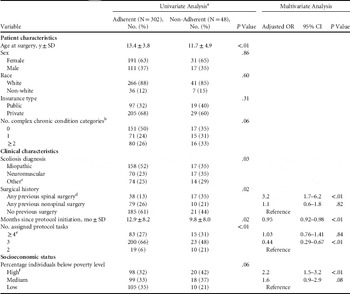
The study cohort included 350 patients; of these, 302 (86.3%) were protocol adherent. The average age of the cohort was 13.1±4.0 years old; ~66% were female; and >50% were white. In addition, ~66% had private insurance, and ~50% had no CCC category diagnoses. Furthermore, ~50% had idiopathic scoliosis; >50% had no previous surgery; and >50% were assigned 3 protocol tasks. Age at surgery and number of CCC category diagnoses were considered in the initial multivariate model, along with the clinical characteristics. Factors significant for an increased risk of protocol nonadherence in the final multivariate model included any previous spinal surgery, fewer months since protocol initiation, and high census-tract percentage of individuals in poverty (Table 1).
Univariate Analysis of Demographic and Clinical Factors by Protocol Adherence Groups and Multivariate Analysis of Factors Associated with Protocol Nonadherence

NOTE. OR, odds ratio; CI, confidence interval; SD, standard deviation.
a Data are shown as mean±SD or number (%).
b Excluding technology dependence and other congenital or genetic defect.
c Includes congenital, syndromic, and other diagnoses
d For multivariate analysis, comparing any previous spine surgery versus any previous non-spinal surgery: adjusted OR, 3.0; 95% CI, 1.3–7.1; P=.01.
e For multivariate analysis, comparing ≥4 vs 3 assigned tasks: OR, 2.4; 95% CI, 2.0–2.9; P<.01.
f For multivariate analysis, comparing high vs medium percentage individuals below poverty level: adjusted OR, 1.3; 95% CI, 1.0–1.7; P=.03.
DISCUSSION
Much of the SES-adherence literature addresses chronic disease management and health maintenance. Little has been reported about a preoperative scenario, possibly due to assumptions that preoperative preparation is acute, and given surgical risk, protocol adherence is a foregone conclusion. This assumption may be inaccurate; low-to-moderate SSI prevention protocol adherence has been reported among healthcare workers and patients and families.Reference Schweizer, Chiang and Septimus 4
The association of a history of spinal surgery with nonadherence was unanticipated. We assumed that families and patients who had experienced spinal surgery previously would understand SSI risk and adhere to the protocol. Possibly, families and patients who did not experience an SSI felt a false sense of confidence and put less stock in protocol adherence. This finding causes concern because previous spine surgery has been linked to SSI risk.Reference Schimmel, Horsting, de Kleuver, Wonders and van Limbeek 9
Our findings are limited by an inability to assess whether instruction differed between families, which could influence adherence. However, the association of months since protocol initiation with adherence suggests that instruction improved as it became more standard over time. Our findings may also be limited by the ecological fallacy generated when area-level factors are assigned to individuals in a census tract who may not possess any of the factors. However, census-tract data are relatively homogeneous, suggesting that data aggregated to this level can be used to approximate an individual’s SES.Reference Krieger, Chen, Waterman, Rehkopf and Subramanian 8
When designing care protocols, patient and family contexts need to be considered. The benefit of achieving high reliability must be weighed against its feasibility. Our data suggest that SES is an important factor to consider when assigning family SSI prevention tasks. Lower SES may represent financial hardship (eg, inability to purchase materials or take time off work or substandard housing with no access to running water for bathing) and psychosocial stressReference Beck, Huang and Simmons 10 that may prevent families from adhering to recommended protocols. Further study is needed to identify models of care that facilitate adherence to SSI prevention protocols among all patients.
ACKNOWLEDGMENTS
We would like to thank Amy Liu for data management assistance and the members of the Crawford Spine Center and Perioperative Services as well as the patients and families who participated in this study.
Financial support: J.K.S. received grant support from the Cincinnati Children’s Hospital Research Foundation (Place Outcomes Research Award).
Potential conflicts of interest: P.F.S. has been a paid consultant for Medtronic, Depuy Spine, and Ellipse Technologies. All other authors report no conflicts of interest relevant to this article.