Implications
This data strongly suggest that foetal bovine intermuscular adipose tissue (AT) has much more in common with white than with brown AT from 180 days post conception until 2 or 3 weeks before birth. This raises questions over the specific location of brown AT depots and/or the ability of intermuscular AT to acquire the metabolic properties required for thermogenesis before birth. Our data highlight that one of the major AT sites contains mainly unilocular putatively white adipocytes 2 to 3 weeks before birth, and thus emphasize the potential limitation in heat production for the survival of pre-term ruminants born in harsh environments.
Introduction
In cattle, adequate development of foetal adipose tissue (AT) is a major challenge for promoting neonatal survival, as AT is the tissue that ensures non-shivering thermogenesis at birth. Moreover, foetal growth of AT is thought to be a critical factor contributing to adult AT mass and thus to the lifelong productivity of the offspring based on (1) a strong postnatal hypertrophy of adipocytes, which mainly increase in number during the foetal growth (Vernon, Reference Vernon1986) and (2) evidence for foetal programming of postnatal AT growth in bovines (Greenwood and Cafe, Reference Greenwood and Cafe2007).
In bovines, intermuscular AT is an important compartment of adipose mass, largely shaping the quality and value of both carcass and meat end product. In male Friesians, the mass of intermuscular AT relative to total AT mass is 60% at birth and 40% at a weight of 700 kg (Robelin, Reference Robelin1986). Despite its abundance at birth, there are no data on the cellular and molecular features that sustain intermuscular AT growth in bovine foetus, and the sole data concern the timing of its appearance, which was reported to occur at 180 days post conception (dpc; Vernon, Reference Vernon1986). The few published metabolic features of foetal bovine AT have been obtained on perirenal AT. It has been shown that in the last third of foetal growth or at birth, bovine perirenal AT exhibits in vitro lipogenesis from acetate and palmitate (Landis et al., Reference Landis, Carstens, McPhail, Randel, Green, Slay and Smith2002), expresses lipoprotein lipase (LPL; Hocquette et al., Reference Hocquette, Sauerwein, Higashiyama, Picard and Abe2006) and uncoupling protein 1 (UCP 1; Casteilla et al., Reference Casteilla, Champigny, Bouillaud, Robelin and Ricquier1989), and contains multilocular adipocytes with a high number of mitochondria that highlight the presence of brown adipocytes in foetal AT (Alexander et al., Reference Alexander, Bennett and Gemmell1975; Landis et al., Reference Landis, Carstens, McPhail, Randel, Green, Slay and Smith2002). However, we recently reported that at the end of foetal life (260 dpc), bovine perirenal and intermuscular AT are a mixture of brown and mainly white adipocytes (Taga et al., Reference Taga, Bonnet, Picard, Zingaretti, Cassar-Malek, Cinti and Chilliard2011). It is not yet clear whether intermuscular AT from appearance onwards expresses the cellular and molecular features of primarily brown AT or of both brown and white AT. This question is reinforced by the recent characterization in mice of two distinct adipose cell precursors: one committed in either brown adipocytes or muscular cells, and the second is committed in either brown or white adipocyte (Seale et al., Reference Seale, Bjork, Yang, Kajimura, Chin, Kuang, Scime, Devarakonda, Conroe, Erdjument-Bromage, Tempst, Rudnicki, Beier and Spiegelman2008). These recent findings could prompt the hypothesis that intermuscular AT, due to its muscle-based anatomical location, has a cellular origin similar to that of muscle, consequently leading to different cellular and metabolic features to those reported for perirenal AT during foetal life.
The main objective of this study was to characterize intermuscular AT throughout foetal growth, in order to complement cellular and molecular features that we previously reported at 260 dpc (Taga et al., Reference Taga, Bonnet, Picard, Zingaretti, Cassar-Malek, Cinti and Chilliard2011) by cellular and molecular features assayed at 180 and 210 dpc. This study was conducted in two bovine breeds chosen for their large use for meat production from growing cattle in France and because of their differences in muscular development and adiposity during the postnatal life (Picard et al., Reference Picard, Lepetit, Cottin, Hadj Sassi, Bauchart, Biau, Giraudeau, Jailler, Micol, Listrat and Jurie2010). For this, we examined the histology and cellularity of foetal intermuscular AT and the expression of genes involved in the main metabolic pathways known to contribute to AT growth, namely lipogenesis, lipolysis, oxidative metabolism and adipokine synthesis, some of which are reportedly hallmarks of brown, white or both brown and white adipocytes.
Material and methods
Animals and AT sampling
Charolais and Blond d'Aquitaine foetuses were generated by artificial insemination of Charolais and Blond d'Aquitaine primiparous cows with Charolais and Blond d'Aquitaine bull sperm, respectively, at INRA experimental farm UR1213. Foetuses were collected at 180 dpc (n = 5 Charolais and n = 3 Blond d'Aquitaine), 210 dpc (n = 5 Charolais and n = 3 Blond d'Aquitaine) and 260 dpc (n = 10 Charolais and n = 3 Blond d'Aquitaine; in INRA herds, full gestation averages 287 and 290 days for primiparous Charolais and Blond d'Aquitaine cows, respectively) from cows slaughtered at the INRA's experimental abattoir. Foetuses at 260 dpc were the same as those previously used to compare three breeds for one part of the parameters described in this study (Taga et al., Reference Taga, Bonnet, Picard, Zingaretti, Cassar-Malek, Cinti and Chilliard2011). At slaughter, foetal AT samples were collected from intermuscular depots between the main forequarter and hindquarter muscles. All experimental procedures were approved by the INRA Animal Care Committee in accordance with the Use of Vertebrates for Scientific Purposes Act 1985.
AT cellularity
Within 30 min of slaughter, intermuscular AT samples were placed at 37°C and fixed by osmium tetroxide as previously described (Robelin, Reference Robelin1981). Adipocytes were dispersed in 8 M urea, and macroscopic analysis determined adipocyte diameter of ca. 300 adipocytes using Optimas software (version 6, OPTIMAS Corporation). We then calculated adipocyte volume and number of adipocytes per gram of lipid (1/(volume (cm3) × 0.92)) and number of adipocytes per gram of intermuscular AT (number of adipocytes per gram of lipid × percentage of AT lipids). For this purpose, total lipid content of AT was determined after extraction by mixing 250 mg of lyophilized tissue with chloroform : methanol at 2 : 1 (vol/vol), as previously described (Folch et al., Reference Folch, Lees and Sloane Stanley1957).
AT histology
Fragments of frozen intermuscular AT were fixed in 4% formaldehyde in 0.1 M phosphate buffer pH 7.4 overnight at 4°C, then washed in the same buffer. For paraffin embedding, samples were dehydrated in ethanol, cleared in xylene and embedded in melted paraffin at 60°C. Sections of 4-μm thickness were mounted on clean slides, counterstained with haematoxylin and eosin, and examined by light microscopy as previously described (Taga et al., Reference Taga, Bonnet, Picard, Zingaretti, Cassar-Malek, Cinti and Chilliard2011). AT was digitized at magnifications of 10×, 20×, 40× and 100×.
AT enzyme activities and mRNA abundances
At slaughter, intermuscular AT samples were frozen in liquid nitrogen and stored at −80°C until analysis. The following lipogenic enzyme activities were assayed: fatty acid synthase (FAS), which is involved in de novo fatty acid (FA) synthesis; malic enzyme (ME) and glucose-6-phosphate dehydrogenase (G6PDH), which yield reduced nicotinamide adenine dinucleotide phosphate for de novo FA synthesis; and glycerol-3-phosphate dehydrogenase (G3PDH), which is involved in glycerol-3-phosphate synthesis from glucose and thus in FA esterification. FAS, G6PDH, ME and G3PDH activities were assayed spectrophotometrically in intermuscular AT, as previously described (Chilliard et al., Reference Chilliard, Gagliostro, Flechet, Lefaivre and Sebastian1991). Enzyme activities were expressed as nanomoles of reduced (G6PDH, ME) or oxidized (FAS, G3PDH) nucleotides per minute and per million adipocytes, or per milligram protein after measurement of soluble protein content in enzyme homogenates (Bradford, Reference Bradford1976) using bovine serum albumin as standard (Bio-Rad Protein Assay, Marnes-La-Coquette, France).
We also measured mRNA abundances of genes encoding for: fatty acid synthase (FASN); LPL, the rate-limiting enzyme in triacylglycerol (TAG)-rich lipoprotein catabolism providing TAG-derived FAs to AT for storage; diacylglycerol O-acyltransferase 1 (DGAT1), which catalyses the terminal step in FA esterification using diacylglycerol and fatty acyl CoA as substrates; hormone-sensitive lipase (LIPE; also called HSL), considered until recently as the rate-limiting enzyme in TAG hydrolysis; patatin-like phospholipase domain-containing 2 (PNPLA2; also termed adipose triglyceride lipase (ATGL), desnutrin or phospholipase A2), recently identified as an additional lipase involved in TAG hydrolysis that may be essential for the provision of FAs as substrate for AT thermogenesis (Zechner et al., Reference Zechner, Kienesberger, Haemmerle, Zimmermann and Lass2009); perilipin (PLIN), which is also involved in lipolysis regulation; UCP1, a highly specific component of brown adipocytes uncoupling oxidative phosphorylation from the respiratory chain (Casteilla et al., Reference Casteilla, Forest, Robelin, Ricquier, Lombet and Ailhaud1987); uncoupling protein 2 (UCP2), similar to UCP1 but mainly expressed in white adipocytes; type-II iodothyronine deiodinase (DIO2), a highly specific component of brown adipocytes involved in the synthesis of thyroid hormones and the regulation of UCP1 expression (Ribeiro, Reference Ribeiro2008); leptin (LEP), a hormone mainly synthesized in AT at a rate strongly related to adiposity in ruminants (Chilliard et al., Reference Chilliard, Delavaud and Bonnet2005); and adiponectin (ADIPOQ), another adipokine controlling energy metabolism (Hu et al., Reference Hu, Liang and Spiegelman1996). The abundances of FABP4, LIPE, PNPLA2, PLIN, UCP1, UCP2, DIO2 and ADIPOQ mRNA plus the three housekeeping genes TBP (TATA box-binding protein), UXT (ubiquitously expressed transcript) and EIF3K (eukaryotic translation initiation factor 3, subunit k) were quantified as previously reported (Taga et al., Reference Taga, Bonnet, Picard, Zingaretti, Cassar-Malek, Cinti and Chilliard2011).
Plasma LEP analysis
Intracardiac foetal blood was sampled on EDTA at slaughter. Plasma LEP concentration was determined in duplicate according to the previously described disequilibrium double-antibody ovine-specific radioimmunoassay validated for LEP determination in bovine plasma (Delavaud et al., Reference Delavaud, Bocquier, Chilliard, Keisler, Gertler and Kann2000). Mean intra- and inter-assay coefficients of variation were 6.1% and 8.5%, respectively.
Statistical analysis
Data were analysed using the MIXED procedure of SAS (SAS Institute, Cary, NC, USA). Fixed effects included breed, age and their interaction. Random effect was animal. When applicable, a multiple comparison of means was performed using the LSMEANS statement of the MIXED procedure. Differences between breeds and/or ages were considered significant at P ⩽ 0.05. Breed × age interactions were considered significant at P ⩽ 0.10 to guard against type-II error. This was deemed appropriate because of the low number of experimental animals tested for interaction rather than main effects, and the a priori expectation on interactions (Loor et al., Reference Loor, Ferlay, Ollier, Doreau and Chilliard2005).
Results
Cellularity and morphology of intermuscular AT
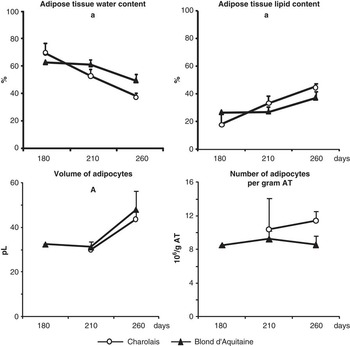
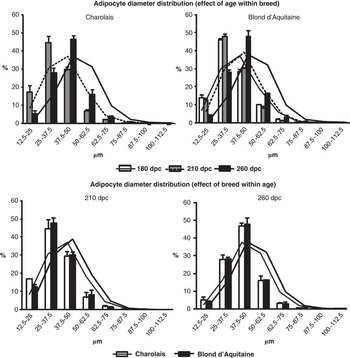
Regardless of the genotype, adipocyte volume increased (+38% on average for the two breeds, P < 0.01) between 210 and 260 dpc, whereas the number of adipocytes per gram of AT did not vary across the foetal ages (Figure 1). This is consistent with the increase in percent lipids (+127% on average, P = 0.02) and the decrease in percent water (−32%, P = 0.02) in intermuscular AT between 180 and 260 dpc. The increase in lipid storage and thus in adipocyte volume resulted in a greater proportion of larger adipocytes at 260 than at 210 or 180 dpc (Figure 2). Regardless of the age, mean adipocyte diameter (data not shown) and the distribution of adipocyte diameters remained the same between Charolais and Blond d'Aquitaine foetuses (Figure 2).
Water and lipid percentages, adipocyte volume (pL), and million adipocytes per gram of intermuscular adipose tissue (AT) from Charolais and Blond d'Aquitaine foetuses at 180, 210 and 260 days post conception. Results are means ± s.e.m. B, A or b, a: significant effect of breed or age (P < 0.001 or P < 0.05, respectively); B × A or b × a: significant interaction (P < 0.05 or P < 0.10, respectively).

Adipocyte diameter distribution as a percentage of total cell count in intermuscular adipose tissue from Charolais and Blond d'Aquitaine foetuses at 180, 210 and 260 days post conception.

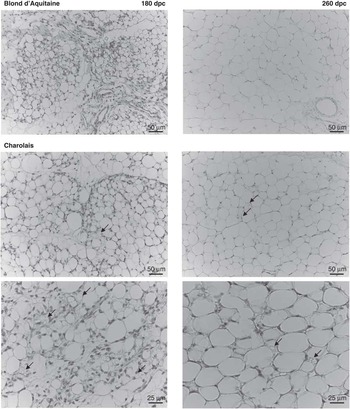
The cellular morphology of intermuscular AT at 180 and 260 dpc from both Charolais and Blond d'Aquitaine foetuses shows a mixture of unilocular adipocytes with a thin cytoplasm interspersed with a few multilocular or paucilocular adipocytes that could be seen on pictures with the highest magnification (Figure 3).
Haematoxylin–Eosin-stained intermuscular adipose tissues from Charolais and Blond d'Aquitaine foetuses at 180 and 260 days post conception. The arrows indicate multilocular or paucilocular adipocytes among the unilocular white adipocytes. Magnification 20× or 40×, bar = 50 or 25 μm.

Activity and mRNA abundances of lipogenic enzymes
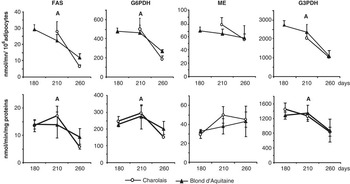
Except for ME, the activities of enzymes involved in de novo FA synthesis and esterification decreased (P ⩽ 0.01, FAS: −65%, G6PDH: −57%, G3PDH: −61%, on average) between 180 and 260 dpc when expressed per million adipocytes (Figure 4). FAS and G6PDH activities slightly increased (+13 and +20% on average, respectively) between 180 and 210 dpc when expressed per milligram proteins (Figure 4), whereas these activities and the G3PDH activity decreased between 210 and 260 dpc (P ⩽ 0.01, FAS: −46%, G6PDH: −33%, G3PDH: −33%, on average). However, the decreases in activities per milligram proteins were of lower amplitude, probably due to a decrease in soluble protein concentration (P < 0.01) between 210 and 260 dpc (mean soluble protein concentration for the two breeds: 17.2, 15.9 and 12.1 mg/g of AT at 180, 210 and 260 dpc, respectively). Similar age variations were observed when lipogenic activities were expressed per milligram proteins or per gram of AT (data not shown). The ranges of variation in enzyme activities with age were similar for Charolais and Blond d'Aquitaine foetuses, regardless of the basis for expression.
Activities of lipogenic enzymes in intermuscular adipose tissue: fatty acid synthase (FAS), glucose-6-phosphate dehydrogenase (G6PDH), malic enzyme (ME) and glycerol-3-phosphate dehydrogenase (G3PDH) expressed as nanomoles per minute and per million adipocytes, or as nanomoles per minute and per milligram of proteins from Charolais and Blond d'Aquitaine foetuses at 180, 210 and 260 days post conception. Results are means ± s.e.m. B, A or b, a or (b, a): significant effect of breed or age (P < 0.001 or P < 0.05 or P < 0.10, respectively); B × A or b × a: significant interaction (P < 0.05 or P < 0.10, respectively).

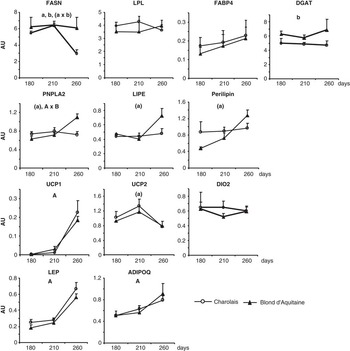
The abundance (Figure 5) of FASN mRNA decreased (P = 0.05) between 210 and 260 dpc, but only in Charolais because of a breed × age interaction (P = 0.10), and differed between breeds (P = 0.05), being greater in Blond d'Aquitaine foetuses (+105%) at 260 dpc. These differences between breeds deserve to be confirmed in a higher number of animals, because of the low number of Blond d'Aquitaine foetuses. The abundance of DGAT mRNA differed among breeds (P = 0.05), and was greater in Blond d'Aquitaine foetuses (averaging +20% at 180 and 210 dpc and +43% at 260 dpc compared with Charolais foetuses). Abundances of LPL and FABP4 mRNA did not vary with age or between breeds.
mRNA abundances (in arbitrary units; AU) of fatty acid synthase (FASN), lipoprotein lipase (LPL), fatty acid-binding protein 4 (FABP4), diacylglycerol O-acyltransferase 1 (DGAT1), patatin-like phospholipase domain containing 2 (PNPLA2), hormone-sensitive lipase (LIPE), perilipin (PLIN), uncoupling protein 1 (UCP1), uncoupling protein 2 (UCP2), type-II iodothyronine deiodinase (DIO2), leptin (LEP) and adiponectin (ADIPOQ) in intermuscular adipose tissue from Charolais and Blond d'Aquitaine foetuses at 180, 210 and 260 days post conception. For each mRNA, transcript abundance was related to the geometric mean (Vandesompele et al., Reference Vandesompele, De Preter, Pattyn, Poppe, Van Roy, De Paepe and Speleman2002) of the abundance of the three housekeeping genes TBP (TATA box-binding protein), UXT (ubiquitously expressed transcript) and EIF3K (eukaryotic translation initiation factor 3, subunit k). Results are means ± s.e.m. B, A or b, a or (b, a): significant effect of breed or age (P < 0.001 or P < 0.05 or P < 0.10, respectively); B × A or b × a: significant interaction (P < 0.05 or P < 0.10, respectively).

Abundances of lipolytic enzyme mRNA
Abundances of LIPE, PNPLA2 and PLIN mRNA tended (P < 0.08) to increase with age (Figure 5), being highest at 260 dpc (averaging +42%, +18% and +39% between 210 and 260 dpc for the two breeds, respectively). mRNA abundance of PNPLA2 was highest in Blond d'Aquitaine foetuses (+49%) at 260 dpc only, because of a breed × age interaction (P = 0.03).
Oxidative metabolism and mitochondrial function
The abundance of UCP1 mRNA strongly increased (averaging +950%, P = 0.01, for the two breeds) between 210 and 260 dpc in both Charolais and Blond d'Aquitaine foetuses (Figure 5). Abundance of UCP2 mRNA tended (P = 0.12) to decrease between 210 and 260 dpc, but did not reach significance. Abundance of DIO2 mRNA did not vary with age or between breeds (Figure 5).
Abundances of adipokine mRNA and plasma LEP
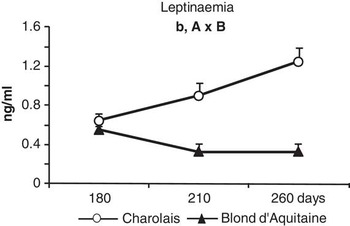
Regardless of the breed, the abundances of mRNAs encoding the adipokines LEP (+184%, P < 0.01, on average for the two breeds) and ADIPOQ (+67%, P = 0.01) increased between 180 and 260 dpc (Figure 5). At plasma level (Figure 6), LEP increased between 180 and 260 dpc, but only in Charolais (+95 and +39% at 260 compared with 180 and 210 dpc, respectively) because of a breed × age interaction (P < 0.01). Moreover, leptinaemia was two- to threefold greater (P < 0.05) in Charolais than Blond d'Aquitaine foetuses at 210 and 260 dpc.
Plasma leptin concentrations (ng/ml) in Charolais and Blond d'Aquitaine foetuses at 180, 210 and 260 days post conception. Results are means ± s.e.m. B, A or b, a: significant effect of breed or age (P < 0.001 or P < 0.05, respectively); B × A: significant interaction (P < 0.05).

Discussion
The two major findings of this study are: (i) the presence of numerous unilocular white-like adipocytes as early as 180 dpc in bovine foetal intermuscular AT; (ii) a decrease or lack of variation in the expression of genes encoding lipogenic enzymes during the last third of pregnancy, with concomitant strong increases in the expression of genes encoding UCP1, LEP and ADIPOQ, and in Charolais foetuses, an increase in plasma LEP. The variations were of higher amplitude between 210 and 260 dpc than between 180 and 210 dpc, which suggests a strong regulation of adipocyte hypertrophy from 210 dpc.
Age-related differences in foetal AT cellularity and metabolism
Surprisingly, although adipocyte volume increased between 210 and 260 dpc, number of adipocytes per gram of intermuscular AT did not decrease conversely to what was repeatedly observed postnatally (Robelin, Reference Robelin1981; Robelin et al., Reference Robelin, Barboiron and Jailler1985; Schoonmaker et al., Reference Schoonmaker, Fluharty and Loerch2004). This lack of relationship during the foetal AT growth may result from the strong increase in the lipid content of intermuscular AT between 180 and 260 dpc. To the best of our knowledge, this study provides the first estimation of water and lipid content in foetal intermuscular AT. The increase in adipocyte volume between 210 and 260 dpc may contribute to the expected increase in intermuscular AT weight, which achieved 60% of total AT mass at birth (Robelin, Reference Robelin1986). As the cellularity of intermuscular AT across foetal development has never previously been reported, we used this study to describe the distribution of adipocyte diameters across foetal ages and across breeds. Our results highlight that adipocytes found in the greatest proportions had a diameter in the range 25 to 37.5 μm at 210 dpc and 37.5 to 50 μm at 260 dpc, regardless of the breed. However, the 38% increase in adipocyte volume between 210 and 260 dpc is much less significant than the 200% increase reported between 200 and 400 days after birth in Friesian and Charolais bulls (Robelin et al., Reference Robelin, Barboiron and Jailler1985), with this period being considered the rapid growth phase of intermuscular AT.
The lack of a strong increase in adipocyte volume between 210 and 260 dpc may be related to the decrease in the activities of enzymes involved in some lipogenic pathways. The activities of FAS and G6PDH, which are involved in de novo lipogenesis, and G3PDH, which is involved in glycerol phosphate synthesis, strongly decreased from 180 dpc onwards when expressed per million adipocytes or from 210 dpc onwards when expressed per milligram of proteins. Difficulties encountered in establishing a satisfactory and meaningful baseline expression of enzyme activities in AT have been repeatedly reported (Bonnet et al., Reference Bonnet, Leroux, Faulconnier, Hocquette, Bocquier, Martin and Chilliard2000; Eguinoa et al., Reference Eguinoa, Brocklehurst, Arana, Mendizabal, Vernon and Purroy2003; Bonnet et al., Reference Bonnet, Faulconnier, Hocquette, Bocquier, Leroux, Martin and Chilliard2004). Expressing results on a cellular or protein basis was shown to be more relevant because of its better relation to total activity in the studied AT sites (Hood and Allen, Reference Hood and Allen1973). However, marked increases in both adipocyte size and total adipocyte count are logically expected to occur in bovine foetal AT, and could complicate the evaluation of the quantitative importance of age-related changes in enzyme activities. Nevertheless, the abundance of FASN mRNA also decreased from 210 dpc onwards in Charolais foetuses, which is in line with the decrease in de novo lipogenesis enzyme activities per adipocytes and per milligram protein. In contrast, abundances of LPL, FABP4 and DGAT, respectively, involved in circulating TG hydrolysis, in FA uptake and in FA esterification, did not decrease with increasing foetal age. These data suggest that the maintenance of the expression of genes encoding enzymes involved in TG hydrolysis and FA intracellular transport and esterification favoured FA storage in adipocytes, and thus contributed to the slight increase in adipocyte volume. This is in agreement with results obtained in vitro by Landis et al. (Reference Landis, Carstens, McPhail, Randel, Green, Slay and Smith2002) reporting that de novo lipogenesis was barely detectable at birth, whereas glycerolipid synthesis from palmitate remained high in bovine perirenal AT. Taken together, our data suggest that the growth of intermuscular AT is primarily due to an increase in total adipocyte numbers in this AT site, as we observe either a decrease in de novo lipogenesis or a stable uptake and esterification of FAs that seem sufficient to ensure only a slight increase in adipocyte volume as foetal age increased. To the best of our knowledge, this is the first time that metabolic parameters of intermuscular AT during foetal growth have been described ex vivo for cattle or any large mammals. Our findings complete a previous study that reported a cessation of the adipocyte volume increase from 240 dpc onwards in perirenal AT from Brahman and Angus foetuses, which was concomitant with a decrease in in vitro lipogenesis from acetate, glucose and palmitate (Landis et al., Reference Landis, Carstens, McPhail, Randel, Green, Slay and Smith2002).
We found an increased expression of genes encoding LEP and ADIPOQ as a function of foetal age. The increase in the abundance of LEP mRNA in intermuscular AT may reflect an enhanced ability to synthesize LEP, which could in turn sustain the increase in plasma LEP levels from 210 dpc onwards, at least in Charolais foetuses. In line with our results, an increase in LEP mRNA abundances in perirenal AT (Yuen et al., Reference Yuen, McMillen, Symonds and Owens1999) and plasma LEP (Yuen et al., Reference Yuen, Owens, Muhlhausler, Roberts, Symonds, Keisler, McFarlane, Kauter, Evens and McMillen2003) was reported in ovine foetuses during the last month before birth.
Between-breed differences in foetal AT cellularity and metabolism
Despite the lack of between-breed differences in adipocyte volume, we observed greater abundances of FASN, PNPLA2 and DGAT2, mainly at 260 dpc, in Blond d'Aquitaine foetuses compared with Charolais foetuses. These results suggest a more intense futile cycling between lipogenesis/esterification and lipolysis – previously proposed to sustain adipocyte hypertrophy in growing ruminants (Vernon, Reference Vernon1980) – in Blond d'Aquitaine foetuses than Charolais foetuses. During the postnatal period, Blond d'Aquitaine bulls are generally described as leaner than Charolais bulls at similar ages (Picard et al., Reference Picard, Lepetit, Cottin, Hadj Sassi, Bauchart, Biau, Giraudeau, Jailler, Micol, Listrat and Jurie2010). Our results obtained at foetal age may reflect a delay in the growth of intermuscular AT in Blond d'Aquitaine foetuses that did not achieve the decrease in lipogenic/lipolytic futile cycling at 260 dpc observed in Charolais foetuses. To date, the rare few studies comparing lipid metabolism among breeds during the foetal or perinatal periods have only investigated perirenal AT. Our data thus complement previous studies reporting a greater in vitro lipogenesis from glucose and palmitate 96 days before birth (Landis et al., Reference Landis, Carstens, McPhail, Randel, Green, Slay and Smith2002), a twofold higher concentration of β-adrenergic receptors at birth (Martin et al., Reference Martin, Carstens, King, Eli, Mersmann and Smith1999), consistently with a greater basal lipolytic rate in Brahman than in Angus perirenal AT, and greater lipogenic enzyme activities in perirenal AT from Holstein than Charolais or Blond d'Aquitaine at 260 dpc (Taga et al., Reference Taga, Bonnet, Picard, Zingaretti, Cassar-Malek, Cinti and Chilliard2011).
Moreover, Charolais foetuses were characterized by greater leptinaemia at 210 and 260 dpc than Blond d'Aquitaine foetuses despite no breed difference was observed for LEP mRNA abundance in intermuscular AT. This breed difference at 260 dpc may also partly result from a trend (P = 0.06) for higher LEP gene expression in perirenal AT, as well as from the greater number of perirenal adipocytes in Charolais foetuses compared with Blond d'Aquitaine foetuses (Taga et al., Reference Taga, Bonnet, Picard, Zingaretti, Cassar-Malek, Cinti and Chilliard2011). Altogether, these results are consistent with the greater adiposity of Charolais than Blond d'Aquitaine previously reported in postnatal life (Picard et al., Reference Picard, Lepetit, Cottin, Hadj Sassi, Bauchart, Biau, Giraudeau, Jailler, Micol, Listrat and Jurie2010), and they highlight that this breed difference already exists during the foetal life.
Cellular and metabolic characteristics of the bovine foetal intermuscular AT
In bovines, the appearance of perirenal AT occurs at 80 dpc, followed by subcutaneous and intermuscular AT at around 180 dpc (Vernon, Reference Vernon1986). To date, foetal bovine perirenal AT, contrary to subcutaneous AT, has been considered as brown because of its high mitochondria content (Alexander et al., Reference Alexander, Bennett and Gemmell1975; Landis et al., Reference Landis, Carstens, McPhail, Randel, Green, Slay and Smith2002) and its high expression of mitochondrial function-related proteins such as UCP1, cytochrome c oxidase and ADP/ATP carrier protein around birth (Casteilla et al., Reference Casteilla, Forest, Robelin, Ricquier, Lombet and Ailhaud1987 and Reference Casteilla, Champigny, Bouillaud, Robelin and Ricquier1989). However, we recently reported that 2 to 3 weeks before the end of foetal life (260 dpc), bovine perirenal and intermuscular AT were a mix of brown and mainly white adipocytes (Taga et al., Reference Taga, Bonnet, Picard, Zingaretti, Cassar-Malek, Cinti and Chilliard2011), as previously reported in subcutaneous AT from newborn calves (Smith and Carstens, Reference Smith and Carstens2005). In this study, we observed the presence of unilocular adipocytes in intermuscular AT as early as 180 dpc, with a few multilocular or paucilocular adipocytes interspersed. In agreement with the presence of mainly unilocular putatively white adipocytes, we observed a significant expression of LEP and UCP2 genes, both hallmarks of white adipocytes (Cinti et al., Reference Cinti, Frederich, Zingaretti, De Matteis, Flier and Lowell1997; Digby et al., Reference Digby, Crowley, Sewter, Whitehead, Prins and O'Rahilly2000). This was concomitant with a significant expression of UCP1 and DIO2 genes, both hallmarks of brown adipocytes (Giralt et al., Reference Giralt, Casteilla, Vinas, Mampel, Iglesias, Robelin and Villarroya1989; Cinti et al., Reference Cinti, Frederich, Zingaretti, De Matteis, Flier and Lowell1997). This result, together with the strong increase in the abundance of UCP1 mRNA from 210 dpc onwards, may contrast with the abundance of unilocular adipocytes. A high UCP1 mRNA abundance was previously reported at 260 dpc in bovine perirenal AT, whereas the amount of UCP1 protein was barely detectable (Casteilla et al., Reference Casteilla, Forest, Robelin, Ricquier, Lombet and Ailhaud1987 and Reference Casteilla, Champigny, Bouillaud, Robelin and Ricquier1989). Few multilocular or paucilocular putatively brown adipocytes were, however, present in the heterogeneous intermuscular foetal AT in our study, which could express UCP1 and thus be poised to participate in thermogenesis, which is essential in newborns of most mammalian species (Trayhurn, Reference Trayhurn2009). Altogether, our data thus suggest that intermuscular AT, from its appearance until 260 dpc, has much more in common with white than with brown AT.
In conclusion, this ex vivo investigation provides new insights on the cellular and molecular-level features of bovine foetal intermuscular AT growth from 180 to 260 dpc. Among the most interesting findings of our study is the presence of abundant unilocular adipocytes that express molecular and metabolic features of white adipocytes, thus challenging current conceptions on the largely brown nature of foetal adipocytes.
Acknowledgements
The authors thank the farm and slaughterhouse staff and especially Pascal Faure at the INRA Theix Research Centre for animal care and handling. They thank C. Barboiron for technical assistance and help on foetus dissection, D. Bany, S. Bes and C. Labonne for assistance with the cellularity and enzyme assays, total RNA extraction assays, and mRNA quantification and protein assays and C. Delavaud and M. Tourret for plasma leptin assays.