

I. INTRODUCTION
On November 27, 1940, Edwin Bidwell Wilson acted as chairman of the Examining Committee at Paul Samuelson’s thesis defense, along with Joseph Schumpeter and Overton Taylor at Harvard University.Footnote 1 For Samuelson’s defense, Wilson wanted a large part of the staff of the department to attend the examination because he rated Samuelson’s work as summa cum laude, but knew that he was biased. In his words:
I may be prejudiced. I find in [these] developments [of Samuelson’s thesis] of a great many things I suggested in my lectures on mathematical economics in 1936 (I believe). I said at the time that I had not the opportunity to develop this line of thought to the perfection which I should deem essential if I were to publish about it but that I was throwing it out to any interested persons in the class. Samuelson has followed almost all the leads I gave besides a great many things that I never mentioned.Footnote 2
In October 1940, just after leaving Harvard for the Massachusetts Institute of Technology, Samuelson had written to Wilson:
I should like … to express, however inadequately, what I feel to be my debt to your teachings. I think I have benefitted from your suggestions, perhaps more than from anyone else in recent years, and even chance remarks which you have let fall concerning Gibbs’s thermodynamical systems have profoundly altered my views in corresponding fields of economics.Footnote 3
Subsequently, Samuelson expanded his thesis into a manuscript that became Foundations of Economic Analysis (1947). Following the publication of his book, Samuelson wrote again to Wilson:
Ever since my book came out, I have been meaning to write to you to express its indebtedness to your lectures. In fact, the key to the whole work suddenly came to me in the middle of one of your lectures on Gibbs’s thermodynamics where you pointed out that certain finite inequalities were not laws of physics or economics, but immediate consequences of an assumed extremum position. From then on, it became simply a matter of exploration and refinement.Footnote 4
* * *
Wilson was an American polymath who played a central role in the constitution of an American community of mathematical economists around 1930 and in the origins of the Econometric Society. He promoted and established a program of mathematical and statistical economics during the 1930s at the department of economics at Harvard, where Samuelson conducted his graduate studies between 1935 and 1940 (Carvajalino Reference Carvajalino2018a). Late in his life, Samuelson acknowledged that he “was perhaps [Wilson’s] only disciple” (Samuelson Reference Samuelson1998, p. 1376).
Wilson’s “importance to Samuelson and hence to Foundations cannot be overstated” (Backhouse Reference Backhouse2015, p. 331). In this paper, certain aspects of this importance are examined.Footnote 5 By regarding Foundations from the perspective of Samuelson’s active commitment to Wilson, as regards mathematics, statistics, and science, this paper sheds new light on Samuelson’s early mathematical economics.
Samuelson’s commitment to Wilson was manifest at various levels. First, Wilson’s foundational ideas provided a unifying basis for the different parts of Samuelson’s thesis and Foundations. The projects on which Samuelson worked during his doctoral years, some of which composed the thesis, were rather disparate; in the thesis and in Foundations, however, Samuelson presented the different chapters as a unified, comprehensive whole, which he thought could serve as new scientific foundations for economics. Such perceived unity was based on Wilson’s ideas, which were embodied in the mottos that abound in Samuelson’s thesis and Foundations, such as “Mathematics is a Language,” “operationally meaningful theorems,” and “useful” knowledge. For Wilson, science implied mathematics, and vice versa. He also believed that much science could be developed with little mathematics.Footnote 6 By this, he meant that if the mathematics of a scientific contribution was not fully complete—namely, fully consistent—but if the mathematical gaps could be filled with intuition related to the subject matter, such a contribution could be regarded as mathematically and scientifically grounded. Foundations embodies these Wilsonian ideas.
Second, Wilson’s foundational ideas were also significantly influential in the way Samuelson dealt, in the thesis and in Foundations, with the study of the economy as a system in stable equilibrium, treating separately and connectedly, depending on the emphasis of the analysis, the microeconomic and the macroeconomic levels of the system. More particularly, Wilson’s thought influenced the way Samuelson framed a certain number of theoretical concerns. Through his ideas about how economists should mathematically define a position of stable equilibrium, Wilson was particularly important to Samuelson’s work on consumer theory, cost and production theory, as well as dynamics. For Wilson, mathematical economics based only on marginal and differential calculus was empirically empty, as the formulas that were developed within these frameworks were defined by abstract, because continuous, relationships. For Wilson, the discrete was more general than the continuous; the discrete was also more cogent with data. Furthermore, since Wilson believed that calculus had emerged as an abstraction of the study of the discrete, he assumed that without loss of generality, correspondences between the discrete and the continuous could be established (Carvajalino Reference Carvajalino2018a).
Precisely, the most important of Samuelson’s Wilsonian concerns in the thesis, and therefore in Foundations, consisted of establishing correspondences between the continuous and the discrete, in order to translate the mathematics of the continuous, used in standard contemporary economics procedures of optimization and in the treatment of dynamical systems, into formulas of discrete magnitudes. Extant statistical methods for the treatment of economic data, Wilson felt, remained unsatisfactory and arbitrary. Around 1940, Samuelson must have felt the same, as he did not introduce any statistical tests or econometric regressions in his thesis, or in Foundations. In Samuelson’s thesis and Foundations, the local and the discrete—in sum, the observable in idealized conditions—provided the best way of operationalizing marginal and differential calculus in economics. The discrete resonated intuitively with data; the continuous did not. From this Wilsonian perspective, Foundations appears to be not only an exercise in mathematical economics, but also and unexpectedly an exercise in mathematical statistics, based on observable, although not necessarily observed, data.
In the following pages, the master and the disciple will be first briefly introduced. Second, we will show how Wilson framed and limited Samuelson’s doctoral thesis, being particularly influential in four interconnected dimensions: the opening page where Samuelson wrote “Mathematics is a Language”; the introductory chapters, where Samuelson presented his thesis as a unified whole; the individual (microeconomic) level of the system; and the aggregate (macroeconomic) level of the system. Last, Wilson’s influence on Samuelson’s expansions of the thesis leading to Foundations will be discussed, showing how he contributed to the development of the most mathematically and statistically oriented parts of such expansions.
II. THE MASTER AND THE DISCIPLE
Edwin Bidwell Wilson
Wilson was born in 1879, in Hartford, Connecticut. He was trained as mathematician at Harvard University, Yale University, and at the École Normale Supérieure in Paris around 1900. Wilson subsequently became one of the “most active” members among the American research community of mathematicians during the first decade of the 1900s (Fenster and Parshall Reference Fenster, Parshall, Knobloch and Rowe1994). He, however, gradually marginalized himself from that community, disavowing the influence that David Hilbert’s structuralist mathematics was then exerting on his American colleagues and concomitantly committing to the traditional applied American mathematics that Josiah Willard Gibbs, his mentor at Yale, practiced.Footnote 7 Wilson’s career illustrates this process of marginalization and corollary process of incursion into other fields. First, in 1907, he became associate professor of mathematical physics at Massachusetts Institute of Technology (MIT). Second, in 1922, he accepted the chairmanship of the department of vital statistics at the newly founded Harvard School of Public Health (HSPH), opening the door to his incursion into social science and economics. In parallel spheres, since 1914, when the Proceedings of the National Academy of Science (PNAS) was launched, Wilson served as managing editor of this journal until the end of his life in 1964.Footnote 8
The task that Wilson gave himself consisted of interconnecting mathematics and different subject matters. At Harvard’s department of economics, between 1932 and 1943, Wilson gave a course on Mathematical Statistics and another on Mathematical Economics (since 1935), alternately every two years since 1935. Wilson aimed his instruction at protecting students from what he disdainfully regarded as the beauty of certain pure theoretical and/or mathematical contemporary works in economics.Footnote 9 He thought that students of economics, by learning his American Gibbsian constrained mathematics, would learn how to behave in a scientific way.Footnote 10
Paul Samuelson
Samuelson was born in 1915, in Gary, Indiana. In 1932, he entered college at the University of Chicago, where he majored in economics. He performed exceptionally well and was awarded in 1935 a selective pre-doctoral scholarship given by the Social Science Research Council (SSRC). With it, he went to Harvard, with all expenses covered. During the 1935–36 academic year, Samuelson took, in particular, Wassily Leontief’s Price Analysis course, and Wilson’s course on Mathematical Statistics. Samuelson was then only twenty-one years old. The following spring, he attended Wilson’s course on Mathematical Economics. For most students, it was difficult, but Samuelson was mathematically well trained (Samuelson Reference Samuelson, Dietzenbacher and Lahr2004). In college, he had taken a significant number of mathematical courses. Also, during the summers of 1935 and 1936, he had taken extra curriculum courses on differential equations and on the theory of equations, where linear matrix equations were treated (Backhouse Reference Backhouse2015).
Eventually, Samuelson impressed Wilson. As he wrote to Lawrence Henderson, chairman of the Harvard Society of Fellows (HSF) and Wilson’s close friend, when recommending Samuelson as a Junior Fellow of the Society, Wilson believed that “one of the most brilliant young men in political economy whom I have ever met is Samuelson.… I had him in my course in mathematical statistics and he was the most original and inquisitive of all the students.”Footnote 11
In 1937, Samuelson was elected Junior Fellow of the HSF. The membership came with a scholarship, and also with the restriction that the work undertaken under the Fellowship program should be somehow different from the work that would be submitted to obtain a doctoral degree. Presumably following this rule, Samuelson did not work to complete a comprehensive and well-constructed thesis. Between 1937 and 1940, instead, he conducted research and wrote an important number of papers, not all published, on consumer theory, cost and production theory, capital and investment theory, business cycles, population dynamics, international trade and welfare economics, as well as comparative statics and dynamics. In order to fulfill the requirements of the department of economics and to graduate, however, in 1940, Samuelson took some of his fellowship projects, put them together, added three introductory chapters and a mathematical appendix, and submitted a thesis, defended in November 1940.
“You did a fine job at your doctor’s examination,”Footnote 12 Wilson wrote Samuelson after the defense. Concerned about career opportunities for Samuelson, Wilson was then actively supporting Samuelson’s thesis to be considered for the David A. Wells Prize, which was awarded to Samuelson in 1942.Footnote 13
III. THE COMMITMENT: THE THESIS
Samuelson titled his thesis “Foundations of Analytical Economics: The Observational Significance of Economic Theory” (1941a). The dissertation had nine chapters and a mathematical appendix. The first three chapters were introductory; from the fourth to the seventh chapters, Samuelson analyzed optimizing behavior of the firm first (chapter four) and then, in three chapters, of the consumer. In the last two chapters, Samuelson studied stability conditions of equilibrium of aggregate economic systems, first emphasizing comparative statics and then focusing on dynamics and its more formal aspects. In the mathematical appendix, Samuelson covered maximization, especially quadratic forms.Footnote 14
As it will be discussed in this section, Wilson was key regarding Samuelson’s opening page and the introductory chapters; in these parts of the thesis, by reflecting on Wilson’s ideas, Samuelson presented the different and somehow disparate parts of the thesis as a comprehensive whole. At the same time, the chapters that Samuelson included in his thesis corresponded well to the fellowship projects on which Wilson had had the most significant influence. The last two subsections of this section will explore such influence on theoretical concerns, which eventually led Samuelson to treat as distinct, but interconnected, the individual and the aggregate levels of the economy, regarded as a system.Footnote 15
The Opening Page
The first instantiation of Samuelson’s commitment to Wilson in matters of mathematics, statistics, and science appeared in the opening page of the thesis, where he wrote: “Mathematics is a Language.” Samuelson attributed, rightly or wrongly, this motto to Gibbs, the legacy of whom was transmitted to him by Wilson, who defined mathematics as a sort of language.Footnote 16 For Wilson, mathematics as a language implied two main ideas, which Samuelson probably wanted to evoke, and which set the spirit of the thesis since its opening page.
First, mathematics as a language implied, for Wilson, defining mathematics as connected with science and meaning.Footnote 17 For Wilson, mathematics consisted of establishing correspondences, as translations, between purely mathematical entities that represented certain mathematical structures, which he called “postulates,” and conventional working hypotheses found in subject matters, which he called “axioms.” In these translations, postulates and axioms must simultaneously restrict each other: while postulates imposed logical structure on the subject matter, acting thus as a sort of grammar, axioms constrained freedom and abstraction of postulates and gave them meaning connectedly to the subject matter, acting thus as a sort of semantics. Without their corresponding meaning in science, mathematical structures were as beautiful and as useless as pure theoretical treatises of subject matters, Wilson felt. At the same time, without their corresponding mathematical structures, subject matters could not achieve scientific status. For him, mathematical structures were indispensable in science to mediate between theory and data, as they were necessary to determine meaning. Wilson, however, insisted that emphasis should be placed on meaning and intuition rather than on pure consistency of close mathematical systems (Wilson Reference Wilson1904). He even believed that contributions in which the mathematics was not necessarily fully consistent but in which meaning and intuition of the subject matter filled the mathematical gaps could be regarded as truly scientific and well mathematically founded. In his words: “[W]hether the [work] is mathematically complete or not does not interest me; this is unimportant. Science advances not so much by the completeness or elegance of its mathematics as by the significance of its facts” (Wilson Reference Wilson1928a, p. 244).
At the same time, for Wilson, mathematics implied immediate usefulness, which could be achieved only if correspondences between postulates and axioms were established.Footnote 18 In such translations, mathematical operators and operations should be used. Sometimes, new operators and operations should even be developed, in accordance with the immediate problems at hand. This “operational … side,” Wilson believed, required applying “a series of rules of operation often both dull and unintelligible,”Footnote 19 generally found in algebra or advanced calculus, but which could be regarded as simply as the arithmetic operations of division and multiplication. These operations, he thought, “are not in themselves of practical or intellectual interest.”Footnote 20 Operational thinking, Wilson believed, was hence distinct from postulational and axiomatic thinking.
Wilson’s interest in axioms, as conventional working hypotheses, reflected his belief that they corresponded to the (ontological) invariances necessary for the use of mathematics in science, as they supposedly represented things that “change so slowly that we may regard them for practical purposes as non-changing or at any rate can assign limits to their change in amount and not [in] time.”Footnote 21 Also, Wilson thought, scientific knowledge resulted from a plurality of working hypotheses. Scientific knowledge was therefore never to be held as universally true, but merely as partial, probable, and approximate. Because the reason for prevalence of a certain working hypothesis over another was not self-evident (Wilson Reference Wilson1920), scientific knowledge, for him, was also conventional. In this way, as a result of the possibility to “assign limits to their change in amount and not [in] time,” working hypotheses conveyed truth and meaning, relative to the problem at hand, only in a certain proportion at given moments in time. Statistics, he thought, offered an operational way of determining the most likely working hypothesis, as it could be used to quantify that range that carried truth and meaning while connecting theory and data.
All this implied that in defining mathematics as a language, Wilson believed that the mathematician/scientist needed to be familiar with certain mathematical structures (postulates), to master the conventional working hypotheses (axioms) of the subject matter of interest as well as to know how to play with his skills in (vector) algebra, advanced calculus, and (mathematical) statistics in order to develop correspondences between postulates and axioms. When establishing these translations, Wilson insisted, the mathematician/scientist should endeavor to produce much science with little mathematics, by following the idea that meaning and intuition prevailed over mathematical consistency, even when the mathematics was highly sophisticated.Footnote 22
Also, for Wilson, defining mathematics as a language implied regarding mathematics and its operational (algebraic and statistical) techniques as a vernacular, which all individuals could learn (Wilson Reference Wilson1940); and as Wilson stated: “[T]here [seemed] to be no present conclusive evidence that learning a particular technique [was] impossible to any person … and, therefore, each could presumably learn any technique and use it in much the same sense as he could learn any language and write in it” (Wilson Reference Wilson1940, p. 664).
For Wilson, these operational techniques were the language that economists should learn if they wanted economics to become truly scientific. This was the language that Samuelson learnt and used in his thesis.
Introductory Chapters
Methodology
Samuelson started the thesis by criticizing how, in economics, “bad methodological preconceptions” (Samuelson Reference Samuelson1941a, p. 2) had left the field without sound scientific foundations. During his career, Wilson had diagnosed all the fields with which he engaged as suffering from lack of scientific foundations. As a result, he claimed, practitioners in these fields tended to commit to wrong methodological approaches, either purely theoretical or purely empirical.Footnote 23
These methodological problems, Samuelson believed, had two disastrous consequences for economics. First, because of them, he held that disagreement among economists about applied and theoretical concerns was the rule rather than the exception. Echoing Wilson, Samuelson suggested that consensus was a necessary condition for any scientific practice. Second, because of wrong methodological approaches, economics lacked unity; its different branches, Samuelson insisted, remained unsatisfactorily connected. In order to develop a unifying approach, it was necessary to build on the high level of generality provided by mathematics. In his courses, Wilson emphasized the greater level of generality that could be attained in economics if mathematics was properly applied. In 1936, when commenting on Wilson–Gibbs vectorial and matrix analysis for a commemorative volume of Gibbs, by quoting the latter, Wilson wrote: “We begin by studying multiple algebras: we end, I think, by studying MULTIPLE ALGEBRA” (Gibbs Reference Gibbs1886, p. 32; emphasis in original; quoted in Wilson Reference Wilson, Donnan and Haas1936, p. 160).
Samuelson suggested that he had begun by studying various branches of economics and that he had ended by studying economics in general. In a Wilson–Gibbs spirit, Samuelson aimed at unifying economics and at establishing a methodological balance between economic theory and data representing “empirical human behavior” (Samuelson Reference Samuelson1941a, p. 2). For this purpose, he wanted to achieve minimal consensus about the basic working hypotheses at the foundations of economics.
Basic Working Hypotheses
Reflecting Wilson’s emphasis on conventional working hypotheses, Samuelson claimed that he rejected universal principles. He wanted to establish scientific statements that “are not deduced from thin air or a priori propositions of universal truth and vacuous applicability” (Samuelson Reference Samuelson1941a, p. 5).
Samuelson proceeded on the basis of two general working hypotheses, which he took as conventional, that represented specific ways of dealing with the economy as a system and that, he thought, embodied other conventional hypotheses in economics. First, he regarded optimizing individuals—consumers and firms—as separated and isolated systems in stable equilibrium. Second, he assumed that the aggregate system of the economy—namely, the interaction through time of aggregate variables—was in dynamical stable equilibrium.
Building on his two working hypotheses, Samuelson made normative statements about how economists should study, scientifically, the economy as a system and unify economics. With them, he tied together the different chapters of the thesis and presented the individual and the aggregate levels of the economy as distinct problems that could, however, be studied as interconnected.
Samuelson supported this idea of interconnection, appealing to two main arguments. First, the notion of (general) stable equilibrium at the individual and aggregate levels, he explained, yielded that all variables of a given system were simultaneously determined. This implied, he argued, that the subfields of economics could be regarded as being interconnected, since the variables of one problem, of interest for a subfield, could be regarded as the parameters of another problem, studied by a different subfield. Second, Samuelson argued that in his research at the individual and aggregate levels and in various fields of economics, he had repeatedly “found out” that certain discrete inequalities provided the necessary and sufficient conditions of achieving stable equilibrium positions. Eventually, he presented such discrete inequalities as acting as a formal analogy that unified the thesis, and eventually economics. However, Samuelson did not systematically and comprehensively develop the mathematics, which he would have needed to in order to achieve certain conclusions that he offered, as it will be suggested in the following subsections. Notwithstanding this, he stressed that such inequalities implied the existence of operationally meaningful theorems.
In all these aspects about the indispensability and applicability of mathematics and unification of economics, Wilson was central. Let’s interpret how.
Operationally Meaningful Theorems
In his course on Mathematical Economics, Wilson defined stable equilibrium position of the consumer with certain discrete inequalities and argued that his definition was original relative to the relevant literature, particularly Vilfredo Pareto’s economics, as it was more general because it was made “with finite differences [rather] than [only] with derivatives.”Footnote 24 Also, in his course on Mathematical Statistics, having in mind economic spectral analysis, Wilson taught the fundamental elements in calculus that lay behind lag operators, and emphasized analytical statistics and numerical mathematics, without covering standard inference theory, of which he was critical. He believed that extant statistical methods in the emerging econometric movement remained arbitrary, for they relied too strongly on probability, of which he was skeptical.Footnote 25
Following Wilson, Samuelson thought that mathematics of the continuous—marginal and differential calculus of neoclassical economics—had left economics without empirical foundations. He sought to connect certain discrete inequalities with his two working hypotheses, while willing to interconnect these working hypotheses with some sort of data. In this vein, he made the “structural characteristics of the equilibrium set” (Samuelson Reference Samuelson1941a, p. 15) correspond with the—seemingly—conventional working hypotheses of individuals’ optimizing behavior as well as of stability of intertemporal interrelations between aggregate variables. The problem, he believed, was that there was not yet enough available and detailed quantitative empirical economic information. In the thesis, the emphasis was placed on observable, not observed, data. In his words:
One cannot leave the matter here [at the level of marginal and differential calculus], for in the world of real phenomena all changes are necessarily finite, and instantaneous rates of change remain only limiting abstractions. It is imperative, therefore, that we develop the implications of our analysis for finite changes. Fortunately, despite the impression current among many economists that the calculus can only be applied to infinitesimal movements, this is easily done. (Samuelson Reference Samuelson1941a, p. 54)
Data always comes in a discrete form, Samuelson hinted.
From this Wilsonian perspective, Samuelson’s operationally meaningful theorems were not only statements in mathematical economics; they also appear—and this is less evident—as statements in mathematical statistics, as Wilson’s foundational statistical ideas were also framing and limiting Samuelson’s thought. In Samuelson’s thesis, there were not standard statistical tests or econometric regressions. Samuelson seemed even to have adopted Wilson’s skepticism for—Pearsonian and Fisherian—statistical estimation procedures. Following Wilson’s analytical statistics and without using probability theory, Samuelson attempted rather to establish correspondences between formulas of discrete elements and equations of continuous elements, in order to show that neoclassical abstract economics based on marginal and differential calculus had a corresponding form in the more general discrete world (of comparative statics), intuitively more cogent with data.
As reflections of Wilson’s ideas about mathematics as a language, these correspondences/translations between the discrete and the continuous embodied what Samuelson meant to offer with his operationally meaningful theorems: they represented a way of postulationally structuring economic thinking; of attributing meaning to mathematical structures relatively to conventional working hypotheses in economics; and, at the same time, of determining the meaningfulness of these working hypotheses by connecting them with data, if only in “idealized conditions,” where idealized conditions should be understood as formulas defined in the discrete.Footnote 26
The Individual Level
In 1937, Samuelson published his two first papers. He elaborated on the consumer’s (1937a) and the entrepreneur’s (1937b) behavior, by assuming that they optimized intertemporally. These papers on mathematical economics appeared in February and in May, respectively. Samuelson must have finished the first paper before taking Wilson’s course on Mathematical Economics; in the May paper, Samuelson briefly referred to Wilson’s Advanced Calculus (1911) and to Edmund Whittaker’s and George Robinson’s The Calculus of Observations (1924), both covered by Wilson in his 1936 course on Mathematical Statistics. In these papers, Wilson’s influence on the way Samuelson approached mathematical economics was not yet evident. Wilson’s presentation of Gibbs’s thermodynamical systems that “have profoundly altered [Samuelson’s] views in corresponding fields of economics”Footnote 27 took place almost at the same time that these two papers were published; it is unlikely that Samuelson had had the time to engage with the difficult content of Wilson’s presentation of Gibbs’s systems. It can be conjectured that once Samuelson explored more in detail Wilson’s course material on mathematical economics and thermodynamics, he started then neglecting the old Fisherian working hypothesis of intertemporal optimization, as Wilson presented the consumer maximization problem as being independent of time.Footnote 28
In the thesis, with the first working hypothesis, which consisted of assuming an extremum position, Samuelson presented the consumer and the firm problem analogically. With it, he defined “individual’s equilibrium” with respect to specifically demanded and/or supplied quantities that corresponded to the optimal individual’s position. At this individual level, such quantities therefore implied simultaneously concepts of stability of equilibrium and optimality, at discrete moments in time, as his idealized consumer and firm did not optimize over time, but at all moments in time.Footnote 29
Consumer Theory
After having attended Wilson’s lectures in Mathematical Economics during the spring of 1937, in a series of papers all published in 1938, Samuelson, who was then twenty-three years old, claimed to have established new foundations for consumer theory by developing its empirical implications (1938a, 1938c, 1938d). When Samuelson sent to Wilson the last of the three cited papers for suggestions, the latter responded explaining that he had refereed positively the work for publication in Econometrica. Wilson believed,
There is no evidence in the style in which the paper is written that you have taken anything other than an intellectual attitude toward any of the questions. If however, there are any particular points where you yourself have any doubt or think other people might have some which you want to take up with me I shall be glad to discuss the matter with you.Footnote 30
In the thesis, Samuelson elaborated on the Evolution of the Utility Concept (1941a, pp. 111–134), which eventually culminated, he hinted, at his operationally meaningful theorems, deducible, he argued, however, from the standard analysis.
Samuelson regarded utility theory as a convenient convention, which did not yet reflect “the factual behavior of consumers” (1941a, p. 114). Its relevance, “for better or worse,” was due to the fact that it “has occupied an important position in economic thought for the last half century. This alone makes it highly desirable that its meaning be clearly understood” (1941a, pp. 113–114). Footnote 31 The notion of utility in economics represented, therefore, one of those invariants in science that Wilson regarded as necessary for the applicability of mathematics; determining its operational meaningfulness required, then, properly connecting it with some sort of data.
In his course on Mathematical Economics, Wilson presented consumer theory analogically to thermodynamics by explaining that certain discrete inequalities, which he called the “Gibbs conditions,” characterized the static and stable equilibrium position of thermodynamics and economics systems.Footnote 32 Such analysis did not imply the use of calculus, Wilson argued, but corresponded, in the discrete, to the conditions of stability of equilibrium of standard economic problems of optimization under constraint, in a static world. Wilson’s consumer analysis was indeed time-independent: “With time introduced, everyone recognizes that preferences change.”Footnote 33
In this Wilsonian manner, in the thesis, Samuelson framed his Meaningful Theorems (1941a, pp. 134–144) on consumer analysis in a time-independent and static idealized world. He rephrased something that he had called in his doctoral papers the postulate of “consistency in idealized individual’s behavior,” with which he had connected utility analysis with observable data, by establishing certain correspondences between observable expenditure, the preference-field, and the demand function.Footnote 34
With his approach, which consisted of playing with his skills in logical and arithmetical operations and his knowledge of the economic theory of index numbers, Samuelson was able to infer certain relations in the preference-field from observable expenditure. On this basis, Samuelson was then able to deduce a specific correspondence between such relation and demanded quantity behavior, expressed by the demand function. To accomplish this, and building on his theorem, Samuelson deduced the following relationships:
 $$\mathop \sum \limits_{i = 1}^n {p_i}{\rm{\Delta }}{x_i} \le 0implies\mathop \sum \limits_{i = 1}^n \left( {{p_i} + {\rm{\Delta }}{p_i}} \right){\rm{\Delta }}{x_i} < 0$$
Following Wilson’s lead, Samuelson showed that a discrete inequality relationship, the second one, corresponded to the necessary and sufficient conditions of stability of an extremum position, as found in standard procedures of consumer-constrained optimization defined at the margin. The second inequality, Samuelson argued, “contained almost all the meaningful empirical implications of the whole pure theory of consumer’s choice” (Samuelson Reference Samuelson1941a, pp. 138–139); it corresponded to the well-established negative-slope and stability-concavity restrictions in maximization procedures upon (Marshallian) demand functions.Footnote 35 In this way, he connected his consistency postulate, grounded on observable data—not observed data—and the notion of equilibrium, with some structural characteristics of optimization under constraint.Footnote 36
In the standard continuous analysis, however, there was an empirical restriction, which Samuelson did not succeed in deriving from his discrete formula: the integrability conditions.Footnote 37 In his words, integrability conditions
reflect differential properties of our demand functions which are hard to visualize and hard to refute.… I have tried, but thus far with no success, to deduce implications of our integrability conditions which can be expressed in finite forms; i.e., be conceivably refutable merely by a finite number or point observations. (Samuelson Reference Samuelson1941a, p. 134n13)
In spite of the difficulties that he encountered, Samuelson remained optimistic about his approach and hoped that “a proof may still be forthcoming by which [his approach] may be slightly generalized to include the question of integrability” (1941a, p. 139n14).
All in all, in consumer theory, Samuelson felt that he had developed something new, based on the old. Because he believed that he had translated abstract formulas defined at the margin into a discrete form, Samuelson felt that he had developed the empirical implications of the abstract utility and Marshallian demand theories. He thought that he had failed to encompass integrability precisely because he had not been able to establish such a continuous-discrete connection. From our Wilsonian perspective, it can be argued that the novelty of Samuelson’s consumer theory appears in the emphasis that he gave to the working hypothesis of a stable individual’s equilibrium, which, following Wilson, had to be defined in the discrete. From this point, Samuelson connected such a definition of the stable equilibrium with certain mathematical structures of optimization and with some sort of data. In this way, he could present his work as operationally meaningful—namely, as mathematically, theoretically, and empirically well founded, emphasizing more one aspect or the other, depending on the part of the thesis. This amalgamation of these three different elements had, in Samuelson’s thesis, the consequence that the notion of stable equilibrium could simultaneously be regarded as mathematically constructed, theoretically well founded, and empirically intuitive. His work, however, was not based on actual empirical data, but only on discrete formulas, which he presented as having an empirical nature.
Production and Cost Theory
Even though Wilson did not cover the theory of the firm in his courses, he significantly influenced Samuelson’s production and cost theory.Footnote 38 His relevance emerged as Samuelson found some difficulties when dealing with optimizing problems in which “certain costs [were] regarded as completely fixed,” or when a “firm [was constrained] to employ the same total of labor.”Footnote 39 These problems raise new questions about stability when dealing with systems, the equilibrium of which depended on “prescribed values of … ‘conjugate variables’,”Footnote 40 or parameters. They led Samuelson to study thermodynamics, where, he claimed, analogical problems were found, and which implied optimizing with a greater number of constraints.Footnote 41 But as the system had more constraints, Samuelson was concerned about the implication for the stability of equilibrium when the system faced changes of a parameter.
In his course on Mathematical Economics, Wilson had treated, in passing, the Le Chatelier Principle as a principle of stability of equilibrium in the case of infinitesimal changes of a parameter. Following Wilson, Samuelson interpreted this principle as implying, in the case of infinitesimal changes, that the greater the number of constraints the system had, the more stable the equilibrium position was in response to the marginal change of a parameter. The question remained to be established whether the principle could be generalized to the case of discrete finite changes.
During his fellowship years, when he was dealing with these issues, Samuelson even wrote a paper on the Le Chatelier Principle, which he sent to Wilson; in Samuelson’s words, his “manuscript represents a dangerous excursion … into a field about which I know very little. It was inspired partly by some remarks of yours in class some time ago, [and] partly by some work I have been doing in the field of economic theory.”Footnote 42
In his response, Wilson wrote as follows:
[G]eneral as the treatment is I think that there is a possibility that it is not so general in some respects as Willard Gibbs would have desired. … I remember Gibbs used to talk about non-negative quadratic forms meaning those which never had negative values though they might take zero values for values of the variables which weren’t zero. Moreover, in discussing equilibrium and displacements from one position of equilibrium to another position he laid great stress on the fact that one had to remain within the limits of stability. Now if one wishes to postulate the derivatives including the second derivatives in an absolutely definite quadratic form one doesn’t need to talk about limits of stability because the definiteness of the quadratic form means that one has stability.…
I wonder whether you can’t make it clearer or can’t come nearer following the general line of ideas of Willard Gibbs as given in his Equilibrium of Heterogeneous Substances, equation 133. He doesn’t use derivatives but introduces a condition which is equivalent to saying that his function has to be on one side or in a tangent plane to it. He doesn’t even assume that there is a definite tangent plane but merely that at each point of his surface it is possible to draw some plane such that the surface lies except for that point and some other points entirely to one side of the plane.Footnote 43
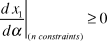
Following Wilson’s disciplining comments, Samuelson acknowledged that his paper “relates to instantaneous rates of change and does not approach the generality of the Gibbs formulation which makes no continuity or differentiability assumptions but only requires certain arithmetic inequalities (‘single concavity conditions’) to hold.”Footnote 44 Assuming that he remained in the limits of stability, Samuelson then came to the conclusion, as he wrote to Wilson again, that as a matter of formal definition the Le Chatelier Principle did not hold in the discrete case of finite changes, when several constraints were taken into account. In his words:
Implicitly assuming that we remain within ‘the limits of stability’, I was able through the Gibbs approach to show that
 $${\rm{\Delta \alpha }}\Delta {x_1}{|_{(n\,constraints)}} \mathbin{\lower.3ex\hbox{$\buildrel>\ove{\smash{\scriptstyle=}\vphantom{_x}}$}} 0$$
This corresponded to the theorems on partial derivatives:
 $${\left. {{{d{x_1}} \over {d\alpha }}} \right|_{(n\,constraints)}} \ge 0$$
Intuitively, I had expected that the generalized theorem on the partial derivatives of the form
 $${\left. {{{d{x_1}} \over {d\alpha }}} \right|_{\left( {no\,c.} \right)}} \mathbin{\lower.3ex\hbox{$\buildrel>\ove{\smash{\scriptstyle=}\vphantom{_x}}$}} {\left. {{{d{x_1}} \over {d\alpha }}} \right|_{\left( {1\,c.} \right)}} \mathbin{\lower.3ex\hbox{$\buildrel>\ove{\smash{\scriptstyle=}\vphantom{_x}}$}} \ldots \mathbin{\lower.3ex\hbox{$\buildrel>\ove{\smash{\scriptstyle=}\vphantom{_x}}$}} {\left. {{{d{x_1}} \over {d\alpha }}} \right|_{\left( {n - 1\,c.} \right)}} \mathbin{\lower.3ex\hbox{$\buildrel>\ove{\smash{\scriptstyle=}\vphantom{_x}}$}} 0$$
would have an analogous theorem of the Gibbs type of the form
 $${\rm{\Delta \alpha \Delta }}{x_1}{|_{\left( {no\,c.} \right)}} \mathbin{\lower.3ex\hbox{$\buildrel>\ove{\smash{\scriptstyle=}\vphantom{_x}}$}} {\left. {{\rm{\Delta \alpha \Delta }}{x_1}} \right|_{\left( {1\,c.} \right)}} \mathbin{\lower.3ex\hbox{$\buildrel>\ove{\smash{\scriptstyle=}\vphantom{_x}}$}} \ldots \mathbin{\lower.3ex\hbox{$\buildrel>\ove{\smash{\scriptstyle=}\vphantom{_x}}$}} {\left. {{\rm{\Delta \alpha \Delta }}{x_1}} \right|_{\left( {n - 1\,c.} \right)}} \mathbin{\lower.3ex\hbox{$\buildrel>\ove{\smash{\scriptstyle=}\vphantom{_x}}$}} 0$$
Unfortunately, I was not able to develop a proof of this, and in trying to do so, became aware that such a theorem is not true, at least on the basis of the very general Gibbs curvature assumptions.Footnote 45
In the thesis, however, “[b]y making use of Professor E. B. Wilson’s suggestion that [the Le Chatelier Principle] is essentially a mathematical theorem applicable to economics” (Samuelson Reference Samuelson1941a, p. 98), Samuelson claimed that it held for finite as well as for marginal changes, as long as the system remained at the limits of equilibrium (Samuelson Reference Samuelson1941a, p. 43n12). It corresponded to the economic intuition according to which, for a firm in equilibrium, there was no possible movement that would improve its profits, no matter the number of constraints it had to face.
Samuelson used Wilson as a rhetorical figure of authority in order to introduce, as a general principle, his Le Chatelier Principle. To some extent, Samuelson was not persuaded that the formal analogy embodied in the existence of certain inequalities was formally consistent relative to all the cases that he analyzed; there were substantial differences in the treatment of discrete and continuous cases. By filling the mathematical gaps with meaning and intuition, Samuelson followed his master’s reassuring suggestion and the intuitive economics insight, which, however, led him to take the Le Chatelier Principle seriously. He also presented his cost and production theory as being operationally meaningful.
The Aggregate Level
In the thesis, with the second working hypothesis, which consisted of assuming a dynamical stable equilibrium, Samuelson aimed at establishing consensus and offering operationally meaningful theorems. He analyzed how equilibrium of the aggregate system was determined through time by studying the “stability conditions relating to the interaction between economic units”—namely, between aggregate variables (Samuelson Reference Samuelson1941a, p. 193), through time.Footnote 46
Such interactions were often studied by analyzing the dynamics and stability conditions of Marshallian or Walrasian aggregate supply-and-demand systems when confronted with changes of prices.Footnote 47 But in Wilson’s spirit, Samuelson thought that “the economist would be truly vulnerable to the gibe that he is only a parrot taught to say ‘supply and demand’” (Samuelson Reference Samuelson1941a, p. 192). For Samuelson, Wilson’s “great virtue was [precisely] his contempt for social scientists who aped the more exact sciences in a parrot-like way” (Samuelson Reference Samuelson1998, p. 1376).
Samuelson’s “mathematical dynamics reflects in large measure the beliefs and prejudices of E. B. Wilson” (Weintraub Reference Weintraub1991, p. 58) on dynamical systems. Samuelson supposed that his second working hypothesis implied a correspondence between comparative statics and dynamics, as a way of connecting, while keeping separated, optimizing behavior of individuals, a static problem, and the evolution through time of the aggregate system. With such a correspondence, Samuelson presented comparative statics as a special case of dynamics; this intuitively implied that individual’s optimizing behavior was a special case, related to discrete moments in time, of the continuous evolution over time of the aggregate system at large. In his dynamics, Samuelson suggested, individuals were necessarily optimizing at every discrete moment in time, not over time. Further, at discrete moments in time, their optimizing behavior gave rise to the aggregates of the system, and hence individual optimizing behavior, he argued, “affords an unified approach” in economics. Comparative statics lay thus at the basis of his treatment of dynamical systems.Footnote 48
These ideas about the correspondence between comparative statics and dynamics seemed to have been directly related to Wilson’s lectures in Mathematical Economics, where he discussed thermodynamical systems.
In the early 1920s, in correspondence with Francis Edgeworth, Wilson had claimed that there were two main working hypotheses in quantum theory regarding the treatment of dynamical systems. In the first working hypothesis, it was assumed that atomic nature was dynamical in essence and studied statistically only to ease the analysis. In the second working hypothesis, “the dynamical is a consequence of the statistical”: it was assumed that atomic nature was essentially discrete and that dynamics resulted from arbitrary manipulations with the theory of probability through which the discrete elements (quanta) were averaged and put into aggregates “to develop dynamics on the statistical basis.” Aggregates did not result from a sampling and taxonomical statistical analysis; they and their dynamics, he thought, were freely constructed. He believed that the two approaches were legitimate, depending on the problem in hand. However, he remained skeptical about using probability to freely construct aggregates and their dynamics.Footnote 49
In 1936, A Commentary on the Scientific Writings of J. Willard Gibbs, in two volumes, was published. In the first volume, Wilson discussed Gibbs’ Lectures on Theormodynamics. In the second volume, Paul Epstein, a mathematical physicist at the California Institute of Technology, commented on Gibbs’ Methods in Statistics. Epstein’s argument resonated with Wilson’s comment on the different working hypotheses in physics to deal with dynamics. He explained, indeed, that in old quantum theory, there was equivalence between dynamical systems and integrable systems. He also pointed out that in the new quantum theory, based on wave theory, such was not necessarily the case because quanta could jump from one stationary equilibrium state to another and there was no way of determining the probability of a specific trajectory. Epstein then argued that such “probability could only be inferred indirectly and approximately, by classical analogies known under the name of ‘principle of correspondence’” (1936, p. 530). Based on the principle of correspondence, Epstein suggested, modern physicists connected and clarified the relationship between the old and the new quantum theory.
In the thesis, Samuelson did not (yet) call his correspondence between comparative statics and dynamics the Correspondence Principle. He thought, however, that with it the relation between old and modern economics, as had been the case regarding the relation between classical and modern quantum mechanics, according to Epstein, could be clarified. At the same time, following Wilson, Samuelson’s emphasis lay on comparative statics rather than on dynamics, as he focused on the (discrete) properties characterizing stationary equilibrium, more cogent with data, and not on moving equilibrium.
Samuelson’s dynamics was also informed by his personal research on business cycles (1939a, 1939a, 1940) and population dynamics.Footnote 50 In all these investigations, Samuelson encountered a similar formal difficulty when facing series and polynomials that did not converge. Eventually, he defined “dynamics” as the study of behavior through time of all variables of a system from arbitrary conditions, and referred to “stability”—as perfect stability of the first kind—as the cases in which “from any initial conditions all the variables approach their equilibrium values in the limit as time becomes infinite” (Samuelson Reference Samuelson1941a, p. 198). He used the general and mathematical formulation of functionals to map a great number of variables themselves functions of time.Footnote 51
Within his general and mathematical framework, Samuelson used some examples of business cycles and of aggregate supply-and-demand dynamical systems to illustrate his general ideas about stability. He was able to show the correspondence between John Hicks’s difference equation-system, related to the dynamics of a multimarket system, with a differential equation system. He also showed, in the Keynes–Hansen business cycles case, that there were important correspondences between the static and dynamical cases, studied either with difference equations or with differential equations systems. In all these cases, certain inequalities represented the necessary and sufficient conditions for stability. Also, in all these cases, the correspondence between difference equations and differential equations embodied the ideal of possible translations between continuous and discrete mathematical formulas, while the correspondence between static and dynamical systems showed, Samuelson thought, that the study of dynamics shed light on comparative statics problems, and vice versa.
In the last paragraph of the thesis, the mathematical appendix excluded, Samuelson concluded, pointing out that the study of dynamics and stability had led him “into the most difficult problems in higher mathematics” (Samuelson Reference Samuelson1941a, p. 250), some of which he had shown in the thesis, and for some of which he did not yet have finite results.
***
After the defense of the thesis, Wilson advised Samuelson to translate the mathematics into English. In his words,
What I am interested in in your thesis is to have the thing go out if possible so that good economic theorists who are not primarily mathematical economists can get fairly easily from it the things they need to keep them from making mistakes in their literary or semi-mathematical discussions. You have pointed out in the thesis several places where you have definite results that should preclude certain mistaken discussions on the part of economic theorists but I don’t believe that in the present form the economic theorists will get the point. I think there are too many formulas which would scare them off and that a good deal of the text could profitably be rewritten and considerably expanded for their benefit. If this were done in such a way that your contribution meant a good deal to a wide range of economic theorists it would not only help them but it would help them to appreciate the value of rigorous mathematical economics of which not a few of them are rather skeptical.Footnote 52
Wilson liked the thesis; it embodied his program for mathematical economics. Notwithstanding this, Wilson believed that, in its too-mathematical form, the thesis would not play the pedagogical role among economists that he wanted it to play.
Two years after the defense, Samuelson communicated to Wilson that he was revising the thesis and would love to have his suggestions. In response, Wilson wrote: “The thesis is so good and you are so busy [with war work and instruction] that I wonder whether you ought to put your time in revising it at all unless there is something really rather important in the way of improvements which you think you can make.”Footnote 53
Eventually, Samuelson did not follow Wilson’s advice and kept working on the highly mathematical problems that he had encountered.
Samuelson and Wilson remained in close contact, as Samuelson was working on a manuscript based on his thesis, which he would submit for publication to the Harvard University Press at the beginning of 1945. Foundations of Economic Analysis, as he titled the extended version of his thesis, wasn’t published until 1947, due to publishing delays.
IV. FOUNDATIONS: THE FINISHING TOUCHES
When Samuelson defended his thesis, he was already appointed assistant professor of economics at MIT (Backhouse Reference Backhouse2014). There, between 1941 and 1945, he was put in charge of graduate elective economics courses. He lectured on Economic Analysis and Business Cycles and offered a course titled Mathematical Approach to Economics and another, in collaboration with Harold Freeman, titled Advanced Economic Statistics. He also taught Public Finance to engineering undergraduate students as of 1943.Footnote 54 Concomitant with his instructional responsibilities, Samuelson embarked on war work; between 1941 and 1943, he acted as a consultant to the National Resources Planning Board (NRPB) in Washington.Footnote 55 Already in July of 1943, he “was engaged in some part-time, technical war work,” probably at MIT.Footnote 56 In view of this experience “in testing anti-aircraft,” Samuelson was released from his instructional duties from March 1944 to July 1945 to work as a full-time staff member mathematician on ballistics at the MIT Radiation Laboratory.Footnote 57
Despite his war research experiences, Samuelson kept unchanged the core of his thesis for Foundations. As he wrote to Wilson, “The principle [sic] changes have been a new chapter on Welfare Economics, further discussion of dynamics and an appendix on elementary difference equations.”Footnote 58 In the framing of some of these expansions, Wilson was still highly influential.Footnote 59
On dynamics, Samuelson further developed the difficult problems in higher mathematics that he had encountered; these involved studying stability issues of linear and non-linear systems. This time, Samuelson called his correspondence between dynamics and comparative statics the “Correspondence Principle.”Footnote 60
Further exploring the mathematical difficulties that he had encountered in the thesis involved connecting his dynamics with (analytical) statistics, which he attempted to do in the second appendix on difference equations and in various mathematical and statistical papers that he wrote between 1940 and 1943.Footnote 61 Given all his war duties and empirical work at the NRPB, Samuelson seemed to have used his lectures as a way of making progress in his more analytical research. As he wrote to Harold Hotelling in July 1943, with whom he had been corresponding about his research on mathematical statistics, “For the last three years, in lectures, and in my notes I have been developing various numerical methods in connection with inverting linear equations, scalar and matrix iteration, determination of latent roots and vectors.”Footnote 62
To deal with these complex problems, Samuelson connected statistics with numerical and computational methods; in these efforts, he was not only building on Wilson’s lectures on mathematical statistics, he was actually collaborating with Wilson on instruction of mathematical and statistical economics by sending him some of his MIT students and letting them write papers (for final examination) “in a cooperative fashion,”Footnote 63 in which Samuelson and Wilson would agree on the subject covered.Footnote 64
In 1942, they seemed to have encouraged their students to make some explorations based on the work of Whittaker and Robinson as well as of Alexander C. Aitken. In the middle of the following year, Samuelson sent two papers that he had written to Wilson in which he fully built on the work of these applied mathematicians.Footnote 65 Despite the fact that the rules of the PNAS, which Wilson still edited, prevented him from sponsoring papers, he made “an exception to the general rule and [took] them under [his] own sponsorship.”Footnote 66 The papers appeared in the December 1943 volume of the PNAS.Footnote 67 Samuelson was happy about their publication: he “could make reference to them in connection with other work on the fire,”Footnote 68 related probably to his war work on ballistics and/or to his appendix on difference equations.
With respect to the new chapter on welfare economics, Wilson’s influence on Samuelson remained unclear, as Samuelson argued in his doctoral papers on trade theory and welfare economics that there was no way of determining operationally and meaningfully the existence of a unique utility index enabling welfare comparisons (Samuelson Reference Samuelson1938b, 1938e, 1939b). In the thesis, Samuelson did not include his work on trade theory and welfare economics, probably because he felt that it did not respond to Wilson’s call for operationally meaningful knowledge.
In Foundations, at the end of the first part, in which he was exploring the consequences of the assumption of extremum positions, Samuelson added his work on welfare economics, introducing it with an extensive historical account of the subject. Samuelson still argued “that the theorems enunciated under the heading of welfare economics are not meaningful propositions” (Samuelson Reference Samuelson1947, p. 220). Samuelson was probably then no longer writing only for Wilson.
V. CONCLUSION
As suggested by Wilson and Samuelson in the opening quotations of this paper, Samuelson’s thesis and Foundations reflected his active commitment to Wilson as regards mathematics, statistics, and science. This paper sought to reconstruct this commitment. For this purpose, similarities in their work and ideas were traced and then used as the common thread that unified the story of this commitment.
Echoing Wilson, Samuelson’s diagnosis of the contemporary state of economics literature consisted of emphasizing the lack of operationally meaningful knowledge due to bad methodological approaches adopted by economists. In a Wilsonian spirit, Samuelson treated mathematics as a language and attempted to develop operationally meaningful theorems: he used his analytical skills and techniques in mathematics and statistics to establish correspondences between the conventional economic notion of equilibrium, at the individual and aggregate levels, and the mathematical structural characteristics of optimization problems under constraint and of functional analysis. At the same time, he thought that this sort of mathematics of the continuous, already standard in his contemporary mathematical economics, which he used, remained empirically empty. In this vein, he sought to connect his work with some sort of data. But by adopting Wilson’s skepticism of classical statistics and probability, Samuelson did not embark on standard statistical work of estimation of parameters or regressions; he rather attempted to translate formulas defined in the continuous into formulas of discrete magnitudes, following Wilson’s characterization of a stable equilibrium position, which was defined with a discrete time-independent inequality. In this way, in Foundations, Samuelson succeeded in presenting the notion of equilibrium as simultaneously being empirical (therefore intuitive), theoretical, and mathematical, even if at some points the mathematics was not necessarily fully developed, but simply completed with economic intuition.
In Foundations, Samuelson worked willingly to create the new based on the old. His modern economics was not a break with extant economics; his modern economics was a way of mediating between the new and the old. In the old neoclassical economics, mathematics of the continuous, as instantiated in marginal and differential calculus, was commonly used. Useful, operational, and meaningful knowledge required, however, connecting conventional working hypotheses of economics with mathematical structures and data. Of particular relevance in Foundations, Samuelson attempted, albeit in highly abstract and analytical ways, to connect his mathematical economics with data, by means of establishing correspondences between the continuous cases as found in marginal and differential calculus and mathematical formulas defined with discrete elements, which Samuelson regarded as better reflecting the world of economic phenomena.
From this Wilsonian perspective, Samuelson’s Foundations appears to be an exploration to find formulas composed by discrete magnitudes, observable in idealized conditions. Under this new light, Foundations can be regarded as an attempt to provide an alternative approach to the econometric movement. In such an approach, the statistical treatment of economic data was mainly analytical, indeed taxonomical; it implied avoiding probability theory in the construction of central concepts, of aggregates, and of their dynamics.
Notwithstanding the emphasis on a discrete economic world, in Foundations, Samuelson did not offer new foundations for economics based on discrete mathematics; instead, he endeavored, as illustrated by his Le Chatelier Principle and Correspondence Principle, to provide mathematics of the continuous a sort of observable nature, by means of establishing correspondences between the discrete and the continuous, and presenting the discrete as having an empirical nature, because more cogent with data. In this work of “translation,” he left some aspects of his mathematics incomplete and filled the gaps with economic intuition and meaning. In that sense and despite its sophisticated mathematical character for the time in economics, Foundations, in the last analysis, appears to have offered in a Wilsonian spirit much economics with little mathematics.



