Over the past three decades, outcomes for children undergoing congenital heart surgery have improved dramatically. Even those with lesions that were uniformly fatal as recently as the 1970s and 1980s now routinely survive into adulthood.Reference Gilboa, Devine and Kucik 1 With these improvements has come the need to transition to understanding and optimising longer-term outcomes. These include survival, re-intervention/hospitalisation, various morbidities, and other important outcomes such as neurodevelopment and overall quality of life.
Routine collection of these data, however, has been challenging for several reasons.Reference Pasquali, Jacobs and Farber 2 First, many patients undergoing congenital heart surgery may not receive follow-up care at the institution where their surgery was performed, and instead may follow-up with other cardiologists in the community. Larger centres in particular may serve as regional, national, and international referral centres with a resulting wide geographic distribution of their patient population. Second, there are no current standards in the field regarding longitudinal data collection with regard to time frame or key variables. Although Wernovsky et al have developed useful guidelines regarding the time frame for regular outpatient follow-up clinic visits and testing for patients who may be followed at an individual centre, there are no current standards or recommendations regarding the collection of longitudinal outcomes data across all patients, including those who may receive follow-up care elsewhere.Reference Wernovsky, Lihn and Olen 3 – Reference Jacobs and Morales 5 Third, with the ever-increasing requirements and pressures to participate in data collection for various research, quality improvement, and performance measurement initiatives, there may be limited resources to support additional data collection capabilities. Finally, to date, there has been limited engagement with patients and families in spearheading longitudinal data collection efforts. Thus, routine longitudinal follow-up data remain limited to non-existent across most centres.
To address these challenges, the UM C.S. Mott Children’s Hospital Congenital Heart Center and CHOP Cardiac Center recently collaborated to develop a programme to incorporate routine and standardised collection of critical longitudinal outcomes data into usual care. In this study, we describe the design of this programme and lessons learnt, initial results, and future directions.
Methods
Programme initiation
At CHOP, the programme began in January 2014 and targeted eligible patients undergoing surgery since January 2007. At UM, the programme began in January 2015 and targeted eligible patients undergoing surgery since January 2010. The programmes initially began independently, and subsequently collaborated to harmonise methodology and data collection as described in the sections below.
Personnel
At both centres, personnel included a leadership team comprised of paediatric cardiologists, paediatric cardiac surgeons, nurses, and experts in paediatric cardiovascular outcomes research. At UM, the team also included an expert in patient-reported outcomes and quality-of-life assessment, who provided guidance to both groups in this area. At each centre, a full-time programme coordinator with previous experience in the field of CHD was hired – at CHOP, the programme coordinator had previously served as a nurse in the cardiac ICU and registry data coordinator, and at UM the programme coordinator had served as a care coordinator and resident assistant on the paediatric cardiology inpatient floor. The programme coordinator’s primary responsibilities include general day-to-day oversight and coordination of the programme, data collection, and working with data management colleagues to produce various reports. Both centres already had staff in place specialising in database management and biostatistics, and these individuals provide ongoing assistance to the programme.Reference Bradley, Wu and Goldberg 6
Patient/parent engagement
The team engaged with patient and parent stakeholders to develop the follow-up programme. This included individual patients and parents with CHD, as well as the Patient and Family Centered Care Program at the UM, and a national advocacy organisation – The Pediatric Congenital Heart Association. 7 In addition to providing informal guidance, focus groups from the two organisations provided more formal review, including a six-member Pediatric Congenital Heart Association sub-committee and a 20-member E-advisory group from the Patient and Family Centered Care Program at the UM comprised of parents and children with a variety of conditions across the spectrum of paediatric disease. Both groups provided critical input regarding the key domains covered by the follow-up questionnaire and wording of specific questions.
Funding
The programmes were funded by a combination of internal heart centre funds and philanthropic support.
Regulatory considerations
At both centres, the programme was incorporated into usual standard of clinical care. At the UM, the programme went through a process of review and endorsement as a formal clinical practice guideline, and was reviewed by the Institutional Review Board and designated as “not regulated” status. Any use of the data for research purposes requires appropriate regulatory approvals.
Patient population
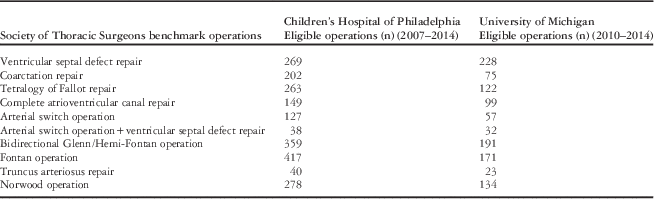
At both centres, eligible patients for the programme include all children aged 0–18 years undergoing any of the Society of Thoracic Surgeons benchmark operations.Reference Jacobs, O’Brien and Pasquali 8 These include 10 operations spanning the spectrum of complexity as described in Table 1.
Eligible operations included in the longitudinal follow-up programmes.

Numbers listed add up to more than the total number of patients as some patients had more than one benchmark operation at different time points during the study period
Data collection
Frequency
As there are no current standards for the time interval for data collection, the programmes at both centres discussed various options and chose to conduct follow-up on an annual basis. This coincides with the frequency of clinical follow-up for many patients, and is in line with the programme goals, which were to understand care and outcomes across the lifespan, rather than smaller changes over shorter periods of time. Initially the CHOP programme began collecting data on an annual basis after a benchmark operation on the patient’s birthday, whereas the UM programme conducted follow-up annually on the basis of the date of surgery. The UM programme is currently transitioning to annual follow-up on the patient’s birthday. Both options appeared to produce similar rates of successful follow-up as described in the results section; however, follow-up based on the birthday/age of the patient allowed for easier adaptability of age-specific questions, and for a more personal connection with children/families each year at the time of their birthday.
Data capture and integration
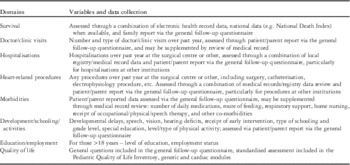
At each centre, a Research Electronic Data Capture (REDCap) Database was built to facilitate data capture.Reference Harris, Taylor and Thielke 9 The database also integrated with local surgical and ICU registry data at each site (local Society of Thoracic Surgeons and Pediatric Cardiac Critical Care Consortium data), which were utilised to identify eligible patients and for collection of baseline characteristics and subsequent hospitalisations and procedures (Table 2). Further linkages with the electronic health record and local congenital heart centre data warehouses allowed ease of access to patient contact information and supported the collection of e-mail addresses for those families who chose to provide this information. At CHOP, e-mail addresses are collected as a part of routine data capture of patient/family contact information and entered into the electronic health record. At UM, this information is captured primarily by clinical care coordinators during the surgical hospitalisation, and is entered into a custom web-based application integrated with the congenital heart centre data warehouse.Reference Bradley, Wu and Goldberg 6
Overview of longitudinal follow-up data collection.

Overview of general domains and variables included in longitudinal follow-up assessment. Not all individual questions are specified. All questions are customised by age
Mode of communication
Before annual communication with the family, local records and the National Death Index are searched to assess survival status (Table 2). For survivors, follow-up with the family was initially conducted via telephone interview by the programme coordinator at each site; however, it was recognised that a system supporting automated and electronic communication with families may both decrease the resource needs of the programme as the number of eligible patients continues to grow, and also be more in line with patient/family preferences regarding modes of communication. A survey conducted at UM of 324 families who had undergone congenital heart surgery suggested that 70% preferred to receive communication via e-mail rather than other options such as phone, mail, social media, text message, etc. On the basis of this information, and guidance provided from the parent and patient stakeholders described in the preceding sections, systems to support electronic communication were subsequently piloted at both centres. At CHOP, a system was built into REDCap to support generation of an e-mail to eligible patients with a link to the annual survey questions. At UM, a system was also constructed within REDCap to allow generation of an e-mail link containing the quality of life questionnaire (see below). As described in the discussion, we have subsequently partnered with healthcare information technology experts to build a comprehensive system to further automate electronic data capture across centres.
Follow-up questionnaire and data
Both centres began collecting follow-up data focussed on survival, burden of disease, and quality of life. Although some of this information may be available in the medical record and/or existing local registry data – for example, hospitalisations or re-interventions at the local site – these data are not necessarily available for patients cared for elsewhere after their initial surgery. In addition, certain variables are best captured via direct patient/parent report. Thus, follow-up questionnaires were designed to capture this information. The questionnaires were initially developed independently at each centre, and over the past year we have collaborated to integrate and standardised specific fields and questions. An overview of data collection is presented in Table 2. The general follow-up questionnaire takes ~5–10 minutes to complete.
In addition to the general follow-up questionnaire, more specific and standardised information regarding quality of life is collected via the Pediatric Quality of Life Inventory, which was initially piloted as a part of the programme at UM. This instrument is the most widely used in the field, has both generic and cardiac modules, allows for both parent and patient report, and has undergone extensive testing for reliability, validity, sensitivity, and responsiveness.Reference Uzark, Jones, Burwinkle and Varni 10 , Reference Uzark, Jones and Slusher 11 It is brief and does not add a significant amount of time to completion of the general questionnaire. In addition, minimal clinically important differences have been determined, as well as cut-off scores corresponding to significant impairments in quality of life. Both of these factors facilitate reporting and ease of use.
Analysis
For the purposes of this report, we have summarised our initial experience and follow-up rates overall, across both centres, and across individual benchmark operations, using standard descriptive statistics. We included all patients eligible for follow-up since the programmes were initiated through December 31, 2014, such that the most recent cohort of patients undergoing surgery during 2014 had the opportunity to complete their first annual follow-up at the time at which the analysis was undertaken in early 2016. Several follow-up rates were reported. The first category was “any” follow-up and consisted of patients with any type of follow-up data available, which at a minimum included the availability of survival data. Those with no contact or documented survival status within 3 years were considered lost to follow-up. We also reported questionnaire completion rates, which included individuals who completed the general follow-up questionnaire as described in the preceding sections and Table 2. Finally, we reported on two pilot populations – the proportion of individuals at UM who completed the Pediatric Quality of Life Inventory to assess more detailed aspects of quality of life, and the proportion of patients who completed the questionnaire via the automated e-mail system piloted at CHOP.
Results
Eligible patients
The longitudinal follow-up programme began in January 2014 at the CHOP. Data were collected on eligible patients undergoing any of the Society of Thoracic Surgeons benchmark operations since January 2007. At the UM, the programme began in January 2015, and data were collected on eligible patients undergoing the benchmark operations since 2010. As described in the preceding sections, the present study includes patients at both centres undergoing surgery through the end of 2014 (n=1737 at the CHOP and n=887 at the UM). The distribution of patients across benchmark operations is displayed in Table 1.
Follow-up rates
Any follow-up
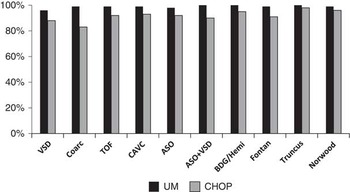
Overall, follow-up data of any type were obtained for 90.8% of eligible patients from the CHOP. The median follow-up time was 4.3 years, and the overall survival, including in-hospital deaths, was 92.2%. At the UM, the overall follow-up rate was 98.3% (median follow-up 2.8 years, overall survival 92.7%). Of note, most patients (69%) lost to follow-up at the CHOP had undergone surgery before 2010. Follow-up rates across benchmark operations are shown in Figure 1, and were similar across institutions and operations.
Follow-up rate across operations and institutions. Data are displayed for both institutions across all benchmark operations, and depict proportion of patients for whom any type of follow-up data were available (at a minimum, survival data). ASO=arterial switch operation; ASO+VSD=arterial switch operation plus ventricular septal defect repair; BDG/Hemi=bidirectional Glenn or Hemi-Fontan operation; CAVC=complete atrioventricular canal repair; CHOP=Children’s Hospital of Philadelphia; Coarc=coarctation repair; Fontan=Fontan operation; Norwood=Norwood operation; TOF=tetralogy of Fallot; Truncus=truncus arteriosus repair; UM=University of Michigan; VSD=ventricular septal defect repair.

Questionnaire completion rates
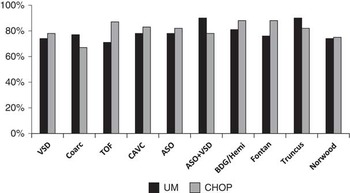
Rates of follow-up questionnaire completion among discharge survivors were also examined. The follow-up questionnaire completion rate was 80.2% at the CHOP and 78.4% at the UM. Data across benchmark operations and institutions are displayed in Figure 2, and were generally similar.
Follow-up questionnaire completion rates across operations and institutions. Data are displayed for both institutions across all benchmark operations, and depict proportion of discharge survivors who completed the general follow-up questionnaire. ASO=arterial switch operation; ASO+VSD=arterial switch operation plus ventricular septal defect repair; BDG/Hemi=bidirectional Glenn or Hemi-Fontan operation; CAVC=complete atrioventricular canal repair; CHOP=Children’s Hospital of Philadelphia; Coarc=coarctation repair; Fontan=Fontan operation; Norwood=Norwood operation; TOF=tetralogy of Fallot; Truncus=truncus arteriosus repair; UM=University of Michigan; VSD=ventricular septal defect repair.

Pilot testing
At the CHOP, beginning in June 2015, an electronic system was piloted where eligible patients (n=1290) received an e-mail with a link to the general questionnaire at the time of their annual follow-up. Completion rates via e-mail were 53.4%. Those who did not respond by e-mail were then subsequently contacted by phone to complete the survey.
At the UM, the Pediatric Quality of Life Inventory was piloted in addition to the general follow-up questionnaire, to assess more detailed information regarding quality of life. Patients could complete the questions either over the phone or via a secure e-mail link. Overall, 55.5% of patients able to be contacted completed the quality-of-life questionnaire.
Discussion
This report describes the development of a collaborative programme to assess standardised longitudinal outcomes in children undergoing heart surgery. Our results suggest that follow-up data can be successfully obtained on the vast majority of patients with similar rates across the two institutions participating in the project, and across benchmark operations of varying complexity. Ongoing prospective enrolment of eligible patients should optimise completeness of follow-up, as the majority of those lost to follow-up were children who had undergone surgery several years before the programme began. Further, our data suggest that approximately half of eligible patients completed the follow-up questionnaires via the e-mail link when this was provided as an option. This is important as it may decrease the resources necessary to develop and maintain longitudinal follow-up programmes over time and across other institutions, as described further in the following sections.
Further analyses are underway to understand the characteristics of patients lost to follow-up, evaluate serial follow-up rates over time, and to begin to evaluate the longitudinal data captured to date. This will inform subsequent studies and quality improvement efforts to optimise follow-up rates and to further understand and improve longer-term outcomes.
Future directions
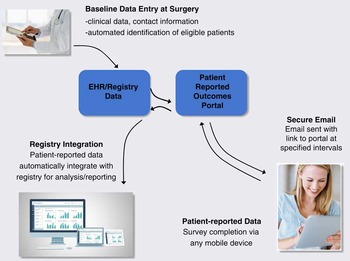
Although the present study suggests that standardised follow-up data collection is feasible, there are several additional challenges to address. Although follow-up by phone can be successful, it is resource intensive and likely will not be feasible at all centres, particularly as the number of patients eligible for follow-up continues to grow. In addition, our survey data suggest that families prefer to communicate electronically. Our pilot study aimed at addressing these two issues suggests that approximately half of patients will complete follow-up questionnaires electronically when given this option, reducing the number of families for which phone follow-up is required. In order to further this work, we have partnered with experts in healthcare information technology at ArborMetrix Inc. (Ann Arbor, Michigan, United States of America) who have expertise in the design of automated systems to support secure collection of longitudinal patient-reported outcomes data. 12 , Reference Fernando, Landreneau and Mandrekar 13 This system will expand upon our pilot study and utilise existing baseline demographic and patient information collected within a site’s local clinical registries, as well as contact information available in the electronic health record, to automate the process of identifying eligible patients and automatically initiate an e-mail request for completion of the annual follow-up questionnaire with a link to a secure portal containing the survey questions (Fig 3). Programme coordinators will continue to provide the option of phone follow-up to those who prefer this option or do not complete the questionnaire electronically, and the system is able to generate automatic reminders for programme staff for this purpose. The system can function across different registries and electronic health record platforms, and the collected longitudinal outcomes data are automatically merged with the existing registry in order to facilitate research, quality improvement, and benchmarking activities.
Methodology for automating and integrating collection of follow-up data.

Conclusions
Standardised capture of follow-up data in children undergoing heart surgery is feasible. This information will be critical in better understanding longer-term outcomes including survival, re-interventions, functional status, and quality of life in this patient population. Ongoing efforts to integrate with existing registry data and the electronic health record may decrease the resources necessary to implement and maintain longitudinal follow-up programmes across sites, as well as facilitate multi-centre research, quality improvement, and benchmarking activities geared towards improved long-term outcomes in children with heart disease.
Acknowledgements
The authors are grateful to the patients and parents at both institutions, the Patient and Family Centered Care Program at UM, and the Pediatric Congenital Heart Association who provided guidance regarding the development and implementation of the follow-up programmes and questionnaires.
Financial Support
At CHOP, this project was supported in part by the Daniel Tabas Chair. At UM, project support was provided in part by the Janette Ferrantino Professorship, the Delta Golf Classic, Rooney and Van Hooser Families, and other generous donors to CHAMPS for Mott.
Conflicts of Interest
Dr M. G. G. is Executive Director of the Pediatric Cardiac Critical Care Consortium (PC4) and receives support from the National Heart, Lung, and Blood Institute (grant 1K08HL116639, PI: M. G. G.). Justin B. Dimick, MD, is primary mentor to Dr M. G. G. on K08HL116639. Dr Dimick is the Co-Founder and an equity owner at ArborMetrix Inc. (Ann Arbor, MI); PC4 hospitals subcontract to ArborMetrix, which provides software and health information technology services to measure quality and cost efficiency.