Cognitive-behavioural therapy (CBT) is a recommended psychological treatment for unipolar depression with many randomized controlled trials (RCTs) providing evidence for its efficacy (DeRubeis et al., Reference DeRubeis, Hollon, Amsterdam, Shelton, Young, Salomon, O'Reardon, Lovett, Gladis, Gallop, Brown and Gallop2005; Cuijpers et al., Reference Cuijpers, Cristea, Karyotaki, Reijnders and Huibers2016). However, it only achieves remission for less than half of treated patients (DeRubeis et al., Reference DeRubeis, Hollon, Amsterdam, Shelton, Young, Salomon, O'Reardon, Lovett, Gladis, Gallop, Brown and Gallop2005; Cuijpers et al., Reference Cuijpers, Karyotaki, Weitz, Andersson, Hollon and van Straten2014). CBT targets key mechanisms in the maintenance of depression such as negative thinking and behavioural avoidance. One potential way to improve the efficacy of CBT is to adapt it to specifically target another key mechanism in depression, namely rumination (Watkins, Reference Watkins2015). Rumination, defined as repetitive negative thinking about the symptoms of depression and their causes and consequences (Nolen-Hoeksema and Morrow, Reference Nolen-Hoeksema and Morrow1991), has been shown to predict the onset, severity and duration of depressive episodes (Nolen-Hoeksema, Reference Nolen-Hoeksema2000; Nolen-Hoeksema et al., Reference Nolen-Hoeksema, Wisco and Lyubomirsky2008), and is associated with slower treatment response and poorer rates of recovery when using antidepressant medication and cognitive therapy (Ciesla and Roberts, Reference Ciesla and Roberts2002; Jones et al., Reference Jones, Siegle and Thase2008). Moreover, because rumination is shown to exacerbate negative affect, impair problem-solving, reduce motivation, and block individuals from connecting with both direct positive experience and evidence disconfirmatory of negative beliefs (Nolen-Hoeksema et al., Reference Nolen-Hoeksema, Wisco and Lyubomirsky2008; Watkins, Reference Watkins2008), tackling rumination is likely to enhance the treatment benefits of cognitive-behavioural approaches. Further, as a transdiagnostic process also contributing to anxiety disorders (Watkins, Reference Watkins2008), targeting rumination may improve treatment for depression with co-morbid anxiety. As a consequence, directly tackling rumination has been recommended to improve interventions for depression (e.g. Topper et al., Reference Topper, Emmelkamp and Ehring2010; Drost et al., Reference Drost, Van der Does, van Hemert, Penninx and Spinhoven2014; Grierson et al., Reference Grierson, Hickie, Naismith and Scott2016; Spinhoven et al., Reference Spinhoven, Klein, Kennis, Cramer, Siegle, Cuijpers, Ormel, Hollon and Bockting2018). Rumination-focused CBT (RFCBT) was therefore developed as a modification of CBT to explicitly target depressive rumination (Watkins, Reference Watkins2016) and features two key novel adaptations of standard CBT: (1) based on a theoretical conceptualization of rumination-as-a-mental-habit (Watkins and Nolen-Hoeksema, Reference Watkins and Nolen-Hoeksema2014), it uses functional analysis to change rumination by identifying its triggers and practicing alternative behaviours to these cues; (2) based on experimental research indicating that the consequences of repetitive thought depend on the information processing style adopted (Watkins et al., Reference Watkins, Moberly and Moulds2008), it trains patients to shift into a more adaptive style of processing (Watkins, Reference Watkins2008). It differs from standard CBT by not involving direct thought challenging and by focusing on shifting the process of thinking rather than the content. RFCBT has been shown to improve outcomes in treatment-resistant residual depression (Watkins et al., Reference Watkins, Mullan, Wingrove, Rimes, Steiner, Bathurst, Eastman and Scott2011). Although the reduction in depressive symptoms in that study reported for RFBCT was better than the reduction reported in a RCT of standard CBT for residual depression (Paykel et al., Reference Paykel, Scott, Teasdale, Johnson, Garland, Hons, Moore, Jenaway, Cornwall, Hayhurst, Abbott and Pope1999), to date, no RCT has directly compared RFBCT v. standard CBT, nor directly investigated RFCBT for patients with a current major depressive episode. This study therefore reports the first RCT directly comparing RFCBT v. CBT for major depression. A group format for delivering therapy was chosen to improve cost-effectiveness and vicarious learning, and to reduce experiences of loneliness and shame, through sharing and normalization within the group. Even though a group format may limit flexibility in tailoring the therapy for the individual patient, evidence suggests that group therapy has equivalent outcomes compared with individual therapy (Burlingame et al., Reference Burlingame, Gleave, Erekson, Nelson, Olsen, Thayer and Beecher2016). The aim of this study was to test the hypothesis that group RFCBT would be superior to group CBT in reducing symptoms of depression post-treatment, when added to standard medical management.
Method
The study was approved by the National Committee on Health Research Ethics in Denmark (case no. H-1-2013-049) and the trial was registered at ClinicalTrials.gov (registration no. NCT02278224) on 28 October 2014. The study protocol was published in Trials on 17 August 2015 (Hvenegaard et al., Reference Hvenegaard, Watkins, Poulsen, Rosenberg, Gondan, Grafton, Austin, Howard and Moeller2015).
Design
The study was conducted as a two-arm, assessor-blinded, randomized superiority trial. Participants were randomly allocated in a 1:1 ratio to groups of seven to nine participants providing CBT plus medical management or RFCBT plus medical management. Medical management was defined as clinical management and treatment by a trained and experienced psychiatrist at the outpatient service, including the potential prescription of antidepressant medication. Randomization was performed by an external statistical agency (Statcon, DK) according to an independent pre-study off-site computer-generated schedule with randomly ordered permutable blocks sized 6–10. A researcher (MH) masked and kept blind to treatment allocation assessed all participants at baseline (T 0) and 12 weeks later after completing treatment (T 1) with all primary and secondary measures and at the 6 months post-treatment follow-up (T 2) with the primary measure only. After completing each follow-up T 2 assessment or following the point in time in which the T 2 assessment was scheduled for those who did not attend, the assessor completed a forced guess of treatment allocation for each participant, and the accuracy of the guesses was at chance level (48.9%), consistent with blindness.
Participants
Recruitment occurred from December 2013 to July 2015 from a public health system outpatient clinic north of Copenhagen, Denmark, which treats 200–250 patients with a diagnosis of major depression per year. The clinic is a secondary mental health care facility and offers treatment for patients referred from primary care with affective disorders, post-traumatic stress disorder and personality disorders, including specialized treatment for difficult-to-treat depression. Most patients with depression in the outpatient clinic had received treatment with antidepressant medication and/or psychotherapy in primary care prior to the referral. Consecutive referrals to the outpatient service were approached, and those patients who met inclusion criteria and gave written informed consent to participate were randomly allocated to group RFCBT or to group CBT. When baseline assessment was completed, the off-site randomization administrator informed the relevant therapist to contact the patient and initiate the allocated intervention.
Inclusion criteria were: aged between 18 and 65 years, meeting Diagnostic and Statistical Manual of Mental Disorders, Fourth Edition (American Psychiatric Association, 1994) criteria for a current episode of unipolar major depression in a structured M.I.N.I. 5.0 interview (Sheehan and Lecrubier, Reference Sheehan and Lecrubier1998) and with a score of ⩾13 on the 17-item Hamilton Rating Scale for Depression (HRSD; Hamilton, Reference Hamilton1960). Exclusion criteria were: a history of bipolar disorder, psychosis, current (past 6 months) drug or alcohol abuse or dependence, a primary diagnosis of any anxiety disorder, anorexia, or bulimia, all determined by the M.I.N.I 5.0 interview, imminent and substantial suicide risk as assessed by an experienced psychiatrist or clinical psychologist, and concurrent psychotherapy at point of entry to the study. There were no exclusion criteria with respect to co-morbid anxiety disorders or the use of antidepressants.
Outcome measures
The primary outcome was severity of depressive symptoms measured with the 17-item interviewer-rated HRSD at post-treatment (T 1). All other measures were secondary outcomes and included change between T 0 and T 1 in self-reported rumination, worry, anxiety and severity of depressive symptoms. Self-report measures of behavioural activation, well-being, a neuropsychological test of task switching and a computer-based test of visual emotional attention bias were also included but will not be reported in this paper. Suicidal behaviour/ideation was monitored during the trial in accordance with the guidelines from the Danish Health Authorities.
Primary outcome measure
Hamilton Rating Scale for Depression
The HRSD (Hamilton, Reference Hamilton1960) is a standardized clinical interview developed to assess severity of depression that includes scoring the test persons answers as well as direct observation of the test person. Higher scores suggest higher levels of symptoms of depression (range 0–52). A Danish version of the 17-item HRSD interview guide was used (Bech and Larsen, Reference Bech and Larsen2012). Masked ratings of randomly selected recorded interviews (18%) indicated moderate to strong inter-rater reliability between the interviewer and the masked rater, all κ coefficients >0.76. The HRSD was conducted as a face-to-face structured interview at T 0 and T 1. The HRSD at T 2 was conducted as a mixture of face-to-face interviews (43%) and telephone interviews (57%); telephone interviews were used for convenience to increase patient retention.
Secondary outcomes measures
Ruminative Response Scale of the Response Style Questionnaire
The Ruminative Response Scale (RRS) (Nolen-Hoeksema and Morrow, Reference Nolen-Hoeksema and Morrow1991) consists of 22 items that assess ruminative responses to sad and depressed mood. Participants rate the frequency that they use unhelpful ruminative strategies, and higher scores suggest higher levels of rumination (range 22–88).
Generalized Anxiety Disorder 7-item Scale
The Generalized Anxiety Disorder 7-item Scale (GAD-7) (Spitzer et al., Reference Spitzer, Kroenke, Williams and Löwe2006) consists of seven items that assess the severity of generalized anxiety. Participants rate the frequency that they experience symptoms of anxiety, and higher scores suggest higher frequency of symptoms (range 0–21).
Penn State Worry Questionnaire
The Penn State Worry Questionnaire (PSWQ) (Meyer et al., Reference Meyer, Miller, Metzger and Borkovec1990) consists of 16 items that assess the general disposition to worry. Participants rate statements about worry on a scale of 1 (‘not at all typical of me’) to 5 (‘very typical of me’). Higher scores suggest higher level of worry (range 16–80).
Hamilton Self-report Questionnaire
The Hamilton Self-report Questionnaire (HAM-D6) consists of six items that assess the severity of symptoms of depression (Bech, Reference Bech1975). Participants rate intensity of symptoms, and higher scores suggest higher levels of symptoms of depression (range 0–22).
Interventions
RFCBT is a principle-driven manualized CBT treatment for depression, adopting a behavioural activation perspective (Martell et al., Reference Martell, Addis and Jacobson2001), in which rumination is conceived as a learnt habitual behaviour developed through negative reinforcement (Watkins and Nolen-Hoeksema, Reference Watkins and Nolen-Hoeksema2014). Based on this conceptualization, rather than challenging individual negative thoughts, RFCBT uses functional analysis to change rumination by helping patients to learn to identify antecedent cues and triggers to rumination, control exposure to these cues and repeatedly practice alternative behaviours to these cues. Further, based on experimental research indicating that the consequences of repetitive thought depend on information processing style (Watkins et al., Reference Watkins, Moberly and Moulds2008), it trains patients to shift into a more adaptive style of processing. Alternative responses include activity scheduling, imagery, recreating experiences of being absorbed (‘flow’) or of increased compassion to self or others, and/or shifting into a more concrete and specific thinking style (Watkins, Reference Watkins2008). A group version consisting of a one-to-one individual preparatory session of 1 h and 11 group sessions of 3 h with two breaks, scheduled weekly, was developed in collaboration with Edward Watkins (EW) – the original developer of RFCBT (Møller et al., Reference Møller, Hvenegaard and Kistrup2017). Trial recruitment, data collection and analysis of data were conducted in Copenhagen independently of EW.
CBT was based on Beck's CBT manual for depression (Beck, Reference Beck2011) adapted to a group format, which was the routine treatment already being used in the outpatient service. It consisted of a one-to-one individual preparatory session of 1 h followed by 11 group sessions of 3 h with two breaks, scheduled weekly. Both treatment manuals are described in online Supplement 1.
The therapists in both treatment conditions were employees in the psychiatric clinic in which the patients were recruited. Therapists were not chosen or allocated on the basis of therapeutic allegiance or experience: the therapists in the CBT arm were already delivering CBT groups for depression in the clinic; the RFBCT therapists were chosen on the basis of their availability for training and to deliver new treatment groups. All therapists had prior CBT training and had completed at least one year or more of formal education in CBT. The therapists in both treatment conditions had equivalent levels of training and experience as CBT therapists (9 years on average), and received equivalent levels of video supervision during the trial (1 h a month). In addition, the therapists conducting RFCBT received a 3-day training workshop on RFCBT conducted by the developer of the therapy (EW). Prior to the trial, a pilot group in both conditions was conducted with video supervision provided.
All therapy sessions in the trial were videotaped. For both treatment conditions, a random sample of 16 (18%) videotapes, stratified by therapy group and therapy session, were rated for therapist's competence and adherence to treatment manual by four independent raters. For each treatment, based on the detailed and structured therapy manual (Watkins, Reference Watkins2016; Møller et al., Reference Møller, Hvenegaard and Kistrup2017), there was a checklist of the required and prohibited therapy components. To assess adherence to treatment manuals, the raters used each checklist to record the presence or absence of these key therapy components in the rated sessions for each treatment. For both treatment conditions, no prohibited components were reported and the presence of required therapy key components was high (CBT 98%; RFCBT 98%).
Therapists’ competence was rated using the 11-item Cognitive Therapy Rating Scale (CTRS) for the CBT condition (Young and Beck, Reference Young and Beck1980). For the RFCBT condition, an adapted version of the CTRS was used. The first six items reflecting general skills common to both therapies (e.g. agenda setting, asking for feedback, therapist empathy, interpersonal effectiveness, collaboration and efficient use of time) were the same. To capture the novel components of RFCBT, other item scales were adapted as required to reflect specific RFCBT competence, e.g. item 8 ‘Focusing on key cognitions or behaviours’ was changed to ‘Focusing on key cognitions or behaviours relevant to functional analysis’, item 9 ‘Strategy for Change’ was adapted to ‘Focus on changing thinking style’ and item 10 ‘Application of Cognitive-Behavioural Techniques’ was adapted to ‘Application of RFCBT techniques’. A total score of 40 or greater on the CTRS represents the standard threshold of acceptable competence in CBT delivery (Dobson et al., Reference Dobson, Shaw and Vallis1985). CTRS scores for all the rated sessions for both CBT [M = 43.6, standard deviation (s.d.) = 2.1] and RFCBT (M = 46.3, s.d. = 2.2) were 40 or above for all raters, evidencing good quality of treatments delivered by the CBT and RFCBT therapists. The inter-rater reliabilities in both conditions were moderate-to-good (RFCBT: κ = 0.65; CBT: κ = 0.66).
Statistical analysis
The primary and secondary outcomes were analysed using a multilevel regression model with treatment condition (RFCBT v. CBT) as main effect, therapy group as random intercept, baseline (T 0) scores as covariate and T 1 scores as the dependent variable. The analysis was performed according to the intention-to-treat principle (ITT, i.e. all participants according to randomization), with multiple imputations of missing data. For post-treatment, 12.2% of HRSD scores were missing. Multiple imputations conducted with MICE package in R-studio (van Buuren and Groothuis-Oudshoorn, Reference van Buuren and Groothuis-Oudshoorn2011) were used to account for missing data for all primary and secondary outcomes. No difference was found on HRSD baseline scores for participants with missing HRSD T 1 scores (M = 20.1, s.d. = 6.8) and complete cases (M = 19.9, s.d. = 4.9). See online Supplement 2 for a full description of the missing data and the multiple imputations method.
We calculated the sample size required based on the relative changes in HRSD scores pre- to post-treatment for RFCBT (Watkins et al., Reference Watkins, Mullan, Wingrove, Rimes, Steiner, Bathurst, Eastman and Scott2011) and CBT (Paykel et al., Reference Paykel, Scott, Teasdale, Johnson, Garland, Hons, Moore, Jenaway, Cornwall, Hayhurst, Abbott and Pope1999) for patients with residual depression in prior RCTs. Assuming similar mean changes in HRSD scores from pre- to post-intervention as found by Watkins et al. (Reference Watkins, Mullan, Wingrove, Rimes, Steiner, Bathurst, Eastman and Scott2011) for RFCBT (M = 7.8) and by Paykel et al. (Reference Paykel, Scott, Teasdale, Johnson, Garland, Hons, Moore, Jenaway, Cornwall, Hayhurst, Abbott and Pope1999) for CBT (M = 3.5) and a conservative estimate of pooled s.d. for change in HRSD of 6.0 (when s.d. = 3.6 for change in HRSD in RFCBT from Watkins et al., Reference Watkins, Mullan, Wingrove, Rimes, Steiner, Bathurst, Eastman and Scott2011), we estimated a between-treatment effect size of Cohen's d = 0.7. To detect a difference in effect size of 0.7 between RFCBT and CBT at a two-tailed significance level of 5%, each treatment arm requires 44 patients to obtain 90% statistical power. Assuming a lost to follow-up rate of 20%, we would recruit 55 patients into each treatment arm. With an average size of the therapy group of m = 8 in both treatment arms and an intraclass correlation of about ρ = 0.05, a design effect of 1 + (m − 1)ρ = 1.35 followed, so that we planned to recruit eight groups in each treatment arm (128 patients in total). Initial sample size (N = 112) was adjusted upwards based on recommendations to control for design effects in group studies – this occurred after recruitment commenced, but before it completed, and was published in the study protocol (Hvenegaard et al., Reference Hvenegaard, Watkins, Poulsen, Rosenberg, Gondan, Grafton, Austin, Howard and Moeller2015). The analysis plan was decided prior to the data collection and was described in the published study protocol (Hvenegaard et al., Reference Hvenegaard, Watkins, Poulsen, Rosenberg, Gondan, Grafton, Austin, Howard and Moeller2015).
Results
Patient flow
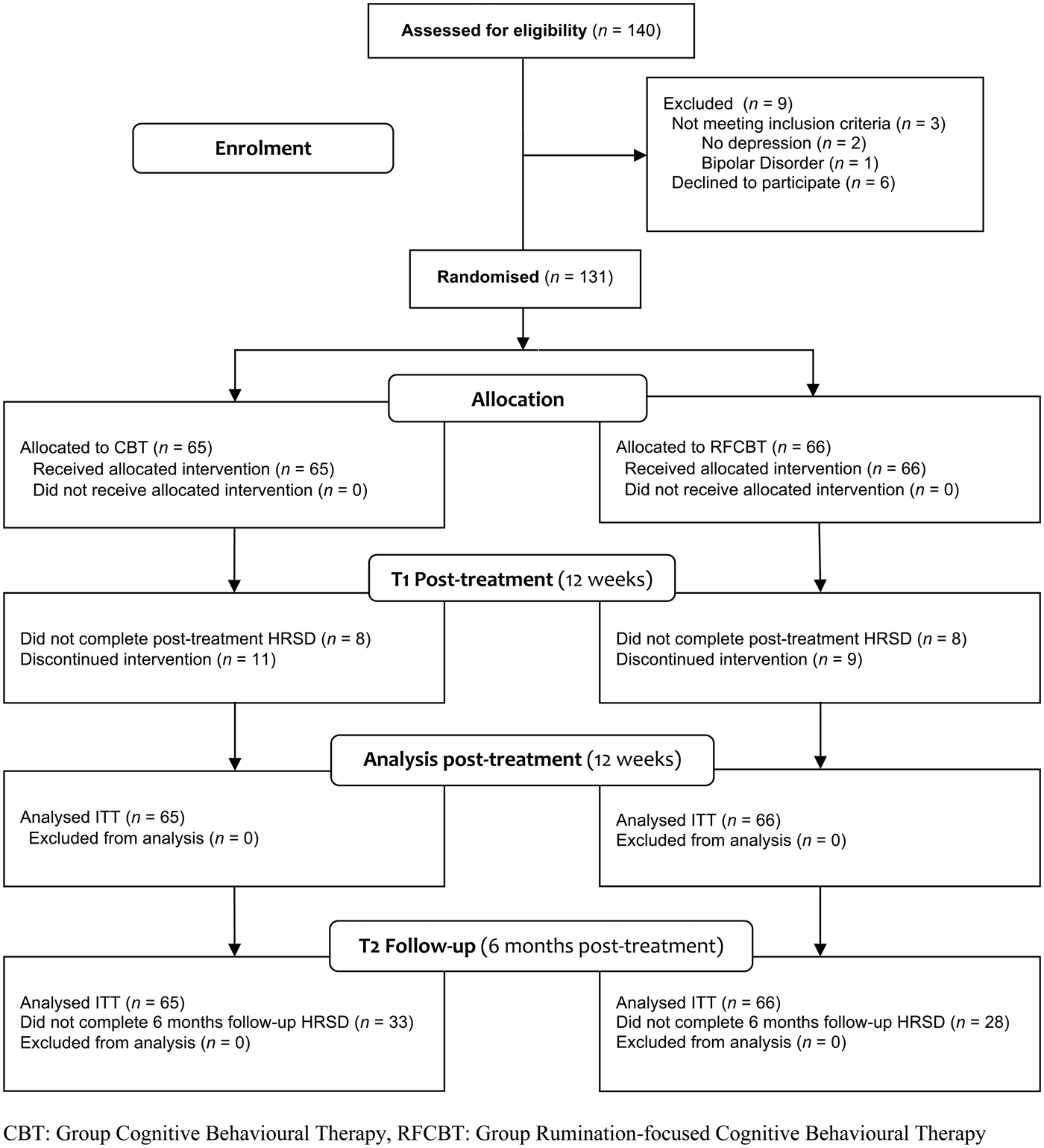
A total of 140 patients from a public Danish psychiatric outpatient service were screened and 131 patients who agreed to participate and met the inclusion criteria were randomized to either group RFCBT (n = 66) or group CBT (n = 65). Figure 1 shows the participant flow from screening to follow-up. The main reasons for potentially eligible individuals not participating were that they declined to participate (6.4%) or they did not meet study criteria (3.2%). Main reasons for not meeting the inclusion criteria were: not meeting criteria for an episode of major depression, or meeting criteria for bipolar depression.
CONSORT 2010 flow diagram. CBT, group cognitive-behavioural therapy; RFCBT, group rumination-focused cognitive-behavioural therapy.
All participants across both treatment conditions were offered clinical management and treatment with antidepressant medication by a trained and experienced psychiatrist at the outpatient service. The number of participants receiving antidepressant medication did not differ between CBT and RFCBT [59 of 65 (91%) v. 60 of 66 (91%); χ2 = 0.001; p = 0.978]. See online Table S3 in Supplement 3 for full details on number of participants receiving antidepressant medication, types of antidepressant medications, dosage of antidepressant medications and for statistics showing no significant differences between the uses of medications in the two treatment conditions. All participants were offered at least consultation by a psychiatrist in the outpatient clinic on their use of medication during the treatment. Participants’ verbal reports of side effects of the medication and non-compliance with the medical treatment were reported in the participants’ medical files. The number of participants reporting no side effects of medications (CBT: n = 44, 67.7% v. RFCBT: n = 50, 75.8%; χ2 = 1.051, p = 0.305) and the number of participants reporting non-compliance with medical treatment (CBT: n = 4, 6.1% v. RFCBT: n = 2, 3.0%; χ2 = 0.731, p = 0.39) did not differ between the two treatment conditions. See online Table S4 in Supplement 4 for full details on side effects of medical treatment. The number of consultations with a psychiatrist during the trial did not differ between CBT and RFCBT (M = 1.1, s.d. = 1.4 v. M = 1.1, s.d. = 1.6; t = −0.174, p = 0.862).
One participant was hospitalized for prevention of suicide during the trial. To assess deterioration, we calculated a Reliable Change index (RC; Jacobson and Truax, Reference Jacobson and Truax1991) for the HRSD of 6.5 points. The RC was calculated using the α coefficient (α = 0.789) from a meta-analysis on the reliability of the HRSD scale (Trajković et al., Reference Trajković, Starčević, Latas, Leštarević, Ille, Bukumirić and Marinković2011) and by dividing the HRSD change score with the standard error of difference. No participant showed deterioration exceeding the RC and only two participants (one in CBT, one in RFCBT conditions) reported a deterioration of more than 3 points on the HRSD.
For both conditions, overall treatment compliance was good: there was no difference in the number of group sessions attended between CBT and RFCBT (M = 8.3, s.d. = 3.2 v. M = 8.8, s.d. = 2.8; t = −1.2, p = 0.226), nor in the number of participants who dropped out of treatment [11 of 65 (17%) v. 9 of 66 (14%); χ2 = 0.273; p = 0.601].
A total of 114 (87%) completed the post-treatment assessment (T 1). Despite repeated attempts to contact all participants, only half of the patients could be contacted and then participated in the T 2 follow-up assessment 6 months post-treatment (70, 53%), reducing our statistical power for T 2 analyses. The last patient was randomized on 26 May 2015. Follow-up data were obtained between 4 March 2014 and 15 January 2016. No harms or side effects of psychological interventions, or adverse events were reported during the trial.
Participant characteristics
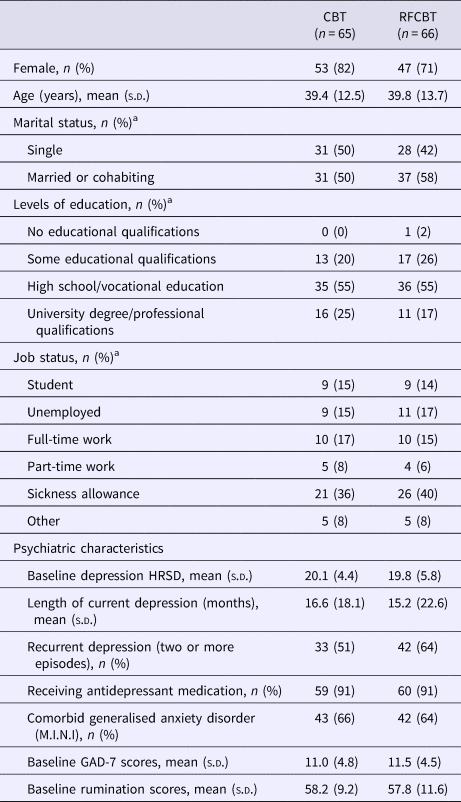
Table 1 shows participant characteristics of the ITT sample for both the RFCBT and CBT groups. Twenty-six per cent had chronic depression lasting 2 years or more, 57% had recurrent depression with a history of two or more depressive episodes, and 65% had a comorbid anxiety disorder.Footnote 1Footnote †
Demographic and psychiatric characteristics of group rumination-focused cognitive-behavioural therapy (RFCBT) and group cognitive-behavioural therapy (CBT)
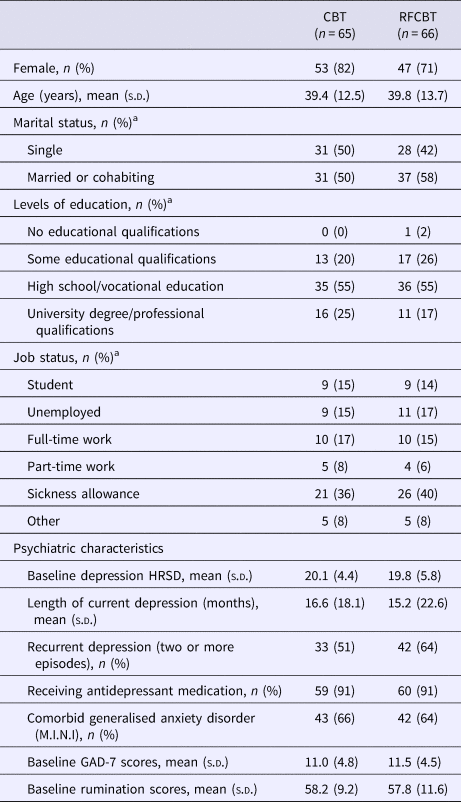
HRSD, Hamilton Rating Scale for Depression (17-item version); GAD-7, Generalized Anxiety Disorders scale; RRS, Ruminative Response Scale (22 items).
a Five patients did not give information on marital status, two did not give information on level of education and seven did not give information on job status. Percentages calculated for valid cases.
Primary outcome
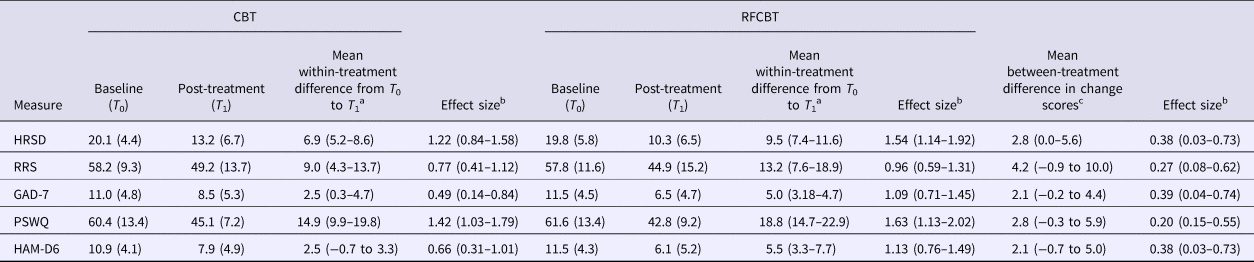
As shown in Table 2, as hypothesized, group RFCBT patients reported a significantly greater reduction in depressive symptoms at post-treatment (T 1) than group CBT patients, after adjusting for difference in baseline HRSD scores (M ΔHRSD = 2.8; 95% CI 0.0–5.6, p = 0.049). A complete case analysis (n = 114; 87% of sample) found similar results: RFCBT resulted in significantly lower between-treatments HRSD scores at T 1 than CBT (M ΔHRSD = 2.7; t = 2.26, 95% CI 0.3–5.1, p = 0.026).
Mean (s.d.) scores on outcome measures at baseline assessment and post-treatment assessment on intention-to-treat sample (N = 131) for group rumination-focused cognitive-behavioural therapy (RFCBT) and group cognitive-behaviour therapy (CBT)

HRSD, Hamilton Rating Scale for Depression 17-item; RRS, Rumination Scale of Rumination Response Style Questionnaire; GAD-7, Generalized Anxiety Disorder; PSWQ, Penn State Worry Questionnaire; HAM-D6, Hamilton Self-report Questionnaire.
a Mean difference from baseline to post-treatment scores (95% CI).
b Cohen's d = M1 − M2/σ pooled, σ pooled = √[(σ 12 + σ 22)/2] (95% CI).
c Between-group effect size for change in symptoms (95% CI).
Secondary outcomes
In both treatments, the levels of self-reported depression, rumination, worry and anxiety were reduced, but no statistical difference was found between RFCBT and CBT for any of these variables at post-treatment (T 1), although we note varying levels of missing data on the questionnaires. Missing secondary outcomes included: RRS (41, 31%), PSWQ (42, 32%), HAM-D6 (41, 31%). In a complete case analysis (n = 87; 66% of sample), RFCBT reduced symptoms of anxiety significantly more than CBT (M ΔGAD-7 = 2.4, 95% CI 0.4–4.4). Complete case analyses on other secondary outcomes were not significant. Change scores from baseline to post-treatment for both primary and secondary outcomes are shown in Table 2. No significant between-treatment difference in average depressive symptoms (i.e. average HDRS at T 2) was found between RFCBT (M = 9.7, s.d. = 7.5) and CBT (M = 8.7, s.d. = 6.8) in the ITT sample at the 6 months follow-up (M ΔHRSD = −1.1, 95% CI −4.1 to 1.9, p = 0.56, E.S. = 0.15).
Discussion
The primary aim of this study was to compare the efficacy of group RFCBT with the efficacy of group CBT for treating major depression.
Treatment effects on depressive symptoms
Consistent with our primary hypothesis, participants in the group RFCBT treatment improved significantly more than those in the group CBT treatment in reducing symptoms of depression at the end of treatment (after 12 weeks). This finding is consistent with the positive results of RFCBT already found for residual depression (Watkins et al., Reference Watkins, Mullan, Wingrove, Rimes, Steiner, Bathurst, Eastman and Scott2011; Teismann et al., Reference Teismann, Von Brachel, Hanning, Grillenberger, Hebermehl, Hornstein and Willutzki2014) and for adolescents at risk for depressive relapse because of a prior history of depression (Jacobs et al., Reference Jacobs, Watkins, Peters, Feldhaus, Barba, Carbray and Langenecker2016). Furthermore, the within-group effect of group CBT in this study was similar to that found in other trials (Oei and Dingle, Reference Oei and Dingle2008). Because it is difficult to find benefits of an intervention compared with another effective intervention, these findings are encouraging. In the absence of a definitive RCT of RFCBT v. CBT with a larger sample and a longer follow-up with less missing data, we tentatively suggest that these modifications made to CBT for RFCBT may engender better treatment outcomes.
The data available for T 2 also indicate that initial treatment effects are stable over the 6 months follow-up. However, the difference in depressive symptoms at 6 months follow-up (T 2) numerically disappeared. However, a large proportion (47%) of patients were lost to follow-up at T 2 and the most parsimonious explanation is that the study was underpowered at follow-up (T 2) to detect a difference on HRSD between the conditions, even if there was a genuine difference in the effect of the treatments. Because of the high attrition at T 2, these secondary analyses need to be treated with caution. Alternatively, it may be that both CBT and RFCBT are similarly effective treatments for depression in the long run, but that the benefits of RFCBT manifest earlier. We are unable to discriminate between these different interpretations in the current study.
Mechanisms of the treatment effect
Surprisingly, group RFCBT did not reduce self-reported rumination significantly more than group CBT. In both conditions, the level of rumination was significantly lower at post-treatment compared with baseline. We note several possible accounts for this observation. First, because of missing data on this secondary measure and follow-up attrition (only 66% completion), the study was underpowered to detect a genuine difference in rumination, unless there was a large effect size between RFCBT and CBT. As such, we need to be cautious about making any strong interpretation of these findings. Second, it may be that group CBT is also effective at reducing rumination, perhaps because challenging negative thoughts, increased problem solving and activity scheduling all act to break the vicious circle of rumination, as suggested in a recent meta-analysis (Spinhoven et al., Reference Spinhoven, Klein, Kennis, Cramer, Siegle, Cuijpers, Ormel, Hollon and Bockting2018), although this meta-analysis also found that treatments targeting rumination tended to produce stronger reductions in rumination.
The lack of a differential effect of the treatments on rumination raises the possibility that shifting rumination was not the active mechanism underpinning the effect of RFCBT. RFCBT differs from standard CBT in a number of ways. Elements unique to RFCBT include engendering the ability to recognize pathological rumination and coaching an ability to adopt more functional styles of processing as an alternative through practise in experiential/imagery exercises, such as concreteness training, absorption training and self-compassion training. Any or none of these elements might be responsible for the apparent differential efficacy between treatments. It has been posited that a behavioural activation approach may be simpler and more straightforward for people with depression, with one study finding that behavioural activation outperformed CBT for patients with more severe levels of depression (Dimidjian et al., Reference Dimidjian, Hollon, Dobson, Schmaling, Kohlenberg, Addis, Gallop, McGlinchey, Markley, Gollan, Atkins, Dunner, Dobson, Shaw and Vallis2006), but others finding no difference (Richards et al., Reference Richards, Ekers, McMillan, Taylor, Byford, Warren, Barrett, Farrand, Gilbody, Kuyken, O'Mahen, Watkins, Wright, Hollon, Reed, Rhodes, Fletcher and Finning2016). The emphasis on habit change in RFCBT may provide a simple and convincing rationale for patients, and may encourage repeated practice of new strategies in daily life engendering more robust change. Because the trial was designed to test the effects of the complete intervention packages, we cannot determine which of the treatment components within RFCBT are responsible for the observed differential treatment effect. The current RCT was designed to mitigate threats to internal validity when evaluating RFCBT relative to CBT and was successful in this intention. However, it was not designed to investigate construct validity (i.e. to determine what aspect of RFCBT contributes to treatment outcome). Nonetheless, the relative outperformance of RFCBT to CBT post-treatment raises the possibility that some elements found in RFCBT but not in CBT may underpin either improved treatment outcomes or faster recovery. Rigorous trial designs that can decompose the active ingredients of treatment (e.g. dismantling studies or factorial designs) are needed to resolve the question of which elements actively underpin outcome.
It is hypothesized that patients with depression would benefit more from RFCBT than classical CBT when they have severe, chronic and treatment-resistant depression, because rumination is found to exacerbate and prolong depression and interfere with treatment, or when they have co-morbid anxiety disorders, because rumination is identified as a transdiagnostic mechanism. However, these hypotheses were not formally tested in this trial.
Limitations of the study
This study has several limitations. First, the principal limitation is the missing data on secondary outcomes and the high follow-up attrition rate at 6 months, which limit conclusions for these outcomes. Ideally, more participants would have been retained at 6-month follow-up and follow-up would have continued for at least 2 years post-treatment to examine rates of relapse and recurrence longer term. Resource constraints meant that this was not feasible. Nonetheless, the trial was well-powered to answer the primary aim and there was little missing data on the primary outcome. Second, because we did not evaluate non-specific therapy factors such as patient expectations, therapy allegiance and treatment credibility, we cannot rule out the possibility that differences in non-specific factors may account for the observed difference in treatment outcomes. Third, there was no active monitoring of changes in antidepressant medication over the course of the trial making it impossible to assess the impact of any such changes to the primary and secondary outcomes. However, no difference was found in the use of antidepressant medication throughout the trial between the treatment conditions as assessed from medical records (see online Supplement 3). Fourth, the lack of consecutive repeated HRSD assessments at post-treatment limits our ability to assess the proportion of participants who achieved remission (lasting >3 weeks). Fifth, no systematic assessment of potential harm effects of psychotherapy was conducted, as now recommended (e.g. Schneibel et al., Reference Schneibel, Wilbertz, Scholz, Becker, Brakemeier, Bschor, Zobel and Schmoll2017). Sixth, registration of the trial happened almost 1 year after the trial commenced and sample size was increased during recruitment into the trial to include the recommended design effect to account for the reduced variability of participants treated in the same therapy group (Roberts and Roberts, Reference Roberts and Roberts2005), although this amendment was included in the published trial protocol. Seventh, we were unable to examine to what extent participants may have received CBT or not (CBT-naïve) prior to the trial, as no record of prior psychotherapy before entering the secondary outpatient service was routinely collected. However, it is unlikely that participants received CBT prior to the referral, as CBT is not routine treatment in Danish primary care services and patients are typically referred to the secondary service in order to receive CBT for depression: the secondary out-patient service is the principal route to access CBT for depression in the Danish healthcare system.
In conclusion, this study is the first RCT to conduct a head-to-head comparison of group RFCBT and group CBT for patients with major depression. The finding that a novel adaptation of traditional CBT (Rumination-focused CBT) performs significantly better in reducing observer-rated depressive symptomology at 12 weeks than an established empirically validated intervention (CBT) in a reasonably well-powered study is noteworthy, as it is rare for new treatments to outperform current treatments. As a minimum, these results suggest the potential benefits of rumination-focused CBT as an alternative to standard CBT for depression in this population. Nonetheless, as a single study, we need to be cautious about this finding and there is a need for larger, multicentre RCTs to replicate these findings in other settings and to examine cost-effectiveness in a definitive Phase III trial.
Supplementary material
The supplementary material for this article can be found at https://doi.org/10.1017/S0033291718003835.
Acknowledgements
We are grateful to the people who participated in the trial and to the physicians and other healthcare staff who enabled the trial, especially the research workers and therapists on the trial. MH and EW were the lead authors on the manuscript and MH and MG analyzed the data. All authors interpreted the data. MH, EW, SM designed the study. EW led the training and supervision of the rumination-focused CBT treatment. NR led the training and supervision of the CBT treatment. MH coordinated the recruitment and follow-ups of participants. MK, SM and SA provided the interventions. NR and HH organised the treatment fidelity ratings. All authors contributed to the writing of the manuscript and approved the final version.
Financial support
The Trial was funded by the University of Copenhagen, Mental Health Service in the Capital Region of Denmark and TrygFonden.
Conflict of interest
None.