In 1784, a House of Commons committee reported on its investigations into frauds committed against the revenue service. Led by the legal reformer William Eden, it examined the “illicit practices,” such as smuggling, that prevented Customs and Excise from carrying out its work. An appendix to the report detailed the goods banned from being imported into Britain. Textiles feature heavily in the appendix, which records the distribution and use of more than twenty types of silks and silk mixes.Footnote 1 East India painted silks, French brocades, and silk stockings, ribbons, gloves, and braiding were all prohibited.Footnote 2 Such detailed restrictions were the outcome of a longer history of state regulation. In 1700, Parliament moved against wrought silks and stuffs mixed with Asian silks; in 1706 it banned French alamodes, lustrings, ribbons, and laces. All foreign gold and silver lace had been prohibited by 1749. All foreign wrought silks and velvets were outlawed in 1765, as were ready-made silk garments and accessories. Those found guilty of illegally importing silks could be fined one hundred pounds and have all apparel seized.Footnote 3
English silk manufacturers won this legislation through sustained lobbying.Footnote 4 Although it was the smaller of the textile industries, silk received considerable state attention because of the prestige derived from its core market of elite consumers, the high value of its products, and the sophistication of the technology and skills involved in its production. The prohibitions on foreign silks were part of a mercantilist policy designed to shield domestic textile manufacturers—including the much larger woolen and worsted sectors—from foreign competition.Footnote 5
Historians have emphasized how this protectionism developed in response to Asian textile imports. Although the cargos coming from Asia contained silks alongside cottons and mixed-fiber fabrics, a significant body of work has focused on printed and painted Indian cottons (often called calicos). These products had been known in Europe since the sixteenth century,Footnote 6 but it was a period of aggressive marketing by the East India Companies in the last three decades of the seventeenth century that produced a political reaction. Manufacturers believed that the bold, printed, floral patterns, the quality of the fabric, and the competitive pricing attracted consumers at the expense of fabrics made in Britain.Footnote 7 The reaction against Asian textiles resulted in the so-called Calico Acts, with the final act in 1721 banning Asian textiles from being sold and worn in the domestic market.Footnote 8 Historians of cotton, such as Giorgio Riello, and of smuggling, like Michael Kwass, assume that the ban on cottons was widely broken in Britain and France.Footnote 9 Contemporaries thought that the British prohibitions on foreign silks were being violated in the same manner.Footnote 10
Who were the smugglers undermining mercantilist policy, and how did they work? Given that all foreign silks were prohibited, where exactly did the smuggled silks come from? Potential consumers of these products could range from the fashionable metropolitans of the “beau monde” for the painted silks or brocades, to professional families who sought quality fabrics, to a wider middling group who might buy the more affordable items, like ribbons.Footnote 11 Were the consumers of contraband silks all the same, or were black marketers selling to distinct social groups? These questions are part of the wider historiographical debate on how other countries influenced consumer culture in Britain. Whether Britain experienced a “consumer revolution” during the long eighteenth century remains a disputed point among historians. What is clear, however, is that the content and character of consumption changed in important ways between the 1680s and 1820s.Footnote 12 For historians of this period, explaining how that change took place remains a key task.
One explanation is that transnational influences provoked a response from consumers and producers in Britain. One region that was particularly influential was Asia, principally India and China. Studies of cottons and porcelains have provided case studies for the role of Asia in changing British consumer culture. After a “craze” for Indian cottons and Chinese ceramics at end of the seventeenth and beginning of the eighteenth centuries, British manufacturers responded to the new goods through conscious import substitution, or a blending of styles and materials to create hybrid products. This took some time, as artisans found it hard to replicate the finishing techniques—or find equivalent materials—used by their Indian and Chinese counterparts. However, by the second half of the eighteenth century, cotton printers and porcelain producers were finding success in consumer markets: British producers and consumers had domesticated products that were once exotic.Footnote 13
The emergence of distinctly British consumer goods is complemented by two related historiographies: the creation of “Britishness” as a patriotic, Protestant identity; and the emergence of Britain as an imperial power. Linda Colley and Kathleen Wilson have both argued that the long period of conflict from the War of the Spanish Succession to the Napoleonic wars shaped an assertive national identity in Britain that defined itself against imperial rivals, above all the French.Footnote 14 The process of identity formation at the political level mirrors the emergence of a newly confident British “taste” and design culture by the second half of the eighteenth century.Footnote 15 Indeed, Gerald Newman and Michéle Cohen have used controversies over French influences on fashion and style as evidence for the emergence of national identity. “Slavish” followers of French manners and clothes came under attack by such self-styled patriots as William Hogarth and the Anti-Gallican Society.Footnote 16 The historiography of food and drink also stresses the importance of imperial connections to changing British consumption. Colonial trade networks and the plantation system in the Atlantic made the popularity of sugar and tobacco possible. The role of the East India Company as the main supplier of tea reinforces the argument that extra-European trade shaped new tastes.Footnote 17
Even so, the importance of Asian and imperial trade to consumption in Britain should not be overstated. From a macro perspective, Jan De Vries has been skeptical about the significance of the trade in Asian goods for European markets, noting its small proportion of overall trade, and the difficulty the trading companies had in sustaining profits.Footnote 18 Historians debate how popular the new goods such as calicos really were. Beverley Lemire has argued non-elite consumers adopted calicos early in the eighteenth century, while John Styles has presented evidence that this happened much later, in the 1790s.Footnote 19 Giorgio Riello notes that the prices of calicos imported by the East India Company increased after the 1720s, positioning them firmly as luxury goods.Footnote 20 Styles has also questioned the extent of the influence of Indian textiles on European producers. He argues that the use of floral motifs and the search for lighter fabrics had begun in the late Middle Ages, before the rise of direct seaborne trade with India and China.Footnote 21 Differences over the popularity of Asian goods reflect wider arguments about the role of social distinction, fashion, and price in the “consumer revolution.”Footnote 22
Looking at other commodities shows that Europe was as important as Asia or the Americas in supplying British consumers. Stephen Conway's work has shown that Britain's cultural relationship with Europe was more constructive than histories of Britishness and imperialism have allowed.Footnote 23 Consumption of alcohol, for example, depended upon suppliers in France (wine and brandy) and Portugal (port).Footnote 24 Several styles that were used in the design of British consumer goods were European rather than Asian. Rococo, for example, was popular with craftsmen both in Britain and on the continent.Footnote 25 The point here is not to pose a European cosmopolitanism against a problematic imperialism. As Ludington's work on wine makes clear, continental connections were not innocent of politics and power. Aristocratic Whig drinkers used taste in wine to legitimate their political and class positions, as they switched from French claret to a more refined version of port to demonstrate their patriotism, while still distinguishing themselves from middling Tories.Footnote 26 Nevertheless, the demand for European products had its own dynamics and audience. The attacks on “Frenchness” in the 1750s and 1760s did not necessarily divert consumers to a British substitute product. This may have infuriated patriots, but European influences remained strong through the eighteenth century.
The contraband trade provides a mixed picture of the geographical influences on consumer goods. Smuggling had grown in eighteenth-century Britain as taxation shifted from direct taxes on wealth to indirect taxes on consumable goods. The staples of the contraband trade were those consumables that were high-value, bulk imports: tea, tobacco, and brandy. Many consumers sought to avoid tax because high duties were placed on commodities that could not be satisfied by a domestic alternative. How historians view smuggling depends on which goods are studied, or which part of the supply chain is examined. W. A. Cole, Hoh-Cheung Mui and Lorna H. Mui, Robert C. Nash and H. V. Bowen all emphasize the importance of the long distance trade from Asia and the Americas.Footnote 27 In this view, the East India Companies were crucial, particularly as tea was the most commonly smuggled commodity. Cal Winslow, Paul Monod, Paul Muskett, and Gavin Daly instead highlight the role of places such as Ostend as hubs of smuggling. Communities on the European coast, such as those made up of fishermen and small-time traders, moved goods between the ports of France, the Low Countries, and the British Isles.Footnote 28 The relationship between smuggling and consumption has been seen as a one-way process, where black marketers supplied commodities to consumers. Mui and Mui argue that tea smuggling helped to extend demand beyond the metropolitan areas, and to promote different styles of tea. Cole and Nash doubt whether shifting consumer demand had encouraged the smuggling of new types of smuggled tea and tobacco.Footnote 29
How far did the smuggling of silk follow these patterns? Was it driven by bulk supply from Asian markets or organized through the looser European networks? Apart from Susan North's article, there are few studies devoted to the illicit market in imported textiles.Footnote 30 However, there are good reasons to think it may have differed from the black market in groceries. Unlike tea, tobacco, or brandy, which had high duties on them, foreign silks ended up being banned outright.Footnote 31 Unlike cottons, the legislation covering silks stayed in place until the 1820s. Silks also diverged from the black economy in groceries in their geographic origins. While tea came from China or tobacco from the Americas, silks came (potentially) from China, India, France, and Italy. Individual groceries could be said to be of “mono-origin,” while silks were “multi-origin.” The product line of a dealer in contraband silks was, therefore, potentially more varied than one in groceries. This suggests that the East India Companies were only one source of the illegal trade. Textiles also lent themselves to forms of smuggling other than landing big cargos. Pieces of cloth and garments could be folded up and hidden inside boxes and packages. Individual travelers, therefore, could make ideal “smugglers.”
The legitimate silk trade in Britain was also influenced by several regions and products. Silk manufacturers responded to new textiles from both Asia and Europe. As with cottons, there was an intense response from consumers and designers from the 1680s to the 1730s. The bright and bold “bizarre” style in silk designs shows clear evidence of Asian influence.Footnote 32 At the same time, the continental connection remained strong. The Huguenots who entered the silk industries in Canterbury and London provided French expertise in weaving and design.Footnote 33 Those Asian silk objects that found consumers in Britain, such as the banyan or Chinese wallpaper, were clearly luxury items.Footnote 34 However, the range of textiles prohibited suggests that a focus on these items may mislead those trying to determine the market for these goods; relatively more affordable items may have been as important. This was certainly the case for silk production in a region like the Midlands where ribbons and stockings were made. Finally, the silk industry provides a very different chronology of import substitution. Given that protectionism remained in place until the 1820s, this suggests that foreign silks remained in demand, and were thus a threat to English producers, well beyond the 1720s.Footnote 35
Smuggling supplied the demand for foreign consumer goods in eighteenth-century Britain. Trends within the black market of silks demonstrate that the illicit trade with both Asia and Europe created new fashions among consumers. My analysis of these trends is both quantitative and qualitative. I use quantitative evidence to provide an overview of the products that were supplied by smugglers to consumers in Britain. First, I offer two sets of figures detailing contraband textiles seized by the customs to establish the composition of contraband silks, by product type and geographical origins. In doing so, my intention is not to measure the true amount of smuggling but to suggest what the most popular silks were, where they came from, and whom their consumers were. I then offer qualitative evidence, taken from investigations by customs officers, supplemented with evidence from travelers to assess the performance of traders, travelers, and diplomats as smugglers and the means they used to bring silks into Britain. The evidence should also catch those silks that might not have shown up in the quantitative sources but that contemporaries thought were significant. Using a market segmentation analysis breaks down the monolithic category of “silks” to give a more precise picture of products and consumers. I also examine the enforcement challenges faced by customs officers in policing different kinds of smuggling. Finally, I offer a contribution to the methodology of studying the black market. Scrutinizing the products supplied by smugglers allows historians to reconstruct the geography of the contraband trade and of new consumption it created. Together these approaches show how the dynamics of smuggling were intertwined with changing consumer markets during the age of mercantilism.
AN INVENTORY OF CONTRABAND
To show the transnational connections that made up the black market in silks, an inventory is needed. This gives us quantitative evidence about the types of silks that were smuggled. From this, we can draw inferences about where the silks were made, and who their consumers were. Statistics of recorded crime by the authorities do not give a true picture of the amount of crime actually committed because there are a number of crimes that are not reported —the so-called dark figure. Nevertheless, historians of crime and smuggling have still used statistical evidence to shed light on patterns and trends.Footnote 36 The first set of figures shown here come from the “Reports from the committee on illicit practices used in defrauding the revenue” prepared for the House of Commons in 1784. Instead of looking for “foreign” silks in court and business records, I used records specifically related to smuggling. Reports of seizures positively identify a textile type as having been imported into Britain via the black market. The parliamentary reports collected figures on seizures made by the Revenue Service for the years 1769–1773 and 1778–1782. As this is a discontinuous series, and the aim was not to arrive at a “true picture” of smuggling, I used two sample years: 1770 and 1780.
The report records a wide range of contraband goods including tea, brandy, wine, and tobacco, as well as textiles. Because the figures for all goods are given in different kinds of quantities—pounds for tea, pieces for textiles, etc.—rather than by value, comparisons between all the commodities would have been difficult. However, it seems likely that, reflecting the smaller size of its conventional market, the size of the black market in silks was much smaller than that of tea, brandy, or tobacco. In the case of silks, measuring by pieces does avoid the problem of comparing cloths that may have been the same size but different weights. The report makes a distinction between seizures in the Port of London and the outports, that is, the non-London ports. To provide an overview, I have kept the report's categories and distinctions for figures 1 to 4 and then conflated them slightly for figures 5 and 6.
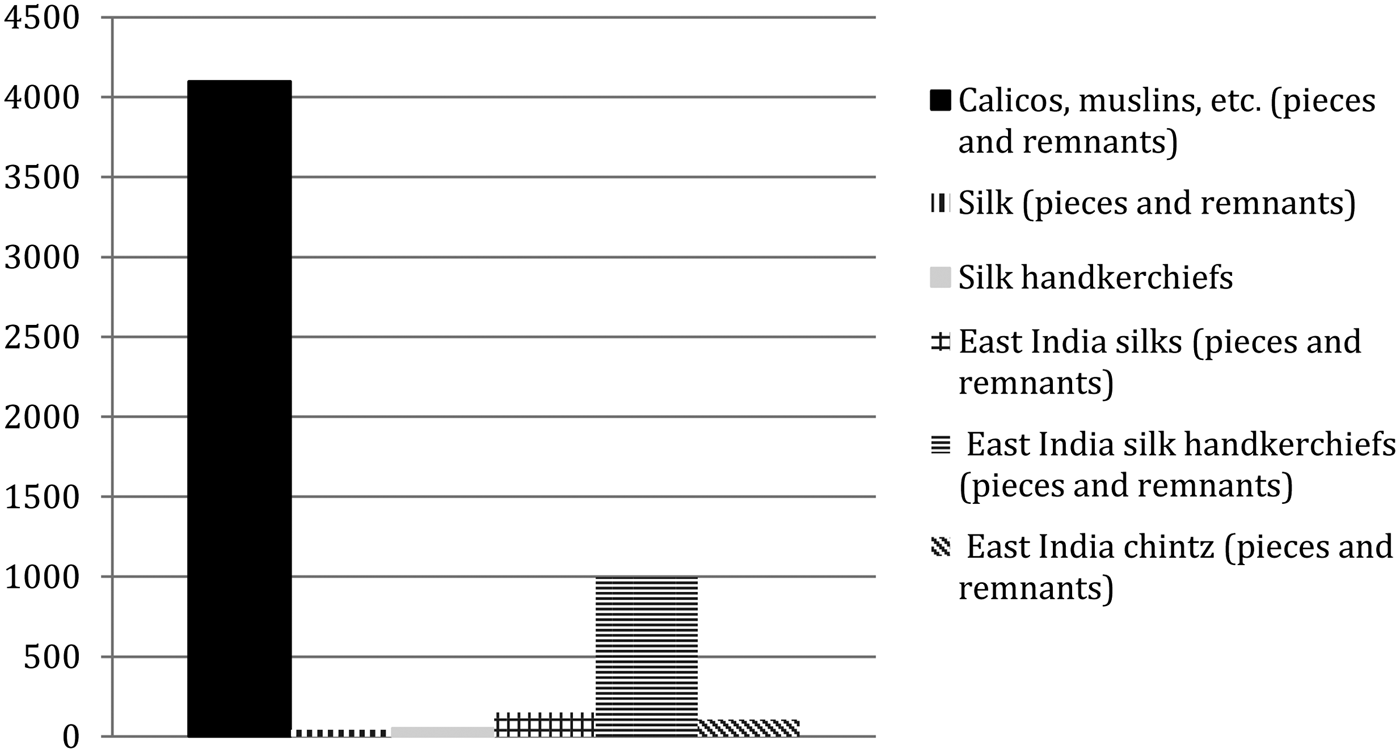
Seizures of cottons and silks in the Port of London, 1770. Number of pieces.

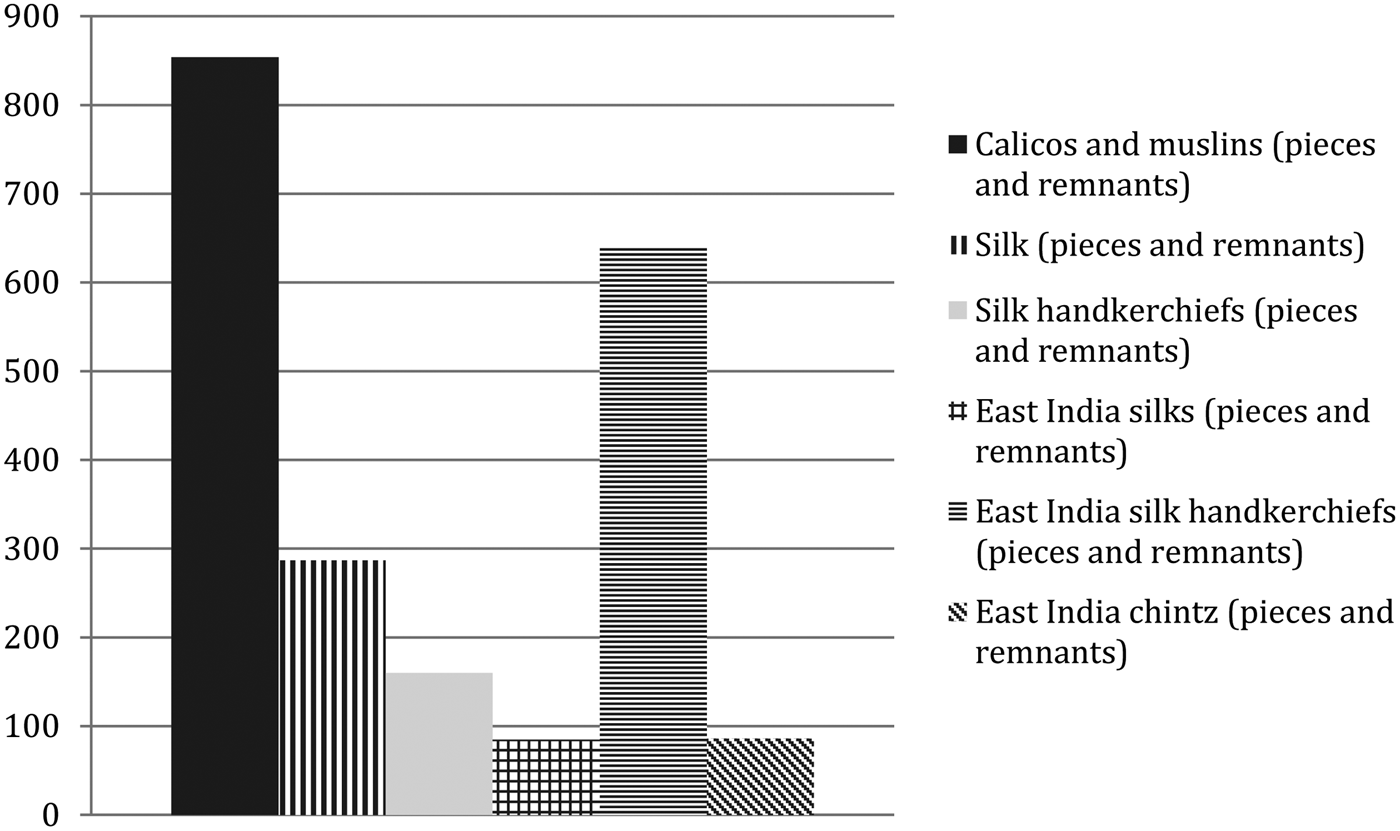
Seizures of cottons and silks in the Port of London, 1780. Number of pieces. Figures 1 and 2 from Port of London, Account of seizures made 1769–1773, 1778–1782, in “Reports from the committee on illicit practices used in defrauding the revenue,” Reports from Committees of the House of Commons, vol. 11 (1783 and 1784), Appendix 4, 240–41.
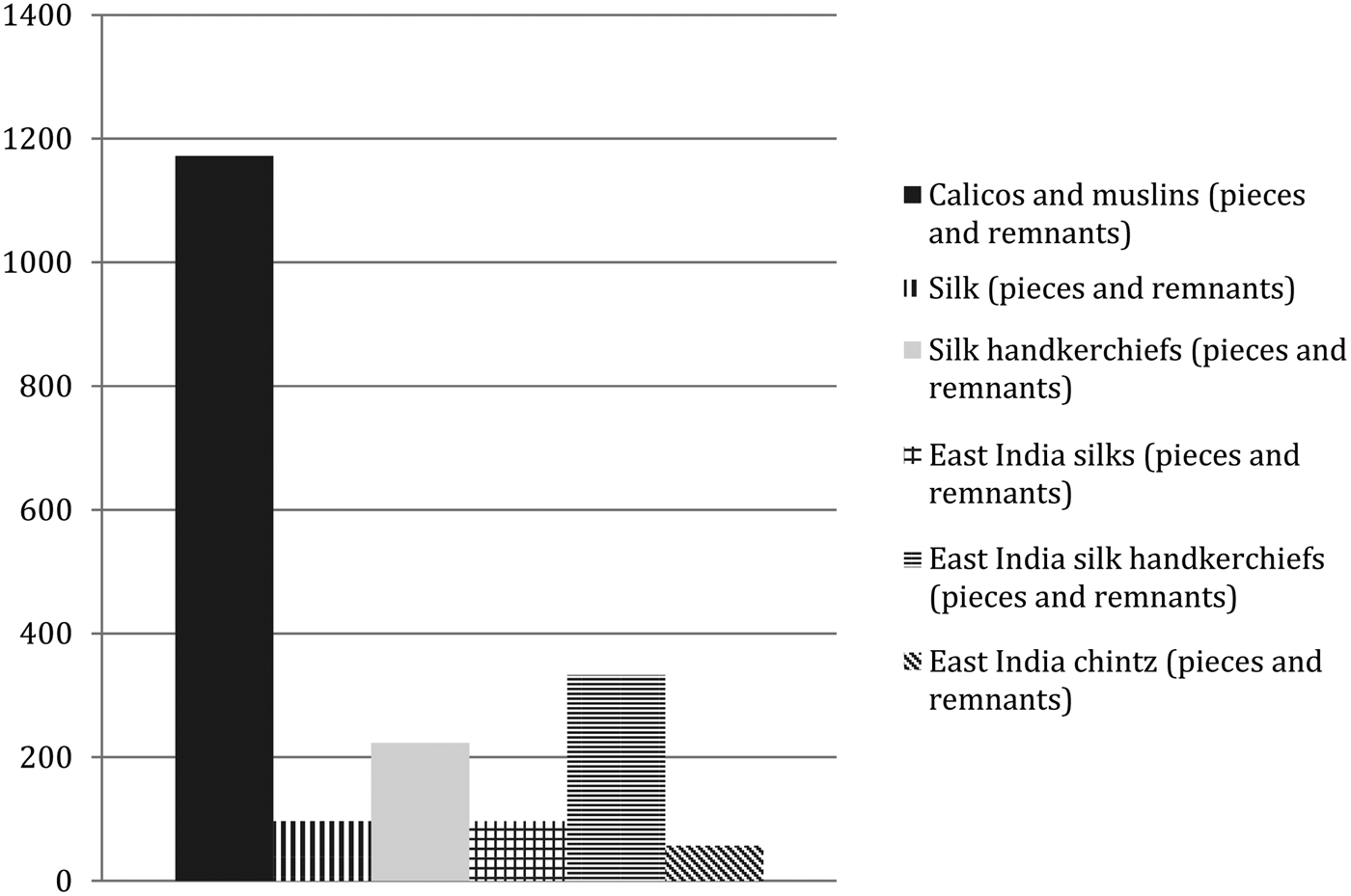
Seizures of cottons and silks in the outports, 1770. Number of pieces.
Seizures of cottons and silks in the outports, 1780. Number of pieces. Figures 3 to 4 from Account of seizures made at the Out Ports, by Officers of the Customs, 1769–1773, 1778–1782, in “Reports from the committee on illicit practices used in defrauding the revenue,” Reports from Committees of the House of Commons, vol. 11 (1783 and 1784), Appendix 4, 240–41.
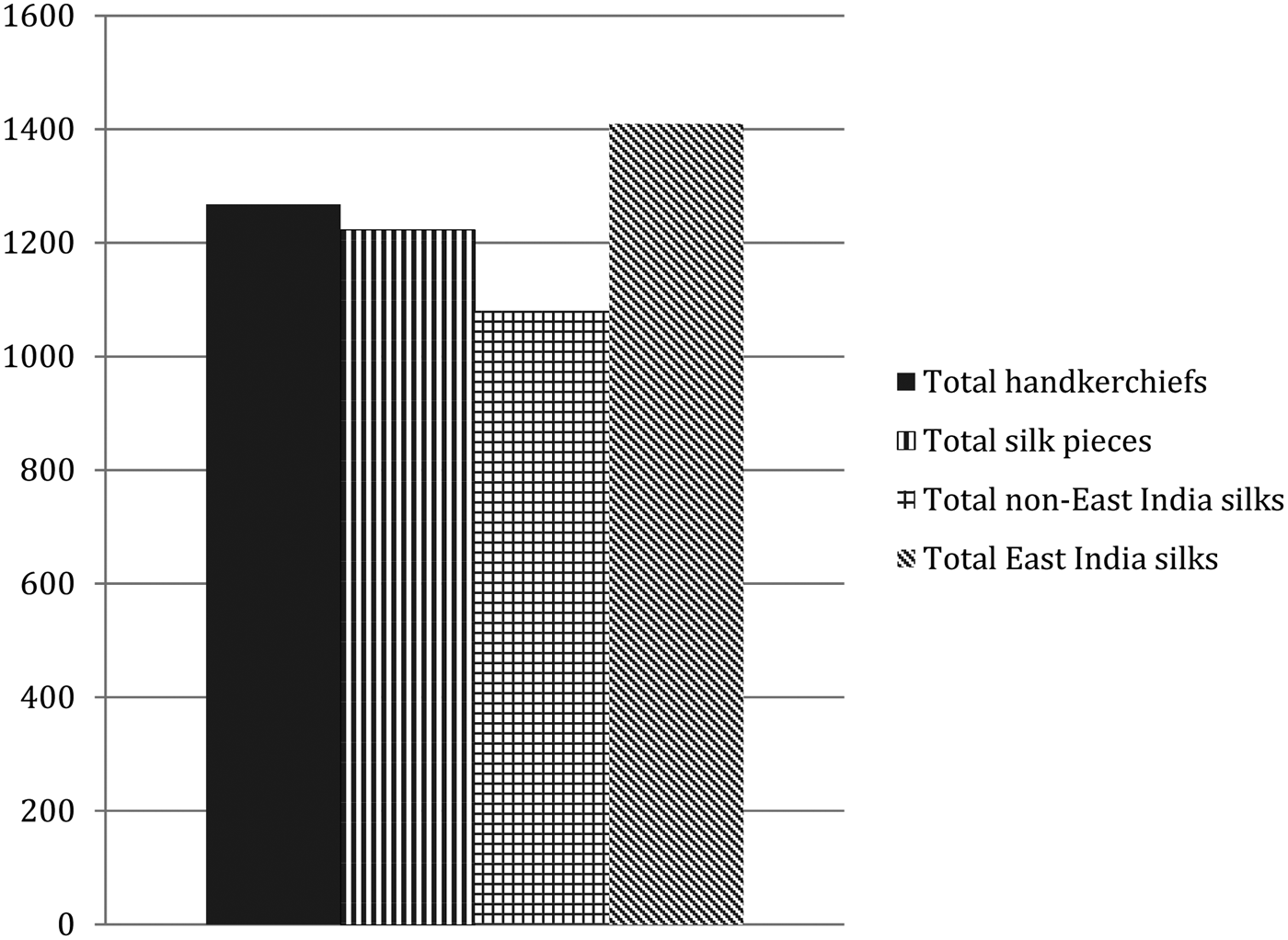
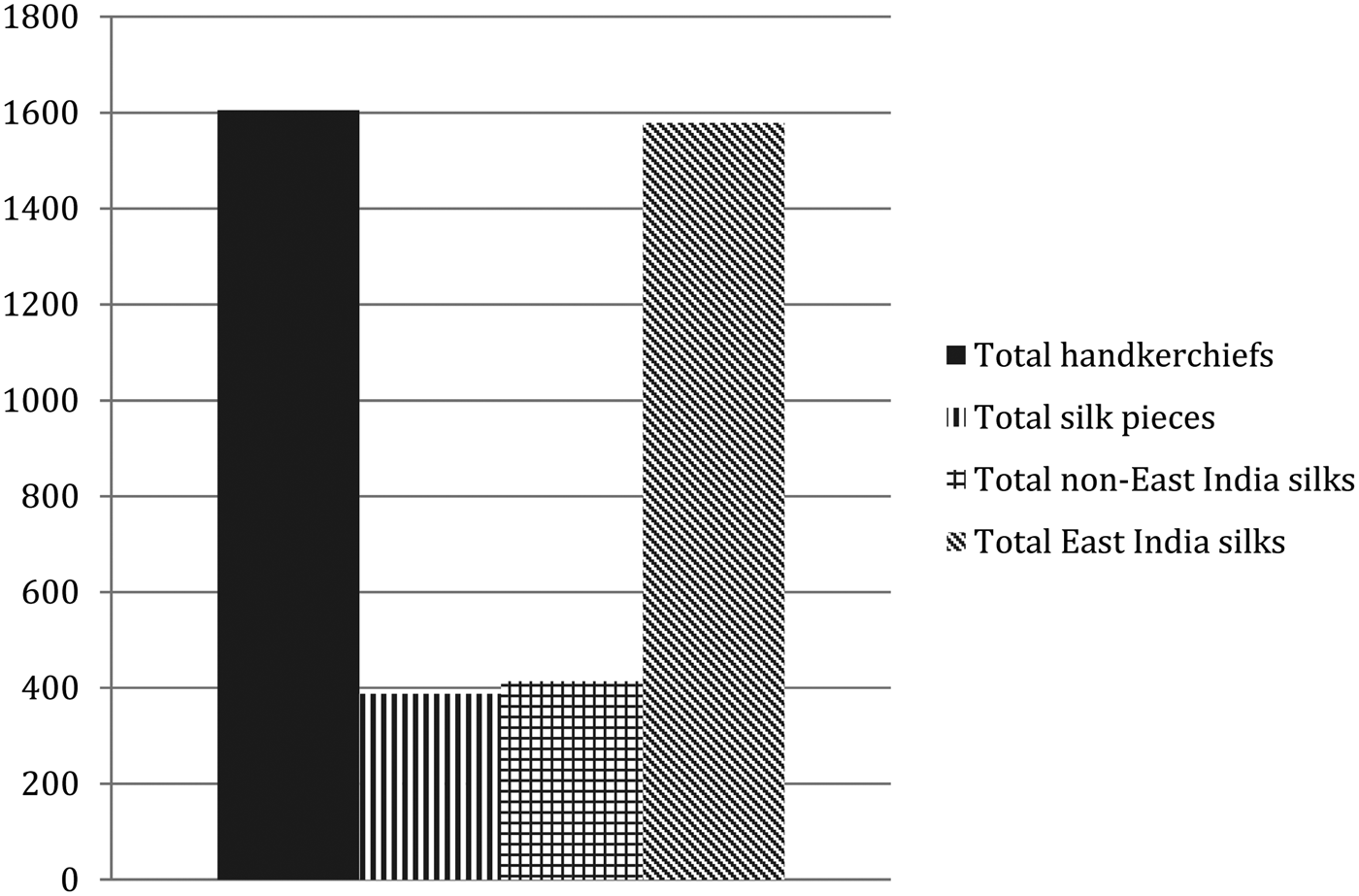
Seizures of silk in London and outports, 1770. Handkerchiefs vs. pieces; non-East India vs East India. Number of pieces.
Seizures of silk in London and outports, 1780. Handkerchiefs vs. pieces; non-East India vs. East India. Number of pieces. Figures 5 to 6 from Account of seizures made at the Out Ports, by Officers of the Customs, 1769–1773, 1778–1782, in “Reports from the committee on illicit practices used in defrauding the revenue,” Reports from Committees of the House of Commons, vol. 11 (1783 and 1784), Appendix 4, 240–41.
This analysis of the evidence from the report shows the popular contraband goods and how they entered Britain. As figures 1 to 4 illustrate, the seizures of calicos and muslins are much higher than the seizures of silks. This indicates that these goods did indeed enter into the home market in significant numbers even after the Calico Acts.Footnote 37 In both London and the outports, the most common type of silks seized were East India silk handkerchiefs. There were more seizures of handkerchiefs, wherever they were from, than seizures of silk pieces and remnants (the leftover end piece of a cloth); more East India silks were confiscated than were non-East India ones. Seizures in the Port of London were a large proportion of all silks taken by the authorities. In 1770 they were 53 percent of the total; in 1780 they were 62 percent.Footnote 38 This reflects London's size and importance as an international port, trading not just with the continent, as some of the outports did, but directly with Asia, too. It was, of course, home to the East India Company's dock and warehouse. Furthermore, it was also the major center for fashion and retail in Britain, so it was the obvious destination for contraband silks. The pattern of seizures for all goods across the country confirms this, showing that while most confiscations made at the outports were for tea, in London the majority were for textiles.Footnote 39
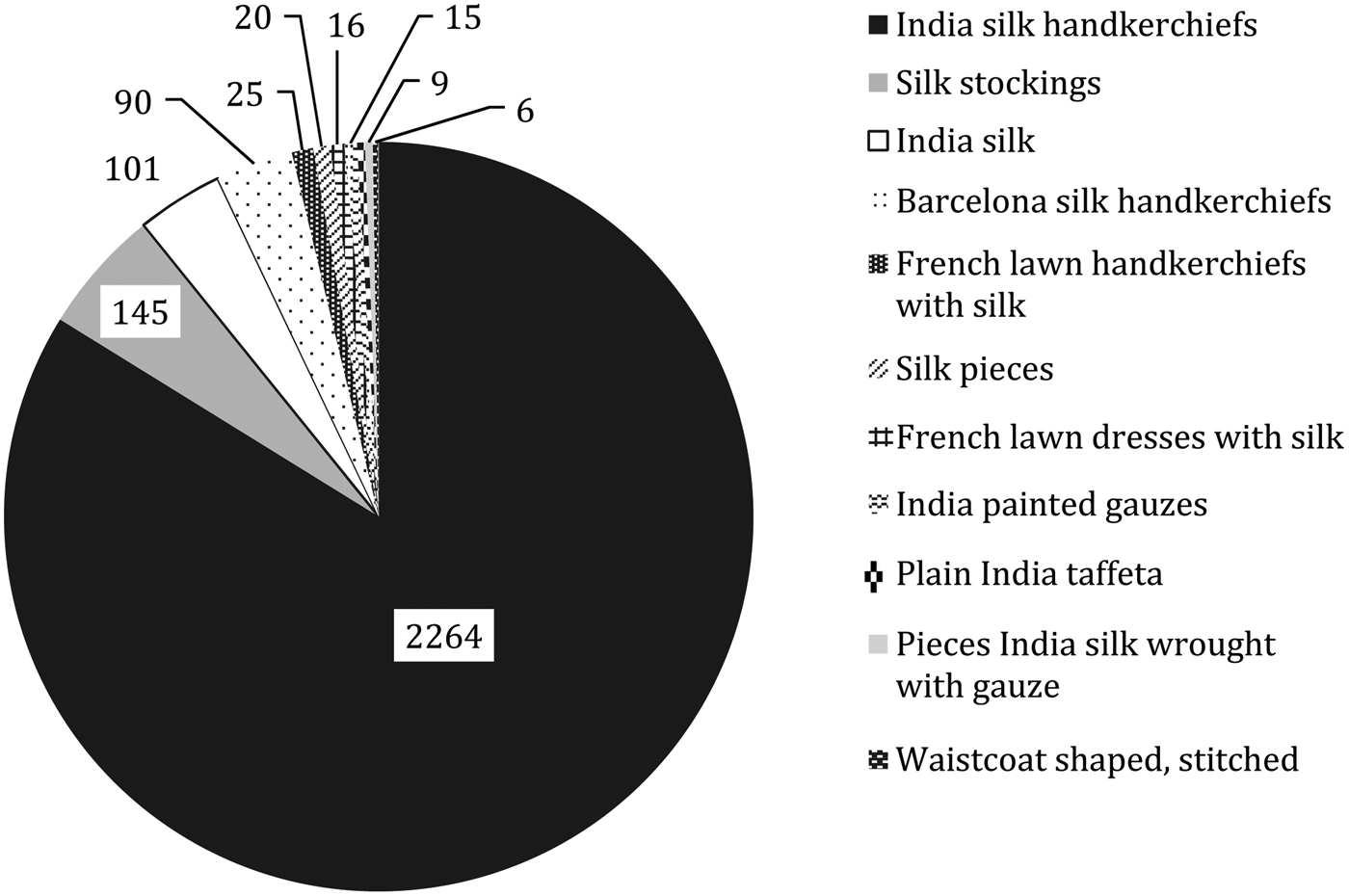
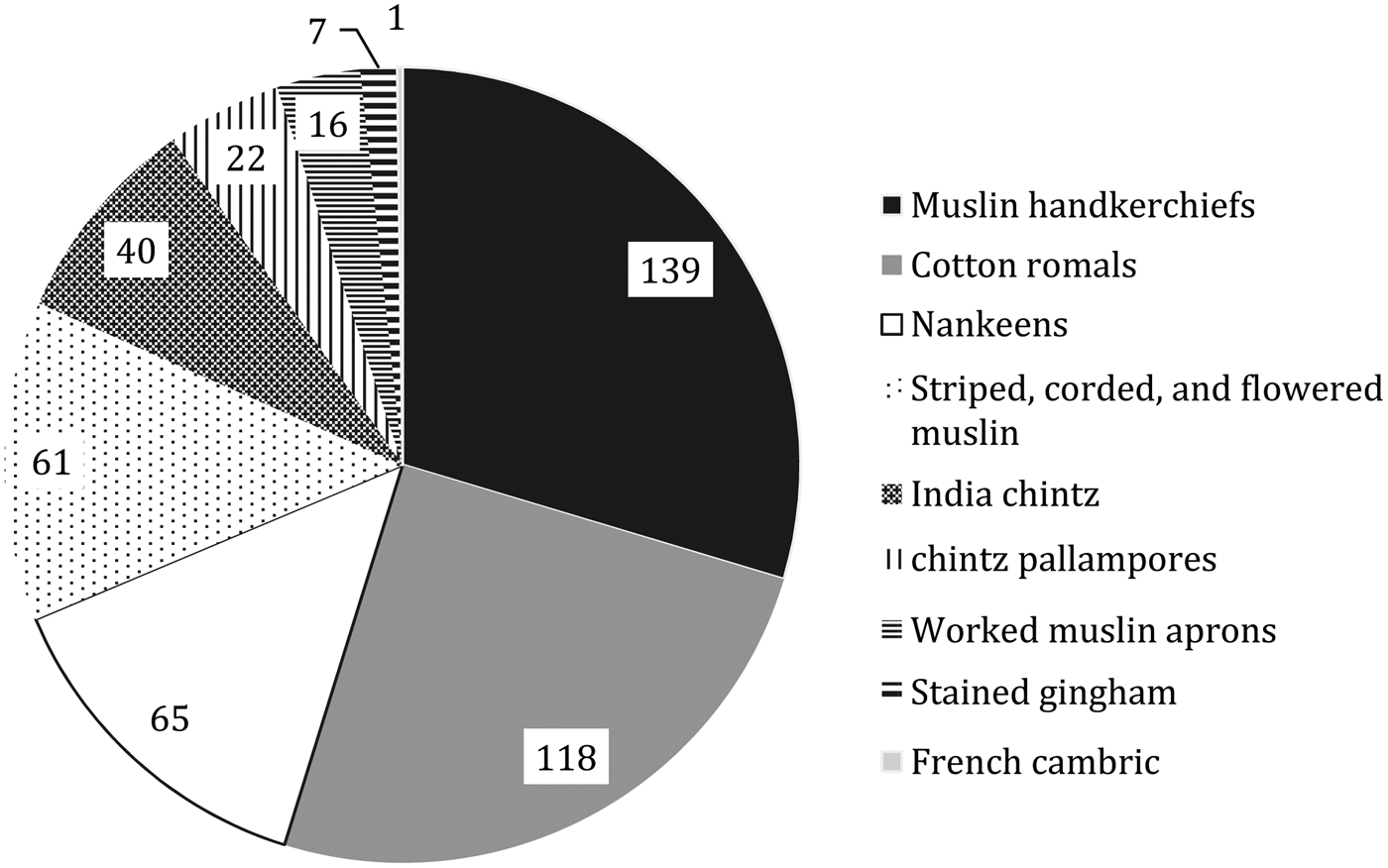
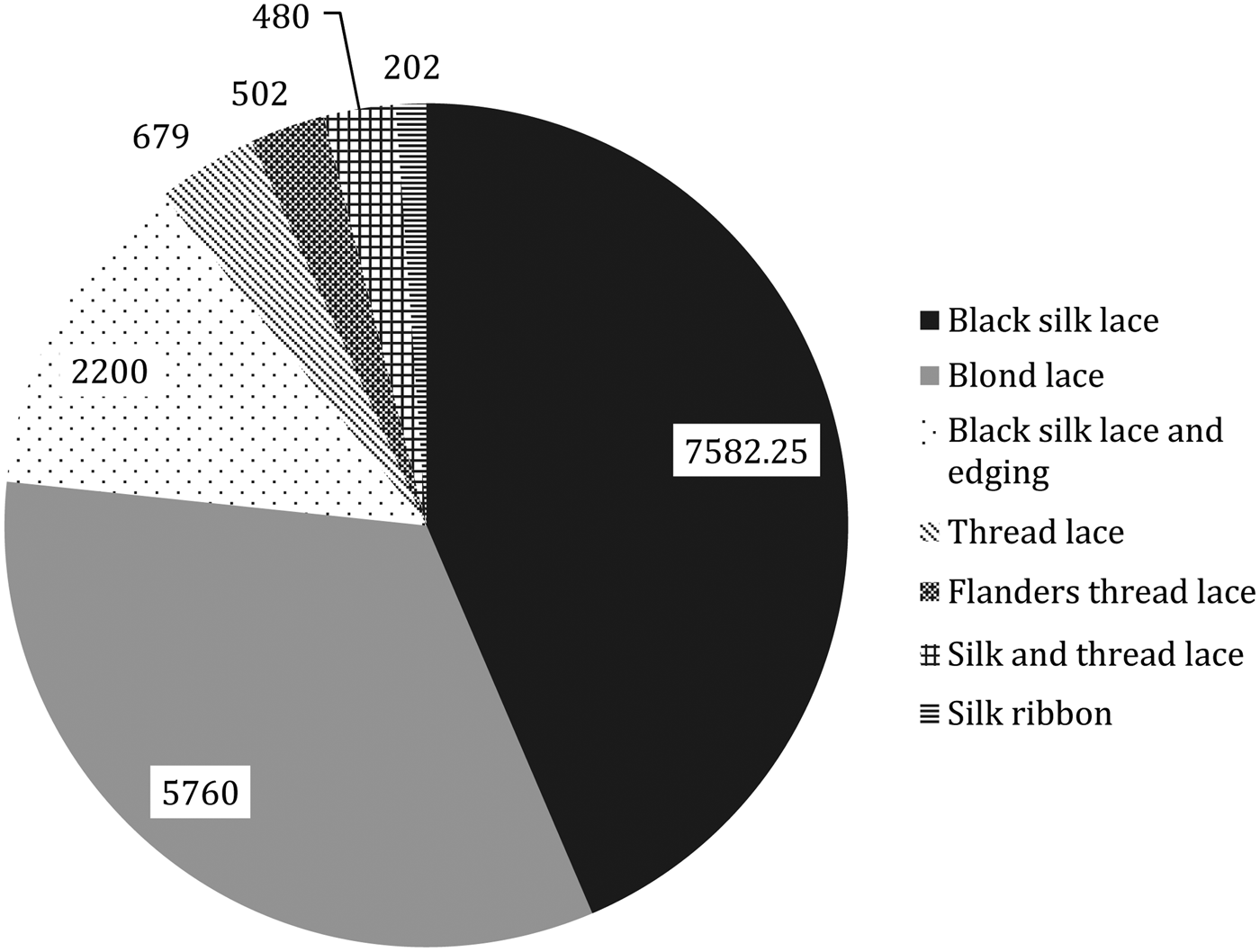
The finding that handkerchiefs from India dominated the smuggling of silks is confirmed by a second source. Here advertisements for goods seized by the customs and sold at public actions are used.Footnote 40 Customs officials sold textiles, brandy, tea, and tobacco at auctions held quarterly. To prevent further frauds, goods in the auctions were weighed, packed, marked, and numbered.Footnote 41 Silks were sold on condition that they were exported out of the country, but permission was given to sell other goods to the domestic market.Footnote 42 Despite the assurances that silks bought at these sales would be exported, some smugglers used them as a means of acquiring fabrics at a cheap price. They then took the goods over to Ostend or Calais, repackaged them, and brought them back into Britain.Footnote 43 I start with the earliest advertised sale of silks organized by Customs and Excise that I have found, in 1768, and I follow them until 1800. For the figures that follow, I used twenty-eight sales in total for which the advertisements gave quantities. The majority of the sales were on the south coast of England—Hampshire, Sussex, and Kent—although there was one in Newcastle. The sales have been broken down into three charts: one for silks (figure 7), one for cottons (figure 8), and one for accessories (figure 9).
Silk or silk mix pieces sold at customs auctions 1768–1800. Figures 7 to 9 compiled from the Burney Collection.
Cotton pieces sold at customs auctions 1768–1800.
Lace, thread and ribbons sold at customs auctions 1768–1800 (yards).
The advertisements reveal trends that have been hidden so far, as they have more specific categories than does the parliamentary report. Indian silk handkerchiefs remain the largest type of contraband silk—in fact, there are more of them than there are cotton handkerchiefs or all the cotton pieces combined. As with the parliamentary evidence, handkerchiefs, wherever they originated, are the most common type of silk, and silks from India outnumber silks from elsewhere. This points to India silk handkerchiefs as a distinct and popular item in the Euro-Asian textile trade: the reasons for this are explored below. The auction categories also reveal (where geographical descriptions are given) that non-Asian silks are largely French. Silk stockings emerge as the second-biggest category after handkerchiefs, showing the importance of ready-to-wear silk garments. The weighting of silk piece goods toward handkerchiefs is clear when compared to the figures for cottons, which show a more balanced variety of fabrics. Riello has pointed out that most of the Indian cottons imported legally into Europe were white, indicating that they were for printing on.Footnote 44 However, smuggled cottons were more likely to be printed and decorated in the styles that had made them popular. This suggests that smugglers traded the most visually appealing and “exotic” Indian textiles.
It is striking that one type of silks—handkerchiefs—was more commonly seized than all the other types of silks put together (velvets, flowered silks, stockings, etc.).Footnote 45 This suggests that much of the market for smuggled silks was made up of lower-value items that were supplied by the trade with Asia. This would certainly be in keeping with changing fashions. Handkerchiefs are good examples of the “populuxe goods” that Cissie Fairchilds identified as making a more affordable version of luxury available to consumers in this period.Footnote 46 Made of cotton, silk, or linen, handkerchiefs were a large piece of material—much larger than our pocket handkerchiefs—worn by both men and women. Patterns, such as dots or stripes, and colors allowed wearers to add variety to their outfits. Men wore handkerchiefs round the neck; women wore them tied around the head or draped across the shoulders. Handkerchiefs were a more colorful alternative to plain cravats or shawls, often kept for Sunday best.
Evidence from retailers suggests that silk handkerchiefs were priced for middling consumers, although plebeians could acquire them by saving up or buying secondhand. Margaret Spufford found silk handkerchiefs among the textiles sold by peddlers as early as the late seventeenth century. They were priced at 1s. and above; linen or mixed fiber handkerchiefs were cheaper at 6d. to 10d.Footnote 47 Anne Buck dates the uptake of handkerchiefs made of silk or cotton slightly later, to the 1730s.Footnote 48 Although silk was the most expensive kind, handkerchiefs spread down the social hierarchy; this dissemination was helped by the informal economy.
Both dealers in used clothes and petty traders made the fashion for colorful handkerchiefs available to a wider audience. These were a popular item for thieves: 17 percent of theft trials at the Old Bailey between 1740 and 1800 involved a handkerchief. In these trials, silk handkerchiefs were more commonly mentioned than cotton until the 1790s.Footnote 49 They were also sold by small shops that served plebeian Londoners, such as the one belonging to Barbara Richards in Spitalfields.Footnote 50 Alison Toplis found that silk handkerchiefs, including Indian ones, were among the possessions of laborers who used secondhand dealers, theft, and informal trading to acquire clothes.Footnote 51 They were important for the creation of self-conscious plebeian (and, in the Americas, even slave) fashion.Footnote 52 “Transnational” plebeians also helped to import handkerchiefs into Britain. Lemire finds them to have been a common item owned by sailors on Asian voyages, who adopted them for their own distinctive dress, and as an easily acquired and sellable item.Footnote 53
Exactly when the fashion for silk handkerchiefs emerged is not clear. Looking back on the heyday of silk smuggling, George Porter remarked on the take-up of foreign handkerchiefs among all classes, attributing this popularity to the allure and exclusivity of contraband.Footnote 54 Even the ultrarespectable Parson Woodforde purchased India silk handkerchiefs from a smuggler.Footnote 55 “India handkerchiefs” were not widely mentioned during the passing of the Calico Acts. Silk weavers made specific complaints about them in the 1780s, suggesting they became popular after the main prohibitions against Asian textiles were in place.Footnote 56 This implies that smugglers were the first importers of these new goods. Seeing that they would fit well within British wardrobes, smugglers helped to create the popularity of Indian handkerchiefs.
There were European-made rivals to India handkerchiefs, but they used different construction techniques. As with other Asian goods such as calicos, Indian handkerchiefs, usually called sarongs or bandanas, had distinctive qualities compared to those manufactured in Europe. The quality of dyeing used in Indian textiles, producing the deep colors seen in the handkerchiefs, made them attractive to consumers. Their patterns were achieved through the use of hand printing and tie-dying, which the European textile industries did not employ.Footnote 57 Weavers in London were making silk handkerchiefs by at least the 1760s; by 1780, manufacturers across England were making products “in imitation” of the Indian examples.Footnote 58 These imitation fabrics either had patterns achieved on the loom or through experiments with mechanical printing. However, these techniques produced patterns that were too regular, lacking the charm of those produced by hand.Footnote 59 Merchants working in the re-export trade to the North American colonies purchased silks imported by the East India Company when possible, believing they were of better quality than those made in London.Footnote 60 India silk handkerchiefs became popular because they were a new, attractive product with few rivals on the market.
The availability of deliberate imitations of India silk handkerchiefs might inspire skepticism of the identification of South Asia as the source of these items. In London, conmen attempted to pass off fake handkerchiefs to unsuspecting buyers.Footnote 61 Can we be sure that contemporaries were not deceived, and that they were accurate in recording these objects in customs records or newspapers? Textile nomenclature in this period is complicated and potentially deceptive. There are over one hundred types of textiles listed in the East India Company records.Footnote 62 Names that appear to refer to geographic origins of fabrics may in fact refer to style or construction. The term “India silk” could be used as a generic term for all silks marketed by the East India Company, including those made in China.Footnote 63 Furthermore, textiles “imitating” Asian designs were produced in Europe for the contraband trade.Footnote 64 Work on the legitimate Euro-Asian trade also obscures the place of Indian silks. There tends to be an assumption that textiles fell into a simple division of Indian cottons (the vast majority of all textile imports) and Chinese silks. Leanna Lee-Whitman examines the East India Company's trade in silks using accounts of the trade with Canton, ignoring India altogether. Given the complexity of textile nomenclature, K. N. Chaudhuri and H. V. Bowen refrain from providing statistical breakdowns of the kinds of textiles traded by the East India Company, instead breaking down the trends by region. A more in-depth examination of the origins of smuggled handkerchiefs is needed to establish that India was the source of supply.
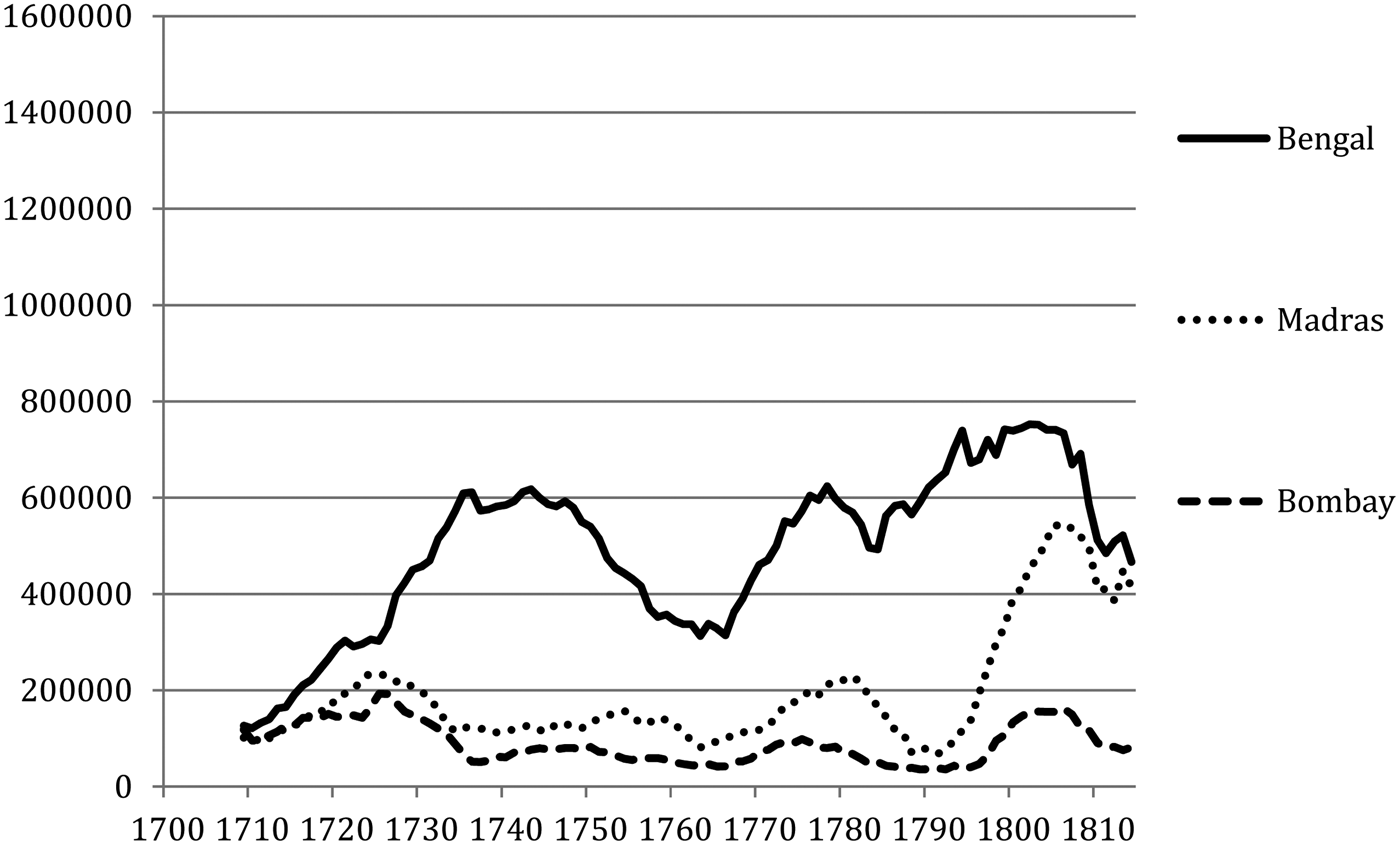
Despite these problems, contextual evidence makes informed identification possible. The contraband handkerchiefs are unlikely to be Chinese, as Lee-Whitman's analysis does not find handkerchiefs to be a type of silk bought by traders in Canton.Footnote 65 Chaudhuri's glossary of Indian “cotton textiles” contains several silks and silk mixes, all of them produced in Bengal, Bihar, and Orissa (that is, Eastern India). By contrast, there are no silk or silk mixes listed in the western or southern Indian sections of the glossary. Silks from Eastern India included badannoes or thread-dyed silk handkerchiefs, cotton-and-silk-mix handkerchiefs, and silk lunges used as sarongs. From the information available on occupations in India it is known that there were silk weavers in areas such as Kasimbazar in Bengal and in Benares.Footnote 66 After the late 1720s Bengal became much more important within the European trade in Indian textiles—and the trade with Bombay, near the great cotton weaving center of Gujarat, became less so (figure 10). Eastern India was, therefore, the main source of silk handkerchiefs for both the East India Company's legitimate trade and the black market.
Indian textile pieces imported by the East India Company into London, by region, 1700–1810. Ten year moving averages. Number of pieces. Figures for 1700–1760 from Chaudhuri, The Trading World of Asia and the English East India Company, Table C.22, pp. 544–45; Table C.21 pp. 542–43; Table C.20, pp. 540–41; Table C.23 p. 546. For 1761–1820, from H. V. Bowen's data file, The East India Company: Trade and Domestic Financial Statistics, 1755–1838, UK Data Archive, September 2007. SN: 5690, http://dx.doi.org/10.5255/UKDA-SN-5690-1.
Furthermore, the records used in this article to identify contraband were created by “experts” who could tell the difference between European and Asian silks. The revenue service made serious efforts to ensure that their own classifications were accurate. “Consultants” from the silk industry were used to help identify textiles correctly. Members of the Weavers' Company, the guild that represented textile workers in London, worked with customs officers to make seizures of foreign silks.Footnote 67 Correctly identifying types of silks was important to bringing successful prosecutions; misidentification could lead to a case collapsing.Footnote 68 Customs had its own “examiner, searcher and stamper” of silks, a position originally awarded to a weaver and a mercer.Footnote 69 Considering all these factors, it seems reasonable to conclude that “India handkerchiefs” were indeed from India. The argument that new consumer goods were created through smuggling and Euro-Asian trade has solid foundations.
South Asia was not the only source of contraband textiles. An important difference from cottons is the number of silk accessories—including silk laces, edgings, and ribbons—that appear in the auctions. The presence of laces and ribbons confirms the importance of French silks in the category of non-Asian contraband. At the Parliamentary hearings, weavers and mercers defended the quality of English silks in general, but many agreed that it was in comparison with the high-end or fashion silks influenced by French taste that they suffered most.Footnote 70 These were among the most expensive products on offer and they were associated with elite metropolitan taste.Footnote 71 From the 1730s, the so-called flowered silks—those with floral designs—were created with raised decorative work to emphasize the intricate nature of foliage and achieve three-dimensional effects. Brocading, a technique applied by the weavers on the loom, was one way of achieving this and was used in both London and Lyon. There was also a fashion for trimmings, such as gold braiding, and embroidery.Footnote 72 Many French silks were bought complete with embroidery or lacing, but there was also a market for materials to make up garments in this style. When revenue officers made seizures from several tailors in 1748, they found four bundles of foreign embroideries and thread intended to make up waistcoats.Footnote 73 Specialist French silks were brought into the country illicitly to feed the taste for intricate decoration.
The timing of concerns about French silks in the 1760s with the end of the Seven Years' War suggests that London had been isolated from the new flowered styles and brocading techniques.Footnote 74 Not only did the restoration of trade with France lead to more silk coming into London (legally or not), but French silk designers had created new fashions in the intervening years. Surviving examples of embroidered French silk imported into Britain show the fineness of the work being done in the 1750s.Footnote 75 Internal changes in the organization of work also led some mercers to look to France. During that period, the retailing of the high quality silks had changed in London. Mercers wanted designers of brocaded silks to work exclusively for them, and produce only limited runs of drawings. Customers did not want designs that were widely available, and competition over brocades built up. Mr. Lovie, a mercer, claimed that he had to resort to importing French brocades because he could not get any pattern drawers to work for him, as they had all been signed by his rivals.Footnote 76 In this restricted situation, fashionable consumers looked to the continent for items they could not easily obtain.
Overall, the evidence suggests that silk smuggling introduced new consumer goods to Britain. The illicit trade in silks was supplied from several regions and able to meet the needs of quite different customers. Two markets stand out. Firstly, silk handkerchiefs from India that sold to middling and some plebeian customers. This supports those accounts that stress the importance of trade with Asia for creating new consumer goods in Britain. Secondly, however, luxury or high fashion silks from France made up a recognizable section of the contraband trade. This suggests that influences from the continent remained important for British taste and style. In both cases, the silks were popular as they had material qualities that appealed to consumers, and British producers had trouble supplying an adequate substitute product. The distinct geography and markets of contraband silks suggest that the suppliers were not a uniform group of people, either.
WHO WERE THE “SMUGGLERS”?
It is important to establish the characteristics of silk smugglers, as doing so helps to show which sections of the market they were provisioning. Large-scale smugglers would be able to supply middling customers, while those working on a smaller scale would have to target niche groups. The importance of India silk handkerchiefs indicates that the East India Company was the largest, although not the only, source of contraband silks. This was not, of course, an official policy of the directors. However, the whole transport and distribution operation, from loading ships in Indian ports to warehousing in London, leaked goods along the way. H. V. Bowen's work places the privileges of private trade, granted to some of the company's employees, at the center of the contraband trade between India, China, and the British Isles. Opportunities for private and illicit trade increased over the eighteenth century as the company's fleet expanded after 1756. Private investors owned ships and leased them to the East India Company, and they and the commanders shared the profits of private trade.Footnote 77 All private trade goods coming to England were supposed to be sold at the official company sale in London, and duties and handling charges had to be paid.Footnote 78
Officers and passengers sometimes made false declarations about the cargo when loading up the ships in India or hid items within the ship; this was done in order to avoid the restrictions on the amount of private trade goods they could import. Commanders also overloaded ships to carry extra consignments of tea and textiles. As vessels drew nearer to home waters, the methods of landing contraband were multiple. Before sailing into the English Channel, captains might stop off at continental ports, the Isle of Man, or Ireland, selling goods to local dealers who would then run them into Britain. In the Channel and at Gravesend, passengers could disembark, taking items with them before customs officers came aboard. East Indiamen could not go any farther up the river Thames than Deptford, and the cargo was unloaded onto smaller boats at that point and taken to the East India Wharf next to London Bridge. The goods were taken first to the customs house to be recorded and then to the East India Company's warehouse.Footnote 79 It took several weeks to unload an East Indiaman in Deptford. The number of people going on and off board ship not only increased the number of people handling the cargo but also obstructed customs officers from carrying out their tasks. Tide surveyors boarded and searched the ships for contraband, including textiles. They were instructed by Customs and Excise to ensure that “no silk, or others goods be put up, or made into wearing apparel or the Captain will be prosecuted.”Footnote 80 All baggage and small parcels found in cabins had to be landed and inspected in the warehouse.Footnote 81 Captains and officers were allowed to land personal linen and apparel that was not prohibited so that it could be washed.Footnote 82
Many people working around the Thames were involved in the black economy and they helped move silks off the ships and on to retailers, legitimate and illegitimate, in the city. One customs officer followed Thomas Wetherby, a porter, having seen him leave St. Katherine Docks with a small box labeled Tobacco “in large letters.” Wetherby was observed “to look back frequently” as he left the dock, entering the City of London and walking as far as Ludgate Hill. Unable to lose his tail, Wetherby gave himself up and tried to bluff his way out by claiming the box only contained a few pounds of tea. However, he was forced to open the box, which, instead of tobacco or tea, contained £41 worth of silk mittens and £160 worth of garnets (a crystal mined in western India).Footnote 83 Corruption of officials was also a problem. Those who were involved in the landing of goods and in calculating duties could be bribed.Footnote 84 Bowen points out that the antismuggling action that the East India Company undertook was concentrated in London, confirming its importance as a hub of the black economy. Rather than look to the illegal importing via northern Europe or Ireland, the company instead focused on building the new East India Company dock, which was to be larger and more secure than the existing one.Footnote 85
Once they had been successfully unloaded, silks were then moved into the possession of retailers. Some were sold to mercers and tailors. Others, particularly handkerchiefs, became part of the moveable stock of peddlers and secondhand dealers. Historians have shown that there was a significant overlap between the formal and informal distribution of textiles and clothing. This overlap included crime, thanks to those dealers who asked no questions about the provenance of items. Hawkers, street markets, and pawnbrokers were all sources from which many people acquired clothing, including fabrics and items that were new to this period.Footnote 86 Potentially, secondhand dealers had good access to imported goods as they used ports as home bases for their operations. Both London and Liverpool had significant concentrations of these businesses.Footnote 87
The attention of the authorities, however, fell more heavily on shopkeepers. Customs officers often targeted tailors, as the provisions of the laws prohibiting Asian textiles focused on those who might sell and distribute foreign goods. In respectable shops, contraband silks were not displayed openly, but kept under the counter and sold by pattern.Footnote 88 The risk of prosecution that shop owners feared was real. In 1766 “Davidson of Fleet Street” was fined two hundred pounds for having cambrics and India silk handkerchiefs in his possession.Footnote 89 David Weir was prosecuted for “Two pieces of Clouded Gingham … 122 Pieces of India Silk handkerchiefs … and 25 pieces of India striped Taffaty.”Footnote 90 Thomas Metcalf prosecuted William Martin, John Smith, John Simpson, James Kent, and William Cochlewere for possession of Indian satins, muslins, and handkerchiefs “which came into their hands without Payment of duties.”Footnote 91 Two officers rummaged Hugh Douglas's house and seized forty-five handkerchiefs and some muslins. They maintained that his goods had come from an East Indiaman—the Norfolk—the night before the raid.Footnote 92
Even though French silks were a smaller proportion of the contraband trade, some were brought into London in similar ways to East India textiles. A “large seizure” was made by customs in 1766 from a ship lying below London Bridge that was carrying French silks and brocades.Footnote 93 Revenue officers prosecuted George Tomlyn “master and mariner” of Rochester, Roger Bridges and Francis Douglas, mariners also of Rochester, alongside Bartholomew Garman of Dunkirk for “unshipping without payment of Duties” plain and flowered muslin, India silk handkerchiefs, and French lawns, cambrics, and wrought silks.Footnote 94 In 1766 Charles Lutwidge, Receiver General of the Isle of Man, reported that 447 Barcelona silk handkerchiefs had arrived from Dunkirk and were intended for re-export to Britain and Ireland. Three months later 3,450 Barcelona handkerchiefs had arrived in Douglas. The Wolf arrived in April that year from Barcelona and Malaga carrying wine, food, and thirty boxes of handkerchiefs. The merchants (who were all British) paid the duties due to the revenue, but were open about their intention to take the goods into Britain.Footnote 95 The Isle of Man's legal status left Lutwidge unable to make a seizure: the island collected and retained its own duties, which were lower than those in Britain. Although customs officials were stationed on the island they were powerless to make arrests.Footnote 96
Foreign silks did not have to enter the country solely via “smugglers.” A variety of people who were not traders crossed borders with foreign silks in their possession. Some did sell the silks they carried with them, but many more had the silks for their own wardrobes, or for friends and relatives. These small-scale frauds were used to import silks coming from the continent, and were difficult for authorities to detect. The high status of these importers contributed to the fashion for foreign silks. Undoubtedly Indian and Chinese silks did come back to Britain with people returning from service in the East India Company.Footnote 97 Warren Hasting's wife Marian, for example, became well known in London society for her Indian gowns.Footnote 98 However, the baggage of those coming from the continent attracted greater attention from customs.
Customs officers became concerned about the importation of textiles and clothing by foreign ministers in London. Ambassadors, their families, and staff were the kind of people likely to own French or Italian silks. Indeed, wives of French ambassadors were seen as fashion leaders by London society.Footnote 99 Officers raided the lodgings of a group of French hairdressers in the Strand and found a large amount of French “Gold and Silver Lace, Trimmings and Embroidery.” They were reported to be hairdressers to “Persons of Distinction” and were accused of trying to pass off the goods as being the property of their distinguished clients.Footnote 100 Officials did have the power to search baggage belonging to foreign officials as it came into the country, but diplomats also had immunity from prosecution, making customs' investigations difficult. So, for example, in 1701 the Venetian ambassador had to provide a schedule of when his baggage would be landed and certify that the goods were “for his own use.”Footnote 101 News of a later Venetian ambassador's journey to London traveled ahead of him in 1768; officers of the river were given plenty of time to prepare to board his ship, the Henrietta, when it arrived from Calais, and take the ambassador's baggage on shore for inspection.Footnote 102 The customs officers actively monitored diplomatic staff to try and reduce the level of smuggling.
Whether embassies could be searched was more contentious legally, casting doubt on the viability of investigations. Customs officers tried to inspect the residences of the French, Austrian, and Bavarian ambassadors. One officer, Mr. Tankard, succeeded in gaining entry to the French embassy and searched underneath the staircase for smuggled goods. He found nothing illegal, however, and a complaint was made against his behavior by embassy staff. Legal advice taken by Customs and Excise was cautious about any systematic action along these lines as the legality of searching embassies “appears to us to have been rather studiously avoided by the writers upon the law of nations.”Footnote 103 Not surprisingly, suspicion built up in customs that some foreign ministers were engaging in smuggling. The outports were instructed to open packets being sent “to private persons … under colour of their being dispatches for the secretaries of state or foreign ministers.”Footnote 104 In 1737 officers were sent a note confirming that no East India silks should be delivered to residences of ambassadors, but should stay in port to be exported.Footnote 105 Two men in particular, the Austrian ambassador Count Kinski and the Bavarian Ambassador Count Haslang, were widely believed to be smugglers who used their embassies as warehouses. The Treasury ordered duties to be paid on “one piece of French brocaded silk with silver, weighing nine pounds, one remnant of plain silk for the lining, weighing one pound, and one short silk apron workt with silver and silk” imported for Kinski.Footnote 106 Haslang refused all requests to let revenue officers inspect his house.Footnote 107 During the Gordon Riots in 1780, the crowd attacked his house and looted it for contraband. After his death, revenue officers arrested his secretary, Mr. Killinhoff, for smuggling offenses.Footnote 108
It was not just elite Europeans, but also British tourists in Europe who helped to bring foreign silks into the country. A silk suit or gown was a common purchase. Frederick Robinson had a suit made for him in Paris in 1778 after travelling there from Spain. His tailor, le Duc, had sent patterns for a striped silk suit with a white embroidered waistcoat to Lord Grantham in Spain the year before.Footnote 109 For Robert Adam, who bought velvet and satin suits in Paris and gold and embroidered waistcoats in Lyon, it was also an economical decision. He found the garments to be a third of the price of similar products in London.Footnote 110 The Grand Tour, in particular, brought British visitors into contact with French and Italian fashions. Many tourists found the tour to be a sociable and urbane experience, and they became participants in the life of the cities they visited. Letters home discussed leisure activities, such as attending the theatre and opera, which provided plenty of opportunities for display.Footnote 111 There were, therefore, good reasons to dress well and fit in, and that meant purchasing clothes locally. Paris, the first stop for many tourists, was the preeminent center for acquiring silks. In the hope of selling their services, tailors and barbers beat a path to the doors of British visitors. In 1749 Sir John Swinburne ran up a tailor's bill of £1,367 in Paris and purchased a waistcoat of “rich Lyon stuff,” “a lined crimson velvet coat and breeches,” and a suit embroidered in gold.Footnote 112
For longer trips down to southern France, Germany, and Italy, the need to replace clothes also became important. Roger Robertson felt he had to buy a second suit later on in his tour, even though he had purchased a new set of clothes in Paris.Footnote 113 In Italy, well-connected tourists found that they had access to high society in Turin or Florence, another inducement to dress up. Edward Thomas, invited to dine with the British ambassador in Turin, felt the pressure to buy more expensive clothing. During his travels he had picked up items in several different cities, including figured silk, silk stockings, and a black velvet suit from Genoa.Footnote 114
The regularity with which travelers in Europe brought silks back to Britain demanded a response from customs officers. The silk industry in London exploited the belief that fashionable society in London was being unpatriotic by wearing foreign silks when it was lobbying for legislative protection. Newspapers reported that gentlemen were sidestepping the prohibitions by having silk suits made up in Paris.Footnote 115 The weaver Mr. Triquet gave evidence to Parliament that by the mid-1760s the only people bringing gold and silver brocade into the country were “Gentleman themselves for their own particular wear.”Footnote 116 These suspicions had a basis in fact. The letters of the Duchess of Leinster show that aristocrats who sent foreign textiles to each other were concerned about these items being confiscated by customs officers, and purposely hid them in their luggage.Footnote 117
Customs officers did not know whether they had legal power to pursue individuals. Some officials on the ground were keen to seize goods or prosecute offenders; even small numbers of textiles seemed to be in breach of the spirit of the acts of 1700, 1706, and 1749 that had prohibited foreign silks. Samuel Wills, a tidesman in the Port of London, had found shirts and India handkerchiefs in the portmanteaux of a Mr. Egelsham and decided to confiscate them. Soon afterwards Egelsham served a writ on Wills and Customs' solicitors had to defend the action of their officer.Footnote 118 In 1763 a legal opinion, requested by officials, stated that the acts were meant to apply “at point of importation or sale, or premises of dealers, tailors etc.” While officers often received information that foreign silks and embroideries were making their way into people's homes, they were not allowed to prosecute. Goods in “private houses or the lodgings of gentlemen” were not covered by the acts and officers did not have the powers to search such premises.Footnote 119
Customs and Excise failed to secure prosecutions against high profile offenders, publically undermining its regulatory efforts. In 1773 Lord Villiers stood trial for breaching the act prohibiting foreign gold and silver lace. “Several coats, waistcoats, and breeches, were produced in Court” and deemed to be foreign lace and therefore illegal.Footnote 120 One of his waistcoats was identified as having been made for him in France—he had gone to collect it and had it with him when he returned through Dover.Footnote 121 Villiers was known as a flamboyant dresser and had appeared at the Royal Court during a period of mourning dressed in “a pale purple velvet coat turned up with lemon colour” and embroidered with pearls and medallions.Footnote 122 The prosecuting counsel conceded that the thrust of the acts exempted individuals wearing foreign clothing, but as Villiers was not actually wearing the clothing when he returned to Britain he was in effect “an importer.” If the court found in Villiers' favor then a situation would be created where there would be nothing to stop “the nobility or gentry who want any quantity of French cloaths, to send a servant over, who might just put them on his back in France and then they may be imported safely.”Footnote 123 To Customs' disappointment the Lord Chief Justice did not find Villiers guilty, as “the legislators could never mean to strip a man stark naked the very moment he landed in this kingdom from abroad, for having an embroidered button on his coat.”Footnote 124 Villiers, and anyone else, were free to buy foreign textiles for their own use.
The ruling in the Villiers's case that Customs could not prosecute individuals exacerbated the problems of enforcement. It confirmed the silk weavers' argument that prominent consumers were undermining the industry. The political campaigning against foreign silks had attempted to put pressure on members of the elite to become patriotic consumers; as a counterpoint, weavers sought out public patronage from members of the royal family and the court.Footnote 125 Unlike the tory and whig divide that Ludington found around wine, silk did not cause party politicization. The use of fashion within high politics was individualistic, perhaps preventing such clear divisions from emerging.Footnote 126 Instead, the evasions and frauds committed by ambassadors or fashionable lords reinforced a generalized critique of “elites.” This view was popular with those who felt that the expansion of taxation was unfairly borne by consumers of necessary commodities, rather than by those who purchased luxuries.Footnote 127
The example of Lord Villiers highlights how the form that smuggling took affected its visibility and policing. Illicit practices carried out on a wide scale tended to dissipate attention, as the practitioners were able to slink into the background of the market. Personal means of bringing silks into the country attracted public attention. Thanks to the high profiles of the offenders, interest groups like silk manufacturers could politicize these more informal forms of “smuggling.” Yet the social influence of aristocrats and diplomats protected them from serious sanctions. Practical pressures of searching individuals also restricted the efforts of customs officers. In effect, contraband silks for “personal use” were allowed into Britain. Not only was the status of elite “smugglers” closely linked with the popularity of these silks, but their political and social connections made this kind of smuggling difficult to stamp out.
CONCLUSIONS
Britain banned all imported silks during the eighteenth century, but its own silk industry continued to face competition from several different directions. Smuggling provided that competition by introducing goods into Britain and creating new fashions. The contraband trade was a diverse one, supplying a middling market from India, and a luxury one from France. Smuggling as a business practice involved responding to—and shaping—consumer demand. It was more than a form of tax evasion. Indeed, the taste for the most common contraband silks—India handkerchiefs—appears to have been created by the smugglers themselves. These were populuxe goods, relatively affordable items that satisfied people's desire to add strong colors and patterns to their dress. These silks were among a number of textiles from South Asia that remained popular into the nineteenth century.Footnote 128 The success of Indian handkerchiefs, and the role of the East India Company in supplying them, supports the argument that new forms of consumption in Britain were created through Asian trade.
French brocades and embroidery represented a different, high fashion end of the market, but were also important to the economy of silk smuggling. From the end of the 1750s to the 1770s, the popularity of these silks threatened the most high-profile and creative branches of domestic silk weaving. These silks were expensive, and their consumers came from the members of the elite who followed metropolitan fashion. Here, non-traders had an important role in bringing goods across borders, and they picked up items, not along the French coastline, but from much further inside Europe. The Continent was not just a warehouse for smugglers; it was the cause of the demand itself. This is an important reminder that France continued to direct the fashion cycle across Europe, thanks to the sophisticated marketing operations of its manufacturers.Footnote 129 Indeed, manufacturing centers like Spitalfields remained in a competitive dialogue with their counterparts across the Channel. They wanted to exclude French goods from the British market, while paying close attention to new designs that were created in Lyon. When moves to freer trade were introduced in 1820s it was French competition, not that from India, that did serious damage to producers in London.Footnote 130
Paying close attention to the different types of contraband also shows how the Revenue Service's response to smuggling varied. Smuggling from France was more controversial, and difficult to police, than that from South Asia. Indian silks did not inspire the intense debates that calicos had between the 1680s and 1720s. This is partly explained by a change in the political relationship between the manufacturing interests and the East India Company. The compromise of the Calico Acts diffused the hostility that had emerged toward the Company. Furthermore, the Company was now seen as a potential ally of the silk industry as it had become a supplier of raw materials.Footnote 131 The high profile nature of the European “smugglers” garnered them attention that those smuggling Indian silks—involving larger, more anonymous distribution networks—never received. The informal and elite methods by which French and Italian silks entered the country seemed to confirm the criticisms that a section of society stood against the interests of those in manufacturing. However, these same methods, and the high status of their carriers, also made the ban on importing high-fashion silks hard to enforce. This led to its de facto toleration by the authorities. For a luxury goods industry, protected as part of mercantilist policy, this was as damaging to its business as the evasion of duties was for the fiscal state.