INTRODUCTION
Changes in both the control and consumption of goods and resources, come with the emergence of states. Resources controlled by elites may include luxury and everyday bulk goods, such as metals, obsidian or fine cherts, food, and cotton. In Mesoamerica, a combination of ethnohistorical accounts as well as archaeological investigations document the control of these goods. This research has three foci: It investigates the archaeological visibility of use and manufacturing patterns in obsidian objects, whether or not these patterns changed during the rise of the Tarascan state, and how these activities might reflect state control of this luxury and everyday resource. Moreover, it reflects the initial stage of research into intra- and intersite changes in obsidian use within the Tarascan state.
A qualitative model of craft production and distribution under direct control of the elites of Tzintzuntzan was based on archaeological surface survey and sixteenth-century ethnohistorical documents (Pollard Reference Pollard1972, Reference Pollard1993). This model demonstrates isolated obsidian workshops and distinct residential and ritual zones in the capital. Obsidian source identification provided insights into the mechanisms by which obsidian was imported into the capital. Pollard concluded that elites controlled the distribution of obsidian within the empire and the capital and also controlled the production of obsidian goods from lapidary objects to prismatic blades. Pollard's data indicated that obsidian from the Ucareo/Zinapecuaro area entered the capital at a high rate (90%) during the Late Postclassic period and that there was an increase in prismatic blade production. This preliminary research on the economic distribution of obsidian provided a basic understanding of the obsidian trade within the Tarascan empire. A more systematic and complete study of obsidian artifacts from a secondary administration center (Erongaricuaro) and one of its tributaries (Urichu) has identified consumption patterns of obsidian and the production of obsidian goods within the Lake Patzcuaro Basin. For this research, every artifact from surveys—as well as from limited and extensive excavations performed in 1994, 1996, 2001, and 2005—has been sorted and analyzed. This in-depth study began in 2003 and discerned that obsidian source patterning in settlements outside the capital differed from that at the capital. How did the obsidian production change, and did the sources change with the Tarascan empire? How did production change and were there specific locations of production within settlements (Miller Reference Miller, Hruby and Flad2007)?
I examined artifacts from two settlements in the Lake Patzcuaro Basin to observe whether or not there were changes in the acquisition of material from different obsidian sources associated with the rise of the state. I then investigated whether the archaeological signatures of workshop localities or household production of obsidian blades and tools could be identified at the site of Erongaricuaro, Michoacin. I used data from both settlements to complete my analysis in an effort to determine how obsidian production reflected the social and economic structures within the site and whether material from survey and limited excavation could provide this information.
This study was threefold: I first anticipated seeing a change in obsidian consumption patterns in terms of obsidian sources which were utilized. Second, I expected to find that obsidian was processed at Erongaricuaro but not at Urichu. My third hypothesis projected that each site specialized in different objects made from a variety of obsidian sources due to limited access to obsidian trade networks controlled by the state in the Late Postclassic period. If workshops at Erongaricuaro were limited to specific areas within the site, I anticipated finding localities with concentrations of blades, cores, and debris that reflected isolated production of prismatic blades, indicating control of obsidian production (Johnson Reference Johnson and Odell1996). The alternative hypothesis to centralized control would be household production, signified by a low frequency of blades, cores, and debris with possibly a variety of reworked flakes and a few tools throughout the entire sites. The patterning of these changes in obsidian production and distribution within Erongaricauro and Urichu should be reflected by the significance of the relative role of market exchange and state redistribution of obsidian during the Late Postclassic period.
CULTURAL SETTING
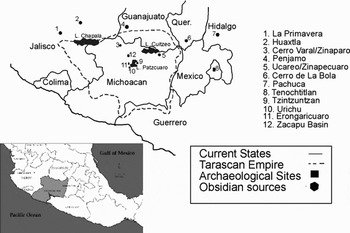
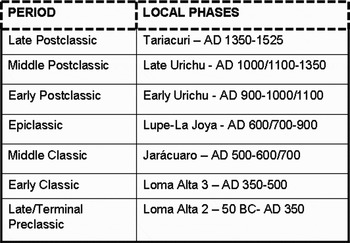
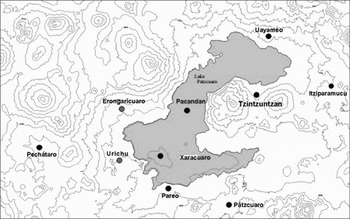
The core of the Tarascan empire was in the Lake Patzcuaro Basin in north-central Michoacan (Figure 1). Prior to the rise of the Tarascan empire, many independent settlements surrounded Lake Patzcuaro. By a.d. 1350 these settlements were incorporated into the Tarascan state (Figure 2). A settlement hierarchy then developed from the capital at Tzintzuntzan to secondary administrative sites and small tributary centers. The settlement of Erongaricuaro was an administrative and a tribute center with allegiance to Tzintzuntzan, the capital of the Tarascan state (Gorenstein and Pollard Reference Gorenstein and Pollard1983). Erongaricuaro is located on the western side of Lake Patzcuaro and much of it is occupied by the modern day eponymous town of Erongaricuaro. The rest of the site is under cultivation and occupied by small farms (Pollard 2001, Reference Pollard, Smith and Berdan2003c, Reference Pollard2005a). Urichu was tributary to Erongaricuaro (Pollard Reference Pollard, Williams, Weigand, Mestas and Grove2005b; Warren Reference Warren1985). Local and state elites inhabited both settlements (Figure 3).
Map of Study Area.

Central Michoacan Phases.

Patzcuaro Lake Basin, modified from Pollard 1993.

PREVIOUS RESEARCH
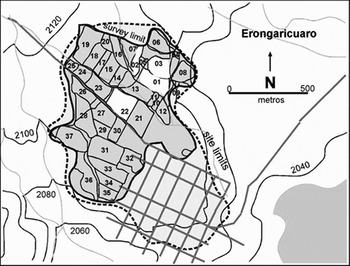
Erongaricuaro (Figure 4) was surveyed and tested in 2001. The survey units were various fields, 37 in all, although one remained unsurveyed due to absentee landowners. The fields varied in size from 3–6 ha, and surveyors recorded the conditions of the field (plowed, not plowed, half plowed, half fallow, never plowed, or completely fallow (Pollard Reference Pollard2005a). Recorded artifact visibility corresponded closely to field conditions (good, moderate, and poor). Obsidian, basalt, ceramic (vessel fragments, figurines, and pipes), and ground stone artifacts were collected. Based on the collected ceramic assemblage, Pollard dated the survey collection to the Late Postclassic period (a.d. 1350–1525). Limited excavation of the settlement was conducted in 2001 in fields ER-1, ER-07, and ER-22 and continued in 2005 in fields ER-01, ER-02, and ER-03 (Figure 4).
Map of Erongaricuaro, modified from Pollard 2005.

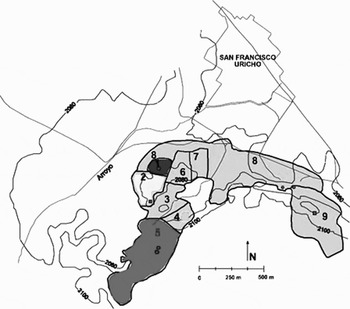
Urichu was previously surveyed and excavated between 1990 and 1995 (Pollard Reference Pollard2000, Reference Pollard, Amy Hirshman, Glascock, Williams and Weigand2001). It has been determined that during the Late Postclassic period the settlement included elite residential, commoner residential, and civic-ceremonial areas (Figure 5). The obsidian, basalt, ceramic, and ground stone artifact assemblages were similar to those found at Erongaricuaro.
Urichu, dark fields excavated, modified from pollard 2000.

The rise of elites and the development of the state may have been due to pressures of environmental change and associated population growth (Gorenstein and Pollard Reference Gorenstein and Pollard1983). With the formation of the Tarascan state in the following phases, elite power became visible in the construction of monumental ritual architecture at the capital of Tzintzuntzan and the increase and consolidation of the population around Lake Patzcuaro. At Urichu, Pollard and Cahue (Reference Pollard and Cahue1999) identified the emergence of elites by the Loma Alta 3 and into the Jaracuaro phase (a.d. 350/500–700) (Pollard Reference Pollard2008). During the subsequent Epiclassic Lupe phase (a.d. 600–900) the formal tomb burials of the elite were associated with imported and luxury grave goods. These imported luxury items reveal that the elite inhabitants of the basin participated in a regional trade network (Pollard and Cahue Reference Pollard and Cahue1999).
A tribute and market system existed within the Patzcuaro Basin and throughout the empire (Pollard Reference Pollard1993; Warren Reference Warren1985). Imported goods included obsidian, salt, lime, and cotton. Because obsidian is not local to the Patzcuaro Basin, it had to be imported both before and during the era of the Tarascan empire. During the Classic period (the Loma Alta phase in the Patzcuaro Basin), obsidian from the Pachuca mines of central Mexico was imported. At the same time, obsidian from sources in northern Michoacan, specifically Ucareo, were traded into and beyond central Mexico (Braswell Reference Braswell, Smith and Berdan2003; Healan Reference Healan1997). With the rise of the Tarascan state, the Ucareo and Zinapecuaro mines and obsidian distribution may have been controlled by the Tarascan state (Pollard et al. Reference Pollard, Amy Hirshman, Glascock, Williams and Weigand2001). Comparative analysis of obsidian from pre-state and state periods can help determine whether the mines were controlled by the state, including the production and distribution of blades and other items (Pollard and Vogel Reference Pollard, Vogel, Smith and Hodge1994). Spatial distribution of both raw materials and finished goods help distinguish between market exchange and state control. For example, an even distribution of obsidian from many sources would imply market exchange, as demonstrated by Hirth's (Reference Hirth1998) distributional approach. Marked intrasite variation in source materials could simply mean that particular obsidian sources were state controlled. Recognizing that this approach must be used with caution when dealing with survey rather than excavated collections, it nonetheless does provide a formal framework by which to interpret the artifact assemblage.
Previous sourcing of obsidian material from Tzintzuntzan led me to believe that the sourcing patterns at Erongaricuaro and Urichu would be very different from those at the capital. Obsidian from a sample of 864 artifacts recovered from surface survey at Tzintzuntzan, the Tarascan capital, was sourced using x-ray florescence, which demonstrated that 94% of the obsidian derived from the Ucareo source (Pollard et al. Reference Pollard, Amy Hirshman, Glascock, Williams and Weigand2001). Pollard interpreted this single-source dominance as a product of Late Classic period state control of obsidian imports. Tzintzuntzan may therefore have controlled the obsidian that circulated between sites within the Lake Patzcuaro Basin, including the site of Erongaricuaro, given its position as a secondary center with high-ranking elites.
The residents of Erongaricuaro may have had some control over craft production, specifically blade manufacture and possibly lapidary work. While Urichu did have local elites, these elites, in turn, paid tribute to higher-ranking elites in Erongaricuaro (Pollard Reference Pollard1993, Reference Pollard, Williams, Weigand, Mestas and Grove2005b; Warren Reference Warren1985). Late Postclassic blade production and the varieties of obsidian resulting from long-distance trade were not expected. Obsidian tested from Urichu revealed that throughout the various phases (ranging from the Late Preclassic to the Late Postclassic period), 50% to 90% of the obsidian artifacts tested derived from the Cerro Varal source of the Zinaparo obsidian complex, the closest Michoacan source to the Lake Patzcuaro Basin. Some Ucareo obsidian, in the form of prismatic blades, is found in elite residential areas at Urichu. These occur during the formation of the Tarascan empire in the Middle and Late Postclassic periods. Pollard (Reference Pollard2003b:232) concluded that most of the obsidian found in the Lake Patzcuaro Basin sites was distributed through a regional market system supplied by long-distance traders who brought obsidian into the basin. Tarascan state control appears to have been limited to the Ucareo obsidian source and to obsidian acquired from beyond the empire by state-sponsored long-distance traders. Sources closer to the basin, such as Cerro Varal and others from the obsidian complex at Zinaparo, were interpreted by Pollard as part of a regional market system because they have also been found at tertiary sites and in commoner residential areas (Pollard Reference Pollard2000, Reference Pollard, Smith and Berdan2003a).
By 2003, when I began my analysis, my focus was to understand the differential patterning of obsidian types within several major settlements during the height of the Tarascan state in the Lake Patzcuaro Basin. For example, did Erongaricuaro have access to Ucareo obsidian because it was a secondary center with high-ranking elites and therefore had a closer connection to Tzintzuntzan, or did the site have access to materials similar to Urichu through a market system? I expected to see that access to obsidian at Erongaricuaro was through both market exchange and direct provisioning by the royal dynasty at Tzintzuntzan.
Expectations derived from the results of ongoing and previous research provide a starting point for this investigation. Numerous burial goods recovered from various periods at Urichu, as well as a previous study by Pollard and Vogel of artifacts from the capital Tzintzuntzan and Tarascan border sites, form the core of the previous research (Pollard Reference Pollard, Smith and Berdan2003a:78–86, 87–92, 227–237; Pollard and Cahue Reference Pollard and Cahue1999; Pollard and Vogel Reference Pollard, Vogel, Smith and Hodge1994). In addition, studies from the two other primary sources in Michoacan form the previous research of Michoacan obsidian (Darras Reference Darras and Darras1998, Reference Darras1999, Reference Darras2008; Healan Reference Healan1997, Reference Healan and Williams2004, Reference Healan, Eduardo Williams, Weigand and Grove2005).
OBSIDIAN PRODUCTION AND WORKSHOPS
The production of prismatic blades involves raw material quarrying, several stages of percussion flaking to create rough cores or nodules for trade and to shape cores, and indirect pressure flaking to produce blades. Throughout Mesoamerica many avenues were taken to acquire and produce obsidian blades. Those sites situated near sources may have controlled the mining as well as the creation of blades, while sites farther from sources would have traded for either obsidian cores or just for prismatic blades. Many have identified the reduction process of obsidian and its economic and social relationships (Clark Reference Clark1982, Reference Clark and Isaac1986, Reference Clark1997; Healan Reference Healan, Hirth and Andrews2002; Hirth Reference Hirth2006; Hirth and Andrews Reference Hirth, Andrews, Hirth and Andrews2002; Pastrana Reference Pastrana, Hirth and Andrews2002).
Obsidian nodules or cores that enter a site may be formed into useful tools by a larger segment of the population or by a few specialized craftspeople. If craft specialization is present, obsidian reduction most likely took place in individual workshops. Depending on the need for obsidian blades and bifaces, the craftspeople may have been full-time or part-time specialists. Full-time and part-time specialists could be identified, but doing so would depend upon the context of site and obsidian artifacts and will not be addressed here (Clark Reference Clark, Hruby and Flad2007; Costin Reference Costin1991, Reference Costin, Hruby and Flad2007; Costin and Wright Reference Costin and Wright1998; Smith and Schreiber Reference Smith and Schreiber2005:195).
Many obsidian workshops have been identified by their refuse dumps in Mesoamerica. They are characterized by the enormous quantity of exhausted cores, broken blades, flakes, and core maintenance debris (Clark Reference Clark and Isaac1986, Reference Clark1997; Hirth Reference Hirth2006; Spence Reference Spence1981). Such debris is usually all the evidence many archaeologists need to proclaim the existence of a workshop. Concentrations of obsidian located on surveys are often later excavated to reveal workshop complexes, storage pits turned trash pits, or trash middens (Andrews Reference Andrews, Hirth and Andrews2002; Clark Reference Clark and Isaac1986; Clark and Bryant Reference Clark and Bryant1997; Healan et al. Reference Healan, Kerley and Bey1983; Healan and Stoutamire Reference Healan, Stoutamire and Healan1989; Johnson Reference Johnson and Odell1996; Moholy-Nagy Reference Moholy-Nagy1984, Reference Moholy-Nagy1997). The debris, when studied, allows the researcher to understand the manufacturing sequences. Archaeologists maintain that if obsidian debris is present at a site but lacking spatial concentration, household or individual production would have taken place (Clark and Bryant Reference Clark and Bryant1997; Healan et al. Reference Healan, Kerley and Bey1983, Reference Healan1997; Hirth and Flenniken Reference Hirth, Flenniken, Hirth and Andrews2002). When specific obsidian concentrations are not located, some archaeologists contend that obsidian blades or other finished products may have been imported.
METHODS TO ACCESS PRODUCTION
The artifact assemblage from Erongaricuaro derives from the 2001 survey collection and limited excavation (Pollard 2001, Reference Pollard2005a). Most of the excavation areas at Erongaricuaro are Late Postclassic in date. But two areas, fields ER-22 and ER-03, based on radiocarbon dates and the ceramic assemblages, were determined to include Loma Alta phase, or Classic period, deposits. This was important, as it allowed the comparison of obsidian sources and reduction techniques between phases within the site and at multiple sites and within the basin. Blade manufacture and lapidary production took place at Erongaricuaro and will be discussed in a later section.
The Urichu collection derives from the excavations of 1990–1995. Extensive excavation in three areas of the site coupled with numerous radiocarbon dates document occupation during the Classic, Epiclassic, and Postclassic periods. While in-depth statistical analysis must be carried out to assess variation between elite residential, commoner residential, and civic ceremonial zones of the site, an initial phase of the investigation of the obsidian artifacts has isolated a pattern of obsidian biface manufacture taking place at this site. The number of biface thinning flakes, as well as biface fragments, is overwhelming compared to the scarcity of biface reduction debris found at Erongaricuaro. Other artifacts, such as blades and cores, do not provide any specific pattern within the site. The basalt industry, however, was thriving, and this will play an important role in further analysis of the sites' lithic assemblages.
OBSIDIAN SOURCING METHODS
A total of 150 obsidian artifacts were sourced from Erongaricuaro, fifty of which were sent before I began my research. I used these previously sourced obsidian artifacts from Erongaricuaro to create a quantitative checklist of visual properties upon which to base my interpretation of the obsidian sources. Variables included color, texture, inclusions, and “quality” of each type. I selected 100 more pieces from Erongaricuaro to source and sent them to be analyzed in two sets of 50 artifacts each. Some were chosen from the Loma Alta (Classic period) phase excavations as well as the Tariacuri Phase (Late Postclassic period) survey and excavation. I visually sourced these prior to sending them to the lab to monitor my ability to predict sources using categories formed from the original 50 sourced pieces. With the first 50 I was 44% correct in my source assignment; with the second batch of 50 artifacts I was 54% correct in identification. I was 81% correct in my source assignment of green obsidian but was able to distinguish only Pachuca from all the other green sources. This is possible because Pachuca obsidian is a very distinctive shade of green.
SOURCING RESULTS
The individual obsidian sources identified from each site are important since they reveal access to particular raw-material resources. The individual artifacts demonstrate the range of special craft activities carried out by inhabitants of particular sites. As noted above, a subset of artifacts were chemically sourced, but given the cost, the majority of artifacts were visually sourced based on quantitative criteria.
Chemical Sourcing
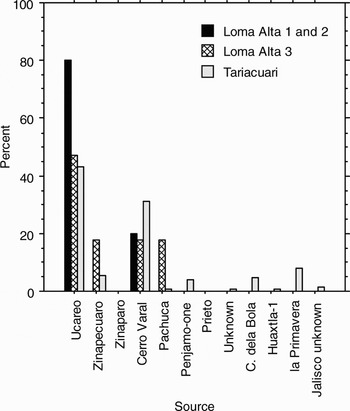
The sources found for each phase at Erongaricuaro are presented in Figure 6. During the Loma Alta phase there are fewer varieties of obsidian (2 to 4) than in later phases and only one green variety, Pachuca. Others include local gray/black varieties from Michoacan. Obsidian blades, flakes and debitage were visually sourced as gray, dark gray, or feathery gray although the cores themselves are black; the observed color depends largely on the thickness of the obsidian. Most obsidian artifacts located in this area are transparent or slightly opaque if they are thin and therefore appear gray. Results of sourcing for the Tariacuri phase are different. Green obsidian came from either five or six sources, some of which are beyond or close to the edge of the Tarascan empire (Figure 1). The discrete sources include Pachuca, Pénjamo, Cerro de la Bola, Huaxtla-1, La Primavera, and an unknown Jalisco source (Glascock, personal communication 2006). This pattern most likely indicates that long-distance traders, controlled by the royals at Tzintzuntzan, brought these materials into the basin (Pollard Reference Pollard1993; Relación Michoacan Reference de Michoacán1989).
Results of 150 sourced artifacts from Erongaricuaro.

Visual Sourcing
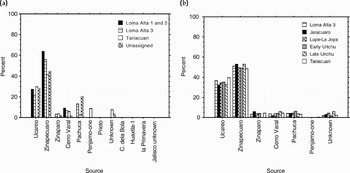
During the Loma Alta Phase the green Pachuca variety was recovered at both sites, but a higher percentage was found at Erongaricuaro (Figures 7a and 7b). Ucareo and Zinapecuaro sources are from the same complex and are therefore very similar; as a result, my identification of these two sources can be reliable only as far as I have been able to separate them from other sources in Michoacan. In past analyses Ucareo and Zinapecuaro were not always distinguished from one another. Healan has suggested that these two flows, and that of Cruz Negra, be considered a “source area” (Healan Reference Healan1997:82). If this is the case, I can consider them to be one source, and therefore much of the obsidian at both sites was imported from this source during the Late Postclassic. For the Tariacuri phase there is again a difference in the green obsidian, with a higher frequency at Erongaricuaro. Through qualitative criteria I classified all of the darker or bottleglass green as coming from Pénjamo-1; although chemically sourced bottleglass green came from four to five different locations (Glascock 2006). This means that bottleglass green obsidian was more readily available to the inhabitants of Erongaricuaro and was imported from more than one location unlike the Pachuca or olive green obsidian.
(a) Erongaricuaro obsidian sources and phase. (b) Urichu obsidian sources and phase. Visually sourced by K. J. Rebnegger.

RESULTS OF ANALYSIS OF PRODUCTION AT ERONGARICUARO
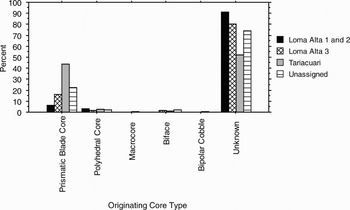
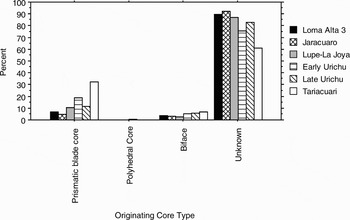
To assess temporal changes in reduction technique I examined the originating core type for blades and flakes during both phases (Loma Alta and Tariacuri) and at each site. Only 9% of the artifacts recovered from the Loma Alta phase were the result of prismatic blade core reduction whereas almost 40% of the artifacts resulted from a prismatic blade core reduction during the Tariacuri phase. This is a clear case for an increase in prismatic blade production and consumption with the rise of the state. When the artifacts are categorized by both site and phase there continues to be a difference between Urichu and Erongaricuaro. The Erongaricuaro assemblage has more prismatic blade cores and more artifacts resulting from prismatic cores. Biface manufacture clearly was taking place at Urichu and not at Erongaricuaro, a fact that holds true even into the Late Postclassic periods when blades become more common in both archaeological assemblages (Figure 8 and 9).
Erongaricuaro, originating core and phase.

Urichu, originating core and phase.

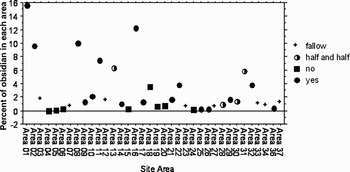
The distribution of artifact categories shows that during the Late Postclassic period obsidian reduction was taking place at Erongaricuaro. High percentages of flakes, flake fragments, and blades as well as the presence of core maintenance and cores is characteristic of a complete reduction sequence. Because of the varying field sizes employed during the survey I examined the density of obsidian artifacts within the fields. To better understand obsidian densities I also employed comparatively the density of basalt and ceramic artifacts for each field. Although none is very dense, higher density outliers were present. Basalt is not prevalent in any field, but a few fields do have a higher density of ceramics and obsidian. To clearly understand the density of artifacts, it was necessary to determine which field had been plowed, left fallow, never plowed, or half plowed and half unplowed or fallow. Plowed fields were always marked as having good visibility, while others were labeled as having moderate to poor visibility. Figure 10 shows the density of obsidian artifacts by field and demonstrates that plowed fields had a higher density of artifacts. This is expected, as plowed fields had a higher visibility. It should be noted, however, that some plowed fields had very low artifact densities.
Obsidian density and field condition at Erongaricuaro.

Plotting the fields with high obsidian densities shows that obsidian special concentrations cluster in one particular area. Field ER-03 has a lower elevation than the fields around it. Pollard (Reference Pollard, Smith and Berdan2003c) maintains that it appears to be a plaza with surrounding platforms accommodating elite residential structures. The concentrations of obsidian indicate that the households around the plaza consumed the most obsidian at the site, but all of these fields have been plowed, which undoubtedly influenced the number of artifacts collected.
If these survey units were locations where the production of prismatic blades occurred; I would anticipate finding core maintenance debitage since blade production involves the preparation and rejuvenation of prismatic blade cores. Did one of these survey units also have a high density of core maintenance debris? I examined exhausted prismatic cores and core fragments, as well as platform rejuvenation flakes, rejuvenation blades and flakes, and decortication flakes. The highest densities of core maintenance were in Fields ER-01, ER-11, ER-16, and ER-22. These fields are near the platform area and also had a high density of all obsidian artifacts. It is therefore possible that blade production took place in these areas. Field ER-22 is the only field that did not have a high general density of obsidian artifacts.
The production of blades produces blades; therefore the next aspect of this study examines the density of blades for each survey unit. This included first, second, and third series blades, blade fragments, decortication blades, and ribbon blades. Fields ER-08, ER-10, ER-11, and ER-16 have the highest blade densities. All of the fields except field ER-10 had a generally high density of obsidian artifacts. Fields ER-11 and ER-16 are the only two fields that have both a high density of core maintenance and tools manufactured on blades.
The other obsidian artifacts collected in the survey include scrapers, points (finished and preforms), and bifaces. Most of the scrapers are end scrapers. Of these 70% are found in fields ER-01 and ER-02. This is interesting because scrapers are not necessarily a specialized tool. Why are most recovered from only two fields? Were they utilized for spatially discrete specialized activities? I initially predicted that scrapers would be distributed rather evenly throughout the entire site. Principal component analysis of the obsidian and basalt artifact distribution shows that basalt scrapers are found in fields ER-28 and ER-29 while obsidian scrapers are located in the northern fields. This localized distribution may have to do with some type of processing or production that required scrapers. Were obsidian and basalt scrapers used for the same purpose, and why are they distributed in different areas of the settlement?
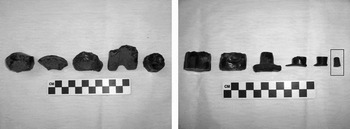
Obsidian artifacts resulting from processes other than blade production were recovered during the survey, and others were recovered during the 2005 excavations. Most are drill cores for ear plugs, and the other is an unknown ground preform (Andrews, personal communication 2004; Clark, personal communication 2004; Healan, personal communication 2004 and 2007; Otis-Charlton 1995; and personal communication 2007). The unknown worked piece of obsidian may have been intended to be an ear plug or large bead made from an exhausted core drilled out from both ends, broken in half and discarded. These objects were found in fields ER-02 and ER-07, both near the platform and high concentration of obsidian. During the 2005 field season, we met a local man who had collected from a few fields over ten years, specifically around field ER-07 and ER-08. His collection included huge polyhedral cores with cortex, prismatic blade cores, and artifacts that represented the entire process of manufacture for lip and ear plugs including a drill core (Figure 11). Some are very similar to items found by Otis-Charlton (Reference Otis-Charlton1993) at the site of Otumba. While working on the collection in Erongaricuaro, I identified another bead fragment and an ear spool preform. Grinding and polishing obsidian is a task that was most likely undertaken by a specialized craftsman. If this is so, it is reasonable to contend that there were craftspeople who practiced their lapidary work in the areas around the plaza, possibly creating jewelry for an elite group of residents at Erongaricuaro or for elites at Tzintzuntzan (Inomata Reference Inomata1998, Reference Inomata, Hruby and Flad2007; Kovacevich Reference Kovacevich, Wells and Davis-Salazar2007).
Lapidary artifacts.

Through analysis of the obsidian assemblage, I am able to draw some preliminary conclusions about the use of obsidian at Erongaricuaro during the Late Postclassic period. There are no workshops indicating a high level of craft specialization in previous spatial analysis of obsidian from Erongaricuaro, although I did locate an area of the site where obsidian is concentrated compared to the basalt industry (fields ER-01, ER-02, and ER-03 [Rebnegger 2004]). This concentration suggests obsidian blade production in the northern area of the site. This interpretation is based on not just the quantity of blades recovered, but the number of what I have termed and adopted from Clark's work in Chiapas core maintenance and production debris (CMP), including core rejuvenation flakes or blades as well as exhausted cores (Clark Reference Clark1997:142–148). Field and laboratory analysis in 2005 and 2006 indicates that some of these exhausted cores were located in an area used for lapidary work; this area was defined by the presence of a few fragments of partially ground drill cores or reamers, ear spool cores, and a bead (Charlton 1993 and personal communication 2007; Rebnegger Reference Rebnegger2006). The core fragments, usually the proximal or distal end, could be considered near-exhausted cores although other exhausted cores from the area are much smaller (at Tzintzuntzan they are about 2 cm in diameter; these are about 4 cm). Some core fragments are ground on the sides, and others are broken at odd angles and may have been discarded, as they were not adequate for ear spool manufacture. The high percentage of green obsidian, as well as lapidary work, in these areas is similar to some of the lithic workshops found at the capital and associated with elite assemblages (Pollard and Vogel Reference Pollard, Vogel, Smith and Hodge1994). This northern area of the site also produced a high concentration of obsidian scrapers; 70% of those found at the site were recovered from fields ER-01 and ER-02.
CONCLUSION
The questions and hypotheses posed at the outset of this paper focused on the use of obsidian sources and changes in blade manufacture from the Loma Alta and Tariacuri phases at two sites in the Lake Patzcuaro Basin. Based on analysis of these collections, a case can be made for state control of certain source varities of obsidian. In the Loma Alta phase almost all of the green obsidian blades at both sites were from the central Mexican Pachuca source. There is no evidence for local manufacture of these blades. Green blades were a prestige item found more frequently as elite society became more prominent within the basin. I would argue that as the state grew, control of long-distance traders and their acquisition of green obsidian products were important to the royal dynasty and elites of the Tarascan empire. As the empire expanded, elites had both the need and the ability to acquire green obsidian from more than just two locations. Green obsidian was used to make bezotes, earspools, and beads for the elite of the Tarascan state. This was very clearly demonstrated at Erongaricuaro. Some examples of the artifacts recovered from the northern end of the site are depicted in Figure 11. Similar artifacts were recovered by both Pollard at Tzintzuntzan and in Instituto Nacional de Antropología e Historia excavations of elite burials at Tzintzuntzan (Cabrera Castro Reference Cabrera Castro1987; Castro Leal Reference Castro Leal1986; Pollard Reference Pollard1993). The small number of green obsidian artifacts found at Urichu during the Tariacuri phase in a locus of members of the lower nobility seems to emphasize the value attached to these sources and demonstrates elite control by the royal dynasty and upper nobility in the Tarascan empire.
Visual or qualitative obsidian sourcing is not completely accurate, so any claims about the Ucareo and Zinapecuaro sources need to be taken with caution. I will, however, state that I was able to identify all the chemically sourced Cerro Varal obsidian correctly. The consumption of this source seems to have stayed constant during the rise of the state, especially in its distribution at Urichu. The inhabitants of Urichu used Cerro Varal for all types of nonprismatic blade artifacts, demonstrated by the fact that much of the Cerro Varal is debitage in the form of medium and small flakes. This is consistent with the idea that Cerro Varal was not under state control but rather was part of a regional market system and available to every social class in the Tarascan empire.
At the outset of this analysis I had hoped to identify workshop areas within the site of Erongaricuaro by using a sample of artifacts collected from the survey. The location of workshop areas would allow me to interpret the social and economic structures of the site. Areas that had workshops may have controlled the production and distribution of obsidian within Erongaricuaro. These areas would have a high concentration of cores, core maintenance, and debris.
I found areas at the site that had higher concentrations of obsidian artifacts, but the densities of artifacts may not be high enough to consider them to be workshops (Clark Reference Clark and Isaac1986; Hirth Reference Hirth2006). The fields with the highest density of obsidian were located around Field ER-03, the possible plaza. This distribution may indicate that obsidian was brought into the site through a market system or tribute. Of the entire obsidian assemblage, 69% was collected from the fields surrounding the possible plaza. If the market was in the plaza, then those inhabitants around it may have controlled its distribution allowing only those in the residential areas near the plaza to obtain obsidian. I contend that inhabitants of this northern area of the site controlled access to obsidian and may have controlled the distribution of blades throughout the site but that the majority of obsidian remained in this area. This area of the site is also associated with an elite assemblage of ceramics and pipe stems (Pollard Reference Pollard2005a).
Specific workshop areas like those found in Tula or Teotihuacán are not evident at Erongaricuaro (Andrews Reference Andrews, Hirth and Andrews2002; Clark Reference Clark and Isaac1986; Healan Reference Healan1983, Reference Healan1997; Spence Reference Spence1981, Reference Spence and Kenneth1984). Because there is manufacturing debris in the plaza area, however, I also think that part-time craft specialization took place. Many blades can be removed in one sitting—enough to supply numerous households. Field ER-11, with its low density of domestic debris in the form of ceramics, may have been a part-time workshop area or dump. The other fields do not have such dramatic variation in densities between obsidian and ceramics. As noted, the ensuing basalt analysis will be very important to this study on a comparative basis. While test excavations in the three fields expanded our knowledge of the area, they did not reveal possible production areas.
The only observable lithic craft specialization at these sites is the lapidary work at Erongaricuaro. Blade manufacture is not at a level that could be considered a workshop (Clark Reference Clark and Isaac1986; Healan Reference Healan and Isaac1986; Hirth Reference Hirth2006; Spence Reference Spence1981, Reference Spence and Kenneth1984). Blade production technology was present and became more common during the Tariacuri phase. During the Tariacuri phase isolated areas of blade production can be documented at Erongaricuaro. However, as noted earlier, this area was also the site of jewelry production. It appears that there was controlled distribution of green obsidian. It was used for the manufacture of earspools and bezotes, whereas gray obsidian was more often used to make ear spools. This distinction is evident in the ground core fragments and waste drill cores seen in the local collector's artifact assemblage and excavated material from 2005. This northern area of the site is also associated with an elite assemblage of ceramics and pipe stems. Blade production may have taken place at Urichu, but on a very small scale, if at all. The inhabitants of the site manufactured and used bifaces, varying from small projectile points to larger tools that may have been used as knives. Biface thinning flakes as well as biface fragments are located near elite residential and ritual areas at Urichu and may indicate some degree of control over their production by the local elites.
Additional research at the sites of Erongaricuaro and Urichu and the comparison of artifacts recovered from Tzintzuntzan may further highlight the differences in procurement and manufacture of obsidian products during the Loma Alta and more specifically, the Tariacuri phase. Consequently, expansion of this analysis beyond the imperial capital has revealed a set of distinctive patterns that both confirm and alter the several conclusions and interpretation presented by Pollard (Reference Pollard1972, Reference Pollard1993) on the basis of a more restricted set of materials. Apparently only some of the obsidian was controlled by royal inhabitants of the capital, and craft production took place not only at the capital, but beyond it at the secondary settlement of Erongaricuaro.
RESUMEN
Muchos asentamientos de los tarascos rodearon el Lago de Patzcuaro en Michoacan, México, durante el período posclasico tardió. Dr. Helen Pollard llevó a cabo las primeras exploraciones e identificó tres niveles de sitios en la regiόn. Una jerarquía de asentamientos existió de la capital Tzintzuntzan hasta los sitios de administración secundarios y las comunidades tributarias pequeñas. Artefactos de obsidiana de un sitio de administraciόn secundario, Erongaricuaro, han sido estudiados por la autora. El análisis de la obsidiana de este sitio resaltó los modelos particulares en la producción y el consumo de navajas prismaticas y los raspadores grandes. Los datos de artefactos de obsidiana excavados en el sitio de Urichu, fueron obtenidos y analizados más recientemente. Urichu era un centro tributario de Erongaricuaro bajo el poder del Estado tarasco. Las élites locales y estatales habitaron ambos sitios y el análisis de la fabricación de la obsidiana indica que los sitios pueden haber tenido funciones diferentes. La obsidiana de los sitios también varía por las ubicaciones de las fuentes. Esto puede indicar también la función del sitio y cambios en la organización sociopolítica de producción y uso de la obsidiana en el imperio tarasco.
ACKNOWLEDGMENTS
Survey and excavations have been carried out at both Urichu and Erongaricuaro under the direction of Helen Pollard with funding from the Wenner-Gren Foundation for Anthropological Research, the National Geographic Society, the National Science Foundation, the National Endowment for the Humanities, and the Heinz Foundation. Recent excavations at Erongaricuaro by Dave Haskell, supported by the Foundation for the Advancement of Mesoamerican Studies, Inc., have also informed this report. All work was made possible by permits from the Instituto Nacional de Antropología e Historia of Mexico.