Introduction
In mass-casualty incidents (MCIs), Advanced Medical Posts (AMPs) provide structured triage, treatment, and coordinated transport.Reference Schultz, Koenig and Noji 1 During the World Economic Forum (WEF) in Davos, a fully operational AMP is pre-established as part of contingency planning.Reference Junge and Niedermaier 2
In MCIs, patients typically undergo pretriage at the scene, which serves to rapidly identify and prioritize those requiring immediate attention.Reference Junge and Niedermaier 2 –Reference Lerner, McKee and Cady 3 In Switzerland, the SwissPre pretriage algorithm, derived from SALT and mSTART principles, assigns casualties to color-coded priority groups according to injury severity and physiological compromise. Patients receive a patient-tracking tag, which accompanies them until they reach definitive care.Reference Stuby, Fehlmann and Bellotti 4
The effectiveness of an AMP depends on timely identification of patients requiring life-saving interventions or priority transport.Reference Schultz, Koenig and Noji 1 However, inaccurate pretriage labels resulting from undertriage or clinical deterioration before AMP arrival may influence clinical expectations and workflow decisions within the AMP. Therefore, inaccurate pretriage labeling may alter queue position, propagate through downstream workflow processes, and delay adequate treatment.
While pretriage accuracy has frequently been studied at the level of categorical correctness, less is known about how inaccurate pretriage labeling affects downstream time-critical processes.Reference McKee, Heffernan and Willenbring 5 This pilot study evaluated the impact of inaccurate pretriage labeling at AMP entry on time-critical care processes for red-category patients in an AMP. Specifically, whether mislabeled patients experienced delays to case-dependent predefined first critical action compared with correctly triaged red patients.
Methods
Study Design and Setting
This was a prospective, pilot simulation-based study conducted during 2 full-scale AMP simulation runs during WEF 2026. The aim was to examine the downstream effects of entering the AMP with a triage label that underestimates true acuity at the time of AMP entry on time-critical care processes.
The AMP reflected the operational structure and personnel that would be deployed in the event of a real mass-casualty incident during the WEF. Medical staff comprised emergency physicians and paramedics from civilian emergency medical services and the Swiss military.
The exercise simulated the complete AMP workflow, including triage, resuscitation, treatment, and transport coordination. The AMP layout, equipment, and logistics mirrored real-world operational conditions. The AMP consisted of 3 triage bays, 5 resuscitation bays, and a lower-acuity treatment and transport waiting area. The targeted AMP surge capacity was approximately 300 patients within 6 hours under real-world operational conditions. Two full simulation runs were conducted under identical scenario conditions, using the same patient cases, identical patient arrival sequences, and identical transport capacity constraints. Team composition varied between the 2 runs.
Simulated Patients
Each simulation run (run A and run B) included 18 simulated patient cases with injury patterns fitting the simulated MCI scenario, including penetrating injury patterns. All cases were identical across both runs and were defined by preset clinical presentations, physiological parameters, and scripted time-dependent trajectories. Actors were briefed regarding their case, moulaged, and carried patient cards displaying predefined vital parameters.
For each patient, a correct triage category was predefined using the SwissPre pretriage algorithm.Reference Stuby, Fehlmann and Bellotti 4 Ten simulated patients met red triage criteria at baseline. The remaining 8 patients were categorized as yellow patients. All patients entered the exercise with a patient-tracking tag reflecting their predefined pretriage label. The simulation timeline began at AMP entry for each patient, and all outcome measurements were calculated from this time point.
Exposure
Three red-category patients were purposively mislabeled before the start of each simulation run, resulting in 6 patient-specific comparisons. For each patient exposed to mislabeling in one simulation run, the corresponding patient in the alternate run served as the correctly labelled comparator. “Mislabeled at AMP entry” was defined as a mismatch between the assigned pretriage category before presenting at the AMP and the true acuity of the patients. Specifically, patients fitting within the red SwissPre pretriage category were mislabeled as yellow. The specific patients mislabeled differed between runs, while the number of mislabeled patients per run remained constant. Correctly labeled red patients within the same run served as comparators. All patients underwent secondary triage at AMP entry in both runs at 1 of 3 triage bays.
Outcomes
Time to first critical action (TFCA) from AMP entry was used as the primary outcome. A critical action was a predefined case-specific clinical intervention needed to prevent scripted patients’ deterioration. Each critical action consisted either of a specific life-saving intervention performed within the AMP, or initiation of transport from the AMP when definitive treatment outside the AMP was defined as the deterioration-preventing step.
Secondary outcomes included:
-
• Reaching the scripted deterioration and/or death threshold before critical action (yes/no);
-
• Time to correction of triage status (minutes).
Deterioration and death thresholds were predefined scenario-specific timepoints established by the exercise designers during case development, representing the expected progression to clinical deterioration or death if the predefined critical action was not performed within the specified timeframe.
System Load Measures
To assess comparability between the two simulation runs, system load was documented using the AMP patient count documented by the electronic patient tracking system IES (Informations- und Einsatzsystem), the same electronic tracking system employed during real events in Switzerland. 6 AMP entry and transport times were also recorded using the IES. System load data were analyzed descriptively.
Observers recorded real-time timestamps of relevant events in patient management using standardized tracking sheets.
Sample Size Justification
This was a fixed-opportunity study limited to 2 full-scale simulation runs. The sample size was conveniently determined by the predefined number of red patients within the scenario design.
Ethical Considerations
This study constituted simulation-based research involving health care professionals. Participation in the simulation exercise was part of scheduled training and voluntary. Data were analyzed at the system and process level only.
All participants underwent structured debriefing after the simulation. Scripted deterioration and death were not framed as individual failure.
The Ethics Committee Zurich, Switzerland, determined that this project did not require formal ethical approval and issued a declaration of no objection on October 17, 2025 (Business Administration System for Ethics Committees Req-2025-01414).
Results
Primary Outcome
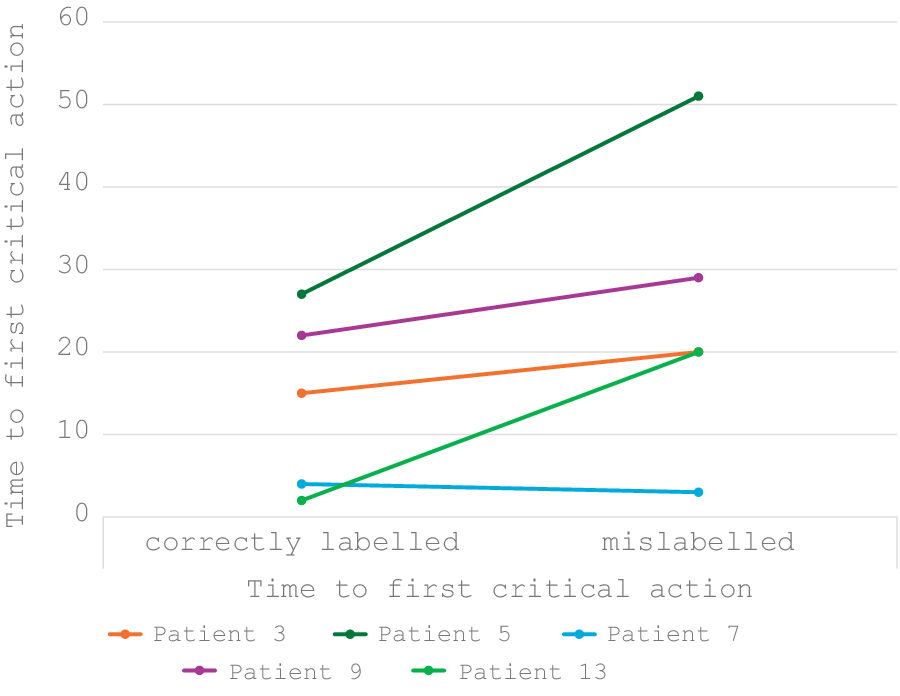
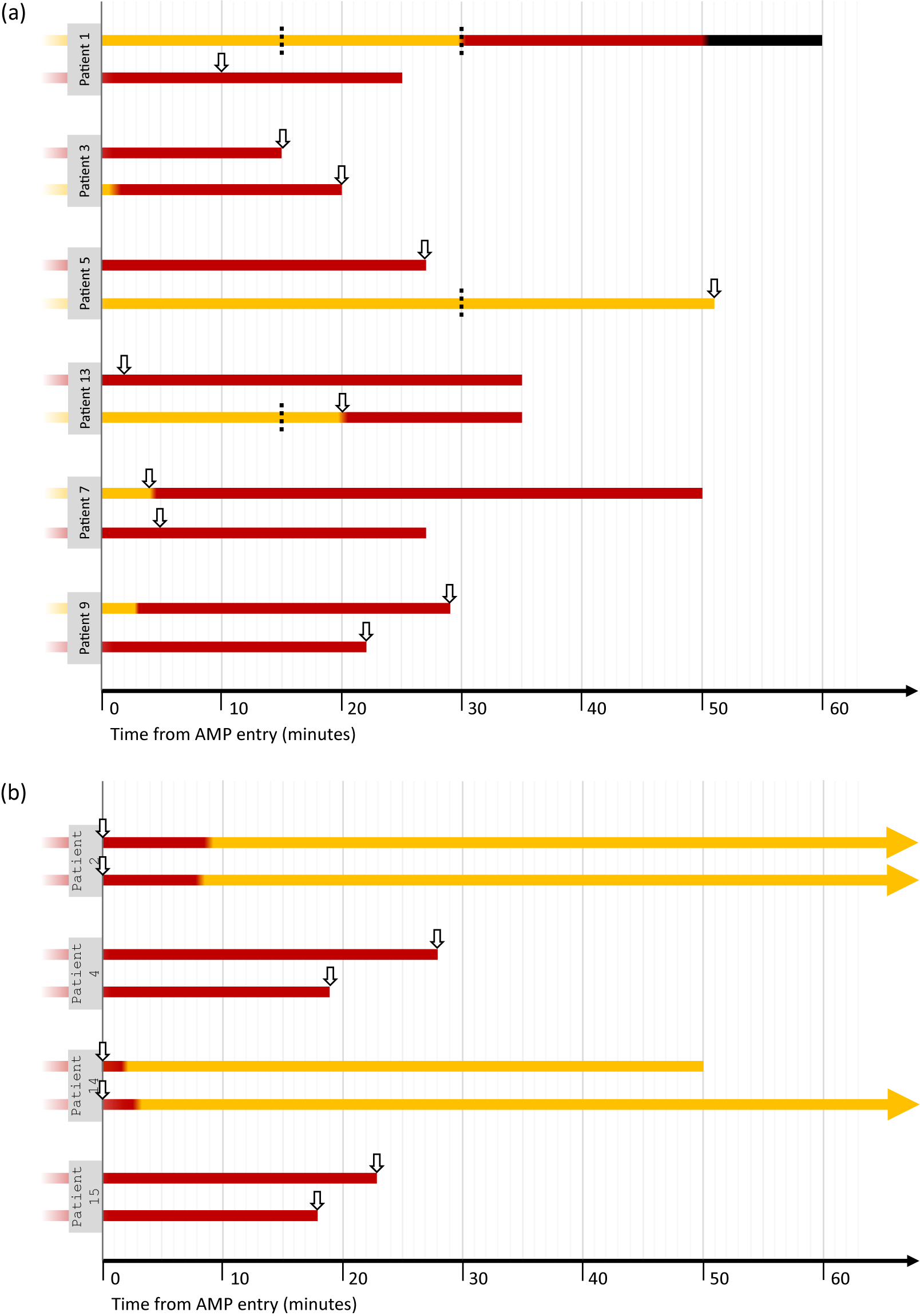
In 4 of 5 comparisons in which a predefined critical action was performed, TFCA was longer for mislabeled patients than for correctly labeled ones. The paired delay ranged from 5 to 24 minutes (Figures 1 and 2a). In 1 case (patient 1), the predefined critical action was not performed in the mislabeled run before the scripted death threshold was reached.
Paired comparison of time from AMP entry to predefined critical action.
Each line represents 1 red patient, with the 2 dots showing the time to first critical action in both runs (left: correctly labeled; right: mislabeled); the patient reaching the death threshold in run B is not shown.

Figure 1 Long description
The figure is a paired dot plot. For each patient, one point shows the time from advanced medical post (AMP) entry to the first predefined critical action when correctly labelled, and a second point shows the time when mislabelled as yellow. A connecting line displays the within-patient difference. Mislabelling was associated with a delay in four of the five paired comparisons, with delays ranging from 5 to 24 minutes. Patient 7 was the exception, with TFCA one minute shorter in the mislabelled condition. Patient 1 is not displayed because, in the mislabelled run, the critical action was not performed before the scripted death threshold was reached.
(a) Timeline representation of red-category patients exposed to mislabeling during 1 of the 2 runs. (b) Timeline representation of red-category patients correctly labeled in both runs.
Each pair of horizontal bars represents 1 patient from AMP entry onward (upper bar: run A; lower bar: run B). Bar color reflects the triage category displayed at AMP entry and during the AMP course (yellow = delayed; red = immediate; black = deceased). Color transitions indicate changes in triage status. Downward arrows mark the predefined first critical action. Black dashed vertical markers indicate the case-specific deterioration threshold, if reached prior to the first critical action.

Figure 2a Long description
Panel A includes six patients who were correctly labelled as red at AMP entry in one run and mislabelled as yellow in the other. Five of six mislabelled patients were corrected between 1 and 30 minutes after AMP entry; one remained yellow until transport. Three deteriorated, and patient 1 subsequently reached the scripted death threshold before the critical action. No correctly labelled patient deteriorated or died. Of five complete paired comparisons, TFCA was longer when mislabelled in four and one minute shorter in one. Panel B includes four patients who were correctly labelled as red at AMP entry in both runs. TFCA, time from AMP entry to the first predefined critical action. TFCA was broadly comparable between the two simulation runs. None of the correctly labelled patients reached a predefined deterioration or death threshold.
TFCA for the 4 patients correctly labeled at AMP entry in both simulation runs was comparable between runs (Figure 2b).
Secondary Outcomes
Deterioration and death before intervention
Three of 6 mislabeled patients reached the deterioration threshold. One of those patients subsequently reached the death threshold. No correctly labeled red patient reached deterioration or death in either simulation run.
Correction of triage status
Time to correction of triage status varied substantially among the 6 patients entering the AMP mislabeled. In 5 of 6 cases, mislabeling was corrected during the AMP course, with times to correction ranging from 1′ to 30′ after AMP entry. In 1 case, no formal correction of triage status occurred prior to transport. In 2 patients, correction occurred at or after the case-specific deterioration threshold. In 3 patients, correction occurred in the triage bay (≤4′) (Figure 2a).
System load
Owing to the electronic patient tracking system, total patient numbers and triage-category distributions could be assessed with high temporal resolution. Peak total AMP occupancy occurred after 21′ with 16 patients in run A, and after 20′ with 14 patients in run B. Peak red-patient load was observed after 18′ with 9 red patients in run A, and after 16′ with 8 red patients in run B.
Discussion
This pilot simulation study suggests that inaccurate pretriage labeling at AMP entry may influence downstream time-critical care processes. Six patients were assessed under both correctly labeled and mislabeled conditions. In 5 patients, the predefined critical action was performed in both simulation runs. In 4 of these 5 paired comparisons, mislabeling was associated with longer time to predefined critical action. In the remaining patient, the predefined critical action was not performed in the mislabeled run before the scripted death threshold was reached. Overall, 3 mislabeled patients crossed their case-specific deterioration thresholds, 1 of whom subsequently reached the scripted death threshold. In contrast, no correctly labeled red patient reached a deterioration or death threshold in either simulation run.
These findings seem to suggest that inaccurate pretriage labeling may not remain a purely categorical error but may act as a process-modifying input into the subsequent patient management and AMP workflow dynamics. Medical personnel may be influenced by an initial label when assessing and interpreting subsequent information, a phenomenon described as cognitive anchoring,Reference Ly, Shekelle and Song 7 which is among the most common cognitive biases affecting emergency medical personnel.Reference Watari, Tokuda and Amano 8 Although all patients underwent formal secondary triage at AMP entry, the displayed pretriage category may have served as a reference point for subsequent judgments and may have influenced the depth and urgency of reassessment under operational pressure.Reference Watari, Tokuda and Amano 8
The timing of triage category correction appeared to be of importance. Mislabeling at AMP entry was not associated with meaningful delays when corrected promptly at the triage area. In contrast, delayed correction was associated with crossing of deterioration thresholds. This pattern suggests that the AMP entry triage represents a critical control point at which severely injured patients should be identified and correctly categorized before entering downstream workflow pathways, such as transfer to an inadequate treatment zone. Although the accuracy of primary mass-casualty triage systems has been extensively studied, most investigations have focused on rates of overtriage and undertriage rather than on the downstream consequences of inaccurate triage categorization. Consequently, little is known about the effectiveness of secondary triage processes in correcting inaccurate pretriage categorization. To the best of our knowledge, no previous studies have specifically evaluated the impact of secondary triage within an AMP on the recognition and correction of inaccurate pretriage labels or the resulting effects on time-critical care processes.
Pretriage algorithms are designed for rapid on-scene assessment and are associated with substantial rates of overtriage and undertriage. A meta-analysis of the widely used START algorithm reported overtriage rates of 7-14% and undertriage rates of 6-10%.Reference Franc, Kirkland and Wisnesky 9 Even when the initial categorization is correct, patients may deteriorate during the interval between on-scene pretriage and arrival at the AMP, rendering the initial label no longer appropriate. Consequently, some degree of inaccurate pretriage labeling at AMP entry may be unavoidable. As suggested by our results, failure to identify an inaccurate pretriage label may trigger a cascade of downstream delays, potentially leading to patient deterioration. High-quality secondary triage may therefore play a critical role in ensuring adequate patient management in an AMP and should represent a distinct clinical reassessment step rather than a simple repetition of the pretriage algorithm. Accordingly, secondary triage should ideally be performed by experienced personnel using structured triage protocols, as also recommended by the current CHEST consensus.Reference Christian, Sprung and King 10 Continuous reassessment should be maintained throughout AMP patient flow rather than being limited to a single assessment at entry. Such an approach may facilitate timely correction of triage category in dynamic conditions and optimization of patient pathways. Simulation exercises, such as the one used in this study, may provide opportunities for MCI responders to become familiar with triage and reassessment workflows and to practice their application under operational pressure.
Overall, the findings of this study highlight the importance of recognizing that pretriage labels may not accurately reflect a patient’s clinical condition at AMP entry and underscore the potential role of high-quality secondary triage in identifying undertriaged patients requiring time-critical interventions.
Limitations
Some limitations must be considered. The study was limited to two simulation runs with a small number of red patients, and no formal statistical hypothesis testing was performed. This study focused exclusively on undertriage and does not address effects of overtriage. Deterioration thresholds were predefined scenario endpoints and do not necessarily reflect real dynamic trajectories. While system load was found to be comparable across runs, unmeasured differences in team dynamics or decision-making may have contributed to observed variation. Finally, as a simulation-based study, findings may not directly translate to real-world mass-casualty incidents. As such, the findings should be considered hypothesis-generating.
Conclusion
In this pilot simulation study, inaccurate pretriage labeling at AMP entry was associated with delays in time-critical interventions. These findings highlight the importance of continuous structured reassessment and timely correction of triage categorization within structured mass-casualty care systems after initial on-scene pretriage. These findings should be considered hypothesis-generating and warrant confirmation in larger simulation and real-world studies.
Author contribution
-
• Manuel Walter: Conceptualization; study design and methodology; project administration; data analysis and interpretation; visualization; writing, review, and editing.
-
• Sarah Thiel: Conceptualization; literature review; writing, review, and editing.
-
• Paolo Rodi: Conceptualization; literature review; writing, review, and editing.
-
• Helge Junge: Simulation design and planning; review and editing.
-
• Nils Thöni: Simulation design and planning; review and editing.
-
• Armin Hess: Implementation of the simulation exercise; data collection.
-
• Dominic Schier: Implementation of the simulation exercise; data collection.
Funding statement
None.
Competing interests
None.