


Introduction
Millions of distressed migrants move internationally for higher wages and to support left-behind families through financial remittances (Abubakar et al., Reference Abubakar, Aldridge, Devakumar, Orcutt, Burns, Barreto, Dhavan, Fouad, Groce, Guo, Hargreaves, Knipper, Miranda, Madise, Kumar, Mosca, McGovern, Rubenstein, Sammonds, Sawyer, Sheikh, Tollman, Spiegel, Zimmerman, Abubakar, Aldridge, Devakumar, Orcutt, Burns, Barreto, Dhavan, Fouad, Groce, Guo, Hargreaves, Knipper, Miranda, Madise, Kumar, Mosca, McGovern, Rubenstein, Sammonds, Sawyer, Sheikh, Tollman, Spiegel, Zimmerman, Abbas, Acer, Ahmad, Abimbola, Blanchet, Bocquier, Samuels, Byrne, Haerizadeh, Issa, Collinson, Ginsburg, Kelman, McAlpine, Pocock, Olshansky, Ramos, White and Zhou2018). Among them, an estimated 8.5 million female migrant domestic workers (MDWs) globally perform housework, childcare and eldercare, typically living in their employer’s home working 6–7 days per week (Gallotti, Reference Gallotti2015). These conditions may constrain social engagement, limit mobility and heighten vulnerability to loneliness and poor mental and physical health (Chan et al., Reference Chan, Dominguez, Hua, Garabiles, Latkin and Hall2024; Fernández, Reference Fernández2025). For MDWs, social networks provide connections, emotional and material support, and resources, yet may also create stress through burdens, negatively affecting health and well-being (Villalonga-olives and Kawachi, Reference Villalonga-olives and Kawachi2017). Yet, limited evidence exists on the relationship between migrant social network characteristics and health. This study examines MDW network capital and its association with mental health, loneliness and self-rated health.
This study is guided by two complementary theoretical pillars: social network theory and social capital theory. Social network theory holds that social structure, rather than individual attributes, shapes behavioural and health outcomes (Kawachi and Berkman, Reference Kawachi and Berkman2001). These interpersonal ties to family, colleagues, community groups and friends create structured positions that determine access to information, support and resources with documented effects on health throughout the life course (Kawachi and Berkman, Reference Kawachi and Berkman2001; Vacchiano et al., Reference Vacchiano, Hollstein, Settersten and Spini2024). Social capital theory extends this by conceptualizing the resources embedded within social relationships as capital, which are assets that can be drawn on to counter stress and promote well-being (Cohen and Wills, Reference Cohen and Wills1985; Kawachi and Berkman, Reference Kawachi and Berkman2001). However, social capital is not inherently beneficial. The ‘dark side’ of social capital shows how social relationships may undermine health through excessive demands, conflict, emotional contagion and reciprocal obligations that strain limited resources (Portes, Reference Portes1998; Villalonga-olives and Kawachi, Reference Villalonga-olives and Kawachi2017). For example, in migrant populations where members share similar stressors and constrained resources, reciprocity – often conceptualized as a positive aspect of supportive relationships – may instead function as a burden (Hall et al., Reference Hall, Garabiles and Latkin2019a; Lai and Fong, Reference Lai and Fong2023).
Together, these two theories create a classification of network capital that guides the present study. Network capital is conceptualized to contain positive dimensions such as emotional closeness and perceived helpfulness of support, which are theorized to promote health through emotional and instrumental resources (Campos et al., Reference Campos, Ullman, Aguilera and Schetter2014). Negative aspects are also present, such as reciprocity burden, which is a relational stressor that can harm health through demand, strain and emotional contagion (Portes, Reference Portes1998). Finally, there are neutral network dimensions including network size and financial resource access, where their health implications are highly conditional on populations and context (Wright, Reference Wright2016).
Similar to other international migrant workers, MDWs’ social networks are often transnational and consist largely of kin and co-national ties (Bilecen and Lubbers, Reference Bilecen and Lubbers2021; Sumerlin et al., Reference Sumerlin, Li, Chen, Garabiles, Li, Shi, Latkin and Hall2025a). The Philippines and Indonesia are among the largest MDW-sending countries globally, and both societies emphasize collectivist values including group harmony and familism (Grimm et al., Reference Grimm, Church, Katigbak and Reyes1999; Cukur et al., Reference Cukur, De Guzman and Carlo2004; Sawitri and Creed, Reference Sawitri and Creed2017). Despite these cultural similarities, Filipino and Indonesian MDWs differ substantially in their network structures. In a study of 749 Filipino and 431 Indonesian MDWs in Hong Kong and Singapore, Filipino MDWs were more likely to report pre-migration overseas contacts and had larger, more geographically diverse networks with a higher proportion of white-collar ties than Indonesian MDWs (Paul, Reference Paul2019). Similar patterns were observed in Macao among 1330 Filipino and 353 Indonesian MDWs, where Filipino MDWs had larger, more geographically diverse post-migration networks; greater emotional closeness; and better received access to tangible resources, but also reported higher listening reciprocity burden (Sumerlin et al., Reference Sumerlin, Li, Chen, Garabiles, Li, Shi, Latkin and Hall2025a). Although these network dimensions are well documented, their implications for health have not been directly examined.
Existing research on MDWs’ health has relied predominately on aggregate measures of perceived social support or social capital, with mixed results. Some studies find that social support buffers the effects of discrimination-related stress on mental health (Sumerlin et al., Reference Sumerlin, Kim and Chung2025b), while others report paradoxical effects in which greater cognitive social capital is associated with worsening mental health symptoms under high stress conditions (Mendoza et al., Reference Mendoza, Mordeno, Latkin and Hall2017; Hall et al., Reference Hall, Pangan, Chan and Huang2019b). Reviews of MDWs’ mental health conclude that evidence on the protective role of social support or social capital remains inconsistent (Ho et al., Reference Ho, Yang, Leung, Bressington, Chien, Cheng and Cheung2022; Liao et al., Reference Liao, Pulido and Liu2024). Several methodological limitations contribute to this inconsistency, including many studies using small or single-nationality samples; those including multiple nationalities rarely stratify analyses; and aggregate support measures do not capture specific network dimensions or negative relational processes. This study seeks to directly address these gaps.
Drawing on social network and social capital theories, this study hypothesizes that negative network capital, through reciprocity burden, will be the most consistently associated measure of worse health outcomes over positive and neutral network capital measures. Moreover, using egocentric network data from a large sample of Filipino and Indonesian female MDWs working in Macao, China, this study aims to
1) Quantify network capital across the full sample, by ego–alter relationship type, and alter residence location.
2) Examine associations between network capital and mental health (depression, anxiety, post-traumatic stress disorder [PTSD]), loneliness and self-rated health.
3) Compare network capital patterns and health associations across network subgroups defined by relationship type and alter residence (see Fig. 1).
Analytical framework.

Methods
Study setting and design
This study took place in Macao, China, a major destination for MDWs in East Asia. As of December 2025, approximately 28,611 MDWs were employed in Macao, predominately from the Philippines (54%) and Indonesia (21%) (DSAL, 2026). An egocentric network analysis (ENA) design was used to examine MDWs’ personal social networks, an approach well-suited for populations with geographically dispersed and difficult-to-observe networks. In ENA, participants (‘egos’) identify individuals within their personal networks (‘alters’) through name-generating questions and provide information about each relationship (Crossley et al., Reference Crossley, Bellotti, Edwards, Everett, Koskinen and Tranmer2015), capturing network composition and relationship characteristics without requiring data from alters. Alter-level network measures were aggregated to the ego level for analysis.
Participants and data collection
Data were drawn from the Population Research Initiative for Domestic Employees study, conducted in Macao between November 2016 and August 2017 using respondent-driven sampling (Heckathorn, Reference Heckathorn1997); detailed sampling procedures are described elsewhere (Hall et al., Reference Hall, Shi, Garabiles and Chan2018). Surveys were administered at a community-based non-governmental organization. Eligibility criteria included the following: (1) age ≥ 18 years; (2) Filipino or Indonesian nationality; and (3) a valid Macao SAR work visa or residence identification. After providing informed consent, participants completed a structured tablet-based questionnaire in Tagalog or Bahasa Indonesian and received 100 MOP (13.00USD) compensation. Ethical approval was obtained by the University Research Ethics Committee.
Study measures
Ego background characteristics
Demographic, migration and work-related measures included age, educational attainment, marital status, number of countries worked in as an MDW, monthly salary, living arrangement (live-in vs. live-out), working days per week and average weekly working hours.
Network capital measures
Name-generating questions and network capital measures were developed through formative research among Filipino MDWs in Macao (Hall et al., Reference Hall, Garabiles and Latkin2019a). Egos identified alters using five name-generating questions asking whom they (1) discuss important matters with, (2) enjoy socializing with, (3) consider important, (4) have disagreements with and (5) currently have a sexual relationship with. Participants could name up to five alters per question (maximum 25), including local and transnational ties. Five network capital dimensions were examined. All alter-level measures were aggregated to the ego level using mean scores.
Network size was defined as the total number of unique alters named across all name-generating questions.
Closeness was assessed with a single item rating emotional closeness to each alter, rated on a 5-point Likert scale (1 = not close at all to 5 = very close).
Social support helpfulness. Egos reported whether they received emotional, informational, appraisal or instrumental support from each alter, then rated the helpfulness of each endorsed type on a 4-point scale. A composite score was created by summing across support types (not helpful = −1, no support = 0, sometimes helpful = 1, generally helpful = 2 and very helpful = 3; range: −4 to 12), with higher scores indicating greater perceived helpfulness.
Listening reciprocity burden was measured using a single item assessing the degree to which egos felt burdened by expectations to listen to network members’ problems (−1 = not burdened at all to 3 = very burdensome; 0 = no listening reciprocity).
Financial resource access was measured by asking whether the ego could rely on each alter for a small loan, if needed (0 = no, 1 = yes).
Outcomes measures
Mental health. Depressive symptoms were assessed using the Patient Health Questionnaire-9 (PHQ-9), and anxiety symptoms using the Generalized Anxiety Disorder-7 (GAD-7), both assessing symptoms the prior 2 weeks on a 4-point Likert scale (0–3); higher summed scores indicate greater severity. The PHQ-9 has been structurally validated among Filipino and Indonesian MDWs, and both scales have demonstrated good psychometric properties among Filipino MDWs (Garabiles et al., Reference Garabiles, Lao, Yip, Chan, Mordeno and Hall2020; Hall et al., Reference Hall, Patel, Lao, Liem, Mayawati and Tjipto2021).
PTSD symptoms were measured using the PTSD Checklist for DSM-5 (PCL-5), which assesses symptom severity over the past month on a 5-point Likert scale (range: 0–80) (Blevins et al., Reference Blevins, Weathers, Davis, Witte and Domino2015). The PCL-5 demonstrated high internal consistency (Cronbach’s α = 0.95) and excellent reliability among Filipino MDWs (Hall et al., Reference Hall, Yip, Garabiles, Lao, Chan and Marx2019c).
Loneliness was assessed using the UCLA 3-item loneliness scale, with responses ranging from 1 (hardly ever) to 3 (often) and summed scores (range: 3–9) (Hughes et al., Reference Hughes, Waite, Hawkley and Cacioppo2004). Study sample internal consistency was good (Cronbach’s α: Filipino = 0.84; Indonesian = 0.80).
Self-rated health. Participants rated subjective overall health on a 5-point Likert scale (1 = very poor to 5 = very good). This item is a consistently reliable measure of morbidity and mortality (Idler and Benyamini, Reference Idler and Benyamini1997).
Statistical analysis
Descriptive statistics used frequencies and percentages for categorical variables and means and standard deviations for continuous variables. Listwise deletion was applied for missing data on age (Filipino n = 1), salary (Filipino n = 5), PHQ-9, GAD-7, PCL-5, loneliness (Filipino n = 1 each) and self-rated health (Filipino n = 9); the Indonesian sample had no missing data. Group differences by nationality were assessed using chi-square tests and t-tests. Given substantial demographic and network differences, all analyses were stratified by nationality. Network capital characteristics were summarized and compared across ego–alter relationship types (MDW, kin) and alter residence locations (roommate, Macao, abroad) using t-tests and ANOVA. Spearman correlations assessed bivariate associations between network capital variables and health outcomes.
Multivariable linear regression models examined associations between network capital dimensions and outcomes, adjusting for demographic and work-related covariates and reporting standardized beta coefficients. Models were estimated for the full sample and repeated for five prespecified network subgroups: MDW, kin, roommate, Macao-based and abroad-based.
To address multiple comparisons across five network capital measures and five outcomes, p-values were adjusted using the Benjamini–Hochberg (BH) false discovery rate procedure (Benjamini and Hochberg, Reference Benjamini and Hochberg1995), applied separately within each subgroup model and nationality stratum (m = 25 tests per family). Adjusted p-values (q-values) were calculated as q = p × (m/rank), where rank reflect the ascending order of the raw p-value, with monotonicity enforced. Significance was determined where the raw p-value fell below its BH critical value of (rank/25) × 0.05 (Supplementary Tables 1–12). All analyses used Stata 16.0 (Stata Corp, 2025).
Results
Sample characteristics
A total of 1769 MDWs completed the survey (Filipino n = 1401; Indonesian n = 368). Participants were excluded for missing all data (n = 15) or reporting no network alters (Filipino n = 58; Indonesian n = 15), yielding an analytic sample of 1681 MDWs (Filipino n = 1329; Indonesian n = 352), representing 94.9% and 95.7% of the original samples, respectively.
Background characteristics differed significantly between nationality groups across most demographic and work-related variables (p < 0.05; see Table 1), except for number of countries worked in as an MDW. Filipino egos were generally older with higher educational attainment, whereas Indonesian egos reported longer working hours, more working days per week and higher monthly salaries. PTSD symptoms and loneliness were significantly higher among Indonesian MDWs; depressive and anxiety symptoms did not differ by nationality.
Participant background, migration and work characteristics, by ego nationality (Filipino n = 1329; Indonesian n = 352)

Table 1 Long description
Participant characteristics are reported for Filipino and Indonesian groups, with percentages and counts for categories and mean with standard deviation for selected measures, plus p values for group comparisons. Age differed, with Filipino participants most often aged 35 to 44 years at 39.7 percent or 528, and Indonesian participants most often aged 35 to 44 years at 46.0 percent or 162. Educational attainment differed, with Filipino participants at 43.0 percent or 572 for some college or technical and 19.6 percent or 260 for bachelors or above, while Indonesian participants were 22.7 percent or 80 for primary and 73.9 percent or 260 for junior or senior high school. Marital status differed, with Filipino participants 44.5 percent or 592 single never married, and Indonesian participants 37.8 percent or 133 divorced separated widowed. Work characteristics include countries worked in, living arrangement, salary in MOP per month, working days, and weekly work hours by interquartile range categories; salary mean was 3728.3 with standard deviation 563.0 for Filipino and 3970.1 with standard deviation 539.5 for Indonesian. Working days differed, with 89.3 percent or 1180 of Filipino participants working 6 days and 19.0 percent or 66 of Indonesian participants working 7 days. Weekly work hours categories were 27.2 percent or 353 at 53 hours or less for Filipino and 31.1 percent or 108 at 79 hours or more for Indonesian. Mental health measures list mean and standard deviation for depression, anxiety, PTSD, and loneliness; PTSD mean was 17.92 with standard deviation 14.70 for Filipino and 20.38 with standard deviation 14.07 for Indonesian, and loneliness mean was 4.31 with standard deviation 1.54 for Filipino and 4.93 with standard deviation 1.61 for Indonesian. Self rated health differed, with Filipino participants 12.3 percent or 162 very good and Indonesian participants 5.4 percent or 19 very good, and Indonesian participants 62.8 percent or 221 normal compared with 52.8 percent or 697 for Filipino.
Network capital characteristics
Network capital characteristics varied significantly by ego–alter relationship type and residence location for both nationality groups (Table 2). In both samples, emotional closeness and social support helpfulness were significantly higher within kin compared with MDW networks (p < 0.001). In contrast, MDW networks were more frequently perceived as accessible sources of financial support than kin networks (p < 0.001). Among Indonesian MDWs, network size was significantly larger in MDWs versus kin networks (2.91 vs. 2.31, p = 0.002), and reciprocity burden was also greater within MDW networks (p = 0.002). No significant differences in reciprocity burden by relationship type were observed among Filipino MDWs.
Ego network capital characteristics by alter groups and by ego nationality

Table 2 Long description
Mean and standard deviation are reported for five network capital measures: network size, closeness, social support helpfulness, reciprocity burden, and financial support access, shown separately for Filipino egos and Indonesian egos. For Filipino egos, totals are n 1329, with MDW networks n 1235 and kin networks n 931, plus roommate networks n 906; by alter residence, Macao networks are n 990 and abroad networks are n 789. Filipino means: network size total 6.00, MDW 3.48, kin 3.31 with t-test p-value 0.168; roommate 2.65; Macao 2.84 and abroad 3.29 with ANOVA p-value less than 0.001. Filipino closeness is total 3.59, MDW 3.31, kin 4.11 with t-test p-value less than 0.001; roommate 3.61; Macao 3.32 and abroad 3.89 with ANOVA p-value less than 0.001. Filipino social support helpfulness is total 6.43, MDW 6.10, kin 7.16 with t-test p-value less than 0.001; roommate 6.89; Macao 5.97 and abroad 6.35 with ANOVA p-value less than 0.001. Filipino reciprocity burden is total minus 0.53, MDW minus 0.55, kin minus 0.50 with t-test p-value 0.115; roommate minus 0.50; Macao minus 0.57 and abroad minus 0.50 with ANOVA p-value 0.060; Filipino financial support access is total 0.69, MDW 0.73, kin 0.63 with t-test p-value less than 0.001; roommate 0.75; Macao 0.73 and abroad 0.53 with ANOVA p-value less than 0.001. For Indonesian egos, totals are n 352, with MDW networks n 310 and kin networks n 134, plus roommate networks n 148; by alter residence, Macao networks are n 266 and abroad networks are n 122. Indonesian means: network size total 3.69, MDW 2.91, kin 2.31 with t-test p-value 0.002; roommate 1.93; Macao 2.69 and abroad 2.43 with ANOVA p-value less than 0.001. Indonesian closeness is total 3.38, MDW 3.25, kin 3.91 with t-test p-value less than 0.001; roommate 3.51; Macao 3.23 and abroad 3.72 with ANOVA p-value less than 0.001. Indonesian social support helpfulness is total 4.43, MDW 4.17, kin 5.82 with t-test p-value less than 0.001; roommate 5.07; Macao 4.10 and abroad 4.86 with ANOVA p-value 0.004. Indonesian reciprocity burden is total minus 0.36, MDW minus 0.33, kin minus 0.51 with t-test p-value 0.002; roommate minus 0.35; Macao minus 0.35 and abroad minus 0.47 with ANOVA p-value 0.215; Indonesian financial support access is total 0.34, MDW 0.37, kin 0.29 with t-test p-value less than 0.001; roommate 0.41; Macao 0.35 and abroad 0.25 with ANOVA p-value 0.016.
a Network size ranged from 1 to 17 (with a potential maximum of 25 alters) and includes the total number of alters listed by each ego participant.
b Closeness is a single measure used to assess tie strength. The score ranged from 1 (not close at all) to 5 (very close).
c The social support helpfulness score is a summative score of emotional, information, appraisal and instrumental support. The score ranges from −4 to 12, where feeling the support was not helpful = −1, no support received = 0, sometimes helpful = 1, generally helpful = 2 and very helpful = 3.
d Reciprocity burden is a single item score of how burdened the ego felt from listening reciprocity. The score ranges from −1 to 3, where not feeling at all burdened = −1, no listening reciprocity = 0, slightly burdened = 1, burdened = 2 and very burdensome = 3.
e Access to financial support if needed is a single question with a dichotomized response where perceived inaccessibility = 0 and perceived access = 1.
Distinct patterns were also observed across alter residence categories. For both nationality groups, network size, closeness, social support helpfulness and financial support access differed significantly by alter location (p < 0.05). Reciprocity burden did not significantly differ by alter residence for either sample (p > 0.05).
Correlations between network capital and health outcomes
Spearman correlations between network capital measures and health outcomes are presented in Table 3. Among Filipino MDWs, network size was positively correlated with depressive, anxiety and PTSD symptoms and negatively correlated with self-rated health. Emotional closeness and social support helpfulness were inversely correlated with mental health symptoms and loneliness and positively correlated with self-rated health. Reciprocity burden showed consistent positive correlations with mental health symptoms and loneliness (ρ range: 0.13–0.18, p < 0.001) and a negative correlation with self-rated health (ρ = −0.15, p < 0.001).
Spearman’s correlation matrix of network measures and outcomes by ego nationality (Filipino: n = 1322; Indonesian: n = 352)

Table 3 Long description
Spearman correlations are listed among 10 measures for two groups, Filipino sample and Indonesian sample, including network size, closeness, social support helpfulness, reciprocity burden, financial support access, depression, anxiety, PTSD, loneliness, and self rated health. In the Filipino sample, depression correlated with anxiety at 0.77 and with PTSD at 0.59, and anxiety correlated with PTSD at 0.59. In the Indonesian sample, depression correlated with anxiety at 0.70 and with PTSD at 0.60, and anxiety correlated with PTSD at 0.64. For Filipino network measures, closeness correlated with social support helpfulness at 0.54, and social support helpfulness correlated with financial support access at 0.51; reciprocity burden correlated negatively with social support helpfulness at minus 0.30 and with financial support access at minus 0.33. For Indonesian network measures, social support helpfulness correlated with reciprocity burden at minus 0.49 and with financial support access at 0.34; closeness correlated with social support helpfulness at 0.31. Self rated health correlated negatively with depression, anxiety, and PTSD in both samples, with Filipino values minus 0.32, minus 0.30, and minus 0.30, and Indonesian values minus 0.21, minus 0.23, and minus 0.13. Loneliness correlated positively with depression, anxiety, and PTSD in both samples, with Filipino values 0.29, 0.26, and 0.27, and Indonesian values 0.38, 0.39, and 0.31.
* p < 0.05, **p < 0.01, ***p < 0.001.
Among Indonesian MDWs, network size was positively correlated with depressive (ρ = 0.16, p < 0.01) and PTSD symptoms (ρ = 0.11, p < 0.05) and negatively correlated with self-rated health (ρ = −0.11, p < 0.05). Social support helpfulness showed small positive correlations with depressive, anxiety and PTSD symptoms. Reciprocity burden and financial support access were not significantly correlated with most outcomes at the bivariate level.
Multivariable linear regression: Filipino sample
Regression results for Filipino MDWs are shown in Table 4. Negative network capital (reciprocity burden) showed the most consistent and robust associations with adverse health outcomes after BH-adjustment, while positive dimensions showed more limited associations and neutral dimensions showed mixed patterns that largely attenuated after adjustment.
Multiple linear regression models of Filipino MDW network capital and outcome measures

Table 4 Long description
Standardized beta coefficients, standard errors, and p values are reported for five outcomes: depression, anxiety, PTSD, loneliness, and self rated health. Predictors are network size, closeness, social support helpfulness, reciprocity burden, and financial support access, shown for total network and for MDW, kin, roommate, Macao, and abroad networks with their sample sizes. For total network, network size has standardized betas of 0.08 for depression, anxiety, and PTSD with p values 0.004, 0.003, and 0.003, and standardized betas of minus 0.07 for loneliness with p value 0.007 and minus 0.06 for self rated health with p value 0.033. For total network, social support helpfulness has standardized beta minus 0.15 for loneliness and 0.15 for self rated health, both with p values less than 0.001, while closeness has p values 0.271, 0.191, 0.445, 0.297, and 0.164 across the five outcomes. For MDW networks, social support helpfulness again has standardized beta minus 0.15 for loneliness and 0.15 for self rated health, both with p values less than 0.001, and network size has standardized beta minus 0.08 for loneliness with p value 0.003 and minus 0.06 for self rated health with p value 0.032. For kin networks, social support helpfulness has standardized beta 0.15 for self rated health with p value 0.001, and reciprocity burden has standardized beta 0.18 for PTSD with p value less than 0.001 and 0.10 for depression with p value 0.003. For roommate networks, closeness has standardized beta 0.11 for self rated health with p value 0.007, and social support helpfulness has standardized beta minus 0.13 for loneliness with p value 0.003 and 0.12 for self rated health with p value 0.005. For Macao networks, social support helpfulness has standardized beta minus 0.15 for loneliness with p value less than 0.001 and 0.12 for self rated health with p value 0.003, and closeness has standardized beta minus 0.09 for anxiety with p value 0.016. For abroad networks, social support helpfulness has standardized beta 0.16 for self rated health with p value 0.001, and reciprocity burden has standardized betas 0.15 for depression, 0.16 for anxiety, and 0.21 for PTSD with p values less than 0.001, plus 0.10 for loneliness with p value 0.006.
a Network size in each subgroup analysis retains only the total number of alters among the specified group. Raw p-values shown prior to Benjamini–Hochberg false discovery rate procedure adjustment.
* Denotes associations that remained significant following p-value adjustment using the Benjamini–Hochberg false discovery rate procedure. Each model is controlled for with ego age, educational attainment, marital status, number of countries worked in, living arrangement, salary, working days per week and weekly working hours. Beta coefficients are standardized. Adjusted R 2 = Total (Depression 0.04; Anxiety 0.04; PTSD 0.06; Loneliness 0.06; Self-rated health 0.06); MDW networks (Depression 0.03; Anxiety 0.03; PTSD 0.04; Loneliness 0.06; Self-rated health 0.05); Kin alters (Depression 0.05; Anxiety 0.03; PTSD 0.05; Loneliness 0.03; Self-rated health 0.04); Roommate networks (Depression 0.02 Anxiety 0.02; PTSD 0.05; Loneliness 0.02; Self-rated health 0.04); Macao networks (Depression 0.05; Anxiety 0.03; PTSD 0.05; Loneliness 0.04; Self-rated health 0.03); Abroad networks (Depression 0.04; Anxiety 0.04; PTSD 0.05; Loneliness 0.03; Self-rated health 0.04).
Negative network capital. Higher reciprocity burden was associated with greater depressive, anxiety and PTSD symptoms; higher loneliness; and worse self-rated health in the total sample (Standardized β = 0.12, 0.13, 0.21, 0.14, −0.09; all p < 0.001). These associations were largely consistent across network subgroup analyses, and nearly all remained significant following BH-adjustment.
Positive network capital. Social support helpfulness was consistently associated with lower loneliness (Standardized β = −0.15, p < 0.001) and better self-rated health (Standardized β = 0.15, p < 0.001) across the total sample and all network-specific models, remaining significant following BH-adjustment. Associations with mental health outcomes were limited, and those that reached significance in MDW, roommate and abroad networks attenuated after BH-adjustment. Emotional closeness showed few significant associations overall; only its positive association with self-rated health in roommate networks remained significant following BH-adjustment (Standardized β = 0.11, p = 0.007).
Neutral network capital. Larger network size was associated with higher depressive, anxiety and PTSD symptoms; worse self-rated health; and lower loneliness in the total sample (Standardized β = 0.08, 0.08, 0.08, −0.07, −0.06; all p < 0.05); only the self-rated health association attenuated after BH-adjustment. In subgroup analyses, network size showed significant negative associations with loneliness only within MDW networks after BH-adjustment (Standardized β = −0.08, p = 0.003). Financial support access was positively associated with anxiety symptoms and loneliness in the total sample, with comparable patterns with anxiety in MDW, kin and Macao network subgroups; only its association with anxiety in the total network remained significant after BH-adjustment (Standardized β = 0.09, p = 0.013).
Multivariable linear regression: Indonesian sample
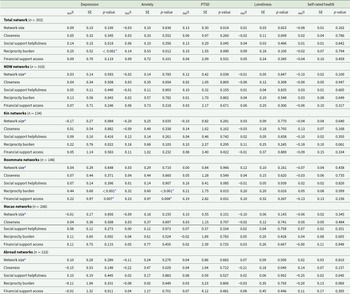
Regression results for Indonesian MDWs are presented in Table 5. Fewer network capital dimensions showed robust associations with health outcomes after BH-adjustment compared with the Filipino sample, with the most consistent findings concentrated in roommate networks.
Multiple linear regression models of Indonesian MDW network capital and outcome measures

Table 5 Long description
Standardized beta coefficients, standard errors, and p-values are reported for five outcomes: Depression, Anxiety, PTSD, Loneliness, and Self-rated health. Rows list five predictors within each network subgroup: Network size, Closeness, Social support helpfulness, Reciprocity burden, and Financial support access, with sample sizes shown for Total network, MDW networks, Kin networks, Roommate networks, Macao networks, and Abroad networks. In the Total network group, reciprocity burden has standardized beta 0.25 for Depression with standard error 0.52 and p-value less than 0.001 with an asterisk; social support helpfulness has standardized beta 0.14 for Depression with standard error 0.10 and p-value 0.018; network size has standardized beta 0.13 for PTSD with standard error 0.30 and p-value 0.014; and social support helpfulness has standardized beta 0.13 for PTSD with standard error 0.29 and p-value 0.045. In MDW networks, network size has standardized beta 0.12 for PTSD with standard error 0.42 and p-value 0.038, and reciprocity burden has standardized beta 0.13 for Depression with standard error 0.56 and p-value 0.043. In Kin networks, network size has standardized beta minus 0.20 for Anxiety with standard error 0.25 and p-value 0.035, and reciprocity burden has standardized beta 0.22 for Depression with standard error 0.76 and p-value 0.022. In Roommate networks, financial support access has standardized beta 0.22 for Depression with standard error 0.97 and p-value 0.007 with an asterisk, and standardized beta 0.23 for Anxiety with standard error 0.97 and p-value 0.008 with an asterisk; reciprocity burden has standardized beta 0.21 for PTSD with standard error 1.75 and p-value 0.015, and standardized beta 0.20 for Loneliness with standard error 0.20 and p-value 0.016. In Abroad networks, closeness has standardized beta minus 0.22 for Anxiety with standard error 0.47 and p-value 0.029, standardized beta minus 0.21 for Loneliness with standard error 0.18 and p-value 0.040, and social support helpfulness has standardized beta minus 0.25 for Self-rated health with standard error 0.02 and p-value 0.045.
a Network size in each subgroup analysis retains only the total number of alters among the specified group. Raw p-values shown prior to Benjamini–Hochberg false discovery rate procedure adjustment.
* Denotes associations that remained significant following p-value adjustment using the Benjamini–Hochberg false discovery rate procedure. Each model is controlled for with ego age, educational attainment, marital status, number of countries worked in, living arrangement, salary, working days per week and weekly working hours. Beta coefficients are standardized. Adjusted R 2 = Total (Depression 0.08; Anxiety 0.02; PTSD 0.04; Loneliness 0.03; Self-rated health 0.00); MDW networks (Depression 0.04 Anxiety 0.00; PTSD 0.02; Loneliness 0.03; Self-rated health −0.01); Kin networks (Depression 0.02; Anxiety 0.01; PTSD 0.02; Loneliness 0.02; Self-rated health 0.04); Roommate networks (Depression 0.21; Anxiety 0.12; PTSD 0.07; Loneliness 0.12; Self-rated health −0.04); Macao networks (Depression 0.04; Anxiety −0.01; PTSD 0.00; Loneliness 0.03; Self-rated health −0.01); Abroad networks (Depression 0.02 Anxiety 0.05; PTSD 0.04; Loneliness 0.05; Self-rated health 0.09).
Negative network capital. Higher reciprocity burden was associated with greater depressive (Standardized β = 0.25, p < 0.001) and anxiety symptoms (Standardized β = 0.14, p = 0.012) in the total sample, though only the depression association remained significant following BH-adjustment. The strongest associations were in roommate networks, where reciprocity burden was positively associated with all mental health outcomes and loneliness, though only depression (Stdβ = 0.44, p < 0.001) and anxiety (Standardized β = 0.32, p < 0.001) associations remained significant after BH-adjustment.
Positive network capital. Social support helpfulness showed an unexpected pattern where greater helpfulness was associated with higher depressive and PTSD symptoms in the total sample, and within abroad networks it was negatively associated with self-rated health. However, all associations attenuated following BH-adjustment, warranting interpretive caution. Emotional closeness was negatively associated with anxiety symptoms (Standardized β = −0.22, p = 0.029) and loneliness (Standardized β = −0.21, p = 0.040) within abroad networks only, but did not remain significant following BH-adjustment.
Neutral network capital. Larger network size was associated with higher PTSD symptom severity in the total sample and within MDW networks, though both attenuated after BH-adjustment. Financial support access was positively associated with depressive (Standardized β = 0.22, p = 0.007) and anxiety symptoms (Standardized β = 0.23, p = 0.008) within roommate networks, and both associations remained significant after BH-adjustment.
Discussion
Overview
This study examined positive, negative and neutral dimensions of network capital and their associations with mental health, loneliness and self-rated health among Filipino and Indonesian MDWs in Macao, using both overall and network-specific subgroup analyses, revealing clear nationality-specific patterns. Following BH-adjustment for multiple comparators, reciprocity burden emerged as the most consistent risk factor, particularly among Filipinos, contributing to social network theory by demonstrating how negative network aspects, such as obligations, may undermine health in migrant populations with collectivist norms and shared stressors. Moreover, varied associations across nationalities indicate that network capital may function differently across cultural contexts. These findings highlight the importance of considering reciprocal obligations and culturally shaped interpretations that structure MDWs’ social relationships (Hall et al., Reference Hall, Garabiles and Latkin2019a).
In this study, the observed effect sizes were generally modest and should be interpreted within the context of epidemiologic research on behavioural and psychosocial determinants of health where health outcomes are influenced by multiple interacting individual, social and structural factors (Funder and Ozer, Reference Funder and Ozer2019). While many associations remained statistically significant following BH-adjustment, their modest magnitude indicates that individual network capital dimensions were not strong standalone correlates of health outcomes. Rather, these findings suggest that network capital represents one important component within the broader social determinants of migrant health.
Filipino network capital
Among Filipino MDWs, several dimensions of network capital were associated with health outcomes, although reciprocity burden showed the largest and most consistent associations across the overall sample and network-specific analyses. Filipino MDWs reported relatively large and geographically diverse networks, consistent with literature documenting engagement with overseas Filipino communities through church attendance, social gatherings and chain migration processes (Lan, Reference Lan2006; Constable, Reference Constable2007; Paul, Reference Paul2015, Reference Paul2019; Yap, Reference Yap2015; Hall et al., Reference Hall, Garabiles and Latkin2019a). Cultural values such as bayanihan (communal unity) and pakikisama (general friendliness) further shape these relationships (Garabiles et al., Reference Garabiles, Harper Shehadeh and Hall2019). Yet, these features may also contribute to the ‘double-edged sword’ of Filipino network capital observed in this study (Li et al., Reference Li, Guo and Shi2023). Although larger network size was associated with lower loneliness and greater mental health symptoms, these associations were generally modest and less consistent across network-specific analyses. This pattern is consistent with the competing benefits and demands of larger networks within resource-constrained migrant communities (Mendoza et al., Reference Mendoza, Mordeno, Latkin and Hall2017; Hall et al., Reference Hall, Pangan, Chan and Huang2019b).
Reciprocity burden, a dimension that emphasizes the obligations within networks alongside benefits, may explain previous paradoxical findings in the literature (Bilecen and Lubbers, Reference Bilecen and Lubbers2021; Liao et al., Reference Liao, Pulido and Liu2024). Filipinos who experienced greater burden consistently reported worse mental health, greater loneliness and poorer self-rated health, the standardized associations were among the largest within the sample, particularly in its associations with PTSD symptoms. This reveals the importance of the obligation to listen and provide emotional support, which are deeply embedded expectations in collectivist cultures. These findings support the presence of emotional contagion within highly homogenous co-national migrant networks, where discussing shared stressors may increase distress (Hall et al., Reference Hall, Garabiles and Latkin2019a). This also addresses a critical gap in migrant health literature, which has rarely examined strain within social relationships (Liao et al., Reference Liao, Pulido and Liu2024). Notably, the listening reciprocity burden measure, developed from formative qualitative work with MDWs (Hall et al., Reference Hall, Garabiles and Latkin2019a), captures network strain that standard social support scales miss.
Indonesian network capital
The fewer significant associations observed in the Indonesian sample may reflect differences in social network structure and engagement. Indonesians generally reported smaller and less connected networks, consistent with prior research (Paul, Reference Paul2019; Sumerlin et al., Reference Sumerlin, Li, Chen, Garabiles, Li, Shi, Latkin and Hall2025a). While working abroad, Indonesian MDWs may be less emotionally engaged with distant kin networks and instead focus on maximizing income, reflected in longer working hours and higher average pay compared to Filipino MDWs. Cultural norms may also shape these patterns. The Indonesian value of mutual assistance (gotong royong) is traditionally rooted in kinship-based proximity and may weaken with geographic and familial distance (Nolin, Reference Nolin2010; Slikkerveer, Reference Slikkerveer, Slikkerveer, Baourakis and Saefullah2019). In the MDW context, where kin networks are largely abroad, reliance on social networks may be more limited, potentially attenuating associations between network capital and health outcomes.
The strongest associations with the largest standardized associations emerged within roommate networks. In these co-residential networks, greater reciprocity burden and perceived financial support access were associated with worse depressive and anxiety symptoms, suggesting that network strain for Indonesian MDWs is most consequential in high contact environments.
Implications
While migration research has largely emphasized the supportive functions of social networks, this study demonstrates that social ties may also generate strain, with implications for MDWs and other migrant and refugee populations.
While interventions have been proposed that utilize migrant networks (e.g., lay health workers for task shifting interventions), these findings highlight the need to firstly understand the network structure and its function, and to secondly aim to strengthen beneficial aspects of MDW networks while mitigating harms. Efforts should adopt culturally grounded approaches that align with distinct norms around help-seeking and emotional expression. Based on the study’s findings, low-pressure and confidential support options may be particularly important for Indonesian MDWs, while interventions for Filipino MDWs could focus on validating boundary-setting around listening reciprocity and emotional labour. Attending to cultural context may help reconcile previous mixed findings regarding social support networks and MDWs’ well-being (Ho et al., Reference Ho, Yang, Leung, Bressington, Chien, Cheng and Cheung2022).
Strengths, limitations and future directions
This study offers several strengths. First, it is the first to examine positive, negative, and neutral dimensions of network capital among a large migrant worker sample (Filipino and Indonesian MDWs). Second, respondent-driven sampling is well suited for hard-to-reach populations and a population size equal to 10% of each group was obtained. Third, ENA enabled nuanced examination of how specific network characteristics relate to health outcomes.
Several limitations should be noted. The cross-sectional design precludes causal inference, and self-reported measures are subject to bias, although substantial formative qualitative work and psychometric validation were conducted to enhance cultural relevance. The egocentric approach, which asked participants to list people important to them, may under-capture weaker ties who may influence health. Alter-level data aggregated to the ego level may mask nuance in relational quality and type. Based on the large number of comparisons in the regression analyses, there is a risk of Type I error. Accordingly, all p-values were adjusted using the BH false discovery rate procedure. Findings that remained statistically significant but had modest effect sizes should nevertheless be interpreted with appropriate caution. Future research should employ longitudinal designs to assess causal pathways and network dynamics, and further mixed methods work can help to deepen understanding of underlying mechanisms. While this study examined total networks and by relational type and alter residence, future studies may consider examining the nature of the ego–alter relationship (e.g., romantic partner, conflict) using multilevel analysis to understand variation in relational quality. Additional studies are also needed among diverse migrant populations and in different geographies.
Conclusions
To our knowledge, this is the first study to apply egocentric network data to examine positive, negative and neutral dimensions of social network capital and health among MDWs. This approach revealed that network capital includes both supportive and burdensome processes, the latter of which has been underexamined across the migration literature. Among Filipino MDWs, larger networks and reciprocity burden were consistently linked to poorer mental health, but social support helpfulness showed protective effects in some contexts. For Indonesian MDWs, network capital operated less consistently, though associations within roommate networks between reciprocity burden and financial support access and mental health were found. Subgroup analyses support the need for culturally adapted approaches when designing network-based interventions to improve MDWs’ health.
Supplementary material
The supplementary material for this article can be found at https://doi.org/10.1017/S2045796026100894.
Availability of data and materials
Data and materials will be made available upon reasonable request to the corresponding author.
Acknowledgements
Thank you to Susana Tjipto, Haksi Mayawati and Carritas-Macau for their support in this research. Many thanks to all the domestic workers who took part in this study.
Financial support
This work was supported by the Macao (SAR) Government and the RSTKO, University of Macau (MYRG2015-00109-FSS).
Competing interests
None.
Ethical standards
The authors assert that all procedures contributing to this work comply with the ethical standards of the relevant national and institutional committees on human experimentation and with the Helsinki Declaration of 1975, as revised in 2000. The Research Ethics Committee at the University of Macau approved this study (MYRG-2015-00111).




 Open access

