Introduction
End-of-life caregiving is considered challenging for many family carers. Whether they have prepared themselves to bear this role may affect their mental health, psychological well-being and quality of life (Hashemi et al., Reference Hashemi, Irajpour and Taleghani2018; McDonald et al., Reference McDonald, Swami and Pope2018) and the quality of care provided (Seow & Bainbridge, Reference Seow and Bainbridge2018). Family carers voiced the difficulties in preparing themselves to take care of family members in the awareness of death. Particularly, they stated the challenges of living in uncertainty and transitioning to new roles in end-of-life caregiving (Given & Reinhard, Reference Given and Reinhard2017). Preparing family carers to take care of family members in end-of-life care may involve various dimensions including cognitive (information giving), affective (emotional support), and behavioral (completion of caregiving tasks) (Terzakis & MacKenzie, Reference Terzakis and MacKenzie2019). The ways health- and social-care professionals may better support their needs via proper assessment are therefore crucial.
For example, the Carer Support Needs Assessment Tool (CSNAT) was developed to help professionals of home palliative care services to assess the needs of family carers in providing end-of-life care at home, including their needs to provide care to family members and the needs for their own personal support (Ewing & Grande, Reference Ewing and Grande2013). When family carers indicate great need for further support in end-of-life caregiving, it may also reflect their unpreparedness for provision of home end-of-life care (Ewing et al., Reference Ewing, Brundle and Payne2013).
Home palliative care services have been found effective in increasing the chance of patients dying at home and reducing their symptom burden (Gomes et al., Reference Gomes, Calanzani and Curiale2013) as well as reducing the financial burden on the healthcare system, compared with hospital-based palliative care services (Wong et al., Reference Wong, So and Ng2018). Yet, the effectiveness of home-based palliative care for supporting family carers seems inconclusive (Gomes et al., Reference Gomes, Calanzani and Curiale2013) though these carers may feel more secure with the support of home palliative care services (Sarmento et al., Reference Sarmento, Gysels and Higginson2017). A survey in England showed that family carers who provided more intensive care before the death of family members are less likely to be willing to care again in future, but those who received specialist palliative care services are more willing to care again (Johnson et al., Reference Johnson, Allgar and Macleod2016). Patients in end-of-life care may also experience “support paradox,” in which they expect much support from family carers but at the same time worry that the extra care and support from these carers may become their caregiving burden (Chan et al., Reference Chan, Epstein and Reese2009). Their psychosocial outcomes may also be affected by family carers’ adjustment to their illness (Sarmento et al., Reference Sarmento, Gysels and Higginson2017). All these findings may again reflect the importance of health- and social-care professionals in supporting family members who manage the role of carers in provision of end-of-life care, for the sake of both care recipients and carers.
The literature often seems to consider family caregiving as a discrete activity in end-of-life care, which may not be true, especially for patients who do not suffer from cancer and thus do not follow a typical dying trajectory (Seow et al., Reference Seow, O'Leary and Perez2018). Many family carers had been providing care to family members with chronic illness before their condition deteriorated, and therefore end-of-life caregiving could be a natural part of the future care plan which in reality is often ignored. Elderly service agencies may often work with these family carers by providing community support services to older adults, such as home care, including personal care, escort services, basic nursing care and case management. Yet, end-of-life care planning, including understanding the views of these existing family carers on the future transition to the role of end-of-life caregiving, remains underexplored (Duggleby et al., Reference Duggleby, Tycholiz and Holtslander2017). This is particularly important, as some existing family carers have been psychologically distressed by caregiving (Given & Reinhard, Reference Given and Reinhard2017; Washington et al., Reference Washington, Wilkes and Rakes2018). Whether their current emotional distress may inhibit their willingness to provide end-of-life care to family members in future, and whether the psychologically distressed carers may express different needs for support in providing end-of-life care, could be of great concern.
Therefore, this study investigated the views of these family carers on future provision of end-of-life care to their family members. More specifically, this study aimed to (a) examine the willingness, confidence and perceived difficulties of family carers to provide home end-of-life care in future; (b) examine family carers’ need for support in future provision of home end-of-life care; and (c) examine the differences in need for support in future provision of home end-of-life care, as well as willingness, confidenc and perceived difficulties in providing home end-of-life care between family carers of high and low levels of psychological distress.
Method
Participants
Family carers of older adults who are living at home in the community were recruited from a local elderly agency in Hong Kong. Inclusion criteria are (a) primary family carer of an adult aged 65 or above who is receiving community support services from that elderly agency; (b) having provided family caregiving for at least 3 months; (c) ability to communicate in Cantonese. Exclusion criterion is the assessment by social workers of that elderly agency as not being emotionally suitable to join the study, e.g., family carers who are often anxious and participation in this study may exacerbate their anxiety.
Data collection procedures
A survey was conducted from January to April 2018. The first author introduced the recruitment criteria to the social workers of an elderly agency in a district in Hong Kong. The social workers then helped recruit participants for this study. They identified eligible participants from their active service users and invited them to join the study. An informed consent form was signed by each participant. A questionnaire was then distributed to each participant for self-completion. If participants needed assistance in completing the questionnaire, they could contact the research assistant by phone for help. All completed questionnaires were then returned to social workers of that elderly agency or to the research assistant who provided assistance. Research ethics approval was obtained from the first author's affiliated university.
Measures
The questionnaire was sent to social workers of that elderly agency for comments and piloted among three family carers. Amendments were then made, including the format of the questionnaire and wording on the self-developed items concerning views on future provision of end-of-life care. The finalized questionnaire included the following:
(a) Caregiving information, profiles of participants and care recipients: age, gender, education level, relationship with care recipients, whether they were living with care recipients, duration of caregiving, and time spent on caregiving.
(b) The Chinese version of the Hospital Anxiety and Depression Scale (C-HADS)
The Chinese version of HADS was found to be reliable and valid in Hong Kong (Leung et al., Reference Leung, Ho and Kan1993). It includes 14 items, in which the total score represents the level of emotional distress, and 2 subscales measuring anxiety and depression (Zigmond & Snaith, Reference Zigmond and Snaith1993). A 4-point Likert scale was used to rate how often a person experienced the situation described in each item. The cutoff for the total score as suggested by Chan et al. (Reference Chan, Tsang and Lau2017) was adopted in this study, in which participants scoring 14 or below are categorized in the low psychological distress group, and those who scored above 14 in the high psychological distress group. The Cronbach's alpha of C-HADS for this study is 0.89. The Cronbach's alpha for the depression and anxiety subscales are 0.78 and 0.88, respectively.
(c) Views on future provision of end-of-life care
Participants were asked their willingness, perceived difficulties, and confidence in providing end-of-life care if the health of their older family members (care recipients) further deteriorated and came to the end-of-life stage (with a life expectancy of about 6 months). Four options were provided for each item (very unwilling, unwilling, willing, and very willing), and the percentage of their responses was recorded.
(d) The Chinese version of Carer Support Needs Assessment tool (C-CSNAT)
CSNAT was developed to measure carers’ support needs in providing palliative and end-of-life care at home (Ewing & Grande, Reference Ewing and Grande2013). This tool was found to be valid and can be used as both a research tool and as a tool for assessment in palliative care services (Ewing et al., Reference Ewing, Brundle and Payne2013). A total of 14 items were included to assess carers’ need for more support in different aspects, including support for taking care of family members in end of life (e.g., understanding your relative's illness), and personal support for themselves (e.g., looking after your own health). Items were scored as none (0), a little more (1), quite a bit more (2), and a lot more (3). For details refer to: http://csnat.org. CSNAT is not a scale, and therefore, rating of items was not summed up to form a total score. The first author of this manuscript contacted the corresponding person for CSNAT (Dr Gail Ewing) and received formal consent to translate this tool into traditional Chinese in the Hong Kong context. The original English version was first translated into Chinese by the first author and then back-translated into English by another person who is qualified for translation and was not involved in this study. Both persons are bilingual. Comparisons were then conducted, and the Chinese version was finalized to ensure it accurately reflected the contents of the original English version.
Descriptive and univariate statistical analyses were conducted on different items, including background information, willingness, confidence and perceived difficulties, CSNAT items. Chi-square and Mann–Whitney U-test were conducted to examine the differences in different items between participants of the low and the high psychological distress groups.
Results
During data collection, 94 potential participants were identified by the social workers; 89 completed and returned the questionnaires, a response rate of 94%. Of these, six questionnaires were discarded, as they failed to meet one of the inclusion criteria: having provided family caregiving for 3 months.
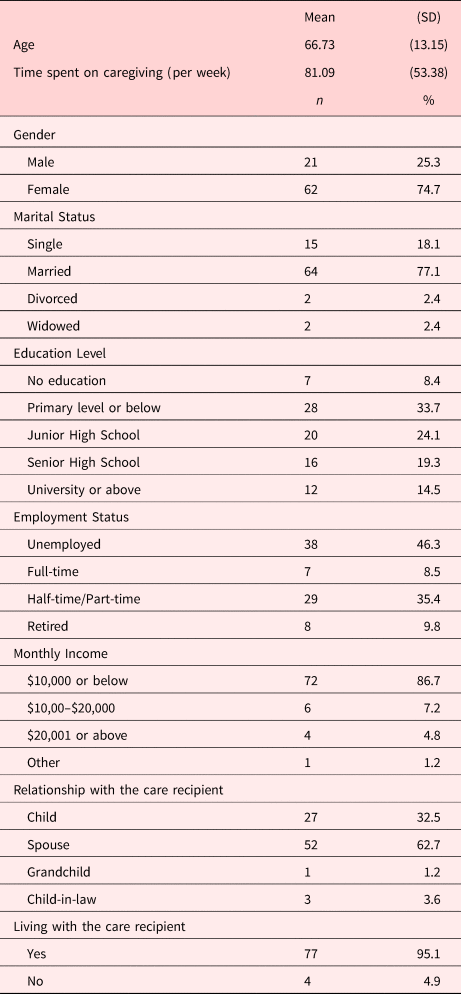
Most participants were female (74.7%), with a mean age of 66.7 (SD = 13.15). More than 60% of participants were the spouse of care recipients, and another 36% were either adult children or children-in-law of care recipients. The majority were living with care recipients (95%). The mean duration of caregiving was 6.93 years (SD = 8.39), and they spent around 81 h on average per week providing care to care recipients. Details are shown in Table 1. The mean scores of depression and anxiety of participants were 6.65 (SD = 4.87) and 7.48 (SD = 4.57)respectively. The mean total score of HADS was 13.97 (SD = 8.64). A total of 39.74% of participants scored above the cutoff total score of HADS, which indicates that they were experiencing a high level of psychological distress.
Demographics of participants (N = 83)

Willingness, confidence, and perceived difficulties in providing home end-of-life care
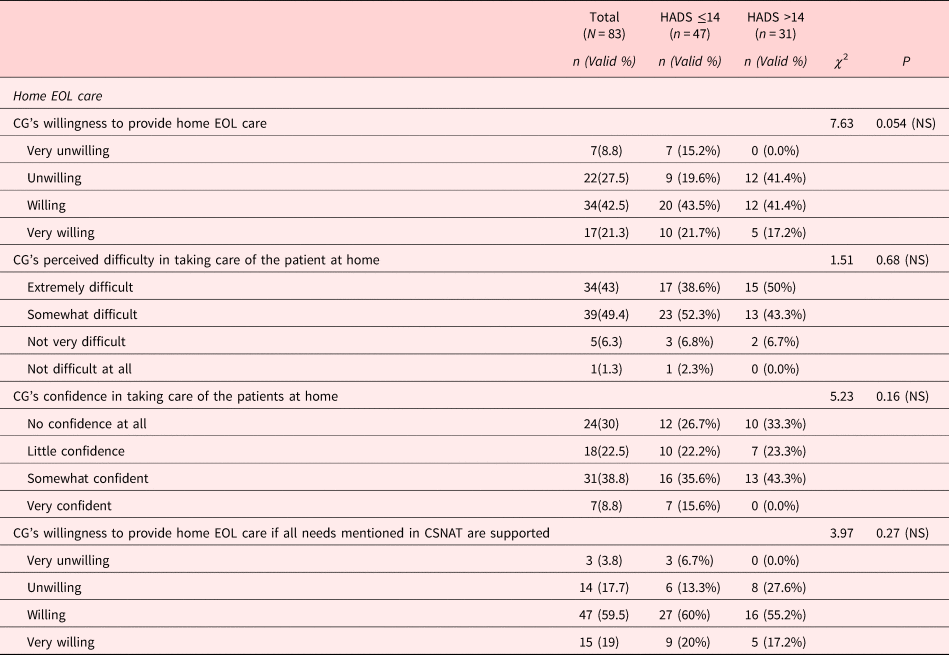
Most participants reported that they were willing or very willing to provide end-of-life care to family members if their existing care recipients’ physical condition deteriorated (63.8%). We asked them this question again but in a context in which their carer support needs in home end-of-life care (findings to be presented) are fulfilled, and the percentage increased to 78.5%.
Almost half perceived providing home end-of-life care to family members difficult (49.4%), and another 43% even perceived it as extremely difficult. Over half (52.5%) reported that they have no confidence or somewhat lacked confidence in providing home end-of-life care. No significant differences were found in all these items between participants of the high psychological distress group and those of the low psychological distress group. Details are shown in Table 2.
Descriptive statistics on participants’ views of future provision of end-of-life care and differences in these views between participants of high psychological distress group (HADS >14) and low psychological distress group (HADS ≤14)

NS, Not Significant
Carers’ need for support in future provision of home end-of-life care
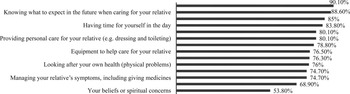
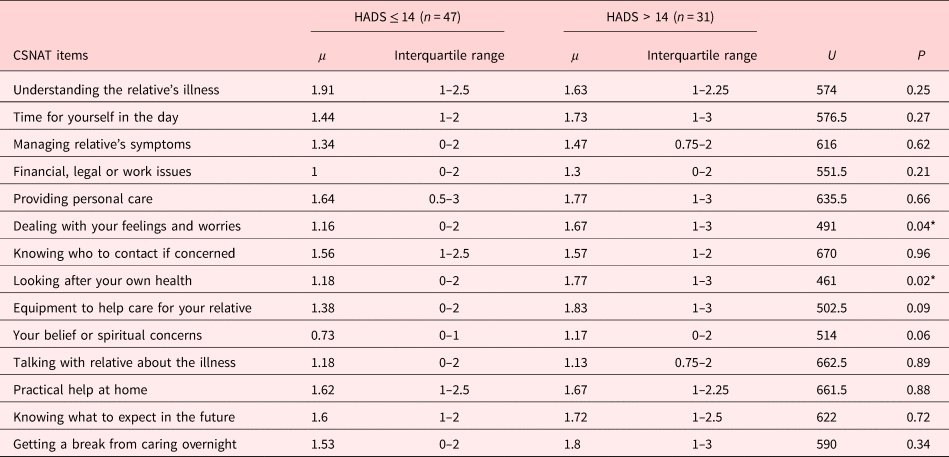
Participants expressed their need for support in different aspects of future provision of home end-of-life care (Figure 1). They reported that the greatest need for more support is in understanding the relative's illness (90.1%, from expressing the need for a little more support to a lot more support), followed by the need for more support in “knowing what to expect in future when caring for your relatives” (88.6%) and “knowing who to contact if concerned” (85%). These three items belong to the need for support for taking care of the relatives. The item with the highest need for personal support is “time for yourself in the day” (83.8%). The least need for support item is “your beliefs or spiritual concerns” (53.8%). When compared with participants of the low psychological distress group, participants of the high psychological distress group experienced a significantly greater need for support in “dealing with your feelings and worries” (mean = 1.67, U = 491, P = 0.04) and “looking after your own health” (mean = 1.77, U = 461, P = 0.02) (Table 3).
Percentage of caregivers expressing need for more support with each domain in the Carer Support Needs Assessment Tool.

Group difference in CSNAT items between participants of high psychological distress group (HADS > 14) and low psychological distress group (HADS ≤ 14)

Note. CSNAT, Carer Support Needs Assessment Tools; HADS, The Hospital Anxiety and Depression Scale; Low-high risk group was divided based on the optimal cutoff point (14) suggested by Chan et al. (Reference Chan, Tsang and Lau2017). A higher score on CSNAT represents more perceived support needs on the particular item *P < 0.05.
Discussion
Our findings show that participants of this study were family carers actively providing care to family members who were living at home. Quite a number of these participants were found to be highly psychologically distressed. Though still more participants reported that they were willing to provide home end-of-life care to their family members in case their family members’ physical condition deteriorated, we may need to pay attention to the fact that quite a number of these existing family carers claimed that they may not be willing to do so. In fact, most of them perceived providing home end-of-life care to family members either difficult or extremely difficult. Participants also showed a lack of confidence in taking care of family members in the end-of-life care context.
Our findings suggest that the majority of family carers, irrespective of their psychosocial status, are not ready to provide home end-of-life care to their family members even though they have been performing this role. It seems that participants consider end-of-life caregiving as very different from their existing caregiving and may therefore feel inadequate to provide home end-of-life care. For example, helping family members to cope with pain at end of life may be a great concern of family carers. A previous study also shows that family carers may lack self-efficacy in this aspect, and this may affect the well-being of both carers and care recipients (Keefe et al., Reference Keefe, Ahles and Porter2003). The unwillingness and lack of confidence in taking care of family members at end of life may be affected by their lack of understanding in such an area. For example, Hong Kong has been highlighted for inadequate community engagement in palliative and end-of-life care, e.g., the public's lack of understanding of end-of-life care, which leads to a lower ranking in the Quality of Death Index (The Economist Intelligence Unit, 2015).
Yet, our findings also reveal that participants’ willingness to provide end-of-life care to family members further increased if their carers’ support needs are met. Therefore, it is important for us to understand what their anticipated needs and worries are, in order to ensure the continuity of care provision. Our findings indicate that participants anticipated the greatest need for more support in three items closely related to the end-of-life context: understanding the relative's illness, knowing what to expect in future, and knowing who to contact if concerned. Taking care of family members in the end-of-life stage is often full of anxiety, as the family carers may have limited understanding of the life-threatening disease and the related end-of-life decisions (Crist et al., Reference Crist, Ortiz-Dowling and Shea2019), and they may not be ready to adapt to different changes in the end-of-life caregiving trajectory (Penrod et al., Reference Penrod, Hupcey and Baney2011). Therefore, family carers may have the urge to know more about the illness and what to expect in the end-of-life care journey. They may also feel much more secure if they are able to identify a key social- or health-care professional who performs the role of a case manager in coordinating the palliative and end-of-life care services, to go to for help and guidance in end-of-life caregiving (Aoun et al., Reference Aoun, Grande and Howting2015).
As shown by the findings, participants prioritized their need for getting support to take care of their family members instead of the need for supporting themselves personally, which may be different from what was found in earlier studies in other cultural contexts (Ewing et al., Reference Ewing, Brundle and Payne2013; Aoun et al., Reference Aoun, Grande and Howting2015). Our findings are, however, consistent with the cultural values in which family is emphasized more than is the individual in Chinese culture (Shek, Reference Shek2006). Our findings further indicate that participants of the high psychological distress group expressed greater need for personal support in emotional (e.g., feelings and worries) and physical aspects (e.g., personal health). These findings may suggest that Chinese family carers may often underestimate their need for self-care until they become psychologically distressed in caregiving. Participants also indicated the least need for support in their beliefs and spiritual concerns. The importance of spirituality may often be overlooked by the family carers, who may have been preoccupied with the practical daily tasks in caregiving. This may be especially true for Chinese carers who often just focus on the pragmatic aspects of caregiving (Chan et al., Reference Chan, Ho and Leung2012). Yet, the literature in recent years has suggested that the spiritual needs of both patients and family carers in end-of-life and palliative care are essential and are worth our attention (Fang et al., Reference Fang, Sixsmith and Sinclair2016; Selman et al., Reference Selman, Brighton and Sinclair2018; Gijsberts et al., Reference Gijsberts, Liefbroer and Otten2019). Therefore, it seems encouraging that family carers show more concern for their personal support, such as their need for spiritual support in caregiving. Providing the corresponding support could be the key issue that health- and social-care professionals should attend to.
Implications
Findings suggest that it is important for health- and social-care professionals to assess the views of existing family carers on providing future end-of-life care. This may help identify the carers’ worries and needs for support, which may ensure better continuity of care in the end-of-life context. For example, family members may feel worried about providing end-of-life care, as they lack knowledge about the terminal illnesses and the possible help that they could seek. Therefore, it is important for health- and social-care professionals to conduct regular talks with existing family carers to enhance their health literacy in the end-of-life context and their understanding of the end-of-life services provided by the community. Our findings also suggest that self-care of family caregivers may need to be pushed forward at a policy level. For example, family caregivers will be encouraged to receive spiritual support services if the cost can be reimbursed by the health care insurance or the long-term care insurance (Saad & de Medeiros, Reference Saad and de Medeiros2020). Future long-term care policy may also give more emphasis to the development of both religious and non-religious spiritual support services in the end-of-life context,
Limitations
Convenience sampling was adopted in this study, which may limit the representativeness of the participants. Items which measure the willingness, perceived difficulties, and confidence in providing future home end-of-life care were self-developed, and their psychometric properties require caution. This cross-sectional study is exploratory and reflects the perception of participants at the moment of data collection. It would be of interest if a longitudinal study could be conducted in future and examine the extent to which these family caregivers may really provide home end-of-life care to their family members and the ways they perceive the difficulties and confidence in doing so when they have provided that care. Discrepancies in their perceptions of the anticipated end-of-life care provision and their actual perceptions of providing end-of-life care could be an area which may further shed light on the way health- and social-care professionals may prepare family caregivers to provide home end-of-life care in future.
Conclusion
Participants of this study are all active family carers of their family members. But quite a number of them may not be willing to provide home end-of-life care to their family members if they further deteriorate physically. It is hoped that the findings of this study alert us to the importance of supporting these family carers in the transition to the role of end-of-life caregiving. To facilitate the continuity of providing end-of-life care to the family members, health- and social-care professionals need to better understand these carers’ support needs, to provide timely support in both social- and health-care services.
Acknowledgments
Thanks to the Tung Wah Group of Hospitals (TWGHs) for funding this project. Special thanks to all colleagues of TWGHs who helped in the implementation of this study.