1. Introduction
Two quite different definitions can be given for the notion of inflectional periphrasis. On a more permissive definition, a syntactic construction is a case of inflectional periphrasis if it serves as the realization of a property that is typically thought to be inflectional (see e.g. Spencer Reference Spencer and Brown2006, Brown et al. Reference Brown, Marina, Corbett, Gergana and Andrew2012). Such a definition is often implicit in descriptive grammars, and is definitely useful for typology, allowing one to see periphrasis as a gradient property, going from open syntactic combination to full morphologization. We will henceforth call this the typological definition of periphrasis.
A narrower definition takes periphrasis to be a type of analysis for a given construction. In this sense, a construction is seen as periphrastic if it is a multi-word construction that interacts with inflectional morphology in such a way that it is best integrated in the inflectional paradigm (see e.g. Hockett Reference Hockett1958, Haspelmath Reference Haspelmath, Booij, Lehmann and Mugdan2000, Ackerman & Stump Reference Ackerman, Stump, Sadler and Spencer2004). Under this view, a periphrase is the realization of a morphosyntactic feature bundle on a lexeme, just in the same sense as an inflected word is. Such a stricter definition is directly relevant to lexicalist models of morphosyntax, which need to either be adapted to encompass such constructions (see e.g. Börjars, Vincent & Chapman Reference Börjars, Nigel, Chapman, Booij and van Marle1997, Ackerman & Webelhuth Reference Ackerman and Webelhuth1998, Sadler & Spencer Reference Sadler, Spencer, Booij and van Marle2001, Ackerman & Stump Reference Ackerman, Stump, Sadler and Spencer2004, Bonami & Webelhuth Reference Bonami, Gert, Chumakina and Corbett2013, Blevins to appear) or to argue against their existence (see e.g. the analysis of Latin periphrastic perfects in Kiparsky Reference Kiparsky, Booij and van Marle2005). We will henceforth call this the formal definition of periphrasis.
Deciding which periphrastic constructions in the typological sense need to receive periphrastic analyses in the formal sense can be difficult. Haspelmath (Reference Haspelmath, Booij, Lehmann and Mugdan2000) and Ackerman & Stump (Reference Ackerman, Stump, Sadler and Spencer2004) propose general empirical criteria, but the relevance of such criteria depends on assumptions on morphology, syntax, and the morphology–syntax interface that are hardly independent of the analysis of the phenomena at hand, as we will see in Section 7. Our goal in this paper is to disentangle some of the issues by looking at an inflectional system involving a diverse set of periphrastic constructions in the typological sense. We will try to determine which of those can be reduced to normal syntax or normal morphology, and provide an explicit, periphrastic in the formal sense, analysis for the remaining cases. Our general strategy is therefore conservative: we characterize a construction as formally periphrastic only if there is no satisfactory purely morphological or purely syntactic analysis. Comparing our analysis of the formally periphrastic constructions to that of the other cases will shed light on the more general typology of inflectional periphrasis. The analysis will rely on the association of a specific syntactic framework, Head-driven Phrase Structure Grammar (HPSG; Pollard & Sag Reference Pollard and Sag1994), and a specific framework for inflectional morphology, Paradigm Function Morphology (PFM; Stump Reference Stump2001). This association is particularly promising for the problem at hand, for two main reasons: first, HPSG's use of a uniform, rich ontology for all aspects of linguistic description makes it easier to define a tight interface with dense information flow between the syntactic and morphological components, as necessitated by the analysis of periphrases. Second, although the two frameworks rely on different ontologies, PFM is the only extant formally explicit theory of morphology that can readily be recast in an ontology of typed feature structure descriptions.Footnote 2
Grammars of Persian (e.g. Lazard et al. Reference Lazard, Yann, Rokhsareh and Pollet2006) distinguish four conjugational periphrastic construction types.
(1) In tâblo foruxte mi-šav-ad.
this painting sell.pfp unbd-become.prs-3sg
‘This painting is sold.’
- (2)
(a) Maryam in tâblo = râ foruxte bud.
Maryam this painting = ddo sell.pfp cop.pst.3sg
‘Maryam had sold this painting.’
(b) Maryam in tâblo = râ foruxte = ast.
Maryam this painting = ddo sell.pfp = cop.prs.3sg
‘Maryam has sold this painting.’
(3) Maryam in tâblo = râ xâh-ad foruxt.
Maryam this painting = ddo want.prs-3sg sell[sinf]
‘Maryam will sell this painting’
(4) Maryam dâr-ad in tâblo = râ mi-foruš-ad.
Maryam have.prs-3sg this painting = ddo unbd-sell.prs-3sg
‘Maryam is selling this painting.’
The passive construction is based on an inflected form of šodan ‘become’ preceded by a perfect participle, as shown in (1). So-called ‘perfect’ forms are based on an inflected form of budan ‘be’ preceded by a perfect participle. The auxiliary is a full word, as in (2a), or a clitic, as in (2b), depending on tense and mood. The future is formed with a special present tense form of xâstan ‘want’ followed by a short infinitive, as shown in (3). Finally, as (4) illustrates, the progressive is based on an inflected form of dâštan ‘have’ followed by a finite form.Footnote 3
The differing properties of these four types of periphrasis result from different origins as finite, infinitival or participial complements, and different degrees of grammaticalization, going from the quasi-analytic passive to the recently morphologized present perfect.
The periphrastic status of a construction can only be evaluated by comparison with characteristic open syntactic constructions and morphological combinations in the relevant language. We thus start in Section 2 with an overview of Persian clausal syntax and conjugation, including sketches of formal analyses. Section 3 deals with the passive construction, Section 4 with the ‘perfect’, Section 5 with the future, and Section 6 with the progressive. Section 7 discusses the position of the Persian constructions in the typology of periphrastic constructions.
Since periphrastic constructions occupy an uncertain and still ill-understood position on the border between typical syntax and typical morphology, the basic descriptive vocabulary tends to be confusing. Part of the problem stems from the fact that two basic intuitions come into conflict when we think of periphrasis: the intuition that inflection is a subcomponent of morphology, and the intuition that morphology deals with words defined as syntactic atoms. Some authors are happy to abandon the latter intuition, and take periphrasis to be part of morphology (e.g. Ackerman, Stump & Webelhuth Reference Ackerman, Stump, Webelhuth, Borsley and Börjars2011: 332) or at the intersection of morphology and syntax (e.g. Brown et al. Reference Brown, Marina, Corbett, Gergana and Andrew2012: 247). Although this is arguably a matter of taste, we find this use of the terminology confusing. In this paper we take the opposite decision. We define inflection as the component of grammar responsible for the realization of lexemes in context. That realization may use morphological means and take the form of a word (we call this synthetic inflection), or it may use a combination of morphological and syntactic means and take the form of a combination of multiple words; we call this periphrastic inflection, and we call the combination of words a periphrase.Footnote 4 Note that under this definition, the term ‘inflectional morphology’ is not synonymous with ‘inflection’, but rather denotes the use of morphology for the expression of inflection.Footnote 5
2. Relevant basic features of Persian grammar
2.1. Grammatical functions
Alignment is clearly accusative in Persian. Subjects and objects contrast most notably in three features. First, subjects, but not objects, trigger person and number agreement on finite verbs. Second, objects, but not subjects, may be realized as enclitic pronouns, as shown in (5).Footnote 6
- (5)
(a) Omid in tablô = râ xarid.
Omid this painting = ddo buy.pst.3sg
‘Omid bought this painting.’
(b) Omid xarid = aš.
Omid buy.pst.3sg = 3sg
‘Omid bought it.’
Third, objects, but not subjects, may carry the clitic =râ. The distribution of =râ is quite complex, and it may appear on non-object constituents, but it never attaches to a subject (Karimi Reference Karimi1996, Ghomeshi Reference Ghomeshi1997, Samvelian Reference Samvelian2006–2007). When attached to an object, it marks it as definite/specific. Example (6) illustrates this.
- (6)
(a) Omid tablô = râ xarid.
Omid painting = ddo buy.pst.3sg
‘Omid bought the painting.’
(b) Omid tablô xarid.
Omid painting buy.pst.3sg
‘Omid bought a painting/paintings.’
Persian is extensively pro-drop, and pronominal subjects are seldom realized overtly, except for contrastive, emphatic or reflexive purposes (7).
- (7)
(a) Tablô = râ xarid-am.
painting = ddo buy.pst-1sg
‘I bought the painting.’
(b) Man tablô = râ xarid-am ( na Maryam).
I painting = ddo buy.pst-1sg not Maryam
‘I bought the painting (not Maryam).’
(c) Xod = am tablô = râ xarid-am ( na Maryam).
self = cl.1sg painting = ddo buy.pst-1sg not Maryam
‘I myself bought the painting.’
2.2. Basic word order
Word order is quite free in Persian. In the written standard, dependents of the verb tend to precede it (the least marked order is SOV), except for subordinate clauses which always occur after the verb. However, in colloquial Persian, subjects, objects, all complements and most adjuncts may also occur after the verb, as shown in (8a–d), respectively.
- (8)
(a) Tablô = râ xarid Maryam.
painting = ddo buy.pst.3sg Maryam
‘Maryam bought the painting.’
(b) Maryam xarid tablô = râ.
Maryam buy.pst.3sg painting = ddo
‘Maryam bought the painting.’
(c) Maryam tablô = râ xarid az Omid.
Maryam painting = ddo buy.pst.3sg from Omid
‘Maryam bought the painting from Omid.’
(d) Maryam in tablô = râ xarid sâl = e piš.
Maryam this painting = ddo buy.pst.3sg year = ez before
‘Maryam bought this painting last year.’
2.3. Subordinate clauses
Finite complement clauses can be marked with the complementizer ke, but the complementizer is very easily dropped, as illustrated in (9a). In addition, embedded valents like those in (9b–d) are easily scrambled to the matrix clause, independently of the presence or absence of the complementizer.
- (9)
(a) Maryam mi-dân-ad [( ke) Omid in ketâb = râ be
Maryam unbd-know.prs-3sg that Omid this book = ddo to
Sârâ dâd].
Sara give.pst.3sg
‘Maryam knows that Omid gave this book to Sara.’
(b) Maryam in ketâb = râ mi-dân-ad [(ke) Omid be Sârâ dâd].
(c) Maryam be Sârâ mi-dân-ad [(ke) Omid in ketâb = râ dâd].
(d) Maryam in ketâb = râ be Sârâ mi-dân-ad [(ke) Omid dâd].
Complement clauses are almost always finite in colloquial Persian. Non-finite complements have a restricted distribution; with a handful of exceptions, the natural translation of an English equi verb is a verb or complex predicate taking a finite complement clause with no overt subject. Optional control verbs have the same construction, whether the embedded object is coreferential with an argument of the embedding verb or not (10).
- (10)
(a) Maryam mi-xâh-ad [( ke) bâ Omid har ruz be
Maryam unbd-want.prs-3sg that with Omid every day to
sinemâ be-rav-ad].
theatre sbjv-go.prs-3sg
‘Maryam decided to go to theatre with Omid everyday.’
(b) Maryam mi-xâh-ad [( ke) bâ Omid har ruz be
Maryam unbd-want.prs-3sg that with Omid every day to
sinemâ be-rav-ad].
theatre sbjv-go.prs-3sg
‘Maryam wants me to go to theatre with Omid everyday.’
Predicates corresponding to raising verbs in English may occur in two contrasting constructions. The more common option is to have an impersonal construction with no subject, as in (11); this is found e.g. with the verb bâyestan ‘must’, the verb šodan ‘become’ in its modal use, the adjective momken ‘possible’ in its predicative use, and the complex predicate be nazar âmadan ‘seem’.Footnote 7 Note that while the subject of the embedded clause may be realized before the matrix verb (12a), this is clearly a long-distance dependency rather than a raised subject, as the agreement is with the embedded predicate only (12b).
(11) Mi-šav-ad [( ke) bačče-hâ madrase be-rav-and].
unbd-become.prs-3sg that child-pl school sbjv-go.prs-3pl
‘The kids may go to school.’
- (12)
(a) Bačče-hâ mi-šav-ad [( ke) madrase be-rav-and].
child-pl unbd-become.prs-3sg that school sbjv-go.prs-3pl
‘The kids may go to school.’
(b) * Bačče-hâ mi-šav-and [(ke) madrase be-rav-and].
child-pl unbd-become.prs-3pl that school sbjv-go.prs-3pl
A less common option is to use a raising construction. To our knowledge, this is only found with tavânestan ‘can’. First, the NP bačče-hâ ‘the kids’ in (13a) is a subject of the matrix verb since it agrees in number with it (contrast (13b)) and cannot be realized within the finite complement clause (contrast (13c)).
- (13)
(a) Bačče-hâ mi-tavân-and [( ke) madrase be-rav-and].
child-plunbd-can.prs-3pl that school sbjv-go.prs-3pl
‘The kids can go to school.’
(b) * Bačče-hâ mi-tavân-ad [( ke) madrase be-rav-and].
child-plunbd-can.prs-3sg that school sbjv-go.prs-3pl
(c) * Mi-tavân-ad [( ke) bačče-hâ madrase be-rav-and].
unbd-can.prs-3sg that child-pl school sbjv-go.prs-3pl
Second, and pace Karimi (Reference Karimi, Karimi, Samiian and Stilo2008), tavânestan is not a control verb: the subject can be inanimate and non-causal, as shown in (14), in contrast to English be able to; and tavânestan ‘can’ can take an impersonal construction as its complement, seen in (15), a fact that is incompatible with its assigning a thematic role to a subject. The unescapable conclusion is that, while rare, raising constructions exist in Persian.
(14) In ketâb mi-tavân-ad [barâ = ye hame mofid bâsh-ad].
this book unbd-can.prs-3sg for = ez all useful be.sbjv-3sg
‘This book can be useful to anybody.’
(15) Mi-tavân-ad [be nazar bi-ây-ad [ke in talâsh-hâ
unbd-can.prs-3sg to opinion sbjv-come.prs-3sg that this effort-pl
bihude = ast]].
vain = cop.prs.3sg
‘It may seem that these efforts are vain.’
2.4. Lexical complements
Persian makes heavy use of constructions that fall under the general category of complex predicates, i.e., where the head verb combines with a non-head word some of whose arguments are realized in the clausal domain (Barjasteh Reference Barjasteh1983, Karimi Reference Karimi1997, Karimi-Doostan Reference Karimi-Doostan1997). These constructions go from idioms (16) to free combinations such as copular constructions (19) through productive and compositional light verb constructions (17).
(16) Maryam be Omid sar zad.
Maryam to Omid head strike.pst.3sg
‘Maryam paid a visit [lit. struck head] to Omid.’
(17) Be daftar = e riâsat = e jomhuri niz imeyl zad-im.
to office = ez presidency = ez republic also email strike.pst-1pl
‘We also emailed [lit. struck email] the office of the presidency of the republic.’
- (18)
(a) Maryam negarân = e Omid = ast.
Maryam worried = ez Omid = cop.prs.3sg
‘Maryam is worried about Omid.’
(b) *Maryam Omid negarân = e = ast.
Maryam Omid worried = ez = cop.prs.3sg
(c) Maryam Omid negarân = ast.
Maryam Omid worried = cop.prs.3sg
- (19)
(a) Maryam râzi az Omid = ast.
Maryam satisfied of Omid = cop.prs.3sg
‘Maryam is satisfied with Omid.’
(b) Maryam az Omid râzi = ast.
(c) Az Omid Maryam râzi = ast.
(d) Maryam râzi = ast az Omid.
What all these constructions have in common is that the arguments of the non-head word have ordering possibilities characteristic of a valent of the head. The contrast between the two copular constructions in (18) and (19) illustrates this. The former instantiates a phrasal complementation structure: the adjective negarân ‘is worried’ combines through the Ezafe particle with its complement, and the two constituents form a phrase that cannot be disrupted, and serves as the complement of the copula. By contrast, in (19), although az Omid ‘of Omid’ clearly expresses an argument of the adjective râzi ‘satisfied’, the two constituents exhibit no syntactic cohesion; in particular, az Omid may be realized in all positions that are legal for a dependent of the head verb (here the clitic copula).
2.5 Verbal complex
In a limited number of constructions, the head verb is tightly linked to a lexical complement. A case in point is that of particle verbs such as bar dâštan ‘take’ exemplified in (20): the particle-verb sequence can only be interrupted by an object clitic, exemplified in (21) or the future auxiliary.
- (20)
(a) Omid ketâb = râ bar dâšt.
Omid book = ddo part have.pst.3sg
‘Omid took the book.’
(b) *Omid bar ketâb dâšt.
Omid part book have.pst.3sg
- (21)
(a) Bar dâr = eš!
on have[imp.2sg]=cl.3sg
(b) Bar = eš dar!
part = cl.3sg have[imp.2sg]
‘Take it!’
This suggests that the head verb forms a small phrase with its complement, which we will call a verbal complex, and that the range of elements that may belong to this phrase is drastically limited.
2.6. Topicalization
In addition to co-valent reordering and long distance scrambling, Persian has a topicalization construction, allowing the fronting of almost any constituent. Note that, as shown by (22a), this is clearly a long-distance dependency, and that, as seen in (22b), it differs from scrambling in possibly affecting finite verbs.
- (22)
(a) Az Omid Maryam fekr mi-kon-am
from Omid Maryam thought unbd-do.prs-1sg
[ke mi-xâh-ad tâblô be-xar-ad].
that unbd-want.prs-3sg painting sbjv-buy.prs-3sg
‘From Omid, I think that Maryam wants to buy a painting.’
(b) Dâd Maryam fekr mi-kon-am
give.pst.3sg Maryam thought unbd-do.prs-1sg
[in tâblo = râ be Omid diruz].
this painting = ddo to Omid yesterday
‘I think that Maryam gave this painting to Omid yesterday.’
2.7. A preliminary HPSG analysis
In this paragraph we sketch an HPSG analysis which accounts for most of the basic features of Persian syntax discussed above. This preliminary account is necessary to set out the background to the analysis of periphrases in later sections, but many aspects are open to debate, and could be altered without implying major changes in that analysis.Footnote 8
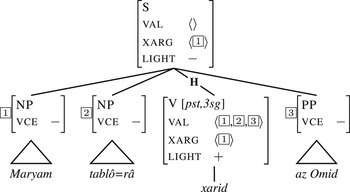
Word order facts and constituency tests provide no motivation for a VP/S asymmetry in Persian: subjects and phrasal complements may be freely reordered. The basic head–valence phrase in (23) thus realizes multiple dependents of the head in the same local tree, as illustrated in Figure 1, and without constraining their relative order.Footnote 9
(23)

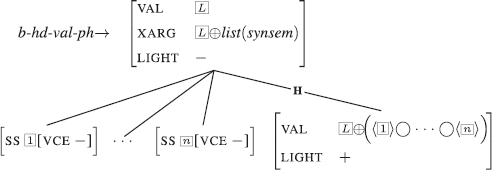
Analysis for example (8c), ‘Maryam bought the painting for Omid’.

This is facilitated by the fact that all valents, subjects and complements alike, are licensed by a single feature val, rather than separate subj and comps features. Wherever the grammar needs to single out subjects, this is done through the feature xarg (for ‘external argument’), which distinguishes at most one argument as externally selectable (Sag Reference Sag, Boas and Sag2012). Note that xarg is not a valence feature (its value is not cancelled when the head combines with the designated argument) but a head feature, as indicated in (24).
(24)
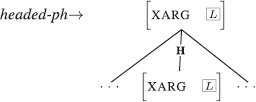
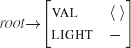
The specification in (23) leaves the possibility open that a basic head–valence phrase be unsaturated for a subject argument. Since xarg is independently constrained to contain at most one element (see (29) below), (23) is compatible with two possibilities:  contains one element corresponding to the subject, and the phrase is unsaturated; or is empty, the phrase is saturated, and whether there is a subject or not (i.e. whether the list concatenated with as the value of xarg is empty or of length one) is left to independent constraints. Unsaturated head–valence phrases will be crucial to the analysis of raising constructions. However, as indicated in (25), root clauses are constrained to be saturated for valence.
(25)
The binary features vce and light are used to specify that some ‘smaller’ constituents have to combine closer to the head. First, words specify lexically their dependents as being either [vce +] (verbal complex elements) or [vce −]: in the former case they can combine with the head only inside the verbal complex, as specified in (26).
(26)
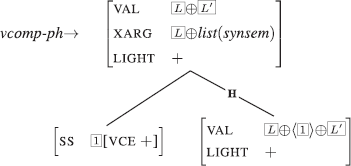
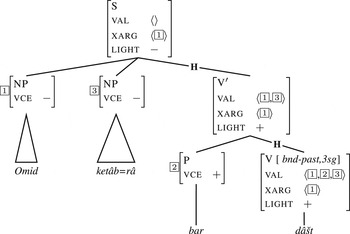
Second, the feature light, adapted from Abeillé & Godard (Reference Abeillé, Godard and Borsley2000), captures the syntactically relevant notion of ‘lexicality’.Footnote 10 Roughly, a [light +] constituent is a word or ‘small’ phrase consisting of [light +] words, such as a word-level coordination; ordinary phrases are [light −]; thus the specifications for light in (23) and (26) ensure that a verbal complex can head a clause, but not the other way around, while still allowing coordinated verbs to head a verbal complex. The coindexation between val and xarg in (26) ensures that the verbal complex phrase introduces as a sister to the head the least oblique non-subject valent. Figure 2 illustrates how (26) correctly captures the placement of the particle in examples (20).
Analysis for example (20a), ‘Omid took the book’.

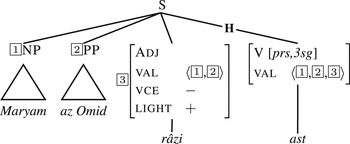
We do not assume that lexical ([light +]) complements of the verb are systematically part of the verbal complex, since they need not be close to the verb. The examples in (19) above are licensed by a lexical entry of the copula that combines with a bare adjective and raises its arguments, as illustrated in Figure 3.
Analysis for example (19b), ‘Maryam is satisfied with Omid’.

Our account of pro-drop and pronominal affixation relies on the notion of non-canonical realization of arguments put forth among others by Miller & Sag (Reference Miller and Sag1997). The central assumption is that whereas verbs represent in their lexical entry a list of all their syntactic arguments (in tight but non-trivial correspondence with the list of semantic arguments of the relation they denote), only a subset of these are projected as valents to be realized as local syntactic dependents of the verb. Those arguments that do not project as valents are called non-canonical. This assumption is spelled out by the constraint in (27), stating that all and only canonical elements of a verb's arg-st list also occur on its val list.
(27)
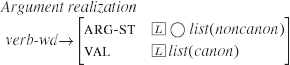
Different kinds of non-canonical synsems can be distinguished to account for the syntactic and semantic variability of non-phrasal (or non-local phrasal) realizations. For concreteness we distinguish: gaps (indicating locally that a dependent has been extracted), non-canonical referential pronouns (corresponding e.g. to pro-dropped arguments), non-canonical generic arguments (corresponding to arbitrary PRO), and non-canonical indefinites (corresponding to implicit arguments with an indefinite interpretation).
(28)
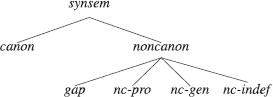
A non-canonical pronoun is a pronoun with no syntactic exponence, but which may have inflectional exponence. This happens in Persian when an object clitic is realized locally on the head verb.Footnote 11
As Bonami & Samvelian (Reference Bonami and Samvelian2008) observe, in a realizational theory of morphology which recognizes the existence of non-canonical pronouns, the possibility of pro-drop follows without stipulation. In a realizational theory, a feature will be realized only if there happen to be inflectional rules realizing it. Saying that pronominality is a morphosyntactic feature does not entail that it has to be realized by specific morphology. We thus posit that Persian has non-canonical subject pronouns, a property it shares with other pro-drop languages, but also with some non-pro-drop languages that express their subject pronouns affixally, like French (Miller Reference Miller1992). Persian differs from French not in having a rule of pro-drop that French lacks, but in having no inflectional rule specifically expressing the pronominality of the subject. English, on the other hand, differs from both Persian and French in lacking non-canonical pronouns altogether, and thus requiring syntactic realization of pronominal arguments. All three languages have rules expressing subject agreement, that is, person and number properties of the subject, irrespective of whether it is canonical or non-canonical, pronominal or non-pronominal. As a result, in French, person and number of a non-canonical pronoun will be spelled out twice by inflection.
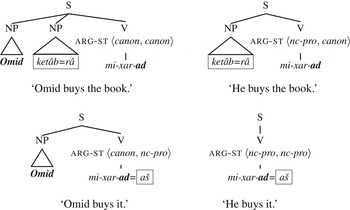
The trees in Figure 4 illustrate the distribution of canonical and non-canonical arguments in Persian, where (syntactic or morphological) exponents of the subject are in boldface and exponents of the object are boxed.
Canonical and non-canonical arguments.

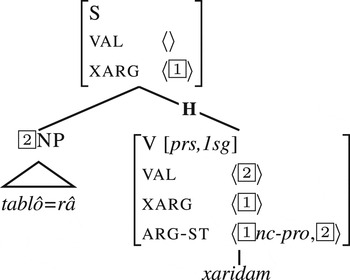
Figure 5 below illustrates the analysis of a sentence with a null pronominal (so-called ‘pro-dropped’) subject. Note that while the verb has a syntactic subject, this subject is not realized in any way by phrasal means, and the phrase is syntactically saturated. However, information on the subject is accessible at phrase level through the feature xarg.
Analysis for example (7a), ‘I bought the painting’.

We are now in a position to turn to the analysis of different types of verbal complementation. First, we noted earlier that although most verbs take a subject, some, such as bâyestan, are subjectless. We thus assume that there is at lexical level a basic division between personal and impersonal verbs. The distinction is specified purely in terms of xarg: personal verbs have one element on xarg, as can be seen in (29a), impersonal verbs have none, see (29b). As is shown in (30), the value of xarg has to be the initial part of the arg-st of verbs. Hence the subject, if there is one, is the least oblique argument of the verb.
- (29)
(a) per-vb-wd→ [xarg〈synsem〉
(b) imper-vb-wd →[xarg 〈 〉]
(30)
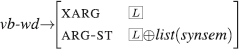
We distinguish four subtypes of verbs taking a clause-like complement. In the simplest case, the verb selects for a finite complement saturated for its valence. This is ensured by the schematic lexical entry for dânestan ‘know’ in (31).
(31)
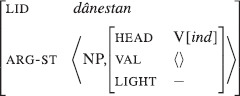
Although the data is compatible with other approaches, for concreteness, we adopt a ‘weak head’ (Abeillié et al. Reference Abeillé, Bonami, Godard, Tseng and Saint-Dizier2006) analysis of complementizers along the lines of Tseng (Reference Tseng, Van Eynde, Hellan and Beermann2002). The complementizer ke takes an unmarked finite clause as its complement, see (32), and projects a phrase specified as [markingke]. Moreover, ke shares the head value of its complement and thus projects a finite clause.
(32)
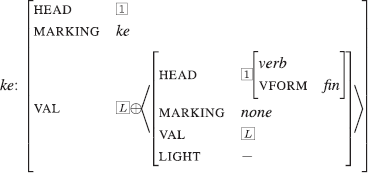
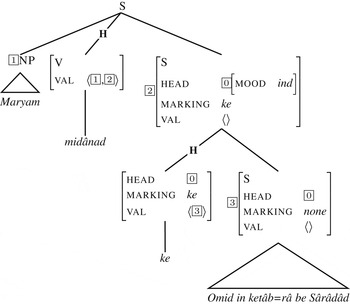
The lexical entries for dânestan ‘know’ and the complementizer ke jointly license the analysis in Figure 6. Observe that, like most verbs, dânestan does not constrain the marking value of its clausal complement, and thus will be compatible with either a ke-marked or an unmarked complement. Also note that ke inherits the valence of its complement. Since only subjects are allowed to be unsaturated at phrase level, this allows ke to mark a phrase not saturated for the subject. In the case at hand, however, dânestan selects a saturated complement and thus the complement of ke must also be saturated.
Analysis for example (9a), ‘Maryam knows that Omid gave this book to Sara’.

Obligatory control constructions are licensed by lexical entries very similar to (31) above, the only difference being that the embedded subject is constrained through xarg to be a non-canonical pronoun coindexed with a matrix argument. The lexical entry for the complex predicate tasmim gereftan ‘decide’ illustrates.
(33)
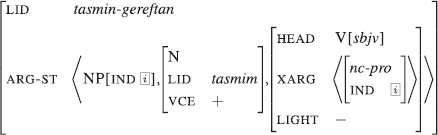
Since they have an empty xarg, impersonal verbs are excluded as complements of a control verb.
Finally, raising constructions are licensed by lexical entries such as (34).
(34)
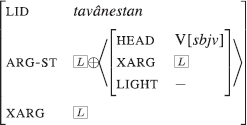
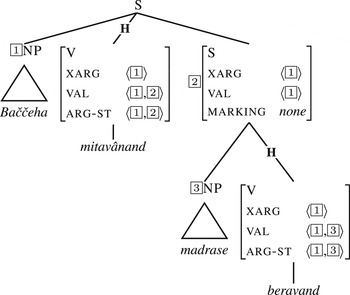
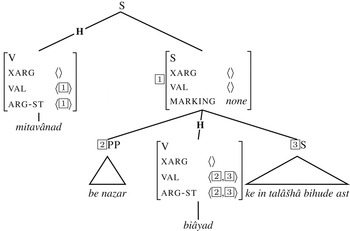
The crucial difference between this and previous lexical entries is that the verb identifies its xarg with that of its complement. As a side effect, the raising verb will take a subject just in case its complement takes a subject – thus it may appropriately combine with impersonal verbs, as shown in (15) above. Figures 7 and 8 contrast the respective analyses of (13a) and (15). The complement will be an unsaturated phrase if and only if the embedded verb takes a canonical subject.
Analysis for example (13a), ‘The kids can go to school’.

Analysis for example (15), ‘It may seem that these efforts are vain’.

2.8. Synthetic conjugation in HPSG/PFM
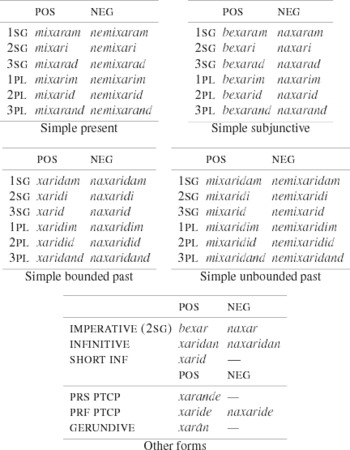
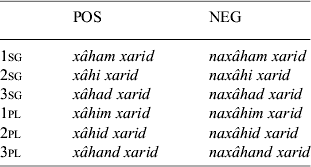
Before addressing the analysis of periphrastic forms, we start with an account of synthetic conjugation. Table 1 below lists all relevant forms of the verb xaridan ‘buy’.
Synthetic forms of xaridan ‘buy’.

Persian verbs exhibit a morphomic stem alternation in the sense of Aronof (Reference Aronoff1994); in Table 1 the alternation is between xar and xarid. Although the two stems are traditionally called ‘present’ and ‘past’, neither of them is associated with a coherent set of paradigm cells. Note in particular that stem selection cannot plausibly be based on tense for non-finite forms. In addition, the form of neither stem is phonologically predictable from that of the other, as illustrated by the small sample in Table 2.
Unpredictable stem alternations.

Affixal exponents realize unbounded aspect in the indicative present and past (mi-), subjunctive or imperative mood (be-), negation (na- or ne-, not illustrated here), and subject agreement for finite forms. Five non-finite forms are distinguished on the basis of stem selection and suffixes. Notice the contrast between the full infinitive, a form used in nominal contexts (e.g. heading subject phrases) and the short infinitive, which heads the rare non-finite complement clauses of the language.
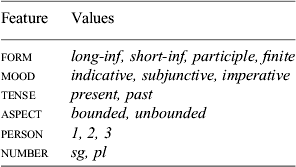
Within Paradigm Function Morphology,Footnote 12 we capture the shape of Persian synthetic paradigms by assuming the features and values in Table 3 and the cooccurrence restrictions stated in prose in (35).
- (35)
(a) Mood distinctions are available only for finite forms.
(b) Tense distinctions are available only in the indicative mood.
(c) Only finite forms and participles have aspectual distinctions.
(d) There is no bounded present.
(e) Only finite forms exhibit agreement.
(f) The short infinitive and present participle have no negative form.
Features used in the synthetic subparadigm of Persian verbs.
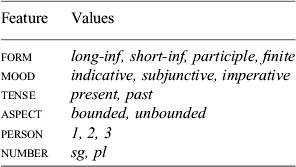
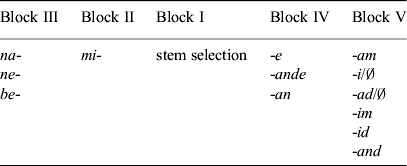
The rather simple position class system can be accounted for using the system of rule blocks outlined in Table 4 and stated in (36)–(40) using the conventions of Ackerman & Stump (Reference Ackerman, Stump, Sadler and Spencer2004).
(36) Block I
(a) XV, σ: {}→ X's second stem
(b) XV, σ: {formfin}→ X's first stem
(c) XV, σ: {tnspast}→ X's second stem
(d) XV, σ: {fromptcp, prf –}→ X's first stem
(37) Block II
(a) XV, σ: {moodind, aspunbd}→ miX
(38) Block III
(a) XV, σ: {pol –}→ naX
(b) XV, σ: {moodind, aspunbd, pol}→ neX
(c) XV, σ: {moodnon-ind, pol+}→ beX
(39) Block IV
(a) XV, σ: {fromptcp, prf +}→ Xe
(b) XV, σ: {fromptcp, prf –}→ Xande
(c) XV, σ: {frominf}→ Xan
(40) Block V
(a) XV, σ: {per1, nbsg}→ Xam
(b) XV, σ: {per2, nbsg}→ Xi
(c) XV, σ: {per2, nbsg, moodimp}→ X
(d) XV, σ: {per3, nbsg, tnsprs}→ Xad
(e) XV, σ: {per1, nbpl}→ Xim
(f) XV, σ: {per2, nbpl}→ Xid
(g) XV, σ: {per3, nbpl}→ Xand
An outline of a PFM analysis of Persian synthetic conjugation.
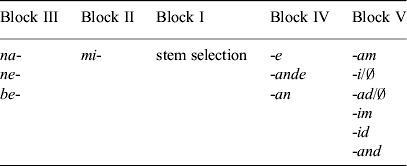
In PFM, realization rules are organized in successive blocks. When attempting to realize a given set of morphosyntactic features, the most specific applicable rule within the block is chosen. For instance, while (40b) asks that finite verbs with a 2sg subject take the suffix -i, the more specific (40c) indicates that the suffix is dropped in the imperative.Footnote 13
To illustrate the workings of the system, let us assume that we are trying to produce the negative first person plural bounded past of the verb xaridan ‘buy’. The input to the derivation is the pair in (41a), where X (here xar) is the verb's basic stem, i (here xaridan) is an index uniquely identifying the lexeme at hand, and τ is the set of morphosyntactic features to be realized.
(41)
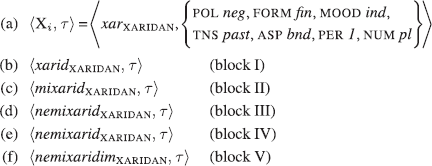
We first select the most specific rule in block I listed in (36) above. Three rules are applicable: (36a) (which is applicable to any input), (36b), and (36c). The most specific rule happens to be (36c): because past tense entails finiteness, rule (36b) is less specific. We thus check the lexicon for xaridan's second stem, and get as output the pair in (41b). We then go to block II, which contains a single rule realizing unbounded aspect; we thus exit the block with a new prefix, as shown in (41c). Block III contains two applicable rules expressing negative polarity, the most specific of which, (38b), also expresses unbounded aspect. The prefix ne- is thus realized, as in (41d). In PFM, features are not ‘consumed’ as they are realized, and hence nothing precludes unbounded aspect from being realized twice – in fact it has to be realized each time a rule licenses its realization. Block IV contains no applicable rule: all rules realize a non-finite form. In that situation we exit block IV with no modification. Finally, block V contains a single applicable rule, (40e), which results in an appropriate final suffixation, seen in (41f).
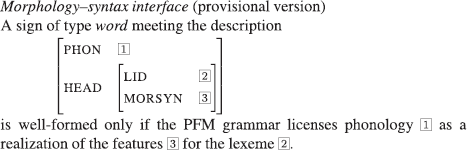
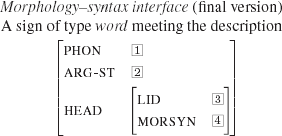
Since the integration of HPSG and PFM will be essential to our account of periphrastic conjugation, it is important that we specify how we intend to carry out the integration. The task is not trivial because of PFM's reliance on comparisons of feature structure descriptions. Such meta-level comparisons are not allowed in the standard formal framework for HPSG grammars.Footnote 14 Rather than attempting a direct integration, we use a PFM grammar to further constrain the class of signs satisfying an HPSG theory. Specifically, we rely on a slight reorganization of the feature geometry for words values, presented in (42), where morsyn is an attribute carried by words which collects features that get realized in inflection.Footnote 15
(42)

The attribute lid is used to assign a specific index to each lexeme (Spencer Reference Spencer2005, Sag Reference Sag, Boas and Sag2012).Footnote 16 We then define a version of PFM that is exactly like that of Stump (Reference Stump2001), except for the fact that typed feature structures are used to model morphosyntactic property sets. The meta-constraint in (43) then links the two grammars.
(43)
3. The passive
The passive in Persian is a typical complex predicate construction, whose properties are parallel to those of copula–predicative complement constructions (Moyne Reference Moyne1974, Dabir-Moghaddam Reference Dabir-Moghaddam1982). The auxiliary šodan is clearly the head: all inflectional information, e.g. negation in (44), is realized on the auxiliary.
(44) In tâblo foruxte ne-mi-šav-ad.
this painting sell.pfp neg-unbd-become.prs-3sg
‘This painting is not sold.’
The participle–auxiliary sequence is syntactically flexible: the auxiliary can have wide scope over a coordination of participles, as illustrated in (45), adverbs may intervene, as in (46), the relative order is not rigid, as shown in (47), and long-distance fronting of the participle is possible, as in (48).
(45) In tâblo (bevasileye do nâšenâs) robude va foruxte
this painting by two strangers steal.pfp and sell.pfp
šod.
become.pst-3sg
‘This painting was stolen and sold by two strangers.’
(46) In tâblo foruxte hatman šod.
this painting sell.pfp certainly become.pst.3sg
‘This painting was certainly sold.’
(47) In tâblo šod robude va foruxte.
this painting become.pst.3sg steal.pfp and sell.pfp
‘It is this painting which was stolen and sold.’
(48) Foruxte fekr mi-kon-am [agar in tâblo be-šav-ad…].
sell.pfp thought unbd-do.prs-1sg if this painting sbjv-become.prs-3sg
‘I think that if this painting is sold …’
A notable contrast between Persian and many languages with periphrastic passives is that in Persian there is no evidence for the existence of a passive participle. Persian has clauses headed by a participle, but these are always in the active voice, as indicated in (49). Note the contrast with English in this respect, evidenced in (50).
- (49)
(a) Nâme = râ xânde, Maryam birun raft.
letter = ddo read.pfp Maryam out go.pst.3sg
‘Having read the letter, Maryam left.’
(b) *bevasileye Maryam xande, nâme Omid = râ xošhâl kard.
by Maryam read.pfp, letter Omid = ddo happy do.pst.3sg
(intended) ‘Read by Maryam, the letter made Omid happy.’
- (50)
(a) *Read the letter, Paul felt better.
(b) Read by Paul, the letter sounded depressing.
The existence of (50) is strong evidence for positing that English possesses a passive participle, although it is always syncretic with the (active) past participle (Aronoff Reference Aronoff1994: Chapter 1). By the same reasoning, the grammaticality pattern in (49) suggests that passive voice can only be expressed constructionally in Persian.
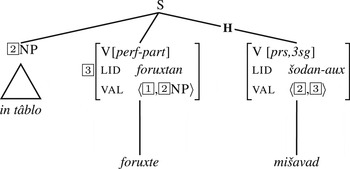
To capture this idea, we rely on an argument composition analysis in the spirit of Hinrichs & Nakazawa (Reference Hinrichs, Nakazawa, Nerbonne, Netter and Pollard1994) and subsequent work (e.g. Abeillé & Godard Reference Abeillé and Godard2002, Bouma & van Noord Reference Bouma, van Noord and Hinrichs1998, Chung Reference Chung1998, Monachesi Reference Monachesi1999). Specifically we propose the lexical entry in (51) for the auxiliary lexeme šodan, giving rise to analyses such as that in Figure 9.
(51)
Figure 9Analysis for example (1), ‘This painting is sold’.
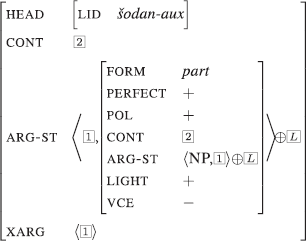

The auxiliary verb combines with a lexical ([light +]) participle rather than a phrase, and promotes the participle's second argument ( ) to subject status. The logical subject is demoted by not being transmitted to the auxiliary's arg-st. All other arguments () of the participle are inherited by the auxiliary.Footnote 17
Recall, from Section 2.7 above, that we distinguish two head–valence schemata for Persian: the simple head–valence phrase empties the valence list of its head, save for the subject in situations like that in (23) above; while the verbal complex phrase forms a small constituent from the head and its least oblique non-subject valent, see (26) above. Since the participle in the passive construction is marked as [vce −], it will combine with the verb and all other valents simultaneously. Since no linear precedence rule intervenes, this will allow the participle to switch places with the auxiliary, as seen in (47) above.Footnote 18
To sum up, we propose that voice is not an inflectional category in Persian. The active–passive opposition does not result from two different representations of the main verb, but from the combination of an active participle with an auxiliary verb manipulating its argument structure. The phrase-structural configuration of the passive construction is an independently existing configuration of Persian, analogous to that of the copular construction illustrated in (19) and represented in Figure 3 above. As a consequence, passive in Persian is not formally periphrastic inflection.
4. The perfect and related forms
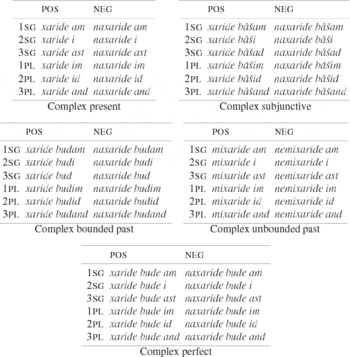
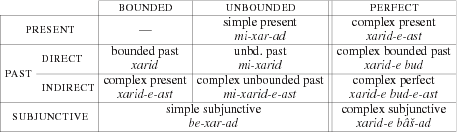
There are five different subparadigms based on budan ‘be’, illustrated in Table 5. These contrast in two independent ways.
The forms based on budan ‘be’ for xaride ‘buy’.

4.1. Morphologized vs. truly periphrastic forms
In the complex present and the complex unbounded past, the perfect participle combines with the present clitic form of the auxiliary, which is homophonous with the exponent of subject agreement except in the 3sg (there is also a non-clitic form of present budan ‘be’, but it may not be used in this construction). In the complex bounded past and complex subjunctive, the perfect participle combines respectively with the bounded past and subjunctive forms of the auxiliary. Finally the complex perfect cumulates two forms of the auxiliary: the participle bude ‘been’ and the present form clitic.
There is strong evidence that the forms historically based on the clitic auxiliary have undergone morphologization in contemporary Persian. First, the sequence cannot be interrupted in any way; in particular, as (52) and (53) illustrate respectively, adverb insertion and participle fronting are excluded.
- (52)
(a) Hatman rafte = ast.
certainly leave.pfp = cop.prs.3sg
‘(S)he has certainly left.’
(b) *Rafte hatman = ast.
leave.pfp certainly = cop.prs.3sg
(53) *Ne-mi-rafte sâl-hâ Maryam be madrase = ast.
neg-unbd-leave.pfp year-pl Maryam to school = be.cop.prs.3sg
‘For years, Maryam didn't go to school’
Second, colloquial Persian allows a form of vowel reduction in the 3sg that is peculiar to these forms, see (54a): comparable constructions where the clitic auxiliary combines with a noun or adjective do not give rise to the same pattern, see (54b).
- (54)
(a) mord′e = ast →mord′e:
die.pfp = cop.prs.3sg
‘(S)he has died.’
(b) mord′e = ast →mord′as
corpse = cop.prs.3sg
‘This is a corpse.’
Finally, the distribution of the aspectual marker mi- is otherwise unexplainable. Since the complex unbounded past indeed realizes unbounded aspect, under a syntactic analysis we would definitely expect the auxiliary to carry the unbounded aspect prefix. Instead, mi- is realized before the participle, something which never happens in participial clauses.Footnote 19
Compare now the situation in which forms are based on a non-clitic auxiliary. The participle–auxiliary combination is more constrained than it is in the passive; in particular, neither adverbs, as seen in (55) nor object clitics, as in (56), can occur between the two verb forms, and, as shown in (57), negation must be realized on the participle.
- (55)
(a) Maryam hatman dide bud = aš.
Maryam certainly see.pfp cop.pst.3sg = cl.3sg
‘Certainly Maryam had seen it.’
(b) *Maryam dide hatman bud = aš.
Maryam see.pfp certainly cop.pst.3sg = cl.3sg
- (56)
(a) Maryam dide bud = aš.
Maryam see.pfp cop.pst.3sg = cl.3sg
‘Maryam had seen it.’
(b) *Maryam dide = aš bud.
Maryam see.pfp =cl. 3sg cop.pst.3sg
(57) Maryam Omid = râ na-dide bud.
Maryam Omid = ddo neg-see.pfp cop.pst.3sg
‘Maryam hadn't seen Omid.’
In addition, the participle rigidly orders before the auxiliary.
(58) *Maryam Omid = râ bud dide.
Maryam Omid = ddo cop.pst.3sg see.pfp
However, the combination is not morphological, since the participle can be extracted.
(59) Foruxte fekr ne-mi-kon-am bâš-ad in
sell.pfp thought neg-unbd-do.prs-1sg cop.sbjv-3sg this
tâblo = râ.
painting = ddo
‘I don't think that s/he has sold this painting.’
4.2. Morphosyntactic import
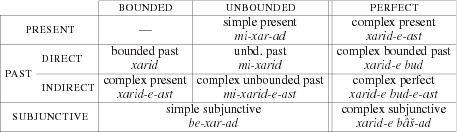
The use of a form based on budan ‘be’ may have two types of semantic import. The complex bounded past, shown in (60), and complex subjunctive, shown in (61), express respectively the past perfect and the subjunctive perfect.
(60) Qabl az inke Omid be-res-ad, Maryam birun rafte
before from that Omid sbjv-arrive.prs-3sg Maryam out go.pfp
bud.
cop.pst.3sg
‘Maryam had left (before Omid arrived).’
(61) Fekr mi-kon-am Maryam mariz bude baš-ad.
thought unbd-do.prs-1sg Maryam sick cop.pfp cop.sbjv-3sg
‘I think Maryam has been sick.’
However, the complex unbounded past does not express perfectivity at all. Rather, it has an evidential value (Windfuhr Reference Windfuhr1982, Lazard Reference Lazard1985, Jahani Reference Jahani, Johanson and Utas2000). Whereas the simple unbounded past is used when the speaker has direct evidence for what she is asserting, the complex unbounded past is used in contexts where the evidence is only indirect, as in (62).
(62) (Banâ bar gofte = ye Omid) Maryam dar sâl = e 1950 in
according to = ez Omid Maryam in year = ez 1950 this
xâne = râ mi-sâxte = ast.
house = ddo unbd-build.pfp = cop.prs.3sg
‘According to Omid, Maryam would have been building this house in 1950.’
The complex present is ambiguous between a perfect and an evidential value: it can be interpreted either as a present perfect, as in (63a) or as a bounded past with indirect evidentiality, as in (63b).
- (63)
(a) Maryam tâze reside = ast.
Maryam new arrived = cop.prs.3sg
‘Maryam has just arrived.’
(b) (Banâ bar gofte = ye Omid) Maryam in xâne = râ dar
according to = ez Omid Maryam this house = ddo in
sâl = e 1950 xaride = ast.
year = ez 1950 buy.pfp = cop.prs.3sg
‘According to Omid, Maryam bought this house in 1950.’
Finally, the complex perfect expresses both perfectivity and indirect evidentiality: it is the indirect evidential equivalent of the complex bounded past, as in (64). Note that this corresponds transparently to the fact that the complex perfect includes two realizations of the copula.
(64) (Az qarâr,) qabl az inke Omid be-res-ad, Maryam
apparently before from that Omid sbjv-arrive.prs-3sg Maryam
birun rafte bude = ast.
out go.pfpcop.pfp = cop.prs.3sg
‘Apparently, Maryam had left before Omid arrived.’
As can be seen in Table 6, if the present perfect is ignored, morphosyntactic properties align with morphologized vs. syntactic combination: the morphologized forms are used for indirect evidentiality. This can be captured by a simple extension of our morphological analysis: a feature evid with values dir and indir is added, subject to the feature cooccurrence restriction in (65). The rules in (66) introduce the relevant exponents.
(65) Evidentiality distinctions are available only in the past.
- (66)
(a) Block IV: XV, σ: {evidindir} →Xe
(b) Block V: XV, σ: {evidindir, 3sg} →Xast
The clitic copula differs from ordinary subject agreement markers only in the 3sg, so that the correct non-3sg forms are already predicted by the rules in (40) above.
The featural content of Persian subparadigms, exemplified in the 3SG.
The truly periphrastic forms are used to express the perfect. The fact that the present perfect is unexpectedly synthetic calls for a paradigmatic analysis: this seems to be a standard case of syncretism, where the exponents used to realize a certain feature set (here indirect bounded past) are re-used in some unrelated part of the paradigm. However, for such an analysis to be viable, one needs to treat perfect as an inflectional category, and thus integrate the truly periphrastic forms in the inflectional paradigm (Ackerman & Stump Reference Ackerman, Stump, Sadler and Spencer2004).
4.3. Exponence as valence
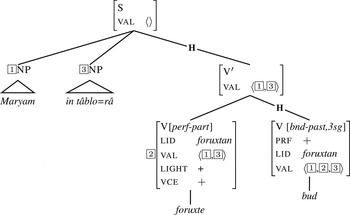
As we just saw, what we need is a way to treat perfect forms as part of the inflectional paradigm, and simultaneously allow for the fact that they correspond to a combination of two words, one of which may be extracted. The solution we explore here can be stated informally as follows: a perfect form of a lexeme Y is a word whose phonology is borrowed from that of a form of the lexeme budan ‘be’, but which subcategorizes for a perfect participle of this same lexeme Y. For instance, the 3sg positive complex bounded past of foruxtan ‘buy’ meets the description in (67).
(67)
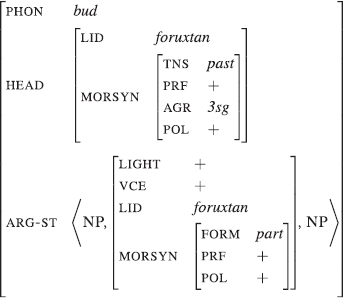
Note the discrepancy between the lexemic index and the phonology. As shown in Figure 10, because of the vce + specification, (67) gives rise to a verbal complex, which contrasts with our analysis of the passive (see Figure 9 above) and accounts for the tighter solidarity of the verbal sequence. In addition, it will allow the extraction of the participle through the usual mechanisms for extraction of arguments.
Analysis for example (2a), ‘Maryam had sold this painting’.

The challenge now is to derive (67) in a principled way, while integrating it within an inflectional system where perfect forms may be realized either synthetically or periphrastically. The approach we propose is based on an extension of the power of realization rules in the spirit of Spencer (Reference Spencer2005). In classical PFM, realization rules relate phonology–lexemic index pairs to phonology–lexemic index pairs. We propose that argument lists be added to the picture. Morphosyntactic features can be realized not only as phonology, but also as valence requirements. We thus extend the meta-constraint in (43) as in (68).
(68)
Realization rules must be modified accordingly to include a specification of argument lists. For most rules the change is trivial, as no modification is made to the argument list. The rule licensing (67) is given in (69).
(69)
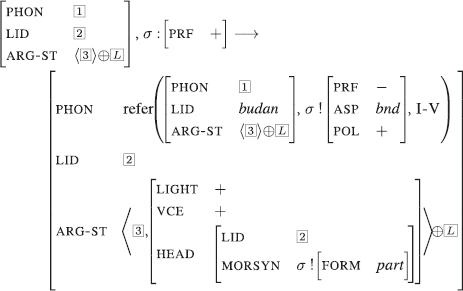
This is a portmanteau rule of referral covering blocks I–V, thus bypassing completely synthetic exponence. The rule states that the realization of a morphosyntactic feature bundle σ including a specification for perfect on a lexeme  takes the form of a word with three characteristics. First, its phonology is referred (through the function ‘refer’) to that of the corresponding bounded positive non-perfect form of budan ‘be’. The notation ‘σ!τ’ denotes the feature structure that is identical to σ except where for the features mentioned in τ, for which it is identical to τ.Footnote 20 Second, this word is an instance of the lexeme , despite having a phonology that does not rely on one of 's stems. Third, the word carries an extra valence requirement not carried by the lexeme. That requirement is one for a past participle of the lexeme . The participle still carries the subset of features of σ that are compatible with being a participle; in particular it carries the polarity feature, and will thus inflect for negation where appropriate. The meta-constraint in (68) makes sure that the arg-st requirement added by the realization rule will indeed constrain the valence of the word within the HPSG grammar. As a consequence, the specification [vce +] will correctly constrain the participle to form a verbal complex with the participle, unless it is extracted.
This approach to periphrastic perfect forms has three definite advantages. First, periphrastic inflection is the manifestation of morphosyntactic features in the form of a valence requirement. Thus periphrasis is a variety of syntactic exponence (Blevins to appear), but there is no need to introduce a notion of phrasal exponence: the periphrase is licensed by a word-level property. Likewise, no competition between morphology and syntax (e.g. Poser Reference Poser, Sag and Szabolcsi1992, Bresnan Reference Bresnan2001) needs to be orchestrated.
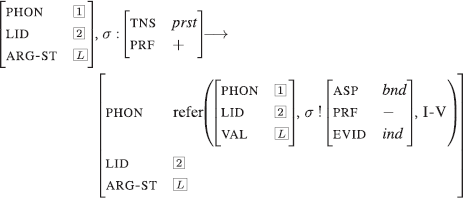
Second, since (69) is an inflectional realization rule, it interacts with other such rules under the logic of rule specificity independently needed for affixal exponence. For instance, the fact that the present perfect is syncretic with the (synthetic) indirect bounded past can be accounted for by the rule of referral in (70), which overrides the application of (69) because of specificity.
(70)
Third, the present analysis accounts correctly for the interaction between passive and perfect. In principle, one could imagine two realizations for passive perfects, as in (71): either the perfect auxiliary selects the passive or the other way around.
- (71)
(a) In tâblo foruxte šod-e bud.
this picture sell.pfp become-pfp cop.pst.3sg
‘This picture has been sold.’
(b) *In tâblo foruxte bud-e šod.
this picture sell.pfp cop-pfp become.pst.3sg
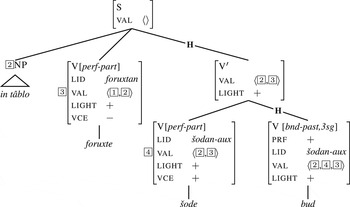
In an analysis where both passive and perfect are morphosyntactic features, there is no expectation as to which of these two strategies will be used by the language. Under our present assumptions however, we correctly predict (71a) to be the attested possibility, whose analysis is stated in Figure 11: there is a passive auxiliary lexeme, and this lexeme has a perfect form, which by (69) is a combination of a form of budan ‘be’ with the participle šode ‘become’. On the other hand, there is no perfect auxiliary lexeme, and no passive inflectional subparadigm; thus there is no basis for generating a combination such as (71b).
Analysis for a passive version of example (2a), ‘This painting had been sold’.

4.4. Discussion
This general strategy for addressing the Persian perfect, initially proposed in Bonami & Samvelian (Reference Bonami, Samvelian and Müller2009), has been successfully applied to analogous data in Pamir languages (Stump & Hippisley Reference Stump, Hippisley, Korn, Haig, Karimi and Samvelian2011) as well as other inflectional periphrasis phenomena in Sanskrit (Stump Reference Stump, Chumakina and Corbett2013), Bulgarian (Popova & Spencer Reference Popova, Andrew, Chumakina and Corbett2013), and various Romance and Germanic languages (Bonami & Webelhuth Reference Bonami and Webelhuth2011, Reference Bonami, Gert, Chumakina and Corbett2013). The particular formulation presented here raises one potential concern:Footnote 21 by modifying valence, rules of periphrasis as stated here are not strictly realizational in the sense of (Stump Reference Stump2001: 4), because the output of a rule manifests syntactic properties distinct from those of its input. The recent literature has presented two attempts to address this concern, neither of which is fully satisfactory. Stump & Hippisley (Reference Stump, Hippisley, Korn, Haig, Karimi and Samvelian2011) introduce valence as a dimension of characterization of paradigm cells. The effects of rule (69) above are implemented as the combination of a condition on well-formed paradigms (making room for periphrastic forms with extended valence) and a rule of referral (making explicit the form of the head of a periphrastic construction). While technically this does away with concerns of incrementality, it is clearly unsatisfactory to model a single rule of periphrasis through two separate statements whose independent existence is empirically unmotivated; moreover, it is unclear that the proposal can scale up to cases of stacked periphrases (situations where two auxiliaries simultaneously combine with a main verb to realize morphosyntactic features). Bonami & Webelhuth (Reference Bonami, Gert, Chumakina and Corbett2013) propose another alternative, also adopted by (Stump Reference Stump, Chumakina and Corbett2013). In their analysis, rules of periphrasis do not compete with inflectional realization rules, but with synthetic inflection as a whole; thus the inflection system proper is decidedly realizational. The downside of such a setup is that there can be no direct competition between a realization rule and a rule of periphrasis, making it difficult to state naturally the situation illustrated by the Persian present perfect. Bonami & Webelhuth (Reference Bonami and Webelhuth2011) sketch a novel solution which reverses the perspective, by taking the main verb to be the principal realization of the lexeme, with the auxiliary realizing features through a process of syntactic reverse-selection. Until this proposal has been fully worked out, we submit that the formal implementation of inflectional periphrasis presented in the present paper is still the most adequate to be available.
5. The future
The future is formed by combining a special form of the auxiliary xâstan ‘want’ with a short infinitive of the main verb, as indicated in Table 7 below. Interestingly, there is no compelling argument in favor of a morphological or syntactic analysis.
The future subparadigm of xaridan ‘buy’.
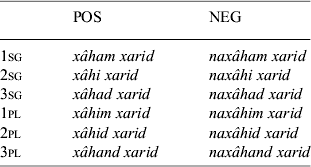
As in the case of the periphrastic perfect, the verb sequence cannot be interrupted, and occurs in a rigid order, as is shown in (72).
- (72)
(a) Maryam Omid = râ xâh-ad did.
Maryam Omid = ddo want.prs-3sg see[sinf]
‘Maryam will see Omid.’
(b) *Maryam xâh-ad Omid = râ did.
Maryam want.prs-3sg Omid = ddo see[sinf]
(c) *Maryam Omid = râ did xâh-ad.
Maryam Omid = ddo see[sinf] can.prs-3sg
In addition, however, unlike what happens in the perfect, no major syntactic rule manipulates the auxiliary–main verb sequence: the main verb cannot be fronted, as seen in (73), nor can a coordination of main verbs combine with an auxiliary, as seen in (74).
(73) Did Maryam Omid = râ xâh-ad.
see[sinf] Maryam Omid = ddo want.prs-3sg
- (74)
(a) Maryam Omid = râ xâh-ad did va xâhad
Maryam Omid = ddo want.prs-3sg see[sinf] and want.prs-3sg
šenâxt.
recognize[sinf]
‘Maryam will see and will recognize Omid.’
(b) *Maryam Omid = râ xâh-ad did va šenâxt.
Maryam Omid = ddo want.prs-3sg see[sinf] and recognize[sinf]
The examples so far show that there is no compelling reason for treating the auxiliary and the main verb as two separate syntactic atoms, as they are always adjacent. The only apparent exception, illustrated in (75b), is that object pronominal clitics can optionally be realized in the middle of the sequence.
- (75)
(a) Maryam xâh-ad did = aš.
Maryam want.prs-3sg see[sinf] = cl.3sg
‘Maryam will see him.’
(b) Maryam xâh-ad = aš did.
Maryam want.prs-3sg = cl.3sg see[sinf]
‘Maryam will see him.’
If, however, the clitics themselves are analyzed as pronominal affixes rather than syntactic atoms (Samvelian & Tseng Reference Samvelian, Tseng and Müller2010), this does not preclude a morphological analysis of the combination.
Let us now turn to the opposite question: are there compelling reasons to treat the auxiliary–main verb sequence as a single word? None of the arguments invoked in the case of the complex present carries over. The periphrastic future does not enter into paradigmatic competition with synthetic inflection, and does not give rise to lexically restricted morphophonological idiosyncrasies. The forms composing the periphrase are a bit unusual, but do occur elsewhere in Persian grammar. The conclusion then is that there is little empirical synchronic evidence helping us decide whether we are dealing with one or two syntactic atoms. Nor is there any clear rationale for choosing in terms of overall elegance or simplicity of the analysis: if the auxiliary–main verb sequence is a word, it is an odd kind of compound which allows infixation of pronominal clitics; if it is a phrase, it is a unique case in the language of a left-headed verbal complex.
In this situation, we turn to diachronic evidence to choose between the two alternatives. Arguably, the analysis positing the smallest departure from the historical source of the construction is preferable. Historically, the future periphrase is a remnant of a complementation option for modal verbs that barely survives in the contemporary language, where the modal combines with a short infinitive (Lazard Reference Lazard1963). A relevant attested example from the 11th century discussed by Lenepveu-Hotz (Reference Lenepveu-Hotz2010) is given in (76).
(76) īn pisar-rā maqām va xāna = i harām bi-xwāh-am
this son = ddo sanctuary and house = ez forbidden foc-want.prs-1sg
namūd
show[sinf]
‘I want to show to this son the sanctuary and the Ka‘aba.’
(Lenepveu-Hotz Reference Lenepveu-Hotz2010: 84 ex. (60))
In the contemporary language, this construction has been restricted to two specific contexts: the future periphrase, and the combination of a modal verb with an impersonal complement, illustrated in (77).
- (77)
(a) Maryam (hatman) bây-ad be madrase be-rav-ad.
Maryam certainly must.prs-3sg to school sbjv-go.prs-3sg
‘Maryam definitely has to go to school.’
(b) (Hatman) bây-ad be madrase raft.
certainly must.prs-3sg to school go[sinf]
‘It is definitely necessary to go to school.’
Note that in the impersonal complementation construction, unlike what happens in the future periphrase, the short infinitive does not have to be adjacent with the governing verb.
Lenepveu-Hotz (Reference Lenepveu-Hotz2010) argues that, in combination with the verb xâstan ‘want’, the short infinitive complementation progressively specialized for the expression of the future, while the finite complementation specialized for the expression of volition. The examples in (78) show that such a tendency is already attested in the 11th century. Note that the use of the aspectual prefix mi- with the verb xâstan ‘want’ is a later development: at the time, xâstan was like with other modal verbs in not taking the aspectual prefix, a property that few verbs have kept in the contemporary language.
- (78)
(a) xwāh-ad ki adab āmōz-ad ba āsānī
want.prs-3sg comp education learn.prs-3sg at easyness
‘He wants to be educated without any effort.’
(Lenepveu-Hotz Reference Lenepveu-Hotz2010: 89 ex. (62a))
(b) man šahr-ē banā xwāh-am kard …
1sg city-ind construction want.prs-1sg do[sinf]
‘I will build a city …’
(Lenepveu-Hotz Reference Lenepveu-Hotz2010: 89 ex. (62b))
Thus it seems that the most likely analysis for the current state of the language posits that the periphrase involves the syntactic combination of two separate words forming an unusual, left-headed verbal complex. Like the perfect and unlike the passive, this periphrase is integrated in the inflection system: (i) it expresses a morphosyntactic feature that is otherwise expressed synthetically; (ii) it is unexpectedly incompatible with the expression of another morphosyntactic feature, the perfect; and (iii) the auxiliary does not have the inflectional characteristics of the main verb it stems from.
Concretely, we list future as another possible value of tense,Footnote 22 and posit the rule in (79).
(79)
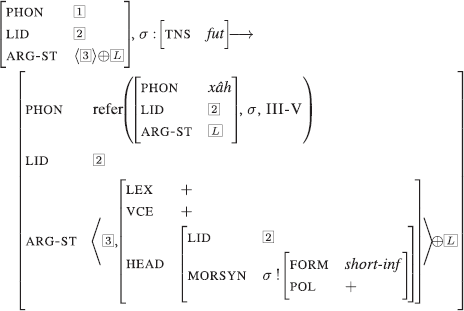
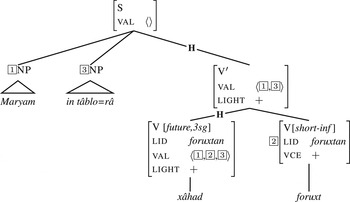
This rule is similar to the rule for the perfect, with three crucial differences. First, the phonology of the auxiliary verb is obtained not from referring to the full inflection of a lexeme, but only to the output of rule blocks III to V, applied to the specific string xâh. Thus we avoid positing a second lexeme xâstan with a paradigm different from that of the main verb xâstan, while still capturing the fact that the auxiliary inflects for polarity and subject agreement. Second, The main verb is a short infinitive, not a participle; as such it can be subjected to different linear precedence constraints than those affecting the main verb in the perfect periphrase, capturing the difference in word order. Third, polarity is realized on the auxiliary, not on the main verb. Figure 12 illustrates the effects of the rule.
Analysis for example (3), ‘Maryam will sell this painting’.

The rule in (79) correctly accounts for the interaction between the future and other constructions. Because the passive auxiliary is an ordinary lexeme, it has a periphrastic future form that is the output of the rule. However, since the future auxiliary forms a verbal complex with its complement, and the participle in the passive construction is not a verbal complex element, the participle cannot be linearized between the two parts of the future periphrase, as (80) illustrates.
- (80)
(a) In tâblo foruxte [xâh-ad šod].
this painting sell.pfp want.prs-3sg become[sinf]
‘This painting will be sold.’
(b) *In tâblo xâh-ad foruxte šod.
this painting want.prs-3sg sell.pfp become[sinf]
When applied to a particle verb, the rule adds a selectional requirement for a short infinitive to a lexical entry already selecting a particle as a verbal complex element. Because that auxiliary, rather than the short infinitive, is the syntactic head of the construction, both the particle and the short infinitive will be realized as complements of the auxiliary. This accounts for the fact that the particle readily linearizes before the auxiliary, as shown in (81).
- (81)
(a) Omid ketâb = râ bar xâh-ad dâšt.
Omid book = ddo part want.prs-3sg have[sinf]
(b) Omid ketâb = râ xâh-ad bar dâšt.
Omid book = ddo want.prs-3sg part have[sinf]
‘Omid will take the book.’
Finally, this rule combines readily with the analysis of pronominal object clitics as pronominal affixes defended by Samvelian & Tseng (Reference Samvelian, Tseng and Müller2010) to account for the ordering possibilities noted in (75) above.
6. The progressive
6.1 The progressive as a periphrase in the typological sense
All Persian forms compatible with unbounded aspect may give rise to either a progressive or a habitual interpretation when combined with an eventive lexeme. The progressive interpretation can also be forced by using the construction illustrated in (82), based on the verb dâštan ‘have’ combined with a finite complement.
- (82)
(a) Maryam dâr-ad tâblo = râ mi-foruš-ad.
Maryam have.prs-3sg painting = ddo unbd-sell.prs-3sg
‘Maryam is selling the painting.’
(b) Maryam dâšt tâblo = râ mi-foruxt.
Maryam have.pst.3sg painting = ddo unbd-sell.pst.3sg
‘Maryam was selling the painting.’
(c) Maryam dâšte = ast tâblo = râ
Maryam have.pfp = cop.prs.3sg painting = ddo
mi-foruxte = ast.
unbd-sell.pfp = cop.prs.3sg
‘Reportedly, Maryam was selling the painting.’
(d) *Maryam dâšt tâblo = râ foruxt.
Maryam have.pst.3sg painting = ddo unbd-sell.pst.3sg
(intended) ‘Maryam was selling the painting.’
(e) *Maryam dâšte bâš-ad tâblo = râ be-foruš-ad.
Maryam have.pfp cop.sbjv-3sg painting = ddo sbjv-sell.prs-3sg
‘that Maryam be selling the painting.’
Note that the construction is compatible with all and only those forms that are explicitly marked for unbounded aspect – that is, the indicative present in (82a), unbounded past in (82b), and complex unbounded past in (82c), but not e.g. the bounded past in (82d) or the subjunctive present in (82e).Footnote 23
In addition to being unavailable in the subjunctive and bounded past, the progressive periphrase is incompatible with the future, the perfect, and with the expression of negation, as illustrated in (83)–(85), respectively.
- (83)
(a) *Maryam xâh-ad dâšt xâh-ad david.
Maryam fut-3sg have[sinf] fut-3sg run[sinf]
(intended) ‘Maryam will be running.’
(b) *Maryam xâh-ad dâšt david.
Maryam fut-3sg have[sinf] run[sinf]
(c) *Maryam dâr-ad xâh-ad david.
Maryam have.prs-3s fut-3sg run[sinf]
- (84)
(a) *Maryam hatman dâšte-ast davide-ast.
Maryam certainly have.prs.prf-3sg run.prs.prf-3sg
(intended) ‘Maryam must have been running.’
(b) *Maryam hatman dâr-ad davide-ast.
Maryam certainly have.prs-3sg run.prs.prf-3sg
(c) *Maryam hatman dâšte-ast dav-ad.
Maryam certainly haveprs.prf-3sg run.prs-3sg
- (85)
(a) *Maryam na-dâr-ad (ne-)mi-dav-ad.
Maryam neg-have.prs-3sg neg-unbd-run.prs-3sg
(intended) ‘Maryam is not running.’
(b) *Maryam (na-)dâr-ad ne-mi-dav-ad.
Maryam neg-have.prs-3sg neg-unbd-run.prs-3sg
It should be noted that except for the incompatibility with bounded aspect, these restrictions on the use of the progressive construction are morphosyntactic rather than semantic in nature. Semantically, there is nothing incoherent with describing e.g. future events in progress. To show this, one may contrast the progressive periphrase with the copular constructions dar hâl=e budan (lit. ‘be in the mood for’) and mašqul=e budan (lit. ‘be occupied by’), which express progressivity by lexical means, and which exhibit none of the restrictions just observed. Contrast (82e) above with (86), (84) with (87), (83) with (88), and (85) with (89).
(86) Fekr mi-kon-am ke Maryam mašqul = e david-an
thought unbd-do.prs-1sg that Maryam occupied = ez run-inf
bâš-ad.
be.subj-3sg
‘I think that Maryam is running.’
(87) Maryam hatman mašqul = e david-an bude-ast.
Maryam certainly occupied = ez run-inf be.prs.prf-3sg
‘Maryam must have been running.’
(88) Maryam mašqul = e david-an xâh-ad bud.
Maryam occupied = ez run-inf fut-3sg cop.pst.3sg
‘Maryam will be running.’
(89) Maryam mašqul = e david-an nist.
Maryam occupied = ez run-inf neg.cop.prs.3sg
‘Maryam is not running.’
The contrasts between the progressive construction based on dâštan ‘have’ and the predicative use of the adjective mašqul ‘occupied’ show that the progressive construction based on dâštan expresses a morphosyntactic feature, whose distribution is subject to semantically unmotivated restrictions, rather than simply conveying progressive semantics. This observation puts the construction at hand in the family of inflectional periphrases in the typological sense, as defined in the introduction to this article.
6.2 Syntactic properties of the construction
Unlike the periphrastic constructions discussed so far, the progressive periphrase results from the grammaticalization of a finite complement clause construction, and all relevant evidence points to the fact that an embedded clausal structure is still present.Footnote 24 The non-auxiliary verb is unmistakably a finite form; it occurs on the right of the auxiliary, just like finite complement clauses occur on the right of their head. As (90a) shows, no complementizer can be used, but since complementizers are not obligatory in Persian, as evidenced in (90b), this does not preclude a clausal analysis.
- (90)
(a) Maryam dâr-ad (* ke) ketâb mi-xân-ad.
Maryam have.prs-3sg that book unbd-read.prs-3sg
‘Maryam is reading a book.’
(b) Maryam mi-xâh-ad (ke) bâ Omid har ruz be sinemâ
Maryam unbd-want.prs-3sg that with Omid every day to theatre
be-rav-ad.
sbjv-go.prs-3sg
‘Maryam wants to go to theatre with Omid everyday.’
Complements normally occur between the two verbs; they can scramble to the left of the auxiliary, as (91a) shows, but this is also possible with clausal complements, as in (91b).
- (91)
(a) Maryam in ketâb = râ dâr-ad mi-xân-ad.
Maryam this book = ddo have.prs-3sg unbd-read.prs-3sg
‘Maryam is reading this book.’
(b) Maryam bâ Omid mi-xâh-ad (ke) har ruz be
Maryam with Omid unbd-want.prs-3sg that every day to
sinemâ be-rav-ad.
theatre sbjv-go.prs-3sg
‘Maryam wants to go to theatre with Omid everyday.’
Lastly, object clitic pronouns must be realized on the non-auxiliary verb, as shown in (92a), and cannot climb to the auxiliary, as shown in (92b).
- (92)
(a) Maryam dâr-ad mi-xân-ad = aš.
Maryam have.prs-3sg unbd-read.prs-3sg = cl.3sg
‘Maryam is reading it.’
(b) *Maryam dâr-ad = aš mi-xân-ad.
Maryam have. prs-3sg = cl.3sg unbd-read.prs-3sg
Finally, we observe that the progressive auxiliary has the characteristic property of a raising verb: like the raising verb tavânestan ‘can’ discussed in Section 2.3, it can take an impersonal clause as its complement, see (93).
(93) Dâr-ad be nazar mi-ây-ad ke in talâš-hâ
have.prs-3sg to opinion unbd-come.prs-3sg that this effort-pl
bihude = ast.
vain = cop.prs.3sg
‘It is becoming apparent that these efforts are vain.’
6.3 A non-paradigmatic analysis of the progressive periphrase
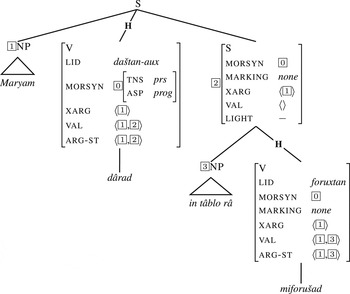
The evidence discussed so far suggests that the optimal analysis of the progressive periphrase relies on the combination of a slightly unusual raising verb with its finite complement. Specifically, we assign the auxiliary dâštan ‘have’ the lexical entry in (94), a variant of the entry proposed for tavânestan ‘can’ in (34) above. The effects of this entry in a concrete example are illustrated in Figure 13.
(94)
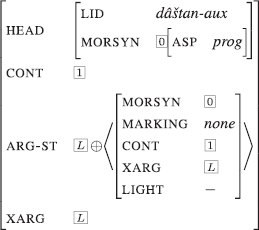
Analysis for example (4), ‘Maryam is selling this painting’.

The sharing of xarg value between the auxiliary and its complement captures the auxiliary's subject raising behavior. In the example in Figure 13, this results in the subject of miforušad ‘sells’ () being realized as a valent of dârad ‘has’ in the matrix clause. In addition, the auxiliary shares its morsyn value with that of its complement. As a result, the auxiliary and the main verb must carry the same tense, aspect, mood, polarity, and agreement features. The fact that the progressive is only found in the positive indicative can be captured by feature cooccurrence restrictions: progressive aspect entails unbounded aspect and non-futurity, and aspectuality entails indicative mood. Thus no extra stipulation is needed to make the auxiliary defective for subjunctive, imperative, non-finite forms: this is just a consequence of realizing the progressive feature.
Recall, from Section 6.1 above, that the periphrase restricts the interpretation of an unbounded form to a progressive interpretation (thus barring e.g. a habitual interpretation), rather than making available an interpretation that is absent when the periphrase is not used. This peculiar situation is captured by making progressive a subtype of unbounded aspect, as indicated in (95).
(95)
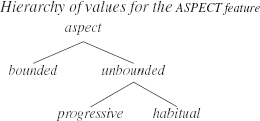
Because no morphology expresses progressivity directly, unbounded forms (usually marked by the prefix mi-) are underspecified between various unbounded interpretations; the periphrase just restricts the interpretation to be progressive. Because of this, the progressive semantics is the realization of a morphosyntactic feature; hence there is no direct semantic contribution to be made by the progressive auxiliary, hence the sharing of cont values in (94).
7. Persian conjugation and the typology of periphrasis
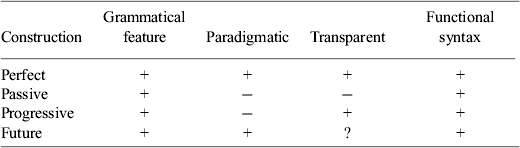
With a formally explicit analysis of the five Persian constructions at hand, we are now in a position to examine how they differ and how they fit in a typology of periphrasis. We will discuss three different ways of laying out such a typology: as a scale of morphosyntactic cohesion, as a set of orthogonal categorical criteria, and as a canonical typology.
7.1 Persian periphrases and degrees of cohesion
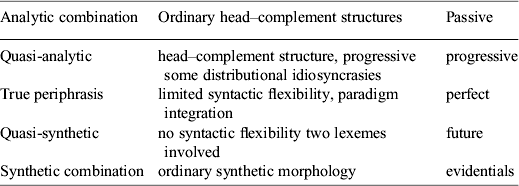
One way of comparing periphrastic constructions is to attempt to place them on a scale of morphosyntactic cohesion, going from open syntactic combination to word-internal stem–affix combinations. Table 8 proposes such a scale. At the bottom is the indirect evidential construction, which we have argued in Section 4.2 to be fully morphologized in contemporary Persian. The future is the limiting case of a syntactic construction with no flexibility at all. The perfect construction is strictly periphrastic: it is a multi-word expression, but very few syntactic processes may affect the sequence; and its distribution is sensitive to paradigm integration. Next comes the progressive construction, which is a specialization of a standard head-finite complement clause combination. Its only distributional peculiarity is that it places a few constraints on the form of the complement clause, which must be subjectless and complementizerless. Finally, the passive construction does not differ at all from a copular construction in terms of cohesion; it is in this sense an analytic combination.
Degrees of periphrasis on a morphosyntactic scale.
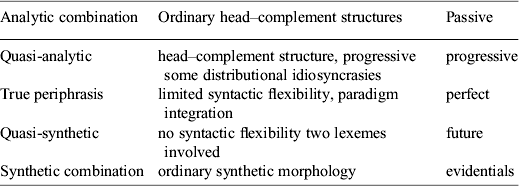
A striking feature of Table 8 is that the two constructions we have analyzed as formally periphrastic occupy the center of the scale; from this it is is tempting to infer that formal periphrases in general occupy a middle ground in terms of syntactic cohesion. Yet such a conclusion is unwarranted. Each of the constructions we discussed is in some sense the grammaticalization of a more general construction of Persian, and the syntactic properties of the source construction have at least as much to say on cohesion as the formal status of the periphrase (Bonami & Webelhuth Reference Bonami, Gert, Chumakina and Corbett2013). For the passive, progressive and perfect, we argued that the periphrase relies on an independently existing complementation strategy. For the future, there is no other comparable construction in contemporary Persian involving short infinitives that we could rely on for establishing what degree of cohesion is expected. Thus only for evidentials is it clear that the periphrase results in more cohesion than the construction it stems from – a clitic being turned into an affix.
7.2 Persian periphrases in a multidimensional typological space
A more appealing way of linking the typology of periphrases and their formal analysis is to apply the criteria for periphrasis collected by Haspelmath (Reference Haspelmath, Booij, Lehmann and Mugdan2000) and Ackerman & Stump (Reference Ackerman, Stump, Sadler and Spencer2004). We use the formulations of Spencer (Reference Spencer and Brown2006) for convenience.
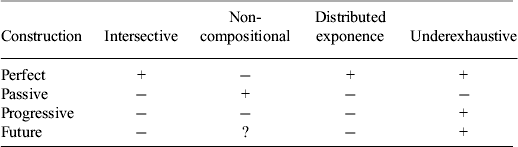
- (96)
(a) Intersectivity
If a construction expresses grammatical properties that are expressed elsewhere in the synthetic paradigm, then it is periphrastic.
(b) Non-compositionality
If some features of elements of the construction are in contradiction with features of the construction as a whole, then the construction is periphrastic.Footnote 25
(c) Distributed exponence
If exponence of features of the construction is distributed on the elements of the construction, then the construction is periphrastic.
(d) Underexhaustivity
If the head of the construction lacks certain forms that other lexemes in the same category have, then the construction is periphrastic.Footnote 26
These four binary criteria define a typological space with 16 possible positions. Note that these criteria make sense only in distinguishing periphrases from open syntactic constructions, and thus they do not apply to the Persian evidential. Table 9 summarizes the classification of the four remaining constructions under examination.
Placing Persian periphrases in a typological space.
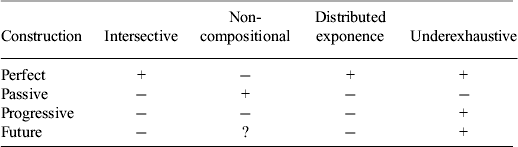
Two important remarks are in order. First, if we are to follow Ackerman & Stump (Reference Ackerman, Stump, Sadler and Spencer2004) and take the criteria in Table 9 as sufficient reasons for necessitating a formally periphrastic analysis, then it should follow that all four constructions are periphrases since they match at least one criterion. Let us thus review the relevant evidence.
Passive was treated as non-periphrastic, yet it is non-compositional: we have argued, in Section 3 above, that the participle carries a perfect feature that the construction as a whole does not express. Here our analysis takes advantage of the fact that there is no expectation, in any familiar syntactic framework, that features of a non-head element should automatically be features of the construction; if that were the case, non-finite complementation constructions would systematically be treated as periphrases. Hence, we argue, the non-compositionality criterion should be sharpened to the principle in (97).
(97) Mismatch between morphological exponence and phrasal features
If the features of a phrasal combination do not match the features that are expected given the exponents carried by the pieces of the construction and independently established general principles of feature transmission, then the combination is periphrastic.
This sharpened principle is a reasonable sufficient condition, under which neither ordinary finite complementation in English nor passive in Persian come out as periphrastic (see also Brown et al. Reference Brown, Marina, Corbett, Gergana and Andrew2012: 252–254).
The second important point in Table 9 that is in need of discussion is the fact that the pre-theoretical, or theory-neutral, nature of the criteria should not be overestimated. A case in point is the compositionality of the future. At first sight it looks non-compositional because the auxiliary verb looks like a present tense form and the construction as a whole expresses the future. However, this is a doubly disputable issue. First, non-compositionality as reformulated in (97) above depends on the expression of features. Thus it is crucial to determine that we are indeed dealing with a feature rather than the expression of a semantic predicate by lexical means. Here the evidence discussed in Section 6 is relevant: we showed that there is a semantically unmotivated restriction on the cooccurrence between progressive and future, which entails that future must be a feature value participating in the system of paradigmatic oppositions. Second, because there is no synthetic future, there is no way to decide for sure whether the forms of the auxiliary are incompatible with future tense.Footnote 27 This situation is unsatisfactory because if we discard non-compositionality, then there is no remaining distinction in Table 9 between the future and the progressive that we can rely on to justify the contrasting analyses proposed in this paper.
What is, then, the crucial contrast between the future and progressive? The future periphrase is the sole realization of the future, and thus enters a paradigmatic opposition with other values of tense that are expressed synthetically. The progressive periphrase also expresses a feature (progressive aspect), but it is not an obligatory realization of that feature: a synthetic unbounded form for verb, indeed the very same form is used in the periphrase, may have progressive meaning without the presence of the auxiliary. This suggests using obligatoriness as a new criterion:
(98) Obligatoriness
If the construction is necessary for some morphosyntactic feature value to be expressed, then the construction is periphrastic.Footnote 28
This makes sense as part of a typology of periphrases, in the sense that we expect periphrases to be obligatory. It also makes sense as a criterion favoring a formally periphrastic analysis: if the inflectional paradigm of a lexeme is defined as the collection of licit combinations of morphosyntactic feature values for that lexeme, a reductionist analysis of an obligatory periphrase is forced to postulate cells in an inflectional paradigm that cannot be realized by inflection.
7.3 Persian periphrases in a canonical typology
In a recent paper, Brown et al. (Reference Brown, Marina, Corbett, Gergana and Andrew2012) outline a different approach to the typology of periphrases based on canonical typology (see e.g. Corbett Reference Corbett2007). The central idea is that a canonical periphrase should correspond to the best possible fit between canonical inflectional morphology and canonical syntax. Although discussing the merits of the proposal is beyond the scope of this paper, we may review the criteria and see how they apply to our Persian examples. The four criteria are listed in (99) below, paraphrasing (Brown et al. Reference Brown, Marina, Corbett, Gergana and Andrew2012: 245). Note that these are to be interpreted as criteria for identifying canonical periphrases rather than just periphrases. Thus the fact that some construction one would like to call periphrastic does not meet the criteria should not be taken as refuting them.
- (99)
(a) Feature realization
A canonical periphrastic construction realizes a (canonical) grammatical feature.
(b) Paradigmaticity
A canonical periphrastic construction occupies a cell in an otherwise inflected paradigm.
(c) Transparency
A canonical periphrastic construction exhibits a transparent relation between meaning and form.
(d) Functional syntax
A canonical periphrastic construction is a canonical functional syntactic construction.
A few terminological clarifications are in order. First, grammatical feature is to be interpreted in the way we have used morphosyntactic feature. Second, ‘inflected paradigm’, in the present context, should be interpreted as a paradigm of synthetically inflected words. Paradigmaticity can be seen as a generalization of intersectivity, taking into account the fact that realizing a feature value that is in paradigmatic opposition to other synthetically expressed values of the same feature may be enough to recognize a paraphrase; hence the Persian future, while not exhibiting intersectivity, exhibits paradigmaticity. The criterion of transparency goes in the opposite direction from non-compositionality (or our revised version, mismatch). This is motivated by the observation that both canonical morphology and canonical syntax are transparent. Finally, functional syntactic constructions are taken to be constructions where grammatical words and/or expression of grammatical meaning plays a crucial role.
The application of the criteria to the Persian data is outlined in Table 10. We have left undecided whether the future is transparent, just as we left undecided whether it was compositional. We listed the passive as expressing a grammatical feature, assuming a broad typological definition of the notion.
Persian periphrases in the canonical typology of periphrases.
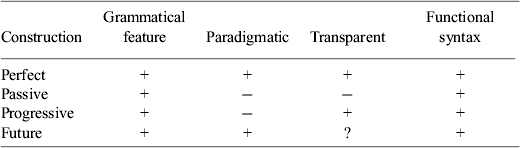
A striking result is that the perfect comes out as closest to the canonical periphrase, and the passive as furthest, which aligns nicely with the analyses proposed in the preceding pages. We do not see such a nice alignment though between the place of the progressive in the typology and the analysis we have proposed.
The reasons for these alignments and misalignments are clear. The typology of is based on the idea that canonical periphrasis is canonical inflection, and that canonical inflection is defined in contrast to derivation (Brown & Hippisley Reference Brown and Hippisley2012: 239). But even when it is realized synthetically, the status of passive as inflection or derivation is disputed and uncertain (see Walther Reference Walther2013: Chapter 1 and references therein). Thus arguably the passive periphrase is less canonical just because of the feature it expresses. The position of the progressive in the typology is dependent on the fact that Brown et al. (Reference Brown, Marina, Corbett, Gergana and Andrew2012) use of the criterion of transparency in the opposite direction from that used in previous work such as Ackerman & Stump (Reference Ackerman, Stump, Sadler and Spencer2004). However, the position taken by Brown et al. (Reference Brown, Marina, Corbett, Gergana and Andrew2012) seems debatable. The guiding idea behind the criteria is that canonical periphrasis should be taken as the tightest possible fit between canonical syntax and canonical morphology. Yet in general, criteria in canonical typology are used to contrast two classes of phenomena (affixes vs. words, agreement vs. pronouns, inflection vs. derivation, etc.). Since transparency does not contrast grammatical components or types of constructions, it is usually not used as a criterion, e.g. when defining canonical morphology or canonical inflection – of course, we expect any kind of linguistic combination to be transparent, but that does not help us classify them. Thus while it seems coherent to say that within a canonical approach non-compositionality should not be taken to be a criterial property of periphrasis, we contend that its opposite, transparency, should not either.
If transparency is left aside, paradigmaticity remains as the sole point of contrast between our four constructions within the canonical typology. While it is reassuring that the typological classification coincides with our opposition between formally periphrastic and syntactically reducible periphrases, it is striking that the sole criterion of paradigmaticity is far from doing justice to the various divergences between the constructions we have observed.
8. Conclusions
In this paper we have proposed analyses for five different constructions which are periphrastic in the typological sense. Of these, two (the passive and the progressive) proved to be best analyzed as instances of ordinary syntax, and one (the indirect evidential) as an instance of morphology.
While the last two constructions, the perfect and the future, are optimally analyzed as formally periphrastic, we have shown that formulating such an analysis did not force one to generate phrases in the inflectional system. By combining the HPSG feature geometry for valence selection and the PFM internal notion of a rule of referral, we were able to treat periphrasis as a word-level phenomenon, whereby a word borrows the morphological realization of an auxiliary verb while selecting for a participial form of the lexeme it realizes. Thus no competition between morphology and syntax (Poser Reference Poser, Sag and Szabolcsi1992, Bresnan Reference Bresnan2001, Kiparsky Reference Kiparsky, Booij and van Marle2005) needs to be orchestrated, and the inflectional component is not extended beside the description of the properties of words (Blevins to appear). Moreover, as argued in detail by Bonami & Webelhuth (Reference Bonami, Gert, Chumakina and Corbett2013), building the theory of inflectional periphrasis on top of the theory of valence makes the correct prediction that periphrases typically exhibit the properties of normal valence-reducing constructions of the language. In the present instance, this is clearly the case for the perfect construction, whose syntactic properties directly follow from the properties of the forms being combined. Interestingly, the future construction provides a contrasting example: as we argued in Section 5, the future periphrase fossilized a valence construction that has otherwise been lost by the language.
In this paper we have adopted a conservative approach to the integration of periphrases in the inflection system: wherever both a formally periphrastic and a purely syntactic analyses were defendable, we elected to err in the direction of pure syntax. Our motivation for doing so was twofold. First the use of well-understood and time-proven formal tools is generally preferable, wherever that does not lead to a distortion of the data. Second, by giving purely syntactic analyses their best chance, we have strengthened the case that some constructions are inescapably formally periphrastic. Third, the exercise has forced us to devise analyses that fit the data as closely as possible, and has thus helped sharpen the typology of periphrases.
This is of course not the only possible strategy to approach the topic at hand. The obvious alternative is to develop a formal theory of periphrases that covers as large as possible a subset of the full typology. That strategy is, we think, implicit in work such as Ackerman & Stump (Reference Ackerman, Stump, Sadler and Spencer2004), Ackerman et al. (Reference Ackerman, Stump, Webelhuth, Borsley and Börjars2011), Bonami & Webelhuth (Reference Bonami, Gert, Chumakina and Corbett2013), and Blevins (to appear). As it happens, the rule format for periphrastic inflection introduced in Section 4.3 could easily be applied to the Persian passive, progressive, and evidential constructions. In each case though, some aspect of the analysis would require a few inelegant stipulations that are avoided under a reductionist analysis. We thus contend that our reductionist strategy has been fruitful: allowing diverse formal encodings for periphrastic constructions allows a better understanding of the fine properties of these constructions.
More generally, by discussing the place of Persian periphrases in different typological proposals, we showed in Section 7 that our current understanding of the typology is quite partial, and can be sharpened by relying on detailed formal analyses which allow one to substantiate, or in some cases, abandon, the criteria on which the typology is based. Thus at this stage in our understanding of the phenomenon of periphrasis, it seems that, in addition to broad surveys such as e.g. Anderson (Reference Anderson2006), detailed formal analyses of particular languages such as the one proposed here are indispensable to the construction of a viable typology.