English resultatives and in particular the way-construction have received much attention in the past two decades by those interested in syntactic fusion (cf. Salkoff, Reference Salkoff1988), construction grammar (cf. Goldberg, Reference Goldberg1995, Reference Goldberg, Alsina, Bresnan and Sells1997), cognitive grammar (Israel, Reference Israel and Goldberg1996), argument structure constraints (cf. Boas, Reference Boas and Rapp2002; Jackendoff, Reference Jackendoff1990, Reference Jackendoff, Stowell and Wehrli1992, Reference Jackendoff1997; Levin & Rappaport, Reference Levin and Rappaport Hovav1995; Marantz, Reference Marantz, Stowell and Wehrli1992), measuring arguments (cf. Tenny, Reference Tenny1994), word-formation and principles of language variation (cf. Rohdenburg, Reference Rohdenburg, Weigand and Hundsnurscher1996; Mondorf, Reference Mondorf2006, forthcoming).Footnote 1 Jackendoff (Reference Jackendoff1990:223) has even dubbed it a “fairly outrageous mismatch between syntax and semantics,” because it appears to violate argument structure constraints and poses intriguing problems as regards its representation in the mental lexicon (cf. Jackendoff, Reference Jackendoff1990:212, 222). One of the most revealing studies on the proliferation of the way-construction has been conducted by Israel (Reference Israel and Goldberg1996), who shows that it was already in use at least as far back as the 15th century and that it was well-established by the 17th century (Israel, Reference Israel and Goldberg1996:221). By counting the number of verbs entering the way-construction in three different semantic domains he observes that over the centuries it has gradually extended its use from “verbs which were somehow directly related to motion or path creation” to ones “which are only marginally or incidentally related to the actual expressed motion” (Israel, Reference Israel and Goldberg1996:225–226). This suggests that the way-construction grammaticalized, thereby extending its scope to an increasing number of verbs and verb senses.
Within the system of English resultatives, the more recent way-construction is sometimes used in the same contexts as the historically earlier reflexive self, as illustrated in the pair of examples in (1) and (2).
- (1)
a. …; there were rumors that he had worked himself to the top of the tall flag-staff—which was as smooth as a greased pole—but I will not vouch for their truth. (COHA: M.T.W. Connor Magan's Luck and Other Stories, 1881)
b. It was lovely Rose Gowdy who persuaded Steve Brill to take the job of telegraph operator, forgetting his prematurely white hair, and she who encouraged him to work his way to the top of the railroad business. (COHA: Emerson, Alice B. Betty Gordon in Washington, 1920)
- (2)
a. Rodham was by nature a planner and an achiever, someone who worked herself to the top of any organisation with which she was associated, … (Guardian, 2003)
b. Mr Irvin grew up in a poor family of 16 and worked his way to the top of the football business. (Guardian, 1997)
Wendt (Reference Wendt1911:197) observed that the way-construction can sometimes take the place of self.Footnote 2 Apparently diametrically opposed is Salkoff's claim that
… it is not way which takes the place of self, but rather the opposite: the substitution of self for way is possible for only a subgroup of verbs in the paradigm. It is therefore way that is basic, and not self. (Salkoff, Reference Salkoff1988:52)
It is not quite clear on what grounds Salkoff (Reference Salkoff1988) considers the way-construction more basic than reflexive self. Concerning the diachronic development, the research introduced in the present article reveals that self was clearly the earlier form that is presently being ousted by way. Moreover, as regards the implication that self is more restricted in applying to fewer verbs, the present paper will uncover that the distribution of both constructions has been in a state of flux, which is best analyzed in terms of principles governing variation and change.
The present paper relies on historical and present-day English corpus data to answer the following questions: Is the variation between these two constructions an instance of language change with one construction acquiring new domains formerly covered by the other? Are all uses of the constructions under investigation equally affected by the reorganization of the system of English resultatives or are we witnessing an emergent division of labor? Does the metaphorical extension of semantic domains investigated by various authors (most notably Israel, Reference Israel and Goldberg1996:227) lend itself to an explanation in terms of grammaticalization theory?
This paper is structured as follows. The first section provides support for the actual existence of the assumed alternation between the way-construction and reflexive self and relates the observable alternation to the approach to linguistic variation and change pursued in the present paper. The following section introduces the methodological prerequisites and the database. The next two sections derive the hypotheses and present findings that emanate from the empirical investigation of these hypotheses with respect to the quantitative distribution of each resultative in comparison to its closest competitor. Moreover, these sections tackle the question of whether the data reveal qualitative changes in the form of a semantically conditioned division of labor. The conclusion relates the findings to language change, variation, and grammaticalization.
THE COMPETITION BETWEEN SELF AND WAY
Although the present paper is based on the competition between reflexive self and the way-construction, there are several additional resultative constructions that are at least partly functionally equivalent to the ones selected here. The “way-construction paradigm” (Salkoff, Reference Salkoff1988:54) consists of at least three additional variants, listed in (3) and (4) (from Salkoff, Reference Salkoff1988:54–55).
(3)

- (4)
a. Max forced his way into the house.
b. Max married himself into big money.
c. Max forced an entrance into the house.
d. Max bicycled it through the country.
e. Max hiked Ø across the U.S. (based on Salkoff, Reference Salkoff1988:55)
The occurrences of the DET path/entrance/…-variant and the it-variant were extremely scarce in the data examined and retrieval of the zero-variant proved too time-consuming because of vast amounts of waste entries. This is not to belittle the role of the zero-variant for verbs such as cut in the paradigm of resultatives, which might affect the percentages scored by way and self in the paradigm. The primary purpose of the present study, however, is to investigate the relation between way and self.
In order to justifiably analyze way-constructions and self-reflexives as functionally equivalent variants, we first need to establish whether the assumed competition between the two structures actually exists. The alternation between the two functionally overlapping constructions is illustrated in the following 17th-century example.
(5) …; yet I am not unknown to the African part of the Macrocosme, where my single Sword hath eaten its waythrough thousands, and hath afterwards drank it selfinto a Surfeit, with the blood of those Hell-dyed Infidels. (Richard Head & Francis Kirkman, The English Rogue, Part 2, 1668)
Such an example poses an almost irresistible challenge to the variation linguist. We are faced with variation by one and the same author, within one and the same text, within one and the same sentence—and we are even dealing with semantically related verbs (eat, drink).
Acknowledging that such variation cannot be relegated to performance, linguists have become increasingly aware that “… at least some categorical constraints are simply the limiting cases of more general statistical tendencies” (Wasow & Arnold, Reference Wasow, Arnold, Rohdenburg and Mondorf2003:148). Thus, we can think of categorical choices of self or way as the endpoints on a scale that is characterized by variation, governed by factors that are yet to be explored. The present paper makes a contribution toward this end.
METHODOLOGY
The analysis is based on a selection of British English historical prose fiction corpora plus one section from the British National Corpus (written domain 1), which contains imaginative prose and is therefore well-suited for comparison with the historical databases.
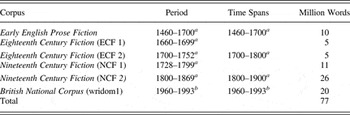
Table 1 shows that roughly 77 million words form the basis for the present study. The earliest corpus data stem from the 15th century, the period from which we have the first attestations of way-constructions according to Israel (Reference Israel and Goldberg1996:221). Note, however, that though the Early English Prose Fiction corpus covers the time span from 1460 to 1700, the texts are not evenly distributed across the centuries. Very few texts are from the 15th and 16th centuries. In fact, in this corpus the earliest instances attested for the way-construction or reflexive self with the verbs investigated here date from 1597 and 1575, respectively. The vast majority of attestations of both variants are found in the late 17th century.
British English historical corpora

aBirth dates.
bPublication dates: The Eighteenth Century Fiction corpus and the Nineteenth Century Fiction corpus have been split into subcorpora in order to provide periods that start or finish at the turn of a century. Because the emergent subcorpora (ECF 1, ECF 2, NCF 1, NCF 2) were ordered by authors' birth dates rather than publication dates, birth dates have been chosen for locating the historical texts in time. This inconsistency in dating the texts is considered negligible here, as all historical texts are dated by birth dates whereas only the present-day English data is based on publication date.
Given that syntactic variants do not easily lend themselves to analysis in small-sized samples, the smaller corpora, which are also the earliest, set the mark for selecting which verbs were to be investigated. Ten verbs (cut, drink, eat, fight, grope, hit, wind, work, worm, and wriggle) have been chosen randomly from the historical data.Footnote 3 Only if they appeared with both constructions—the reflexive and the way-construction—and occurred at least twice in the historical data did they qualify for further study in the present-day English corpus.Footnote 4
The data has only been checked for way- and self-constructions without intervening material in order to retrieve matching contexts. Some way-constructions allow inserted material (e.g., own in worked my own way to the top) that is less readily admitted with the reflexive (e.g., *worked my own self to the top).
In order to collect all instances of way-constructions for the 10 verbs investigated, the Oxford English Dictionary was checked for post–16th-century spelling variants of present-day English way.Footnote 5 Next, all spelling variants were retrieved automatically and all instances that did not match the way-construction were manually eliminated from the tally.
To ascertain the corresponding forms for the reflexive, the spelling variants for reflexive pronouns were gleaned from the Oxford English Dictionary. The resulting search strings, designed to allow for the most common variant spellings, consisted of: m*sel*/m* sel*, y*sel*/y* sel*, h*sel*/h* sel*, i*sel*/i* sel*, o*sel*/o* sel*, th*sel*/th* sel*.Footnote 6
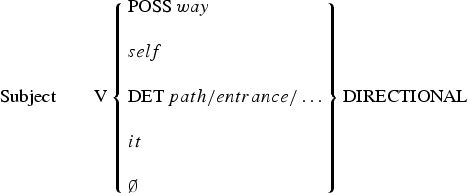
The way-construction has schematically been represented as follows (cf. Salkoff Reference Salkoff1988:49):

This formula does not, however, present the whole picture. Consider the following examples:
- (6)
a. His trademark hat, a straw, beige Kango, seemed to rest at an odd angle on his head; from beneath it a single, long braid had worked its way free and dangled rebelliously behind his right ear. (COCA: Iowa Review, 2006)
b. The image is almost fantastic now, as harried travelers flee Kennedy International Airport's sagging terminals to fight their way home through the endless traffic on the Van Wyck Expressway. (COCA: New York Times, 1996)
c. We begin with some simple number theory which will help us feel our way Ø and also lead us to some new and fascinating algebraic structures. (BNC wridom2)
d. Small builders cannot see their way to take on many trainees. (BNC wridom5)Footnote 7
The scheme therefore has to be revised so as to incorporate at least three additional items:
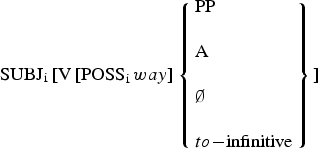
All variants somehow denote a direction or movement, which is why I follow Goldberg (Reference Goldberg1995:199) in calling them directionals. The formula can thus be reduced to:Footnote 8

In order to be classified as a way-construction in the present study, a syntactic string had to meet the following requirements: the possessive pronoun must be coindexed with the subject (cf. Israel, Reference Israel and Goldberg1996:226); the construction must imply movement of a subject along a PATH (explicitly or implicitly) indicated by a directional (cf. Goldberg, Reference Goldberg1995:199; Israel, Reference Israel and Goldberg1996:226); and the directional must modify the path designated in POSS way (cf. Goldberg, Reference Goldberg1995:199).Footnote 9
In order to investigate only the relevant choice contexts, each case of a way-construction or reflexive resultative was checked for whether they can also occur with the other variant. As stated, only those verbs that occurred with both resultative variants have been investigated. This procedure yielded a total of 1,146 occurrences of the 10 verbs with the way-construction or the reflexive.
QUANTITATIVE CHANGES IN THE SYSTEM OF ENGLISH RESULTATIVES
Returning to example (5), which is repeated here for convenience, we have at least four options to interpret the occurrence of the functionally partly overlapping way-construction and reflexive self used by one author within one and the same sentence.
(7) …; yet I am not unknown to the African part of the Macrocosme, where my single Sword hath eaten its waythrough thousands, and hath afterwards drank it selfinto a Surfeit, with the blood of those Hell-dyed Infidels. (Richard Head & Francis Kirkman, The English Rogue, Part 2, 1668)
Firstly, we could—somewhat arbitrarily—assume that the verb eat licenses way-constructions, and drink licenses the reflexive. However, the following examples culled from a sketch retrieval in selected corpora attest that at least for present-day English both verbs can occur with both variants, so that differing profiles for individual lexemes cannot be the whole story:
(8) drink + way
a. …, Maxwell was still drinking his way through the haul. (Guardian, 1994)
drink + self
b. So you can drink yourself into a stupor? (BNC)
eat_ + way
c. … nowadays, we eat our way into the fridge. (F-LOB)
eat + self
d. So he sat there thinking about life and things; what the dog does when it catches its tail and about the snake that ate itself to death. (BNC)
Secondly, it is theoretically possible that the PP (i.e., through thousands vs. into a Surfeit) is responsible for the observed variation. But again, very similar PPs also exhibit variation:
- (9)
a. It will be more to the purpose to tell you how he worked himself into my good graces. (Wilkie Collins, The Woman in White, 1860)
b. … till he had patiently, with long-continuing and deep affection, worked his way into her regard,… (Elizabeth Cleghorn Gaskell, Sylvia's Lovers, 1863)
Note that example (9b) appears to have a stronger volitional, intentional element. The tendency for intentional actions to be more strongly associated with way-constructions than with the reflexive has been discussed in Mondorf (Reference Mondorf2006).
A third interpretation regards the occurrence of both constructions within a single sentence as an instance of language change.
Finally, there is a fourth possible explanation for the co-occurrence of way and self in examples such as (5). Rather than locating the motivation for the variation in the individual lexeme (eat vs. drink), we can look for shared properties of constructions that prefer way and contrast them with those that prefer self. Indeed, we will see that a semantic factor (concrete vs. abstract meanings) plays a considerable part in the choice between the two variant constructions. Although there is still some degree of overlap between way and self, we can additionally observe an emergent division of labor throughout the past centuries. But let us first investigate the third explanation in more detail.
It has often been observed that certain uses of the reflexive appear to become obsolete in a wide range of environments (cf., e.g., Kirchner, Reference Kirchner1951:158; Siemund, Reference Siemund, Rohdenburg and Mondorf2003:488; Strang, Reference Strang1970:153). Kirchner (Reference Kirchner1951:158) mentioned the following examples in which the reflexive has become “somewhat unwieldy”:
- (10)
a. … they scramble themselves into a little education…
b. … they urge themselves forward … (Kirchner, Reference Kirchner1951:158)
Similarly, Strang (Reference Strang1970:153) reported an “increasing disuse of reflexives with such verbs as rest, dress, wash, move. …”
Empirical evidence on the decline of the reflexive in both British and American English comes from Rohdenburg (Reference Rohdenburg, Rohdenburg and Schlüter2009:180), who observed a “centuries-old trend towards the zero variant.”Footnote 10 Kirchner (Reference Kirchner1951:158) believed that there had been a gradual development of the verbs shoulder, work, worm, and wriggle from being used with reflexives to occurring in way-constructions. It would hardly be surprising if this tendency went hand in hand with the high productivity of the way-construction reported in Mondorf (Reference Mondorf2005, forthcoming). We can thus hypothesize that the way-construction is replacing reflexive self in resultative constructions.Footnote 11
The diachronic development of the competition between the way-construction and reflexive self
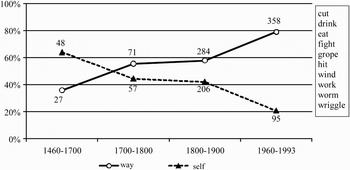
In order to empirically test the hypothesis that the way-construction is supplanting reflexive self in the resultative use, all occurrences of the 10 verbs selected have been searched for in four historically stratified corpora. The results for the aggregate of all 10 verbs investigated are presented in Figure 1. The vertical axis depicts the percentage of each variant's occurrence with the 10 verbs listed on the right. The horizontal axis provides the four time spans investigated. Each curve is additionally labeled with the absolute figures in order to assess if the sample is large enough to permit the deduction of meaningful claims. Thus, the figure can be interpreted as follows.
Diachronic development of the competition between way vs. self (n = 1,146).

In the earliest time period investigated, the reflexive (e.g., She worked her selfto the top) is used in 64% of all instances (48 of 75 cases). Up to the 17th century, the self-variant is the majority form. This pattern is reversed in the 18th century, with the way-construction (e.g., She worked her wayto the top) overtaking the reflexive. From then on, the way-construction is continually on the increase, a development culminating in an 80% usage of way in the present-day English data. Conversely, the reflexive has largely been ousted by its more recent competitor. With 95 as opposed to 358 instances for way, it accounts for a mere 20%.
These figures strongly suggest that the way-construction has largely supplanted its closest competitor throughout the past five centuries. Theoretically, however, there is the possibility that the aggregate figures for all 10 verbs could be brought about by an overrepresentation of one extremely frequent verb, and 9 other verbs show exactly contrary developments. To avoid such skewing effects, we also need to look at the individual verbs.
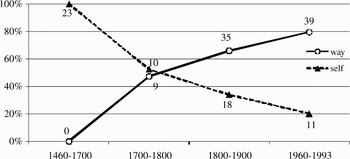
Figure 2 presents the trajectories of change of both variant constructions for the verb wind—wind one's way vs. wind oneself. Here the quantitative effect is even more pronounced than for the aggregate of all 10 verbs shown in Figure 1. At the starting point of both curves, the way-construction is not used at all in the data; though with only 23 contexts for both variants for the first period, we can hardly claim that way was not yet an option. A crossover is again observable in the 18th century, when the way-construction has almost caught up with the reflexive. A steady rise in the use of wind one's way at the expense of wind oneself then leads to an 80% usage of the way-construction in the present-day English data.
Diachronic development of the competition between wind one's way vs. wind oneself (n = 144).

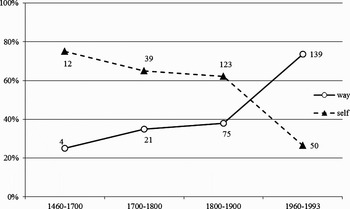
The second verb to be investigated in more detail is the verb work, whose trajectory of change is particularly interesting. Both the starting point and the endpoint of the replacement of self by way extend over the time span observed here. This is indicative of the long stretch of competition between both constructions. What is more, the crossover occurs somewhat later than for wind, for example, or the aggregate of all 10 verbs, which shows that for work, the alternation of both structures is still easily perceivable. Thus, it is not accidental that examples that jump to mind if we look for sentence pairs illustrating the variation between way and self often involve the verb work (cf. (1) and (2)). In present-day English, the way-construction has again almost reached the 80% level and is clearly the majority form today.
Diachronic development of the competition between work one's way vs. work oneself (n = 463).

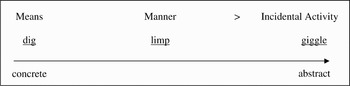
Semantic continuum of verbs entering the way-construction (based on Israel, Reference Israel and Goldberg1996).

An interesting case that requires explanation is the pattern for the verb grope. This verb exclusively takes way-constructions in my data (cf. Appendix). Note, however, that a sketch retrieval in a 1-billion-word megacorpusFootnote 12 yields 4 occurrences of grope with the reflexive (though not necessarily resultative), all of which have a sexual meaning (illustrated, for instance, by (11a) and (11b)), whereas (11c) illustrates an instance of grope plus reflexive with a nonsexual meaning from admittedly messy Internet data.
- (11)
a. Keith Moon shoots up and Mick Jagger gropes himself in banned sleazy video! (Guardian, 1998)
b. If the various characters aren't groping themselves or one another, they are vomiting and urinating…. (Los Angeles Times, 1996)
c. Most fighters—even some of the great ones—would have stayed down but Mayorga groped himself to his feet one last time. (SecondsOut)
This shows that grope does or did occur with reflexive self but is too rare to be found in the comparatively small databases available for the diachronic analysis. Given the fact that grope oneself is so rare that it does not show up in the corpora selected for the diachronic analysis, this verb at first sight appears unrevealing for the development of the competition between the two variant constructions. We will, however, see that this distribution results from semantic factors that systematically constrain the choice between the two variants. The remaining verbs were too scarce in some of the periods analyzed to merit a more detailed discussion.
It has become obvious that the historically earlier reflexive forms are increasingly being ousted by way-constructions, the newcomer to the paradigm.Footnote 13
QUALITATIVE CHANGES IN THE SYSTEM OF ENGLISH RESULTATIVES
In addition to the gradual ousting of reflexive self by the way-construction, we can also observe marked qualitative preferences in the distribution of way and self over time. This qualitative change is best described in terms of an emergent division of labor between both resultative constructions. Concrete uses are a domain of the way-construction, whereas abstract uses are more closely associated with the reflexive. This functional specialization and the successive replacement of self by way are argued to be brought about by a grammaticalization process affecting the way-construction.
The way-construction as an instance of grammaticalization
The present section discusses three aspects that point toward an analysis of the way-construction in terms of grammaticalization theory: the lack of number opposition, semantic bleaching of the noun way, and a transition from concrete to abstract meanings.
Lack of number marking
One of the typical features of grammaticalization (or lexicalization) that might apply to the way-construction is the loss of number marking. Such a development has, for instance, been reported for the take someone prisoner construction.
(12) They took them prisoner.
%They took them prisoners. (Berlage, Reference Berlage2006)
For this construction, number opposition has been on the decline since the late 19th and early 20th centuries, and it is rarely found in present-day English (cf. Berlage, Reference Berlage2006).
We know that present-day English way-constructions do not allow the plural form. Not a single instance was found in the 20th-century data investigated in this article:
- (13)
a. … nowadays, we eat our way into the fridge. (F-LOB)
b. *nowadays, we eat our ways into the fridge.
However, when we apply this criterion of number opposition to earlier way-constructions, we find that there is no straightforward way of showing that way-constructions had plural marking in the first place. Though earlier examples—at first glance—suggest that plural marking was originally used with way,
(14) … and laide them together as they found them, and went their waies merrily to the Rope-makers house, … (Thomas Dekker, The Ravevens Almanacke, 1609)
this argument is considerably weakened by two factors. First, the -s morpheme need not be a plural marker but might instead serve as singular genitive inflection. The OED (entry: ways 23 b.) mentions that in “… the later period a loose use of the plural may have coalesced with the use of the advb. [adverbial] genitive,” so that ways can be used as genitive singular parallel to German (Er ging seines Weges). This would explain why the singular subject in the following example is also accompanied by the -s inflection.
(15) Thus Margaret in a melancholy humor went her waies, and in short time after she forsooke Westminster, & attended on the Kings army to Bullin, …. (Thomas Deloney, The Gentle Craft, 1639)
Secondly, the plural was not as consistently marked in earlier stages of English as it is today. As it thus remains unclear if way-constructions used to have plural marking, we can merely attest a lack—but not a loss—of plural marking with way-constructions. We therefore move on to other, more reliable criteria favoring an analysis of the way-construction in terms of grammaticalization.
Semantic bleaching of way
In the earliest uses of way-constructions, the noun way still encoded a highly concrete notion of way: a path that is a tangible and visible stretch of matter (e.g., grass, mud, gravel) that you could tread on and that was either created or generally used in order to move from one location to another. According to Israel (Reference Israel and Goldberg1996:221), the verbs used with early way-constructions were often high-frequency motion verbs, such as go, ride, run.
(16) I … only replied, I shall, if it please your Worship, and so left him, and went my ways to the next Alehouse, …. (Richard Head & Francis Kirkman, The English Rogue, Part 2, 1668)
By contrast, in more recent way-constructions, way has assumed new meanings. This functional extension goes hand in hand with a bleaching of the original meaning of way.
- (17)
a. …, while I snored my way into a hangover. (F-LOB)
b. …: he can't, on current performance, organise his way out of a bag of popcorn. (Guardian, 1994)
c. …, Seles became the youngest top-ranked tennis pro in history and grunted her way to seven of the first 13 Grand Slam events she entered. (Guardian, 1994)
The noun way in example (17a) no longer refers to a tangible or visible stretch of matter but is instead understood as a stretch of time. Similarly, in (17b), the subject referent is not meant to organize any kind of way in the literal sense. And Seles in (17c) does not grunt while moving from one tennis court to the next, but the way referred to is metaphorical.
Related to this aspect are Tenny's (1994:194) and Goldberg's (1995:205) observations that the way-construction in present-day English hardly ever occurs with so-called “vanilla motion” verbs, that is, high-frequency monomorphemic verbs expressing motion, such as go, walk, run.
The his/her way construction on the other hand, is entered into by verbs which do not include an element of motion in their meaning, as the construction itself adds that element to produce a path-object verb. (Tenny, Reference Tenny1994:194)
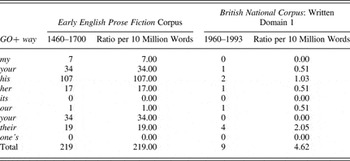
Though this claim appears somewhat too categorical,Footnote 14 a comparison of the prose fiction texts investigated here suggests that vanilla motion verbs, such as go, are scarce in present-day English way-constructions but were considerably more frequent in earlier stages of English (cf. Table 2). Table 2 shows that the ratio of occurrence of verb forms of go in way-constructions (e.g., went his way to the alehouse) amounted to 219 cases per 10 million words in an Early Modern English corpus as opposed to merely 4.6 cases per 10 million words in present-day English data.
Diachronic development of the frequency of way-constructions with the verb go

When the noun way was still understood in its primary sense, go was apt to express motion associated with moving on a stretch of gravel, grass, mud, and such. In present-day English, the meaning of way has been bleached so as to denote different kinds of transition. The motion meaning is—to some extent—expressed by the construction, which leaves the verb free to convey additional information. If the verb does not, as with vanilla motion verbs, it runs the risk of being regarded as redundant.
We can now turn to a third and most compelling argument in favor of analyzing the way-construction in terms of grammaticalization. This argument centers on the verbs that can enter the way-construction, and it involves a transition from concrete to abstract.
A transition from concrete to abstract meanings
A transition of way-constructions from denoting literal to figurative meanings has been described in Kirchner (Reference Kirchner1951). He provided examples for a historically earlier literal use meaning “to make, force one's way by means of the action of the verb” to a later figurative sense “to accompany one's advance by the specific action” (Kirchner, Reference Kirchner1951:155). Similarly, Israel (Reference Israel and Goldberg1996:217) pointed out that the way-construction emerged from three distinct early usages that developed by way of analogical extension: the “means thread,” the “manner thread,” and the “incidental activity” thread, illustrated in (18).Footnote 15
- (18)
a. Rasselas dug his way out of the Happy Valley.
Means of motion
b. The wounded soldiers limped their way across the field.
Manner of motion
c. Convulsed with laughter, she giggled her way up the stairs.
Incidental activity occurring while motion takes place (based on Israel, Reference Israel and Goldberg1996:218; emphasis mine)Footnote 16
Crucially, Israel (Reference Israel and Goldberg1996:225–226) is able to show that the way-construction has gradually extended its conceptual range over time. The earliest attestations of way-constructions represent means or manner readings: verbs of path creation (e.g., pave, smooth, cut, furrow out) denoting the means by which motion is achieved, or manner readings (e.g., limp, rush) that emphasized the manner of motion. Importantly, very much later, the incidental activity thread comes into play (cf. Israel, Reference Israel and Goldberg1996:224–225, and also Goldberg, Reference Goldberg1995:203).
Israel's (1996) analysis thus provides some indication that the way-construction first took a foothold with fairly concrete or primary senses of way. In its early stages, it is most frequently used with verbs implying that concrete movement from one location to another is involved. By contrast, secondary or metaphorically derived senses appear to have developed at somewhat later stages. This suggests that the way-construction became grammaticalized, thereby extending its scope of application to include an increasing number of verbs and verb senses.
As the range of predicates spread, increasingly abstract schemas could be extracted from them and this in turn drove the process of increasing productivity. (Israel, Reference Israel and Goldberg1996:227)
I have ordered Israel's (1996) threefold distinction along a grammaticalization cline of primary or concrete vs. secondary or abstract uses. The observation that the way-construction has successively extended its conceptual domains from highly concrete motion verbs to verbs that are only indirectly associated with directed motion calls for an analysis in terms of grammaticalization in the spirit of Hopper and Traugott (Reference Hopper and Traugott2003). This raises the question of whether there are also other aspects relating to its historical development that are generally regarded as features characterizing grammaticalization processes. We can thus derive the following hypothesis. If expansion of way is an instance of grammaticalization, then way should start out in concrete domains and gradually acquire more abstract domains.
The diachronic development of the competition between the way-construction and reflexive self according to semantic factors
In order to test the hypothesis that the way-construction is gradually extending its territory from concrete to abstract domains, we first need to devise a measure for defining concrete vs. abstract contexts.
Following Walker and Hulme (Reference Walker and Hulme1999:1258), concreteness is conceived of “as an index of how directly the referent of a word can be experienced by the senses.”Footnote 17 Gilhooly and Logie (Reference Gilhooly and Logie1980:396) discerned a considerable degree of unanimity in informants' rating of nouns as concrete or abstract. Whereas, for example, ball and ship are judged highly concrete, logic and conscience are rated as highly abstract. For the present investigation, the nouns contained in the prepositional phrase have been contrasted with respect to whether they denote concrete or abstract entities.Footnote 18
- (19)
a. He made his way back to the Jeep. (Brown)
concrete
b. … you can research your way into Shakespeare's truth. (F-LOB)
abstract
It is reasonable to assume that the concrete meaning of Jeep, for example, is more immediately accessible to the senses than the abstract noun truth.
The two competitors (way vs. self) and two varying semantic contexts (concrete vs. abstract) yield four possible combinations, each of which is attested in the data investigated.
- (20)
a. …, and the procession wound its way into the cemetery. way + concrete
b. She could see how he had worked his way into her aunt's affections.
way + abstract
c. It was large and green, and wound itself along the branch with reptilian patience. self + concrete
d. Alex worked himself into a crimson-faced rage and bit the… self + abstract
(all examples from BNC wridom1)
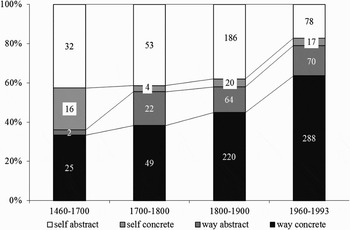
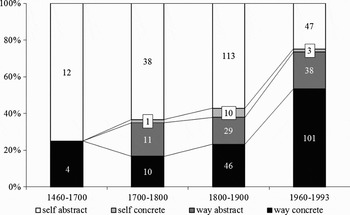
Figure 5 and Table 3 (see Appendix for individual verbs) depict the competition between the way-construction and reflexive self in concrete vs. abstract contexts. To be able to assess the reliability of the findings, each segment is additionally labeled with the actual number of occurrences. In 1460–1700, the way-construction has 25 occurrences with a concrete noun in the prepositional phrase and merely 2 with an abstract noun.
Concrete vs. abstract uses of one's way vs. oneself (n = 1,146).

Diachronic development of the competition between way vs. self (n = 1,146)

The way-construction consistently has a higher proportion of concrete rather than abstract uses throughout all four periods. By contrast, reflexive self scores consistently lower on concrete than on abstract meanings. This distribution is indicative of a division of labor. Concrete uses are a domain of way, but abstract ones are more closely associated with self. The emergent substitution of self by way is more advanced in the concrete domain. In particular with abstract meanings, self can still to some extent stand its ground. But even here it is continually declining in use.
Thus we are witnessing a gradual replacement of self by way, with way acquiring new domains that were formerly inaccessible to this variant. This is in line with an analysis along the lines of an emergent grammaticalization, in which way extends its range of application. The noun way is losing its semantic restriction to concrete entities that are easily accessible to the senses by being tangible and visible. The concomitant semantic bleaching allows it to expand its use into ever less concrete domains to become the majority form in present-day English.
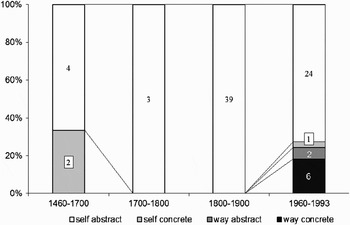
Theoretically, the pattern for all 10 verbs investigated could be brought about by a single verb in the data that was extremely frequent and hence can skew the results for the aggregate figures. We therefore also need to consider the patterns for individual verbs. The following section is restricted to those verbs that have at least eight occurrences of either the way-construction or reflexive self in the data, wind, work, and drink.Footnote 19 The pattern for grope has additionally been included here.Footnote 20
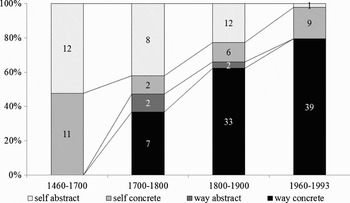
The pattern observed for the aggregate of all 10 verbs is matched by the distribution of the verb wind shown in Figure 6. The observed division of labor between way and self is well-discernible. As has been shown in Figure 2, in the earliest period investigated, the way-construction is not yet an option. Reflexive self is used in equal shares in the concrete and abstract domains. When way emerges in the second period, it displays a certain affinity toward concrete rather than abstract meanings. Conversely, self scores lower on concrete than on abstract meanings. Note, however, that the figures for wind also exhibit a quantitative difference regarding the overall occurrences in the abstract domain. Recessive abstract uses of wind are increasingly replaced by concrete ones, which leaves us with merely one instance of an abstract use in the present-day English data. This tendency holds for both way and self. In general, the pattern for wind parallels the aggregate figures for all 10 verbs in that concrete uses are more clearly associated with way, whereas abstract uses can—at least temporarily—serve as a refuge for self.
Concrete vs. Abstract uses of wind one's way vs. wind oneself (n = 144).

The verb work displays the by now familiar trend (cf. Figure 7). The main difference between work and the remaining verbs investigated here is that the emergent division of labor develops at a slower pace, possibly owing to its high frequency. The competition between both variants already existed in the 17th century and has still not been settled, though the observable trajectories of change warrant venturing the hypothesis that future developments will lead to an increased replacement of self by way. Again, we witness a gradual process in which way acquires new domains, whereas self can to some extent stand its ground with abstract uses.
Concrete vs. abstract uses of work one's way vs. work oneself (n = 463).

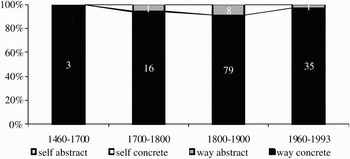
The verb drink also deserves our attention. At a total of 81 occurrences it does not provide a very stable pattern (cf. Figure 8). Drink one's way only emerges in the 20th century in my data. It appears to be a very recent acquisition of the way construction. The newcomer status of drink is presumably motivated by the fact that drink plus reflexive widely operates in abstract contexts, such as I drank myself into oblivion. Even though the substitution of self by way has almost been completed for wind and work, for example, other semantically restricted verbs such as drink lag a long way behind. The by now familiar pattern of way being more closely associated with concrete uses while self displays a proclivity toward abstract uses is again confirmed by the distribution of drink.
Concrete vs. abstract uses of drink one's way vs. drink oneself (n = 81).

Concrete vs. abstract uses of grope one's way vs. grope oneself (n = 143).

We have observed earlier that with the verb grope, the reflexive is not used at all in my data, though it does occur—but rarely—in larger corpora. We can now give a reason why this might be the case. A classification of the way-constructions with grope along the concrete-abstract distinction reveals that the way-construction has always been associated in the vast majority of cases with concrete rather than abstract meanings. Concrete meanings, however, are the domain of way-constructions rather than of reflexive self. Because self can only stand its ground in abstract uses, it has not been able to get a foothold in this verb's semantic domain. Hence the way-construction prevails throughout all periods. Another explanation can be formulated in terms of blocking: grope oneself might be blocked because of its sexual connotations.Footnote 21 Further research would be needed to decide which of the two factors is the dominant one. The OED describes the “indecent sense” of grope as obsolete (the latest entry being provided for 1664 in a nonreflexive use), but a corpus retrieval in a 1-billion-word megacorpus gleans 4 instances of grope immediately followed by the reflexive (cf. Qualitative Changes section). This shows that grope still occurs with self but that it is very rare.
What remains is the question of why the way-construction should display a proclivity toward occurring with concrete nouns while reflexive self is more closely associated with abstract meanings. There are two aspects that deserve attention. Firstly, the way-construction contains the originally concrete noun way that only by analogical extension came to be used with abstract meanings (cf. Israel, Reference Israel and Goldberg1996:225–226). Way might hence be more biased toward concrete uses.
Secondly, grammaticalization theory predicts that changes tend to be initiated in local contexts (cf. Hopper & Traugott, Reference Hopper and Traugott2003:2) and expand from there, for example, to other verbs (cf. also Israel, Reference Israel and Goldberg1996:227). We can thus expect that the more recent variant (way) will only gradually expand its uses to less prototypical, that is, metaphorically derived, abstract meanings and that in order to do so it first needs to be established in concrete domains.
CONCLUSIONS
The coexistence of way-constructions (e.g., She worked her way to the top) with semantically overlapping reflexive structures (e.g., She worked herself to the top) has eventually led to a reorganization within the system of English resultatives. Two diachronic and synchronic corpus-based studies tracing the trajectories of change of both variants reveal quantitative and qualitative changes.
The research findings concerning the quantitative changes involved clearly show that the way-construction is increasingly supplanting its historically earlier competitor self. During this replacement process reflexive self is being ousted by the way-construction, which tends to become the majority form around the 18th century. However, the exact time when the use of way outscores self varies for individual verbs.
As regards the qualitative changes characterizing the long-standing battle between the way-construction and its competitor self, the spread of the way-construction is accompanied by a split of the functions performed by each variant. This change culminates in a semantically motivated division of labor. The second question posed in the introduction addressing the issue of whether all uses of the two competitors are to the same degree affected by the reorganization can now be answered in the negative. The way-construction is particularly successful in expressing concrete meanings, whereas reflexive self is more clearly associated with abstract uses. Although in the long-run self is being ousted by way, self can in the short-run maintain itself in the abstract domain.
By taking a functional perspective toward the observable fluctuations in the system of resultatives, we are able to explain the gradual proliferation of the way-construction in terms of grammaticalization theory. Innovations tend to be initiated in local contexts (cf. Hopper & Traugott, Reference Hopper and Traugott2003:2) and expand to new semantic domains by metaphorical extension (cf. also Israel, Reference Israel and Goldberg1996:227). This is in line with the finding that the way-construction was first implemented with concrete meanings and only gradually acquired less prototypical, metaphorically derived, abstract contexts.
APPENDIX
Diachronic development of the competition between way vs. self (n = 1,146)