Increasing use of peripherally inserted central catheters (PICCs) has improved the care of hospitalized patients.Reference Meyer 1 PICCs are versatile central venous catheters that enable tasks such as short- or long-term intravenous therapies, chemotherapy, and invasive hemodynamic monitoring. However, growing use of PICCs has also led to the realization that they are not without attendant risks.Reference Chopra, Flanders and Saint 2 For example, central line–associated bloodstream infection (CLABSI) and deep vein thrombosis (DVT) are costly, morbid, and potentially lethal adverse events associated with these devices.Reference Ajenjo, Morley and Russo 3 – Reference Chopra, O’Horo, Rogers, Maki and Safdar 5 Balancing these risks against the benefits afforded by PICCs is central to ensure patient safety.
Several studies have linked the number of PICC lumens and corresponding size of the device (gauge) to subsequent complications.Reference Chopra, Ratz, Kuhn, Lopus, Chenoweth and Krein 6 – Reference O’Brien, Paquet, Lindsay and Valenti 9 Additionally, existing guidelines for device selection and placement recommend using the minimal number of device lumens to meet clinical needs. 10 – Reference O’Grady, Alexander and Burns 12 Consequently, some hospitals have enacted policies that limit use of multilumen PICCs in order to prevent PICC-related CLABSI and DVT. For instance, 1 hospital simply stopped purchasing multilumen 6-French (Fr) PICCs and experienced a 50% decrease in rates of upper-extremity DVT.Reference Evans, Sharp and Linford 13 Similarly, use of single-lumen PICCs in the absence of valid reason for a multilumen device resulted in substantial reductions in CLABSI and maintenance costs in another study.Reference O’Brien, Paquet, Lindsay and Valenti 9
Although encouraging, few hospitals have enacted policies to standardize PICC characteristics. Although clinician preferences regarding multilumen devices may explain this phenomenon,Reference Chopra, Kuhn and Coffey 14 , Reference Chopra, Kuhn, Flanders, Saint and Krein 15 uncertainty regarding clinical and economic benefits related to use of single-lumen PICCs might also attenuate change. To better quantify benefits, we performed a simulation-based study to examine the impact a single-lumen PICC policy might have on cost and patient outcomes.
METHODS
We developed a simulation model to determine the impact of a hospital policy that defaults to use of single-lumen PICCs and restricts use of multilumen devices to select clinical indications (ie, a “single lumen-default PICC policy”). Existing systematic reviews of the literature were used to estimate clinical benefits, risks, and costs related to single vs multilumen PICC use.Reference Chopra, Anand and Hickner 4 , Reference Chopra, O’Horo, Rogers, Maki and Safdar 5 , Reference Evans, Sharp and Linford 8 , Reference Evans, Sharp and Linford 13 For maintenance costs, we assumed each PICC would remain in place for at least 1 week and used published cost estimates from an existing study.Reference O’Brien, Paquet, Lindsay and Valenti 9 In order to standardize comparisons, we assumed that no difference in rates of complications related to insertion or maintenance exists between hospitals. Both direct medical costs (eg, medical expenditures resulting from a PICC-related complication) and indirect costs (eg, PICC acquisition and maintenance) were used in modeling.
To mirror real-world settings, baseline rates of single- and multilumen PICC use were set using data from the Hospital Medicine Safety Consortium (HMS), a Blue Cross Blue Shield of Michigan quality improvement project focused on improving PICC use in hospitalized patients. 16 To date, the project has collected data from more than 16,000 unique PICC placements in 51 Michigan hospitals, thus offering a unique view of PICC use and outcomes.Reference Chopra, Smith and Swaminathan 17
Model Variables
CLABSI Rate and Cost
PICC-related CLABSI rates were defined as the number of CLABSIs divided by the number of PICCs placed in an individual hospital. Existing literature suggests a wide range for rates of CLABSI associated with PICCs, varying from 5% to 10% for multilumen PICCs and from 2% to 5% for single-lumen PICCs.Reference Chopra, O’Horo, Rogers, Maki and Safdar 5 , Reference Chopra, Ratz, Kuhn, Lopus, Chenoweth and Krein 6 , Reference O’Brien, Paquet, Lindsay and Valenti 9 Real-world data from HMS suggest estimates that range from 3% to 5% for both types of devices.Reference Chopra, Bernstein and Kaatz 18 Therefore, we used a conservative CLABSI incidence estimate of 2% for single-lumen and 3% for multilumen PICCs. Corresponding costs for PICC-related CLABSI also vary across studies, ranging from $12,000 per episode to $68,000 per episodeReference Warren, Quadir, Hollenbeak, Elward, Cox and Fraser 19 , Reference Al-Rawajfah, Hewitt, Stetzer and Cheema 20 ; staying conservative, we assumed a mean cost of $12,000 for each CLABSI episode.
DVT Rate and Cost
As with CLABSI, PICC-DVT rates were calculated as the number of PICC-related DVTs divided by the number of PICCs placed. Available evidence suggests that rates of PICC-DVT are from 3% to 5% for multilumen PICCs vs from 1% to 2% for single-lumen devices.Reference Chopra, Ratz, Kuhn, Lopus, Lee and Krein 7 , Reference Evans, Sharp and Linford 8 , Reference Evans, Sharp and Linford 13 Correspondingly, our simulation model was estimated using DVT rates of 2% and 3% for single- and multilumen PICCs, respectively. Although few precise estimates exist, PICC-related DVT costs are estimated at $16,000 per incident.Reference Evans, Sharp and Linford 13 Using a conservative lens and incorporating estimates from the Agency for Healthcare Quality and Research, we used an estimate of $10,000 per DVT episode. 21
Baseline Prevalence and Costs of PICC Acquisition and Maintenance
We extrapolated data from our ongoing HMS PICC project to accurately portray the prevalence of single- vs multilumen PICCs in hospital practice. Data from more than 16,000 PICCs in this study suggest that the prevalence of single-lumen PICCs in HMS is approximately 25% across all hospitals, with 1 in 5 facilities reaching 50% use.Reference Chopra, Bernstein and Kaatz 18 Additionally, a recent study reported that only 50% of patients receiving PICCs have a clinical indication for a multilumen device.Reference O’Brien, Paquet, Lindsay and Valenti 9 Using these data, we modeled our simulation so as to assume baseline single-lumen PICC use of 25% and a targeted rate of 50%.
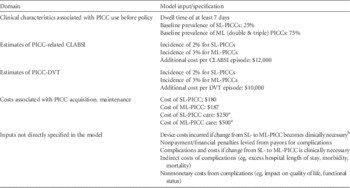
Internal financial data were used to estimate acquisition costs of 4-Fr single-lumen PICCs and 5-Fr multilumen PICCs ($180 and $187, respectively). 22 Costs for PICC care and maintenance (eg, flushes, dressing changes, nursing time, and device care) were obtained from both internal financial data and an existing study,Reference O’Brien, Paquet, Lindsay and Valenti 9 , 22 and were set at a constant $250 and $500 for single- and multilumen PICCs, respectively. Model assumptions and inputs are displayed in Table 1.
Model Inputs Underlying Simulation Analysis

NOTE. CLABSI, central line–associated bloodstream infection; DVT, deep vein thrombosis; ML, multilumen; PICC, peripherally inserted central catheter; SL, single lumen.
a Cost of PICC care for single and multilumen devices reflects costs associated with nursing time (flushes, dressing changes, device care and trouble-shooting) for 7 hospital days.
b Although direct costs were not estimated, diminished savings from an SL-PICC policy were described.
The Simulation Model
Our simulation was implemented at the patient level but summarized using the hospital perspective. Before the implementation of the single-lumen default PICC policy and in keeping with existing HMS data, we assigned patients a single-lumen PICC 25% of the time. PICC acquisition and maintenance costs were assigned on the basis of type of PICC received by the patient. CLABSI and DVT events were then assigned on the basis of previously described complication rates for CLABSI and DVT by PICC type.
Although costs associated with CLABSI or DVT were derived from available literature,Reference Warren, Quadir, Hollenbeak, Elward, Cox and Fraser 19 , Reference Butler, Olsen and Merz 23 , Reference Shannon, Patel, Cummins, Shannon, Ganguli and Lu 24 no studies explicitly report distribution of such costs. Therefore, we applied an inverse Gaussian distribution to generate confidence intervals around published mean cost data, an approach that not only is acceptedReference Moran, Solomon, Peisach and Martin 25 but also yields more conservative estimates of cost distribution than a constant parameter. Costs associated with PICC-related CLABSI were therefore set as a mean of $12,000 (interquartile range, $7,660-$13,710) whereas PICC-DVT costs were set as a mean of $10,000 (interquartile range, $6,900-$11,230).Reference Warren, Quadir, Hollenbeak, Elward, Cox and Fraser 19 , Reference Butler, Olsen and Merz 23 , Reference Shannon, Patel, Cummins, Shannon, Ganguli and Lu 24 If no complication was experienced in the simulation, a cost of $0 was assigned to the patient. The total number of CLABSI and DVT events and associated costs were summed over all patients to report totals at the hospital level.
The simulation was repeated under the assumption that a policy mandating use of single-lumen PICCs in the absence of rationale for a multilumen device was introduced at each hospital. To estimate cost savings attributable to the default single-lumen PICC policy, we simulated the data as if patients who received PICCs were identical before and after policy enactment. In this manner, cost savings realized were attributable directly to changes in device, rather than potential differences in patient characteristics. Thus, after the policy, the simulation was re-run keeping all parameters constant with the exception that single-lumen PICCs were assigned to patients 50% of the time. Attributable event and cost savings were determined by subtracting totals following the single-lumen default PICC policy from totals prior to policy enactment; positive results thus indicated event and cost savings whereas negative results indicated financial loss. Mean savings along with 95% confidence intervals (CIs) were reported for each event and cost. Total cost savings were computed by summing differences in maintenance, CLABSI, and DVT costs before vs after policy implementation. To account for varying use of PICCs across hospitals, we repeated simulations assuming 100, 300, 500, 1,000, 2,000, or 3,000 PICCs placed per year. To ensure reliability of the data, all simulations were run with 1,000 iterations.
Sensitivity Analysis
Multiway sensitivity analyses allowing the risk of CLABSI to vary from 1% to 3% for single-lumen and from 2% to 4% in multilumen PICCs were performed. Similarly, we allowed the risk of DVT to vary from 0.5% to 2.5% in single-lumen and from 3% to 6% in multilumen PICCs to assess impact on cost and outcomes. We also kept the postpolicy single-lumen PICC percentage at 50% but allowed the prepolicy percentage to vary from 10% to 45%. Model inputs were varied simultaneously to test all possible combinations assuming placement of 1,000 PICCs.
RESULTS
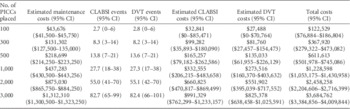
We began by estimating baseline costs associated with placement, maintenance, and treatment of PICC complications prior to the single-lumen default PICC policy. On the basis of HMS data, we set the prevalence of single and multilumen PICCs to be 25% and 50% at each hospital, respectively, with corresponding costs for maintenance and complications (Table 2). The simulation using these data showed that smaller hospitals that may place only 100 PICCs per year experience average PICC-related costs of $122,529 (95% CI, $76,884–$186,804) annually. Conversely, hospitals that place 3,000 PICCs experience annual PICC-related costs of $3,684,762 (95% CI, $3,384,856–$4,009,844). A midsize hospital (or one that places 1,000 PICCs per year) would expect annual PICC-related costs of $1,228,598 (95% CI, $1,053,175–$1,430,958) (Table 2).
Baseline Estimates of Costs Associated With Peripherally Inserted Central Catheter (PICC) Use

NOTE. Baseline costs were calculated using the following assumptions: prevalence of single lumen PICCs=25%; prevalence of multilumen PICCs=50%; costs associated with care, maintenance, and management of complications were fixed and constant. CLABSI, central line–associated bloodstream infection; DVT, deep vein thrombosis.
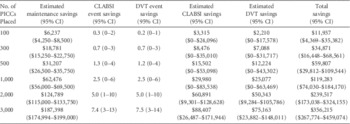
Next, cost savings associated with introduction of a single-lumen default PICC lumen policy were estimated. For hospitals that place at least 1,000 PICCs per year, every 5% increase in single-lumen PICC use was estimated to save 0.5 PICC-related CLABSIs or $6,000; 0.5 PICC-related DVTs or $5,000; and $12,500 in maintenance costs. Therefore, hospitals that place at least 1,000 PICCs per year would save an estimated $23,500 on complication and maintenance costs for each 5% increase in single-lumen PICC use. In hospitals where baseline single-lumen PICC use is 25%, introduction of the single-lumen default policy and resultant shift in use of this device from 25% to 50% would result in a savings of 2.5 PICC-related CLABSIs (95% CI, 0–6, attributable cost savings $29,980 [95% CI, $0-$83,538]) and 2.5 PICC-related DVTs (95% CI, 0–6, attributable cost savings $25,077 [95% CI, $0-$63,469]). Thus, shifts in single-lumen prevalence from 25% to 50% in hospitals that place at least 1,000 PICCs per year would result in an annual savings of $119,283 (95% CI, $74,030-$184,170).
Because hospital costs related to maintenance and complications of PICCs vary by the number of insertions, we estimated simulation-based cost savings over a range of PICC use (Table 3). These estimates showed that regardless of the number of PICCs placed, expected hospital cost savings of a single-lumen default PICC policy is approximately 10%. Thus, hospitals that place only 100 PICCs in a year would experience estimated cost savings of $11,937 (95% CI, $4,369–35,382). Conversely, larger facilities that place 3,000 PICCs would experience greater savings of $356,215 (95% CI, $267,774-$459,074).
Cost and Event-Savings Associated With Introduction of Single-Lumen Peripherally Inserted Central Catheter (PICC) Policy (Stratified by No. of PICCs Placed)

NOTE. CLABSI, central line–associated bloodstream infection; DVT, deep vein thrombosis.
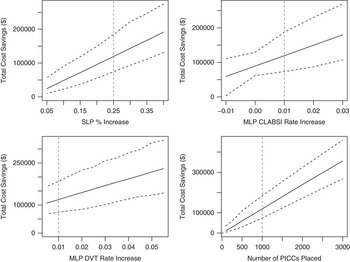
Recognizing that baseline use, risk of adverse events, and cost are not necessarily fixed or predictable, we varied conditions to test the stability of our findings (Figure 1). First, we allowed the baseline percentage of single-lumen PICCs and probabilities of developing a CLABSI or DVT with a single- versus multilumen PICC to vary. Holding all else constant, a 5% increase in single-lumen PICC use in this setting was estimated to save a total of $23,500 at hospitals that place 1,000 PICCs per year, whereas a 40% increase yielded a savings of $188,000. Second, we varied the risk of CLABSI between single- and multilumen devices to determine impact on cost. Were there actually a 1% increase in CLABSI rates between single- and multilumen PICCs as opposed to our proposed 1% decrease, a total savings of $57,500 would be expected. However, if the risk of infection with multilumen PICCs were greater than the anticipated (e.g., 2% decrease), savings of $147,500 would be expected. Similarly for DVT, we would expect a cost savings of $105,000 if only a 0.5% difference in rate of DVT between single and multilumen PICCs exists; were the difference 5.5%, savings of $230,000 would be expected.
Cost savings associated with varying device, cost, or complication data. CLABSI, central line–associated bloodstream infection; DVT, deep vein thrombosis; MLP, multilumen peripherally inserted central catheter; PICC, peripherally inserted central catheter; SLP, single-lumen peripherally inserted central catheter. SLP% increase means percent increase of SLPs after the implementation of an SLP default policy. MLP CLABSI rate increase means the increase in CLABSI infection rate for MLPs compared with SLPs; MLP DVT rate increase means the increase in DVT rate for MLPs compared with SLPs; the no. of PICCs placed means the no. of PICCs placed in the hospital in a year. On each graph, the vertical dashed line represents the base case scenario whereas the solid line represents the mean cost savings over the range of plotted values. The corresponding dashed lines represent the 95% CIs for mean cost savings.

Sensitivity Analyses
We performed multiway sensitivity varying more than one parameter (eg, prevalence of single-lumen PICC use, risk and cost of complications) to understand how such changes may influence our findings. Under these conditions at a hospital that places 1,000 PICCs per year, the minimum savings estimated with the introduction of a single lumen-default policy under all scenarios was $9,381, corresponding to a 5% increase in single-lumen PICC use, 1% greater risk of CLABSI, and 0.5% lower risk of DVT for single-lumen PICCs. The greatest savings observed was $466,431, corresponding to a 40% increase in single-lumen PICC use, 3% lower risk of CLABSI, and 5.5% lower risk of DVT. The median savings among all possible combinations of the input variables was $139,775.
It is possible that some patients who receive single-lumen PICCs may subsequently require a multilumen device, incurring additional cost and complications. Assuming 5% of patients who receive single-lumen devices may require this change, savings in maintenance, CLABSI, and DVT cost would diminish by an estimated $4,675 (per 1,000 PICCs). Assuming 20% of patients who receive single-lumen devices require this change, estimated savings would diminish by $18,700.
DISCUSSION
Extending the results of existing studies and available evidence, our simulation-based analysis quantifies the amount by which policies aimed at increasing single-lumen PICC prevalence would decrease complications and cost. Under a number of scenarios, we observed that increased single-lumen PICC use resulted in decreased adverse events as well as cost savings. Even with minimal differences in event rates, greater use of single-lumen PICCs yielded cost and event savings compared with multilumen devices. To frame results in a broader perspective, there are approximately 5,000 community and academic hospitals in the United States. 26 If 30% of these hospitals adopted a single lumen PICC-default policy (assuming an average 25% single-lumen PICC use and 1,000 PICCs placed) it would take 5.6 years for $1 billion to be saved across the nation with this change alone. Importantly, these estimates do not take into account penalties related to hospital-acquired conditions, of which both CLABSI and VTE are principal. Our findings thus have important policy implications because they illustrate how considerable safety and savings may be gained through relatively simple approaches.
Our results quantifying the benefits of single-lumen PICCs directly reflect available evidence that supports associations between the number of PICC lumens and CLABSIReference Ajenjo, Morley and Russo 3 , Reference Chopra, O’Horo, Rogers, Maki and Safdar 5 , Reference Chopra, Ratz, Kuhn, Lopus, Chenoweth and Krein 6 as well as PICC size and DVT.Reference Chopra, Ratz, Kuhn, Lopus, Lee and Krein 7 , Reference Evans, Sharp and Linford 8 , Reference Evans, Sharp and Linford 13 The number of PICC lumens is thought to directly increase risk of infections because more routes for access to the bloodstream are provided,Reference Baxi, Shuman and Scipione 27 an observation that echoes evidence from an earlier era and traditional central venous catheters.Reference Yeung, May and Hughes 28 , Reference Hilton, Haslett, Borenstein, Tucci, Isenberg and Singer 29 More frequent access and manipulation of available lumens in hospitalized patients might also increase the risk of endoluminal transmission of infection.Reference Safdar and Maki 30 An increase in the number of PICC lumens also results in greater gauge, a factor independently associated with risk of DVT.Reference Nifong and McDevitt 31 Conversely, smaller-gauge PICCs occupy less cross-sectional venous area thus allowing greater blood flow around the catheter, substantially reducing this risk.Reference Chopra, Fallouh and McGuirk 32
Importantly, some studies have reported savings from the introduction of device-specific policies. For instance, O’Brien and colleaguesReference O’Brien, Paquet, Lindsay and Valenti 9 reported a CA $1.1 million (Canadian dollar) savings over a 2-year period following the institution of a single-lumen PICC policy. Of note, these savings did not include those from reduction in complications and were based solely on maintenance and insertion/reinsertion costs. Similarly, Evans et alReference Evans, Sharp and Linford 8 substituted use of larger-gauge multilumen PICCs for smaller caliber devices and showed significant decrease in rates of PICC-associated DVT (3.0% vs 1.9%; P=.04). Savings from PICC-associated DVT attributable to this policy was estimated at $16,000, well illustrating the economic benefit of this approach.Reference Evans, Sharp and Linford 13
Despite encouraging data, few hospitals have developed policies to regulate PICC characteristics. Multiple reasons may explain this inertia. First, clinicians may preferentially order multilumen PICCs because the availability of a “backup lumen” in the event one becomes occluded or to serve incompatible medications is alluring. However, medications can be separated in time for delivery through a single-lumen device just as flushing is effective in preventing device occlusion. Second, the association between device lumens and complications may not be well known to clinicians. In both a Michigan and a national survey, approximately 1 in 4 hospitalists were not aware of the association between device characteristics such as number of lumens, gauge, or PICC-tip position and risk of complications.Reference Chopra, Kuhn and Coffey 14 , Reference Chopra, Kuhn, Flanders, Saint and Krein 15 Thus, use of multilumen PICCs may not be informed by consideration of risks. Finally, no studies have examined both cost and clinical benefits across hospitals in a manner that would lend itself to informing policies. In this regard, our analysis fills a key gap in the available evidence.
Our study has limitations. First, we made a number of assumptions regarding the risk of complications and average catheter dwell time of 1 week; however, these estimates were informed by real-world data from HMS and existing evidence lending credence to our findings.Reference Evans, Sharp and Linford 13 , Reference Chopra, Bernstein and Kaatz 18 Second, measuring costs related to hospital-acquired complications is inherently difficult; although we used conservative estimates to offset bias, it is important to note that variations, and challenges in costing may affect our findings.Reference Graves 33 , Reference Merlo, Page, Ratcliffe, Halton and Graves 34 Third, we were unable to directly account for unintended consequences related to our policy, including clinically appropriate changes from single-lumen to multilumen devices that not only may incur additional device and care costs, but also may expose patients to harm from PICC reinsertion. Because such aspects may adversely affect patient safety, use of the Michigan Appropriateness Guide to Intravenous Catheters to improve clinical decision-making and tailor PICC policies may prove helpful.Reference Chopra, Flanders and Saint 11
Our study also has important strengths. First, to our knowledge, this is the first study to specifically examine the impact of policies targeting PICC characteristics on costs and complications. Our data suggest that a single-lumen default PICC policy would have far-reaching implications that would benefit patients, hospitals, and payers. Second, we used real-world data coupled with available evidence to inform assumptions regarding cost and outcomes. The use of these 2 converging sources of information is unique and lends strength and representativeness to our findings. Third, through inclusion of single- and multiway sensitivity analyses that vary baseline rates of use, risk of complications, and cost, our results should be applicable to most hospitals. Data from this simulation may thus help motivate hospital policymakers and purchasers to adopt these types of innovations.
In conclusion, we found that increasing use of single-lumen PICCs is associated with improved patient outcomes and cost savings. Although strategies that evaluate intended and unintended consequences of such approaches are necessary, rapid adoption of policies targeting device characteristics appears appropriate.
ACKNOWLEDGMENTS
Financial support. Agency for Healthcare Research and Quality (1-K08-HS022835-01 to V.C.); Blue Cross Blue Shield of Michigan and Blue Care Network (for data collection).
Potential conflicts of interest. All authors report no conflicts of interest relevant to this article.