Different men seek after happiness in different ways and by different means, and so make for themselves different modes of life and forms of government.
AristotleGood government obtains when those who are near are made happy, and those who are far off are attracted.’
ConfuciusFor millennia, philosophers have argued that humans exist in order to be happy, and that the search for happiness is the most fundamental goal of human existence (Hudson, Reference Hudson1996; Kingwell, Reference Kingwell2000; Lane, Reference Lane2000; Tefler, Reference Tefler1980). For example, Aristotle (1998) identified happiness as the chief and final good in his first book, Ethics, and wrote more than nine books inquiring into the nature of human happiness (Nussbaum, Reference Nussbaum2004; Vanier, Reference Vanier2002). Utilitarian philosopher Jeremy Bentham (Reference Bentham, Burns and Hart1996) claimed that government's primary purpose is to ensure the greatest amount of happiness for the greatest number of people. In the Declaration of Independence, Thomas Jefferson pronounced that all men possess an ‘unalienable’ right to the ‘the pursuit of happiness’. Among philosophers and many other thinkers, there is general agreement that happiness constitutes the greatest quality of human life.
Happiness, however, is a peculiarly difficult subject to frame and analyze (Haybron, Reference Haybron2000; see also Argyle, Reference Argyle1987; Chiang, Reference Chiang1996; Chu et al., Reference Chu2005; Diener, Reference Ed2000; Lu, Reference Lu2001; Park, Reference Park2005; Seligman, Reference Seligman2002; Wu, Reference Wu1992). Although everyone is sure that happiness is desirable, people disagree widely about what happiness is, and how it is achieved. Is happiness the same as peace of mind or a sense of contentment or satisfaction? Is it enjoyment and pleasure or fulfillment? Does happiness emanate from riches, fame, or power? Do the ingredients of happiness and its sources vary across the places and the ages in which people live? These are longstanding philosophical and empirical questions that people still argue about today. The present study represents a systematic attempt to deal with some of these questions from a cross-cultural perspective.
This paper is organized into nine sections. The section that follows immediately explicates the notion of happiness by reviewing the ways people often use the term to appraise the quality of their life experiences. The second section introduces the three fundamental accounts of happiness known in the philosophical literature, and proposes a conceptual framework for our comparative analysis of how the mass citizens of six culturally different countries experience happiness. The third section discusses the four key variables of subjective well-being included in our analyses, and describes how they are measured. The fourth section compares the levels of avowed happiness across the six countries, and identifies the most and least happy of these societies. In the next two sections, we ascertain the different patterns of living a happy life in terms of experiencing enjoyment, achievement, and satisfaction, and compare the demographic characteristics of those who experience it in multidimensional terms. In the seventh section, we identify the most and least essential components of happiness for each country, and compare those components across six countries. The eighth section tests the four models – economic, political, psychological, and sociological – social scientists have recently proposed to explain the experience of happiness. The final section summarizes key findings and discusses their implications.
The notion of happiness
From the Epicureans to contemporary social scientists, considerable confusion reigns regarding precisely what happiness means. Even in present English usage, ‘happiness’ carries numerous meanings, and thus frequently creates a semantic snare (Margolis, Reference Margolis1975). To clarify the substance of the concept, and establish grounds for its proper use in scholarly research, it is necessary to undertake a conceptual investigation of the philosophical and empirical literature on happiness, and in so doing distinguish the three main uses of the term ‘happy’ (Thomas, Reference Thomas1968).
The first use of the term refers to a feeling, which is usually of short duration. When Homer and Herodotus equated happiness with physical pleasure, and when Bradburn (Reference Bradburn1969) and Campbell (Reference Campbell1981) thought of it as an affective state of mind, they were referring to short-term moods of gaiety and elation, which is fundamentally different from the core meaning of satisfaction. Such happy feelings are often termed euphoria: the presence of pleasure and the absence of pain. Viewed from this perspective, happiness is a hedonistic concept.
A second use is one in which a person is ‘happy with’ or ‘happy about’ something, and these expressions mean ‘being satisfied with’ or ‘contented with’ the state of one's well being, and do not at all imply that one has any particular feeling. Referring to happiness in this way refers to more than emotional pleasantry (Biswas-Diener et al., Reference Biswas-Dienter, Diener and Tamir2004, 18); the word is used exclusively to describe the welfare aspect of a life experience, not its hedonistic aspect.
Thirdly, the term ‘happy’ is often used to characterize the quality of a whole human life rather than making a statement about a particular aspect of it as in the case of the second use (Beneditt, Reference Beneditt1974; Cameron, Reference Cameron1975; Lu, Reference Lu2001; Sumner, Reference Sumner1996). In this sense, when a person says that he is happy, he means that he has a happy life; one in which all of his objectives come together to form a harmonious and satisfying whole (Simpson, Reference Simpson1975). When one makes such a global or holistic judgment in the context of the concept of happiness, he takes into account various aspects of his conditions and circumstances, as well as how he feels about all of them. For this reason, the philosopher Austin (Reference Austin1968) concludes that a person's sense of happiness represents the highest assessment of his whole life.
Unlike the first two segmented views of happiness, which focus on either pleasure or fulfillment and welfare, this third conception of happiness includes the whole scope of human needs, desires, interests, tastes, and demands, and seeks to determine whether they constitute a harmonious whole. Fletcher (Reference Fletcher1975: 14) characterizes that whole as ‘a sensitive commixture of mind and feeling’ (see also Goldstein, Reference Goldstein1973). Believing that a mind without emotions is impoverished, and that emotion without mind is squalid, they integrate both into ‘happiness’. Unlike pleasure, therefore, happiness is neither episodic nor subject to momentary moods. Feelings of pleasure and pain can occur both in the context of a happy life, and in the context of an unhappy life. This distinction between feeling happy and being happy should be considered in systematic accounts of happiness (McCall, Reference McCall1975).
This important distinction and the value of happiness as a conceptual tool for assessing the whole life quality of people through their own appraisals have gained little appreciation in empirical research on the quality of life (Andrews and Withey, Reference Andrews and Withey1976; Campbell et al., Reference Campbell, Converse and Rodgers1976). Despite substantial and consistent evidence contrary to their claims, many well-known scholars have identified happiness merely with short-term moods of gaiety and elation. For example, Bradburn (Reference Bradburn1969: 63–68) viewed happiness as a product of positive feelings and absence of negative feelings, although his data explain only small portions of variations in happiness. Andrews and Withey (Reference Andrews and Withey1976) equated happiness with a preponderance of positive feelings over negative ones, despite the fact that their Affect Balance Scale tapping positive and negative feelings explains only 26% of the variance in self-reports on happiness among the American population. These research findings clearly suggest that happiness should not be equated with an experience of feeling or affect alone. Instead, it should be viewed as an overall assessment of a person's whole life, according to his or her own criteria.
Accounts of happiness
If happiness refers to an overall quality of life, the essential question remains: of what does happiness consist? Philosophers and social scientists have examined a variety of life experiences such as honor, virtue, material comfort, pleasure, and success in search for the constituents of happiness (Furnham and Cheng, Reference Furnham and Cheng2000; Veenhoven, Reference Veenhoven2000). Each of these components has its advocates and critics in the quest for the constituents of true happiness.
Von Wright (Reference Von Wright1963, 92–94) adumbrates three well-known accounts of the happy life. The first of these he calls the ‘Epicurean Ideals’. It holds that happiness consists in having (as opposed to doing) certain things that give one passive pleasure. For example, one might get pleasure from the enjoyment of beautiful paintings and good company. For that individual, happiness consists in enjoying life by having enough of these pleasure-producing things. The well-known Lockean idea that property is the foundation and means of happiness belongs to this hedonistic conception of happiness (Scharr, Reference Schaar1970).
The second ideal leading to a happy life is, according to von Wright, found in the writings of the utilitarian philosophers, who derived happiness from the satisfaction of desires. In such a view, happiness is essentially contentedness – equilibrium between needs and wants on the one hand and satisfaction on the other. The prompt satisfaction of needs produces happiness, while the persistence of unfulfilled needs causes unhappiness (Wilson, Reference Wilson1967). A person's happy life would be one in which as many as possible of his or her needs and desires are met.
A third account of the happy life, as revealed in the philosophical literature, sees happiness neither in passive pleasure, as in the possession of property, nor in the satisfaction of needs. This view, expressed in Aristotle's concept of eudaimonia, equates happiness with creative activity (McKeon, Reference McKeon1941: 1093–1112). Happiness derives from the fulfillment of one's capacities by doing what one enjoys. As Annas (Reference Annas2004) and Shaar (Reference Schaar1970) point out, happiness is a sense of achievement brought about by man's inner productiveness, and it is the accompaniment of all productive human activity.
Having considered all three of these philosophical accounts of happiness, we propose that the three positive life experiences of enjoyment, satisfaction, and achievement constitute the three main components of happiness. We also propose that these positive life experiences, by themselves or in combination, shape a person's overall judgment of happiness. Next, we will investigate which specific components are most and least essential to the experience of happiness in culturally different societies. In those societies, what particular combinations or mix of these life experiences accompany happiness most and least often? Do the answers to these questions vary across these societies? By addressing these questions, this study seeks to determine systematically whether culture matters in living a life of happiness.
Measurements
To test the conceptual model of happiness outlined across different cultures, we selected a set of four items from the latest wave of the AsiaBarometer (ASB) surveys. During the months of July and August 2008, these ASB surveys were conducted in the six countries, each of which represents a different culture in the East or the West. These countries are Japan, China, and India from the East, and the United States, Russia, and Australia from the West.
The first item of the set was intended to tap the extent to which people were experiencing happiness at the time of the survey. On the assumption that each individual is the best judge of his/her own state of happiness, the ASB surveys framed the item tapping happiness in such a way that respondents could make the distinction between feeling happy and being happy, and judge the state of their happiness in terms of their own conception of it.
Like other surveys, the ASB surveys asked respondents the straightforward question; ‘All things considered, would you say you are: (1) ‘very happy, (2) quite happy, (3) neither happy nor unhappy, (4) not too happy, or (5) very unhappy?’ This particular wording of the question enabled respondents to distinguish between being happy and feeling happy, and allowed them to make an appraisal of the overall situation of their existence. On the basis of the previous research finding that answers to this question are valid, and provide reliable estimates of happiness (Ng, Reference Ng1996), we took such self-reports as the basic dependent variable.
To tap the extent of life enjoyment, the ASB surveys asked: ‘How often do you feel you are really enjoying life these days – often, sometimes, rarely or never?’ To tap the extent of achievement in life, the same surveys asked: ‘How much do you feel you are achieving what you want out of your life – a great deal, some, very little or none?’ In these questions, enjoyment and achievement represent different qualities of a whole life. To measure satisfaction, the ABS asked respondents to evaluate their life as a whole on a 5-point verbal scale ranging from ‘very satisfied’ to ‘very dissatisfied’.
In every country, overwhelming majorities of over 90% were able to evaluate their subjective well being in terms of happiness, enjoyment, accomplishment, and satisfaction. Of the six countries surveyed, Russia registered the lowest response rate with 93%. In all five other countries, over 96% were capable of appraising their subjective well being from a global perspective. Among the four components chosen for our analysis, happiness registered the highest rate of responses in four of the six countries, while satisfaction registered the lowest rate of responses in five of the six countries. Only in Japan, accomplishment turned out to be the most difficult to judge. Despite these small differences, all six countries are alike in that very small proportions, ranging from 1 to 7%, were incapable of evaluating their happiness and the other feelings of well being we proposed as its constituents.
Levels of happiness
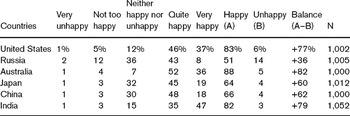
Of the six countries surveyed, which countries are the most and least happy? To address this question, Table 1 reports the distribution of survey responses across these five response categories ranging from ‘very happy’ to ‘very unhappy’. The table also reports the percentages expressing happiness and unhappiness and their balance. In all six countries, happy people constitute majorities ranging from 51% to 88%, while unhappy people constitute very small minorities ranging from 3% to 14%. In all these countries, moreover, very unhappy people constitute minorities of 1% or 2%.
Self-assessments of happiness

Source: 2008 AsiaBarometer Surveys.
Despite these similarities, there are notable cross-national differences in the extent to which people experience happiness or unhappiness. For example, the percentages of people rating their lives as ‘very happy’ vary by 39 percentage points from 8% in Russia, to 47% in India. The percentages reporting happiness (‘very happy’ or ‘quite happy’) also vary considerably by 37 percentage points, from 51% in Russia, to 88% in Australia (see Figure 1). Even the proportions reporting unhappiness vary by 11 percentage points, from 3% in India, to 14% in Russia. In short, ratings of both happiness and unhappiness vary considerably across the countries.
Cross-national differences in levels of happiness and unhappiness

To portray a balanced picture of experiencing happiness in each country, therefore, we need to consider together negative and positive ratings. The percentage differential index (PDI) scores reported in Table 1 provide such a picture by measuring the extent to which either negative or positive ratings outweigh the other. According to these index scores, Australia is the happiest nation with +82%. This country is followed by India (+79%); the US (+77%); China (+62%); Japan, (+60%); and Russia (+36%), in that order. Of the six countries, Russia emerges as the least happy nation by registering the lowest level of happiness, while registering the highest level of unhappiness. Australia emerges as the happiest nation with the highest percentage (88%) of people rating their lives ‘quite happy’ or ‘very happy’. Australia, however, is not the country with the highest percentage of ‘very happy’ people. They are most numerous in India, the poorest of the six countries surveyed. This finding runs counter to the claim that money buys happiness.
Conceptions of happiness: types and consequences
Reviewing the philosophical literature on happiness, we have identified its three key components: the enjoyment of life, the achievement of goals, and the satisfaction of basic needs. Do contemporary publics equate happiness with the experience of only one or two components? Or do they equate it with the presence of all three components? If they do, which ones form the most and least popular conceptions of happiness among the popular masses of six different countries? In this section, we explore these questions by linking the experience of happiness to that of enjoyment, achievement, and satisfaction in isolation and in combination.
Specifically, among those who judged their lives as happy, we calculated the percentages experiencing only one component, two components, or all three components of enjoyment, achievement, and satisfaction. We also calculated those experiencing none of these components. Comparing these percentages, we found that they fall into four different categories of experiences,Footnote 1 and we then attempted to ascertain the most and least popular conceptions of happiness in each country.
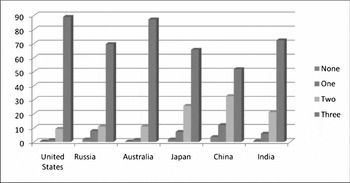
One notable feature of the data reported in Figure 2 concerns being unable to live a happy life without experiencing any of the three proposed components – enjoyment, accomplishing, and satisfaction. In all six countries, very small minorities claimed happiness without experiencing at least one of these positive life experiences. In three countries including the US (0.4%), Australia (0.3%), and India (0.6%), these minorities account for less than 1% of the population. In Russia (1.7%), Japan (1.7%), and China (3.5%), they also form small minorities of less than 5%. To overwhelming majorities of the mass citizenries in the six countries, therefore, enjoyment, accomplishment, and satisfaction do seem to constitute the three essential components of happiness.
Patterns of experiencing happiness in terms of enjoyment, achievement, and satisfaction

Nonetheless, a careful review of the data reported in Figure 2 indicates that not any one of these three components alone allows many people to live a happy life in all six countries. When all these countries are considered together, one out of 18 (5.5%) people reports happiness, while experiencing only one of the three components. In two countries, the US and Australia, the figures are even smaller, 1.3% and 1.5%, respectively. In other countries, they range from 7% in Japan to 12% in China. Thus, with respect to large majorities, ranging from 88% to 98% of the mass publics surveyed, happiness constitutes a multi-faceted phenomenon with more than one characteristic.
In two countries, the US and Australia, large majorities of 89% and 87% of those who report happiness experienced all three components of enjoyment, achievement, and satisfaction. In the four other societies, smaller majorities ranging from 52% to 72% report happiness, while experiencing all three components. When all six countries are considered together, those living a happy life with all three components are over three times as many as those living such a life with two components (74% vs. 19%). They are over twelve times as many as those living it with only one component (74% vs. 6%). Regardless of the place or culture in which people live, it is clear that most people experience happiness in multidimensional terms.
Nonetheless, multidimensional conceptions of happiness vary considerably across the countries surveyed. Those are most prevalent in the US and Australia, two English-speaking Western nations, and least prevalent in China and Japan, two countries in Confucian Asia. In these two Confucian countries, those reporting living a happy life with experiencing only one or two components of well-being, constitute substantial minorities ranging from 33% in Japan, to 45% in China. The corresponding figures for the two Western countries are 11% for the US, and 13% for Australia. When these two sets of figures are compared, it is apparent that culture matters in the experience of happiness; people in Confucian Asia are less likely to experience happiness as a multidimensional phenomenon than their peers in the West (Lu and Gilmore, Reference Lu and Gilmour2004).
Does the way in which people experience happiness affect their level of happiness? Would the incidence of experiencing all three dimensions of happiness correspond to happier lives than for those experiencing fewer dimensions? In Figure 3, we explore this question by linking the experience of a ‘very happy’ life to differing dimensional conceptions. In every country, those living ‘very happy’ lives are most numerous in the multidimensional category and least numerous in the unidimensional category. In every country, the difference between these two categories exceeds by more than 10 percentage points in favor of the former. In the United States, multidimensional conceivers are over 20 times more likely to be very happy with their lives than unidimensional conceivers (44% vs. 2%). The differences between multi- and bi-dimensional conceivers also range from 9 percentage points in China to 23 percentage points in the US In all countries, moreover, increases in the number of dimensions from one to three always bring about significantly higher proportions of the very happy. These findings indicate that multidimensional conceivers live very happy lives in a significantly higher proportion regardless of the different types of political and economic systems in which they live.
Patterns of experiencing happiness and being very happy

Nonetheless, a careful scrutiny of the data in Figure 3 indicates cultural differences in the way multidimensional conceptions affect the unqualified experience of happiness. In the US, Australia, and India, for example, multidimensional conceivers lead two-dimensional conceivers in reporting unqualified happiness by very large margins of over 20 percentage points. In Russia, Japan and China, on the other hand, the former lead the latter by much smaller margins of less than 15 percentage points. This seems to suggest that multiple conceptions are less instrumental in promoting a life of unqualified happiness in Confucian Asia than in the English-speaking West.
The demographics of multidimensional conceptions
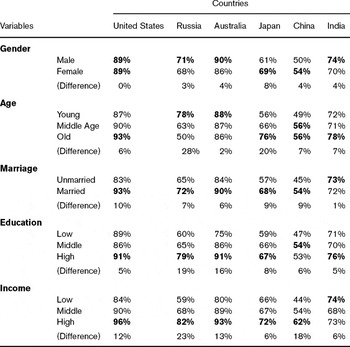
Why do some people experience happiness in multidimensional terms while others do not? Do demographic characteristics affect the way people experience happiness? In Table 2, we explore this question by comparing multidimensional conceivers across the categories of five demographic characteristics, including gender, marriage, age, education, and family income. The table shows what percentage of happy people in each demographic group report experiencing all three components of happiness.
Multidimensional conceptions of happiness among population

Source: 2008 AsiaBarometer Surveys.
Of the five characteristics listed in Table 2, only gender is, by and large, of little consequence. Yet, the table shows three contrasting patterns of its relationship with the multidimensional conceptions of happiness. In the US, males and females are identical in such conceptions. In Russia, Australia, and India, multidimensional conceivers are more numerous among males than females. In China and Japan, in contrast, they are more numerous among females than males. This finding differentiates Confucian culture from Western and other cultures.
Age matters much more than gender in experiencing happiness in multidimensional terms. In four countries, age associates positively with a three-dimensional conception. In the US, Japan, China, and India, age accompanies, by and large, increasing multidimensionality in the conception of happiness. In these societies, multidimensional happiness is most commonplace among people in their 60s and older. In Russia, in striking contrast, they are most numerous among people in their 20s and 30s. In Austria, however, there is little difference across the three age groups.
Like age, marital status matters considerably in five countries. Those who married are multidimensional in their happiness conceptions to a significantly greater proportion than their unmarried counterparts. In the US, China, and Japan, the former outnumber the latter by as much as 10 percentage points. Only in India, is there virtually no difference between the married and unmarried. Why is it that only in India, married people maintain the same perspective on happiness, while many of their counterparts in other countries adopt a new multidimensional perspective on it? This remains a mystery.
Education also matters considerably in most societies. In only three countries including Russia, Australia, and Japan, do higher levels of education always accompany higher proportions of multidimensional conceivers. In the case of Australia, 19% more of the college-educated than from those with little or no education are multidimensional conceivers. In the US and India, the least educated are not least multidimensional. In China, on the other hand, the most educated are not most multidimensional. On the whole, education does not consistently shape multidimensional conceptions.
Of all the five demographic variables considered, income matters most in motivating people to view happiness as a three-dimensional phenomenon. When the six countries are considered together, the proportions of multidimensional conceivers steadily rise from 71% of low-income people, through 75% of middle-income people, to 80% of high-income people. In five countries, omitting India, more income is always associated with more multidimensional conceivers. Of these five countries, income effect is more pronounced in Russia and China, and least pronounced in Japan. Only in India, does income matter little.
When all these findings are considered together, it is evident that each of the five demographic characteristics does not similarly shape the multidimensional conceptions of happiness in every country. In some countries, they contribute to those conceptions, while detracting from those in other countries. Of the five characteristics, however, marriage and income are the two most pervasive and consistent promoters of multidimensional conceptions.
The essentiality of components
In all six countries, we have found that enjoyment of life, the achievement of goals, and the satisfaction of basic needs do constitute the three essential components of a happy life. Of these three components, which is most essential to living a happy life? Do the six countries agree or disagree regarding the most essential component of happiness? We examined these questions by estimating and comparing the percentage of people becoming happy with the experience of each component, when the effects of the other two components are statistically controlled for. We calculated this percentage by means of the Multiple Classification Analysis (MCA), which is capable of estimating the value of the dependent variable for each category of the independent variable, controlling for all other independent and control variables (Andrews et al., Reference Andrews1973).
Figure 4 reports a great deal of cross-national variation in the extent to which each of the three components contributes to happiness independent of the other two. In Russia, for instance, there is only a 5-percentage point difference between the highest and lowest of the ratings of the three components. This means that all three components are almost equally essential to a happy life in that country. In striking contrast, in Australia and China, the difference between the two extreme ratings is over 30 percentage points. In these two countries, enjoyment contributes to happiness significantly more than the achievement of life goals.
The extent to which each of three components make people happy independently

Careful scrutiny of the percentages reported in Figure 4 and the beta coefficients reported in Figure 5 also reveals four patterns of valuations. In the richest countries on earth – the US and Japan, life satisfaction and goal achievement are rated, respectively, as the most and least essential components. In Australia and China, on the other hand, enjoyment is the most essential, and goal achievement the least essential. In Russia and India, in contrast, achievement was the most essential component, but they differ on the least essential component: enjoyment for the former and life satisfaction for the latter. On the whole, patterns in the six countries disagree more on the most essential component than on the least essential one. While each component is the most essential component in two different countries, goal achievement is the least important in four out of the six countries – the US, Australia, Japan, and China.
Predicting happiness in terms of enjoyment, achievement, and satisfaction: MCA estimates of beta coefficients

Sources of happiness
What makes people live a happy life? Social scientists have recently offered a variety of answers to this question (Easterlin, Reference Easterlin2003; Furham and Cheng, 2001; Veenhoven, Reference Veenhoven2000; Wu, Reference Wu1992; Yang, Reference Yang2008). Economists, for example, have identified money and other financial capital as a force promoting a happy life (Cumins, Reference Robert2000; Frey and Stutzer, Reference Frey and Stutzer2002; Easterlin, Reference Easterlin2001, Reference Easterlin2003; Lane, Reference Lane1993). Sociologists have identified the human capital of knowledge and skills, and the social capital of family life and other interpersonal relationships as important sources of happiness (Christakis and Fowler, Reference Christakis and Fowler2008; Helliwell and Putnam, Reference Helliwell and Putnam2004; Lu and Shih, Reference Lu and Shih1997). Psychologists, on the other hand, have established that a person's relative assessment of his/her own life, as compared to that of others’ shapes perceptions of happiness (Diener et al., Reference Diener, Suh, Lucas and Smith1999; Campbell, Reference Campbell1981; Veenhoven, Reference Veenhoven1991). Religious thinkers have long emphasized spirituality as the key to happiness (Lama and Cutler, Reference Lama and Cutler1998; Twerski, Reference Twerski2007). More recently, political scientists have identified the expansion of free choice through democratization as a powerful promoter of happiness (Frey and Stutzer, Reference Frey and Stutzer2000; Inglehart and Klingemann, Reference Inglehart, Klingemann, Dinner and Suh2000; Inglehart et al., Reference Inglehart, Foa, Peterson and Welzel2008).
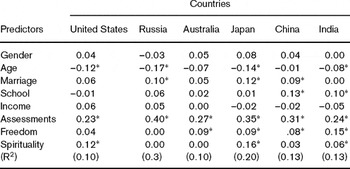
From previous research findings, we chose variables that represent each of the six known categories of influence upon happiness. They are family income, representing physical capital; educational attainment, representing human capital; marital status, representing social capital; the relative assessment of one's own standard of living, as a subjective assessment of life standing; the experience of freedom, representing democratization; and the practice of prayer or meditation, representing spirituality. We included gender and age in the ordinary least square analysis as control variables to estimate the net effects of the six independent variables on happiness as the dependent variable. For each of the six countries surveyed, Table 3 reports the regression coefficients (beta) and the coefficient of determination (R2) statistics from the OLS analyses.
Sources of happiness: OLS estimates

Notes: *Statistically significant at the 0.05 level.
Source: 2008 AsiaBarometer Surveys.
Of the six independent variables reported in the table, which ones contribute most and least to the experience of a happy life in each country? Do these variables differ across the societies? The beta coefficients reported in Table 3 reveal which independent variables are the most and least powerful influences on happiness. In every country, the most powerful variable was respondents’ assessments of their own standard of living compared to others. The rest of predictors, including the two control variables of gender and age, have much less explanatory power. This subjective assessment variable is the only predictor, whose coefficients are statistically significant in all six countries. In all those countries, moreover, the magnitudes of those coefficients exceed those of any other predictor considered, although their magnitudes vary considerably across countries. These findings, when considered together, indicate that interpersonal comparisons of one's standard of living are the most pervasive influence on perceptions of happiness across cultures. The findings also suggest that subjective assessments of the conditions of life shape the experience of a happy life more powerfully or directly than do objective life conditions.
A careful comparison of beta coefficients for those subjective assessments reveals that their magnitudes vary considerably across countries. The magnitude is highest in Russia with 0.39, and lowest in the US with 0.23. In the former, those assessments influence the experience of happiness over one-and-a-half times more powerfully in the latter. Why perceptions of one's own standard of living compared to others’ matter much more in Russia and Japan than in the US and India is an important question to be addressed in future research.
Of the remaining five other independent variables, only the experience of freedom significantly influences happiness in most countries. This variable, which taps the extent to which people are satisfied with the situations of human rights, including those to demonstrate and criticize the government (see Appendix for a list of these rights), is estimated to significantly affect happiness in four countries – Australia, Japan, China, and India. In all these countries, moreover, freedom is the second most powerful predictor behind the relative assessment of living standards.
Marriage is found to significantly shape happiness in three countries, Russia, Japan, and China. Spirituality as tapped in terms of the frequency of prayer or meditation is also found to be a significant influence on happiness in three countries – the US, Japan, and India – whose cultures are more dissimilar than similar. Education has a significant effect in China and India, the two socioeconomically least developed of the six countries surveyed. Family income, on the other hand, has no such effect in any of the six countries surveyed.
From the findings reported above, it is evident that the psychological model featuring the sense of relative achievement or deprivation is the most pervasive and powerful influence on happiness across countries, which are greatly different in types of cultures and political systems as well as levels of socioeconomic modernization. The economic model of financial resources is the least effective in accounting for happiness. This suggests that the expansion of goods and services alone cannot build a nation of happiness. The expansion of freedom thorough the democratization of authoritarian rule, on the other hand, is necessary for allowing people to live a life of happiness. Between economic prosperity and political freedom, the latter matters far more in building a nation of happiness.
Summary and conclusions
In every country and culture, it is common for people to desire to live lives of happiness. What constitutes a happy life? Do objective conditions of life or subjective assessments of those conditions determine their state of happiness? Do conceptions of happiness and its sources vary across culturally different societies? Utilizing the 2008 round of the ASB surveys conducted in the six countries scattered over four different continents, we sought to address these and other questions concerning how various segments of the societies’ populations understand and experience happiness.
To explore these questions, ones that have not been adequately addressed in previous research, we first placed the notion of happiness into the context of a person's whole life, and then allowed respondents to appraise their happiness according to their own criteria. Then we reviewed the philosophical literature to identify from it what are asserted to be the three essential components of happiness. With these resources, we analyzed the surveys to ascertain the particular components or mix of the components that most and least often lead to reports of a happy life among the ordinary citizens in the six countries. We also analyzed the surveys to compare the sources of avowed happiness across the six societies and within each one as well.
In all six countries, representing different cultures, happiness means much more than emotional pleasantry; it is a positive assessment of a whole life, the holistic judgment of life experiences that recognizes not only the enjoyment of living, but also the achievement of goals and/or the satisfaction of desires and needs. Yet feelings of enjoyment alone do not lead to such a life among the vast majority of the citizens in all six countries. When these citizens experience enjoyment together with achievement and satisfaction, then they are happy or very happy with their lives. The preponderance of multiple conceptions in all the six countries surveyed poses a direct challenge to the hedonistic, single dimensional conception of happiness that is most commonplace in the affluent West (Bradburn, Reference Bradburn1969; Bradburn and Capilovitz, Reference Bradburn and Capilovitz1965; Campbell, Reference Campbell1981).
In all countries, people tend to understand and experience happiness in multiple terms. In all countries, once again, those who experience it in multiple terms are far more likely to live a very happy life than those who do not. Yet, such multiple conceptions of happiness are significantly less numerous in Confucian countries, than in English speaking countries of the West. In the former, moreover, they are much less likely to experience unqualified happiness, rather than in the latter. These findings testify to notable cross-cultural differences in conceptions of happiness.
Of the three components, the achievement of life goals constitutes the least essential component in most of the countries surveyed. On the most essential component, there is little agreement among these countries. From one pair of countries to another, a different component emerges as the most important. As the most essential component varies across countries, the explanatory or predictive power of the proposed three-component model varies considerably across them. Yet, the model is found to perform better in Western countries than in Asian countries. This also suggests cross-cultural differences in the conception and sources of happiness.
About the author
Doh Chull Shin is a chair professor of political science at the University of Missouri in Columbia, Missouri. He is the founder of the Korea Barometer and a co-founder of the Asian Barometer. For the past two decades, he has conducted comparative research on democratization and quality of life. His latest publications include Citizens, Democracy, and Markets Around the Pacific (Oxford University Press, 2006), How East Asians View Democracy (Columbia University Press, 2008), and The Quality of Life in Confucian Asia (Springer, 2009).