


Mental illness is one of the most debilitating human conditions and affects millions of people, families, and communities around the world. Being one of the most populated countries in the world, the People's Republic of China has a population of approximately 1.3 billion people and also likely has the largest population of persons with mental illness in the world. According to the World Health Organization, mental illness has now overtaken heart disease and cancer as the largest burden on the Chinese health system, affecting 17.5% of the population. It is estimated that 173 million Chinese people experience the deleterious effects of a mental disorder (Xiang, Yu, Sartorius, Unqvari, & Chiu, Reference Xiang, Yu, Sartorius, Ungvari and Chiu2012). Research evidence in China indicates that the effects of stigmatizing attitudes toward people with mental illness and their families are pervasive and severe (Phillips, Pearson, Li, Xu, & Yang, Reference Phillips, Pearson, Li, Xu and Yang2002; Tsang, Weng, & Tarm, Reference Tsang, Weng and Tarm2000). There is a great deal of covert and overt public endorsement of discrimination toward people with mental illness and this adds to the burden of those with mental illness (Corrigan, Reference Corrigan2004). However, we know relatively little about how the mechanism of discrimination operates in different cultures (e.g., Hopper & Wanderling, Reference Hopper and Wanderling2000; Kulhara & Chakrabarti, Reference Kulhara and Chakrabarti2001). Few studies have examined the mechanisms and origins of mental illness discrimination in a Chinese cultural context.
Discrimination toward people with mental illness is influenced by attributions about the causes of their illness (Corrigan et al., Reference Corrigan, Markowitz, Watson, Rowan and Kubiak2003; Weiner, Reference Weiner1995). For instance, research findings in the US suggest that discrimination toward people with mental illness is greatly influenced by both attribution about the causes and the perceived responsibility of their condition. A review of recent literature of mental illness stigma, discrimination, and attribution model only revealed one study in the last decade explored the role of culture in non-Western society (i.e., Olmos). This study found the attribution model to be a relatively good fit for South Asians in the US and India, but there is still much more to learn about the role played by one's culture in this process.
Attribution Model
According to the attribution theory, people actively seek to understand the world around them and try to make sense of their environment by developing a causal explanation of events (Heider, Reference Heider1958; Weiner, Reference Weiner1995). This is especially the case for unexpected or unusual occurrences when no apparent explanation is readily available. When people place an undue emphasis on internal characteristics rather than considering external factors as a cause in a given situation, it has been referred to as a fundamental attribution error (Ross, Reference Ross and Berkowitz1977). This attribution error appears to be more likely to happen with people from Western cultural backgrounds. According Markus and Kitayama (Reference Markus and Kitayama1991), people in Western cultures tend to see themselves as independent agents and focus more on individual motives for behaviour, as opposed to focusing on contextual influences, making them possibly more prone to this attribution error than people from non-Western and collectivistic cultures.
Weiner's (Reference Weiner1995) attribution model suggests that behaviour is determined by a cognitive-emotional process. A substantial amount of research has supported Weiner's attribution-affect-behaviour model in the Western countries (i.e., Corrigan et al., Reference Corrigan1999; Karasawa, Reference Karasawa1991; Weiner, Perry & Magnusson, Reference Weiner, Perry and Magnusson1988). Corrigan and his colleagues (Reference Corrigan, Markowitz, Watson, Rowan and Kubiak2003) extended this model with the addition of the stigma of mental illness as a means to explain the relationship between stigmatizing attitudes and discriminatory behaviour. According to attribution theory, when people search for a reason why someone experiences a mental disorder, they try to determine the responsibility for the cause and the controllability of the mental illness. If the person's mental illness is attributed to a blemished character, then they will be blamed for his/her problems. On the other hand, if the individual's mental illness is perceived to be caused by an external accident, then this person may not be held responsible. Based on the distinct differences between Western and Eastern cultural factors impacting the likelihood to commit the fundamental attribution error (Markus & Kitayama, Reference Markus and Kitayama1991), it is reasonable to hypothesize that Westerners place more emphasis on the sense of individual responsibility, making it a mediator of disability attitudes. Further, those of an Eastern background are likely to construct the self as interdependent, which is sensitive to social context and very situationally specific. As a result, they tend to emphasize the much larger social context, involving the individuals and the status of their family members, making it a mediator of disability attitudes.
The attribution model is one of the major theoretical frameworks used in studying mental health stigma and in developing strategies for anti-stigma interventions. A conceptual model of the attribution process is presented in Figure 1. This model implies that when the cause for mental illness is perceived to be under an individual's control, the perception of personal responsibility by others is increased and causes their negative emotional reactions, such as less pity and more anger and fear. This finally results in discriminatory behaviour toward the individual with mental illness. The specific association between causal attribution, emotional responses and behaviour in this model has been well studied and validated in Western cultural contexts. There may be potential benefits for it to applied and further studied in Eastern cultural contexts.
Attribution Model Process in Mental Illness Discrimination.

Goals of the Study
The purpose of this study is to test the usefulness of the attribution model (Corrigan et al, Reference Corrigan, Markowitz, Watson, Rowan and Kubiak2003; Weiner, Reference Weiner1995) in an Eastern cultural context, specifically Chinese culture to better understand Chinese college students’ attributions and discriminatory responses toward people with mental illness. The present study uses a hierarchical regression analysis (HRA) in order to assess intervening mechanisms. The following research questions are addressed: To what extent does the attribution model (i.e., controllability, responsibility, emotions of pity, anger, and fear) explain discriminatory behaviour? What relationships exist between causal attributions, responsibility, emotional responses, and rejecting responses?
Method
Procedures and Participants
The participants in the study were undergraduate students in two universities in China. There were 316 surveys distributed to the students and 304 were returned completed, resulting in a return rate of 96%. Five of the surveys collected were excluded in the final data analysis due to either an incomplete demographic section or over 25% of the items not completed on the AQ. Two cases were identified as having multivariate outliers after employing the Mahalanobis distance values and were excluded. Four cases were identified as univariate outliers, with a standard deviation value greater than 3.5, so they were excluded as well. Thus, a total of 293 surveys were deemed valid and included in the final analysis.
Measures
The survey included two parts: a demographic information form and an AQ based on the four randomly assigned personal vignettes.
Modified attribution questionnaire (AQ)
The AQ (Corrigan et al., Reference Corrigan, Markowitz, Watson, Rowan and Kubiak2003) was adapted for this study. The AQ consists of 21 items on a 9-point scale (1 = not at all, 9 = very much) including constructs: (a) personal responsibility, (b) pity, (c) anger, (d) fear, and (e) discrimination. The AQ is unlike other traditional measures because it incorporates a personal vignette as part of the measure to enhance the fidelity to the stimulus. The vignettes and questionnaires were modified in order to be culturally sensitive for people from an Eastern, specifically Chinese, cultural background resulting in the Adapted Attribution Questionnaire (AAQ). The study participants were assigned to read vignettes depicting Wang, a 28 year old single male with schizophrenia. The vignettes provided information regarding the controllability of the cause, such as (1) the cause is not under his control, which is depicted by a severe head injury due to a car accident and (2) the cause is under his control, which is depicted by the abuse of illegal drugs (Zheng, Reference Zheng2011). After reading the vignettes, students were administered the AAC, which consisted of five construct measurements: personal responsibility beliefs, pity, anger, fear of Wang, and likelihood of discriminating against Wang. Each item was coded on a nine-point type scale from 1 = ‘not at all’ to 9 = ‘very much.’
The discriminatory behaviour was conceptualized as ‘coercion-segregation’ as in the original AQ. Coercion refers to mandatory inpatient and outpatient treatment, while segregation refers to treatment for persons with mental illness in an institutional setting away from their community. In the current study, the scale of discrimination on the AAQ changed some of the wording from the original AQ in order to make it more culturally relevant, including ‘asylum’ and ‘group home’ because they do not exist in China. The AAQ was reviewed by two American clinical psychologists with over 20 years of experience working with people with mental illness and two professors from sociology and psychology departments in Chinese Universities for appropriateness for a Chinese cultural context while maintaining as much similarity to the original AQ as possible.
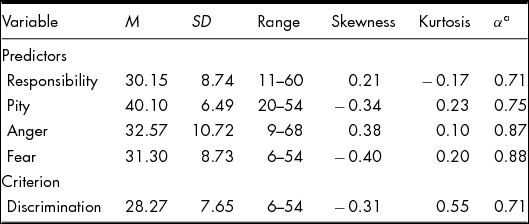
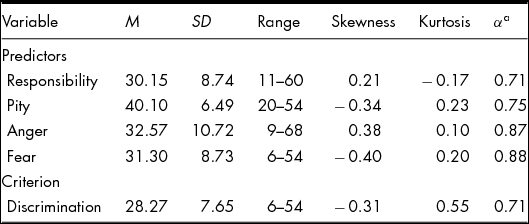
Coefficient alphas were used to estimate the internal consistency of scores on each measure used (see Table 1).
Descriptive Statistics for Study Measures (N = 293)
Note: aCronbach's alpha.
Data Analysis
The primary analysis was conducted using a HRA to determine the amount of variance accounted for in discriminatory behaviours by Corrigan's attribution model, which included controllability, responsibility, pity, anger, and fear. The order of entry in this study was predetermined to address questions of theoretical interest. In the equation, the effects of providing information about controllability on discrimination was first estimated. The responsibility variable was then added to see if it mediated the impact of controllability. In following the path of the attribution model, as illustrated by Figure 1, the emotion variables were entered after the sense of responsibility and a cognitive judgment was made. The fear variable was entered last because it was predicted to be the strongest emotion associated with discrimination. The analysis also measured the amount of unique variance in discrimination accounted for by each set of individual predictor variables.
Results and Discussion
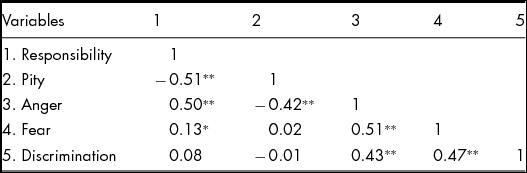
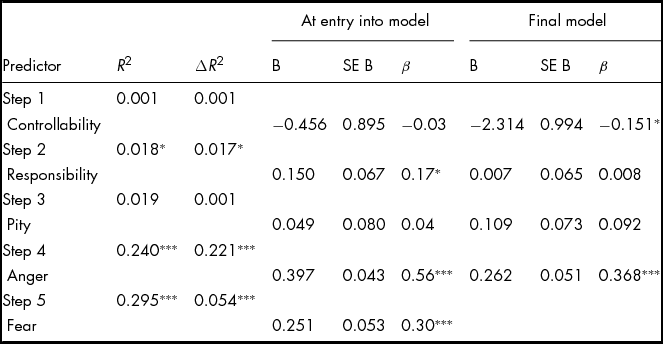
The HRA was performed to test the incremental variance accounted for by each predictor set in Corrigan's attribution model. The outcome variable, discrimination, was regressed on the five predictor variables: (a) controllability; (b) responsibility; (c) pity; (d) anger; (e) fear. The correlation matrix for the criterion and predictor variables is presented in Table 2. Interestingly, the outcome variable discrimination was significantly correlated with all other variables except for responsibility and pity, which was not expected. Table 3 provides a summary of the findings obtained from the HRA, including value changes in R 2 (∆R 2), unstandardized regression coefficients (B), standard errors (SE B), and standardized coefficients (β) for the predictor variables at each step and in the final model.
Correlation of Responsibility, Pity, Fear, Shame–anger, and Discrimination Variables (N = 293)
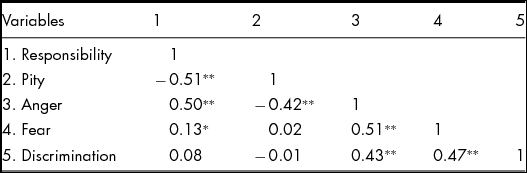
*p < 0.05. **p < 0.01.
Summary of Hierarchical Regression Analysis for Discrimination in Attribution Model (N = 293)
Note: ∆R 2 = R 2 change. F (5, 287) = 23.7, p < 0.001, for the total model; for step 1, F (1, 291) = 0.26, p = 0.61; for step 2, ∆F (1, 290) = 5.01, p < 0.05; for step 3, ∆F (1, 289) = 0.38, p = 0.54; for step 4, ∆F (1,288) = 83.86, p < 0.001; for step 5, ∆F (1,287) = 22.00, p < 0.001.
*p < 0.05. **p < 0.01. ***p < 0.001.
The HRA was performed with the five predictors: controllability, responsibility, pity, anger and fear as well as the criterion variable of discrimination. The results are presented in Table 3. The full model for discrimination indicated R 2 = 0.30, F (5, 287) = 23.97, p < 0.001.
Controllability and Responsibility Effects
In the first step of the regression analysis, the controllability variable was entered, but did not contribute significantly to the variance in discrimination scores, R 2 = 0.001, F (1, 291) = 0.26, p = 0.61. This result is not consistent with the attribution model and indicates that the causes of mental illness do not appear to predict Chinese university students’ tendency toward discrimination against people with mental illness.
In the second step of the regression analysis, the variable of responsibility was entered, but a non-significant change in the variance in discrimination scores was explained by responsibility, R 2 = 0.018, ∆R 2 = 0.017, F (2, 290) = 2.66, p = 0.02. An examination of the standardized partial regression coefficients revealed that responsibility did not contribute significantly to explaining variance in discrimination, β = 0.15, t (290) = 1.95, p = 0.06.
There are some possible explanations for these findings. First, responsibility may be a challenging concept to measure in Chinese culture because it is not as clearly defined as in Western cultures, where an accepted cultural principle of right and wrong holds individuals responsible for their own behaviour. According to Bedford and Hwang (Reference Bedford and Hwang2003), there is a relational and subjective component of Chinese morality when it comes to the judgment of responsibility. In the context of the strong obligation for conformity to complex relational networks and relentless efforts to maintain balance, individual freedom and choice are not emphasized. Thus, it is normal for Chinese people to believe that their lives are somewhat controlled by forces outside oneself and others (Lin, Reference Lin2001). Therefore, it is reasonable to assume that the concept of controllability is more difficult to define when applied in Eastern, specifically Chinese, society than it is in Western societies. Chinese culture involves much more complex contextual cues to determine personal responsibility according to the differences in fundamental attribution error. Since the concepts of controllability and responsibility are major factors in the attribution model, the model seems less clear in explaining Chinese people's stigma and discriminatory behaviour related to people with disabilities.
Additionally, there may be some evidence indicating the reliability of the responsibility subscale may not be optimal. From this study, the reliability of the responsibility subscale is lowest among all the subscales, α = 0.71. The study by Corrigan et al. (Reference Corrigan, Markowitz, Watson, Rowan and Kubiak2003) yielded a similar reliability coefficient. However, in one separate study the responsibility subscale of the AQ was reported to have inadequate psychometric properties and demonstrated non-significant correlations relative to the three other stigma measures by Brown (Reference Brown2008) after the AQ was administered to 774 college students to evaluate its test–retest reliability. The relatively low reliability of the responsibility scale might indicate that we may not be adequately assessing the level of responsibility.
Emotional Regulation Effects
The emotion variable of pity was entered into the regression analysis in the third step. This addition did not contribute significantly to the variance in discrimination scores, R 2 = 0.019, ∆R 2 = 0.001, F (3, 289) = 1.90, p = 0.13. The standardized partial regression coefficients β = 0.04, t (289) = 0.62 p= 0.54, revealed that pity was not associated with discrimination. The fourth step of the regression analysis, in which the emotion variable anger was entered, indicated that a significant change in the variance in discrimination scores was explained by anger, R 2 = 0.24, ∆R 2 = 0.22, F (4, 288) =22.80, p < 0.001. The standardized partial regression coefficient, β = 0.56, t (288) = 9.16, p < 0.001, suggested anger was associated with discrimination. When anger was added, the effect of controllability became significant.
The emotion variable fear was entered in the last step of the regression analysis. This variable also contributed to a significant change in the variance in discrimination, R 2 = 0.30, ∆R 2 = 0.06, F (5, 287) =23.97, p < 0.001. The standardized partial regression coefficient β = 0.29, t (287) = 4.69, p < 0.001 indicated that fear contributed uniquely to the change in variance while controlling for the rest of variables in discrimination. This suggests that when greater levels of fear are experienced, there is an increased likelihood of discrimination against people with mental illness.
In summary, the R 2 for the full model is computed to be 0.30, R 2 = 0.30, F (5, 287) = 23.97, p < 0.001. The final regression model, which includes all the variable sets, accounted for 30% of the variance in the discrimination toward people with mental illness score. When controllability was first entered into the regression model, the result was insignificant in predicting discrimination. This indicates that the causes of mental illness alone, regardless if it is due to less perceived responsibility (e.g., car accident) or greater perceived responsibility (e.g., drug abuse), does not appear to predict discriminatory behaviours. When responsibility was entered after controllability in the second step of the regression, the effect of responsibility did not seem to mediate the controllability of cause since the effect of controllability on the discrimination was not reduced. Additionally, it appeared that the sense of personal responsibility did not lead to strong emotions toward individuals with mental illness that result in discrimination that is proposed by the attribution model. Responsibility was not found to have a significant effect in the final regression model either. Ultimately, the emotions of anger and fear predicted the majority of the variance in the discrimination outcome variable. The more angry and fearful people felt in regard to individuals with mental illness, the more likely discrimination was reported. Despite personal responsibility being perceived differently in Chinese culture, which is consistent with the research findings of a cultural difference in fundamental attribution errors (Markus & Kitayama, Reference Markus and Kitayama1991; Miller, Reference Miller1984), the discrimination is as powerful, or even more powerful, in China as was observed in the US. In both of these Eastern and Western cultures, discrimination is most associated with the emotions in the attribution model.
Measurement of Discrimination
The full attribution model only accounted for 30% of the variance in the discrimination toward people with mental illness score, so a further examination of how discrimination is measured in this study may be required. The discrimination scale consisted of 6 items, with half of them measured by segregation/confinement, such as forcing the person into a psychiatric hospital for regular treatment, and the other half by coercive treatment, such as forcing the person to take medication regularly. In the Western countries, treating people with mental illness without their consent has always been a defining human rights issue within mental health law (Monahan, Swartz & Bonnie, Reference Monahan, Swartz and Bonnie2003). However, after an extensive literature review and deeper probe into related cultural aspects, a measurement of discriminatory behaviour that includes mandatory treatment and institutional segregation may not fit well with the realities of Chinese culture. In fact, one of the greatest obstacles in mental health services in China is that 75% of people with mental illness have no access to psychiatric care, with most unable to afford such services. This need for available and affordable treatment may currently be a larger and more relevant issue than the individual right for autonomy. In China, the person's family members usually decide what kind of treatment is needed and how much money should be spent while the person with mental illness has little or no control in the decision-making process (Pearson, Reference Pearson1993). Instead of considering mandatory treatment as a form of behavioural discrimination that may regularly undermine the opportunities of those with mental illness as is the case in the West (Corrigan et al., Reference Corrigan, Markowitz, Watson, Rowan and Kubiak2003), the availability of any free or affordable treatment in China might be more appreciated by the family members, especially those with extremely limited resources, regardless of discrimination. In the study by Corrigan et al. (Reference Corrigan, Markowitz, Watson, Rowan and Kubiak2003), pity was significantly negatively correlated with discrimination of people with mental illness. The more pity participants felt towards people with mental illness, the less likely they would endorse coercion or segregation. In the current study, pity did not correlate significantly with discrimination. This shows that a deeper exploration is needed to explain the complicated relationships between pity and coercion or segregation in a Chinese cultural context.
The current study employed the same theoretical model and used the AQ framework and items, but due to necessary changes in the scenarios and adjustments to the AQ measurement in order to increase their cultural relevance, these findings are not entirely comparable to the study by Corrigan and colleagues (Reference Corrigan, Markowitz, Watson, Rowan and Kubiak2003). Nonetheless, it is interesting to note that in their study, the attribution model was found to explain 73% of the variance in the discrimination variable and the responsibility variable remained significant in their final model that included predictors of controllability, danger, responsibility, pity, anger, and fear. In the current study, there was a much larger variance that was not explained for the coercive responses when testing the attribution model with Chinese university students.
Limitation
The implications of this study should be considered within the context of a few limitations. First, the sample of this study was a non-probability sample, thus the generalizability of the findings is limited. Second, it is important to note that the self-reporting of discrimination used in the study is not equivalent to the direct observation of discrimination. Finally, the vignette condition used in this study was developed to strictly apply to only one type of mental illness (i.e., schizophrenia), thus it cannot be generalized to the full range of mental illnesses.
Implication to Future Practice and Research
The findings from this study have potentially significant implications for clinical practice when working with individuals with mental illness from a Chinese cultural background, as well as their family and community members. In contrast to the main anti-stigma strategies used in the US, which emphasize that the individual is not responsible for his/her condition, may not be effective in reducing discriminatory behaviours toward people with mental illness from a Chinese cultural upbringing. In these cases, exploring and reducing the factors that produce anger and fear will likely be a more effective approach.
Research of this nature in the future will likely shed further light on some of the underlying attitudes and values of Chinese people related to mental illness, family roles, and treatment. It is also likely to assist in the development of improved quantitative research designs to further explore the mechanisms underlying discrimination against people with mental illness in a Chinese cultural context. In addition, the development of an alternative model, such as a disability severity attribution model, may provide a more accurate explanation of the discriminative behaviour in this more collectivistic Eastern culture.
Summary and Conclusion
Conclusive research evidence in the US demonstrates that discrimination against people with mental illness is greatly influenced by the attribution of causes and perceived responsibility for their condition. By addressing the extent to which the attribution model (i.e., controllability, responsibility, emotions of pity, anger, and fear) explains discriminatory behaviour among Chinese college students, the impact of the disruptive nature of schizophrenia was investigated in a society where social order and harmony are highly valued. This exploratory research provided additional insight into the differences and commonalities between American and Chinese cultures regarding the mechanism of discrimination toward people with mental illness. These findings demonstrated the relationship among controllability, responsibility, and discrimination in this study was inconsistent with those suggested by the attribution model, specifically that responsibility did not mediate the controllability of cause. Personal responsibility did not play a significant role in determining discrimination toward people with mental illness as was demonstrated in a Western cultural setting. This indicates that there are culturally influenced differences in the disability attribution process despite similar expressions of discrimination.