Increasing evidence indicates that assessment of physiological arousal is important for understanding individual differences in children's aggressive behavior (e.g., Herpertz et al., Reference Herpertz, Mueller, Wenning, Qunaibi, Lichterfeld and Herpertz-Dahlmann2003; Murray-Close & Crick, Reference Murray-Close and Crick2007; Snoek, Van Goozen, Matthys, Buitelaar, & Van Engeland, Reference Snoek, Van Goozen, Matthys, Buitelaar and Van Engeland2004). Although a great deal of progress has been made in this area in recent years, a number of significant limitations remain. First, studies tend to either exclude girls completely or fail to evaluate the role of gender. Second, the vast majority of researchers have focused on forms of aggression that are most salient and characteristic of boys (e.g., physical aggression) to the neglect of those that are more typical of girls (e.g., relational aggression, such as gossip). Third, despite some evidence that relationally aggressive youth are more sensitive to relational stressors (i.e., threats to interpersonal relationships) whereas physically aggressive youth are more sensitive to instrumental stressors (i.e., threats to dominance and property; e.g., Crick, Grotpeter, & Bigbee, Reference Crick, Grotpeter and Bigbee2002), there is a lack of research regarding the role of stressor type. Fourth, limited research focuses on biosocial interactions between physiological reactivity and negative peer treatment in the development of aggressive conduct. The goal of the present study was to address these limitations in a community sample of 10-year-old boys and girls. Specifically, we examined the association between physiological reactivity to two types of peer stressors (i.e., relational and instrumental) and physical and relational aggression. We also investigated whether these associations were moderated by actual experiences of peer maltreatment (i.e., physical and relational victimization) and whether the pattern of effects differed by gender.
Physiological Arousal and Aggressive Conduct
For decades, developmental psychopathologists have highlighted the need for multilevel perspectives in the study of maladaptive behavioral patterns (e.g., Cicchetti, Reference Cicchetti1993), and there has been mounting interest in the role of the sympathetic nervous system (SNS) in the development of aggressive behavior (see Murray-Close, Reference Murray-Close2013a). Activation of the SNS involves the “fight or flight” response and results in increases in physiological arousal (e.g., heart rate). Several theoretical perspectives suggest that low levels of SNS activity serve as a risk factor for aggression. According to fearlessness theory, SNS underarousal is associated with a relatively fearless temperament (Ortiz & Raine, Reference Ortiz and Raine2004), which may in turn interfere with socialization efforts to reduce aggression and lead youth to be relatively unafraid of the negative consequences of aggressive behaviors (e.g., punishment or retaliation by victims). Stimulation-seeking theory, in contrast, suggests that SNS underarousal reflects stimulation-seeking tendencies (see Ortiz & Raine, Reference Ortiz and Raine2004, and Sijtsema et al., Reference Sijtsema, Veenstra, Lindenberg, van Roon, Verhulst and Ormel2010, for applications to heart rate). From this perspective, underaroused individuals may engage in aggressive behavior in an effort to raise their arousal to optimal levels.
Although many researchers in this area have focused on measures of resting arousal, Ortiz and Raine (Reference Ortiz and Raine2004) argued that aggressive youth are unresponsive and fearless when encountering aversive situations, highlighting the potential importance of underarousal during stressors. In their meta-analysis, the effect size for the association between antisocial behavior and heart rate during stress (d = –0.76) was almost twice the magnitude of the effect size for associations with resting heart rate (d = –0.44). Because heart rate is influenced by both the parasympathetic nervous system (PNS) and the SNS, however, findings from heart rate research are unable to clarify the precise role of SNS functioning. Additional support for the role of SNS underarousal has been provided by evidence that low resting skin conductance (Beauchaine, Katkin, Strassberg, & Snarr, Reference Beauchaine, Katkin, Strassberg and Snarr2001; Gatzke-Kopp, Raine, Loeber, Stouthamer-Loeber, & Steinhauer, Reference Gatzke-Kopp, Raine, Loeber, Stouthamer-Loeber and Steinhauer2002; Kruesi, Hibbs, Zahn, & Keysor, Reference Kruesi, Hibbs, Zahn and Keysor1992; Raine, Venables, & Williams, Reference Raine, Venables and Williams1990) and blunted skin conductance reactivity (e.g., Harden, Pihl, Vitaro, & Gendreau, Reference Harden, Pihl, Vitaro and Gendreau1995; Herpertz et al., Reference Herpertz, Mueller, Wenning, Qunaibi, Lichterfeld and Herpertz-Dahlmann2003), pure indices of SNS functioning (see Dawson, Schell, & Filion, Reference Dawson, Schell, Filion, Cacioppo, Tassinary and Berntson2007), are positively related to aggressive or antisocial behavior.
In contrast to hypotheses derived from fearlessness or stimulation-seeking theories, however, several researchers have argued that higher SNS reactivity to threat or provocation will promote aggressive responses; in effect, SNS overarousal following stress may energize aggressive behaviors (Scarpa & Raine, Reference Scarpa and Raine1997), perhaps because it reflects negative emotional experiences of anger or frustration (e.g., Hubbard et al., Reference Hubbard, Smithmyer, Ramsden, Parker, Flanagan and Dearing2002; for a review, see Murray-Close, Reference Murray-Close2013a). An emerging body of research has documented positive associations between SNS reactivity to stress or provocation and aggressive behaviors (e.g., Bollmer, Harris, & Milich, Reference Bollmer, Harris and Milich2006; Hubbard et al., Reference Hubbard, Smithmyer, Ramsden, Parker, Flanagan and Dearing2002), although findings are mixed (e.g., Snoek et al., Reference Snoek, Van Goozen, Matthys, Buitelaar and Van Engeland2004) and may depend on the age of participants (see Lorber, Reference Lorber2004). Moreover, findings may be particularly likely to emerge in the context of relatively pure measures of SNS arousal, such as skin conductance, because other indices such as heart rate can reflect PNS arousal and attentional processes as well (Hubbard et al., Reference Hubbard, Smithmyer, Ramsden, Parker, Flanagan and Dearing2002).
Although less commonly included in studies of aggressive children and adolescents (Kibler, Prosser, & Ma, Reference Kibler, Prosser and Ma2004), heightened systolic and diastolic blood pressure reactivity have been found to be positively related to hostility, Type A personality, and aggressive behavior in a large body of research with adults (for a meta-analytic review, see Chida & Hamer, Reference Chida and Hamer2008). Hostile individuals may be particularly likely to experience exaggerated blood pressure reactivity and anger when in stressful circumstances; these dysregulated, angry, and hostile emotional responses in turn may place youth at risk for responding to perceived threat with aggressive behavior. In their meta-analysis with adults, Chida and Hamer (Reference Chida and Hamer2008) found that aggression was positively associated with both systolic and diastolic blood pressure, but not with more specific indices of SNS functioning (such as skin conductance). Although limited research has been conducted with children to date, several preliminary findings indicate that heightened blood pressure reactivity to aversive stimuli is positively related to aggressive conduct among children and adolescents (e.g., Murray-Close & Crick, Reference Murray-Close and Crick2007; Schneider, Nicolotti, & Delamater, Reference Schneider, Nicolotti and Delamater2002; although see Kibler et al., Reference Kibler, Prosser and Ma2004). In contrast, Gower and Crick (Reference Gower and Crick2011) recently documented relatively low resting blood pressure among aggressive youth and interpreted findings in the context of fearlessness and stimulation-seeking theories (see also Kibler et al., Reference Kibler, Prosser and Ma2004). Although this study focused on resting blood pressure, the findings highlight the possibility that, similar to findings with skin conductance, low levels of blood pressure reactivity may serve as a risk factor for aggression among some youth.
Developmental psychopathologists argue that maladaptation results from a failure to negotiate salient developmental tasks (Cicchetti, Reference Cicchetti1993). The internalization of rule-governed behavior, including the inhibition of aggression, is a key developmental task during middle childhood (Masten & Coatsworth, Reference Masten and Coatsworth1998), highlighting the significance of research on mechanisms that may interfere with mastery of these abilities during this developmental period. In addition, given the importance of studying typical development to better understand deviations from adaptive functioning (Cicchetti, Reference Cicchetti1993), it is important to evaluate physiological risk factors among normative samples of children and adolescents. Although findings regarding the direction of effects in the association between physiological reactivity and aggression are mixed, the developmental psychopathology concept of equifinality suggests that there may be multiple pathways to a single developmental outcome (Sroufe, Reference Sroufe1997). From this perspective, both blunted and heightened physiological reactivity may promote aggressive behavior via distinct pathways, a possibility that has been proposed by Frick and Morris (Reference Frick and Morris2004) regarding the development of physical aggression. The primary goal of the present study is to examine the association between three indices of physiological reactivity (i.e., skin conductance, systolic blood pressure, and diastolic blood pressure) to peer stress and aggressive behavior in a community sample of children.
Gender and Forms of Aggression
To date, the vast majority of research examining the physiological correlates of antisocial behavior has focused on boys (for reviews, see Kibler et al., Reference Kibler, Prosser and Ma2004; and Lorber, Reference Lorber2004), raising questions as to whether similar associations will be found in girls. Although findings are mixed (see Ortiz & Raine, Reference Ortiz and Raine2004, for a meta-analysis regarding heart rate), several researchers have reported stronger evidence for associations between physiological arousal and aggression among boys than among girls (e.g., Beauchaine, Hong, & Marsh, Reference Beauchaine, Hong and Marsh2008; Crozier et al., Reference Crozier, Dodge, Fontaine, Lansford, Bates and Pettit2008; Sijtsema et al., Reference Sijtsema, Veenstra, Lindenberg, van Roon, Verhulst and Ormel2010). Compounding the problem of research focusing on boys, most researchers have exclusively studied forms of aggression that are relatively characteristic of boys, such as physical aggression, to the exclusion of forms of aggression that are more salient for girls, such as relational aggression. Physical aggression refers to behaviors intended to hurt or harm others via physical means (e.g., hitting, kicking, or punching), whereas relational aggression is defined as behaviors intended to hurt or harm others via damage to relationships (e.g., spreading malicious gossip or using social exclusion; Crick & Grotpeter, Reference Crick and Grotpeter1995). Although girls are relatively unlikely to engage in physical aggression, they are as likely as their male counterparts to exhibit relational aggression (Card, Stucky, Sawalani, & Little, Reference Card, Stucky, Sawalani and Little2008).
There are several theoretical possibilities regarding the association between physiological reactivity and forms of aggression among boys and girls. For instance, similar physiological profiles may give rise to both physical and relational aggression, but the effects may vary across gender. Crick and Zahn-Waxler (Reference Crick and Zahn-Waxler2003) highlighted relationally aggressive behaviors as a subset of the broader construct of externalizing pathology, and recent empirical work has provided additional support for this suggestion (e.g., Tackett, Waldman, & Lahey, Reference Tackett, Waldman and Lahey2009). From this perspective, relational aggression may share risk factors with physical aggression, but the specific manifestations of externalizing pathology may depend on factors such as the gender of the participant (Burt, Donnellan, & Tackett, Reference Burt, Donnellan and Tackett2012; Crick & Zahn-Waxler, Reference Crick and Zahn-Waxler2003). In particular, physiological risk may be most strongly related to physical aggression in boys and relational aggression in girls.
However, distinct physiological profiles may be associated with physical versus relational forms of aggression. Relational aggression has often been conceptualized as a relatively sophisticated aggressive behavior that builds on social–cognitive capacities and thus becomes increasingly common as youth approach adolescence (e.g., Murray-Close, Ostrov, & Crick, Reference Murray-Close, Ostrov and Crick2007). Relational aggression has also been identified as a deliberate strategy used by adolescents to gain social status in the peer group (Cillessen & Mayeux, Reference Cillessen and Mayeux2004). Thus, during late childhood and adolescence, relationally aggressive behaviors may be particularly likely to emerge in the context of blunted physiological reactivity, which is often hypothesized to underlie deliberate and strategic aggression (see Murray-Close, Reference Murray-Close2013b). In contrast, physical aggression may be particularly likely to emerge in the context of the negative emotional reactions (e.g., anger) accompanying heightened stress reactivity, particularly during adolescence when such conduct becomes relatively uncommon (Côté, Vaillancourt, LeBlanc, Nagin, & Tremblay, Reference Côté, Vaillancourt, LeBlanc, Nagin and Tremblay2006). Sijtsema, Shoulberg, and Murray-Close (Reference Sijtsema, Shoulberg and Murray-Close2011) recently reported that relational aggression was related to blunted physiological reactivity in a sample of female children and adolescents. In contrast, physical aggression was associated with exaggerated stress responses among girls with cognitive and contextual risk factors (e.g., rejection). However, this pattern has not consistently emerged in research in this area (see Murray-Close & Crick, Reference Murray-Close and Crick2007), underscoring the need for additional work regarding the correlates of physical versus relational forms of aggression. In the present study, we examined whether similar physiological risk factors emerged for relational and physical aggression, and whether these risk factors were common to boys and girls.
Type of Stressors
Researchers examining the association between physiological reactivity and aggressive conduct have included a wide range of stimuli, and mounting evidence indicates that differences in factors such as valence (Lorber, Reference Lorber2004) and the nature of the challenge (e.g., cognitive vs. interpersonal; Obradović, Bush, & Boyce, Reference Obradović, Bush and Boyce2011) have important implications for findings. Social information processing research indicates that physically aggressive children tend to be sensitive to instrumental peer provocations (i.e., loss or damage to possessions or territory, or physical harm to the body; e.g., having an art project destroyed by a classmate or getting hit by a ball during an athletic game; Crick et al., Reference Crick, Grotpeter and Bigbee2002). In contrast, peer provocations that involve a relational conflict (i.e., situations in which a relational slight such as social exclusion has occurred; e.g., not getting invited to a classmate's birthday party) are particularly upsetting for relationally aggressive children (Crick, Reference Crick1995; Crick et al., Reference Crick, Grotpeter and Bigbee2002), especially for highly victimized girls (Mathieson et al., Reference Mathieson, Murray-Close, Crick, Woods, Zimmer-Gembeck and Morales2011; cf. Crain, Finch, & Foster, Reference Crain, Finch and Foster2005). These findings highlight the possibility that physiological reactivity to different types of stressors may be related to physically and relationally aggressive behavior patterns.
The findings from several preliminary studies provide evidence for a link between heightened physiological arousal to instrumental peer provocations (losing a board game and a prize to a peer who cheated, Hubbard et al., Reference Hubbard, Smithmyer, Ramsden, Parker, Flanagan and Dearing2002; anticipating a physical fight with a peer, Williams, Lochman, Phillips, & Barry, Reference Williams, Lochman, Phillips and Barry2003) and physical aggression. Few studies have examined the association between physiological reactivity to relational stressors and aggressive behavior, despite emerging evidence that the neural correlates of “social pain” (e.g., social exclusion) overlap with physical pain systems and research demonstrating important individual differences in neural sensitivity to social pain (Eisenberger, Reference Eisenberger2012). Preliminary work in this area has documented associations between physiological reactivity to relational stressors (e.g., being excluded) and relational aggression (e.g., Murray-Close, Reference Murray-Close2011; Murray-Close & Rellini, Reference Murray-Close and Rellini2012; Sijtsema et al., Reference Sijtsema, Shoulberg and Murray-Close2011). However, previous studies have failed to assess reactivity to both types of peer stressors, and few studies included both physical and relational aggression (see Murray-Close & Crick, Reference Murray-Close and Crick2007; and Sijtsema et al., Reference Sijtsema, Shoulberg and Murray-Close2011, for exceptions), severely limiting researchers' ability to evaluate the specificity of associations between physiological reactivity to distinct types of peer stress and forms of aggression. Thus, in the present research, we examined the association between physiological reactivity to both relational and instrumental stressors and both relational and physical aggression.
Biosocial Interactions
From a developmental psychopathology perspective, the influence of risk factors on behavioral adaptation may vary depending on environmental contexts (e.g., Cicchetti, Reference Cicchetti1993), highlighting the importance of considering interactions across levels of analysis in studies of aggressive conduct. A particularly relevant contextual factor regarding the association between physiological reactivity to peer stressors and aggressive behavior is the frequency with which children encounter these types of stressors in their daily lives. In other words, physiological reactivity to relational stress may be most strongly associated with aggression among youth who experience relational victimization by peers. In addition, physiological reactivity to instrumental stress may be most strongly associated with aggression among youth who experience physical victimization by peers. In several recent studies, researchers have documented the moderating role of negative experiences with peers, including victimization, in the association between physiological reactivity to stress and aggression (e.g., Murray-Close, Reference Murray-Close2011; Sijtsema et al., Reference Sijtsema, Shoulberg and Murray-Close2011). Sijtsema et al. (Reference Sijtsema, Shoulberg and Murray-Close2011) argue that frequent negative experiences with peers may be most likely to interact with heightened physiological reactivity in predicting aggressive conduct because the negative emotionality exhibited among these youth may make them particularly sensitive to experiences of peer victimization; in contrast, youth with blunted physiological profiles may be relatively indifferent to negative treatment by peers. This viewpoint is consistent with biological sensitivity to context theory (Boyce & Ellis, Reference Boyce and Ellis2005), which suggests that youth who exhibit heightened physiological stress responses may fare worst in negative environmental contexts but benefit most from supportive contexts. Thus, the final goal of the present study was to examine whether experiences of relational victimization moderated the association between heightened physiological reactivity to relational stress and aggression, and whether experiences of physical victimization moderated the association between heightened physiological reactivity to instrumental stress and aggression.
Study Hypotheses
In sum, the goal of the present study was to examine whether physiological reactivity to relational and instrumental peer stressors was associated with physical and relational aggression in a community sample of 10-year-old children. Consistent with the concept of equifinality (Sroufe, Reference Sroufe1997), we expected that both blunted and heightened physiological reactivity to peer stress would be related to elevated aggressive conduct, depending on the moderating effects of gender, form of aggression, type of stressor, and experiences of victimization. First, we tested the competing hypotheses that physical and relational aggression evidence shared, versus having distinct, physiological correlates. Second, we examined whether these associations differed for boys and girls. Third, we examined the hypothesis that reactivity to relational stressors would be most strongly associated with relational aggression and reactivity to instrumental stressors would be most strongly associated with physical aggression. However, because it is also possible that stress responses to a variety of types of stressors are related to aggressive conduct, we explored associations between reactivity to both types of stressors and both physical and relational aggression in our models. Fourth, we examined whether experiences of peer victimization moderated these associations; we expected that heightened physiological reactivity to relational stressors would be most strongly related to aggression among relationally victimized youth, whereas heightened physiological reactivity to instrumental stressors would be most strongly related to aggression among physically victimized youth.
Method
Participants
One hundred ninety-six children (105 girls), recruited from a large Midwestern city, participated in the present study. Participants ranged in age from 8.53 to 12.44 years (M = 10.11 years, SD = 0.64). This age range was selected given previous research with a different sample documenting associations between physiological arousal and physical and relational aggression during this developmental period (Murray-Close & Crick, Reference Murray-Close and Crick2007). Participants were recruited through visits to local schools (8.2% of the sample) and through a university participant pool (91.8%). A group of research assistants visited schools to explain the purposes and procedures of the study and distributed the consent forms to students. These students were asked to take the consent forms home to their parents and then return the forms to their teachers at schools. Eighteen percent of students approached through local schools returned a consent form agreeing to participate in the study. Another group of research assistants called the families from a university participant pool and invited eligible families to participate. Families with children in fourth to sixth grades were invited to participate. To be eligible to participate, children could not have developmental delays that would interfere with study protocols and families had to live within a 2-hr drive from the university laboratory. Of participants reached through the university participant pool who were within the eligible distance of the research laboratory (14% of families reached were screened out owing to distance), 51.2% agreed to participate in the study. Ninety-one percent of participants were Caucasian, 3% Asian, 2% African American, and 4% other racial groups. Five percent of participants reported that they were Hispanic in ethnicity. Distribution for parental education levels was as follows: 2.6% high school or GED graduate, 27.2% 2-year college or associate's degree, 46.2% bachelor's or 4-year college degree, and 24.1% postgraduate degree. Distribution of the marital status of the parents was as follows: 94.4% married, 1.5% divorced, 2.1% single, and 2.1% living with a partner. Median yearly household income was $80,001 or more (64.4%); 16.8% had incomes between $60,001 and $80,000, 13.6% had incomes between $40,001 and $60,000, and 5.2% had incomes between $10,001 and $40,000.
Parents of all children gave informed written consent for their child to participate in the study, and children gave written assent to participate. The procedures and purposes of the study were approved by the institutional review board at the second author's university. Participants were invited into the lab where they completed a 2-hr, individually administered interview about their stressful peer experiences and a series of questionnaires; in less than 20% of cases, researchers visited participants in their homes to complete the interview protocol. During this interview, physiological arousal during the retelling of stressful situations was assessed. Families were compensated $50 and for mileage for attending the laboratory session. Participants' teachers completed measures assessing relational and physical aggression and victimization. Teachers were compensated $10 for completing measures for each participating child.
Assessment of physiological reactivity
Children's physiological reactivity was assessed with a semistructured interview, the Social Competence Interview (SCI), adapted from a procedure developed by Ewart and Kolodner (Reference Ewart and Kolodner1991, Reference Ewart and Kolodner1993). The SCI was adapted to allow for assessment of reactivity to relational and instrumental conflicts, respectively. The SCI interview consisted of two parts, Interview A and Interview B (counterbalanced in order across participants). In Interview A, the child was given a deck of five cards, each of which provided an example of an instrumental peer provocation situation. The child was asked to choose the situation that had happened to him or her the most and, following the procedures developed by Ewart and Kolodner, to reconstruct the event using standard imagery techniques. During Interview B, the child selected a problem from five cards describing relational provocations. To our knowledge, this is the first study to assess physiological reactivity to both instrumental and relational stressors in the prediction of physical and relational aggression.
Blood pressure (systolic and diastolic) was recorded with an Accutorr Plus (Datascope) monitor. Skin conductance level (expressed in microsiemens) was assessed with two Ag/AgCl skin conductance electrodes attached to the distal phalanges of the first and second fingers of the child's nondominant hand with double-sided adhesive collars to limit gel to a 1-cm diameter circle. Physiological indices were collected using James Long Company hardware and software. A 16-channel James Long Company A/D converter was used to digitize the signals. An initial accommodation period of approximately 5 min preceded the interview protocol. During this time, the interviewer attached the blood pressure cuff to the participant's arm on the dominant side and took one reading in order to familiarize the child with the recording procedure. Each SCI interview consisted of an initial 6-min resting baseline (i.e., sitting quietly without talking), followed by one of the interviews (A or B), which lasted approximately 12 min, and then a 6-min recovery period. Previous research with a different sample has successfully used this protocol to investigate the association between physiological activity and relational aggression (Murray-Close & Crick, Reference Murray-Close and Crick2007). Blood pressure was recorded at 2-min intervals throughout the entire 24-min procedure. Skin conductance levels were assessed continuously.
Physiological changes during Interviews A and B were used to index systolic blood pressure reactivity (SBPR-R), diastolic blood pressure reactivity (DBPR-R), and skin conductance reactivity (SCLR-R) to relational stressors and instrumental stressors (SBPR-I, DBPR-I, and SCLR-I, respectively). Resting (nonstress) arousal was estimated for each of the two interviews (A and B) by computing the mean of the preinterview baseline readings. This resting nonstress mean was subtracted from the mean of the readings obtained during the corresponding interview (e.g., resting mean obtained prior to Interview A was subtracted from the mean of the readings obtained during Interview A to provide physiological reactivity to Interview A). Second-by-second skin conductance scores were averaged across baseline and interview sessions for these calculations.
Assessment of physical and relational aggression
A teacher-rating measure, Children's Social Behavior Scale—Teacher Report, was used to assess physical and relational aggression (Crick, Reference Crick1996). This instrument was designed for use with third to sixth graders and included relational aggression (five items; e.g., “This student spreads rumors or gossips about some peers”) and physical aggression (four items; e.g., “This student hits, pushes, or shoves peers”) scales. Items were rated on a 5-point scale from 1 (never) to 5 (almost always). Mean scores were used in the analyses. Favorable psychometric properties of this instrument have been demonstrated in prior research, including internal consistency, test–retest reliability, and construct validity (Crick, Reference Crick1996). Both the physical aggression (Cronbach α = 0.75) and relational aggression (Cronbach α = 0.87) subscales demonstrated good internal consistency in the present study.
Assessment of physical and relational victimization
A teacher-rating measure, the Children's Social Experience Scale—Teacher Report, was used to assess physical and relational victimization (Cullerton-Sen & Crick, Reference Cullerton-Sen and Crick2005). This measure includes two subscales: relational victimization (three items; e.g., “This child gets ignored by other children when a peer is mad at them”) and physical victimization (three items; e.g., “This child gets hit or kicked by peers”). Items were rated on a 5-point scale from 1 (never) to 5 (almost always). Mean scores were used in the analyses. Good internal consistency for the subscales in this measure has been reported in prior research (Cullerton-Sen & Crick, Reference Cullerton-Sen and Crick2005). For the current sample, Cronbach α was 0.86 for relational victimization and 0.84 for physical victimization.
Results
Descriptive and preliminary analyses
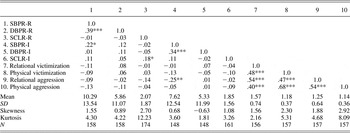
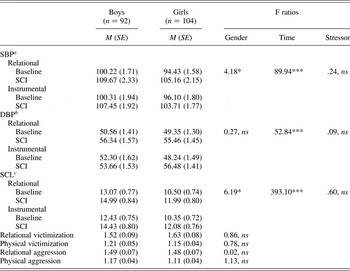
Means, standard deviations, and intercorrelations of study variables are presented in Table 1. Intercorrelations among study variables indicated that systolic and diastolic blood pressure reactivity within types of stressors were positively, moderately correlated. Relational aggression was significantly associated with blunted SBPR-I. Exploration of gender differences in study variables (see Table 2) indicated that boys exhibited higher overall systolic blood pressure and skin conductance levels relative to girls. Both boys and girls exhibited increases in physiological arousal during the SCI, as compared to baseline. Girls exhibited greater increases than did boys in diastolic blood pressure following instrumental stressors, and boys exhibited greater increases than did girls in skin conductance across both types of stressors.
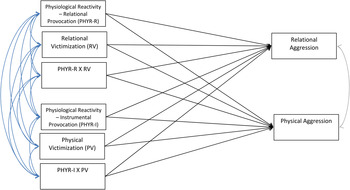
(Color online) An illustration of the theoretical model.

Descriptive statistics and correlations among study variables

Note: SBPR-R, Systolic blood pressure reactivity to relational stress; DBPR-R, diastolic blood pressure reactivity to relational stress; SCLR-R, skin conductance reactivity to relational stress; SBPR-I, systolic blood pressure reactivity to instrumental stress; DBPR-I, diastolic blood pressure reactivity to instrumental stress; SCLR-I, skin conductance reactivity to instrumental stress.
*p < .05. **p < .01. ***p < .001.
Gender differences in study variables

Note: SBP, Systolic blood pressure; DBP, diastolic blood pressure; SCL, skin conductance level; SCI, Social Competence Interview.
a No two-way or three-way interactions were significant.
b Gender × Time was significant at p = .016; Gender × Time × Stressor was significant at p = .015. Probing of this three-way interaction indicated that the increase in DBP during SCI was greater in girls than in boys for instrumental provocation, but the increase in DBP during SCI was similar across gender for relational provocation.
c Gender × Time was marginally significant at p = .055. Probing of this two-way interaction indicated that the increase in SCL during SCI was greater in boys than in girls.
*p < .05. ***p < .001.
Data analysis plan
Path analyses using Mplus version 6 were conducted to address study hypotheses. Examination of study variables (see Table 1) indicated that some study variables exhibited substantial departures from normality (Kline, Reference Kline2005). Thus, a robust weighted least squares estimator was used to accommodate nonnormally distributed variables (see chap. 15 in Muthén & Muthén, Reference Muthén and Muthén1998–2010). In addition, because missing data were common across study variables (see Table 1), maximum likelihood estimation procedures were used to accommodate missing data.
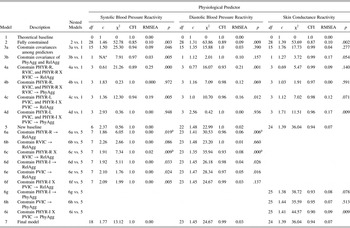
A series of path analyses were conducted to examine whether physiological reactivity predicted physical and relational aggression and whether experiences of victimization by peers and participant gender moderated these associations. Separate analyses were run for each index of physiological reactivity (i.e., systolic blood pressure, diastolic blood pressure, and skin conductance). A depiction of this theoretical model is presented in Figure 1. In the first baseline model, all paths were allowed to vary by gender (see Table 3, Model 1). Relational victimization served as the moderator of reactivity to relational stressors, whereas physical victimization served as the moderator of reactivity to instrumental stressors. Continuous variables were mean-centered prior to analyses.
Nested model comparisons for gender moderation

Note: PHYR-R, Physiological reactivity to relational provocation; PHYR-I, physiological reactivity to instrumental provocation; RVIC, relational victimization; PVIC, physical victimization; RelAgg, relational aggression; PhyAgg, physical aggression. The p values reflect the significance of scaled chi-square difference tests for nested model comparisons.
a Due to estimation problems for this model, nested model comparisons were used without using mlr.
b Scaling correction produced a negative chi-square difference; therefore, a standard chi-square difference test is reported for this analysis.
Next, to test whether pathways varied by gender, all paths in the model were fully constrained to be equivalent by gender (Table 3, Model 2). If these constraints resulted in a significant decrease in model fit, we tested several additional models to locate which paths differed by gender, including covariances among model predictors (Model 3a); covariances between physical and relational aggression (Model 3b); physiological reactivity to relational provocation, relational victimization, and their interaction in the prediction of relational aggression and physical aggression, respectively (Models 4a and 4b); and physiological reactivity to instrumental provocation, physical victimization, and their interaction in the prediction of relational aggression and physical aggression, respectively (Models 4c and 4d). Based on the results of these analyses, we adopted a new baseline model in which pathways that did not vary between boys and girls were constrained to be equal across gender (Model 5). We then ran a series of nested model comparisons to examine which specific pathways differed for boys and girls. Relative fit for models was compared using a chi-square difference test for nonnormally distributed data (Satorra & Bentler, Reference Satorra and Bentler2001). In cases where significant interactions across groups were found, we allowed the constituent main effects to vary across groups, regardless of the results of scaled chi-square difference tests for these main effects, because this implied that the main effects may have different meanings across groups. Significant interactions between physiological reactivity to stress and victimization by peers were probed using simple slope analyses at low (–1 SD) and high (+1 SD) levels of the moderator variable (see Aiken & West, Reference Aiken and West1991). Preliminary analyses indicated that age was not associated with the variables of interest; thus, age was not controlled in the final models. The root mean square error of approximation (RMSEA) and the comparative fit index (CFI) were used to evaluate model fit (Hu & Bentler, Reference Hu and Bentler1999). In general, a cutoff value of 0.06 or lower for the RMSEA and a cutoff value of 0.95 or higher for the CFI suggest good fit with the observed data, although lower thresholds are generally adopted for acceptable fit (e.g., CFI = 0.90; see Hu & Bentler, Reference Hu and Bentler1999). To facilitate interpretation, we present standardized estimates.
Systolic reactivity to stressors
The first model examined the association between systolic reactivity and physical and relational aggression. As depicted in Table 3, the unconstrained theoretical model fit the data well. Moreover, constraining all of the paths across gender resulted in a significant decrease in model fit, suggesting gender moderation. Follow-up nested model comparisons indicated that the association between the predictors and physical aggression did not differ by gender (Models 4b and 4d). Thus, these were constrained to be equal in the second baseline model (Model 5). This second baseline was used as a comparison to examine which of the remaining unconstrained pathways differed for boys versus girls. Model 5 was modified to constrain any pathways that did not significantly differ by gender, including 12 of the 15 covariances among predictors (not shown in Table 3 because of space constraints), to be equal. Although the scaled chi-square difference test indicated that the path from relational victimization to relational aggression did not differ by gender, we allowed this path to vary across gender because the two-way interaction involving relational victimization was significant. The final model exhibited excellent model fit (see Table 3, Model 7). The estimates of the covariances among predictors in the final model indicated that for both boys and girls, blunted SBPR-R was associated with relational victimization (β = −0.16, p < .01 for boys; β = −0.14, p < .05 for girls), and blunted SBPR-I was associated with physical victimization (β = −0.13, p < .05 for boys; β = −0.25, p < .01 for girls). Physical and relational victimization were also positively associated for boys and girls, although this effect was larger for boys than for girls, scaled Δχ2 (1) = 4.62, p < .05. Physical and relational aggression were associated for girls (β = 0.60, p < .001) but not for boys (β = 0.13, p = .35).
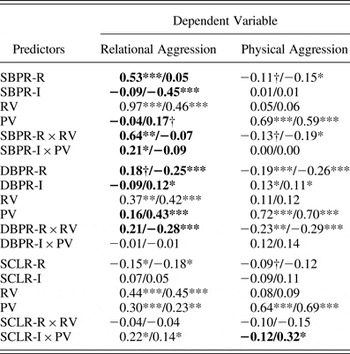
The results for directional paths, presented in Table 4, indicated that relational victimization was positively associated with heightened levels of relational aggression, but not physical aggression, for both boys and girls. Physical victimization was positively associated with physical aggression. Gender moderation in the association between physical victimization and relational aggression was significant. Follow-up tests indicated that physical victimization was positively associated with relational aggression for girls at a trend level (p < .10).
Physiological reactivity to stressors and victimization in the prediction of physical and relational aggression

Note: Findings are presented separately for boys/girls. The estimates in bold type indicate significant (p < .05) gender differences in estimates based on scaled nested model comparisons. Estimates reflect the standardized solution. SBPR-R, Systolic blood pressure reactivity to relational stress; SBPR-I, systolic blood pressure reactivity to instrumental stress; RV, relational victimization; PV, physical victimization; DBPR-R, diastolic blood pressure reactivity to relational stress; DBPR-I, diastolic blood pressure reactivity to instrumental stress; SCLR-R, skin conductance reactivity to relational stress; SCLR-I, skin conductance reactivity to instrumental stress.
†p < .10. *p < .05. **p < .01. ***p < .001.
Heightened SBPR-R, and the interaction between SBPR-R and relational victimization, predicted relational aggression for boys only. Follow-up simple slope analyses of the interaction effect indicated that, among boys at lower levels of relational victimization, blunted SBPR-R was associated with relational aggression (β = −0.27, p < .05). In contrast, at higher levels of relational victimization, heightened SBPR-R predicted relational aggression among boys (β = 1.29, p < .001). Blunted SBPR-I predicted relational aggression for girls only. However, the interaction between SBPR-I and physical victimization in the prediction of relational aggression was significant for boys only. Follow-up simple slope analyses indicated that blunted SBPR-I predicted relational aggression at lower levels of physical victimization (β = −0.35, p < .01), whereas heightened SBPR-I was marginally associated with relational aggression at higher levels of physical victimization (β = 0.21, p = .10).
For both girls and boys (findings only approached statistical significance for boys, but gender moderation was not significant), SBPR-R interacted with relational victimization in the prediction of physical aggression. For both genders, SBPR-R was not associated with physical aggression at lower levels of relational victimization (β = 0.06, p = .29 for boys; β = 0.06, p = .31 for girls). However, blunted SBPR-R predicted physical aggression at higher levels of relational victimization for both boys (β = −0.26, p < .05) and girls (β = −0.35, p < .05).
Diastolic reactivity to stressors
The next model examined the association between diastolic reactivity and physical and relational aggression. As depicted in Table 3, nested model comparisons indicated significant gender moderation. The covariances among model predictors, the association between physical and relational aggression, and the association between the predictors and physical aggression did not differ by gender (Models 3a, 3b, 4b, and 4d). Thus, these were constrained to be equal in the second baseline model (Model 5). In the final model, Model 5 was modified to constrain any pathways that did not significantly differ by gender to be equal; specifically, the interaction between DBPR-I and physical victimization in the prediction of relational aggression was constrained to be equivalent across gender. We allowed the path from relational victimization to relational aggression to vary across gender because the two-way interaction involving relational victimization was significant. Results indicated that this final model exhibited excellent model fit (see Table 3, Model 7). The estimates for the final model indicated that physical and relational aggression were associated for boys (β = 0.36, p < .001) and for girls (β = 0.39, p < .001). The association between DBPR-R and DBPR-I approached statistical significance for boys (β = 0.13, p < .10) and girls (β = 0.12, p = .10).
The results for directional paths, presented in Table 4, indicated that for boys, heightened DBPR-R was associated with relational aggression at the trend level. In contrast, blunted DBPR-R predicted relational aggression in girls, and this effect was moderated by relational victimization. Follow-up simple slope analyses of the interaction effect indicated that among girls at lower levels of relational victimization, DBPR-R was not associated with relational aggression (β = 0.11, p = .17). In contrast, among girls at higher levels of relational victimization, blunted DBPR-R predicted relational aggression (β = −0.57, p < .001). Heightened DBPR-I was associated with relational aggression for girls only.
The interaction between DBPR-R and relational victimization in the prediction of physical aggression was significant for both boys and girls. At lower levels of relational victimization, DBPR-R was marginally associated with heightened levels of physical aggression among boys (β = 0.09, p < .10) but not among girls (β = 0.10, p = .11). In contrast, at higher levels of relational victimization, blunted DBPR-R predicted physical aggression for boys (β = −0.54, p < .001) and girls (β = −0.58, p < .001). Heightened DBPR-I was associated with physical aggression for both boys and girls.
Skin conductance reactivity to stressors
The final model examined the association between skin conductance reactivity and physical and relational aggression. As depicted in Table 3, nested model comparisons indicated that the covariances among model predictors and the association between the predictors and relational aggression did not differ by gender (Models 3a, 4a, and 4c). In addition, the association among SCLR-R, relational victimization, and their interaction in the prediction of physical aggression did not differ by gender (Model 4b). Thus, these were constrained to be equal in the second baseline model (Model 5). Although gender differences in the covariance between physical and relational aggression only approached statistical significance (p = .05), this association was allowed to vary by gender in Model 5 because constraining this covariance to be equal across groups resulted in poor model fit indices (CFI = 0.91, RMSEA = 0.09). In addition, we allowed the paths from physical victimization to physical aggression and from SCLR-I to physical aggression to vary across gender because the two-way interaction between these two variables was significant, even though the scaled chi-square difference tests indicated that these paths did not differ by gender. As a result, the final model was identical to Model 5. Results indicated that this final model exhibited acceptable model fit (see Table 3, Model 7). In the final model, SCLR-R and SCLR-I were positively associated for both boys (β = 0.24, p < .01) and girls (β = 0.25, p < .05). Blunted SCLR-I was also marginally associated with physical victimization for boys (β = −0.08, p = .07) and girls (β = −0.13, p = .07).
The results for directional paths, presented in Table 4, indicated that blunted SCLR-R was associated with relational aggression for both boys and girls. The interaction between SCLR-I and physical victimization in the prediction of relational aggression was significant for both genders. Follow-up simple slope analyses indicated that blunted SCLR-I was marginally related to relational aggression at lower levels of physical victimization (β = −0.17, p = .08 for boys and β = −0.15, p = .07 for girls), whereas heightened SCLR-I was marginally associated with relational aggression at higher levels of physical victimization (β = 0.30, p = .06 for boys and β = 0.24, p = .08 for girls).
Finally, the significant interaction between SCLR-I and physical victimization in the prediction of physical aggression emerged for girls only. Simple slope analyses indicated that among girls at lower levels of physical victimization, blunted SCLR-I predicted physical aggression (β = −0.34, p < .05). In contrast, among girls at higher levels of physical victimization, heightened SCLR-I predicted physical aggression at the trend level (β = 0.57, p < .10).
Discussion
The goal of the present study was to examine the associations between several indices of physiological stress reactivity (i.e., skin conductance, systolic blood pressure, and diastolic blood pressure) to relational and instrumental peer stressors and physical and relational aggression. Consistent with the mixed findings in the literature to date, we found evidence that blunted physiological reactivity was associated with aggression in some contexts, whereas heightened physiological reactivity was associated with aggression in other contexts. Several factors moderated these associations, including child gender, type of stressor, experiences of peer victimization, and form of aggression.
For both boys and girls, blunted physiological reactivity to relational provocation (i.e., blunted SBPR-R and DBPR-R) was positively associated with physical aggression among youth who were at least occasionally relationally victimized. In contrast, heightened DBPR-I was associated with physical aggression for boys and girls. Moreover, among girls at higher levels of physical victimization, heightened SCLR-I marginally predicted physical aggression. It is possible that victimized youth may be especially likely to engage in physical aggression when they are angered by instrumental stressors yet are unconcerned about the potential negative interpersonal repercussions, such as peer rejection (Dodge, Coie, & Lynam, Reference Dodge, Coie, Lynam, Damon, Lerner and Eisenberg2006), of aggressive responding. These findings are reminiscent of the results from social information processing studies indicating that physically aggressive youth are more likely to select instrumental, rather than relational, goals in peer conflict situations (Crick & Dodge, Reference Crick and Dodge1996). In effect, consistent with emotional interpretations of heightened physiological reactivity (e.g., Hubbard et al., Reference Hubbard, Smithmyer, Ramsden, Parker, Flanagan and Dearing2002), physically aggressive youth may be highly emotionally invested in the outcomes of instrumental conflicts; however, consistent with fearlessness theory, they may be indifferent to the relational costs (e.g., losing friends) that are associated with winning those conflicts through the use of physical force.
Although aggression is often conceptualized as reflecting behaviors enacted in anger (see, for instance, Crick, Bigbee, & Howes, Reference Crick, Bigbee and Howes1996), our findings highlight the possibility that physical aggression may emerge among victimized youth who fail to experience negative emotional arousal in response to relational peer stress. These findings mirror research on the role of callous–unemotional traits (Frick & White, Reference Frick and White2008) and fearlessness (Ortiz & Raine, Reference Ortiz and Raine2004) in the development of aggression. Our findings extend this research to suggest that physically aggressive youth may be unemotional in response to relational, but not instrumental, stressors. It is important to note, however, that this process may be most evident among youth higher in victimization. At lower levels of physical victimization, blunted reactivity to instrumental stress (i.e., SCLR-I) was associated with physical aggression for girls. These findings are consistent with recent research documenting that physically aggressive victims exhibited increases, whereas their nonvictimized, physically aggressive peers evinced decreases, in SNS activation while recounting a stressor (Kliewer, Dibble, Goodman, & Sullivan, Reference Kleiwer, Dibble, Goodman and Sullivan2012), and suggest that the physiological correlates of physical aggression may differ among victimized versus nonvictimized youth.
Several gender differences emerged in the physiological correlates of relational aggression. Among girls, blunted physiological reactivity to relational stress (i.e., DBPR-R and SCLR-R) was associated with relational aggression, particularly when it occurred among girls who were at least occasionally relationally victimized (i.e., DBPR-R effect). Girls who fail to experience a normative level of negative affect in relational conflict situations may be at risk for engaging in relational aggression because they do not fear the negative repercussions of such conduct (e.g., friendship loss). These findings are consistent with evidence that callous–unemotional traits were associated with relational aggression in a sample of adjudicated girls (Marsee & Frick, Reference Marsee and Frick2007) and extend this research to highlight the role of blunted physiological reactivity in the prediction of relational aggression in girls.
Mixed findings emerged regarding the association between physiological reactivity to instrumental stressors and relational aggression among girls. As with physical aggression, some evidence indicated that heightened reactivity to instrumental stress (i.e., DBPR-I and SCLR-I) predicted relational aggression, and this effect was particularly robust among girls with higher levels of physical victimization (i.e., SCLR-I effect). It is possible that girls who find instrumental provocations stressful, yet are relatively unconcerned about the interpersonal repercussions regarding aggressive conduct, may at times elect to respond with relational aggression rather than physical aggression because this behavior is consistent with gender schemas regarding aggression (Ostrov & Godleski, Reference Ostrov and Godleski2010). However, blunted SBPR-I was also associated with relational aggression among girls, and blunted SCLR-I emerged as a marginally significant predictor of relational aggression among nonphysically victimized girls. These mixed findings underscore the need for additional research regarding the contexts in which underarousal, rather than overarousal, of stress systems in response to instrumental stressors is related to relational aggression in girls.
In boys, findings suggest that there may be two distinct physiological profiles associated with relational aggression, a finding consistent with the developmental psychopathology concept of equifinality (Sroufe, Reference Sroufe1997). Similar to findings with girls, there was some evidence that blunted physiological reactivity to peer stress (blunted SBPR-I, SCLR-I, SBPR-R, and SCLR-R) was associated with relational aggression. However, whereas blunted reactivity to relational stress was most strongly associated with relational aggression among relationally victimized girls, these effects were most robust among nonvictimized boys. Specifically, blunted SBPR-I and SCLR-I were related to relational aggression among boys at lower levels of physical victimization only and blunted SBPR-R was related to relational aggression among boys at lower levels of relational victimization only. This profile may reflect boys who are socially skilled and integrated into the peer group (e.g., popular; see Cillessen & Mayeux, Reference Cillessen and Mayeux2004); from the perspective of fearlessness theory, the blunted physiological responses to relational and instrumental peer stress may allow these boys to use relational aggression to their advantage with few concerns about its potentially negative consequences, such as getting into a physical fight with their targets or being disliked by peers as a result of their objectionable social behaviors.
In contrast, several findings emerged suggesting that heightened physiological reactivity (SBPR-I, SCLR-I, SBPR-R, and DBPR-R) was related to relational aggression among boys. Moreover, positive associations tended to emerge among boys who exhibited higher levels of relational victimization (SBPR-R effect) and physical victimization (SBPR-I and SCLR-I effects). Consistent with the suggestion that heightened physiological reactivity to stress reflects angry reactions and thus promotes aggressive responding (e.g., Hubbard et al., Reference Hubbard, Smithmyer, Ramsden, Parker, Flanagan and Dearing2002), aggression may emerge among victimized boys who both encounter peer stress in their lives and experience high negative emotionality in the face of negative peer treatment.
It is interesting that evidence for both blunted and heightened physiological profiles among aggressive youth emerged in models assessing systolic and diastolic blood pressure reactivity. To date, theoretical perspectives regarding the association between blood pressure and aggression have tended to focus on the role of hostility and anger, rather than stimulation-seeking tendencies or fearlessness (for one notable exception, see Gower & Crick, Reference Gower and Crick2011). Our findings suggest that blood pressure may be an important index to include in studies exploring the association between physiological arousal and aggressive behavioral patterns in youth, and that fearlessness and stimulation-seeking perspectives may be relevant to this research. Moreover, the findings that aggressive behavior patterns were associated with both heightened and blunted blood pressure reactivity provide an interesting parallel to studies of the hypothalamic–pituitary–adrenal axis, one of the primary human stress systems. A large body of research indicates that both high and low levels of hypothalamic–pituitary–adrenal axis functioning are associated with maladaptive behavior patterns, with direction of effects depending on factors such as stressor controllability and duration since stressor onset (see Miller, Chen, & Zhou, Reference Miller, Chen and Zhou2007). Across multiple human stress systems, then, it may be the case that aggressive youth exhibit physiological dysregulation that is at times manifested as both higher and lower levels of arousal.
Gender and forms of aggression
An important goal of the present study was to examine whether there were differences in the association between physiological reactivity and physical versus relational aggression. Researchers have often conceptualized relational aggression as a subtype of externalizing pathology (e.g., Crick & Zahn-Waxler, Reference Crick and Zahn-Waxler2003), and our findings provide partial support for shared physiological correlates across forms of aggression. For instance, heightened reactivity to instrumental stressors appeared to predict both physical and relational forms of aggression, particularly among youth who were at least occasionally physically victimized. However, distinct correlates emerged across forms of aggression as well; for instance, heightened reactivity to relational stressors emerged in the prediction of relational, but not physical, aggression among boys.
With respect to gender moderation, the physiological risk factors for physical aggression were largely similar for boys and girls. Relational aggression, in contrast, was more robustly associated with blunted physiological reactivity to relational stressors among girls who were at least occasionally victimized and among boys who were not victimized. Moreover, among victimized boys but not girls, heightened reactivity to relational provocation was associated with relational aggression. These results suggest that boys who encounter peer maltreatment may be more likely than girls to engage in relational aggression as a result of angry responses to these environmental stressors. In contrast, girls who are targeted by peer victimization (and boys who are not) may primarily engage in relationally aggressive conduct because they are relatively unconcerned about the negative repercussions regarding such conduct (i.e., fearlessness theory). Thus, although relational aggression may at times occur at similar frequencies in boys and girls (e.g., Card et al., Reference Card, Stucky, Sawalani and Little2008), the processes that underlie these behaviors may be quite distinct across genders. These findings are consistent with the developmental psychopathology concept of equifinality (Sroufe, Reference Sroufe1997), as well as with the suggestion that gender schemas may lead to distinct processing of and responses to stressful peer situations by boys and girls (see Ostrov & Godleski, Reference Ostrov and Godleski2010).
Type of stressors
Consistent with hypotheses, the type of stressor used to elicit physiological reactivity had important implications for study findings. However, contrary to expectations, reactivity to both types of stressors was associated with both forms of aggression. For instance, physical aggression was not more strongly associated with physiological reactivity to instrumental stressors compared to reactivity to relational stressors. Instead, physically aggressive youth appeared to simultaneously exhibit blunted physiological responses to relational stressors and exaggerated reactivity in response to instrumental stressors. Moreover, in some analyses, relationally aggressive youth exhibited differing patterns of reactivity to instrumental versus relational stressors (e.g., some evidence indicated blunted reactivity to relational stressors but heightened reactivity to instrumental stressors among relationally aggressive girls). These findings highlight the need to consider the context of stress reactivity in the prediction of aggressive behavior. Instead of describing aggressive youth as “stress reactive,” researchers must understand which contexts do, and which do not, elicit a stress response in aggressive youth. In effect, temperamental pathway models to aggression (e.g., Frick & Morris, Reference Frick and Morris2004) may benefit from consideration of the contextual nature of emotional processes underlying aggressive conduct.
Biosocial interactions
We also examined whether experiences of peer victimization moderated the relation between physiological reactivity to peer stress and aggressive conduct. Consistent with hypotheses, boys who exhibited heightened physiological reactivity to peer stress and who were victimized exhibited elevated levels of relational aggression. These findings are consistent with the idea that children who experience exaggerated negative emotional responses to peer stress may be most at risk for engagement in aggressive behavior when they frequently encounter these peer stressors (see Sijtsema et al., Reference Sijtsema, Shoulberg and Murray-Close2011). Contrary to expectations, however, a combination of relatively high levels of relational victimization and blunted physiological reactivity to relational stress predicted heightened physical and relational aggression in several models. These findings differ from the suggestion that victimization may be particularly likely to promote aggressive behavior in youth with heightened physiological reactivity (Sijtsema et al., Reference Sijtsema, Shoulberg and Murray-Close2011) and from biological sensitivity to context theory (Boyce & Ellis, Reference Boyce and Ellis2005), which suggests that youth who exhibit low levels of physiological reactivity to stress may be relatively unaffected by positive or negative environmental experiences. It is important to note that the combination of blunted physiological reactivity and heightened victimization in the prediction of aggression emerged primarily in the context of reactivity to relational stressors. These findings are consistent with the notion that victimized youth who do not find interpersonal conflict arousing are at high risk for responding to peer provocation with physical and relational aggression, perhaps because they are unconcerned about the interpersonal consequences of aggressive conduct. In effect, these youth may not fear the disruptions in their relationships with peers that often accompany aggressive behavior.
Limitations and future directions
In discussing the present findings, several important limitations must be acknowledged. First, although physiological reactivity was conceptualized as a risk factor in the development of aggressive conduct, the data were cross-sectional. Thus, it is possible that experiences with aggression led to alterations in physiological reactivity, rather than the reverse (see Murray-Close, Reference Murray-Close2013b). Future research should adopt longitudinal designs in an effort to examine these processes over time. Second, although physiological reactivity is hypothesized to reflect emotional processes (e.g., fearlessness or anger), these emotional reactions were not examined in the present study. Future research would benefit from including explicit measures of negative emotionality, including trait and state emotions. Third, physiological reactivity was assessed while participants discussed a recent peer stressor. Although this methodology likely maximizes ecologically valid stress responses, and evidence from the social pain literature suggests that recounting relational stressors is effective in eliciting activation of neural circuitry involved in pain processing (Eisenberger, Reference Eisenberger2012), future research should also explore reactivity in response to standardized stressors (e.g., Cyberball; Sijtsema et al., Reference Sijtsema, Shoulberg and Murray-Close2011). Research may benefit from examining how physiological reactivity relates to aggressive behaviors in “real time.” Experimental paradigms that are designed to elicit aggressive responses, combined with psychophysiological indices, could be particularly helpful in this regard. Future research would also benefit from measures that specifically assess PNS functioning, such as respiratory sinus arrhythmia, to elucidate the processes that may underlie physiological stress responses (see Murray-Close, Reference Murray-Close2013a).
It will also be important for researchers to investigate whether similar physiological correlates of physical and relational aggression emerge across developmental periods. For instance, because relational aggression during early childhood tends to be focused on the “here and now” and tends to be relatively direct (Ostrov, Woods, Jansen, Casas, & Crick, Reference Ostrov, Woods, Jansen, Casas and Crick2004), these behaviors may be less tied to blunted physiological reactivity. Given the considerable overlap between physical and relational forms of aggression (Card et al., Reference Card, Stucky, Sawalani and Little2008), researchers in this area should include person-centered approaches in addition to the variable-centered analyses adopted in the present study. Person-centered analyses would allow researchers to consider, for instance, whether youth who engage in high levels of both physical and relational aggression exhibit distinct physiological reactivity profiles relative to peers who are only physically or only relationally aggressive. As is common in normative samples, overall levels of aggression and victimization in the present study were relatively low and should be interpreted relative to sample characteristics. Considering the relatively low levels of victimization in our sample, our biosocial interaction findings suggest that even occasional victimization experiences may predict aggressive behaviors among youth with dysregulated physiological stress responses. Given evidence that physiological correlates of aggression may differ across clinical versus community samples (e.g., Graziano & Derefinko, Reference Graziano and Derefinko2013), future research should examine whether similar correlates emerge among highly victimized or aggressive youth. Moreover, it will be important for future research to explore these processes in more diverse samples.
Despite these limitations, this study is the first to examine the associations between reactivity to both instrumental and relational peer stressors and both physical and relational aggression. There has been significant interest in the role of physiological arousal in the development of aggressive behavior patterns in youth. However, mixed findings are common, and it is unclear whether blunted, versus heightened, physiological reactivity serves as a risk factor for aggressive conduct. The findings from the present study indicate that both physiological reactivity profiles are related to aggressive conduct, with patterns of results depending on child gender, form of aggression, type of stressors, and experiences of victimization. More specifically, in both boys and girls, physical aggression was associated with blunted physiological reactivity to relational stress and heightened physiological reactivity to instrumental stress, particularly among youth higher in victimization. In girls, relational aggression was most robustly associated with blunted physiological reactivity to relational stressors, particularly among girls experiencing higher levels of relational victimization. In boys, relational aggression was associated with heightened physiological reactivity to both stressors at higher levels of peer victimization and blunted physiological reactivity to both stressors at lower levels of victimization. Results underscore the shared and distinct emotional processes underlying physical and relational aggression in boys and girls.