1. Introduction
In pre-modern England, land was the measure of wealth and power and thus was concentrated in the hands of men; yet a man's widow had legal claims to his land, and both custom and charity decreed that she be provided for from his estate. Under common law a widow received a life interest in one third of her deceased husband's free holdings. For lands under the jurisdiction of the customary law of the manorial court (hereafter ‘customary land’), one third and one half were common for the widow's dower or portion, while in many locations the widow enjoyed possession of the entire holding (a custom known as free bench). These provisions often carried restrictions, such as the widow forfeiting the lands if she remarried or was found to be unchaste.Footnote 1 In some manors, such as the Norfolk manor of Hevingham Bishops, ‘widows did not have any rights to their husbands’ customary land’ if they had not been made a joint tenant.Footnote 2 Coupled with the potential of forming new households through remarriage, dower and free bench made widows an important, if small, group within the landholding sector. As seen in the present study of three villages from the Durham bishopric estate in County Durham, whether and how widows held lands and remarried had ramifications beyond widow-right. For one, the experiences of taking and holding land provide glimpses of social mores and expectations of widows by the widows themselves, the courts, and local society; and second, the practice of widowhood interconnected with broader structures in local society such as the land and marriage markets.Footnote 3
Sandy Bardsley, Miriam Müller, Richard Smith, and Jane Whittle have all commented on the need to consider the local interplay of attitudes and economic change to understand women's roles in a given community, and the different experiences of Durham widows provide us with a glimpse of that interplay.Footnote 4 Long-term studies are crucial: if there was consistency over centuries in the practices of widow-right, as in these Durham villages, then widows found these lands attractive or necessary and there was a broad if perhaps reluctant acceptance of the widow as tenant, which speaks to public and underlying patriarchal attitudes and structures. Consequently, such an analysis opens the complexities of patriarchy for closer inspection and discloses localised views about women, widows, and even the gendering of other elements of rural life. Irrespective of whether widow-right in Durham was unique or if similar patterns may be found elsewhere in the future, the contrast between the Durham widows examined here and widows elsewhere offers a means to better understand the agency and economic activity of widows in that locality and beyond.
In much of County Durham, the widow had the option to take her deceased husband's full holdings of customary land, although the lack of surviving records from lay estates precludes attempts to ascertain the full spread of the practice. The Durham records referred to this right as widow-right (in jure vidue or in jure viduale) and its lack of restrictions meant Durham widows were less hemmed in than their sisters elsewhere in England, who could lose the land due to fornication or even remarriage.Footnote 5 For the period 1349–1660, in the Durham bishopric villages of Bishop Middleham, Cornforth, and Sedgefield, widows normally took up their deceased husbands' lands, trumping inheritance and inter-vivos transfers to sons and other relatives.Footnote 6 Moreover, despite the many upheavals and transformations of this period from the aftermath of the Black Death to enclosure, this and other patterns associated with widow-right in Durham persisted without challenge until the sixteenth century, and on both the bishopric estate and the Dean and Chapter (formerly Priory) estates the widow's right survived those challenges.Footnote 7 Such consistency should not be presumed. Richard Smith explored the ways in which customary law was mutable and its application was flexible, and in one of his examples, the Cambridgeshire manor of Cottenham, when it suited their interests both lord and village elite ignored the custom of a widow forfeiting her holding on remarriage then later observed that custom when socio-economic conditions had shifted.Footnote 8 On the other side of the coin, Sandy Bardsley showed how inheritance practices on a range of English manors changed after the Black Death with daughters inheriting land less frequently than they should have in that demographic environment; she concluded that ‘[t]he structures that gendered land-holding as primarily male were thus too complicated and intertwined to be dislodged by massive population loss alone.’Footnote 9 Thus when both custom and practice remain unchanged over a long period, a simple invocation of ‘custom’ is an insufficient explanation; the answer lies in the complex social, cultural, and economic context. The constancy of both custom and practice in these Durham villages over such a long period is indicative of a practice deeply embedded in rural society; similar to Bardsley's analysis of the continuity of inheritance practices, Durham widow-right too was a product of patriarchal structures, but in this case those structures were served by maintaining the rights of widows.
Yet while the people of these Durham villages respected the rights of widows and the absence of remarks about lands held by widows being rundown (remarks made about lands held by men) suggests that Durham widows could run their lands capably, a widow held widow-right as an extension of her deceased husband's right. She did not possess the level of control that she would have had over land held in her own right, she did not have the same power and authority in the village that her husband derived from the holding, and widows sometimes were protected and valued less for themselves than for the lands they occupied.Footnote 10 The self-reinforcing mixture of predation with protection and respect with denigration indicates a complex view of gender relations and patriarchy rooted in the particular social and economic systems of agrarian Durham and ingrained in the general culture of the period.Footnote 11 As widowhood and widow-right were inextricably linked to the activities and life-events of men, any shift in one required a shift in the other; widow-right in Durham evolved according to local population and economic realities and was not purely a social or cultural phenomenon. Thus the definition and practice of widow-right together raise questions about patterns of marriage and economic development, and emphasise the need to evaluate widows within the context of this framework as well.
Long-term studies specifically of widow-right are all but lacking, although shorter-term studies of women and English communities demonstrate the potential of examining widows within changing historical contexts. Widows were an important group in Jane Whittle's examination of landholding by women in north-east Norfolk from 1440–1580, and she found that women as landholders were a small but consistent group.Footnote 12 That period is important in the transition between the medieval and early modern but it omits most of the critical century following the Black Death as well as the fuller impact of population growth leading up to the Civil War. Another work comparable in time period although not focusing on women or widows is Cicely Howell's study of the Merton College manor of Kibworth Harcourt (Leicestershire), where in the sixteenth and seventeenth centuries men left holdings solely to their wives slightly less than half of the time, but that study used wills and did not include villein lands.Footnote 13 Beyond these works, decades of research first on rural society in general and then on rural women specifically has prepared an ample foundation for sustained research on widows. In the wave of general studies on rural society in the 1960s and 1970s, historians sought to identify the customs of widow-right and its relation to the land market and the broader economy, whether in regard to remarriage or fathers and sons developing strategies to keep land out of widows’ hands, but little beyond this.Footnote 14 After Margaret Spufford's 1974 monograph Contrasting communities: English villagers in the sixteenth and seventeenth centuries gave greater, if still limited acknowledgement, to the experiences of widows outside the land market, in the 1980s historians began studying records for signs of agency, seeking explanations for widows’ marriage choices outside the pressures of the land market.Footnote 15 Research focusing on women, such as Judith Bennett's Women in the medieval English countryside: gender and household in Brigstock before the plague, Mavis Mate's Daughters, wives and widows after the Black Death: women in Sussex, 1350–1525, and Amy Louise Erickson's Women and property in early modern England contributed to or complemented studies of widow remarriage by exploring the different facets of the lives of widows (and other women), laying out the choices and limitations they faced.Footnote 16 In turn, more recent socio-economic works such as John Mullan and Richard Britnell's Land and family: trends and local variations in the peasant land market on the Winchester bishopric estates, 1263–1415, provide far greater coverage of widows’ tenurial activities when examining a village or estate as a whole.Footnote 17 Even with the proliferation of studies on medieval women, certain questions have yet to be addressed to satisfaction. In particular, what were the lives of widows like outside of central England? Did the status and rights of widows change as agriculture and rural society were transformed over centuries? As noted previously, studies of estates or regions over long periods could afford only limited attention to widows. Those studies focusing primarily on widows usually cover a century or less, and normally emphasise the period before the Black Death.Footnote 18 The haphazard survival of manorial records puts significant limits on the quantitative analysis of rural widows and widow-right. And, as is true with much medieval rural history, southern England is overrepresented. The care with which historians now strive to avoid essentialist analyses and instead emphasise variation over time and place has its own drawbacks. Studies of other rural topics over the long term, such as the family-land bond and standards of living, have indicated the importance and influence of widows in these systems and suggest that a similar long-term study of widow-right would be profitable, especially with a sufficiently intact series of manorial records.Footnote 19
This returns us to a focus on widows and land to examine how a widow's choices shaped the broader patterns in rural society, and in turn an analysis of those patterns to map out a widow's agency and how this reflects society's views of widows. That is the approach of this case study. While it might appear to be a return to the narrow focus of widows in relation to land, the quantitative approach and long period permit identification of broad patterns or practices illuminating the status and roles of widows and generate new lines of enquiry for understanding rural society. The results depict a complex dynamic rooted in both economy and society in ways that suggest that geography and agriculture were important factors. The mixed agriculture and availability of land in the villages obviated any need to challenge or limit the widow's right. One supposition arising from this is that similar patterns should be found in other areas of low pressure on land resources, with similar cultural and legal inertia. The opportunities of widows in Durham to take land in widow-right and to remarry are high compared to the experiences of widows reported in other studies, which themselves show considerable variation dependent on both location and time period. This study is not meant as a claim to typicality, but as an extended exploration of connections between widow-right and a particular economy and geography that offers a new way forward in the history of women and of gender in pre-modern England.
2. Tenure and the custom of widow-right in Durham
Widow-right functioned as part of a broader spectrum of customary law tenures in Durham. On the extensive bishopric and Durham Priory estates, which together included one hundred villages and hamlets and thus encompassed the better part of the county, the manorial courts (called halmotes in Durham and other areas of northern England) administered most lands not held under common law.Footnote 20 The main types of customary land, which originally rendered heavy weekly and seasonal labour services on the lord's lands, were the husbandland, usually of 30 acres of arable land, and the cotland of up to 12 acres of arable. Other types of customary land, such as mallands, which earlier paid a combination of money rent and lighter labour services, and exchequerland, a catch-all category comprised predominately of lands cleared and brought into cultivation in the thirteenth and early fourteenth centuries, existed in medieval Durham but by the fifteenth century the practical distinctions were eroding as labour services were commuted into cash rents. Customary land could not be alienated by the holder but had to be surrendered into the lord's hand, voluntarily or upon the tenant's death, and then the new tenant was admitted to the holding. This process of surrender and admittance occurred in the halmote court or before the lord's steward and was enrolled in the records of that court. Complaints of broken contracts and unpaid debts make clear that buying and selling underlay many of these surrenders, and tenants when taking up a holding frequently purchased licences to let part or all of their holdings, suggesting a substantial and lightly regulated market in sublet holdings and parcels.Footnote 21
The basic form of customary tenure was in jure dum vixit (‘in right while he/she lives’), often shortened to in jure even in many records written in English in the sixteenth and seventeenth centuries. In the Middle Ages this form of tenure possessed a de facto hereditary right, and by the sixteenth century the hereditary descent was made de jure with the specification that the land was to be held by the new tenant et sequilis suis (‘and his sequels’).Footnote 22 With hereditary right and the need to keep records of current and even past tenants, the halmote books permit a reconstruction of the inheritance customs for non-freehold land as practiced in Durham. Customs rarely were stated explicitly but can be extracted from the usually consistent procedures of the halmote court. When a tenant died, any customary holding held for life followed a set descent:
-
• First claim to all holdings went to the widow.
-
• If there was no widow or if she declined, the holding(s) descended to the eldest son; and then to other sons in order of seniority, each of whom could decline in turn.
-
• Next, the holding(s) descended to the daughters. Composite holdings could be dismembered into the constituent parts, but a single holding meant joint tenancy if there was more than one daughter, although in practice, the other sister(s) often declined.
-
• The holding then passed to other blood kin of the deceased: brothers, cousins, nephews, nieces, and grandchildren.Footnote 23
Inheritance should have been limited to lands held in right, but occasional incidences of widows or relatives taking leasehold lands (lands held not in right but for a specified term, whether for a certain number of years or lives) after the death of the tenant suggest that, while not automatic, they sometimes were offered first refusal of those lands. The 1647 Parliamentary Survey records widows holding their deceased husband's leaseholds and some leases for lives including the life of the tenant's wife.Footnote 24 Widows possessed the right of first refusal to leasehold lands on the estate of the Dean and Chapter of Durham following (and likely before) a dispute over terms of tenure in the sixteenth century, after which the right to claim the land went to the former husband's son(s), brother(s), or nephew(s) but not to any female relatives.Footnote 25
Widow-right was treated as its own category of occupancy. Durham bishopric widows paid an entry fine commensurate with the holding and needed men from the village to stand as pledges that the rents would be paid and the holding maintained, as was true with most conveyances in right. The clerk recorded this as with any other holding except the formula stated that the widow would hold in jure vidue (although occasionally the clerk erred and entered in jure).Footnote 26 The widow possessed a life interest in the land. If she remarried, she retained her widow-right unlike widows in many other areas of England. However, the extent of the widow's right was limited in that custom controlled the descent of the land; a widow could surrender her holding at any time but only to her deceased husband's closest heir, and if she died the land followed the inheritance custom described above; only if the holding went into the lord's hand because the heir declined or if there were no heirs could someone else enter the holding. There is no evidence that a widow's new husband could take up the lands in his own right, except in the absence of heirs and thus as new entry.Footnote 27 Marriage to a widow provided access to land without a separate entry fine, but it did not convey any right; that remained vested in her deceased husband's heirs.
The definition of widow-right in Durham was a narrow, legalistic one: the widow was her deceased husband's relict in a tenurial, social, and legal sense. Unlike a jointure or land she held in her own right, a widow had no independent right and the lands remained linked to her husband. The need to link the widow to a current and past husband is reflected in the wording of some conveyances, as with ‘Dorothea, now wife of William Digright, widow of Ralph Hutton.’Footnote 28 This view is exemplified further by an otherwise perplexing clerical practice. Of the 143 widows who took lands in widow-right in this period the next tenant of the lands could be determined in 79 cases (55 per cent).Footnote 29 But in 50 of these 79 cases, the clerk omitted the widow entirely in recording the conveyance; most of these are written as if the husband had only recently died, with no indication of a widow's death or her decision to surrender her right. Take Isabella Jopling, whose husband John died in 1612; she took up his two parcels of land in 1613 and died in 1615.Footnote 30 In 1618 their grandson came forward:
Marmaduke Jopling, blood and heir of John Jopling deceased viz. son and heir of Anthony Jopling son and heir of the aforesaid John Jopling, came outside of the court at Durham before Robert Cooper Esq. the Steward. And he took [the lands] which the aforesaid John Jopling recently his grandfather held in right while he lived, to have to the said Marmaduke and his sequels in right [etc.]Footnote 31
Had the earlier records not survived, instances such as these would appear to be direct post-mortem transfers especially as most (33) were to a son. These instances show a legal mentality in operation akin to coverture. Coverture did not apply to widows and Miriam Müller has argued that it is not as applicable to manorial situations as historians have assumed; yet the elision of the widow from the record hints at a similar local perspective where gender was the greater limiter of the civil rights of married women, whether wives or widows.Footnote 32
The clerks of the halmote court often noted not only the most recent tenant of a holding but the previous one, even if that person had been an occupant (nuper in occupacione) and not a tenant in right. That the clerks frequently omitted widows as prior occupants but (as far as has been determined) almost never omitted prior male tenants suggests a subconscious view if not deliberate policy.Footnote 33 In the minds of the clerks and likely many of the men of Durham, widow-right was a post-mortem extension of the man's right to land. Seen in that light, it should have been a way to secure inheritance by the son, but that is not how it played out in practice. Interestingly, this interpretation of widow-as-relict generated no restrictions on the widow's right to remarry as was common in many other English manors, and it presumed that a widowed woman was capable of finding ways to cultivate the land and pay the rent.
3. The practice of widow-right: sample, method and data
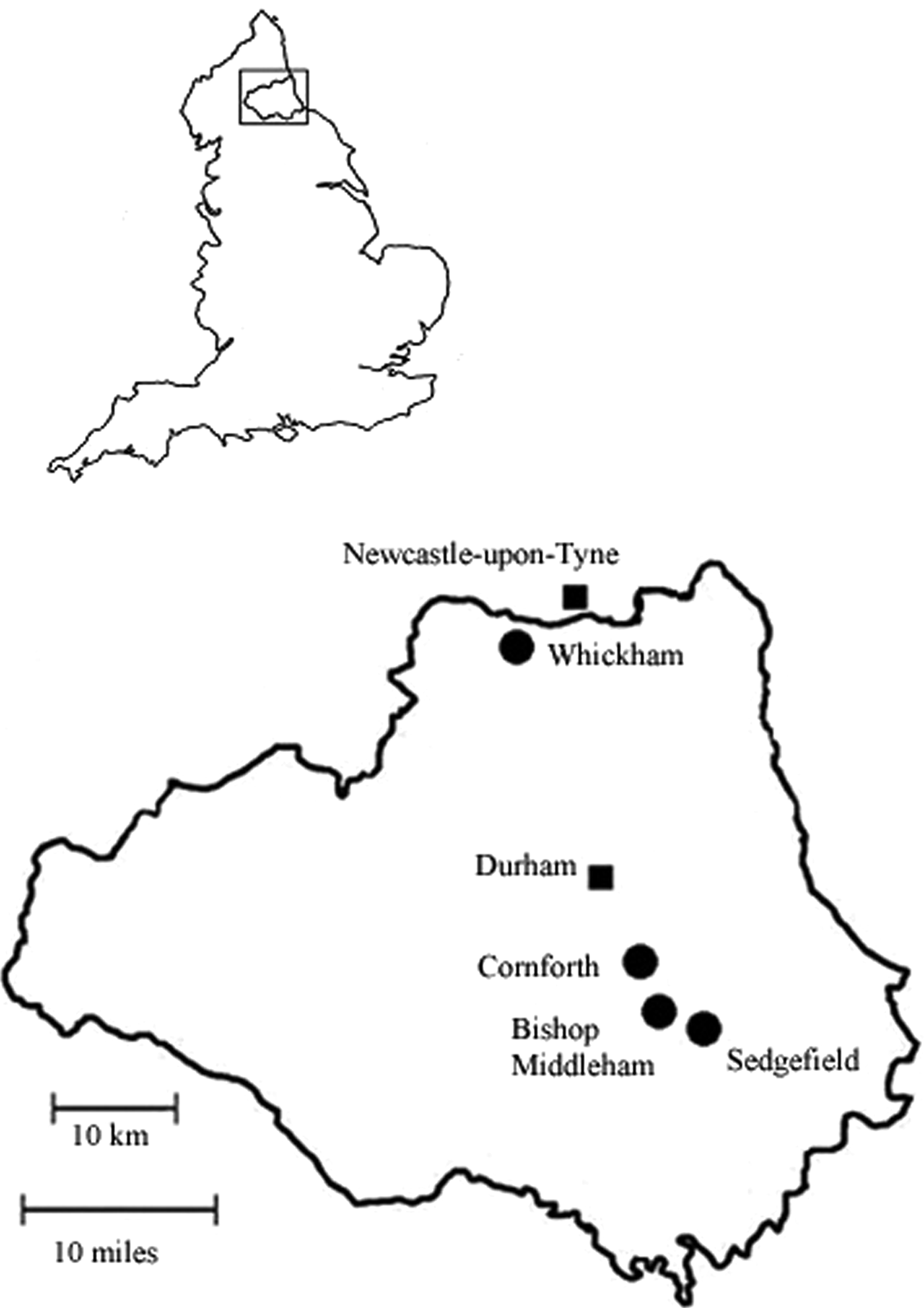
The villages of Bishop Middleham, Cornforth, and Sedgefield lay approximately eight to fifteen kilometres south and east of the city of Durham and formed an administrative unit of the Durham bishopric estate centred on Bishop Middleham (see Figure 1).Footnote 34 Those villages were the major settlements of the parish of Bishop Middleham, which was divided in 1580 with Sedgefield forming the centre of a new parish.Footnote 35 The three villages also comprised a judicial unit and served as one of the stops for the bishop's halmote court, with the bishop's steward and his retinue travelling throughout the county and holding court at ten estate centres such as Bishop Middleham (although later in the period meetings were held at Cornforth and Sedgefield as well). The circuit was held three times a year: spring, summer, and autumn, until 1512 when it began to meet only twice per year. The village of Bishop Middleham could be considered typical of many Durham villages in the Middle Ages with a mix of holdings and demesne land; Sedgefield was larger with a market; while Cornforth was a smaller village.Footnote 36 Two of the villages were enclosed in this period, Cornforth in 1626 and Sedgefield in 1636; the lands of Bishop Middleham would not be enclosed until 1693. The administrative, legal, economic, and religious connections, and the potential to observe patterns beyond a single village, means that a study of these three villages provides the benefits of a multi-village study while retaining a manageable sample size.Footnote 37
Pre-modern County Durham. Map created by author. Note: Circles indicate location names mentioned in the article; squares indicate major cities.

Firm population numbers are lacking but various estate surveys note the size of the tenant population, with 136 tenants and 171.5 residences in the three villages circa 1383; in 1588 there were 70 tenants and 96 tenants in 1642.Footnote 38 The Protestation Returns of 1641–1642 recorded 442 adult males, while the Hearth Tax of 1666 listed 268 households.Footnote 39 Converting the number of tenants and taxpayers into overall population requires care and cannot be done reliably, as it requires using different multipliers to render three categories (tenant, adult male, household) into a single category of population, but different approaches yield similar results. Applying a multiplier of 4.15 based on the analysis of Broadberry et al. of Josiah Russell's estimates using the 1377 Poll Tax to the number of tenants recorded in 1383 yields an approximate population of 565. Projecting that forward to 1545 with a multiplier of 1.13 (again based on Broadberry et al.’s study) yields an estimated population of 640. This is almost identical to an estimated population of 645 calculated by back projecting from an estimate of around 1,150 persons derived from applying Arkell's multiplier of 4.3 to the Hearth Tax returns.Footnote 40 That coincidence does not validate the result but at least suggests a degree of reliability for the approximations; data from the parish registers suggest a smaller population in 1545 and a much sharper increase in population in the seventeenth century, but those calculations do not account for migration. Nevertheless, the diverse sources show the slow and limited engrossment of holdings alongside the increase in population in the sixteenth and seventeenth centuries.Footnote 41
Information on landholding and land transfer is more reliable. The process of surrender and admittance ensured that nearly all land transactions were enrolled, although not all stages in a transaction were recorded as a matter of course; the halmote court was concerned with right, not possession or life interest. As the halmote court also enforced minor debts, breaches of contract, and failure to adhere to agricultural bylaws, these add to the pool of data on widows and land. The business of the court was taken down on paper, with business transacted outside court entered into blank spaces left for that purpose; later on, the records were transcribed onto parchment as a permanent record. The parchment books, now held in The National Archives, Kew, London, are extant for 1349–1619, with significant gaps for 1362–1388 and 1425–1437, while the paper booklets, held in Durham University Library Special Collections, survive for 1519–1925.Footnote 42 Counting other small gaps, this provides landholding data from 269 out of the 312 years chosen for this study.
The land transactions for the three villages were extracted from the halmote books, yielding 2,462 separate actions.Footnote 43 To maintain fidelity to the original record, transactions were entered into the database as they were in the halmote books, so database entries could include more than one discrete holding if that is how they were originally entered. Often only a single entry fine was recorded for multiple holdings and over time accumulated holdings began to be treated as a single holding. The exception to this method was when a conveyance and sublet were recorded together, as these indicate a transfer of possession if not right that can reveal other dynamics of the land market.
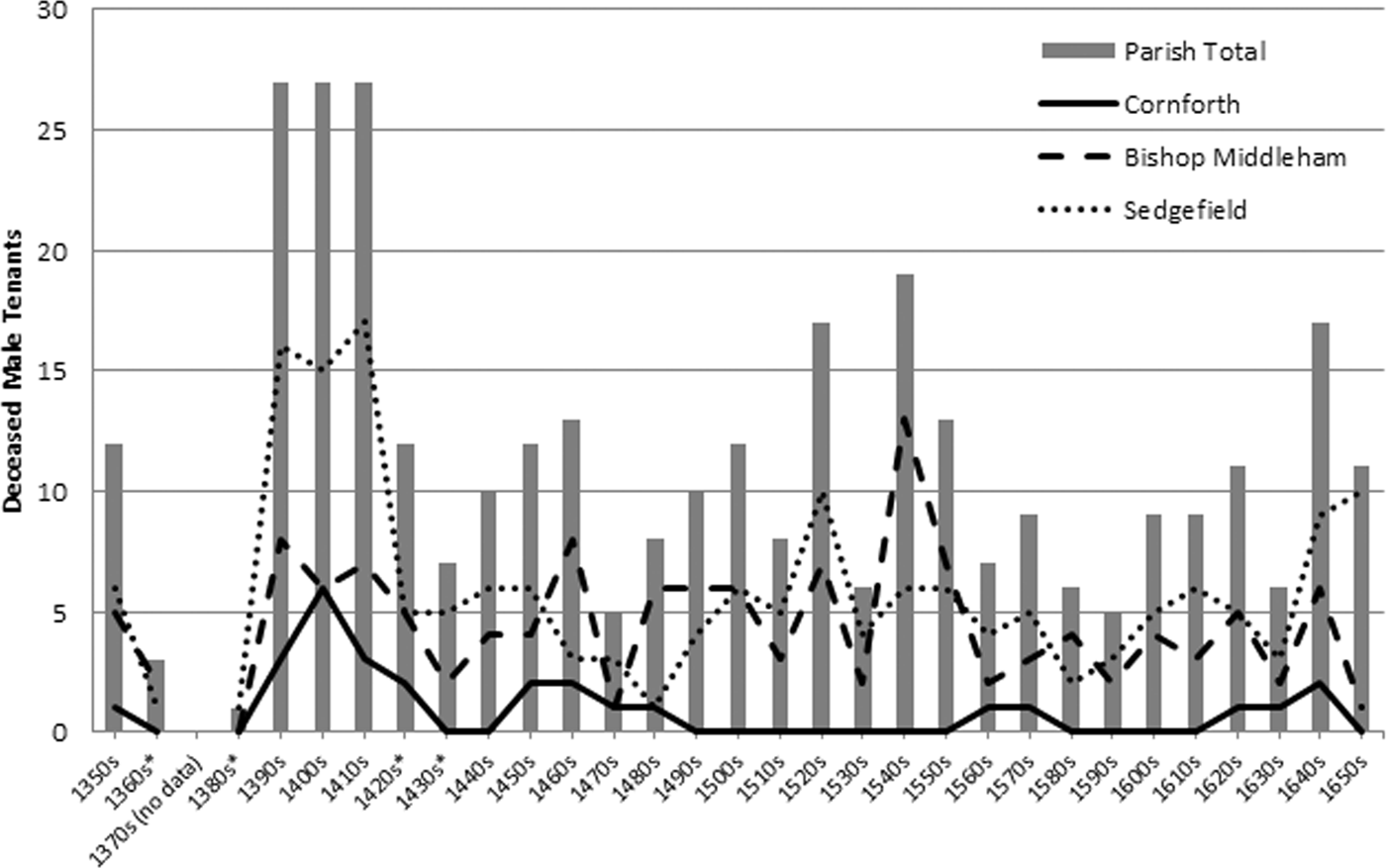
The collection of transactions included 511 post-mortem transfers of land, of which 427 followed the deaths of 341 different male tenants, broken down by village in Figure 2.Footnote 44 The apparently smaller number of male tenant deaths in the village of Cornforth is explained by a widespread shift to leasing lands in the early fifteenth century, which removes the most reliable measure of tenant mortality: the call for heirs to claim a holding.Footnote 45 As this data reflects post-mortem transfers, there are numerous factors that require any demographic analysis to be tentative, yet increases in recorded deaths (particularly for Sedgefield in the 1390s to 1420s and for Bishop Middleham in the 1540s) suggest periods of increased overall mortality.
Male tenant deaths in the parish. N = 341 individual male tenants. Note: The * on the x-axis labels indicate that only partial data survives for that decade. Source: The National Archive: Public Record Office, Kew, London, Palatinate of Durham: Chancery Court: Curistor's Records: Halmote Court Books DURH (hereafter TNA PRO DURH) 3/12-28 and Durham University Library, Special Collections, Durham Bishopric Halmote Records: Court Books (hereafter DUL-SC) DHC 1/I/1-83.

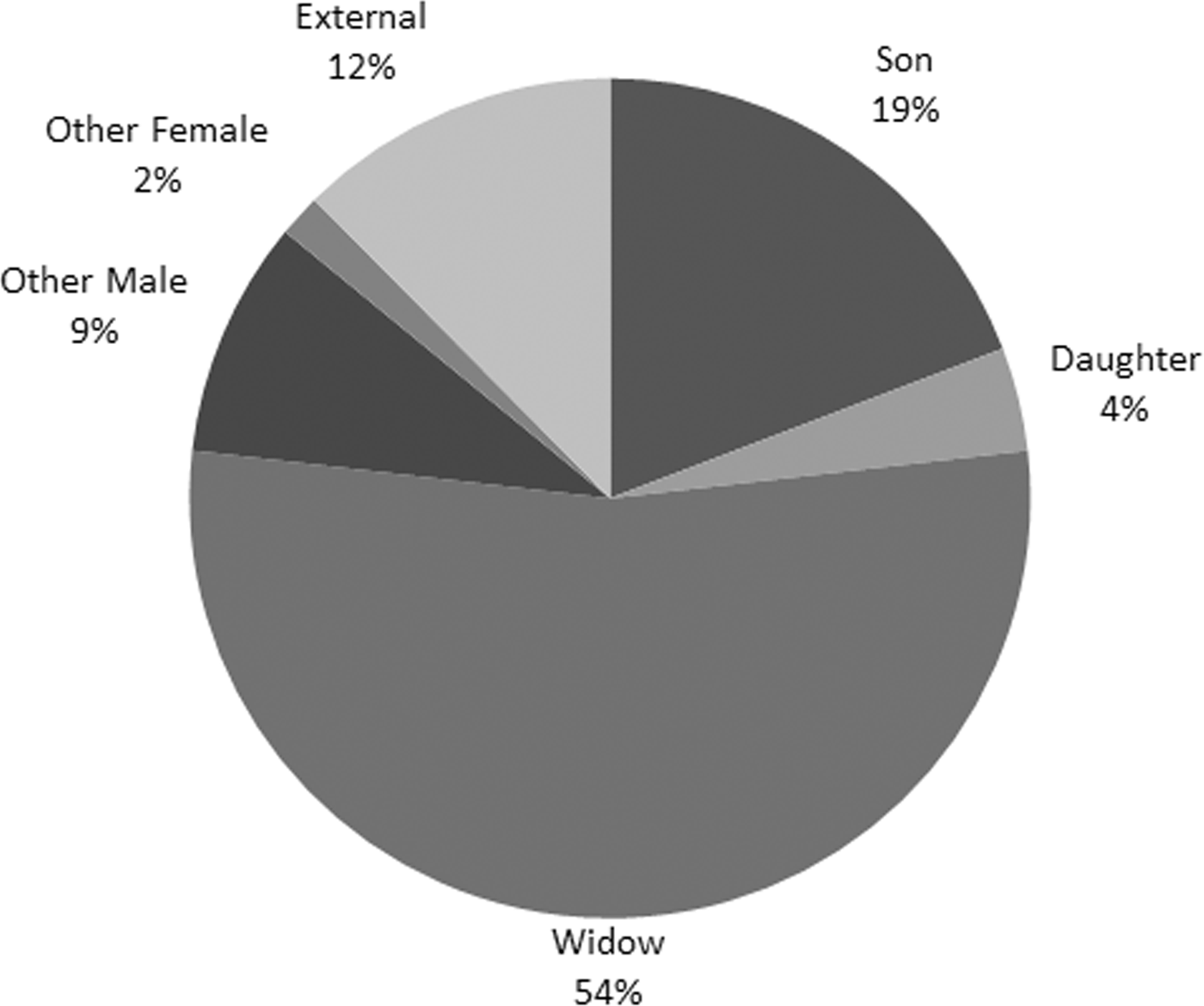
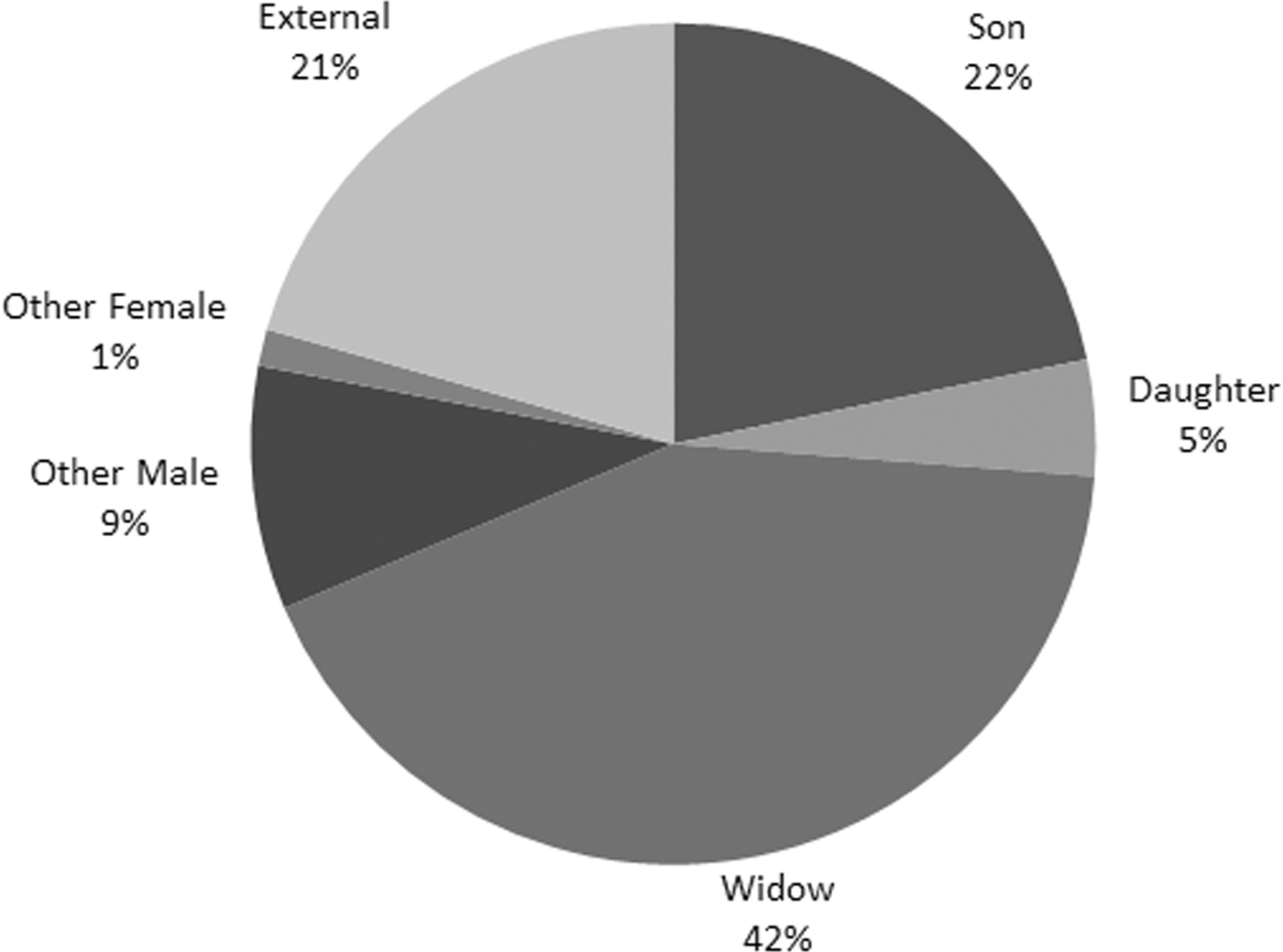
Figure 3 shows the nearest named heir to the holding while Figure 4 shows the first entry into the holding post-mortem. Heirs were recorded or could be deduced for 301 of the deceased male tenants; of these, widows were the most frequent at 57 per cent, with sons at 25 per cent and daughters at 4 per cent. However, the nearest heir did not always take up the holding and in the case of multiple holdings the nearest heir may have taken some but not others; the nearest heir declined 54 of the 427 total holdings (14 per cent). Examining the first entry into a holding, widows still comprised the largest group but now at 42 per cent, almost exactly twice as frequently as sons at 22 per cent, with holdings going to daughters only 4 per cent of the time. Interestingly, one of the daughters was Agnes, widow of Gilbert de Hoton; the entry makes it clear that she was taking land that had belonged to her father (John de Hardwick) and she would hold it in right and not widow-right, but the clerk listed her deceased husband Gilbert as the most recent tenant, demonstrating a mentality of coverture.Footnote 46 Overall, and including instances where no heir was named, lands went into the lord's hand or out of the family slightly less than they went to sons, at 21 per cent.
Nearest recorded heir to deceased male parish tenants.
N = 301 individual men; heirs were not named for an additional 40 men. Based on heirs named in the halmote court. Source: TNA PRO DURH 3/12-28 and DUL-SC DHC 1/I/1-83.

First entry post-mortem of male parish tenants for each holding. N = 427 holdings. Source: TNA PRO DURH 3/12-28 and DUL-SC DHC 1/I/1-83.

These proportions fall within the range demonstrated by other studies of customary tenants. In her study of sixteenth and seventeenth century wills from Kibworth Harcourt (which excluded villein land), Howell found that men left land solely to the widow 44 per cent of the time, and to a widow jointly with a kinsman (usually a son), 31 per cent of the time. The pattern varied depending on whether there were minor children, and the widow's term could end when the heir was of age; moreover a woman lost her lands if she remarried.Footnote 47 In pre-plague Thornbury (Gloucestershire), 58 per centFootnote 48 of new entrants were widows, compared to 37 per cent on the Winchester bishopric before the plague and 39 per cent after, whereas Thornbury sons were entrants 22 per cent of the time compared to 39 per cent and 31 per cent for Winchester bishopric. The major difference is how much more often lands left the family in these Durham villages: 21 per cent, compared to 7 per cent in Thornbury and 2 per cent and 1 per cent on the Winchester bishopric.Footnote 49 Although analysing deathbed transfers rather than a custom of widow-right in six manors for the later fourteenth and early fifteenth centuries, Smith found that 31 per cent of such transfers from a male tenant went to the wife/widow alone and another 9.1 per cent went to the widow and someone else jointly.Footnote 50 The variance in local conditions and customs, and the difference in periods examined, renders conclusions from such comparisons tenuous, but these do suggest that the inheritance by Durham widows, at least in these villages, was not atypical.
One question that often has not been asked (or it has not been possible ask) when looking at widows is, how frequently did widows decline their widow-right? The divergence between heir and first entry in Figures 3 and 4 indicates that looking solely at the inheritance is insufficient because it omits the widow's choice. Moreover, the question should be asked about individuals as well as holdings; that a widow kept one holding and declined another is significant and also different from discussing total numbers accepted or declined. Further exploration of these patterns should reveal not only more detail as to the workings of the land and marriage markets, but also more nuanced views about women and widows in particular localities.
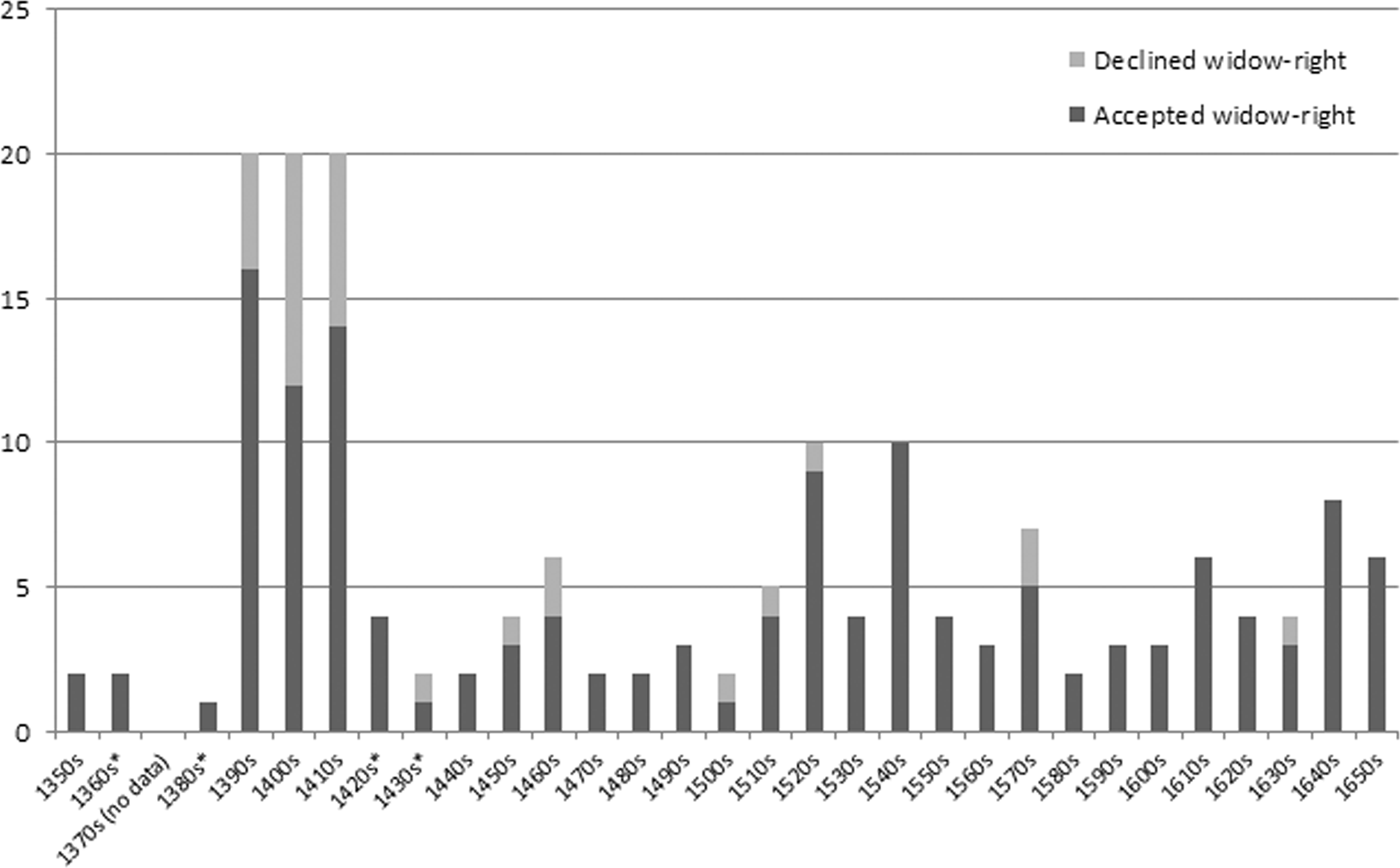
Of the 341 male tenants who died between 1349 and 1662, 173 (51 per cent) left a clearly identifiable widow.Footnote 51 Most widows (144, or 82 per cent) chose to take possession of some or all of their husband's holdings (Figure 5).Footnote 52 Of the 230 total holdings in which widow-right could be claimed, widows claimed their right in 172 (75 per cent); there were claims in a further ten leases or temporary occupations, such as the case of Juetta del Gate, widow of Robert del Gate in Cornforth, who was granted a ‘license to occupy [his] tenure’ for the remainder of the year. Within that time she married John Py, who took del Gate's lands at lease.Footnote 53 Looking solely at the period after 1438, for which the records are nearly continuous, 230 male tenants left 105 widows of whom 93 (89 per cent) took their right.
Widow-right taken and declined in the parish. Note: The * on the x-axis labels indicate that only partial data survives for that decade. Source: TNA PRO DURH 3/12-28 and DUL-SC DHC 1/I/1-83.

The legal need to record a widow declining her right should mitigate omissions, and so while some widows must have gone unrecorded, determining the scope of under-reporting in land transfers is difficult. The clerks were consistent in linking widows back to their deceased husband in other halmote business, allowing for identification of an unrecorded widow but only if mentioned in the records for some other reason; three such widows were identified this way and added into the 173 widows above, but others might simply never have appeared in other halmote business. Connecting widows to deceased male tenants is more difficult for the sixteenth and seventeenth centuries because the clerks ceased to note the deceased's first name and often referred to the widow solely by her surname; for this reason, although the parish registers survive from 1559 onward they are of limited use. For example, was the ‘widow Dawson’ who died in 1587 the widow of William Dawson (d. circa 1560–1561), Robert Dawson (d. circa 1563–1564), or yet another Dawson?Footnote 54 The limited range of first names further hinders clear identification. Those caveats must be kept in mind when attempting to identify widows of deceased tenants. Of the 98 male tenants who died between 1559 and 1660, a widow was listed in the post mortem conveyance(s) for 50 (51 per cent) and 46 (92 per cent) took up a holding in widow-right. Of the remaining 48 men for whom no widow was listed, a search of the parish registers yields 26 possible marriages; an additional 8 of the men appear to have had neither wife nor issue. Of those 26 potential marriages, the wife predeceased or likely predeceased her husband in 10 instances and in another 8 the connection is tenuous. That leaves 8 potentially unrecorded widows, three of whom shared one of the common village surnames, Hutchinson.Footnote 55 If all of those connections were valid, that would raise the number of men leaving widows to 58 (59 per cent), and lower the percentage of widows taking widow-right to 79 per cent. If a similar rate of omission were applied to the entire period, to create a safe lower estimate of widow-right, widows would still have taken widow-right 71 per cent of the time. Whether the overall average of widows taking up lands was 71, 82, or 89 per cent, or even higher in certain periods, quite simply it is clear that over more than three centuries most widows took most of the holdings offered to them, a remarkable consistency given the transformations England underwent during this time.
4. Widows as tenants
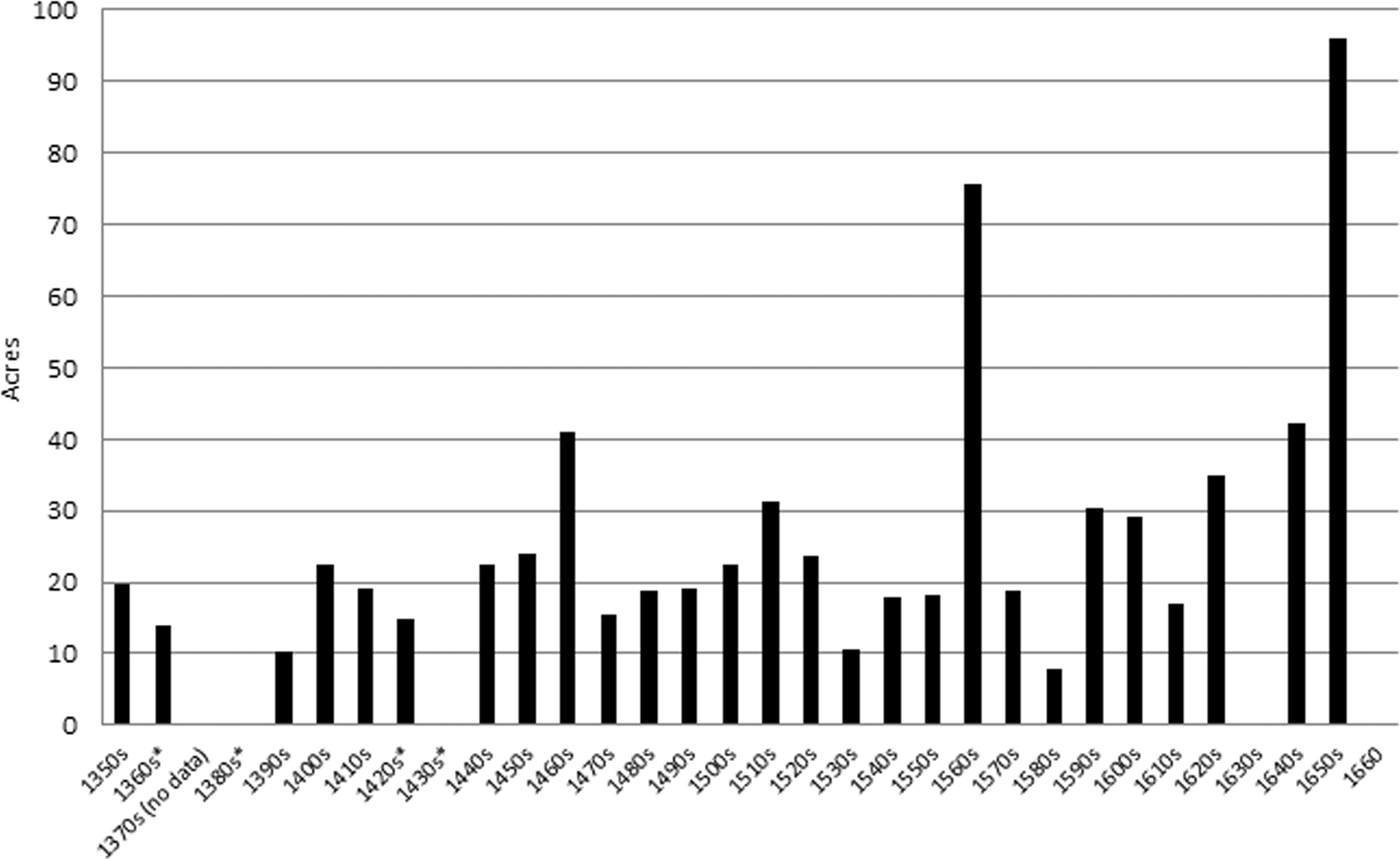
The size of the holdings implies that Durham's social and structural institutions facilitated women as capable holders or at least stewards of land, in that there is no greater evidence for their failure than for men.Footnote 56 Some widows’ holdings were small, and 26 (18 per cent) received no arable or pastoral land with their widow-right.Footnote 57 Others, such as the lands left by William Hall to his wife Helena, suggest rising yeomanry: more than 130 acres of arable and pasture lands, 11 unmeasured parcels and closes, and 14 residences (tenements and messuages).Footnote 58 Altogether, widows as tenants reflected the broader tenantry, which should be expected as there were no deathbed transfers to avoid widow-right; analysis of inter-vivos transfers confirms this. Although some holdings were broken up and clearing new lands had generated parcels of varying size, the basic tenurial structure still predominated: cottages with perhaps a garden but little to no arable land; cotlands (cottage-lands), which varied in size but frequently included 6 or 12 acres; husbandlands of 30 acres which were akin to the virgates and yardlands found elsewhere in England and were often noted as being comprised of two 15-acre parcels called bovates (or oxgangs); and in Sedgefield there was an unusual tenure, the malland, containing two bovates of 18 acres each. Engrossment in the late fourteenth century created another de facto category, double husbandlands and mallands of 60 or 72 acres (see Figure 6).Footnote 59
The average size of a holding for a widow who took lands in widow-right was 30.57 acres, close to the standard 30-acre husbandland.Footnote 60 Forty-one widows possessed holdings totalling 30 acres or more, putting them among the top ranks of the peasantry, and six of those widows held one hundred acres or more in widow-right. Widows like Helena Hall became instant landlords (or at least had the potential to be landlords) when their widow-right included multiple cottages or house plots (messuages); 26 widows fell into this category. While Alex Brown notes ‘the importance of widows in the inheritance of land and future transmission of holdings’ on the bishopric estate in the seventeenth century, the institution of widow-right had a mixed influence on the emergence of a yeoman group in the villages and over time the average size of the lands received in widow-right increased, reflecting the accumulation of holdings and increasing polarisation of wealth and status.Footnote 61 While widow-right as an extension of the deceased husband's tenure could preserve a holding for an heir and enable further engrossment, as seen above composite holdings could be broken up and the tendency for lands in widow-right to pass out of the family may have retarded the accumulation of very large holdings. Likewise, marriage to a widow often was a route to having land more so than having more land. In the fourteenth century, the average size of a holding for the widows who took land was 16 acres, slightly more than a bovate of husbandland and slightly less than the 18-acre bovate of malland. The average rose to 25 acres in the fifteenth century and then to 29 acres in the sixteenth century, but jumped in the seventeenth century to 54 acres. This change reflects an increasing number of large holdings in widow-right. The largest widow-right taken in the fifteenth century was 71 acres and 15 holdings were 15 acres or more, while in the seventeenth century the largest was over 194 acres and 10 widows took 30 or more acres. The increasing size of holdings in widow-right mirrored the increasing engrossment of lands while the variety in size reflected the surviving diversity of tenure and status, following a pattern similar to that which Brown described for his bishopric case studies but in marked contrast to the experience of the coal-mining village of Whickham.Footnote 62 The changes in economy and society that brought this about did not dislodge the acceptance, grudging or not, of widows as tenants.
Average acreage in widow-right taken in the parish, by decade. Note: The * on the x-axis labels indicate that only partial data survives for that decade. Source: TNA PRO DURH 3/12-28 and DUL-SC DHC 1/I/1-83.

The ubiquity of widow-right meant the passing of land to the next generation (or out of the family) could be delayed significantly.Footnote 63 The length of widow-right, whether to surrender or death, could be determined for 75 widows and on average widow-right lasted just over 12 years. This is twice the average that Jane Whittle found in four Norfolk manors in the fifteenth and sixteenth centuries, but just as in those manors, some Durham widows held their lands in widow-right considerably longer than average.Footnote 64 Only 7 widow-rights in Bishop Middleham parish lasted a year or less, while 37 were held for 10 or more years and 15 of those appear to have been held for 20 years or more. The longest discernible widow-right was that of Agnes, widow of Robert Sander, who took up a messuage called Hindleyland in 1551; the holding passed to her daughter Katherine after Agnes's death in 1604.Footnote 65 Another long widow-right was that of Alice, widow of Thomas Bentley; widowed in 1549, her granddaughter Helena Collinge took up the land in 1578 after Alice's death, and the halmote court book entry described Helena as ‘the blood and heir of Thomas Bentley, that is the daughter of Thomas Bentley son of the aforesaid Thomas Bentley’, her grandfather.Footnote 66 Agnes and Alice had exceptionally long periods of widow-right; whether this represented positive support for widows versus acceptance of widow-right as the lesser evil is a different question, but if there was pressure from family on widows to cede their lands to a new generation as has always been a distinct possibility in England, the halmote court and the overall tenantry provided sufficient support for widows to retain their lands.
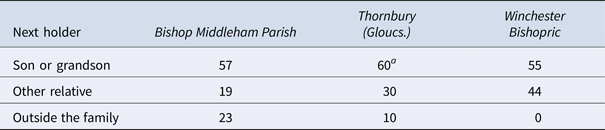
Some widows surrendered their lands during their lifetime, but more often these lands passed to a new tenant upon the widow's death; 30 widows surrendered their lands whereas new tenants were recorded entering after a widow's death 40 times and in another 6 instances the land had been taken into the lord's hand when the new tenant took it up.Footnote 67 A son or grandson was the recipient of 60 per cent of holdings surrendered by widows, another 7 per cent went to other relatives, and in 30 per cent of the surrenders the next tenant came from outside of the family; in one case, the widow had two holdings, one of which she surrendered to a son and the other to non-relative man. Generally, when a widow died the lands were more likely to stay in the family, with 57 per cent of lands passing to a son or grandson and 19 per cent to another relative after the widow's death, with the remaining 23 per cent going out of the family.Footnote 68
The post-mortem descent of land from widow to son in these villages is consistent with what has been found elsewhere, as seen in Table 1. The major difference lies in the descent of lands that did not pass to a son or grandson; in the manor of Thornbury and the Winchester Bishopric estate, the majority if not all of those lands passed to another family member, while in Durham, slightly more lands left the family than went to another family member. This indicates a potential link between widow-right and another factor, whether demography, migration, or attitudes to landholding, suggesting a potential future approach in studying these practices. That widows often retained the lands, when they could freely decline or later surrender the holdings, speaks of at least moderate success in managing those lands either directly or through subletting. There was no penalty for declining or surrendering a holding in widow-right, providing the widow with a choice subject to her own situation and any personal (rather than general) pressure.
Post-mortem descent of land held in widow-right in Bishop Middleham (County Durham), Thornbury (Gloucestershire), and the Winchester bishopric estate (%)

a Includes stepsons.
Sources: TNA PRO DURH 3/12-28 and DUL-SC DHC 1/I/1-83; Peter Franklin, ‘Peasant widows’ “liberation” and remarriage before the Black Death’, Economic History Review n.s. 39 (1986), 189–90; John Mullan and Richard Britnell, Land and family: trends and local variations in the peasant land market on the Winchester bishopric estates, 1263–1415 (Hatfield, 2010), 107.
5. Declining widow-right
In these Durham villages it was normal, perhaps even expected, for a widow to enter her deceased husband's holding, so the ubiquity of widow-right meant these widows – like many of the men of the parishes – could be found in small plots that might be little more than a cottage, or a garden: just enough to live in. The small number of holdings declined obviates reliable discernment of patterns in the size of the declined holdings, and other conclusions are tenuous at best. Overall, 27 per cent of those holdings that widows declined went to a son and 4 per cent to another relative; the remaining 69 per cent went to someone outside the family. In 8 per cent of those instances of a holding going to outside the family, the clerk noted that the son also refused the holding. Leaving aside the question of whether the widow wanted to take the holding, two factors may have influenced her decision to decline the land: pressure to give up the holding, and her ability to work or manage the holding. The consistency with which widows took lands suggests weak pressure to decline holdings and might suggest the reverse, that families and communities exerted pressure on widows to take the lands; as seen above, most lands held in widow-right stayed in the family while most of those declined left the family, and so family may have been a key element in supporting widows and perpetuating widow-right. The consistency in taking holdings in widow-right likewise suggests that widows were able to manage the holdings, with or without the help of children or a new husband; only two holdings were seized from a widow, a husbandland from Agnes Cape in 1355 ‘on account of her impotence’ and a messuage and 13 acres called Butlerplace from Agnes the widow of Thomas Jakson because she could not find pledges in 1421.Footnote 69 Other studies have emphasised how the availability of land affected a widow's choice to take the lands or remarry, observing that ‘[i]t was obviously difficult for women to meet the obligations of customary land’ or that widows relinquished land ‘to escape the burdens of estate management’, but these conclusions do not hold for these Durham villages.Footnote 70
That said, there was a significant drop in widows taking lands in the 1390s to 1410s that requires explanation.Footnote 71 In these three decades, 68 per cent of widows who could take land in widow-right did so. This period is the only one when both the frequency is markedly lower and the sample size is large enough for the lower number to be significant. One possible factor here is that the emergence of leasehold as a tenure and other changes in the land market led to greater precision in identifying widows. However, since there are no records from before the Black Death and only fragments for 1363–1387, we cannot determine whether this pattern was new.Footnote 72 If it were, then it could be the response to a diminished population. Another potential explanation lies in a sharp rise in tenant mortality in this period; there is another coincidence of high tenant mortality with a decline in widow-right in the 1450s and 1460s, although other peaks in mortality do not correlate with drops in widow-right. Furthermore, refusal of lands coincides with higher percentages of men leaving widows; an average of 77 per cent of tenants left a widow in these three decades, whereas the average for the 1450s and 1460s was 40 per cent and for the entire period, 51 per cent. That variation suggests more was involved than increased mortality such as broader trends in the land market, particularly the emergence on the bishopric of leasing lands for a term of years, or variations in accuracy in reporting widows with right.Footnote 73 Only five holdings declined by widows were then taken at lease, but the increased leasing may have discouraged widows. Many holdings in the early fourteenth century were held by the new tenant ‘at his peril’ (suo periculo) and carried no right, suggesting that the bishopric steward was concerned that they might not make the rent.Footnote 74 The volume of transfers in the land market and the shift to leasing indicated that many men were uncertain in what was a perfect storm: high mortality, a dynamic land market and tenure system in flux, and deteriorating holdings that together created instability. Since trends in widow-right reflected broader trends in landholding, it follows that, like men, widows were doubting their ability to cultivate the holdings successfully but also that this was not a problem specific to women or widows. Beyond holding or surrendering land, there is little evidence to judge ‘success’ in landholding by women or men in Durham during these centuries, and the scant evidence from wills in the later sixteenth and seventeenth century adds little; engrossment was not open to women – aside from inheritance and surrenders, the land market was a male preserve – but lack of engrossment does not necessarily imply lack of success.
6. Widowhood and rural society
The data from these villages suggest that, while the tenants of these three villages and the administrators of the Durham bishopric estate scrupulously observed the limitations of widow-right as a tenure, they also enabled the widow's right to hold her deceased husband's lands for as long as she wished. This becomes surprising given one critical element of tenurial practice across the bishopric estate: the basic building blocks of the landscape – the husbandlands, cotlands, and mallands – did not fragment during the later thirteenth and early fourteenth centuries as occurred in many other localities.Footnote 75 This made inheritance an all-or-nothing deal: a 30-acre husbandland could go to the widow, to one son, or to some new tenant, but it could not be divided among multiple heirs.Footnote 76 If a man died and left multiple holdings – two cottages, or a husbandland and a cotland, or the like – then multiple heirs could inherit, but the surviving widow still had the right to accept or decline each holding. The practice of widow-right thus put the widow in a strong position – legally emancipated and with a life interest in the land – that persisted even as society, economy, and other customs changed.
The practice of widow-right combined with Durham tenurial practices had implications for other aspects of rural life in the villages. A widow with land could make an appealing marriage partner, but widow-right affected the prospects of sons too. Some widows held onto the land for the sake of minor heirs, but the average length of widow-right and the rate at which land left the family means that often it was more than a temporary guardianship. For example, John Busby entered a cottage and acre in Sedgefield 20 years after his father's death.Footnote 77 Men such as John stayed with their widowed mothers and worked the lands with or for them, but others left to find their fortunes elsewhere. While 74 (22 per cent) of the 341 Durham men who died had some or all of their lands go to a son directly after their death, another 42 (12 per cent) had sons who did not receive lands until after a widow-right; thus nearly one third of sons inheriting post-mortem had to wait for their father's land. Besides post-mortem inheritance, a son could receive his father's land through an inter-vivos conveyance (or support from the father to enter another holding in the same village). But fathers were not providing lands for their sons in their lifetimes; only 34 men did so.Footnote 78 Thus a son could not rely on receiving his father's land during or after the latter's lifetime. If there were more sons than the land market evidence reveals – and disputes recorded in the court books do reveal younger sons – these landless sons had to turn elsewhere for their livelihood.
The prevalence of widow-right suggests that the (re-)marriage market and land market had a strong connection. In her study of sex ratios in late medieval England, Bardsley estimated there were 110 to 115 men for every 100 women, and the prevalence of widow remarriage in Durham would support that skewed ratio.Footnote 79 A preliminary analysis of marriage fines from the entire Durham bishopric from 1350 to 1450 shows that marriages to widows made up just under half (49 per cent) of all recorded marriages; and while the fine for marrying a widow could be higher than when marrying a never-married woman, the rates fell into the same general range of sixpence to two shillings.Footnote 80 For the first hundred years following the Black Death, marriage to a widow was, like widow-right, a regular element of Durham village life, at least for tenants. This is very similar to the 51 per cent of marriages involving a widow that Smith found in early fourteenth-century Cottenham but higher than found elsewhere, particularly for the post-plague period: in Ramsey Abbey from 1397 to 1458 only about 10 per cent of merchet payments were by widows, while on the Winchester bishopric estates between 9 per cent and 38 per cent of marriages involved a widow between 1350 and 1415.Footnote 81 The greater involvement of widows in the Durham marriage market reflects the interconnection of attitudes to tenure (in particular the inviolability of holdings) with both the land and marriage markets. Whittle attributed the absence of widow's right in the Norfolk manor of Hevingham to its active land market, as ‘a widow's rights to dower complicated the full alienation of land by her husband’.Footnote 82 Referring to the village of Brigstock (Northamptonshire), Bennett observed that ‘[its] land market was an active component of the local economy; with parcels of land changing hands at almost every court meeting, several dozen households altered the size or configuration of their landholdings every year’, while Britnell and Mullan remarked ‘that there was an increasing tendency, particularly during the fourteenth century, for holdings on the Winchester estates to be viewed less as hereditary family resources and more as marketable assets’.Footnote 83 By way of contrast, inheritance and marriage to a widow were the main ways of acquiring a holding in Cottenham before the Black Death, but the post-plague availability of land lessened the importance and value of marrying a landed widow.Footnote 84 The land market in Bishop Middleham and its neighbouring villages allowed for the acquisition of holdings outside of marriage and inheritance but this still required pledges and cash, whereas marriage to a widow was cheaper. This would have shaped attitudes about the acceptability or desirability of marriage to a widow, which alongside a shortage of women increased the greater proportion of widows in the marriage market. The inverse correlation that keeps cropping up between the land market on one hand and the rights of widows and widow remarriage on the other warrants systematic research to see whether the decline in remarriage observed elsewhere in England also occurred in the Durham bishopric villages in the early modern period.Footnote 85
Such research would address any changes that widows had in their choice to take up widow-right or remarry, especially in the absence of more narrative sources. The extent of women's agency is a major debate, particularly so for widows. Erickson has rightly challenged the ‘particularly masculine point of view’ in assumptions made about wealth and remarriage of widows, emphasising the need to consider other factors.Footnote 86 Barbara Todd noted that ‘[w]ealth seemed to have had less effect on changing remarriage patterns than one would expect’ although the husband's occupation or social standing does appear to have affected remarriage for certain groups.Footnote 87 Barbara Hanawalt saw greater choice and agency for rural widows, and Peter Fleming has described the late medieval period as a ‘golden age’ for those widows who had property; Peter Franklin talked about widows’ ‘liberation’ while linking remarriage with economic necessity and although Bennett rejected the concept of liberation, she did explore the options open to medieval widows.Footnote 88 Lori Gates consciously moved away from considerations of the land market to look at other economic, demographic, and social factors.Footnote 89 In Bishop Middleham, Cornforth, and Sedgefield, the widow's option to take her deceased husband's lands was a real one and not merely a legal formality. Hanawalt referred to a ‘self-limiting patriarchy’ in medieval London and Smith saw the ‘village notables’ as manipulating fines for marrying widows to keep lands within certain families, and similar concepts appear to be in operation.Footnote 90 Durham widows must have felt able to take their deceased husband's lands and run them, and their families may have even encouraged them to do so; and they were successful in doing so, just as Bennett found in pre-plague Brigstock.Footnote 91 The active subletting market helped widows to manage their lands, as a widow who found her holding too large could sublet all or part of her holding. Some widows with land chose to remarry and some did so out of necessity, but there is no evidence of pressure or economic need as was the case in late medieval Sussex, where widows regularly exchanged their lands for maintenance or an annuity.Footnote 92 Widows were an integral part of peasant society in this part of Durham as landholders and probably in the formation of new households as well.
7. Conclusions
The historian's usual challenge is to explain change, particularly within the late medieval and early modern periods; here the task is to explain why widow-right did not change over three centuries, either directly or through circumvention by increasing use of inter-vivos or deathbed transfers to sons. Widow-right was part of a broader, stable system yet elements of that system were in flux, first with leasing and then with the many transformations of the early modern period. One possible explanation lies in the geography and economy of the parish, and potentially of the broader region. The Durham land market attests to a stability of rural society; there was some periodic engrossment of lands, a larger landless population, and increased polarisation of society, but many aspects of rural Durham in 1500 and 1660 were remarkably similar to 1349; even the enclosure of Sedgefield appears not to have led to immediate disruption of local society.Footnote 93 The sluggish land market strengthened widow-right, as the custom provided stability and, in a period of reduced or declining population, a larger tenant base. Widow-right prevailed even in the sixteenth century when demand for land rose and elsewhere in Durham lords threatened to replace copyhold tenure or tenure in right with less secure and therefore more profitable leasehold. For example, in the tenurial disputes in Weardale and on the Dean and Chapter estate, widow-right served as evidence in court alongside claims of military border service that might seem incompatible with a widow as tenant, suggesting that widow-right was a deeply ingrained part of rural culture. That should hold true in the three villages of Bishop Middleham, Cornforth, and Sedgefield, where military service was never part of a tenant's obligations.Footnote 94
Maryanne Kowaleski notes that ‘[m]edieval demography is still a new frontier for feminist scholars, but it is the field most likely to show the powerful role of the undocumented, non-elite majority in shaping the medieval world’, and the practice of widow-right in Durham is an entrée into how gender influenced demographic (and economic) trends.Footnote 95 The consistency of Durham widow-right and the absence of attempts to undermine or circumvent it seem to represent an acceptance of the widow as householder and tenant. If the remarriage of widows, at least in the late medieval period, was frequent then there are repercussions in other areas of women's lives. The remarriage of widows indicates a scarcity of unmarried women, whether due to fertility or mortality, or else landholding through widow-right provided widows with an edge over unmarried women who then had to migrate for marriage or employment. The low rate of sons receiving lands from fathers suggests similar issues facing young men, who had to migrate for lands or work if they did not marry a landed widow. Altogether this implies a flexibility or ephemerality of the household, with sons and perhaps daughters leaving and widows remarrying so that lands often changed hands from generation to generation. The persistence of certain surnames and lineages by contrast suggests stability of the parish and village community; the patterns in widow-right and widow remarriage may not even have been possible without a strong community.
The apparent prominence of widows in the Durham bishopric marriage market affected society too; as Bennett notes, ‘[a]ll these women, however, especially when widowed, could aspire to public power, not only as heads of households, but also as controllers of the economic resources left by their husbands.’Footnote 96 Taking on the lands of their deceased husbands may not have provided these Durham widows more standing in the village economy, and it did not permit them to hold office or serve on the jury, but the men leading the village took their needs into account – otherwise widows would not continue to take lands so consistently. Widow-right provided women with increased influence in other areas of life, although the biases of medieval recordkeeping in Durham hide this from view. Widows comprised a small group within the Durham tenantry, and they did not possess public authority, but the regularity of widow-right does provide a sound argument for asking those questions. More importantly, this study indicates the need for similar investigations of other areas in England and beyond to determine where, when, and why similar patterns of widow-right and concomitant effects occurred elsewhere. Areas with low pressure on land would be ideal starting places, as marriage and the land market are so closely connected. Likewise, where the practice of widow-right was not as stable, the factors driving those changes must be sought in local conditions, rather than assuming the change as natural. Such research will expand not only the history of women in England, but provide new insights into the broader mechanics of rural society.
The roles of the widow in these Durham villages in contrast with widows elsewhere in pre-modern England demonstrate the complexity of gender relations in accordance with local conditions and context. These widows were not necessarily powerful, as their rights existed at the sufferance of men; their position and opportunities could have been modified or curtailed to their detriment.Footnote 97 This did not happen, and in large part the answer likely is that the economic and demographic systems did not push local men towards such changes; but there is more than economic determinism at work and the choices of men and women sustained these patterns.Footnote 98 Preserving the right of the widow was in the interests of many; it gave the widow a better chance of economic security, and both represented and provided a significant degree of agency in her life. Widow-right may have been perceived as the extension of the deceased man's right in land, but in reality it enabled widows to remarry or to cultivate the land on their own. Widow-right presumed that widows were capable; other than not expanding their holdings, there is no clear evidence that widows were any less successful than other tenants.
This discussion of widow-right has one glaring exception: widows who did not hold customary land either because their husband held no land or because he transferred it during his life.Footnote 99 If a man ‘sold’ his lands during his lifetime, what then happened to his future widow if he were to die? It is possible that some such men made provisions for the widow; if not, she could to look to children for support or find a new husband, or else face penury on her own. That many widows took their widow-right and died with their lands suggests the desire or need for those lands and the support or freedom that they brought, a conclusion that would be strengthened if landless widows remarried with greater frequency. This indicates a significant division in the histories of widows between those widows with land and those without, underscoring the diversity of women's experiences.
Acknowledgements
This article comes from a larger project, supported by a Huntington Library / British Academy Short-Term Fellowship and a Pauley Endowment Travel Award from the University of Central Florida Department of History. I would like to thank the following individuals for their feedback and suggestions at various stages as this article evolved: Judith Bennett, Ben Dodds, Amy Froide, Emily Graham, Anna Jones, Nicole Sidhu, and Gregory Thompson. I also am grateful to the anonymous readers for their engaged and supportive critiques, and to the editors for all of their assistance. All errors remain mine.