Introduction
The long-established concept of the family Lobariaceae Chevall., comprising the genera Sticta (Schreb.) Ach., Pseudocyphellaria Vain. and Lobaria (Schreb.) Hoffm., has recently been revised based on a phylogenetic study which revealed 12 genera instead of the three mentioned above (Moncada et al. Reference Moncada, Lücking and Betancourt-Macuase2013). The present study follows the generic divisions proposed by Moncada and collaborators and takes a critical look at some species within the genus Ricasolia De Not., which was previously treated as section Ricasolia (De Not.) Vain. within Lobaria s. lat. (Yoshimura Reference Yoshimura1971). We focus particularly on the genetic diversity within foliose specimens of the generic type species R. amplissima (Scop.) De Not. from Europe and North America. While in the Old World R. amplissima is a well-known lichen of humid, nemoral habitats in Europe, North Africa, Asia Minor and the Canary Islands, three morphological variants of this species have been reported for North America: a composite specimen from northern California (Tønsberg & Goward Reference Tønsberg and Goward2001), a foliose specimen from south-eastern Alaska (Tønsberg & Goward Reference Tønsberg and Goward2001) and a dendriscocauloid specimen from Montana (McCune et al. Reference McCune, Rosentreter, Spribille, Breuss and Wheeler2014) (all identified as Lobaria amplissima (Scop.) Forssell). However, additional foliose specimens have been found in at least 23 other sites in Alaska, epiphytic on the trunks and lower branches of old-growth Picea sitchensis (Bong.) Carr. and Tsuga heterophylla (Raf.) Sarg. forests of marine beaches (Dillman Reference Dillman2004, Reference Dillman2010). In assessing the placement of the Alaskan population, however, three clear distinctions from European R. amplissima emerged: the lack of chemical compounds, the lack of erumpent cephalodia or the dendriscocauloid form in close proximity, and the lack of fertile apothecia.
Early attempts to identify the Alaskan material by Derr and others suggested that it could be closely related to one of four morphologically similar species formerly in the genus Lobaria s. lat.: Lobaria japonica (Zahlbr.) Asah. (hereafter referred to as Ricasolia japonica), R. amplissima, R. quercizans (Michx.) Stizenb. or R. virens (With.) H. H. Blom & Tønsberg. Ricasolia amplissima and R. quercizans are morphologically similar and can be indistinguishable without the analysis of secondary products. While the European R. amplissima produces mainly scrobiculin (Culberson 1967 Reference Culbersona , Reference Culbersonb , Reference Culberson1969; Huneck et al. Reference Huneck, Follmann and Redón1973; Elix & Tønsberg Reference Elix and Tønsberg2006), North American R. quercizans contains abundant gyrophoric acid (Hale Reference Hale1957; Culberson Reference Culberson1969; Jordan Reference Jordan1973). However, no lichen substances were detected by thin-layer chromatography (TLC) of R. amplissima samples collected in Alaska (Dillman Reference Dillman2010) or in the specimen from California (Tønsberg & Goward Reference Tønsberg and Goward2001). Lichen substances were not detected in European specimens of erumpent cephalodia attached to the chloromorph of R. amplissima (Culberson 1967 Reference Culbersonb ; James & Henssen Reference James and Henssen1976; Tønsberg & Holtan-Hartwig Reference Tønsberg and Holtan-Hartwig1983) nor are they found in the morphologically similar East Asian R. japonica (Yoshimura Reference Yoshimura1971) or the European R. virens (Schumm Reference Schumm2003).
In Europe, erumpent cephalodia are known to occur as coralloid extensions on the dorsal surface of some cyanolichens (Moreau Reference Moreau1921; Kaule Reference Kaule1932; James & Henssen Reference James and Henssen1976; Tønsberg & Holtan-Hartwig Reference Tønsberg and Holtan-Hartwig1983; Cornejo & Scheidegger 2013 Reference Cornejo and Scheideggera ). The dendriscocauloid forms are often called cyanomorphs when they occur sympatrically with the foliose thalli (chloromorphs) of R. amplissima and are believed to have become detached from the foliose thalli. Genetic tests of European material have identified the same fungal component within foliose R. amplissima and its dendriscocauloid form (Armaleo & Clerc Reference Armaleo and Clerc1991; Stenroos et al. Reference Stenroos, Stocker-Wörgötter, Yoshimura, Myllys, Thell and Hyvonen2003), which supports this concept. In North America, erumpent cephalodia were not detected in any of the south-east Alaskan populations, nor were dendriscocauloid forms observed in close proximity. The aforementioned tiny, composite California specimen from a dry oak savannah is the only known exception in North America where the R. amplissima chloromorph and dendriscocauloid form are attached to one another (Tønsberg & Goward Reference Tønsberg and Goward2001).
Tønsberg & Goward (Reference Tønsberg and Goward2001) proposed treating the North American specimens as Lobaria (Ricasolia) amplissima but, from a biogeographical point of view, R. japonica or R. quercizans could be valid alternative species as well. An Asian common ancestor of R. japonica and North American material could have migrated across the Bering Land Bridge which has been frequently demonstrated to be an active pathway for the migration of seed plants, ferns, lycophytes and bryophytes between Asia and North America (Schofield Reference Schofield1988; Xiang & Soltis Reference Xiang and Soltis2001; Manos & Meireles Reference Manos and Meireles2015; Xiang et al. Reference Xiang, Wen and Peng2015). Alternatively, North American material could share a common ancestor with R. quercizans. Biogeographical analyses of bryophytes and seed plants provide evidence that floristic disjunction between eastern and western North America represents the fragmentation of a once continuous mixed forest community (Schofield & Crum Reference Schofield and Crum1972; Xiang et al. Reference Xiang, Soltis and Soltis1998; Shaw Reference Shaw2001; Xiang & Soltis Reference Xiang and Soltis2001; Shaw et al. Reference Shaw, Werner and Ros2003; Manos & Meireles Reference Manos and Meireles2015).
In the present study, we investigate the taxonomic position of the North American foliose material from Alaska under the hypothesis that it belongs to one of four closely related Ricasolia species from: Europe, 1) R. amplissima and 2) R. virens; North America, 3) R. quercizans; or Eastern Asia, 4) R. japonica. For this purpose, morphological and chemical patterns were investigated and a molecular phylogeny was generated based on three genetic markers: nuclear ITS and RPB2, and mitochondrial SSU. The taxonomy of, and phylogenetic relationships between, erumpent cephalodia and the dendriscocauloid form of this (and other) species complexes are not addressed in this analysis.
Material and Methods
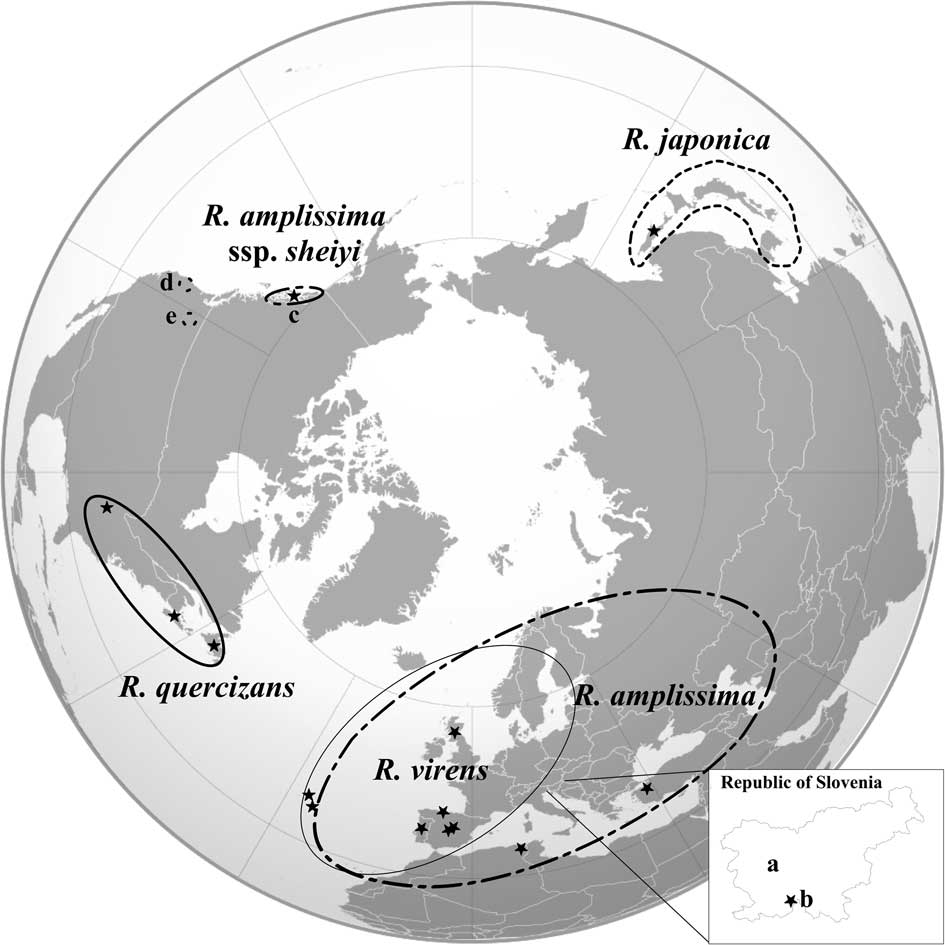
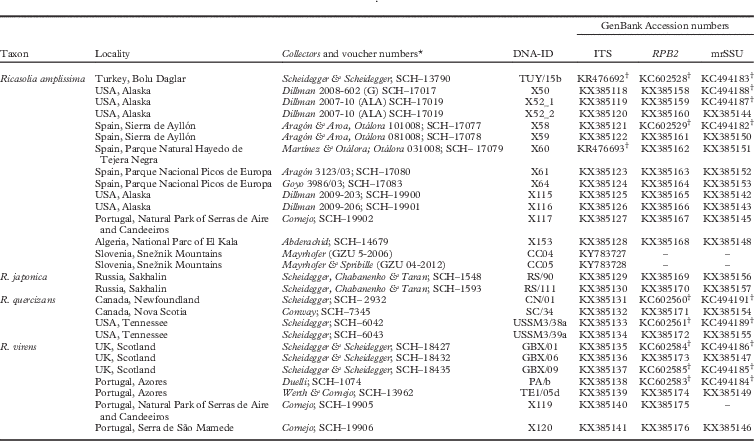
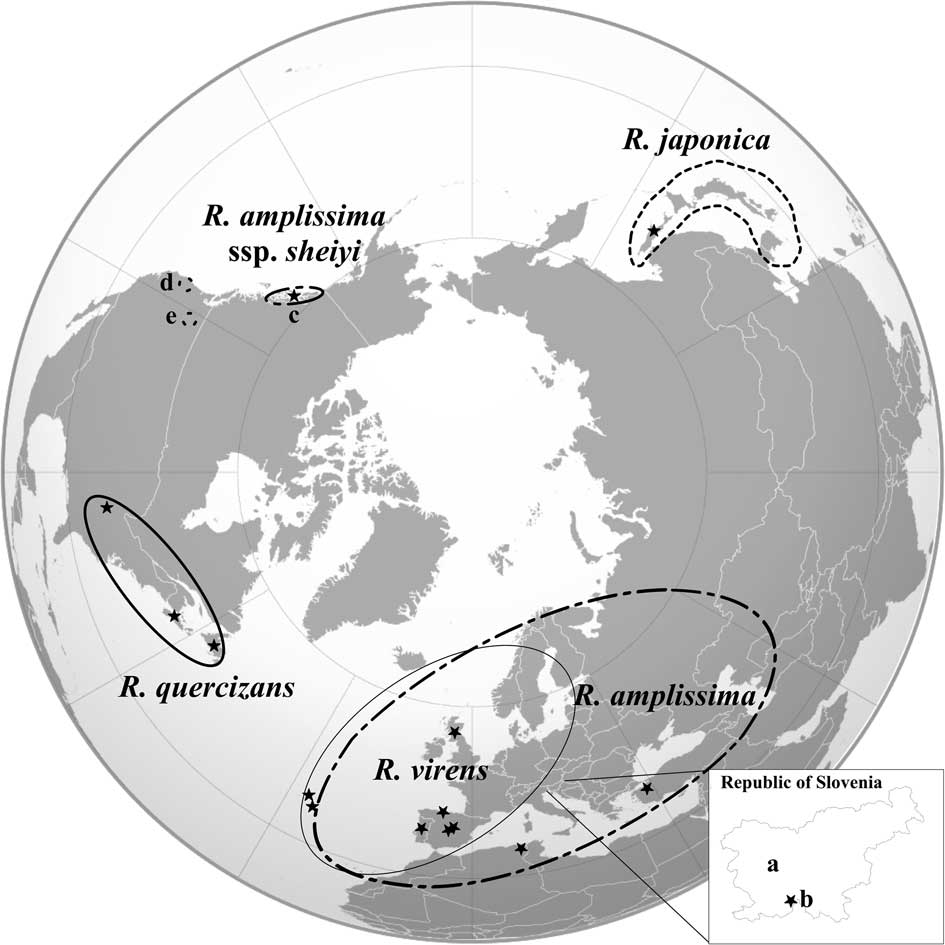
The present work studies species within the reinstated genus Ricasolia with emphasis on the type species R. amplissima from Europe and North America (specifically Alaska). For this purpose, fresh material was collected during different field excursions in Alaska and the Sakhalin and Macaronesian Islands, and stored air-dried and frozen (−20°C). Honegger (Reference Honegger2003) demonstrated that soft cell structures within highly hygroscopic lichens disintegrate within a few years if specimens are kept at room temperature, challenging the usual conditions applied in herbaria for the preservation of fungi (temperature 20–23°C, humidity 40–60% RH; Ariyawansa et al. Reference Ariyawansa, Hawksworth, Hyde, Jones, Maharachchikumbura, Manamgoda, Thambugala, Udayanga, Camporesi and Daranagama2014). Thus, to slow down DNA degradation, we kept the lichen material frozen in our lichen collection until examination (hb. Scheidegger; WSL). Table 1 lists voucher information for the specimens sampled, and Table S1 (see Supplementary Material, available online) lists all sequences obtained from GenBank (NCBI suite: http://www.ncbi.nlm.nih.gov/). Figure 1 shows the known range of R. amplissima and allied species.
Circumpolar map showing the distribution (delimited by solid and dashed lines) and collection sites (★) of Ricasolia species used in this study. Sites of note for R. amplissima include a, holotype, Idrija, Republic of Slovenia; b, Snežnik Mountains, c. 65 km from Idrija; c, foliose specimens from south-eastern Alaska; d, small, composite specimen, northern California, USA (Tønsberg & Goward Reference Tønsberg and Goward2001), not included in this analysis due to degraded DNA; e, dendriscocauloid form, Montana, USA, (McCune et al. Reference McCune, Rosentreter, Spribille, Breuss and Wheeler2014). (Circumpolar map: Wikimedia Commons (Rob984); map of Slovenia: d-maps.com).
Voucher information for the sequenced Ricasolia specimens used in this study together with their GenBank Accession numbers
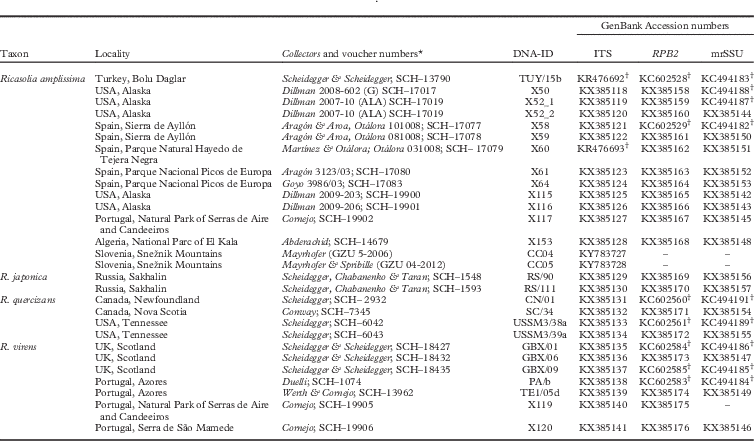
* all SCH–specimens are in the frozen collection of C. Scheidegger at the Swiss Federal Research Institute WSL.
† Sequences published in Cornejo & Scheidegger (Reference Cornejo and Scheidegger2015).
Chemical analyses were performed using standard TLC techniques (Culberson & Ammann Reference Culberson and Ammann1979; White & James Reference White and James1985). Secondary substances were extracted in acetone for c. 10 min at 40°C. The extracts were spotted on pre-coated Merck silica gel F254 plates and eluted in three solvent systems: A) toluene: dioxan: acetic acid (180:45:5 ml); B) hexane: diethylether: formic acid (130:100:20 ml); and C) toluene: acetic acid (200:30 ml). For each solvent system, we used a separate plate spotted with the same extracts. The plates were examined first by UV light at 254 nm and 366 nm wavelengths. The plates were then immersed briefly in a sulphuric acid bath, air dried and heated in an oven at 100 °C for c. 15 min. Identification of the substances was made by comparison with known references from our laboratory.
The DNA isolation of all specimens, the polymerase chain reactions of the ITS and RPB2 loci, and the cycle sequencing were performed as described in Cornejo & Scheidegger (Reference Cornejo and Scheidegger2010). Additionally, we used the primer set mrSSU1 and mrSSU3R for the amplification of the mitochondrial small subunit of the RNA gene according to Zoller et al. (Reference Zoller, Scheidegger and Sperisen1999).
Sequences were aligned in DNA Workbench 7 (CLC bio, Aarhus, Denmark) and corrected by hand if necessary. Regions with ambiguous alignments were excluded from all analyses by processing all datasets with Gblocks 0.91b (Castresana Reference Castresana2000; Talavera & Castresana Reference Talavera and Castresana2007) on the Phylogeny.fr platform (Dereeper et al. Reference Dereeper, Guignon, Blanc, Audic, Buffet, Chevenet, Dufayard, Guindon, Lefort and Lescot2008). Phylogenetic trees were reconstructed by maximum likelihood (ML) and Bayesian statistics (based on a Markov chain Monte Carlo algorithm), using PhyML 3.0 (Guindon & Gascuel Reference Guindon and Gascuel2003; Guindon et al. Reference Guindon, Dufayard, Lefort, Anisimova, Hordijk and Gascuel2010) on the ATGC platform (www.atgc-montpellier.fr) and BEAST 1.8.2 (Drummond & Rambaut Reference Drummond and Rambaut2007) on the CIPRES Science Gateway (Miller et al. Reference Miller, Pfeiffer and Schwartz2010), respectively. For phylogenetic analyses, the interactive software jModelTest v.0.1.1 (Guindon & Gascuel Reference Guindon and Gascuel2003; Posada Reference Posada2006, Reference Posada2008) and the Akaike Information Criterion (AIC) or the corrected AICc for short samples (Akaike Reference Akaike1973; Hurvich & Tsai Reference Hurvich and Tsai1989) were used to select the model that best fitted our data. Bootstrap confidence values (B) were calculated for 1000 pseudoreplicates (Felsenstein Reference Felsenstein1985). To obtain the Bayesian posterior probabilities (PP), a maximum clade credibility tree was generated by analyzing the BEAST tree file in TreeAnnotator v.1.8.2 (available from http://beast.bio.ed.ac.uk/). Phylograms of both concatenated and single locus datasets were produced with TreeGraph 2 (Stoever & Mueller Reference Stoever and Mueller2010). Detailed specifications on phylogenetic analyses are available in Cornejo & Scheidegger (Reference Cornejo and Scheidegger2015).
Single locus trees were used to detect conflicting phylogenetic signals among the sampled markers. For this purpose, clades of the separate gene trees were examined for well-supported (≥700 of 1000 replicates) conflict between maximum likelihood phylogenies. A restricted dataset excluding specimens that were represented by only one sequence was used to concatenate the three genes in order to improve the detection of monophyly. The combined matrix contained 2405 nucleotide sites and included 37 terminal units, 29 of which were represented by three genes, and eight by two genes (Table 1; Table S1). Moncada et al. (Reference Moncada, Lücking and Betancourt-Macuase2013) have shown that taxa of Dendriscosticta Moncada & Lücking, Lobariella Yoshim. and Yoshimuriella Moncada & Lücking belong to different closely related genera within Lobaria s. lat. Taxa of these genera were therefore chosen as outgroup to test the monophyly of the ingroup. Bifurcations of B≤700 and PP≤0·90 support were considered statistically non-significant and collapsed using the software TreeGraph, with the exception of branches with ambiguous results shown on trees. A phylogenetic species was considered strongly supported if a particular lineage exhibited monophyletic patterns in a majority of sampled loci (genealogical concordance), which were not contradicted by phylogenetic patterns in other loci (genealogical non-discordance) (Taylor et al. Reference Taylor, Jacobson, Kroken, Kasuga, Geiser, Hibbett and Fisher2000; Dettman et al. Reference Dettman, Jacobson and Taylor2003, Reference Dettman, Jacobson and Taylor2006).
Results and Discussion
Phylogenetic patterns within the genus Ricasolia
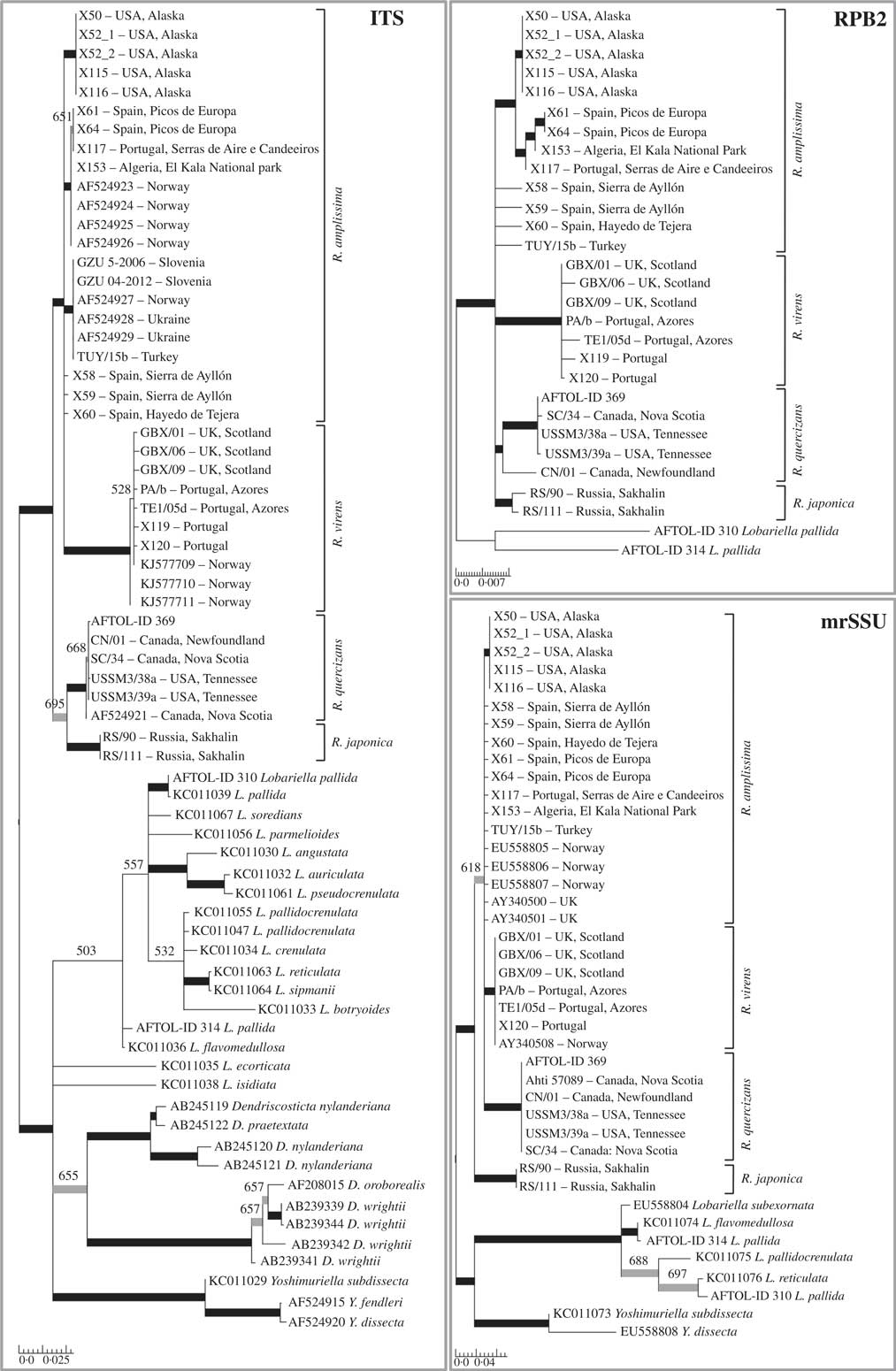
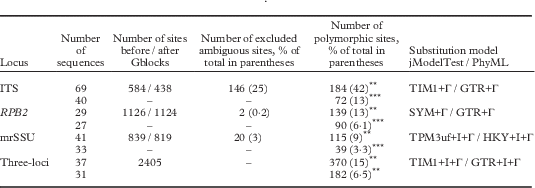
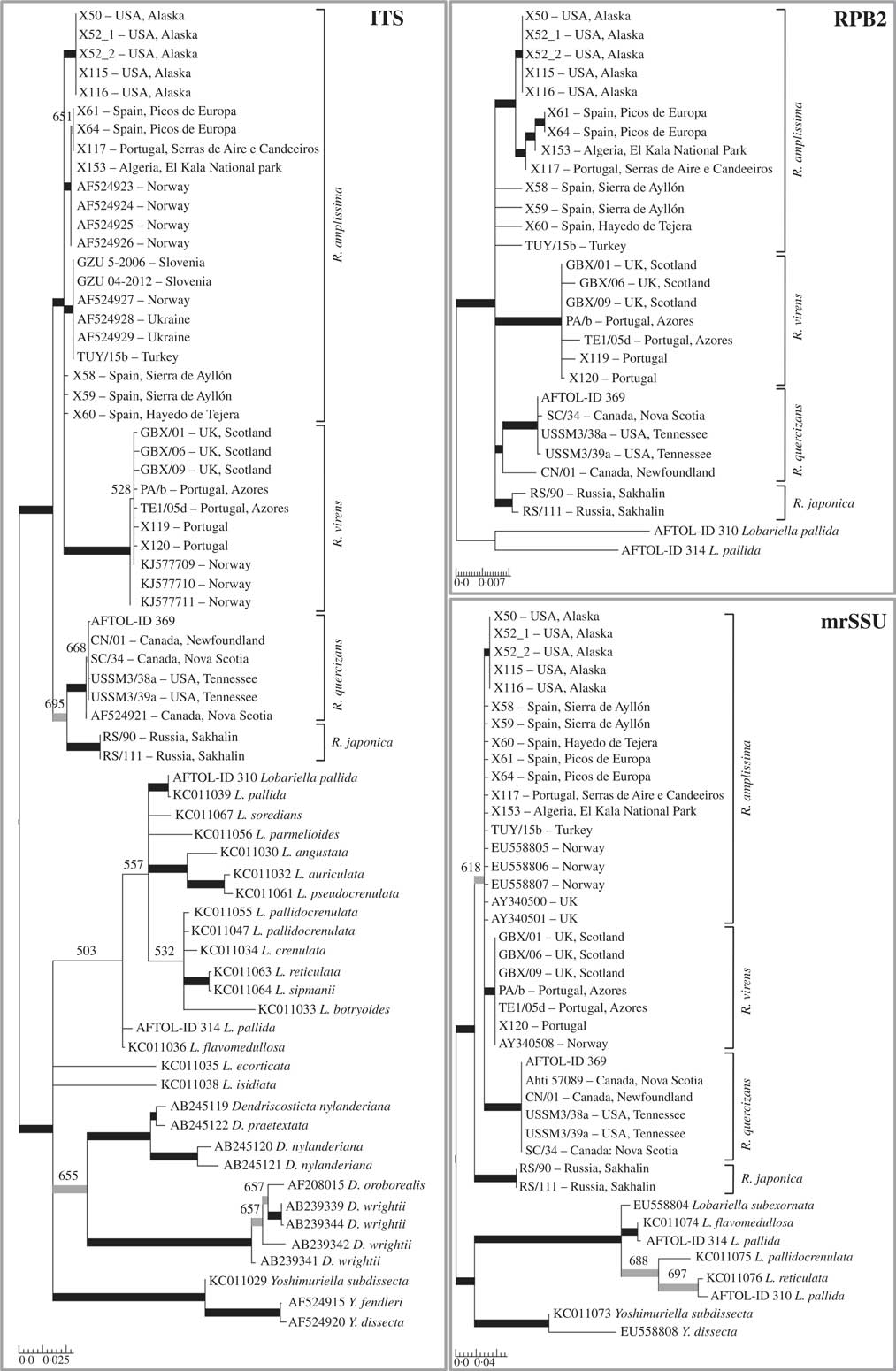
For this study, 26 ITS, 19 RPB2 and 16 mrSSU sequences were newly sampled. Table 2 summarizes information on data matrices and the results of analyses with Gblocks and jModelTest. A few important herbarium specimens were collected a long time ago and their extracted DNA was of poor quality. This is the case for the Californian and Alaskan specimens of R. amplissima collected in 1999 (Tønsberg & Goward Reference Tønsberg and Goward2001) and received from HSU and BG, respectively, as well as the Slovenian specimens collected in 2006 and 2012, both received from GZU. PCR of these samples failed in most cases and only ITS sequences of GZU-5-2006 and GZU-04-2012 were obtained. Figure 2 shows the single-locus trees graphically edited with the software TreeGraph, which was used to collapse all branches with bootstrap values B<500 (of 1000 replicates). Because all singlelocus trees presented a concordant topology, multilocus analyses were performed based on a concatenated dataset.
Maximum likelihood phylograms of Ricasolia species, resulting from single locus analyses of ITS, RPB2 and mrSSU sequences. Specimens of the genera Dendriscosticta, Lobariella and Yoshimuriella were used to root the trees. Bootstrap values are indicated as follows; thick black lines >700 (of 1000 replicates); thick grey lines=600–700; thin black lines=500–600.
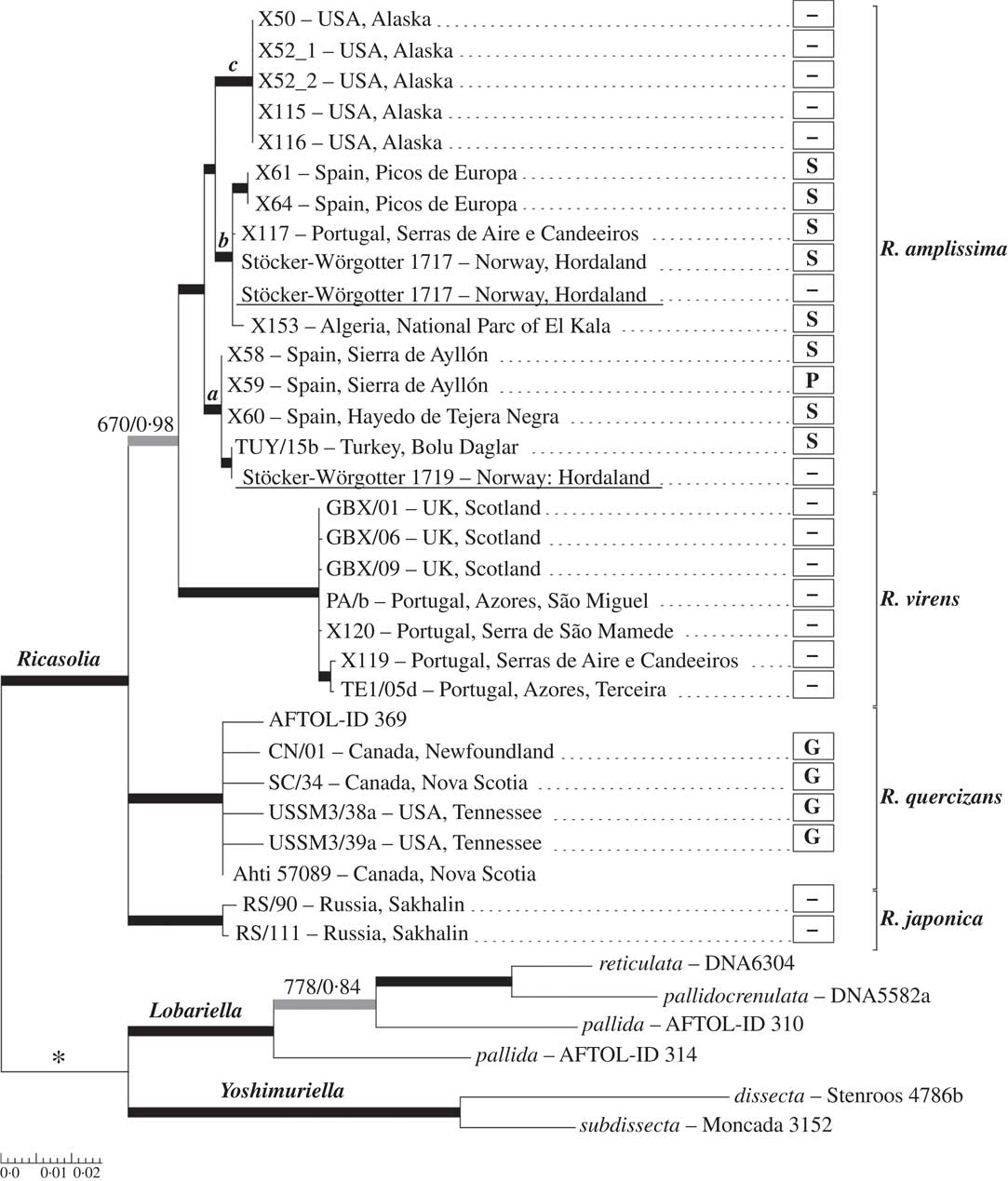
Both the ML and Bayesian analyses of the concatenated dataset resulted in nearly identical topologies. Therefore, the ML tree was selected for the representation of data in Fig. 3 and the Bayesian tree can be found as supplementary information (see Fig. S1, available online). The phylogeny in Fig. 3 confirms the monophyly of the genus Ricasolia, clearly separating it from the genera Dendriscosticta, Lobariella and Yoshimuriella (B=1000; PP=0·97). This result is consistent with the three-loci phylogeny of Moncada et al. (Reference Moncada, Lücking and Betancourt-Macuase2013), as well as with the ITS-phylogeny of Stenroos et al. (Reference Stenroos, Stocker-Wörgötter, Yoshimura, Myllys, Thell and Hyvonen2003). Our study also confirms the systematic position of Yoshimuriella subdissecta (Nyl.) B. Moncada & Lücking identified by Moncada et al. (Reference Moncada, Lücking and Betancourt-Macuase2013) and contradicts the naming of this species as Ricasolia subdissecta Nyl. based on ITS analysis (Tønsberg et al. Reference Tønsberg, Blom, Goffinet, Holtan-Hartwig and Lindblom2016). Within Ricasolia, specimens of R. amplissima (B=963; PP=1), R. japonica (B=1000; PP=1), R. quercizans (B=1000; PP=1), and R. virens (B=1000; PP=1) compose distinct clades. However, the bifurcation of R. amplissima and R. virens had low ML bootstrap support but a high result under the Bayesian analysis. In the R. amplissima clade, Alaskan specimens are separated from specimens from Europe, Algeria and Turkey in different strongly supported subclades. All Alaskan specimens form a maximal corroborated subclade (B=1000; PP=1).
Maximum likelihood phylogram of Ricasolia amplissima and closely related species, resulting from combined analysis of ITS, RPB2 and mrSSU sequences. Three subclades (a, b, and c) were found within the monophyletic clade of R. amplissima. Specimens of the genera Lobariella and Yoshimuriella were used to root this tree (asterisk). Bifurcations with bootstrap values <50 were collapsed, except for two branches with ambiguous ML and Bayesian results (thick grey bifurcations). All thick black branches represent bootstrap and posterior probabilities of at least 700 (of 1000 replicates) or 0·9, respectively. Individuals known to produce a dendriscocauloid form are underlined. Major chemical compounds are indicated in rectangles: G, gyrophoric acid; P, pseudocyphellarin A; S, scrobiculin; –, no chemical compound detected.
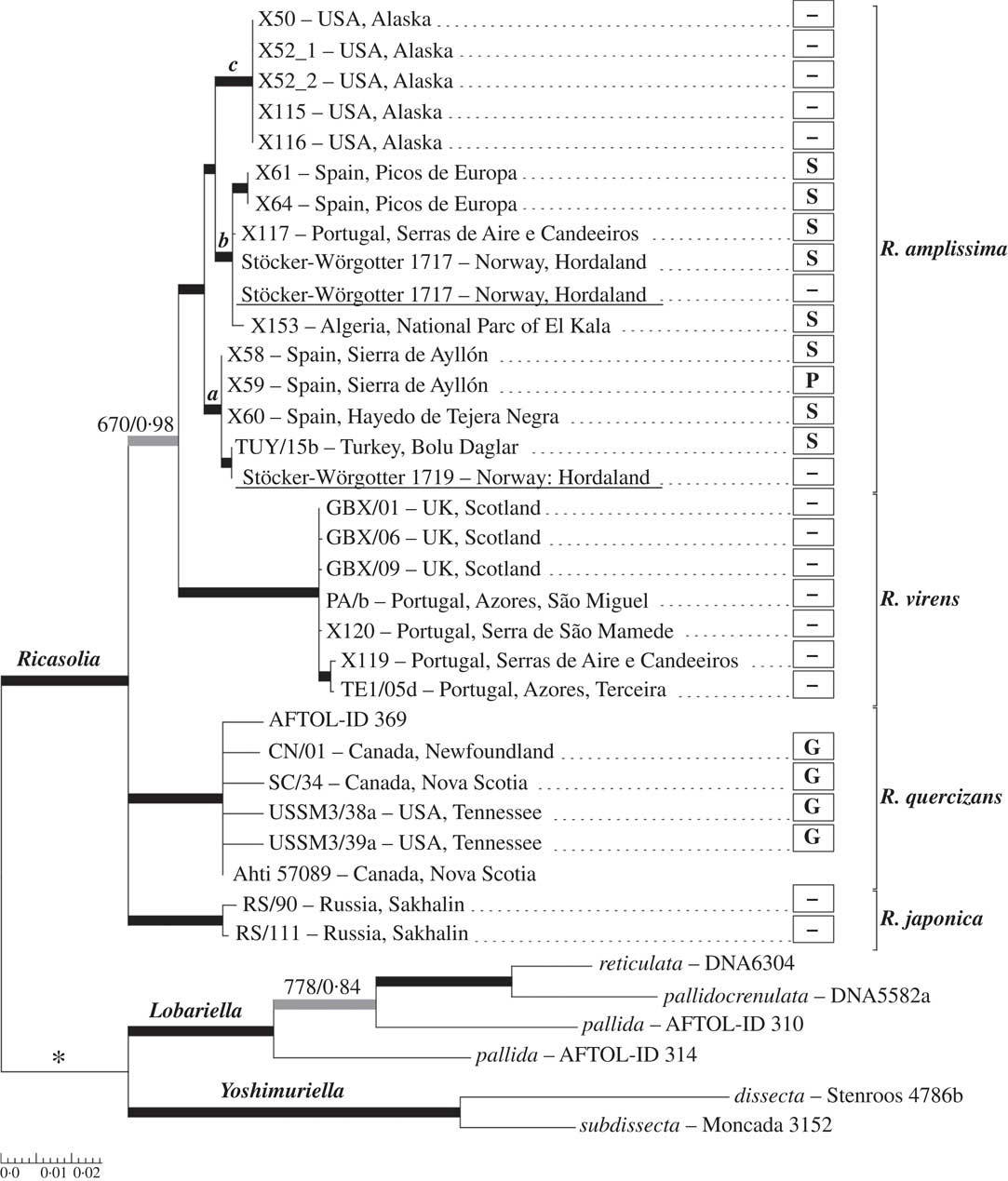
The phylogeny presented here highly corroborates a relationship at species level for specimens of R. amplissima from Europe and North America. However, these taxa were arranged in three statistically highly supported subclades. Surprisingly, samples from Central Spain and Turkey appear closely related to specimens from Norway (Fig. 3, subclade a), while other specimens from Norway are more closely related to specimens from Algeria, Portugal and northern Spain (Fig. 3, subclade b). The Alaskan subclade (Fig. 3, c ) is noteworthy because, unlike the other two subclades, it has distinctive chemical, morphological and geographical patterns. These are discussed below.
Chemical characteristics
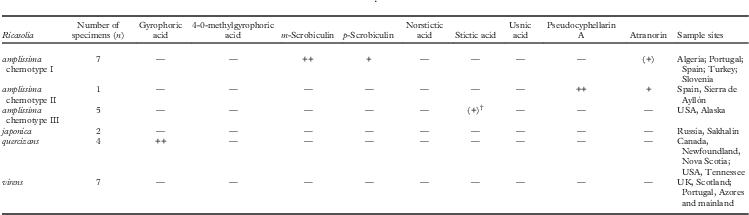
Thin-layer chromatography was used to analyze metabolites of 26 lichen samples and the resulting chemotypes are listed in Table 3, while Fig. 3 provides a short overview of the main secondary products in the specimens studied. No lichen substances were detected in R. virens (medulla and cortex: K−, C−, KC−, P−, UV−), confirming the results of Tønsberg et al. (Reference Tønsberg, Blom, Goffinet, Holtan-Hartwig and Lindblom2016). Jordan (Reference Jordan1973) reported two chemotypes for herbarium specimens of R. quercizans: one containing gyrophoric acid, atranorin and two unknown substances, and the other containing gyrophoric acid, 4-0-methylgyrophoric acid, atranorin and an unknown substance. The TLC findings from our study detected only gyrophoric acid and are consistent with Culberson’s chemical analyses (1969) which consistently detected gyrophoric acid in R. quercizans and 4-0-methylgyrophoric acid in only some specimens.
Summary of molecular data matrices used in the phylogenetic analyses including the substitution model selected by jModelTest and the model effectively implemented in PhyMLFootnote *
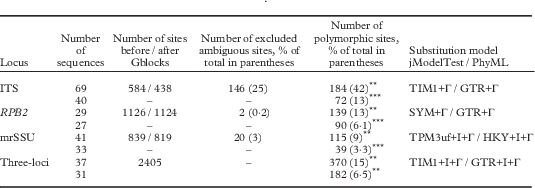
* PhyML in the online ATGC-platform does not list the substitution models SYM, TIM1 or TPM3uf; therefore the next model on the AIC selection list was used for maximum likelihood analyses.
** alignment including the outgroup.
*** alignment excluding the outgroup.
Γ=Gamma distribution.
Secondary products of European and North American Ricasolia amplissima and its allied species. Chemotypes of R. amplissima are listed as I, II, and III
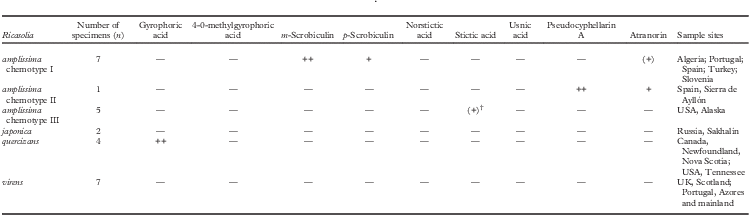
Key: ++ major; + minor; (+) not detected in all specimens; – absent; † detected in traces in one of five specimens.
Specimens of R. amplissima from Algeria, the Iberian Peninsula and Turkey contained primarily m-scrobiculin, p-scrobiculin and occasionally atranorin (chemotype I). Elix & Tønsberg (Reference Elix and Tønsberg2006) reported, in addition to the substances mentioned above, pseudocyphellarin A and traces of an unknown scrobiculin derivative for specimens from Norway. On the other hand, TLC results from the northern Spain specimen X59 produced mainly pseudocyphellarin A and traces of atranorin but was negative for other chemical compounds (chemotype II). As in previous studies (Tønsberg & Holtan-Hartwig Reference Tønsberg and Holtan-Hartwig1983; Schumm Reference Schumm2003; Zalewska & Bohdan Reference Zalewska and Bohdan2012), atranorin was found to be an accessory substance of R. amplissima. However, to our knowledge, this is the first report of pseudocyphellarin A as the major chemical compound from R. amplissima. Culberson (1967 Reference Culbersonb ) mentioned one specimen of R. amplissima from Norway that showed only traces of scrobiculin with spots indicating unknown compounds; however, the author did not specify their Rf values.
In contrast with the TLC results from European material, Alaskan specimens were chemically negative (chemotype III). These findings are not surprising and were used to characterize the first species report of Lobaria (Ricasolia) amplissima for North America (Tønsberg & Goward Reference Tønsberg and Goward2001). It is interesting to note that TLC of the European erumpent coralloid cephalodia attached to the chloromorph and of the dendriscocauloid form did not detect chemical substances, although the corresponding chloromorph produced abundant scrobiculin (Culberson 1967 Reference Culbersona ; James & Henssen Reference James and Henssen1976; Tønsberg & Holtan-Hartwig Reference Tønsberg and Holtan-Hartwig1983; Stenroos et al. Reference Stenroos, Stocker-Wörgötter, Yoshimura, Myllys, Thell and Hyvonen2003: E. Stocker-Wörgötter, pers. comm.). In different parts of its range, R. amplissima appears to be able to produce several chemical compounds, in varying concentrations and combinations. The lichen photobiont (Dictyochloropsis s.l. or Nostoc) has been hypothesized to be one fundamental element influencing the biosynthesis of these compounds and this question has been studied in culture experiments with R. amplissima and Yoshimuriella fendleri (Tuck. & Mont.) Moncada & Lücking (Stenroos et al. Reference Stenroos, Stocker-Wörgötter, Yoshimura, Myllys, Thell and Hyvonen2003), for example, but it has not been answered yet. The TLC results of our study question a correlation between the association with Nostoc or Dictyochloropsis strains and the inhibition of lichen substances in R. amplissima. Other yet unknown factors might also contribute to the variations in chemical compounds which are responsible for the presence of pseudocyphellarin A as a satellite or major substance in European specimens.
Morphological characteristics of Ricasolia amplissima in Europe and North America
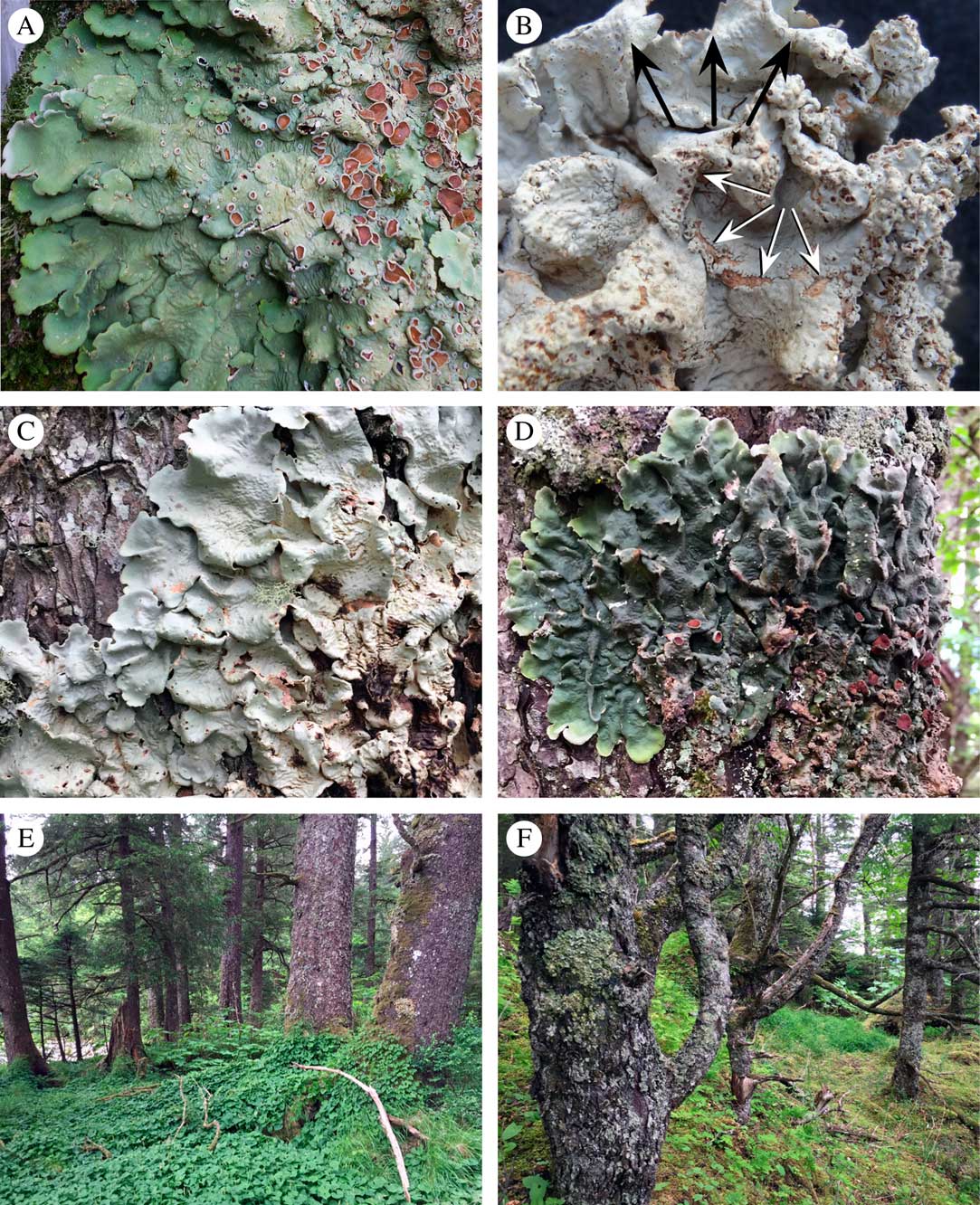
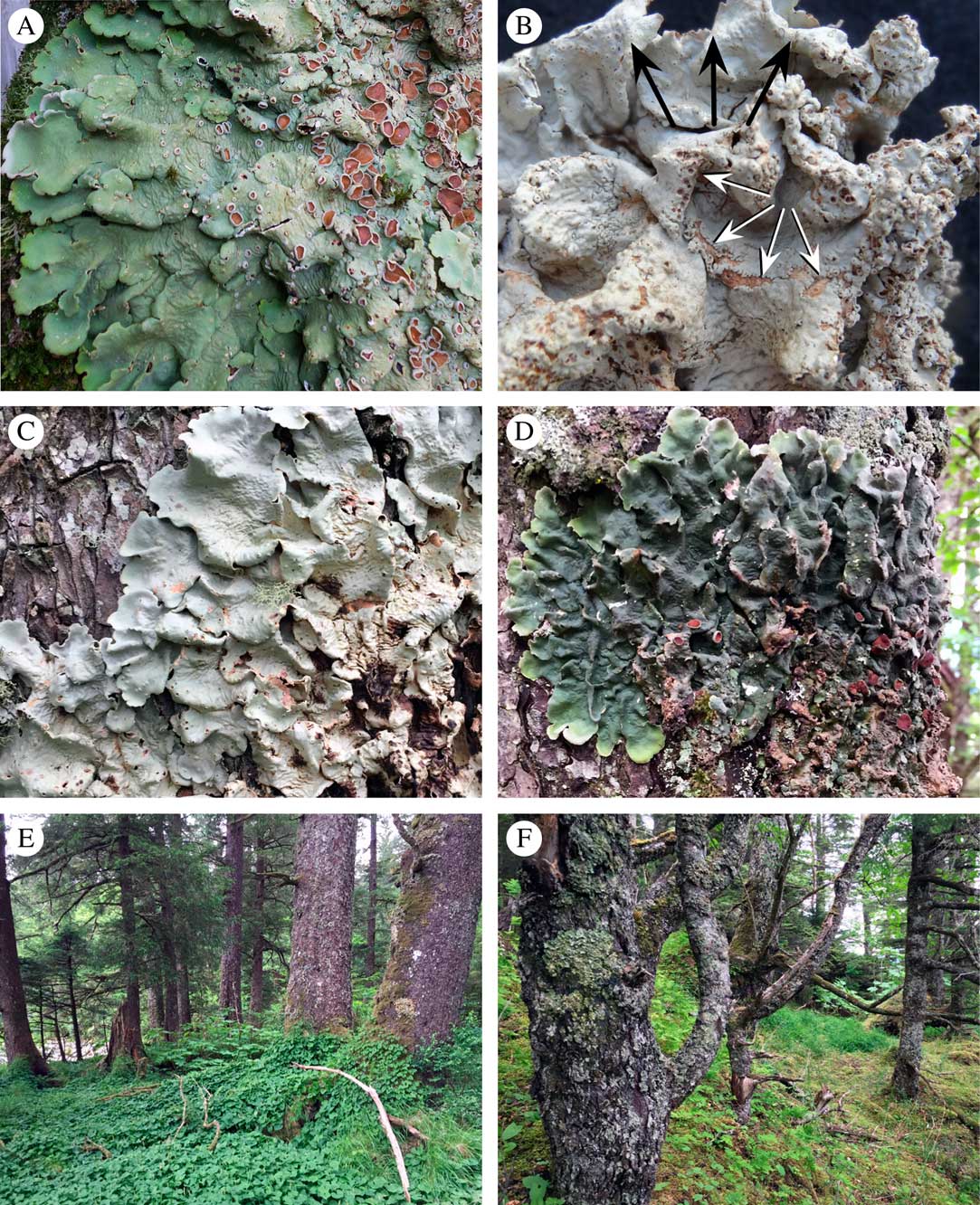
The Alaskan populations of R. amplissima rarely produce apothecia but a small number of vouchers with abundant sterile apothecia have been collected (Fig. 4D; Dillman Reference Dillman2010). These apothecia are somewhat elevated on a constricted base and the undersides of the apothecia are rough, almost warty in texture. The thalli can be quite large, sometimes covering more than decimetre-long sections of a tree bole, and are closely pressed to the substratum. The rounded, overlapping lobes have the appearance of dried puddles of wax dripped from a candle held overhead. European populations of R. amplissima frequently produce fertile apothecia (Purvis et al. Reference Purvis, Coppins, Hawksworth, James and Moore1992). The Californian sample did not bear apothecia (Tønsberg & Goward Reference Tønsberg and Goward2001).
Ricasolia amplissima. A, habit of the chloromorph from Europe (photograph: S. Stofer). B–F, R. amplissima ssp. sheiyi; B, habit of type specimen, black arrows=apical zones of the thallus, white arrows=typical wounds caused by grazing invertebrates on the upper cortex; C & D, habit, photographed in the field; E & F, field localities in Alaska: Warren Island and Sukoi Island, respectively.
An important morphological difference that separates the Alaskan populations of R. amplissima from those in Europe is that Alaskan specimens do not appear to produce erumpent coralloid cephalodia (Dillman Reference Dillman2010). Instead, minute warts are occasionally present above the cephalodia close to the upper cortex. These warts could be primordial erumpent cephalodia. Tønsberg & Goward (Reference Tønsberg and Goward2001) stated that a sample from the Yamani Islets of south-eastern Alaska bore globose, unbranched (not coralloid) cephalodia that measure c. 1 mm in diameter and we confirm this observation. These structures were assumed to represent primordial erumpent cephalodia as similar globose and warty cephalodia are also found in specimens of R. amplissima from Europe (Fig. 5B in Tønsberg & Goward Reference Tønsberg and Goward2001).
Some of the small warty growths, as well as mature cephalodia, observed on a number of the Alaskan samples appear to be heavily browsed by herbivores, leaving the upper surface with pits where the Nostoc cells were apparently mined (Fig. 4B; Dillman Reference Dillman2010). This supports the suggestion that at least some of the warts might be primordial erumpent cephalodia. Indeed, predation by gastropods might be one reason for the apparent lack of coralloid erumpent cephalodia in samples, as the collections are all from the lower boles of trees where terrestrial gastropods easily access lichens (Fig. 4E & F). Grazing by gastropods has also been documented on R. amplissima in Norway and Switzerland (Asplund et al. Reference Asplund, Larsson, Vatne and Gauslaa2010; Cornejo & Scheidegger 2013 Reference Cornejo and Scheideggerb ). Additionally, extensive grazing by snails has been reported to have a detrimental impact on populations of endangered lichen species such as Erioderma pedicellatum (Hue) P. M. Jørg. in Nova Scotia, Canada (Cameron Reference Cameron2009). In Alaska, R. amplissima does occur higher in the canopy but these populations were not accessible for collection and observation. Thus, it remains difficult to determine if our samples contained cephalodia that would have eventually broken through to form erumpent cephalodia. Further study is required to address this question.
In addition to the apparent lack of erumpent coralloid cephalodia on R. amplissima from south-eastern Alaska, the dendriscocauloid form (“Dendriscocaulon” per McCune & Geiser Reference McCune and Geiser2009) is rarely detected in exposed coastal forests at the foliose R. amplissima sites (Dillman Reference Dillman2004). However, the dendriscocauloid form can be abundant at some cyanolichen-rich sites in south-eastern Alaska, especially cool, shady, wet riparian forests near glaciers or in glacially influenced sites, where they occur on conifers and hardwood twigs such as Salix L. and Alnus Mill. (Geiser et al. Reference Geiser, Dillman, Derr and Stensvold1998; Dillman Reference Dillman2010). The dendriscocauloid form has been reported frequently in North America as Dendriscocaulon intricatulum (Nyl.) Henss. (Goward Reference Goward1994; Geiser et al. Reference Geiser, Dillman, Derr and Stensvold1998; Lesher et al. Reference Lesher, Derr and Geiser2003), D. umhausense (Auersw.) Degel. (≡Polychidium umhausense (Auersw.) Henss.) (Hale & Culberson Reference Hale and Culberson1966, Reference Hale and Culberson1970; Weber & Viereck Reference Weber and Viereck1967; Ohlsson Reference Ohlsson1973) and Sticta oroborealis Tønsberg & Goward, and with the chloromorph in the Sticta wrightii group (Tønsberg & Goward Reference Tønsberg and Goward2001). The recently reported dendriscocauloid form from Montana, verified by DNA as Lobaria amplissima (McCune et al. Reference McCune, Rosentreter, Spribille, Breuss and Wheeler2014), and other dendriscocauloid forms in Alaska and elsewhere need further study to establish the intraspecific relationship to R. amplissima or to other dendriscocauloid taxa of North America. Older specimens collected in North and Central America identified as Lobaria amplissima exist in herbaria throughout the world. These collections have not been examined in this study due to DNA degradation and will need further examination to determine if they are in the Ricasolia genus.
An evolutionarily significant unit of Ricasolia amplissima in North America
The present phylogeny suggests that Alaskan specimens are more closely related to the highly disjunct European R. amplissima and another European species (R. virens) than to eastern Asian or eastern North American taxa (R. japonica and R. quercizans, respectively) (Fig. 3). This finding reveals a geographical disjunction within R. amplissima which is well known in other organisms. Parmelina quercina (Willd.) Vain., Letharia vulpina (L.) Hue and Hypogymnia hultenii (Degel.) Krog (Culberson Reference Culberson1972; Printzen et al. Reference Printzen, Ekman and Tønsberg2003; Miadlikowska et al. Reference Miadlikowska, Schoch, Kageyama, Molnar, Lutzoni and McCune2011) are good examples of European-North American disjunct lichens, among many others (for discussion see Feuerer & Hawksworth Reference Feuerer and Hawksworth2007; Braidwood & Ellis Reference Braidwood and Ellis2012). In the nonvascular plants, approximately 7% of the European and 6% of the North American moss flora, and 5% of the European and 4% of the North American hepatic flora show this pattern, with a large portion of disjunction between oceanic British and Norwegian populations, and populations in western North America (Schofield Reference Schofield1988).
The highly supported genetic branching of the Alaskan specimens in all three loci, particularly in the slow-evolving mitochondrial DNA, suggests that Alaskan and European populations of R. amplissima may have little or no genetic exchange and have begun to drift independently (Figs 2 & 3). The rather long bifurcation also shows that the time of separation of the Alaskan population has been longer than that between both of the other European subclades. The combination of a distinctive chemical property, apparent reproductive isolation and subsequent genetic drift, and slow evolution of Alaskan material warrants Evolutionarily Significant Unit (ESU) status for R. amplissima subsp. sheiyi (Moritz Reference Moritz1995; DeWeerdt Reference DeWeerdt2002). As an ESU, this geographically differentiated clade meets the criteria for biological conservation.
Taxonomic Treatment
Ricasolia De Not.
Giornale Botanico Italiano 2(1): 178 (1846); type: Ricasolia amplissima (Scop.) De Not., Giornale Botanico Italiano 2(1): 179 (1846), designated by Yoshimura, J. Hattori Bot. Lab. 34: 301 (1971).
Notes. The characteristics of the genus Ricasolia are reported in Yoshimura (Reference Yoshimura1971) under his description of the former section Ricasolia within the genus Lobaria s. lat. The present study is restricted to the nomenclatural changes for two taxa which are phylogenetically confirmed as belonging to Ricasolia: R. japonica and the new subspecies of R. amplissima. For the other confirmed species of Ricasolia, names already exist that can be used at the species level (i.e. R. amplissima, R. quercizans and R. virens).
Ricasolia amplissima (Scop.) De Not.
MycoBank No.: MB 404140
Giornale Botanico Italiano 2(1): 179 (1846).—Lichen amplissimus Scop., Flora carniolica 2: 386 (1772).—Parmelia amplissima (Scop.) Schaer., Lich. Helv. Spicil. 9: 450 (1840).—Sticta amplissima (Scop.) Rabenh. Deutschl. Krypt.-Fl. (Leipzig) 2: 64 (1845).—
Lobaria amplissima (Scop.) Forssell, Bih. K. svenska Vetensk. Akad. Handl., Afd. 3 8 (no. 3): 111 (1883); type: Italy, 1729, Micheli, Nova Plantarum Genera Tab. 46, top, designated as lectotype by Burgaz & Tretiach, Taxon 51:765–766 (2002) (FI-M—epitype, not seen).
(Fig. 4A)
Thallus foliose, consisting of fungal, green-algal and cyanobacterial partners; composed of irregularly branched lobes with a wrinkled upper surface, especially in older parts. Lobes more or less imbricate, lacking soredia, isidia and true lobules but regeneration lobules can be common along predation wounds or mechanically injured areas (Cornejo & Scheidegger 2013 Reference Cornejo and Scheideggerb ). Photobiont Dictyochloropsis s. lat. (Dal Grande et al. Reference Dal Grande, Beck, Cornejo, Singh, Cheenacharoen, Nelsen and Scheidegger2014), also contains Nostoc located in internal or erumpent cephalodia (Stenroos et al. Reference Stenroos, Stocker-Wörgötter, Yoshimura, Myllys, Thell and Hyvonen2003, Reference Stenroos, Hognabba, Myllys, Hyvonen and Thell2006).
Chemistry. Chemotype I: m-scrobiculin (major), p-scrobiculin (sub-major), atranorin (accessory, in traces). Chemotype II: pseudocyphellarin A (major), atranorin (in traces). Chemotype II seems to be an exception and was found in only one of eight European specimens. Additionally, this specimen was genetically indistinct from other European specimens.
Range. In Europe, R. amplissima is a well-known lichen of humid, nemoral habitats. In Central Europe, this lichen is in decline and is cited in most Red Lists as either extinct or critically endangered (e.g. Türk & Hafellner Reference Türk and Hafellner1999; Scheidegger & Clerc Reference Scheidegger and Clerc2002; Wirth et al. Reference Wirth, Hauck, Von Brackel, Cezanne, De Bruyn, Dürhammer, Eichler, Gnüchtel, John and Litterski2011). It is also rarely found in Eastern Europe (Zalewska & Bohdan Reference Zalewska and Bohdan2012). Its range extends eastward to Asia Minor and westward to the Canary Islands. In North Africa, in the Moroccan Rif and Algerian-Tunisian Khroumirie Mountains, populations occur in restricted areas with marked relief and an oceanic climate. Otte (Reference Otte2007) detected R. amplissima in the Great Caucasus in Western Asia.
Notes. Our phylogeny shows genetic variability between European and Alaskan specimens, supporting the description of a new taxon within the species R. amplissima. However, it also shows variability within European specimens, making the autonym R. amplissima ssp. amplissima appear paraphyletic. For that reason, it would be important to characterize the type specimen of R. amplissima molecularly. In 1772 Scopoli described Lichen amplissimus from Carniola, Slovenia: “in fago e abiete, circa Idriam in Weichenthal” (on beech and fir, in proximity to Idrija in Weichenthal; Fig. 1, site a). However, the herbarium of Scopoli was lost, and Burgaz & Tretiach (Reference Burgaz and Tretiach2002) designated an Italian specimen from Micheli’s (Reference Micheli1729) herbarium (FI-M) as epitype, the illustration of which is attached to Flora Carniolica (designated as lectotype) and described by Scopoli as “optime” in the protologue of Lichen amplissimus. However, DNA cannot be extracted from this epitype due to the age of the specimen, though this would be critical for the correct identification of the species type (for discussion on rules for epitypification, see Hyde & Zhang Reference Hyde and Zhang2008; Ariyawansa et al. Reference Ariyawansa, Hawksworth, Hyde, Jones, Maharachchikumbura, Manamgoda, Thambugala, Udayanga, Camporesi and Daranagama2014). Since it is technically not feasible to characterize at a molecular level the designated Micheli epitype, we decided to include specimens from Carniola, Slovenia, collected as close to Idrija as possible (c. 65 km; Fig. 1, site b), to get an idea of which of the European subclades might represent the type population. Therefore, we included the specimens GZU 5-2006 and GZU 04-2012 in our dataset but the DNA was of poor quality and only the multicopy locus ITS could be amplified. The ITS tree (Fig. 2) shows the specimens GZU 5-2006 and GZU 04-2012 that group together with specimens from Norway, Turkey and Ukraine. The GZU specimens themselves are not included in Fig. 3, which was generated based on two loci at a minimum, but the most similar ITS-haplotypes form the subclade a in Fig. 3. Therefore, we hypothesize that subclade a may represent R. amplissima ssp. amplissima. It is clear that the fungal barcode is not sufficient for the characterization of R. amplissima ssp. amplissima, but this work is beyond the scope of the present study. Future research should assess the legitimacy of Micheli’s epitype according to the International Code of Nomenclature for Algae, Fungi, and Plants (Melbourne Code; McNeill et al. Reference McNeill, Barrie, Buck, Demoulin, Greuter, Hawksworth, Herendeen, Knapp, Marhold and Prado2012) and provide a molecular characterization of R. amplissima ssp. amplissima from fresh material, including several loci.
Early lichenologists reported R. amplissima from Eastern Asia; however, Yoshimura (Reference Yoshimura1971) disagreed with this determination and identified Asian samples as Lobaria japonica (Zahlbr.) Asah.
Ricasolia amplissima subsp. sheiyi Derr & Dillman subsp. nov.
MycoBank No. MB 818300
Similar to Ricasolia amplissima subsp. amplissima but differing in the absence of scrobiculin.
Type: USA, Alaska, McDonald Island, Frederick Sound close to Petersburg, on Picea sitchensis, 56°50'52·25''N, 132°49'8·85''W, 5 m, 19 August 2008, Dillman 2008-602 (G—holotype; hb. Scheidegger SCH–17017—isotype). GenBank Accession numbers: KR476692 (ITS), KC602528 (RPB2) and KC494183 (mitochondrial ribosomal SSU).
Thallus foliose, forming patches or rosettes, up to 50 cm wide, often eroding and becoming blackened in the centre of the older rosettes. Lobes wavy-edged with rounded apices, contiguous and overlapping, up to 2·5–3·0 cm in width on the older thalli. Upper surface grey-white when dry, sage green when wet, young samples with a smooth surface and older specimens having an uneven wrinkly appearance. Scattered conical warts present on upper surface (some up to 1 mm in size) becoming more abundant on older thalli. Lower surface tomentose and light brown in older, more central portions of the thallus, light beige and less tomentose at the lobe margins, without cyphellae or pseudocyphellae.
Apothecia rare, up to 4 mm; disc red-brown to dark pink; asci empty.
Etymology. We chose to give this new taxon a Tlingit name to honour the people who have lived in south-eastern Alaska since time immemorial. Sheiyi means Sitka spruce, which is an important tree species to the Tlingit culture and the most common substratum on which this lichen occurs. Sheiyi is pronounced ʃi:aɪ (American English: shee’-eye).
Chemistry. No lichen substances detected (chemotype III of R. amplissima).
Range. USA, Alaska, Alexander Archipelago, from DeLong Islands (54·9°N, 131°W) north to Canon Beach near Yakutat on the mainland (59°N, 139°W).
Habitat and ecology. In south-eastern Alaska, the exposed headlands and forested shorelines where subspecies sheiyi was found are almost all directly exposed to the Pacific Ocean or major bodies of sea water that are between the larger islands within the Alexander Archipelago. Many of these sites are characterized by a moderately productive forest, dominated by Sitka spruce (Picea sitchensis) and Pacific reed grass (Calamagrostis nutkatensis (J. Presl) J. Presl ex Steud.). This forest type is a narrow band (up to several hundred metres wide) parallel to the salt water edge. With increasing distance from the saltwater, the vegetation and light regimes change to a closed forest comprised predominantly of western hemlock (Tsuga heterophylla) and blueberry (Vaccinium L. ssp.) (Martin et al. Reference Martin, Trull, Brady, West and Downs1995). At these sites, subspecies sheiyi appears to be restricted to medium and large conifer boles and branches (P. sitchensis, T. heterophylla, and rarely on Thuja plicata Donn ex D. Don), and the boles of older Pacific crab apple trees (Malus fusca (Raf.) C. K. Schneid.). The thalli examined were on the lower bole of the tree at or just above eye level, although in some locations individuals could be observed covering the bole in unreachable sections of the canopy. Only one site had thalli with abundant apothecia on more than one tree (Warren Island, Fig. 4C & E); most sites had only one or two thalli present on a single tree and usually lacked apothecia (Fig. 4D) (Dillman Reference Dillman2010).
In Alaska, other lichens commonly occurring with R. amplissima are: Fuscopannaria laceratula (Hue) P. M. Jørg., Lobaria anomala (Brodo & Ahti) T. Sprib. & McCune, L. pulmonaria (L.) Hoffm., L. oregana (Tuck.) Müll. Arg., Parmotrema arnoldii (Du Rietz) Hale, Pseudocyphellaria crocata (L.) Vainio, P. rainierensis Imshaug, Ramalina farinacea (L.) Ach., R. menziesii Taylor, R. roesleri (Hochst. ex Schaerer) Hue, Sticta limbata (Sm.) Ach. and Dolichousnea longissima (Ach.) Articus (Dillman Reference Dillman2004).
Notes. This description of subspecies sheiyi only applies to the south-eastern Alaskan foliose samples and does not include the composite L. amplissima reported from California (Tønsberg & Goward Reference Tønsberg and Goward2001) or the dendriscocauloid form from Montana (McCune et al. Reference McCune, Rosentreter, Spribille, Breuss and Wheeler2014). We were able to examine the small Californian composite sample (Roediger 9/99-3), which was obtained from HSU. Because the sample was so small (chloromorph <2 cm, cyanomorph <1 cm) and old (collected in 1999), our attempts to analyze the DNA failed on both the chloromorph and the cyanomorph. At this time, the samples from California and Montana remain under R. amplissima.
In 1957, Hale showed morphological and chemical differences between specimens from eastern North America and those from Europe, and assigned North American material to R. quercizans. Although Hale (Reference Hale1961) also mentioned the presence of R. amplissima from Central America, this species has not been located again in Central America despite subsequent lichen-focused forays (Sipman & Wolf Reference Sipman and Wolf1998; Umaña & Sipman Reference Umaña and Sipman2002). In 1992, the second author C. Derr collected R. amplissima from the Sukoi Islets near Petersburg in south-eastern Alaska (Derr 920 ALA, OSC) (Dillman Reference Dillman2010). This specimen was identified by C. Derr and B. McCune as R. quercizans and subsequently by I.M. Brodo (Ottawa), C. Derr and B. McCune as R. japonica, which occurs primarily in cool-temperate deciduous forests in mountainous Japan (Yoshimura Reference Yoshimura1971). A duplicate sample was also sent to Japan for verification by I. Yoshimura, which he verified as R. japonica. Unfortunately, that specimen was lost in Japan when his herbarium was relocated and the record was not published. Other specimens collected since 1992 from the same location on the Sukoi Islets have been identified as R. amplissima by the authors, B. McCune and Dr T. Tønsberg (pers. comm.).
Additional specimens examined. USA: Alaska: Petersburg Borough, Sukoi Islets, Frederick Sound, on Picea sitchensis, 1992, Derr 920 (ALA, OSC); Kuiu Island, Explorer Basin, on P. sitchensis, 2003, Dillman 2003-639 (ALA); Coronation Island, Egg Harbor, on P. sitchensis, 2009, Dillman 2009-203 (hb. Scheidegger SCH–19900); Warren Island, Warren Cove, on P. sitchensis, 2009, Dillman 2009-206 (hb. Scheidegger SCH–19901); Windfall Islands, Tebenkof Bay, on P. sitchensis, 2007, Dillman 2007-10, (ALA; HSU; hb. Scheidegger SCH–17019); Kuiu Island, Point Ellis, on P. sitchensis, 2007, Dillman 2007-01 (ALA).
Note: lichen material used for molecular analysis is deposited in the frozen collection of C. Scheidegger at the Swiss Federal Research Institute WSL (vouchers, see Table 1).
Ricasolia japonica (Asah.) Cornejo comb. nov.
MycoBank No.: MB 817390
Lobaria laciniata subsp. japonica Zahlbr. Bot. Mag. Tokyo 41: 324 (1927).—Lobaria japonica (Zahlbr.) Asah., J. Jap. Bot. 9: 450 (1933).—Lobaria amplissima var. japonica (Zahlbr.) Zahlbr., Cat. Lich. Univ. 8: 306 (1932).—Lobaria quercizans f. japonica (Zahlbr.) O. B. Blum, Ukrainian Bot. J. 32(6): 769 (1975); type: Japan, Honshu, Daisen, U. Faurie 2130, designated as lectotype by Yoshimura, J. Hattori Bot. Lab. 34: 306 (1971) (W—lectotype; KYO—duplicate, not seen).
Lobaria japonica f. pallidior Asah., J. Jap. Bot. 19: 128 (1943); type: Japan, Honshu, Prov. Suruga: Subashiri, Mt. Fuji, Y. Asahina 64 (TNS—lectotype, designated by Yoshimura 1971).
Chemistry. No lichen substances detected.
Range. North-east Asia: Sakhalin (this study) and Japan.
Notes. This species is similar to R. quercizans and species of Lobaria s. lat. (e.g. L. sublaevis), which were not analyzed in this study. However, R. quercizans and L. sublaevis contain gyrophoric acid, whereas R. japonica lacks any secondary products.
Collectors cited in the specimen vouchers are thanked for providing material for this study, in particular Slimani Abderachid and Mónica Garcia Otálora. We thank Marie Antoine (HSU), Tor Tønsberg (BG), and Helmut Mayrhofer (GZU) for loan of Ricasolia amplissima, and Isao Yoshimura, Irwin Brodo and Bruce McCune for assisting with early examinations and TLC of Ricasolia amplissima ssp. sheiyi. We also thank Christoph Scheidegger for his invaluable contribution to this article, Reinhard Berndt and Ludwig Beenken for taxonomic advice, and Toby Spribille and two anonymous reviewers for comments on the manuscript. The authors wish to extend sincere gratitude to the Petersburg Indian Association for their cooperation in naming this lichen in honour of the Tlingit people of the region. We are grateful to Christine Keller for helping with chemical analyses. Alaskan fieldwork was supported by the United States Department of Agriculture, Tongass National Forest, Air Resource Management and Botany programs.
Supplementary Material
For supplementary material accompanying this paper visit https://doi.org/10.1017/S002428291700041X