Beginning in 1856 and ending in 1876, colonial authorities in Portuguese Mozambique registered almost 55,000 enslaved and freed Africans (libertos).Footnote 1 The sources for these twinned registration processes are located in the Overseas Historical Archive (Arquivo Histórico Ultramarino) in Lisbon, Portugal and the Historical Archive of Mozambique (Arquivo Histórico de Moçambique), in Maputo, Mozambique. Fragments of the originals survive for only six of the ten districts of the colony, but contemporary copies exist for nearly all districts. Combined, they provide a unique opportunity to understand both the extent of slavery — as opposed to the export slave trade — and the process of abolition in late-nineteenth-century Mozambique. In this article, we first describe the context in which registration was legislated and the order disseminated, followed by an overview of the resistance of masters to registration. We turn next to the registration of slave and freed Africans and the kinds of information that we can glean from the registers; we also look briefly at the ways in which freed Africans were employed after registration and consider the extent to which being a liberto implied ‘freedom’.
Our article also reflects two different historiographical trends in the study of slavery in Africa: quantification and the biographical turn. On the one hand, working together we have developed a database that, while certainly not exhaustive, represents the most comprehensive enumeration of enslaved and freed Africans in nineteenth-century Mozambique.Footnote 2 Previous studies have focused mainly on aggregate census returns.Footnote 3 More recent database projects are largely based on ship captures by anti-slave-trade forces and, because they center on the transatlantic traffic, their sample of ships departing from Mozambique is rather limited.Footnote 4 On the other hand, the details that emerge from the different registers we accessed, while clearly incomplete, enable us to go beyond numbers and offer many possibilities for beginning to glimpse at least some aspects of the lives of both masters and enslaved in Portuguese East Africa.Footnote 5 In the first instance, these figures contribute to assessing the magnitude of slavery in all of Portugal's African territories in the second half of the nineteenth century.Footnote 6 In the second, it adds a different dimension to the emerging study of abolition and liberated Africans in the Indian Ocean world.Footnote 7
Abolition as an imperial project
The first point to understand is that the entire process of registration was part of a larger effort by metropolitan Portugal to assert meaningful administrative control over its African colonies. Mozambique, in particular, was consistently emphasized by contemporary Portuguese chroniclers as being barely under Portugal's authority. Indeed, the geographical locations of the registers we have examined serve as a reminder that Portuguese claims in East Africa were spatially limited. In the western Indian Ocean, Portugal was threatened by the steady march of British imperialism and its demands for the abolition of the slave trade; in the Zambezi River valley, it was challenged by rebellious estate holders. Therefore, declaring an end to slavery in its African territories and registering enslaved people was one component of Portugal's larger imperial project.Footnote 8 The process began with the promulgation of the royal decree of 14 December 1854 that declared Portugal's intention to gradually abolish slavery and the slave trade in all of its colonial territories. Published two weeks later, the decree was transmitted to the colonies in a government order dated 5 March 1855. The 1854 decree ordered all masters to register their slaves with the local authorities within thirty days of the decree's publication within their respective districts and to pay a per capita fee of 500 réis for each slave registered.Footnote 9 Those who failed to register their slaves would automatically lose their rights over their human property.Footnote 10 Any individual forced into Portuguese territories by land after the decree's publication was to be considered a liberto (freed person) and registered in a separate book dedicated to such people.Footnote 11 In addition, they were placed under the custody of individuals who may or may not have been involved in their enslavement.Footnote 12 They were further required to work for their new masters for a ten-year period, during which their labor could be sold to another party.Footnote 13 Masters, however, did not have a say in which register the enslaved would be recorded. The entire process was determined by the imperial administration, and the legislation was clear: existing slaves living in Portuguese territories would be recorded in the register of slaves, while those forced into such territories after the decree publication would be listed in the registers of libertos. Subsequent legislation gave freedom to children born from slave mothers, freed the slaves belonging to the church, converted the status of all slaves to that of freed people, and determined a date (29 April 1878) for ending the libertos’ work ties to their masters, which was later pushed forward by two years (29 April 1876).Footnote 14 A separate order from the Ministry of the Navy and Overseas Affairs mandated that the registration fee for each liberto be split between the newly established Junta Protectora dos Escravos e Libertos (Board of the Protectorate of the Slaves and Freedmen) and the provincial government.Footnote 15
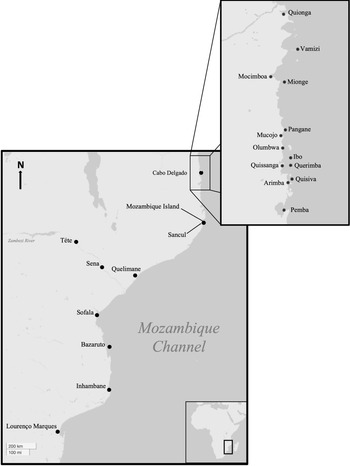
The decree reached the governor general of Mozambique at the end of 1855 and was published in three parts in the Boletim do Governo, the colony's official paper, in January 1856.Footnote 16 Although the abolition of the export slave trade from what is today coastal Mozambique was still decades away, this metropolitan initiative coincided with the culmination of a half century of attempts by the British to restrict the slave trade in the Mozambique Channel.Footnote 17 From the colonial headquarters at Mozambique Island, copies were subsequently sent to the governors of each district and the decree made public by posting these in prominent places.Footnote 18 This extenuated process of transmission meant, however, that depending on local circumstances some outlying districts only began to address implementation in mid-1858. Fig. 1 below shows the different districts of the colony, with an expanded section revealing several sites under the jurisdiction of Cabo Delgado, Portugal's northernmost district in Mozambique at the time.
Portuguese Mozambique in the mid-nineteenth century. Map by authors.

It will come as no surprise to learn that slave owners were less than enthusiastic about registering their property or losing control of their labor. Excuses were plentiful. As early as January 1856, a petition in Mozambique District signed by 44 residents decried the devastating impact of smallpox to appeal for delaying registration.Footnote 19 At the end of February, after much consultation, the governor general granted a postponement, while leaving a date for registration up to the board. In May, local slave owners on the island and mainland petitioned the Crown not to implement registration, arguing that it would lead to the ‘total annihilation of the province’.Footnote 20 The details of this petition make it clear how thoroughly the colonial economy of midcentury Mozambique depended on slavery and the slave trade. As Randy Sparks observes, ‘The Portuguese situation in Mozambique mirrored that of Spain and Cuba — the Portuguese could not abolish the slave trade there without wrecking the local economy and depriving the colonial administration of their main revenue.’Footnote 21 Still not satisfied, Portuguese masters living at Sancul on the mainland opposite Mozambique Island asserted in September 1857 that they would not register their freedmen until their voting rights as citizens were implemented, a dispute initially focused on payment of tree taxes that had persisted since the mid-1840s.Footnote 22 The ability of these residents (moradores) to delay the registration process speaks to the larger struggle between local interests and metropolitan officials to control the colony.
Elsewhere in the province, this pattern of slave owner resistance to the 1854 decree repeated itself. In March 1856 a group of slave owners from Quelimane petitioned to demand extended postponement of registration. The petition asserted that while they could bring their own slaves for registration, they had no control over those captives who themselves were the property of powerful slaves who lived farther upriver.Footnote 23 This situation would create chaos throughout Zambezia and encourage direct opposition to Portuguese rule by certain powerful prazo leaders with whom Portuguese authorities at Quelimane were already in armed conflict.Footnote 24 While slave owners in other districts did not go so far as to organize petitions to the Crown, they nonetheless balked at compliance with registration. In Cabo Delgado District, the governor reported that outside the administrative capital of Ibo and the coastal settlement of Quirimba registration was difficult to enforce. The Muslims of Quissanga, a notorious center of slave trading, in particular, had in fact ‘withdrawn to machambas [farms] they have at a distance of 4 to 5 leagues in the interior’. Similarly, masters in Pangane ‘abandoned the huts they had near the beach and established a new settlement farther inland, something like half a league, but distant enough so nobody can reach them’.Footnote 25 Matters were no different in the southern Portuguese footholds. Although this initiative coincided with the height of the Gaza state that was founded by Soshangane Nxumalo, Portuguese records do not reveal any direct impact of its hegemony in the interior — of which they were well aware — on registration.Footnote 26 On 11 August 1856, the governor of Inhambane informed that the residents and the Municipal Chamber of the district capital requested him to halt the registration because, with ‘the news that slaves might attain freedom, some have already run away and refuse to work and, when their masters force them to do so, they run away to our enemies’.Footnote 27 Two days later, the governor of Sofala reported that, when the registration period started in his district, ‘masters showed up stating that they did not have any slaves but black criados [servants] for their service.’Footnote 28 On 24 February 1857, the governor of Lourenço Marques forwarded a petition from the district's residents to the governor general of Mozambique asking him to postpone or rescind the registration.Footnote 29
By April 1857 the metropolitan government had determined that none of these issues was sufficient to delay further the registration of slaves at Mozambique. Accordingly, a month later the governor general ordered that registration should commence in all districts, attaching a template of the certificate that district authorities were required to issue to all owners who registered their slaves.Footnote 30 This kind of bureaucratic paper-keeping was itself evidence of the concerted effort of the Portuguese state to assert its hegemony over its proclaimed East African territory. In June, the Board of the Protectorate of Slaves and Freedmen advised the governor general that ‘the circumstances that had delayed the registration of the slaves and freedmen had finally ceased,’ so that he ordered that registration should begin in the capital city and its mainland settlements on 22 June 1857.Footnote 31
Leaving nothing to chance, the process for registration was set out in precise detail. On Mozambique Island, registration would take place at the Office of the Government General; on the mainland, registration would be conducted at the governor's palace in Mossuril, always from 9:00 am to 2:00 pm. Specific days for different neighborhoods were published, covering a period from 22 June through 28 July 1857. When arriving at the place of registration, masters would have to give their names to the gatekeeper, who would call them by order of arrival. Masters were encouraged to register by memory any slave who had run away. They were also reminded that those who failed to register their slaves within the said period risked losing their rights over their human property. Finally, the instructions confirmed the value of the registration fee, 500 réis per slave, and informed slave owners that ‘as soon as the registration at the aforementioned settlements is complete, further instructions will be provided regarding the method of registration in other mainland points of the district.’ The instructions ended with an official list of all streets, roads, alleys, squares and the like available in each neighborhood of Mozambique Island.Footnote 32
Although this all sounds very efficient, in practice the process was less than thorough. Slave registration was supposed to be recorded in uniform, published ledgers that were dispatched from Lisbon to all its African colonies. Following a standard form established by Lisbon, the register entries cover two pages with the following headings: ‘number of order’ of the masters, names of the masters and their residences, ‘number of order’ of the slaves, names of the slaves, sex (male/female), ‘place of birth’ (naturalidade, but which also implied ‘nationality’ or what we might call ‘ethnicity’), probable age in years, marks, occupation, and remarks.Footnote 33 Only in the case of small, geographically restricted outposts, however — such as Bazaruto, with a total of only 86 registered slaves, and Lourenço Marques, with 415 registered slaves — was the existing register accurately completed.Footnote 34 For example, the governor general observed that even in Mozambique Island ‘at least one third of the slaves brought to the registry are not listed in the respective books, and they exist only in statements without uniformity.’Footnote 35 Some of these statements were missing information on the slaves’ body marks, while others were missing information on their occupations and other details. In some cases, the masters’ names were incomplete. Although the registration period was extended more than once, masters were still reluctant to bring their slaves to the registry. Instead, they continued to record them by issuing statements or by other means of prevarication.Footnote 36 Slave owners in Sancul were especially resistant, despite attempts by the royal government to encourage masters to comply with the registration.Footnote 37 However, on 9 May 1859, the governor general reported that ‘the masters of Sancul did not come to register their slaves and, because of that, they are now considered as libertos.’Footnote 38 Only after this extreme measure did they feel compelled to register their slaves, arguing that the real reason for having failed to do so previously was that they did not have the ready cash to cover the registration fees. Bowing to their recalcitrance, the imperial government reversed the governor general's decision, provided additional time to complete the registration, and allowed masters to pay the fees in kind rather than cash.Footnote 39
Elsewhere, matters were no better. In Tete, the local authorities had filled out the registers incorrectly and failed to collect the registration fees. The governor general then ordered the authorities to replace the books and collect the fees.Footnote 40 Because masters in Quelimane, Tete, and Sena kept their slaves spread out over a vast area in the interior, they requested additional time to complete the registration, which the governor general granted through a portaria dated 4 February 1860.Footnote 41 Our best information from outside Mozambique Island and its mainland comes from Cabo Delgado, where the Governor of Ibo faced relentless opposition and foot-dragging. Cabo Delgado was not only a populous district, but it was also deeply engaged in the illegal traffic, selling slaves to Cuba, Brazil, the French Indian Ocean islands, and Madagascar. Registering slaves there would prove to be a challenging task. The governor general ordered the local authorities to begin the registration on 14 October 1857, but it took half a year for the governor of Cabo Delgado to initiate the process.Footnote 42 On 17 May 1858, the latter instructed the director of the Customs House to enforce the registration in Cabo Delgado. He provided the director with two official registers and advised him to have ‘the greatest prudency and circumspection, so to avoid trouble or incorrect interpretation among the district's residents’.Footnote 43 On the same day, he tasked a clerk of the Customs House to assist the director, noting that the registration was to begin three days later, on 20 May 1858.Footnote 44 He also sent a circular letter to all captains-major of the district with a bando attached and instructions to publicize it ‘in all points of your jurisdiction’.Footnote 45 The notice read:
That within a period of 30 days beginning on 20 of the current [month, May 1858] all masters resident in this district [of Cabo Delgado] must bring their slaves to the Customs House of this town [Ibo, the district capital] where the officers will be ready to open the registration of the said slaves from 9 o'clock in the morning until 2 in the afternoon according to what the Decree of 14 December 1854, orders, in the certainty that, should they fail to show up during this period, they will incur the penalties consigned in the same decree.Footnote 46
The registration period, therefore, was supposed to last until 20 June 1858. However, many masters failed to meet the deadline. The governor of Cabo Delgado thus wrote to the director of the Customs House with a new bando to be distributed, which extended the registration period to 10 July 1858. Should masters fail to show up, he stressed, ‘they will lose their rights over their slaves.’Footnote 47 Yet, nothing came out of that extension. Almost two years later, on 11 February 1860, a new interim governor tried again by applying additional pressure on the director of the Customs House.Footnote 48 A few days later, on 24 February, he informed the governor general of the ‘constant impediments hindering the completion’ of such a diligence and his appointment of a sergeant to try to carry it out.Footnote 49
Slavery in the age of abolition
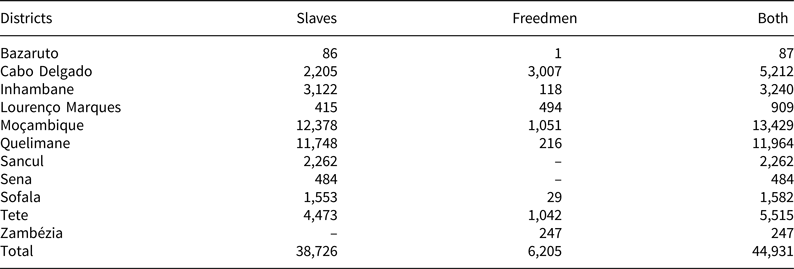
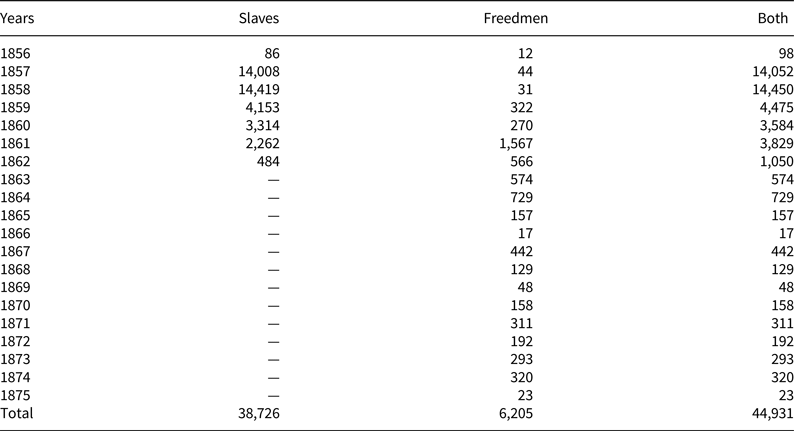
Not surprisingly, the registration of slaves took far longer than the imperial government anticipated. Nevertheless, at a time when revenue from the export slave trade was no longer available, the collection of registration fees on slaves and libertos provided a temporary boost to the colonial treasury.Footnote 50 The details are varied, depending on local circumstances and administrative ability to complete the task efficiently, but for the province as a whole the process took six years to complete. In the case of Mozambique and Cabo Delgado, the process must have been seriously, if temporarily, interrupted by the cholera epidemic that afflicted both locations in March and April of 1859, leaving a total of more than 2,300 dead, at least three-quarters of whom were Africans.Footnote 51 Moreover, there is no question that the results were incomplete. To take only one example, Sena was apparently the last district to complete the registration. Located inland and facing many other obstacles, including violent conflicts, it is unsurprising that the authorities took longer to complete the registration there than in any other district. Unfortunately, no traces of the slave register of Sena survive, with the exception of two remittance notes, both dated 28 February 1862, each covering half the sum paid for the registration of a total of 8,551 slaves.Footnote 52 As was the situation elsewhere, masters in Sena were also granted more time to register their slaves, which resulted in an additional 484 individuals listed (273 males, 211 females). On 27 May 1862, the Governor General forwarded copies of the registers listing this last group to Lisbon, completing thereby the registration of slaves who lived in Mozambique following the publication of the 1854 decree.Footnote 53 Table 1 shows the number of enslaved and freed Africans listed by districts, while Table 2 shows the number registered by years. Although the total number of slaves that we have enumerated from the documents is 38,726, when we add the 8,551 missing from Sena, we arrive at a minimal estimate of 47,277 residing in the territories of Portuguese East Africa between 1856 and 1862.
Total slaves and freedmen registered in Mozambique by districts, 1856–75.

Source: AHM FSXIX Cod. 11-1160, 11-1161, 11-1166, 11-1167, 11-1167, 11-1168, 11-1169, 11-1406, 11-1406, 11-1464, 11-1804, 11-1936, 11-2393, and 11-2394; AHU SEMU Moçambique No. vermelho 1303, 1304, 1306, 1306, 1308, 1308, 1309, 1309, 1310, 1310, 1311, 1312, 1313, 1314, and 1315. Transcriptions of the data collected are available at Between Oceans and Continents: The Registers of Slave and Freed Africans from Portuguese Mozambique, (https://www.africanregisters.org/database.html), accessed 16 Oct. 2020.
Total slaves and freedmen registered in Mozambique by year, 1856–75.

Source: Same as Table 1.
Registration of libertos took place concomitantly with that of slaves and, again not surprisingly, masters were as reluctant to register their libertos. According to our calculations from the remaining registers, the total number of freedmen registered was 6,205, nearly half of whom were accounted for by Cabo Delgado, with 3,007 over a 15-year period, beginning on 30 August 1860 and ending on 19 October 1875. Even here, however, for which we have a complete register, record keeping was sloppy, and the hand-recorded totals were distorted by a combination of clerical errors and at one point in time, we believe, by deliberate manipulation. Only digitization has enabled us to arrive at an accurate count from the Cabo Delgado register.
The real value of the Cabo Delgado register, however, is the wealth of detail it provides on both masters and freedmen.Footnote 54 The register includes not only the names of more than 400 masters, most of whom were men with Portuguese surnames, but also a significant number of women. Many, if not most, of the masters with Portuguese family names were probably Afro-Portuguese, rather than metropolitan Portuguese. Whatever their exact ethnic identity, they were all clearly considered to be ‘senhores’, while the question of citizenship does not appear to have been germane. Of the almost 100 non-Portuguese masters, most were Gujarati, with a small number being Mwani/Swahili, including one woman named Fatima. For freedmen only given names were included. Most of these were Portuguese, but many were Muslim, reflecting the Mwani/Swahili cultural zone of Cabo Delgado.Footnote 55 Initially, the place of residence for most masters was noted as Ibo, but by the mid-1860s clerks omitted this important detail; nevertheless, we know that masters registering freedmen also resided in Pemba, Arimba, Quissanga, and Olumbwa (all four on the mainland), Querimba Island, Mulongy (perhaps Mionge Island), Malize (perhaps Vamizi Island), and Vamizi. One last important set of data regarding masters is the number of libertos registered by each individual, which reveals that most were small-scale slave owners, as indicated in Table 3. In a word, most masters owned a few household slaves, rather than large numbers of slaves employed either on plantations or in large commercial ventures.
Number of libertos registered by masters in Cabo Delgado, 1860–75.

Source: AHM FSXIX Cod. 11-1936, ‘Register of freedmen of Cabo Delgado’. Transcriptions of the data collected are available at Between Oceans and Continents: The Registers of Slave and Freed Africans from Portuguese Mozambique, (https://www.africanregisters.org/database.html), accessed 16 Oct. 2020.
What can we learn about the libertos from the Ibo register? Under the ambiguous category of ‘naturalidade’, the most frequent attributions are Makua and Yao, the two most frequently enslaved groups of Africans during the heyday of the slave trade in East Central Africa. Other names of interior ethnicities include Maravi, Nyasa, Mangoche (a Yao subgroup), Lomwe (closely related to the Makua), Mwalia (the town of the important Makua chief of Meto), and a few Maconde. In addition, we find local names of towns and villages — for example, Ibo and Arimba, both island settlements, or Mucojo and Mocimboa, both located on the mainland — while some simply gave Mrima, meaning the coast in general, as their identity. These local names suggest that they may have been born into slavery or perhaps were driven into that status through indebtedness or pawning. The general impression one gets from this mixture of names is that the Afro-Portuguese society of the Querimba Islands and Cabo Delgado mainland was very ethnically diverse, in fact, a social extension of the Swahili coast to the north of Cape Delgado with the addition of a long history of Portuguese settlement.Footnote 56
Most of the libertos were young, with very few listed as being older than forty years of age. Many children under the age of 14 are also listed. Eventually we will undertake a comprehensive analysis of the recorded ‘probable age’ distribution for all the registers. Approximately 55 per cent of the Ibo registered libertos were male, and 45 per cent female. Unfortunately, although in some of the other registers we do have at least some occupations listed, these are few and far between in the Cabo Delgado register. Equally frustrating is the total absence of distinguishing marks being recorded, although these exist in certain other registers. Similarly, the Ibo register lacks information on occupation, although, once again, such details do exist in some other registers.Footnote 57 The discrepancies in recorded detail between registries from different captaincies are not entirely clear but suggest to us both the weakness of the Portuguese colonial bureaucracy and the resistance of slave owners to providing details of their bondsmen. In the various miniscule hands that noted ‘observations’, however, we occasionally encounter some valuable details. For example, a number of deaths are recorded among Ibo libertos in 1871, during the fourth great cholera pandemic of the nineteenth century, which reached Ibo in February 1871.Footnote 58 Other notations record the flight of individual libertos from their masters. Further scrutiny of the register, as well as of the existing archives, may well reveal more substantive details about mortality and the phenomenon of runaways (marronage) for Cabo Delgado and the Querimba Islands in the later decades of the nineteenth century.
The provisions of registration specifically indicate that libertos remained under the protection of the government through the Board of the Protectorate of the Slaves and Freedmen, but initially it is clear that the Portuguese state often drafted libertos into its service. In February 1858, for example, the governor of Cabo Delgado designated two dozen libertos, both men and women, to serve the ill-fated colony at Pemba.Footnote 59 A year later, the Ministry of the Navy and Overseas Affairs authorized the recruitment of thirty ‘of the healthiest, robust, and well-mannered blacks in order to liberate them to serve in the garrison of Macao’, Portugal's port on the Pearl River delta in China.Footnote 60 Exactly how they were to be selected is not evident, but when the Ministry required additional manpower for the warship Angra in August 1858, it ordered the board to select ‘healthy and robust’ slaves and freedmen from among those in its charge to serve on its crew.Footnote 61 The published accounts of the expenses of the treasury (cofre) of the board provide evidence that financial support was provided both to Portuguese masters and to the government hospital to support individual freedmen. In early reports, the freedmen and women who received such support through their guardians remain anonymous. Only in the cases of Izidro (or Isidro) and Constantino, who received maintenance from Tibúrcio Custódio d'Araújo, and that of Carlota, a free girl who received her ‘education, maintenance, and clothing’ from António Joaquim Carvalho, are these persons named.Footnote 62 In the cases of libertos Luiz and Pedro, the board financed their apprenticeships as joiners and carpenters to José Zeferino and José Theodoro Ferreira for almost two years.Footnote 63 In 1860–1, the board also published the names of those slaves who had received their official letters of liberation in the government bulletin, which in theory should have provided these individuals with a modicum of protection from enslavement.Footnote 64 In the 1870s, a floating population of libertos was in its charge, either directly working as apprentices in the naval warehouse or for some other official agency, or having been farmed out to Portuguese residents. The number of freedmen and women for whom the board was responsible fluctuated over time from about forty to fifty individuals to as many as eighty in 1872–3, then declined to as few as twenty at the end of its administration.Footnote 65
Owing to the labor requirement attached to becoming a liberto, in many respects the status was similar to that of indenture, albeit without a formal contract between the freed person and the employer.Footnote 66 Although becoming liberto may have been designed to provide a first step towards the abolition of slavery, in reality, as João de Andrade Corvo, who served as Portuguese Minister of the Navy and Overseas Affairs in the 1870s, commented bitterly, ‘Slaves came to be called libertos, but abuse made libertos slaves’ — even to the point of being sold into the clandestine slave trade.Footnote 67 Indeed, in 1857 a ‘Moor’ named Assane Cassimo attempted to sell a liberto outside the district; four years later a liberto whose master was a Swahili named Issufo bin Aly tried to sell his own two slaves; and in 1875 three libertos had been captives on a small slaving vessel in Infusse, a small port to the south of Mozambique Island.Footnote 68 So, to be liberto did not protect one from being sold. Further evidence that to be liberto did not guarantee ‘freedom’ are the examples of two male and two female Makua, who were registered as libertos in November 1861 and were subsequently sold on 4 February 1862 to Tito Augusto de Figueiredo; similarly, three Yao male libertos were sold on 11 December 1864 to Joaquim Francisco Colaço.Footnote 69 At least another dozen individuals were sold after being registered as libertos, while several others were clearly used as collateral to pay their master's debts, as indicated by the notation of their ‘belonging to’ (pertence a) someone else.Footnote 70 On a larger scale, enslavers continued to capture Africans regardless of their formal legal status, as happened in 1858 when a French ship arrived at Ibo claiming it carried slaves from Nzwani. Upon closer examination, the captives proved to be from near Mozambique.Footnote 71
When British Consul J. Frederic Elton arrived at Mozambique Island in late 1875, he commented:
All the property owners on the mainland hold libertos and slaves. Slave discipline is still carried on. Slave punishments are not discontinued, such as working with a heavy log attached to the leg by a chain. Slaves are let out to work for hire — are lent to foreign commercial houses for a consideration and whether termed libertos or slaves fall under the English interpretation of the word slave. For in the case of the liberto the equivalent of his labour is never received by him — he is not in the position of a man engaged for a term for certain work. He can be put to work for any person whom his master chooses to hire him, on the terms his master chooses to agree to.Footnote 72
There are clearly many intriguing leads for future research that emerge from this review of how Portugal sought to use abolition to extend its feeble control over its East African possessions. The data from the Mozambican slave and freedmen registers provide an opportunity to explore the possibility of following up on the life trajectories of both masters and freedmen. For example, do any descendants of the masters listed in the registers still live in Mozambique? If so, do they possess family papers? Lacking family names makes it extremely difficult to trace the libertos or their descendants, but perhaps there are families who have preserved a forebearer's carta de alforria or ‘letter of freedom from slavery’ that was mandated by the 1854 decree for each slave or liberto who compensated their master for the value of their freedom (redenção).Footnote 73 According to the ‘observations’ column in the register of libertos for Cabo Delgado, of the more than 3,000 registered libertos, only about a dozen received this invaluable letter.Footnote 74 This situation may, however, be explained by the fact that being registered as a liberto was not the same as gaining one's emancipation. This document was only issued after an individual liberto had negotiated the price with their master and paid it.Footnote 75
The meaning of abolition
To what extent, then, did becoming a freedman or woman make a difference to the individual? What did it mean to be a liberto? For most individuals, as we have seen, there was apparently little difference from what they had experienced as slaves. Most were still beholden to their masters, or to the colonial government, and enjoyed neither fewer nor greater possibilities for exercising individual movement or agency.Footnote 76 A limited index to the predicament that freedmen at Mozambique found themselves in is their predominance in the weekly reports of lockups in the Mozambique Island jail, provided by the Administration of the Council of Mozambique Island, which illustrates our contention that the Portuguese government used abolition as a way of expanding its authority in Mozambique. These reports provide clear evidence that libertos were jailed more frequently than either free Africans, other island residents, degredados (exiled criminals), or visiting sailors. In the first published report on 27 April 1872, 24 out of 28 prisoners for the previous week were freedmen and women. Their offences included 11 men and 3 women whose masters sent them to the jail for punishment; other offences included assault, drunkenness, drunk and disorderly, arguing with local police patrols, petty theft, and ‘inquiry’.Footnote 77 The first category of imprisonment is noteworthy because it specifically reflects the removal of corporal punishment that was exercised by former slave owners and places that responsibility with the colonial administration.Footnote 78 While the details of offenses and the proportion of freedmen and women who ended up in jail varied over time, the general picture remained the same. For example, in the last week of November 1876, among 41 prisoners were 33 libertos, 15 of whom were women. Ten had been sent by their masters for punishment, while the offenses of the others included robbery, disorderly conduct, public disturbance, vagrancy and absence.Footnote 79 By the end of the period of the Board of the Protectorate of the Slaves and Freedmen's authority, these Council reports were now specifically named as police reports. In effect, they are reminiscent of the effects of vagrancy laws in other postslavery societies.Footnote 80
Nevertheless, some individuals probably were able to improve their situation by becoming apprenticed to learn a new skill. The published financial records of the Board of the Protectorate of the Slaves and Freedmen notes various individuals who received emoluments from the board to enable them to train apprentices in a variety of artisanal skills. Of course, many persons acquired such skills while enslaved, so we cannot determine if being a liberto significantly expanded such opportunities. Lacking firsthand accounts by any of these individuals, we are equally stymied in trying to understand if their worldview was affected by their new status. A clear example of African agency, however, may be inferred from published lists for 1871–2, in which freedmen who were reckoned as belonging to specific masters or the inheritors of their estates were divided into the categories of runaways (fugidos) and deceased (falecidos).Footnote 81 The total number of named runaways listed in these official notices was 239. Where these persons may have escaped to is nowhere indicated, so we can only assume that they found refuge of some sort among neighboring Africans who lived just beyond the reach of effective Portuguese authority. How these individuals understood their liberation and what their status as outsiders in these societies may have been, however, remain equally opaque.
One possibility for apprehending what being a freedman may have meant may be implied in the response to ‘free’ French labor recruitment at Ibo in the early 1880s. Based on an 1881 agreement with Portugal to secure libres engagés laborers from Mozambique for plantations on its Indian Ocean island colonies of Nossi-Bé and Mayotte, efforts were made to revive recruitment from Ibo, where it had previously flourished in the 1850s.Footnote 82 But in the postabolition atmosphere prevailing in 1882, neither of the two French commercial firms established at Ibo was willing to serve as the recruitment agency for these workers. The French then turned to an influential local Portuguese, whom British Consul Henry O'Neill at Mozambique identified as ‘Senhor Gonzages’, and whom he described as before emancipation one of the largest slave owners of the district.Footnote 83 We know from the register of libertos that Luís João Gonzaga was indeed one of the major owners in Cabo Delgado, having registered exactly 100 Africans as libertos.Footnote 84 In the end, however, O'Neill wrote:
It would seem that the natives absolutely refused to credit the statements that only willing emigrants were to be taken. . . . The notion that an authorized Slave Trade upon a large scale was about to be undertaken appears to have taken possession of them. Acting under this impression, and determined to resist what they believed to be an unwarrantable encroachment upon the liberty of late years granted to them, they assembled in large numbers, armed, and (I am told) attempted to disarm the sentries on guard.Footnote 85
This action by Africans who had lived through the period of abolition and emancipation — many of whom, we believe, would have been freedmen — precipitated a violent response from the Portuguese guard, who killed or wounded dozens of protesters, causing the flight of many others to the mainland. As a result, from 1884 to 1894, only 33 workers ever signed contracts at Ibo to work on the French islands.Footnote 86
Yet as slavery was being abolished, labor continued to be required. Three years before Portugal ceded administration of Ibo to the Nyassa Company, when the Portuguese began to require identity cards for their African subjects, some 1,383 cards were issued at Ibo in the first half of April 1894. The official register included each name, occupation, and employer (patrão), while those listed only by name, occupation, and place of residence were evidently independent carpenters, tailors, fishers, and stonemasons, among others. The names of employers included at least three Portuguese who also appeared as masters in the register of libertos: João de Barros Carrilho, João Lopes Barros Coelho, and Bernadino Barros Coelho.Footnote 87 More intriguingly, among Bernadino's twenty employees who acquired identity cards in 1894 are included at least three men who may have been registered as libertos in 1861.Footnote 88 If these are the same men, working for the same employer, it suggests that the residual effects of emancipation in such a small-scale society encouraged the maintenance of ties of protection and, possibly, even of affection. In any event, this new colonial regulation marks an important stepping stone between the laws of 1875 and 1878, which established the details of contracts between employers and employees other than former masters, and the Labor Code of 1899, which included the concept that for Africans to become civilized, they had a moral obligation to work.Footnote 89 In short, libertos in Mozambique were no more free than their brothers and sisters in other African colonial territories or across the western Indian Ocean world.
Finally, the registration of enslaved and freed Africans in Mozambique shaped more than colonial policies around labor. It also allowed Portuguese officials, lawmakers, and statesmen to reflect on the place of Africans in society during a new era of European colonialism and imperial expansion. None of the liberal constitutions or legislation that Portugal had enacted during the first half of the nineteenth century granted citizenship to free Africans. In fact, when that very issue emerged, Portuguese constitutional thought and juridical law were but poorly equipped to address it.Footnote 90 State officials began to articulate an answer by tracing the transition of enslaved Africans to libertos and then to tutees and contractors. Men like António Enes, Eduardo da Costa, and Freire d'Andrade, among others, served in Mozambique at different capacities during the last quarter of the nineteenth century. They observed this transition firsthand and discussed it in detail in their reports, studies, and treatises.Footnote 91 This material was widely published and debated in Portugal at the main centers for government training and academic learning of the time, such as the Colonial School, the Geographic Society of Lisbon, and the University of Coimbra. They informed new policies and legislation on the juridical status of the indígenas (natives), which were subsequently enforced in Mozambique as well as in other colonies of the Portuguese empire.
Conclusion
Over the course of a quarter-century, enslaved Africans in the Portuguese colonial province of Mozambique experienced the first stage of what was intended to be a transformative abolition of slavery and emancipation. The architecture of this process is recorded in the official registers that we examine in this article. From the metropolitan perspective of the Portuguese Crown, the process of registering slaves and libertos was one step in the closer integration of its loosely held and vigorously claimed African colonies. It also signaled a tentative move towards a differently conceived colonial economy, one that rather than export African labor through the slave trade, ultimately came to exploit it forcibly both domestically and through state-managed labor migration. For the African men and women affected both by their enslavement and their status as freedmen, very little had changed. Nevertheless, these precious records, however incomplete and limited by their bureaucratic structure, open up windows on the social composition of this important population of enslaved Africans that, supplemented by other colonial records, enable us to begin to reconstruct their collective experience.
Acknowledgements
The research for this article would not have been possible without the support from the Fondren Fellows program at Rice University. We thank also the archivists from the Arquivo Histórico de Moçambique, in Maputo, Mozambique, and the Arquivo Histórico Ultramarino and the Biblioteca da Sociedade de Geografia, both in Lisbon, Portugal. Further, we are grateful for the help of Dr. Joel das Neves Tembe, Vice-Provost of Universidade Eduardo Mondlane, previously director of the Arquivo Histórico de Moçambique, and our research collaborators, Elcídio Rui Macuácua and Ivan C. Zacarias, from the Oficina de História Moçambique. The conclusions reached in this article, however, are the sole responsibility of its authors.