On 24 June 1913, Louise Hester Barnes resigned her post as headmistress of the Church Missionary Society (CMS) Mary Vaughan High School in Hangzhou. Her resignation followed a dispute with the CMS about extending her furlough to enable her to support the higher education of a Chinese student who was studying in London under her care, Zeng Baosun (曾寶蓀; 1893–1978), the great-granddaughter of Zeng Guofan (曾國藩; 1811–72). Barnes explained in her letter to the society: ‘It is with the very deepest regret that after a connection of almost twenty-three years with the beloved Church Missionary Society that I'm obliged to ask the committee to accept my resignation.’Footnote 1 She went on to explain her decision in a further letter dated 30 November 1913:
I need hardly say I am not taking this serious step without much thought and waiting upon God. If I returned to China soon, it would have meant no college career for Miss Tseng, and that I considered very short sighted policy as I believe the time has come for us to give our very best efforts to the training of the Chinese or any other students, who are willing and capable of being trained.Footnote 2
Barnes's decision to resign was indeed a ‘serious step’, as she had to forego her pension in consequence. As it turns out, her faith in Zeng's potential was justified. Zeng went on to become the first Chinese woman to earn an honours degree from the University of London, founded her own Christian school for girls in Changsha upon her return to China, and became a leading educator and political figure in republican China. She represented the Republic of China at the United Nations Commission on the Status of Women in Geneva in 1952 and at the Asian Anti-Communist League in Manila in 1956. Still, Zeng is little known in mainland China compared to her illustrious great-grandfather, Zeng Guofan, who is famed for his role in suppressing the Taiping rebellion (1850–64).
Zeng's story deserves greater historical scrutiny, not because she was the great-granddaughter of a famous Chinese general, but because her story throws light on the ways in which Christianity shaped the life of Chinese women at the turn of the twentieth century. The story of the relationship between Zeng and Barnes reveals the changing power dynamics between foreign missionaries and Chinese Christians in the process of indigenizing the church in China: the roles of teacher and pupil were reversed upon their return to Changsha, with Zeng serving as headmistress of her own school and Barnes as a teacher. Although an extraordinary example due to her elite family background, Zeng's life also highlights the important role played by Christian-educated Chinese women in the process of educational exchange between China and the West. Chinese Christian women such as Zeng could use the social networks to which their education gave them access on a local, national and international scale. Through their experiences of multiple educational systems, both Chinese and Western, they were active agents in the transfer of educational knowledge between China and the West in the early twentieth century, adapting, rejecting and assimilating different aspects as they saw fit.
Although much attention has been paid to the role of Western missionaries in the process of internationalizing Chinese education, the role of Chinese Christian women in the exchange has been understudied. There have been several explorations of the contribution of returning male Chinese overseas students who pursued degree studies in Japan, the UK and the USA at the turn of the twentieth century.Footnote 3 Hu Ying's examination of Ida Khan and Mary Stone has drawn attention to the role played by missionary-educated Chinese women who stepped outside the domestic sphere in the creation of the Chinese New Woman.Footnote 4 However, very little attention has been paid to their role in educational exchange, which has largely been dominated by studies of Western missionaries in their efforts to found and run universities in China.Footnote 5 Chinese women have been portrayed as passive recipients of a modernizing Western education, ‘enlightening’ and ‘uplifting’ them, unbinding their feet and freeing them from arranged marriages. Although there is a proliferation of English-language missionary writings, it is very difficult, due to a lack of sources in mission archives, to know how Chinese women themselves experienced and responded to missionary education. As Kwok Pui-Lan has highlighted, Chinese Christian women's voices were seldom recorded in conference reports or minutes of church meetings.Footnote 6 Better understanding of the role of Christian-educated Chinese women in this process of internationalizing Chinese education is vital for a fuller picture of the missionary enterprise in China and for putting the role of Western missionaries into clearer perspective.
Thomas Kennedy's translation of Zeng Baosun's memoir has made her story accessible to an English-speaking audience.Footnote 7 Zeng's memoir, originally published in 1970 when she was seventy-seven, is naturally influenced by loss of memory, nostalgia and the contemporary political situation, and therefore must be treated with caution. Zeng herself admits: ‘All my diaries and records no longer exist. It has only been since I have enjoyed the peace and security of life here on Taiwan that I felt I could begin writing, but I have had to rely entirely on memory. Inevitably, this resulted in many errors and gaps.’Footnote 8 Although Kennedy's is a very close translation, I also draw upon the Chinese version for biographical and other information concerning her missionary school experience which he left out.Footnote 9
Early Education and Conversion to Christianity
Zeng Baosun was born in the spring of 1893 into a wealthy family of the scholarly elite from Xiang Xiang (湘鄉), Hunan Province.Footnote 10 Her father, Zeng Guangjun (曾廣鈞), the eldest grandson of Zeng Guofan, was successful in the imperial examinations and in 1889, at the age of twenty-three, became the youngest member of the Hanlin Academy, the highest academic institution for classical learning in China, sponsored by the emperor.Footnote 11 A friend and supporter of the reformer Liang Qichao (梁啟超; 1873–1929), he held progressive ideas on women's education.Footnote 12 He made sure his daughter's feet were not bound and did not arrange a marriage for her. He also did not object to Zeng's conversion to Christianity and allowed her to go abroad to study.Footnote 13
As Susan Mann, Dorothy Ko and Ellen Widmer have shown, although there were many vocational avenues for female education in late imperial China, only the most privileged girls had a chance to receive a formal education.Footnote 14 Born into the wealth of the Zeng family, Zeng Baosun studied alongside her brothers and male cousins under tutors employed in the family school at the Zeng family home, Prosperity Hall, in Changsha. She was an unusually gifted scholar and an avid reader. Influenced by her reform-minded father, her tutors not only taught the Confucian classics, but also history, geography, modern languages and calisthenics.Footnote 15 Zeng was thus more than well prepared academically upon entering public education in missionary schools.
Zeng's varied formal educational experiences challenge us to rethink traditional interpretations, which place missionary education at the forefront of educational modernization in this period.Footnote 16 She found the academic standards at missionary schools disappointing compared to her rigorous training at home, and their heavily religious atmosphere restrictive. For example, Zeng recalled her disappointment at the curriculum when she entered the Baptist Eliza Yates Academy (晏摩氏女校) in Shanghai in 1904. Although she learned to play Western musical instruments (particularly the organ), which was a novelty, the other subjects seemed of little use to her. Given her family background, she had little need for domestic education, which was designed to equip lower-class girls with the skills needed to make them useful Christian homemakers: ‘I began to learn to do handicrafts, and to make garments, but there was no mathematics, history or geography.’Footnote 17
Naturally academic and excelling in Chinese literature, Zeng found the academic environment of Wuben (務本女中), a Chinese-run private school for girls which she attended from 1905, much more amenable. In 1906 she transferred to Hangzhou Provincial Normal School for Women (杭州省立女子師範).Footnote 18 Recognizing her academic potential, the mathematics teacher Chen Boyuan (陳伯原) recommended that rather than becoming a primary school teacher, Zeng would do better to continue her studies at the newly opened Mary Vaughan High School (馮氏女校) in Hangzhou, where he was about to take up an appointment in 1909.Footnote 19
The Mary Vaughan High School opened on 13 February 1909. It was named in honour of a CMS missionary who had donated two thousand dollars of her own money to build a school for girls in Hangzhou but had died shortly before it was finished. Her close friend and fellow CMS missionary, Miss Louise Barnes, was appointed as the acting principal for the school in 1909 and remained until 1912.Footnote 20 Louisa Hester Barnes was born on 14 January 1855, in Dorchester, Dorset.Footnote 21 In her modest family background, Barnes differed from the majority of CMS missionaries in this period, who tended, like Mary Vaughan, to come from the middle classes.Footnote 22 Her father, Peter Fredrick Barnes, was a bricklayer by trade.Footnote 23 It is difficult to ascertain Barnes's early educational background, but by 1881 she was a certified teacher living in Ryde on the Isle of Wight.Footnote 24 Her training and experience as a school teacher probably made her attractive to the CMS at a point when their educational activities were beginning to expand. In view of her humble family background, therefore, giving up her pension was a momentous decision. With no wealthy relatives to support her retirement, Barnes's decision to resign was a brave step which highlights how much potential she saw in her Chinese pupil.
The Mary Vaughan School was in many ways a new departure for the CMS in Zhejiang province. It was the society's first girls’ school in East China to cater specifically for the upper classes. In a letter to the board, Barnes announced with great satisfaction that the school had been able to attract girls from ‘High Class Families’: ‘Of the twenty-five pupils, eleven are the daughters of Christians; nearly all the remaining fourteen are from official families, three of their boarders are relatives of the Marquis Tseng. And one day scholar is a granddaughter of a late Prime Minister.’Footnote 25 Indeed, the fact that the Zeng family had signed up three of their daughters was very welcome advertising for the school, and enabled them to attract more upper-class pupils.Footnote 26
Although the formal provision of women's education had been sanctioned in 1907 by the Qing government, when the Mary Vaughan High School opened there was no government school in East China which offered higher-level middle school training for girls. Prior to this a number of private schools for girls had been set up by Chinese reformers. In Hangzhou, Manchu noblewoman Hui Xing (惠興) established a school for girls, Zhenwen nüxue (貞文女學; later known as Huixing Girls’ School; 惠興女子中學), as early as 1904. However, this school only offered a curriculum up to junior middle school level.Footnote 27 Therefore in the first decade of the twentieth century missionary schools were often the only places where elite girls could gain a higher-level middle school education. An advanced curriculum with English-language tuition and textbooks and plush new facilities help to explain why upper-class families such as the Zeng clan may have chosen the Mary Vaughan School. In November 1908, Barnes reported: ‘On Saturday an educationalist lady from Shanghai asked to see over the building. She told me she had been engaged for six years in educational work in China, and had seen a great many schools, but never one quite like this – she quite envied me!’Footnote 28
The strict discipline of missionary schools may have been another reason why elite reform-minded families such as Zeng's chose to send their daughters to missionary establishments in this period. By the turn of the century, education was becoming a class indicator for girls, and Zeng's was the first generation of her social class to receive a public education outside the home. As Joan Judge has explored, the moral ambiguity of female students, as the first category of ‘respectable’ women to step into the public sphere, was of deep concern in the print media discourse of the early twentieth century.Footnote 29 At Mary Vaughan, as at many missionary schools for girls in this period, conservative notions of female obedience and family loyalty were encouraged above all else, making it an attractive option for the upper classes and allaying parental concerns that a public education would give girls radical ideas and unfit them for their traditional roles as ‘good wives and wise mothers’. Indeed Barnes stressed that the aim of female education in China was ‘not only imparting intellectual knowledge, but of the training of these dear girls to be loyal, true and noble Chinese women’.Footnote 30
In her memoirs, Zeng attributes her conversion to Christianity while studying at Mary Vaughan to three main factors. First was the influence of Miss Barnes, who forgave her after she led a short-lived rebellion against the school, sparked by the arrogance of a foreign teacher who, she felt, unfairly punished the whole class for one student's misdemeanour. Secondly, she cites the example of another teacher, Miss Stuart, who had returned to China as a missionary despite being crippled as a child and losing her parents during the Boxer Uprising of 1900. Finally, she was moved by her experience of attending revival meetings held at Mary Vaughan by Pastor Ding Limei (丁立美), one of the most influential Chinese preachers of the early twentieth century.Footnote 31
Becoming the first Christian in her family was a challenge, as Zeng explained:
… it was not easy to convert to Christianity at that time. In the first place my family had been followers of Confucianism for thousands of years … . None of our friends or relatives were followers of foreign religions. To have a young woman of the family become a Christian would simply make them a laughing-stock.Footnote 32
While her grandmother was opposed to her conversion, her father was not, and gave his permission after asking Zeng to read texts which included Thomas Huxley's On Evolution and Ethics, Herbert Spencer's The S tudy of Sociology, Charles Darwin's Origin of Species and Adam Smith's Wealth of Nations, to ensure she was making an informed choice.Footnote 33
The conversion of the daughter of such a family was the fulfilment of a female missionary educator's greatest hopes: to convert the upper classes to Christianity via their educated daughters. As her close relationship with Barnes developed and she continued to excel academically, Zeng accompanied Barnes back to England on her furlough in order to pursue a higher education, thus embarking on a new course of life on the eve of the 1911 revolution. Her family allowed her to pursue higher education in the UK on condition that she remain under Barnes's care at all times; if Barnes returned to China, so must Zeng.Footnote 34
Higher Education in the UK
Zeng's educational experiences highlight the new networks for Chinese Christian women that were emerging on a local, national and international scale at the turn of the century. These networks provided women with unprecedented mobility and exposure to new experiences and life choices. Zeng, having already moved from Changsha to Shanghai and then to Zhejiang for her middle school education, now, under the protection of her teacher, Louise Barnes, studied in England. Zeng made use of these global missionary networks in seeking support to establish her own school for girls at Changsha.
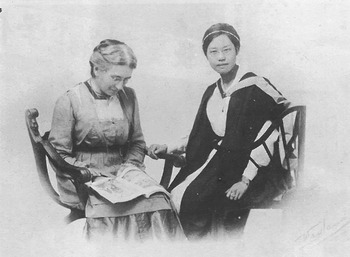
Zeng studied at two girls’ high schools in London, Worthing Church House School and Blackheath Girls’ School.Footnote 35 She lived with Barnes, who rented small houses near to the schools, but also had the companionship of her cousin, Zeng Yuenong (曾約農), who was studying engineering at the University of London.Footnote 36 As Barnes devoted herself to Zeng's education, their relationship grew to resemble that of mother and daughter. As Jane Hunter has shown, it was not unusual for missionary women to adopt Chinese children, normally abandoned girls.Footnote 37 Zeng, from an elite family, was in no need of rescue or adoption; however, studying abroad in a foreign country, she was in need of a surrogate mother or mentor figure and Barnes fulfilled this role (Fig. 1).
Zeng Baosun with Miss Barnes on her graduation from London University, 1916. Image from Beautiful China, August 1970, 8. Queen Mary University of London Archives, Westfield College Archive, WFD-15-3-7.

In 1913, while Zeng was preparing to sit for the examination to enter Westfield College, Barnes had to make a life-changing decision: would she go back to China and continue her work as school principal or stay in England and support Zeng in her studies? After much reflection, and correspondence with the CMS, who refused to grant her an extension of her furlough, Barnes decided that her duty lay with her Chinese pupil.
There are a few, who feel very strongly I am giving up the ‘many for the one’, and perhaps Miss Tseng might be strengthened if left alone; others … feel equally strongly I ought to remain in England at least for a time, and help the one who is capable, willing and ready to be trained … . There is a strong feeling we have been praying for such a one to come forward, and I can best help China and the work by remaining and that by so doing I am helping to prepare ‘the One for the Many’. She will do more than twenty of me.Footnote 38
Barnes felt strongly that the time had come for a self-supporting Christian church, and that with a college degree Zeng as a Chinese Christian could return to China and achieve far more than she, a foreign missionary, could ever hope to achieve.
In October 1913 Zeng entered Westfield College, one of the three women's colleges affiliated with the University of London, majoring in Biology and minoring in Mathematics.Footnote 39 Taking its inspiration from Mount Holyoke College in the USA, Westfield had been founded in 1882 with the goal of promoting women's higher education with a distinctly Christian ethos, as reflected in its original motto: ‘Behold the Handmaiden of the Lord.’ Evangelism both at home and overseas remained at the heart of the college enterprise, with many of its graduates going on to work for the CMS.Footnote 40
Zeng's experience of the English education system exposed her to new ideas which she would carry back to China and apply to her own school for girls in Changsha. Zeng provides a pertinent example of Chinese women's agency in the transnational circulation of educational ideas between China and the West in the early twentieth century. In her memoirs she stated frankly: ‘Life at Westfield College, was filled with new experiences for me. The exposure to the way that students were treated at Westfield and the way they responded and conducted themselves afforded me important insights that influenced my direction of women's education in China.’Footnote 41 Zeng explained how the English trimester system would need to be adapted in China:
This system of trimesters in the academic year would not work too well in China but the longer summer vacation would be an excellent idea to allow students to be out of classes during the extreme heat and have more time for review. It would also be suitable for schools in tropical Asia.Footnote 42
She was also impressed by the trust and power afforded to the autonomous Student Association, which was self-governing and represented the interests of students to the college, and by the trust placed in students during examinations for which there was no proctor:
I became familiar with a fine educational system. Later when I headed the Yifang School, I adopted many of the methods used at Westfield. Naturally, middle school students could not be given as much freedom as university students, but Yifang did not proctor examinations. It did not register de-merits; nor did we dismiss students for a certain number of demerits. These ideas I absorbed during my years at Westfield.Footnote 43
Zeng's experience thus complicates the picture of a one-way flow of educational knowledge between China and the West. It shows that Chinese women were active agents in the dynamic flow of educational knowledge and expertise between China and the West, taking the best of two complementary systems and adapting it to a specific cultural setting, much as Chinese Christians were able to take and absorb aspects of Christianity, adapting it to Chinese culture.
During the First World War, Zeng was also deeply influenced by Quaker pacifism and by the social gospel, which was becoming popular in missionary circles. She joined the Westfield College branch of the Student Volunteer Movement, participating in small group discussions about religious and social problems. During this period of spiritual and intellectual growth, Zeng applied her Christian faith to the national situation in China, deciding that the best way for her to serve her country was to found her own Chinese-run Christian school for girls, and she started to use her own extensive networks in the UK to realize this dream.Footnote 44
The Yifang School for Girls at Changsha
The Yifang Collegiate School for Girls (藝芳女子學院) was established by Zeng Baosun and Zeng Yuenong in Changsha in 1918. In evaluating Zeng's efforts, we must look beyond the self-congratulatory rhetoric of the missionary enterprise which praised her as the fruit of their labour, to examine how Zeng actively and resourcefully utilized the networks and connections which her Christian education opened to her, as well as her family's resources, and how she skilfully incorporated the best aspects of her international educational experiences into her own school for girls.
In spring 1915, during her third year of study at Westfield College, Zeng began to formulate plans for school. Although Barnes had originally conceived that Zeng would return to work as a teacher at the Mary Vaughan High School, Zeng was not convinced about this for several reasons. Zhejiang province, situated on the east coast of China, already had a number of schools for girls. She felt she could serve her country better by starting her own school for girls in the capital of her home province, Changsha, Hunan, where there were far fewer educational options available to girls of her class. In 1917 there was only one missionary middle school offering senior middle school training to girls (jointly run by the American Presbyterian and United Evangelical Churches) and no higher-level government middle schools which could prepare girls for university.Footnote 45 The possibility of using family resources and connections to start her school was also an important consideration in Zeng's decision to return to Changsha.Footnote 46
Using her own name and social position as a drawing point, Zeng's school was aimed at girls from elite families, who had previously been largely left out of the missionary school system. She hoped that her school might grow into a Central China Women's College, with a connection to a foreign university, along the lines of Ginling College in Nanjing.Footnote 47 By 1926 her school's curriculum offered a six-year middle school course, and four years of college-level education for girls which aimed at achieving university standard.Footnote 48 Enrolment grew steadily from eight pupils in 1918 to more than sixty by 1927, and the school expanded its buildings and facilities to meet this growing demand.Footnote 49
A second important aspect of Zeng's decision was her conviction of the pressing need to indigenize the church in China. After the 1911 revolution, with the rise of Chinese nationalism, many missionaries (including Barnes) recognized the pressing need to establish a Chinese-controlled church. Zeng was also inspired by her uncle, Zeng Jirong, who had set up his own Chinese Christian church in Changsha, as she recalled in her memoir:Footnote 50
I wanted to start a Christian School run entirely by Chinese. Not that mission schools were not good but I felt that Christianity must be completely assimilated in Chinese society before the Chinese people would embrace it as their own religion, as they did Buddhism. Uncle Jirong had also felt this way and started an independent Christian Church in Changsha. I would be very willing to accept foreign personnel and financial help, but unwilling to accept foreign control or foreign imposed conditions. Ms. Barnes agreed with this idea.Footnote 51
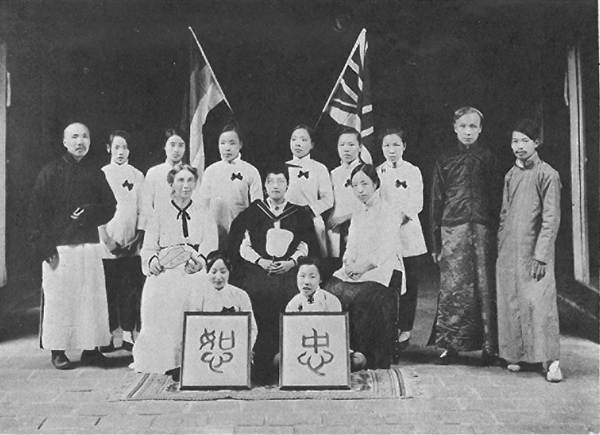
Unlike some of her fellow CMS missionaries, Barnes herself had long been supportive of the principle of a Chinese-led Christian church.Footnote 52 Yifang thus became a remarkable early example of a Chinese-established Christian school in China. Another unusual aspect of the school for its time was the reversal of the power dynamics between missionary school pupil and teacher, as Zeng became headmistress of the school with Barnes as an English teacher under her (Fig. 2). As Zeng recalled, this was almost unheard of at the time in China: ‘Ms. Barnes agreed to teach English but preferred that I serve as principal. I think this may have been a first in those days in China: an elderly foreigner working under a young Chinese, especially a Chinese who had formerly been her student.’Footnote 53 We can question whether this reversal of the power relationship between Western missionary and Chinese student was as dramatic as Zeng presents. The differences in both class background and financial resources may have made this power shift more natural. Barnes, conscious of her lowly class and educational background was both proud and in awe of her upper-class Chinese pupil. Zeng hints in her memoirs that she was aware of Barnes's very ‘ordinary’ background: ‘I discovered that she was not extremely learned and articulate, simply an ordinary person.’Footnote 54 It is also possible that Barnes became financially dependent on Zeng after resigning from the CMS. The financial support that Barnes received from the wealthy family of Mary Vaughan, on which she lived for the rest of her life, was due partly to their friendship and partly to the prestigious Chinese student she had under her charge.Footnote 55
‘At the opening of the Yifang Girls school, August 10, 1918’; Louise Barnes sits on Zeng’s right and Zeng Yueneng stands to her left. Image from Beautiful China, August, 1970, 8. Queen Mary University of London Archives, Westfield College Archive, WFD-15-3-7.

In establishing her school, Zeng drew upon the local, national and international networks to which her Christian educational background and her status as a member of the Zeng family gave her access. The principals of Westfield College, Agnes de Sélincourt and later Helen Richardson, were supportive of Zeng's idea for a girls’ school in Changsha and were instrumental in securing donations towards the funds needed. After the school was established, Helen Richardson helped secure the appointment of three foreign teachers for Yifang: Miss Madge (1922–4), Winifred A. Galbraith (1925–7) and Violet C. Grubb (1925–7) were all ‘Old Westfieldians’ with degrees and educational experience.Footnote 56 In 1922 the school was by no means self-supporting, being mostly funded by the Zeng family, and therefore it was imperative to secure donations to support the cost of these foreign workers. Zeng Baosun, Zeng Yuenong and Barnes did not receive salaries.Footnote 57
Lists of foreign and Chinese sponsors of the school also reveal the importance of the personal contacts that Zeng made during her studies in the UK in helping her secure the necessary funds. Using her CMS contacts, Barnes introduced Zeng to several prominent missionary families, Christian educators and churchmen, including the wealthy family of Mary Vaughan.Footnote 58 Zeng also recalls the invaluable help provided by Miss de Sélincourt: ‘She sought out a number of prominent and zealous Englishmen who would give their support. Amongst them was Dr. W. Temple, later Archbishop of England. She also enlisted Ms. Richardson and Ms. McDougall to help me present my ideas to other educators. She considered this true missionary work.’Footnote 59 Zeng also made important contacts during her further studies in education at St Hugh's College, Oxford, and Newnham College, Cambridge, during the summers of 1916 and 1917.Footnote 60 On her way back to China in autumn 1917, Zeng travelled via the USA and Canada, where she advertised her new school, making valuable contact with leading Chinese intellectuals, including Hu Shi (胡適) and Chen Hengzhe (陳衡哲).Footnote 61
Zeng's social position as a descendant of the famous Zeng Guofan no doubt facilitated her access to these intellectual contacts and social networks. Moreover, upon her return to Changsha, the Zeng family used its influence to secure the recovery of the Zeng Guofan ancestral temple as a site for the school, and to ensure the school's smooth registration with the Hunan provincial education authorities.Footnote 62 With the backing of her family proving a powerful asset (at least in its early days), the school was officially opened on 12 September 1918 with eight pupils. The school was named Yifang (藝芳), in memory of Zeng's grandmother's studio at Prosperity Hall.Footnote 63
In establishing her school in Changsha, Zeng aimed to take the best of her Chinese and Western educational experiences and combine them into a unique formulation. She was aware of the advantages and pitfalls of each system and hoped to bridge the gap between Chinese government and foreign missionary education:
The gulf separating Church-sponsored and secular education at that time was great … . The two educational systems, church and secular, rivalled each other but each had its forte. The church-operated universities inevitably stressed English, Western History and Geography, and Science. Although they made a considerable contribution in introducing new knowledge, they also missed a great deal concerning Chinese history, customs and the traditional culture.Footnote 64
Zeng aimed to bridge the gap by drawing from both Chinese and English schools to fulfil what she perceived to be the needs of Chinese girls at Changsha. Her curriculum offered courses in the Chinese classics and history, geography, mathematics and science. Advanced mathematics courses included algebra, trigonometry, calculus and geometry. Students also benefited from the tuition of English by native speakers who taught texts ranging from Charles Kingsley's Heroes to Shakespeare. Zeng's curriculum was designed to outstrip both the Chinese government and Western missionary school curricula for girls at the middle school level.Footnote 65 Zeng reported proudly in 1948 the high college entrance rates of Yifang students: ‘Our students have been uniformly successful in college entrance examinations: ninety per cent of our old students have university degrees. More than half of our students are in actual work outside the home.’Footnote 66
Her educational plan had several distinguishing features, which made it both different from and similar to missionary schools in China. Perhaps recalling her own frustration at the strict atmosphere at missionary schools, Zeng was keen to stress student self-government and leadership in her school. A School Union was formed and all important decisions concerning the school were voted on by the students. Based on her experience of the student democracy and debating society at Westfield, Zeng also encouraged the students to practise debating issues of national concern. Sometimes she and Zeng Yunong would take opposite stances in the debate as an example for the students. Winifred Galbraith recalled:
From the first the school has been self-governing; staff and students all belong to the students’ union which settles all business of the school. … These meetings and decisions provide valuable training in public speaking, good temper, and for the foreigner at least, patience, since neither lessons, meals nor bedtimes are allowed to cut short the discussion.Footnote 67
Several important and influential speakers came to Yifang in the period 1918–27, including the president of Peking University, Cai Yuanpei (蔡元培), who lectured on ‘The Importance of Women's Education’, and the former premier of China, Xiong Xiling (熊希齡), who spoke on ‘Women's Work’, as well as several YWCA secretaries and members of the Yale in China Mission.Footnote 68 This was policy, as Zeng explained:
We also invited several well-known people to deliver lectures. Later, we established a regular practice of having someone from outside of the school speak on a specialized topic every Friday afternoon. On Saturday, I always had a one-hour talk on current events: world affairs or problems related to China, Hunan province or society at large.Footnote 69
In its religious aspects Yifang differed from missionary schools in several ways. Although there were daily morning prayers and hymns led by Zeng, Sunday worship and Bible study classes, Yifang was not officially affiliated to any mission or denomination. Nor did Yifang require its students to attend chapel or Bible study, which until 1927 was usually compulsory at missionary schools. Indeed, Zeng was keen for girls to make informed decisions about their spiritual lives, and invited members of every missionary society in Changsha to give talks to the girls on Sundays. In her circular letter of 1922 Louise Barnes describes the open-minded interdenominational religious atmosphere at Yifang:
Miss Tseng is one of those who look forward to the development of the native Christian church and she does not therefore ally herself to any missionary body, though living in sympathetic relationship with the various Christian communities represented in Changsha, a member from each of which is asked to give an address in the school each Sunday… . No pressure is put upon girls to become baptised, but when they do wish fully to accept the Christian faith, they are left entirely free to choose to which Christian church they wish to belong.Footnote 70
In providing such an ecumenical atmosphere, Yifang was ahead of its time, foreshadowing the formation in 1922 of the National Christian Council of China (Zhonghua quanguo jidujiao xiejinhui; 中華全國基督教協進會), which sought to transcend denominational divides by establishing a Chinese-controlled church. Zeng's example as headmistress exerted a powerful influence, and many girls who came from elite non-Christian families became Christians through the exposure to the Christian atmosphere that pervaded Yifang.
There is not scope here to tell the story of Yifang itself, and the turbulent experience of its pupils, Chinese and foreign teachers during the social, cultural, political and intellectual outpouring of the May Fourth Movement in the 1920s,Footnote 71 the anti-foreign violence which accompanied the reunification of China under nationalist government during the Northern Expedition of 1926–7, and the war with Japan, events which led to the destruction and refounding of the school three times between 1918 and 1949. On 13 September 1927, Barnes died in Shanghai of a heart attack, which Zeng believed had been triggered by the strain of their escape from Changsha during the Northern Expedition.Footnote 72 During the 1930s Zeng was a YWCA delegate giving lecture tours across China, and represented China at the International Missionary Council at Tambaram, Madras (sometimes referred to as the World Christian Meeting) in 1938, before being elected to the national assembly in 1948. In 1949 she fled to Hong Kong and was then invited by the nationalist government to live in Taiwan, where she died in 1978. The legacy of Zeng's work at Yifang is manifested in the generations of Chinese women whom she helped to educate. The strong Yifang alumnae association proudly carries on its school history though annual meetings and an annual magazine.Footnote 73 On today's Yifang campus (Changsha Tianjiabing Experimental Middle School; 长沙市田家炳实验中学), there is a monument celebrating the important contributions of Zeng Baosun, Zeng Guofan and Zeng Yuenong to modern Chinese education.
Zeng's life story, although an extraordinary one, highlights the dynamic role played by Chinese Christian women in the transfer of educational knowledge between China and the West during the early twentieth century. Their Christian status was essential in this process: Chinese women could use for their own ends the Christian networks to which their education and social status gave them access. Rather than being the ‘passive recipients’ or the ‘fruits’ of missionary labour, Chinese women were active agents in this exchange, appropriating, combining and rejecting different aspects of their educational experience as they saw fit. In Zeng's case, the result was a novel form of education that aimed to combine the best of the missionary, British and Chinese educational systems to form the next generation of Chinese women. This was an extremely pressing task, as both Chinese government and missionary educational initiatives in the first two decades of the twentieth century were focused primarily on the provision of boys’ education, particularly at the middle school level. Moreover, while missionary colleges for women were opening on China's east coast from 1907, it was not until 1919 that Chinese government universities started to admit women.Footnote 74 Yifang was one of the earliest institutions offering college level training to women in inner China, and the first Christian women's college to be founded and led by a Chinese woman educator.Footnote 75 We can therefore draw wider parallels between Zeng's case and initiatives by highly educated pioneering women in other parts of the world to found colleges for women on their own terms, such as Emily Davis, who founded Girton College in Cambridge in 1869. In Zeng's changing relationship with Barnes, from pupil and teacher to headmistress and friend, we can see the changing power balance between missionaries and Chinese Christians in the early twentieth century. The school they established in mutual cooperation is an early example of the indigenization of the Chinese church, which in the 1920s and 1930s would become such a pressing task in the face of the rising tide of Chinese nationalism.