




No CrossRef data available.
Article contents
The cost effectiveness of prenatal ultrasound screening for trisomy 21
Published online by Cambridge University Press: 01 November 2004
Abstract
Objectives: The cost-effectiveness of opportunistic nuchal translucency ultrasound screening in pregnancy was compared with alternative screening strategies for trisomy 21 in Australia.
Methods: A decision analytic model was used of various pregnancy screening strategies based on a systematic review of the literature on the effectiveness of nuchal translucency ultrasound and serum screening and costs based on current reimbursement fees. The model included the likelihood and cost of terminations after diagnostic testing and the associated risk of fetal loss. All prices are in 2001 Australian dollars.
Results: With a twenty percentage point difference in detection rate, the incremental cost for a combination of nuchal translucency and serum screening with age in the first trimester compared with maternal serum screening in the second trimester was $105,484 per extra case detected and $374,779 per live trisomy 21 birth avoided. Serum screening in the second trimester had an incremental cost per extra case detected of between $61,700 and $117,100 per extra live birth avoided when compared with no screening.
Conclusions: The cost-effectiveness of ultrasound screening for trisomy 21 would appear to be more attractive if it were done at the same time as current dating ultrasound. Any funding mechanism for screening should take this strategy into account by incorporating, as far as possible, provision of nuchal translucency screening into existing services provided in early pregnancy.
Information
- Type
- GENERAL ESSAYS
- Information
- International Journal of Technology Assessment in Health Care , Volume 20 , Issue 4 , November 2004 , pp. 464 - 468
- Copyright
- © 2004 Cambridge University Press
The ultrasonographic measurement of nuchal translucency thickness in the first trimester of pregnancy is increasingly being used as a method of identifying those fetuses at risk of major genetic abnormalities, especially trisomy 21. Women who are found to have an increased risk of trisomy 21 are offered the option of invasive genetic testing, such as chorionic villus sampling (CVS) or early amniocentesis. There is evidence that screening in the first trimester of pregnancy has acceptable sensitivity and specificity compared with other screening options (Medical Services Advisory Committee [MSAC], 4). Nuchal translucency screening (NTS), however, is likely to be more expensive than other options. Gilbert et al. (3) for example, conclude that, for the United Kingdom, a combination of NTS and maternal serum screening across trimesters is the cheapest and most effective screening alternative. Vintzileos et al. (9) conclude for the United States that second trimester serum screening of pregnant women is more cost-effective than 75 percent of women having NTS and 15 percent having serum screening as long as the detection rate of NTS is below 80 percent. This study presents an evaluation of the cost-effectiveness of a set of prenatal screening strategies for trisomy 21 based on cost and prevalence data from Australia.
METHODS
A decision analytic model was constructed to compare the cost-effectiveness of four population screening strategies for a cohort of pregnant women in Australia:
- Serum screening in second trimester followed by amniocentesis for those with a positive test;
- NTS in first trimester followed by CVS for those with a positive test;
- NTS and maternal serum screening in the first trimester, followed by CVS for those with a positive test; and
- NTS and maternal serum screening for high-risk women (age-related) in the first trimester, with maternal serum screening in the second trimester for other women.
Full details of the model and its assumptions are reported in MSAC (4). Each strategy was initially compared against the next best alternative (including no screening) for a given level of uptake. An additional set of analyses considered current practice and several variations in the key assumptions, including uptake, detection rates, cost, and the rate of substitution.
Outcome Measure
NTS detects cases of trisomy 21 earlier in pregnancy. This finding would allow some women to choose to have an earlier, less physically and perhaps emotionally traumatic termination. However, for others, there would be an increase in unnecessary anxiety, invasive procedures and terminations of affected fetuses that would have otherwise miscarried before a second trimester serum screening was done. There are several possible measurable consequences of a screening program (5). The two outcome measures chosen here—trisomy 21 cases detected and live trisomy 21 births prevented—represent proxies for the benefits of prenatal screening.
Some studies, such as Vintzileos et al. (9), have gone further and calculated the lifetime extra cost of care for infants born with trisomy 21. Although there are no studies of these costs for Australia, and it is not possible to take overseas results directly, it is clear that these costs are likely to be substantial. Life expectancy with trisomy 21 is now in excess of 50 years and is usually associated with major health problems. However, including only the cost of care as a negative social value of a child with trisomy 21 provides a distorted picture of the net benefits of screening. The extra cost of care needs to be balanced by the value of the benefits of having a child with trisomy 21. There are no reliable estimates of the money value of a life with or without trisomy 21, and there are conceptual difficulties in the calculation not least because of the potential for a replacement pregnancy. For these reasons, the perspective of the analysis has been constrained and the full net benefits of screening have not been calculated.
Model
The framework for the spreadsheet model is very similar in structure to Wald et al. (10). For each strategy, the model starts with a cohort of births and calculates the number of affected and unaffected births screened in a given trimester. An assumed spontaneous fetal loss rate allowed the model to calculate the number of affected and unaffected pregnancies screened. The number of trisomy 21 pregnancies detected is (the number of affected pregnancies screened)×(detection rate). The number of trisomy 21 births avoided is (the number of affected births screened)×(detection rate)×(uptake of antenatal diagnosis)×(uptake of termination). The cost of each strategy was the sum of the number of screening tests, antenatal diagnoses, terminations and miscarriages times their unit cost with the addition of the cost of counseling at each stage.
To test how robust the results are to variations in the main assumptions, each key parameter was varied individually and in combination. (Full details of the sensitivity analysis are reported in MSAC 2002 (4).)
Data
There were approximately 260,000 births per year in Australia in 2001. It is unknown what the prevalence of trisomy 21 would be without any screening program. Data from South Australia (1) suggests that the prevalence was 1.1 per 1,000 live births in 1982. Given the upward trend in maternal age since 1982, the model assumed an underlying prevalence of 1.6 per 1,000 live births (10). This rate would suggest 416 trisomy 21 live births each year.
There is a high spontaneous rate of miscarriage of trisomy 21. Between the first trimester and term, the rate is reported to be 40–48 percent (8), and between the second trimester and term, 23–30 percent (2). These data are not precise and do not accord exactly with the dates of NTS and serum screening. For the purposes of the primary modeled analysis, the assumption was a 40 percent rate of spontaneous miscarriage of trisomy 21 between the time when NTS would be performed in the first trimester and term. The rate of fetal loss between the time when a second trimester serum screen would be done and term was assumed to be 23 percent.
A systematic review of the literature (MSAC report 2002 Table 21 (4)) suggested that the detection rate for triple-marker serum screening in the second trimester (alpha-fetoprotein, total human chorionic gonadotropin, inhibin A) was no more than 64 percent with a 5 percent false-positive rate. CVS or amniocentesis is offered to those who have a risk in excess of 1:250 in second trimester and 1:300 in first trimester either determined through screening or because of the risk associated with maternal age. Amniocentesis has been reported to have a procedure-related fetal loss rate of 0.9 percent (95 percent confidence interval [CI]=1.2 to 0.6 percent) in the second trimester of pregnancy (10). The current uptake of amniocentesis among women with a positive screen has been reported as 85 per cent (6). The vast majority of women whose fetuses are diagnosed as having trisomy 21 seek elective terminations of the pregnancy, and 90 percent was assumed in this analysis.
Yates et al. (11) estimated in 1991 and 1992 that 97 percent of pregnant women had at least one ultrasound scan and that 46 percent had two or more. NTS may substitute for the current use of ultrasound in the first trimester, with considerable implications for the cost-effectiveness of ultrasound screening. If we take the current Medicare fee for genetic defect screening ultrasound at 17–22 weeks ($100) as indicative of the likely cost of a first trimester NTS, then the extra cost of NTS over a current ultrasound examination at less than 16 weeks ($60–70) would be only $30–40. The primary analysis assumes that there will be no substitution for current first trimester ultrasound, but the sensitivity analysis considers an 80 percent substitution in the first trimester at a marginal cost of $40. This approach is in contrast to that of Gilbert et al. (3) who, based on the cost structure of the United Kingdom, assume a very low marginal cost for NTS.
Evidence from Snijders et al. (7) suggests that, with a false-positive rate of 5 percent, the sensitivity of NTS for trisomy 21 was 77 percent (95 percent CI=72 percent, 82 percent). A combination of NTS, double-serum markers, and age were assumed to raise the detection rate to 86.4 percent. Women who screen positive would be offered CVS or amniocentesis at a fee of $683 and $782.90, respectively. The uptake of diagnostic testing after a positive screen was assumed to be 85 percent with a 100 percent detection rate and a procedure-related rate of fetal loss of 0.9 percent, irrespective of the test. The cost of a termination is $1,016.
An additional cost of counseling was added for those who have a positive screen and for those who decline further diagnosis while the cost of an additional ultrasound scan was added for those who went on to have a diagnostic test.
RESULTS
Table 1 illustrates the basic structure of the model and results with respect to NTS. Parallel calculations for serum screening in the second trimester and a combination of first trimester serum screening and ultrasound were made.

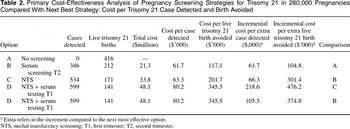
Table 2 shows the number of cases detected, live trisomy 21 births, and the cost of each strategy ranked in order of cases detected and live births avoided. In the absence of screening or diagnosis in a cohort of 260,000 live births, there were 416 live trisomy 21 births. Serum screening detected 346 cases of trisomy 21 per year at a cost of $21.3 million and had 212 live births. NTS in the first trimester added an additional $12.5 million but detected a further 188 cases while avoiding a further 41 live trisomy 21 births. NTS combined with serum screening in the first trimester had an additional cost of $14.3 million over second-trimester serum screening alone, but 65 additional cases detected and 30 live trisomy 21 births prevented. The combination of NTS and serum screening in the first trimester when compared with serum screening in the second trimester resulted in 155 less traumatic terminations but also 44 additional terminations that would have otherwise resulted in a fetal loss before 16 weeks.

The results were sensitive only to the extent of substitution for dating ultrasound and the assumed detection rate for NTS. With 100 percent substitution, the incremental cost per extra case detected and trisomy 21 birth averted for the combination of NTS and serum screening in first trimester compared with serum screening in the second trimester was less than 50 percent of the primary results. The sensitivity of the cost-effectiveness to variation in the detection rates for the three screening modalities was assessed in a probabilistic sensitivity (Monte Carlo) analysis. This method assumed a uniform probability distribution for each of the detection rates and sampled from that distribution 1,000 times to produce a distribution of mean incremental cost per case detected. Literature-based estimates of the detection rate for NTS were 0.72–0.82; for second-trimester serum screening 0.63–0.80; and for combination of NTS and serum screening in first trimester, 0.71–0.88. The result was an incremental cost per extra case detected for the NTS and serum screening combination compared with second trimester serum screening alone of $121,554 (95 percent CI, $104,109 $141,664). This value compares with the $105,484 per extra case detected in the primary analysis.
DISCUSSION AND POLICY IMPLICATIONS
The cost-effectiveness analysis is based on a simplified model of pregnancy screening in Australia and the social value of its outcomes. A limitation of these results is that the true cost of these tests are not known but have been estimated from current public insurance reimbursement rate for private services in Australia. The charge for NTS has been assumed to be the same as a mid-trimester ultrasound at $100. Many patients pay an additional out of pocket charge of at least $50. However, that the $100 represents the opportunity cost of a scan to government does make the fee the relevant cost from the perspective of the major funder of services. In contrast, a recent study by Gilbert et al. (3) of the cost of NTS in the United Kingdom has a cost of only £4 ($10). In that study, the cost of serum screening was 2.5 times the cost of the NTS, whereas the reimbursement in Australia for serum screening was approximately half the cost of a mid-trimester ultrasound. Clearly, these differences could reflect the nature of medical practice, medical incomes, and the system of reimbursement and limit the generalizability of these studies across countries. On the other hand, the cost of amniocentesis and CVS is very similar across the two countries using current exchange rates. This finding illustrates that the cost-effectiveness of NTS is likely to depend critically on the extent to which it can be administered as an adjunct to the existing regimen of ultrasound in pregnancy. If NTS can be effectively performed in a few minutes during a first-trimester dating ultrasound, with no additional overhead or capital costs, as Gilbert et al. (3) assume, then it has a very low additional cost. On the other hand, if NTS involves an extra visit to a specialist practice that attributes some additional doctor time, overhead, and capital charges to the ultrasound, the cost is likely to be considerably higher.
Even if the additional unit cost of NTS is high, it may still be that health-care decision-makers are willing to pay for the apparent benefits that include reassurance, the emotional and psychological effects on the family of preventing the birth of a disabled child, and the savings from the care of a disabled child.
This study is part of a review commissioned by the Commonwealth Department of Health and Ageing on behalf of the Medical Services Advisory Committee (MSAC). I am grateful for helpful comments from Professor Lachlan de Crespigny and the work of Alex Raulli and Dr. Elmer Villanueva who completed a systematic review of the clinical literature. All opinions expressed in this article, however, are the author's own and do not necessarily reflect the views of either the MSAC or the Commonwealth Department of Health and Ageing.
References
Cheffins T,
Chan A,
Haan EA, et al.
2000
The impact of maternal serum screening on the birth prevalence of Down's syndrome and the use of amniocentesis and chorionic villus sampling in South Australia.
Br J Obstet Gynaecol.
107:
1453–
1459.Google Scholar
Cuckle HS,
Wald NJ.
1990
Screening for Downs syndrome.
In: Lilford R, ed.
Prenatal diagnosis and prognosis.
London:
Butterworths;
67–
89.
Gilbert RE,
Augood C,
Gupta R, et al.
2001
Screening for Down's syndrome: Effects, safety, and cost effectiveness of first and second trimester strategies.
BMJ.
322:
423–
436.Google Scholar
Medical Services Advisory Committee
2003
Nuchal translucency measurement in the first trimester of pregnancy for the screening of trisomy 21 and other autosomal trisomies.
May 2002 MSAC reference 4 Assessment report.
Canberra:
Commonwealth of Australia.
Mooney G,
Lange M.
1993
Ante-natal screening: What constitutes ‘benefit’?
Soc Sci Med.
37:
873–
878.Google Scholar
SABDR (South Australian Birth Defects Register) 1997.
1998
Annual report of the South Australian Birth Defects Register.
Adelaide:
SABDR;
Snijders RJ,
Noble P,
Sebire N, et al.
1998
UK multicentre project on assessment of risk of trisomy 21 by maternal age and fetal nuchal-translucency thickness at 10-14 weeks of gestation.
Lancet.
352:
343–
346.Google Scholar
Snijders RJ,
Sebire NJ,
Nicolaides KH.
1995
Maternal age and gestational age-specific risk for chromosomal defects.
Fetal Diagn Ther.
10:
356–
367.Google Scholar
Vintzileos AM,
Ananth CV,
Smulian JC, et al.
2000
Cost-benefit analysis of prenatal diagnosis for Down syndrome using the British or the American approach.
Obstet Gynecol.
95:
577–
583.Google Scholar
Wald NJ,
Kennard A,
Hackshaw A, et al.
1997
Antenatal screening for Down's syndrome.
J Med Screen.
4:
181–
246.Google Scholar
Yates JM,
Lumley J,
Bell RJ.
1995
The prevalence and timing of obstetric ultrasound in Victoria 1991–1992: A population-based study.
Aust N Z J Obstet Gynaecol.
35:
375–
379.Google Scholar

Nuchal Translucency Ultrasound Screening for Trisomy 21 for All Pregnant Women (260,000 Live Births)
Primary Cost-Effectiveness Analysis of Pregnancy Screening Strategies for Trisomy 21 in 260,000 Pregnancies Compared With Next Best Strategy: Cost per Trisomy 21 Case Detected and Birth Avoided
 You have
Access
- 7
- Cited by