INTRODUCTION
Despite the substantial growth of foreign direct investment (FDI) in the developing world in the past few decades, there are increasing signs of domestic backlash against FDI in host countries. Recent protests against proposed FDI projects in emerging markets such as India and China have increased the influence of public opinion in the formulation of FDI policy, not only in democratic regimes, but also in authoritarian states. In 2012, for example, the Indian coalition government's decision to cut fuel subsidies and allow 51 percent FDI in multi-brand retail has sparked large-scale protests across the country (Badkar Reference Badkar2012). As another example, Japan's direct investments in China experienced sharp declines of 20% in 2013 and a further 40% during the first half of 2014, largely in response to the sometimes violent demonstrations that broke out in China over Japan's decision to nationalize a small chain of disputed islets in the East China Sea (Iida Reference Iida2014).
The above examples suggest that in developing countries, including even authoritarian states such as China, major decisions regarding FDI are increasingly constrained by public opinion. Growing public input on foreign economic policy, therefore, underscores the need for more systematic study of individual attitudes toward FDI in these countries. Through an experimental conjoint survey administered to 2,224 Chinese citizens, this paper undertakes such an endeavor and explores how, in the present project, individual respondent characteristics and specific FDI features affect respondents’ preferences.
Existing studies of individual preferences regarding FDI inflows in developing countries tend to emphasize the distributional consequences of FDI, suggesting that individuals at higher skill levels are more likely to support FDI (e.g. Pandya Reference Pandya2010). It has also been suggested that skilled workers should be more likely to support skill-intensive FDI, which tends to increase the relative demand and thus real wages for them (Feenstra and Hanson Reference Feenstra and Hanson1997; Griffith Reference Griffith1999). Conversely, unskilled workers should favor low-skill-intensive FDI, as it raises their real income (Zhu Reference Zhu2011). However, to the best of our knowledge, no study has been conducted to empirically assess individual support for FDI with different skill content in the context of a country abundantly endowed with low-skilled labor, such as China. This paper seeks to fill this lacuna in the literature and examine how skill level and a set of economic and political factors influence FDI preferences. Contrary to conventional economic theory, we find that low-skilled respondents are indifferent toward different types of FDI. Instead, the home country of the FDI project and its impact on the local job market are the most prominent determinants of FDI preferences. To the extent that our question about FDI projects’ job creation potential focuses on their effects on the local economy as a whole, these results indicate that in their preference formation, individuals may be primarily concerned about FDI's socioeconomic impact on the nation rather than on their individual welfare.
HYPOTHESES
Existing studies of the distributional effects of FDI emphasize that global capital flows should increase the demand for and therefore the wages of local workers (Feenstra and Hanson Reference Feenstra and Hanson1997; Griffith Reference Griffith1999). It has further been argued (e.g. Zhu Reference Zhu2011) that different types of FDI may generate different distributional consequences. As FDI inflows in a low-skill-intensive or high-skill-intensive sector raise capital endowments and thus demand for unskilled or skilled labor in a sector, they should increase the marginal productivity of labor in this sector and cause more unskilled/skilled labor in low-/high-skill-intensive sectors to flow into this sector. Consequently, capital inflows in low-/high-skill intensive sectors should increase the demand for and therefore the wages of unskilled/skilled workers in the host country. This effect should be magnified even further in developing countries abundantly endowed with unskilled labor. This reasoning should lead us to expect that in a developing country with an abundant supply of unskilled labor, such as China, low-skilled individuals should be more likely to favor low-skilled, labor-intensive FDI instead of skill- or technology-intensive FDI (Hypothesis 1).
Our second hypothesis focuses on the labor market effect of FDI inflows. Previous studies (e.g. Dunning Reference Dunning1998; Reference Dunning1993; Pandya Reference Pandya2010) have shown that multinational corporations, as a result of their ownership, location, and internalization advantages and their greater ability to access the credit and other resources provided by parent firms even during times of economic crisis, may be well positioned to promote labor market stability and thus gain the goodwill of the host public. This leads us to expect that respondents should be more favorable toward foreign investment projects that generate more job opportunities for the host economy (Hypothesis 2).
We further expect that FDI preferences may depend on the favorability of the investment source country, which may be determined by prevalent impressions about its political relations or corporate culture (e.g. Jensen and Lindstädt Reference Jensen and Lindstädt2012). One potential explanation is that FDI from these countries is more likely to be associated with more stringent labor and environmental standards that generate positive socioeconomic spillovers for the host country (Dean et al. Reference Dean, Lovely and Wang2009). In other words, respondents should be more likely to favor capital flows from developed countries than those from developing countries (Hypothesis 3a). However, this effect should be moderated when FDI originates from a home country with contentious political relations with the host government. In light of the long history of animosity and recent territorial disputes between China and its Asian neighbors (Reilly Reference Reilly2013; Yang Reference Yang and Soderberg2002), this leads us to expect that respondents should be less likely to favor FDI from Asian countries than from other regions (Hypothesis 3b).
In addition to the above main hypotheses, we take into account a couple of other factors that may affect FDI preferences. First, we expect that individuals should be more likely to favor joint ventures rather than projects involving mergers and acquisitions, or those in which foreign firms are the sole proprietors, because of the greater managerial and financial control the former provides to domestic firms (Harms and Méon Reference Harms and Méon2014; Wang and Wong Reference Wang and Sunny Wong2009). Second, investment incentives in the form of tax breaks, grants, preferential loans, infrastructure, market preferences, and sometimes even monopoly rights have been considered important determinants of international investment flows (Easson Reference Easson2001; Taylor Reference Taylor2000). Individuals may support FDI projects that offer foreign investors greater policy concessions if they believe that such concessions are needed to attract FDI. However, if individuals are concerned about equal treatment and fair competition for local enterprises (Kelly et al. Reference Kelly, Rajan and Goh2006), then they may be likely to oppose such projects. Third, as Pandya (Reference Pandya2014) has suggested, workers who anticipate the largest wage increases should be more likely to support FDI flows. If this is the case, then respondents should be more likely to hold favorable attitudes toward FDI projects that offer greater potential for wage increases. Lastly, we control for the size of the investment project, on the expectation that larger-scale investments may be more likely to gain the support of the host public due to their greater potential to generate multiplier effects for the local economy.
METHODS AND DATA
We tested our hypotheses in the context of a randomized experiment. The experiment was embedded in a larger online survey administered to Chinese adults in November 2014. China is particularly suitable for this study as it is not only the largest developing country, but also one of the most popular hosts of FDI. The survey was implemented by SoJump, an Internet marketing research firm in China, which drew a sample of 2,224 respondents from its 2.6 million registered subjects.Footnote 1
A comparison of the key demographic variables of our sample with those of the Internet active subsample of the China Survey and the China Policy Attitude Survey (CPAS) suggests that our sample is comparable to the China Survey sample with Internet access and closer to the online sample of the CPAS.Footnote 2 As with other online samples drawn in China, the respondents tend to be younger and more educated urbanites (based on their household registration, or hukou) and are more likely to be members of the Chinese Communist Party (CCP). In other words, this sample represents a subgroup of a relatively politically engaged population whose opinions arguably are more likely to capture the attention of the Chinese government.
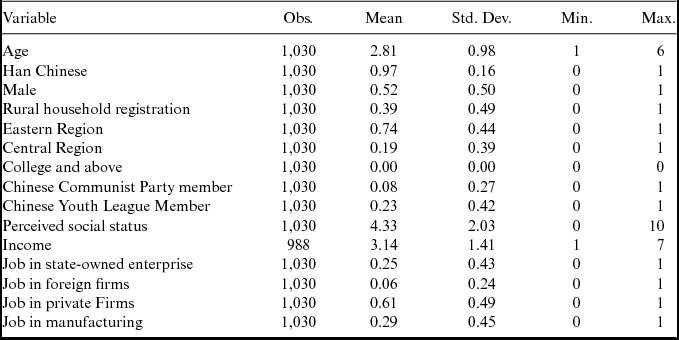
One problem with this sample is the highly skewed distribution of skill level as measured by education: nearly 80% of the respondents have college degrees. Since our hypotheses are based on low-skilled labor, with which China is abundantly endowed, we implemented a follow-up survey in October 2015 targeting low-skilled respondents (i.e. those without college degrees). In total, 553 respondents from this wave were low-skilled. Combining these respondents with the low-skilled respondents from the original survey yields a final sample size of 1,030.Footnote 3 Table 1 presents descriptive statistics for the combined sample.
Descriptive Statistics of the Combined Sample of Low-Skilled Respondents
In both waves of the survey, we implemented a series of conjoint experiments to empirically assess our hypotheses. Developed in marketing and psychology to analyze multidimensional choices, conjoint analysis involves having respondents evaluate two or more hypothetical options (e.g. several political candidates) with multiple attributes (e.g. race, party, and ideology), then estimating how each attribute affects respondents’ preferences for different options. While the conjoint design has increasingly been used in studies of politics and international political economy (e.g. Bechtel and Scheve Reference Bechtel and Scheve2013; Hainmueller and Hopkins Reference Hainmueller and Hopkins2014; Hansen et al. Reference Hansen, Olsen and Bech2014; Spilker et al. Reference Spilker, Bernauer and Umaña2016), it has some added benefits when applied to an authoritarian population. By presenting realistic scenarios bundled with multiple dimensions, the conjoint design increases the chances that the results will reveal the true preferences of the respondents, whose answers could otherwise be biased due to self-censorship or pressure to conform if we were to ask them for their preferences directly.
Similar to these earlier works, our conjoint module begins with a short introductory text and instructions on how to complete the choice-tasks. After this, respondents are asked to choose one of two hypothetical FDI projects with multiple attributes, presented to them side by side in a table. To minimize primacy and recency effects, the ordering and contents of the attributes are fully randomized. We repeat this binary comparison four times for every respondent, and each time, they are asked: “In comparison, which of the two projects do you prefer?” This forced choice yields a variable for each of the eight (2 × 4) FDI projects, coded “1” if the respondent chooses that project and “0” if not. In addition to this binary choice, the respondents are asked: “Suppose that your city is evaluating the two FDI projects above and is seeking your opinion. Please rate the two projects on a seven-point scale, with ‘7’ equal to ‘complete support’ and ‘1’ equal to ‘no support at all.’”
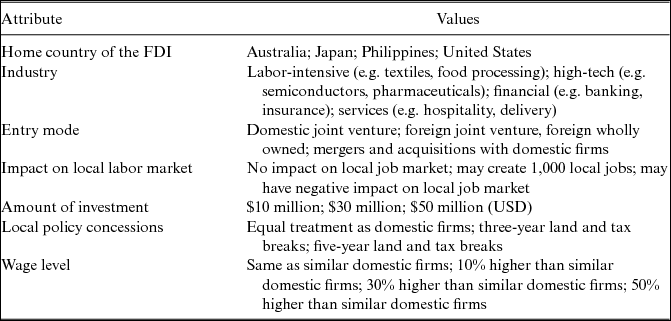
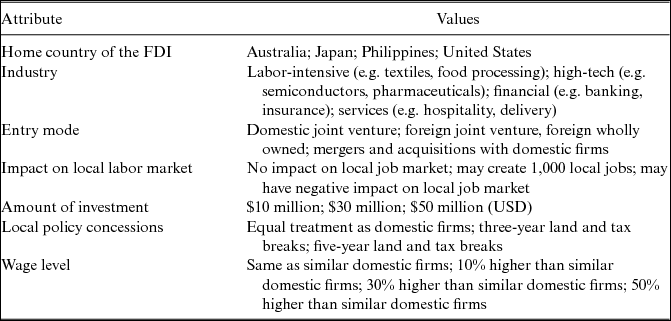
Table 2 shows the attributes and values used in the conjoint analysis. Corresponding to the hypotheses, we focus on the skill intensity, labor market aspects, and country of origin of the proposed FDI project. For the industry of the project, we include four values: labor-intensive, high-tech, financial, and services, with illustrated examples. The potential impact on the local job market includes three scenarios: no impact, negative impact (which is left vague), and positive impact (1,000-job creation).Footnote 4 For country of origin, we include four potential source countries: two developed countries outside of Asia (i.e. the U.S. and Australia), one developed Asian country (i.e. Japan), and one developing Asian country (i.e. the Philippines). The other four features of the FDI are entry modes, amount of the investment, local policy concessions (land and tax breaks), and wages compared to domestic firms.
Attributes and Values in the Conjoint Analysis
Our design yields a total of 8,240 (1,030 × 2 × 4) FDI projects.Footnote 5 To obtain the average marginal component effect (AMCE) of each attribute value on the probability that a particular FDI project will be chosen, we regress either the choice or the ranking variable on a set of dummy variables corresponding to the values of each feature, with one value excluded as the baseline. Standard errors are clustered on the respondent to account for within respondent correlations in their responses. The regression coefficient for each dummy variable thus represents the AMCE of that value of the feature relative to the omitted baseline value.Footnote 6
RESULTS
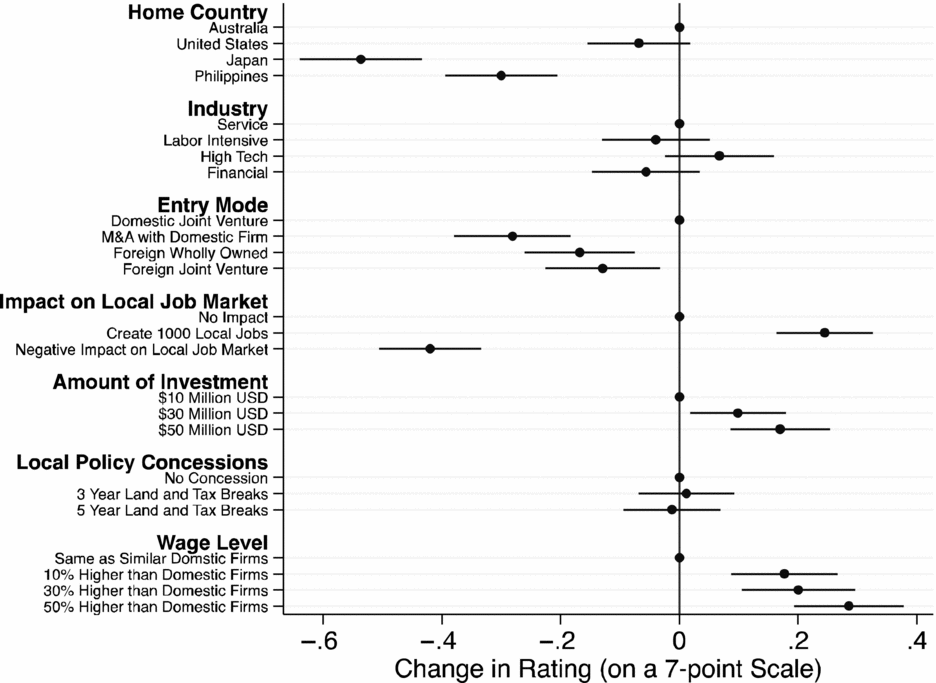
We present the main findings of the conjoint analysis in Figure 1, which illustrates the marginal effect associated with each attribute on an individual's rating for an FDI project.Footnote 7 The dots are coefficient estimates, and the horizontal lines represent the 95% confidence intervals. Each attribute can be interpreted relative to the (omitted) baseline category, which is depicted as the dot on the vertical zero line.
Effect of FDI Features on Individual Preferences.
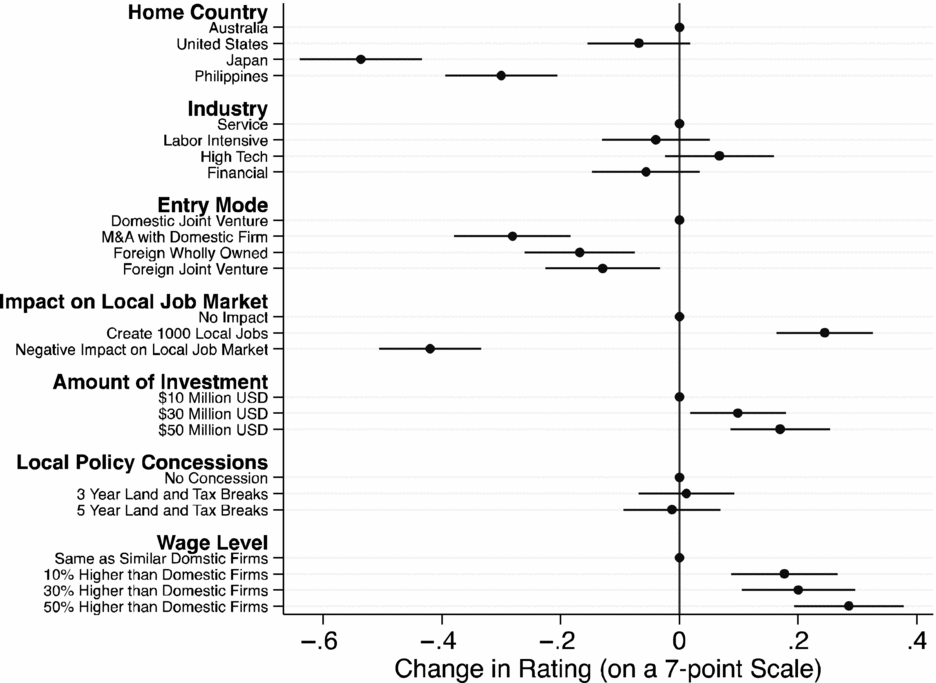
Our most interesting finding concerns individual attitudes toward FDI with different skill intensities. Contrary to Hypothesis 1, our results suggest that respondents are indifferent to the four types of FDI. This is somewhat surprising because the existing literature (e.g. Zhu Reference Zhu2011) would lead us to expect that low-skilled individuals should be more likely to support low-skilled, labor-intensive FDI that will increase the demand for labor in such industries. Since FDI is a topic requiring economic knowledge to comprehend, it is also possible that ordinary citizens, especially low-skilled individuals, simply do not know that they may profit more from an increase in labor-intensive FDI than from other types (Guisinger Reference Guisinger2009; Rho and Tomz Reference Rho and Tomz2017).
In the meantime, the results lend considerable support to Hypothesis 2, that FDI's potential impact on the local job market may factor prominently in individuals’ FDI preferences. Indeed, the substantive effects are very large. The coefficients on the “impact on local job market” variable show that support for a project increases by 0.25 points if it could create local jobs and decreases by 0.42 points if the project may lead to job losses. The large substantive effects suggest that job prospects may be one of the most salient factors when individuals consider potential FDI projects.
To the extent that our survey question focuses on FDI's job-creation potential for the local economy and for the respondent's own sector, it may also allow us to capture their sociotropic versus egocentric policy preferences, i.e. the degree to which individuals formulate policy preferences based on FDI's collective impact on the nation (e.g. Mansfied and Mutz Reference Mansfield and Mutz2009) or on individual self-interest. The fact that low-skilled respondents are supportive of FDI projects that create jobs for the local economy but are no more likely to favor labor-intensive FDI could point to the possibility that individuals may formulate their preferences based on the effect of FDI on the nation as a whole, in a way that is consistent with the sociotropic model of decision-making.Footnote 8
Our results additionally lend support to our hypotheses regarding the influence of the country of origin (Hypothesis 3): the ratings for investments from the Philippines and Japan are 0.54 and 0.3 points lower than investments from Australia. However, respondents do not discriminate regarding FDI projects from the U.S. These findings suggest that Chinese respondents are more likely to hold negative views of foreign investment originating from Asian countries with historical animosity with China and/or a corporate culture that tends to disregard labor and environmental protection. The large substantive effects suggest that country of origin is also one of the most important factors underlying individual preferences for FDI.
Turning to the control variables, the FDI project's entry mode, size, and wage effect influence FDI preferences as hypothesized. Respondents are more likely to support projects that are large and offer higher wages. They are also more likely to favor joint ventures where the Chinese party has the controlling share rather than projects involving mergers and acquisitions or those in which foreign firms are the majority shareholders or the sole proprietors. In other words, Chinese citizens prefer FDI projects that give domestic firms managerial and financial control. Interestingly and somewhat counter-intuitively, whether or not local governments offer policy concessions has no influence on individual FDI preferences, suggesting that fairness is not a big concern for respondents or that respondents may focus more on the welfare effects of FDI in formulating their opinion.
CONCLUSION
Scholars of international political economy have only recently begun to examine individual preferences for FDI (Jensen and Lindstädt Reference Jensen and Lindstädt2012; Pandya Reference Pandya2010; Zhu Reference Zhu2011). This study contributes to this emerging literature by exploring how individual respondents’ characteristics and specific features of the proposed project affect FDI preferences in China. Given the increasing salience of public opinion in influencing FDI policy in developing host countries, this study also has important policy implications.
Our survey experiments provide substantial support for arguments emphasizing the importance of the favorability of the source country and the FDI's local job market impact when explaining FDI preferences. Perhaps the most intriguing finding is that low-skilled individuals in China are no more likely to support labor-intensive FDI, a finding that sustains a series of robustness checks (see the appendix). There are a couple of possible explanations for this counter-intuitive finding. It is likely that respondents may perceive labor-intensive FDI as a competitive threat and focus instead on the possibility that domestic workers will lose their jobs if their factories are forced to close due to increased competition. Meanwhile, respondents may be more likely to view high-skilled FDI favorably because as consumers, they will be able to gain access to high-quality goods at more affordable prices and benefit from the higher level of economic growth made possible by more skill-intensive foreign investment.Footnote 9 Furthermore, our findings regarding FDI's impact on the local job market lend some credence to the sociotropic model of decision-making (Mansfield and Mutz Reference Mansfield and Mutz2009), whereby in formulating their preferences, individuals are motivated mainly by FDI's collective impact on the community rather than by individual self-interest. Our study thus underscores the need for more in-depth analysis of the non-economic sources of FDI preference formation in developing countries.
SUPPLEMENTARY MATERIALS
To view supplementary material for this article, please visit https://doi.org/10.1017/XPS.2017.15.