The Late Postclassic period (AD 1200–1524; Borgstede and Robinson Reference Borgstede, Robinson and Nichols2012) in the Maya Highlands has been the source of much discussion about the role of elite actors in political organization, particularly as models of political organization for the Classic period Maya (Fox Reference Fox1987; Fox and Cook Reference Fox and Cook1996; but see Braswell Reference Braswell, Inomata and Houston2001a, Reference Braswell, Hostettler and Restall2001b, Reference Braswell, Smith and Berdan2003a). Much of the information for these models stems from ethnohistoric documents (Carmack and Weeks Reference Carmack and Weeks1981; Fox Reference Fox1978, Reference Fox1989, Reference Fox1996; Hill and Monaghan Reference Hill and Monaghan1987; Wallace and Carmack Reference Wallace and Carmack1977) because the Highlands, particularly the K'iche’ region, are the source of many well-known ethnohistoric and precontact Indigenous documents (Akkeren Reference Akkeren2000; Carmack and Weeks Reference Carmack and Weeks1981; Matsumoto Reference Matsumoto2017; Wallace and Carmack Reference Wallace and Carmack1977). Although ethnohistoric documents provide information on political organization, they are largely devoid of information on economic organization. The role of political elites in economic organization provides a window into understanding political management, given that economies are sometimes used as sources of political power (see Mann Reference Mann, Hall and Schroeder2005; Schroeder Reference Schroeder, Hall and Schroeder2005; Yoffee Reference Yoffee2005). This article addresses obsidian economies among the Late Postclassic period K'iche’; the management of obsidian exchange provides evidence about the role of K'iche’ elites in economic activities and the degree of economic centralization among the K'iche’.
Examining the lithic economy, particularly obsidian production and distribution, enables an understanding of the role of elites in the distribution and consumption of utilitarian implements. Examinations of lithic production and exchange throughout the K'iche’ region can also shed light on the territorial integration of areas that were conquered and ruled by the K'iche’ elites. The independence or dependence of obsidian acquisition networks illustrates the level of elite involvement in obsidian exchange networks. Management of obsidian resources is often discussed as a source of power for Maya rulers (e.g., Aoyama Reference Aoyama1999; Braswell Reference Braswell, Garraty and Stark2010; Braswell and Glascock Reference Braswell, Glascock and Glascock2002), but the management of such trade must be evaluated.
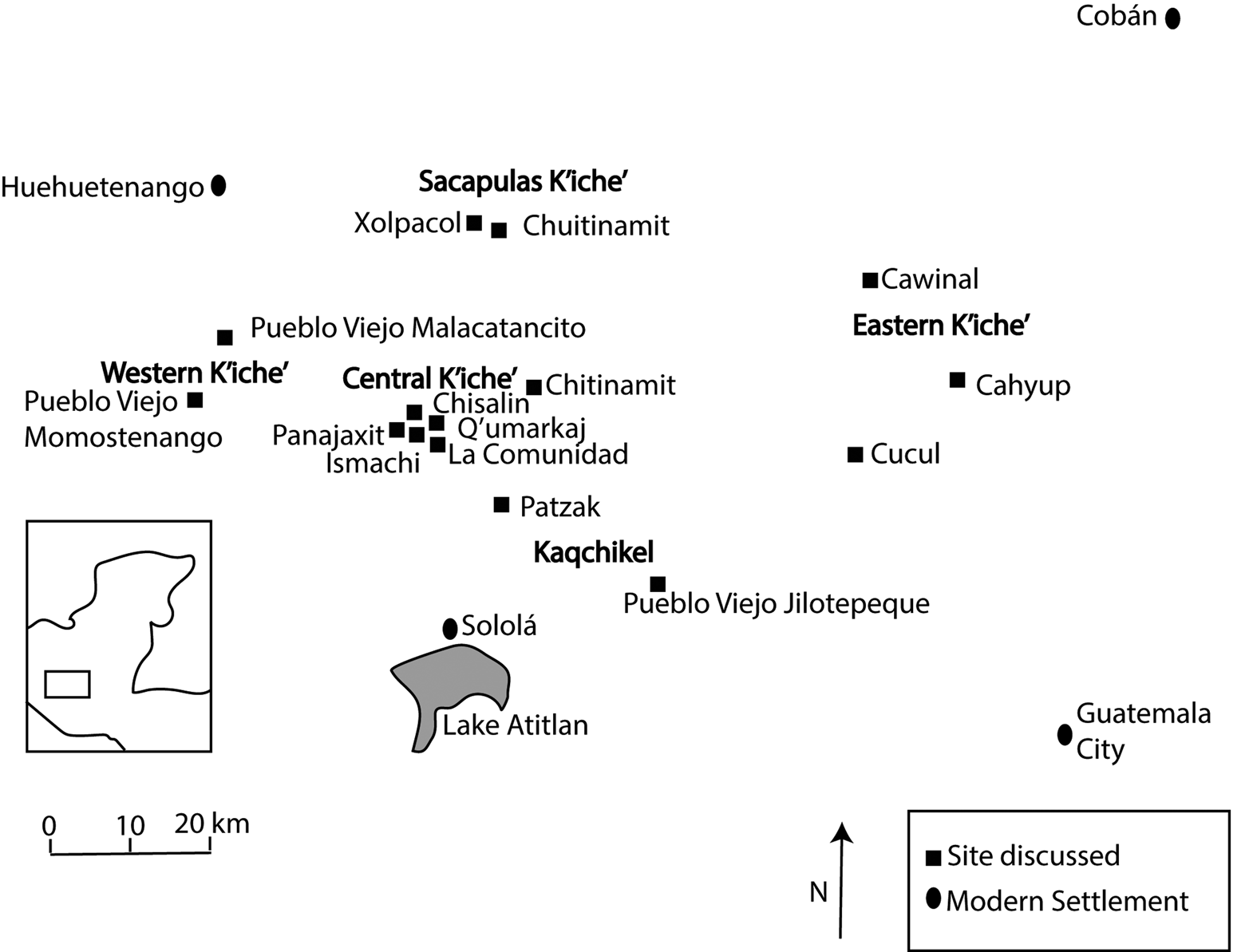
This article examines obsidian from the K'iche’ capital of Q'umarkajFootnote 1 and the surrounding region using technological and sourcing studies to examine the organization of the Late Postclassic period K'iche’ lithic economy (Figure 1). Although there is recent research on the Late Postclassic period in the Maya Highlands (e.g., Castillo Aguilar Reference Castillo Aguilar2020; Cojti Ren Reference Cojti Ren2012, Reference Cojti Ren2020; Macario Calgua Reference Macario Calgua2006, Reference Macario Calgua2007, Reference Macario Calgua2012), this article draws from a legacy collection obtained during the 1970s, highlighting the utility of revisiting data from earlier excavations (e.g., Babcock Reference Babcock2012; Nance et al. Reference Nance, Whittington and Borg2003). I find that, during the Late Postclassic period, access to nearby obsidian sources was managed through independent and diverse acquisition networks, indicating that the exchange of local obsidian was not a source of political power for K'iche’ elites.
Map of sites discussed in text (map by Rachel Horowitz modified from Fox [Reference Fox1978:Map 1] and Carmack [Reference Carmack1981:Figure 1.1]).

K'iche’ and Late Postclassic Period Economies
Although the origins of the K'iche’ are still debated (e.g., Akkeren Reference Akkeren2000; Babcock Reference Babcock2012; Borgstede and Robinson Reference Borgstede, Robinson and Nichols2012; Braswell Reference Braswell, Hostettler and Restall2001b; Carmack Reference Carmack1981; Cojti Ren Reference Cojti Ren2020; Fox Reference Fox1987, Reference Fox1989; Wauchope Reference Wauchope1947), scholars generally agree that Q'umarkaj was founded as the Late Postclassic period K'iche’ capital around AD 1200 (Borgstede and Robinson Reference Borgstede, Robinson and Nichols2012; Macario Calgua Reference Macario Calgua2012). K'iche’ political organization is known from ethnohistoric documents that discuss elite lords as centralized political leaders based at Q'umarkaj. The leaders came from key family lineages and political power passed through these lineages (Carmack Reference Carmack1981; but see Braswell Reference Braswell, Hostettler and Restall2001b). Lineage power was both political and territorial (Hill and Monaghan Reference Hill and Monaghan1987).
Q'umarkaj's layout reflects the importance of lineage groups. The site consists of 70–80 structures (Carmack Reference Carmack1981; Macario Calgua Reference Macario Calgua2012; Wallace Reference Wallace, Wallace and Carmack1977), including pyramidal, range, and multichambered residential structures grouped around plazas (Carmack Reference Carmack1981; Wallace Reference Wallace, Wallace and Carmack1977). The similar architectural layouts suggest repetitive functions and the occupation of the plaza groups by different lineages; this pattern is also seen elsewhere in the K'iche’ region (e.g., Annereau-Fulbert Reference Annereau-Fulbert, Arnauld, Manzanilla and Smith2012).
Outside Q'umarkaj, the K'iche’ elite managed a large multiethnic territory, much of which was acquired through conquest. The centralization of territorial management has long been a subject of debate, including identifying archaeological correlates for K'iche’ influence, the degree of territorial control over the region, and the role of the K'iche’ in settlement shifts from the Classic to the Postclassic periods (Arnauld Reference Arnauld and Breton1993; Borgstede and Robinson Reference Borgstede, Robinson and Nichols2012; Braswell Reference Braswell, Smith and Berdan2003a; Carmack Reference Carmack1981; Ichon Reference Ichon and Breton1993). In other words, scholars disagree whether K'iche’ elites directly managed outlying areas or had indirect control over the region (see Hill Reference Hill1996). Obsidian distribution in these territories can shed light on how economies functioned in areas under K'iche’ control.
Obsidian Sourcing
In Mesoamerica, many economic studies rely on obsidian sourcing. Such studies for the Late Postclassic period indicate an economic system based on competitive market exchange (Smith and Berdan Reference Smith, Berdan, Smith and Berdan2003:7), suggesting that market exchange was the main mechanism for the distribution of goods in the K'iche’ region (e.g., Berdan Reference Berdan, Smith and Berdan2003; Berdan et al. Reference Berdan, Smith and Berdan2003; Masson Reference Masson, Masson and Freidel2002; McKillop Reference McKillop2005; Smith Reference Smith, Smith and Berdan2003; Smith and Berdan Reference Smith, Berdan, Smith and Berdan2003). This article defines market exchange following Garraty (Reference Garraty, Garraty and Stark2010:5–6) as transactions where supply and demand are important but are influenced by social mechanisms. Braswell's (Reference Braswell, Smith and Berdan2003b) analysis of obsidian exchange in Mesoamerica illustrated that in the Late Postclassic period the Maya Highlands acquired limited obsidian from long-distance trade and were reliant on local sources. Braswell proposed that there was not direct management of obsidian sources. A full discussion of temporal shifts in obsidian distribution is outside the scope of this article (for a summary, see Braswell Reference Braswell, Smith and Berdan2003b), but the distribution of obsidian sources during the Late Postclassic period is discussed in a later section.
Previous studies of obsidian sourcing within the K'iche’ and neighboring Kaqchikel regions indicate that sources from the Guatemalan Highlands were most common: they included San Martin Jilotepeque, the closest source to Q'umarkaj and the K'iche’ region, located approximately 50 km away (to the east); El Chayal (90 km to the southwest); and Ixtepeque (130 km to the southeast). Other local sources include San Bartolome Milpas Altas. The most common nonlocal source in the K'iche’ region is Pachuca, located in modern-day central Mexico (Figure 2).
Map of obsidian sources discussed in text (map by Rachel Horowitz).

Braswell (Reference Braswell1996) and colleagues (Braswell and Robinson Reference Braswell, Robinson, Laporte, Escobedo and Villagrán de Brady1992; Robinson Reference Robinson1998) found that, in the Kaqchikel region, most obsidian was from San Martin Jilotepeque, but that there were several acquisition networks, with variable quantities of San Martin Jilotepeque and El Chayal and small amounts of Ixtepeque, San Bartolome Milpas Altas, and Pachuca at different sites (Figure 1). In the K'iche’ region, Norris (Reference Norris and Weeks2001) and Macario Calgua (Reference Macario Calgua2006, Reference Macario Calgua2012) identified similar trends, with most obsidian coming from San Martin Jilotepeque and some from El Chayal and Ixtepeque.
In regions neighboring the K'iche area, including the Pacific Coast and Highland Chiapas, similar trends were identified, with most obsidian from San Martin Jilotepeque, followed by El Chayal (Blake Reference Blake2010; Chinchilla Mazariegos Reference Chinchilla Mazariegos, Hutson and Ardren2020; Clark Reference Clark, Bryant and Lee2020; Clark and Lee Reference Clark, Lee, Lowe and Pye2007; Hayden Reference Hayden, Bryant and Lee2020; Johnston Reference Johnston, Laporte, Escobedo and Arroyo2002; Popenoe de Hatch and Scheiber de Lavarreda Reference Popenoe de Hatch, de Lavarreda, Laporte, Suasnávar and Arroyo2001). The presence of San Martin Jilotepeque in these regions points to exchange networks integrating the K'iche’ with the Pacific Coast and Highland Chiapas.
Although several previous studies have sourced materials from the K'iche’ region, geochemical sourcing technology has advanced since the early 1990s and has been shown to be more accurate than visual sourcing. Thus, this study provides a comparison to the materials sourced previously to provide updated and additional data for Late Postclassic K'iche’ obsidian consumption.
Technological Studies
Although the studies already discussed highlight the importance of obsidian in understanding the economic and political organization in the region, they draw mostly from resource acquisition, as discussed via sourcing. Technological analyses, in contrast, provide details about obsidian procurement, production, and distribution. To examine local obsidian exchange and consumption patterns, production techniques must also be analyzed (e.g., Braswell Reference Braswell1996), because sourcing alone does not provide data on production organization. Furthermore, previous studies of obsidian production point to the specialized production of obsidian blades (see Hirth Reference Hirth2008); thus, the distribution of materials indicative of different parts of the production process sheds light on production and distribution activities.
In overviews of the K'iche’ region, obsidian is discussed when it is present, but mostly as the presence of specific tool types (e.g., Fox Reference Fox1975; Guillemin Reference Guillemin and Hammond1977; Kidder Reference Kidder and Wauchope1975; Weeks Reference Weeks1983). There was some earlier discussion of potential production areas (Fox Reference Fox1975, Reference Fox1978) based on the quantities of obsidian observed, but no detailed analyses were performed. Additional information on the production stage and the regional distribution of items in different stages of production can shed light on obsidian access, which relates to differences in management and acquisition strategies. For example, at the San Martin Jilotepeque source, production included preforms, macrocores, and polyhedral cores, which Braswell (Reference Braswell1996:647) interpreted as independent production, with some materials produced in the quarry, whereas others were removed for further reduction. Workshop areas located at a distance from quarries also illustrated a combination of reduction activities, with evidence of blade and biface production (Braswell Reference Braswell1996:684–686), and they operated independently from elite centers.
Similar research in other areas of Mesoamerica demonstrated the exchange of cores and blades between sites, such as studies of the differences in production techniques at the Ucareo source and Tula (Healan Reference Healan1997, Reference Healan, Hirth and Andrews2002, Reference Healan and Hirth2003). Furthermore, some locations have variable blade production techniques; thus, study of the technological nature of the assemblage could provide information on exchange (e.g., De León et al. Reference De León, Hirth and Carballo2009; Healan Reference Healan, Hirth and Andrews2002, Reference Healan and Hirth2003; Hirth Reference Hirth, Hirth and Andrews2002, Reference Hirth and Hirth2003, Reference Hirth2008; Hirth and Flenniken Reference Hirth, Flenniken, Hirth and Andrews2002; Hirth et al. Reference Hirth and Hirth2003; Pastrana Reference Pastrana, Hirth and Andrews2002). The presence of different types of production debris and various parts of blades can shed light on the form in which obsidian was acquired (e.g., as cores or blades) and on whether it was acquired directly from the source or through trade (De León et al. Reference De León, Hirth and Carballo2009; Hirth Reference Hirth2008).
Obsidian Sample and Its Limitations
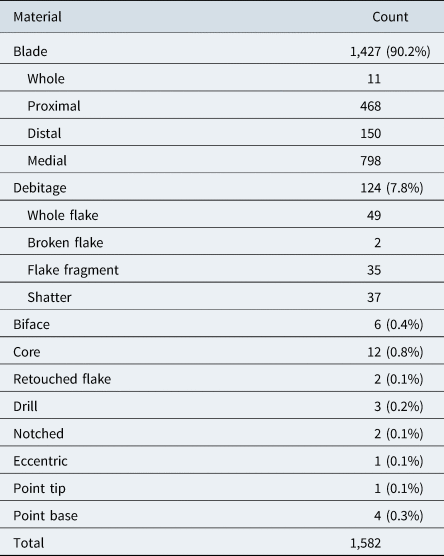
One of the most-studied parts of the K'iche’ area is Q'umarkaj, the capital city, and the surrounding region (Figure 1). This article examines obsidian (n = 2,286) collected from settlement surveys and excavations at Q'umarkaj and the K'iche’ region conducted between 1971 and 1974 as part of the University of Albany project (e.g., Babcock Reference Babcock2012; Fox Reference Fox1975, Reference Fox1978; Wallace and Carmack Reference Wallace and Carmack1977; see Table 1 and Supplemental Table 1). The collections are housed at the Middle American Research Institute at Tulane University. The assemblages discussed are only from sites studied by the University of Albany Project, which represent a sample of K'iche’ and Kaqchikel sites.
Counts of Materials from Q'umarkaj.

Before discussing the samples in more detail, some caveats must be made about the collection methods. Most of the materials were obtained through surface collections. The exact collection methods are unclear, and materials are only labeled to the site level. Because of the collection methods, larger objects, including formal tools, were more likely to be collected than smaller items, such as pressure flakes. Thus, later stages of production are probably underrepresented. Such limitations are common in heritage collections (see Nance et al. Reference Nance, Whittington and Borg2003). Because most of the materials in the assemblage are related to blade production, very small objects like pressure flakes were probably not that common. Thus, the assemblage provides an overview of the obsidian production that focused mostly on blade production.
Given that all materials were collected through similar means, we can assume that any limitations in the data for one site are shared among sites. For example, if only larger objects were collected, than we would assume this was the case at all sites. Thus, intra-assemblage comparisons are feasible. More consideration would be necessary if comparisons were made to other assemblages. Additionally, I combined sites into regions to alleviate issues of sample size and collection bias, thereby allowing interpretations that would not be possible on a site level. Regional comparisons help alleviate any variation within the collection process between individual sites.
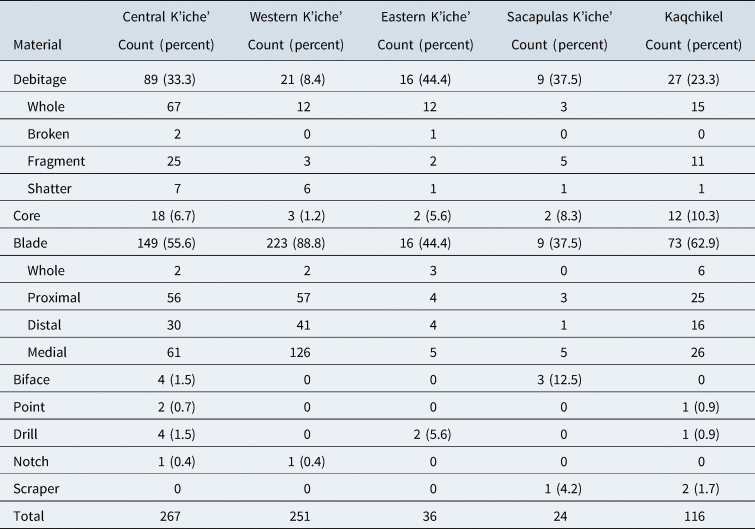
The regional survey assemblage consists of obsidian (n = 704) from 50 sites (Figure 1; Supplemental Table 1). The survey material was divided into broad regional divisions following those used by Fox (Reference Fox1975, Reference Fox1978). Fox explored these areas based on ethnohistoric evidence and the current people residing in these regions. Here the regions used by Fox are used as directional indicators. For instance, the Kaqchikel collections are from south of the central K'iche region, whereas the eastern K'iche’ materials are from the east of that area. The materials include samples from the Central K'iche’ region (around Q'umarkaj; n = 277), the eastern K'iche’ (n = 36), the western K'iche’ (n = 251), Sacapulas K'iche’ (n =24), and the Kaqchikel (n = 116) regions.
The regional assemblage dates to the Late Postclassic period based on chronological attributions performed in the 1970s through the dating of ceramics from surface collections (Babcock Reference Babcock2012; Fox Reference Fox1978; Wauchope Reference Wauchope and Bullard1970). It is possible that some of these sites are multicomponent sites that were occupied during various time periods. However, given that the assemblages stem from surface collections, they were most likely from the latest occupation of these sites, the Late Postclassic period.
The Q'umarkaj assemblage (n = 1,582) resulted from excavations and surface survey (Carmack Reference Carmack1981) and represent only a fraction of the materials from the site (the location of the remaining excavated material is unknown). The contextual information identified some samples from residential and ritual spaces, whereas others could not be identified to specific areas of the site. Thus, these data are discussed at the site level, following the approach of Nance and colleagues (Reference Nance, Whittington and Borg2003). All samples represent the Late Postclassic period because excavations at Q'umarkaj indicate the site was occupied only during this period (Babcock Reference Babcock2012; Macario Calgua Reference Macario Calgua2006, Reference Macario Calgua2007, Reference Macario Calgua2012; Macario Calgua et al. Reference Macario Calgua, Putzeys, Fulbert, Telón, Ortega, Cáceres, Palomo, Laporte, Arroyo and Mejía2007; Putzeys et al Reference Putzeys, Jorge Cáceres, Cuyán, Laporte, Arroyo and Mejía2008; Wauchope Reference Wauchope and Bullard1970).
The mixture of contexts from the site core presents some issues for comparisons with the regional survey data because they may combine quotidian and ritual contexts. As is discussed later, from examinations of the technological aspects of the Q'umarkaj assemblage, such as ratios of blade segments, the materials from Q'umarkaj (Table 1) are comparable with quotidian assemblages from other contexts.
Although other types of analyses, such as normalization of lithic quantities by counts of ceramic sherds or other materials or use of the distributional approach (Hirth Reference Hirth1998), would be useful, the data to perform such analyses are not present. The ceramics that are present from these collections/excavations have not been reanalyzed since the 1970s. Despite the limitations in both the regional and site core data, the technological and sourcing analysis of the materials provides an opportunity to expand the analysis of obsidian economies among the Late Postclassic period K'iche’.
Methods
The obsidian sample was analyzed using a detailed attribute analysis following standard conventions of lithic analysis (Andrefsky Reference Andrefsky2006; Whittaker Reference Whittaker1994), as well as attributes of prismatic blade production, including size, form, production stage, and mechanism (see Hirth Reference Hirth and Hirth2006; Hirth and Andrews Reference Hirth, Andrews, Hirth and Andrews2002; Hirth and Flenniken Reference Hirth, Flenniken, Hirth and Andrews2002). The technological analysis allows a discussion of production processes and comparisons of the form and size among sites. Not all attribute data are presented here but will be presented in future publications.
One aspect of the attribute analysis included the identification of production stage and reduction mechanism following standard discussions of the blade-core reduction sequence (Clark and Bryant Reference Clark and Bryant1997; Hirth and Andrews Reference Hirth, Andrews, Hirth and Andrews2002). Blade production focuses on the production of flakes, which are at least twice as long as they are wide with roughly parallel edges, otherwise known as blades. The products of blade production change from earlier to later in the manufacturing process, becoming more regular in shape and consistent in size from early- to final-series blades (see Hirth and Andrews Reference Hirth, Andrews, Hirth and Andrews2002:Figure 1.2). The presence of different stages of blade manufacture is an indicator of the degree of core preparation and reduction completed before their manufacture, with final-series blades being the last products produced from the core. In addition to production stage, the quantity of different segments of final-series blades (medial, distal, proximal) can also be used to identify local blade production versus acquisition of blades produced elsewhere (De León et al. Reference De León, Hirth and Carballo2009). A discussion of the ratios of these blade segments provides evidence for the types of materials acquired throughout the K'iche’ region.
Another aspect of the analysis was the use of the cutting edge to mass ratio (Sheets and Muto Reference Sheets and Muto1972), which is calculated by multiplying the length of blades by two and dividing by weight. Sheets and Muto (Reference Sheets and Muto1972) developed the ratio from experimental blade reduction that they used to suggest the maximum possible cutting edge for the mass of different-sized cores. They suggest that the ratio should decrease the farther from the source, because of the difficulty in accessing raw material. This ratio will be compared between sites when possible. Not all sites/areas had blade assemblages large enough to make calculating the ratio a useful metric; therefore, I did not use any statistical comparisons. A few concerns about this metric should be noted. First, although the collection of these materials might be problematic for a metric that uses size, as noted earlier, larger objects are more likely to be collected. However, as noted later, the ratio is lower than would be expected for sites near source areas, suggesting that any size preferences in collecting did not skew the ratios; if larger materials were preferentially collected, that would suggest that the ratios should be lower than they are now. Finally, Braswell and Robinson (Reference Braswell, Robinson, Laporte, Escobedo and Villagrán de Brady1992:274) suggest that the cutting edge to mass ratio is not as sensitive when raw material sources are relatively close to a site. Although this may be the case, we can use the ratio to examine its potential use in this region and discuss whether conservative uses of raw material did occur near source areas.
pXRF sourcing was conducted with a Bruker Tracer 5 g using the Missouri Research Reactor/Bruker calibration (Glascock Reference Glascock2020; Glascock and Ferguson Reference Glascock and Ferguson2012). The calibration used the values from Glascock (Reference Glascock2020; see also Martindale Johnson et al. [Reference Martindale Johnson, Ferguson, Freund, Drake and Duke2021] for a discussion of the validity of these calibration samples). Each sample was run for 120 s. Source samples from known Mesoamerican samples were processed using the same instrument, under the same conditions. These samples were borrowed from the Missouri Research Reactor, which maintains a collection of known obsidian sources from the region. Sources compared to the archaeological collection included El Chayal, Ixtepeque, San Martin Jilotepeque, and San Bartolome Milpas Altas, from the Maya Highlands, and Guadalupe Victoria, Laguna Ayarza, Otumba, Pachuca, Paredon, Pico de Orizaba, Ucareo, Zinapecuaro, and Zaragoza from central Mexico (Figure 2). Elemental analysis was compared between the archaeological and source samples to determine source attributions.
Results
Here I discuss the materials divided into those regions used by Fox (Reference Fox1975, Reference Fox1978). This allows comparisons between the areas closer to Q'umarkaj and those that are farther away.
Q'umarkaj
The lithic assemblage consists of obsidian materials from across the site (n = 1,582), the majority of which resulted from blade production (Table 1; Figure 3). In terms of tool debris, the presence of bifaces and projectile points made on blades points to the use of these tools as projectiles for hunting or warfare. Other tools represent a variety of activities, as seen from the presence of drills and a notch (Table 1).
Representative lithics from Q'umarkaj; A. blade segments; B. blade cores; and C. bifaces (photographs by Rachel Horowitz). (Color online)

In terms of production activities, there is relatively little evidence of flake production, with the majority representing blade production. The flakes that were present show evidence of predominantly hard hammer percussion (n = 76; 61.3%), with little evidence of thinning (n = 1; 0.8%) or pressure flaking (n = 6; 4.8%).
Blades and blade-related production debris make up most of the assemblage. All cores were blade cores in various stages of reduction (see Table 1; Figure 3). These included broken core segments that were exhausted or suffered from production errors. Rejuvenation flakes (n = 38) and blades (n = 6) illustrate that blade production occurred. The rejuvenation blades are overshot blades to rejuvenate small cores, whereas the flakes are mostly for error correction to remove hinge or step fractures. Lastly, most of the blades recovered were final-series blades (n = 1,362; 95%), but there were some early-stage blades (n = 59; 4%), illustrating that although all blade cores recovered were exhausted, some cores were brought into the site partially prepared.
The final-series blades show evidence of use. Most blades were medial segments (n = 798; 55.9%), typical of materials used in component tools. Furthermore, some blades show evidence of retouch (n = 309; 26%).Footnote 2 The cutting edge to weight ratio (Sheets and Muto Reference Sheets and Muto1972) of the blades was calculated as 35.2 mm/g or 3.52 cm/g ([33,088 × 2]/1,877.5). This ratio suggests a conservative use of obsidian, the potential reasons for which are discussed later.
The production of blades from prepared cores indicates that Q'umarkaj residents obtained obsidian mainly in core form that was reduced at the site. This conclusion is supported by the ratio of proximal to distal (3.1:1) and medial to distal (5.3:1) blade segments. Although these ratios are higher than those De León and colleagues (Reference De León, Hirth and Carballo2009) suggest for local production (1:1, 2:3:1, respectively), they are much lower than those suggested for segmented production (6:1, 6:1). The presence of production debris, such as early-stage blades, supports local blade production.
Some non-blade core production also occurred, and residents used a variety of tools produced on flakes and blades. The assemblage indicates that residents had ample access to obsidian. Analyses of the geochemical sourcing of these materials and comparisons with the region around Q'umarkaj can provide further insight into obsidian acquisition networks.
Sourcing Analysis. A 10% sample of the assemblage was sourced using the pXRF (n = 174). The geochemical analysis finds that most of the materials were from San Martin Jilotepeque, with others from El Chayal, San Bartolome Milpas Altas, and Ixtepeque (see Table 3 and Supplemental Table 2). The sourcing also identified a single blade fragment from Pachuca, indicating that some obsidian was obtained through long-distance trade. The presence of Pachuca obsidian confirms Braswell's (Reference Braswell, Smith and Berdan2003b) discussion of it as the most common nonlocal obsidian in the Highlands during this period.
In terms of the types of implements produced from different sources, there is some variety between sources, but each were used for similar types of materials. Braswell and Robinson (Reference Braswell, Robinson, Laporte, Escobedo and Villagrán de Brady1992) found that El Chayal was overrepresented in blades. In this sample, about 23% of the blades were El Chayal, very close to the overall percentage of materials assigned to El Chayal (24%). Interestingly, both Ixtepeque and San Bartolome Milpas Altas are found only as blades, indicating these obsidians were probably brought into the region in this form.
Both El Chayal and San Martin Jilotepeque are represented by a variety of technologies. Whereas the El Chayal assemblage is related mostly to blade production, including cores, early-stage blades, and blade-core rejuvenation flakes, there were also a few flakes. Similarly, the San Martin Jilotepeque assemblage was mostly made up of blades and blade-related materials but showed some evidence of flake production, as well as a single biface. Thus, both San Martin Jilotepeque and El Chayal entered the site mostly in the form of early-stage blade cores. However, in both cases, other types of reduction occurred, suggesting residents of the site had access to non-blade cores.
In comparisons with previous geochemical studies, the Q'umarkaj assemblage is consistent in terms of the sources identified, with San Martin Jilotepeque as the most prominent, followed by El Chayal, and a small number of materials from other sources. Comparisons across the K'iche’ region can begin to look for regional patterns in obsidian distribution.
Central K'iche’
The central K'iche’ assemblage (n = 267; Table 2; Figure 4) includes larger collections from La Comunidad (n = 76) and Chitinamit (n = 57), as well as smaller collections from nine additional sites (n = 134; Supplemental Table 1). The larger assemblages are discussed separately and then combined for a regional discussion.
Obsidian from the central K'iche’ region: A. biface; B. blades, and C. core (photographs by Rachel Horowitz). (Color online)

Counts of Materials from the K'iche’ Region.

Materials from La Comunidad indicate that some reduction activities occurred at the site while other materials were brought into the site as finished products. The high proportion of flakes (n = 46; 60.5%), including the presence of cortex on some flakes (n = 14, 29.2%), suggests importation of materials in core form. The flakes also consisted of a mix of types of reduction including hard hammer (n = 8), thinning flakes (n = 22), and rejuvenation flakes (n = 6). While few blades (n = 15; 19.7%) were present, most (n = 11) are final-series blades. Blade-based tools, including drills, were also present. Most interesting is the large number of cores (n = 12), the majority of which were polyhedral blade cores. The presence of blade cores indicates that blade production occurred within the site but that residents of La Comunidad also had access to non-blade obsidian cores.
Although Chitinamit contains a large assemblage (n = 57), there is little evidence of production. Most of the materials are final-stage blades (n = 55; 96.5%). The presence of a single core indicates that some blade core reduction may have occurred. Ratios of proximal to distal (2.3:1) and medial to distal blade fragments (3.6:1) are within the ranges suggested by De León and colleagues (Reference De León, Hirth and Carballo2009) for local production, indicating that blades were probably locally produced. The cutting edge to weight ratio was calculated as 42.3 mm/g or 4.2 cm/g ([1,493 × 2]/70.6), indicating a conservative use of lithic raw materials, the implications of which are discussed later.
Much like La Comunidad and Chitinamit, the remaining sites in the Central K'iche region show evidence for production (Table 2). Most of the assemblage were blades (n = 79; 54.9%), and there were some early-stage blades (n = 8), which indicates some blade cores were not fully prepared when they arrived. All blade cores present were exhausted, suggesting extensive reduction activities.
Non-blade production also occurred, as evidenced by the presence of bifacial cores (n = 2) and non-blade core fragments (n = 2), as well as flakes (n = 42; 29.2%) showing a variety of manufacturing methods (hard hammer, n = 10, soft hammer n = 17) and rejuvenation flakes (n = 9). Some of this reduction may be related to the production of tools on blade blanks because both projectile points were bifacially retouched on blades.
These data indicate that obsidian was imported into the central K'iche’ region as final-stage prismatic blade cores, which were local reduced into blades and retouched into blade tools. These data are supported by the ratios of proximal to distal blade fragments (1.9:1) and medial to distal blade fragments (2.1:1), which fall within De León and colleagues’ (Reference De León, Hirth and Carballo2009) ratio for local production. However, some sites seem to have produced more blades than others, suggesting independent obsidian acquisition networks. Independent acquisition networks are supported by the variable presence of non-blade core debitage and tools between sites, especially La Communidad and Chitinamit.
Western K'iche’
The western K'iche’ sample is large (n = 251; Table 2; Figure 5) and stems predominantly from Pueblo Viejo Malacatancito (n = 195) and Pueblo Viejo Momostenango (n = 42), with a small number of lithics from four additional sites (n = 14; Supplemental Table 1). The Pueblo Viejo Malacatancito assemblage consists almost entirely of blades (n = 193), with two flakes. The vast majority (n = 112) are medial blade segments. Despite this large number, the ratios of proximal to distal segments (1.6:1) and medial to distal segments (3.6:1) are still within the range for the importation of whole blades into the site (De León et al. Reference De León, Hirth and Carballo2009). The cutting edge to mass ratio is 47 mm/g (4.7 cm/g; total length of [3,395 × 2]/144.2), indicating a conservative use of raw materials, the implications of which are discussed later.
A. Core; and B. blades from western K'iche’ sites (photographs by Rachel Horowitz). (Color online)

The smaller sample of materials from Pueblo Viejo Momostenango (n = 42) is indicative of blade production activities. The assemblage includes cores (n = 2; 4.8%) and flakes (n = 15; 35.7%), as well as final-stage blades.
The remaining materials (n = 14) from the western K'iche’ region come from four sites. The majority (n = 9) are blades; there are also flakes (n = 4) and a blade core (n = 1). Like the materials from Pueblo Viejo Malacatancito, this indicates the importation of blades or final-stage blade cores, which is also supported by the ratios of proximal to distal segments (1.4:1) and medial to distal segments (3:1). The presence of production debris suggests importation and reduction of blade cores in the region.
The sample from the western K'iche’ region shows little evidence of production. Materials were imported into the site as blades and in a few cases as final-stage blade cores, which were reduced.
Eastern K'iche’
The eastern K'iche’ assemblage is small (n = 36; Table 2) and comes from four sites (Supplemental Table 1). The collection provides evidence of limited blade production activities through the presence of exhausted blade cores (n = 2; 5.6%) and blade-core rejuvenation flakes (n = 2). Production of blade-based tools also may have occurred, given the presence of drills produced on blades.
The collection suggests limited reduction at these sites—all of which occurred on blade cores. This does not differ greatly from the Central K'iche’ region, but the sample size limits the discussion.
Sacapulas K'iche’
The Sacapulas K'iche’ sample is small (n = 24; Table 2) and comes from three sites (Supplemental Table 1). The sample indicates some reduction, based on the presence of exhausted blade cores and flakes. The blades, which were all produced from blade cores in their final reduction stage, and the presence of exhausted blade cores indicate that blade cores were imported. Other types of formal tools may also have been imported, based on the presence of bifaces and a scraper.
Kaqchikel
The Kaqchikel materials came from eight sites (n = 116; Supplemental Table 1), with nearly all from Patzak (n = 46), Cucul (n = 30), and Pueblo Viejo Jilotepeque (n = 31). Pueblo Viejo Jilotepeque is located near the San Martin Jilotepeque source and had comparatively large numbers of blade cores (n = 12; 38.7%; Figure 6). Patzak and Cucul showed some evidence of production as flakes, and final-series blades were present (Table 2).
Blade cores from Pueblo Viejo Jilotepeque (photographs by Rachel Horowitz). (Color online)

The Kaqchikel materials indicate blade-core reduction, particularly of early-stage blades at Pueblo Viejo Jilotepeque. Patzak and Cucul also indicate blade-core reduction, mostly of final-stage blades. The ratios of proximal–distal blades (1.6:1) and medial–distal segments (1:1) also support local blade production (De León et al. Reference De León, Hirth and Carballo2009). Thus, even near the source of raw materials, early-stage reduction and core preparation occurred at a few sites while later stages of reduction occurred more widely.
Regional Sourcing Analysis
Obsidian samples from the regional survey were also sourced using the pXRF. A total of 90 lithics from 30 Late Postclassic sites were sourced (Table 3). These data provide information about regional differences in obsidian access and variability in obsidian acquisition among sites.
The data from the Central K'iche’ region broadly reflect the patterns at Q'umarkaj, with slightly more Ixtepeque in comparison to El Chayal (Table 3). This is in many ways unsurprising, given that these satellite sites are thought to have been allies of the political leaders of Q'umarkaj and would be expected to participate in economic exchange networks similar to those used by the residents of Q'umarkaj.
Obsidian Source Designations.

Note: SMJ = San Martin Jilotepeque; SBMA = San Bartolome Milpas Altas
In the outlying areas, several interesting patterns emerge. In the eastern region, the assemblage is predominately El Chayal, with no San Martin Jilotepeque, a distinction from the other regions. The western region, however, shows high amounts of San Martin Jilotepeque, some El Chayal, and a few other sources, suggesting similar distribution networks to Q'umarkaj. Within the Kaqchikel region, most materials were San Martin Jilotepeque, the closest source to this area, and there was an absence of El Chayal. This analysis supports previous sourcing projects from the K'iche’ region (Macario Calgua Reference Macario Calgua2006; Norris Reference Norris and Weeks2001).
Discussion
Obsidian procurement has often been used as a proxy for centralized economic and political organization. The locations closer to Q'umarkaj did not have greater access to obsidian than outlying areas, based on the types of obsidian materials identified, specifically the presence of blade cores. The greatest core frequencies were from areas closest to the San Martin Jilotepeque source, supporting Braswell's (Reference Braswell1996) findings of the decentralized management of obsidian sources. No evidence of source area management was found at San Martin Jilotepeque (Braswell Reference Braswell1996) or El Chayal (Suyuc Ley Reference Suyuc Ley, Hruby, Braswell and Mazariegos2011), suggesting that independent acquisition networks may have operated around source areas, which would support independent distribution networks within the K'iche’ region. Such patterns also suggest down-the-line trade or direct acquisition as a main distribution mechanism.
In terms of types of production, however, these data indicate that prismatic blade production was practiced by specialized individuals. The limited locations in which cores were identified suggest that specialized producers reduced cores, a pattern identified throughout other areas of Mesoamerica (De León et al. Reference De León, Hirth and Carballo2009; Healan Reference Healan, Hirth and Andrews2002, Reference Healan and Hirth2003; Hirth Reference Hirth, Hirth and Andrews2002, Reference Hirth and Hirth2003, Reference Hirth2008; Hirth and Flenniken Reference Hirth, Hirth and Andrews2002; Hirth et al. Reference Hirth and Hirth2003; Pastrana Reference Pastrana, Hirth and Andrews2002).
Related to the production of these materials by specialized individuals is the degree of access to different types of obsidian products. Some areas did not have access to prismatic blade cores, instead obtaining blades and other materials from craft producers, whereas other areas produced blades. This difference in the distribution of blade cores and the lack of reduction debris at some sites support different acquisition networks. That is, some sites obtained materials as blades, whereas others obtained blade cores and reduced them. For example, within the western K'iche’ assemblage, Pueblo Viejo Malacatancito had 99.9% blades, whereas Pueblo Viejo Momostenango had only 57% blades with more blade cores and flakes. Within regions there is variation in how and in what form obsidian was acquired, as supported by ratios of types of blade fragments (De León et al. Reference De León, Hirth and Carballo2009). These differences in the obsidian assemblage makeup indicate intra- and interregional differences in obsidian acquisition networks.
The sites that contained large numbers of blades can also be examined in terms of their conservative or unconservative use of blades, as compared to the experimental data from Sheets and Muto (Reference Sheets and Muto1972). Both Chitinamit (4.2 cm/g) and Pueblo Viejo Malacatancito (4.7 cm/g), the two sites with the largest numbers of blade fragments, showed relatively conservative blade use (as compared to 2.1 cm/g in Sheets and Muto [Reference Sheets and Muto1972:633]). Even Q'umarkaj (3.5 cm/g) shows a more conservative use of blades than the experimental data, although it is lower than the more outlying sites. In this case, despite being relatively close to sources, the ratios are higher, which may indicate other restrictions in access. For instance, the ratios from sites in this study are more similar to those from Late Postclassic period sites in coastal Belize (Stemp et al. Reference Stemp, Graham and Goulet2011:Table 3) than to the original experimental data. The lower average at Q'umarkaj suggests differences in obsidian access, with Q'umarkaj having greater access to blade resources.
The sourcing data highlight similarities between the Central K'iche’ region and Q'umarkaj. The similarities in source distributions (Table 3) indicate that these areas acquired goods using the same or similar acquisition networks. Farther afield, however, wealth seems to have influenced acquisition. That is, the K'iche’ elite did not manage obsidian distribution outside the Central K'iche’ region. This is not to suggest that political activities did not influence obsidian acquisition, because long-distance trade activities might have operated differently. A full discussion of this possibility is outside the scope of this article.
No clear data support the management of obsidian distribution outside the central K'iche’ region by the political leaders at Q'umarkaj. Instead, differences in economic wealth and status and local acquisition networks resulted in the variations in obsidian concentrations and sources observed within and between regions.
One caveat should be made about elite management, and that relates to nonlocal obsidians, which were found only within the site core, suggesting that these long-distance trade routes might have been managed by elite political networks or at least that they had preferential access to such goods.
The data from Q'umarkaj and the surrounding region support previous studies of Late Postclassic period obsidian circulation. Braswell's (Reference Braswell, Smith and Berdan2003b) study of obsidian circulation proposed that there was no direct control over local obsidian sources in the highlands and that there were also limited nonlocal obsidian; the data support both arguments.
Conclusions
The K'iche’ region obsidian analysis provides an opportunity to evaluate the relationship between political and economic centrality among the Late Postclassic K'iche’. In general, this research supports previous studies on Postclassic period Maya economies, which suggest a market-based economy with limited elite management of obsidian distribution. The exception to this is the acquisition of nonlocal obsidians, particularly Pachuca obsidian, which was limited to the site core and was related to elite management of long-distance trade. This conclusion follows Braswell's (Reference Braswell1996, Reference Braswell, Smith and Berdan2003b) discussions of management of Late Postclassic period obsidian exchange networks in the Maya highlands and studies of Late Postclassic period distribution networks elsewhere in Mesoamerica (e.g., Golitko and Feinman Reference Golitko and Feinman2015).
Furthermore, the technological and sourcing analyses indicate variable economic networks both within and between regions under K'iche’ control. Q'umarkaj and the central K'iche’ region seem to have had similar economic networks, given the similarities in obsidian sources and access to blades and core technologies. Outside the core K'iche’ region, in those areas conquered by the K'iche’, there was less similarity in obsidian economic networks. Within and between regions, both the sourcing and the technological analyses suggest that these sites had their own acquisition networks. This is suggestive of a market-based economy with independent acquisition networks as the main obsidian distribution mechanism. The conservative use of blades in some sites indicates that purchaser wealth may have contributed to these differences.
The lack of centralized economic management by the K'iche’ elite of regional economic networks has implications for the role of economies as sources of political power (e.g., Mann Reference Mann, Hall and Schroeder2005). Although the K'iche’ elite could have used other sources of power to support their political power, obsidian exchange networks do not support the centralized management of economic resources within the K'iche’ region. Instead, it seems more likely that the obsidian exchange networks in these regions existed before the K'iche’ conquest and continued despite the political rulership of the K'iche’. However, K'iche’ elites could have gained political power through management of trade routes of obsidian to the coast and neighboring highland regions.
Although K'iche’ political expansion and organization have been the focus of much debate and discussion among archaeologists and other scholars (e.g., Braswell Reference Braswell, Inomata and Houston2001a, Reference Braswell, Smith and Berdan2003a; Carmack Reference Carmack1981; Fox Reference Fox1987; Norris Reference Norris and Weeks2001), the role of economic power has not been fully addressed. The obsidian analyses discussed here indicate decentralized economic networks outside the central K'iche’ region, suggesting that the economic management of locally available resources was not a main source of political power for the K'iche’ elite in the Late Postclassic period. This does not imply that political centralization of these outlying areas did not exist, just that it was not propped up by the management of local economic resources.
Acknowledgments
Thanks to the Middle American Research Institute for access to the material, particularly Caroline Parris, Erin Patterson, Jocelyne Ponce, and Marcello Canuto. Thanks to Genie Robinson and Tom Babcock for providing information about the Q'umarkaj investigations. Jeff Ferguson and Michael Glascock of the Missouri Research Reactor provided obsidian source samples. Thanks to Jeff Ferguson, Matt Bolanger, and Nigel Kelly for their assistance with the pXRF. Thanks to the members of the spring 2018 lithic analysis class at Tulane University who conducted a preliminary analysis of the regional survey material, which led to my reanalysis of the collection and my analysis of the Q'umarkaj assemblage. Thanks to Genie Robinson, Jason Nesbitt, Erin Thornton, Lori Phillips, Kim Sheets, Garrett Toombs, Emily Kenney, and three anonymous reviewers for their comments on a previous draft of this article. No permits were required.
Funding
None
Data Availability Statement
All artifacts discussed are housed at the Middle American Research Institute at Tulane University. Raw sourcing data can be requested from the author. All other data are contained within the text.
Competing Interests
The author declares none.
Supplemental Material
For supplemental material accompanying this article, visit https://doi.org/10.1017/laq.2022.79.
Supplemental Table 1. Full List of Sites from the Regional Survey and Count of Lithics Analyzed.
Supplemental Table 2. Source Attributions from the Q'umarkaj Site Core.