Introduction
Forest game management has a long history in Europe. However, ongoing overabundance of some game animals as wild boars and wild ruminants is evident, and the negative relationship between the abundance of wildlife populations and their health status has often been shown (Gortázar et al., Reference Gortázar, Ferroglio, Höfle, Frölich and Vicente2007; Macháček et al., Reference Macháček, Dvořák, Ježek and Zahradník2014; Zbořil, Reference Zbořil2017). Moreover, wild animals often enter cattle pastures and thus spread parasite germs to livestock. Therefore, wildlife disease surveillance and control is currently gaining importance (Nechybová et al., Reference Nechybová, Vejl, Hart, Melounová, Čílová, Vašek, Jankovská, Vadlejch and Langrová2018).
Filarial nematodes of the genus Setaria Viborg, 1795 (Filarioidea, Onchocercidae) are mosquito-borne parasites of many artiodactyls, equines and even African hyraxes, and the nematodes reside in the host's abdominal cavity (Anderson, Reference Anderson2000). In Europe, four valid Setaria species are currently recognized according to the database Fauna Europaea (https://fauna-eu.org): S. cervi (Rudolphi, Reference Rudolphi1819), S. tundra (Isaichikov et Rajewskaja, 1928), S. labiatopapillosa (Alessandrini, 1848) and S. equina (Abildgaard, 1789) (Gibson et al., Reference Gibson, Bray, Hunt, Georgiev, Scholz, Harris, Bakke, Pojmanska, Niewiadomska, Kostadinova, Tkach, Bain, Durette-Desset, Gibbons, Moravec, Petter, Dimitrova, Buchmann, Valtonen and de Jong2014; Gibson, Reference Gibson2017). This database also mentions two other congeners, namely S. transcaucasica (Assadov, 1952) in Estonia, Poland and Ukraine and S. digitata (Linstow, 1906) in Italy. However, the first species is currently considered a younger synonym of S. tundra (Laaksonen et al., Reference Laaksonen, Pusenius, Kumpula, Venäläinen, Kortet, Oksanen and Hoberg2010; Enemark et al., Reference Enemark, Oksanen, Chriél, Harslund, Woolsey and Al-Sabi2017) while the data of S. digitata are uncertain and its real natural occurrence in Italy has never been confirmed molecularly. In summary, S. cervi, S. tundra and S. labiatopapillosa are found in European hoofed game (Pietrobelli, Reference Pietrobelli2008; Alasaad et al., Reference Alasaad, Pascucci, Jowers, Soriguer, Zhu and Rossi2012; Karbowiak et al., Reference Karbowiak, Demiaszkiewicz, Pyziel, Wita, Moskwa, Werszko, Bien, Goździk, Lachowicz and Cabaj2014; Demiaszkiewicz et al., Reference Demiaszkiewicz, Kuligowska, Pyziel and Lachowicz2015; Čurlík et al., Reference Čurlík, Konjević, Bujanić, Sabol, Martinković and Sindičić2019; Oloś et al., Reference Oloś, Nowakowska, Rojewska and Welc-Falęciak2019) while S. equina is a parasite of horses, mules and donkeys (Hornok et al., Reference Hornok, Genchi, Bazzocchi, Fok and Farkas2007; Regnier et al., Reference Regnier, Martin, Semin, Lienard, Geffre, Douet and Raymond-Letron2019)
Setaria infection is usually non-pathogenic but may cause mild chronic peritonitis in mammalian hosts (Anderson, Reference Anderson2000). The number of nematodes in individual host animals is usually low; however, there are known cases of epidemic disease causing serofibrinous peritonitis with severe morbidity and mortality in reindeer and moose (Jayasinghe and Wijesundera, Reference Jayasinghe and Wijesundera2003; Enemark et al., Reference Enemark, Oksanen, Chriél, Harslund, Woolsey and Al-Sabi2017). Moreover, individuals of several Setaria species are capable of entering the central nervous system and migrating through the brain and spinal cord. The infection can then cause serious neurological disease, lumbar paralysis or cerebrospinal nematodiasis, which can be fatal, especially in aberrant host animals such as goats, sheep and horses (Innes et al., Reference Innes, Shoho and Pillai1952; Blažek et al., Reference Blažek, Dyková and Páv1968; Tung et al., Reference Tung, Lai, Ooi, Yang and Wang2003). In certain case, nematodes were associated with ocular setariasis in mammalian hosts (Anderson, Reference Anderson2000; Tung et al., Reference Tung, Lai, Ooi, Yang and Wang2003; Nabie et al., Reference Nabie, Spotin and Rouhani2017). Indeed, it has been shown that various Setaria species have zoonotic potential, and S. labiatopapillosa and S. equina have served as aetiological agents of human subconjunctival infections (Panaitescu et al., Reference Panaitescu, Preda, Bain and Vasile-Bugarin1999; Nabie et al., Reference Nabie, Spotin and Rouhani2017).
The indirect life-cycle of Setaria nematodes requires the participation of blood-sucking insects as vectors. These insects would comprise various mosquito species (Culicidae) or flies from the families Simuliidae and Muscidae (Czajka et al., Reference Czajka, Becker, Poppert, Jöst, Schmidt-Chanasit and Krüger2012; Kemenesi et al., Reference Kemenesi, Kurucz, Kepner, Dallos, Oldal, Herczeg, Vajdovicz, Bányai and Jakab2015; Čurlík et al., Reference Čurlík, Konjević, Bujanić, Sabol, Martinković and Sindičić2019; Rydzanicz et al., Reference Rydzanicz, Golab, Rozej-Bielicka and Masny2019). The insects become infected by first-stage larvae L1 (microfilariae) after sucking blood from an infected animal host (Bain and Babayan, Reference Bain and Babayan2003). Within the insect individual, the larvae undergo two moults from L1 to second L2 and third-stage larvae L3. The ability and speed of this development depend, for instance, on the outdoor temperature; the L1–L3 development lasts 14 days at temperatures above 21°C, but is inactivated at 14.1°C (Laaksonen et al., Reference Laaksonen, Solismaa, Kortet, Kuusela and Oksanen2009). The cycle continues as soon as L3 larvae are injected into the mammal during the time the infected mosquito/fly sucks on the animal.
Within the final hosts, the larvae initially gather in the connective or aponeurotic tissue and then migrate to various parts of the abdominal cavity. There they undergo two moults, the first to L4 larvae and the next to juvenile nematodes that are sometimes referred to as L5 stage (Tung et al., Reference Tung, Lai, Ooi, Yang and Wang2003). The fifth-stage juveniles mature into adult females and males during approximately one year, and their bodies grow much in that period (Sommerville, Reference Sommerville1960; Wilson, Reference Wilson1976; Sonin, Reference Sonin and Ryzhikov1977; Anderson, Reference Anderson2000). In fact, little is known about the behaviour of Setaria nematodes in the final hosts. The larval stages and juvenile females were morphologically determined only partially in Setaria marshalli (Boulenger, 1921) and S. digitata (Tung et al., Reference Tung, Lai, Ooi, Yang and Wang2003). In S. cervi, only body size of the larvae was roughly published (Sonin, Reference Sonin and Ryzhikov1977).
Female and male Setaria nematodes reside naturally in the abdominal and peritoneal cavity for up to 1.5 years (Anderson, Reference Anderson2000). Every day, fertile viviparous females produce thousands of microfilariae (L1 larvae) that migrate into the mammal host bloodstream (Nelson, Reference Nelson1962), and the cycle is completed after the L1 larvae are transmitted via blood-sucking insect vectors into the new intermediate host, survive there and are capable of further development.
Adult Setaria nematodes range in size from medium to large. The genus is characterized by compound cephalic structures (mouth opening surrounded by lateral lips in the peribuccal crown, amphids, submedian papillae and externolabial papillae) and smooth or finely transversely striated cuticle (Sonin, Reference Sonin and Ryzhikov1977; Almeida et al., Reference Almeida, Deobhankar, Bhopale, Zaman and Renapurkar1991). The caudal parts differ between females and males; a female has a typical caudal knob and lateral appendages, while a male possesses two different spicules and a species-specific set of papillae (Nakano et al., Reference Nakano, Tozuka, Ikadai, Ishida, Goto, Kudo, Katayama, Muranaka, Anzai and Oyamada2007; Kowal et al., Reference Kowal, Kornas, Nosal, Basiaga and Lesiak2013; Sundar and D´Souza, Reference Sundar and D'Souza2015; Kumar and Kumar, Reference Kumar and Kumar2016; Enemark et al., Reference Enemark, Oksanen, Chriél, Harslund, Woolsey and Al-Sabi2017).
Setaria cervi is a typical parasite of the families Cervidae and Bovidae, which occur throughout Europe and Asia (Anderson, Reference Anderson2000). It is capable of infecting several further atypical, aberrant hosts such as sheep and goats. In Europe, the first evidence of S. cervi occurring in red deer was revealed in Germany (Schwangart, Reference Schwangart1940). Later, this parasite was found in red deer, sika deer and roe deer in many countries of Southern and Central Europe, including the Czech Republic (e.g. Blažek et al., Reference Blažek, Dyková and Páv1968; Sugár, Reference Sugár1978; Shimalov and Shimalov, Reference Shimalov and Shimalov2002; Rehbein and Visser, Reference Rehbein and Visser2007; Kuzmina et al., Reference Kuzmina, Kharchenko and Malega2010; Alasaad et al., Reference Alasaad, Pascucci, Jowers, Soriguer, Zhu and Rossi2012; Angelone-Alasaad et al., Reference Angelone-Alasaad, Jowers, Panadero, Pérez-Creo, Pajares, Díez-Baños, Soriguer and Morrondo2016; Oloś et al., Reference Oloś, Nowakowska, Rojewska and Welc-Falęciak2019).
Species-specific traits of S. cervi are apparent from a comparison of three most frequent European congeners occurring in hoofed game (S. cervi, S. labiatopapillosa and S. tundra) made by Lanková et al. (Reference Lanková, Vejl, Melounová and Langrová2019). Setaria cervi females (males) are up to 142 (76) mm long, their cuticle is smooth, their cuticular peribuccal crown with four dentate elevations has an almost square shape, lateral lips have a crescentic shape; S. cervi adult males have horn-like lateral appendages, characteristically striated bands on the ventral side of the tail, four pairs precloacal papillae, one mediate papilla near the cloaca, four pairs postcloacal papillae and one pair small lateral papillae. Setaria labiatopapillosa may reach up to 150 (80) mm in length. Peribuccal crown is oblong, the lateral lips are rectangular. On the ventral side of the caudal body end are three pairs of precloacal and four pairs of postcloacal papillae, respectively, as well as an additional one pair of ad-cloacal papillae. However, the problems in the morphological differentiation of these species are illustrated by the fact that the description of S. cervi from cattle in Wisconsin by Williams (Reference Williams1955) de facto corresponds to the characteristics of S. labiatopapillosa. The third congener, S. tundra, is shorter up to 80 (37) mm in length and the cuticle is covered by numerous small papillae on each side. The lateral lips are non-cuticularized, and on the ventral side of the tail are three pairs of precloacal, one pair of ad-cloacal papillae and three pairs of postcloacal papillae (see Lanková et al., Reference Lanková, Vejl, Melounová and Langrová2019). The morphology of younger developmental stages may slightly differ; however, literature data are scarce.
It is now clear that the comprehensive approach to identifying Setaria that combines light and scanning electron microscopy with molecular data is currently the only reliable method. Regarding molecular taxonomy, one of the most commonly used tools is the sequencing of the mitochondrial cytochrome c oxidase subunit 1 gene (cox1); five European Setaria species, including S. cervi, have repeatedly been subjected to this procedure (for review, see Lanková et al., Reference Lanková, Vejl, Melounová and Langrová2019). Two studies of S. cervi by Alasaad et al. (Reference Alasaad, Pascucci, Jowers, Soriguer, Zhu and Rossi2012) and Oloś et al. (Reference Oloś, Nowakowska, Rojewska and Welc-Falęciak2019) used the partial sequence of the cox1 gene; however, the complete cox1 gene has been already sequenced in other two congeners: S. digitata (Yatawara et al., Reference Yatawara, Wickramasinghe, Rajapakse and Agatsuma2010; Liu et al., Reference Liu, Li and Zhu2017) and S. labiatopapillosa (Gao et al., Reference Gao, Hou, Cui and Shi2019). This study will supplement corresponding information regarding S. cervi.
Despite the veterinary importance and wide occurrence of S. cervi, its development within a mammalian host has not been thoroughly studied, and published morphological studies are rare and sometimes confusing. In this study, we focus on the detailed investigation of the outer body structure of various developmental stages of females and even of males obtained from the body cavity of ungulate hosts, and uncovering detailed characteristics of their larval and adult stages. The study was conditioned by finding out the unambiguous species identity of all individuals by the application of molecular characteristics, and the phylogenetic analysis made it possible to evaluate the broader phylogenetic position of the Setariinae lineage within the family Onchocercidae.
Material and methods
Origin of the host animals and nematode collection
Entrails dissected from the body cavities of 96 hunting game ruminants were transported to the Czech University of Life Sciences Prague and parasitologically examined from 2016 to 2018. A total of 26 red deer (Cervus elaphus L.), 44 sika deer (Cervus nippon Temminck), 22 roe deer (Capreolus capreolus L.) and three fallow deer (Dama dama L.) were caught in official hunts in three mountain regions of western and northern Bohemia (Šumava – area of Srní; Český les – area of Rozvadov; Doupovské hory – area of Valeč), while one moose (Alces alces L.) was killed by vehicle collision in the area of Šumava Mountains (Fig. 1). All infected hosts were adult, 2–8 years old (Table 1).
Map of three hunting grounds in mountains of the western and northern Bohemia (Czech Republic) from which the game under investigation came. Individual host animals are identified in accordance with Table 1.

Complex characteristics of Setaria cervi nematodes with regard to sex, developmental stages, morphology, hosts, localities and NCBI numbers

L5, juvenile fifth-stage female; L4, fourth-stage female larva; M, moose; RD, red deer; SD, sika deer.
All experimental procedures were conducted in accordance with Czech legislation (section 29 of Act No. 246/1992 Coll. on the protection of animals against cruelty, as amended by Act No. 77/2004 Coll.). All experimental protocols were approved by the Czech University of Life Sciences Prague (CZU), Faculty of Agrobiology, Food and Natural Resources of the Czech Republic and Institutional and National Committees.
The Setaria nematodes which were found within the infected host animals were located on the surface of the intestines, liver and, in some cases, on the surface of the pericardium of the heart. Other parts of the animal (spinal cord, brain) were not dissected. The nematodes were rinsed in a saline solution, fixed in 70% ethanol, and measured. Measurement of the body length and width and morphology of the cephalic and caudal parts was studied using an Olympus BX51 Light Microscope (LM). Some samples were cleared within the lacto-phenol solution (Hoffman, Reference Hoffman1999) and later photographed using QuickPHOTO MICRO 3.0 software (PROMICRA, s.r.o., Prague, Czech Republic). Each specimen was numbered and divided into three parts: cephalic (head), middle and caudal (tail). Middle body part of each nematode was used for molecular analysis. The material was then placed back in 70% ethanol. Frontal and caudal morphology was also documented with the use of a scanning electron microscope (SEM).
For SEM microscopy, cephalic and caudal segments of nematodes were incubated for 24 h in 2.5% glutaraldehyde in 0.1 M cacodylate buffer (pH 7.2). Fixed samples were then dehydrated through an ascending ethanol series and placed in a CO2 Bal-Tec CPD 030 (BAL-TEC AG) critical point dryer. Samples were coated with a 2 nm layer of gold in a Bal-Tec SCD 050 ion sputter coater (BALTEC AG) and observed with a 6380 LV microscope (JEOL Ltd.).
Species affiliation
Setaria cervi species affiliation was determined based on the structure of the peribuccal crown on the cephalic part of the body as well as on the morphology of the caudal end. The gross morphology was determined under light microscope; details were defined using SEM microscopy as described above. The proximal body end of both females and males has the same species-specific characteristics, males are shorter and their caudal body part is sharp and coiled. Larger female has a blunt tail with a caudal knob and two lateral appendages (Blažek et al., Reference Blažek, Dyková and Páv1968; Sonin, Reference Sonin and Ryzhikov1977; Almeida et al., Reference Almeida, Deobhankar, Bhopale, Zaman and Renapurkar1991; Oloś et al., Reference Oloś, Nowakowska, Rojewska and Welc-Falęciak2019). Moreover, each specimen was subjected to molecular analysis, which confirmed species determination (see below).
Based on the evaluation using body size, LM and SEM, the females were divided into three categories: adult fertile females, L5 juvenile females and L4 larval females. Mutual differences of the body size (body length and body width) among these female developmental categories were statistically analysed using a non-parametric Kruskal–Wallis test and a subsequent post-hoc Test of Multiple Comparisons (Dell Inc., 2015). Fourth category comprised males that were not tested. Prevalence and intensity of infection were assessed for each host species.
Molecular study and analysis of cox 1 gene haplotypes
Central body parts of S. cervi specimens used for molecular analysis were preserved in 70% ethanol. Before DNA extraction, they were dried in a freeze-dryer (Alpha 1–4 Christ) for 60 min. Genomic DNA was extracted from all 24 individuals presented in Table 1 using a NucleoSpin® Tissue Kit. An animal tissue support protocol was utilized.
A consensus sequence containing ND4, cox1, tRNA-Trp and ND6 genes was created based on complete mitochondrial genome sequences of species from genera Setaria, Brugia, Dirofilaria, Loa, Onchocerca and Wucheria (Table 2). Program BioEdit version 7.0.5.3 (Hall, Reference Hall1999) was used for consensus sequence creation. A Primer3 Input 0.4.0 Program (Rozen and Skaletsky, Reference Rozen, Skaletsky, Misener and Krawetz2000) was utilized to design primer pairs (Table 3) located in the conserved regions of the mitochondrial genes. A fertile SC1 female from the moose was used for primary sequence analyses.
Sequences of cox1 gene used for haplotype and phylogenetic analyses

Primer pairs used for primary sequencing of Setaria cervi cox1 gene including flanking regions located in the conserved regions of the mitochondrial genes

The PCR mix (12.5 μL) consisted of the following: 20 ng of genomic DNA, 5 ng BSA, 0.4 μ m of each primer, 1.5 mm of MgCl2, 0.2 mm of dNTP, 2 mm of TMA oxalate (Top Bio) and 0.7 U of Taq polymerase (Roche). The amplification was performed in a C1000™ Thermal Cycler (BioRad) under the following conditions: 1× (94°C – 180 s), 35× (94°C – 60 s, 62°C – 60 s, 72°C – 60 s) and 1× (72°C – 600 s). Samples were analysed by electrophoresis through 1.5% agarose gels and visualized using ethidium bromide, and later extracted from the gel using a MiniElute PCR Purification Kit (Qiagen). A BigDye® Terminator v 3.1 Kit (Life Technologies) and an ABI 3730xl DNA Analyser (LifeTechnologies) were used for rDNA region sequencing. Three replicates of each PCR amplicon were sequenced.
Based on the sequences of the 24 amplicons (Table 3), the sequence of the part of the mitochondrial genome carrying the part of the ND4 gene, the complete coxI and tRNA-Trp genes and part of the ND6 gene was assembled. This sequence was used to design three pairs of specific sequencing primers (Table 4). The design of specific primers, amplification, purification of PCR products and final sequencing were performed under the same conditions as for the primary sequencing. Partial amplicons were assembled for all 24 Setaria specimens using the program BioEdit version 7.0.5.3 (Hall, Reference Hall1999).
Sequencing primer pairs specific for Setaria cervi mtDNA

Haplotypes (Table 2) derived from the complete sequences of the mitochondrial genomes of the six above-mentioned onchocercid genera were used for phylogenetic analyses. Specifically, cox1 information from GenBank was used for the onchocercid species Onchocerca flexuosa (OnF), O. ochengi (OnO), O. volvulus (OnV), Dirofilaria sp.‘honkonensis’ (DiH), D. immitis (DiI), D. repens (DiR), Loa loa (LoL), Wuchereria bancrofti (WuB), Brugia malayi (BrM), B. pahangi (BrP), B. timori (BrT), Setaria digitata (SeD) and S. labiatopapillosa (SeL). As an outgroup, five sequence samples of Thelazia callipaeda (ThC) belonging to Thelazioidea were used. The new S. cervi sequences were marked as SeC.
Cox1 gene haplotypes were identified by the DNA Sequence Polymorphism program (Rozas et al., Reference Rozas, Ferrer-Mata, Sánchez-DelBarrio, Guirao-Rico, Librado, Ramos-Onsins and Sánchez-Gracia2017). MAFFT version 7 software (Katoh and Toh, Reference Katoh and Toh2008) was used for multiple sequence alignment (G-INS-i iterative refinement method). The jModelTest 2.1.10 program v20160303 (Darriba et al., Reference Darriba, Taboada, Doallo and Posada2012) was used as an optimal substitution. The Nearest-Neighbor-method (NNI) was used as a tree topology search operation. Phylogenetic analysis was conducted using PHYML 3.0 program (Guindon and Gascuel, Reference Guindon and Gascuel2003). The evolutionary history of the family Onchocercidae was inferred using the maximum likelihood method based on the General Time Reversible model GTR + I + G (Nei and Kumar, Reference Nei and Kumar2000). Discrete γ distribution was used to model evolutionary rate differences between sites. The bootstrap consensus tree was inferred from 1000 replicates.
Results
From a total of 96 dissected wild ungulate individuals, only 13 tested were positive for the genus Setaria and the hosts consisted of a single moose, ten red deer and two sika deer (Table 5). A total of 24 filarial nematodes S. cervi were found in low numbers within the abdominal outcasts of the host ungulates. Specifically, one nematode was found in each of the five hosts, two in another five hosts and three worms were in each of the three remaining hosts (Table 5). Regarding sex, 20 ♀ and 4 ♂ were obtained. The only moose included in the study was infected with 3 ♀ of S. cervi, while ten infected red deer (prevalence 38.5%) had a total of 10 ♀ + 3 ♂ of S. cervi. The two sika deer were parasitized less often (prevalence 4.5%; 3 ♀ + 1 ♂ of S. cervi in total) (Table 5).
Quantitative data on the occurrence of Setaria cervi in host animals including information regarding sex and developmental stages

AD♀, adult female; L5♀, fifth-stage juvenile female; L4♀, fourth-stage female larva; ♂, male; I, surface of intestines; L, surface of liver; P, surface of pericardium.
The length and width of each of the 20 females and four males were measured (Table 1). All 24 worms were divided into four groups according to size, with the males in one group (4 ♂, 38–42 mm long and 0.395–0.444 mm wide) and females in the remaining three (small: 5 ♀, 27–29 mm long and 0.206–0.215 mm wide; medium: 6 ♀, 51–56 mm long and 0.550–0.630 mm wide; and large: 9 ♀, 109–135 mm long and 0.904–1.125 mm wide, see Fig. 2).
Body length and width of 24 examined individuals of Setaria cervi from various host ungulates.

A statistical comparison by Kruskal–Wallis test of the body length [H (2, N=20) = 16.5124, P = 0.0003] and body width [H (2, N = 20) = 16.6000, P = 0.0002] showed significant differences among the three female groups. In actuality, the body length and width of adult fertile females (AF) significantly differed (post-hoc Test of Multiple Comparisons) from those of both the L4 larval females (P = 0.0002) as well as the L5 juvenile females (P = 0.0485). On the contrary, no statistically significant differences were found between body length and width of the L4 larval females and L5 juvenile females (P = 0.3741). Males were not included in this comparison.
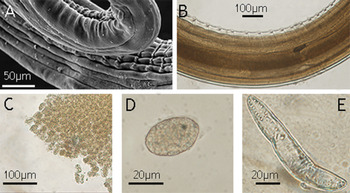
Moreover, all five smallest females differed morphologically in several characteristics (see below: Figs 3 and 4). Therefore, these females were in the fourth larval stage (L4) which took place before the last moult (Tables 1 and 4). Six females in the medium group were unfertile and appeared to be in the fifth juvenile stage (L5), while nine largest fertile females contained eggs in their uterine canal and microfilaria in the ovejector (Fig. 5). All four males were comparable in length and morphology, indicating that they were in the juvenile to adult stage (Table 1, Figs 2, 5 and 6). Interestingly, two red deer were infected exclusively with males (one deer with one individual and the other with two) (Table 5).
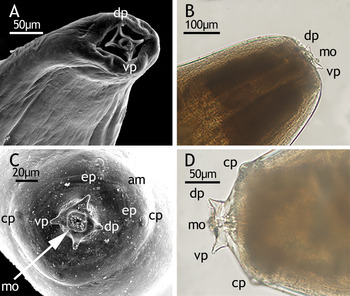
Structure of the peribuccal crown in Setaria cervi females. Larval stage L4 (A, B) and adult fertile female (C, D) visualized by SEM (A, C) and LM (B, D). dp, dorsal projections; vp, ventral projections; mo, mouth opening; ep, externolabial papilla; cp, cephalic papilla; am, amphid.

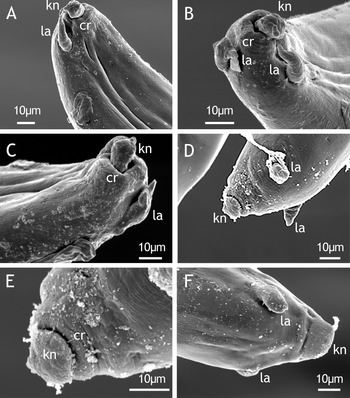
Development of caudal end of Setaria cervi females (SEM). Knob-like papilla with a maul-like structure forming in the centre of the cuticularized ring in the L4 larval stage (A–C). Disc knob in L5 juvenile female (D, E). Thimble-shaped knob in adult fertile female (F). kn, knob; cr, cuticularized ring; la, lateral appendages.

Important features of Setaria cervi. Striated bands on the ventral side of male caudal end visualized by SEM (A) and LM (B). Eggs released from the uterine canal (C, D) and microfilaria released from the ovejector (E) of fertile females visualized by LM.

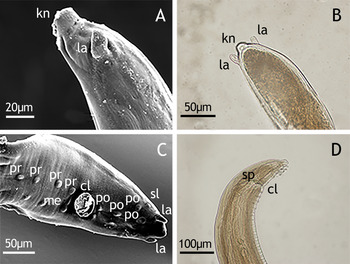
Caudal part of Setaria cervi. Adult female (A, B) and male (C, D) tail visualized by SEM (A, C) and LM (C, D). kn, knob; la, lateral appendages; cl, cloaca; precloacal papilla; po, postcloacal papilla; me, mediate papilla; sl, small lateral papilla; sp, spicule.

The morphology of the cephalic and caudal ends of all individuals was examined using LM and SEM.
Using LM to observe the cephalic body part, we were able to identify the presence of dorsal and ventral projections and cephalic papillae in both sexes; however, the shape and distribution of the dorsal and ventral projections as well as the shape of the lips and mouth opening were defined only using SEM (Fig. 3). The same techniques were used to study caudal body end, which was rounded (with a knob) in females and sharper (with cloaca, spicules and papillae) in males (Figs 4–6).
The peribuccal crown of the males, fertile females and juvenile L5 females had a protruding character and was located on the rounded cephalic body end. The dorsal and ventral projections were sharp and slightly curved, and the distances between these projections were identical (Fig. 3). The mouth opening was round in shape, with a pair of crescentic lateral lips. Observation of the fertile females using SEM revealed the presence of two amphids, four cephalic papillae and four externolabial papillae (Fig. 3C). The structure of the peribuccal crown in the four males was identical to that of the fertile females. However, the structure of the peribuccal crown of the smallest L4 larvae slightly differed from two aforementioned groups (Fig. 3A and B); here, the cephalic part was less rounded without obvious cephalic papillae and amphids. On the other hand, the dorsal and ventral projections of the peribuccal crown had the same shape as those of the fertile females (Fig. 3C and D).
The caudal ends of the larval L4 females, juvenile L5 females and fertile adult females differed in shape (Fig. 4). The structure of the caudal end of the smallest L4 larvae presented with a small maul-shaped knob. The lower part of this knob was slightly retracted into the ring caudal body end and its surface indicated a number of small protrusions. The caudo-lateral appendages were relatively pointed and situated in close proximity to the forming knob (Fig. 4A–C).
The caudal knob of juvenile L5 females was a slightly cuticularized disc-shaped ring structure without protrusions, and the knob was separated from the body end by a distinct constriction or ring groove (Fig. 4D and E). This disc-shaped knob apparently changed its shape during maturation of females. Adult fertile females had a thimble-shaped knob with a blunt end and finely porous surface structure; the knob was not separated from the rest of the female. The two caudolateral appendages of adult females had the rounded ends and were located at a significant distance from the knob (Figs 4F, 6A and B); these appendages of juvenile L5 females and L4 larvae had more pointed ends and were located closer to the body end (Fig. 4A–E).
The caudal body part of the males is presented in Fig. 6C and D. The males had four pairs of precloacal papillae and four pairs of postcloacal papillae in addition to an unpaired mediate central papilla close to the cloaca and a pair of small lateral papilla behind the lateral appendages. On the ventral side of the spiral body termination, there are apparent transverse ridges (Fig. 5A and B).
This study is the first to represent the complete sequence of the cox1 gene including flanking regions (ND4, ND6, tRNA-Trp). New nucleotide sequences have been deposited in the GenBank NCBI with the following accession numbers (see Table 1). All 24 specimens (20 females and four males) were identified as S. cervi on the basis SeC1 haplotypes. The alignment of the complete cox1 gene sequence indicated that an identical SeC1 haplotype was presented in all specimens and partial sequences indicated 100% identity with the haplotype described by Alasaad et al. (Reference Alasaad, Pascucci, Jowers, Soriguer, Zhu and Rossi2012) and Oloś et al. (Reference Oloś, Nowakowska, Rojewska and Welc-Falęciak2019).
jModelTest 2.1.10 v20160303 (Darriba et al., Reference Darriba, Taboada, Doallo and Posada2012) software revealed 1624 candidate models. Criterions AIC and AICc identified the GTR + I + G model (Nei and Kumar, Reference Nei and Kumar2000) as the most suitable (-lnL = 9006.71179; AICc = 18155.370348). We observed γ distribution with a shape parameter and a parameter p-inv of 1.1230 and 0.5160, respectively. The percentages of replicate trees, in which the associated taxa clustered together in the bootstrap test (1000 replicates), are shown next to the nodes of a phylogenetic tree presented in Fig. 7.
Molecular phylogenetic analysis (maximum likelihood) of the family Onchocercidae rooted by outgroup Thelazia callipaeda, inferred from mitochondrial cox1 nucleotide sequences (SeC 1 haplotype of Setaria cervi originates from Alces alces from the Czech Republic). Scale bar indicates the proportion of sites changing along each branch. Numbers above and below nodes represent bootstrap values (%).

Discussion
In the 2-year period during which game ungulates were monitored for parasites in western and northern Bohemia, relatively low numbers of S. cervi nematodes were detected in three host species – red deer (ten out of 26 examined deer, prevalence 38.5%), sika deer (two out of 44 examined deer, prevalence 4.5%) and one moose. However, 22 roe deer and three fallow deer originating from the same regions were not infected by this nematode species. Much more nematode parasites were detected in the dissected ungulates like the species of dorylaimid nematodes Trichuris and Capillaria (Trichocephalida), and several rhabditid genera Haemonchus, Ashwortius, Trichostrongylus, Nematodirus and Chabertia (Strongylida). Some analyses have been already published (Magdálek et al., Reference Magdálek, Kyriánová and Vadlejch2017; Nechybová et al., Reference Nechybová, Vejl, Hart, Melounová, Čílová, Vašek, Jankovská, Vadlejch and Langrová2018; Vadlejch et al., Reference Vadlejch, Magdálek, Rylková, Forejtek and Čadková2018). Throughout Europe, red deer commonly act as hosts to this filarial nematode (e.g. Alasaad et al., Reference Alasaad, Pascucci, Jowers, Soriguer, Zhu and Rossi2012; Oloś et al., Reference Oloś, Nowakowska, Rojewska and Welc-Falęciak2019). In fact, the classical taxonomy of S. cervi has been problematic since its original description as Filaria cervi by Rudolphi (Reference Rudolphi1819) and plenty of synonyms have appeared (Sonin, Reference Sonin and Ryzhikov1977). Therefore, data concerning the European distribution of S. cervi may be inaccurate. Classification of the Setaria species demonstrates how classical morphology based exclusively on light microscopy may not be sufficient for clear species identification (Yeh, Reference Yeh1959; Sonin, Reference Sonin and Ryzhikov1977). Unambiguous determination of these species most likely requires the contribution of scanning microscopy and molecular taxonomy (Alasaad et al., Reference Alasaad, Pascucci, Jowers, Soriguer, Zhu and Rossi2012; Oloś et al., Reference Oloś, Nowakowska, Rojewska and Welc-Falęciak2019, this study).
The recent prevalence of S. cervi in red deer in the Czech Republic corresponds more or less to previously published data, even though these are scarce. For instance, out of 11 red deer examined by Oloś et al. (Reference Oloś, Nowakowska, Rojewska and Welc-Falęciak2019) in southwestern Poland, eight deer were infected by S. cervi (together with two S. tundra in one deer, P = 27.3%). Similarly to the present study, the numbers of nematodes within individual hosts were low (range 1–3) and there were only one male and eight females of S. cervi in total (Oloś et al., Reference Oloś, Nowakowska, Rojewska and Welc-Falęciak2019).
The sika deer appears to be the second most suitable cervid host of S. cervi; however, the prevalence of this mosquito-borne nematode tends to be lower than this in red deer. The difference is likely related to specifics in the aetiology and ecological preferences of the non-native, originally East Asian sika deer, and European red deer. Sika deer favours open land habitats that are more likely to have lower mosquito populations (Honda et al., Reference Honda, Miyagawa, Kuwata, Yamasaki and Iijima2014; Macháček et al., Reference Macháček, Dvořák, Ježek and Zahradník2014). Setaria cervi has rarely been reported in sika deer from Europe (Rehbein and Visser, Reference Rehbein and Visser2007). However, no information concerning the prevalence of S. cervi in sika deer in the Czech Republic is currently available.
The last infected host, European moose, was killed due to collision with a motor vehicle in the region of the Šumava Mountains, where a small local population of this game has existed for a long time (Homolka, Reference Homolka1998). To date, only S. tundra has been reported in European moose, and those observations took place in Finnish Lapland (Laaksonen, Reference Laaksonen2010; Laaksonen et al., Reference Laaksonen, Pusenius, Kumpula, Venäläinen, Kortet, Oksanen and Hoberg2010) and Poland (Demiaszkiewicz et al., Reference Demiaszkiewicz, Kuligowska, Pyziel and Lachowicz2015); however, Anderson (Reference Anderson2000) did suggest the broad possibility of S. cervi infection in this host. The current study confirms that assumption. A hypothetical reason may be the fact that a partially farmed elk population in Šumava lives here stably, the animals do not migrate and have no contacts with moose in Poland or elsewhere in Europe. Their infection is therefore affected by parasites that dominate the surrounding large game. However, it should be borne in mind that also the species S. tundra may occur in other, as yet unexplored, regions of the Czech Republic.
As we have already mentioned, the only reliable way to identify specimens of the Setaria species is now through the concurrence of complex morphological and molecular analyses. In our study, both approaches were applied to all 24 Setaria individuals. Correct identification of all Setaria nematodes as S. cervi was ensured through DNA analysis of the complete mitochondrial cox1 gene sequence, which has been obtained here for the first time. The already known complete sequences of the cox1 gene in two congeneric Setaria species (S. digitata and S. labiatopapillosa) facilitated our task. Our partial SeC1 haplotypes clustered well with information on S. cervi cox1 sequences published by Alasaad et al. (Reference Alasaad, Pascucci, Jowers, Soriguer, Zhu and Rossi2012) and Oloś et al. (Reference Oloś, Nowakowska, Rojewska and Welc-Falęciak2019). Both authors also used the primer pair according to Casiraghi et al. (Reference Casiraghi, Anderson, Bandi, Bazzocchi and Genchi2001) and subsequently sequenced a 690 bp PCR amplicon. Alasaad et al. (Reference Alasaad, Pascucci, Jowers, Soriguer, Zhu and Rossi2012) analysed the partial sequence of the cox1 gene in two males taken from red deer in Italy (JF800924.1), while Oloś et al. (Reference Oloś, Nowakowska, Rojewska and Welc-Falęciak2019) evaluated six females and one male from red deer in Poland (MK360913.1). The present study, which evaluated 20 females and four males, is more robust.
The gross morphology of four males and most of the females corresponded to the species characteristics of S. cervi adults (Durette-Desset, Reference Durette-Desset1966; Sonin, Reference Sonin and Ryzhikov1977; Almeida et al., Reference Almeida, Deobhankar, Bhopale, Zaman and Renapurkar1991; Sundar and D´Souza, Reference Sundar and D'Souza2015; Oloś et al., Reference Oloś, Nowakowska, Rojewska and Welc-Falęciak2019). However, the five smallest females slightly differed morphologically in details of both cephalic and caudal body parts; they were larvae of the fourth stage (L4). The remaining 15 longer females were divided into two groups according to length and distinct caudal body part; of these, six were medium-sized juvenile females without eggs or microfilariae (fifth-stage stadium L5), and nine were larger fertile adults. The body lengths and widths of the females in these three groups showed discontinuous increases, and the differences between groups were significant (see Fig. 2). Sudden changes in body size and slight changes in morphology are very likely related to the moulting of the smallest L4 larvae to the longer L5 juveniles that later grow and sexually mature into adult females producing microfilariae. A similar analysis of female development in S. cervi has not yet to be made available, although Sonin (Reference Sonin and Ryzhikov1977) reported L3 larvae of S. cervi in a mammalian host that reached 5 mm in length and L4 larvae that ranged to 22.8 mm. It is in good agreement with the current measurements of L4 larvae reaching a maximum body length of 29 mm.
Tung et al. (Reference Tung, Lai, Ooi, Yang and Wang2003) described the morphology of larval and adult females of two Setaria species S. marshalli and S. digitata from cattle in Taiwan. Concerning fourth-stage larvae morphology, the authors considered these larvae unsuitable for species differentiation because the morphology of either peribuccal crown or the caudal knob was indistinct in both species. However, juvenile L5 and adult females of these species were easily distinguishable. Our findings concerning the morphology of larvae, juveniles and adults of S. cervi were similar but not identical. All five molecularly determined L4 female larvae were distinguishable not only from other longer/older S. cervi nematodes by their retracted and simpler peribuccal crowns, which did not present any papillae or amphids (Fig. 3C and D). Interestingly, the gross morphology of peribuccal crown clearly corresponded to the characteristics of S. cervi; however, we recognized that verification of species identification by DNA was required. The peribuccal crowns of juvenile L5 females, adult females and males showed clear and very similar characteristics; they were protruded and had a species-specific system of lips, projections, papillae and amphids.
The structure of the caudal body ends differed obviously between males and females, but also between each developmental stage of females (Fig. 4). Female L4 larvae had a small maul-shaped knob, while L5 juveniles are characterized by a flat knob distinguishable from the body by a groove, and adult fertile females had a distinct thimble-shaped, blunt-ended knob that was not separated from the body end (Figs 4F, 6A and B). This information was unknown until recently.
In summary, changes in morphology, including body size, clearly indicate the presence of ontogenetic development in S. cervi. Moreover, it should be noted that many of the authors who observed these rare nematodes did not take into account their developmental stages. In fact, S. cervi has become a sophisticated laboratory model for molecular analyses and antifilarial drug development (e.g. Anwar et al., Reference Anwar, Ansari, Ghatak and Murti1977; Rathaur et al., Reference Rathaur, Rai, Srikanth and Srivastava2009; Nayak et al., Reference Nayak, Gayen, Saini, Maitra and Sinha Babu2011; Roy et al., Reference Roy, Sengupta, Joardar, Bhattacharyya, Saha, Misra and Babu2019); however, the morphological characteristics of this model nematode have often gone unnoticed.
New information regarding the complete mitochondrial cox1 gene sequence was utilized in an updated phylogenetic study focusing on the family Onchocercidae as well as on the position of the subfamily Setariinae. The family Onchocercidae is generally considered monophyletic (e.g. Lefoulon et al., Reference Lefoulon, Bain, Bourret, Junker, Guerrero, Cañizales, Kuzmin, Satoto, Cardenas-Callirgos, de Souza Lima, Raccurt, Mutafchiev, Gavotte and Martin2015). Phylogeny based on morphological characteristics indicated a relatively early separation of Setaria spp. from other subfamilies of the Onchoceridae family (Bain and Chabaud, Reference Bain and Chabaud1986), which was later confirmed on the basis of a molecular phylogenetic study analysing the sequences of several mitochondrial and nuclear genes (Lefoulon et al., Reference Lefoulon, Bain, Bourret, Junker, Guerrero, Cañizales, Kuzmin, Satoto, Cardenas-Callirgos, de Souza Lima, Raccurt, Mutafchiev, Gavotte and Martin2015; Yilmaz et al., Reference Yilmaz, Fritzenwanker, Pantchev, Lendner, Wongkamchai, Otranto, Kroidl, Dennebaum, Hoa Le, Anh Le, Ramünke, Schaper, von Samson-Himmelstjerna, Poppert and Krücken2016; Mirzaei et al., Reference Mirzaei, Ghahvei, Lefoulon, Lia, Otranto, Martin and Sazmand2018). Setariinae can therefore also be considered a separated clade.
Our phylogenetic analysis (Fig. 7) fully supports this hypothesis. Subclade B1, which contains the genus Setaria (97% bootstrap replicates), was clearly separated from subclade B2 (98% bootstrap replicates), which includes the subfamilies Onchocercinae and Dirofilariinae. However, some phylogenetic studies based on partial sequences of the cox1 gene provided different results (Bain, Reference Bain, Klei and Rajan2002; Alasaad et al., Reference Alasaad, Pascucci, Jowers, Soriguer, Zhu and Rossi2012). In any case, our analysis is in good agreement with the latest studies looking at relationships within the family Onchoceridae (Lefoulon et al., Reference Lefoulon, Bain, Bourret, Junker, Guerrero, Cañizales, Kuzmin, Satoto, Cardenas-Callirgos, de Souza Lima, Raccurt, Mutafchiev, Gavotte and Martin2015; Yilmaz et al., Reference Yilmaz, Fritzenwanker, Pantchev, Lendner, Wongkamchai, Otranto, Kroidl, Dennebaum, Hoa Le, Anh Le, Ramünke, Schaper, von Samson-Himmelstjerna, Poppert and Krücken2016; Mirzaei et al., Reference Mirzaei, Ghahvei, Lefoulon, Lia, Otranto, Martin and Sazmand2018); it is confirming the relationship of the genera Dirofilaria and Onchocerca (B2-2 subclade), and the close position of the sister genera Wuchereria and Brugia (B2-1-1) with the genus Loa (B2-1-2). The present analysis confirms also a clear separation of the Setariinae from all other subfamilies and provides much needed information regarding this subclass.
Conclusions
This is the first extensive review of the occurrence of the filaroid nematode S. cervi in game ungulates in the Czech Republic. Sika deer and moose were first registered in the Czech Republic as hosts of S. cervi. All 20 nematode females and four males were assigned to the species S. cervi through the identification of both traditionally morphological and newly acquired molecular features. This study was the first to detect different morphological characters in the developmental stages of S. cervi females (larvae of fourth-stage, fifth-stage juvenile females, adult females) using light and especially scanning electron microscopy. Detailed morphology of cephalic peribuccal crown, papillae and amphids, as well as the structure of female caudal body end provided with a knob, was shown. The complete structure of the mitochondrial cox1 gene was originally determined and a clear distinction of a Setariinae subfamily within the family Onchocercidae has been confirmed.
Acknowledgements
The authors are grateful to Dr Miroslav Hyliš, Ph.D. of the Laboratory of Electron Microscopy of the Faculty of Science, Charles University in Prague, for providing technical assistance and SEM micrographs. We also thank Ing. Stanislava Nechybová, Ph.D. for her support in obtaining material. The authors are grateful to Brian Kavalir (Ontario, Canada) for his proofreading.
Financial support
This study was financially supported by the Ministry of Education, Youth and Sports INTER-EXCELLENCE project (INTER-COST LTC 19018).
Conflict of interest
None.
Ethical standards
Not applicable.
Consent for publication
We confirm that informed consent has been obtained from all authors in order to publish the article.