Introduction
Learners have repeatedly expressed a desire for first language (L1) support in a wide range of learning contexts (e.g. Tang, Reference Tang2002; Jingxia, Reference Jingxia2010). However, there is great variability in how much L1 support students want (Kim & Petraki, Reference Kim and Petraki2009). In evaluating student desire for L1 support, a number of learner characteristics have been suggested to be of importance. These include second language (L2) proficiency level (Carson, Reference Carson, Sonda and Krause2014), L2 ambiguity tolerance (Ely, Reference Ely and Reid1995), motivation for L2 learning (Critchley, Reference Critchley2002), and gender (Jones & Jones, Reference Jones and Jones2001). This study explores this issue through the following research question:
To what degree can Japanese university students’ preference for classroom L1 support be explained by their L2 proficiency, L2 ambiguity tolerance, L2 learning motivation level, and gender?
Method
Participants
Three-hundred and eighty students participated in this study (143 male and 237 female). They were first-year liberal arts majors who were studying at a university in Japan. The participants took four 90-minute classes of English a week: two listening and speaking, and two reading and writing. The learners were taught by 32 different native English-speaking instructors.
Materials
The Japanese in the Classroom Survey measured desire for L1 support. The questionnaire was developed by the researchers for this study. It comprised eight statements that collectively referred to L1 use by the teacher, student L1 policy, and L1 use in classroom materials. The students were presented with a four-point Likert scale to express their opinion on each of the statements (1. Strongly agree; 2. Agree; 3. Disagree; 4. Strongly disagree). As with the ambiguity tolerance and motivation questionnaires mentioned below, the Japanese in the Classroom Survey was translated into the learners’ L1. Ambiguity tolerance was measured through the 12-item Second Language Tolerance of Ambiguity Scale (SLTAS) (Ely, Reference Ely and Reid1995).
The Motivation Questionnaire (Sick, Reference Sick2004) was based on the Gardner and Lambert (Reference Gardner and Lambert1959) socio-educational model. The five items that comprised this research instrument each corresponded to a component of the model: (1) attitude towards the learning situation, (2) instrumental orientation, (3) integrative orientation, (4) lack of anxiety when communicating in English, and (5) anticipated effort. L2 proficiency was evaluated though the Computer Assessment System for English Communication (CASEC) test, a widely-used general proficiency test (CASEC, n.d.).
Results
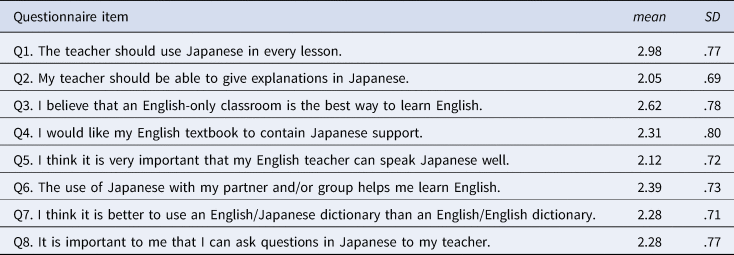
The descriptive statistics for each of the items on the Japanese in the Classroom Survey are displayed in Table 1.
Descriptive results – Desire for L1 in the classroom

The participants’ mean average responses tended to cluster towards the centre of the scale. While the results did not show a desire for L1 use every lesson (Q1: M = 2.98, SD = .77), there was an expectation that the teacher should be capable of giving explanations in the L1 (Q2: M = 2.05, SD = .69) and speaking the language well (Q5: M = 2.12, SD = .72). Regarding classroom language policy, the participants were inclined to recognize the value of L1 communication with other students (Q6: M = 2.39, SD = .73) and their teacher (Q8: M = 2.28, SD = .77), and there was also a mildly unfavourable response with regard to an exclusively English-only classroom (Q3: M = 2.62, SD = .78). Lastly, the participants collectively expressed a preference for L1 support in their textbooks (Q4: M = 2.31, SD = .80) and bilingual dictionaries (Q7: M = 2.28, SD = .71). The Cronbach alpha reliability for the Japanese in the Classroom Survey (α = .86), the L2 learning motivation questionnaire (α = .75) and the L2 ambiguity tolerance questionnaire (α = .88) were all satisfactory. For descriptive results for the other variables, see our conference poster.Footnote 1
The scores from the surveys were subjected to principal components analysis with oblique rotation. The participants’ factor score coefficients (regression method) were extracted and used in the later analyses. The learners’ Test of English for International Communication (TOEIC) scores were estimated to average 380 points (SD = 119) (see Maruzen, 2003), based upon their CASEC scores.
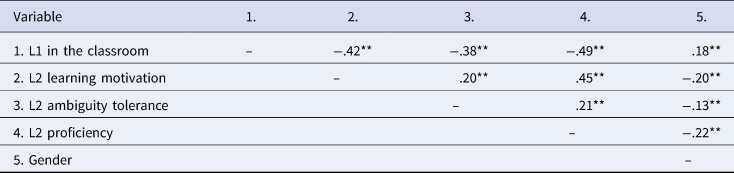
As shown in Table 2, the L1 in the classroom variable most strongly correlated with the L2 proficiency scores (r = −.49, p < .01), followed by L2 learning motivation (r = −.42, p < .01), then L2 ambiguity tolerance (r = −.38, p < .01). Gender was also significantly related to desire for L1 support (r = −.22, p < .01) with male students wanting more L1 assistance than females.
Correlations between the variables

Note: **p < .01 (two-tailed).
Next, the data was subjected to multiple regression analysis. The L1 in the classroom scores were used as the dependent variable and the other scores as the independent variables. Gender was a non-significant predictor (p = .44). Therefore, it was removed and the analysis repeated. A statistically significant regression model containing all three explanatory variables emerged (F 3, 376 = 69.86, p < .001). The results for the individual variables are provided in Table 3.
Summary of multiple regression for variables predicting student interest in L1 in the classroom

Note: S.E. (B) = standard error of B.
The standardized partial regression coefficients indicate that L2 proficiency (β = .−34, p < .001) made the greatest independent contribution to the prediction of desire for L1 support in the classroom, followed by L2 ambiguity tolerance (β = −.27, p < .001) and L2 motivation (β = −.21, p < .001). Collectively, the three variables accounted for 35% of the variance (adjusted R2 = .35).
Discussion
The results showed L2 proficiency had the strongest relationship with desire for L1 support in the classroom, followed by L2 ambiguity tolerance and L2 motivation. As with L2 proficiency, there was a negative relationship between the variables. Thus, the more highly ambiguity-tolerant and motivated students tended to desire less L1 support.
The results from this study and others have shown that for many students the use of L1 support is a ‘learner-preferred strategy’ (Atkinson, Reference Atkinson1987, p. 422), especially those with particular characteristics. In the L2 classroom, instructors need to be cognisant of these learner characteristics as they impact the success of the student and therefore should influence teaching practice. Indeed, as noted by Irvine and York, ‘the closer the match between a student's learning style and the teacher's instructional methods, the more likely the student will experience academic success’ (Reference Irvine, York, Banks and Banks1995, p. 491). Through selective L1 support, teachers can enable some learners to more readily understand the target material and transfer input into intake. Indeed, classroom observations have shown that L2 teachers draw upon the L1 most often for such functions as clarifying instruction for classroom activities, providing feedback to learners, and for verifying comprehension (Macaro, Reference Macaro1997). However, L1 support does not necessarily have to involve teacher talk, which is particularly pertinent when teachers are not proficient in their students’ native language. For instance, students can be allowed to confer in their L1 when planning complex tasks or verifying comprehension (see von Dietze & von Dietze, Reference von Dietze and von Dietze2007). The need for L1 support can also be met through the use of bilingual dictionaries and learning materials.
On a final point, the ambiguity-tolerance results also have practical implications for teaching. Students with a low tolerance for ambiguity can become anxious in the absence of a clear course structure (DeRoma, Martin, & Kessler, Reference DeRoma, Martin and Kessler2003). To help them, the L1 can be used to reinforce understanding of course syllabi and grading criteria. When furnished with a clear understanding of classroom procedures, anxious students have been found to be more comfortable, self-confident, and motivated in the L2 classroom (Dörnyei, Reference Dörnyei2005).
Supplementary material
The supplementary material for this article can be found at https://doi.org/10.1017/S0261444820000178
Paul Joyce is an Associate Professor at Kindai University in Osaka, Japan. He has also taught at Kanda University of International Studies and J. F. Oberlin University in Japan. He has a Masters in TEFL/TESL from the University of Birmingham, UK and a Ph.D. in Applied Linguistics from the University of Surrey, UK. His research interests include vocabulary acquisition, testing, L2 listening, and the role of the L1 in second language acquisition.
Hans von Dietze has taught English at J. F. Oberlin University in Japan, German and French in several high schools, and was general manager of an ELICOS college in Australia. He is currently teaching Japanese in two primary schools in Cairns, Australia. He has a Masters in Education (Teaching Second Languages) from the University of Southern Queensland. His research interests include the role of technology in the classroom as well as the role of the L1 in L2 teaching and learning.
Alison von Dietze has a Masters in Education (Teaching Second Languages) from the University of Southern Queensland. She taught English at J. F. Oberlin University and at Takushoku University in Japan. It is through her extensive involvement in English as a second language programmes in Australia and study abroad programmes that she developed her interest in language acquisition and how the role of the L1 in second language acquisition is viewed by teachers and learners. She is currently teaching Japanese in Australia.
Brian McMillan holds a Masters in Education (Teaching Second Languages) from the University of Prince Edward Island, Canada. He taught English at Kanda University of International Studies and at Hiroshima Bunkyo Women's University in Japan, and is currently teaching French immersion at the intermediate school level in Canada. The use of the learners' L1 has been the main focus of his research, and has played a central role in his teaching practice over the past 25 years.