I. INTRODUCTION
This paper discusses the history of free riding. Social scientists know well Mancur Olson’s formulation of the problem in The Logic of Collective Action ([1965] 1971). But, in tracing the longer history of the idea, it is important to bear in mind two points.
First, variations of the problem had been on the agenda of social scientists and studied in detail in the context of groups since at least the Second World War.Footnote 1 More specifically, before it sprang to attention in economics, free riding had concerned political scientists, social psychologists, and sociologists interested in the issue of morale. “Morale” was then seen as “the capacity of a group of people to pull together consistently and persistently in pursuit of a common purpose” (Leighton Reference Leighton1949, p. 78). Yet, its strong appeal resided in the difficulties attached to its creation and maintenance. Morale problems, as understood by social scientists, were, in one way or another, connected with what Olson later described as the “free rider problem,” which may explain, in turn, why his book had so much impact on other social sciences (Oppenheimer 2008). It may also explain why the first book-length treatment of the subject, taking “Olson’s Problem” as its point of departure, came from Richard Tuck (Reference Tuck2008), a Harvard professor of government.Footnote 2
The second point is that the study of collective-action problems, of which the notion of free riding forms a part, took place against significant changes in attitudes within American society. Whereas the US entry into the Second World War encouraged widespread acceptance of the necessity of individual participation in the collective effort, by the late 1960s and early 1970s, mistrust in political leaders and, more generally, decision makers increased the social acceptability of not contributing to the collective effort, with the result of complicating the moral condemnation of free riding. Though the terms free riding and free rider seldom appeared in the social science literature before 1970, their increasing use afterwards reflects how the idea of enjoying the benefits of collective action without incurring the corresponding costs shed light on a number of major issues in the context of social crisis (e.g., Frohlich and Oppenheimer Reference Frohlich and Oppenheimer1970). The terms, which had been used to depict problems in various segments of society, were now regarded as describing problematic situations at the societal level.
Olson’s group-level analysis explained the working of specific sectors in society, but his distinction between small and large groups provided the basis for an exploration into problems affecting the whole society. His analysis was about the effects of social change in America, specifically the transformations that led to a gradual decline of engagement in communities from the mid-1960s (see Putnam Reference Putnam2000) and were followed by a notable change in the ideas and metaphors used to describe the working of society (see Rodgers Reference Rodgers2011). In the very first lines of his essay, Olson noted the widespread acceptance in economics, political science, and sociology of the idea that groups with common interests attempt to further those common interests. Yet, as he found its justification on the basis of the self-interestedness of agents inadequate, Olson (1971, p. 2) argued that, at least in large groups, “coercion or some other special device” is required for individuals to act in their common interest.
In the following, after reviewing the various meanings associated with the term free riding (and free rider), I follow the notion from the late 1930s to the early 1970s. I will not aim at comprehensiveness but will try to give a concrete impression of its uses within economics. I argue that the phenomenon of free riding gained widespread recognition once it was viewed as the typical behavior of people placed in certain circumstances rather than the exception confirming the rule that people should pay for what they get. In a sense, the increasing significance of the economics of free riding and its influence on other social sciences must be seen against the background of reflections on what holds society together, which have become central to the changing division of labor within social science from the 1960s.
II. A JOURNEY INTO FREE RIDING
In general, dictionaries include two main definitions for free riding. Earlier ones point to the “practice of travelling on a train without paying” and note that the term can also apply to “other forms of public transport.” This use of the term is noted as rare today. More recent definitions, which have been in use since the 1930s at least, stress “the action or practice of benefiting (or seeking to benefit) in some way from the effort, sacrifice, financial outlay, etc., of others, without making a similar contribution.” Some terms of the same family even include a more pejorative meaning. Free rider, for instance, was used to describe a “mounted soldier, mercenary, etc., not belonging to a regular or established military body” and occasionally a “bandit” or a “freebooter.” This definition is now rare but it was still in use when free riding applied to someone traveling without a ticket. Of course, free rider is also used to describe someone who is involved in free riding in the above senses. To the extent that free riding refers to enjoying the benefits available to others without undertaking similar efforts, it often carries negative moral connotations. In other words, it is not only a social scientific term but also a word with powerful everyday meanings. It is, therefore, useful to ask how far social scientists have borrowed from these common-sense definitions.Footnote 3
A JSTOR search shows that the occurrences of the term picked up in the early 1970s. From 1900 to 1938, the term does not even appear in social science journals. The first occurrence is in a review of American economist and journalist Sylvia F. Porter’s How to Make Money in Government Bonds, where free riding is seen as implying “the purchasing of commodities or securities, a subsequent sale and profit, without the use of any cash on the part of the purchaser” (Badger Reference Badger1939, p. 605).
This was a new use of the term in the literature from 1939 (there were only three occurrences in the 1940s), with a very limited number of occurrences referring to the purchasing of commodities instead of securities (see, for instance, Comments 1951 and Telser Reference Telser1960 on free riding at the expense of retailers who provide special services).Footnote 4 With the National Association of Securities Dealers (NASD), created in 1939 and playing a significant role in the regulation of markets and definition of associated policies, there were various attempts to design the rules of fair practice on markets for securities. Accordingly, the restrictions designed to limit free riding were given some attention, especially when lessons were drawn from the Second World War finance. While discussing Henry Murphy’s The National Debt in War and Transition (1950), Woodlief Thomas (Reference Thomas1951), economic adviser to the Board of Governors of the Federal Reserve System, mentioned the “war loans drives, which were designed to further the objective of raising funds from nonbank investors.” He went on to note that “[i]t is clear that, owing to the profits that could be obtained from playing the pattern of rates, many of the purchases of securities in the later drives were made possible by sales to banks of securities purchased in previous drives. Such shifts, which were known as ‘free riding,’ were highly profitable, and the possibility of profits induced some of the buying of securities. Free riding or ‘quota riding’ also resulted from efforts to build up impressive sales results in local war-loan campaigns” (p. 624).
The references to free riding in securities markets were not as frequent in the economics literature; they appeared mostly on special occasions, as with the publication of the Report of the Special Study of the Securities Markets of the Securities and Exchange Commission, in 1963, which provoked reactions concerning the public regulation of these markets (for instance, Stigler Reference Stigler1964) and responses to justify the usefulness of the Report (Robbins and Werner Reference Robbins and Werner1964), notably in prompting the securities industry to correct some of its problems, including the inevitable free riding. Following the issuing of the Report, there were also a few law articles alluding to free riding in the context of corporate and securities regulation. These pointed to the role of the NASD in defining the rules of fair practice as ruling out free riding (for instance, Jennings Reference Jennings1964, p. 950), especially in relation to the “hot issue” phenomenon. The latter, which had supposedly characterized the securities markets from the early 1940s, referred to “a public issue of stock which trades at a substantial premium above the offering price immediately after the issue is placed on the market” (Comments and Notes [Duke Law Journal] 1968, p. 1137). While considering the special regulations and rules adopted by the NASD to control “hot issues,” legal theorists often referred to the rules pertaining to withholding and free riding. The NASD manual of 1967 had a section on these practices. Withholding refers to the fact that sellers “retain for their own accounts or affiliates a portion of the issue to be distributed, a practice which has the effect of limiting the supply and therefore of inflating prices” (p. 1159). Here, professionals were supposed to play against the public and, in the process, undermine its confidence in the fairness of the securities markets. The NASD likewise prohibited the practice of free riding “hot issues.” Here, professionals who had withheld shares from the public at the initial public offering were castigated for selling them with a significant profit in the trading market afterwards (p. 1161).
From the mid-1960s, free riding was used to describe “the practice of purchasing during distribution and selling after a subsequent rise in price in the aftermarket” (Comments and Notes 1968, p. 1162). Though not illegal, this practice was forbidden by the NASD because the broker-dealer was supposed to enjoy “an unfair advantage from his position as a distributor of securities” (p. 1162). Once again, the opposition between the broker-dealer and the public in general was used to underscore the unfairness attached to that practice.Footnote 5
For its proponents, regulation of the securities market was justified by the need to defend the interests of the public against unfair practices and free riding in particular, while, for its adversaries, this regulation appeared as an obstacle to access a supposedly open market. A similar argument applies to the labor market, where regulation in the form of compulsory union membership was regarded as either a remedy for free riding or a restriction on the openness of the market and the right to work.
III. THE FREE RIDER AND LABOR UNIONS
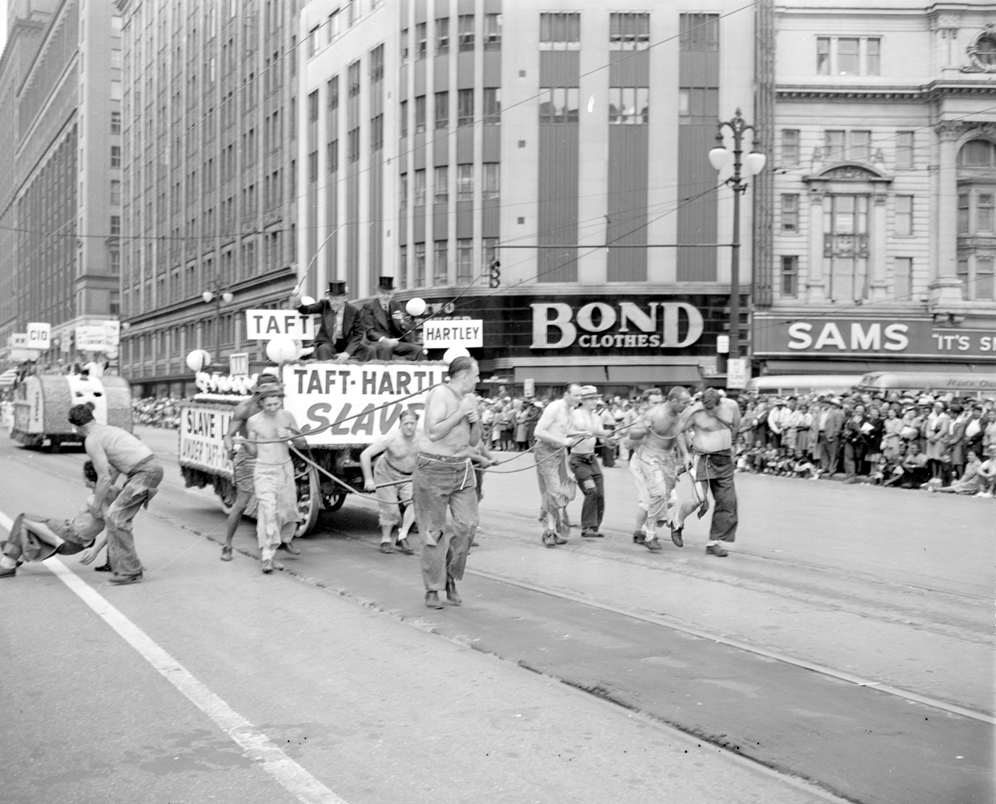
Though legal scholars and economists used free riding in the context of securities markets, the term experienced even greater success in the analysis of unionism. In that context, references to free riding picked up from the 1950s, as did those to free rider, which were even more frequent.Footnote 6 The increasing interest in free riding was linked with the reactivation of the old debate between the pros and cons of the union shop as a result of the controversy over the right-to-work laws, which forbade various union security devices. Right-to-work laws made their first appearance after Congress enacted the 1935 National Labor Relations (or Wagner) Act, creating the National Labor Relations Board (NLRB) and giving new rights to unions. After Pearl Harbor, the American Federation of Labor (AFL) and the Congress of Industrial Organizations (CIO) even promised not to disrupt production for the duration of the war, though their “no-strike pledge” was primarily meant as a reaction against Congress’s anti-strike mood (Brinkley Reference Brinkley1995, pp. 209–210). Following the sweeping victory of Republicans at the congressional elections of November 1946 after a campaign centered on “Big Labor” and its responsibility in repeated strikes, the passage of the Taft–Hartley Act rekindled controversy. Congress outlawed the closed shop, which requires union membership at the time of hiring as a condition of employment, while permitting the union shop, which requires union membership after hiring only. In addition, the Taft–Hartley Act allowed the states to outlaw the union shop, which would otherwise be legal under national law. Finally, the law required that “all union officers seeking access to NLBR facilities and services sign an affidavit stipulating that they were not Communists” (Zieger Reference Zieger1995, p. 247). To industrial unionists, Taft–Hartley could hardly appear other than anti-union legislation. Following its passage on 23 June 1947, after President Truman’s veto message to the House of Representatives had pointed out that the “bill taken as a whole would reverse the basic direction of our national labor policy, inject the Government into private economic affairs on an unprecedented scale, and conflict with important principles of our democratic society,” the law repeal became the order of the day for unions, which organized rallies and demonstrations and published pamphlets to that effect (see Figures 1 and 2).Footnote 7
Unions published numerous pamphlets denouncing Taft–Hartley. The cover of this one—issued by the California CIO Council in July 1947—betrays unions’ perception that the bill significantly affected the balance of power between employees and workers (Holt Labor Library, San Francisco, CA).

The denunciation of Taft–Hartley as a “slave labor bill” was a recurrent theme of union demonstrations, as illustrated by the Labor Day Parade in downtown Detroit on 1 September 1947 (Detroit News Staff).
Between the late 1940s and the mid-1960s, most law and economics journals considered issues of union membership through the treatment of the free rider rather than of free riding.Footnote 8 The personalization of the problem reflected the tension at the very heart of the free-rider problem between those who pay to enjoy the fruits of unionist work and those who do not pay, as much as it revealed the moral dimension of political discussion. It is during that period that researchers increasingly began to refer to the free-rider argument to the effect that labor unions have a right to enforce membership because the free rider benefits from collective action without supporting its costs.
Discussing the Taft–Hartley Act, the former president of the American Economic Association and authority on labor issues, Sumner H. Slichter (1949, p. 2), wrote that the “‘free-rider’ is a well-known problem of the American union.” That problem referred to the “reluctance of workers to pay union dues after their immediate demands have been met.” Among the characteristics of the American trade unions, the institutionalist economist saw “reliance upon the closed shop or the union shop,” which he defined as “devices partly to deal with the problem of the ‘free-rider’” (p. 5).Footnote 9 In an issue of the Annals of the American Academy of Political and Social Science devoted to discussing labor in the American economy, even Senator Robert A. Taft (1951, p. 196), Republican of Ohio, who wrote the Taft–Hartley Act of 1947 as a result of his conviction that the Wagner Act was too favorable to the labor unions, conceded that a “limited type of compulsory membership contract is a complete answer to the ‘free-rider’ argument so often advanced to support the need for a closed shop.”
By that time, however, the solution contemplated to combat free riding was no longer the closed shop but the union shop or even the agency shop in which employees must pay a fee to the union, whether or not they are members.Footnote 10 In the eyes of leftist unionists, Taft–Hartley had made it more difficult for workers to protect themselves against “free riders” (Zieger Reference Zieger1995, p. 247). The tolerance of free riders because of their symbolizing freedom of choice was regarded not only as a threat to union security but also as the main obstacle to a more equal workplace, which could, in turn, open the way to a fair society. For right-to-work advocates, there was no reason for free riders to subject themselves to the diktat of unions and surrender the right to dispose freely of their property (Gall Reference Gall1988, p. 136). The view of unionists who criticized free riders for being insensitive to the common good was as idealistic and dangerous as that of communist sympathizers who hoped for a new man.Footnote 11
By the late 1950s, following a decade of tensions between unions and employers about labor legislation, the theoretical discussions about the free-rider argument had a strong policy dimension. The publication of Labor Unions and Public Policy (1958), the title of which said more about its ambitions than contents, was clear indication that policy motivations often inspired theoretical investigations into unionism, its pros and cons. The book put together four essays from two lawyers and two economists, among whom was Edward H. Chamberlin. An influential Washington think-tank, the main ambition of which was to promote a free society and limited government, sponsored the book. The American Enterprise Association had gradually moved to the study of government policies and was keen, therefore, to bring to the attention of Congress those developments that could help the cause. The conclusion of one of the reviewers left no doubt as to the aim of the book, even if its analyses showed more nuance: “the primary objective of the writers was the case against the unions” (Leftwich Reference Leftwich1959, p. 374). Other reviewers were not necessarily more generous but some pointed to the apparent inconsistency between Chamberlin’s conclusion that workers improve their lot through collective bargaining and Philip D. Bradley’s refutation of the free-rider argument for the union shop on the basis that unions do not obtain significant benefits for workers in the bargaining unit (see Lester Reference Lester1959, p. 205; Phelps Brown Reference Phelps Brown1959, p. 180).
The free-rider argument remained on the agenda of legal scholars and economists alike in the late 1950s and early 1960s, with a variety of positions, from the acceptance of compulsory membership as a means to maintain union stability in the face of free riding to the recognition of employees’ right to work without joining a labor union as not necessarily implying free riding. Starting with the Johnson presidency, however, a new stream of literature, originating in the theory of public finance, considered free riding in settings other than the labor union and the financial market, and stressed the relevance of free riding for society as a whole.Footnote 12
IV. FREE RIDING: FROM GROUPS TO SOCIETY
With the involvement of American economists in government during the Second World War and the establishment of the Council of Economic Advisers in 1946, it became increasingly natural for some of them to consider the role of government in the economy.Footnote 13 Richard A. Musgrave, one of the fathers of modern public finance, made no secret of the fact that his personal association with policy makers and search for the good society heightened his interest in theoretical questions related to the conduct of government. Musgrave believed that it could promote the collective good, but other analysts of public finance were more skeptical. Soon after Musgrave’s The Theory of Public Finance was published in 1959, James Buchanan (1960, p. 238), who regarded it as an important book, took issue with Musgrave’s tripartite division of the governmental budget into the allocation, distribution, and stabilization branches. Like allocation, he suggested, both redistribution and stabilization had to be taken as satisfying social wants and, as a result, depended on individual evaluations. While discussing the allocation branch and, more specifically, the satisfaction of “social wants,” Buchanan identified the free-rider problem without using the phrase. Summarizing Musgrave’s analysis, he noted that with such wants, “[t]he individual, because he is aware that he cannot be excluded from sharing in the benefits, will try to escape his share of the costs. He will be led to conceal his ‘true’ preferences for the services provided, and there is no mechanism analogous to the market which can be employed to force him to reveal these preferences. By necessity the political process must be introduced along with its inherent compulsion” (p. 235).Footnote 14 Buchanan, who did not share Musgrave’s view of government, did not take that justification for granted, for he believed the impossibility of exclusion was not a necessary condition for collective action in satisfying a social want.Footnote 15
It is significant that Buchanan first referred explicitly to the free-rider problem after having consulted an earlier draft of The Logic of Collective Action, which Olson wrote while he was serving as a lieutenant in the Air Force between 1961 and 1963 (Swedberg Reference Swedberg1990, p. 168). In “What Should Economists Do?,” originally given as the Presidential Address to the Southern Economic Association in November 1963, Buchanan maintained that the “‘free rider’ problem” could be “found in many shapes and forms in the literature of modern public finance theory” (1964, p. 220).Footnote 16 That was true, indeed, but the phrase free rider problem was no part of public finance language. No mention was made of the free-rider problem or free riding in The Calculus of Consent of 1962.Footnote 17 For Buchanan to employ the phrase in that context, he had to see parallels between its use in labor union parlance, where it appeared under the “free rider argument” and served mostly as a justification for compulsory membership, and its possible use in the theory of public-goods supply, where it described the tendency for a rational agent to refrain from making voluntary contributions to the public good when its potential benefits were non-divisible, and suggested, therefore, a possible role for governmental intervention. In other words, he used the term free rider because he thought the problem it represented was worth taking into account while considering the possibility of voluntary cooperation in society and because it had been associated with a debate, the terms of which expressed two contrasting visions of the state.
The societal dimension of free riding is obvious from Buchanan’s analysis of the determinants of individual choice among ethical rules in relation to a change in numbers. In “Ethical Rules, Expected Values, and Large Numbers,” Buchanan (1965, p. 8) left no doubt as to his frame of reference. He wrote:
Volunteer fire departments arise in villages, not in metropolitan centers. Crime rates increase consistently with city size. Africans behave differently in tribal culture than in urban-industrialized settings. There is honor among thieves. The Mafia has its own standards. Time-tested honor systems in universities and colleges collapse when enrollments exceed critical size limits. Litter is more likely to be found on main-traveled routes than on residential streets. Even the old adage, ‘Never trust a stranger,’ reflects a recognition of this elemental truth, along with, of course, additional ethical predictions.
The increase in group size suggested greater adherence to the expediency criterion as opposed to the moral law, and, as a result, a proliferation of free-riders situations (see Fontaine Reference Fontaine2007, p. 15).Footnote 18 The question of significance, therefore, was whether the social changes affecting American society in the 1960s required inevitably greater governmental intervention and, if so, whether individuals were ready to accept its consequences on freedom of choice. On this, Buchanan argued that because of its imperfections, the pure theory of public good did not place theorists in a position to advise policy makers satisfactorily, which amounted to saying that avenues of reform other than collectivization must be contemplated before devising solutions to the free-rider problem.
As already noted, The Logic of Collective Action was influential among political scientists and sociologists alike. As a result, its impact can hardly be appreciated without taking into account the efforts by a number of economists from the late 1950s and early 1960s to investigate the “political” and the “social” (see Fleury 2009). It is well known that The Logic challenged the traditional theory of groups. In particular, Olson questioned what he saw as a common idea among political scientists, sociologists, and social psychologists alike: the logic at work in small groups is applicable to larger groups. “‘The group theory’ that dominates the discussions of pressure groups is inadequate for large economic groups, at least, and there is accordingly a need for a new theory” (Olson Reference Olson1971, p. 131).Footnote 19
To Olson, economists had more expertise than other social scientists to discuss “large economic groups.”Footnote 20 As he questioned the idea that group interests were more important than individual interests in the working of society, Olson made clear that his conclusions entailed reconsideration of the working of society as a whole, not just a critique of the traditional theory of groups.Footnote 21 In criticizing the supporters of the traditional theory of groups, he went against political theory’s analysis of the economy and, in particular, the idea that large economic groups are fundamental in the political process. On the basis of the free-rider problem, Olson likewise criticized the view that large economic groups act to advance their group interests. Still, some large economic groups were organized, which could be explained by the by-product theory of groups: the free-rider problem did not surface because of the capacity of these groups to mobilize their members with selective incentives.
Given that one significant aspect of social change in American society was the increase of large groups, the idea that their logic was different from that of small ones had obvious practical relevance. Olson noted that “the more important point to remember is that some sufficiently small groups can provide themselves with some amount of a collective good through the voluntary and rational action of one or more of their members. In this they are distinguished from really large groups” (p. 33). Once that difference was acknowledged, the problem remained as to its prescriptive implications. It could be that the provision of non-collective benefits had to be encouraged so as to create a captive membership, which limited the free-rider problem. It could be that a scaling down of these large groups offered a satisfactory, theoretical solution to the free-rider problem, as Buchanan suggested at the end of “Ethical Rules,” but their multiplication made it unrealistic to regard that solution as a panacea. Once again, the question of what holds society together came to the fore.
By the time he published The Demand and Supply of Public Goods (1968), Buchanan had had ample opportunity to consider the wider ramifications of free riding in society. He explained that the impossibility of securing agreement among a large number of persons stemmed from “the ‘free rider’ position in which each individual finds himself” (p. 87). In the words of Buchanan, “In the relevant large-number setting, the individual does not really say to himself, ‘let George do it’; he simply treats others as part of nature. . . . In the large-number of n-person dilemma, the failure to attain desirable results through independent action is analytically equivalent to the orthodox prisoners’ dilemma, but without the personal overtones. Full communication among all persons in a large-number dilemma will still not remove the inefficiency in results” (pp. 87–88).
Two main conclusions followed. First, once the free-rider position was theoretically characterized, it was possible to place under the same umbrella a variety of apparently unrelated situations. Second, as much as the term free rider carried negative connotations, the free-rider problem was above all a theoretical construct, the logical basis of which rested on group size. The main difference between small- and large-number settings was that, in the former, individuals might see their action as exerting some influence on others and their lack of contribution as making a difference, which might cause them to contribute. In the large-number settings, by contrast, the individual believed that others would compensate for his or her lack of contribution—hence, free riding. In other words, the problems posed by free riding had little to do with the weakening of moral norms and they could not, therefore, be solved by simply urging people to improve; rather, they betrayed the increasing permeation of society by self-interest—taken as a rule for behavior—as a result of social change and, in particular, the increase in group size. If free riding was a rational response to certain circumstances, then it was for policy makers to help change the environment in such as way as to make it less conducive to such behavior and for social scientists to convince them that they knew what ought to be done.
The transformations of American society described by Buchanan, Olson, and others served merely as background for their analyses of free riding. It was not expected that economists would account for such transformations in the way sociologists and political scientists might; yet, their incursions outside economics’ traditional borders had begun to gain them some notice as students of society.Footnote 22 The work of Anthony Downs, Gordon Tullock, Buchanan, Olson and a few others, for instance, was important in establishing economists as analysts of politics.Footnote 23 As Brian Barry explained in the preface for the new edition of Sociologists, Economists and Democracy, in the late 1970s, “What does seem defunct at any rate in writing about politics, is the notion, introduced by Durkheim and elaborated by Parsons, that the way to explain some feature of a society is to show how it relates to other aspects of the society to form part of a functional whole—not to explore the way it came about or the reasons people have for maintaining it” (1978, p. vi). In addition to the decline of the Parsonian paradigm, what Barry expressed here is a growing segmentation in the analysis of society, which was encouraged by the affirmation of economics imperialism in social science. As economists claimed expertise over human behavior in a variety of situations— economic, political, and social—it was not unusual for them to suggest that the working of one segment of society—the economy—could be taken as a good approximation to the working of the whole society.
Olson’s critique of structural functionalism exemplified economists’ conviction “that there is no fully satisfactory intellectual framework or theory for the analysis of society-wide social problems” (1970, p. 112). To Olson, free riding was one of these society-wide social problems (remember that, for Olson, “social” was the opposite to “individual,” not “economic”). It fell upon economists to compensate for the weaknesses of political and social theories and provide a new intellectual framework, if only through the use of economic concepts such as opportunity cost.
In the Appendix to The Logic, written in 1971, Olson described his own attempt to broaden his audience towards other fields and identified the satisfaction of the need for collective goods in large groups as a major issue of American society, one that government may find increasingly hard to solve precisely because “[t]he types of collective goods and externalities with which governments have to deal are . . . becoming more numerous and important over time” (1971, p. 172). The idea of “selective incentives” can be seen as the economists’ solution to the above problem, an idea that could serve as a starting point to think of the various ways to prevent free riding in society. But it also shows that, by that time, economic reasoning had already made significant progress in society at large, offering the promise of the intellectual framework economists, sociologists, and political scientists thought lacking and policy makers would soon find especially helpful in view of the social ills affecting American society.
V. CONCLUDING REMARKS
Following the Second World War, free riding was often used to describe unfair behavior in securities markets. Building on the commonsensical idea of enjoying the benefits of collective action without incurring its costs, economists and legal scholars alike emphasized its problematic nature and thought of various ways to counterbalance its negative effects. Controversy over the right-to-work laws played a significant part in prompting economists and legal scholars to analyze free riding also in the context of unionism. Finally, from the 1960s, the notion was extended beyond securities markets and labor. Though Olson and others continued to refer to free riding in the context of groups, their analyses of public goods conveyed a message about society as a whole. By then, free riding may have appeared unfair, but it was described as the result of specific conditions.
Of course, there were many problems plaguing American society from the mid-1960s, and it is doubtful free riding was the most significant one. Even if it was not, it offered nonetheless a theoretical reading of these problems, centered on the assumption of a rational, self-interested individual’s maximizing his or her satisfaction. That model of human behavior seemed to confirm the experience of many who denounced the depersonalization, dehumanization, egoism, coldness, and alienation of society, but it went well beyond the moral condemnation of contemporary society and actually shaped the view of its working itself. The economic analysis of free riding increasingly influenced the definition of public policy making by emphasizing the fact that people may have good reasons not to contribute to public goods and by suggesting that the best way to prevent free riding is to make it less profitable to individuals. In the process, a partial view of the reasons why people refrain from free riding has emerged.Footnote 24