1. Introduction
Formation control of multi-agent systems (MASs) has drawn a great amount of attention in control community. The aim is to develop control laws to allow achievement of the desired formation for MASs in a manner that have limited capability in accessing their neighbor information [Reference Liu, Liu, Chen and Zhang1–Reference Yang, Si, Yue and Tian3]. In ref. [Reference Liu, Liu, Chen and Zhang1], the authors design a distributed adaptive fuzzy control of MASs with predefined performance and unknown time delay. The distributed adaptive control is considered for a class of high-order nonlinear MASs without using global information in ref. [Reference Cao and Song2]. In ref. [Reference Yang, Si, Yue and Tian3], the authors design a time-varying formation tracking strategy for a class of uncertain nonaffine nonlinear MASs with directed topologies. Formation control for MASs is playing an important role in a wide range of applications, including unmanned aerial vehicles [Reference Chen, Liu and Guo4], spacecraft [Reference Du, Chen and Wen5], multi-robots [Reference Yoo and Kim6], and autonomous underwater vehicles [Reference Li and Zhu7].
Formation control of MASs has been studied extensively over the past decades (see, refs. [Reference El-Ferik, Qureshi and Lewis8–Reference Fei, Shi and Lim18] and the references therein). Neural network-based, robust control, and event-triggered method are used respectively to address formation control problems for MASs with unknown nonlinear dynamics [Reference El-Ferik, Qureshi and Lewis8, Reference Cheng, Hou, Tan, Lin and Zhang9, Reference Wang, Gao, Zhang and He17, Reference Fei, Shi and Lim18], with system uncertainties and external disturbances [Reference Yan, Shi, Lim and Wu13, Reference Shou, Xu, Lu, Zhang and Mei14] and with switching topologies [Reference Zhang, Zhang, Gao and Sun15, Reference Li, Zhang, Wang and Cao16]. The higher order systems arise in many engineering fields, including flexible robot manipulator [Reference Han and Lee19], quadrotor with a variable degree of freedom [Reference Omürlü, Büyük, Sahin, Kirli and Turgut20], and nuclear power plant [Reference Davydov, Antonov, Makeev, Batov, Dudkin and Myazin21]. It can also be used to approximate partial differential equations by means of spatial discretization. Compared with low-order models, the high-order systems can grasp the more complex dynamics of MASs, and therefore, it is worth to study such important case. Complex nonlinear systems can be divided into affine nonlinear systems, where the control inputs are linear with respect to the state variable, and nonaffine nonlinear systems, where the control inputs have nonlinear relationships with the state variables. Many practical control systems, such as aircraft control systems [Reference Pashilkar, Sundararajan and Saratchandran22], chemical reaction systems [Reference Mutha, Cluett and Penlidis23], and biological systems [Reference Krstic, Kokotovic and Kanellakopoulos24], have nonaffine nonlinear structures. Therefore, in order to meet the high precision control requirements of modern complex systems, it is of great theoretical significance and practical value to design controllers directly for non-affine nonlinear uncertain systems. Backstepping technique provides a recursive and systematic control design tool for high-order nonaffine nonlinear system; thus, it has been widely employed to design formation control schemes for MASs with high-order nonaffine nonlinear dynamics [Reference Siavash, Majd and Tahmasebi25–Reference Cheng, Hu and Wu28].
It should be noticed that recursive differentiations are inevitable in backstepping control design procedure and can result in the “differential explosion” phenomenon, which could give rise to great disturbance during the control design process and affect the control performance. Active disturbance rejection control (ADRC) has become a standard control technique in the engineering industries due to easy implementation and high-quality control performance. ADRC technique has been successfully applied to time-delay systems [Reference Zhao and Gao29], infinite-dimensional systems [Reference Wu, Zhou, Guo and Deng30], and robotic systems [Reference Fareh31], respectively, to solve the system uncertainty problems. We will adopt ADRC to deal with unknown nonaffine nonlinear functions in MASs in this paper. In fact, resilience is an inherent property of every system, which implies that all systems possess resilience, but the degree of resilience required varies depending on the control objectives [Reference Wang, Qian, Yan, Yuan and Zhang32, Reference Zhang, Zhang and Gupta33]. In the field of MASs formation control, system resilience refers to the ability of the system to maintain the stable states or quickly recover to the stable states when subjected to external disturbances and internal uncertainties. In nonaffine nonlinear MASs, the complexity and coupling of the system make it susceptible to various internal and external disturbances, leading to a decrease in system performance or failure, thereby affecting the resilience performance of the system. The introduction of self-disturbance rejection technology into nonaffine nonlinear MASs can not only monitor and compensate for disturbances in real-time, effectively suppressing the impact of external interference on system performance, but also adaptively adjust control strategies based on changes in system states and control inputs in the presence of the external disturbances to improve the resilience and robustness of the system.
Prescribed performance control (PPC) aims to guarantee achievement of predefined transient and steady-state performance for the controlled systems. For MASs, a variety of performance specifications, including convergence rates, overshoot, steady-state errors, etc., need to be taken into account in real applications. To facilitate the control design process, a MAS constrained with prescribed performance is often transformed into an unconstrained system, and then the new system is utilized to design formation control laws; thus, the control targets can eventually be fulfilled [Reference Hua, Chen and Li27, Reference Stamouli, Bechlioulis and Kyriakopoulos34–Reference Li and Liu36]. Position-based formation control problem of MASs with prescribed performance is considered in ref. [Reference Chen and Dimarogonas35] and the developed PPC can ensure the predefined convergence rate. In ref. [Reference Li and Liu36], the authors propose a PPC law for uncertain pure-feedback nonlinear systems to guarantee the evolvement of the system states within prescribed funnel boundary. PPC is also developed respectively for MASs with single integrator [Reference Stamouli, Bechlioulis and Kyriakopoulos34] and high-order dynamics [Reference Hua, Chen and Li27] to achieve the desired formation while fulfilling performance specifications.
In addition, input saturation is an operating condition in control implementations due to safety reasons and physical actuator limitations, which could result in degrading control performance. Input-saturated control of MASs has attracted great attention [Reference Fei, Shi and Lim37–Reference Yu, Qu and Zhang42]. The event-triggered consensus problem of MASs subjected to input saturation is considered in refs. [Reference Zhao, Yu and Xia40, Reference Hao, Wang and Zheng41]. Neural network-based method is adopted for MASs to compensate for the effect of saturation phenomenon [Reference Fei, Shi and Lim37, Reference Mohammadzamani, Hashemi and Shahgholian39]. The auxiliary dynamic compensator for MASs is introduced to solve the input saturation problem [Reference Yang, Li, Yu and Chen38, Reference Yu, Qu and Zhang42]. Finite-time formation control of MASs with prescribed performance and input saturation is rarely investigated in the literature review, which is of paramount importance in real applications. We will attempt to fill the gap on the topic in this paper.
Motivated by the aforementioned work, we propose a time-varying formation tracking strategy consisting of backstepping control and ADRC technique for a nonaffine-nonlinear MAS with prescribed performance and saturated input. To achieve the desired formation and guarantee the predefined control performance simultaneously, we utilize ADRC technique to access the real-time estimations of unknown nonaffine functions in the MASs and then employ backstepping control together with finite-time performance function (FTPF) to design a control law for the MASs. A dynamic compensator is introduced to counteract the adverse influence of input saturation. The proposed control scheme ensures the desired transient and steady-state control performance of the MASs. Indeed, the formation errors of the MASs can converge to a predefined arbitrarily small residual set, and the convergence rate can be bounded by a prespecified value while the maximum overshoot is less than a sufficiently small preassigned constant.
The main contributions of the paper are summarized as follows:
-
A novel formation controller is proposed for an uncertain nonaffine nonlinear MAS, which allows the MAS to fulfill the predefined performance specifications. It should be emphasized that the approach used here is, in principle, quite different from the approach used in ref. [Reference Hua, Chen and Li27]. Compared with existing literature [Reference Yang, Si, Yue and Tian3, Reference Chen and Dimarogonas43, Reference Hashim, El-Ferik and Lewis44], an auxiliary variable is introduced into the PPC to address the effect of input saturation on MASs in this paper. By the provided controller, the formation tracking errors will converge to the small region containing zero and then move to zero asymptotically.
-
The proposed formation control strategy, composed of extended state observers (ESOs) and tracking differentiators (TDs), is capable of eliminating the influence of nonaffine nonlinear disturbance to MASs and avoiding “differential explosion” phenomenon.
-
Stability analysis of the controlled MAS is established by using Lyapunov stability theorem, which implies that the formation errors of the MASs can converge to an arbitrarily small neighborhood of zero in finite time.
-
Different from the performance function of exponential form in refs. [Reference Liu, Liu, Chen and Zhang1] and [Reference Mehdifar, Bechlioulis, Hashemzadeh and Baradarannia45], a novel performance function, named FTPF, is proposed such that not only formation errors converge to the predefined compact set within preassigned time rather than infinite time, but also the prescribed transient and steady-state performances of states can be also guaranteed.
The rest of this paper is organized as follows. In Section 2, the problem is formulated and some necessary preliminaries about the graph theory, PPC, and ADRC are introduced. Formation control of MASs with prescribed performance and input saturation is designed based on the backstepping method and ADRC in Section 3. In Section 4, the rigorous proof of stability of the controlled MAS is presented. Simulations are conducted in Section 5 to demonstrate the effectiveness and superiority of the theoretical results. Section 6 concludes this paper finally.
2. Problem formulation and preliminaries
This paper aims to analyze the formation control problem of high-order nonaffine nonlinear MASs. In what follows, some necessary preliminaries are required to describe the model and obtain main results.
2.1. Algebraic graph theory
In this paper, the information interaction between agents in the MASs is represented by graph. The connected relationship between agents is represented by a weighted undirected graph
 $G=\left ( \nu,\varepsilon,A \right )$
, where
 $\nu = \left \{ \nu _{1},\nu _{2},\cdots,\nu _{N} \right \}$
represents the set of nodes,
 $\varepsilon =\left \{ \left ( i,j \right ) \in \nu \times \nu \right \}$
is the ordered set of node pairs, called the edge of the graph, and
 $A=[a_{ij}]\subset \mathbb{R}^{N\times N}$
is the corresponding adjacency matrix. In the network of agents,
 $\left ( i,j \right ) \in \varepsilon$
means that the agent
 $j$
passes state information to the agent
 $i$
, then
 $j$
is the neighbor of
 $i$
and
 $a_{ij}=1$
,
 $\left ( i\neq j, i,j=1,2,\cdots N \right )$
. Thus, a neighbor set is denoted as
 $\mathcal N_{i}\,:\!=\,\left \{ j:\left ( \nu _{i},\nu _{j} \right ) \in \varepsilon \right \}$
. Otherwise,
 $a_{ij}=0$
represents no interaction. We assume that
 $a_{ii}= 0$
and the graph is fixed.
 $D={\rm{diag}} (d_{i})\subset \mathbb{R}^{N\times N}$
is called the in-degree matrix, where
 $d_{i}= \sum _{j=1}^{N}a_{ij}$
,
 $i=1,2,\cdots,N$
, is the weighted in-degree of node
 $\nu _{i}$
, and the Laplacian matrix is defined as
 $L=D-A$
. In addition, a weighted matrix
 $C=\rm{diag} (c_{i})$
is defined with
 $c_{i}=1$
if the
 $i$
th follower can obtain the information of the leader agent directly, otherwise
 $c_{i}=0$
.
Figure 1 shows the communication topology of the MASs with one leader and four followers. Let
 $x_{i}$
represent the location of the
 $i$
th follower, then the set of vertices is
 $\nu =\left \{ x_{i}\,:\,i=1,2,3,4 \right \}$
. Therefore, the set of edges of a graph
 $\varepsilon$
is given as
 $\varepsilon =\left \{ (1,2),(1,3),(2,3),(3,4)\right \}$
. The communication weight matrix between the leader and followers is defined as
 $C={\rm{diag}}\left \{ c_{1},0,0,0 \right \}$
and
 $c_{1}=1$
. The neighbor of
 $i$
th follower is
 $ \mathcal N_{1}=\left \{ 2,3 \right \}$
.
Communication topology graph.

Remark The communication graph
 $G$
reflects the structural relationships between agents in the communication network. Those agents, which have paths to each other, can reach formation. In other words, when the communication topology is connected, every agent in MASs will achieve formation under the action of the controller.
2.2. Dynamical models
Consider a class of
 $n$
th order nonaffine stochastic nonlinear MASs with one leader agent and
 $N$
follower agents, the dynamics of follower agent
 $i$
is described as follows:
 \begin{equation} \left \{\begin{array}{l} \dot{x}_{i,1}(t)=f_{i,1}\left ( x_{i,1}(t),x_{i,2}(t) \right ),\\ \quad \quad \quad \quad \quad \quad \quad \vdots \\ \dot{x}_{i,p}(t)=f_{i,p}\left ( \bar{x}_{i,p}(t),x_{i,p+1}(t)\right ),\\ \quad \quad \quad \quad \quad \quad \quad \vdots \\ \dot{x}_{i,n}(t)=f_{i,n}\left ( \bar{x}_{i,n}(t),u_{i}\left ( v_{i}(t) \right )\right ),\\ y_{i}(t)=x_{i,1}(t), \end{array}\right. \end{equation}
where the subscript
 $i\in \lbrace 1,2,\cdots,N\rbrace$
represents the
 $i$
th follower,
 $\bar{x}_{i,p}=\left [ x_{i,1},x_{i,2},\cdots,x_{i,p} \right ]^{T}\in \mathbb{R}^{n}$
are measurable state vector of the
 $i$
th follower, and
 $p=1,2,\cdots, n$
represents the order of the system.
 $y_{i}\in \mathbb{R}^{n}$
is the output vector of the
 $i$
th follower and
 $f_{i,p}\left ( \cdot \right )$
denotes unknown continuous nonaffine function of the
 $i$
th follower.
 $v_{i}(t)$
is the control input to be designed and
 $u_{i}\left ( v_{i}(t) \right )$
denotes the input saturation function for the
 $i$
th agent, which can be computed as:
 \begin{equation} u_{i}\left ( v_{i}(t) \right )={\rm{sat}}\left (v_{i}(t)\right )= \begin{cases} -u_{\text{max}} & v_{i}(t)\lt -u_{\text{max}}, \\v_{i}(t), & v_{i}(t) \leqslant u_{\text{max}} \\u_{\text{max}},& v_{i}(t) \gt u_{\text{max}}, \end{cases} \end{equation}
where
 $u_{\text{max}}$
and
 $-u_{\text{max}}$
are defined as the upper and lower bounds of the input saturation
 $u_{i}\left ( v_{i}(t) \right )$
. It is not difficult to find that the saturated nonlinear input of the system is symmetric, which is very commonly used in practical engineering applications. Similarly, the dynamic equation of the leader is expressed as:
 \begin{equation} \left \{\begin{array}{l} \dot{x}_{0}(t)=f_{0}\left (x_{0} (t) \right ),\\[3pt] y_{0}(t)=x_{0} (t), \end{array}\right. \end{equation}
where
 $x_{0} (t)\in \mathbb{R}^{n}$
represents the state of the leader and
 $y_{0}(t)\in \mathbb{R}^{n}$
is the output of the leader.
To achieve the aforementioned formation control objectives, we need the following definitions and assumptions.
Definition 1. If the control input of a nonlinear MASs is in the form shown in Eq. (4), the nonlinear MASs is said to be nonaffine nonlinear MASs.
 \begin{equation} \dot{x}(t)=f (x)+g (x)h (u) \end{equation}
where
 $x$
is the measurable state,
 $f (x)$
and
 $g(x)$
are nonlinear functions,
 $u$
is the control input to the MASs,
 $h ( u )$
represents a nonlinear transformation of the controller
 $u$
, for example,
 $\sin ( u )$
and
 $u^{2}$
, and so on.
Definition 2. MASs are said to achieve formation if, for any initial state values, the following conditions hold:
 \begin{equation} \left \{\begin{matrix} \vert y_{i}-y_{0}-\chi _{i} \vert \leq \vartheta _{1},\vert \dot{y}_{i}-\dot{y}_{0} \vert \leq \vartheta _{2},\forall t\geq T_{\text{max}},\\[5pt] \lim _{t\rightarrow \infty }\vert y_{i}-y_{0}-\chi _{i} \vert =\lim _{t\rightarrow \infty }\vert \dot{y}_{i}-\dot{y}_{0} \vert =0, \end{matrix}\right. \end{equation}
where
 $i=1,2\cdots N$
,
 $\vartheta _{1}\gt 0$
, and
 $\vartheta _{2}\gt 0$
are positive constants,
 $T_{\text{max}}=\max \left \{ T_{1},T_{2},\cdots T_{N} \right \}$
is a user-assigned maximum time, which is not related to the system initial states, and
 $\chi _{i}$
represents the relative position between the
 $i$
th follower and the leader in the reference formation.
Assumption 1. The graph
 $G$
contains a spanning tree with the root node representing the leader agent and assumes that at least one follower agent can receive the information from the leader agent, that is,
 $c_{1}+c_{2}+\cdots +c_{N}\gt 0$
.
Assumption 2. The leader’s output signals
 $y_{0}(t)$
and
 $\dot{y}_{0}(t)$
are smooth and bounded and only available to a part of follower agents. It is further assumed that there exist two unknown positive constants
 $Y_{0}$
and
 $Y_{1}$
that satisfy
 $\vert y_{0}(t) \vert \lt Y_{0}$
and
 $\vert \dot{y}_{0}(t) \vert \lt Y_{1}$
.
Assumption 3.
The nonaffine function
 $f_{i,p}\left ( \cdot \right )$
is continuously differentiable
 $g_{i,p}\left ( \cdot \right )$
with respect to
 $x_{i,p}$
and
 $u_{i}$
are bounded. For
 $x_{i,p}\neq 0$
,
 $i=1,\cdots N$
, and
 $p=1,\cdots n-1$
, there exist two unknown positive constants
 $g_{i,\text{min}}$
and
 $g_{i,\text{max}}$
such that
 $0\lt g_{i,\text{min}} \leq \vert g_{i,p}\left ( \cdot \right )\vert \leq g_{i,\text{max}}\lt \infty$
, where
 \begin{equation} \begin{aligned} g_{i,p}\left ( \bar{x}_{i,p},x_{i,p+1}\right )&=\frac{\partial f_{i,p}\left ( \bar{x}_{i,p},x_{i,p+1}\right )}{\partial x_{i,p+1}},\\ g_{i,n}\left (\bar{x}_{i,n},u_{i}\right )&=\frac{\partial f_{i,n}\left ( \bar{x}_{i,n},u_{i}\right )}{\partial u_{i}}. \end{aligned} \end{equation}
Remark 1. Due to the fact that
 $g_{i,p}\left ( \cdot \right )$
is a continuous function, the Assumption 3 implies that
 $g_{i,p}\left ( \cdot \right )$
is strictly either positive or negative. We mainly consider the scenario that
 $g_{i,p}\left ( \cdot \right )\gt 0$
in this paper. Mathematically,
 $g_{i,p}\left ( \cdot \right )\lt 0$
is a matter of a simple mathematical transformation and can be treated in the same way. Therefore, without loss of generality, we only need to consider the case of
 $g_{i,p}\left ( \cdot \right )\gt 0$
.
2.3. Prescribed performance
In this subsection, we introduce a FTPF, which preserves some desired properties that the controlled MAS should exhibit. The error dynamic system is established based on FTPF, and some useful lemmas are listed at the end of this subsection.
2.3.1. New performance function
In this subsection, we first introduce a new FTPF
 \begin{equation} \begin{aligned} \beta _{i}(t)=\left \{\begin{matrix} \gamma _{i}\left ( 1-b_{i} \right )\left ( 1-\frac{t}{T_{i}} \right )^{m} +\gamma _{i}b _{i},& 0\leq t\leq T_{i},\\[4pt] \gamma _{i}b _{i},& t\gt T_{i}, \end{matrix}\right. \end{aligned} \end{equation}
where
 $0\lt T_{i}\lt \infty$
denotes a user-assigned time.
 $0\lt b _{i}\lt 1$
and
 $\gamma _{i}$
are design parameters. Note that the FTPF (7) can reach to
 $\gamma _ib_i$
in the finite time
 $T_{i}$
and its trajectory evolves within a prescribed area over time, which are the desired properties that the controlled MAS needs to exhibit in this paper. The aforementioned statements are clearly illustrated in Fig. 2.
Example of prescribed performance function.

The properties associated with the function
 $\beta _{i}(t)$
stated in the following lemmas are useful for our control design.
Lemma 2.1. [Reference Cao and Song2] If the function
 $\beta _{i}$
is designed as shown in Eq. (7), then the following properties of the function
 $\beta _{i}$
are true.
1)
 $\beta _{i}$
monotonically decreases from
 $\gamma _{i}$
to
 $\gamma _{i}b _{i}$
when
 $0\lt t\lt T_{i}$
and keeps constant
 $\gamma _{i}b _{i}$
for
 $t\gt T_{i}$
.
2)
 $\beta ^{k}_{i}(t) \left ( k= 1,2\cdots m \right )$
are continuously differentiable for
 $t\in \left [ 0,\infty \right )$
.
3)
 $0\leq -( \dot{\beta } _{i}(t)/ \beta _{i}(t))\leq m\gamma _{i}\left ( 1-b _{i} \right )/T_{i}b _{i}$
,
 $t\in [ 0,\infty )$
.
Proof.
Based on the expression of function
 $\beta _{i}$
in Eq. (7), we can see clearly that
 $\lim _{t\rightarrow T_{i}^{-}}\beta _{i}^{k}(t)=\lim _{t\rightarrow T_{i}^{+}}\beta _{i}^{k}(t)=\gamma _{i}b _{i}$
for
 $k= 1,2, \cdots, m$
; thus,
 $\beta _{i}^{k}(t)$
are continuous functions. In addition, from the definition of
 $\beta _{i}(t)$
in Eq. (7), it can be seen that
 \begin{equation} \dot{\beta }_{i}(t)=\left \{\begin{matrix} -\frac{ m\gamma _{i}\left ( 1-b _{i} \right )}{T_{i}}\left ( 1-\frac{t}{T_{i}} \right )^{m-1},& 0\leq t\leq T_{i},\\[8pt] 0,& t\gt T_{i}. \end{matrix}\right. \end{equation}
Because of
 $0\lt \left ( 1-t/T_{i} \right )^{m-1}\lt 1$
, we can get
 $-m\gamma _{i}\left ( 1-b _{i} \right )/T_{i}\leq \dot{\beta }_{i}(t)\leq 0$
for
 $t\in \left [ 0,\infty \right )$
. Similarly, recalling the fact that
 $b_{i}\gamma _{i}\leq \beta _{i}(t)\leq \gamma _{i}$
, it can be concluded that
 $0\leq - \dot{\beta } _{i}(t)/ \beta _{i}(t)\leq m\gamma _{i}$
 $\left ( 1-b _{i} \right )/T_{i}b _{i}$
.
Remark 2. In most of the literature on prescribed performance, the performance function is chosen as an exponential form, for example,
 $\Gamma (t)=\left (\iota _{0}-\iota _{\infty } \right )\text{exp}\left ( -\lambda t \right )+\iota _{\infty }$
, where
 $\iota _{0}$
,
 $\iota _{\infty }$
, and
 $\lambda$
are positive constants. In this setting, the performance function can asymptotically approach some predefined value and thus cannot attain the predefined value in a finite time. Instead, compared with reference [Reference Shi, Zhou and Guo46], the novel prescribed performance function (7) proposed in this paper can satisfy that it can attain the value, which is needed for the prescribed performance, in the time
 $T_{i}$
.
2.3.2. Transformed formation error dynamic model
Our objective is to design a distributed cooperative control protocol for each agent
 $i \in N$
such that each agent
 $i$
preserves the connectivity with its neighbor
 $j \in \mathcal N_{i}$
while guaranteeing prescribed performance in the presence of unknown dynamics. Define the following neighborhood errors:
 \begin{equation} e_{i}=\sum _{j\in \mathcal N_{i}}^{}a_{ij}\left ( y_{i}-\chi _{i} - y_{j}+\chi _{j} \right ) +c_{i}\left ( y_{i}-y_{0}-\chi _{i} \right ). \end{equation}
It should be noted that the prescribed performance bounds are used to ensure transient response performance and steady response performance of MASs. The formation error
 $e_{i}$
needs to be bounded by the decaying function
 $\beta _i$
, that is,
 \begin{equation} -\beta _{i}(t)\lt e_{i}(t) \lt \beta _{i}(t),\forall t\geq 0. \end{equation}
To solve the formation tracking control problem with constraints, we will transform the formation errors with the constraints (10) into unconstrained forms. First, we need to normalize
 $e_{i}(t)$
with respect to the prescribed performance function
 $\beta _{i}(t)$
and define the modulated error
 $\hat{e}_{i}(t)$
as
 \begin{equation} \hat{e}_{i}(t)=\frac{e_{i}(t)}{\beta _{i}(t)}. \end{equation}
The transformation error is given by
 \begin{equation} s_{i}=\ln \left ( \frac{1+\hat{e}_{i}}{1-\hat{e}_{i}} \right ), \end{equation}
where
 $ s_{i}$
represents the error mapping and
 $\ln \left ( \cdot \right )$
denotes the natural logarithm. Differentiating Eq. (12) with respect to time, we get
 \begin{equation} \dot{s}_{i}=\varphi _{i}\left ( \frac{\dot{e}_{i}\beta _{i}-\dot{\beta }_{i} e_{i}}{\beta ^{2}_{i}} \right ), \end{equation}
where
 $\varphi _{i}=1/\left [\left ( 1+\hat{e}_{i} \right )\left (1-\hat{e}_{i} \right )\beta _{i}\right ]\gt 0$
.
Remark 3. It can be shown that if the transformation error
 $s_{i}$
is bounded, then the modulation error
 $\hat{e}_{i}(t)$
will be constrained within a certain region
 $\hat{e}_{i}(t)\in \left ( -1,1 \right )$
. This also means that the error
 $e_{i}(t)$
satisfies the constraints (10). In addition, the parameters
 $b_{i}$
,
 $\gamma _{i}$
, and
 $T_{i}$
 $\left ( i=1,2,\cdots,N \right )$
should be chosen appropriately for the formation tracking performance.
2.4. Active disturbance rejection control
ADRC, including extended state observer (ESO) and TD, is employed to estimate system uncertainties in MASs. Consider the following nonaffine nonlinear system:
 \begin{equation} \dot{y}(t)=f\left ( y(t),u(t)\right )+b(t)u(t), \end{equation}
where
 $y(t)$
denotes the measurable state of system,
 $f\left ( \cdot \right )$
is a nonaffine nonlinear function,
 $u(t)$
stands for the control input signal of the system, and
 $0\lt b_{1}\lt b(t)\lt b_{2}$
is the coefficient of uncertain control quantity.
2.4.1. Extended state observer
In the ADRC technique, ESO is used to dynamically estimate system uncertainties and compensate for the unknown total disturbance. According to Assumption 3, the system (14) can be rewritten as
 \begin{equation} \begin{aligned} \dot{z}_{1}&=z_{2}+b_{0}u,\\ \dot{z}_{2}&=H(t), \end{aligned} \end{equation}
where
 $z_{1}=y$
,
 $z_{2}=f\left ( z_{1},u \right )+ \left (b(t)-b_{0}\right )u$
,
 $b_{0}\in \left (b_{1},b_{2} \right )$
, and
 $H(t)$
is unknown. We employ an ESO for the system (15), and the ESO can be designed as
 \begin{equation} \begin{aligned} \dot{\phi }_{1}&=\phi _{2}-\varrho _{1}\varepsilon +b_{0}u,\\ \dot{\phi }_{2}&=-\varrho _{2}\vert \varepsilon \vert ^{\delta }{\rm{sgn}}(\varepsilon), \end{aligned} \end{equation}
where
 $\varepsilon =\phi _{1}-z_{1}$
represents the estimation error of ESO, the parameters
 $\varrho _{1}$
and
 $\varrho _{2}$
are positive constant,
 $\delta \in \left ( 0,1 \right )$
is a designed constant, and
 $\rm{sgn}\left ( \cdot \right )$
represents the signum function. The ESO states
 $\phi _{1}$
and
 $\phi _{2}$
are used to estimate
 $z_{1}$
and
 $z_{2}$
, respectively. Let us define the error
 $\bar{\varepsilon }=\phi _{2}-z_{2}$
, the controller
 $u(t)$
is designed as
 \begin{equation} \begin{aligned} u(t)=\frac{1}{b_{0}}\left ( -\phi _{2}-kz_{1} \right ) \end{aligned} \end{equation}
where
 $k\gt 0$
. The observation error orbit
 $\left (\varepsilon,\bar{\varepsilon } \right )$
can converge to neighborhood of origin under appropriate selection of parameters
 $\varrho _{1}$
,
 $\varrho _{2}$
, and
 $\delta$
[Reference Huang and Han47]. In this paper, we will use the state
 $\phi _{2}$
of ESO to estimate unknown nonaffine nonlinear function.
2.4.2. Tracking differentiator
TD is used to solve the problem of reasonable extraction of continuous and differential signals from measurement signals that are not continuous or with random noise, which can effectively suppress noise and avoid high-frequency tremor. Compared with classic differentiator/filter (noise amplification effect) and sliding mode differentiator (high-frequency tremor), TD is more convenient to implement in real applications. TD will be used to solve the “differential explosion” problem. The TD is expressed as
 \begin{equation} \begin{aligned} \dot{\psi } _{1}&=\psi _{2},\\ \dot{\psi } _{2}&=-\kappa ^{2}{\rm{sgn}} \left ( \psi _{1}-\psi _{0} \right )^{\zeta }\vert \psi _{1}-\psi _{0} \vert -\kappa \psi _{2}, \end{aligned} \end{equation}
where
 $\psi _{1}$
and
 $\psi _{2}$
are state of the TD,
 $\zeta \in \left ( 0,1 \right )$
, and
 $\kappa \gt 0$
is the designed parameter. By selecting the appropriate parameters, we get
 $\lim _{t\rightarrow \infty }\psi _{1}-\psi _{0}=0$
and
 $\lim _{t\rightarrow \infty }\psi _{2}-\dot{\psi } _{0}=0$
.
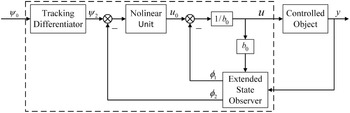
To sum up, the block diagram of ADRC based on ESO and TD for agent
 $i$
is shown in Fig. 3. It is composed of a first-order TD and a second-order ESO. By identifying system uncertainties and rejecting external disturbances, the ADRC controller can guarantee stability of the controlled system.
Structure diagram of active disturbance rejection control.

3. Control design based on backstepping and ADRC
In this section, a distributed formation control approach with prescribed performance and saturated input will be developed for MASs (1) by using backstepping control method and ADRC technique.
According to Assumption 3, the nonaffine nonlinear MASs (1) can be rewritten as
 \begin{equation} \left \{\begin{array}{l} \dot{x}_{i,1}(t)=F_{i,1}\left ( x_{i,1}(t),x_{i,2}(t) \right )+\xi _{i,1}x_{i,2}(t),\\ \quad \quad \quad \quad \quad \quad \quad \vdots \\ \dot{x}_{i,p}(t)=F_{i,p}\left ( \bar{x}_{i,p}(t),x_{i,p+1}(t)\right )+\xi _{i,p}x_{i,p+1}(t),\\ \quad \quad \quad \quad \quad \quad \quad \vdots \\ \dot{x}_{i,n}(t)=F_{i,n}\left ( \bar{x}_{i,n}(t),u_{i}\left ( t\right ) \right )+\xi _{i,n}u_{i}\left ( v_{i}(t) \right ),\\ y_{i}(t)=x_{i,1}(t), \end{array}\right. \end{equation}
where
 $x_{i,p}(t)$
(
 $p=1,2,\cdots,n-1$
and
 $i=1,2,\cdots,N$
) represents the measurable state of
 $i$
th follower.
 $u_{i}\left ( v_{i}(t) \right )$
denotes the saturation nonlinearity of the control input of
 $i$
th follower,
 $\xi _{i,p}\gt 0$
is the parameter to be selected, and
 $F_{i,p}\left ( \cdot \right )$
is the new uncertainty function, which are defined as
 \begin{equation} \begin{aligned} F_{i,p}\left (\bar{x}_{i,p},x_{i,p+1}\right )&=f_{i,p}\left ( \bar{x}_{i,p},x_{i,p+1}\right )-\xi _{i,p}x_{i,p+1},\quad \quad p=1,\cdots,n-1,\\[3pt] F_{i,n}\left ( \bar{x}_{i,n},u_{i}\right )&=f_{i,n}\left ( \bar{x}_{i,n},u_{i}\right )-\xi _{i,n}u_{i}. \end{aligned} \end{equation}
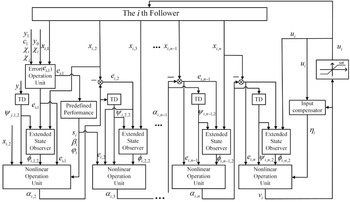
Figure 4 shows the process of designing controller for the
 $i$
th follower based on backstepping control method in this paper. By introducing ESO and input compensator, the formation tracking controller, in the presence of input saturation and system uncertainties, is capable of achieving the desired formation of the MAS.
Formation tracking controller for the
 $i$
th follower.

For system (19), a backstepping procedure with
 $n$
steps is applied to develop the controller
 $u_{i}$
based on the following coordinate transformation:
 \begin{equation} \begin{aligned} e_{i,1}&=e_{i},\\ e_{i,p}&=x_{i,p}-\alpha _{i,p},\quad \quad p=2,\cdots,n-1,\\ e_{i,n}&=x_{i,n}-\alpha _{i,n},\\ \tilde{e}_{i,n}&=e_{i,n}-\eta _{i}, \end{aligned} \end{equation}
where
 $\alpha _{i,p}$
and
 $\alpha _{i,n}$
are virtual control inputs designed by backstepping procedure, and
 $\eta _{i}$
is the compensation parameter, which is adapted to compensate for input saturation.
Step i,1: Based on Eq. (21), taking the derivative of
 $e_{i,1}$
, we have
 \begin{equation} \dot{e}_{i,1}=\sum _{j\in \mathcal N_{i}}^{}a_{ij}\dot{y}_{i}+c_{i}\dot{y}_{i}-\sum _{j\in \mathcal N_{i}}a_{ij}\dot{y}_{j}-c_{i}\dot{y}_{0}, \end{equation}
Note that
 $\dot{y}_{i}=x_{i,1}=F_{i,1}+\xi _{i,1}x_{i,2}$
, and Eq. (22) can be rewritten as
 \begin{equation} \dot{e}_{i,1}=\tilde{F}_{i,1}+\left (d_{i}+c_{i}\right )\xi _{i,1}x_{i,2}-c_{i}\dot{y}_{0}-\sum _{j\in \mathcal N_{i}}a_{ij}\dot{y}_{j}. \end{equation}
where
 $\tilde{F}_{i,1}=\left (d_{i}+c_{i}\right )F_{i,1}$
. As the iteration of backstepping proceeds, the interactive derivative operations will lead to differential explosion and thus
 $\dot{y}_{j}$
cannot be obtained directly. To overcome this difficulty, the following TD is designed to approximate the derivative of
 $y_{j}$
,
 \begin{align} \dot{\psi } _{j,1,1} & = \psi _{j,1,2},\nonumber\\ \dot{\psi } _{j,1,2} & =-\kappa ^{2}_{j,1}{\rm{sgn}}\left ( \psi _{j,1,1}-y_{j}\right )^{\zeta _{j,1}}\vert \psi _{j,1,1}-y_{j} \vert -\kappa _{j,1}\psi _{j,1,2}. \end{align}
where
 $\kappa _{j,1}$
and
 $\zeta _{j,1}\in \left ( 0,1 \right )$
are positive constant to design.
For unknown nonaffine nonlinear smooth function
 $\tilde{F}_{i,1}$
, the ESO is designed as
 \begin{equation} \begin{aligned} \varepsilon _{i,1}&=\phi _{i,1,1}-e _{i,1},\\ \dot{\phi } _{i,1,1}&=\phi _{i,1,2}-\varrho _{i,1,1}\varepsilon _{i,1}+\left ( d_{i}+c_{i} \right )\xi _{i,1}x_{i,2}+c_{i}\dot{y}_{0}-\sum _{j=1}^{N}a_{ij}\psi _{j,1,2}, \\ \dot{\phi } _{i,1,2}&=-\varrho _{i,1,2}\vert \varepsilon _{i,1} \vert ^{\delta _{i,1}}{\rm{sgn}}\left ( \varepsilon _{i,1}\right ), \end{aligned} \end{equation}
where
 $\varepsilon _{i,1}$
represents the estimation error of ESO, the parameters
 $\varrho _{i,1,1}$
,
 $\varrho _{i,1,2}$
are positive constant, and
 $\delta _{i,1}\in \left ( 0,1 \right )$
. From Eq. (25), we know that
 $\phi _{i,1,2}$
is the estimation value for
 $\tilde{F}_{i,1}\left ( \cdot \right )$
.
Then, the virtual control law
 $\alpha _{i,2}$
is designed as
 \begin{equation} \begin{aligned} \alpha _{i,2}=-\frac{1}{\xi _{i,1}\left (d_{i}+c_{i}\right )}\left( \rho _{i,1}s_{i}+\phi _{i,1,2}-\frac{\dot{\beta }_{i}}{\beta _{i}}e_{i}-c_{i}\dot{y}_{0}-\sum _{j\in \mathcal N_{i}}a_{ij}\psi _{j,1,2} \right), \end{aligned} \end{equation}
where
 $\xi _{i,1}$
and
 $\rho _{i,1}$
are positive parameters.
Consider a Lyapunov candidate function as
 \begin{equation} V_{i,1}=\frac{1}{2}s^{2}_{i}. \end{equation}
Differentiating
 $V_{i,1}$
with respect to time
 $t$
and using Eqs. (13), (22), and (27), we obtain
 \begin{equation} \begin{aligned} \dot{V}_{i,1}&=\varphi _{i}s_{i}\left( \tilde{F}_{i,1}+\xi _{i,1}\left (d_{i}+c_{i}\right )\left ( e_{i,2}+\alpha _{i,2} \right )-\frac{\dot{\beta }_{i}}{\beta _{i}} e_{i}-\sum _{j\in \mathcal N_{i}}a_{ij}\dot{y}_{j}-c_{i}\dot{y}_{0}\right). \end{aligned} \end{equation}
Substituting the virtual control law
 $\alpha _{i,2}$
into Eq. (28), we have
 \begin{equation} \begin{aligned} \dot{V}_{i,1}&=\varphi _{i}s_{i}\left( -\rho _{i,1}s_{i}+ \tilde{F}_{i,1}+\sum _{j\in \mathcal N_{i}}a_{ij}\left (\psi _{j,1,2} -\dot{y}_{j}\right )+\left (d_{i}+c_{i}\right )\xi _{i,1} e_{i,2} -\phi _{i,1,2}\right). \end{aligned} \end{equation}
Step i,2: Note that
 $e_{i,2}=x_{i,2}-\alpha _{i,2}$
. The derivative of
 $e_{i,2}$
along the systems (19) and (21) is
 \begin{equation} \begin{aligned} \dot{e}_{i,2}=F_{i,2}\left ( \bar{x}_{i,2},x_{i,3}\right )+\xi _{i,2}x_{i,3}-\dot{\alpha }_{i,2}. \end{aligned} \end{equation}
Similarly,
 $\dot{\alpha }_{i,2}$
estimated by TD is designed as follows:
 \begin{align} \dot{\psi } _{i,2,1} & = \psi _{i,2,2},\nonumber\\ \dot{\psi } _{i,2,2}&=-\kappa ^{2}_{i,2}{\rm{sgn}}\left ( \psi _{i,2,1}-\alpha _{i,2} \right )\vert \psi _{i,2,1}-\alpha _{i,2} \vert ^{\zeta _{i,2}}-\kappa _{i,2}\psi _{i,2,2}, \end{align}
where
 $\kappa _{i,2}\gt 0$
and
 $\zeta _{i,2}\in \left ( 0,1 \right )$
are the design parameters. The
 $\psi _{i,2,2}$
of TD’s state is used to track
 $\alpha _{i,2}$
.
For function
 $F_{i,2}\left ( \bar{x}_{i,2},x_{i,3}\right )$
, the following ESO is designed:
 \begin{equation} \begin{aligned} \varepsilon _{i,2}&=\phi _{i,2,1}-e _{i,2},\\ \dot{\phi } _{i,2,1}&=\phi _{i,2,2}-\varrho _{i,2,1}\varepsilon _{i,2}+\xi _{i,2}x_{i,3}-\psi _{i,2,2}, \\ \dot{\phi } _{i,2,2}&=-\varrho _{i,2,2}\vert \varepsilon _{i,2} \vert ^{\delta _{i,2}}{\rm{sgn}}\left ( \varepsilon _{i,2}\right ), \end{aligned} \end{equation}
where
 $\varrho _{i,2,1}$
,
 $\varrho _{i,2,2}$
, and
 $\delta _{i,2}\in \left ( 0,1 \right )$
are positive constant to design.
 $\phi _{i,2,2}$
is the estimation value of intermediate variable
 $F_{i,2}\left ( \bar{x}_{i,2},x_{i,3}\right )$
. Then, the virtual control law
 $\alpha _{i,3}$
is designed as
 \begin{equation} \begin{aligned} \alpha _{i,3}=-\frac{1}{\xi _{i,2}}\left( \phi _{i,2,2}+\rho _{i,2}e_{i,2}+\varphi _{i}s_{i}\left ( d_{i}+c_{i} \right ) \xi _{i,1}-\psi _{i,2,2}\right), \end{aligned} \end{equation}
where
 $\xi _{i,2}\gt 0$
and
 $\rho _{i,2}\gt 0$
are parameters to be designed.
Define the Lyapunov candidate function as
 \begin{equation} \begin{aligned} V_{i,2}=V_{i,1}+\frac{1}{2}e^{2}_{i,2}. \end{aligned} \end{equation}
Taking the time derivatives of
 $V_{i,2}$
along Eqs. (30) and (33) yields
 \begin{equation} \begin{aligned} \dot{V}_{i,2}&=\dot{V}_{i,1}+e_{i,2}\left( F_{i,2}-\rho _{i,2}e_{i,2}-\phi _{i,2,2}+ \xi _{i,2} e_{i,3}-\dot{\alpha }_{i,2} +\psi _{i,2,2}-\left (d_{i}+c_{i}\right )\xi _{i,1} \varphi _{i}s_{i} \right). \end{aligned} \end{equation}
Step i,p,
 $\left ( 3\leq p\leq n-1 \right )$
: Similarly, the derivative of
 $e_{i,p}$
along systems (19) and (21) is
 \begin{equation} \begin{aligned} \dot{e}_{i,p}=F_{i,p}\left ( \bar{x}_{i,p},x_{i,p+1}\right )+\xi _{i,p}x_{i,p+1}-\dot{\alpha }_{i,p}. \end{aligned} \end{equation}
TD is designed as follows:
 \begin{equation} \begin{aligned} \dot{\psi } _{i,p,1}&=\psi _{i,p,2},\\ \dot{\psi } _{i,p,2}&=-\kappa ^{2}_{i,p}{\rm{sgn}}\left ( \psi _{i,p,1}-\alpha _{i,p} \right )\vert \psi _{i,p,1}-\alpha _{i,p} \vert ^{\zeta _{i,p}}-\kappa _{i,p}\psi _{i,p,2}, \end{aligned} \end{equation}
where
 $\kappa _{i,p}\gt 0$
and
 $\zeta _{i,p}\in \left ( 0,1 \right )$
. The
 $\dot{\psi } _{i,p,2}$
is for the estimation of
 $\dot{\alpha }_{i,p}$
.
The nonaffine function
 $F_{i,p}\left ( \bar{x}_{i,p},x_{i,p+1}\right )$
can be estimated by ESO as follows:
 \begin{equation} \begin{aligned} \varepsilon _{i,p} &=\phi _{i,p,1}-e _{i,p},\\ \dot{\phi } _{i,p,1}&=\phi _{i,p,2}-\varrho _{i,p,1}\varepsilon _{i,p}+\xi _{i,p}x_{i,p+1}-\psi _{i,p,2},\\ \dot{\phi } _{i,p,2}&=-\varrho _{i,p,2}\vert \varepsilon _{i,p} \vert ^{\delta _{i,p}}{\rm{sgn}}\left ( \varepsilon _{i,p}\right ), \end{aligned} \end{equation}
where
 $\varrho _{i,p,1}$
,
 $\varrho _{i,p,2}$
, and
 $\delta _{i,p}\in \left ( 0,1 \right )$
are positive constant.
 $\phi _{i,p,2}$
is the estimation value for
 $F_{i,p}\left ( \bar{x}_{i,p},x_{i,p+1}\right )$
. Based on Eqs. (35), (37), and (38), the virtual control law
 $\alpha _{i,p+1}$
is taken as
 \begin{equation} \begin{aligned} \alpha _{i,p+1}&=-\frac{1}{\xi _{i,p}}\left(\phi _{i,p,2}+\rho _{i,p}e_{i,p}+\xi _{i,p-1} e_{i,p-1}-\psi _{i,p,2}\right), \end{aligned} \end{equation}
where
 $\rho _{i,p}\gt 0$
and
 $\xi _{i,p}\gt 0$
are design parameters.
Similarly, consider a Lyapunov candidate function
 \begin{equation} \begin{aligned} V_{i,p}=V_{i,p-1}+\frac{1}{2}e^{2}_{i,p}. \end{aligned} \end{equation}
Substituting Eqs. (36) and (39) into
 $\dot{V}_{i,p}$
yields
 \begin{equation} \begin{aligned} \dot{V}_{i,p}= \dot{V}_{i,p-1}+e_{i,p}\left( F_{i,p}-\phi _{i,p,2}+ \xi _{i,p} e_{i,p+1}-\dot{\alpha }_{i,p}-\rho _{i,p}e_{i,p} -\xi _{i,p-1} e_{i,p-1}+\psi _{i,p,2}\right). \end{aligned} \end{equation}
Step i,n: In this step, an actual controller will be constructed. Since the control input of the MASs is limited by saturation, there exists a deviation between the designed control input and the actual control input; an input auxiliary system (42) is introduced to compensate for the deviation,
 \begin{equation} \begin{aligned} \dot{\eta }_{i}=-\varpi _{i}\tanh \left ( \eta _{i}\right )+\xi _{i,n}\left ( u_{i}-v_{i} \right ), i=1,2,\cdots,N, \end{aligned} \end{equation}
where
 $\varpi _{i}\gt 0$
and
 $\xi _{i,n}\gt 0$
are parameters to be designed,
 $\eta _{i}$
is the compensation parameter, and
 $\tanh \left ( \cdot \right )\in \left ( -1,1 \right )$
is the hyperbolic tangent function.
We define the state tracking error
 ${e}_{i,n}=x_{i,n}-\xi _{i,n}{u}_{i}$
and
 $\tilde{e}_{i,n}=e_{i,n}-\eta _{i}$
, then the derivative of
 $\tilde{e}_{i,n}$
can be expressed as
 \begin{equation} \begin{aligned} \dot{\tilde{e}}_{i,n}=F_{i,n}-\alpha _{i,n}+\varpi _{i}\tanh \left ( \eta _{i}\right )+\xi _{i,n}v_{i}. \end{aligned} \end{equation}
TD is designed as
 \begin{equation} \begin{aligned} \dot{\psi } _{i,n,1}&=\psi _{i,n,2},\\ \dot{\psi } _{i,n,2}&=-\kappa ^{2}_{i,n}{\rm{sgn}}\left ( \psi _{i,n,1}-\alpha _{i,n} \right )\vert \psi _{i,n,1}-\alpha _{i,n} \vert ^{\zeta _{i,n}}-\kappa _{i,n}\psi _{i,n,2}, \end{aligned} \end{equation}
where
 $\kappa _{i,n}$
and
 $\zeta _{i,n}\in \left ( 0,1 \right )$
are parameters to be determined.
 $\dot{\psi } _{i,n,2}$
is used to estimate
 $\dot{\alpha }_{i,n}$
.
Similar to the previous steps, the ESO in this final step is designed as
 \begin{equation} \begin{aligned} \varepsilon _{i,n} &=\phi _{i,n,1}-e _{i,n},\\ \dot{\phi }_{i,n,1}&=\phi _{i,n,2}-\varrho _{i,n,1}\varepsilon _{i,n}+\xi _{i,n}u_{i}-\psi _{i,n,2},\\ \dot{\phi } _{i,n,2}&=-\varrho _{i,n,2}\vert \varepsilon _{i,n} \vert ^{\delta _{i,n}}{\rm{sgn}}\left ( \varepsilon _{i,n}\right ), \end{aligned} \end{equation}
where
 $\varrho _{i,n,1}$
,
 $\varrho _{i,n,2}$
, and
 $\delta _{i,n}\in \left ( 0,1 \right )$
are positive constant.
 $\phi _{i,n,2}$
is the estimation value for
 $F_{i,n}\left ( \bar{x}_{i,n},u_{i}\right )$
.
Finally, the controller of
 $i$
th follower be designed as
 \begin{equation} \begin{aligned} v_{i}&=-\frac{1}{\xi _{i,n}}\left(\rho _{i,n}\tilde{e}_{i,n}+\xi _{i,n-1}e_{i,n-1}+\phi _{i,n,2}-\psi _{i,n,2}+\varpi _{i}\tanh \left ( \eta _{i}\right )\right). \end{aligned} \end{equation}
where
 $\rho _{i,n}$
is the parameter to be designed. In particular,
 $v_{i}$
is a controller designed for agent
 $i$
based on backstepping method.
Consider the Lyapunov candidate function as
 \begin{equation} \begin{aligned} V_{i,n}=V_{i,n-1}+\frac{1}{2} \tilde{e}^{2}_{i,n}. \end{aligned} \end{equation}
Substituting Eqs. (46) into (2), the saturated control input
 $u_{i}(v_i(t)\!)$
of the MASs can be written as
 \begin{equation} u_{i}\left ( v_{i} \right )=\left \{\begin{array}{l} -u_{\text{max}}, \quad \quad \quad \quad \quad \quad \quad v_{i}\lt -u_{\text{max}},\\[3pt] -\dfrac{1}{\xi _{i,n}}\Big (\rho _{i,n}\tilde{e}_{i,n}+\xi _{i,n-1}e_{i,n-1}+\phi _{i,n,2}-\psi _{i,n,2}+\varpi _{i}\tanh \left ( \eta _{i}\right )\Big ),\vert v_{i}\vert \leqslant u_{\text{max}}, \\[3pt] u_{\text{max}},\quad \quad \quad \quad \quad \quad \quad \quad v_{i}\gt u_{\text{max}}. \end{array}\right. \end{equation}
By Eqs. (43) and (48), the derivative of the Lyapunov candidate function (47) is written as
 \begin{equation} \begin{aligned} \dot{V}_{i,n}&=\dot{V}_{i,n-1}+\tilde{e}_{i,n}\left ( F_{i,n}+\xi _{i,n}u_{i}-\dot{\alpha }_{i,n}- \dot{\eta _{i}} \right )\\ &=\dot{V}_{i,n-1}+\tilde{e}_{i,n}\left({-}\rho _{i,n}\tilde{e}_{i,n}+F_{i,n}-\xi _{i,n-1}e _{i,n-1}+\psi _{i,n,2}-\phi _{i,n,2}-\dot{\alpha }_{i,n}\right). \end{aligned} \end{equation}
The pseudo code of a finite-time ADRC formation controller with prescribed performance and saturated input designed based on backstepping is described in Algorithm 1.

4. Stability analysis of the MAS
The following theorem presents the stability result of the ADRC tracking controller for nonaffine nonlinearity MASs with prescribed performance.
Theorem 4.1. Consider a class of nonaffine nonlinear MASs (1) subject to input saturation. Let the Assumptions 1–3 be satisfied. Then the controller (46) can ensure that the tracking errors of the MAS converge to an arbitrary small neighborhood of the origin, and simultaneously the prescribed performance is guaranteed.
Proof.
We will use Lyapunov stability theorem to prove the stability of nonaffine nonlinear MASs (1). For the analysis of stability, choose the Lyapunov candidate function
 $V$
as
 \begin{equation} \begin{aligned} V=\sum _{i=1}^{N} V_{i,n}, \end{aligned} \end{equation}
From Eqs. (29), (35), (41), and (49) and with the help of Young’s inequality, one has
 \begin{equation} \begin{aligned} \dot{V}_{i,1}\leq & -\left ( \varphi _{i}\rho _{i,1}-\frac{1+d_{i}}{2} \right )s_{i}^{2}-\sum _{j=1}^{N}\frac{a_{ij}}{2}\rho ^{2}_{i,1}\left ( \psi _{j,1,2} -\dot{y}_{j}\right )^{2}+\frac{\rho ^{2}_{i,1}}{2}\left (\tilde{F}_{i,1}-\phi _{i,1,2} \right )^{2}\\ &+\varphi _{i}\left (c_{i}+ d_{i} \right )\xi _{i,1}s_{i}e_{i,2}, \end{aligned} \end{equation}
 \begin{equation} \begin{aligned} \dot{V}_{i,2}\leq & -\left ( \varphi _{i}\rho _{i,1}-\frac{1+d_{i}}{2} \right )s_{i}^{2}+\frac{1}{2}\left ( F_{i,2}-\phi _{i,2,2} \right )^{2}-\sum _{j=1}^{N}\frac{a_{ij}}{2}\rho ^{2}_{i,1}\left (\psi _{j,1,2} -\dot{y}_{j}\right )^{2}\\ &+\rho _{i,2}e_{i,2}e_{i,3}+\frac{\rho ^{2}_{i,1}}{2}\left (\tilde{F}_{i,1}-\phi _{i,1,2} \right )^{2}+\frac{1}{2}\left ( \psi _{i,2,2}-\dot{\alpha } _{i,2} \right )^{2}\\ &-\left ( \xi _{i,2}-1\right )e^{2}_{i,2}, \end{aligned} \end{equation}
 \begin{equation} \begin{aligned} \dot{V}_{i,p}\leq &-\left ( \varphi _{i}\rho _{i,1}-\frac{1+d_{i}}{2} \right )s_{i}^{2}+\frac{\rho ^{2}_{i,1}}{2}\left (\tilde{F}_{i,1}-\phi _{i,1,2} \right )^{2}-\sum _{j=1}^{N}\frac{a_{ij}}{2}\rho ^{2}_{i,1}\left ( \psi _{j,1,2} -\dot{y}_{j}\right )^{2}\\ &-\sum _{j=2}^{p}\left[\left ( \rho _{i,j}-1\right )e^{2}_{i,j}-\frac{\rho ^{2}_{i,j}}{2}\left ( \psi _{i,j,2}-\dot{\alpha } _{i,j} \right )^{2}-\frac{1}{2}\left ( F_{i,j}-\phi _{i,j,2} \right )^{2}\right]\\ &+\xi _{i,p}e_{i,p}e_{i,p+1},\qquad \qquad \qquad \qquad \qquad \qquad \qquad \qquad p=3,\cdots,n-1, \end{aligned} \end{equation}
 \begin{equation} \begin{aligned} \dot{V}_{i,n}\leq &-\left ( \varphi _{i}\rho _{i,1}-\frac{1+d_{i}}{2} \right )s_{i}^{2}+\frac{1}{2}\left (\tilde{F}_{i,1}-\phi _{i,1,2} \right )^{2}+\sum _{j=2}^{N}\frac{1}{2}\left ( \psi _{i,j,2}-\dot{\alpha }_{i,j} \right )^{2}\\ &-\left (\rho _{i,n-1}-\frac{3}{2}\right )e^{2}_{i,n-1}+\frac{1}{2}\xi _{i,n-1}^{2}\eta _{i}^{2}-\sum _{j=1}^{N}\frac{a_{ij}}{2}\rho ^{2}_{i,1}\left ( \psi _{j,1,2} -\dot{y}_{j}\right )^{2}\\ &-\left ( \rho _{i,n}-1 \right )\tilde{e}^{2}_{i,n}-\sum _{j=2}^{n-2}\left (\rho _{i,j}-1\right )e^{2}_{i,j}+\sum _{j=2}^{n}\frac{1}{2}\left ( F_{i,j}-\phi _{i,j,2} \right )^{2}. \end{aligned} \end{equation}
To prove the boundedness of auxiliary system parameters
 $\eta _{i}$
, we consider a Lyapunov candidate function
 \begin{equation} \begin{aligned} V_{\eta }=\sum _{i=1}^{N}\frac{1}{2}\eta ^{2}_{i}. \end{aligned} \end{equation}
Taking the derivative of
 $V_{\eta }$
, we have
 \begin{equation} \begin{aligned} \dot{V}_{\eta }&=\sum _{i=1}^{N} \eta _{i}\dot{\eta }_{i}\\ &=-\sum _{i=1}^{N} \eta _{i}\left ( \varpi _{i}tanh\left ( \eta _{i}\right )-\xi _{i,n}\left ( u_{i}-v_{i} \right )\right )\\ \leq &-\sum _{i=1}^{N}\vert \eta _{i}\vert \left ( \varpi _{i}tanh\left (\eta _{i}\right )-\xi _{i,n}\vert u_{i}-v_{i} \vert \right ), \end{aligned} \end{equation}
If
 $\varpi _{i}\geq \varpi _{i}\tanh \left (\eta _{i} \right )\geq \xi _{i,n}\vert u_{i}-v_{i} \vert$
, then
 $\dot{V}_{\eta }\leq 0$
. Therefore,
 $\eta _{i}$
is bounded.
The state of ESO (
 $\phi _{i,1,2}$
and
 $\phi _{i,j,2}$
) is used to estimate the unknown nonlinear functions
 $\bar{F}_{i,1}\left ( \cdot \right )$
and
 $F_{i,j}\left ( \cdot \right )$
,
 $i=1,2,\cdots N$
and
 $j=2,3,\cdots n$
. According to Eq. (16), the estimate errors of the ESO can be sufficiently small by choosing the right parameters
 $\varrho _{i,j,1}$
,
 $\varrho _{i,j,2}$
, and
 $\delta _{i,j}$
. Similarly, the estimate errors of the TD,
 $\psi _{j,1,2}-\dot{y}$
and
 $\psi _{i,j,2}-\dot{\alpha }_{i,j}$
, can be enough small by selecting appropriate parameters
 $\kappa _{i}$
and
 $\zeta _{i,j}$
,
 $i=1,2,\cdots,N$
,
 $j=1,2,\cdots,n$
. Denote the entire errors from the ESO and TD as a positive parameter
 $\theta$
 \begin{equation} \begin{aligned} \theta &=\underset{t\in (0,+\infty )}{\sup } \Bigg \{ \sum _{i=1}^{N}\rho _{i,1}\vert \tilde{F}_{i,1}-\phi _{i,1,2} \vert +\sum _{i=1}^{N}\sum _{j=2}^{n}\Big ( \vert F_{i,j}-\phi _{i,j,2}\vert + a_{ij}\vert \psi _{i,j,2} -\dot{\alpha }_{i,j} \vert \Big ) \\ &+\sum _{i=1}^{N}\frac{1}{2}\xi _{i,n-1}^{2}\eta _{i}^{2}+\sum _{i=1}^{N}\sum _{j=1}^{N}a_{ij}\rho _{i,1}\vert \psi _{j,1,2} -\dot{y}_{j} \vert \Bigg \}. \end{aligned} \end{equation}
It follows from inequalities (51) to (54) that
 \begin{equation} \begin{aligned} \dot{V}\leq &-\sum _{i=1}^{N}\sum _{j=2}^{n-2}\left ( \rho _{i,j} -1\right )e^{2}_{i,j}-\sum _{i=1}^{N}\left ( \rho _{i,n}-1 \right )\tilde{e}^{2}_{i,n} \sum _{i=1}^{N}\left ( \rho _{i,n-1} -\frac{3}{2}\right )e^{2}_{i,n-1}\\ &-\sum _{i=1}^{N} \left ( \varphi _{i}\rho _{i,1}-\frac{1+d_{i}}{2} \right )s_{i}^{2}+\frac{\theta ^{2}}{2}\\ \leq &-\lambda V+\frac{\theta ^{2}}{2}, \end{aligned} \end{equation}
where
 $\lambda =\min \left [\varphi _{i}\rho _{i,1}-\frac{1+d_{i}}{2},\rho _{i,j} -1, \rho _{i,n-1}-\frac{3}{2}\right ]$
,
 $i=1,2,\cdots,N$
, and
 $j=2,3,\cdots,n-2,n$
. Integrating both sides of the inequality (50) yields
 \begin{equation} \begin{aligned} V\leq \frac{\theta ^{2}}{2\lambda }+\left ( V\left ( 0 \right )-\frac{\theta ^{2}}{2\lambda }\right )e^{-\lambda t}. \end{aligned} \end{equation}
From Eqs. (50) and (59), it can be seen that
 $V(0)$
is bounded and
 $V$
can asymptotically converge to a neighborhood of radius
 $\theta ^{2}/2\lambda$
as
 $t\rightarrow \infty$
. The inequality in Eq. (48) implies that transformation error
 $ s_{i}$
and coordinate transformation
 $e_{i,p}$
,
 $\tilde{e}_{i,n}$
can satisfy
 \begin{equation} \begin{aligned} \vert s_{i}\vert &\leq \sqrt{2\theta ^{2}/\lambda +\left ( 2V\left ( 0 \right )-2\theta ^{2}/\lambda \right )\exp \left ( -\lambda t \right )}\\ \vert e_{i,p}\vert &\leq \sqrt{2\theta ^{2}/\lambda +\left ( 2V\left ( 0 \right )-2\theta ^{2}/\lambda \right )\exp \left ( -\lambda t \right )},\\ \vert \tilde{e}_{i,n}\vert & \leq \sqrt{2\theta ^{2}/\lambda +\left ( 2V\left ( 0 \right )-2\theta ^{2}/\lambda \right )\exp \left ( -\lambda t \right )},\\ \end{aligned} \end{equation}
which implies that
 $s_{i}$
,
 $e_{i,p}$
 $ \left ( p=2,\cdots,n \right )$
and
 $\tilde{e}_{i,n}$
converge exponentially to a small neighborhood around zero in a finite time
 $T_{i}$
by choosing small enough
 $\lambda$
.
Due to the candidate transformation function defined in Eqs. (11) and (12), the neighborhood error
 $e_{i}$
satisfies
 \begin{equation} \begin{aligned} \vert e_{i}\vert & \leq \vert \beta _{i}\vert \frac{\exp \left ( 2\sqrt{\frac{\theta ^{2}}{2\lambda }+\left ( V\left ( 0 \right )-\frac{\theta ^{2}}{2\lambda }\right )e^{-\lambda t}}\right )-1}{\exp \left ( 2\sqrt{\frac{\theta ^{2}}{2\lambda }+\left ( V\left ( 0 \right )-\frac{\theta ^{2}}{2\lambda }\right )e^{-\lambda t}}\right )+1}\\ &\leq \vert \beta _{i}\vert, i=1,2,\cdots,n, \end{aligned} \end{equation}
where
 $\beta _{i}$
are defined by Eq. (7).
The transient and steady states of the formation tracking error
 $e_{i}(t)$
evolve strictly within the bounds generated by the FTPF
 $\beta _{i}(t)$
. In addition, in order for the formation tracking errors to converge to a small neighborhood around the origin, the design parameters of ESO, TD, and controllers should be selected appropriately. It is shown that the proposed controllers (48) with input saturation can ensure that, under prescribed performance, all formation tracking errors can asymptotically converge to predefined regions in a prescribed time and therefore all followers can converge to a small neighborhood of the trajectory of the leaders within a finite time
 $T_{i}.$
Remark 4. Through the analysis of Eqs. (57), (58), and (61), we can see that the ADRC technology can be used to track and estimate the uncertain nonaffine nonlinear term in the MASs, overcome the difficulty that the virtual control signals can not be quickly calculated in the backstepping control, and the follower agents in the MASs can accomplish the control targets. Therefore, ADRC technology improves the suppression ability and dynamic response speed of nonaffine nonlinear system to interference, and reduces the oscillation frequency of the system so that the system can quickly return to the original stable states after being affected by internal and external uncertainties, and enhances the resilience performance of the system.
5. Simulation
To verify the effectiveness of the proposed control method, numerical simulation results are provided. Consider a group of multi-agent networks composed of five followers and one leader. Figure 5 shows the network communication topology among the leader and the followers. According to the network communication topology, it is obvious that Assumption 1 is satisfied.
The communication topology of the MASs.

These robotic agents are assumed to be linked via an undirected communication graph in Fig. 5. The Laplacian matrix for the graph is computed as
 \begin{equation} L=\begin{bmatrix} 2& \quad 0 & \quad -1 & \quad 0 & \quad -1 \\[2pt] 0& \quad 1 & \quad 0 & \quad -1 & \quad 0 \\[2pt] -1& \quad 0 & \quad 3& \quad -1& \quad -1\\[2pt] 0 & \quad -1 & \quad -1 & \quad 2 & \quad 0 \\[2pt] -1& \quad 0 & \quad -1 & \quad 0 & \quad 2 \end{bmatrix} \end{equation}
Based on the network communication topology (Fig. 5), we know that follower agents 1 and 2 can communicate with leaders, so matrix
 $C$
can be written as
 $C=\rm{diag}\left \{1,1,0,0,0 \right \}$
.
The dynamics of the follower agent is described in Eq. (63)
 \begin{equation} \begin{aligned} \left \{\begin{array}{l} \dot{x}_{i,1}=f_{i,1}(x_{i,1},x_{i,2}),\\ \dot{x}_{i,2}=f_{i,2}\left ( \bar{x}_{i,2},u_{i}\left ( v_{i} \right ) \right ),\\ y_{i}=x_{i,1}, \end{array}\right. \end{aligned} \end{equation}
where
 $i=1,\cdots, 5$
, and the nonaffine nonlinear functions
 $f_{i,1}\left ( x_{i,1},x_{i,2} \right )$
and
 $f_{i,2}\left ( \bar{x}_{i,2},u_{i}\left ( v_{i} \right )\right )$
are represented as
 \begin{equation} \begin{aligned} f_{i,1}\left (x_{i,1},x_{i,2}\right )&=3x_{i,2}+\cos \left (x_{i,1}x_{i,2}\right ),\\ f_{i,2}\left ( \bar{x}_{i,2},u_{i}\left ( v_{i} \right )\right )&=1.6u_{i}\left ( v_{i} \right ) +\sin \left ( x_{i,1} x_{i,2} \right )+\cos \left ( u_{i}\left ( v_{i} \right ) \right ), \end{aligned} \end{equation}
and the controller with saturated input is designed as
 \begin{equation} u_{i}\left ( v_{i}(t) \right )={\rm{sat}}(v_{i}(t))=\left \{\begin{matrix} -30, & v_{i}(t)\lt -30,\\ v_{i}(t),& \vert v_{i}(t)\vert \leqslant 30, \\ 30,& v_{i}(t) \gt 30, \end{matrix}\right. \end{equation}
The leader’s dynamic is described by
 \begin{equation} \begin{aligned} \left \{\begin{array}{l} \dot{x}_{0,1}(t)=0.7,\\ \dot{x}_{0,2}(t)=0.15x_{0,1}(t). \end{array}\right. \end{aligned} \end{equation}
In the nonaffine nonlinear MASs, the initial positions of the agents are given by
 $x_{0}\left ( 0 \right )=\left [ 0;\, 0\right ]$
,
 $x_{1,1}\left ( 0 \right )=\left [ 2;\, 1\right ]$
,
 $x_{2,1}\left ( 0 \right )=\left [1 ;\,2 \right ]$
,
 $x_{3, 1}\left ( 0 \right )=\left [ 0;\,1.5 \right ]$
,
 $x_{4,1}\left ( 0 \right )=\left [ -0.3 ;\,0.4\right ]$
,
 $x_{5,1}\left ( 0 \right )=\left [ 1 ;\,0\right ]$
, and
 $x_{i,2}\left ( 0 \right )=\left [0;\,0\right ]$
, where
 $i=1,\cdots, 5$
. The prescribed performance function is given by
 \begin{equation} \begin{aligned} \beta _{i}(t)=\left \{\begin{matrix} 4\left ( 1-0.02 \right )\left ( 1-\dfrac{t}{5} \right )^{5} +0.08,& 0\leq t\leq 5,\\[5pt] 0.08,& t\gt 5, \end{matrix}\right. \end{aligned} \end{equation}
The parameters of the prescribed performance function are set to
 $T_{i}=5$
,
 $b_{i}=0.02$
,
 $m=5$
, and
 $\gamma _{i}=4$
.
Based on the PPC and ADRC techniques, the proposed control law can allow the MASs to realize a circle formation, in which the leader is located at the center of a circle and all the followers are evenly distributed on the circle. The relative position between the
 $i$
th follower and the leader in the desired formation is designed as
 \begin{equation} \begin{aligned} \chi _{i}=\left [ \cos \left (\frac{2\left ( i-1 \right ) \pi }{5} \right );\,\sin \left (\frac{2\left ( i-1 \right ) \pi }{5} \right ) \right ]. \end{aligned} \end{equation}
The design parameters in our controllers are chosen as:
 $\varrho _{i,1,1}=5$
,
 $\varrho _{i,1,2}=50$
,
 $\kappa _{j,1}=2$
,
 $\zeta _{i,1}=0.8$
,
 $\delta _{i,1}=0.9$
,
 $\kappa _{i,2}=2$
,
 $\zeta _{i,2}=0.8$
,
 $\varrho _{i,2,1}=20$
,
 $\varrho _{i,2,2}=150$
,
 $\delta _{i,2}=0.9$
,
 $\varpi _{i}=30$
,
 $\xi _{i,1}=1$
,
 $\xi _{i,2}=4$
,
 $\rho _{i,1}=30$
, and
 $\rho _{i,2}=40$
, where
 $i,j=1,\cdots, 5$
. The initial values of ESOs and TDs are all zero.
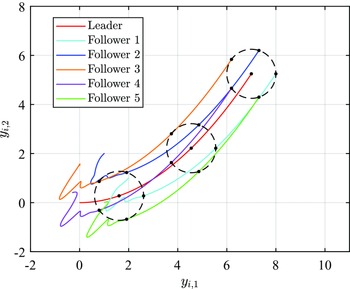
Simulation results for the distributed ADRC controller (48) are presented in Figs. 6–8. Figure 6 plots the trajectory and formation process of the MASs and the initial and final positions of all agents. It can be clearly seen that all agents can follow the trajectory of the leader and eventually form the predetermined formation and maintain the formation at the velocity of the leader.
Trajectory of the leader and followers.

Control input of the followers in X-direction.

Control input of the followers in Y-direction.

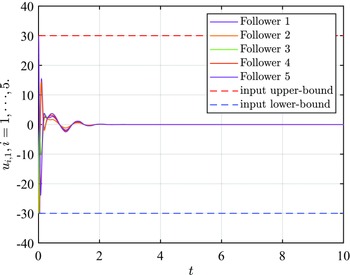
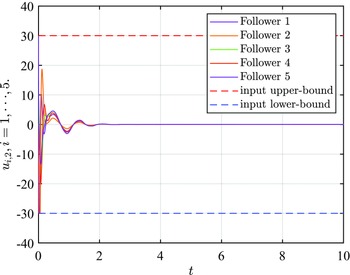
The saturated input signals for each agent in the X and Y directions are shown in Figs. 7 and 8. During the tracking control process, the control signals are always maintained between
 $u_{\text{max}}$
and
 $-u_{\text{max}}$
. It is interesting to see that no larger control effort is required from our control approach compared with that from ref. [Reference Tee, Ge and Tay48]. Figures 9 and 10 show the observation effects of the ESO designed for Node 1. It can be seen that, in a very short time, the output of the ESO
 $\phi _{1,1,2}$
and
 $\phi _{1,2,2}$
can accurately estimate the nonaffine nonlinearity function
 $\tilde{F}_{1,1,1}$
and
 $F_{1,2,1}$
and provide internal compensation for the unknown nonlinear term of the closed-loop system. The curves show that the ESO designed in this paper can deal with external disturbance and nonaffine nonlinearity well.
The performance of the ESO in the first step.

The performance of the ESO in the second step.

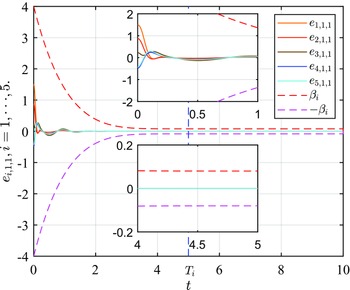
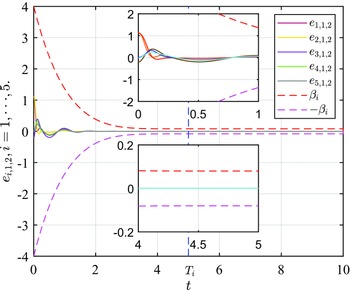
The curves of the error and the predefine performance function are plotted in Figs. 11 and 12. In the figures, the red and pink dashed lines represent the trajectories of the prescribed performance function, and the blue dashed lines represent the steady state of Eq. (7). It can be seen that with the controller (48) proposed in this paper, the formation tracking errors
 $e_{i}$
of agents can quickly converge in a finite time and are bounded by the decaying function, which is predefined before the control design. Therefore, the prescribed performance can be guaranteed by the proposed control scheme. It is worth noting that the formation errors are preserved within the prescribed performance bounds for all cases and that our proposed asymptotically formation tracking control scheme has higher tracking precision than the uniformly ultimately bounded formation tracking control scheme in ref. [Reference Tee, Ge and Tay48].
Formation tracking error in X-direction.

Formation tracking error in Y-direction.

To evaluate the transient response to the sensitivity to disturbance and performance of controllers, we introduce integral squared errors (ISE) defined by Eq. (69), which is used to verify the formation tracking accuracy of the system under PPC. Table I shows the settling time, overshoot, control input, ISE, and tracking effect of the different control algorithms under the condition of uncertainty interference.
 \begin{equation} \begin{aligned} \text{ISE}=\int _{t_{1}}^{t_{2}} e_{x}^{2} ( t )+e_{y}^{2} ( t )dt \end{aligned} \end{equation}
where
 $e_x,e_y$
are the tracking errors for MASs in
 $x$
and
 $y$
coordinates, respectively.
Performance comparisons of various formation control algorithms.

By analyzing the results of each control method in formation tracking performance in Table I, it can be seen that the ADRC designed in this paper with predefined performance and saturated input can not only make the nonaffine nonlinear MASs form the reference formation successfully but also track the lead agent trajectory in any initial states within a finite time. Moreover, it performs better than other control algorithms in adjusting time, overshoot, control input, ISE, and tracking uncertain interference. At the same time, compared with ref. [Reference Yang, Si, Yue and Tian3], the controller designed in this paper sacrifices the estimation time of uncertain interference and greatly reduces the control input and cost of the system. In general, the controller designed in this paper shows very good performance in terms of response speed, convergence speed, and control input for MASs formation tracking when the interference is determined.
Remark 5. This paper primarily consists in theoretically providing insight into the formation control algorithm for nonaffine nonlinear MASs and disciplinarily analyzing the stability of the MASs. On the other hand, the similar dynamic model for MASs in this paper is also used in ref. [Reference Freudenthaler and Meurer50], in which the backstepping method is also adopted to analyze and verify the system. Therefore, the validation of our developed control algorithm can as well be verified by the use of the MASs constructed in ref. [Reference Freudenthaler and Meurer50]. The paper ref. [Reference Dong, Zhou and Ren51] uses four quadrotor UAS to build a time-varying formation tracking experiment platform and complete formation tracking experiment. The main hardware structure of time-varying formation tracking experimental platform consists of one ground control station, four quadrotors with flight control system (FCS), global positioning system (GPS), ultrasonic range finder, and Zigbee module. Three one-axis gyroscopes, a three-axis magnetometer, and a three-axis accelerometer are employed by the FCS to estimate the attitude and acceleration of each quadrotor. The position and velocity in the horizontal plane (XY plane) of each quadrotor are measured by the GPS module. An ultrasonic range finder is used to measure the height of each quadrotor for the cases flying near and far from the ground, respectively.
6. Conclusion
In this paper, a finite-time ADRC formation control strategy is proposed for uncertain nonaffine nonlinear MASs with input saturation and prescribed performance. A novel finite-time formation control of the MAS is designed by using backstepping method and ADRC technique, and an auxiliary dynamic compensator is developed to compensate for the effect of input saturation. The analysis and synthesis of the controller are provided by using Lyapunov stability theorem, which implies that the formation control problem with prescribed performance and input saturation can successfully be solved by the proposed control algorithm. Finally, after analyzing the simulation results, it can be concluded that the formation controller designed in this paper has almost the same time to reach a stable state as the adaptive method. However, compared to the adaptive method, this paper’s controller only has 11.6%, 6%, and 4.3% of the maximum overshoot, control input, and ISE, respectively, which saves control costs and has more stable performance. Similarly, in terms of the ISE and the tracking time of the nonaffine nonlinearity uncertainty of the agent, the controller designed in this paper has almost the same performance as the virtual structure method. However, the time to form the expected formation and the maximum overshoot of this paper’s controller increased by 54.3% and 68.9%, respectively, compared to the virtual structure method, which effectively demonstrates that the controller designed in this paper has better fast adjustment performance. In summary, the proposed controller can enable the MAS to achieve the desired performance requirements and offset the system uncertainties and the adverse effect of input saturation.
Author’s contribution
All authors contributed to the study’s conception and design. Material preparation, data collection, and analysis were performed by Zhixiong Zhang, Kaijun Yang, and Lingcong Ouyang. The first draft of this paper was written by Zhixiong Zhang and all authors commented on previous versions of the manuscript. All authors read and approved the final manuscript.
Financial support
The authors declare that no funds, grants, or other support were received during the preparation of this manuscript.
Competing interests
The authors declare that they have no Competing interests.
Ethical approval
The submitted work is original and not has been published elsewhere in any form or language.