Introduction
In 5G new radio millimeter wave frequency bands (5G NR FR2), there are several measurement applications requiring multiple angles of arrival (AoA) for device characterization: MIMO throughput testing (a multiple-input multiple-output technique used in both 4G and 5G to increase data speeds) with two or more spatial layers, RF (radio frequency) fading with multiple impinging waves, simultaneous in-band and spurious emissions threshold monitoring, and radio resource management (RRM) [1]. One common example of an RRM scenario is when the 5G wireless handset monitors the power levels from different base-stations and performs a handover to another base-station when the signal from the first one goes below a given threshold. It is assumed that these base-stations are located in the far-field (FF) of the wireless handset.
The FF as calculated by the Fraunhofer formula of R FF = 2D 2/λ where D is the quiet zone (QZ) or device under test (DUT) size and λ is the wavelength is roughly 24 m at 40 GHz for a typical wireless handset with a maximum diagonal of 30 cm. Although millimeter wave antenna array modules have apertures of 1–2 cm, it is likely that several modules are placed at different locations inside the wireless handset that can be activated simultaneously, therefore requiring a “blackbox” approach where the minimum quiet zone (QZ) is bounded by the maximum DUT size. Measurement techniques for RRM and RF fading include cabled measurements for wireless communications systems at frequencies below 8 GHz and wireless over-the-air (OTA) in the far-field of the DUT at frequencies above 24 GHz. While cabled measurements are faster and less complex, they are not as representative of real-world conditions as wireless OTA measurements.
In order to simulate multiple AoA (or base-stations) in the FF of the DUT, probes (transmitting antennas) are typically placed at a distance corresponding to a desired QZ size and/or maximum allowed measurement uncertainty (MU) [2]. In the millimeter wave frequency range, this approach leads to large chambers with higher free-space path loss. An alternative approach uses a multiple compact antenna test range (multi-reflector CATR) to reduce the required RRM measurement setup footprint, while maintaining low MU inside a defined QZ encompassing the entire wireless handset [Reference Rowell, Cardalda-Garcia and Derat3]. Current multiple reflector CATR state-of-the-art are the sub-reflector systems that only generate a singular quiet-zone from one angle of arrival [Reference Dragone4–Reference Hakli, Koskinen, Ala-Laurinaho and Raisanen6]. This paper uses a CATR system with multiple reflectors to generate multiple spatially overlapped quiet-zones where each reflector is positioned at a different angle of arrival into the quiet-zone.
Previous publications have demonstrated the relevance and accuracy of the multi-reflector CATR solution with different setups [Reference Rowell, Cardalda-Garcia and Derat3, Reference Rowell, Derat and Cardalda-Garcia7]. The main contribution of this paper is to demonstrate that the setup and measurements can be extended to more realistic test scenarios using commercially available 5G FR2 handsets.
In Section “Background,” the relevant background material for RRM specifications and the accepted methods of measurements are briefly presented. Section “Measurement setup” explains the setup used for measurements. Measurement results are provided and analyzed in Section “Results and discussion.” Conclusions and perspectives toward future applications are finally delivered in Section “Conclusion and perspectives.”
Background
RRM specifications
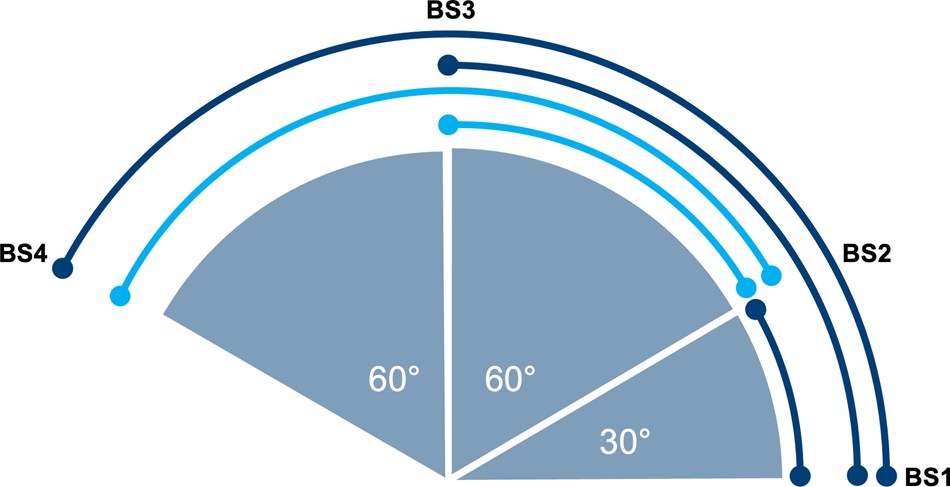
For 5G FR2 RRM specifications, 3GPP (3rd Generation Partnership Project – a standards organization that develops protocols and specifies measurement methods for mobile communications) has defined five sets of base-station pairs, positioned at different relative angular separations [8]: 30, 60, 90, 120, and $150^\circ$ . The wireless handset performance is measured for each pair of AoA that are broadcasting on either different frequencies or in different time slots. Figure 1 shows how the angular separations can be achieved with four-antenna probe locations (as opposed to placing six-antenna probes at $0,\; \, 30,\; \, 60,\; \, 90,\; \, 120,\; \, 150^\circ$
 ). Probes 2 and 3 are used for the angular spread of $60^\circ$
 and probes 2 and 4 are used for the angular spread of $120^\circ$
 . The probes are arranged in a single plane as only pairs of switched probes are considered in the 3GPP standards specifications. If the measurement setup includes a 2-axis positioner for the DUT, it can simulate a three-dimensional (3D) multiple AoA system. By enabling and combining fast switching between the pairs of probes in the four-probe system, individual probe power control, and positioner movements, it is possible to measure a dynamic AoA scenario simulating a moving DUT.
Realization of AoA separations for RRM: each probe as BS1–BS4 location generates a field in order to simulate monitoring of signal levels of multiple base-stations.

3GPP RRM test cases performed with such system include neighbor cell power measurements, mobility scenarios, beam management, and radio link monitoring. The fundamental measurement parameter in RRM test cases is the Synchronization Signal-based Reference Signal Received Power (SS-RSRP) [1]. The SS-RSRP is defined as the linear average of the power contributions of the elements containing the synchronization signals. In all RRM test scenarios, the wireless handset takes decisions based on the measured SS-RSRP for each of the Cells.
RRM measurements
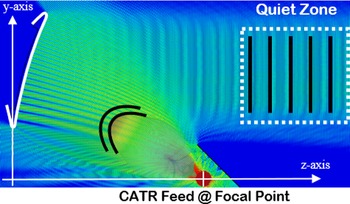
There are two approved 3GPP methods for RRM measurements using direct far-field (DFF) and indirect far-field (IFF) [8]. The DFF method uses a distance of 75 cm between the DUT and with multiple measurement antennas placed at the locations in Fig. 1, while allowing for larger MUs. The IFF CATR method places paraboloid reflectors with rolled edges at each angular position, thus generating much lower MU than for the DFF method. Figure 2 illustrates a typical CATR system where the spherical wave from the measurement feed antenna is transformed to a planar wave using the parabolic geometry of the reflector. More details about the reflector design used in this paper are described in [Reference Rowell, Derat and Cardalda-Garcia7].
Typical CATR setup where the parabolic section is offset from its center.

Similar to a DFF system, an IFF CATR arrangement can measure RF transceiver metrics instantaneously and directly in both Tx and Rx modes [Reference Derat, Rowell and Tankielun9], where MU is then generally dependent on the dynamic range of the setup. The dynamic range of a CATR system can be much larger compared to the DFF approach. The improvement stems from the lower free-space path loss (FSPL), which occurs only between the limited region where the spherical waves propagate between the feed and the reflector. RF cables inside an IFF system are also typically shorter than a DFF system, as the CATR feed antennas are often mounted close to the chamber walls or floor.
Measurement setup
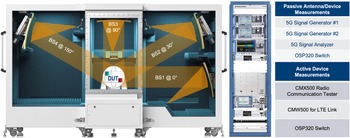
The measurement setup uses an R&STM ATS1800M multiple-angle CATR system together with a vector network analyzer for calibration, and communication testers for commercial 5G handset measurements (Fig. 3). In the vertical multi-reflector CATR system, four reflector setups are arranged inside the portable chamber with wheels, along a vertical arc at the specified probe angular locations. The DUT is mounted on a dual-axis positioner. Absorber blockers are placed between all neighboring reflectors and below the reflector at $150^\circ$ to prevent scattering from adjacent rolled edges into the QZ. The system footprint is 3.25 × 1.4 m with a height of 2 m. The FSPL at 40 GHz is 62.15 dB, resulting in an improvement of almost 30 dB in dynamic range compared to the DFF approach for an equivalent QZ of 30 cm diameter (DFF has a range length of 24 m and therefore an FSPL of 92 dB).
Vertical multi-reflector CATR system with four sets of CATR components representing four base-stations inside the shielded anechoic chamber.

Four dual-polarized CATR feed antennas containing eight cables are attached to an R&S OSP320 switching platform with cable outputs routed to the appropriate measurement instrument. This allows the measurement instruments to connect to any single or pair of feed antenna polarizations inside the setup with a switching time of less than 10 ms.
Two sets of measurements are performed:
(1) Non-signaling with continuous wave (CW): a four-port R&S ZVA67 Vector Network Analyzer (VNA) is utilized for measurement of the S-parameters and antenna gain patterns. The goal of this measurement setup is to evaluate the influence of scattering from adjacent CATR systems on the DUT radiation performance.
(2) Signaling with active wireless handset: a non-standalone (NSA) 5G wireless handset is used to monitor signal levels between different pairs of base-stations at a single position. In NSA mode, the 5G wireless handset uses an LTE base-station for signaling and control of the device. The LTE link antenna in the proposed multi-reflector CATR systems is a single-polarized Vivaldi antenna R&S TS-F24V3 connected to an R&S CMW500 communication tester for LTE signaling. An R&S CMX500 5G radio communications tester sends and receives the 5G NR-FR2 base-station cell signal to the 5G wireless handset.
The performance of the multi-reflector CATR vertical system is measured using a 20 dBi standard gain horn antenna as the DUT for the CW measurements. A commercially available 5G handset with an unknown number of 5G FR2 antenna modules (black-box device) is used in the signaling test scenarios and connected in NSA mode to the base-station simulator.
Results and discussion
Non-signaling with CW signals
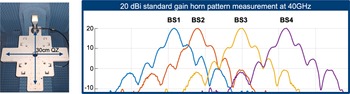
In the interest of brevity, gain pattern results are graphically presented in Fig. 4 for the E-plane of a 20 dBi standard gain horn antenna operated at 40 GHz, for each reflector angle, where the antenna is placed at the far edge of the QZ. The complete results for the MU (standard deviation of the results) are tabulated and presented in [Reference Rowell, Derat and Cardalda-Garcia7] for: (1) all relevant frequencies, (2) both the peak realized gain and TRP (Total Radiated Power), (3) different reflector sizes, and (4) different locations inside the QZ. Close agreement is observed for the different reflector angles, demonstrating the accuracy of the multi-reflector CATR system for a full 30 cm QZ.
Two-dimensional gain pattern measurement results for the 20 dBi standard gain horn antenna at 40 GHz (CW signal) measured at the border of the 30 cm QZ in the R&S ATS1800M multi-reflector CATR system.

Signaling with active wireless handset
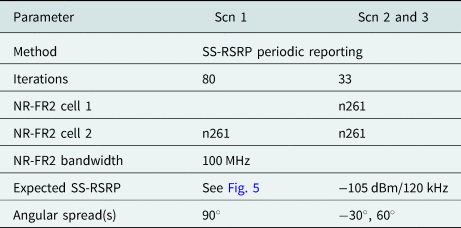
The second set of measurements focuses on evaluating different RRM scenarios. The accuracy of the SS-RSRP measurements in the multi-CATR arrangement is compared with a state-of-the-art single-CATR system. Typical RRM scenarios for SS-RSRP measurement accuracy and event-triggered measurements with two 5G NR FR2 cells are defined and evaluated. A commercial wireless handheld UE (user equipment) supporting 5G NR FR2 is used for the tests where the UE fulfilled transmission power requirements of Power Class 3 for band n261 [10] (Table 1). Frequency band n261 is specified as: uplink and downlink bands from 27.5 to 28.35 GHz using TDD (time division duplex).
Transmission power of different devices for 5G FR2 [10]

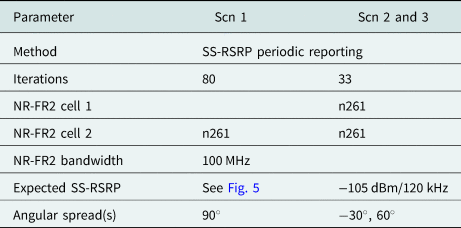
The measurements are repeated 33 times for statistical significance, following the recommendations of 3GPP TS 38.533 Annex G [8]. The measurement results for the test setups for one active cell are presented in [Reference Rowell, Derat and Cardalda-Garcia7]. This paper focuses on three different cases using a handheld UE:
(1) Two active cells: two active cells generate two AoAs at the wireless handset. The Tx power level is changed by ±10 dB for every 20 iterations, in order to determine if the wireless handset can accurately monitor both base-stations simultaneously. The CATR setups at 0 and $90^\circ$
 are used for this measurement scenario. The wireless handset is placed such that its rear portion faces the $45^\circ$ elevation direction (between the two CATR setups).
(2) Antenna beam analysis: based on the SS-RSRP measurement report, different antenna beam configurations of the wireless handset are analyzed in this scenario. The CATR setup at $30^\circ$
is used for NR cell 1 and the CATR setup at $90^\circ$ is used for NR cell 2.(3) Event-triggered measurements: an event-triggered measurement is a typical RRM test case in which the wireless handset needs to send a measurement report when a certain condition is fulfilled. For this measurement scenario, the CATR setup at $30^\circ$
is used for NR cell 1 and the mirrors at 0 and $90^\circ$ are used for NR cell 2 at different runs of the test.


An LTE antenna attached to a base-station simulator, acting as the link antenna for NSA mode, is placed nearby the wireless handset in the positioner so as to maintain a stable link. The detailed configurations for all conditions are described in Table 2.
Test parameters for realized RRM measurement scenarios (Scn)
Test case: two active cells
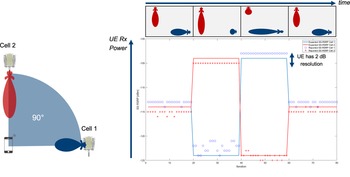
In the first RRM test scenario of two active base-station cells, it is seen that the wireless handset is able to simultaneously receive signals from base-station cells located in multiple directions, even when one of them has significantly higher power than the other (Fig. 5). The measurements show that both cells are reporting within 1 dB of expected SS-RSRP for higher Tx power (higher signal to noise ratio) and within 1–3 dB of expected SS-RSRP for lower Tx power (lower signal to noise ratio). Although the commercial wireless handset has unknown specific gain values for different orientations and polarizations, the expected values are based on the assumption that 3GPP requirements are met by the commercial wireless handset.
RRM scenario no. 1: inter-frequency SS-RSRP reporting for two cells in multi-AoA setup.

As illustrated in Fig. 5, the switch between different Tx powers of 10 dB is correctly reported without any delay. The lowest expected SS-RSRP level (−124 dBm) is below the reference sensitivity limit defined by 3GPP and the internal noise of the commercial wireless handset results in the higher measurement error for the lower Tx power. The reported SS-RSRP for cell 1 is in general higher than for cell 2, matching the outcome from the first RRM test scenario, where the SS-RSRP reports for the reflector at $30^\circ$ are also higher than for the reflector at $150^\circ$
 . From these results, it can be deduced that the commercial wireless handset has higher antenna gain when the signal is received from the top area of wireless handset, consistent with the known antenna module placement.
Test case: antenna beam analysis
The 3GPP in [1] considers that a wireless handset for 5G FR2 will have at least two different antenna beam configurations. While scanning for neighbor cells, the device will typically use a beam configuration with wider beamwidth in order to speed up the scan. For the active cell, however, the device will use an optimized antenna beam with higher gain and therefore a narrower beamwidth. The 3GPP refers to these two beam configurations as “rough beam” and “fine beam” respectively.
3GPP defines the test procedures to characterize the antenna pattern of the fine beam configuration (e.g. the 3D equivalent isotropic sensitivity (EIS) scan for the fine beam peak search) [11]. There is no procedure, however, defined for the characterization of the antenna pattern of the rough beam. In this paper, the characterization of both antenna beam configurations are based on the SS-RSRP reports from the wireless handset. Although this method is less accurate than the 3D EIS scan (due to the measurement accuracy of SS-RSRP), the SS-RSRP reports can also be obtained for cells without an active connection, allowing the measurement of both the fine and rough beam antenna patterns.
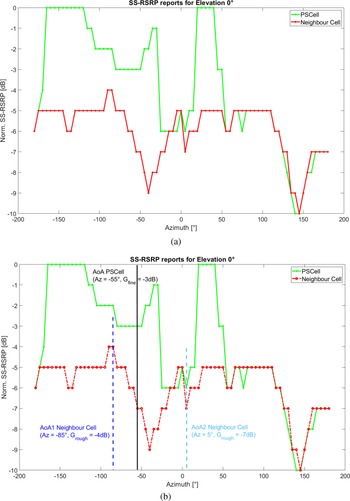
For the analysis of the two different antenna beam configurations, a scenario with two 5G NR cells is used. The wireless handset has an active connection to the 5G NR cell 1 (PSCell). 5G NR cell 2 is a neighbor cell with an angular offset of $60^\circ$ with respect to the 5G NR cell 1. The SS-RSRP reports are collected in an azimuth cut at elevation $0^\circ$
 . The antenna power (normalized with the maximum received power) is shown in Fig. 6. In general, it can be seen that the fine beam has a higher received power than the rough beam in most directions. The area where both antenna configurations have a normalized received power of −10 dB corresponds with the bottom portion of the wireless handset and therefore is consistent with the 5G millimeter wave antenna module placement. Understanding the difference between the rough and fine antenna beam configurations is critical in order to design meaningful RRM test scenarios, as illustrated in the next RRM test case.
RRM scenario no. 2 (top): comparison of the fine beam and rough beam antenna configurations of the wireless handset and RRM scenario no. 3 (bottom): AoA selected for the event triggered measurement scenario.

Test case: event-triggered measurements
The third test is an event-triggered measurement scenario where the wireless handset needs to send a measurement report when a certain condition is fulfilled. The different events are defined in [12]. In this scenario, Event A3 is used, which occurs when the received power for the neighbor cell compared to the received power of the PSCell satisfies the following simplified condition: SS − RSRP neighbor > SS − RSRP PSCell + Offset where the Offset is defined by a combination of multiple radio resource control signaling parameters in [12].
Event A3 requires the PSCell with an active connection to the wireless handset and a second cell (the neighbor) which the device needs to find and report. The difference between both beam configurations shown in Fig. 6-left plays a relevant role in fulfilling the Event A3 condition.
Taking into account the results in Fig. 6-left, the event triggered measurement has been configured to transmit the PSCell from the reflector at $30^\circ$ , with the positioning system rotated such that the wireless handset sees the signal from an azimuth of $55^\circ$
 . The neighbor cell is transmitted alternatively from two different reflectors, the one at $0^\circ$
 and the one at $90^\circ$
 .
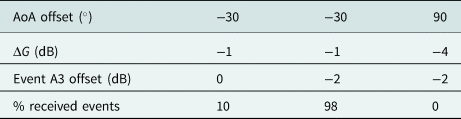
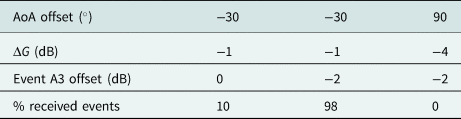
When the neighbor cell is transmitted from the reflector at $0^\circ$ , the difference between the fine beam and the rough beam is 1 dB. That means, if both cells are transmitted using the same downlink power, the wireless handset will receive 1 dB higher power for the PSCell than for the neighbor cell. If the offset of event-triggered condition is kept as 0, the power measurements may not satisfy the A3 condition. During the event triggered scenario with this configuration, the measurement report has only been received in 10% of the iterations. As a second step, the offset has been configured as −2 dB. In this case, Event A3 is easily satisfied and the measurement report has been received in 98% of the iterations. For the final step, the neighbor cell is transmitted from the reflector at $90^\circ$
 , with an antenna gain difference between the fine beam and the rough beam of 4 dB. With this configuration, the wireless handset has not sent the event-triggered measurement report in any iteration.
The summary of the event-triggered measurement results is shown in Table 3, where ΔG is defined as the difference between the rough beam and the fine beam antenna gain from the configured azimuth of arrival of the signal. This clearly demonstrates that baseband testing is not sufficient for RRM testing in the millimeter wave frequency bands (5G FR2), as the results are influenced by the direction of arrival of the signal. OTA testing in a multi-reflector CATR system and a careful selection of a representative set of test directions is crucial to fully characterize the performance of a wireless handset for 5G FR2 certification.
Test results for the event-triggered measurement scenario
Conclusion and perspectives
In summary, the proposed multi-reflector CATR system is able to perform accurate measurements for different types of DUTs operating in either passive non-signaling or active signaling modes for both a single angle of arrival and multiple simultaneous AoA. It is demonstrated that the proposed measurement system has low QZ measurement error for all reflectors, and different types of measurements, using a variety of measurement instruments and signals. Due to the minimum disturbance of the adjacent reflectors, it is possible to perform combined RF conformance and multiple angular measurements in a single measurement system.
During the measurements with the active wireless handset, it has been demonstrated that the multi-reflector CATR system enables new measurement scenarios where the impact of the antenna characteristics in the wireless handset performance can be analyzed. The results have shown the influence of the different antenna beam configurations in the overall wireless handset performance, conclusively demonstrating why testing from multiple AoA is necessary for a complete evaluation of a 5G FR2 wireless handset.
Acknowledgements
The authors would like to thank the following Rohde & Schwarz team members for assistance with conceptual discussions and measurements: Jose Maria Fortes, Engelbert Tyroller, Anes Belkacem, and Mert Celik.
Author contributions
All authors contributed equally to analyzing data and reaching conclusions, and in writing the paper.
Financial support
This research received no specific grant from any funding agency, commercial or not-for-profit sectors.
Conflict of interest
The authors report no conflict of interest.
 Corbett Rowell (M’94) was born in California, USA in 1972. He received his B.S. degree in physics (honors) from the University of California, Santa Cruz in 1994, his M.Phil. degree in electrical and electronic engineering from Hong Kong University of Science and Technology in 1996, and his Ph.D. degree in electrical and electronic engineering from Hong Kong University in 2013. From 1996 to 2005, he worked extensively in the mobile antenna design industry, developing some of the first internal antennas for mobile phones working directly for antenna manufacturers and as CEO of the first internal antenna design companies in Asia. He served as an R&D director at the Hong Kong Applied Science and Technology Research Institute for almost a decade, where he focused on advanced RF systems. In 2013, he joined China Mobile Research Institute as an R&D director responsible for the development of massive MIMO base-stations for 4.5G and 5G FR1. After China Mobile, he was an electrical engineering professor in Kazakhstan and an honorary adjunct professor at the Hong Kong University of Science and Technology for 2 years. Since 2016, he has been working in Rohde & Schwarz at the Munich headquarters in different roles: as a project lead engineer where he developed three new CATR systems for 3GPP conformance measurements and currently as an R&D director for the mobile network testing, whose products include wideband RF scanners, wideband down-converters, and PC-based demodulation algorithms. He has written over 40 papers in top journals and holds over 100 granted patents worldwide. His interests include a wide breadth of wireless technologies from massive MIMO, antenna design, phased arrays, cloud RAN, fiber backhaul, mobile network testing, and communications systems. Professor Rowell was a recipient of the 2018 Fred Ellersick Award for best original paper in IEEE Communications Society for one of the papers proposing hybrid beamforming in millimeter wave base-stations (now part of 3GPP standards). He was awarded Inventor of the Year in Rohde & Schwarz in 2018.
 Adrian Cardalda Garcia was born in Langreo, Asturias, Spain in 1988. He received two M.S. degrees in telecommunication engineering in 2012 and information technology and mobile network communications in 2015 from the University of Oviedo, Spain. From 2011 to 2012, he was an student research assistant with the German Aerospace Center (DLR). Since 2012, he has been a development engineer and 3GPP RAN5 representative with Rohde & Schwarz at the Munich headquarters. He is the author of one book, two articles, and almost 10 inventions. In his role as 3GPP representative, he is involved in the definition of 5G NR specifications and he is the Rapporteur of the 5G NR positioning and RRM sub-work items in RAN5. His research interests include over-the-air testing methods for 5G FR2 and positioning technologies for cellular networks. Mr. Cardalda Garcia was a recipient of the Scientific Award of the 2012 ITS World Congress in Vienna and three other awards for his master thesis.
 Benoit Derat was born in Drancy, France in 1979. He received his engineering degree from SUPELEC (Gif-sur-Yvette, France) in 2002 and his Ph.D. degree in physics from the University of Paris XI (Orsay, France) with honors in 2006. From 2002 to 2008, he worked at SAGEM Mobiles, as an antenna design and electromagnetics research engineer. During these years, he gained expertise in antenna measurements and simulations, and actively contributed to innovation and international standardization in near-field techniques for human exposure assessment to radiofrequency waves. In 2009, he founded the company ART-Fi, which created the first vector-array SAR measurement system and initiated the IEC 62209-3 standard development. Dr. Derat operated as the CEO and President of ART-Fi, before joining Rohde & Schwarz in Munich in 2017. He is now working as senior director for Systems Developments and Project Implementations, covering EMC, OTA, and antenna test applications. Dr. Derat is the author of more than 80 scientific conference and journal papers, as well as an inventor of more than 30 patents.