

Since being signed into law in March 2010, the Patient Protection and Affordable Care Act—commonly known as the Affordable Care Act (ACA)—has given rise to a number of contentious debates falling at the intersections of gender and sexuality. This article examines one slice of these discussions, namely, the potential impact of the ACA’s ongoing implementation on assisted reproductive technologies (ART) as part of wider access to reproductive health care. In the pre-ACA era, ART was regulated in a piecemeal approach, with oversight emanating primarily from state agencies. While the ACA applies federal regulatory structures to a number of health benefits, it leaves reproductive medicine, in general, and ART, in particular, mostly in their pre-ACA states. The predominantly state-level authority in this domain suggests that the ACA will have a mostly negligible effect on these types of fertility benefits when viewed as a national question. Yet, though most of the state-level practices that existed in the pre-ACA era remain unchanged, the particular elements of the ACA could change the way fertility is understood medically as well as politically. These elements include the ACA’s essential health benefits (EHBs), the ACA’s impact on the state-level regulation of individual insurance markets, and the ACA’s prohibition of insurance coverage denials on the basis of pre-existing conditions.
Years after the passage of the ACA, there is still a great deal of uncertainty as to how the law will alter the American landscape of fertility health care. Reference Omurtag and Adamson1 The precise nature of how and where this influence will emerge for patients seeking fertility treatment is unknown. Nevertheless, this article aims to contribute to our understanding of ART coverage in the post-ACA period, while keeping in mind that we remain in a time of policy change. Specifically, we address the question of how the ACA might impact patients who require treatments involving assisted reproductive technologies.
In order to preview the potential impacts of the ACA on ART, we first reviewed the pre-ACA regulatory framework. The variation in ART availability and regulation at the state level yields layers of complexity that must be noted in order to understand the potential impact of ACA implementation on reproductive health. Reproductive health covers a wide range of conditions, procedures, treatments, and preemptive care, including nutrition and lifestyle counseling, maternal and infant health, infertility in men and women, postpartum depression, and ART. We focused on ART treatments to demonstrate the complexity of the regulation of reproductive medicine.
To map potential trajectories of ART regulation with the ACA’s implementation, we also reviewed several existing areas of divergence among current state policies. These differences appear across states for specific ART procedures, state-level regulatory institutions, mandates for insurance coverage, and access to and utilization of fertility treatments. While not a comprehensive examination of each state’s regulations, this article presents a snapshot of the widespread variation of the pre-ACA regulatory framework.
Examination of ART exemplified the complexity of the regulation of reproductive medicine in the United States, but also suggested some policy patterns and trends that scholars interested in the subject should note and track. To supplement those findings, we reviewed the structure of the ACA with particular focus on the legislative components that have the potential to impact reproductive health care, such as the ACA’s EHB requirements and state-level federally subsidized insurance markets. With this review complete, we explored how the ACA’s implementation could affect the delivery of reproductive health services as American health care priorities continue to develop.
ART regulation in the United States
ART is defined as “all fertility treatments in which both eggs and sperm are handled.” 2 The Centers for Disease Control and Prevention (CDC) explain that, “In general, ART procedures involve surgically removing eggs from a woman’s ovaries, combining them with sperm in the laboratory, and returning them to the woman’s body or donating them to another woman,” and excludes treatments where only sperm is handled and procedures that do not include egg retrieval. 3 The most common and effective treatment using ART is in vitro fertilization (IVF), a procedure where fertilization occurs outside the body. 4 Although ART may be used by patients to avoid passing on inherited genetic disorders to their children, it is most often used to address infertility.
Patients may seek treatments using ART for themselves or, as in the case of surrogacy, in the process of using donor eggs, sperm, and/or wombs. The CDC defines a traditional surrogate as “a woman who agrees to become pregnant using the man’s sperm and her own egg,” meaning that “the child will be genetically related to the surrogate and the male partner.”
5
In the United States, however, it is more common for the surrogate to be a gestational carrier: a woman into whom embryos created by the intended parents using IVF are transferred and who has no genetic link to the fetus she is carrying.
6
As the American Society for Reproductive Medicine (ASRM) notes, “Traditional surrogacy arrangements often are perceived as controversial with the potential to be complicated both legally and psychologically,” making “the utilization of a gestational surrogate, legally
 $\ldots$
a lower-risk procedure
 $\ldots$
” because of the lack of genetic tie between the gestational carrier and the child.
7
In the case of paid or commercial surrogacy, the intended parent(s) compensate the surrogate for her role in the pregnancy under an established contract. As such, paid surrogacy should afford the intended parents legal protections vis-à-vis the delivered child. However, the legality and availability of paid surrogacy varies from state to state in the United States (discussed in more detail below in the review of state regulations).
Federal oversight of reproductive medicine
In terms of women’s health and fertility, adolescent reproductive health, and safe motherhood, the CDC’s Division of Reproductive Health has a long history of surveillance and research. 8 However, it was not until the 1990s that the CDC began to strengthen existing data collection efforts, which had been initiated by ASRM and the Society for Assisted Reproductive Technology (SART), and developed a national system for monitoring ART use and outcomes. 9 The fact that the regulation of reproductive medicine in the United States is governed by a piecemeal combination of state and federal government regulation—as well as self-regulation among medical professionals—has complicated these streamlining efforts. 10
The result of this fragmentary approach is a broad tapestry of federal laws that regulate laboratory and clinical settings, and varying state regulations more specific to medical procedures. Despite the absence of a singular federal legislative act addressing ART, general regulatory mechanisms have the greatest effect. Among these mechanisms are clinical, ART-specific regulations, such as the Fertility Clinic Success Rate and the Certification Act of 1992; nonmedical regulation of clinical ART, such as legislation related to “truth in advertising”; mandatory lab regulations and the regulation of somatic cell nuclear transfer; and the regulation of genetic testing and treatment. Reference Stapleton, Stapleton and Byers11 Implementation of comprehensive federal law might create an opportunity to standardize the regulation of reproductive medicine in the United States, but the ACA’s broader approach, almost in every area of clinical relevance, avoids such macro-level approaches. Because it leaves most pre-ACA arrangements—especially private insurance arrangements—intact, 12 the ACA’s implementation will not necessarily lead to more conformity in ART regulation.
Enter the ACA: relevance to reproductive health care
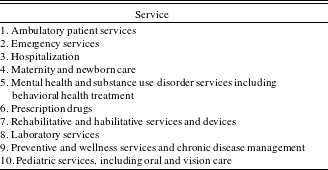
Analysis of the ACA’s fertility politics must begin with a brief discussion of the parts of the ACA that bear on reproductive health. Most discussions about fertility within the ACA’s broader politics center on the bill’s EHBs. For various reasons—some pragmatic, some political—the ACA’s framers left the specific formulation of benefits offered within EHB categories to the states. Reference Bagley and Levy13 Despite some regional and state-to-state variation, the ACA’s most important effect on benefits occurs in ten areas where the bill rationalizes benefits across individual medical insurance plans (see Table 1), both to ensure that consumers purchase and are enrolled in plans that meet most health needs that the Institute of Medicine (IOM) has deemed essential and to create broad insurance “pools” that spread risk across as many insureds as possible.
Essential health benefits categories.

Source: The Center for Medicare and Medicaid Services (http://www.cms.gov/CCIIO/Resources/Data-Resources/ehb.html).
Though the ACA’s EHBs constitute a major step toward the rationalization and regulation of benefit categories, it leaves the determination of actual benefits within those categories to the states. For the most part, this maintains the status quo ante of fertility treatment coverage in the pre-ACA era, where states had the authority to determine which, if any, ARTs were covered under individual insurance plans offered within their state. And, as state politics scholars have shown, state-level policies are a function of subtler and often more contentious dynamics. Reference Bovbjerg, Wiener, Housman, Holahan, Weil and Wiener14 As noted below, in the domain of health policy it is important to recall that insurance regulation is primarily the purview of states, making insurance policy vulnerable to more local (and often more powerful) interests. Reference Gardner and McCabe15
There are benefits as well as liabilities to handling health care reform on the state rather than federal level. As Marmor, Mashaw, and Oberlander noted some years ago,
Historically, proposals for national health insurance have been portrayed by opponents as limiting the public’s choice of medical care. In large part, these portrayals have been inaccurate, the exaggerated rhetoric of those with concentrated financial interests in defeating reform. Nevertheless, the association of health reform with restrictions on choice in medical care is a political problem for reformers, however baseless the perception, and reforms must confront it head-on. The federalist option reduces this problem by shifting attention to the principle of state choice in health care. Opponents of federalist health reform can thus be cast as opponents of choice, and reformers can use the federalist strategy to try to retake the symbolism of choice that has so often been used against them. Reference Marmor, Mashaw, Oberlander, Rich and White16
The political dynamic Marmor and colleagues identified continues to hold. Because it delegates responsibility to the states, the ACA may even intensify the dynamic. In the case of the ACA, opponents often focus specifically on claims about restricted choice—especially regarding doctor choice—about which Americans tend to hold strong beliefs. Numerous bills, most of which have stalled in committee, have been introduced by ACA critics in the name of devolving power to the states and maximizing choice. 17 But scholars have shown that devolution rarely maximizes choice when access and resources concern marginalized populations. Reference Haussman, Sawer and Vickers18
Health policy scholars have similarly debated the impact of post-ACA “narrow networks” in which provider options are limited to facilitate fiscally sustainable medical insurance pools. Though patients dislike restricted choice, Reference Hancock19 studies suggest that the impact on health outcomes is negligible, if there is any impact at all. Reference Gnadinger20 Not only are narrow networks not new, Reference Carroll21 but the ACA’s move toward leaner, more rationalized health delivery systems with better cost controls could—somewhat paradoxically—open possibilities for increased access to treatments such as IVF. By constraining choices that are proven to have little or no impact on health benefits for patients, the focus of medical care will shift to treatments with demonstrated effects (including many fertility treatments). As a result, advocates for expanded access to fertility treatments may take advantage of the shift to include treatments such as IVF.
The Pre-ACA framework, the ACA’s structure, and potential areas of impact
In this section, we report on the results of our review of state variation in the pre-ACA era regarding particular fertility treatments as well as state statutes mandating coverage. In addition, we describe our findings on the impacts that state-level regulation of ART has had on access and utilization of ART treatments. We also present an overview of the ACA’s structure, specifically elements that might be the most relevant to reproductive health care. Finally, from these findings, we preview areas that the ACA has the potential to impact for patients seeking treatments using ART.
Examples of existing differences in state ART regulation
As is the case with most services lacking comprehensive oversight, pre-ACA state policies regarding infertility treatments using ART were uneven. Because the federal government has ceded regulation of ART almost entirely to the states, each state has its own configuration of institutions and agencies charged with oversight and policy making (or lack thereof) regarding different ART treatments. Although there is no existing, comprehensive list of state regulations on each ART treatment, several organizations maintain data on varying practices such as surrogacy, embryo donation and disposition, and insurance coverage. 22 Looking at ART regulation regarding a particular process such as paid surrogacy, illustrates the wide variation in state laws. 23
As mentioned above, regulation of paid surrogacy hinges upon contracted agreements and embedded concerns about legal protections for all parties involved. A few states—Arizona, Michigan, and New York—have passed laws that make surrogacy contracts illegal or that impose fines. 24 Other states allow a dizzying range of possibilities, with some even requiring the intended parents to adopt their biological child from the gestational surrogate. 25
There is also little consistency in state regulations within regions of the United States. For example, Alabama state law “does not directly address surrogacy, except to say that laws regarding adoption and baby brokering do not apply to surrogacy.” 26 Nevertheless, a state court has “upheld the parental rights of a woman whose child was born via surrogacy even though she did not provide the egg.” 27 Alabama’s neighbors are different. In Mississippi, “state law and case law are silent on surrogacy” while in Tennessee surrogacy agreements are allowed, and the genetic parents are not required to adopt the baby. 28 In Florida, “State law allows and regulates surrogacy agreements,” but the “intended parents must be at least 18 years old, heterosexual and married.” 29 Thus, parents considering an ART procedure, such as paid surrogacy, often confront options limited by geography.
Insurance coverage
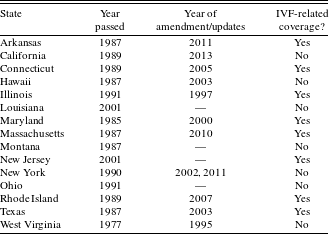
The wide variation of pre-ACA practices in reproductive health across states due to the absence of comprehensive federal oversight is further complicated by variations in insurance coverage. Currently, 15 states mandate, by statute, some form of insurance coverage for an infertility diagnosis and its treatment (see Table 2), although the type of coverage widely varies. 30 More than half of the states with mandates include some type of coverage for IVF treatment, but particulars of that coverage vary from state to state. For example, Louisiana “prohibits the exclusion of coverage for the diagnosis and treatment of a correctable medical condition, solely because the condition results in infertility” but does not require coverage for fertility drugs, IVF, or other ART. 31 In contrast, Texas potentially allows more comprehensive coverage, requiring “group insurers to offer coverage of IVF” although with significant qualifications, including that the patient has been unable to attain a pregnancy through less costly treatment covered under insurance and that the patient’s eggs be fertilized only by her spouse’s sperm. 32 In short, insurance providers in one state may be obligated to provide additional coverage for treatments that are not required in another.
States with legislative mandates for fertility treatment coverage.

Sources: Resolve, The National Fertility Association (http://www.resolve.org/family-building-options/insurance_coverage/state-coverage.html), and ASRM, “State Infertility Insurance Laws (https://www.asrm.org/insurance.aspx). For specifics on state mandates, see http://www.ncsl.org/research/health/insurance-coverage-for-infertility-laws.aspx; The National Fertility Association; Omurtag and Adamson (2013).
Despite only a minority of states requiring some form of insurance coverage for an infertility diagnosis and its treatment, together they make up almost half of the U.S. population, as approximately 48 percent of Americans live within the 15 states with legislative mandates. 33 These states account for more than 47 percent of live births nationally. Reference Hamilton, Martin, Osterman and Curtin34 With such a significant part of the population potentially covered, mandate states can serve as sound case studies for examining whether mandates lead to increased levels of access and utilization. Studies have found a positive correlation between the availability of mandated insurance coverage and utilization of ART procedures, Reference Schmidt35 presumably because individuals are more likely to pursue treatment for fertility issues in states that mandate coverage where it should be comparatively less costly than in non-mandate states.
We found that insurance coverage also tends to rely on a series of assumptions about infertility. For one, the way the medical establishment defines infertility impacts potential coverage. ASRM defines infertility as “the inability to achieve pregnancy after one year of unprotected intercourse,” 36 which assumes that infertility issues are discovered after a patient attempts to conceive in a heterosexual relationship. It does not, however, account for patients who may become infertile due to other medical treatments, such as radiation or chemotherapy to treat cancer, or for gay parents. Moreover, legislative mandates tend to take for granted that fertility patients will be insured, that they will find equal access and acceptance at fertility clinics, and that their condition is covered by state requirements. No state directly addresses issues of access for uninsured or low-income patients. In addition, restrictions regarding the accessibility of ART reflect “pronounced class- and race-based inequalities.” Reference Inhorn and Birenbaum-Carmeli37
Treatment access
Studies of ART availability across intra-state demographics thus raise issues of inequality in access to and utilization of fertility health care. Hammoud and colleagues’ review shows that states that mandate coverage tend to have higher rates of utilization but are no more likely to “reduce racial, ethnic, or educational disparity” in infertility treatment. Reference Hammoud, Gibson, Stanford, White, Carrell and Peterson38 A study of fertility treatment availability in Massachusetts—a state requiring comprehensive coverage such as a range of treatments, no lifetime cap or limits to number of treatment cycles, and no restrictions on fertility drug coverage 39 —confirms this conclusion, noting that “the predominant individuals who access those services tend to be Caucasian, highly educated, and wealthy.” Reference Jain and Hornstein40 Additionally, a review of several variables that determine the likelihood that a woman will pursue infertility treatment and her choice of treatment type found that “‘financial access’ variables of income and insurance have significant effects on the probability of seeking infertility treatments,” and that “the choice to pursue ART—a much more expensive but potentially more productive option—is highly influenced by income.” Reference Staniec and Webb41 In short, the class stratification of utilization in non-mandate states still appears in mandate states.
Across demographics, we also find that patients are predominantly 35 years of age or older. 42 While this age range makes sense considering that women are more likely to experience fertility issues after the age of 35, the prevalence of this age demographic among fertility patients colors the way infertility is defined, which in turn shapes treatment eligibility. This may also make sense. After all, as we acknowledge below, the management of most health care systems does require that limits and criteria be established in terms of need.
Because of how infertility is defined, patients who experience infertility due to another condition, such as cancer, are less likely to be covered. Reference Basco, Campo-Engelstein and Rodriguez43 States do not mandate fertility preservation treatments for patients requiring radiation treatment that may affect their fertility. 44 The same is true for sperm screening and cryopreservation for male cancer patients, though some states have attempted—mostly unsuccessfully—to address this gap. 45 Because a federal mandate ensuring coverage for individuals suffering from infertility is lacking, no matter the cause, state policies are predicated on a particular image of those patients who seek services: educated, wealthy white women and men who are pursuing treatment due to age-related difficulties. As a result, the lack of access to treatment for patients without the financial means to pay out-of-pocket expenses that occur in states without mandated coverage is replicated in the states that do mandate it.
The ACA’s structure: EHBs, markets, and benchmarks
To better understand the role of the state in ACA implementation, we present our findings on the ways in which the structure of the ACA may impact reproductive health care. We examined how states determine their benchmark plans as well as the role that existing state mandates may play in benchmark selection. We also addressed—if states fail to select benchmarks that fold in their mandates—the possibility of a rollback of coverage previously attained by advocates for expanded fertility treatment access. Although our focus was on reproductive health more broadly, the ways that states interpret EHBs and the benchmark plans they choose with regard to reproductive health will affect access to and utilization of fertility treatments, including ART.
The Kaiser Family Foundation explains that EHBs may be derived from ten state options: “the three largest small group plans, the three largest state employee health plans, the three largest federal employee health plan options, or the largest HMO offered in the state’s commercial market.” 46 However, in the absence of a state recommendation, benchmarks default to the state’s largest small group plan. Small groups are considered employers of 100 employees or fewer, although states may limit that to 50 employees or fewer until 2016. 47 In configuring EHBs for the individual market in this manner, the ACA therefore blurs the lines between benefits and benchmarks in the group and individual markets. Under the ACA, which continues to allow large group plans (many of which self-insure) a wide latitude in setting benefits, the companies themselves will make decisions about whether to include fertility treatments in their plans.
The benchmarking process is critical in establishing standards for coverage under the EHBs. However, because of the federal Employee Retirement Income Security Act of 1974 (ERISA), which empowers federal law to preempt state law on the large employer market, benchmarks reach only the individual and small group markets. Accordingly, the means by which most Americans receive their medical coverage—large employer health plans—remain mostly untouched. The use of small group plan benchmarks to establish standards on the individual marketplaces makes individual plans function according to the already-delimited employer plans. The introduction of new regulatory mechanisms on the individual marketplace is therefore not only unlikely to expand access to infertility treatments, but may intensify state-level variations already at work pre-ACA.
Though the ACA EHB provisions have the biggest impact on individual medical insurance plans available on the ACA’s marketplaces, understanding the relationship between state regulations of large group markets and the comparatively unregulated individual and small group markets may be a key to understanding the development of coverage for IVF in the post-ACA era. In 2014, only 27 percent of large employers (with more than 500 employees) covered IVF treatment, though 65 percent covered consultations. 48 And state-established benchmarks for individual plans are tethered to employer-sponsored plans in the small group markets. In the ACA, these inter-state differences are reasserted in the setting of benchmarks for individual insurance plans within states. Selected benchmark plans thus serve as “the standard for plans required to offer EHB in the state.” 49
The ACA and existing state mandates
The relationship between state mandates and the post-ACA policy terrain is complicated. For states that had passed statutes mandating coverage before the end of 2011, the ACA meant they had the opportunity to select a small group plan for their benchmark that would automatically fold in state mandates. Reference Weiner and Colameco50 Section 1311 of the ACA addresses affordable choices of health benefit plans. Regarding rules related to additional required benefits, it allows that states may offer benefits beyond specified EHBs based on state mandates. As a result, states with pre-ACA mandates could add “infertility treatment” to their EHB categories.
If states do add categories to their EHBs, however, they may be responsible for covering additional costs of care. The ACA requires that states must assume costs of additional care for individuals enrolled in qualified health plans or “directly to the qualified health plan in which such individual is enrolled; to defray the cost of any additional benefits described in clause (i).” 51 As a result, states had an incentive to select a small-group plan that included previously mandated benefits so that they would not be financially responsible for additional costs outside of the benchmark plan; specifically, “EHBs in states in 2014 and 2015 are a product of (1) the state mandates in place in 2011 [prior to the ACA] and (2) the choice of a benchmark plan.” 52 Based on this incentive, policy analysts might assume that pre-ACA mandates requiring coverage for fertility treatment are a predictor of the types of coverage that states sought to include in their benchmark plans.
However, we have found that a pre-ACA state mandate for fertility treatment coverage cannot be used as a predictor of state selection of fertility treatments in its EHBs. Table 3 illustrates how varied fertility treatment coverage is state by state in terms of pre-ACA mandates, selection of “infertility treatment” as an EHB category, and coverage exclusions established in benchmark plans. In the 15 states with mandates, 11 have chosen plans that include coverage. States with pre-ACA mandates that have selected Infertility Treatments as an additional EHB category: Arkansas, Connecticut, Hawaii, Illinois, Maryland, Massachusetts, Montana, New Jersey, New York, Rhode Island, and Texas. In addition, 12 states have selected benchmarks that include coverage of at least some fertility treatments despite the fact that they have not previously mandated them. States with no pre-ACA mandate that have selected Infertility Treatments as an additional EHB: Alabama, Georgia, Iowa, Kansas, Michigan, Nevada, New Mexico, North Carolina, South Dakota, Tennessee, Virginia, and Wyoming. The selection of benchmark plans that include infertility treatment as an EHB by states without pre-ACA mandates may indicate the potential for expanded coverage across new geographic areas. At the same time, however, of the 23 states that added the category to their EHBs (mandate and non-mandate states alike), 19 specifically exclude coverage for IVF and other ARTs. Thus, while the potential for an expansion of coverage is present, we have found that access to and utilization of ART is highly constrained in actual policy arrangements.
Overview of state mandates, infertility EHB inclusion, and coverage exclusions.

Source: Centers for Medicaid and Medicare Services (CMS) and the Center for Consumer Information & Insurance Oversight (CCIIO), https://www.cms.gov/CCIIO/Resources/Data-Resources/ehb.html (accessed April 30, 2015). Note: States that did not register in any of the listed categories (state mandates, EHB inclusion, and exclusions) are not included in this table.
When comparing states and their benchmarks’ benefits under the ACA, we also considered the pre-ACA availability of certain reproductive health services on small-group insurance markets because individual plan benchmarks draw upon existing plans available on those markets. A deeper look at state benchmarks illustrates the dynamics behind coverage for fertility treatments. As we have noted, only 11 of the 15 states with pre-ACA mandates explicitly included infertility treatment in their EHBs. The remaining four mandate states—California, Louisiana, Ohio, and West Virginia—did not. Ohio and California, for example, both mandate coverage for certain forms of reproductive medicine, yet neither includes infertility treatment in its EHBs. 53 Additionally, Ohio’s benchmark specifically lists “Diagnostic testing or treatment related to infertility; Artificial insemination, in vitro fertilization, other types of artificial or surgical means of conception including drugs administered in connection with these procedures” as “not covered.” California’s benchmark simply says infertility treatment is not covered. 54
Although this may appear as if Ohio and California are now vulnerable to covering additional costs to meet their state mandated coverage of fertility care as stipulated in the ACA, the specific fertility treatments covered under their mandates may be addressed by other EHB categories, such as maternity and newborn care. Ohio’s mandate, for example, requires HMOs “to provide basic health care services, which are defined to include infertility services,” but only when “medically necessary.” 55 As a result, the same level of coverage remains post-ACA as required pre-ACA. This reminds us that available medical services are refracted through (and dependent upon) a larger policy language of medical necessity, a question to which we return below.
Some states, such as Ohio, can maintain their pre-ACA mandated coverage of infertility treatment without including infertility treatment as an additional category in their EHBs. However, not all mandate states have the requirements of their statutes covered under other categories like maternity and newborn care. For example, Maryland does include infertility treatment in its benchmark plan but lists IVF as an excluded cost from coverage. 56 As a state that has mandated IVF coverage, it leaves itself open to having to help defray the costs of IVF as well as other treatments. Although Maryland may attempt to tie coverage of these treatments to maternity benefits, we have found that fertility advocacy groups are concerned there might be a rollback. 57 These concerns center on the burden of cost: “Given budgetary pressures on state budgets, states could decide to reevaluate their benefit mandates if they are financially liable for coverage of those benefits.” 58 Accordingly, states with more expansive mandates may roll back IVF coverage.
Post-ACA: potential areas of impact
We have found that the particular ways in which the ACA EHBs are structured make it unlikely that federal law will directly shape the landscape of American infertility treatment coverage. As we have shown, the ACA changes little about how private health insurers address fertility, which is predictable considering the cost of IVF (one cycle currently costs about $12,400 in the United States according to ASRM), and about debates regarding the proper scope of “medical necessity” in coverage design. Reference Skinner59 Nevertheless, ACA changes to key insurance instruments may impact patients’ ability to pursue fertility treatments. Areas of impact may not develop for years. However, ACA alterations of rules governing Flexible Spending Accounts (FSAs) and coverage for fertility problems that have been designated as pre-existing conditions have the potential to bring about more immediate changes, even if limited in scope. It appears, then, that the ACA’s essential benefits provisions are the most obvious venue in which we expect the bill’s fertility politics to play out, and this venue is likely to be one of constant change. Over the coming years, even when remaining silent on mandated coverage for infertility treatments, the ACA may indirectly influence reproductive medicine access and utilization.
To explore the potential influence of the ACA on reproductive medicine, we present our examination of the insurance instruments that might exhibit changes, from least to most likely. For one, there is the potential for policy learning across state lines through regional exchanges, although regional exchanges are not likely to be created in the near future. In addition, flexibility in ambulatory patient services and maternity and newborn care EHB categories might become spaces for advocacy. Changes to how insurers handle FSAs and preexisting conditions could also change patients’ access to and utilization of ART. It is important to note, however, that the way fertility treatment is framed in policy discussions will influence the potential shifts regarding these instruments. Finally, we address how the ACA may impact other areas of care, including reproductive health services.
Exchanges
Although the ACA potentially creates a new forum for policy learning across states, the quality and extent of that learning are unknown. A key question remains as to what, if any, horizontal policy diffusion might occur as a result of the new policy terrain brought about by the ACA.
 $^{\text{ }}$
A Commonwealth Fund report notes, “Although the ACA favors the creation of state exchanges, it also confers authority to create a federal exchange as well as a multistate insurance program, and it provides for the possibility of regional exchanges.”
Reference Jost60
One potential impact of the establishment of regional exchanges could be the sharing of inter-state resources, and the diversification of insurance risk pools that could make benefits such as IVF increasingly possible. As Timothy Jost notes, “If a small state offers too small a participant pool to be viable, a regional exchange involving several states may be indicated. Conversely, some states may be so large that a single exchange would be unwieldy.”
61
Thus, the benefits or liabilities of such pools will depend on particular demographic and regional situations.
Considering the regulatory challenges that would have to be overcome, the likelihood of regional exchanges materializing in the near future is admittedly slim. For example, how exactly would intra-state regulatory structures interact with inter-state developments? In all likelihood, significant regulatory reform and innovation would be required. Yet, even provisionally, it is still worth considering some of the benefits such exchanges could provide. As opposed to state exchanges, which are limited to insurance offerings within state borders, regional exchanges could capitalize on state government relationships as well as on expanded provider networks to rationalize EHBs across larger geographical areas. The attendant regionalization of EHBs would constitute a compromise, making similar benefits available to larger and more diverse populations without engaging the contentious politics of national policy making. Should such regional exchanges be created in the future, coverage of infertility treatment might be expanded within regions or even—across multiple regions—nationally, depending on the nature of benchmarking. Of course, such regionalization could have the opposite effect and undo state-level mandates. Such is the risk of regionalization.
Framing of fertility treatment
If “infertility treatment” is not specifically selected as a category in benchmark plans, infertility treatments are most likely to be subsumed under the umbrella of the ACA’s ambulatory patient services and maternity and newborn care EHB categories. In one sense, these categories are merely arbitrary spaces in which advocates can make their cases. More generally, the politics of ACA benefits is best understood—as health policy often is—as a series of contentions driven by stakeholders and, to this extent, the ultimate fate of infertility treatment is likely to be a political question rather than a merely clinical determination of categorization. In many ways, fertility’s status vis-à-vis insurance coverage mirrors debates about the difference between medically necessary, cosmetic, elective, and experimental care. Such debates remind us that most—if not all—clinical decision making is colored by often hidden normative dimensions, as when we afford infertility treatment greater or lesser value when considering whether it should be viewed as not only an “essential benefit,” but quite possibly even a right.
Consequently, it is critical to understand the political contexts within which these questions arise. For example, a 2014 Gallup poll indicated that 52 percent of Americans believe that providing or ensuring health care is not the responsibility of the U.S. government. 62 Accordingly, given the political framework within which a majority of Americans view health care, such discussions about rights tend to give way to considerations of medical need and notions such as personal responsibility. Though political actors may assert the existence of a right to health care, 63 such positions are primarily rhetorical phenomena and a matter for political negotiation rather than an established, uncontestable fact. While the Universal Declaration of Human Rights holds that “Men and women of full age, without any limitation due to race, nationality or religion, have the right to marry and to found a family,” 64 such rights have little traction at the level of American health care policy making. At a minimum, such rights are generally construed in terms of noninterference by the state—a negative liberty—instead of a positive right or entitlement to health services. The ACA attempts to rationalize and stabilize Americans’ access to health care, but it does not establish a right to health care.
Flexible spending accounts (FSAs)
The way health care is financed in the United States adds additional layers of complexity to the discussion. As with many forms of treatment (fertility or otherwise), insurance coverage on both individual and group markets is scarce and uneven, though current tax law does allow individuals to pay for IVF and other fertility-related treatments out of pretax FSAs. The fact that many forms of treatment are considered too marginal for standard coverage but are acceptable when paid out of pretax employee funds is further evidence that there are shades of medical necessity rather than blacks and whites. Most FSAs utilize IRS guidelines to determine what is and is not an allowable tax-deductible expenditure. 65 Specifically, FSAs can be used for over-the-counter fertility monitors and fertility treatments for the employee, the employee’s spouse, and dependents, but they may not be used for fertility treatment for non-dependent surrogates. As a particular example of the difference between dependent and nondependent surrogacy, Cigna’s guidelines state, “If the surrogate mother is not a qualified dependent of the taxpayer, the costs that the surrogate mother incurs are not reimbursable.” 66
The tax status of IVF under FSAs is evidence of a more complex story than simply that some treatments are medically justified while others are not. FSA rules regarding fertility make clear that it is not the position of the medical establishment or insurance regulators that fertility is to be regarded as beyond the scope of a medically necessary or valued treatment. It is here, in other words, that we confront openly normative judgment and a question about social valuation. Advocates of broader insurance-funded IVF access must engage this question directly rather than simply asserting the importance or necessity of treatments such as IVF.
The ACA may also limit access to fertility treatment by limiting FSA per annum contributions. 67 Though most employers did cap their contributions pre-ACA, thereby limiting the resources employees could accrue, there was previously no limit on how much an employee could contribute. As of 2015, the IRS caps yearly FSA individual contributions at $2,550, bringing them closer in line with, but still short of, existing limits for Health Savings Accounts (HSAs). 68 Considering the high cost and lack of coverage in most health insurance plans, IVF and other fertility treatments stand to be impacted in a particularly direct way. Even though individuals within partnerships can utilize FSAs to cover copays, as well as actual fertility treatments themselves, particular treatments will still be limited to the specific, gendered needs and care of each partner. 69 This rule might be partially circumvented is by drawing on FSAs of two partners, for a total of $5,000, 70 but it is still far from the kind of insurance provisions IVF advocates seek. Even a doubling of maximum contributions would not come close to the average cost (approximately $12,400) of a single cycle of IVF.
Infertility as preexisting condition
In the pre-ACA era, infertility was a preexisting condition that could negatively impact access to medical insurance for patients seeking fertility treatments. This is an area where the ACA’s basic regulatory reforms are likely to directly impact access to fertility treatment. Even though this provision, which went into effect in 2014, does not guarantee treatment for fertility, it prevents insurance companies on the individual market from refusing insurance coverage on the basis of infertility or—if the plans do offer fertility treatment—from preventing the insured from accessing treatment because the condition existed when the insured enrolled in the plan. For these protections to take hold, however, state insurance departments will have to remain vigilant in their yearly evaluations of individual marketplace offerings. This poses a challenge in states where insurance regulation is the purview of ACA opponents.
The ACA, noninfertility care, and guaranteed issue
Finally, changes in noninfertility care may indirectly impact infertility treatment. Brezina and colleagues argue that there are two key divisions of reproductive endocrinology and infertility (REI): noninfertility- and fertility-based care. Reference Brezina, Shah, Myers, Huang and Decherney71 The former category, they argue, is likely to have an indirect impact on fertility simply because evidence suggests that good, early, and continual primary care services address issues that increase fertility and reproductive health. This is particularly relevant to screenings and early treatment for sexually transmitted diseases, such as chlamydial infection and gonorrhea, and suggests that nonspecialists are expected to play an increasingly prominent role in the overall national fertility profile.
Thus, infertility’s subsumption under a less fraught category could quiet political complaint,allowing policy to develop in response to need. As we are beginning to see in states with less expansive pre-ACA mandates, the ability to include fertility treatments under other categories can strengthen those mandates. When compared with many ACA provisions, the bill’s ban on coverage denials based on preexisting conditions—so-called “guaranteed issue”—are quite popular, with 66 percent of Americans supporting it, including 56 percent of people identifying as Republicans and 67 percent identifying as Independents. 72 Accordingly, these provisions may be the most logical space within which advocates will push for coverage to circumvent charged political debates on reproductive health.
Post-ACA politics of ART coverage
Our review of ART regulation illustrates the haphazard regulation of reproductive health in American health care. When coupled with our examination of the ACA’s structure, our review provides insight into places for advocacy, whether to expand or restrict fertility options. In this section, we discuss these potential entry points to exert influence in policy making affecting ART access and utilization.
Reconciling benchmarks and state mandates
As we have suggested, the ACA’s approach to fertility benefits must be read in relation to the politics of state fertility mandates. Existing state mandates do not simply fold into the ACA’s EHB requirements but are treated as additions that will need to find a home category. 73 Brezina and colleagues note, the ACA “does not directly address infertility coverage. There is no language in the [ACA] that explains how state-mandated infertility coverage will or will not be affected.” 74 The likely consequence is that politics will determine which services are to be included in EHBs. For example, given their fiscal perspective, states controlled by Republican legislatures are likely to construe benefits narrowly, yielding lower levels of coverage for fertility services. The National Conference of State Legislatures explains the complicated nature of these relations:
To prevent Federal dollars going to state benefit mandates, the health reform law requires states to defray the cost of benefits required by state law in excess of essential health benefits for individuals enrolled in any plan offered through an Exchange. However, as a transition in 2014 and 2015, some of the benchmark options will include health plans in the state’s small group market and state employee health benefit plans. These benchmarks are generally regulated by the state and would be subject to state mandates applicable to the small group market. Thus, those mandates would be included in the state essential health benefits package if the state elected one of the three largest small group plans in that state as its benchmark. 75
HHS is attempting to walk a thin line. Ideally, especially to preserve fiscal order, EHB and state mandates would be kept analytically distinct. Indeed, pre-ACA state legislation requiring insurance companies to cover fertility treatments is considered additional to basic coverage. As a result, the selection of benchmarks by states with a continued approach of state mandates as separate additions to insurance plans will reinforce the variation in fertility treatment coverage and, thus, its availability to certain populations.
Post-ACA, this distinction remains in a formal sense. In practice, however, such distinctions are likely to prove mostly unimportant. For example, required state coverage of fertility treatment does not become part of maternity and newborn care, but remains a separate mandate held outside of the ACA EHBs. The relationship between EHB and state mandates underscores the difficulty of establishing a systematic approach to health care utilization across multiple levels of governance. In many ways, the key impact the ACA has on the field of reproductive health is to strengthen the role played by the states. In turn, such an entrenchment of power at the state-level could weaken the chances of development for a comprehensive federal regulatory approach to fertility treatments and, thus, affect their availability and access. Better grasping the dynamics of these layers is important for understanding the politics of fertility post-ACA. Watching how these policies develop over the coming years, with special attention to the nature of policy diffusion, will be critical for those groups engaged in fertility advocacy.
IVF as medical necessity, benefit, and/or right
Successful public engagement with potentially discriminatory aspects of IVF policy making would constitute progress in civic debates about fertility, regardless of one’s views on IVF and other ART. To the detriment of such progress, however, media tend to focus on sensational and unrepresentative fertility stories, such as “Octomom,” the California woman who gave birth to octuplets resulting from IVF. 76 The media often present these stories as characteristic of ART treatments. When coupled with the comparatively lax regulatory framework for ART, the sensationalist angle that is common to American media results in the perception that the United States is the “Wild West” of reproductive medicine. 77 Clearly, a need exists for improving the seriousness with which health services and their scientific and medical-ethical bases are broached in public debates that in turn inform policy. For example, if fertility treatments are to become a less sensational part of the broader U.S. health care benefits terrain, a national conversation about the right to have children would likely need to take place. Though scholarly inquiries into the question seem to have trailed off in the early 2000s, Reference Warnock78 a renewed conversation would benefit from the perspectives of a wide range of experts to ensure that policies reflect more than self-interested stakeholder perspectives.
While it is impossible to accurately predict precise long-term policy implications of the ACA for IVF access and utilization, the political fault lines are fairly clear and point to likely trajectories of policy development. Here, we examine two critical components of the politics of IVF in terms of theoretical framing: namely, how this politics intersects with debates about the meaning of medical necessity and whether fertility is perceived as a right or a benefit. We also explore how normative framings of fertility can be impacted by the dynamics emanating from the multiple layers of American health services and insurance provision. Again, we maintain that these trajectories, though speculative, are worth exploring for what they offer us by way of theoretical understanding.
Many outcomes in American health care politics hinge on distinguishing what is medically necessary from that which is not. As a result, IVF is often treated no differently than cosmetic and other elective surgeries, because it is not considered necessary to maintain a person’s health or survival. As a result, access to IVF is bound up in a broader politics of medical necessity decision making. The Internet is filled with debates about whether IVF is a legitimate medical question. One widely circulated example, posted some years before the ACA was passed, is benefits specialist and blogger Henry Stern’s post on InsureBlog, in which he argues that “lifestyle choices such as IVF do not fall under the aegis of risk management,” and therefore do not constitute medical necessity and should not be covered. 79 By contrasting fertility treatment with other medical needs, we find that more than medical decision making is at work.
To fully grasp the dynamics of the ACA’s politics of fertility, we must consider the role that norms play in medical decision making. One way to approach the question of norms is to engage the longstanding debate as to whether health care, generally, and subsets such as fertility, in particular, are best construed as rights or benefits. 80 A global view is helpful here. First, at an extreme, we may look to a nation such as Costa Rica, which continues to ban IVF in violation of the Inter-American Commission of Human Rights’ finding that the ban violates human rights, 81 or to those nations that continue to implement forced sterilization policies in contravention of international law. 82 These situations remind us of the quite different stakes in such nations when compared with the coverage decisions we discuss in the American context, where the concern is expanded and funded access rather than human rights protections. Noninterference with one’s right to pursue fertility treatments is quite a different matter than the right to access such treatments more affordably through insurance.
Policies established by European nations may serve as a more meaningful comparison. Many Europeans consider health care generally to be a right, yet this belief provokes an ongoing debate about exactly what services should be provided. Europe is also a useful comparison because the values and laws of Europe (inscribed in documents such as the European Union Charter of Fundamental Rights) are often held in tension with national preferences of and policies in individual nations. In acknowledging a diversity of different policies across the continent, a study of regulation and financing of IVF in Europe revealed a positive correlation between rates of utilization and eligibility but no clear positive relationship between restrictions on public financing of IVF and utilization. They also found that increasingly generous benefits tend to yield more restrictive coverage criteria. Reference Berg Brigham, Cadier and Chevreul83
To circumvent these restrictions, this study determined that patients sometimes crossed borders to seek reproductive services because they were locally unavailable or comparatively costly. Several studies have documented the increasing rates of “reproductive tourism” among Europeans. 84 Legality, lack of access to services, quality of care, and costs were all major reasons cited as motivating “cross border reproductive care.” 85 Though cross-border service seeking in Europe does not parallel the dynamics and legal structures of American federalism, it is clear that adjacent geographical areas with widely divergent fertility policies can produce cross-border policy dynamics that put pressure on policy makers, though it is not certain whether this pressure will yield greater or fewer restrictions.
All societies, of course, ration care to be able to afford what they consider most essential. 86 How societies construct regimes of access and support for medically assisted reproduction such as IVF tells us much about itself “not least because human reproduction is the means by which each society perpetuates itself and its traditions.” 87 This is true not only in terms of what a particular society considers a right, but also what benefits are deemed essential, thereby neutralizing much of the significance of the rights-benefits distinction. The scarcity of medical resources suggests that if IVF—which is quite expensive and has often low and unpredictable success rates—were made more widely available, other treatments would likely be removed.
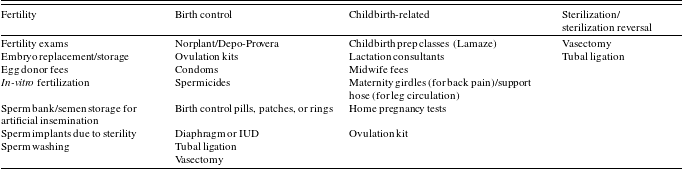
FSA-eligible reproductive health products and services.

Source: ADP Spending Account Eligible Expense Guide, updated May 22, 2013, http://www.spendingaccounts.info/PDF/eligible_expense_guide.pdf.
The issue of establishing the medical necessity of fertility treatments such as IVF, therefore, is not a simple matter of evidence, but a broader normative question of the extent to which Americans wish to prioritize fertility. It is possible, of course, that the costs of normalizing a broader range of fertility treatments could become increasingly possible as the post-ACA world of cost containment begins to take hold, especially with the move from fee-for-service payments to value-based purchasing. Reference VanLare and Conway88 Yet, a less expensive necessity is surely more attractive than a more expensive one; hence, the less expensive necessity will be more likely to gain social acceptance and support. In other words, though one might assume that a particular treatment either is or is not, from a clinical perspective, a medical necessity, it stands to reason that the political economy of medicine plays an important role in gaining social acceptance and financial support.
Fertility can be seen more clearly in this light when one considers the distinction between care that is covered by most health insurance providers and that which is not. Whereas medical necessity tends to get painted—rhetorically, at least—in blacks and whites (that which is or is not necessary), the institutional rules governing tax-free savings accounts reveal grays insofar as they legitimate certain expenditures and delegitimize others. Accordingly, some scholars have proposed establishing degrees of necessity; a sliding scale would be used to determine cost sharing arrangements where patients pay more or less depending upon the level of necessity. 89 Though there are important limitations to such an approach—especially insofar as it would favor the wealthy—one could imagine that such a compromise might be considered regarding IVF and other infertility treatments.
Table 4 lists reproductive health and fertility products and services generally accepted for FSAs but rejected by health insurers and the ACA essential benefits provisions. For example, patients may use their FSAs to pay for IVF, as this treatment would not be covered under a private insurance plan or the ACA EHBs. This list illustrates how use of ART is not only about necessity, but also a willingness on the part of insurers to pay for certain services. These products and services are FSA-eligible, which establishes their relevance to reproductive health care, but insurers do not cover them because fertility is not framed as a medical necessity. In reviewing the list more closely, we see that several items are integral to ART: fertility exams, embryo storage, and IVF, for example.
IVF and federal-state-employer dynamics
Our discussion of medical necessity suggests that insurers will continue to cover infertility diagnosis—perhaps even increasingly—but not the treatments themselves. As a result, this indicates that resources for IVF and other fertility treatments deemed non-necessary will remain accessible to few Americans, subject to out-of-pocket financial resources. As the authors of a study on U.S. insurance coverage of contraceptive and fertility treatments note, “while the extreme measures of the eugenics movement are less frequently in evidence, class differences in access to reproductive services lead to an equally dualistic, albeit unstated, fertility policy in the United States: encouraging births among working- and middle-class families and discouraging births among the poor, particularly those on Medicaid.” Reference King and Meyer90 It should be acknowledged, however, that state Medicaid programs are inhospitable policy domains for significant change to fertility coverage, especially considering the cost of the treatment in relation to the financial status of the patient population seeking to have children. This position may become further entrenched as states expand eligibility to new populations, including previously childless people. 91 The question of who will have access to fertility treatments is therefore inherently political in addition to medical.
It stands to reason that if states remain the predominant force in policy making and implementation, we will see a continuation of the pre-ACA demographic barriers to IVF utilization, with a particular impact on marginalized or underserved populations who tend to experience barriers to access to even more traditional health care. Accordingly, if fertility advocates in states that do not currently mandate IVF coverage look to existing legislation in the 15 states that do as a policy model, they risk replicating practices embedded in those state policies. In such a dynamic, policy diffusion could have the effect of decreasing state mandates in the area of ART, influencing a trend away from coverage.
These considerations suggest several possibilities. The ACA’s deference to states in setting EHB packages could generate a dynamic of policy learning as states discover from one another how fertility treatments such as IVF fit into broader state-level health profiles. This learning could become competitive if advocacy groups raise questions about parity across neighboring state lines. The European example of reproductive tourism discussed above seems to support this possibility, though the example concerns national rather than state borders. Broader access to these treatments could also result in creating more competitive price environments that could, in turn, make fertility treatments less cost prohibitive, and hence increasingly attractive to insurers that have been previously intractable on the issue. Regardless of the fact that price is not supposed to play a determinant role in setting EHBs, there is little doubt that IVF’s high cost, and not just its lack of perceived medical necessity or relegation to a lifestyle decision, plays a role in keeping it on the margins of American medical insurance plans. Reference Skoch92 The cost of ART in the United States compared with many European nations, where services can be as much as 50 percent less, likely plays an important role in defusing policy making. Reference Connolly, Hoorens and Chambers93
If the result of the ACA’s deference to states is the homogenization of benefits and policy convergence across state lines, IVF and other fertility treatments may become normalized, driven in particular by the 15 states that currently mandate various forms of infertility treatment or the 24 states that have included infertility treatment in their benchmark plans. This normalization would intensify and proliferate if state plans that serve as benchmarks are regionalized, serving as benchmarks for neighboring states, which could result in the “cross-pollination” and thus regionalization of state mandates.
Though the prospects of regional exchanges are slight, IVF advocates such as Resolve might opt to mobilize on this level, working with states that seem open to fertility benefits until a critical mass is achieved. Advocates for expanded coverage of infertility treatments have already claimed some success in influencing states’ benchmark selections. 94 Similarly, opponents of the cross-pollination of state benefits are likely to oppose regional exchanges for the converse reason. The benefit of such state-level operations—from both a pro- and anti-IVF coverage perspective—is that they are more likely to remain below the radar of national politics, whereas national efforts, such as the pursuit of a national EHBs package, would be certain to evoke strong political responses not unlike those evoked by the abortion, contraception, and even maternity debates of the ACA. At the same time, as we have suggested, state mandates are often implemented in ways that exclude minorities, the poor, and the young. States tend to be more susceptible to powerful local interests (especially those of insurance companies themselves) that can sway state governments in ways that they usually cannot on the federal level. As such, fertility advocates will want to inquire as to whether state regulatory bodies are in fact enforcing the ACA’s ban on coverage exclusions because of pre-existing conditions.
Changes among employer benefits might also provoke changes within state coverage. Corporations with progressive public faces, such as Facebook and Apple, both of which have announced company policies to cover the costs of freezing eggs, are most likely to be the source of such changes. 95 Advocates may be emboldened to push for more coverage, perhaps with an emphasis on the progressive public image such decisions might afford companies. Finally, state-level advocates might find more support for treatment coverage due to IVF and surrogacy practices that blur the biological and legal definitions of parenthood and fatherhood in particular. 96 To this end, changes in state-level marriage, adoption, and other relevant laws are likely to change public perceptions of IVF. Eventually, these shifts could trickle up to the federal level.
Conclusion
Considering the perception that fertility is only marginally a medical necessity, the development of a national standard may result in more restrictive fertility policies. Be it through policy learning and diffusion, competitive federalism, or another dynamic, the ultimate question of whether broad discussions about benefits engender narrower or more robust conceptions of what is to be considered a legitimately medical question is likely to depend on the qualitative nature of the debate and which voices ultimately shape outcomes. For example, ACA EHBs were largely the outcome of expert opinions issued by the IOM, but final EHB determinations were also established after a period of public comment and professional feedback. No similarly trusted voices as the IOM are part of a national conversation about IVF. Aside from particular issue groups such as Resolve, strong voices from physicians’ groups or prominent politicians have also been largely absent.
Our analysis suggests that to comprehend the ACA’s potential impact on IVF, scholars must be cognizant of the complexities of state-level fertility politics. This understanding must include the risks as well as benefits of moving debates over IVF to the national level. The current piecemeal approach at the federal level has allowed state actors to dominate policy making regarding IVF availability, utilization, and coverage. Although the ACA creates openings for the expansion of IVF benefits nationally, the policy dynamics the bill has set in motion are just as likely to restrict practices. Which way the wind blows will depend on which voices drive the debate and how the issue of infertility is ultimately framed. More generally, changes to policy will depend on how implementation evolves at the state level and whether (and how) state-level politics give way to broader national conversations.
Treatments employing ART are only a small piece of reproductive health care. Nevertheless, understanding how the field of reproductive health might be impacted by the implementation of the ACA identifies areas for further examination in the context of ART. Despite the fact that specific policy outcomes will not be known for some time, examining potential trajectories at this moment can illuminate theoretical, political, and policy dynamics that comprise American ART policy. The result is a richer, more theoretically sound understanding of the American approach to ART availability and utilization.
Note
An earlier version of this work was presented at the Association for Politics and the Life Sciences in Atlanta in October 2014.