Introduction
The privatization of common lands has traditionally been considered a precondition to foster agricultural productivity and economic growth. Liberal thinkers and agrarian reformers, such as Arthur Young, eagerly advocated for the privatization of the commons on the theoretical grounds of facilitating the adoption of more advanced farming methods and thus raising efficiency.Footnote 1 Even though concerns about the subsequent deprivation of the peasantry, exemplified by the work of the Hammonds (Hammond and Hammond Reference McCloskey, Parker and Jones1911), loomed in the public minds, several authors in the 1960s and 1970s supported the liberal views and the inevitability of the privatization process (Chambers and Mingay Reference Chambers and Mingay1966; McCloskey Reference McCloskey, Parker and Jones1975).Footnote 2 According to these critics, apart from preventing individual entrepreneurship and encouraging overexploitation, the ambiguity of the implied ownership rights and the need to reach consensus impeded the diffusion of agricultural improvements.Footnote 3
However, recent research has started to deconstruct the negative image surrounding the communal regime. According to this view, common property regimes do not need to be inefficient and/or unsustainable and, therefore, the persistence of common lands can be compatible with economic development. In this sense, while British agricultural productivity stagnated during the golden era of the enclosure movement, significant growth had already taken place before that period and improvements in farming methods had been actually implemented in open fields (Allen Reference Allen1992, Reference Allen1999, Reference Allen, Aoki and Hayami2001). Likewise, the long-standing belief that rents increased after privatization is not accounted for by growing productivity, but mostly by inflation and by lands being freed from tithe, not to mention a significant redistribution of the existing agricultural income from tenants to landowners (Allen Reference Allen1992; Clark Reference Clark1998).Footnote 4 Recent research on continental commons has also contributed to this positive reassessment of the role of the commons (De Moor Reference De Moor2009; De Moor, Shaw-Taylor, and Warde Reference De Moor, Shaw-Taylor and Warde2002; Vivier Reference Vivier1998). Similarly, McKean (Reference McKean1986) shows that, in Japan, common meadows and forests were also efficiently managed by rural villages for centuries. It should be stressed that a crucial factor behind these findings is that, contrary to previous belief, the commons were not open-access resources, but were conscientiously regulated by the village community (Allen Reference Allen, Aoki and Hayami2001: 4; De Moor Reference De Moor2009: 4–10). Access limits were widespread, both in terms of who was entitled to use the commons and what (and how much) could be extracted from them. Assemblies of users, by-laws, courts, and self-monitoring mechanisms were set up accordingly to secure the proper management of the system. Even though the view that enclosure did not foster economic growth has almost become the new paradigm (Allen Reference Allen2003), the lack of agreement between historians, especially focusing on the British case, still prevents making a definitive assessment of this issue.
This paper seeks to contribute to this debate by analyzing the effect that the privatization of common lands had on labor agricultural productivity in nineteenth- and early-twentieth-century Spain. Displacing the lens of the economic historian to other areas is especially relevant because the “successful” English example was followed by agricultural reformers all across continental Europe (Clark Reference Clark1998: 74; Demélas and Vivier Reference Demélas and Vivier2003). In this sense, by providing pasture, wood, fertilizer, and fuel, together with the possibility of temporary cropping, common lands were a key component in the organic-based Spanish preindustrial economy (Iriarte Reference Iriarte2002).Footnote 5 These communal resources were actually a crucial element of an organic system in which agricultural activity was completely integrated with cattle breeding and forestry. However, the strong liberal bias toward the supposed benefits of enclosure, exemplified by the well-known Young's words comparing “the Goths and Vandals of open fields” with “the civilization of enclosures,”Footnote 6 was widely echoed by Spanish liberalism. The Ministry of Development in 1872, for instance, regarded the communal regime as a harmful remnant of a primitive rural culture that had to be replaced by individual property rights if economic progress wanted to be unleashed.Footnote 7 The transformations resulting from the emergence of the new liberal state, together with increasing market pressures, triggered the gradual dismantling of common lands throughout the nineteenth and early twentieth centuries. Despite numerous warnings arising from the local rural communities, the liberal state actively promoted this process, particularly by passing the so-called General Disentailment Act in 1855.Footnote 8 Interestingly, the intensity of the privatization process, together with the agricultural performance of each region, was geographically diverse.Footnote 9
In order to analyze the distinctive effect of privatization on agricultural productivity, this article exploits a dataset at the provincial level at 1900 and 1930. Apart from quantifying the stock of common lands and agricultural productivity, it draws on data on the different inputs affecting the level of agricultural output. This includes information on agricultural labor force, diverse types of land, and capital, both in terms of livestock and of modern inputs such as artificial fertilizers and modern plows, threshing machines, and tractors. By considering the commons as another productive factor, this paper aims to assess their effect on agricultural productivity. Given their role as provider of pasture, the link between common lands and livestock is also included in the analysis. The results show that, on average, the different stock of common lands did not explain the differences on the levels of output per worker between provinces. Even though privatization fostered labor productivity by bringing more land into cultivation, the role of the commons as provider of pasture and fertilizing materials counteracted that effect, especially in humid regions. The supposed advantages of dismantling the communal regime are thus not supported by the data, so liberal thinkers either were simply wrong or, given who mostly benefited from the sales, were seeking to promote vested interests.
Common Lands, Agrarian Reform, and Agricultural Modernization in Spain
Sharing the same enlightened spirit prevalent in Europe, Spain also bred its own Arthur Youngs. Gaspar Melchor de Jovellanos was actually the leading figure when advocating the need for agricultural reforms in the last third of the eighteenth century (Robledo Reference Robledo1993). Interestingly, Jovellanos also intensely traveled across Spanish regions and the information gathered, together with his impressions, which he kept in a diary, served as a source of material for his subsequent writings (Caso González Reference Caso González and Quintana2000). Although it is unclear whether Jovellanos got to directly know Young's work, he shared both the physiocrats’ idea about the important role of agriculture and Smith's view on the role of economic freedom (Grice-Hutchinson Reference Grice-Hutchinson1993: 140). However, the discussion of foreign ideas, including those of Young's, was a major activity in the Sociedades de Amigos del País (Societies for Friends of the Country), economic societies that sprang up all over Spain during the second half of the eighteenth century in an attempt to find solutions to the nation's economic problems (Reference Grice-Hutchinsonibid.: 64). In any case, Young's work and that of other English liberals praising the benefits of enclosure became, directly or indirectly, increasingly influential among Spanish liberals from the late eighteenth century onward. The journal Semanario de Agricultura y Artes, for instance, which ran from 1797 to 1808, published translations of Young's work (Almenar Reference Almenar and Quintana2000: 19). In this sense, after having read Young's writing, Canga Arguelles, a prominent liberal figure who wrote the preamble to the Constitution of 1812, wondered at the ability of the English farmer to increase yields (Sidney Smith Reference Sidney Smith and Quintana2000: 320).
Jovellanos's ideas, as reflected in the Informe sobre el Expediente de Ley Agraria, included the superiority of private property over other property regimes and, accordingly, the application of market mechanisms for the land factor or, in his own words, “the suppression of the obstacles which prevent the free action of the individual interest” (Reference Jovellanos1795: 10).Footnote 10 Although some timid attempts were made trying to distribute private user rights over the commons during the 1760s and 1770s, his political stance only gradually crystallized throughout the nineteenth century, driven not only by market pressures and ideological considerations, but also by the fiscal problems of both the Crown and municipalities.Footnote 11 This period certainly witnessed a massive privatization process: around 10 million hectares changed hands between 1770 and 1930 (Rueda Herranz Reference Rueda Herranz1997). The privatization of property rights was also paralleled by a privatization of the user rights over the remaining commons. The success of the privatization process was geographically uneven (GEHR 1994). The dismantling of the communal regime was particularly intense in some areas of the central and the southern half of the country, while common land persistence was especially high in northwestern Spain.Footnote 12
The reasons behind this diverse outcome have been analyzed elsewhere (Beltrán Tapia Reference Beltrán Tapia2015a). What it is interesting to stress now is that the literature on the Spanish case, while regretting the potentially negative effects on the living standards of the rural poor, has mainly agreed with contemporary commentators about the necessity of removing old barriers for land to become a perfectly marketed commodity (García Sanz Reference García Sanz, Sanz and Garrabou1985; Herr Reference Herr1974, Reference Herr1989; Simpson Reference Simpson1995). The usual argument is that these reforms, although probably not able to significantly change farming methods and raise productivity, would have helped agriculture to feed a doubling population and meet an increasing international demand for Mediterranean products such as wine or olive oil. In this view, the negative consequences of enclosure on the bottom part of the population were viewed as the price to help bring about the market mechanisms required for a better allocation of resources. However, the appropriateness of having the commons dismantled has been subjected to mounting criticism.
Broadly speaking, the interpretation of this Spanish historical episode has followed a similar evolution as the one on the English enclosures. While contemporaneous agrarian reformists and liberal elites encouraged privatization, this stance was strongly resisted in other spheres. This criticism peaked at the end of the nineteenth century and first decades of the twentieth century coinciding with the end of the process and the realization of its poor results (Carrión Reference Carrión1932; Costa Reference Costa1898). Although heavily influenced by this school of thought, the first wave of professional historians, instead of revaluating the role of the commons, negatively stressed the way the disentailment was carried out, which was seen as a lost opportunity to promote a more equal access to land (Malefakis Reference Malefakis1970; Simón Segura Reference Simón Segura1973; Tomás y Valiente Reference Tomás y Valiente1978). A different view nonetheless emerged from the 1970s onward. Perhaps influenced by Anglo-American historians and social scientists, the focus shifted to the potential positive effects of private property and market mechanisms (García Sanz Reference García Sanz, Sanz and Garrabou1985; Herr Reference Herr1974, Reference Herr1989; Simpson Reference Simpson1995). However, as pointed out in the preceding text, a new wave of researchers has revaluated the contribution of the commons by considering its central role for the sustainability of the whole agrarian system.Footnote 13
By providing pasture and fertilizing materials, as well as constituting a reserve of arable land, the commons were a key element within the agrarian sector, which can only be properly understood as an integrated system where arable pasture and forest land complemented one another. Commons in Spain not only indirectly provided manure by feeding livestock, but also by supplying organic fertilizers obtained from the decomposition of different varieties of fern, which was a fundamental element of the Atlantic areas (Balboa and Fernández Prieto Reference Balboa, Fernández Prieto, Garrabou and Naredo1996). This agrarian system was not only integrated through space but also through the different seasons.Footnote 14 Importantly, commons were not, as often wrongly assumed, an open-access resource, but were subject to tight formal and informal regulations and enforcement mechanisms, thus ensuring that user rights were appropriately enjoyed. Furthermore, the expansion of arable land is likely to have quickly run into diminishing returns as marginal lands were put under the plow.
Some studies have especially stressed how the liberal reforms, by favoring arable land and reducing pasture land, may have negatively affected livestock numbers (Garrabou and Sanz Fernández Reference Garrabou, Sanz Fernández, Garrabou and Sanz1985; GEHR 1979; González de Molina and Pouliquen Reference González de Molina, Pouliquen, Garrabou and Naredo1996). The importance of the commons for maintaining livestock was well known by contemporaries. During the nineteenth century, multiple warnings were raised over the damage that an excessive reduction of the commons would cause on the possibility of keeping adequate numbers of livestock and on agricultural yields (Artiaga and Balboa Reference Artiaga and Balboa1992: 103). An official report about the province of Teruel in the mid-nineteenth century is highly eloquent: “every first-quality land is already under cultivation;. . . and even some plots which should only be employed as pasture or waste land have unfortunately been ploughed and now they are useless for either of them.”Footnote 15 The opposition to the sales was indeed widespread in the responses given by municipalities to the questionnaire sent by the Parliament in 1851 regarding this issue (Gómez Urdañez Reference Gómez Urdañez2002; Moral Ruíz Reference Moral Ruiz1979; Sánchez Salazar Reference Sánchez Salazar1995). Those answers stressed the crucial functions fulfilled by the commons mentioned in the preceding text but especially pointed to the common fear that privatization, and subsequent plowing up of new land, would break down the mixed husbandry and forestry equilibrium, thus reducing the availability of manure and subsequently agricultural yields. The same idea can be found in the writings of prominent Spanish economists and social reformers in the early twentieth century such as Joaquin Costa (Reference Costa1911) or Flores de Lemus (Reference Flores de Lemus1926). Although it seems that livestock density maintained its importance between the mid-eighteenth and mid-nineteenth century, the plowing of new arable land between 1860 and 1880, coinciding thus with the peak of the privatization process, may have reached a threshold that made the preservation of livestock numbers impossible (García Sanz Reference García Sanz1994: 91–92). It is also likely that the expansion of arable land was detrimental to the maintenance of traditional transhumant practices, thus leading to a reduction in livestock density. However, this relationship remains unclear because the reduction in pasture could have been counterbalanced by an expansion of fodder crops and by an expanding demand for animal energy (García Sanz Reference García Sanz, Sanz and Garrabou1985: 37). In this sense, the maintenance of the livestock density between 1750 and 1865 would have been compatible with the expansion of arable land due to simultaneous changes in the relative composition of the herd between different species. This process was reflected in the expansion of animals employed in agricultural tasks, especially mules that were particularly well adapted to work in the semiarid conditions that characterize most of Spain (García Sanz Reference García Sanz1994: 91–95; Garrabou and Sanz Fernández Reference Garrabou, Sanz Fernández, Garrabou and Sanz1985: 121).Footnote 16 Fueled by an increasing demand for working animals, meat, and dairy products, livestock numbers recovered previous figures during the first decades of the twentieth century, which also led to an expansion of fodder crops.Footnote 17
To sum up, in order to fully examine the effect of privatization in Spanish agriculture, this paper proposes to examine three different potential channels: first, the hypothesis that the commons, as defended by many liberal thinkers, were directly harmful to agricultural productivity; second, the possibility that, by expanding the area under cultivation, privatization positively contributed to a rise in productivity; and third, the indirect link through which, by supporting livestock density, these collective resources may have sustained agricultural development.
Methodology
Common Lands and Agricultural Productivity
The effect of the persistence of common lands on agricultural productivity can be assessed by framing it within the context of agricultural modernization. Despite being traditionally considered as a failure due to its inability to fulfill the functions forcefully put forward by Johnston and Mellor (Reference Johnston and Mellor1961), Spanish agriculture nonetheless underwent significant transformations from 1860 onward.Footnote 18 Not only arable land increased considerably, but the crop-mix evolved toward more market-oriented products. Likewise, artificial fertilizers and modern machinery were increasingly applied, especially during the first decades of the twentieth century. Other improvements were the expansion of irrigation and the reduction of fallow. The geographical distribution of these transformations was nonetheless extremely varied. The transformation of the organic agriculture starting in the nineteenth century mostly affected the irrigated lands of the Mediterranean periphery and the Ebro valley, as well as the dry-farmed cereal crops of the latter region and the north of Castile. Furthermore, large-scale farms in southern Spain began mechanizing their operations. As for the rest of Spain, the agrarian sector went on as in the nineteenth century, increasing their productions and transforming their methods basically leaning on the typical methods of an organic agriculture. Agricultural productivity therefore evolved differently depending on the region analyzed.
By considering the commons as another productive factor, this paper assesses their distinctive effect on agricultural labor productivity. The employment of partial productivity measures has been criticized on the grounds that, apart from responding to diverse environmental contexts, different productivity levels may not be the result of technical change or improved efficiency, but the outcome of employing more of other inputs. As Federico (Reference Federico2005: 69) points out, if blessed by a rich endowment of land, output per worker can be relatively high in backward economies or, alternatively, yields per hectare can be higher in densely populated countries that are able to work the land more intensively. The model developed here takes into account the relative contribution of different inputs and therefore attempts to avoid that problem. In order to do so, a detailed panel dataset on the different inputs involved in the agricultural production process is gathered at the provincial level in two different periods (1900 and 1930) and contrasted with information on agricultural labor productivity.Footnote 19 Focusing on cross-regional differences during the period between 1900 and 1930 assures that the potential ultimate effect of the developments taking place throughout the nineteenth century is taken into account. This approach also enables the possibility of contrasting the role of the surviving commons in a dynamic period characterized by the increasing diffusion of modern agricultural inputs. The sources and methodology employed to compile the data, as well as summary statistics of all the variables, are presented in Appendix A.
Drawing on previous literature based on the Cobb-Douglas production function (Craig, Pardey, and Roseboom Reference Craig, Pardey and Roseboom1997; Hayami and Ruttan Reference Hayami and Ruttan1985),Footnote 20 an empirical exercise is thus carried out to uncover the causes behind different levels of labor productivity by estimating a model that attempts to explain variation in productivity across regions and over time:
 \begin{equation*}
ln{\left( Y \right)_{it}} = {\beta _0} + \sum {\beta _j}ln{\left( {{X_j}} \right)_{it}} + \sum {\delta _{{k_i}}} + {\alpha _t} + {u_{it}}
\end{equation*}
where Y refers to agricultural productivity measured by output per worker. Given that the levels of output depend on the crop mix, the whole agricultural sector has been considered when accounting for the numerator.Footnote 21 This choice is also forced by the impossibility of distinguishing between the fraction of the labor force devoted to either farming, cattle breeding, or forestry. Likewise, even though the commons were primarily used as a source of pasture, some of them were allocated for cultivation among neighbors but the available information cannot discriminate between them.
The right-hand side of the equation contains the set of input factors, Xj , potentially contributing to agricultural productivity divided by the size of the agricultural labor force measured by the economically active male agricultural population.Footnote 22 On the one hand, three different types of land are considered: arable land, common land, and other types of land comprising pastures, meadows, and uplands.Footnote 23 Regarding the arable land and given the importance of considering differences on the quality of different land types (Craig et al. Reference Craig, Pardey and Roseboom1997: 1069), the fraction of land left fallow, as well as the fraction of irrigated land, is included in the analysis as interaction terms. On the other hand, the stock of capital is split up between livestock, which is measured in live weights, and modern inputs. The latter separately include both artificial fertilizers, measured in equivalent nutrient units of nitrogen, phosphorous, and potash, and modern machinery, which accounts for the use of modern plows, threshing machines, and tractors.Footnote 24
However, inputs’ choice and agricultural productivity may depend on external factors, such as the constraints imposed by the economic, social, or environmental context where farmers are immersed.Footnote 25 In order to deal with this source of endogeneity and given the wide geographical and climatic differences that characterize the diverse Spanish areas, a set of time-invariant environmental and geographical controls, δk , will be included in the specification. These variables include average monthly rainfall and its interaction with the coefficient of variation of monthly rainfall, average temperature, altitude, a ruggedness index, the pattern of population settlement, distance to big cities, and a dummy for those provinces with access to the sea.Footnote 26 Likewise, a dummy for the year 1930, α t , is also considered in order to account for technological progress or increasing market integration. Lastly, the error term, uit , represents random disturbances that are uncorrelated with the other variables.
Furthermore, in order to account for other potential influences coming from outside the agricultural sector, an augmented model will be considered by expanding the set of Xj . On the one hand, Schultz (Reference Schultz1964) forcibly contends that, by facilitating the acquisition of useful knowledge, higher educational levels enhance agricultural productivity. The stock of human capital, proxied by literacy rates, is thus included in the model. On the other hand, the existence of market incentives is usually seen as a major factor behind variations in land and labor productivity (Hayami and Ruttan Reference Hayami and Ruttan1985). Demand from the nonagricultural sector both increases the incentives to raise productivity and facilitates the reallocation of surplus labor. Likewise, the industrial sector provides artificial fertilizers and modern machinery, thus easing the constraints imposed by the inelastic supply of internally generated inputs.Footnote 27 The urbanization rate is employed in order to account for the new opportunities created by economic development. Lastly, there is a wide literature debating how both different levels of access to land and farm size may affect agricultural efficiency (Deininger and Feder Reference Deininger, Feder, Gardner and Rausser2001; Eastwood, Lipton, and Newell Reference Eastwood, Lipton, Newell, Pingali and Evenson2010). Inequality in access to the land, and indirectly farm size, is thus accounted for as the fraction of landowners over active agricultural population.Footnote 28
The previous specification may nonetheless suffer from reverse causality problems, potentially biasing the estimated coefficients. First, although what is being tested here is the effect of common lands on agricultural productivity, it is plausible that, in those areas with better agricultural potential, privatization pressures were more intense (Allen Reference Allen1992; Clark Reference Clark1998). Second, as well as the nonagricultural sector may foster agricultural development, growth in agricultural productivity may increase the demand for industrial products and release labor force for other sectors (Johnston and Mellor Reference Johnston and Mellor1961; Timmer Reference Timmer, Gardner and Rausser2002). Third, it may be the case that higher levels of educational attainments foster output per hectare and per worker but a more advanced agricultural economy may also facilitate both the supply and the demand for human capital (Huffman Reference Huffman, Gardner and Rausser2001). Lastly, similar arguments can be made regarding the relationship between inequality and agricultural productivity. In order to address these concerns, a two-stage instrumental variable approach, where the previous variables are considered as potentially endogenous and instrumented by their lagged values in 1860 and 1900, respectively, will be implemented.
Common Lands and Livestock
According to the arguments outlined in “Common Lands, Agrarian Reform, and Agricultural Modernization in Spain,” the commons played an essential role as providers of pasture, so that link should be analyzed in order to fully assess the influence of common lands on output per worker. The contribution of the stock of common lands to support livestock is assessed by estimating the following model:Footnote 29
 \begin{equation*}
ln{\left( Y \right)_{it}} = {\beta _0} + {\beta _1}ln{\left( X \right)_{it}} + \sum {\theta _j}ln{\left( {{Z_j}} \right)_{it}} + \sum {\delta _k}_i + {\alpha _t} + {u_{it}}
\end{equation*}
While Y is the importance of livestock measured in live weight and X the stock of common lands,Footnote 30 Zj refers to other potential determinants of livestock numbers as discussed by the literature. Apart from the commons, pastures, meadows, and forests owned privately were used to support livestock, so a proxy accounting for this variable is considered. The role of the arable land is, however, more complex. Although the expansion of crop land may have reduced the stock of spontaneous pastures, it may also have contributed to feeding livestock by producing fodder. Likewise, the proper cultivation of arable land also demanded draft energy, which in turn increased the demand for working animals, especially in a period when tractors were still rare artifacts (Martínez Ruiz Reference Martínez Ruiz2000).Footnote 31 However, some crops, such as vines or olive trees, made little use of animal power (Kander and Warde Reference Kander and Warde2011: 4–5),Footnote 32 so the relative importance of these cultivations should be taken into account.Footnote 33 Furthermore, it is important to note that customary practices allowed livestock to be fed in the area of arable that was left as fallow. However, Federico (Reference Federico2005: 88) argues that fallow produced only a meager pasture, so any substitute would be welcome, providing that the nutrients extracted from the soil by farming could be reintegrated. The diffusion of new rotations first and of chemical fertilizers later would ease these constraints. In this sense, although the coexistence of organic and modern modes of productions has been widely found in the literature, the diffusion of chemical fertilizers, thresher machines, and tractors, by making manure and animal draft energy less necessary, may have reduced the demand for livestock (Knibbe Reference Knibbe2000; Olmstead and Rhode Reference Olmstead and Rhode2001). In order to control for these hypotheses, proxies accounting for these potential determinants of livestock density are included.
As in the previous exercise, the potential effect of technological progress or increasing market integration, as well as climatic and geographical differences, is accounted by considering a time dummy for 1930 (α t ) and a set of time-invariant provincial characteristics (δ k ).Footnote 34 Likewise, an augmented model is preferred again because livestock numbers could have also been influenced by other factors than those purely input related. The pull of urban markets, for instance, may increase incentives not only to raise agricultural productivity by employing more animals in agricultural tasks, but also to directly increase the production of meat and dairy products (GEHR 1979; Van Zanden Reference Zanden1991). Moreover, commercial networks facilitate the purchase of fodder, easing land, either arable or pasture land, from the constraint to feed animals. These trends will be proxy by urbanization rates.Footnote 35 Arguments similar to those already made in the previous empirical exercise also justify considering literacy rates and levels of access to land when explaining livestock numbers. Lastly, in order to avoid endogeneity and further test the robustness of this analysis, an instrumental variable approach will be implemented using the lagged values of these three variables, together with that of the commons, as instruments.
Results
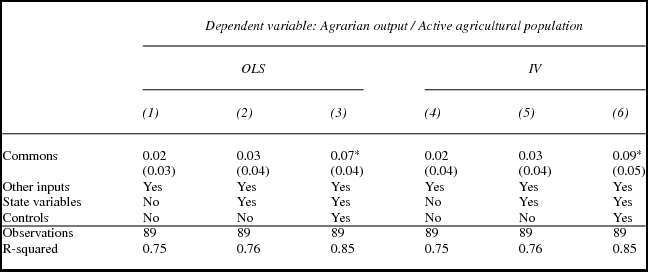
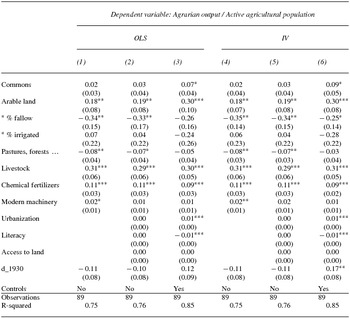
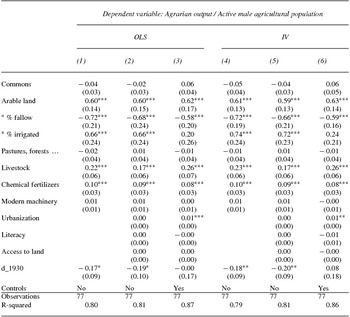
Table 1 reports the results from estimating the equation explained in the preceding text.Footnote 36 While column (1) shows the estimated coefficients of the baseline specification accounting for the different inputs affecting labor agricultural productivity, columns (2) and (3) add the state variables and the climate and geographical controls, respectively. The model employed accounts for 85 percent of the variation in productivity, which suggests that it fits remarkably well the subject under study. The two-stage IV approach, reported in columns (4) to (6), mostly confirms the results obtained using OLS. Contrary to the liberal ideology, the commons did not seem to have been directly detrimental to labor productivity. The coefficients are always positive but hardly statistically significant, although it should be noted that, when the effect of the state variables is controlled for, their positive impact becomes significant. The comparison with the estimated effect of pastures and forests held under private property, which is always negative, is also revealing. Columns (3) and (6) highlight that the supposed negative link between the commons and efficiency was rather reflecting the environmental conditions in which these resources were immersed than their actual productivity. Once climate or geographical variables are taken into account, the commons actually seem to have a positive influence on the agricultural sector. Given that the direct effect of livestock on agricultural productivity is already accounted for, this positive impact of the commons is explained, as argued in “Common Lands, Agrarian Reform, and Agricultural Modernization in Spain,” by their role as provider of organic fertilizer based on different types of fern, especially in humid Spain.Footnote 37
Commons and agricultural productivity, 1900–1930

Robust standard errors between brackets; *, **, or *** denotes significance at 10, 5, or 1 percent level. A time dummy for 1930 is included in all specifications. Other inputs refer to arable land, including its interaction with the fraction left fallow and irrigated; pastures, meadows, and forests; livestock; chemical fertilizers; and modern machinery. All input variables are computed in relation to the labor force and expressed in natural logs. State variables refer to urbanization, literacy, and access to land. The instruments are the lagged values of the endogenous variables (commons, urbanization, literacy, and access to land). Controls include temperature, rainfall, rainfall interacted by its coefficient of variation, ruggedness, altitude, population settlement pattern, distance to Madrid or Barcelona, and a coastal dummy. See Table 1.B in Appendix B for the full specification.
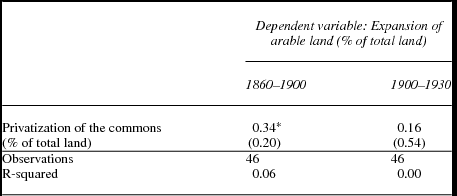
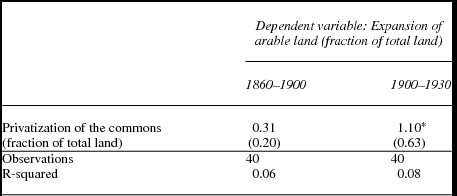
It is true nonetheless that one of the declared aims of the disentailment was to put more land under the plow.Footnote 38 The estimated coefficient on arable land is positive and significant and, therefore, by converting pasture and scrubland into cultivated land, privatization may have indirectly favored agricultural productivity.Footnote 39 Table 2 shows the results of regressing the fraction of land that became private on the fraction of land that was turned into crop land. Although the privatization process appears to have contributed to expanding arable land, the strength of that relationship is not that clear. Both variables show a weak positive relationship between 1860 and 1900 but the link between them completely disappears between 1900 and 1930. There is indeed evidence that the persistence of common lands, at least in some regions, was compatible with the expansion of arable land and increasing yields even in the first decades of the twentieth century, a period witnessing a significant modernization process.Footnote 40 Studying Navarre, Iriarte (Reference Iriarte1998: 128) shows that 40 percent of the plowing of new land between 1850 and 1935 was carried out in common lands that had been leased out. In any case, given that the estimated coefficient of arable land on output per worker is 0.30, assuming that 34 percent of the commons that were privatized helped feeding the expansion of crop land during the second half of the nineteenth century implies that, by potentially encouraging the expansion of land under cultivation, a 1 percent decrease in the stock of common lands would have increased labor productivity by 0.102 percent.Footnote 41 However, it should be noted that part of that land was kept fallow and, given that these lands show a negative relationship with output per worker, that figure should be adjusted. On average, in 1900, 36.5 percent of the arable land was left uncultivated in order to replenish soil nutrients. Therefore, the final opportunity cost of maintaining the commons derived from its potential benefit if put into tillage would be 0.071 percent.Footnote 42 When this figure is compared with the 0.09 percent effect of common lands on output per worker, the supposed advantage of expanding arable land resorting to the commons becomes negligible or even negative.Footnote 43 Furthermore, these estimates are based on the period ranging from 1900 to 1930, when the increasing availability of chemical fertilizers made the expansion of crop land on marginal lands potentially more productive. This possibility was seriously limited during the second half of the nineteenth century when extensification quickly ran into diminishing returns (González de Molina Reference González de Molina and Pujol2001: 69).
Enclosure and arable land expansion, 1860–1930

Robust standard errors between brackets; *, **, or *** denotes significance at 10, 5, or 1 percent level. For simplicity, the intercept is not reported.
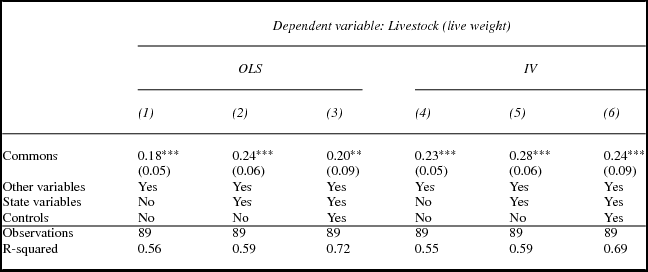
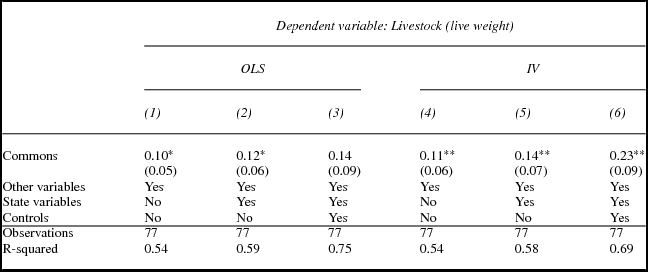
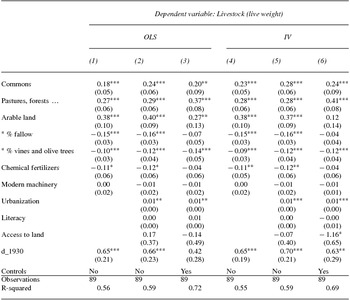
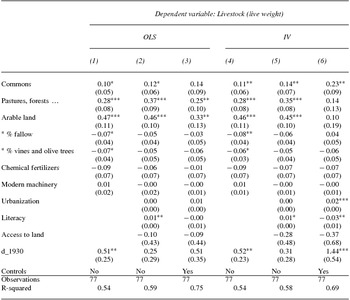
However, according to the arguments outlined in “Common Lands, Agrarian Reform, and Agricultural Modernization in Spain,” the commons played an essential role as providers of pasture. Given that the previous analysis shows that livestock density was significantly associated with higher levels of agricultural productivity, the link between those collective resources and livestock numbers should be explored in order to fully assess the role of common lands on agricultural development. Table 3 reports the estimation of the model presented in “Common Lands and Livestock” that, taking into account other potential determinants of livestock density, confirms the importance of the stock of common lands in supporting livestock. The estimated coefficient, computed based on information of the early twentieth century, should be taken as a minimum. It is likely that, during the second half of the nineteenth century, the role of the commons was even more important given the lack of alternatives to organic manure and animal draft energy.
Commons and livestock, 1900–1930

Robust standard errors between brackets; *, **, or *** denotes significance at 10, 5, or 1 percent level. A time dummy for 1930 is included in all specifications. Other variables refer to other potential determinants of livestock numbers: pastures, meadows, and forests; arable land, including its interaction with the fraction left fallow and the fraction devoted to vines and olive trees; chemical fertilizers; and modern machinery. All these variables, including the commons, are expressed in natural logs. State variables refer to urbanization, literacy, and access to land. The instruments are the lagged values of the endogenous variables (commons, urbanization, literacy, and access to land). Controls include temperature, rainfall, rainfall interacted by its standard deviation, ruggedness, altitude, population settlement pattern, distance to Madrid or Barcelona, and a coastal dummy. See Table 3.B in Appendix B for the full specification.
Therefore, if this indirect effect is taken into account, the positive assessment of the role of the commons on sustaining agricultural productivity becomes stronger. Given that a 1 percent increase in the stock of the commons is associated with a 0.24 percent increase in livestock numbers, and that the estimated effect of livestock on output per worker was 0.31, the indirect effect of the commons on agricultural productivity would be 0.074. Table 4 summarizes the overall influence of the commons on agricultural productivity. These figures should not be understood literally but as an educated guide about the processes at play. In any case, because the two first effects somewhat counterbalanced each other (both in economic and statistical sense), the net effect of the stock of common lands on output per worker remains positive and significant. According to these estimates, the attack on the commons, which mostly took place during the second half of the nineteenth century, and by which 33.5 percent of these resources became private (7.7 percent of the total land), reduced Spanish labor productivity a minimum of 2.3 percent, a negligible amount but also very far from the advocated potential benefits it was supposed to bring about.
Common lands and labor productivity, 1900–1930

*, **, or *** denotes significance at 10, 5, or 1 percent level. These figures reflect the estimated effect (in percentage points) of a 1 percent increase in the stock of common lands.
Common Lands and Agricultural Development in Arid or Semiarid Spain
Apart from the power of large landowners to promote the dismantling of the communal regime, the analysis of the factors explaining the dissimilar regional outcome of the privatization process shows a higher degree of privatization in dry regions (Beltrán Tapia Reference Beltrán Tapia2015a). In contrast to the intensification process carried out in humid Spain, farmers in arid or semiarid regions were likely to have been compelled to the extension of cultivated land if production wanted to be increased. The commons in both areas may have subsequently played different roles, so this section explores this possibility by replicating the previous empirical exercise but leaving aside those provinces that enjoyed an Atlantic climate.Footnote 44 The importance of aridity in constraining agricultural productivity has been widely acknowledged, yet cross-country comparative studies often tend to overlook climatic and geographical differences when accounting for the backwardness of Spanish agriculture (Gallego Reference Gallego2001; Tortella Reference Tortella1994). The lack of water certainly constituted the primary restraint on agricultural yields in dry regions, which refers to most of the country. Therefore, and following the typology presented by Gallego (Reference Gallego2001), the Atlantic provinces are dropped from the analysis.Footnote 45 The results of this exercise are reported in tables 5 to 8.
Commons and agricultural productivity in arid Spain, 1900–1930

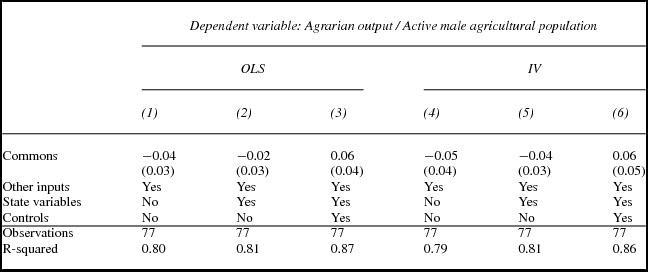
Robust standard errors between brackets; *, **, or *** denotes significance at 10, 5, or 1 percent level. All input variables are divided between the active agricultural populations and expressed in natural logs. The instruments are the lagged values of the endogenous variables (commons, urbanization, literacy, and access to land). Controls include temperature, rainfall, rainfall interacted by its standard deviation, ruggedness, altitude, population settlement pattern, distance to big cities, and a coastal dummy. See Table 5.B in Appendix B for the full specification.
Enclosure and arable land expansion in arid Spain, 1860–1930

Robust standard errors between brackets; *, **, or *** denotes significance at 10, 5, or 1 percent level.
Commons and livestock in arid Spain, 1900–1930

Robust standard errors between brackets; *, **, or *** denotes significance at 10, 5, or 1 percent level. All variables expressed in natural logs. The instruments are the lagged values of the endogenous variables (commons, urbanization, literacy, and access to land). Controls include temperature, rainfall, rainfall interacted by its coefficient of variation, ruggedness, altitude, population settlement pattern, distance to bid cities, and a coastal dummy. See Table 7.B in Appendix B for the full specification.
Common lands and labor productivity in arid Spain, 1900–1930

*, **, or *** denotes significance at 10, 5, or 1 percent level. These figures reflect the estimated effect (in percentage points) of a 1 percent increase in the stock of common lands.
Although the results of assessing the relative importance of the different inputs on agricultural productivity remain relatively unchanged from what has been shown in the previous section, some differences are nonetheless significant. Comparing these results with those obtained with the whole sample of Spanish provinces thus unveils interesting conclusions. First, the coefficient of the common lands in table 5 is never significant, which suggests that, due to their ability to support a higher volume of biomass, the commons were more productive in humid regions, especially regarding the possibility of providing fern-based fertilizers. In this regard, when a dummy for the Atlantic provinces is interacted with the common lands and added to the regression on the whole sample, its coefficient turns to be 0.29 and highly significant, while the general coefficient on the commons is positive but not statistically significant. This result strongly confirms the importance of the commons in providing nonanimal fertilizer in humid regions. Likewise, given that in nonhumid regions privatization was more intense and that the best commons were the first to be appropriated, the previous result may as well reflect that the remaining commons were less productive (De la Torre and Lana Reference De la Torre and Lana2000: 82). Second, the land-labor ratio now has a much larger impact on output per worker, illustrating the logic of extensification in dry areas. Therefore, the possibility of bringing land into cultivation at the expense of commons had a higher potential here.Footnote 46
Table 6 shows that the estimated relationship between the privatization of the commons and the extension of crop land between 1860 and 1900 is not statistically significant at the 10 percent level. However, its p-value is relatively low (0.123), which, given that the coefficient hardly changes with respect to the whole sample, is likely to be the result of the loss of degrees of freedom.Footnote 47 Assuming the estimated coefficients would imply that one percentage increase in the stock of common lands entailed an opportunity cost, in terms of the efficiency loss derived of not having transformed those lands into arable lands, of 0.195 percent. However, as in the previous section, the negative effect of fallow should also be taken into account. On average, these provinces kept fallow 43.5 percent of the cultivated area in 1900, a figure higher than the national average, which reflects the tougher constraints imposed by the lack of water. The adjusted impact would thus be 0.116 percentage points.
Lastly, table 7 confirms that the estimated effect of the commons on sustaining livestock remains virtually unchanged with respect to the estimation that also includes humid regions. Taking all these considerations together, the effect of common lands on labor productivity in dry regions turns out to be different from the impact estimated in the previous section. As shown in table 8, and assuming that no direct influence exists, the net effect of the stock of common lands on output per worker is now negative: a one percentage increase on the stock of common lands reduced output per worker by 0.06 percent. However, compared to the catastrophic admonitions of liberal thinkers, the efficiency loss is almost negligible. During the second half of the nineteenth century, when most of the attack on the communal regime took place, an average of around 41.9 percent of the commons was privatized in these provinces (around 8.1 percent of the total land). Therefore, this process contributed to increasing Spanish agricultural productivity by only 2.5 percent.Footnote 48 It should also be stressed that, given that the estimated elasticity of the extension of cultivated land on the dismantling of the commons was hardly significant, this figure should be taken as a maximum. Furthermore, as explained in the preceding text, the growing accessibility of chemical fertilizers during the first decades of the twentieth century made the expansion of crop land possible, while this strategy was much less productive during the second half of the nineteenth century, and especially so in the poor soils of dry Spain. The analysis carried out in this section also suggests that the diverse persistence of common lands, higher in humid areas and lower in arid or semiarid regions, is partly explained by the different role that these collective resources played in these different contexts, thus suggesting that, given their respective constraints, farmers all over Spain behaved somewhat sensibly when deciding whether to preserve the commons or not. This is not to deny that other factors were also affecting the privatization process, especially the more unequal access to the land prevailing in Southern Spain (Beltrán Tapia Reference Beltrán Tapia2015a).
Conclusion
The macroevidence presented here shows that Spanish peasants were not those “Goth and Vandals” subjected to an irrational communal culture as claimed by liberal advocates, but “civilized” farmers who knew how to adapt their agricultural practices to the constraints imposed by the wider economic, social, and environmental context. Common lands were a valuable resource because, apart from sustaining livestock density, they provided significant amount of fern-based organic manure, especially in humid Spain. Surely, putting more land under the plow at the expense of the commons increased the productivity of those spaces,Footnote 49 although this effect should have been even lower during the second half of the nineteenth century, where most of the attack on the common took place, due to the impossibility of supporting that extensification with chemical fertilizers. In any case, the net gains from privatization were small or even negative depending on the region analyzed. If we took into account the necessary costs of implementing the dismantling of the commons, especially high after 1855 when, by passing the so-called General Disentailment Act, the central state became involved in the process, those partial gains would become negligible or even negative. Among others, these costs include commissioning an inventory of these resources, surveying land values, organizing auctions, fencing plots, establishing a body of public agronomists and a police civil guard, together with the subsequent legal disputes that the process involved.Footnote 50 Furthermore, this article has only focused on the effect of the commons on agricultural productivity and has therefore left aside other important issues regarding the impact of privatization. In this regard, common lands contributed to complementing household and municipal incomes, thus positively enhancing the well-being of rural communities. Not only was the intensity of privatization negatively correlated with life expectancy and heights but also with schooling expenditures and literacy rates (Beltrán Tapia Reference Beltrán Tapia2013, Reference Beltrán Tapia2015b). Likewise, the social networks built around the use and management of these resources fostered social capital and facilitated the emergence of agricultural cooperatives during the first decades of the twentieth century (Beltrán Tapia Reference Beltrán Tapia2012). The commons were thus an essential part of the agricultural system and the overall functioning of local communities. By only listening to the advocates of privatization and forgetting the numerous warnings about the potential consequences of this policy, the General Disentailment Act removed that component and greatly disturbed the whole system, especially given that no other institution was established to take over the functions that the commons fulfilled. State intervention only began to slowly take care of some of these dysfunctions during the first decade of the twentieth century but, by then, most of the damage was already done.
APPENDIX A

Total Agricultural Output
Data on agricultural production is taken from Gallego (Reference Gallego1993). This author worked out information gathered by the GEHR (1991) to provide direct estimations of real agricultural output in 1900 and 1930 (in pesetas).Footnote 51 This author provides disaggregated information on the different agricultural subsectors: agriculture, livestock, and forestry.
Common Lands
Given the hybrid nature that characterized the concept of the “commons” in nineteenth-century Spain, this paper, following Iriarte (Reference Iriarte2002), identifies common lands as those lands that were collectively managed at the local level, in spite of their ownership being collective, municipal, or public. Thus, rather than using the data offered by the GEHR (1994) for the availability of common lands in Galicia, this article employs the data provided by Gallego (Reference Gallego2007), based on the estimates made by Artiaga and Balboa (Reference Artiaga and Balboa1992), that takes into account not only public lands, but also those collectively owned. Unfortunately, no data for the three provinces in the Basque Country is available. See the introduction for a discussion of this assumption. Common lands are measured in hectares.
However, the communal regime in Spain involved two main types of access to the land: a direct but regulated access for all members of the community (comunales) or a temporary cession of user rights to particular individuals in exchange for a monetary income (propios). The importance of collective user rights is measured by the fraction of total uses that were being enjoyed collectively (GEHR 1991). In order to avoid unexplained short-run variations in the data, the average proportion of collective practices over the periods 1861–70, 1903–13, and 1920–32 is used to account for the years 1860, 1900, and 1930, respectively. However, as mentioned in the text, this variable turned out to be statistically insignificant in all specifications so it was dropped from the analysis.
Land
Apart from the commons, two other main types of land are considered. On the one hand, following GEHR (1991), the area of forests, pastures, and meadows (montes, dehesas y pastos) that was not held in common is calculated by subtracting the total productive land from the arable land and the commons (GEHR 1994: 136).Footnote 52 On the other hand, arable land is also taken from Gallego (Reference Gallego1993) and the GEHR (1994). However, the intensity of cultivation depended on the amount of land left fallow and the possibility to resort to irrigation, so the importance of both elements is estimated.
The intensity of rotations is measured through the fraction of land left fallow when cultivating cereals and leguminous plants. While data for 1930 is the average from 1930–35, the figure for 1900 is the average from the periods 1886–90 and 1903–12 (GEHR 1991). Because no data is available for 1860, the data for the period 1886–90 is used instead. The only exception is the province of Alicante, which has no data for 1886–90, so only the information in 1903–12 is employed for both 1900 and 1860.
The amount of land irrigated is taken from contemporary governmental reports (Comisión de Estadística General del Reino 1859; Dirección General de Agricultura 1935; Junta Consultiva Agronómica 1904, 1918). Irrigated area for 1930 is calculated by summing up the area irrigated for each crop. Given the lack of information regarding irrigation in some crops in this date, information from 1935 is used. Because no distinction between dry farming and irrigation is made for some crops, various decisions have been made. Among the cereals, the agronomists in charge of the report Junta Consultiva Agronómica indicates that rice, millet (panizo), and pearl millet (mijo) were cultivated in irrigated land in the early twentieth century (Junta Consultiva Agronómica 1904: 14). Together with these two cereals, all huerta crops are assumed to be farmed in irrigated lands, while those fruit trees expected to be cultivated in dry farming (secano) are left out (higuera, almendro, castaño, nogal, or algarroba). Given that alfalfa, a fodder crop, “was almost exclusively cultivated in irrigated land” (Dirección General de Agricultura 1935: 398), it is also assumed to be irrigated. In the case of artificial pastures, the percentage under irrigation in 1922, the only date when the area devoted to them is split up into dry farming and irrigated, is applied to the area in 1935 (GEHR 1991).Footnote 53 Particular crops presenting suspicious figures have been corrected using data from 1930. The figures so calculated are consistent with information coming from regional studies when available. The numbers obtained have been corrected if major flaws were found by looking up at regional studies.Footnote 54 For instance, Garrabou and Pujol (Reference Garrabou and Pujol1987: 46) reduce the extremely high figure of Lérida in 1900. Also, Pérez-Picazo (Reference Picazo1997: 104), Sánchez-Picón (Reference Sánchez Picón1997: 112), Lana (Reference Lana, Garrabou and Naredo1999: 366), Gallego (Reference Gallego1986b), and Ibarra and Pinilla (Reference Ibarra, Pinilla, Garrabou and Naredo1999: 407) provide more accurate figures for Murcia, Almeria, Navarra, Logroño, and Zaragoza, respectively. The divergence between the figures for Cordoba in 1860 and 1900 is likely to be a typo, so the former has also been corrected. Likewise, given its subsequent evolution, Alicante and Albacete present an extremely high number in 1900, so the information in 1914 is used instead. A case in point is that of some Atlantic regions in 1860. The historical source assigns them with large amounts of irrigated area, especially devoted pastures. It seems, however, that some of them were not proper irrigation systems but areas that simply took advantage of the humid weather. Given that these areas do not generally appear as irrigated in the historical sources used for 1900 and 1930, a conservative approach has been taken regarding these regions and, subsequently, the figures for La Coruña, Lugo, Orense, and León have been corrected. Lastly, given its subsequent evolution, the source for 1860 is also likely to have overestimated the irrigated area in provinces such as Guadalajara, Palencia, Salamanca, Soria, Teruel, and Zamora, so the number in 1900 is used instead.
Labor Supply
The size of the agricultural working population is taken from different population censuses as collected by Rosés et al. (Reference Rosés, Martínez-Galarraga and Tirado2010). A number of problems arise when dealing with the agricultural labor force. First, population censuses do not consistently distinguish between workers employed in agriculture, livestock breeding, or forestry. However, as mentioned in the text, this is not a problem when analyzing the whole agricultural sector. Second, the lack of consistency between censuses regarding female working population advices to rely only on male workers, a usual procedure both in Spanish and international historical literature (Erdozáin and Mikelarena Reference Erdozáin and Mikelarena1999; Nicolau Reference Nicolau, Carreras and Tafunell2005; O'Brien and Prados de la Escosura Reference O'Brien and de la Escosura1992; Prados de la Escosura Reference Prados de la Escosura2008; Van Zanden Reference Zanden1991). Consistency between censuses also recommends using data of 1877 instead of 1860. It seems, nonetheless, that the population distribution did not change much between 1860 and 1877, while there was enough variation between 1877 and 1900.
Livestock
Provincial numbers of horses, mules, oxen, donkeys, pigs, goats, and sheep have been taken from the livestock censuses published in 1865, 1905, and 1929 and compiled by the GEHR (1991).Footnote 55 These numbers have been transformed into a comparable figure using the live weights coefficients for each species provided by Flores de Lemus (Reference Flores de Lemus1951) in 1917.Footnote 56 Although the size of animals, as well as the fraction of them stabled, may have increased throughout the period, especially during the first decades of the twentieth century, these two variables are assumed to be constant due to the lack of information. Because livestock provided traction and fertilizer, this variable has been partitioned into two: draft energy and organic manure.
On the one hand, given that only horses, mules, oxen, and donkeys are able to be employed in agricultural tasks, their numbers have been transformed into potential draft power by applying the coefficients in Simpson (Reference Simpson1987: 282).Footnote 57 On the other hand, the fertilizing capacity is measured based on the livestock total live weight calculated in the preceding text. Following the methodology employed in Gallego (Reference Gallego and Garrabou1986a: 225) and Zapata (Reference Zapata1986: 1538–39), total live weights are transformed into tons of manure depending on the intensity in the use of manure in each area.Footnote 58 In addition, in order to be able to compare the livestock fertilizer capacity with that of modern fertilizers, its actual fertilizing nutrients, in terms of phosphorus pentoxide (P2O5), nitrogen (N), and potassium oxide (K2O), are computed for each type of animal. However, as mentioned in the text, multicollinearity problems prevent employing these series simultaneously in the regression analysis.
Chemical Fertilizers
Gallego (Reference Gallego1993) provides a complete picture of the provincial consumption of modern fertilizers in 1932. It can be safely assumed that, for 1860, apart from the early diffusion of guano in a few Mediterranean provinces (see the following text), no chemical fertilizers were employed in Spanish agriculture. The situation in 1900 is somewhat different. Although their diffusion had been very slow in general terms, the use of these inputs had already progressed in several regions, especially in the Mediterranean coast and the Ebro valley (Gallego Reference Gallego1993). Although no information at the provincial level is available for 1900, a Spanish agronomist provides an account of the consumption of chemical fertilizers by province in 1907 and 1908 (Alonso de Ilera Reference Alonso de Ilera1909). Given that the use of these inputs at the national level increased between 1900 and 1907/08 (Gallego Reference Gallego and Garrabou1986a: 223), the provincial figures are adapted accordingly assuming that the relative distribution between provinces did not change between those dates. The figures obtained are mostly consistent with the qualitative assessments about the importance of the use of modern inputs in each province given by agronomists in several reports conducted by the central state (Junta Consultiva Agronómica 1891, 1904).Footnote 59 Lastly, following Gallego (Reference Gallego and Garrabou1986a: 224), these gross figures are converted into equivalent nutrient units of nitrogen (N), phosphorous (P2O5), and potash (K2O).Footnote 60
However, the assumption that there was no consumption of modern fertilizers in 1860 may be misleading because guano was relatively relevant in some areas during the second half of the nineteenth century (Reference Gallego and Garrabouibid.: 174). Guano was intensely used in paddy fields and orange grooves in Valencia, a region that, together with Britain, pioneered in importing guano from Africa and South America (Simpson Reference Simpson1995: 102).Footnote 61 Data on guano imports from Catalonia and Valencia is taken from Porqueres (Reference Porqueres1975).Footnote 62 Although no other data is available about other provinces, the bias imposed by this lack of information is negligible due to the fact that these two regions consumed 97 percent of the total Spanish imports of this fertilizer in 1862/63, a figure that had hardly decreased by 1900.Footnote 63 Given the availability of data and the need to prevent unexplained short-run variations, the average figures for the periods 1862–65 and 1895–1900 are employed. The total regional imports are allocated among each province using their relative importance in the consumption of chemical fertilizers in 1900. Finally, in order to homogenize these figures with those of chemical fertilizers, the actual chemical content of Peruvian guano is considered: nitrogen (12.3 percent), phosphorus (9.5 percent), and potassium (2.5 percent).Footnote 64 In any case, the results reported in the text remain unchanged regardless whether the series on artificial fertilizers contains guano or not.
Modern Machinery
A complete census of agricultural machinery, providing quantitative information about all sorts of different machines, is only available for 1932. Given that tracing back all this information for the previous periods is almost impossible, only three types of machinery are used as proxies for the introduction of mechanical innovations in cereal farming: modern plows, threshing machines, and tractors.Footnote 65 Given that the historical sources do not mention the presence of these innovations in any province around 1860, a value of 0 is assumed for these variables at that date. Estimations for 1900 are based on the information provided by agronomists working in each province at the end of the nineteenth century (Junta Consultiva Agronómica 1891).Footnote 66 This qualitative and quantitative information is contrasted with regional figures provided in different studies and corrected if necessary.Footnote 67
First, except in some regions, modern plows were hardly used in 1900 (Simpson Reference Simpson1987: 280). Bearing this in mind, the qualitative assessments provided by agronomists point to whether or not this new equipment was completely ignored, known by a minority, and relatively or widely spread. In order to transform this qualitative information into figures, each province is classified in one of those four groups. The estimated number of modern plows is then computed by assuming that, accordingly, each group had 0, 2.5, 5, or 10 percent of the plows existent in 1930.Footnote 68
Second, regarding more advanced agricultural machinery, it can be safely assumed that it was not employed in 1860.Footnote 69 Although their importance at the national level was still anecdotal by 1900, the diffusion of labor-saving technology had nonetheless progressed in a few provinces, especially in Cádiz and Seville (Martínez Ruiz Reference Martínez Ruiz2000: 23–24, 49).Footnote 70 Information for 1900 is mostly qualitative but the sources sometimes stated the number of those apparatus that agronomists knew to be operating in a particular province. The total national figure obtained by this procedure is 177. Given that the total number of locomóviles, part of the “set” including a thresher machine, imported between 1862 and 1893 was 310, and that not all of them were likely to be operating in 1890, this figure is plausible (45–46).Footnote 71 Additional corrections have nonetheless been made. The original source in 1891 points to the existence of numerous thresher machines in the province of Barcelona. Given that Cádiz and Seville, with 30 and 90 thresher machines, respectively, were the provinces where this technology was more widespread, a figure of 30 apparatuses is assumed. Likewise, the source indicates the presence of “some” thresher machines for rice in the province of Valencia in 1891. These “some” is assumed to be 3.Footnote 72
Third, the number of tractors is considered in order to account for the motorization of agriculture. Martínez Ruiz (Reference Martínez Ruiz2000: 114) shows that the first tractors arrived to the peninsula in 1902, so it can be safely assumed that tractors were unknown in 1860 and 1900. Complete quantitative information regarding tractors is available for 1930 (Gallego Reference Gallego1993).
Lastly, once a series for each of these inputs is obtained, they are collapsed together under the category of modern machinery by employing average prices provided by Martínez Ruíz (Reference Martínez Ruiz2000: 90, 144).
Other Variables
Urbanization is measured as the proportion of population living in cities bigger than 5,000 inhabitants and the gross value added by nonagricultural activities per capita, respectively (Rosés et al. Reference Rosés, Martínez-Galarraga and Tirado2010; Tafunell Reference Tafunell, Carreras and Tafunell2005). Literacy rates are taken from Núñez (Reference Núñez1992). Inequality in access to the land is measured through the fraction of landowners over active agricultural population (Dirección General del Institutito Geográfico y Estadístico 1863, 1922). Because data on landownership is only available for 1860 and 1920, linear interpolation is employed to estimate the figure for 1900. For 1930, the information on 1920 is used.
Regarding the time-invariant factors, average rainfall, rainfall variation, and average temperature come from long-term series data (Goerlich Reference Goerlich2010). Likewise, while the ruggedness index quantifies terrain irregularity by comparing the altitude between neighbouring cells using GIS, altitude is measured as the fraction of provincial land over 1,000 meters (Goerlich and Cantarino Reference Goerlich and Cantarino2011; INE 2000 ). The population settlement pattern refers to the number of hectares per parish (Comisión de Estadística General del Reino 1860). Lastly, distance to big cities, Madrid, Barcelona, or Bilbao, is computed as the minimum geographical distance from the provincial capital to any of those cities.
APPENDIX B
Commons and agricultural productivity, 1900–1930

Commons and livestock

Commons and agricultural productivity in arid Spain, 1900–1930

Commons and livestock in arid Spain