Introduction
Psychotic disorders, including schizophrenia and bipolar disorder, have considerable heritability with estimates ranging between 60 and 85% (Cardno et al. Reference Cardno, Marshall, Coid, Macdonald, Ribchester, Davies, Venturi, Jones, Lewis, Sham, Gottesman, Farmer, McGuffin, Reveley and Murray1999; Smoller & Finn, Reference Smoller and Finn2003; Sullivan et al. Reference Sullivan, Daly and O'Donovan2012), and there is evidence of significant genetic overlap between these disorders (Lee et al. Reference Lee, Ripke, Neale, Faraone, Purcell, Perlis, Mowry, Thapar, Goddard, Witte, Absher, Agartz, Akil, Amin, Andreassen, Anjorin, Anney, Anttila, Arking, Asherson, Azevedo, Backlund, Badner, Bailey, Banaschewski, Barchas, Barnes, Barrett, Bass, Battaglia, Bauer, Bayés, Bellivier, Bergen, Berrettini, Betancur, Bettecken, Biederman, Binder, Black, Blackwood, Bloss, Boehnke, Boomsma, Breen, Breuer, Bruggeman, Cormican, Buccola, Buitelaar, Bunney, Buxbaum, Byerley, Byrne, Caesar, Cahn, Cantor, Casas, Chakravarti, Chambert, Choudhury, Cichon, Cloninger, Collier, Cook, Coon, Cormand, Corvin, Coryell, Craig, Craig, Crosbie, Cuccaro, Curtis, Czamara, Datta, Dawson, Day, De Geus, Degenhardt, Djurovic, Donohoe, Doyle, Duan, Dudbridge, Duketis, Ebstein, Edenberg, Elia, Ennis, Etain, Fanous, Farmer, Ferrier, Flickinger, Fombonne, Foroud, Frank, Franke, Fraser, Freedman, Freimer, Freitag, Friedl, Frisén, Gallagher, Gejman, Georgieva, Gershon, Geschwind, Giegling, Gill, Gordon, Gordon Smith, Green, Greenwood, Grice, Gross, Grozeva, Guan, Gurling, De Haan, Haines, Hakonarson, Joachim Hallmayer, Hamilton, Hamshere, Hansen, Hartmann, Hautzinger, Heath, Henders, Herms, Hickie, Hipolito, Hoefels, Holmans, Holsboer, Hoogendijk, Hottenga, Hultman, Hus, Ingason, Ising, Jamain, Jones, Jones, Jones, Jung-Ying, Kähler, Kahn, Kandaswamy, Keller, Kennedy, Kenny, Kent, Kim, Kirov, Klauck, Klei, Knowles, Kohli, Koller, Konte, Korszun, Krabbendam, Krasucki, Kuntsi, Kwan, Landén, Långström, Lathrop, Lawrence, Lawson, Leboyer, Ledbetter, Hyoun Lee, Lencz, Lesch, Levinson, Lewis, Li, Lichtenstein, Lieberman, Lin, Linszen, Liu, Lohoff, Loo, Lord, Lowe, Lucae, MacIntyre, Madden, Maestrini, Magnusson, Mahon, Maier, Malhotra, Mane, Martin, Martin, Mattheisen, Matthews, Mattingsdal, McCarroll, McGhee, McGough, McGrath, McGuffin, McInnis, McIntosh, McKinney, McLean, McMahon, McMahon, McQuillin, Medeiros, Medland, Meier, Melle, Meng, Meyer, Middeldorp, Middleton, Milanova, Miranda, Monaco, Montgomery, Moran, Moreno-De-Luca, Morken, Morris, Morrow, Moskvina, Muglia, Mühleisen, Muir, Müller-Myhsok, Murtha, Myers, Myin-Germeys, Neale, Nelson, Nievergelt, Nikolov, Nimgaonkar, Nolen, Nöthen, Nurnberger, Nwulia, Nyholt, O'Dushlaine, Oades, Ann Olincy, Guiomar Oliveira, Olsen, Ophoff, Osby, Owen, Palotie, Parr, Paterson, Pato, Pato, Penninx, Pergadia, Pericak-Vance, Pickard, Pimm, Piven, Posthuma, Potash, Poustka, Propping, Puri, Quested, Quinn, Ramos-Quiroga, Rasmussen, Raychaudhuri, Rehnström, Reif, Ribasés, Rice, Rietschel, Roeder, Roeyers, Rossin, Rothenberger, Rouleau, Ruderfer, Rujescu, Sanders, Sanders, Santangelo, Sargeant, Schachar, Schalling, Schatzberg, Scheftner, Schellenberg, Scherer, Schork, Schulze, Schumacher, Schwarz, Scolnick, Scott, Shi, Shilling, Shyn, Silverman, Slager, Smalley, Smit, Smith, Sonuga-Barke, St Clair, State, Steffens, Steinhausen, Strauss, Strohmaier, Stroup, Sutcliffe, Szatmari, Szelinger, Thirumalai, Thompson, Todorov, Tozzi, Treutlein, Uhr, van den Oord, Van Grootheest, Van Os, Vicente, Vieland, Vincent, Visscher, Walsh, Wassink, Watson, Weissman, Werge, Wienker, Wiersma, Wijsman, Willemsen, Williams, Willsey, Witt, Xu, Young, Yu, Zammit, Zandi, Zhang, Zitman, Zöllner, Devlin, Kelsoe, Sklar, Daly, O'Donovan, Craddock, Sullivan, Smoller, Kendler and Wray2013). Psychoses are complex genetic disorders where many common variants contribute small increments of risk, and rare variants contribute greater risks (Gratten et al. Reference Gratten, Wray, Keller and Visscher2014; Geschwind & Flint, Reference Geschwind and Flint2015). While many common loci and some rare variants have now been identified (Stefansson et al. Reference Stefansson, Rujescu, Cichon, Pietiläinen, Ingason, Steinberg, Fossdal, Sigurdsson, Sigmundsson, Buizer-Voskamp, Hansen, Jakobsen, Muglia, Francks, Matthews, Gylfason, Halldorsson, Gudbjartsson, Thorgeirsson, Sigurdsson, Jonasdottir, Jonasdottir, Bjornsson, Mattiasdottir, Blondal, Haraldsson, Magnusdottir, Giegling, Möller, Hartmann, Shianna, Ge, Need, Crombie, Fraser, Walker, Lonnqvist, Suvisaari, Tuulio-Henriksson, Paunio, Toulopoulou, Bramon, Di Forti, Murray, Ruggeri, Vassos, Tosato, Walshe, Li, Vasilescu, Mühleisen, Wang, Ullum, Djurovic, Melle, Olesen, Kiemeney, Franke, Sabatti, Freimer, Gulcher, Thorsteinsdottir, Kong, Andreassen, Ophoff, Georgi, Rietschel, Werge, Petursson, Goldstein, Nöthen, Peltonen, Collier, St Clair, Stefansson, Kahn, Linszen, van Os, Wiersma, Bruggeman, Cahn, de Haan, Krabbendam and Myin-Germeys2008; Stone et al. Reference Stone, O'Donovan, Gurling, Kirov, Blackwood, Corvin, Craddock, Gill, Hultman, Lichtenstein, McQuillin, Pato, Ruderfer, Owen, St Clair, Sullivan, Sklar, Purcell, Korn, Macgregor, Morris, O'Dushlaine, Daly, Visscher, Holmans, Scolnick, Williams, Georgieva, Nikolov, Norton, Williams, Toncheva, Milanova, Thelander, Sullivan, Kenny, Waddington, Choudhury, Datta, Pimm, Thirumalai, Puri, Krasucki, Lawrence, Quested, Bass, Curtis, Crombie, Fraser, Leh Kwan, Walker, Muir, McGhee, Pickard, Malloy, Maclean, Van Beck, Pato, Medeiros, Middleton, Carvalho, Morley, Fanous, Conti, Knowles, Paz Ferreira, Macedo, Helena Azevedo, McCarroll, Daly, Chambert, Gates, Gabriel, Mahon and Ardlie2008; Walsh et al. Reference Walsh, McClellan, McCarthy, Addington, Pierce, Cooper, Nord, Kusenda, Malhotra, Bhandari, Stray, Rippey, Roccanova, Makarov, Lakshmi, Findling, Sikich, Stromberg, Merriman, Gogtay, Butler, Eckstrand, Noory, Gochman, Long, Chen, Davis, Baker, Eichler, Meltzer, Nelson, Singleton, Lee, Rapoport, King and Sebat2008; Xu et al. Reference Xu, Roos, Levy, van Rensburg, Gogos and Karayiorgou2008; Purcell et al. Reference Purcell, Wray, Stone, Visscher, O'Donovan, Sullivan and Sklar2009; Grozeva et al. Reference Grozeva, Conrad, Barnes, Hurles, Owen, O'Donovan, Craddock and Kirov2011; Sklar et al. Reference Sklar, Ripke, Scott and Andreassen2011; Lee et al. Reference Lee, Ripke, Neale, Faraone, Purcell, Perlis, Mowry, Thapar, Goddard, Witte, Absher, Agartz, Akil, Amin, Andreassen, Anjorin, Anney, Anttila, Arking, Asherson, Azevedo, Backlund, Badner, Bailey, Banaschewski, Barchas, Barnes, Barrett, Bass, Battaglia, Bauer, Bayés, Bellivier, Bergen, Berrettini, Betancur, Bettecken, Biederman, Binder, Black, Blackwood, Bloss, Boehnke, Boomsma, Breen, Breuer, Bruggeman, Cormican, Buccola, Buitelaar, Bunney, Buxbaum, Byerley, Byrne, Caesar, Cahn, Cantor, Casas, Chakravarti, Chambert, Choudhury, Cichon, Cloninger, Collier, Cook, Coon, Cormand, Corvin, Coryell, Craig, Craig, Crosbie, Cuccaro, Curtis, Czamara, Datta, Dawson, Day, De Geus, Degenhardt, Djurovic, Donohoe, Doyle, Duan, Dudbridge, Duketis, Ebstein, Edenberg, Elia, Ennis, Etain, Fanous, Farmer, Ferrier, Flickinger, Fombonne, Foroud, Frank, Franke, Fraser, Freedman, Freimer, Freitag, Friedl, Frisén, Gallagher, Gejman, Georgieva, Gershon, Geschwind, Giegling, Gill, Gordon, Gordon Smith, Green, Greenwood, Grice, Gross, Grozeva, Guan, Gurling, De Haan, Haines, Hakonarson, Joachim Hallmayer, Hamilton, Hamshere, Hansen, Hartmann, Hautzinger, Heath, Henders, Herms, Hickie, Hipolito, Hoefels, Holmans, Holsboer, Hoogendijk, Hottenga, Hultman, Hus, Ingason, Ising, Jamain, Jones, Jones, Jones, Jung-Ying, Kähler, Kahn, Kandaswamy, Keller, Kennedy, Kenny, Kent, Kim, Kirov, Klauck, Klei, Knowles, Kohli, Koller, Konte, Korszun, Krabbendam, Krasucki, Kuntsi, Kwan, Landén, Långström, Lathrop, Lawrence, Lawson, Leboyer, Ledbetter, Hyoun Lee, Lencz, Lesch, Levinson, Lewis, Li, Lichtenstein, Lieberman, Lin, Linszen, Liu, Lohoff, Loo, Lord, Lowe, Lucae, MacIntyre, Madden, Maestrini, Magnusson, Mahon, Maier, Malhotra, Mane, Martin, Martin, Mattheisen, Matthews, Mattingsdal, McCarroll, McGhee, McGough, McGrath, McGuffin, McInnis, McIntosh, McKinney, McLean, McMahon, McMahon, McQuillin, Medeiros, Medland, Meier, Melle, Meng, Meyer, Middeldorp, Middleton, Milanova, Miranda, Monaco, Montgomery, Moran, Moreno-De-Luca, Morken, Morris, Morrow, Moskvina, Muglia, Mühleisen, Muir, Müller-Myhsok, Murtha, Myers, Myin-Germeys, Neale, Nelson, Nievergelt, Nikolov, Nimgaonkar, Nolen, Nöthen, Nurnberger, Nwulia, Nyholt, O'Dushlaine, Oades, Ann Olincy, Guiomar Oliveira, Olsen, Ophoff, Osby, Owen, Palotie, Parr, Paterson, Pato, Pato, Penninx, Pergadia, Pericak-Vance, Pickard, Pimm, Piven, Posthuma, Potash, Poustka, Propping, Puri, Quested, Quinn, Ramos-Quiroga, Rasmussen, Raychaudhuri, Rehnström, Reif, Ribasés, Rice, Rietschel, Roeder, Roeyers, Rossin, Rothenberger, Rouleau, Ruderfer, Rujescu, Sanders, Sanders, Santangelo, Sargeant, Schachar, Schalling, Schatzberg, Scheftner, Schellenberg, Scherer, Schork, Schulze, Schumacher, Schwarz, Scolnick, Scott, Shi, Shilling, Shyn, Silverman, Slager, Smalley, Smit, Smith, Sonuga-Barke, St Clair, State, Steffens, Steinhausen, Strauss, Strohmaier, Stroup, Sutcliffe, Szatmari, Szelinger, Thirumalai, Thompson, Todorov, Tozzi, Treutlein, Uhr, van den Oord, Van Grootheest, Van Os, Vicente, Vieland, Vincent, Visscher, Walsh, Wassink, Watson, Weissman, Werge, Wienker, Wiersma, Wijsman, Willemsen, Williams, Willsey, Witt, Xu, Young, Yu, Zammit, Zandi, Zhang, Zitman, Zöllner, Devlin, Kelsoe, Sklar, Daly, O'Donovan, Craddock, Sullivan, Smoller, Kendler and Wray2013; Ripke et al. Reference Ripke, O'Dushlaine, Chambert, Moran, Kähler, Akterin, Bergen, Collins, Crowley, Fromer, Kim, Lee, Magnusson, Sanchez, Stahl, Williams, Wray, Xia, Bettella, Borglum, Bulik-Sullivan, Cormican, Craddock, de Leeuw, Durmishi, Gill, Golimbet, Hamshere, Holmans, Hougaard, Kendler, Lin, Morris, Mors, Mortensen, Neale, O'Neill, Owen, Milovancevic, Posthuma, Powell, Richards, Riley, Ruderfer, Rujescu, Sigurdsson, Silagadze, Smit, Stefansson, Steinberg, Suvisaari, Tosato, Verhage, Walters, Bramon, Corvin, O'Donovan, Stefansson, Scolnick, Purcell, McCarroll, Sklar, Hultman and Sullivan2013, Reference Ripke, Neale, Corvin and Walter2014; Green et al. Reference Green, Rees, Walters, Smith, Forty, Grozeva, Moran, Sklar, Ripke, Chambert, Genovese, McCarroll, Jones, Jones, Owen, O'Donovan, Craddock and Kirov2015), little is known about their functional roles and the mechanisms through which they lead to the disease (Geschwind & Flint, Reference Geschwind and Flint2015; Harrison, Reference Harrison2015).
Endophenotypes could help us gain a better understanding of the underlying neurobiology (Gottesman & Gould, Reference Gottesman and Gould2003; Cannon & Keller, Reference Cannon and Keller2006; Gur et al. Reference Gur, Calkins, Gur, Horan, Nuechterlein, Seidman and Stone2007). These are biological markers which are heritable, co-segregate with a disorder within families, are observed in unaffected family members at a higher rate than in the general population, and are expressed in an individual whether or not the illness is active (Gottesman & Gould, Reference Gottesman and Gould2003). Endophenotypes could thus be used to better understand the mechanisms underlying the associations between genetic variants and the disorder (Hall & Smoller, Reference Hall and Smoller2010; Braff, Reference Braff2015).
Although there is an extensive literature identifying and validating endophenotypes for psychosis, fewer studies have examined the relationships between different endophenotypes. Studies conducted so far have mainly analysed the associations between different cognitive measures (Toomey et al. Reference Toomey, Faraone, Seidman, Kremen, Pepple and Tsuang1998; Dickinson et al. Reference Dickinson, Iannone and Gold2002, Reference Dickinson, Ragland, Calkins, Gold and Gur2006; Sullivan et al. Reference Sullivan, Kendler and Neale2003; Gladsjo et al. Reference Gladsjo, McAdams, Palmer, Moore, Jeste and Heaton2004; Sheffield et al. Reference Sheffield, Gold, Strauss, Carter, MacDonald, Ragland, Silverstein and Barch2014; Seidman et al. Reference Seidman, Hellemann, Nuechterlein, Greenwood, Braff, Cadenhead, Calkins, Freedman, Gur, Gur, Lazzeroni, Light, Olincy, Radant, Siever, Silverman, Sprock, Stone, Sugar, Swerdlow, Tsuang, Tsuang, Turetsky and Green2015), but there is a lack of literature examining brain structural–cognitive and electrophysiological–cognitive pairings. Moreover, the inclusion of unaffected relatives in these studies has been rare, yet examining relatives – who carry increased genetic risk but have no illness or treatment confounding factors – is crucial for establishing the utility of these markers for genetic research.
This study seeks to investigate the relationships between the following electrophysiological, neurocognitive, and neuroanatomical endophenotypes for psychosis:
• P300 event-related potential: Reduced amplitude and prolonged latency of the P300 wave have consistently been found in patients with psychotic illnesses as well as in unaffected relatives, compared with controls (Blackwood et al. Reference Blackwood, St Clair, Muir and Duffy1991; Weisbrod et al. Reference Weisbrod, Hill, Niethammer and Sauer1999; Pierson et al. Reference Pierson, Jouvent, Quintin, Perez-Diaz and Leboyer2000; Winterer et al. Reference Winterer, Coppola, Sc, Goldberg, Ph, Egan, Jones, Sanchez, Weinberger, Raedler, Sanchez, Jones, Coppola and Weinberger2003; Bramon et al. Reference Bramon, McDonald, Croft, Landau, Filbey, Gruzelier, Sham, Frangou and Murray2005; Price et al. Reference Price, Michie, Johnston, Innes-Brown, Kent, Clissa and Jablensky2006; Schulze et al. Reference Schulze, Hall, Mcdonald, Marshall, Walshe, Murray and Bramon2008; Bestelmeyer et al. Reference Bestelmeyer, Phillips, Crombie, Benson and Clair2009; Díez et al. Reference Díez, Suazo, Casado, Martín-Loeches, Molina, Díez, Suazo, Casado, Martín-Loeches and Molina2013; Light et al. Reference Light, Swerdlow, Thomas, Calkins, Green, Greenwood, Gur, Gur, Lazzeroni, Nuechterlein, Pela, Radant, Seidman, Sharp, Siever, Silverman, Sprock, Stone, Sugar, Tsuang, Tsuang, Braff and Turetsky2015; Turetsky et al. Reference Turetsky, Dress, Braff, Calkins, Green, Greenwood, Gur, Gur, Lazzeroni, Nuechterlein, Radant, Seidman, Siever, Silverman, Sprock, Stone, Sugar, Swerdlow, Tsuang, Tsuang and Light2015). The P300 amplitude is thought to be a correlate of attention and working memory (Näätänen, Reference Näätänen1990; Ford, Reference Ford2014). Although the latency has been less precisely characterized, it is thought to index classification speed (Polich, Reference Polich2007, Reference Polich, Kappenman and Luck2011).
• Cognitive performance: Deficits on cognitive tests such as digit span (measuring working memory), block design (measuring working memory and spatial visualisation), and the Rey Auditory Verbal Learning Task (RAVLT) immediate and delayed recall (measuring short- and long-term verbal memory, respectively) are common and persistent across psychotic disorders (Heinrichs & Zakzanis, Reference Heinrichs and Zakzanis1998; Gur et al. Reference Gur, Calkins, Gur, Horan, Nuechterlein, Seidman and Stone2007; Bora et al. Reference Bora, Yucel and Pantelis2009; Stone et al. Reference Stone, Giuliano, Tsuang, Braff, Cadenhead, Calkins, Dobie, Faraone, Freedman, Green, Greenwood, Gur, Gur, Light, Mintz, Nuechterlein, Olincy, Radant, Roe, Schork, Siever, Silverman, Swerdlow, Thomas, Tsuang, Turetsky and Seidman2011; Bora & Pantelis, Reference Bora and Pantelis2015; Kim et al. Reference Kim, Seo, Yun, Jung, Park, Lee, Moon, Hong, Yoon and Bahk2015b; Lee et al. Reference Lee, Green, Calkins, Greenwood, Gur, Gur, Lazzeroni, Light, Nuechterlein, Radant, Seidman, Siever, Silverman, Sprock, Stone, Sugar, Swerdlow, Tsuang, Tsuang, Turetsky and Braff2015). Abnormalities are often observed before the onset of the illness as well as in unaffected relatives (Glahn et al. Reference Glahn, Bearden, Cakir, Barrett, Najt, Serap Monkul, Maples, Velligan and Soares2006; Saperstein et al. Reference Saperstein, Fuller, Avila, Adami, McMahon, Thaker and Gold2006; Snitz et al. Reference Snitz, Macdonald and Carter2006; Birkett et al. Reference Birkett, Sigmundsson, Sharma, Toulopoulou, Griffiths, Reveley and Murray2008; Horan et al. Reference Horan, Braff, Nuechterlein, Sugar, Cadenhead, Calkins, Dobie, Freedman, Greenwood, Gur, Gur, Light, Mintz, Olincy, Radant, Schork, Seidman, Siever, Silverman, Stone, Swerdlow, Tsuang, Tsuang, Turetsky and Green2008; Forbes et al. Reference Forbes, Carrick, McIntosh and Lawrie2009; Reichenberg et al. Reference Reichenberg, Caspi, Harrington, Houts, Keefe, Murray, Poulton and Moffitt2010; Ivleva et al. Reference Ivleva, Morris, Osuji, Moates, Carmody, Thaker, Cullum and Tamminga2012; Park & Gooding, Reference Park and Gooding2014; Gur et al. Reference Gur, Braff, Calkins, Dobie, Freedman, Green, Greenwood, Lazzeroni, Light, Nuechterlein, Olincy, Radant, Seidman, Siever, Silverman, Sprock, Stone, Sugar, Swerdlow, Tsuang, Tsuang, Turetsky and Gur2015).
• Lateral ventricular volume: Increased ventricular volume is a highly replicated finding in patients with psychosis compared with controls (Sharma et al. Reference Sharma, Lancaster, Lee, Lewis, Sigmundsson, Takei, Gurling, Barta, Pearlson and Murray1998; Fannon et al. Reference Fannon, Tennakoon, Sumich, O'Ceallaigh, Doku, Chitnis, Lowe, Soni and Sharma2000; Wright et al. Reference Wright, Rabe-Hesketh, Woodruff, David, Murray and Bullmore2000; Shenton et al. Reference Shenton, Dickey, Frumin and McCarley2001; McDonald et al. Reference McDonald, Grech, Toulopoulou, Schulze, Chapple, Sham, Walshe, Sharma, Sigmundsson, Chitnis and Murray2002, Reference McDonald, Marshall, Sham, Bullmore, Schulze, Chapple, Bramon, Filbey, Quraishi, Walshe and Murray2006; Strasser et al. Reference Strasser, Lilyestrom, Ashby, Honeycutt, Schretlen, Pulver, Hopkins, Depaulo, Potash, Schweizer, Yates, Kurian, Barta and Pearlson2005; Boos et al. Reference Boos, Aleman, Cahn, Hulshoff Pol and Kahn2007; Crespo-Facorro et al. Reference Crespo-Facorro, Roiz-Santiáñez, Pérez-Iglesias, Tordesillas-Gutiérrez, Mata, Rodríguez-Sánchez, de Lucas and Vázquez-Barquero2009; Kempton et al. Reference Kempton, Stahl, Williams and DeLisi2010; Fusar-Poli et al. Reference Fusar-Poli, Smieskova, Kempton, Ho, Andreasen and Borgwardt2013; Haijma et al. Reference Haijma, Van Haren, Cahn, Koolschijn, Hulshoff Pol and Kahn2013; Kumra et al. Reference Kumra, Giedd, Vaituzis, Jacobsen, McKenna, Bedwell, Hamburger, Nelson, Lenane and Rapoport2014). This enlargement has been attributed to neurodevelopmental difficulties, disease progression, and/or the effects of antipsychotic medications (Pilowsky et al. Reference Pilowsky, Kerwin and Murray1993; Gogtay et al. Reference Gogtay, Sporn, Clasen, Greenstein, Giedd, Lenane, Gochman, Zijdenbos and Rapoport2003; McDonald et al. Reference McDonald, Marshall, Sham, Bullmore, Schulze, Chapple, Bramon, Filbey, Quraishi, Walshe and Murray2006).
This multi-centre study, seeking to investigate the relationships between multi-modal endophenotypes, includes the largest sample yet of individuals with psychosis, their unaffected first-degree relatives, and controls. The main objective is to facilitate the use of endophenotypes for genetic research into psychosis, which requires well defined and characterised measures. The aim of this study was therefore to examine the relationships between different endophenotype pairs, and in particular, to characterise the P300 event related potential in the context of well-defined cognitive markers.
Methods and materials
Sample and clinical assessments
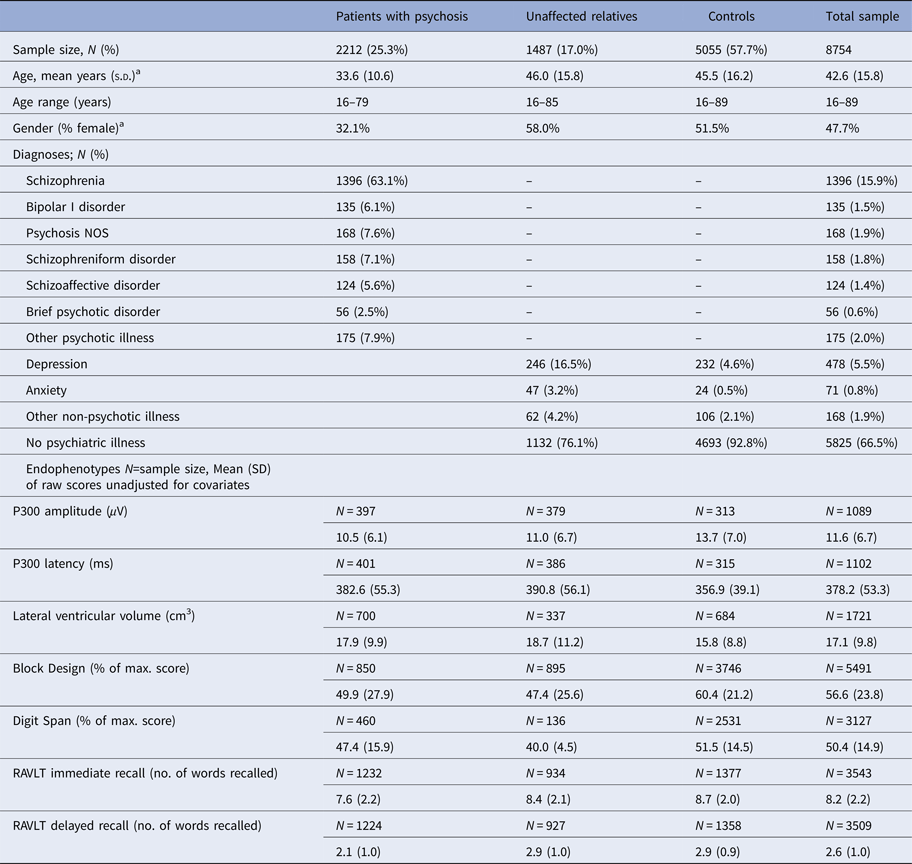
The total sample included 8754 participants: 2212 individuals with a diagnosis of a psychotic disorder (see Table 1 for a breakdown of diagnoses), 1487 of their unaffected first-degree relatives (with no personal history of psychosis), and 5055 healthy controls (with no personal or family history of psychosis). Relatives and controls were not excluded if they had a personal history of non-psychotic disorders (such as depression or anxiety), provided they were well and off psychotropic medication at the time of testing and for the preceding 12 months.
Sample characteristics (N = 8754)

s.d., standard deviation; NOS, not otherwise specified; RAVLT, Rey auditory verbal learning task.
a Missing data for age (717 subjects) and gender (6 subjects).
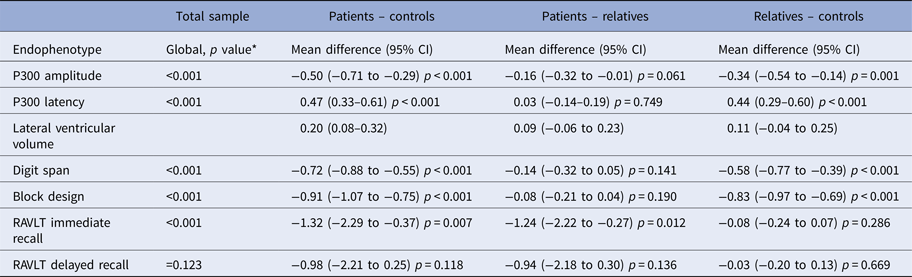
The group differences in endophenotype performance adjusted by covariates are reported in Table 2.
To confirm or rule out a DSM-IV (APA, 1994) diagnosis, all participants underwent a structured clinical interview with either the Comprehensive Assessment of Symptoms and History (Andreasen et al. Reference Andreasen, Flaum and Arndt1992), the Structured Clinical Interview for DSM Disorders (Spitzer et al. Reference Spitzer, Williams, Gibbon and First1992), the Schedule for Affective Disorders and Schizophrenia (Endicott & Spitzer, Reference Endicott and Spitzer1978) or the Schedule for Clinical Assessment in Neuropsychiatry, Version 2.0 (Wing et al. Reference Wing, Babor, Brugha, Burke, Cooper, Giel, Jablenski, Regier and Sartorius1990). Participants were excluded if they had a history of neurologic disease or a loss of consciousness due to a head injury.
Recruitment took place across 11 locations in Australia and Europe (Germany, Holland, Spain, and the UK) (see online Supplementary Table S1 in the supplement). Participants provided written informed consent, and the study was approved by the respective ethical committees at each of the 11 participating centres.
The main focus of this paper is an analysis of the associations between different endophenotype domains, which represents new and unpublished data. Some centres have previously published comparisons in endophenotype performance between groups (patients, relatives, and controls) (Weisbrod et al. Reference Weisbrod, Hill, Niethammer and Sauer1999; Hulshoff Pol et al. Reference Hulshoff Pol, Schnack, Bertens, van Haren, van der Tweel, Staal, Baaré and Kahn2002; McDonald et al. Reference McDonald, Grech, Toulopoulou, Schulze, Chapple, Sham, Walshe, Sharma, Sigmundsson, Chitnis and Murray2002; Steel et al. Reference Steel, Whalley, Miller, Best, Johnstone and Lawrie2002; Bramon et al. Reference Bramon, McDonald, Croft, Landau, Filbey, Gruzelier, Sham, Frangou and Murray2005; Johnstone et al. Reference Johnstone, Ebmeier, Miller, Owens and Lawrie2005; Hall et al. Reference Hall, Schulze, Rijsdijk, Picchioni, Ettinger, Bramon, Freedman, Murray and Sham2006b; Price et al. Reference Price, Michie, Johnston, Innes-Brown, Kent, Clissa and Jablensky2006; Schulze et al. Reference Schulze, MacCabe, Rabe-Hesketh, Crawford, Marshall, Zanelli, Walshe, Bramon, Murray and McDonald2006; González-Blanch et al. Reference González-Blanch, Crespo-Facorro, Álvarez-Jiménez, Rodríguez-Sánchez, Pelayo-Terán, Pérez-Iglesias and Vázquez-Barquero2007; Crespo-Facorro et al. Reference Crespo-Facorro, Roiz-Santiáñez, Pérez-Iglesias, Tordesillas-Gutiérrez, Mata, Rodríguez-Sánchez, de Lucas and Vázquez-Barquero2009; Waters et al. Reference Waters, Price, Dragović and Jablensky2009; Wobrock et al. Reference Wobrock, Gruber, Schneider-Axmann, Wölwer, Gaebel, Riesbeck, Maier, Klosterkötter, Schneider, Buchkremer, Möller, Schmitt, Bender, Schlösser and Falkai2009; Toulopoulou et al. Reference Toulopoulou, Goldberg, Mesa, Picchioni, Rijsdijk, Stahl, Cherny, Sham, Faraone, Tsuang, Weinberger, Seidman and Murray2010; Collip et al. Reference Collip, Habets, Marcelis, Gronenschild, Lataster, Lardinois, Nicolson and Myin-Germeys2013). Here we also present results of a mega-analysis of the combined multi-centre sample.
Neuropsychological assessments
The Wechsler Adult Intelligence Scale, revised version (Wechsler, Reference Wechsler1981) or third edition (Wechsler, Reference Wechsler1997), were administered to participants. Performance on two subtests was used for analyses: the combined forward and backward digit span (measuring attention and working memory) and block design (measuring spatial visualisation). The Rey Auditory Verbal Learning Test (Rey, Reference Rey1964), including both immediate and delayed recall (assessing short- and long-term verbal memory, respectively), was also administered. Higher scores on the cognitive tasks indicate better performance. Full methodology for each contributing site is reported elsewhere (Johnstone et al. Reference Johnstone, Ebmeier, Miller, Owens and Lawrie2005; Crespo-Facorro et al. Reference Crespo-Facorro, Roiz-Santiáñez, Pelayo-Terán, Rodríguez-Sánchez, Pérez-Iglesias, González-Blanch, Tordesillas-Gutiérrez, González-Mandly, Díez, Magnotta, Andreasen and Vázquez-Barquero2007; González-Blanch et al. Reference González-Blanch, Crespo-Facorro, Álvarez-Jiménez, Rodríguez-Sánchez, Pelayo-Terán, Pérez-Iglesias and Vázquez-Barquero2007; Waters et al. Reference Waters, Price, Dragović and Jablensky2009; Toulopoulou et al. Reference Toulopoulou, Goldberg, Mesa, Picchioni, Rijsdijk, Stahl, Cherny, Sham, Faraone, Tsuang, Weinberger, Seidman and Murray2010; Walters et al. Reference Walters, Corvin, Owen, Williams, Dragovic, Quinn, Judge, Smith, Norton, Giegling, Hartmann, Möller, Muglia, Moskvina, Dwyer, O'Donoghue, Morar, Cooper, Chandler, Jablensky, Gill, Kaladjieva, Morris, O'Donovan, Rujescu, Donohoe and Article2010; Korver et al. Reference Korver, Quee, Boos, Simons and de Haan2012).
EEG data collection and processing
Electrophysiological data were obtained from three sites (online Supplementary Table S1). EEG data acquisition and processing methods varied slightly between sites as summarised below. The full methods for each site are reported elsewhere (Weisbrod et al. Reference Weisbrod, Hill, Niethammer and Sauer1999; Bramon et al. Reference Bramon, McDonald, Croft, Landau, Filbey, Gruzelier, Sham, Frangou and Murray2005; Hall et al. Reference Hall, Schulze, Rijsdijk, Picchioni, Ettinger, Bramon, Freedman, Murray and Sham2006b; Price et al. Reference Price, Michie, Johnston, Innes-Brown, Kent, Clissa and Jablensky2006; Waters et al. Reference Waters, Price, Dragović and Jablensky2009).
In summary, EEG was collected from 17 to 20 electrodes placed according to the International 10/20 system (Jasper, Reference Jasper1958). The P300 event related potential was obtained using a standard two-tone frequency deviant auditory oddball paradigm, with standard (‘non target’) tones of 1000 Hz and rare (‘target’) tones of 1500 Hz. The number of tones presented varied from 150 to 800, the tones were 80 dB or 97 dB, lasted for 20–50 ms, and the inter-stimulus interval was between 1 and 2 s. The majority of participants (93.4%) were asked to press a button in response to ‘target’ stimuli, but a subset were asked to close their eyes and count ‘target’ stimuli in their head.
The data were continuously recorded in one of three ways: 500 Hz sampling rate and 0.03–120 Hz band pass filter; 200 Hz sampling rate and 0.05–30 Hz band pass filter; or 400 Hz sampling rate and 70 Hz low-pass filter. Linked earlobes or mastoids were used as reference and vertical, and in most cases also horizontal, electro-oculographs were recorded at each site and used to correct for eye-blink artefacts using regression based weighting coefficients (Semlitsch et al. Reference Semlitsch, Anderer, Schuster and Presslich1986). After additional manual checks, artefact-free epochs were included and baseline corrected before averaging. The averaged waveforms to correctly detected targets were then filtered using 0.03 or 0.05 Hz high-pass and 30 or 45 Hz low-pass filters. The peak amplitude and latency of the P300 were measured at electrode location PZ (parietal midline), within the range of 250–550 ms post-stimulus.
MRI data collection and processing
MRI data acquisition and image processing varied between sites; see previous publications and the supplementary materials for an outline of the methods used for each centre (Barta et al. Reference Barta, Dhingra, Royall and Schwartz1997; Frangou et al. Reference Frangou, Sharma, Sigmudsson, Barta, Pearlson and Murray1997; Hulshoff Pol et al. Reference Hulshoff Pol, Schnack, Bertens, van Haren, van der Tweel, Staal, Baaré and Kahn2002; McDonald et al. Reference McDonald, Grech, Toulopoulou, Schulze, Chapple, Sham, Walshe, Sharma, Sigmundsson, Chitnis and Murray2002, Reference McDonald, Marshall, Sham, Bullmore, Schulze, Chapple, Bramon, Filbey, Quraishi, Walshe and Murray2006; McIntosh et al. Reference McIntosh, Job, Moorhead, Harrison, Forrester, Lawrie and Johnstone2004, Reference McIntosh, Harrison, Forrester, Lawrie and Johnstone2005a, Reference McIntosh, Job, Moorhead, Harrison, Lawrie and Johnstoneb; Schulze et al. Reference Schulze, MacCabe, Rabe-Hesketh, Crawford, Marshall, Zanelli, Walshe, Bramon, Murray and McDonald2006; Crespo-Facorro et al. Reference Crespo-Facorro, Roiz-Santiáñez, Pérez-Iglesias, Tordesillas-Gutiérrez, Mata, Rodríguez-Sánchez, de Lucas and Vázquez-Barquero2009; Dutt et al. Reference Dutt, McDonald, Dempster, Prata, Shaikh, Williams, Schulze, Marshall, Walshe, Allin, Collier, Murray and Bramon2009; Mata et al. Reference Mata, Perez-Iglesias, Roiz-Santiañez, Tordesillas-Gutierrez, Gonzalez-Mandly, Vazquez-Barquero and Crespo-Facorro2009; Wobrock et al. Reference Wobrock, Gruber, Schneider-Axmann, Wölwer, Gaebel, Riesbeck, Maier, Klosterkötter, Schneider, Buchkremer, Möller, Schmitt, Bender, Schlösser and Falkai2009; Habets et al. Reference Habets, Marcelis, Gronenschild, Drukker and Van Os2011; Collip et al. Reference Collip, Habets, Marcelis, Gronenschild, Lataster, Lardinois, Nicolson and Myin-Germeys2013). Field strengths included 1, 1.5 or 3 Tesla. Lateral ventricular volumes were measured using automatic or semi-automatic region of interest analyses, and included the body, frontal, occipital, and temporal horns.
Statistical methods
Mega-analysis of group comparisons
Endophenotype measures were first standardised for each site separately using the mean and standard deviation within each site. Linear regression analyses for each measure were used to establish whether endophenotype performance differed according to group (patients, relatives, and controls). The outcome in each regression model was the endophenotype measure and the main predictor was group. These analyses were adjusted for age, gender, clinical group, study site and, where significant, group × site interactions.
Associations between endophenotypes
Linear regression models were used to investigate associations between each pair of endophenotypes. Potential effect modification by group membership was assessed by specifying in the statistical model a term for the interaction between the predictor of the endophenotype pair and group (patient, relative, control). Where we found evidence that the relationship between a pair of endophenotypes differed according to group, associations are reported separately for patients, relatives, and controls. Where there was no evidence of effect modification, the interaction term was dropped from the model, and associations are reported for the whole sample adjusted for group. These analyses were adjusted for age, gender, clinical group, and study site.
In all analyses, we accounted for correlations between individuals within families using robust standard errors. 63% of the participants had no other family member taking part, but the study also included 1056 families of 2–11 members each (85% of the families had only two members included in the sample). This family clustering violates the independence of observations assumption in linear regression. To account for this clustered structure in the dataset we created a new variable ‘family ID’ that was shared by all individuals in each family. Then we used the variance estimator with the robust cluster option in all the linear regression models. This allowed us to account for the within-family correlations and maintain correct type-1 error rates. This is a standard approach in family studies (Shaikh et al. Reference Shaikh, Hall, Schulze, Dutt, Li, Williams, Walshe, Constante, Broome, Picchioni, Toulopoulou, Collier, Stahl, Rijsdijk, Powell, Murray, Arranz and Bramon2013; Bramon et al. Reference Bramon, Pirinen, Strange, Lin, Freeman, Bellenguez, Su, Band, Pearson, Vukcevic, Langford, Deloukas, Hunt, Gray, Dronov, Potter, Tashakkori-Ghanbaria, Edkins, Bumpstead, Arranz, Bakker, Bender, Bruggeman, Cahn, Chandler, Collier, Crespo-Facorro, Dazzan, de Haan, Di Forti, Dragović, Giegling, Hall, Iyegbe, Jablensky, Kahn, Kalaydjieva, Kravariti, Lawrie, Linszen, Mata, McDonald, McIntosh, Myin-Germeys, Ophoff, Pariante, Paunio, Picchioni, Ripke, Rujescu, Sauer, Shaikh, Sussmann, Suvisaari, Tosato, Toulopoulou, Van Os, Walshe, Weisbrod, Whalley, Wiersma, Blackwell, Brown, Casas, Corvin, Duncanson, Jankowski, Markus, Mathew, Palmer, Plomin, Rautanen, Sawcer, Trembath, Wood, Barroso, Peltonen, Lewis, Murray, Donnelly, Powell and Spencer2014; Ranlund et al. Reference Ranlund, Nottage, Shaikh, Dutt, Constante, Walshe, Hall, Friston, Murray and Bramon2014).
We examined the distribution of residuals and plots of residuals v. fitted values for all models and were able to rule out departures from normality and heteroscedasticity. Lateral ventricular volume showed a positively skewed distribution and to account for this we used bootstrap methods for analyses where this is the outcome variable. Heteroscedasticity was not found to be a concern for ventricular volumes. P values are not presented for the models which used bootstrapping; instead, we examined the 95% bias-corrected confidence intervals to check for statistical significance at the 5% level (p = 0.05).
Although we tested seven endophenotypes, we expect measurements within domains to be correlated and thus a correction of p values by seven tests through Bonferroni or other methods was deemed too stringent for a hypothesis-driven study such as this (Rothman, Reference Rothman1990; Savitz & Olshan, Reference Savitz and Olshan1995; Perneger, Reference Perneger1998). We therefore corrected for associations between three domains (EEG, MRI, cognition), with a corrected significance threshold of 0.05/3 = 0.0167, that we rounded to the slightly more stringent cut-off of p < 0.01. Statistical analyses were conducted using STATA version 13.
Results
Sample characteristics
The sample characteristics are summarised in Table 1. Patients were on average 12.4 years younger than relatives (95% CI: 11.4–13.4; p < 0.001) and 11.9 years younger than controls (95% CI: 11.1–12.7; p < 0.001). There was no evidence of any age difference between relatives and controls. There was a lower proportion of females than males among patients than among relatives and controls (32.1%, 58.0%, and 51.5% respectively; global p < 0.001).
Group comparisons on endophenotype performance
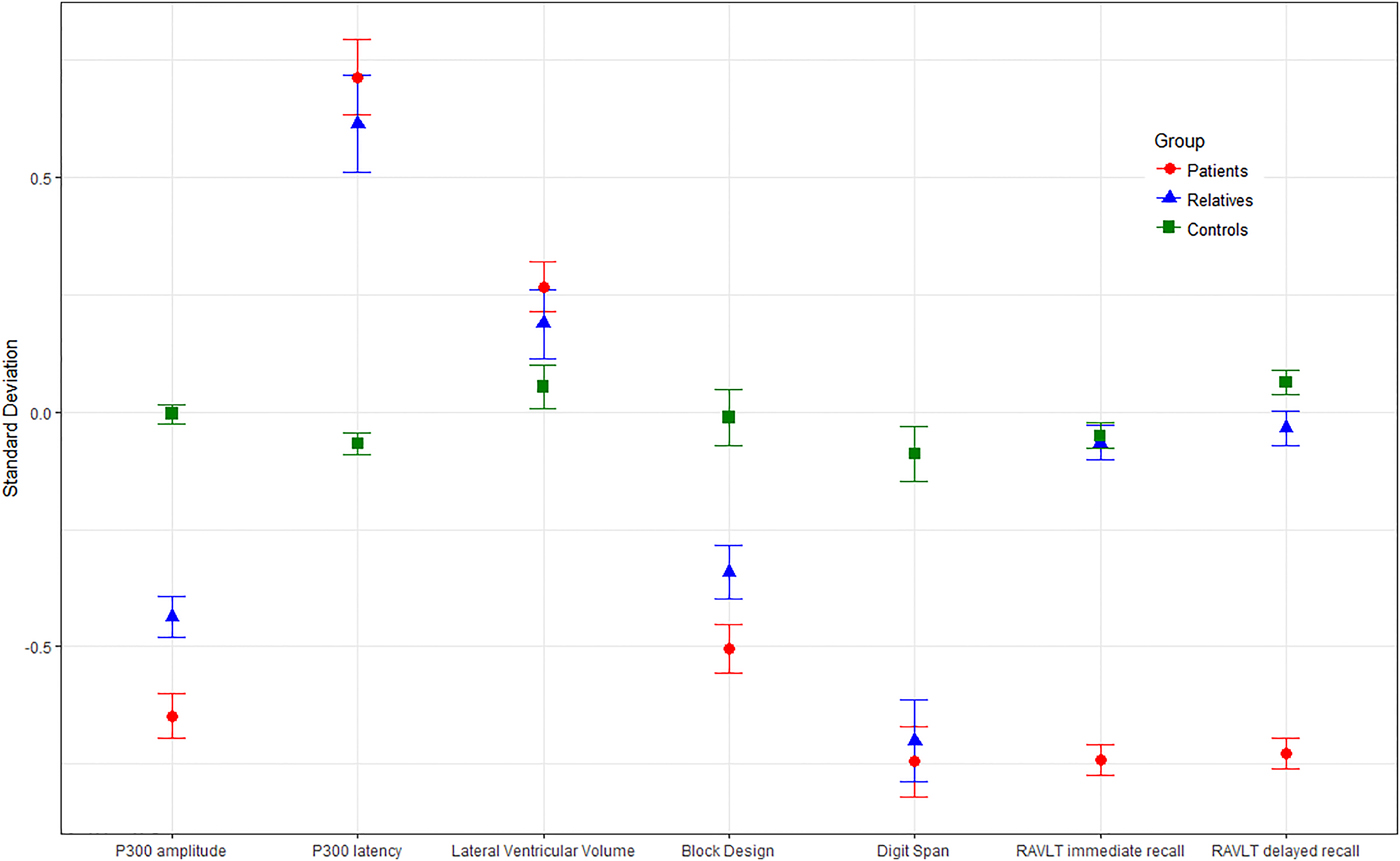
As shown in Fig. 1 and Table 2, differences between the three participant groups on the endophenotypes followed the expected pattern with performance improving from patients through to relatives and controls. We found evidence that patients’ scores differed significantly from those of controls with smaller P300 amplitudes, delayed P300 latency, larger lateral ventricular volumes and deficits in digit span, block design and RVLT immediate recall. When compared with controls, the unaffected relatives showed reduced P300 amplitude, delayed P300 latency and poorer performance in digit span and block design.
Estimated marginal means (adjusted for average age, gender, and study site) of standardised endophenotype scores by group (patients, relatives, and controls). Error bars represent standard errors of the means. RAVLT, Rey auditory verbal learning task.

Endophenptype performance comparison across clinical groups

Linear regression models investigating group differences on endophenotype performance. Endophenotype data were standardised for each site using the mean and standard deviation within each site. The main predictor was clinical group (patients, relatives, and controls). All models included age, gender, study site and, where significant, group × centre interactions. We used robust standard errors to account for correlations within families in all models.
*P value for the overall test of a group effect; Note that p values were not produced for the models that include lateral ventricular volume since we used bootstrapping, which is a percentile-based method; therefore we looked at the bias-corrected confidence intervals to check for significance.
RAVLT, Rey auditory verbal learning task; CI, confidence interval.
Associations between endophenotype pairs
Associations which do not differ according to clinical group
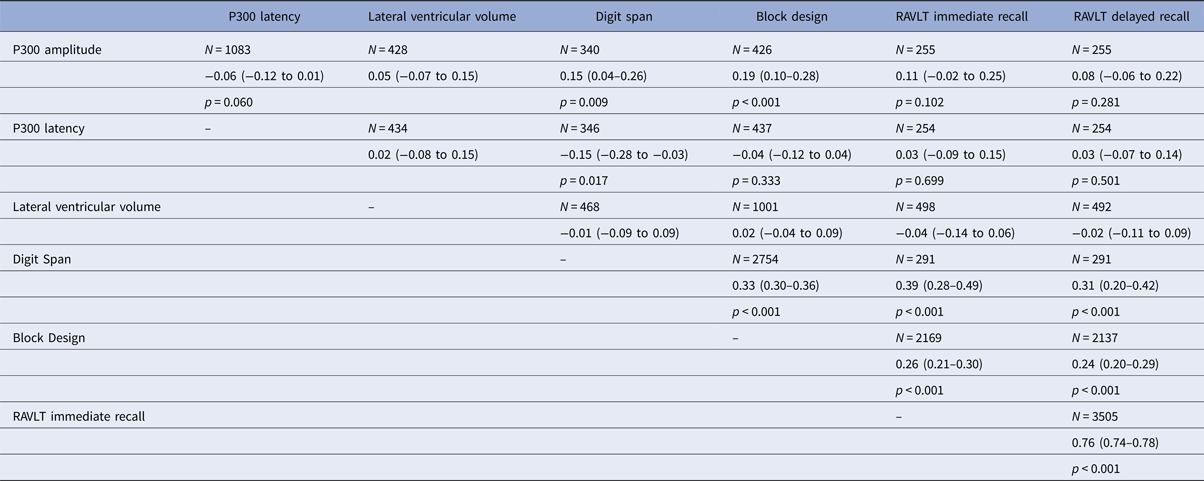
Associations between endophenotype pairs where there was no evidence of effect modification by group are reported in Table 3. There was no evidence of an association between the P300 amplitude and latency at the 1% level of statistical significance (coef. −0.06, 95% CI −0.12 to 0.01, p = 0.06). The P300 amplitude was positively associated with digit span (coef. 0.15, 95% CI 0.04–0.26, p = 0.009) and block design (coef. 0.19, 95% CI 0.10–0.28, p < 0.001) performances, but not with either of the RAVLT measures. The P300 latency showed weak evidence of a negative association with digit span (coef. −0.15, 95& CI −0.28 to −0.03, p = 0.017). Lateral ventricular volume showed no evidence of an association with any of the other measures. All cognitive pairings were significantly positively associated (all p < 0.001).
Adjusted associations between endophenotypes in the whole sample

RAVLT, Rey auditory verbal learning task.
Regression models using standardised scores, adjusted for age, gender, study site and group using robust standard errors to account for correlations within families and, where significant, group × by centre interactions.
Statistics reported are sample sizes, regression coefficients (95% confidence intervals), and p values. Note that p values were not produced for the models that include lateral ventricular volume since we used bootstrapping, which is a percentile-based method; therefore we looked at the bias-corrected confidence intervals to check for significance.
Associations which differ according to clinical group
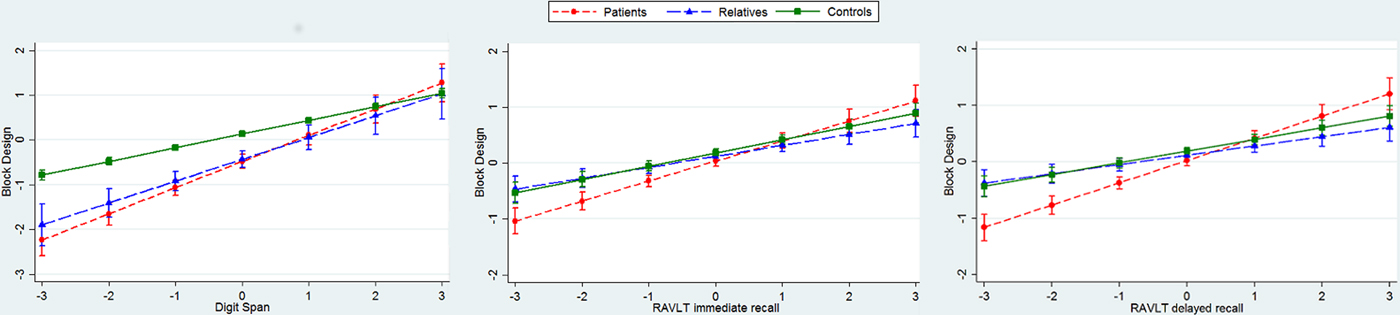
For three pairs of cognitive endophenotypes, we found evidence of an interaction with group. This indicates that the association between these endophenotype pairs differs between patients, relatives, and controls, as reported in Fig. 2 (and online Supplementary Table S3 in the Supplement). In all three cases, the relationship between endophenotype pairs was in the same direction for the three groups, differing only in magnitude.
Interactions between group (patient, relative, and control) and endophenotype pairs (standardised scores). Graphs are adjusted for covariates (age, gender, and study site), and include 95% confidence intervals. RAVLT, Rey auditory verbal learning task.

There was strong evidence that digit span and RAVLT immediate and delayed recall were positively associated with scores on the block design task in all three groups (patients, relatives, and controls). The magnitude of each association was greater among patients than controls (all p < 0.01), but there was no evidence that the strength of the relationship among relatives was different from that among controls (all p > 0.03). See online supplementary Table S3 for full results.
Discussion
This study examined the relationships between different multi-modal psychosis endophenotypes in a large multi-centre sample of patients, their unaffected first-degree relatives, and controls.
Our mega-analysis confirms that both patients and relatives showed reduced amplitudes and prolonged latencies of the P300, compared with controls, replicating past findings and providing further evidence that these are endophenotypes for psychosis (Turetsky et al. Reference Turetsky, Cannon and Gur2000; Bramon et al. Reference Bramon, McDonald, Croft, Landau, Filbey, Gruzelier, Sham, Frangou and Murray2005; Price et al. Reference Price, Michie, Johnston, Innes-Brown, Kent, Clissa and Jablensky2006; Schulze et al. Reference Schulze, Hall, Mcdonald, Marshall, Walshe, Murray and Bramon2008; Thaker, Reference Thaker2008; Bestelmeyer et al. Reference Bestelmeyer, Phillips, Crombie, Benson and Clair2009; Díez et al. Reference Díez, Suazo, Casado, Martín-Loeches, Molina, Díez, Suazo, Casado, Martín-Loeches and Molina2013). We found no evidence of association between the P300 amplitude and latency, indicating that these are independent measures. To examine whether variability on P300 amplitude and latency could potentially affect the correlations between these, we tested for heteroscedasticity between clinical groups. The standard deviations between the patient, relative, and control groups did not vary significantly and are thus unlikely to explain the lack of correlation between P300 amplitude and latency performance. In contrast to our results, Hall et al. (Hall et al. Reference Hall, Schulze, Bramon, Murray, Sham and Rijsdijk2006a) and Polich et al. (Polich, Reference Polich1992; Polich et al. Reference Polich, Alexander, Bauer, Kuperman, Morzorati, O'Connor, Porjesz, Rohrbaugh and Begleiter1997) found a negative correlation between the amplitude and latency. Notably however, these past studies included only small samples (up to 128 participants) compared with our study (N = 1083), and they did not take into account covariates such as age and gender that are known to influence both P300 parameters (Goodin et al. Reference Goodin, Squires, Henderson and Starr1978; Polich et al. Reference Polich, Howard and Starr1985; Conroy & Polich, Reference Conroy and Polich2007; Chen et al. Reference Chen, Lee, Yang, Landau, Chang, Chen, Lu, David and Bramon2013). Furthermore, in the studies by Polich et al. (Polich, Reference Polich1992; Polich et al. Reference Polich, Alexander, Bauer, Kuperman, Morzorati, O'Connor, Porjesz, Rohrbaugh and Begleiter1997) the amplitude – latency correlation was strongest over frontal electrodes, and not parietal as investigated in our current study. More recently, Hall et al. (Reference Hall, Levy, Salisbury, Haddad, Gallagher, Lohan, Cohen, Öngür, Smoller, Ongür and Smoller2014) found a negative correlation between the amplitude and latency in a sample of 274 patients with psychosis and controls after controlling for age and gender effects. Further research is thus needed to clarify the relationship between the P300 amplitude and latency. However, our findings in this large sample suggest that the measures are independent, indexing separate brain functions.
We found associations between the P300 amplitude and both digit span and block design, as in previous smaller studies (Souza et al. Reference Souza, Muir, Walker, Glabus, Roxborough, Sharp, Dunan and Blackwood1995; Polich et al. Reference Polich, Alexander, Bauer, Kuperman, Morzorati, O'Connor, Porjesz, Rohrbaugh and Begleiter1997; Fjell & Walhovd, Reference Fjell and Walhovd2001; Hermens et al. Reference Hermens, Ward, Hodge, Kaur, Naismith and Hickie2010; Kaur et al. Reference Kaur, Battisti, Ward, Ahmed, Hickie and Hermens2011; Dong et al. Reference Dong, Reder, Yao, Liu and Chen2015b). According to the context-updating theory (Heslenfeld, Reference Heslenfeld and Polich2003; Kujala & Naatanen, Reference Kujala, Naatanen and Polich2003), the P300 amplitude is an attention-driven, context-updating mechanism, which subsequently feeds into memory stores (Polich, Reference Polich2007, Reference Polich, Kappenman and Luck2011). Hence, one would expect the amplitude to be associated with cognitive tasks that require attention and working memory, such as digit span and block design (Näätänen, Reference Näätänen1990; Baddeley, Reference Baddeley1992; Ford, Reference Ford2014). The context-updating theory provides a possible explanation for the association between P300 amplitude and block design, since this task requires a constant update of the mental representation of the blocks, in order to complete the target pattern (Polich, Reference Polich2007, Reference Polich, Kappenman and Luck2011). The lack of evidence for associations between P300 amplitude and the RAVLT tests support the idea that the neurobiology of verbal memory is distinct from the attentional and working memory processes linked to the P300 amplitude (Polich, Reference Polich, Kappenman and Luck2011).
The P300 latency showed evidence of a trend-level association with digit span, and no evidence of an association with the other measures. Previous studies have provided conflicting results, with some reporting associations with attention and working memory (Polich et al. Reference Polich, Howard and Starr1983), while others have not (Fjell & Walhovd, Reference Fjell and Walhovd2001; Walhovd & Fjell, Reference Walhovd and Fjell2003; Dong et al. Reference Dong, Reder, Yao, Liu and Chen2015b). The P300 latency has been conceptualised as a measure of classification speed (Polich, Reference Polich, Kappenman and Luck2011; van Dinteren et al. Reference van Dinteren, Arns, Jongsma and Kessels2014). Investigating the relationship between behavioural reaction times (i.e. the speed of button press in the task) and the P300 latency, some have found associations (Bashore et al. Reference Bashore, Wylie, Ridderinkhof and Martinerie2014) while others have not (Ramchurn et al. Reference Ramchurn, de Fockert, Mason, Darling and Bunce2014). Furthermore, there is a substantial body of research showing that the P300 latency as well as reaction times increase (that is they slow down) with ageing in healthy participants (Polich, Reference Polich1996; Chen et al. Reference Chen, Lee, Yang, Landau, Chang, Chen, Lu, David and Bramon2013). Based on our findings we hypothesise that the P300 latency is a specific measure of processing speed at a basic neuronal level. In contrast, block design and the RAVLT task – while influenced by processing speed – reflect wider cognition including spatial abilities and verbal memory. The more complex elements to these tasks may therefore obscure effects of a simple processing speed, and hence explain the lack of association with P300 latency. The trend-level association with digit span performance – a task dependent on attention and short-term working memory – is in line with this interpretation too.
In terms of lateral ventricular volume, there was no evidence of a relationship with any other endophenotype investigated. Enlargement of cerebral ventricles remains the best replicated biological marker in schizophrenia and bipolar disorder, according to several meta-analyses (Kempton et al. Reference Kempton, Stahl, Williams and DeLisi2010; Olabi et al. Reference Olabi, Ellison-Wright, McIntosh, Wood, Bullmore and Lawrie2011; De Peri et al. Reference De Peri, Crescini, Deste, Fusar-Poli, Sacchetti and Vita2012; Fusar-Poli et al. Reference Fusar-Poli, Smieskova, Kempton, Ho, Andreasen and Borgwardt2013; Fraguas et al. Reference Fraguas, Díaz-Caneja, Pina-Camacho, Janssen and Arango2016; van Erp et al. Reference van Erp, Hibar, Rasmussen, Glahn, Pearlson, Andreassen, Agartz, Westlye, Haukvik, Dale, Melle, Hartberg, Gruber, Kraemer, Zilles, Donohoe, Kelly, McDonald, Morris, Cannon, Corvin, Machielsen, Koenders, de Haan, Veltman, Satterthwaite, Wolf, Gur, Gur, Potkin, Mathalon, Mueller, Preda, Macciardi, Ehrlich, Walton, Hass, Calhoun, Bockholt, Sponheim, Shoemaker, van Haren, Pol, Ophoff, Kahn, Roiz-Santiañez, Crespo-Facorro, Wang, Alpert, Jönsson, Dimitrova, Bois, Whalley, McIntosh, Lawrie, Hashimoto, Thompson and Turner2016; Huhtaniska et al. Reference Huhtaniska, Jääskeläinen, Hirvonen, Remes, Murray, Veijola, Isohanni and Miettunen2017; Moberget et al. Reference Moberget, Doan, Alnæs, Kaufmann, Córdova-Palomera, Lagerberg, Diedrichsen, Schwarz, Zink, Eisenacher, Kirsch, Jönsson, Fatouros-Bergman, Flyckt, Pergola, Quarto, Bertolino, Barch, Meyer-Lindenberg, Agartz, Andreassen and Westlye2017). Our hypothesis that ventricular volumes would correlate with other endophenotypes of a functional nature was not confirmed by our data. Of course for such analyses our sample size was modest ranging 428–1001 and lack of statistical power could be a potential reason. Keilp et al. (Keilp et al. Reference Keilp, Sweeney, Jacobsen, Solomon, St. Louis, Deck, Frances and Mann1988) found an association with verbal memory and others have found enlarged lateral ventricles to be associated with poorer motor speed (Antonova et al. Reference Antonova, Sharma, Morris and Kumari2004; Hartberg et al. Reference Hartberg, Sundet, Rimol, Haukvik, Lange, Nesvåg, Melle, Andreassen and Agartz2011; Dong et al. Reference Dong, Nabizadeh, Caunca, Cheung, Rundek, Elkind, DeCarli, Sacco, Stern and Wright2015a). A limitation of our study is the heterogeneity of the MRI methodology between study sites, which might have obscured any true associations. We conclude that ventricular volumes do not seem to exert a detectable influence on brain function in terms of cognition or cortical neurophysiology, however association studies of structural-functional biomarkers in larger samples are needed.
With regard to group comparisons, although patients showed enlarged lateral ventricles compared with controls, a very well supported finding (Wright et al. Reference Wright, Rabe-Hesketh, Woodruff, David, Murray and Bullmore2000; Steen et al. Reference Steen, Mull, McClure, Hamer and Lieberman2006; Cahn et al. Reference Cahn, Rais, Stigter, van Haren, Caspers, Hulshoff Pol, Xu, Schnack and Kahn2009; Kempton et al. Reference Kempton, Stahl, Williams and DeLisi2010), having adjusted by age and sex we observed no volume differences between relatives and controls. This is consistent with the latest meta-analysis of brain structure in relatives of patients with schizophrenia (Boos et al. Reference Boos, Aleman, Cahn, Hulshoff Pol and Kahn2007), and suggests that enlarged ventricles in patients are less heritable than previously thought. Instead, they might be related to illness progression, or to environmental effects or antipsychotic medication, as seen in both animal models of antipsychotic exposure (Dorph-Petersen et al. Reference Dorph-Petersen, Pierri, Perel, Sun, Sampson and Lewis2005; Konopaske et al. Reference Konopaske, Dorph-Petersen, Pierri, Wu, Sampson and Lewis2007), and in human studies (Ho et al. Reference Ho, Andreasen, Ziebell, Pierson and Magnotta2011; Fusar-Poli et al. Reference Fusar-Poli, Smieskova, Kempton, Ho, Andreasen and Borgwardt2013; Van Haren et al. Reference Van Haren, Cahn, Hulshoff Pol and Kahn2013).
For all cognitive measures, patients performed less well than controls, consistent with extensive literature (Ayres et al. Reference Ayres, Busatto, Menezes, Schaufelberger, Coutinho, Murray, McGuire, Rushe and Scazufca2007; Horan et al. Reference Horan, Braff, Nuechterlein, Sugar, Cadenhead, Calkins, Dobie, Freedman, Greenwood, Gur, Gur, Light, Mintz, Olincy, Radant, Schork, Seidman, Siever, Silverman, Stone, Swerdlow, Tsuang, Tsuang, Turetsky and Green2008; Bora et al. Reference Bora, Yücel and Pantelis2010, Reference Bora, Lin, Wood, Yung, McGorry and Pantelis2014; Fusar-Poli et al. Reference Fusar-Poli, Deste, Smieskova, Barlati, Yung, Howes, Stieglitz, Vita, McGuire and Borgwardt2012; Bora & Murray, Reference Bora and Murray2014; Fatouros-Bergman et al. Reference Fatouros-Bergman, Cervenka, Flyckt, Edman and Farde2014; Stone et al. Reference Stone, Mesholam-Gately, Braff, Calkins, Freedman, Green, Greenwood, Gur, Gur, Lazzeroni, Light, Nuechterlein, Olincy, Radant, Siever, Silverman, Sprock, Sugar, Swerdlow, Tsuang, Tsuang, Turetsky and Seidman2015). For the digit span and block design, there were also statistically significant differences between relatives and controls, suggesting a possible effect of increased genetic risk for psychosis. However, this was not seen for the immediate or delayed recall of the RAVLT task, where controls and relatives had similar performance. While some have reported verbal memory impairments in relatives of patients (Sitskoorn et al. Reference Sitskoorn, Aleman, Ebisch, Appels and Kahn2004; Wittorf et al. Reference Wittorf, Klingberg and Wiedemann2004; Massuda et al. Reference Massuda, Bücker, Czepielewski, Narvaez, Pedrini, Santos, Teixeira, Souza, Vasconcelos-Moreno, Vianna-Sulzbach, Goi, Belmonte-de-Abreu and Gama2013), other studies have not (Üçok et al. Reference Üçok, Direk, Koyuncu, Keskin-Ergen, Yüksel, Güler, Karadayi, Akturan and Devrim-Üçok2013; Kim et al. Reference Kim, Kim, Koo, Yun and Won2015a). These findings suggest that working memory and spatial visualisation might represent more promising endophenotypes for genetic research into psychosis than verbal memory.
The associations between pairs of cognitive measures were strong and in the expected directions, as per previous findings (Dickinson et al. Reference Dickinson, Iannone and Gold2002; Sullivan et al. Reference Sullivan, Kendler and Neale2003; Gladsjo et al. Reference Gladsjo, McAdams, Palmer, Moore, Jeste and Heaton2004; Sheffield et al. Reference Sheffield, Gold, Strauss, Carter, MacDonald, Ragland, Silverstein and Barch2014; Seidman et al. Reference Seidman, Hellemann, Nuechterlein, Greenwood, Braff, Cadenhead, Calkins, Freedman, Gur, Gur, Lazzeroni, Light, Olincy, Radant, Siever, Silverman, Sprock, Stone, Sugar, Swerdlow, Tsuang, Tsuang, Turetsky and Green2015). It is interesting to note that for some cognitive measures, the relationships interacted with group; however, the direction of the effect remained the same across patients, relatives, and controls. The interaction effects with group were found exclusively amongst the cognitive measures, and not in any of the other domains. This is possibly due to the larger sample sizes for the cognitive measures, yielding greater statistical power and enabling the detection of subtle interaction effects.
Both the lack of interaction effects for most associations investigated, and the gradient effects identified (where there was an interaction), are consistent with the notion that endophenotype impairments characterising psychosis represent a continuum that includes both relatives and the general population. Ultimately this continuum reflects the underlying variation in genetic liability of developing the disease (Johns & van Os, Reference Johns and van Os2001; Wiles et al. Reference Wiles, Zammit, Bebbington, Singleton, Meltzer and Lewis2006; Allardyce et al. Reference Allardyce, Suppes and van Os2007; Esterberg & Compton, Reference Esterberg and Compton2009; Ian et al. Reference Ian, Jenner and Cannon2010; DeRosse & Karlsgodt, Reference DeRosse and Karlsgodt2015).
This study has several limitations: Firstly, association analyses could only be done for those participants with data available for pairs of endophenotypes and this led to relatively smaller samples for some of the associations. Secondly, there was a mismatch in age and gender between patients and relatives. The group of relatives has older individuals and more females compared with the group of patients who are younger and include more males. This is a common occurrence in psychosis family studies because the onset of psychosis in typically in youth. Most of the families who participated in the study include unaffected parents (with greater participation of mothers) and their affected and unaffected offspring. Family studies in psychosis are less likely to recruit affected parents. Because of this, we recruited a control group with a wider age range than either the other groups and with a balanced gender distribution so as to improve the age and sex matching across the two key comparisons (controls v. patients, controls v. relatives). Furthermore, since age and sex remains a potential confounder, we included age and sex as co-variates in the models throughout the study. As shown in online Supplementary Table S4 in the supplement, there was no evidence of model instability based on the estimates and confidence interval width between the models with and without age and sex.
Another limitation of this study is that we were unable to account for potential moderators such as tobacco, other drug use and medication. Also, information about participants’ socioeconomic status was not available. These clinical and demographic variables could have a potentially important influence on how the three clinical groups perform on endophenotypes. However, the main analyses, which was to investigate associations between endophenotypes are all done within-individuals and are thus less likely to be influenced by exposure to drugs and medication. As for clinical variables such as depression, the sample included 5.5% of individuals with a history of depression. Depression did not constitute an exclusion criterion for our study because it is such a prevalent disorder that if excluded it would probably make our findings hard to generalize. We have re-analysed the group comparisons excluding all participants with a history of depression and the overall findings are unchanged.
A further potential limitation was the heterogeneity of methods between study sites; differences in cognitive test versions and variation on the EEG and MRI protocols all introduced greater variability into the data. All measures were standardised within centres to minimise this variability. Despite this challenge, it is precisely through this multi-centre effort that we were able to achieve a very large sample, the key strength of this study. As the Psychiatric Genomics Consortium's work shows, large international collaborations are essential in genetic studies of common diseases and traits (Sklar et al. Reference Sklar, Ripke, Scott and Andreassen2011; Lee et al. Reference Lee, Ripke, Neale, Faraone, Purcell, Perlis, Mowry, Thapar, Goddard, Witte, Absher, Agartz, Akil, Amin, Andreassen, Anjorin, Anney, Anttila, Arking, Asherson, Azevedo, Backlund, Badner, Bailey, Banaschewski, Barchas, Barnes, Barrett, Bass, Battaglia, Bauer, Bayés, Bellivier, Bergen, Berrettini, Betancur, Bettecken, Biederman, Binder, Black, Blackwood, Bloss, Boehnke, Boomsma, Breen, Breuer, Bruggeman, Cormican, Buccola, Buitelaar, Bunney, Buxbaum, Byerley, Byrne, Caesar, Cahn, Cantor, Casas, Chakravarti, Chambert, Choudhury, Cichon, Cloninger, Collier, Cook, Coon, Cormand, Corvin, Coryell, Craig, Craig, Crosbie, Cuccaro, Curtis, Czamara, Datta, Dawson, Day, De Geus, Degenhardt, Djurovic, Donohoe, Doyle, Duan, Dudbridge, Duketis, Ebstein, Edenberg, Elia, Ennis, Etain, Fanous, Farmer, Ferrier, Flickinger, Fombonne, Foroud, Frank, Franke, Fraser, Freedman, Freimer, Freitag, Friedl, Frisén, Gallagher, Gejman, Georgieva, Gershon, Geschwind, Giegling, Gill, Gordon, Gordon Smith, Green, Greenwood, Grice, Gross, Grozeva, Guan, Gurling, De Haan, Haines, Hakonarson, Joachim Hallmayer, Hamilton, Hamshere, Hansen, Hartmann, Hautzinger, Heath, Henders, Herms, Hickie, Hipolito, Hoefels, Holmans, Holsboer, Hoogendijk, Hottenga, Hultman, Hus, Ingason, Ising, Jamain, Jones, Jones, Jones, Jung-Ying, Kähler, Kahn, Kandaswamy, Keller, Kennedy, Kenny, Kent, Kim, Kirov, Klauck, Klei, Knowles, Kohli, Koller, Konte, Korszun, Krabbendam, Krasucki, Kuntsi, Kwan, Landén, Långström, Lathrop, Lawrence, Lawson, Leboyer, Ledbetter, Hyoun Lee, Lencz, Lesch, Levinson, Lewis, Li, Lichtenstein, Lieberman, Lin, Linszen, Liu, Lohoff, Loo, Lord, Lowe, Lucae, MacIntyre, Madden, Maestrini, Magnusson, Mahon, Maier, Malhotra, Mane, Martin, Martin, Mattheisen, Matthews, Mattingsdal, McCarroll, McGhee, McGough, McGrath, McGuffin, McInnis, McIntosh, McKinney, McLean, McMahon, McMahon, McQuillin, Medeiros, Medland, Meier, Melle, Meng, Meyer, Middeldorp, Middleton, Milanova, Miranda, Monaco, Montgomery, Moran, Moreno-De-Luca, Morken, Morris, Morrow, Moskvina, Muglia, Mühleisen, Muir, Müller-Myhsok, Murtha, Myers, Myin-Germeys, Neale, Nelson, Nievergelt, Nikolov, Nimgaonkar, Nolen, Nöthen, Nurnberger, Nwulia, Nyholt, O'Dushlaine, Oades, Ann Olincy, Guiomar Oliveira, Olsen, Ophoff, Osby, Owen, Palotie, Parr, Paterson, Pato, Pato, Penninx, Pergadia, Pericak-Vance, Pickard, Pimm, Piven, Posthuma, Potash, Poustka, Propping, Puri, Quested, Quinn, Ramos-Quiroga, Rasmussen, Raychaudhuri, Rehnström, Reif, Ribasés, Rice, Rietschel, Roeder, Roeyers, Rossin, Rothenberger, Rouleau, Ruderfer, Rujescu, Sanders, Sanders, Santangelo, Sargeant, Schachar, Schalling, Schatzberg, Scheftner, Schellenberg, Scherer, Schork, Schulze, Schumacher, Schwarz, Scolnick, Scott, Shi, Shilling, Shyn, Silverman, Slager, Smalley, Smit, Smith, Sonuga-Barke, St Clair, State, Steffens, Steinhausen, Strauss, Strohmaier, Stroup, Sutcliffe, Szatmari, Szelinger, Thirumalai, Thompson, Todorov, Tozzi, Treutlein, Uhr, van den Oord, Van Grootheest, Van Os, Vicente, Vieland, Vincent, Visscher, Walsh, Wassink, Watson, Weissman, Werge, Wienker, Wiersma, Wijsman, Willemsen, Williams, Willsey, Witt, Xu, Young, Yu, Zammit, Zandi, Zhang, Zitman, Zöllner, Devlin, Kelsoe, Sklar, Daly, O'Donovan, Craddock, Sullivan, Smoller, Kendler and Wray2013; Smoller et al. Reference Smoller, Kendler, Craddock, Lee, Neale, Nurnberger, Ripke, Santangelo, Sullivan, Purcell, Anney, Buitelaar, Fanous, Faraone, Hoogendijk, Lesch, Levinson, Perlis, Shaun, Rietschel, Riley, Sonuga-Barke, Schachar, Schulze, Thapar, Fanous, Neale, Neale, Nurnberger, Perlis, Bender, Cichon, Daly, Kelsoe, Lehner, Levinson, O'Donovan, Gejman, Sebat and Sklar2013; Ripke et al. Reference Ripke, Neale, Corvin and Walter2014). A further strength of this study is the use of regression models as opposed to the correlation approach frequently seen in the literature (Brewer et al. Reference Brewer, Campbell and Crano1970; Polich et al. Reference Polich, Howard and Starr1983, Reference Polich, Alexander, Bauer, Kuperman, Morzorati, O'Connor, Porjesz, Rohrbaugh and Begleiter1997; Breteler et al. Reference Breteler, van Amerongen, van Swieten, Claus, Grobbee, van Gijn, Hofman and van Harskamp1994; Brillinger, Reference Brillinger2001; Kim et al. Reference Kim, Kang, Youn, Kang, Kim and Kwon2003), which allowed us to account for somme important confounding factors, such as ageing effects. Not only did this approach reduce vulnerability to spurious correlations, but it allowed the examination of interesting interaction effects across groups.
In summary, this study has investigated the relationships between endophenotypes for psychosis, including measures of cognition, electrophysiology, and brain structure. We have shown that cognitive measures are associated with each other as expected, and we have provided support for the notion that the amplitude and latency of the P300 are independent endophenotypes. The P300 amplitude is an index of spatial visualisation and working memory, while the latency is hypothesised to be a correlate of basic speed of processing. Individuals with psychotic illnesses, their unaffected relatives, and healthy controls all have similar patterns of associations between all pairs of endophenotypes, endorsing the theory of a continuum of liability of developing psychosis across the population.
Co-authors who are members of the Psychosis Endophenotypes International Consortium (PEIC):
Maria J. Arranz1,2, Steven Bakker3, Stephan Bender4,5, Elvira Bramon6,2, David Collier7,2, Benedicto Crespo-Facorro8,9, Marta Di Forti2, Jeremy Hall10, Mei-Hua Hall11, Conrad Iyegbe2, Assen Jablensky12, René S. Kahn3, Luba Kalaydjieva13, Eugenia Kravariti2, Stephen M Lawrie10, Cathryn M. Lewis2, Kuang Lin2,14, Don H. Linszen15, Ignacio Mata16,9, Colm McDonald17, Andrew M McIntosh10,18, Robin M. Murray2, Roel A. Ophoff19, Marco Picchioni2, John Powell2, Dan Rujescu20,21, Timothea Toulopoulou2,22,23, Jim Van Os24,2, Muriel Walshe6,2, Matthias Weisbrod25,5, and Durk Wiersma26.
PEIC affiliations:
1Fundació de Docència i Recerca Mútua de Terrassa, Universitat de Barcelona, Catalonia, Spain.
2Institute of Psychiatry, Psychology and Neuroscience, King's College London, De Crespigny Park, London SE5 8AF, UK.
3University Medical Center Utrecht, Department of Psychiatry, Rudolf Magnus Institute of Neuroscience, The Netherlands.
4Child and Adolescent Psychiatry, University of Technology Dresden, Fetscherstrasse 74, 01307 Dresden, Germany.
5General Psychiatry, Vossstraße 4, 69115 Heidelberg, Germany.
6Division of Psychiatry & Institute of Cognitive Neuroscience, University College London, UK.
7Discovery Neuroscience Research, Lilly, UK.
8University Hospital Marqués de Valdecilla, IDIVAL, Department of Psychiatry, School of Medicine, University of Cantabria, Santander, Spain.
9CIBERSAM, Centro Investigación Biomédica en Red Salud Mental, Madrid, Spain.
10College of Biomedical and Life Sciences, Cardiff University, CF24 4HQ Cardiff, UK.
11Mclean Hospital, Harvard Medical School, Belmont MA, USA.
12Centre for Clinical Research in Neuropsychiatry, The University of Western Australia, Perth, Australia.
13Western Australian Institute for Medical Research and Centre for Medical Research, The University of Western Australia, Perth, Australia.
14Nuffield Department of Population Health, University of Oxford, Ocford, UK.
15Academic Medical Centre University of Amsterdam, Department of Psychiatry, Amsterdam The Netherlands.
16Fundacion Argibide, Pamplona, Spain.
17The Centre for Neuroimaging &Cognitive Genomics (NICOG) and NCBES Galway Neuroscience Centre, National University of Ireland Galway, Galway Ireland.
18Centre for Cognitive Ageing and Cognitive Epidemiology, University of Edinburgh, UK.
19UCLA Center for Neurobehavioral Genetics, 695 Charles E. Young Drive South, Los Angeles CA 90095, USA.
20University of Munich, Dept. of Psychiatry, Munich, Germany.
21University of Halle, Dept. of Psychiatry, Halle, Germany.
22Department of Psychology, Bilkent University, Main Campus, Bilkent, Ankara, Turkey.
23The State Key Laboratory of Brain and Cognitive Sciences and the Department of Psychology, The University of Hong Kong, Hong Kong, China.
24Maastricht University Medical Centre, South Limburg Mental Health Research and Teaching Network, EURON, Maastricht, The Netherlands.
25General Psychiatry and Psychotherapy, SRH Klinikum Karlsbad-Langensteinbach, Guttmannstrasse 1, 76307 Karlsbad, Germany.
26University Medical Center Groningen, Department of Psychiatry, University of Groningen, The Netherlands.
Co-authors who are members of the Genetic Risk and Outcome of Psychosis (GROUP) consortium:
Richard Bruggeman, MD, PhD, Department of Psychiatry, University Medical Center Groningen, University of Groningen; Wiepke Cahn, MD, PhD, Department of Psychiatry, Rudolf Magnus Institute of Neuroscience, University Medical Center Utrecht; Lieuwe de Haan, MD, PhD, Department of Psychiatry, Academic Medical Center, University of Amsterdam; René S. Kahn, MD, PhD, Department of Psychiatry, Rudolf Magnus Institute of Neuroscience, University Medical Center Utrecht, Utrecht, the Netherlands; Carin Meijer, PhD, Department of Psychiatry, Academic Medical Center, University of Amsterdam; Inez Myin-Germeys, PhD, South Limburg Mental Health Research and Teaching Network, EURON, Maastricht University Medical Center; Jim van Os, MD, PhD, South Limburg Mental Health Research and Teaching Network, EURON, Maastricht University Medical Center, Maastricht, the Netherlands, and King's College London, King's Health Partners, Department of Psychosis Studies, Institute of Psychiatry, London, England; and Agna Bartels, PhD, Department of Psychiatry, University Medical Center Groningen, University.
Supplementary material
The supplementary material for this article can be found at https://doi.org/10.1017/S0033291717002860.
Acknowledgements
We would like to thank all the patients, relatives, and controls who took part in this research, as well as the clinical staff who facilitated their involvement. This work was supported by the Medical Research Council (G0901310) and the Wellcome Trust (grants 085475/B/08/Z, 085475/Z/08/Z). We thank the UCL Computer Science Cluster team for their excellent support. This study was supported by the NIHR Biomedical Research Centre at University College London (mental health theme) and by the NIHR Biomedical Research Centre for Mental Health at the South London and Maudsley NHS Foundation Trust and Institute of Psychiatry Kings College London.
E. Bramon thanks the following funders: BMA Margaret Temple grants 2016 and 2006, MRC- Korean Health Industry Development Institute Partnering Award (MC_PC_16014), MRC New Investigator Award and a MRC Centenary Award (G0901310), National Institute of Health Research UK post-doctoral fellowship, the Psychiatry Research Trust, the Schizophrenia Research Fund, the Brain and Behaviour Research foundation's NARSAD Young Investigator Awards 2005, 2008, Wellcome Trust Research Training Fellowship.
Further support: The Brain and Behaviour Research foundation's (NARSAD's) Young Investigator Award (Grant 22604, awarded to C. Iyegbe). The BMA Margaret Temple grant 2016 to Johan Thygesen. European Research Council Marie Curie award to A Díez-Revuelta.
The infrastructure for the GROUP consortium is funded through the Geestkracht programme of the Dutch Health Research Council (ZON-MW, grant number 10-000-1001), and matching funds from participating pharmaceutical companies (Lundbeck, AstraZeneca, Eli Lilly, Janssen Cilag) and universities and mental health care organizations (Amsterdam: Academic Psychiatric Centre of the Academic Medical Center and the mental health institutions: GGZ Ingeest, Arkin, Dijk en Duin, GGZ Rivierduinen, Erasmus Medical Centre, GGZ Noord Holland Noord. Maastricht: Maastricht University Medical Centre and the mental health institutions: GGZ Eindhoven en de kempen, GGZ Breburg, GGZ Oost-Brabant, Vincent van Gogh voor Geestelijke Gezondheid, Mondriaan Zorggroep, Prins Clauscentrum Sittard, RIAGG Roermond, Universitair Centrum Sint-Jozef Kortenberg, CAPRI University of Antwerp, PC Ziekeren Sint-Truiden, PZ Sancta Maria Sint-Truiden, GGZ Overpelt, OPZ Rekem. Groningen: University Medical Center Groningen and the mental health institutions: Lentis, GGZ Friesland, GGZ Drenthe, Dimence, Mediant, GGNet Warnsveld, Yulius Dordrecht and Parnassia psycho-medical center (The Hague). Utrecht: University Medical Center Utrecht and the mental health institutions Altrecht, GGZ Centraal, Riagg Amersfoort and Delta.).
The sample from Spain was collected at the Hospital Universitario Marqués de Valdecilla, University of Cantabria, Santander, Spain, under the following grant support: Carlos III Health Institute PI020499, PI050427, PI060507, Plan Nacional de Drugs Research Grant 2005- Orden sco/3246/2004, SENY Fundació Research Grant CI 2005-0308007 and Fundación Marqués de Valdecilla API07/011. We wish to acknowledge Biobanco HUMV-IDIVAL for hosting and managing blood samples and IDIVAL Neuroimaging Unit for imaging acquirement and analysis.
All authors declare that they have no financial interests or potential conflicts of interest.